2016-17
newmichigan
COMPETE I INVEST I GROW
Building a newmichigan
Michigan
Turnaround
Plan
Launched
Budget
Balanced
Debt
Reduced
Road
Repairs
Funded
Taxes
Reformed
Unnecessary
Regulations
Eliminated
2009 2016
“Bottom
Ten”
State
“Top Ten”
State
2020
$
JOBS
Compete
•
•
•
•
•
•
•
•
Grow
•
•
•
•
•
•
•
•
Grow
•
•
•
•
•
•
•
•
Invest
•
•
•
•
•
•
•
•
Stabilize Finances
• Reduce state and
local debt
• Require a cost
estimate for all
proposed legislation
• Deliver more services
across jurisdictions
More Educated and
Skilled Workers
• Heighten awareness of the
need for more educated and
skilled talent at all levels
• Increase in- and out-of-state
enrollment at Michigan
colleges and universities
• Help parents and students
identify workforce needs
and college options
Strengthen Economic
Development Services
Establish MI as the Global
Center of Mobility:
• Retain and attract auto
assembly plants
• Attract a federal connected
vehicle research facility
• Convene global mobility
leaders
• Increase the production
of talent
• Market Michigan
Leverage Assets
• Align state and regional
leaders behind a
common economic
development strategy
• Fill gaps in Michigan’s
tool box to create
good jobs
• Establish a strong
business attraction
program
About Business Leaders for Michigan
Business Leaders for Michigan is a private, non-profit executive leadership
organization whose mission is to develop, advocate and support high-impact
strategies that will make Michigan a “Top Ten” state for jobs, personal income
and a healthy economy. The organization’s work is defined by the New Michigan
Plan, a holistic, fact-based strategy developed to achieve our “Top Ten” goal.
Serving as the state’s business roundtable, the organization is composed
exclusively of the chairpersons, chief executive officers, or most senior
executives of Michigan’s largest companies and universities. Our members
drive 32 percent of the state’s economy, provide nearly 375,000 direct jobs
in Michigan, generate over $1 trillion in annual revenue and serve nearly
one half of all Michigan public university students.
1 Building a New Michigan
2 The Goal of “Top Ten”
4 Michigan’s Economic Competitiveness at a Glance
8 The Winning Strategy – New Michigan Plan
10 Compete
12 Invest
14 Grow
18 What’s Been Accomplished
20 Business Leaders for Michigan Board of Directors
Copyright © 2016 Business Leaders For Michigan. All Rights Reserved.
1
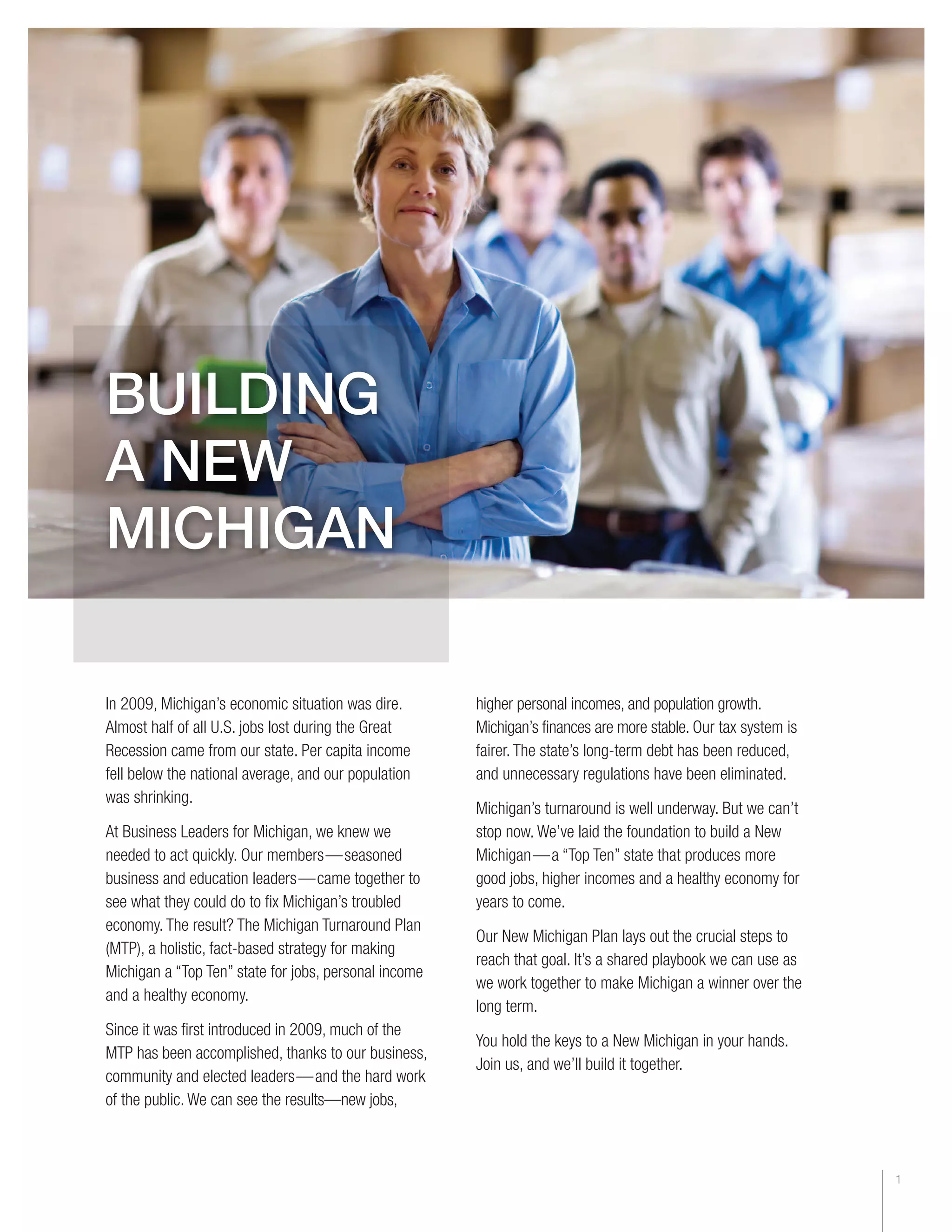
In 2009, Michigan’s economic situation was dire.
Almost half of all U.S. jobs lost during the Great
Recession came from our state. Per capita income
fell below the national average, and our population
was shrinking.
At Business Leaders for Michigan, we knew we
needed to act quickly. Our members—seasoned
business and education leaders—came together to
see what they could do to fix Michigan’s troubled
economy. The result? The Michigan Turnaround Plan
(MTP), a holistic, fact-based strategy for making
Michigan a “Top Ten” state for jobs, personal income
and a healthy economy.
Since it was first introduced in 2009, much of the
MTP has been accomplished, thanks to our business,
community and elected leaders—and the hard work
of the public. We can see the results—new jobs,
higher personal incomes, and population growth.
Michigan’s finances are more stable. Our tax system is
fairer. The state’s long-term debt has been reduced,
and unnecessary regulations have been eliminated.
Michigan’s turnaround is well underway. But we can’t
stop now. We’ve laid the foundation to build a New
Michigan—a “Top Ten” state that produces more
good jobs, higher incomes and a healthy economy for
years to come.
Our New Michigan Plan lays out the crucial steps to
reach that goal. It’s a shared playbook we can use as
we work together to make Michigan a winner over the
long term.
You hold the keys to a New Michigan in your hands.
Join us, and we’ll build it together.
Building
A new
michigAn
2016 New Michigan2
Why is it important to
be a“Top Ten”state?
Michigan needs to be more economically competitive
than other states and nations—that’s what builds jobs,
personal income, and a healthy economy. If Michigan were
performing like a “Top Ten” state today, there would be:
120,000more Michigan people working
$11,000more income per person
$13,000more GDP per person
How can boosting personal income by
$11,000 per person impact a family?
It’s enough to pay for:
• Tuition for one year at one of Michigan’s
15 public universities
• One-third the average cost of a new car
• Nearly three years of mortgage payments
on the average Michigan home
The goAl
of “Top Ten”
3
A Marathon, Not a Sprint
Michigan has made real economic progress. More
Michiganders are back to work and personal incomes
are rising. Our growth has been strong—so strong, in
fact, that we’ve led the nation on many measures of
change.
Although we’ve grown quickly, absolute levels for
employment, per capita income and per capita gross
domestic product (GDP) remain average or below those
of our competitors.
We have to remember that no state suffered more
during the last decade than Michigan did. So while our
progress on major indicators like jobs and income has
moved upward, we still rank in the bottom half of states.
Take a look:
How Do We Attract and
Keep More Jobs?
When a job provider is deciding where to locate or
expand, two factors are considered: (i) the costs
associated with a particular location, and (ii) the benefits
they get from being there. In a competitive world with
many choices, the places that offer the highest value for
a comparable cost will win the most investment.
So what does Michigan need to do to attract and keep
jobs? Reduce costs and add value. Here’s where we are
with that:
Competitive Costs
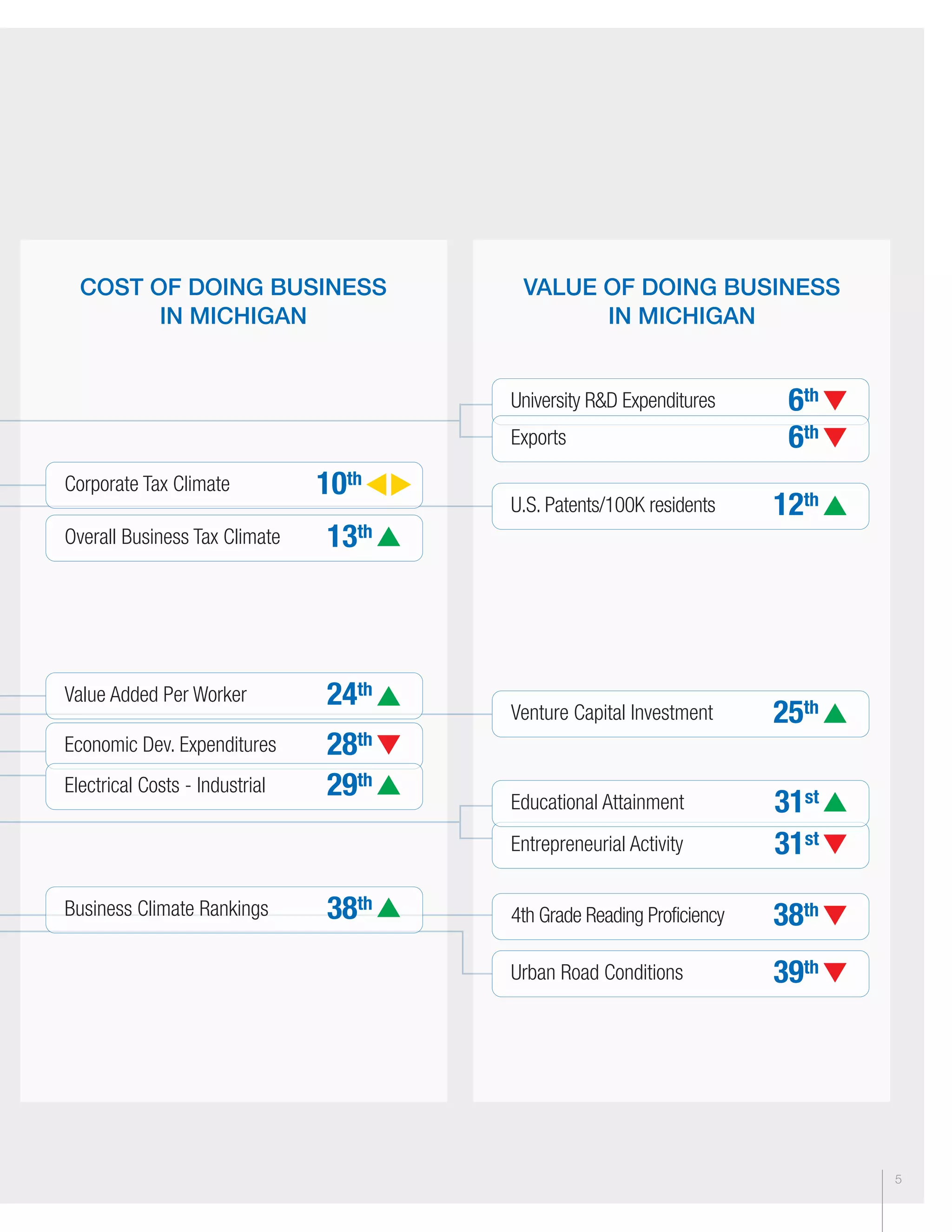
Michigan has done a great job of reducing costs. Our
corporate tax climate is 10th best in the U.S. and our
overall tax climate is 13th. But we still have some work to
do. For example, Michigan offers far fewer financial
incentives to locate here than competitor states and
invests less to attract and retain business (we’re 28th in
economic development spending).
More Value
This is where Michigan has the most work ahead. We’ve
made it more competitive for job providers to locate here,
but what will they get when they come? They want a
skilled, educated workforce, a well-connected
infrastructure and an innovation-rich environment.
Unfortunately, Michigan ranks: (i) 31st for educational
attainment, (ii) 38th for fourth-grade reading proficiency,
and (iii) 41st for enrollment in high school career and
technical education. Our infrastructure is among the
worst in the nation and we’re not translating our R & D
production into enough new high growth businesses.
So what do we do?
The New Michigan Plan identifies areas where we can
compete, invest and grow in order to transform Michigan
into a thriving state.
Employment 18th 29th
(November 2015)
Per Capita
Personal Income
10th 33rd
(Q3 2014)
Per Capita GDP 3rd 34th
(Q2 2015)
GROWTH
rank in the U.S.
(2013-2014)
U.S. RANK
currently
1=best, 50=worst
Source: Bureau of Labor Statistics and Bureau of Economic Analysis. Most recent data available.
2016 New Michigan4
michigAn’s
economic performAnce
1 –
5 –
10–
15 –
20 –
25 –
30 –
35 –
40 –
45 –
50 –
10thPopulation
46thAnnual Unemployment Rate
33rdPer Capita Personal Income (Q3 2015)
29thMonthly Unemployment Rate
(November 2015)
To be a “Top Ten” state for jobs, personal
income and a healthy economy, Michigan
needs to be economically more competitive
with other states and nations. BLM defines
“competitive” as having a cost/value balance
as good or better than “Top Ten” states.
The chart at right highlights Michigan’s
progress as measured by key economic
indicators. The scale shows a 50-state
ranking from best (1) to worst (50), to
indicate where Michigan is performing well
and where we need to improve.
Current “Top Ten” states for jobs,
income, GDP and population:
• Alaska • North Dakota
• Iowa • Pennsylvania
• Massachusetts • Texas
• Nebraska • Washington
• New York • Wyoming
NationalRank
(2014rank,exceptwherenoted)
1=best,50=worst
Michigan’s
Economic
Competitiveness
at a Glance
34thPer Capita GDP(Q2 2015)
5
cosT of doing Business
in michigAn
VAlue of doing Business
in michigAn
10thCorporate Tax Climate
13thOverall Business Tax Climate
24thValue Added Per Worker
28thEconomic Dev. Expenditures
29thElectrical Costs - Industrial
38thBusiness Climate Rankings
6thUniversity R&D Expenditures
6thExports
12thU.S. Patents/100K residents
31stEntrepreneurial Activity
25thVenture Capital Investment
31stEducational Attainment
38th4th Grade Reading Proficiency
39thUrban Road Conditions
2016 New Michigan6
michigAn’s Business cosTs
hAVe improVed BuT JoB
creATion And Business
ATTrAcTion Tools Are lAcKing
Michigan’s corporate tax climate has improved to
10th best in the nation from second worst. While
our business climate has improved, Michigan offers
fewer incentives for business to locate here.
For example, Michigan is one of only four states
with a corporate income tax that fails to offer
tax credits for job creation and ranks 28th in
economic development spending, which is less
than half of the “Top Ten” average.
hArnessing michigAn’s
innoVATiVe sTrengThs To
grow JoBs in KeY AreAs
of opporTuniTY
Michigan remains a “Top Ten” state for R&D,
with a ranking of sixth for university R&D, and
is highly innovative, ranking 12th in the U.S.
for the number of patents awarded.
Michigan can use this expertise to meet growing
global demand in areas where it has unique
strengths. The New Michigan Plan highlights
six areas with the highest potential to create
thousands of good paying jobs over the next
10 years.
Corporate Tax Climate
2011 2015
Michigan
28th
in economic
development spending
Opportunities and Challenges Ahead
7
deBT, unfunded liABiliTies
ThreATen fiscAl sTABiliTY
Michigan governments’ long term liabilities risk our fiscal
future. State unfunded liabilities, such as retiree pensions
and other post-employment benefits (OPEB), limit our
ability to invest in education, economic development or
infrastructure. Ranked 23rd highest in 2014, Michigan’s
unfunded pension liabilities are $3,311 per capita while
OPEB liabilities are $2,384 per capita (10th highest).
Local government debt creates a similar challenge with
4.4 percent of spending going to service debt. Michigan’s high
number of local units of government and lack of sustained
service sharing and collaboration exacerbate fiscal pressures.
Each and every Michigan resident bears $5,695 in unfunded state liabilities (2014 data).
noT enough sKilled TAlenT
Michigan needs more workers with an education beyond
high school. Michigan ranks 31st in educational
attainment. Fewer than one in four public high school
students is enrolled in a career or technical education
course. The state ranks 27th in the number of critical
skills degrees and certificates awarded.
Demographics are also working against us.
Michigan is the 10th oldest state with a median
age of 39.6, and we’re not attracting the talent we need
to replace people who are aging out of the workforce.
We currently rank 28th for talent migration and
46th for out-of-state college/university enrollment.
10th
of the 50
states for an
educated workforce
31st
Michigan has the
oldest
population in
the nation
2016 New Michigan8
Change is on the horizon. Our state’s economic
future is waiting, if we can work together to
make it happen.
The New Michigan Plan offers a compelling road
map for growth. It’s not enough to dream it, we
have to start doing it!
Our state has tremendous assets—geographic,
human and structural—just waiting to be
properly leveraged. In this plan, we’ll identify
coordinated strategies and clear opportunities
for making Michigan a winner.
The winning
sTrATegY
9
COMPETE
• Create an economic environment that is better and stronger than
competitor states
• Strengthen Michigan’s fiscal stability and reduce future financial uncertainty
• Create a regulatory environment that’s more responsive than competitor states
• Provide better local government services than competitor states
• Support federal policy changes that enhance Michigan’s competitiveness
INVEST
• Ensure every Michigan child is ready to learn and advance
• Increase the number of workers with education and training beyond high school
• Improve the connection between education and careers
• Connect Michigan to the world through strong infrastructure
GROW
• Grow a New Michigan economy by leveraging assets with the greatest
potential to meet future global economic needs
• Provide stronger economic development services than competitor states
• Grow Detroit into a thriving city by attracting new investment, improving city
services and repopulating neighborhoods
• Make Michigan an aspirational destination by being a welcoming place to all
• Reclaim Michigan’s reputation as a center for innovation
newmichigan
The plan for Building a
2016 New Michigan10
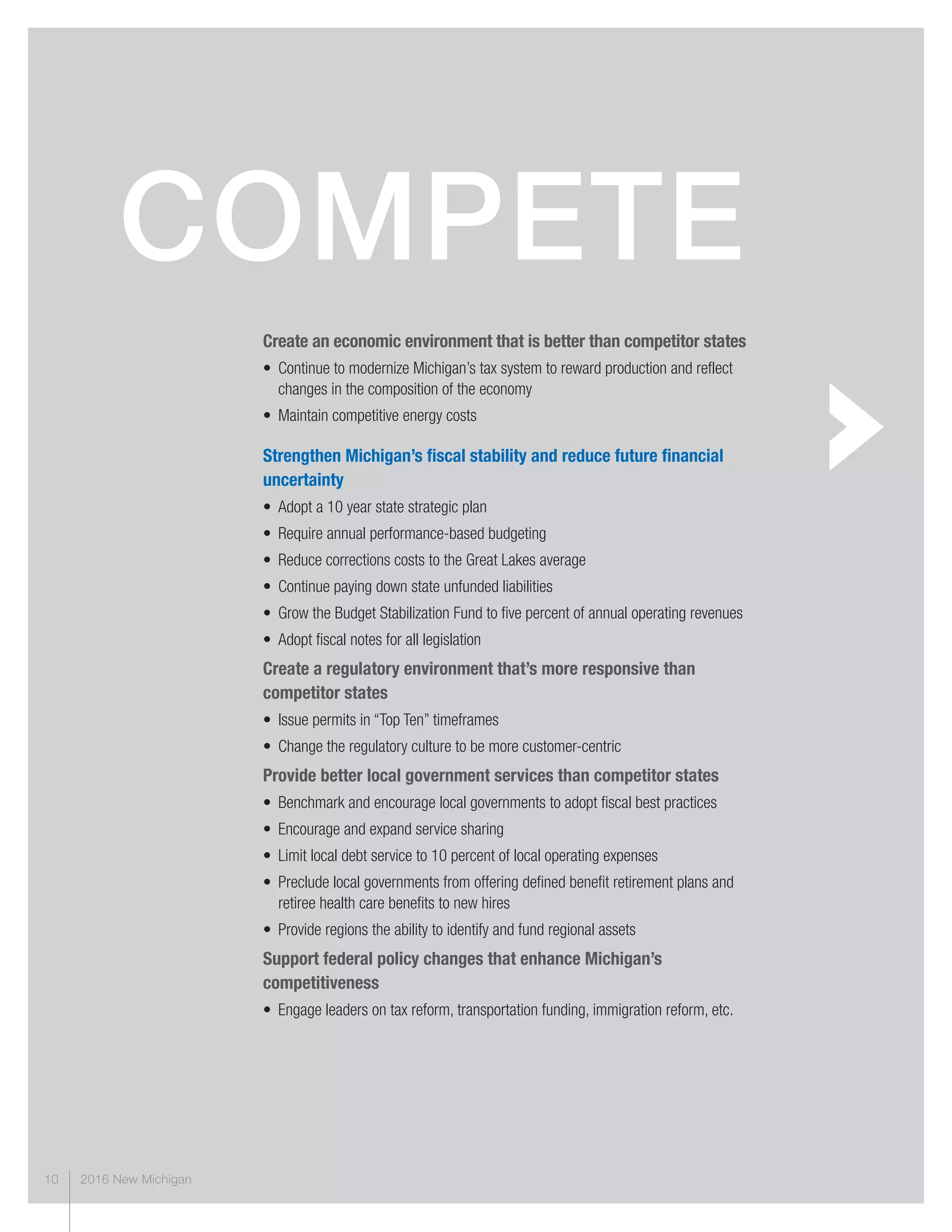
Create an economic environment that is better than competitor states
• Continue to modernize Michigan’s tax system to reward production and reflect
changes in the composition of the economy
• Maintain competitive energy costs
Strengthen Michigan’s fiscal stability and reduce future financial
uncertainty
• Adopt a 10 year state strategic plan
• Require annual performance-based budgeting
• Reduce corrections costs to the Great Lakes average
• Continue paying down state unfunded liabilities
• Grow the Budget Stabilization Fund to five percent of annual operating revenues
• Adopt fiscal notes for all legislation
Create a regulatory environment that’s more responsive than
competitor states
• Issue permits in “Top Ten” timeframes
• Change the regulatory culture to be more customer-centric
Provide better local government services than competitor states
• Benchmark and encourage local governments to adopt fiscal best practices
• Encourage and expand service sharing
• Limit local debt service to 10 percent of local operating expenses
• Preclude local governments from offering defined benefit retirement plans and
retiree health care benefits to new hires
• Provide regions the ability to identify and fund regional assets
Support federal policy changes that enhance Michigan’s
competitiveness
• Engage leaders on tax reform, transportation funding, immigration reform, etc.
compeTe
11
Priorities: Strengthen
the state’s fiscal stability
Strategies:
Adopt additional best practices such as:
• Reduce state and local debt
• Require a cost estimate for all proposed legislation
• Deliver more services across jurisdictions
Where Michigan Ranks:
• 28th Level of unfunded pension and other postemployment
benefit liability (UAAL) divided by population
• 41st State government unfunded other postemployment
benefit non-pension liability (OPEB) divided by population
• 32nd Local government interest payments servicing debt
Why It’s Important:
Fiscal stability provides businesses and individuals the opportunity to
plan for their future without the fear of unexpected tax increases or
service reductions
best
corporate
tax climate
10th
best
overall
business tax
climate
13th
Michigan’s latest
credit rating by
Moody's
Aa1
level of
unfunded liability
(pension and post
employment benefit)
28th
inVesT
2016 New Michigan12
Ensure every Michigan child is ready to learn and advance
• Reward schools, teachers and leaders performing at a high level
• Require high school graduation to be based on meeting college or
career readiness benchmarks
• Encourage and expand service sharing to increase classroom funding
Increase the number of workers with education and training
beyond high school
• Increase in- and out-of-state college enrollment to the national average
without reducing in-state access
• Attract educated workers and skilled immigrants to Michigan
• Expand just-in-time, customized worker training programs
• Achieve “Top Ten” community college and university affordability by
increasing performance-based funding
Improve the connection between education and careers
• Increase opportunities for high school and college students to
participate in school-to-work transition experiences
• Require community colleges and universities to track graduate
placement results
• Provide students with the information they need to make good career
choices and select the best education and training pathways
Connect Michigan to the world through strong infrastructure
• Expand the capacity of the transportation system to allow Michigan to
grow
• Develop critical rail connections
• Strengthen Michigan’s logistics infrastructure
13
career &
college ready
22%
of high
school students
are enrolled in
a career or
tech class
less than
25%
highest
average debt
per college
graduate
9th
Priorities: Produce more
educated & skilled talent
Strategies:
• Raise public awareness of the need for more educated and skilled
talent at all levels
• Increase in- and out-of-state enrollment at Michigan colleges and
universities
• Create a website that helps parents and students identify workforce
needs and options for education and training
Where Michigan Ranks:
• 41st The average number of career-oriented and/or technical
education classes in which public high school students are
enrolled
• 31st Share of residents aged 25 to 64 with an associate degree
or higher
• 46th Percent of entering first-year undergraduates from out of
state
• 35th Percent of students tested that met or exceeded the ACT
College Readiness Benchmarks in all four subjects (English,
reading, mathematics, science)
Why It’s Important:
As an education beyond high school is in growing demand and is
critical to earning a higher income, the state must prioritize
investments in colleges and universities to increase access and
affordability
grow
2016 New Michigan14
Grow a New Michigan economy by leveraging assets with the
greatest potential to meet future global economic needs (see p.16)
• Engineering talent into a Global Engineering Village
• Geographic location into a Gateway to the Midwest
• Higher education system into a Higher Education Marketplace
• Natural resources into a Natural Resources Economy
• Automotive industry into a Global Center of Mobility
• Health and medical expertise into a Life Sciences Hub
Provide stronger economic development services than competitor states
• Offer competitive economic development incentives
• Act cohesively to attract and grow more good jobs
• Ensure greater consistency of economic development activities and programs
Grow Detroit into a thriving city by attracting new investment,
improving city services and repopulating neighborhoods
Make Michigan an aspirational destination by being a
welcoming place to all
• Attract skilled immigrants and facilitate their relocation transitions
• Expand cultural exchange programs
• Prohibit discrimination based on sexual orientation for employment just like
we do for race, color, religion, sex, national origin or disability
Reclaim Michigan’s reputation as a center for innovation
• Become a “Top Ten” state for the availability of venture capital
• Become a “Top Ten” state for entrepreneurship and innovation
• Remove legal and regulatory barriers to entrepreneurship and innovation
• Showcase Michigan’s innovation at entry portals to the state
• Become a convening center for conferences, competitions and research
15
Strengthen the
state’s economic
development efforts
Strategies:
• Align state and regional leaders behind a common
economic development strategy
• Fill gaps in Michigan’s tool box to create good jobs
• Establish a strong business attraction program
Where Michigan Ranks:
• 28th State and local government expenditures on
economic development programs and
incentives (2014 dollars), divided by population
• 38th Average of three major business climate
indices that account for several factors such as
business costs, business leaders’ perceptions,
regulatory climate, quality of life, etc.
Why It’s Important:
Michigan cannot become a “Top Ten” state without both
growing Michigan-based businesses and attracting new
ones
Priorities:
Leverage
Michigan’s
unique assets
Strategies:
Establish Michigan as the Global Center of
Mobility by:
• Retaining and attracting auto assembly plants
• Attracting a federal connected vehicle research facility
• Convening global mobility leaders
• Increasing the production of talent
• Marketing Michigan
Where Michigan Ranks:
• 3rd GDP per capita from mobility industries
• 3rd Employment per capita in mobility industries
• 22nd Wage growth in mobility industries
Why It’s Important:
The automotive industry represents the single largest
potential growth opportunity for the state
2016 New Michigan16
ENGINEERING
TALENT
Global
Engineering
Village
Advanced Analytics, and Data
Grow data-enabled
business models for
engineering services
in operations
management,
customer service and
applications
—
Extend presence in
mobility related
hardware and software
—
Attract adjacent
industries that require
industrial or mechanical
engineering
Potentialwaystoleveragetheassets:PrioritiesOpportunities:Assets:
GEOGRAPHIC
LOCATION
Gateway
to the
Midwest
Improve rail and road
infrastructure
—
Expand logistics and
warehousing
—
Develop VantagePort
(Detroit metro
Aerotropolis)
HIGHER EDUCATION
SYSTEM
Higher
Education
Marketplace
Increase access and
affordability
—
Increase job
placement and
recruiting within
the state
—
Improve higher
education outcomes
—
Drive
commercialization
impact of innovation
NATURAL
RESOURCES
Natural
Resources
Economy
Increase agriculture
production, processing
and organic farming
—
Become a leader
for innovation of
sustainable natural
resources
—
Grow tourism
—
Grow logging and
downstream industries
AUTOMOTIVE
INDUSTRY
Global
Center of
Mobility
Establish global
leadership in
autonomous vehicles
—
Establish leadership
in electrical vehicle
development
—
Attract connected vehicle
platform and application
enterprises
—
Establish global leadership
in lightweight materials
—
Develop an eco-system
for connected and multi-
modal transportation
HEALTH & MEDICAL
EXPERTISE
Life
Sciences
Hub
Become a leader in
digital life science
solutions
—
Increase
manufacturing of
medical devices and
equipment
—
Become a center
of excellence for
advanced bioscience
studies
A 10-year plan to leverage distinctive Michigan assets
Strong base of entrepreneurism, innovation and manufacturing
1
Compete
2
Invest
3
Grow
Growing a New Michigan Economy
newmichigan
Encourage students
to pursue STEM
education
—
Attract and retain
engineering talent
—
Brand and market
Michigan as an
engineering hub
Increase investments
in transportation
infrastructure
—
Attract niche supply
chain businesses
—
Fully grow
VantagePort into
a multi-use
development
Grow in- and out-of-
state enrollments
—
Grow public and
private sector
university-based
research
—
Grow innovation
pipeline coming from
universities
—
Grow spin-outs of
start-ups and high
growth companies
Improve public
infrastructure that
supports the natural
resources economy
—
Support the growth of
sustainable agriculture
production
—
Expand tourism and
outdoor recreation
services and amenities
—
Ensure dedicated
leadership for
advancing the priorities
Secure the assembly
plant base
—
Convene a global
mobility conference
—
Attract a federal
connected vehicle
research facility
—
Identify talent needs
—
Develop a marketing
campaign
Action plan to be
released in 2016
17
The New Michigan Plan features an aggressive strategy for growing the state’s economy.
It identifies opportunities based on Michigan’s unique assets with the highest potential to create
thousands of good paying jobs. The framework for a New Michigan economy highlights six areas. If
leveraged properly, each offers great promise for success. Together, they have the potential to make
our state into a vital economic powerhouse
Global Engineering Village
Global demand is increasing for high-tech manufacturing industries such as aerospace, medical devices and
precision instruments.These and other industries rely heavily on quality engineers, who are in abundance in
Michigan. Encouraging the automotive industry to adopt cutting-edge technology, fostering innovation in
advanced manufacturing industries, and embracing start-ups can help Michigan capitalize on this opportunity.
Gateway to the Midwest
The movement of goods and people is crucial to economic growth and success. Michigan’s geographic
location enables it to be accessible by road, rail, sea or air. Michigan can build on this advantage by
advancing as an integrated, multi-modal hub for trade. Specifically, Michigan has the capacity to
encourage the development of aviation-dependent businesses and international border crossings.
Higher Education Marketplace
Economic growth is being driven by gains in productivity, and gains in productivity are driven by talent and
talent-generated innovation.As a primary source of both talent and innovation, our higher education system
represents a major opportunity to grow Michigan’s economy. In addition, higher education institutions are
drivers of economic growth as they bring students, employers, and additional spending to local economies.
Natural Resources Economy
Today, the demand for natural resources is more pressing than ever. The development of technologies
that maximize the production of scarce resources in a sustainable way is crucial for succeeding in
natural resources markets. Michigan also has competitive advantages in agricultural innovation and can
leverage its natural beauty to increase its tourism industry.
Global Center of Mobility
Michigan has been a center for automotive innovation for as long as cars have existed. The state has a
unique opportunity to continue to expand with the automotive industry by transforming the existing
automotive cluster to a hub of a diverse set of industries that meet the demands of global mobility.
Michigan can increase its focus on multi-modal sustainable transportation.
Life Sciences Hub
The demand for a higher quality of life persists among developing and developed nations alike. The
search for life sciences solutions is causing health care expenditure growth to outpace GDP growth in
the developed world. Michigan produces a large number of bio-science degrees. This asset, combined
with an array of high-end medical research facilities and expertise in bio-pharmaceutical products and
medical devices, gives Michigan unique advantages to advance as a Life Sciences Hub.
Growing Michigan’s Economy
2016 New Michigan18
Since 2009, significant actions have been
taken or are underway that align with the Plan.
While the list on the right is impressive, there’s
a stark difference between turning the state
around and being a “Top Ten” state—
especially when being “Top Ten” could mean
up to 120,000 more jobs and higher incomes
for every Michigander.
If we want to be a vibrant state with more jobs
and businesses, Michigan needs to be able to
better compete. The New Michigan Plan lays
out the strategy for propelling our state forward.
whAT’s Been
Accomplished
COMPETE
• Improved revenue and expenditure forecasts
• Reformed Unemployment Insurance system
• Produced multi-year financial and budget plans
• Produced citizen friendly balance sheet
• Reduced state debt by one third
• Required state agencies to implement spending plans with a strategic mission, vision and goals
• Improved state bond rating
• Aligned public employee health care premiums with the private sector
• Removed statutory barriers and provided incentives to encourage local service sharing
• Passed public school employee retirement reforms estimated to reduce unfunded pension
and health care liability by $16 billion
• Passed emergency manager law to help locals “fix the basics”
• Improved Michigan’s corporate tax climate by replacing the Michigan Business Tax (MBT) with a
flat corporate income tax
• Improved Michigan’s regulatory climate by rescinding over 2,000 obsolete and redundant
rules and requiring a cost benefit analysis for all proposed rules
• Approved referendum to phase out personal property tax
• Conducted annual benchmarking of Michigan’s economic competitiveness
INVEST
• Expanded technical worker training
• Increased funding for higher education based on performance
• Increased access to early childhood education for underserved students
• Increased funding for transportation
• Reached agreement to build new international bridge
• Established the Michigan Higher Education Partnership Council to increase collaboration
• Maintained rigorous K-12 academic standards and adopted aligned assessments
GROW
• Adopted regional economic development model
• Convened state leaders to align behind economic development goals
• Grew venture capital to #25 nationally
• Adopted Michigan urban strategy
• Increased investments in cities
• Identified Michigan’s six most promising existing assets to accelerate growth
• Developed and began implementing strategies for five of the six key assets:
Global Engineering Village, Gateway to the Midwest, Higher Education Marketplace, Natural
Resources Economy and Global Center of Mobility
19
2016 New Michigan20
J. PATRICK DOYLE
CHAIR OF THE BLM BOARD
Domino’s
TERENCE E. ADDERLEY
Kelly Services, Inc.
KEITH J. ALLMAN
Masco Corporation
G. MARK ALYEA
Alro Steel Corporation
GERARD M. ANDERSON
DTE Energy
JOSEPH B. ANDERSON, JR.
TAG Holdings, LLC
DAVID W. BARFIELD
The Bartech Group, Inc.
MARY BARRA
General Motors Company
ALAN S. BATEY
General Motors Company
ALBERT M. BERRIZ
McKinley, Inc.
MARK J. BISSELL
BISSELL Inc.
LAURENT BRESSON
Nexteer Automotive
JOHN C. CARTER
Chase
TIMOTHY P. COLLINS
Comcast
GREGORY J. CRABB
Amerisure Insurance Company
ROBERT S. CUBBIN
Meadowbrook Insurance Group, Inc.
MATTHEW P. CULLEN
Rock Ventures LLC
MARY CULLER
Ford Motor Company
WALTER P. CZARNECKI
Penske Corporation
KURT L. DARROW
La-Z-Boy Incorporated
DAVID C. DAUCH
American Axle & Manufacturing
RICHARD L. DeVORE
PNC Financial Services Group
DOUG DeVOS
Amway
ALESSANDRO P. DiNELLO
Flagstar Bank
STEFAN O. DOERR
BASF Corporation
JAMES E. DUNLAP
Huntington
DENNIS EIDSON
SpartanNash
MATTHEW B. ELLIOTT
Bank of America
JEFF M. FETTIG
Whirlpool Corporation
WILLIAM CLAY FORD, JR.
Ford Motor Company
DAN GILBERT
Quicken Loans
DAVID GIRODAT
Fifth Third Bank-Eastern Michigan
DAN GORDON
Gordon Food Service, Inc.
RONALD E. HALL, Jr.
Bridgewater Interiors, LLC
RICHARD G. HAWORTH
Haworth, Inc.
CHRISTOPHER ILITCH
Ilitch Holdings, Inc.
MICHAEL J. JANDERNOA
Perrigo Company
MILES E. JONES
Dawn Food Products, Inc.
HANS-WERNER KAAS
McKinsey & Company
ALAN JAY KAUFMAN
Kaufman Financial Group
JAMES P. KEANE
Steelcase Inc.
JOHN C. KENNEDY
Autocam Medical
STEPHEN M. KIRCHER
Boyne Resorts
WILLIAM L. KOZYRA
TI Automotive
BLAKE W. KRUEGER
Wolverine World Wide, Inc.
BRIAN K. LARCHE
Engineered Machined Products, Inc.
ANDREW N. LIVERIS
The Dow Chemical Company
KEVIN A. LOBO
Stryker Corporation
Business Leaders for Michigan - 2016 Board of Directors
21
DANIEL J. LOEPP
Blue Cross Blue Shield of Michigan
EVAN D. LYALL
Roush Enterprises, Inc.
BEN C. MAIBACH III
Barton Malow Company
DENNIS MANNION
Palace Sports & Entertainment
RICHARD A. MANOOGIAN
Masco Corporation
FLORINE MARK
The Weight Watchers Group, Inc.
CHARLES G. McCLURE
Michigan Capital Partners, LP
DAVID E. MEADOR
DTE Energy
HANK MEIJER
Meijer, Inc.
MICHAEL MILLER
Google, Inc.
FREDERICK K. MINTURN
MSX International
PAUL J. MUELLER
The Hanover Insurance Group
MARK A. MURRAY
Meijer, Inc.
JAMES B. NICHOLSON
PVS Chemicals, Inc.
WILLIAM U. PARFET
MPI Research
CYNTHIA J. PASKY
Strategic Staffing Solutions
ROGER S. PENSKE
Penske Corporation
WILLIAM F. PICKARD
Global Automotive Alliance, LLC
SANDRA E. PIERCE
FirstMerit Corporation
BILL PUMPHREY
Cooper Standard
JOHN RAKOLTA, JR.
Walbridge
JOSEPH J. RICHARDSON, JR.
The Auto Club Group
MICHAEL T. RITCHIE
Comerica Bank
DOUG ROTHWELL
Business Leaders for Michigan
ANDRA M. RUSH
Rush Group Family of Companies
JOHN G. RUSSELL
CMS Energy & Consumers Energy
MARK S. SCHLISSEL
University of Michigan
J. DONALD SHEETS
Dow Corning Corporation
GARY A. SHIFFMAN
Sun Communities, Inc.
LOU ANNA K. SIMON, Ph.D.
Michigan State University
SAM SIMON
Simon Holdings
MATTHEW J. SIMONCINI
Lear Corporation
BRIG SORBER
Two Men And A Truck/International, Inc.
ROBERT S. TAUBMAN
Taubman Centers, Inc.
GARY TORGOW
Talmer Bancorp, Inc.
HOWARD UNGERLEIDER
The Dow Chemical Company
SAMUEL VALENTI III
TriMas Corporation
STEPHEN A. VAN ANDEL
Amway
BRIAN C. WALKER
Herman Miller, Inc.
THOMAS J. WEBB
CMS Energy & Consumers Energy
S. EVAN WEINER
Edw. C. Levy Co.
THOMAS G. WELCH, JR.
Fifth Third Bank-Western Michigan
M. ROY WILSON
Wayne State University
WILLIAM C. YOUNG
Plastipak Holdings, Inc.
MARK ZEFFIRO
Horizon Global
Dana Corporation
Delta Air Lines, Inc.
*This list represents the board members
at the time of printing. For a current list,
visit businessleadersformichigan.com.
Michigan is our home. Business Leaders for Michigan
members work, live and raise their families here.
We are the companies that you and your neighbors
have worked for, shopped at or been served by for years.
We are committed to Michigan and show that commitment
every day by reinvesting in our state. We are convinced that
our state has a bright future ahead. We invite you to join us
in driving strategies that accelerate Michigan’s turnaround.
Research for the 2016 New Michigan plan was conducted by Business Leaders for Michigan, McKinsey & Company and Anderson Economic Group.
The data presented in this report come from several sources, most of which are publicly available.
For a detailed list of the sources, please see Appendix A at: www.businessleadersformichigan.com/MTPappendix
www.BusinessLeadersForMichigan.com

2016: Building a New Michigan

  • 1.
  • 2.
  • 3.
    “Top Ten” State 2020 $ JOBS Compete • • • • • • • • Grow • • • • • • • • Grow • • • • • • • • Invest • • • • • • • • Stabilize Finances •Reduce state and local debt • Require a cost estimate for all proposed legislation • Deliver more services across jurisdictions More Educated and Skilled Workers • Heighten awareness of the need for more educated and skilled talent at all levels • Increase in- and out-of-state enrollment at Michigan colleges and universities • Help parents and students identify workforce needs and college options Strengthen Economic Development Services Establish MI as the Global Center of Mobility: • Retain and attract auto assembly plants • Attract a federal connected vehicle research facility • Convene global mobility leaders • Increase the production of talent • Market Michigan Leverage Assets • Align state and regional leaders behind a common economic development strategy • Fill gaps in Michigan’s tool box to create good jobs • Establish a strong business attraction program
  • 4.
    About Business Leadersfor Michigan Business Leaders for Michigan is a private, non-profit executive leadership organization whose mission is to develop, advocate and support high-impact strategies that will make Michigan a “Top Ten” state for jobs, personal income and a healthy economy. The organization’s work is defined by the New Michigan Plan, a holistic, fact-based strategy developed to achieve our “Top Ten” goal. Serving as the state’s business roundtable, the organization is composed exclusively of the chairpersons, chief executive officers, or most senior executives of Michigan’s largest companies and universities. Our members drive 32 percent of the state’s economy, provide nearly 375,000 direct jobs in Michigan, generate over $1 trillion in annual revenue and serve nearly one half of all Michigan public university students. 1 Building a New Michigan 2 The Goal of “Top Ten” 4 Michigan’s Economic Competitiveness at a Glance 8 The Winning Strategy – New Michigan Plan 10 Compete 12 Invest 14 Grow 18 What’s Been Accomplished 20 Business Leaders for Michigan Board of Directors Copyright © 2016 Business Leaders For Michigan. All Rights Reserved.
  • 5.
    1 In 2009, Michigan’seconomic situation was dire. Almost half of all U.S. jobs lost during the Great Recession came from our state. Per capita income fell below the national average, and our population was shrinking. At Business Leaders for Michigan, we knew we needed to act quickly. Our members—seasoned business and education leaders—came together to see what they could do to fix Michigan’s troubled economy. The result? The Michigan Turnaround Plan (MTP), a holistic, fact-based strategy for making Michigan a “Top Ten” state for jobs, personal income and a healthy economy. Since it was first introduced in 2009, much of the MTP has been accomplished, thanks to our business, community and elected leaders—and the hard work of the public. We can see the results—new jobs, higher personal incomes, and population growth. Michigan’s finances are more stable. Our tax system is fairer. The state’s long-term debt has been reduced, and unnecessary regulations have been eliminated. Michigan’s turnaround is well underway. But we can’t stop now. We’ve laid the foundation to build a New Michigan—a “Top Ten” state that produces more good jobs, higher incomes and a healthy economy for years to come. Our New Michigan Plan lays out the crucial steps to reach that goal. It’s a shared playbook we can use as we work together to make Michigan a winner over the long term. You hold the keys to a New Michigan in your hands. Join us, and we’ll build it together. Building A new michigAn
  • 6.
    2016 New Michigan2 Whyis it important to be a“Top Ten”state? Michigan needs to be more economically competitive than other states and nations—that’s what builds jobs, personal income, and a healthy economy. If Michigan were performing like a “Top Ten” state today, there would be: 120,000more Michigan people working $11,000more income per person $13,000more GDP per person How can boosting personal income by $11,000 per person impact a family? It’s enough to pay for: • Tuition for one year at one of Michigan’s 15 public universities • One-third the average cost of a new car • Nearly three years of mortgage payments on the average Michigan home The goAl of “Top Ten”
  • 7.
    3 A Marathon, Nota Sprint Michigan has made real economic progress. More Michiganders are back to work and personal incomes are rising. Our growth has been strong—so strong, in fact, that we’ve led the nation on many measures of change. Although we’ve grown quickly, absolute levels for employment, per capita income and per capita gross domestic product (GDP) remain average or below those of our competitors. We have to remember that no state suffered more during the last decade than Michigan did. So while our progress on major indicators like jobs and income has moved upward, we still rank in the bottom half of states. Take a look: How Do We Attract and Keep More Jobs? When a job provider is deciding where to locate or expand, two factors are considered: (i) the costs associated with a particular location, and (ii) the benefits they get from being there. In a competitive world with many choices, the places that offer the highest value for a comparable cost will win the most investment. So what does Michigan need to do to attract and keep jobs? Reduce costs and add value. Here’s where we are with that: Competitive Costs Michigan has done a great job of reducing costs. Our corporate tax climate is 10th best in the U.S. and our overall tax climate is 13th. But we still have some work to do. For example, Michigan offers far fewer financial incentives to locate here than competitor states and invests less to attract and retain business (we’re 28th in economic development spending). More Value This is where Michigan has the most work ahead. We’ve made it more competitive for job providers to locate here, but what will they get when they come? They want a skilled, educated workforce, a well-connected infrastructure and an innovation-rich environment. Unfortunately, Michigan ranks: (i) 31st for educational attainment, (ii) 38th for fourth-grade reading proficiency, and (iii) 41st for enrollment in high school career and technical education. Our infrastructure is among the worst in the nation and we’re not translating our R & D production into enough new high growth businesses. So what do we do? The New Michigan Plan identifies areas where we can compete, invest and grow in order to transform Michigan into a thriving state. Employment 18th 29th (November 2015) Per Capita Personal Income 10th 33rd (Q3 2014) Per Capita GDP 3rd 34th (Q2 2015) GROWTH rank in the U.S. (2013-2014) U.S. RANK currently 1=best, 50=worst Source: Bureau of Labor Statistics and Bureau of Economic Analysis. Most recent data available.
  • 8.
    2016 New Michigan4 michigAn’s economicperformAnce 1 – 5 – 10– 15 – 20 – 25 – 30 – 35 – 40 – 45 – 50 – 10thPopulation 46thAnnual Unemployment Rate 33rdPer Capita Personal Income (Q3 2015) 29thMonthly Unemployment Rate (November 2015) To be a “Top Ten” state for jobs, personal income and a healthy economy, Michigan needs to be economically more competitive with other states and nations. BLM defines “competitive” as having a cost/value balance as good or better than “Top Ten” states. The chart at right highlights Michigan’s progress as measured by key economic indicators. The scale shows a 50-state ranking from best (1) to worst (50), to indicate where Michigan is performing well and where we need to improve. Current “Top Ten” states for jobs, income, GDP and population: • Alaska • North Dakota • Iowa • Pennsylvania • Massachusetts • Texas • Nebraska • Washington • New York • Wyoming NationalRank (2014rank,exceptwherenoted) 1=best,50=worst Michigan’s Economic Competitiveness at a Glance 34thPer Capita GDP(Q2 2015)
  • 9.
    5 cosT of doingBusiness in michigAn VAlue of doing Business in michigAn 10thCorporate Tax Climate 13thOverall Business Tax Climate 24thValue Added Per Worker 28thEconomic Dev. Expenditures 29thElectrical Costs - Industrial 38thBusiness Climate Rankings 6thUniversity R&D Expenditures 6thExports 12thU.S. Patents/100K residents 31stEntrepreneurial Activity 25thVenture Capital Investment 31stEducational Attainment 38th4th Grade Reading Proficiency 39thUrban Road Conditions
  • 10.
    2016 New Michigan6 michigAn’sBusiness cosTs hAVe improVed BuT JoB creATion And Business ATTrAcTion Tools Are lAcKing Michigan’s corporate tax climate has improved to 10th best in the nation from second worst. While our business climate has improved, Michigan offers fewer incentives for business to locate here. For example, Michigan is one of only four states with a corporate income tax that fails to offer tax credits for job creation and ranks 28th in economic development spending, which is less than half of the “Top Ten” average. hArnessing michigAn’s innoVATiVe sTrengThs To grow JoBs in KeY AreAs of opporTuniTY Michigan remains a “Top Ten” state for R&D, with a ranking of sixth for university R&D, and is highly innovative, ranking 12th in the U.S. for the number of patents awarded. Michigan can use this expertise to meet growing global demand in areas where it has unique strengths. The New Michigan Plan highlights six areas with the highest potential to create thousands of good paying jobs over the next 10 years. Corporate Tax Climate 2011 2015 Michigan 28th in economic development spending Opportunities and Challenges Ahead
  • 11.
    7 deBT, unfunded liABiliTies ThreATenfiscAl sTABiliTY Michigan governments’ long term liabilities risk our fiscal future. State unfunded liabilities, such as retiree pensions and other post-employment benefits (OPEB), limit our ability to invest in education, economic development or infrastructure. Ranked 23rd highest in 2014, Michigan’s unfunded pension liabilities are $3,311 per capita while OPEB liabilities are $2,384 per capita (10th highest). Local government debt creates a similar challenge with 4.4 percent of spending going to service debt. Michigan’s high number of local units of government and lack of sustained service sharing and collaboration exacerbate fiscal pressures. Each and every Michigan resident bears $5,695 in unfunded state liabilities (2014 data). noT enough sKilled TAlenT Michigan needs more workers with an education beyond high school. Michigan ranks 31st in educational attainment. Fewer than one in four public high school students is enrolled in a career or technical education course. The state ranks 27th in the number of critical skills degrees and certificates awarded. Demographics are also working against us. Michigan is the 10th oldest state with a median age of 39.6, and we’re not attracting the talent we need to replace people who are aging out of the workforce. We currently rank 28th for talent migration and 46th for out-of-state college/university enrollment. 10th of the 50 states for an educated workforce 31st Michigan has the oldest population in the nation
  • 12.
    2016 New Michigan8 Changeis on the horizon. Our state’s economic future is waiting, if we can work together to make it happen. The New Michigan Plan offers a compelling road map for growth. It’s not enough to dream it, we have to start doing it! Our state has tremendous assets—geographic, human and structural—just waiting to be properly leveraged. In this plan, we’ll identify coordinated strategies and clear opportunities for making Michigan a winner. The winning sTrATegY
  • 13.
    9 COMPETE • Create aneconomic environment that is better and stronger than competitor states • Strengthen Michigan’s fiscal stability and reduce future financial uncertainty • Create a regulatory environment that’s more responsive than competitor states • Provide better local government services than competitor states • Support federal policy changes that enhance Michigan’s competitiveness INVEST • Ensure every Michigan child is ready to learn and advance • Increase the number of workers with education and training beyond high school • Improve the connection between education and careers • Connect Michigan to the world through strong infrastructure GROW • Grow a New Michigan economy by leveraging assets with the greatest potential to meet future global economic needs • Provide stronger economic development services than competitor states • Grow Detroit into a thriving city by attracting new investment, improving city services and repopulating neighborhoods • Make Michigan an aspirational destination by being a welcoming place to all • Reclaim Michigan’s reputation as a center for innovation newmichigan The plan for Building a
  • 14.
    2016 New Michigan10 Createan economic environment that is better than competitor states • Continue to modernize Michigan’s tax system to reward production and reflect changes in the composition of the economy • Maintain competitive energy costs Strengthen Michigan’s fiscal stability and reduce future financial uncertainty • Adopt a 10 year state strategic plan • Require annual performance-based budgeting • Reduce corrections costs to the Great Lakes average • Continue paying down state unfunded liabilities • Grow the Budget Stabilization Fund to five percent of annual operating revenues • Adopt fiscal notes for all legislation Create a regulatory environment that’s more responsive than competitor states • Issue permits in “Top Ten” timeframes • Change the regulatory culture to be more customer-centric Provide better local government services than competitor states • Benchmark and encourage local governments to adopt fiscal best practices • Encourage and expand service sharing • Limit local debt service to 10 percent of local operating expenses • Preclude local governments from offering defined benefit retirement plans and retiree health care benefits to new hires • Provide regions the ability to identify and fund regional assets Support federal policy changes that enhance Michigan’s competitiveness • Engage leaders on tax reform, transportation funding, immigration reform, etc. compeTe
  • 15.
    11 Priorities: Strengthen the state’sfiscal stability Strategies: Adopt additional best practices such as: • Reduce state and local debt • Require a cost estimate for all proposed legislation • Deliver more services across jurisdictions Where Michigan Ranks: • 28th Level of unfunded pension and other postemployment benefit liability (UAAL) divided by population • 41st State government unfunded other postemployment benefit non-pension liability (OPEB) divided by population • 32nd Local government interest payments servicing debt Why It’s Important: Fiscal stability provides businesses and individuals the opportunity to plan for their future without the fear of unexpected tax increases or service reductions best corporate tax climate 10th best overall business tax climate 13th Michigan’s latest credit rating by Moody's Aa1 level of unfunded liability (pension and post employment benefit) 28th
  • 16.
    inVesT 2016 New Michigan12 Ensureevery Michigan child is ready to learn and advance • Reward schools, teachers and leaders performing at a high level • Require high school graduation to be based on meeting college or career readiness benchmarks • Encourage and expand service sharing to increase classroom funding Increase the number of workers with education and training beyond high school • Increase in- and out-of-state college enrollment to the national average without reducing in-state access • Attract educated workers and skilled immigrants to Michigan • Expand just-in-time, customized worker training programs • Achieve “Top Ten” community college and university affordability by increasing performance-based funding Improve the connection between education and careers • Increase opportunities for high school and college students to participate in school-to-work transition experiences • Require community colleges and universities to track graduate placement results • Provide students with the information they need to make good career choices and select the best education and training pathways Connect Michigan to the world through strong infrastructure • Expand the capacity of the transportation system to allow Michigan to grow • Develop critical rail connections • Strengthen Michigan’s logistics infrastructure
  • 17.
    13 career & college ready 22% ofhigh school students are enrolled in a career or tech class less than 25% highest average debt per college graduate 9th Priorities: Produce more educated & skilled talent Strategies: • Raise public awareness of the need for more educated and skilled talent at all levels • Increase in- and out-of-state enrollment at Michigan colleges and universities • Create a website that helps parents and students identify workforce needs and options for education and training Where Michigan Ranks: • 41st The average number of career-oriented and/or technical education classes in which public high school students are enrolled • 31st Share of residents aged 25 to 64 with an associate degree or higher • 46th Percent of entering first-year undergraduates from out of state • 35th Percent of students tested that met or exceeded the ACT College Readiness Benchmarks in all four subjects (English, reading, mathematics, science) Why It’s Important: As an education beyond high school is in growing demand and is critical to earning a higher income, the state must prioritize investments in colleges and universities to increase access and affordability
  • 18.
    grow 2016 New Michigan14 Growa New Michigan economy by leveraging assets with the greatest potential to meet future global economic needs (see p.16) • Engineering talent into a Global Engineering Village • Geographic location into a Gateway to the Midwest • Higher education system into a Higher Education Marketplace • Natural resources into a Natural Resources Economy • Automotive industry into a Global Center of Mobility • Health and medical expertise into a Life Sciences Hub Provide stronger economic development services than competitor states • Offer competitive economic development incentives • Act cohesively to attract and grow more good jobs • Ensure greater consistency of economic development activities and programs Grow Detroit into a thriving city by attracting new investment, improving city services and repopulating neighborhoods Make Michigan an aspirational destination by being a welcoming place to all • Attract skilled immigrants and facilitate their relocation transitions • Expand cultural exchange programs • Prohibit discrimination based on sexual orientation for employment just like we do for race, color, religion, sex, national origin or disability Reclaim Michigan’s reputation as a center for innovation • Become a “Top Ten” state for the availability of venture capital • Become a “Top Ten” state for entrepreneurship and innovation • Remove legal and regulatory barriers to entrepreneurship and innovation • Showcase Michigan’s innovation at entry portals to the state • Become a convening center for conferences, competitions and research
  • 19.
    15 Strengthen the state’s economic developmentefforts Strategies: • Align state and regional leaders behind a common economic development strategy • Fill gaps in Michigan’s tool box to create good jobs • Establish a strong business attraction program Where Michigan Ranks: • 28th State and local government expenditures on economic development programs and incentives (2014 dollars), divided by population • 38th Average of three major business climate indices that account for several factors such as business costs, business leaders’ perceptions, regulatory climate, quality of life, etc. Why It’s Important: Michigan cannot become a “Top Ten” state without both growing Michigan-based businesses and attracting new ones Priorities: Leverage Michigan’s unique assets Strategies: Establish Michigan as the Global Center of Mobility by: • Retaining and attracting auto assembly plants • Attracting a federal connected vehicle research facility • Convening global mobility leaders • Increasing the production of talent • Marketing Michigan Where Michigan Ranks: • 3rd GDP per capita from mobility industries • 3rd Employment per capita in mobility industries • 22nd Wage growth in mobility industries Why It’s Important: The automotive industry represents the single largest potential growth opportunity for the state
  • 20.
    2016 New Michigan16 ENGINEERING TALENT Global Engineering Village AdvancedAnalytics, and Data Grow data-enabled business models for engineering services in operations management, customer service and applications — Extend presence in mobility related hardware and software — Attract adjacent industries that require industrial or mechanical engineering Potentialwaystoleveragetheassets:PrioritiesOpportunities:Assets: GEOGRAPHIC LOCATION Gateway to the Midwest Improve rail and road infrastructure — Expand logistics and warehousing — Develop VantagePort (Detroit metro Aerotropolis) HIGHER EDUCATION SYSTEM Higher Education Marketplace Increase access and affordability — Increase job placement and recruiting within the state — Improve higher education outcomes — Drive commercialization impact of innovation NATURAL RESOURCES Natural Resources Economy Increase agriculture production, processing and organic farming — Become a leader for innovation of sustainable natural resources — Grow tourism — Grow logging and downstream industries AUTOMOTIVE INDUSTRY Global Center of Mobility Establish global leadership in autonomous vehicles — Establish leadership in electrical vehicle development — Attract connected vehicle platform and application enterprises — Establish global leadership in lightweight materials — Develop an eco-system for connected and multi- modal transportation HEALTH & MEDICAL EXPERTISE Life Sciences Hub Become a leader in digital life science solutions — Increase manufacturing of medical devices and equipment — Become a center of excellence for advanced bioscience studies A 10-year plan to leverage distinctive Michigan assets Strong base of entrepreneurism, innovation and manufacturing 1 Compete 2 Invest 3 Grow Growing a New Michigan Economy newmichigan Encourage students to pursue STEM education — Attract and retain engineering talent — Brand and market Michigan as an engineering hub Increase investments in transportation infrastructure — Attract niche supply chain businesses — Fully grow VantagePort into a multi-use development Grow in- and out-of- state enrollments — Grow public and private sector university-based research — Grow innovation pipeline coming from universities — Grow spin-outs of start-ups and high growth companies Improve public infrastructure that supports the natural resources economy — Support the growth of sustainable agriculture production — Expand tourism and outdoor recreation services and amenities — Ensure dedicated leadership for advancing the priorities Secure the assembly plant base — Convene a global mobility conference — Attract a federal connected vehicle research facility — Identify talent needs — Develop a marketing campaign Action plan to be released in 2016
  • 21.
    17 The New MichiganPlan features an aggressive strategy for growing the state’s economy. It identifies opportunities based on Michigan’s unique assets with the highest potential to create thousands of good paying jobs. The framework for a New Michigan economy highlights six areas. If leveraged properly, each offers great promise for success. Together, they have the potential to make our state into a vital economic powerhouse Global Engineering Village Global demand is increasing for high-tech manufacturing industries such as aerospace, medical devices and precision instruments.These and other industries rely heavily on quality engineers, who are in abundance in Michigan. Encouraging the automotive industry to adopt cutting-edge technology, fostering innovation in advanced manufacturing industries, and embracing start-ups can help Michigan capitalize on this opportunity. Gateway to the Midwest The movement of goods and people is crucial to economic growth and success. Michigan’s geographic location enables it to be accessible by road, rail, sea or air. Michigan can build on this advantage by advancing as an integrated, multi-modal hub for trade. Specifically, Michigan has the capacity to encourage the development of aviation-dependent businesses and international border crossings. Higher Education Marketplace Economic growth is being driven by gains in productivity, and gains in productivity are driven by talent and talent-generated innovation.As a primary source of both talent and innovation, our higher education system represents a major opportunity to grow Michigan’s economy. In addition, higher education institutions are drivers of economic growth as they bring students, employers, and additional spending to local economies. Natural Resources Economy Today, the demand for natural resources is more pressing than ever. The development of technologies that maximize the production of scarce resources in a sustainable way is crucial for succeeding in natural resources markets. Michigan also has competitive advantages in agricultural innovation and can leverage its natural beauty to increase its tourism industry. Global Center of Mobility Michigan has been a center for automotive innovation for as long as cars have existed. The state has a unique opportunity to continue to expand with the automotive industry by transforming the existing automotive cluster to a hub of a diverse set of industries that meet the demands of global mobility. Michigan can increase its focus on multi-modal sustainable transportation. Life Sciences Hub The demand for a higher quality of life persists among developing and developed nations alike. The search for life sciences solutions is causing health care expenditure growth to outpace GDP growth in the developed world. Michigan produces a large number of bio-science degrees. This asset, combined with an array of high-end medical research facilities and expertise in bio-pharmaceutical products and medical devices, gives Michigan unique advantages to advance as a Life Sciences Hub. Growing Michigan’s Economy
  • 22.
    2016 New Michigan18 Since2009, significant actions have been taken or are underway that align with the Plan. While the list on the right is impressive, there’s a stark difference between turning the state around and being a “Top Ten” state— especially when being “Top Ten” could mean up to 120,000 more jobs and higher incomes for every Michigander. If we want to be a vibrant state with more jobs and businesses, Michigan needs to be able to better compete. The New Michigan Plan lays out the strategy for propelling our state forward. whAT’s Been Accomplished
  • 23.
    COMPETE • Improved revenueand expenditure forecasts • Reformed Unemployment Insurance system • Produced multi-year financial and budget plans • Produced citizen friendly balance sheet • Reduced state debt by one third • Required state agencies to implement spending plans with a strategic mission, vision and goals • Improved state bond rating • Aligned public employee health care premiums with the private sector • Removed statutory barriers and provided incentives to encourage local service sharing • Passed public school employee retirement reforms estimated to reduce unfunded pension and health care liability by $16 billion • Passed emergency manager law to help locals “fix the basics” • Improved Michigan’s corporate tax climate by replacing the Michigan Business Tax (MBT) with a flat corporate income tax • Improved Michigan’s regulatory climate by rescinding over 2,000 obsolete and redundant rules and requiring a cost benefit analysis for all proposed rules • Approved referendum to phase out personal property tax • Conducted annual benchmarking of Michigan’s economic competitiveness INVEST • Expanded technical worker training • Increased funding for higher education based on performance • Increased access to early childhood education for underserved students • Increased funding for transportation • Reached agreement to build new international bridge • Established the Michigan Higher Education Partnership Council to increase collaboration • Maintained rigorous K-12 academic standards and adopted aligned assessments GROW • Adopted regional economic development model • Convened state leaders to align behind economic development goals • Grew venture capital to #25 nationally • Adopted Michigan urban strategy • Increased investments in cities • Identified Michigan’s six most promising existing assets to accelerate growth • Developed and began implementing strategies for five of the six key assets: Global Engineering Village, Gateway to the Midwest, Higher Education Marketplace, Natural Resources Economy and Global Center of Mobility 19
  • 24.
    2016 New Michigan20 J.PATRICK DOYLE CHAIR OF THE BLM BOARD Domino’s TERENCE E. ADDERLEY Kelly Services, Inc. KEITH J. ALLMAN Masco Corporation G. MARK ALYEA Alro Steel Corporation GERARD M. ANDERSON DTE Energy JOSEPH B. ANDERSON, JR. TAG Holdings, LLC DAVID W. BARFIELD The Bartech Group, Inc. MARY BARRA General Motors Company ALAN S. BATEY General Motors Company ALBERT M. BERRIZ McKinley, Inc. MARK J. BISSELL BISSELL Inc. LAURENT BRESSON Nexteer Automotive JOHN C. CARTER Chase TIMOTHY P. COLLINS Comcast GREGORY J. CRABB Amerisure Insurance Company ROBERT S. CUBBIN Meadowbrook Insurance Group, Inc. MATTHEW P. CULLEN Rock Ventures LLC MARY CULLER Ford Motor Company WALTER P. CZARNECKI Penske Corporation KURT L. DARROW La-Z-Boy Incorporated DAVID C. DAUCH American Axle & Manufacturing RICHARD L. DeVORE PNC Financial Services Group DOUG DeVOS Amway ALESSANDRO P. DiNELLO Flagstar Bank STEFAN O. DOERR BASF Corporation JAMES E. DUNLAP Huntington DENNIS EIDSON SpartanNash MATTHEW B. ELLIOTT Bank of America JEFF M. FETTIG Whirlpool Corporation WILLIAM CLAY FORD, JR. Ford Motor Company DAN GILBERT Quicken Loans DAVID GIRODAT Fifth Third Bank-Eastern Michigan DAN GORDON Gordon Food Service, Inc. RONALD E. HALL, Jr. Bridgewater Interiors, LLC RICHARD G. HAWORTH Haworth, Inc. CHRISTOPHER ILITCH Ilitch Holdings, Inc. MICHAEL J. JANDERNOA Perrigo Company MILES E. JONES Dawn Food Products, Inc. HANS-WERNER KAAS McKinsey & Company ALAN JAY KAUFMAN Kaufman Financial Group JAMES P. KEANE Steelcase Inc. JOHN C. KENNEDY Autocam Medical STEPHEN M. KIRCHER Boyne Resorts WILLIAM L. KOZYRA TI Automotive BLAKE W. KRUEGER Wolverine World Wide, Inc. BRIAN K. LARCHE Engineered Machined Products, Inc. ANDREW N. LIVERIS The Dow Chemical Company KEVIN A. LOBO Stryker Corporation Business Leaders for Michigan - 2016 Board of Directors
  • 25.
    21 DANIEL J. LOEPP BlueCross Blue Shield of Michigan EVAN D. LYALL Roush Enterprises, Inc. BEN C. MAIBACH III Barton Malow Company DENNIS MANNION Palace Sports & Entertainment RICHARD A. MANOOGIAN Masco Corporation FLORINE MARK The Weight Watchers Group, Inc. CHARLES G. McCLURE Michigan Capital Partners, LP DAVID E. MEADOR DTE Energy HANK MEIJER Meijer, Inc. MICHAEL MILLER Google, Inc. FREDERICK K. MINTURN MSX International PAUL J. MUELLER The Hanover Insurance Group MARK A. MURRAY Meijer, Inc. JAMES B. NICHOLSON PVS Chemicals, Inc. WILLIAM U. PARFET MPI Research CYNTHIA J. PASKY Strategic Staffing Solutions ROGER S. PENSKE Penske Corporation WILLIAM F. PICKARD Global Automotive Alliance, LLC SANDRA E. PIERCE FirstMerit Corporation BILL PUMPHREY Cooper Standard JOHN RAKOLTA, JR. Walbridge JOSEPH J. RICHARDSON, JR. The Auto Club Group MICHAEL T. RITCHIE Comerica Bank DOUG ROTHWELL Business Leaders for Michigan ANDRA M. RUSH Rush Group Family of Companies JOHN G. RUSSELL CMS Energy & Consumers Energy MARK S. SCHLISSEL University of Michigan J. DONALD SHEETS Dow Corning Corporation GARY A. SHIFFMAN Sun Communities, Inc. LOU ANNA K. SIMON, Ph.D. Michigan State University SAM SIMON Simon Holdings MATTHEW J. SIMONCINI Lear Corporation BRIG SORBER Two Men And A Truck/International, Inc. ROBERT S. TAUBMAN Taubman Centers, Inc. GARY TORGOW Talmer Bancorp, Inc. HOWARD UNGERLEIDER The Dow Chemical Company SAMUEL VALENTI III TriMas Corporation STEPHEN A. VAN ANDEL Amway BRIAN C. WALKER Herman Miller, Inc. THOMAS J. WEBB CMS Energy & Consumers Energy S. EVAN WEINER Edw. C. Levy Co. THOMAS G. WELCH, JR. Fifth Third Bank-Western Michigan M. ROY WILSON Wayne State University WILLIAM C. YOUNG Plastipak Holdings, Inc. MARK ZEFFIRO Horizon Global Dana Corporation Delta Air Lines, Inc. *This list represents the board members at the time of printing. For a current list, visit businessleadersformichigan.com.
  • 26.
    Michigan is ourhome. Business Leaders for Michigan members work, live and raise their families here. We are the companies that you and your neighbors have worked for, shopped at or been served by for years. We are committed to Michigan and show that commitment every day by reinvesting in our state. We are convinced that our state has a bright future ahead. We invite you to join us in driving strategies that accelerate Michigan’s turnaround. Research for the 2016 New Michigan plan was conducted by Business Leaders for Michigan, McKinsey & Company and Anderson Economic Group. The data presented in this report come from several sources, most of which are publicly available. For a detailed list of the sources, please see Appendix A at: www.businessleadersformichigan.com/MTPappendix
  • 28.