The engaging cover of this report
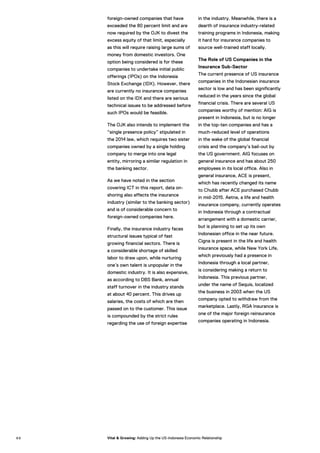
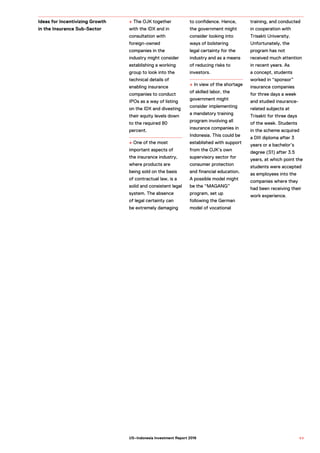
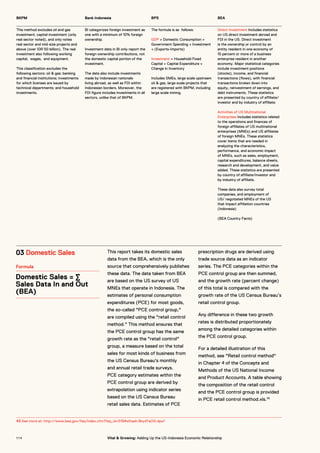
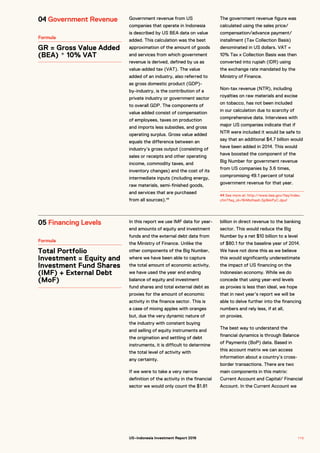
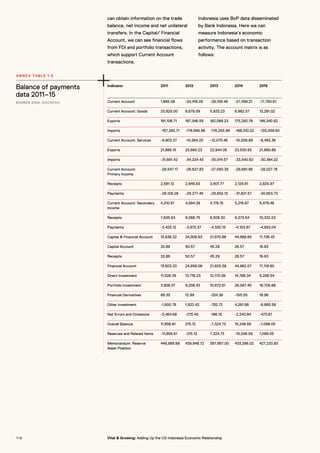
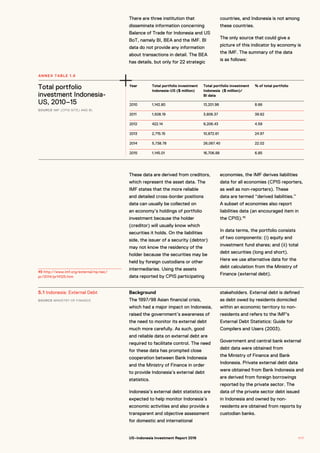
represents two interlocking national birds,
the Javanese Hawk Eagle and the Bald
Eagle. The former belongs to Indonesia and
the latter represents the US. Together, they
depict the collaboration and relationship
between the two countries.
Vital & Growing Adding up the US-Indonesia Economic Relationship
Amcham Indonesia & The U.S. Chamber of Commerce, 2016
© copyright reserved
AUTHOR
PRINCIPAL RESEARCHER
EDITOR
ASSOCIATE EDITORS
The US-Indonesia Investment
Report 2016
Database Services Provided
by CEIC Data Company, Jakarta
Peter Milne
Muhammad Abduh
A. Lin Neumann
Sarah Howe
Arian Ardie
John Goyer
Mary Silaban
Vital & Growing:
Adding Up the US-Indonesia
Economic Relationship
US–Indonesia Investment Report 2016 11
Tableof
Contents
8
18
24
32
01 The Real Impact of the US–Indonesia
Economic Relationship
The New Big Number
A Brief Methodology
Recent Trends in the Indonesia-US Economic Relationship
Components of the Big Number
How the Indonesia-US Economic Relationship Compares in the Region
Index
Preface
Key Points
4
5
6
11
11
12
13
16
19
20
21
25
27
28
33
02 Indonesia’s Current Economic Position
and Outlook
Recent Economic Trends in Indonesia
Weakening FDI and Stemming the Outflows of Capital
Shifting from Commodities to Manufacturing
03 The Government’s Economic Reform
Packages
The Background
Ensuring Implementation of the Reforms
AmCham’s Recommendation and Reform Scorecard
04 Looking beyond Our 2014 Baseline
Three Scenarios for Growth
2 Vital & Growing: Adding Up the US-Indonesia Economic Relationship
36
46
48
56
Annex I
Annex II
Annex III
110
118
120
47
47
49
51
54
58
66
72
78
82
90
96
100
106
05 Cross-sectoral Analysis and Sector Ranking
06 AmCham’s 2016 Investment
Sentiment Survey
Company Perceptions
The Characteristics of US Companies in Indonesia
07 Getting to a Best-Case Scenario
What Is Holding Indonesia Back?
Ideas for a 21st Century Global Economy
The Big Number and Our Conclusions
08 Analysis of Sectors
Agriculture
Comsumer Goods
Creative Industries
Extractive
Finance
Information Communication Technology
Infrastructure and Power
Oil & Gas
Pharmaceuticals, Healthcare & Life Sciences
3US–Indonesia Investment Report 2016
Index
Tables
Figures
1.1 Top 10 realized FDI by country, 2011-2015, ranking for 2015 ($ billion)
1.2 The evolution of the five components of the Big Number, 2010-14
1.3 Comparison of total US economic activities with ASEAN peers, 2010-14 (Nominal price, $ billion)
1.4 Table E3 Comparison of shares of US economic activities with ASEAN peers, 2010-14 (Percent)
3.1 Economic Policy Reform Packages, September 2015 – July 2016
3.2 AmCham’s list of industry concerns and policy package matrix scorecard
4.1 Values of Indonesia-US economic activities in the three scenarios, 2015-19 ($ billion)
5.1 Sector rankings and best overall sector for growth and investment
8.1 Agriculture
8.2 Consumer Goods
8.3 Creative Industries
8.4 Extractive
8.5 Finance
8.6 Information Communication Technology
8.7 Infrastructure and Power
8.8 Oil and Gas
8.9 Revenue split between oil and gas contractors* and the government, 2011–15 ($ billion)
8.10 Pharmaceuticals, Healthcare and Life Sciences
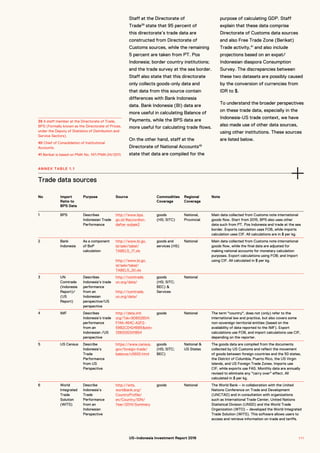
Annex 1.1 Trade Data Sources
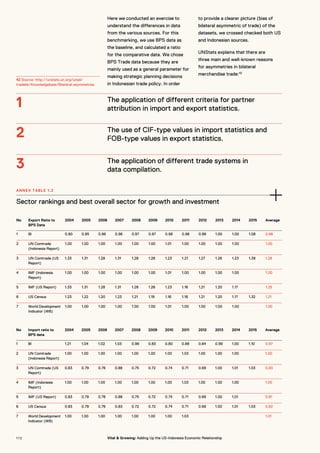
Annex 1.2 Sector rankings and best overall sector for growth and investment
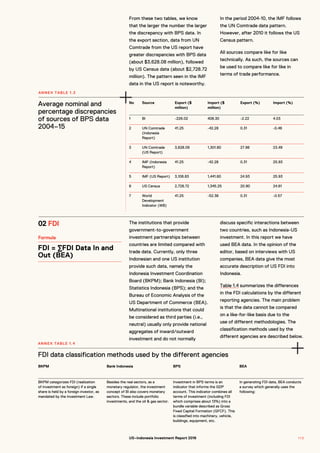
Annex 1.3 Average nominal and percentage discrepancies of sources of BPS data 2004–2015 2015
Annex 1.4 FDI data classification methods used by the different agencies
Annex 1.5 Balance of payments data 2011–15
Annex 1.6 Total portfolio investment Indonesia–US, 2010–15
Annex 3.1 The big number
1.1 A strong recovery in realized US FDI inflows into Indonesia, 2010-14 ($ Billion)
1.2 Growth of total economic activities vs. Indonesia GDP Growth, 2010-15 (percent)
1.3 Total economic activities growth is rapidly outpacing Indonesia’s GDP growth, 2011-14 (percent)
1.4 Evolution of shares of ASEAN peers’ economic relationships with the US, 2010-14 (Percent)
2.1 Indonesia’s manufacturing is a shadow of its former self (Growth in GDP and real manufacturing output, %)
2.2 Indonesia’s economy has de-industrialized prematurely (Manufacturing as a share of GDP, %)
2.3 Indonesia’s global manufacturing market share is low and stagnant (Share in global manufacturing market, %)
2.4 Rupiah Depreciation against the US dollar 2013-16 (Rupiah)
3.1 The addressing of AmCham’s industry concerns has been slow, 2013-15 (impact of 50 AmCham recommendations on policy)
4.1 Three Growth Scenarios for the value of Indonesia-US economic activities, 2015-19 ($ billion)
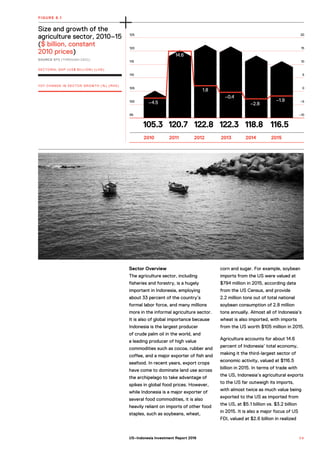
8.1 Size and growth of the agriculture sector, 2010-15 ($ billion, constant 2010 prices)
8.2 Size and growth of the consumer goods sector, 2010-15 ($ billion, constant 2010 prices)
8.3 Size and growth of the creative industries sector, 2010-15 ($ billion, constant 2010 prices)
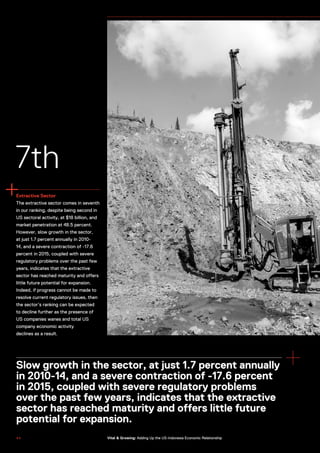
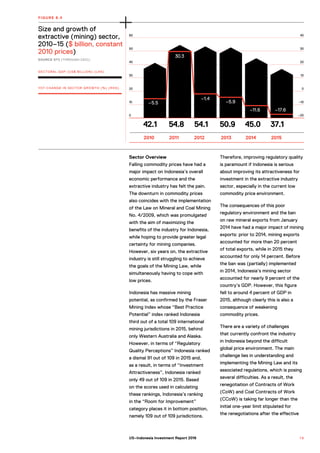
8.4 Size and growth of the extractive (mining) sector, 2010-15 ($ billion, constant 2010 prices)
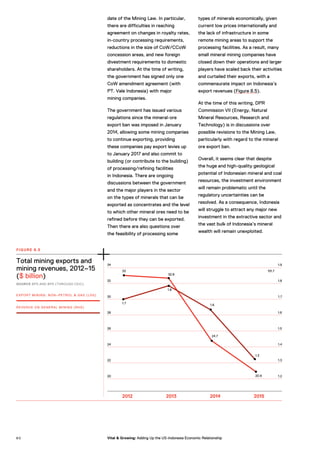
8.5 Total mining exports and mining revenues, 2012-15 ($ billion)
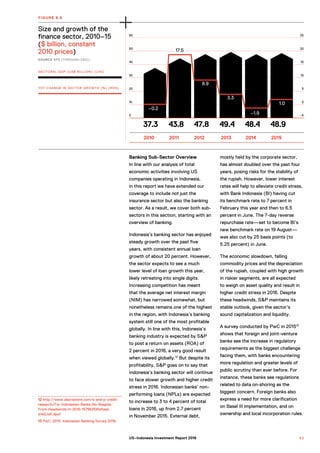
8.6 Size and growth of the finance sector, 2010-15 ($ billion, constant 2010 prices)
8.7 Size and growth of ICT sector, 2010-15 ($ billion, constant 2010 prices)
8.8 Size and growth of the infrastructure and power sector, 2010–15 ($ billion, constant 2010 prices)
8.9 Size and growth of the oil and gas sector, 2010–15 ($ billion, constant 2010 prices)
8.10 Size and growth of the oil and gas sector, 2010–15 ($ billion, constant 2010 prices)
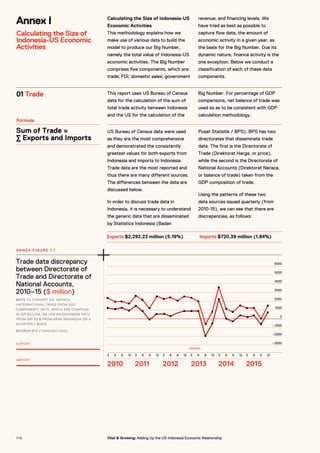
Annex 1.1 Trade data discrepancy between Directorate of Trade and Directorate of National Accounts, 2010-15 ($ million)
10
13
16
16
26
29
35
38
58
66
72
78
82
90
96
100
101
106
111
112
113
113
116
117
120
11
12
12
16
22
22
22
23
31
34
59
67
73
79
80
83
91
97
101
107
110
4 Vital & Growing: Adding Up the US-Indonesia Economic Relationship
Preface
The US-Indonesia Investment Initiative
is now in its fourth year and is a
collaborative effort between AmCham
Indonesia and the U.S. Chamber
of Commerce in Washington, DC.
Throughout the year, companies active
in the Initiative work closely with the
Indonesian government and private
sector leaders to identify ways in which
to improve the investment climate and
achieve our shared objective of higher
economic growth in Indonesia.
Under the Initiative, our annual
Investment Summits have become key
milestones at which Indonesian officials
and American companies share ideas in
a constructive and mutually
beneficial manner.
As part of this work, each year we
prepare an Investment Report. In 2013,
our first report broke new ground by
more accurately calculating the real
level of US company foreign direct
investment into Indonesia. This year,
our fourth such report, “Vital &
Growing: Adding up the US-Indonesia
Economic Relationship,” takes a
fresh approach by looking beyond
direct investment and calculating
the full value for Indonesia of the
total economic relationship with US
companies. The “big number” we
found may surprise readers, and we
think it will focus needed attention on
nurturing and opening up the
business climate.
As always, we want to recognize our
Indonesian partners in this work. The
Indonesian Chamber of Commerce and
Industry (KADIN) and the Employers’
Association of Indonesia (APINDO) are
our key private sector partners, both
of which provide counsel, support and
guidance on an ongoing basis.
The other agency with whom we work
particularly closely is the Indonesian
Investment Coordinating Board
(BKPM), which has been a co-sponsor
of our Summits since the beginning.
We greatly value the interaction with
BKPM and look forward to more joint
activities in the future.
This report would not have been
possible without the hard work of both
the AmCham and the U.S. Chamber
staff. Our consultant Arian Ardie
provides valuable advice and hard work
throughout the year on the Initiative
and the Report. We are also grateful
to all the companies who support the
Initiative and met with us to round out
the data and share their insights and
recommendations for the report.
Finally, we offer a word of heartfelt
thanks to the authors of this report,
Peter Milne and Muhammad Abduh.
Peter marshalled the resources and
wrote the report while Abduh dug deep
into the data to return the vital figures
needed to break new ground.
Our annual Investment Summits
have become key milestones at
which Indonesian officials and
American companies share ideas
in a constructive and mutually
beneficial manner.
US–Indonesia Investment Report 2016 5Amcham Indonesia Investment Report 2016
Key
Points
What is the real value for Indonesia
of its economic relationship with the
United States? AmCham Indonesia
and our partner in the US-Indonesia
Investment Initiative, the U.S. Chamber
of Commerce, have previously focused
in several studies on foreign direct
investment (FDI), coming up with
impressive numbers regarding US
companies and their involvement in
Indonesia. But this year, we wanted
to do more.
We set out to try and quantify the
totality of the US-Indonesia economic
relationship, to include not just FDI,
but also trade, domestic sales, finance
and government revenue. Together
these five components equal the
Big Number, which captures the
enormous importance of the economic
engagement between these two major
powers. Here are some of the key
findings from the main report.
+ The total value of
the bilateral economic
relationship between the
US and Indonesia was
$90.1 billion in 2014.
+ The net trade adjusted
figure represents 10.1
percent of Indonesia’s
GDP in 2014.
The Big Number + The compound
annual growth rate
(CAGR) for the total
economic relationship
grew at 8.0 percent
over 5 years (2010-
15), while Indonesia’s
GDP growth over the
same period was 5.5
percent, indicating the
relationship is a strong
driver of overall growth.
+ Domestic sales make
up the largest component
of the Big Number at
$34.1 billion, followed by
bilateral trade at $27.6
billion, FDI at $14.7 billion,
finance at $11.8 billion
and government revenue
at $1.8 billion.
+ Using the best case
scenario, the number
could grow to $131.7
billion by 2019—an
increase of 46.2 percent
over 5 years.
AmCham Indonesia and our partner
in the US-Indonesia Investment
Initiative,the U.S.Chamber of
Commerce, have previously focused
in several studies on foreign direct
investment (FDI), coming upwith
impressive numbers regarding US
companies and their involvement
in Indonesia. But this year,
we wanted to do more.
66 Vital & Growing: Adding Up the US-Indonesia Economic Relationship
Legal Certainty is the foundation for business confidence and growth. Both US
and Indonesian companies will be able to invest, grow and create jobs if there is
greater legal certainty in terms of contract sanctity, enforcement of existing laws
and an impartial judiciary.
Collaboration and Communication are vital for the creation of an enabling
economic environment and the development of rational laws and regulations.
Effective communication as economic policies are developed to make use of the
experience and expertise of the private sector will lead to effective policies to
make Indonesia a world class economy.
Innovation is the key to keeping pace in a dynamic global economy. Incentives
for taking risks, finding new ways of doing things, investing in research and
development and human resource capacity building are the keys to innovation.
Bureaucratic and Policy Reform must continue and expand. Specific examples
include the abolition of the Negative Investment List (DNI), rationalization of the
work permit process, streamlining of permitting at all levels of government, and
reform and proper incentivization of the civil service and judiciary.
The Road to the Best Case
Economic Sector Potential
US Company Sentiment
Achieving the best-case scenario will
depend on actions taken by both the
Indonesian and US governments. It is
also dependent on external factors that
cannot necessarily be controlled. There
are, however, a series of economic
reforms that can be undertaken by
the Indonesian government that would
increase the likelihood of achieving
the best-case scenario. The process
of economic reform has already been
started by the Widodo administration,
but will need to continue and expand to
achieve the desired outcome.
These include:
The report also looks at nine industrial,
extractive and service sectors.
Each one is at a different stage of
development with US companies
playing different roles in each. The
degree to which each sector is
controlled by the government is a main
factor in the performance of each of
these sectors, now and into the future.
Based upon a ranking system
developed in the report, several
sectors have a high degree of future
potential. These include the creative
economy, finance and infrastructure.
Several sectors in which US companies
have a significant presence have
average prospects growing apace with
GDP, such as oil and gas, consumer
goods and agriculture. The final
set of sectors have lower potential
partly due to restrictive government
policies that inhibit investment and
create uncertainty. These include
extractive, pharmaceutical/healthcare/
life sciences and information
communications technology (ICT).
A survey was also taken and interviews were conducted with the executives of US
companies both in Indonesia and the US. Here are some of the findings:
+ When asked if the
reform packages have
had any impact on their
own businesses, only
25 percent stated that
they had “some impact,”
while 75 percent stated
that there was “no
impact” or that it was
still “too early to say.”
+ 87 percent felt that
there had been “some
improvement” in the
investment climate
under the Widodo
administration;
+ 100 percent stated
that the 12 economic
reform packages had
“some impact;”
US–Indonesia Investment Report 2016 7Amcham Indonesia Investment Report 2016
88 Vital & Growing: Adding Up the US-Indonesia Economic Relationship
1
The Real
Impact of the
US–Indonesia
Economic
Relationship
The first AmCham Indonesia/U.S.
Chamber of Commerce1
Investment
Report was published in 2013. That
report focused on FDI and our analysis
revealed that real US FDI into Indonesia
was far higher than the officially
published figures. We concluded,
conservatively, that from 2004 to
2012, US FDI into Indonesia totaled
about $65 billion. This contrasted
significantly with most published data
and suggested that the US, instead
of being the fourth-largest investor in
the country (at that time), was likely
the largest investor in Indonesia. More
narrowly defined official figures from
Bank Indonesia showed US FDI for the
same period as being just over a
paltry $7 billion.
Moreover, back in 2013, our findings
indicated that 95 percent of total US
FDI into Indonesia was in the oil and
gas, mining and manufacturing sectors
and, while the oil and gas and mining
industries were by far the largest
US–Indonesia Investment Report 2016 9Amcham Indonesia Investment Report 2016
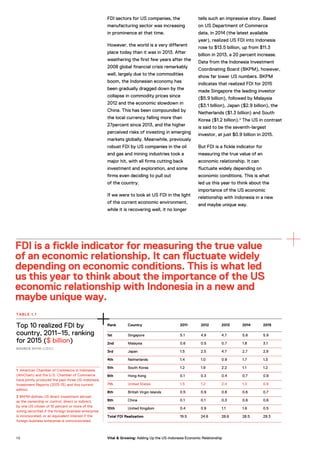
Top 10 realized FDI by
country, 2011–15, ranking
for 2015 ($ billion)
SOURCE BKPM (CEIC).
TABLE 1.1
Rank Country 2011 2012 2013 2014 2015
1st Singapore 5.1 4.9 4.7 5.8 5.9
2nd Malaysia 0.6 0.5 0.7 1.8 3.1
3rd Japan 1.5 2.5 4.7 2.7 2.9
4th Netherlands 1.4 1.0 0.9 1.7 1.3
5th South Korea 1.2 1.9 2.2 1.1 1.2
6th Hong Kong 0.1 0.3 0.4 0.7 0.9
7th United States 1.5 1.2 2.4 1.3 0.9
8th British Virgin Islands 0.5 0.9 0.8 0.6 0.7
9th China 0.1 0.1 0.3 0.8 0.6
10th United Kingdom 0.4 0.9 1.1 1.6 0.5
Total FDI Realization 19.5 24.6 28.6 28.5 29.3
1 American Chamber of Commerce in Indonesia
(AmCham) and the U.S. Chamber of Commerce
have jointly produced the past three US-Indonesia
Investment Reports (2013-15) and this current
edition.
2 BKPM defines US direct investment abroad
as the ownership or control, direct or indirect,
by one US citizen of 10 percent or more of the
voting securities if the foreign business enterprise
is incorporated, or an equivalent interest if the
foreign business enterprise is unincorporated.
FDI is a fickle indicator for measuring the true value
of an economic relationship. It can fluctuate widely
depending on economic conditions. This is what led
us this year to think about the importance of the US
economic relationship with Indonesia in a new and
maybe unique way.
FDI sectors for US companies, the
manufacturing sector was increasing
in prominence at that time.
However, the world is a very different
place today than it was in 2013. After
weathering the first few years after the
2008 global financial crisis remarkably
well, largely due to the commodities
boom, the Indonesian economy has
been gradually dragged down by the
collapse in commodity prices since
2012 and the economic slowdown in
China. This has been compounded by
the local currency falling more than
27percent since 2013, and the higher
perceived risks of investing in emerging
markets globally. Meanwhile, previously
robust FDI by US companies in the oil
and gas and mining industries took a
major hit, with all firms cutting back
investment and exploration, and some
firms even deciding to pull out
of the country.
If we were to look at US FDI in the light
of the current economic environment,
while it is recovering well, it no longer
tells such an impressive story. Based
on US Department of Commerce
data, in 2014 (the latest available
year), realized US FDI into Indonesia
rose to $13.5 billion, up from $11.3
billion in 2013, a 20 percent increase.
Data from the Indonesia Investment
Coordinating Board (BKPM), however,
show far lower US numbers. BKPM
indicates that realized FDI for 2015
made Singapore the leading investor
($5.9 billion), followed by Malaysia
($3.1 billion), Japan ($2.9 billion), the
Netherlands ($1.3 billion) and South
Korea ($1.2 billion).2
The US in contrast
is said to be the seventh-largest
investor, at just $0.9 billion in 2015.
But FDI is a fickle indicator for
measuring the true value of an
economic relationship. It can
fluctuate widely depending on
economic conditions. This is what
led us this year to think about the
importance of the US economic
relationship with Indonesia in a new
and maybe unique way.
1 0 Vital & Growing: Adding Up the US-Indonesia Economic Relationship
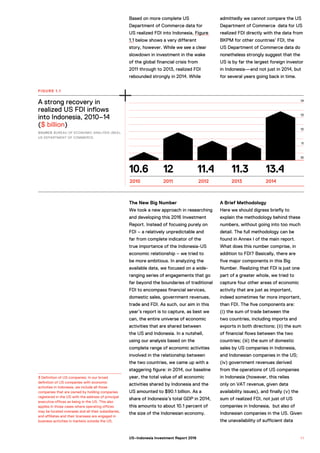
Based on more complete US
Department of Commerce data for
US realized FDI into Indonesia, Figure
1.1 below shows a very different
story, however. While we see a clear
slowdown in investment in the wake
of the global financial crisis from
2011 through to 2013, realized FDI
rebounded strongly in 2014. While
admittedly we cannot compare the US
Department of Commerce data for US
realized FDI directly with the data from
BKPM for other countries’ FDI, the
US Department of Commerce data do
nonetheless strongly suggest that the
US is by far the largest foreign investor
in Indonesia—and not just in 2014, but
for several years going back in time.
A strong recovery in
realized US FDI inflows
into Indonesia, 2010–14
($ billion)
SOURCE BUREAU OF ECONOMIC ANALYSIS (BEA),
US DEPARTMENT OF COMMERCE.
FIGURE 1.1
10.6 12 11.4 11.3 13.4
2010 2011 2012 2013 2014
14
13
12
11
10
The New Big Number
We took a new approach in researching
and developing this 2016 Investment
Report. Instead of focusing purely on
FDI – a relatively unpredictable and
far from complete indicator of the
true importance of the Indonesia-US
economic relationship – we tried to
be more ambitious. In analyzing the
available data, we focused on a wide-
ranging series of engagements that go
far beyond the boundaries of traditional
FDI to encompass financial services,
domestic sales, government revenues,
trade and FDI. As such, our aim in this
year’s report is to capture, as best we
can, the entire universe of economic
activities that are shared between
the US and Indonesia. In a nutshell,
using our analysis based on the
complete range of economic activities
involved in the relationship between
the two countries, we came up with a
staggering figure: in 2014, our baseline
year, the total value of all economic
activities shared by Indonesia and the
US amounted to $90.1 billion. As a
share of Indonesia’s total GDP in 2014,
this amounts to about 10.1 percent of
the size of the Indonesian economy.
A Brief Methodology
Here we should digress briefly to
explain the methodology behind these
numbers, without going into too much
detail. The full methodology can be
found in Annex I of the main report.
What does this number comprise, in
addition to FDI? Basically, there are
five major components in this Big
Number. Realizing that FDI is just one
part of a greater whole, we tried to
capture four other areas of economic
activity that are just as important,
indeed sometimes far more important,
than FDI. The five components are:
(i) the sum of trade between the
two countries, including imports and
exports in both directions; (ii) the sum
of financial flows between the two
countries; (iii) the sum of domestic
sales by US companies in Indonesia,
and Indonesian companies in the US;
(iv) government revenues derived
from the operations of US companies
in Indonesia (however, this relies
only on VAT revenue, given data
availability issues), and finally (v) the
sum of realized FDI, not just of US
companies in Indonesia, but also of
Indonesian companies in the US. Given
the unavailability of sufficient data
3 Definition of US companies: In our broad
definition of US companies with economic
activities in Indonesia, we include all those
companies that are owned by holding companies
registered in the US with the address of principal
executive offices as being in the US. This also
applies in those cases where operating offices
may be located overseas and all their subsidiaries,
and affiliates and their licensees are engaged in
business activities in markets outside the US.
1 1US–Indonesia Investment Report 2016
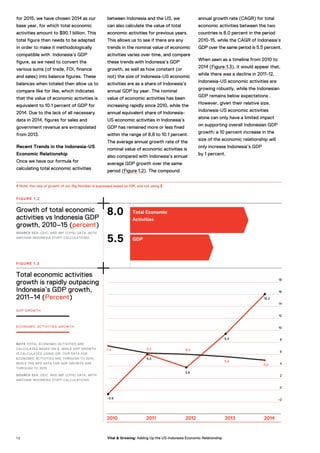
Growth of total economic
activities vs Indonesia GDP
growth, 2010–15 (percent)
SOURCE BEA, CEIC, AND IMF (CPIS) DATA, WITH
AMCHAM INDONESIA STAFF CALCULATIONS.
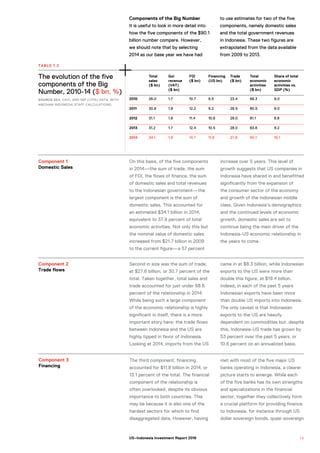
Total economic activities
growth is rapidly outpacing
Indonesia’s GDP growth,
2011–14 (Percent)
FIGURE 1.2
FIGURE 1.3
Total Economic
Activities
8.0
5.5 GDP
2010 2011 2012 2013 2014
18
16
14
12
10
8
6
4
2
0
–2–0.6
7.4 6.2 6.0
5.6
5.0
6.0
3.8
9.4
16.0
NOTE TOTAL ECONOMIC ACTIVITIES ARE
CALCULATED BASED ON $, WHILE GDP GROWTH
IS CALCULATED USING IDR. OUR DATA FOR
ECONOMIC ACTIVITIES ARE THROUGH TO 2014,
WHILE THE BPS DATA FOR GDP GROWTH ARE
THROUGH TO 2015.
SOURCE BEA, CEIC, AND IMF (CPIS) DATA, WITH
AMCHAM INDONESIA STAFF CALCULATIONS.
GDP GROWTH
ECONOMIC ACTIVITIES GROWTH
for 2015, we have chosen 2014 as our
base year, for which total economic
activities amount to $90.1 billion. This
total figure then needs to be adapted
in order to make it methodologically
compatible with Indonesia’s GDP
figure, as we need to convert the
various sums (of trade, FDI, finance
and sales) into balance figures. These
balances when totaled then allow us to
compare like for like, which indicates
that the value of economic activities is
equivalent to 10.1 percent of GDP for
2014. Due to the lack of all necessary
data in 2014, figures for sales and
government revenue are extrapolated
from 2013.
Recent Trends in the Indonesia-US
Economic Relationship
Once we have our formula for
calculating total economic activities
between Indonesia and the US, we
can also calculate the value of total
economic activities for previous years.
This allows us to see if there are any
trends in the nominal value of economic
activities varies over time, and compare
these trends with Indonesia’s GDP
growth, as well as how constant (or
not) the size of Indonesia-US economic
activities are as a share of Indonesia’s
annual GDP by year. The nominal
value of economic activities has been
increasing rapidly since 2010, while the
annual equivalent share of Indonesia-
US economic activities in Indonesia’s
GDP has remained more or less fixed
within the range of 8.8 to 10.1 percent.
The average annual growth rate of the
nominal value of economic activities is
also compared with Indonesia’s annual
average GDP growth over the same
period (Figure 1.2). The compound
annual growth rate (CAGR) for total
economic activities between the two
countries is 8.0 percent in the period
2010-15, while the CAGR of Indonesia’s
GDP over the same period is 5.5 percent.
When seen as a timeline from 2010 to
2014 (Figure 1.3), it would appear that,
while there was a decline in 2011-12,
Indonesia-US economic activities are
growing robustly, while the Indonesian
GDP remains below expectations .
However, given their relative size,
Indonesia-US economic activities
alone can only have a limited impact
on supporting overall Indonesian GDP
growth: a 10 percent increase in the
size of the economic relationship will
only increase Indonesia’s GDP
by 1 percent.
4 Note: the rate of growth of our Big Number is expressed based on IDR, and not using $.
1 2 Vital & Growing: Adding Up the US-Indonesia Economic Relationship
Components of the Big Number
It is useful to look in more detail into
how the five components of the $90.1
billion number compare. However,
we should note that by selecting
2014 as our base year we have had
to use estimates for two of the five
components, namely domestic sales
and the total government revenues
in Indonesia. These two figures are
extrapolated from the data available
from 2009 to 2013.
The evolution of the five
components of the Big
Number, 2010-14 ($ bn, %)
SOURCE BEA, CEIC, AND IMF (CPIS) DATA, WITH
AMCHAM INDONESIA STAFF CALCULATIONS.
TABLE 1.2
Total
sales
($ bn)
GoI
revenue
(VAT)
($ bn)
FDI
($ bn)
Financing
(US bn)
Trade
($ bn)
Total
economic
activities
($ bn)
Share of total
economic
activities vs.
GDP (%)
2010 26.0 1.7 10.7 6.5 23.4 68.3 9.0
2011 30.8 1.8 12.2 9.2 26.5 80.5 9.0
2012 31.1 1.8 11.4 10.8 26.0 81.1 8.8
2013 31.2 1.7 12.4 10.5 28.0 83.8 9.2
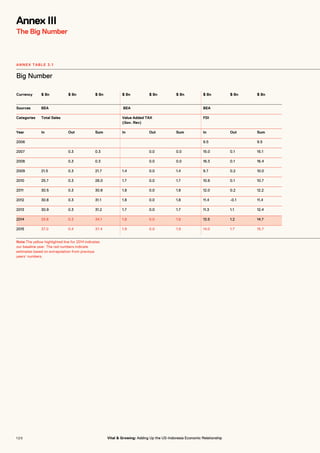
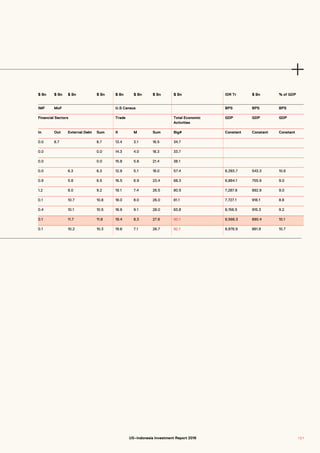
2014 34.1 1.8 14.7 11.8 27.6 90.1 10.1
Component 1
Domestic Sales
Component 2
Trade flows
Component 3
Financing
On this basis, of the five components
in 2014—the sum of trade, the sum
of FDI, the flows of finance, the sum
of domestic sales and total revenues
to the Indonesian government—the
largest component is the sum of
domestic sales. This accounted for
an estimated $34.1 billion in 2014,
equivalent to 37.9 percent of total
economic activities. Not only this but
the nominal value of domestic sales
increased from $21.7 billion in 2009
to the current figure—a 57 percent
increase over 5 years. This level of
growth suggests that US companies in
Indonesia have shared in and benefitted
significantly from the expansion of
the consumer sector of the economy
and growth of the Indonesian middle
class. Given Indonesia’s demographics
and the continued levels of economic
growth, domestic sales are set to
continue being the main driver of the
Indonesia-US economic relationship in
the years to come.
Second in size was the sum of trade,
at $27.6 billion, or 30.7 percent of the
total. Taken together, total sales and
trade accounted for just under 68.6
percent of the relationship in 2014.
While being such a large component
of the economic relationship is highly
significant in itself, there is a more
important story here: the trade flows
between Indonesia and the US are
highly tipped in favor of Indonesia.
Looking at 2014, imports from the US
came in at $8.3 billion, while Indonesian
exports to the US were more than
double this figure, at $19.4 billion.
Indeed, in each of the past 5 years
Indonesian exports have been more
than double US imports into Indonesia.
The only caveat is that Indonesian
exports to the US are heavily
dependent on commodities but, despite
this, Indonesia-US trade has grown by
53 percent over the past 5 years, or
10.6 percent on an annualized basis.
The third component, financing,
accounted for $11.8 billion in 2014, or
13.1 percent of the total. The financial
component of the relationship is
often overlooked, despite its obvious
importance to both countries. This
may be because it is also one of the
hardest sectors for which to find
disaggregated data. However, having
met with most of the five major US
banks operating in Indonesia, a clearer
picture starts to emerge. While each
of the five banks has its own strengths
and specializations in the financial
sector, together they collectively form
a crucial platform for providing finance
to Indonesia, for instance through US
dollar sovereign bonds, quasi-sovereign
1 3US–Indonesia Investment Report 2016
Component 4
FDI
bonds (to state-owned enterprises)
and to the private sector. Looking at
the past 2 years, US banks have been
involved in roughly 60 to 75 percent
of all US dollar bond issuances in
Indonesia, which have raised about
$25 billion in bond financing from
2014 to May 2016. In terms of the
US dollar debt market, growth was
about 86 percent in the period 2019-
14, or an impressive 17 percent on an
annualized basis. Meanwhile, US banks
in Indonesia also constitute some of
the largest traders of equities in the
domestic stock market, together with
being major players in mergers and
acquisitions (M&A).
The fourth component is FDI, at
$14.7 billion, or 16.3 percent of the
relationship in 2014. FDI is the figure
most often cited as a measure of the
economic relationship, but it only
ranks fourth out of our five major
components. While it is undoubtedly
true that investment policy reform
often drives the broader reform
agenda, other components actually
contribute more to the total Indonesia-
US economic relationship. FDI can also
be volatile, proof of which can be seen
in the fact that it is the only one of our
components that declined due to the
global economic crisis, from 2011 to
2012. That decline notwithstanding,
total FDI (including Indonesian FDI in
the US) increased by 47 percent during
the period, from $10 billion in 2009
to $14.7 billion in 2014, an average
annualized increase of 9.4 percent.
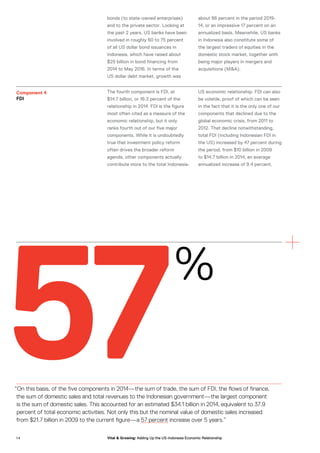
57“On this basis, of the five components in 2014—the sum of trade, the sum of FDI, the flows of finance,
the sum of domestic sales and total revenues to the Indonesian government—the largest component
is the sum of domestic sales. This accounted for an estimated $34.1 billion in 2014, equivalent to 37.9
percent of total economic activities. Not only this but the nominal value of domestic sales increased
from $21.7 billion in 2009 to the current figure—a 57 percent increase over 5 years.”
1 4 Vital & Growing: Adding Up the US-Indonesia Economic Relationship
Component 5
Government Revenues
The smallest contribution to the
relationship is Indonesian government
revenues, which accounted for an
estimated $1.8 billion, or just 2 percent
of the total. Unfortunately, the
unavailability of data means that this
component is greatly understated, as
we only have complete data on value-
added tax (PPN), but not on non-tax
revenue (NTR), including royalties on
raw materials and excise on tobacco.
However, even just taking VAT
revenue into account, US companies
still contributed 13 percent of total
government tax revenue of $13.24
billion in 2014.
While the smallest of our five
components, it is nonetheless vital
to the government of Indonesia.
It is worth remembering that for
many years US companies also have
been Indonesia’s largest contributor
to government revenue, although
they are not necessarily the largest
companies operating in Indonesia.
For example, in recent years PT.
Freeport Indonesia was the largest
contributor to goverment revenues
until the collapse in commodities
prices and the implementation of the
export ban on mineral ore, after which
its dominant position has been taken
over by PT. HM Sampoerna, another
US company. (Note, both companies
owe their prominent position not to
VAT, but more to NTR in the form of
royalties and excise, respectively, in
addition to regular corporate income
tax.) Other major contributors to NTR
government revenues are in the oil
and gas sector, including Chevron,
ExxonMobil and ConocoPhillips. It is
worth noting that despite the current
low oil price environment, which
has caused government revenue to
plummet by around 43 percent,5
the
oil and gas sector still plays a vital role
in supporting regional development,
including through the development
of the oil and gas support services
sector, which provides important
multiplier effects. Furthermore,
Indonesia’s production share from oil
and gas is generally regarded as the
second highest in the world. From the
US company figures that we do have
access to, it is safe to say that NTR
to the government was at the very
least around $4.7 billion in 2014. This
would boost our sectoral Big Number
for government revenue from US
companies by 3.6 times.
It is worth remembering that for many
years US companies have been Indonesia’s
largest contributor to government revenue,
although they are not necessarily the
largest companies operating in Indonesia.
By way of comparison, looking back
at 2009, at the start of the global
financial crisis, the shares of the five
components were relatively similar
to 2014. Total economic activities in
2009 were valued at just shy of $57.4
billion, implying a 56.8 percent increase
in the period 2009 to 2014. The main
exception is that the share of financial
flows was significantly lower, at just
10.96 percent compared with 13.05
percent in 2014. This would have
almost certainly been due to the impact
of the global economic crisis at that
time. In the other four components, the
shares in 2009 were 37.83 percent for
total sales, 31.41 percent for the sum of
trade, 17.4 percent for the sum of FDI,
and 2.4 percent for total revenues to
the Indonesian government.
5 2016 Oil and Gas Production in Indonesia (BOEPD): Chevron 251,000; ConocoPhillips: 241,000; and ExxonMobil:
170,000 (Source: WoodMackenzie: SKK Migas).
1 5US–Indonesia Investment Report 2016
Comparison of total US
economic activities with
ASEAN peers, 2010–14
(Nominal price, $ billion)
NOTE *IN THE 2014 DATA, GOVERNMENT
REVENUE AND DOMESTIC SALES DATA ARE
ESTIMATED FOLLOWING THE TREND IN CAGR.
SOURCE: BEA, CEIC, AND IMF DATA, WITH
AMCHAM INDONESIA STAFF CALCULATIONS.
NOTE ** 2015 DATA ARE ESTIMATES
Comparison of shares of
US economic activities
with ASEAN peers,
2010–14 (Percent)
NOTE *IN THE 2014 DATA, GOVERNMENT
REVENUE AND DOMESTIC SALES DATA ARE
ESTIMATED FOLLOWING THE TREND IN CAGR.
SOURCE BEA, CEIC, AND IMF DATA, WITH
AMCHAM INDONESIA STAFF CALCULATIONS.
Evolution of shares of
ASEAN peers’ economic
relationships with the US,
2010–14 (Percent)
NOTE *IN THE 2014 DATA, GOVERNMENT
REVENUE AND DOMESTIC SALES DATA ARE
ESTIMATED FOLLOWING THE TREND IN CAGR.
SOURCE: BEA, CEIC, AND IMF DATA, WITH
AMCHAM INDONESIA STAFF CALCULATIONS.
NOTE ** 2015 DATA ARE ESTIMATES
TABLE 1.3
TABLE 1.4
FIGURE 1.4
Thailand Vietnam Philippines Malaysia Indonesia
2010 96.5 22.6 40.3 106.8 68.3
2011 105.5 26.6 43.9 112.2 80.5
2012 113.8 29.3 43.7 105.5 81.1
2013 117.0 34.4 43.4 109.4 83.8
2014* 130.8 41.2 48.9 118.2 90.1
2015** 137.0 50.4 48.4 121.1 92.1
Thailand Vietnam Philippines Malaysia Indonesia
2010 27.93 19.50 19.61 40.10 9.03
2011 28.90 19.65 19.80 39.10 9.02
2012 28.58 18.80 16.98 33.21 8.83
2013 28.22 20.07 16.69 35.24 9.15
2014* 32.43 22.12 17.31 37.32 10.12
2010 2011 2012 2013 2014* 2015**
50
45
40
35
30
25
20
15
10
5
MALAYSIA
THAILAND
VIETNAM
PHILIPPINES
INDONESIA
40.1
27.9
19.5
19.6
9.0 9.0 8.8 9.2 10.1 10.7
19.8
17.0 16.7 17.3 17.1
19.7 18.8
20.1
28.9 28.6 28.2
32.4
22.1
26.0
35.0
39.1
33.2
35.2
37.3
45.2
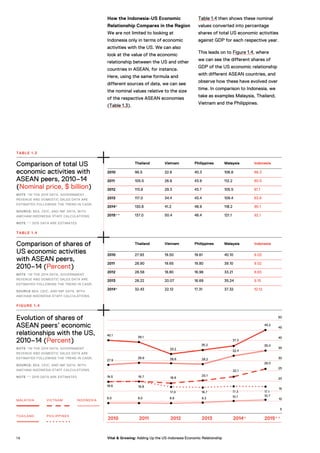
How the Indonesia-US Economic
Relationship Compares in the Region
We are not limited to looking at
Indonesia only in terms of economic
activities with the US. We can also
look at the value of the economic
relationship between the US and other
countries in ASEAN, for instance.
Here, using the same formula and
different sources of data, we can see
the nominal values relative to the size
of the respective ASEAN economies
(Table 1.3).
Table 1.4 then shows these nominal
values converted into percentage
shares of total US economic activities
against GDP for each respective year.
This leads on to Figure 1.4, where
we can see the different shares of
GDP of the US economic relationship
with different ASEAN countries, and
observe how these have evolved over
time. In comparison to Indonesia, we
take as examples Malaysia, Thailand,
Vietnam and the Philippines.
1 6 Vital & Growing: Adding Up the US-Indonesia Economic Relationship
Indonesia’s position in terms of the
value of its total economic activities
with the US compared with its ASEAN
peers is probably about where it
should be—not too high and not too
low, and also relatively stable over
the five-year period. In our five-
country sample, the nominal value of
the economic relationship between
Indonesia and the US lies sandwiched
between Malaysia and Thailand with
the highest values, and the Philippines
and Vietnam, with the lowest. While
it is true to say that growing the
size of the economy is what is most
important here, the fact that in some
countries the value of their economic
activities with the US is growing faster
than others may indicate that these
countries are more open and attractive
to US economic activities.
While no one really knows what an
optimal share of GDP should be in
a country’s economic relationship
with the US, this is not the most
important issue. Far more important
is that the size of the economic
“pie”—i.e., the nominal total value of
economic activities—is growing on an
annual basis. If this growth is indeed
occurring, while the share of the value
of economic activities in GDP remains
more or less constant, it infers that all
economic relationships with a country
are growing together and mutually
benefiting each other. This, after all, is
the ultimate goal.
Indonesia’s position in
terms of the value of its
total economic activities
with the US compared with
its ASEAN peers is probably
about where it should be–
not too high and not too low,
and also relatively stable
over the five-year period.
1 7US–Indonesia Investment Report 2016
1 81 8 Vital & Growing: Adding Up the US-Indonesia Economic Relationship
2
Indonesia’s
Current
Economic
Position and
Outlook
Recent Economic Trends in Indonesia
The Indonesian economy has been
struggling to maintain growth since
2012 in the face of lower commodity
prices and slower global growth.
Despite the recent slowdown, however,
the country’s per capita GDP has
grown steadily from $560 in 2000 to
$3,630 in 2014. With Indonesia’s export
revenues contracting throughout 2015,
GDP growth slipped to 4.8 percent.
While still respectable, especially for a
commodities exporter, Indonesia will
struggle to absorb new entrants into
the country’s labor force at this rate of
growth. Going forward, Indonesia will
need to adapt to a less favorable global
environment and focus even more on
facilitating investment and reducing
the costs of doing business.
The fiscal stimulus provided by the
government, aided by additional
funds coming from the shift in public
US–Indonesia Investment Report 2016 1 9Amcham Indonesia Investment Report 2016
expenditure away from wasteful fuel
subsidies, will undoubtedly help to
support economic expansion. There
was, for instance, a threefold increase
in infrastructure spending in the first
quarter of 2016, together with a 10-fold
spike in physical construction for the
same quarter. However, government
activity alone will not raise growth
above 5 percent in 2016. The only
way to ensure that growth rebounds
will be through greater private sector
activity, especially through private
sector investment. This is where US
companies can play an important role
— especially in generating new jobs.
Driven mainly by the increase in public
spending at the end of the year,
growth did pick up in the final quarter
of 2015 to 5 percent year-on-year,
after three previous quarters of 4.7
percent growth. However, at the same
time consumption remained moderate,
while exports and imports both
continued to decline, highlighting the
challenges faced by the private sector.
Worryingly, the biggest contributor
to the overall decline in the trade
balance came from a contraction in
manufacturing exports, which fell by
13.4 percent year-on-year.
Weakening FDI and Stemming the
Outflows of Capital
Indonesia also experienced a significant
decline in its financial account in 2015,
as capital fled emerging markets
generally. Total 2015 capital flows to
Indonesia declined to just $17.1 billion
in 2015, down from $45 billion in 2014.
The outflows of capital from Indonesia
were only stemmed by foreign
investment into Indonesian government
bonds toward the end of 2015, helping
to stabilize the rupiah at 4.4 percent in
February. Most of these investments
flowed through US investment banks
in Indonesia. A stronger rupiah and
lower inflation helped Bank Indonesia
to finally start easing its monetary
policy in January with two consecutive
cuts in interest rates of 25 basis points
each. However, as we have seen in the
past few months, BI will need to remain
vigilant amid continuing global financial
market volatility and the possibility
of rising US interest rates putting
pressure on the rupiah.
Against this backdrop, the World Bank
set its GDP growth projections at
5.1 percent in 2016 and 5.3 percent
in 2017, with the figure for 2016
contingent on private sector spending
picking up in the second half of the
year. Beyond 2016, the economic
recovery in Indonesia will ultimately
rely on policies designed to attract
far greater private investment and
diversify the economy away from
reliance on the extractive industries.
The first welcome signs of this new
approach were seen in September
2015, with the unveiling of the first
of a continuing series of economic
reform packages.
2 0 Vital & Growing: Adding Up the US-Indonesia Economic Relationship
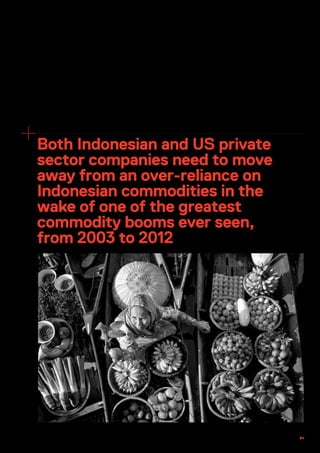
Both Indonesian and US private
sector companies need to move
away from an over-reliance on
Indonesian commodities in the
wake of one of the greatest
commodity booms ever seen,
from 2003 to 2012
Shifting from Commodities to
Manufacturing
Both Indonesian and US private
sector companies need to move away
from an over-reliance on Indonesian
commodities in the wake of one of
the greatest commodity booms ever
seen, from 2003-2012. One side-
effect of the commodities boom
was that it rendered investing in the
Indonesian manufacturing sector less
attractive to investors when easy
returns could be made in commodities
with little or no valued-added. Given
that manufacturing tends to be highly
labor-intensive and the extractive
industries just the opposite, it should
come as little surprise that while
Indonesia comprises half of ASEAN’s
total labor force it contributes only 16
percent of ASEAN’s manufacturing
exports. In fact, looking more closely
at data from the World Bank, Indonesia
underwent a process of “premature
deindustrialization” from about 2002
onwards, as commodities overtook
manufacturing as the largest exports
from 2005 onward.
2 1US–Indonesia Investment Report 2016
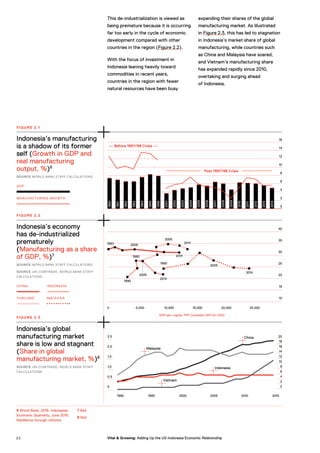
Indonesia’s manufacturing
is a shadow of its former
self (Growth in GDP and
real manufacturing
output, %)6
SOURCE WORLD BANK STAFF CALCULATIONS.
Indonesia’s economy
has de-industrialized
prematurely
(Manufacturing as a share
of GDP, %)7
SOURCE WORLD BANK STAFF CALCULATIONS
SOURCE UN-COMTRADE; WORLD BANK STAFF
CALCULATIONS.
Indonesia’s global
manufacturing market
share is low and stagnant
(Share in global
manufacturing market, %)8
SOURCE UN-COMTRADE; WORLD BANK STAFF
CALCULATIONS
FIGURE 2.1
FIGURE 2.2
FIGURE 2.3
16
14
12
10
8
6
4
2
0
40
35
30
25
20
15
10
20
18
16
14
12
10
8
6
4
2
0
2.5
2.0
1.5
1.0
0.5
0
0 5,000
1990
Malaysia
China
Indonesia
Vietnam
1995 2000 2005 2010 2015
10,000 20,00015,000 25,000
1990
1991
1992
1993
1994
1995
1996
2001
2002
2003
2004
2005
2006
2007
2008
2009
2010
2011
2012
2013
2014
Post 1997/98 Crisis
GDP per–capita, PPP (constant 2011 int USD)
Before 1997/98 Crisis
GDP
MANUFACTURING GROWTH
6 World Bank, 2016. Indonesian
Economic Quarterly, June 2016.
Resilience through reforms.
7 Ibid.
8 Ibid.
CHINA
THAILAND
INDONESIA
MALAYSIA
1990
1990
2005
2014
1990
2005
2014
2005
2014
1990
2005
2014
This de-industrialization is viewed as
being premature because it is occurring
far too early in the cycle of economic
development compared with other
countries in the region (Figure 2.2).
With the focus of investment in
Indonesia leaning heavily toward
commodities in recent years,
countries in the region with fewer
natural resources have been busy
expanding their shares of the global
manufacturing market. As illustrated
in Figure 2.3, this has led to stagnation
in Indonesia’s market share of global
manufacturing, while countries such
as China and Malaysia have soared,
and Vietnam’s manufacturing share
has expanded rapidly since 2010,
overtaking and surging ahead
of Indonesia.
2 2 Vital & Growing: Adding Up the US-Indonesia Economic Relationship
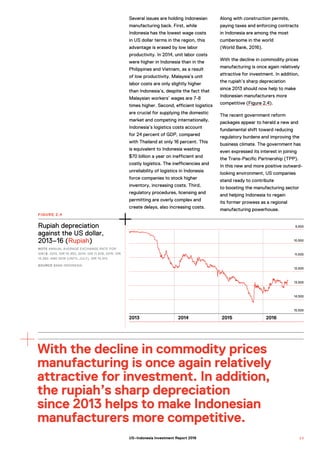
With the decline in commodity prices
manufacturing is once again relatively
attractive for investment. In addition,
the rupiah’s sharp depreciation
since 2013 helps to make Indonesian
manufacturers more competitive.
Rupiah depreciation
against the US dollar,
2013–16 (Rupiah)
NOTE ANNUAL AVERAGE EXCHANGE RATE FOR
IDR/$: 2013, IDR 10,452; 2014, IDR 11,878; 2015: IDR
13,392; AND 2016 (UNTIL JULY), IDR 13,414.
SOURCE BANK INDONESIA.
FIGURE 2.4
9,500
10,500
11,500
12,500
13,500
14,500
15,500
2013 2014 2015 2016
Several issues are holding Indonesian
manufacturing back. First, while
Indonesia has the lowest wage costs
in US dollar terms in the region, this
advantage is erased by low labor
productivity. In 2014, unit labor costs
were higher in Indonesia than in the
Philippines and Vietnam, as a result
of low productivity. Malaysia’s unit
labor costs are only slightly higher
than Indonesia’s, despite the fact that
Malaysian workers’ wages are 7-8
times higher. Second, efficient logistics
are crucial for supplying the domestic
market and competing internationally.
Indonesia’s logistics costs account
for 24 percent of GDP, compared
with Thailand at only 16 percent. This
is equivalent to Indonesia wasting
$70 billion a year on inefficient and
costly logistics. The inefficiencies and
unreliability of logistics in Indonesia
force companies to stock higher
inventory, increasing costs. Third,
regulatory procedures, licensing and
permitting are overly complex and
create delays, also increasing costs.
Along with construction permits,
paying taxes and enforcing contracts
in Indonesia are among the most
cumbersome in the world
(World Bank, 2016).
With the decline in commodity prices
manufacturing is once again relatively
attractive for investment. In addition,
the rupiah’s sharp depreciation
since 2013 should now help to make
Indonesian manufacturers more
competitive (Figure 2.4).
The recent government reform
packages appear to herald a new and
fundamental shift toward reducing
regulatory burdens and improving the
business climate. The government has
even expressed its interest in joining
the Trans-Pacific Partnership (TPP).
In this new and more positive outward-
looking environment, US companies
stand ready to contribute
to boosting the manufacturing sector
and helping Indonesia to regain
its former prowess as a regional
manufacturing powerhouse.
2 3US–Indonesia Investment Report 2016
2 42 4 Vital & Growing: Adding Up the US-Indonesia Economic Relationship
3
The
Government’s
Economic
Reform
Packages
The Background
President Widodo announced the
first in a series of economic policy
reform packages in early September
2015, with a focus on much needed
deregulation efforts. The packages
have continued coming since then, with
the twelfth and latest package released
in late April of this year. Overall,
they seem to demonstrate President
Widodo’s resolve in pushing ahead with
constructive and practical efforts to
improve the investment climate and
kick-start higher economic growth
rates, after a disappointing slowdown
in 2015. They also demonstrate the
practical efficiency of decision-making
under Coordinating Minister for the
Economy Darmin Nasution, who was
inaugurated into his position shortly
before the deregulation packages
started to come forth, in mid-2015.
US–Indonesia Investment Report 2016 2 5Amcham Indonesia Investment Report 2016
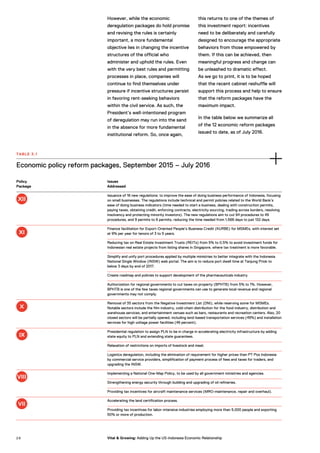
However, while the economic
deregulation packages do hold promise
and revising the rules is certainly
important, a more fundamental
objective lies in changing the incentive
structures of the official who
administer and uphold the rules. Even
with the very best rules and permitting
processes in place, companies will
continue to find themselves under
pressure if incentive structures persist
in favoring rent-seeking behaviors
within the civil service. As such, the
President’s well-intentioned program
of deregulation may run into the sand
in the absence for more fundamental
institutional reform. So, once again,
this returns to one of the themes of
this investment report: incentives
need to be deliberately and carefully
designed to encourage the appropriate
behaviors from those empowered by
them. If this can be achieved, then
meaningful progress and change can
be unleashed to dramatic effect.
As we go to print, it is to be hoped
that the recent cabinet reshuffle will
support this process and help to ensure
that the reform packages have the
maximum impact.
In the table below we summarize all
of the 12 economic reform packages
issued to date, as of July 2016.
Policy
Package
Issues
Addressed
Issuance of 16 new regulations: to improve the ease of doing business performance of Indonesia, focusing
on small businesses. The regulations include technical and permit policies related to the World Bank’s
ease of doing business indicators (time needed to start a business, dealing with construction permits,
paying taxes, obtaining credit, enforcing contracts, electricity sourcing, trading across borders, resolving
insolvency and protecting minority investors). The new regulations aim to cut 94 procedures to 49
procedures, and 9 permits to 6 permits, reducing the time needed from 1,566 days to just 132 days.
Finance facilitation for Export-Oriented People’s Business Credit (KURBE) for MSMEs, with interest set
at 9% per year for tenors of 3 to 5 years.
Reducing tax on Real Estate Investment Trusts (REITs) from 5% to 0.5% to avoid investment funds for
Indonesian real estate projects from listing shares in Singapore, where tax treatment is more favorable.
Simplify and unify port procedures applied by multiple ministries to better integrate with the Indonesia
National Single Window (INSW) web portal. The aim is to reduce port dwell time at Tanjung Priok to
below 3 days by end of 2017.
Create roadmap and policies to support development of the pharmaceuticals industry
Authorization for regional governments to cut taxes on property (BPHTB) from 5% to 1%. However,
BPHTB is one of the few taxes regional governments can use to generate local revenue and regional
governments may not comply.
Removal of 35 sectors from the Negative Investment List (DNI), while reserving some for MSMEs.
Notable sectors include the film industry, cold-chain distribution for the food industry, distribution and
warehouse services, and entertainment venues such as bars, restaurants and recreation centers. Also, 20
closed sectors will be partially opened, including land-based transportation services (49%) and installation
services for high voltage power facilities (49 percent).
Presidential regulation to assign PLN to be in charge in accelerating electricity infrastructure by adding
state equity to PLN and extending state guarantees.
Relaxation of restrictions on imports of livestock and meat.
Logistics deregulation, including the elimination of requirement for higher prices than PT Pos Indonesia
by commercial service providers, simplification of payment process of fees and taxes for traders, and
upgrading the INSW.
Implementing a National One-Map Policy, to be used by all government ministries and agencies.
Strengthening energy security through building and upgrading of oil refineries.
Providing tax incentives for aircraft maintenance services (MRO-maintenance, repair and overhaul).
Accelerating the land certification process.
Providing tax incentives for labor-intensive industries employing more than 5,000 people and exporting
50% or more of production.
Economic policy reform packages, September 2015 – July 2016
TABLE 3.1
XI
X
IX
VIII
VII
2 6 Vital & Growing: Adding Up the US-Indonesia Economic Relationship
Tax incentives for the development of Special Economic Zones (SEZ).
Strengthening licensing management for water resources utilization, and that water-use permits remain
valid, despite the Constitutional Court’s verdict in early 2015 that struck down the 2002 Water Law.
Simplifying import licensing and payment procedures for food and the raw materials for drugs through a
paperless mechanism using the INSW.
Opportunity for companies to revalue their assets, which should be of most help to struggling state-
owned companies.
Eliminating double taxation for real estate investment trusts (REITs) to encourage more domestic REITs,
instead of them listing in tax haven countries.
Deregulating policies in the Sharia banking industry.
Introducing new formula for calculating minimum wages by considering the variables of inflation and the
economic growth rate, removing the unpredictability of the previous system.
Decreasing fuel and electricity prices. The reforms cover diesel, aviation fuel, LPG, gas and electricity, but
do not include petrol.
Providing more affordable and wider access to the People’s Business Credit (KUR) program.
Simplifying the land licensing process for investment. Also, computerization of national Land Agency
(BPN) offices, resurveying of land plots nationwide, establishing a credible system for adjudicating
ownership disputes, and compiling a centralized map of land-ownership nationwide.
Interest-income tax exemptions for deposits by foreign-exchange earning exporters.
Value-added tax exemptions for transportation sector items, including aircraft, trains, vessels, spare parts
and related services.
Accelerated permitting for investments that take place in industrial zones.
Plans to set up two bonded zones by the 2016: one for fuel products in Banten; and one for manufactured
goods in West Java.
Swifter processing for granting tax allowances and tax holidays.
Reforms in forestry sector permitting to reduce the number of permits for resource sector investors and
accelerate processing. The ministry will reduce the number of permits from 14 to 6.
Industrial Sector Deregulation by eliminating several regulations, permits, and bureaucracies within the ministries and
related institutions that inhibits national trade.
Trade Sector Eliminating regulations and requirements that are not relevant that have been set previously by 15
ministries or 18 units of licensing publisher as well as improving the efficiency in licensing services with
Indonesia National Single Window (INSW).
Empowerment of
Cooperatives and SMEs
Eliminating regulations and bureaucracies that are not relevant in order to strengthen the function
of cooperatives and to increase SMEs in economic activity and the issuance of new regulations to
strengthen regional cooperatives and to ease import for cooperatives and SMEs.
Maritime & Fisheries (Fisherman) Presidential decree to convert diesel fuel to LPG for fuel cost savings of 70%.
Tourism Sector The issuance of new regulations to add visa-free countries as well as the elimination of regulations that
inhibit marine tourism.
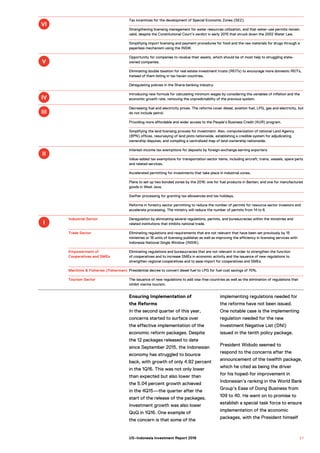
Ensuring Implementation of
the Reforms
In the second quarter of this year,
concerns started to surface over
the effective implementation of the
economic reform packages. Despite
the 12 packages released to date
since September 2015, the Indonesian
economy has struggled to bounce
back, with growth of only 4.92 percent
in the 1Q16. This was not only lower
than expected but also lower than
the 5.04 percent growth achieved
in the 4Q15—the quarter after the
start of the release of the packages.
Investment growth was also lower
QoQ in 1Q16. One example of
the concern is that some of the
implementing regulations needed for
the reforms have not been issued.
One notable case is the implementing
regulation needed for the new
Investment Negative List (DNI)
issued in the tenth policy package.
President Widodo seemed to
respond to the concerns after the
announcement of the twelfth package,
which he cited as being the driver
for his hoped-for improvement in
Indonesian’s ranking in the World Bank
Group’s Ease of Doing Business from
109 to 40. He went on to promise to
establish a special task force to ensure
implementation of the economic
packages, with the President himself
VI
V
IV
III
II
I
2 7US–Indonesia Investment Report 2016
acting as chairman. One of the first
undertakings of the special task force
will be to complete all of the 203
implementing regulations required
to support the economic packages
announced to date. At the time of
writing, 193 of these regulation have
been issued. This is a positive step
and demonstrates the President’s
own personal determination in making
sure there is real progress towards full
implementation. However, it should
also be mentioned that the delays
in implementation are also to some
extent due to the tug-of-war between
more reformist ministers who support
the liberalization, and those who are
more protectionist. In light of the
recent cabinet reshuffle, it is hoped
that the changes bode well for greater
synergies across the cabinet and a
stronger degree of consensus between
ministries and ministers in achieving
the government’s agenda.
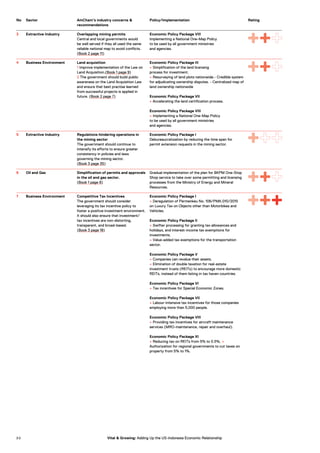
AmCham’s Recommendation and
Reform Scorecard
Taking all 12 economic reform
packages into account, and looking
back over all the recommendations
made by AmCham in its three
investment reports to date (2013-15)
comprising 50 industry concerns in
all, we have attempted to measure
progress against these concerns.
This is hardly a scientific exercise and
rather subjective. Nonetheless, it does
give a clearer indication of the extent
of progress we have seen to date. The
results are shown in Table 3.2 below,
which lists the industry concerns
that have been partially addressed,
the reform measures taken, and a
rough score from one to three of how
effective the reforms are viewed in
addressing the industry concerns. At
this stage, we have decided not to
try to measure the effective changes
on the ground and how effectively
the reforms have been implemented.
In many cases it is still too soon to
tell, and we will leave this exercise
until a clearer understanding can be
developed, hopefully in next year’s
investment report.
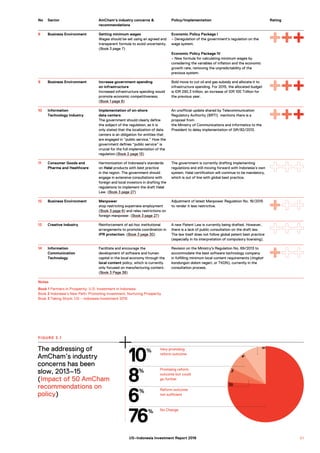
As Figure 3.1 illustrates, reform
progress in addressing AmCham’s
list of industry concerns has been
relatively slow. Of the 50 industry
concerns made over the past
three years, only 12 have been
addressed to any degree. Of these
12 recommendations, we categorize
the reforms into three levels: (i)
very promising, (ii) somewhat
promising, but could go further, and
(iii) inadequate in addressing the
recommendation in question. There
are five, four and three reforms in
these categories, respectively. This
means that reforms to date that are
very promising or somewhat promising
only address 16 percent of the industry
concerns made by AmCham since
2013 in its three investment reports.
While disappointing, this does still
confirm that some progress is being
made in addressing AmCham’s primary
concerns, although clearly there
is considerable scope for
further progress.
2 8 Vital & Growing: Adding Up the US-Indonesia Economic Relationship
No Sector AmCham’s industry concerns &
recommendations
Policy/Implementation Rating
1 Opening up more sectors
for foreign investment
Agriculture 1 The Indonesian government should
consider relaxing restrictions on
foreign investment to spur agricultural
development. (Book 2 Page 17)
(Book 3 page 22)
Economic Policy Package X
1 No changes in DNI.
2 No changes in DNI.
3 More open 49 to 100% (e.g., the film industry, hotels,
restaurants and bars).
Financial 2 The government may wish to assess
foreign ownership limits in the insurance
industry. The level of ownership should
ensure the attractiveness of the
insurance industry to foreign companies
(Book 2 Page 19) (Book 3 page 44)
Creative Industry 3 Incentives for the creative sector,
lower barriers to foreign investment.
(Book 3 page 31) e-commerce: sensible
regulations aimed at strengthening
e-commerce. (Book 3 page 30)
2 Business Environment Simplify investment procedures.
Reducing the number of procedures
would help to improve Indonesia's
investment competitiveness.
(Book 1 page 8)
1 Establish a “dashboard” at the
central government level. A centralized
dashboard would serve to monitor the
coherence of investment regulations and
their implementation. (Book 1 page 8)
2 Reduce the overall time for inspection,
permitting and licensing. There should be
a one-stop service, allowing the digital
submission of documents.
(Book 3 page 39)
Economic Policy Package II
+ Accelerated permitting for investment in industrial
zones.
+ Reforms in forestry sector permitting.
Economic Policy Package III
+ Simplificating the land licensing process. +
Computerization of the National Land Agency (BPN
offices).
+ Credible system for adjudicating ownership disputes.
Economic Policy Package IX
+ Logistic deregulation; the elimination of the
requirement for higher prices by commercial service
providers, simplification of the payment process for
fees and taxes by traders, and upgrading the Indonesia
National Single Window (INSW).
Economic Policy Package XII
Released several regulations to improve the ease of
doing business in Indonesia:
+ Public Works and Public Housing No. 05/PRTM/2016
concerning Building Permits.
+ Minister of Trade Regulation No. 14/M-DAG/
PER/3/2016 concerning Amendment to
Minister of Trade Regulation No. 77/M-DAG/
PER/12/2013 on the Issuance of Trade
Business Licenses and Company Registration.
+ Director General of Tax Regulation No. PER-03/
PJ/2015 concerning the Submission of Electronic Tax
Notifications using the Online Method.
Establishment of a One-Stop Service Center at
BKPM.This was announced on 26 January 2015.
Economic Policy Package IX
+ Logistics deregulation (single billing), simplification
of the payment process of fees and taxes by traders,
and upgrading of the Indonesia National Single Window
(INSW).
Economic Policy Package XI
+ Simplification and unification of port procedure under
the Indonesia National Single Window (INSW).
AmCham’s list of industry concerns and policy package matrix scorecard
TABLE 3.2
Very promising
reform outcome
Promising reform
outcome but could
go further
Reform outcome
not sufficient
No Change
2 9US–Indonesia Investment Report 2016
No Sector AmCham’s industry concerns &
recommendations
Policy/Implementation Rating
3 Extractive Industry Overlapping mining permits
Central and local governments would
be well served if they all used the same
reliable national map to avoid conflicts.
(Book 2 page 11)
Economic Policy Package VIII
Implementing a National One-Map Policy
to be used by all government ministries
and agencies.
4 Business Environment Land acquisition
1 Improve implementation of the Law on
Land Acquisition.(Book 1 page 9)
2 The government should build public
awareness on the Land Acquisition Law
and ensure that best practise learned
from successful projects is applied in
future. (Book 2 page 7)
Economic Policy Package III
+ Simplification of the land licensing
process for investment.
+ Resurveying of land plots nationwide.- Credible system
for adjudicating ownership disputes. - Centralized map of
land ownership nationwide
Economic Policy Package VII
+ Accelerating the land certification process.
Economic Policy Package VIII
+ Implementing a National One-Map Policy
to be used by all government ministries
and agencies.
5 Extractive Industry Regulations hindering operations in
the mining sector
The government should continue to
intensify its efforts to ensure greater
consistency in policies and laws
governing the mining sector.
(Book 3 page 35)
Economic Policy Package I
Debureaucratization by reducing the time span for
permit extension requests in the mining sector.
6 Oil and Gas Simplification of permits and approvals
in the oil and gas sector.
(Book 1 page 8)
Gradual implementation of the plan for BKPM One-Stop
Shop service to take over some permitting and licensing
processes from the Ministry of Energy and Mineral
Resources.
7 Business Environment Competitive Tax Incentives
The government should consider
leveraging its tax incentive policy to
foster a positive investment environment.
It should also ensure that investment/
tax incentives are non-distorting,
transparent, and broad-based.
(Book 3 page 18)
Economic Policy Package I
+ Deregulation of Permenkeu No. 106/PMK.010/2015
on Luxury Tax on Objects other than Motorbikes and
Vehicles.
Economic Policy Package II
+ Swifter processing for granting tax allowances and
holidays, and interest-income tax exemptions for
investments.
+ Value-added tax exemptions for the transportation
sector.
Economic Policy Package V
+ Companies can revalue their assets.
+ Elimination of double taxation for real-estate
investment trusts (REITs) to encourage more domestic
REITs, instead of them listing in tax haven countries.
Economic Policy Package VI
+ Tax incentives for Special Economic Zones.
Economic Policy Package VII
+ Labour-intensive tax incentives for those companies
employing more than 5,000 people.
Economic Policy Package VIII
+ Providing tax incentives for aircraft maintenance
services (MRO-maintenance, repair and overhaul).
Economic Policy Package XI
+ Reducing tax on REITs from 5% to 0.5%. +
Authorization for regional governments to cut taxes on
property from 5% to 1%.
3 0 Vital & Growing: Adding Up the US-Indonesia Economic Relationship
No Sector AmCham’s industry concerns &
recommendations
Policy/Implementation Rating
8 Business Environment Setting minimum wages
Wages should be set using an agreed and
transparent formula to avoid uncertainty.
(Book 3 page 7)
Economic Policy Package I
+ Deregulation of the government's regulation on the
wage system.
Economic Policy Package IV
+ New formula for calculating minimum wages by
considering the variables of inflation and the economic
growth rate, removing the unpredictability of the
previous system.
9 Business Environment Increase government spending
on infrastructure
Increased infrastructure spending would
promote economic competitiveness.
(Book 1 page 8)
Bold move to cut oil and gas subsidy and allocate it to
infrastructure spending. For 2015, the allocated budget
is IDR 290.3 trillion, an increase of IDR 100 Trillion for
the previous year.
10 Information
Technology Industry
Implementation of on-shore
data centers
The government should clearly define
the subject of the regulation, as it is
only stated that the localization of data
centers is an obligation for entities that
are engaged in “public service.” How the
government defines “public service” is
crucial for the full implementation of the
regulation.(Book 2 page 13)
An unofficial update shared by Telecommunication
Regulatory Authority (BRTI) mentions there is a
proposal from
the Ministry of Communications and Informatics to the
President to delay implementation of GR/82/2012.
11 Consumer Goods and
Pharma and Healthcare
Harmonization of Indonesia's standards
on Halal products with best practice
in the region. The government should
engage in extensive consultations with
foreign and local investors in drafting the
regulations to implement the draft Halal
Law. (Book 3 page 27)
The government is currently drafting implementing
regulations and still moving forward with Indonesia’s own
system. Halal certification will continue to be mandatory,
which is out of line with global best practice.
12 Business Environment Manpower
stop restricting expatriate employment
(Book 3 page 6) and relax restrictions on
foreign manpower. (Book 3 page 27)
Adjustment of latest Manpower Regulation No. 16/2015
to render it less restrictive.
13 Creative Industry Reinforcement of ad-hoc institutional
arrangements to promote coordination in
IPR protection. (Book 3 page 30)
A new Patent Law is currently being drafted. However,
there is a lack of public consultation on the draft law.
The law itself does not follow global patent best practice
(especially in its interpretation of compulsory licensing).
14 Information
Communication
Technology
Facilitate and encourage the
development of software and human
capital in the local economy through the
local content policy, which is currently
only focused on manufacturing content.
(Book 3 Page 38)
Revision on the Ministry's Regulation No. 69/2013 to
accommodate the best software technology company
in fulfilling minimum local content requirements (tingkat
kandungan dalam negeri, or TKDN), currently in the
consultation process.
Notes
Book 1 Partners in Prosperity: U.S. Investment in Indonesia
Book 2 Indonesia’s New Path: Promoting Investment, Nurturing Prosperity
Book 3 Taking Stock: US – Indonesia Investment 2015
The addressing of
AmCham’s industry
concerns has been
slow, 2013–15
(Impact of 50 AmCham
recommendations on
policy)
FIGURE 3.1
76%
6%
8%
10% Very promising
reform outcome
Promising reform
outcome but could
go further
Reform outcome
not sufficient
No Change
3 1US–Indonesia Investment Report 2016
3 23 2 Vital & Growing: Adding Up the US-Indonesia Economic Relationship
4
Looking
Beyond Our
2014 Baseline
Three Scenarios for Growth
Using our Big Number for 2014 as a
baseline, it is possible to extrapolate
into the future using a number of
different scenarios of economic
growth between now and 2020. We
have selected three main scenarios
as follows: (i) our business-as-usual
scenario, which assumes a compound
annual growth rate (CAGR) of 5.1
percent over the period (the current
World Bank GDP growth projection
for 2016); (ii) a worst-case scenario
where Indonesia is hit by global
financial shocks and experiences
macroeconomic volatility that reduces
economic growth to an average of 3.5
percent; and (iii) a best-case scenario
whereby Indonesia achieves President
Joko Widodo’s goal of 7 percent GDP
growth by the end of his term in 2019.
The growth trajectories are illustrated
in Figure 4.1 below:
US–Indonesia Investment Report 2016 3 3Amcham Indonesia Investment Report 2016
Three growth scenarios for
the value of Indonesia-US
economic activities,
2015–19 ($ billion)
NOTE THESE DATA USE NOMINAL FIGURES,
AFTER CALIBRATING FROM CONSTANT PRICE
FOR PROJECTION PURPOSES. AT CONSTANT
2015 PRICES (CPI = 6.38%) AND 2014 $/IDR
FOREX RATE.
SOURCE AMCHAM STAFF CALCULATIONS.
FIGURE 4.1
135
130
125
120
115
110
105
100
9597.2
100.5
107.5
103.7
100.6
104.1
107.7
111.5
109.0
114.5
120.4
131.7
115.0
123.1
2015 2016 2017 2018 2019*
98.7
3.5% GROWTH
5.1% GROWTH
7.0% GROWTH
Based on these assumptions, in the
best-case scenario the total value of
economic activities shared by Indonesia
and the US grows from $90.1 billion
in 2014 to $131.7 billion in 2019, an
increase in the “pie” of 46.2 percent
over 5 years. Meanwhile, the business-
as-usual scenario would only increase
economic activities by 5.1 percent, to
$120.4 billion in 2019, while the worst-
case scenario would see an increase of
3.5 percent, to $111.5 billion by the end
of President Widodo’s terms in 2019
(Table 4.1).
46.2“In the best-case scenario the total value of economic activities shared
by Indonesia and the US grows from US$ 90.1 billion in 2014 to US$
131.7 billion in 2019, an increase in the “pie” of 46.2 percent
over 5 years.”
3 4 Vital & Growing: Adding Up the US-Indonesia Economic Relationship
Values of Indonesia–US
economic activities in the
three scenarios, 2015–19
($ billion)
NOTE THESE DATA USE NOMINAL FIGURES,
AFTER CALIBRATING FROM CONSTANT PRICE
FOR PROJECTION PURPOSES. AT CONSTANT
2015 PRICES (CPI = 6.38%) AND 2014 $/IDR
FOREX RATE.
SOURCE AMCHAM INDONESIA STAFF
CALCULATIONS.
TABLE 4.1
5.1% World Bank
growth scenario (i)
3.5% growth
scenario (ii)
President’s Widodo’s 7%
growth by 2019 scenario (iii)
2015 98.7 97.2 100.5
2016 103.7 100.6 107.5
2017 109.0 104.1 115.0
2018 114.5 107.7 123.1
2019 120.4 111.5 131.7
What can be done to make sure that
Indonesia gets on track to follow the
best-case scenario and grow the
economic pie by as much as is feasibly
possible? This assumes that the share of
the Indonesia-US economic relationship
to GDP remains more or less constant at
9.5 percent from 2014 to 2019, while the
nominal size of the relationship grows to
$ 131.7 billion by 2019.
Incidentally, if the Indonesian economy
were to grow based on our best-
case scenario assumption, this would
mean that the cumulative value of all
economic activities between the two
countries from 2015 through to 2019
would be about $577.8 billion—a very
big number indeed!
3 5US–Indonesia Investment Report 2016
3 63 6 Vital & Growing: Adding Up the US-Indonesia Economic Relationship
5Cross–Sectoral
Analysis &
Sector Ranking
In order to analyze the nature of the involvement of US companies across our
nine sectors, and the relative prospects for those sectors, we constructed a
methodology to rank sectors according to four criteria. These four criteria are:
1	
2
3
4
Total US economic activities of US
companies in each sector.
Overall share of US companies in each sector as
a fraction of the total size of each sector.
Compound annual growth rate (CAGR) of each
sector in 2010-14.
Year-on-year growth of each sector from 2014
to 2015.10
US–Indonesia Investment Report 2016 3 7Amcham Indonesia Investment Report 2016
Sector rankings and best overall sector for growth and investment
TABLE 5.1
2015 AG CG CI PHLS FIN INF ICT O&G EXT
Size of sector ($ bn) 116.54 319.74 76.92 9.22 48.92 167.44 30.39 28.58 37.10
Share of sector in the economy (% GDP) 14.61% 40.08% 9.64% 1.16% 6.13% 20.99% 3.81% 3.58% 4.65%
US size in sector ($ bn) 7.16 22.75 7.96 0.28 1.81 5.38 1.03 15.08 17.99
Share of US presence in sector (%) 6.15% 7.12% 10.35% 3.08% 3.70% 3.21% 3.39% 52.75% 48.50%
CAGR (%) 2010–14 3.06% 3.54% 5.50% 5.89% 6.73% 6.43% 2.51% 3.75% 1.70%
Year-on-year growth (%) 2014–15 -1.91% -4.21% 0.28% 0.2% 1.05% 3.16% -2.39% -33.36% -17.57%
Rank according to US size in sector 4 1 5 9 7 6 8 3 2
Rank according to growth of sector 2010–14 7 6 4 3 1 2 8 5 9
Rank according to % of US in sector 4 5 3 9 6 8 7 1 2
Rank According YoY growth 2014–15 5 7 3 4 2 1 6 9 8
Total of all variables score 20 19 15 25 16 17 29 18 21
Ranking best overall sector 6 5 1 8 2 3 9 4 7
1 2 3 4 5 6 7 8 9
Ranking best overall sector CI FIN INF O&G CG AG EXT PHLS ICT
For each of these criteria, we ranked
each sector from 1 to 9 and then added
their rankings to give sector scores of
4-36. Then dividing them by 4 gives
equal weighting to each of our four
criteria. The result is a sectoral ranking
from 1 to 9, where 1 is the most the
sector with the greatest potential
for growth and investment for US
companies and 9 is the least.
By including all four factors in this
way—using our data on economic
size, share of the sector, compound
growth rate and latest year-on-
year growth rate—we try to reflect
as accurately as we can, albeit
subjectively, what is happening in the
overall Indonesian economy and how
US companies are doing.
These factors were chosen such that
we could compare the potential for
investment and growth in the various
sectors in which US companies have
investments. The absolute size of the
sector, and the portion of the sector
that is occupied by US companies,
gives us an indication of the relative
importance and opportunities for
further investments in the sector.
The CAGR (2010-14) gives historical
perspective on sector growth, while
the 2014-15 growth rate gives us
information about the current direction
and potential of the sector. The
growth rates differ from those given
by the Indonesian government, as they
are based upon rupiah converted to
US dollar values, thus reflecting the
continued devaluation of the rupiah
over the past 5 years. Ultimately, this
is the value that US investors use in
making their investment decisions
and the return on the US dollar
invested. Cross-sectoral comparisons
are difficult at best and our ranking
system does not take the policy and
regulatory environment into account,
which is highly subjective, but would
probably also change the rankings of
the sectors.
3 8 Vital & Growing: Adding Up the US-Indonesia Economic Relationship
Ranking Based on US Companies’
Economic Activities in the Sector
This ranking simply states which sector
has the largest amount of US company
economic activity. The largest sector
on this basis is the consumer goods
sector, followed by the extractive
sector, and oil and gas. This makes
sense, as consumer goods in our
definition is a vast catch-all sector of
the economy, while extractive, and
oil and gas, are also major sectors,
regardless of the recent downturn in
commodities prices. Conversely, the
smallest sectors are pharmaceuticals,
healthcare and life sciences, followed
by ICT and finally by finance. Despite
the importance of financial flows as
a component of our Big Number, the
relative size of the finance sector
reflects actual booked revenue and
taxes, as opposed to the huge size of
financial transactions supported by
the sector.
Ranking Based on the Share of the
US Presence in the Sector
This ranking reflects the share of a
sector filled by US companies. The
percentage share number can also
be viewed as a saturation number,
indicating those sectors that have
already reached a mature stage where
US companies have little further scope
for expansion. Not surprisingly, the
ranking shows that the oil and gas,
and extractive sectors both have the
largest respective market shares. The
creative industries sector comes in
at a surprising third position, perhaps
reflecting the relatively new nature
of the industry and the leading edge
and high penetration in this new area
by US companies. Pharmaceuticals,
healthcare and life sciences is the
sector in which US companies have
the smallest representation, while
infrastructure has the next smallest US
share (ranking eighth). This seems to
confirm that US companies have had
less involvement in large infrastructure
projects of late.
Ranking Based on the Growth
Rate of the Sector
Ranking Based on the Year–on
–Year Growth Rate 2014-15
The calculated 2010-14 CAGR for the
sectors helps to complete the overall
picture by ranking sectors according
to how well they have been doing
in the recent past. Historically, the
fastest growing sectors are finance,
infrastructure, healthcare and life
sciences, and the creative industries.
It comes as no surprise that the worst
performing sector is oil and gas given
the decline in commodity prices,
investment and production.
The latest annual growth rate for
2014-15 reflects the current status
of each sector. The growth rate has
been impacted by the depreciation
of the rupiah over the period, which
fell by 11 percent during this period.
During 2015, infrastructure and finance
grew the fastest, with agriculture and
consumer goods contracting, while
the extractive and oil and gas sectors
plummeted with -17.6 percent and
-33.4 percent year-on-year declines.
During 2015, infrastructure and finance
grew the fastest, with agriculture and
consumer goods contracting, while
the extractive and oil and gas sectors
plummeted with -17.6 percent and -33.4
percent year-on-year declines.
3 9US–Indonesia Investment Report 2016
1st 2nd
Creative Industries Sector
The creative industries sector is the
newest of the sectors that we cover,
exhibiting strong historical and current
growth. It also is third best in terms
of US company sector penetration.
Although the creative economy did not
rank top for any of the four factors,
and faces challenges with excessive
regulatory oversight together with
inconsistent enforcement measures
impacting the exploitation and
distribution of creative content,
a strong combination of market
penetration and growth indicates that
this sector has good potential.
Financial Sector
The nature of the finance sector is that
companies take only a small amount of
its huge overall turnover. This tends
to understate the impact of the sector
on overall economic activity, despite
its obvious importance and overall
size, as shown by the relative size
of financial flows as a component of
our Big Number. While US companies
play a vital role in this sector and the
overall economy, there are relatively
few US players operating in Indonesia.
With a CAGR of 6.73 percent over the
past 5 years, growth in the sector is
the best of all sectors. Given the US
presence of just 3.7 percent, there
should be significant scope for further
US expansion in the sector, especially
as the insurance market starts to open
up and gains traction from the growing
middle class. It may be difficult for US
banks not already present in Indonesia
to penetrate the market, given the
regulatory environment. However,
the large US banks already here are
well positioned to benefit from future
robust economic growth.
Below are some thoughts on each of the sectors based upon their overall ranking from
the most promising for growth and investment to the least promising.
4 0 Vital & Growing: Adding Up the US-Indonesia Economic Relationship
Infrastructure Sector
The infrastructure sector exhibits
strong historical growth and the best
recent growth rate of all of the sectors.
Given the government’s priority on
infrastructure, and the constraints
on meeting the huge financial
requirements needed, this should make
the sector attractive to US companies
going forward, although competition
will be fierce from major Asian and
European infrastructure companies.
The potential in the sector is so large
that US companies should be able to
make inroads in the coming years.
3rd
Given the US presence of just
3.7 percent, there should be
significant scope for further
US expansion in the sector,
especially as the insurance
market starts to open up
and gains traction from the
growing middle class
4 1US–Indonesia Investment Report 2016
4th
Oil & Gas Sector
Being the largest sector in terms of US
company presence, at 52.8 percent,
and the third-largest sector in terms of
US company economic activities, the
oil and gas sector should be a good one
for US companies. However, this has
to be tempered by negative growth in
the sector—it experienced the largest
contraction in 2015. As a result, we
rank the oil and gas sector fourth.
This is a sector that has also reached
maturity for US companies, and is
likely to see a decline in the coming
years as the impact of low commodity
prices forces companies to scale back
their operations. As a result, we are
likely to see the ranking of the oil and
gas sector decline in future years.
However, this decline is not entirely
due to falling prices; severe regulatory
challenges were already in place
for years before the price decline,
discouraging investment. Collective
efforts are required to correct
persistent regulatory problems in order
to improve the investment climate and
reverse the declines. Given the size
of the sector for Indonesia, further
declines, if they occur, will have a large
negative impact on total US company
activities in Indonesia.
Being the largest sector in terms
of US company presence, at 52.8
percent, and the third-largest
sector in terms of US company
economic activities, the oil and gas
sector should be a good one for US
companies. However, this has to be
tempered by negative growth in the
sector—it experienced the largest
contraction in 2015
4 2 Vital & Growing: Adding Up the US-Indonesia Economic Relationship
Consumer Goods Sector
This is the largest sector in the
Indonesian economy and it provides
the largest amount of US company
economic activities. In terms of our
ranking, the consumer goods sector
comes in fifth overall, primarily due
to relatively slow growth historically
and negative growth in 2015. Overall,
US companies are already well
positioned in the sector and making
strong revenues, but at the same
time the sector has been hurt by slow
growth and rupiah depreciation. If the
Indonesian economy gradually recovers
from the 2015 slowdown, growth in
the sector should start to reverse its
contraction of -4.21 percent in 2015,
and move back toward its historical
CAGR of 5.5 percent in 2010-14. It is
likely therefore that going forward we
can expect the consumer goods sector
to not only consolidate its primary
position for US companies in Indonesia,
but also to attract further interest from
US companies that have yet to start
operations in Indonesia.
5th 6th
Agriculture Sector
The agriculture sector appears to be
stable for US companies, with sizeable
economic activities, together with
a US presence slightly above the
median. The growth rate, at a CAGR
of 3.06 percent in 2010-14, is below
the national GDP growth rate of 5.1
percent, which is probably largely
due to the depreciation of the rupiah.
At 6.2 percent presence in the sector,
there is still ample scope for US
companies to expand their
penetration should government
policies encourage higher levels of
investment in agriculture.
4 3US–Indonesia Investment Report 2016
7th
Extractive Sector
The extractive sector comes in seventh
in our ranking, despite being second in
US sectoral activity, at $18 billion, and
market penetration at 48.5 percent.
However, slow growth in the sector,
at just 1.7 percent annually in 2010-
14, and a severe contraction of -17.6
percent in 2015, coupled with severe
regulatory problems over the past few
years, indicates that the extractive
sector has reached maturity and offers
little future potential for expansion.
Indeed, if progress cannot be made to
resolve current regulatory issues, then
the sector’s ranking can be expected
to decline further as the presence of
US companies wanes and total US
company economic activity
declines as a result.
Slow growth in the sector, at just 1.7 percent annually
in 2010-14, and a severe contraction of -17.6 percent
in 2015, coupled with severe regulatory problems
over the past few years, indicates that the extractive
sector has reached maturity and offers little future
potential for expansion.
4 4 Vital & Growing: Adding Up the US-Indonesia Economic Relationship
8th
Pharma, Healthcare & Life Sciences
The pharmaceuticals, healthcare and
life sciences sector came in second
to bottom of all of the sectors due
to the small market penetration by
US companies, as just 3.1 percent,
as well as low US company economic
activities, at only $265.5 million in
2015. The relatively strong growth
rate of the sector, with a CAGR of
5.89 percent in 2010-14, indicates
that there is considerable room for
further penetration by US companies.
However, future expansion may
be constrained by implementing
regulations for the 2014 Halal Law,
which is set to have a major impact
on pharmaceuticals.
ICT
Another relatively new industry, the
ICT sector is at the bottom of the
rankings due to the relatively small US
company presence in the sector, which
is dominated by the large domestic
telecommunications companies, as
well as slow historical growth and a
contraction in 2015. The presence of
US companies in the sector is also
low, at just 3.4 percent, limiting the
scope for total US company economic
activities. Overall, this indicates good
growth potential, not only for the
sector but also for US companies, as
the non-telecommunications portions
of the sector develop.
9th
4 5US–Indonesia Investment Report 2016
6
AmCham’s 2016
Investment
Sentiment
Survey
In order to better understand the current investment sentiment of US companies
in Indonesia and the current characteristics of US companies already operating
here, AmCham Indonesia conducted a combined investment survey and data
questionnaire among large companies in May and June of this year. The survey
provides the following insights.
4 64 6 Vital & Growing: Adding Up the US-Indonesia Economic Relationship
Company Perceptions
First of all, we asked US companies
whether they had seen an
improvement in the investment climate
over the past two years (i.e., since the
Widodo administration took office).
In response, 87 percent of companies
felt that there had been “some
improvement.” Meanwhile, when
asked whether the 12 economic reform
packages had had any impact on the
business environment, fully 100 percent
replied that they perceived “some
impact.” This figure drops considerably
when the same companies were asked
if the packages had had any tangible
impact of their own businesses. Here,
only 25 percent felt there was “some
impact,” while 75 percent felt there
had been “no impact,” or that it was
still “too early to say.”
We then asked the companies
about those areas they felt needed
improvement in order for their
businesses to prosper, asking
them to rank five areas in terms of
importance. The most important
area of concern was Legal Certainty,
with 50 percent of companies
ranking this the highest priority.
This was followed by Regulatory
Reform, ranked first by 37 percent
of companies, followed by the need
for Policy Reform. This was followed
by Infrastructure Improvements. The
fifth most important area was seen as
Improvements in Human Resources.
Lastly, we asked the companies if they
felt more positive today than they did
two years ago about doing business.
Here we found that while 50 percent of
companies were “more positive” now,
the other 50 percent were either “less
positive” or “not sure.” The structural,
procedural and behavioral changes
underway need to be continuously
encouraged to bring about more
positive reforms.
The Characteristics of US
Companies in Indonesia
In terms of the characteristics of
the US companies in our survey, the
average amount of total FDI invested in
Indonesia was about $3 billion. Average
revenue in 2015 was about $1.9 billion,
with average total salaries of $83
million. Total salaries and employee
compensation paid by US companies in
2015 were about $344 million.
The figures for government revenue
paid by the companies in our survey
are also interesting, as they shed
some light on the degree to which
the government revenue component
in our Big Number is understated.
The average payments for total VAT
(PPN), total indirect taxes (royalties
and excise) and corporate income tax
by US companies in 2015 were $171.3
million, $2.0 billion and $105 million,
respectively. Meanwhile, the totals
were $685.2 million for VAT, $4.0
billion for NTR, and $315.8 million for
corporate income tax. It is interesting
to note that the revenue from NTR
is almost six times that from VAT.
Bearing in mind that our Big Number
uses data built on only VAT revenue,
this means that our Big Number is
understated by at least $4.7 billion, if
we include both NTR and corporate
income tax.
Looking at investment intentions going
forward, on average the US companies
in our survey had plans to invest $334
million over the next 5 years. In terms
of employment, the US companies in
our survey employed about 112,000
workers in 2015, while fewer than 100
employees in these companies were
expatriates—less than 0.1 percent.
Therefore, US companies operating
in Indonesia can be seen to be major
employers of Indonesians,
not expatriates.
US–Indonesia Investment Report 2016 4 7Amcham Indonesia Investment Report 2016
4 84 8 Vital & Growing: Adding Up the US-Indonesia Economic Relationship
7
Getting to a
Best-Case
Scenario
What Is Holding Indonesia Back?
It can be tempting at times to wonder
why optimal progress toward growth,
prosperity and equality seems to
be so hard to achieve in Indonesia.
Indonesia is well-endowed in many
ways, yet it has struggled to unleash
rapid economic progress and social
empowerment—at least since the
start of the Reformasi era. This may
have its roots in the command-and-
control economy of the Soeharto era
that was established in the wake of
economic collapse in the 1960s. This
focus on control is still alive in today’s
government bureaucracy.
This has become further complicated
in recent years by an apparent
yearning to become self-sufficient
without relying on international trade
or investment. Despite the welcome
efforts made by President Widodo
to encourage investment, there
is a strong perception that many
Indonesians—both in the elite and the
broader population—see foreign direct
investment (FDI) as something of an
embarrassment. When times are bad it
may be tolerated, but when times are
good then maybe it could be done away
with completely. Even the Investment
Coordinating Board (BKPM), which
US–Indonesia Investment Report 2016 4 9Amcham Indonesia Investment Report 2016
has been tasked in recent years with
making international investment easier,
was originally established as part of
the broader command-and-control
system to limit FDI, as opposed to
enabling it. In light of this, its new
role of investment facilitator has been
challenging for BKPM, although it has
taken the transition seriously.
Over the course of the five
governments that have come and gone
since Reformasi in 1998, Indonesia
has become increasingly inward-
looking. As a consequence, the space
that had previously been created for
foreign private sector businesses has
narrowed. A sense of complacency was
also apparent after Indonesia avoided
the direct impact of the global financial
crisis in 2009-11, protected as it was
by the commodities boom. Bureaucrats
could claim that restrictive policies
were having the desired effect, but in
reality the collapse in commodity prices
and the economic slowdown in China
left Indonesia in the doldrums.
It has become quite clear that the
over-dependence on commodities
since 1998 has come at the heavy price
of deindustrialization and contraction
of the once-powerful manufacturing
sector. Today these policies, many of
which are still being adhered to, have
allowed other more open economies
in the region, such as Vietnam, India
and the Philippines, to power ahead
of Indonesia. While some senior
technocrats make the case for greater
participation in the global economy—
an idea backed by President Widodo
with orders to streamline regulations—
the reality is that many career
bureaucrats have been resisting the
directives as they continue to pursue
regulatory complexity.
While AmCham Indonesia and the
U.S. Chamber of Commerce are
mostly focused on issues that directly
challenge our members in their
respective sectors, we also view this
broader context with concern. In the
nine sector chapters of this investment
report, we dwell on specifics but we
also wish to offer some ideas—inspired
by the President’s own rhetoric—for
continuing to shift the country away
from protectionism and policies that
discourage private sector investment.
We believe these ideas would help the
Indonesian people and that if these
shifts take root in the next year or two,
it is quite possible to reach President
Widodo’s goal of 7 percent GDP
growth in 2019. This could also grow
the size of the economic relationship
between Indonesia and the US to
$131.7 billion by that year, a potential
46 percent increase on its 2014 level.
That should certainly be a goal worth
striving for.
While some senior technocrats
make the case for greater
participation in the global
economy—an idea backed by
President Widodo with orders to
streamline regulations—the reality
is that many career bureaucrats
have been resisting the directives.
5 0 Vital & Growing: Adding Up the US-Indonesia Economic Relationship
Ideas for a 21st Century
Global Economy
In interviews with senior executives
of major US companies operating
in Indonesia, we have put together
a short list of themes that resonate
across sectors and that might be useful
in helping Indonesia move toward
becoming a truly 21st
century global
economy that embraces trade and
investment and feels confident enough
to become a competitive player in the
global economic system.
Achieving a best-case scenario Innovation
We frequently hear that Indonesia must become more innovative. Clearly, in a
world that is changing rapidly, in both creative and disruptive ways, Indonesia
needs to embrace change if it is to avoid falling behind its peers. In Indonesia,
however, (and not only in Indonesia) there are strong forces resisting innovation,
as it threatens established controls. Not only do controls need to be loosened,
but perhaps more importantly a vital ingredient for innovation is the opportunity
to fail. Failure is an inseparable part of innovation and many, if not most, initial
attempts at innovation result in failure. For innovation to take root across
the business environment and society, failure and acceptance of risk must be
accepted as part of this process.
Ownership and equity
One facet of the protectionist environment in Indonesia has long been an
overemphasis on ownership and equity. Instead of focusing on performance and
excellence, artificial limits have been placed on ownership through equity shares.
The result is often an uncomfortable mix of “partners” and hesitation among
foreign investors who feel uneasy about being limited to holding a minority stake
in their businesses. The recent revision of the Negative Investment List (DNI)
partially addressed this in a few sectors but huge potential could be unleashed by
allowing the best and the most capable investors—regardless of whether they are
foreign or local—to prove their worth by lifting restrictions on ownership. As long
as companies follow the law, pay their taxes and create employment, generating
wealth along the way, ownership percentages should be of secondary concern.
Regulations: Control or enable?
Excessive control can be stifling for innovation and investment. The government
bureaucracy seems designed to exert control, often unnecessarily, and this
has become a justification for government itself. This is in stark contrast to
facilitating an enabling environment in which businesses, both local and foreign,
can thrive and prosper. BKPM is a good example of change. It has moved from
being an instrument for restricting and controlling investment to becoming a
modern government agency focused on enabling business. Following this model,
regulations should be seen as enabling tools, not restrictive barriers that may
benefit a few to the detriment of the majority.
Incentives
We often hear from senior executives about the need for greater incentives in
Indonesia to stimulate better performance and greater efficiency. In some sectors,
increased incentives would help reverse a continuous erosion of the economic
attractiveness of projects and significantly increase investment. The private
sector is well acquainted with incentives—indeed they are widely used internally
by companies to encourage better performance—but they need to be applied
across an even wider range of activities, especially in the interaction between
government and business. Applied correctly and with care, the right incentives
could have the same transformational impact on government and investment as
they have had in the private sector.
5 1US–Indonesia Investment Report 2016
Let business decide
Executives frequently raise concerns about government regulators interfering
in what are essentially management and business decisions. We mention above
the question of ownership limits as an example, but often just as debilitating are
restrictions placed on hiring expatriates, including limiting the age of expatriate
workers regardless of their competence. Hiring decisions should be made by
companies themselves with the full understanding that employing expatriates is
expensive and is often done as a last resort when local talent cannot be found.
Frequently, expatriates create jobs and bring much needed revenue into the
country. Government should not try to micromanage corporate hiring, and in
an enabling environment for business, it would focus instead on monitoring
compliance with necessary regulations and imposing sanctions, if needed.
Actions that could
transform the economy
Based on the themes we have articulated above, we have come up with four
possible actions that could unleash great economic potential if implemented.
Some of them would be immensely challenging politically, while others would
serve to strength what is already taking place but has yet to be fully optimized.
Abolish the DNI
The Negative Investment List (DNI)
is an outdated throwback. It has been
humorously referred to by a former
Minister of Trade as the “Import
Encouragement List” because, by
discouraging investment through
limiting equity ownership, it simply
forces companies to make products
abroad that could be made more
cheaply in Indonesia—products that
are then imported instead. It would
take a brave politician to propose it,
but the DNI should be abolished.
Bureaucratic reform
This is a daunting and far-reaching
challenge that governments have
chosen to avoid. For instance,
there is an urgent need to improve
the efficiency and transparency of
government permitting and approvals.
But the government bureaucracy
remains largely unreformed and is
not well-suited to the tasks required
by a modernizing, rapidly changing
and globally connected business
environment. There is often antipathy
and suspicion toward the private
sector, especially the foreign private
sector, and excessive regulation is seen
as a means of promoting anti-business
policies and cementing bureaucratic
power. Overhauling personnel,
imposing accountability and changing
incentive structures are prerequisites
for achieving higher levels of
professionalism. The bureaucracy is
a vital cog in the wheel of economic
performance and efficiency, and all
the regulatory improvements in the
world are unlikely to have much impact
without a professional and dynamic
interface between the government
and the real sector. One step would be
to use early retirement to create new
space for the hiring of young university
graduates as has already been done
in some ministries under the current
government. This is a way to build new
attitudes from the ground up.
Collaboration and open
communications
Time and again, we hear a similar
message: foreign companies
want deeper collaboration with
the government. Instead of being
controlled from a distance by ministry
officials, companies want to work in
partnership with government to find
win-win solutions. Often, regulations
are introduced with seemingly little
thought given to possible negative
consequences. Business can help by
being consulted early in the process
instead of just being informed that
changes are coming. A flexible enabling
government that wants growth,
investment and employment can work
with senior executives in the private
sector to
5 2 Vital & Growing: Adding Up the US-Indonesia Economic Relationship
Freedom to establish a PMA
Our last action could be an easy one.
One of the outdated regulations
in Indonesia is that any foreign
company wanting to set up operations
must apply for approval from the
government first. This is unnecessary
and should be abolished, in order to
allow all companies the freedom to
establish a foreign legal entity (PMA)
simply by applying online to the
Ministry of Law and Human Rights. We
suggest welcoming foreign companies
to set up, within the existing legal
framework, and invest in Indonesia.
Of course, this means they will have
to follow the laws and regulations
of the land, which will require ex
post monitoring for compliance, and
sanctions where laws and regulations
are not respected. Such a shift would
be very straightforward but it would
send shock waves throughout the
international investor community and
advertise the fact that Indonesia really
is open for business.
With these steps Indonesia could finally move away from the potential to the
fully possible. In the nine sectors we concentrate on, a full flowering of economic
benefit could create the best outcomes for the private sector and
the general population.
ONE NOTE If this seems too ambitious in nine sectors at once, then perhaps
Indonesia could start with just one sector of the nine—a pilot sector. One perfect
place would be in what we call the consumer goods sector, as this contains much
of the crucially important manufacturing sector. As we mention earlier, Indonesian
manufacturing lost much of its prowess after the Asian financial crisis in 1997/98
and the later shift toward commodities. Now is the time to correct this error
before it is too late, and return the manufacturing sector to its rightful place in
the Indonesian economy.
A full flowering of
economic benefit could
create the best outcomes
for the private sector and
the general population.
obtain the perfect combination of
skills and experience to overcome
previous constraints in policymaking
and regulation. This reasoning
also extends to intra-government
coordination, both between agencies
and between the central government
and regional governments. Clear, open
communications among all government
stakeholders maximizes the value of
investments for companies and for
Indonesia. The resulting synergies could
turn Indonesia into a world-beater.
5 3US–Indonesia Investment Report 2016
The Big Number and Our Conclusions
This investment report lays out the size
and importance of the Indonesia-US
economic relationship in a way that
has never been done before. We show
that, at $90.1 billion in 2014, it is far
more important than simply looking at
FDI flowing from the US to Indonesia,
especially if looking at the data. The
relationship is hugely important, not
only to the US, but particularly to
Indonesia, as it accounts for more than
10 percent of Indonesia’s GDP. With
the suggestions and actions here and
in the sectoral sections of this
report, the Indonesia-US economic
relationship will certainly grow.
For the first time in several years,
there are encouraging signs that
the government is embracing
greater openness. We believe that a
fundamental change in the mindset of
controlling – in contrast to enabling
– foreign investors is needed, and
that such a shift must be reflected
throughout the government—not just
by a handful of senior ministers.
The more daring the reforms, the
greater will be economic growth,
with the hope that it can result in
President Widodo’s goal of 7 percent
GDP growth being achieved by 2019.
This would increase the Indonesia-US
economic relationship to $131.7 billion.
This will be a tough challenge to meet,
but the US private sector companies
in Indonesia, and those on the verge
of investing, stand ready to work in
partnership with the government and
people of Indonesia to make it happen.
The more daring the
reforms, the greater
will be the growth,
with the hope being
that it can result in
President Widodo’s
goal of 7 percent
GDP growth by
2019.
5 4 Vital & Growing: Adding Up the US-Indonesia Economic Relationship
5 5US–Indonesia Investment Report 2016
5 65 6 Vital & Growing: Adding Up the US-Indonesia Economic Relationship
8
Overview of
Sectors
US–Indonesia Investment Report 2016 5 7Amcham Indonesia Investment Report 2016
Agriculture
Indicator 2015 Source
Total size of sector ($) $116.5 billion BPS
Share of sector in the economy (% GDP) 14.6% BPS
Sector ranking in the Indonesian economy 3rd largest BPS
CAGR 2010-14 (%) 3.1% BPS
YoY sector growth 2014-15 (%) -1.9% BPS
Largest company in sector PT. Perkebunan Nusantara (PTPN) AmCham
Largest US company in sector Cargill AmCham
Size of US companies in sector ($) $7.2 billion BEA*
% share of US companies in sector (%) 6.2% BEA*
FDI (realized) by US companies in sector ($) $2.6 million BI
Exports of US companies in sector ($) $5.1 billion US Census
Imports of US companies in sector ($) $3.2 billion US Census
Total workforce in the sector (formal sector only) 37.7 million BPS
% employment of sector in total Indonesian workforce 32.9% BPS
NOTE *BEA DATA FOR 2014
BPS BADAN PUSAT STATISTIK / STATISTICS INDONESIA
BEA BUREAU OF ECONOMIC ANALYSIS, US DEPARTMENT OF COMMERCE
S 1
TABLE 8.1
5 8 Vital & Growing: Adding Up the US-Indonesia Economic Relationship
20
15
10
5
0
–5
–10
125
120
115
110
105
100
95
105.3
–4.5
14.6
1.8
–0.4
–2.8
–1.9
120.7 122.8 122.3 118.8 116.5
2010 2011 2012 2013 2014 2015
Size and growth of the
agriculture sector, 2010–15
($ billion, constant
2010 prices)
SOURCE BPS (THROUGH CEIC).
FIGURE 8.1
SECTORAL GDP (US$ BILLION) (LHS)
YOY CHANGE IN SECTOR GROWTH (%) (RHS)
Sector Overview
The agriculture sector, including
fisheries and forestry, is a hugely
important in Indonesia, employing
about 33 percent of the country’s
formal labor force, and many millions
more in the informal agriculture sector.
It is also of global importance because
Indonesia is the largest producer
of crude palm oil in the world, and
a leading producer of high value
commodities such as cocoa, rubber and
coffee, and a major exporter of fish and
seafood. In recent years, export crops
have come to dominate land use across
the archipelago to take advantage of
spikes in global food prices. However,
while Indonesia is a major exporter of
several food commodities, it is also
heavily reliant on imports of other food
staples, such as soybeans, wheat,
corn and sugar. For example, soybean
imports from the US were valued at
$794 million in 2015, according data
from the US Census, and provide
2.2 million tons out of total national
soybean consumption of 2.8 million
tons annually. Almost all of Indonesia’s
wheat is also imported, with imports
from the US worth $105 million in 2015.
Agriculture accounts for about 14.6
percent of Indonesia’ total economy,
making it the third-largest sector of
economic activity, valued at $116.5
billion in 2015. In terms of trade with
the US, Indonesia’s agricultural exports
to the US far outweigh its imports,
with almost twice as much value being
exported to the US as imported from
the US, at $5.1 billion vs. $3.2 billion
in 2015. It is also a major focus of US
FDI, valued at $2.6 billion in realized
5 9US–Indonesia Investment Report 2016
FDI in the same year (US Census data).
However, agriculture has struggled to
grow since 2012 and has contracted in
size annually since that year.
The agricultural sector is highly
fragmented, and is made up of
state-owned plantations, known as
PT. Perkebunan Nusantara (PTPN),
large private plantations and food
crop farms, together with millions of
smallholders. Given that agriculture
contributes about 14 percent to GDP,
when taking into account the number
of people employed implies very low
levels of productivity. Another drag
on productivity is that as younger
people leave the land for the cities,
the average age of farmers has been
rising, with 80 percent of the country’s
farmers now aged over 45. This holds
back the implementation of new
farming methods based on
modern technology.
Indonesia’s reliance on imports of
soybeans, wheat, corn and sugar,
and its difficulties in achieving self-
sufficiency in the national staple, rice,
have put food security on the national
agenda. Concerns have also been
raised due to the relative stagnation
of the sector, with many crop yields
in decline due to changing weather
patterns in recent years and a
decrease in both private and public
sector investment. Food security is
one of the top priorities of President
Joko Widodo’s government. However,
one of the worries among foreign
investors is that, in the government’s
view, it appears that food security
equates to food self-sufficiency. While
the intention may be commendable,
such policies can have unintended and
adverse consequences, and
these potential impacts are not
being taken into consideration in
the policymaking process.
The government has adopted
numerous policies to try to boost
yields and productivity in order to
achieve its food security goals.
Unfortunately, however, some of
these policies have had the opposite
effect to the ones intended, limiting
the growth of the sector and causing
domestic prices to rise for local
consumers. In addition, as with
infrastructure in general, agricultural
infrastructure, especially irrigation and
transportation systems, is in urgent
need of upgrading. Only through
such upgrading will productivity be
enhanced and investment attracted
back into the sector. It seems to
be a major missed opportunity for
Indonesia not to view investment in
agriculture as going hand-in-hand with
increased food security. In particular,
foreign investment is constrained by
restrictions on foreign ownership,
while low levels of land registration and
complicated land rights hinder both
domestic and foreign investors.
In recent years, especially with the
rise of economic nationalism in the
build-up to the general election in
2014, erratic policies seemingly not
based on hard data and evidence
Given that agriculture
contributes about 14 percent
to GDP, when taking into
account the number of people
employed implies very low
levels of productivity
6 0 Vital & Growing: Adding Up the US-Indonesia Economic Relationship
have led to restrictions on imports of
agricultural commodities ranging from
beef to onions, garlic and soybeans.
As a result, Indonesian consumers
have experienced major shortages
driving significant price increases in
these staples. Beef is an example of
Indonesia’s apparent emphasis on self-
sufficiency over food security: since
quotas were introduced in 2011, beef
prices have steadily increased and now
stand at over IDR 130,000/kg. The
average annual per capita consumption
of beef in Indonesia is a mere 1.7kg,
among the lowest levels in ASEAN.
1
As a result of unofficial restrictions on
corn imports in 2015, the price of corn
feed has risen from IDR 2,500/kg in
early 2015 to around IDR 4,000/kg in
2016, which in turn has impacted the
production of poultry, raising the price
of chicken from IDR 8,000/kg to about
IDR 14,000/kg over the same period.2
There are several challenges in
agriculture that have led foreign
investors to shy away from the sector.
First is the legal framework. This
shuts out much foreign investment
by imposing restrictions on foreign
ownership to a maximum of 30 percent
(Law No. 13/2010 on Horticulture),
fully effective from 2015. There is also
the prioritization of domestic needs,
which must be fulfilled before export
can be allowed. The law also gives the
government the authority to limit or
prohibit the import of certain products
to protect the “national interest.”
Furthermore, if the price of imported
products is lower than the “normal
price” in Indonesia and causes a loss to
domestic producers, the government
is entitled to take anti-dumping
measures. It is unclear what the
“normal price” means in practice.
This legal framework gives rise to the
second major issue, which is erratic
policymaking. In an attempt to slow
down imports, the new licenses
required by companies to import food
products and the reintroduction of the
old State Logistics Agency (Bulog)
quota system have significantly
increased the risks for companies
in providing imports. Orders can be
placed and shipments made from
overseas to ports in Indonesia, but by
the time a vessel docks the original
one-month validity of the import
license may have expired. As a result,
vessels may have to wait months
in port to obtain a new license, all
the while incurring demurrage fees.
Alternatively, restrictions imposed
on one commodity, for example corn,
may create a search for unrestricted
(but less efficient) alternatives,
for example feed wheat, to reduce
the risk to suppliers. In this case, if
the government were to then move
to restrict feed wheat, this could
pose serious existential risks to the
sustainability of the meat industry
in Indonesia.
1 http://www.insideindonesia.org/rethinking-indonesia-s-beef-self-sufficiency-agenda-2
2 USDA Foreign Agricultural Service. 2015. Gain Report. Grain and Feed Update. Global Agricultural Information Network.
6 1US–Indonesia Investment Report 2016
There are similar erratic policies that
affect plantations and processing.
For example, while the Negative
Investment List (DNI) has seen some
improvements this year, there is a
new rule that requires 20 percent
of feedstock for food processing to
come from the foreign investors’
own plantations, despite the fact
that in many cases all feedstock for
foreign firms comes from domestic
smallholders. However, foreign
companies need to comply with
the restriction limiting plantation
ownership to a maximum 100,000
ha. under one legal entity, which
also limits their ability to cultivate a
minimum 20 percent themselves. This
then threatens major processing plant
investments made by foreign investors,
as they can no longer comply with
the regulations in supplying feedstock
for processing. Similarly, processing
often requires blending in order to
make international standard products,
such as cocoa. This is why cocoa is
imported from Ghana and the Ivory
Coast. If restrictions are imposed on
the import of cocoa in order to raise
the price of domestic cocoa, this would
make blending impossible and threaten
the survival of the cocoa processing
industry in Indonesia.
Third, there is a serious data problem
in the agriculture sector that the
government is increasingly cognizant
of. Agricultural production data from
local governments are grossly over-
estimated in comparison with industry
data, and subsequent policy decisions
are then made based on this erroneous
information. The problem stems from
the perverse incentives that encourage
local governments to inflate production
data. This issue is compounded by the
relatively low level of human resources
in the field. For example, total corn
production in 2013 was 18.5 million
tons, based on data from the Central
Bureau of Statistics (BPS), while the
industry reported total production
of no more than 8 million tons.
Import quotas based on such huge
discrepancies cannot but lead to supply
deficiencies and sudden price spikes.
Foreign companies would be more
than happy to share their expertise
and data with the government to help
build a data system that could be more
effective and accurate. However, the
incentives at the local level continue to
encourage inflated production data.
Fourth, there is a lack of evidence-
based policymaking. Law No. 18/2012
on Food mandated the establishment
of the Food Security Agency by 2015
reporting directly to the president. This
should be a very positive development,
as the agency can provide expert
advice to policymakers prior to
decision-making. However, the Food
Security Agency (Badan Ketahanan
Pangan, or BKP) is only as good as
the data it is fed, and there are still
wide disparities between industry and
government agricultural data, making
it impossible for the agency to develop
reliable evidence-based analysis.
The Role of US Companies in
the Agriculture Sector
The largest US companies operating
in the agriculture sector include
names such as Cargill, Monsanto,
HM Sampoerna (Philip Morris
International), Du Pont, Mars Inc., and
Elanco Animal Health. As mentioned
in the overview, the largest US
agricultural import into Indonesia is
soybean, which provides just under
80 percent of Indonesia’s total
soybean consumption. The value of
US soybean imports to Indonesia was
$794 million in 2015. Soybeans are
highly significant in the Indonesian
diet, being used in tofu, which is hugely
popular in many products. While there
are efforts underway to try to boost
local production, US imports will likely
remain vital to the Indonesian tofu
industry for the foreseeable future.
The second-largest agricultural import
from the US is raw cotton, at $293
million in 2015. The US is a major global
cotton producer and exporter, and raw
cotton is purchased by Indonesia to
supply the local textile industry. The
third-largest agricultural import to
Indonesia from the US is pulpwood and
wood pulp, which are mainly used in
6 2 Vital & Growing: Adding Up the US-Indonesia Economic Relationship
the production of paper. US pulpwood
and wood pulp imports into Indonesia
were worth $261 million in 2015. In
addition to these top three imports,
animal feeds, dairy products and eggs,
corn and wheat are all significant
agricultural imports from the US, each
in excess of $100 million in 2015. It is
also worth mentioning that Indonesia
is a major importer of US tobacco,
which is used by HM Sampoerna, and
other cigarette manufacturers, in
the blending process with Indonesian
tobacco in the manufacture of
cigarettes. In 2015, the value of
tobacco imports from the US was
just over $60 million.
Looking at Indonesia agricultural
exports to the US, once again using
US Census data, by far the largest
export is fish and shellfish, valued at a
staggering $1,677 million in 2015. This
single export alone is worth more than
the top four US agricultural imports
to Indonesia combined. The second-
largest product is natural rubber, with
exports to the US worth $973 million
in 2015, followed in third place by
food oils and oilseeds at $673 million.
Tobacco product exports to the US
were $351 million in 2015, with green
coffee worth $339 million, and teas
and spices worth $252 million.
80the largest US agricultural import into Indonesia is soybean, which provides just under
80 percent of Indonesia’s total soybean consumption. The value of US soybean imports
to Indonesia was $794 million in 2015. Soybeans are highly significant in the Indonesian
diet, being used in tofu, which is hugely popular in many products.
6 3US–Indonesia Investment Report 2016
Finally, looking briefly at the major
US companies operating in Indonesia,
Cargill, active in the country since
1974, provides food, agriculture,
financial and industrial products and
services, employing 19,000 people
here. The company is important
in helping Indonesia to feed its
large population, while reducing
environmental impacts and improving
people’s lives and communities.
Its major products include animal
nutrition products, cocoa, grains
and oilseeds, palm oil and sugar.
HM Sampoerna, a subsidiary of
Philip Morris International, has
significant agricultural operations and
relationships with Indonesia farmers to
cultivate the majority of the tobacco
and cloves that go into global and local
cigarette brands. Monsanto provides
agricultural products that support
Indonesian farmers to produce more
from their land while conserving natural
resources such as water and energy.
The company provides Indonesia with
seed brands in crops such as corn,
oilseeds, and fruit and vegetables,
together with leading in-the-seed trait
technologies for farmers, which are
aimed at protecting yields, supporting
on-farm efficiency and reducing on-
farm costs. Dupont provides a wide
range of products, such as hybrid corn
seeds and crop protection chemicals,
food ingredients, soy proteins,
enzymes for feeds, detergents,
textiles and polymers for packaging.
Mars Inc. is one of the world’s leading
confectionary producers. As such,
the company has major operations
in Indonesia to cultivate cocoa for
use in the production of chocolate.
Lastly, Elanco Animal Health develops
and markets products to improve
animal health and protein production.
It provides a line of science-based
products and services that help to
enhance the lives of animals, advance
food safety and improve disease
management and production
efficiency of livestock and poultry.
6 4 Vital & Growing: Adding Up the US-Indonesia Economic Relationship
+ Major foreign investors
in the agriculture
sector regret the lack
of consultation by
the government with
stakeholders. This is a
lost opportunity, as the
major stakeholders could
be more closely involved
in data collection on
the government’s
behalf, providing a
more balanced and
realistic view of the
supply chain. One idea
would be to use the
resources and technical
ability of stakeholders
to provide regular input
to the government on
production with a
view to informing
decision-making.
+ The sad irony of the
drive to achieve self-
sufficiency in agriculture,
while also boosting the
incomes of farmers,
is that the constant
state intervention has
the opposite effect,
creating supply deficits,
for example in beef,
corn and soybeans.
Therefore, one idea
would be to allow
market forces to play a
greater role and provide
incentives to responsible
companies in the sector
to boost yields. The
government might
consider selecting just
one or two products as
pilots and compare the
results over time with
more tightly controlled
food commodities
managed by Bulog.
+ The government might
consider introducing
incentives to attract far
higher levels of FDI into
poorer rural areas where
unemployment and
under-employment are
high. This might include
looking at income-tax
breaks, land-tax refunds
or subsidized electricity,
as well as streamlining
the various restrictions
imposed on foreign
investors in rural areas.
This would likely lead
to higher crop yields as
foreign investors in turn
incentivize smallholders
and help create jobs. The
various CSR programs
that large investors
would bring to remote
rural regions would be
another plus. Again, the
government could start
by experimenting with
a small number of crops
first, perhaps starting
with cocoa.
+ Indonesia could use
the experience of China
to learn how to best
incentivize agriculture.
After all, China has
more than five times as
many mouths to feed
as Indonesia and has
achieved remarkable
success in the past
three decades in terms
of agricultural output.
Careful incentivizing
of the sector using
major foreign investors
among others has been
instrumental to this
success. Indonesia could
use win-win policies that
have already succeeded
in China.
Ideas for Incentivizing Growth in
the Agriculture Sector
6 5US–Indonesia Investment Report 2016
Consumer Goods
Indicator 2015 Source
Total size of sector ($) $319.7 billion BPS
Share of sector in the economy (% GDP) 40.1% BPS
Sector ranking in the Indonesian economy Largest sector BPS
CAGR 2010-14 (%) 3.5% BPS
YoY sector growth 2014-15 (%) -4.21% BPS
Largest company in sector HM Sampoerna AmCham
Largest US company in sector HM Sampoerna AmCham
Size US companies in sector ($) $22.8 billion BEA**
% share of US companies in sector 7.1% BEA**
Domestic sales by US companies in sector ($) $8.5 billion BEA**
FDI (realized) by US companies in sector ($) (BEA Version) $752.0 million BEA**
FDI (realized) by US companies in sector ($) (BI Version) $95.3 million BI
GoI revenue by US companies in sector ($) $476.8 million BEA**
Exports of US companies in sector ($) $7.5 billion US Census
Imports of US companies in sector ($) $4.2 billion US Census
Total workforce in sector 41 million BPS
% employment of total workforce 35.7% BPS
% of workforce in the sector employed by US companies 0.1% BEA*
NOTE *2013, AS NO BEA DATA FOR 2014-15. ** BEA DATA FOR 2014
BPS BADAN PUSAT STATISTIK / STATISTICS INDONESIA
BEA BUREAU OF ECONOMIC ANALYSIS, US DEPARTMENT OF COMMERCE
S 2
TABLE 8.2
6 6 Vital & Growing: Adding Up the US-Indonesia Economic Relationship
350
340
330
320
310
300
290
280
270
260
35
30
25
20
15
10
5
0
–5
–10
290.4
–3.2
17.6
1.1
–1.2
–2.2
–4.2
341.4 345.2 341.1 333.8 319.7
2010 2011 2012 2013 2014 2015
Size and growth of
consumer goods sector,
2010–15 ($ billion, constant
2010 prices)
SOURCE BPS (THROUGH CEIC).
FIGURE 8.2
SECTORAL GDP (US$ BILLION) (LHS)
YOY CHANGE IN SECTOR GROWTH (%) (RHS)
Sector Overview
With its rapidly growing middle-
class and high rate of urbanization,
Indonesia continues to offer significant
growth opportunities in the consumer
goods industry, despite the economic
slowdown and lower levels of consumer
confidence seen in 2015. The Boston
Consulting Group (BCG)3
estimates
that the size of the current middle
class in Indonesia is about 74 million
and that this could almost double to
over 140 million by 2020. Meanwhile,
Euromonitor International finds that
Indonesia has the world’s fourth-
largest middle-class with 17.3 million
households as of 2014, behind the US
at 25.3 million, India at 74 million and
China at a huge 112 million.4
In addition,
BCG finds that individual Indonesians
seem to have internalized the promise
of future growth, with 91 percent
feeling financially secure—a higher
percentage than anywhere else in the
world. The Global Confidence Report
in 2014, published by AC Nielsen,
shows that the consumer confidence
index (CCI) in Indonesia is 120, the
second-most-optimistic in the world
after India (129). This helps to explain
why private consumption in Indonesia
has accounted for an average of 56
percent of the country’s output over
the past five years, protecting the
economy to some extent from external
shocks.5
The combination of a growing
middle class, together with high levels
of consumer confidence, offers a major
opportunity for companies operating
in the consumer goods sector in
Southeast Asia’s largest market.
Despite the slowdown in consumer
spending witnessed in 2015, signs
now point towards a gradual recovery
into 2016. Sales of cars in the first 4
months of the year, at 360,000 units,
are on a par with the first 4 months of
2015. This bodes well for a return to
sales growth in the second half of 2016,
and serves as a reminder that Indonesia
continues to be Southeast Asia’s most
promising consumer market.
Nonetheless, the government needs
to avoid killing the goose that lays the
golden eggs of consumption growth,
particularly following the downturn
in 2015, and the weak nature of the
current recovery. There are several
issues that are cause for concern.
First, an issue that affects all sectors,
but that is particularly important in
consumer goods, is the quality of the
regulatory environment. Over-specified
regulations, as well as conflicting
regulations and onerous requirements
to obtain numerous permits, are major
disincentives to investment in the
consumer goods sector and in the
plans for companies in the sector to
expand. One major US company in the
sector informed us that it was required
to have more than 6,000 permits.
3 http://jakartaglobe.beritasatu.com/economy/
indonesian-middle-class-will-reach-141-million-
by-2020-bcg/
4 http://blog.euromonitor.com/2015/09/
top-5-emerging-markets-with-the-best-middle-
class-potential.html
5 https://www.bcgperspectives.com/content/
articles/center_consumer_customer_insight_
consumer_products_indonesias_rising_middle_
class_affluent_consumers/?chapter=2
6 7US–Indonesia Investment Report 2016
Second, and a more detailed example
of the first point, a cloud is still
hanging over the food, beverage,
drugs, cosmetics, and chemical and
biological products sectors in Indonesia
due to the promulgation of Halal Law
No. 33/2014 in late 2014. The law
states that halal checking will also
include the manufacturing process,
packaging, distribution, and sales
and serving, so that Muslims can be
assured that halal products are not
mixed with non-halal products during
production and distribution. Previously,
halal certification was supervised
by the Indonesian Council of Ulema
(MUI). However, the law mandates
the establishment of a new agency,
the Halal Product Guarantee Agency
(BPJPH), to be responsible for issuing
halal certificates to producers. A
halal certificate, once secured, will
be valid for four years and subject to
extensions. The government is required
to issue implementing regulations
before the end of this year and the
law will become effective in stages,
making halal labeling mandatory for all
products available in Indonesia. Based
on a current draft of the implementing
regulations, the new rules will become
effective for food by the end of 2016,
for cosmetics by the end of 2017, and
for pharmaceuticals by the end of
2018, although there is some possibility
that further delays will be possible over
concerns about negative economic
and health impacts. Privately, both
local and foreign investors have raised
serious concerns over the sweeping
nature of the Law. The EU’s Delegation
to Indonesia has said that if the law
is implemented “in the same spirit as
its far-reaching provisions, it will no
doubt put in place one of the most
extensive and draconian halal regimes
of any country.” What appears clear is
that implementation of the law will add
significant additional costs to products,
especially those imported from
overseas, implying unnecessary trade
barriers on imports. The law will also hit
SMEs particularly hard.
Third, there is some concern in the
industry that the government may
use sales and excise taxes as a means
of making up for weak tax revenue
realization in 2015, in an attempt
to achieve the higher tax revenue
projections in the 2016 budget. The
worry is that revisions to tax and
a cloud is still hanging over the food,
beverage, drugs, cosmetics, and
chemical and biological products sectors
in Indonesia due to the promulgation
of Halal Law No. 33/2014 in late 2014.
The law states that halal checking will
also include the manufacturing process,
packaging, distribution, and sales and
serving, so that Muslims can be assured
that halal products are not mixed with
non-halal products during production
and distribution
6 8 Vital & Growing: Adding Up the US-Indonesia Economic Relationship
tariff rates may be directed more
towards existing taxpayers, particularly
foreign investors, instead of making
efforts to broaden the tax base by
identifying new taxpayers, although
the introduction of the tax amnesty
program may help expand the tax base
over time. Additional taxes in the form
of VAT changes or higher excise rates
could undermine consumer goods
manufacturers, potentially affecting
competitiveness and employment. It
is worth mentioning that Indonesia’s
largest taxpayer in 2015 was PT. HM
Sampoerna, a subsidiary of Philip
Morris International, at IDR 67.2 trillion
(about $4.9 billion). Here the concern
is that higher taxes and excise could
adversely affect the labor-intensive
hand-rolled cigarette segment,
threatening thousands of jobs.
Fourth, the draft Tobacco Law is
another source of concern by limiting
the share of imported tobacco to 20
percent. Foreign tobacco is a vital
ingredient in the blending of local
tobacco. In addition, the restriction
would create problems of supply in the
sector as Indonesia does not currently
have the capacity to provide the
necessary volume of tobacco needed
by the industry. Based on Ministry of
Agriculture data for 2015, the tobacco
yield in Indonesia is under 200,000 tons
annually, while the industry requires
400,000 tons. Meanwhile, the draft law
also proposes to levy an import duty
on imported tobacco at a minimum
60 percent. Such a duty would be in
violation of the GATT agreement.
Fifth, at the time of writing we are
awaiting to see what become in the
DPR of an Alcohol Prohibition Law.
In its current draft form, the law
will impose a full nationwide ban
on the production, distribution and
consumption of drinks containing an
alcohol content of between 1 and 55
percent. Reminiscent of the disastrous
prohibition experiment in the US in the
1920s, the law is strongly opposed by
producers and tourist industry players.
PT. Multi Bintang Indonesia, a Dutch-
owned company that is Indonesia’s
largest producer of beer, has put IDR
635 billion ($48 million) of expansion
plans on hold pending the outcome
of the draft law. It would appear that
the reality of the economic costs of
imposing prohibition are starting to
6 9US–Indonesia Investment Report 2016
play on the minds of legislators there
is an increasing likelihood that the
passage of the draft law will be delayed.
Finally, there is the concern shared
by many foreign investors across
the country that the ability to
bring in foreign talent is becoming
increasingly difficult. US companies
in general employ a far higher share
of Indonesians than foreign workers,
with our 2016 survey of US companies
showing that US companies employ on
average about 1,160 Indonesia workers
for every expat employee. However,
there is often a limited availability of
locally sourced skills and technical
capacity. It is therefore crucially
important that companies are allowed
to bring in foreign talent according to
their own needs, not only to maximize
production but also to help transfer
knowledge, expertise and experience
to local employees. Restrictions on the
employment of foreign workers, and
the ease with which they can come and
go depending on work requirements,
also make it very hard for potential
investors to consider making
Indonesian a regional hub or ASEAN
headquarters. While some of the more
impractical suggestions such as forcing
all foreign workers to become fluent in
Indonesian have been quietly shelved,
the issue remains of considerable
concern, and appears to fly in the face
of President Joko Widodo’s appeals for
greater foreign investment in Indonesia.
The Role of US Companies in
the Sector
As the largest sector in the economy,
the consumer goods sector also sees
the largest total economic activities by
US companies across all nine sectors
in our analysis, at $22.6 billion, or 7.1
percent of the total. The sector has
remained robust despite the economic
slowdown, posting a CAGR of 3.5
percent in 2010-14. However, the
year-on-year growth seen in 2014-
15 was -4.2 percent, confirming that
2015 was a tough year. Noteworthy
US companies operating in this sector
include 3M, ACE Hardware, Amway,
Coca Cola, General Motors, Goodyear,
HM Sampoerna, Levi Strauss, Mattel,
Procter and Gamble (P&G), UL
(Underwriter Laboratories), and food
outlets such as Starbucks, Burger King,
KFC, McDonalds, Pizza Hut
and Wendy’s.
Our 2016 survey of US
companies show[s] that
US companies employ
on average about 1,160
Indonesia workers for
every expat employee.
7 0 Vital & Growing: Adding Up the US-Indonesia Economic Relationship
+ Improving the
regulatory environment
would offer considerable
benefits. This is a huge
area, however, with few
quick-fixes. Nonetheless,
a concerted effort
across ministries and
government agencies
could yield important
results in areas such as
removing unnecessary
permits, improving
regulatory compliance
and enforcement,
simplifying excise taxes,
streamlining regulations
on the payment of
income tax and VAT, and
reducing the number
of permits required to
employ foreigners and
extend existing foreign
employees’ contracts.
+ The draft Halal Law
still looms over the
sector and remains a
major source of concern.
To date, we have seen
few signs that the
Ministry of Religious
Affairs is taking into
account the views and
concerns of companies
operating in the sector,
both Indonesia and
foreign. The law will have
a huge impact on the
sector if implemented
in its current form
and assuming that
the current technical
aspects of the law stand.
It can only be hoped
that there will be a last
minute review based on
the impact of the law
on business operations
and subsequent inflation.
Ideally, the law should
be made voluntary, as
opposed to mandatory.
This would allow
consumers to choose
those products that suit
their religious needs
based on clear product
descriptions, which
would be more in line
with the regulations in
other countries
across ASEAN.
+ Likewise, the draft
Alcohol Prohibition
Law poses risks for the
sector. An alcohol ban
would likely impact US
companies operating
in the tourism sector.
It would be hoped
that any restrictions
on the availability
of alcohol would be
sensitive to the needs
of the tourism sector
and avoid impacting
Indonesia’s policy
objectives of promoting
itself as a major tourism
destination in the
coming years.
+ The draft Tobacco
Law is another source
of concern by limiting
the share of imported
tobacco to 20 percent
when it is clear that
Indonesia does not
possess the capacity
to meet the needs of
the domestic tobacco
industry. A better
approach might be
to discuss with all
stakeholders how to
maximize local yields,
while protecting the
competitiveness of the
industry by avoiding
restrictions and
excessive duties.
This could help
to achieve a win-
win solution for all
stakeholders, including
Indonesian tobacco
farmers.
Ideas for Incentivizing Growth in
the Consumer Goods Sector
7 1US–Indonesia Investment Report 2016
Creative Industries
Indicator 2015 Source
Total size of sector ($) $76.9 billion BPS
Share of sector in the economy (% GDP) 9.6% BPS
Sector ranking in the Indonesian economy 4th largest BPS
CAGR 2010-14 (%) 7.1% BPS
YoY sector growth 2014-15 (%) 0.3% BPS
Largest company in sector MNC/MultiVision AmCham
Largest US company in sector Disney AmCham
Size of US companies in sector ($) $8.0 billion BEA**
% share of US companies in sector 10.4% BEA**
Domestic sales by US companies in sector ($) $2.5 billion BEA**
FDI (realized) by US companies in sector ($) (BEA version) $827.0 million BEA**
FDI (realized) by US companies in sector ($) (BI version) $10.5 million BI
GoI revenue by US companies in sector ($) $98.7 million BEA**
Exports of US companies in sector ($) $4.5 billion US Census
Imports of US companies in sector ($) $364.2 million US Census
Total workforce in the sector 17.9 million BPS
Total workforce in the sector employed in US companies 15,900 BEA*
% employment of sector in total Indonesian workforce 15.6% BPS
% of workforce in the sector employed by US companies 0.1% BEA*
S 3
NOTE *2013, AS NO BEA DATA FOR 2014-15. ** BEA DATA FOR 2014.
BPS BADAN PUSAT STATISTIK / STATISTICS INDONESIA
BEA BUREAU OF ECONOMIC ANALYSIS, US DEPARTMENT OF COMMERCE
TABLE 8.3
7 2 Vital & Growing: Adding Up the US-Indonesia Economic Relationship
61.9 74.2 78.2 78.7 76.7 76.9
90
80
70
60
50
40
30
20
10
0
25
15
5
–5
–2.8
19.8
5.4
0.6
–2.5
0.3
2010 2011 2012 2013 2014 2015
Size and growth of the
creative industries sector,
2010–15 ($ million,
constant 2010 prices)
SOURCE BPS (THROUGH CEIC).
FIGURE 8.3
SECTORAL GDP (US$ BILLION) (LHS)
YOY CHANGE IN SECTOR GROWTH (%) (RHS)
Sector Overview
The creative industries sector is widely
recognized as offering Indonesia
significant potential for growth
and high-quality job creation in the
coming years. Indeed, it is AmCham
Indonesia’s top ranking sector, based
on our analysis of attractiveness.
However, realizing the sector’s
potential depends on putting in
place an optimal policy mix that both
attracts investment and unleashes
domestic potential. First, it is worth
noting what the sector comprises.
In the Ministry of Trade definition
there are 15 subsectors, namely, (i)
advertising, (ii) architecture, (iii) art
markets, (iv) crafts, (v) design, (vi)
fashion, (vii) cinema, film production
and photography, (viii) interactive
games, (ix) music, (x) performing
arts, (xi) printing and publishing,
(xii) computer services and software
(overlapping with ICT), (xiii) television
and radio, (xiv) culinary and (xv)
research and development. According
to the ministry, creative industries
have been one of the most successful
sectors in Indonesia since 2002, when
the ministry first acknowledged its
existence and importance. Creative
industries was moved from the Ministry
of Trade to the Ministry of Tourism in
2011. In 2014, under the government
of President Joko Widodo, a new
standalone Creative Economy Agency
(Badan Ekonomi Kreatif, or Bekraf)
was established to promote the 15
subsectors. In regulatory matters,
however, the Ministry of Education
and Culture is seen as the leading
government agency in the sector.
7 3US–Indonesia Investment Report 2016
The creative industries sector
was given a significant potential
boost in the government’s 10th
economic reform package that
called for film production and
distribution to be opened to full 100
percent foreign ownership, which
is reflected in the latest revision of
the Negative Investment List. The
Ministry of Education and Culture
will be responsible for ensuring
implementation of the 10th economic
reform package as it relates to the film
subsector, with advice and assistance
from BKPM and Bekraf. Domestic
players have expressed the view that
allowing more competition in the film
industry will help support growth in the
creative economy as a whole. Perhaps
the Indonesian film industry could even
emulate the lead of India, which now
has the second-largest film industry in
the world after the US, worth close to
$2 billion a year.
Although the change in the DNI is a
big positive, several challenges remain
including widespread piracy and issues
surrounding copyright and trademark
protection, there are worries over a
possible ban on dubbing foreign films
into Bahasa Indonesia, which could
interfere with legitimate commercial
decisions and stifle competition.
There is also a need to increase the
level of creative skills and knowledge
available domestically.
The high level of piracy in the country
means that an estimated 90 percent
of all audio-visual material is pirated
in Indonesia. The Indonesian Record
Industry Association (AIRI) believes
that record music companies may
suffer losses of up to $500 million
annually due to illegal downloads of
local music content by an estimated
6 million people. World Bank research6
has also found that players in the
creative industries face a complicated
process to register copyright,
The high level of piracy in
the country means that an
estimated 90 percent of all
audio-visual material is pirated
in Indonesia. The Indonesian
Record Industry Association
(AIRI) believes that record
music companies may suffer
losses of up to $500 million
annually due to illegal downloads
of local music content by an
estimated 6 million people.
6 World Bank. 2011. Trade Development Technical Note. Development of the Creative Industry. June 2011
7 4 Vital & Growing: Adding Up the US-Indonesia Economic Relationship
discouraging artists, designers and
authors from registering ownership of
their creative products. The system
is also sometimes abused, whereby
third parties register a trademark
of a competing brand as their own
copyright. In addition, there is
little point in holding copyright if
copyright infringements continue
to be rampant with few sanctions
applied. Furthermore, the Indonesian
censorship system is relatively strict,
which only serves to encourage
people to buy uncensored pirated
DVD versions of films at one-tenth
the price of the original censored
versions. In 2015, the International
Intellectual Property Alliance (IIPA)
recommended that the US Trade
Representative (USTR) keep Indonesia
on its priority watch list, given the lack
of improvement in protecting general
intellectual property and copyright.7
This assessment came despite the fact
that Indonesia passed a new Copyright
Law No. 28/2014 in October 2014. At
the time of writing, a Patent Law has
been passed and a draft Trademark
Law is being developed, while a draft
Creative Economy Law is also being
prepared. It remains to be seen if this
legislation will be helpful to industry.
The 2009 Film Law remains a
significant concern. Although the
necessary implementing regulations
have not been issued, the possibility of
a quota system for local film screening
and provisions banning the dubbing
of foreign films into Bahasa Indonesia
have the potential to inhibit growth of
the local film sector. A quota system
would stifle growth in cinemas and
audience numbers as there simply
may not be sufficient local content to
support screen growth in Indonesia
under a quota system. The potential
restrictions on dubbing are particularly
problematic as this could limit
commercial opportunities for some
companies, especially when selling
content to television stations.
7 World Bank. 2011. Trade Development Technical Note. Development of the Creative Industry. June 2011
7 5US–Indonesia Investment Report 2016
A letter proposing the dubbing ban was
issued in July by the Film Censorship
Agency (LSF), supposedly to comply
with provisions in the Film Law that
prohibit foreign movies from being
dubbed into Bahasa Indonesia, except
imported movies for educational and/
or research purposes. It is not clear
that the censorship body has the
authority to issue such a regulation
since film regulation is covered by the
Ministry of Education and Culture. The
“dubbing ban,” whether it goes into
effect or not, is another example of
conflicting agencies, unclear actions,
special-interest interference and
regulatory confusion that creates
uncertainty among investors.
In the case of the film and music
subsectors, certain production
processes need to be outsourced
internationally, for instance editing,
copying and subtitling, all increasing
production costs, while the current
level of technology in Indonesia is
often outdated and therefore heavily
dependent on outsourcing technology-
intensive activities. With the
implementation of the new regulations
allowing foreign investment,
partnerships should soon be possible,
allowing foreign players to introduce
state-of-the-art technology locally.
Another major concern is that
Indonesia is not doing enough to
encourage the development of its
own creative local talent. The creative
industries sector is after all driven
by people and ideas, but Indonesians
often work in roles as operators more
than creators. Therefore, more effort
needs to be directed into human
capital development in the creative
industries, with more educational
institutions focusing on the needs and
opportunities of the sector. One way
policymakers can help spur growth of
the local creative film industry and local
talent is through the implementation
of a production incentive program.
The Government of Indonesia has
previously shown interest in production
incentives to attract international
productions and we believe the opening
of the sector provides an opportunity
to implement policies that incentivize
production and create meaningful ways
to support the local creative industry
and its talent.
Another major concern is that
Indonesia is not doing enough
to encourage the development
of its own creative local talent.
The creative industries sector
is after all driven by people and
ideas, but Indonesians often
work in roles as operators
more than creators.
7 6 Vital & Growing: Adding Up the US-Indonesia Economic Relationship
+ Protecting IPR is
still a major challenge
in Indonesia, despite
significant progress in
recent years and the
creation of a national
task force to protect
IPR. Further efforts are
needed to raise public
awareness and give
the same attention to
protecting the rights of
foreign companies as is
given to protecting local
products and brands.
+ The Film Law has
significant potential to
hamper screen growth
and the growth of the
local film industry, if
it is implemented. The
government might
consider reassessing the
merits of introducing
local quotas and
dubbing, before drafting
the implementing
regulations.
+ As in other sectors
of the economy, the
Ministry of Manpower’s
restrictions on allowing
companies to employ
foreign talent are stifling
creativity and innovation
in Indonesia, and turning
away companies from
investing here. Indonesia
could look to how other
countries in the region
attract foreign talent
into their creative
industries sectors, for
example in Singapore
and China, and the
benefits that this
could bring in boosting
creativity and helping
to inspire and train local
talent.
+ Depending on how the
Ministry of Education
and Culture drafts the
implementing regulations
of the draft Creative
Economy Law, the
hope is that these will
be flexible and investor
friendly, and not
impose limitations on
major US film houses
working closely with
smaller Indonesian film
producers to develop
and enhance the local
film industry.
Ideas for Incentivizing Growth in
the Creative Industry Sector
The Role of US Companies in the
Creative Industries Sector
Creative industry is one of the fastest
growing sectors of the economy,
posting a CAGR of 7.1 percent
in 2010-14, although YoY growth
dropped significantly in 2014-15. US
companies are actively involved in the
sector and stand to benefit from its
rapid growth. US companies already
contribute just under $8 billion to
the sector in economic activities and
occupy a 10.4 percent share. The
biggest names in the film industry are
the major Hollywood Studios, namely
Disney, Time-Warner (Warner Bros.),
Sony, Universal, Viacom (Paramount
Pictures) and 21st Century Fox.
Disney provides a good example of a
diversified entertainment company
that, in addition to producing well
known movies, is also the world’s
largest licenser of consumer products.
Factories across Java benefit from
orders for toys, dolls and apparel
incorporating Disney characters.
Disney also provides television and
film content to local broadcasters who
monetize their broadcasts through
pay television subscriptions and
advertising. While these legitimate
businesses have a great deal of
potential in Indonesia to create jobs,
produce tax revenues and offer high
quality and safe products and services
to Indonesian consumers, there is
also a major counterfeit industry in
Indonesia, particularly at the lower end
of the market, where the difference
between original and counterfeit
products can be hard to see.
The widespread availability of
counterfeit products harms the
Indonesian economy.
7 7US–Indonesia Investment Report 2016
Extractive
Indicator 2015 Source
Total size of sector ($) $37.1 billion BPS
Share of sector in the economy (% GDP) 4.7% BPS
Sector ranking in the Indonesian economy 6th largest BPS
CAGR 2010-14 (%) 1.7% BPS
YoY sector growth 2014-15 (%) -17.6% BPS
Largest company in sector PT. Freeport Indonesia AmCham
Largest US company in sector PT. Freeport Indonesia AmCham
Size of US companies in sector ($) $18.0 billion BEA*
% share of US companies in sector 48.5% BEA**
FDI (realized) by US companies in sector ($) (combined extractive
sector with oil and gas sector)
$322.8 million BI
Exports of US companies in sector ($) $780.0 million US Census
Imports of US companies in sector ($) $250.9 million US Census
Total workforce in the sector (including oil and gas) 1.32 million BPS
% employment of sector in total Indonesian workforce
(including oil and gas sector)
25,000 BPS
S 4
NOTE *2013, AS NO BEA DATA FOR 2014-15. ** BEA DATA FOR 2014.
BPS BADAN PUSAT STATISTIK / STATISTICS INDONESIA
BEA BUREAU OF ECONOMIC ANALYSIS, US DEPARTMENT OF COMMERCE
TABLE 8.4
7 8 Vital & Growing: Adding Up the US-Indonesia Economic Relationship
42.1 54.8 54.1 50.9 45.0 37.1
40
30
20
10
0
–10
–20
60
50
40
30
20
10
0
–5.5
30.3
–1.4
–5.9
–11.6 –17.6
Size and growth of
extractive (mining) sector,
2010–15 ($ billion, constant
2010 prices)
SOURCE BPS (THROUGH CEIC).
FIGURE 8.4
SECTORAL GDP (US$ BILLION) (LHS)
YOY CHANGE IN SECTOR GROWTH (%) (RHS)
2010 2011 2012 2013 2014 2015
Sector Overview
Falling commodity prices have had a
major impact on Indonesia’s overall
economic performance and the
extractive industry has felt the pain.
The downturn in commodity prices
also coincides with the implementation
of the Law on Mineral and Coal Mining
No. 4/2009, which was promulgated
with the aim of maximizing the
benefits of the industry for Indonesia,
while hoping to provide greater legal
certainty for mining companies.
However, six years on, the extractive
industry is still struggling to achieve
the goals of the Mining Law, while
simultaneously having to cope with
low prices.
Indonesia has massive mining
potential, as confirmed by the Fraser
Mining Index whose “Best Practice
Potential” index ranked Indonesia
third out of a total 109 international
mining jurisdictions in 2015, behind
only Western Australia and Alaska.
However, in terms of “Regulatory
Quality Perceptions” Indonesia ranked
a dismal 91 out of 109 in 2015 and,
as a result, in terms of “Investment
Attractiveness”, Indonesia ranked
only 49 out of 109 in 2015. Based
on the scores used in calculating
these rankings, Indonesia’s ranking
in the “Room for Improvement”
category places it in bottom position,
namely 109 out of 109 jurisdictions.
Therefore, improving regulatory quality
is paramount if Indonesia is serious
about improving its attractiveness for
investment in the extractive industry
sector, especially in the current low
commodity price environment.
The consequences of this poor
regulatory environment and the ban
on raw mineral exports from January
2014 have had a major impact of mining
exports: prior to 2014, mining exports
accounted for more than 20 percent
of total exports, while in 2015 they
accounted for only 14 percent. Before
the ban was (partially) implemented
in 2014, Indonesia’s mining sector
accounted for nearly 9 percent of the
country’s GDP. However, this figure
fell to around 4 percent of GDP in
2015, although clearly this is also a
consequence of weakening
commodity prices.
There are a variety of challenges
that currently confront the industry
in Indonesia beyond the difficult
global price environment. The main
challenge lies in understanding and
implementing the Mining Law and its
associated regulations, which is posing
several difficulties. As a result, the
renegotiation of Contracts of Work
(CoW) and Coal Contracts of Work
(CCoW) is taking far longer than the
initial one-year limit stipulated for
the renegotiations after the effective
7 9US–Indonesia Investment Report 2016
1.9
1.8
1.7
1.6
1.5
1.4
1.3
1.2
34
32
30
28
26
24
22
20
date of the Mining Law. In particular,
there are difficulties in reaching
agreement on changes in royalty rates,
in-country processing requirements,
reductions in the size of CoW/CCoW
concession areas, and new foreign
divestment requirements to domestic
shareholders. At the time of writing,
the government has signed only one
CoW amendment agreement (with
PT. Vale Indonesia) with major
mining companies.
The government has issued various
regulations since the mineral-ore
export ban was imposed in January
2014, allowing some mining companies
to continue exporting, providing
these companies pay export levies up
to January 2017 and also commit to
building (or contribute to the building)
of processing/refining facilities
in Indonesia. There are ongoing
discussions between the government
and the major players in the sector
on the types of minerals that can be
exported as concentrates and the level
to which other mineral ores need to be
refined before they can be exported.
Then there are also questions over
the feasibility of processing some
types of minerals economically, given
current low prices internationally and
the lack of infrastructure in some
remote mining areas to support the
processing facilities. As a result, many
small mineral mining companies have
closed down their operations and larger
players have scaled back their activities
and curtailed their exports, with a
commensurate impact on Indonesia’s
export revenues (Figure 8.5).
At the time of this writing, DPR
Commission VII (Energy, Natural
Mineral Resources, Research and
Technology) is in discussions over
possible revisions to the Mining Law,
particularly with regard to the mineral
ore export ban.
Overall, it seems clear that despite
the huge and high-quality geological
potential of Indonesian mineral and coal
resources, the investment environment
will remain problematic until the
regulatory uncertainties can be
resolved. As a consequence, Indonesia
will struggle to attract any major new
investment in the extractive sector and
the vast bulk of Indonesia’s mineral
wealth will remain unexploited.
Total mining exports and
mining revenues, 2012–15
($ billion)
SOURCE BPS AND BPK (THROUGH CEIC).
FIGURE 8.5
1.7
1.8
1.6
1.3
33
32.8
24.7
20.9
131.7
2012 2013 2014 2015
EXPORT MINING: NON–PETROL & GAS (LHS)
REVENUE ON GENERAL MINING (RHS)
8 0 Vital & Growing: Adding Up the US-Indonesia Economic Relationship
The Role of US Companies in the
Extractive Sector
The extractive sector is second only
to the oil and gas sector in terms of
the presence of US companies, at 48.5
percent of the total industry. Sector
growth has fallen off a cliff since
2012, and contracted by 17.6 percent
in 2014-15. Despite this massive
downturn, US economic activity still
came in at $18 billion in 2015, second
only to the US activity in the consumer
goods sector.
The two major US companies operating
in the extractive sector in Indonesia
are PT. Freeport Indonesia and PT.
Newmont Nusa Tenggara. Both
heavily impacted by the raw mineral
ban imposed in 2014, Newmont is
currently in the process of selling its
main Indonesian asset, the open pit
Batu Hijau copper and gold mine in
Sumbawa, to a local buyer,10
and can
be expected to exit from Indonesia
in the near future. Freeport, on the
other hand, is striving to come to an
agreement with the government to
guarantee its operating rights through
to 2041 as agreed in its current CoW.
PT. Freeport Indonesia plays a major
role in the Indonesian economy,
contributing 1.7 percent to the state
budget and 0.8 percent of GDP in
2013.11
Freeport was for many years
Indonesia’s largest taxpayer, although
its position has been displaced in the
wake of the collapse of commodities
prices and the reduction in operations
imposed by the export ban. Despite
the export ban, Freeport still posted
$367 million in taxes, royalties,
dividends, fees and other payments in
2015, while providing jobs for almost
32,500 employees and contractors,
of which just 152, or 1.26 percent, are
expatriates. It has also invested $2.3
billion in a smelter in Gresik, East Java,
which currently processes 1 million
tons of ore a year, but which is due to
rise to 3 million tons with expansion
to the plant. Despite this, Freeport
is currently required to apply for
renewal of its export permits every six
months. If the company cannot reach
agreement on its long-term rights, it
may be forced to reduce or defer its
current annual investments of $1 billion
in underground mining development
projects, which are planned from
2016 to 2020.
+ The relationship between the
government and PT. Freeport
Indonesia is of paramount importance
in enabling the company to fulfil its
potential and make its full contribution
to the Indonesian economy. Suffice to
say, the government should consult
with all stakeholders to create a more
predictable and consistent legal and
fiscal framework that will enable the
private sector to make the major long-
term investments necessary in order
for the sector to play its full role in the
growth of the Indonesian economy.
+ One possible solution to the issue of
divestment obligations that should be
seriously considered by the Ministry
of Energy and Mineral Resources,
together with Investment Coordinate
Board (BKPM) and the Financial
Services Authority (OJK) —not only
for Freeport but for all major mining
companies—is to use stock exchange
offerings to enable foreign companies
to at least partially fulfil their
divestment obligations.  
Ideas for Incentivizing Growth in
the Extractive Sector
10 http://www.wsj.com/articles/newmont-mining-to-sell-indonesian-mine-for-920-million-1467285254
11 PT. Freeport Indonesia. 2016. Fact Sheet. Update 2016.
8 1US–Indonesia Investment Report 2016
Finance
Indicator 2015 Source
Size of sector ($) $48.9 billion BPS
Share of sector in the economy (% GDP) 6.1% BPS
Sector ranking in the Indonesian economy 5th largest BPS
CAGR 2010-14 (%) 6.7% BPS
YoY sector growth 2014-15 (%) 1.1% BPS
Largest company in sector Bank Mandiri AmCham
Largest US company in sector Citibank AmCham
Size of US companies in sector ($) $1.8 billion BEA**
% share of US companies in sector 3.7% BEA**
Domestic sales by US companies in sector ($) $946 million BEA**
FDI (realized) by US companies in sector ($) (BEA version) $1.1 billion BEA**
FDI (realized) by US companies in sector ($) (BI version) $17.7 million BI
GoI revenue by US companies in sector ($) $41.4 million BEA*
Total workforce in the sector 3,266,500 BPS
Total workforce in the sector employed in US companies 5,300 BEA*
% employment of sector in total Indonesian workforce 5.3% BPS
% of workforce in the sector employed by US companies 0.2% BEA*
S 5
NOTE *2013, AS NO BEA DATA FOR 2014-15. ** BEA DATA FOR 2014.
BPS BADAN PUSAT STATISTIK / STATISTICS INDONESIA
BEA BUREAU OF ECONOMIC ANALYSIS, US DEPARTMENT OF COMMERCE
TABLE 8.5
8 2 Vital & Growing: Adding Up the US-Indonesia Economic Relationship
37.3 43.8 47.8 49.4 48.4 48.9
25
20
15
10
5
0
–5
60
50
40
30
20
10
0
–0.2
17.5
8.9
3.3
–1.9
1.0
Size and growth of the
finance sector, 2010–15
($ billion, constant
2010 prices)
SOURCE BPS (THROUGH CEIC).
FIGURE 8.6
SECTORAL GDP (US$ BILLION) (LHS)
YOY CHANGE IN SECTOR GROWTH (%) (RHS)
2010 2011 2012 2013 2014 2015
Banking Sub-Sector Overview
In line with our analysis of total
economic activities involving US
companies operating in Indonesia,
in this report we have extended our
coverage to include not just the
insurance sector but also the banking
sector. As a result, we cover both sub-
sectors in this section, starting with an
overview of banking.
Indonesia’s banking sector has enjoyed
steady growth over the past five
years, with consistent annual loan
growth of about 20 percent. However,
the sector expects to see a much
lower level of loan growth this year,
likely retreating into single digits.
Increasing competition has meant
that the average net interest margin
(NIM) has narrowed somewhat, but
nonetheless remains one of the highest
in the region, with Indonesia’s banking
system still one of the most profitable
globally. In line with this, Indonesia’s
banking industry is expected by S&P
to post a return on assets (ROA) of
2 percent in 2016, a very good result
when viewed globally.12
But despite its
profitability, S&P goes on to say that
Indonesia’s banking sector will continue
to face slower growth and higher credit
stress in 2016. Indonesian banks’ non-
performing loans (NPLs) are expected
to increase to 3 to 4 percent of total
loans in 2016, up from 2.7 percent
in November 2015. External debt,
mostly held by the corporate sector,
has almost doubled over the past four
years, posing risks for the stability of
the rupiah. However, lower interest
rates will help to alleviate credit stress,
with Bank Indonesia (BI) having cut
its benchmark rate to 7 percent in
February this year and then to 6.5
percent in June. The 7-day reverse
repurchase rate—set to become BI’s
new benchmark rate on 19 August—
was also cut by 25 basis points (to
5.25 percent) in June.
The economic slowdown, falling
commodity prices and the depreciation
of the rupiah, coupled with high growth
in riskier segments, are all expected
to weigh on asset quality and result in
higher credit stress in 2016. Despite
these headwinds, S&P maintains its
stable outlook, given the sector’s
sound capitalization and liquidity.
A survey conducted by PwC in 201513
shows that foreign and joint-venture
banks see the increase in regulatory
requirements as the biggest challenge
facing them, with banks encountering
more regulation and greater levels of
public scrutiny than ever before. For
instance, these banks see regulations
related to data on-shoring as the
biggest concern. Foreign banks also
express a need for more clarification
on Basel III implementation, and on
ownership and local incorporation rules.
12 http://www.alacrastore.com/s-and-p-credit-
research/For-Indonesian-Banks-No-Respite-
From-Headwinds-In-2016-1579635#sthash.
srle2JsK.dpuf
13 PwC. 2015. Indonesian Banking Survey 2016.
8 3US–Indonesia Investment Report 2016
Other worries include the passage of
the draft law on Financial System Crisis
Prevention and Mitigation (PPKSK),
previously known as the draft law
on the Financial Stability Safety Net
(JPSK).14
In its current form, the law
will prevent government intervention
or financial assistance in the event
of a financial crisis that leads to the
collapse of one or more systematically
important domestic banks (DSIBs). The
government will now have no authority
to use state funds for bank takeovers
or rescues. This approach might be
feasible within a regulatory framework
that genuinely brings about compliance,
prudence and transparency, but
otherwise it may risk exacerbating
instability in the banking sector.
However, there are some positive signs
of regulatory progress. For example,
the Financial Services Authority
(OJK) has relaxed the requirements
on commercial banks and branches of
foreign banks entering into the foreign
exchange management business and
the government has also introduced
tax exemption incentives for export
proceeds (DHE) that are deposited
in domestic banks. Bank Indonesia
estimates that export proceeds
flowing into deposit accounts could
increase by $1 billion a month as a
result of this move.
The OJK has laid out a blueprint to
consolidate the banking sector over
the coming 10 to 15 years. There
are currently 118 commercial banks
operating in Indonesia and the OJK
would like to see this number drop
to 60 or 70 through consolidations.
Meanwhile, the appetite from foreign
investors remains strong, with interest
especially being seen from Japanese,
Chinese and South Korean banks.
the Financial Services Authority
(OJK) has relaxed the
requirements on commercial
banks and branches of foreign
banks entering into the foreign
exchange management
business and the government
has also introduced tax
exemption incentives for
export proceeds (DHE) that are
deposited in domestic banks.
14 http://www.thejakartapost.com/news/2016/03/15/govt-left-toothless-financial-crisis-bill.html
8 4 Vital & Growing: Adding Up the US-Indonesia Economic Relationship
The Role of US Companies
in Banking
There are five major US banks
operating in Indonesia, namely Bank
of America-Merrill Lynch, Citi Group,
Goldman Sachs, JPMorgan Chase
and Morgan Stanley. Together,
they account for the bulk of the US
economic activity in the finance sector
(including insurance), at $1.8 billion,
which is equivalent to a US share in the
finance sector of 3.7 percent. Other
US financial services companies that
also operate in the sector include Ernst
& Young, Mastercard, Visa and PwC.
Citibank is one of the leading banks in
Indonesia in terms of the sovereign,
quasi-sovereign (state-owned
enterprises) and corporate dollar bond
market, with Citi involved in $6.6
billion out of a total of $10.2 billion in
2014, and $9.7 billion out of a total
of $12.5 billion in 2015. So far this
year, Citi accounts for all US dollar
bond issuances in Indonesia, at $2.5
billion. This is an impressive record of
achievement. Meanwhile, the other
US banks focus in different areas,
with Goldman Sachs the leader in
terms of mergers and acquisitions
(M&A) deals in 2014-15, at $3.1 billion,
and also in Indonesia equity offerings in
the same period, with a market share
of almost 18 percent. Morgan Stanley
on the other hand focuses mostly on
equity trading on the Indonesia Stock
Exchange (IDX), with a 6 percent
market share in 2015, making it the
largest single trader in the market.
It is also a leading US bank involved
in M&A business.
+ One way to attract larger capital inflows into Indonesia would be to broaden the
range of more sophisticated banking products that could be offered to wealthy
clients here and try to provide a similar range of products to those founds in
major financial hubs like Singapore. With support from the OJK in developing and
approving such products, Indonesia could compete for a share of regional money
looking for more attractive rates of return.
Ideas for Incentivizing Growth in
the Banking Sub-Sector
8 5US–Indonesia Investment Report 2016
Insurance Overview
Indonesia’s general (non life) insurance
industry, comprising 79 insurance
companies (three state-owned, 60
domestic and 16 foreign/joint venture)
and six reinsurance companies, holds
enormous promise given the potential
size of the market, the current low
insurance density and the fact that, as
of September 2015, only just over 2.5
percent of Indonesians held any kind
of insurance policy. The Indonesian
Life Insurance Association (AAJI),
comprising 50 members, is optimistic
that life insurance companies will post
premium growth of 20 to 30 percent in
2016 with the aim of boosting market
penetration.15
Indonesia’s life insurance
industry recorded growth of 16.7
percent in new premium income to IDR
57.6 trillion ($4.14 billion) from January
to September 2015, having declined by
nearly 10 percent in 2014. The existing
premium income of life insurers rose
by 15 percent to IDR 43.21 trillion YoY
as of September 2015, raising total
premium income to IDR 100.80 trillion,
a 16 percent YoY increase.
In the life insurance segment, the
10 largest companies based on total
premiums are dominated by joint
ventures backed by multinationals,
such as the UK’s Prudential, Canada’s
Manulife Financial and Germany’s
Allianz. State-owned PT. Jiwasraya
Asuransi is the only local company in
the top ten.
Meanwhile, growth in general (non-
life) insurance premiums is expected
to be 15 to 20 percent in 2016,
according to the Indonesian General
Insurance Association (AAUI).16
Marine hull insurance is expected to
make the largest contribution, helped
by the government’s maritime axis
program. General insurers expect
to see moderate growth in property
insurance, while a negative outlook
is likely for vehicle insurance, given
slowing automotive sales. For the nine
months to September 2015, Indonesia’s
general insurance posted 10 percent
growth to IDR 42.3 trillion in premium
revenue, up from IDR 38.5 trillion YoY,
lower than the 14.8 percent increase
for the same period in 2014.
16Indonesia’s life insurance industry recorded growth of 16.7 percent in new premium
income to IDR 57.6 trillion ($4.14 billion) from January to September 2015, having
declined by nearly 10 percent in 2014. The existing premium income of life insurers rose
by 15 percent to IDR 43.21 trillion YoY as of September 2015, raising total premium
income to IDR 100.80 trillion, a 16 percent YoY increase.
15 http://www.asiainsurancereview.com/News/View-NewsLetter-Article?id=34625&Type=eDaily
16 Ibid.
8 6 Vital & Growing: Adding Up the US-Indonesia Economic Relationship
While the prospects for growth remain
bright, especially as Indonesia recovers
from the slowdown that began in
2014, there are serious challenges
to future investment in the sector.
For example, foreign players have
expressed concern with the ongoing
OJK directives regarding the on-
shoring of data centers, as well as
mandatory reinsurance cessions – both
of which combine to create worries
over security. In addition, there are
concerns over never-ending DPR
maneuvers to reduce newly confirmed
foreign equity levels (set in the DNI)
to far lower levels. There are also
some concerns within the industry
over the capacity of the OJK to cope
with the necessary follow through
and related audit requirements. These
are vital in view of the constant flow
of new regulations in the insurance
industry, which could also give
rise to unintended consequences.
There appears to be a difference in
the regulatory environment in the
banking sector and the situation in the
insurance industry. In this regard, it
has been suggested by some industry
experts that there is a tendency to
sidestep international best industry
practices, favoring perceived national
interest concerns.
Reinsurance exists in order to spread
and diversify risk, and normally goes
offshore because of the capacity and
sophistication of reinsurance products
available in the off-shore market.
Direct insurers look for help in product
development, pricing and underwriting
from reinsurers abroad. Forcing
reinsurance to stay in Indonesia,
where capacity is limited and may fall
short of international standards, will
likely result in these internationally
appreciated benefits being drastically
curtailed, since domestic players
cannot be expected to provide the
same level of experience and expertise.
This will deprive Indonesian insurance
companies and their customers of
more diverse and better products, and
likely raise premiums for policyholders.
The result could deprive Indonesia of
a bigger pool of investment capital
generated by the industry. The latest
OJK regulation, passed earlier this
year, to retain increased levels of
liability within Indonesia obliges primary
insurers to increase the amount of
locally-procured reinsurance to a
minimum 25 percent and to cede that
liability to the existing four national
reinsurance license-holders. At
the same time, a new state-owned
reinsurer, called Indonesia Re, has
been created to supply the required
reinsurance capacity. However,
there are some concerns over the
capitalization of this new state-backed
reinsurance company and the degree
to which it will be able to implement
its mandate. The Indonesia Re CEO
has stated that the company will need
a capital injection of at least IDR 500
billion this year and boost its capital
by IDR 2.0 to 2.5 trillion in 2017
to absorb reinsurance premiums
repatriated from overseas.17
Another major issue is foreign
ownership limits. Law No. 40/2014,
which replaced Law No. 2/1992, is still
awaiting implementing regulations. A
previous regulation passed in 2008
allowed foreign companies to own up
to 80 percent of Indonesian insurance
companies, offering a relatively open
investment environment. However,
many multinational insurance
companies have gone beyond this
limit and in some cases even own up
to 100 percent of the equity in their
Indonesian entities. Although legislators
have called on the OJK to lower the
foreign ownership cap to 49 percent,
the OJK has recently announced that
it intends to maintain the 80 percent
cap on foreign ownership “to calm the
market,” according to a senior OJK
official.18
An OJK regulation will likely
be issued later in 2016, but the 80
percent cap is now clearly stated in the
Negative Investment List (DNI), which
comes as a relief to foreign-owned
companies in the sector. However,
a problem still remains for those
17 http://www.thejakartapost.com/news/2015/12/21/government-merges-two-state-owned-reinsurers.html
18 Interview with Peter Meyer, former head of PT. AIG Indonesia, dated 8 June 2016.
8 7US–Indonesia Investment Report 2016
foreign-owned companies that have
exceeded the 80 percent limit and are
now required by the OJK to divest the
excess equity of that limit, especially
as this will require raising large sums of
money from domestic investors. One
option being considered is for these
companies to undertake initial public
offerings (IPOs) on the Indonesia
Stock Exchange (IDX). However, there
are currently no insurance companies
listed on the IDX and there are serious
technical issues to be addressed before
such IPOs would be feasible.
The OJK also intends to implement the
“single presence policy” stipulated in
the 2014 law, which requires two sister
companies owned by a single holding
company to merge into one legal
entity, mirroring a similar regulation in
the banking sector.
As we have noted in the section
covering ICT in this report, data on-
shoring also affects the insurance
industry (similar to the banking sector)
and is of considerable concern to
foreign-owned companies here.
Finally, the insurance industry faces
structural issues typical of fast
growing financial sectors. There is
a considerable shortage of skilled
labor to draw upon, while nurturing
one’s own talent is unpopular in the
domestic industry. It is also expensive,
as according to DBS Bank, annual
staff turnover in the industry stands
at about 40 percent. This drives up
salaries, the costs of which are then
passed on to the customer. This issue
is compounded by the strict rules
regarding the use of foreign expertise
in the industry. Meanwhile, there is a
dearth of insurance industry-related
training programs in Indonesia, making
it hard for insurance companies to
source well-trained staff locally.
The Role of US Companies in the
Insurance Sub-Sector
The current presence of US insurance
companies in the Indonesian insurance
sector is low and has been significantly
reduced in the years since the global
financial crisis. There are several US
companies worthy of mention: AIG is
present in Indonesia, but is no longer
in the top-ten companies and has a
much-reduced level of operations
in the wake of the global financial
crisis and the company’s bail-out by
the US government. AIG focuses on
general insurance and has about 250
employees in its local office. Also in
general insurance, ACE is present,
which has recently changed its name
to Chubb after ACE purchased Chubb
in mid-2015. Aetna, a life and health
insurance company, currently operates
in Indonesia through a contractual
arrangement with a domestic carrier,
but is planning to set up its own
Indonesian office in the near future.
Cigna is present in the life and health
insurance space, while New York Life,
which previously had a presence in
Indonesia through a local partner,
is considering making a return to
Indonesia. This previous partner,
under the name of Sequis, localized
the business in 2003 when the US
company opted to withdraw from the
marketplace. Lastly, RGA Insurance is
one of the major foreign reinsurance
companies operating in Indonesia.
8 8 Vital & Growing: Adding Up the US-Indonesia Economic Relationship
+ The OJK together
with the IDX and in
consultation with
foreign-owned
companies in the
industry might consider
establishing a working
group to look into the
technical details of
enabling insurance
companies to conduct
IPOs as a way of listing
on the IDX and divesting
their equity levels down
to the required 80
percent.
+ One of the most
important aspects of
the insurance industry,
where products are
being sold on the basis
of contractual law, is a
solid and consistent legal
system. The absence
of legal certainty can
be extremely damaging
to confidence. Hence,
the government might
consider looking into
ways of bolstering
legal certainty for the
industry and as a means
of reducing risks to
investors.
+ In view of the shortage
of skilled labor, the
government might
consider implementing
a mandatory training
program involving all
insurance companies in
Indonesia. This could be
established with support
from the OJK’s own
supervisory sector for
consumer protection
and financial education.
A possible model might
be the “MAGANG”
program, set up
following the German
model of vocational
training, and conducted
in cooperation with
Trisakti University.
Unfortunately, the
program has not
received much attention
in recent years. As
a concept, students
worked in “sponsor”
insurance companies
for three days a week
and studied insurance-
related subjects at
Trisakti for three days
of the week. Students
in the scheme acquired
a DIII diploma after 3
years or a bachelor’s
degree (S1) after 3.5
years, at which point the
students were accepted
as employees into the
companies where they
had been receiving their
work experience.
Ideas for Incentivizing Growth
in the Insurance Sub-Sector
8 9US–Indonesia Investment Report 2016
Information
Communication
Technology
Indicator 2015 Source
Total size of sector ($) $30.4 billion BPS
Share of sector in the economy (% GDP) 3.8% BPS
Sector ranking in the Indonesian economy 7th largest BPS
CAGR 2010-14 (%) 2.5% BPS
YoY sector growth 2014-15 (%) -2.4% BPS
Largest company in sector PT. Telkom Indonesia AmCham
Largest US company in sector Microsoft*** AmCham
Size of US companies in sector ($) $1.0 billion BEA**
% share of US companies in sector 3.4% BEA**
Domestic sales by US companies in sector ($) $193.9 million BEA**
FDI (realized) by US companies in sector ($) (BEA version) $73.0 million BEA**
GoI revenue by US companies in sector ($) $17.7 million BEA
Exports of US companies in sector ($) $623.2 million US Census
Imports of US companies in sector ($) $103.0 million US Census
Total workforce in the sector 5,106,800 BPS
Total workforce in the sector employed in US companies 4,100 BEA*
% employment of sector in total Indonesian workforce 4.4% BPS
% of workforce in the sector employed by US companies 0.1% BEA*
S 6
NOTE *2013, AS NO BEA DATA FOR 2014-15. ** BEA DATA FOR 2014. *** WHILE HEWLETT PACKARD HAS A LARGER OPERATIONAL OFFICE
AND PRESENCE IN INDONESIA, DESPITE THE MODEST SIZE OF ITS OFFICE HERE MICROSOFT HAS GREATER TURNOVER DUE TO THE LARGER
MULTIPLIER EFFECT CREATED BY ITS SOFTWARE SALES.
BPS BADAN PUSAT STATISTIK / STATISTICS INDONESIA
BEA BUREAU OF ECONOMIC ANALYSIS, US DEPARTMENT OF COMMERCE
TABLE 8.6
9 0 Vital & Growing: Adding Up the US-Indonesia Economic Relationship
28.2 32.1 33.2 32.7 31.1 30.4
15
10
5
0
–5
34
33
32
31
30
29
28
27
26
25
2.9
13.9
3.3
–1.5
–4.8
–2.4
Size and growth of the ICT
sector, 2010–15 ($ billion,
constant 2010 prices)
SOURCE BPS (THROUGH CEIC).
FIGURE 8.7
SECTORAL GDP (US$ BILLION) (LHS)
YOY CHANGE IN SECTOR GROWTH (%) (RHS)
2010 2011 2012 2013 2014 2015
Sector Overview
Indonesia has been the largest spender
on ICT in Southeast Asia since 2011,
with a total of about $13 billion in
2015. Telecommunications accounts
for the largest share, at about 25
percent since 2011, with more than
a 100-percent penetration rate. The
public sector is a major consumer of
ICT, accounting for about 10 percent
of spending in Indonesia, with major
infrastructures initiatives including the
Palapa Ring Project (2016-19) and the
ongoing National Broadband
Plan (2015-19).
Not everyone is rushing online,
however, with SMEs showing a slow
take-up in utilization of ICT; 36 percent
were still offline and 37 percent had
only basic digital access in 2015.
Meanwhile, Indonesia is a net importer
of ICT services, at $480 million in 2014.
This is due to a combination of a limited
domestic labor force and regulatory
barriers related to investment,
localization and data flows, that raise
costs and keep the country from
becoming a regional ICT hub. Despite
these constraints, however, several
large-scale IT outsourcing suppliers are
present in the country, such as Hewlett
Packard, IBM and others.
Some ICT services are procured
cross-border, for example IT help-
desk services, conferencing tools,
enterprise resource planning (ERP)
software, and managed infrastructure
services. With the exception of the
government sector and companies
in manufacturing, transportation and
education, which prefer to use their
own staff, most other companies in
Indonesia tend to outsource (up to
90 percent) of their IT functions.
Large multi-national companies in
Indonesia are the main buyers of cross-
border services due to existing global
agreements with vendors, although
local teams working for these providers
usually support implementation.
Another important and rapidly
growing segment is e-commerce.
The government’s recent move to
relax foreign ownership rules for
e-commerce businesses in Indonesia
has been warmly welcomed and
has given rise to expectations that
the country’s major e-commerce
companies, including foreign players,
may seek listings on the Indonesia
Stock Exchange as a way of boosting
public confidence and involvement in
the sector. With the recent openness,
e-commerce is expected to grow
from $18 billion in 2015, to $25 billion
this year and then to $130 billion
in 2017.19
However, one continuity
uncertainty is that the industry is
regulated by two ministries: “online
retail” by the Ministry of Trade
and “online marketplace” by the
19 Bisnis Indonesia in http://www.indonesia-
investments.com/id/news/todays-headlines/e-
commerce-in-indonesia-open-to-foreign-
investment-ipos-welcomed/item6539
9 1US–Indonesia Investment Report 2016
Ministry of Communications and
Information Technology, despite the
two e-commerce spaces being almost
indistinguishable.
There are several concerns currently
holding ICT back. In order to address
these issues it will be important for
Indonesia to move towards a more
competitive domestic environment,
together with the liberalization of
cross-border ICT services and
data flows.
One issue is Government Regulation
(PP) No. 82/2012, which requires ICT
operators providing public services
to set up data centers and disaster
recovery centers in Indonesia. The
term “public services,” is vaguely
defined and has caused confusion and
led to many companies shunning the
adoption of cross-border ICT services
to avoid potentially violating the
regulation. This has meant that while,
on average, companies in Indonesia
spend 1.85 percent of their revenue
on ICT, only about 15 percent of this is
spent on cross-border services, even
though these are often more cost
effective and technically advanced.
The biggest impact is felt by companies
in financial services, oil and gas,
and the public sector. While already
issued, the regulation has yet to be
enforced, although enforcement is due
to start in August 2016. Those who
fear that forced localization of data
centers will raise costs and damage
competitiveness hope the regulation
can be revised to heed industry
concerns and define terms more clearly
to avoid further uncertainty.
There are also misperceptions in
Indonesia that cross-border ICT
services are more costly than domestic
alternatives, and that there are major
security concerns related to cross-
border services. Compliance with on-
shore data center requirements will add
to costs and will not guarantee higher
data security. In fact, storing data in
Indonesia may entail higher risks. The
Coordinating Minister for Political,
Legal and Security Affairs has said
Indonesia faces over 50,000 cyber-
attacks daily and is the most targeted
nation in the region after Vietnam. In
addition, broadband infrastructure
in Indonesia still suffers from limited
bandwidth, international connectivity
and domestic availability.
Another major issue is local content
requirements. In such a fast-
moving and globalized industry,
imposing rigid local content quotas is
counterproductive: not only does it
encourage ICT manufacturers to move
The Coordinating Minister
for Political, Legal and
Security Affairs has said
Indonesia faces over 50,000
cyber-attacks daily and is
the most targeted nation in
the region after Vietnam.
9 2 Vital & Growing: Adding Up the US-Indonesia Economic Relationship
While Indonesia has huge potential
to become an attractive global ICT
service hub, the issues mentioned
above—poor infrastructure,
regulatory restrictions and data on-
shoring, together with a shortage
of skilled local manpower—hold the
sector back from having an enormous
impact across the entire economy.
elsewhere (there is evidence of several
US companies operating in Indonesia,
opting to manufacture in Vietnam due
to the local content rules in Indonesia),
but it also fails to take into account the
huge potential multiplier effects
of looking beyond the fixation
on local content.
Indonesia’s ICT infrastructure will
need to be expanded and improved if
it is to keep up with rapidly growing
demand. It will be crucial for the
government to ensure that the national
Broadband Plan 2015-2019 is rolled
out without delay. One problem
is the lack of widespread stable
electricity supply, which slows down
broadband adoption. The World Bank
has calculated that Indonesia’s fixed
broadband subscription rate in 2014
was only 1.2 percent. In addition,
Indonesia was ranked 12 out of 14 Asia
Pacific countries in 2014 in terms of
cloud readiness. In the absence of
reasonably high bandwidth, stable
internet connections and good
submarine cable systems, the benefits
of cross-border ICT services will be
limited and hinder adoption.
One other issue concerns Over-The-
Top (OTT) operators in Indonesia,
which comprise social media and
app-based service providers such
as Facebook, Google, Uber, Twitter,
Instagram, etc. Efforts are currently
afoot to require such foreign operators
to establish formal businesses in
Indonesia, if they have not done so
already, with a view to charging VAT on
sales. Such a move is not necessarily
opposed by the industry but the details
are unclear. Also of great concern
is the risk of censorship on content
should companies set up shop in the
country. This would set off alarm bells.
Finally, while SMEs are a major
contributor towards the Indonesian
economy, ICT adoption rates in SMEs
are low due to lack of awareness. This
can be corrected through workshops,
conferences and networking events.
While Indonesia has huge potential
to become an attractive global ICT
service hub, the issues mentioned
above—poor infrastructure, regulatory
restrictions and data on-shoring,
together with a shortage of skilled local
manpower—hold the sector back from
having an enormous impact across the
entire economy.
9 3US–Indonesia Investment Report 2016
The Role of US Companies in the
ICT Sector
While size of the US-company
presence in the ICT sector in Indonesia
is modest, at just 3.4 percent, with
total US economic activities of $1
billion in 2015, a wide range of US
companies are operating in Indonesia.
These include well-known names such
as: Accenture, Apple, Cisco, Google,
HP, IBM, Microsoft, Oracle, Motorola,
Dell and Uber. These companies have
helped Indonesia by introducing the
very latest technology and aiding the
multiplier effect across other sectors.
In addition, the presence of Google
has dramatically changed the way
in which Indonesian students now
learn; Uber has introduced new ways
of commuting and urban travel; and
Microsoft has revolutionized the
office environment.
While investments in the sector by US
companies remain relatively modest,
Indonesia’s rapidly developing ICT
sector holds vast potential for future
investments as long as the sector is
properly regulated by the government.
The concern, however, is that the
government’s somewhat overweening
ambition to force greater investment
into the sector – especially in hardware
and factories -- could easily backfire,
resulting in US and other tech
companies pulling out of Indonesia.
The government’s ambitions for the
sector demonstrate clearly however,
that Indonesia no longer wants to
be treated as simply a market. As
such, US tech companies should rise
to the challenge of finding creative
partnerships with government and
actively assisting the government in
regulating the sector. Companies must
look at serious investment initiatives in
Indonesia should they wish to continue
to operate in the longer term. Big
names such as Apple are looking to
invest in research and development
facilities in Indonesia, consistent with
other global initiatives.
9 4 Vital & Growing: Adding Up the US-Indonesia Economic Relationship
+ The government
should continue
to discuss with
stakeholders the issues
surrounding Government
Regulation (PP) No.
82/2012 on data
localization with a view
to revising the regulation
to make it clearer and
less restrictive.
+ Indonesia could
consider using a well-
recognized international
standard such as ISO
27018, which protects
all personally identifiable
information on the
public cloud. This should
go hand in hand with
efforts to educate local
companies about the
standard in order to
address misconceptions
about cross-border data
transfer and storage.
By adopting such a
standard, Indonesia will
be a more attractive
destination for cross-
border ICT services.
+ Indonesia could also
consider ensuring
cross-border data
security by adopting
cloud security gateways
such as tokenization,
which replaces sensitive
information with
surrogate values in a
“token.” Only tokens
are transferred when
there is a need to do
so, while the original
information is retained
by the company,
which has access to
the cloud security
gateway that returns
original information
from the token. If a
cross-border service
provider’s systems
are compromised by
hackers, only the useless
tokens are stolen.
+ The government’s
SME Indonesia Bisa
(SIB) initiative, launched
in 2013 and intended
to raise ICT awareness
in SMEs, should be
extended and improved.
+ OTT services are
inherently global. Any
attempts to localize OTT
could result in Indonesia
becoming alienated
from advancements in
global technology and
information. Requiring
OTT services to have
some “local presence”
is plausible, but in order
to do so the government
must first develop a
complete understanding
of the sector. The
government should
actively consult with
industry in preparing
regulations and keep in
mind that no country
in the world (including
the US) has succeeded
in fully defining the ICT
sector.
+ E-commerce is also
global and attempts to
localize e-commerce will
only exclude Indonesia
from global trade. Tough
restrictions may result
in foreign companies
hesitating to invest
and Indonesian traders’
losing access to the
global market. While still
upholding principles such
as consumer protection
and taxation, the
government might focus
on building e-commerce
infrastructure,
such as payment
systems, logistics and
delivery services. The
government might also
consider educating
traditional SMEs in the
use of digital marketing.
Finally, as with OTT,
the government should
avoid attempting to
draft any e-commerce
related regulations alone,
but instead should work
closely with industry
players and draw on their
expertise.
+ While requiring a
certain degree of local
content is desirable,
Indonesia needs to
move up the value chain
rather than becoming
overly obsessed by
local content in the
traditional manufacturing
sense. Rather than
imposing tough local
content requirements,
the government should
consider providing
incentives for companies
willing to invest in
Indonesia. Options
for investing should
also be more flexible
and better adapted to
business needs and
the country’s industrial
capability. Requiring
companies to have some
local content is not
necessarily opposed by
US companies, but the
government should be
more flexible.
Ideas for Incentivizing Growth
in the ICT Sector
9 5US–Indonesia Investment Report 2016
Infrastructure
& Power
Indicator 2015 Source
Total size of sector ($) $167.4 billion BPS
Share of sector in the economy (% GDP) 21.0% BPS
Sector ranking in the Indonesian economy 2nd largest BPS
CAGR 2010-14 (%) 6.4% BPS
YoY sector growth 2014-15 (%) 3.2% BPS
Largest company in sector PT. PLN AmCham
Largest US company in sector General Electric (GE) AmCham
Size of US companies in sector (2014) $5.4 billion BEA**
% share of US companies in sector (2014) 3.2% BEA**
Domestic sales by US companies in sector ($) $5.4 billion BEA**
FDI (realized) by US companies in sector ($) (BEA version) $826.0 million BEA**
FDI (realized) by US companies in sector ($) (BI version) $3.1 million BI
GoI revenue by US companies in sector ($) $229.2 million BEA**
Total workforce in the sector 8.5 million BPS
Total workforce in the sector employed in US companies 27,700 BEA*
% employment of sector in total Indonesian workforce 7.4% BPS
% of workforce in the sector employed by US companies 0.4% BEA*
S 7
NOTE *2013, AS NO BEA DATA FOR 2015. ** BEA DATA FOR 2014.
BPS BADAN PUSAT STATISTIK / STATISTICS INDONESIA
BEA BUREAU OF ECONOMIC ANALYSIS, US DEPARTMENT OF COMMERCE
TABLE 8.7
9 6 Vital & Growing: Adding Up the US-Indonesia Economic Relationship
126.5 148.8 155.4 158.3 162.3 167.4
20
10
0
–10
180
160
140
120
100
80
60
40
20
0
17.6
4.5
1.9 2.5
3.2
Size and growth of the
infrastructure and power
sector, 2010–15 ($ billion,
constant 2010 prices)
SOURCE BPS (THROUGH CEIC).
FIGURE 8.8
SECTORAL GDP (US$ BILLION) (LHS)
YOY CHANGE IN SECTOR GROWTH (%) (RHS)
2010 2011 2012 2013 2014 2015
Sector Overview
In the government’s 2016 budget,
infrastructure spending remains the
largest single item, at IDR 313 trillion
($23.2 billion) for capital spending.
This has been made possible by cutting
most fuel subsidies back in 2014 soon
after President Joko Widodo was
inaugurated. The sum for 2016 will be
an increase of 50 percent over 2015
spending of IDR 209 trillion, assuming
all the funds can be spent (in 2015
IDR 67 trillion remained unspent at
year end).20
This year, far greater
efforts are also being made—driven
by the president himself—to ensure
that public funding for projects is
released on time so that spending
can take place as required. However,
apart from the government’s drive to
increase infrastructure spending, it is
also critical to attract higher levels of
domestic and foreign private sector
investment in infrastructure, as the
government will only be able to fund
about 50 percent of its target level for
infrastructure investment over the
next five years.
The period through 2019 will be
hugely critical for Indonesia’s
infrastructure sector. Having already
posted significant increases in 2014
and 2015, the share of infrastructure
spending is projected to remain
high until 2019. Total infrastructure
investment between 2015 and 2019
is projected by PwC to be around 87
percent higher than in the preceding
five years, and this assumes that
the government will fall short in its
ambitious spending plans by around 19
percent.21
This assumption is based on
historical spending patterns that were
also at much lower levels than those
projected for 2015-19, and also takes
into account the range of bureaucratic,
procurement, land and skills
bottlenecks that the infrastructure
sector will inevitably encounter as
spending is ramped up.
The government’s infrastructure
spending plan for 2015-19 is IDR
2,216 trillion ($187 billion). However,
the government also recognizes that
the total infrastructure requirement
is far higher, and has set an overall
spending target of IDR 5,509 trillion
($466 billion) over the same period,
or 7.2 percent of annual GDP.22
Including spending by local and regional
governments, total public spending on
infrastructure is estimated to make up
about 50 percent of the total needed,
with a further 19 percent coming from
state-owned enterprises; this leaves
31 percent to come from the
private sector.
In order to support these ambitious
plans, the government has also
undertaken significant regulatory
and policy reforms to create a more
20 World Bank. 2016. Closing Indonesia’s
infrastructure gap: the key role of fiscal policy
reforms. MFM Practice Notes. May 2016.
Number 13.
21 PwC. 2015. Building Indonesia’s future:
Unblocking the pipeline of infrastructure projects.
22 Expenditure figures from Bappenas
(December 2014). Prioritas Kedaulatan Energi dan
Infrastruktur RPJMN 2015-19.
–1.4
9 7US–Indonesia Investment Report 2016
conducive investment environment
for private sector participation. Three
reforms are particularly noteworthy.
First, Presidential Regulation No.
38/2015 was issued in 2015 to
stimulate investment in public-
private partnership (PPP) projects
by expanding the number of eligible
sectors and offering a more favorable
legal framework. Second, Law No.
2/2012 on Land Acquisition for the
Public Interest finally became effective
in 2015, and should make it easier to
acquire land for infrastructure projects.
The law limits the land acquisition
procedure to a maximum of 583 days
and should provide a crucial boost to
projects held up by prolonged land
acquisition disputes. Third, BKPM
is now able to provide centralized
licensing for certain sectors, making
the investment approval process more
straightforward. In addition to these
much needed reforms, the government
has also set up several public finance
institutions, including the Indonesia
Infrastructure Guarantee Fund (IIGF),
the Indonesia Infrastructure Finance
Company (SMI) and PT. Indonesia
Infrastructure Finance (IIF).
Despite the government’s best
efforts, however, there are still
many impediments to investment
that threaten Indonesia’s drive
towards upgrading its infrastructure.
For instance, almost all the PPP
projects listed as Ready for Tender
in the Bappenas 2013 Book of PPP
Projects are stalled. This is due
to a variety of problems that are
often sector-specific, but include
land acquisition, legal uncertainty
over the right of the private sector
to participate, reluctance by SOEs
to invest and problems within and
between government institutions.
In addition, many PPP projects are
simply not in line with international
best practices. Other issues, such
as the Constitutional Court ruling
rejecting private sector participation
in the water sub-sector, as well
as lower court rulings questioning
the rights of offshore corporate
bondholders, continue to cast a
shadow over the sector. In power
projects for the government’s 35
GW electricity capacity program it
is not clear whether independent
power producers (IPPs) will receive
a government guarantee on tariffs.
Meanwhile, the government changed
the Negative Investment List (DNI) in
2014 to prevent foreign-majority equity
ownership in power projects of less
than 10 MW, hitting foreign interest in
renewable energy projects.
The Role of US Companies in the
Infrastructure and Power Sector
The drive to address the infrastructure
deficit in Indonesia has drawn the
attention of many US companies,
especially in power and energy.
However, as with many other sectors,
regulatory uncertainty remains a
major concern and has tempered
the involvement of US companies.
These challenges are all the greater in
infrastructure due to the need for
close coordination between
government ministries.
As a partial result of these constraints,
the presence of US companies in the
sector is the second-lowest of our nine
sectors, at just 3.2 percent in 2015.
This is despite the attractions of a
relative high growth rate over 2010-14,
at a CAGR of 6.4 percent. In 2015, the
total size of US economic activity in
the sector came in at $2.1 billion.
While it is worth mentioning that many
smaller US companies are involved
in the sector, the main US players
include Boeing, Caterpillar, Chevron,
General Electric (GE), Honeywell,
Lockheed Martin, Paiton Energy and
PW Power Systems. Of these major
companies, Caterpillar, through its
Indonesia subsidiary PT. Trakindo, has
over 40 years’ experience supplying
heavy vehicles and equipment mainly
to Indonesia’s extractive, oil and gas
and infrastructure sectors, but also to
the forestry, agriculture and marine
sectors and training Indonesians to
provide support for its equipment.
Chevron’s history in Indonesia dates
back about 80 years and the company
is Indonesia’s largest producer of
9 8 Vital & Growing: Adding Up the US-Indonesia Economic Relationship
crude oil, delivering about 40 percent
of national production from Riau and
Kalimantan, and providing electricity
from its geothermal projects in
West Java. GE has been in Indonesia
since 1940, and provides the latest
technology and solutions in aviation,
transportation, power generation,
energy, oil and gas, health and
lighting. Similarly, as a diversified
technology and manufacturing
company, Honeywell, provides
Indonesia with aerospace products
and services, control technologies for
buildings, homes and industry, and
turbochargers, together with specialty
materials. In addition to its links with
the Indonesian military, Lockheed
Martin is involved in Indonesia’s
aviation sector, particularly radar
systems and air surveillance coverage.
PT. Paiton Energy is a US-owned
independent power producer (IPP),
which operates a 1,230 MW coal-fired
power plant in Java.
+ Success in
infrastructure and
power still depends to a
large degree on public
spending. As such, it
remains critical that the
government’s policy
of reducing energy
subsidies is adhered
to even in the face of
future increases in the
international cost of
oil. This is the only way
for the government to
create sufficient fiscal
space to fund
the infrastructure
spending boom.
+ Government
coordination continues
to be a major issue,
with frequently poor
coordination between
central, provisional and
district/city levels of
government. A strong
centralized strategy for
infrastructure and PPPs,
with clear roles for the
different levels
of government would
make it easier for the
private sector.
+ In view of the
difficulties in developing
infrastructure and power
projects under public-
private partnership
(PPP) schemes, the
government might
consider developing a
powerful management
center directly under
the president for
coordinating and
supporting PPP
programs with a pipeline
of ready-to-finance
projects. This would also
help to resolve some
of the issues related to
poor inter-governmental
coordination.
+ Indonesia would
benefit from a faster
and more transparent
procurement process,
together with better
project preparation at
the feasibility study
phase. The Committee
for the Acceleration of
Priority Infrastructure
Delivery (KPPIP) should
be supported in finding
and training talented
managers, especially
at the regional
government level.
+ The new Land
Acquisition Law is
welcome. However,
the government might
consider, in tandem
with the new law,
investing greater effort
in providing clearer
nationwide land tenure
that is recognized
at both national and
regional government
levels, as well as in
Indonesian courts.
Ideas for Incentivizing Growth in the
Infrastructure and Power Sector
9 9US–Indonesia Investment Report 2016
Oil & Gas
Indicator 2015 Source
Size of sector ($) $28.6 billion BPS
Size of sector (% GDP) 3.6% BPS
CAGR (%) 2010-15 3.8% BPS
YoY sector growth 2014-15 (%) -33.4% BPS
Ranking in Indonesian economy 8th largest BPS
Largest company in sector PT. Pertamina AmCham
Largest US company in sector Chevron AmCham
Size of US companies in sector $15.1 billion BEA**
% share of US companies in sector 52.8% BEA**
Domestic sales by US companies in sector ($) $18.8 billion BEA**
FDI (realized) by US companies in sector ($) (combined extractive
sector with extractive sector)
$322.8 million BI
FDI (realized) by US companies in sector ($) $322.8 million BI
GoI revenue from US companies in sector ($) $1.1 billion BEA**
Exports of US companies in sector ($) $713 million US Census
Imports of US companies in sector ($) $22.1 million US Census
Total workforce in the sector 1.32 million BPS
Total workforce in the sector employed in US companies 25,000 BEA*
% employment of sector in total Indonesian workforce (includes
extractive sector)
1.2% BPS
% of workforce in the sector employed by US companies 1.8% BEA*
S 8
NOTE *2013, AS NO BEA DATA FOR 2015. ** BEA DATA FOR 2014.
BPS BADAN PUSAT STATISTIK / STATISTICS INDONESIA
BEA BUREAU OF ECONOMIC ANALYSIS, US DEPARTMENT OF COMMERCE
TABLE 8.8
1 0 0 Vital & Growing: Adding Up the US-Indonesia Economic Relationship
37.0 50.6 52.5 49.9 42.9 28.6
50
20
–10
–40
60
50
40
30
20
10
0
3.7
–5.1
–14.0
–33.4
Size and growth of the oil
and gas sector, 2010–15
($ billion, constant
2010 prices)
SOURCE BPS (THROUGH CEIC).
FIGURE 8.9
SECTORAL GDP (US$ BILLION) (LHS)
YOY CHANGE IN SECTOR GROWTH (%) (RHS)
2010 2011 2012 2013 2014 2015
Sector Overview
Oil production continued to decline in
2015, falling to its lowest level since
1969. Based on the BP Statistical
Review 2016, Indonesia produced
just 54 percent of its own total oil
consumption in 2015, the lowest
proportion ever, and the eighth
consecutive annual decline in this
ratio. In 2015, oil, which comprises
37.6 percent of Indonesia’s total
energy demand, lost its position as the
dominant fuel for the first time, giving
up first place to coal, which rose to 41.1
percent of total energy consumption.
Gas declined slightly from its 2014 level
of 19.8 percent to 18.3 percent in 2015,
with hydro surging from 1.9 percent
in 2014 to 5.9 percent. Natural gas
production was marginally lower in 2015
compared with 2014 and 12.4 percent
down on its production peak in 2010.23
The oil and gas sector in Indonesia
was valued at $28.6 billion in 2015,
equivalent to 3.4 percent of the
total economy, ranking it the 8th
largest sector in the economy out
of nine sectors. With the end of
the commodities boom, the oil and
gas sector has experienced a major
slowdown since 20I2, falling from over
$54 billion to $28.6 billion. Despite the
decline, the oil and gas sector still plays
a vital role in Indonesia’s economy,
however, providing government
revenue of about $11.9 billion in 2015
(Table 8.9), around 7.4 percent of
total state revenues.24
However, the
government take from the sector has
fallen precipitously in the past few
years, as Table 8.9 illustrates.
23 BP Statistical Review 2016. Indonesia’s Energy
Market in 2015.
24 Source: Directorate General of Budget (MoF)
through CEIC.
–11.3
36.8
2011 2012 2013 2014 2015**
Government take 35.9 35.4 31.2 26.8 11.9
Cost recovered 15.2 15.5 15.9 16.3 13.4
Contractors’ take 10.2 10.3 9.4 8.2 4.1
Total revenue 61.3 61.2 56.5 51.3 29.4
Revenue split between oil
and gas contractors* and
the government, 2011–15
($ billion)
NOTE * THIS INCLUDES ALL CONTRACTORS
IN THE OIL AND GAS SECTOR, BOTH FOREIGN
AND DOMESTIC. ** BASED ON FQR 4Q15
(UNAUDITED).
SOURCE SKK MIGAS
TABLE 8.9
1 0 1US–Indonesia Investment Report 2016
This contraction has been accompanied
by dramatic changes in the landscape
of the oil and gas industry, both in
Indonesia and globally, with crude
oil prices falling from $110/barrel in
June 2014 to less than $30/barrel
earlier this year and about $50/
barrel currently. This needs to be
seen against a backdrop of other key
changes in Indonesia itself. Oil and
gas production has enjoyed a long
and stable history in Indonesia, with a
relatively well understood regulatory
framework. Indeed, Indonesia has
been an international pioneer in many
areas, including the development of
production sharing contracts (PSCs)
and the commercialization of LNG.
However, today the industry is in
transition, with growing domestic
demand for gas, the importation
of LNG, and a decade-long decline
in oil production, all giving rise to
a shift away from oil towards gas.
Previous government attempts to
stimulate exploration have gained little
traction, while other changes, such
as the deferral of cost recovery, have
generated concern over the sanctity of
contracts.
There has also been increasing
uncertainty over contract extensions.
For example, the PSC with Total
Indonesie SA of France and Inpex of
Japan for the Mahakam gas block in
East Kalimantan was not renewed
by the government last year, after
several years of uncertainty, with
the concession finally being awarded
to PT. Pertamina. More recently, in
March this year, the decision was
made to opt for onshore liquefaction
of LNG for the Masela/Abadi project in
Maluku to exploit 11 trillion cubic feet
of gas reserves under the Arafura Sea.
Despite the upstream regulator, SKK
Migas, the Minister of Energy and the
contractors for the project, Inpex-
Shell, favoring the offshore option for
both cost and technical reasons, the
government switched the project from
a floating LNG plant to a land-based
one. Many in the sector believe that
this last-minute decision after years of
planning sets a bad precedent for the
investment climate in oil and
gas and beyond.
As a result of these and other issues
and concerns, investment in oil and gas
has slowed marginally from $16.1 billion
in 2012, to $15.9 billion in 2015.25
But
more worrying is the fact that growth
in the sector collapsed by 33.4 percent
in 2014-15, after achieving a modest
CAGR of 3.8 percent in 2010-14.
The number of new oil and gas
contracts entered into also fell from
25 in 2012, to 14 in 2013, to 7 in 2014,
and zero (out of 9 put out to tender)
in 2015. So far this year, 11 contracts
have been put out to tender, but none
have yet been awarded. In terms of
production wells drilled, there has
been a dramatic decline since 2012
to all but zero.26
Meanwhile, drilled
exploratory wells fell from an average
of 104 in 2011-13, to 83 in 2014, and to
just 52 in 2015. National oil production
has fallen from 1.25 million barrels per
day (bpd) in 2001 to below 820,000
bpd currently. A recent survey by
PwC found that 53 major oil and gas
companies in Indonesia are more
pessimistic about their operations
here than anywhere else in the world,
with more than 60 percent saying
they would not increase exploration
activities in Indonesian within the
next three years.27
In a recent analysis
by Wood Mackenzie, an oil and gas
consultancy, Indonesia’s oil production
is expected to decline to 500,000 bpd
by 2019, while oil imports are expected
to surge from 800,000 bpd currently to
1.2 million bpd by 2019.28
Nonetheless, Indonesia still has 3.6
billion barrels of proven oil reserves
and is the 20th largest producer,
while it is ranked 10th in world gas
production, the second-largest in
25 Source: SKK Migas.
26 PwC. 2014. Oil and Gas in Indonesia. Investment and Taxation Guide.
27 PwC. 2014. 2014 Investor Survey of the Indonesian Oil & Gas Industry: Opportunities, Risks and Rewards—a balancing act.
28 Wood Mackenzie. 2015. http://www.woodmac.com/reports/upstream-oil-and-gas-indonesia-upstream-summary-761975
1 0 2 Vital & Growing: Adding Up the US-Indonesia Economic Relationship
the Asia Pacific region after China.
Its LNG exports account for about 8
percent of the world’s LNG exports
and it is the world’s fourth-largest
exporter. However, with Indonesia
also struggling to maintain its LNG
production levels and meeting stronger
demand from the domestic market,
this means that LNG imports are likely
to increase. Indonesia also has huge
coal bed methane (CBM) reserves
of 453 Tcf, larger than the country’s
LNG reserves and one of the largest
reserves in the world. Indonesia’s shale
gas reserves are even larger than its
CBM, at an estimated 574 Tcf.29
Meanwhile, in the downstream
segment, although the market was
liberalized in 2001, progress has been
slow and PT. Pertamina, the state-
owned oil-and-gas company, still
dominates the segment. Pertamina
also owns and operates eight of the
country’s nine oil refineries (the ninth
belongs to the R&D arm of the Ministry
of Energy and Mineral Resources).
With installed capacity of only 1.05
million barrels per day, Indonesia has to
import large quantities of refined fuel
products to meet domestic demand.
Given the plummeting crude oil
prices seen earlier this year, it is
hardly a surprise that the sector is
going through hard times, and those
difficulties are only exacerbated by
regulatory uncertainties. There are
several challenges that are unique to
the Indonesian operating environment.
First, and probably most importantly,
is the uncertainty surrounding the
extension of PSCs. The extension of
19 PSCs that will expire between now
and 2018 is now in serious doubt after
the experiences of Total and Inpex
mentioned above. The concessions
account for about 30 percent of
national oil output and the Indonesian
Petroleum Association (IPA) says that
Indonesia risks becoming a net energy
importer by 2019 unless such contracts
are safeguarded in good time.30
Second is the current fiscal and
tax regime, which provides the
government with the second-highest
levels of revenue-take in the world
(Table 6.1),31
making it hard for oil
and gas companies to compete
globally. As the head of SKK Migas
has recently written, “There is no
point in offering incentives. As a
first step, eliminating disincentives
should be the top priority.”32
One
example of a disincentive is onerous
tax policies, such as valued-added tax
(PPN). Tax assessments have been
made that are clearly counter to PSC
arrangements, and come without the
consent of the Ministry of Energy and
Mineral Resources and SKK Migas.
Although PPN costs should normally
be recovered within weeks, in practice
this can often take years, affecting
contractors’ cash flows when many of
these companies are already operating
at 30 percent capacity. This is one of
the reasons behind the 100,000 lay-
offs that the industry has recently seen
across upstream oil and gas activities,
coupled with a decline in government
PPN revenue from the industry.
Third, there is the issue of a land and
building tax paid by contractors during
the exploration phase of projects.
While this has now been revoked,
there are still late-filing cases in the
Tax Court involving IDR 3.1 trillion
($233 million).
Fourth is the prolonged and
complicated licensing processes at
both national and local levels. While
simplified permitting processes at
BKPM are encouraging, this attitude
needs to filter down to the regional/
local government level, where
problems still exist. Overall, far greater
coordination is needed between
government agencies, because while
29 PwC. 2014. Oil and Gas in Indonesia. Investment and Taxation Guide.
30 http://www.thejakartapost.com/news/2016/05/14/view-point-government-needs-wake-harsh-realities-oil-gas-industry.html
31 2016 Oil and Gas Production in Indonesia (BOEPD): Chevron 251,000; ConocoPhillips: 241,000; and ExxonMobil: 170,000 (Source: WoodMackenzie: SKK
Migas).
32 http://www.thejakartapost.com/academia/2016/05/12/disincentives-stall-the-oil-gas-business.html
1 0 3US–Indonesia Investment Report 2016
the Energy Ministry, SKK Migas and
BKPM have greatly improved in the
past two years, it remains hard to
resolve issues outside the oil and
gas sector’s control.
There is a proposal in the DPR to
revise the current Oil and Gas Law
No. 22/2001 in 2016, although this
has not been deliberated at the time of
writing. This could be an opportunity
to clarify previous inconsistencies
between various laws and regulations,
to remove the potential for conflicting
provisions, while at the same time
tightening loopholes. If the lessons
learned from the current downturn
in the industry could be put to good
use in turning around the investment
climate in oil and gas through the
revision, then perhaps investment
could be rekindled. The tragedy is
that if the investment climate does
not improve, then the huge potential
reserves that may exist in remote and
difficult-to-exploit eastern Indonesia
may never be proven. The high cost
and sophisticated technology needed
to go after this potential will likely
prove too challenging for Pertamina to
exploit on its own.
The Role of US Companies in the
Oil and Gas Sector
US companies comprise just over half
of the sector, at $15.1 billion in 2015,
or about 52.8 percent. The major US
oil and gas players include Chevron,
ConocoPhillips and ExxonMobil. US
companies have traditionally had
a very significant presence in the
sector, however, the trend is toward
increasing the role of Pertamina in
coming years and reducing the role
of foreign companies as fewer PSC
extensions are granted.
Despite the ongoing transition in the
industry, US companies still post
impressive figures: domestic sales by
US companies totaled about $18.8
billion in 2015, while FDI for the year
was $10.0 billion. Exports of US
companies in the sector totaled
$713.1 million, against imports of
$22.1 million. In terms of government
revenue, US companies contributed a
total of about $1.1 billion in 2015. This
contribution to the state is significantly
lower than in previous years due to
the slowdown in the sector.
The oil and gas sector is not highly
labor-intensive. While more than 1.3
million workers were employed in
the industry if we include mining and
quarrying (our extractive sector) in
2015, US companies only employed
about 25,000 workers in the oil and
gas sector in 2013, which is only 1.8
percent of the total number of
workers engaged in the sector.
33 This figure of $10.0 billion in 2015 is provided by BEA, and is far higher than the BPS figure for US FDI in the sector foe the same year, at just $322.8 million.
1 0 4 Vital & Growing: Adding Up the US-Indonesia Economic Relationship
34 McKinsey & Company. 2014. Global Energy and Materials: The ideas to reshape Indonesia’s energy sector. September 2014
+ The parties to
PSCs should respect
the sanctity of the
contracts. This means
that the government
should not move
unilaterally to impose
new obligations, or alter
the terms of existing
contracts through
subsequent laws or
regulations. Laws and
regulations passed after
the effective dates of
PSCs should not be
retroactive.
+ Urgent improvements
are needed to ensure
that tax assessments are
consistent with existing
PSC agreements, value-
added tax is reimbursed
in a timely manner and
financial policies are
designed to support
continued investment.
+ Remove the value-
added tax charged
on the use of joint
oil and gas pipelines,
which the companies
operating in the sector
eventually charge back
to the government under
the investment cost
recovery scheme. This
would help oil and gas
companies, particularly
at this difficult time of
low prices, by avoiding
tying up cash for many
months while companies
go through the process
of claiming tax refunds.
+ Reduce the length
of time and complexity
involved in the licensing
process, both at the
national and local levels.
This could be achieved
by encouraging better
coordination between
the various government
agencies involved.
+ Accelerate the
proposed revision of
Oil and Gas Law No.
22/2001. The sooner
a new legal framework
can be applied the
better, and this will bring
clarity to current legal
uncertainties.
Longer-term ideas are as
follows:
+ Accelerate the national
gas infrastructure
blueprint. Given the
growing importance of
natural gas in Indonesia’s
future energy needs,
it would make sense
to invest in building
LNG pipelines and
regasification terminals
from the main natural
gas fields in Kalimantan,
Sulawesi and Papua
to the major areas of
consumption on Java.
McKinsey estimates that
would cost about
$2 billion.15
+ Introduce greater
incentives for oil and gas
exploration. For example,
risk-sharing contracts
could be introduced to
attract new companies
to develop reserves.
+ Build local
technological capacity
and leaders in the
sector. Indonesia should
consider developing
more cutting-edge
oil and gas R&D
centers to foster new
technologies. This
would help to provide
more professionals
able to use the new
technologies required
to continue production
in maturing fields using
the latest enhanced oil
recovery (EOR) and
improved oil recovery
(IOR) techniques.
Likewise, this will be
important in exploiting
unconventional
technologies in the
extraction of coal bed
methane (CBM) and
shale deposits.
Ideas for Incentivizing Growth in the
Oil and Gas Sector
After the July 2016 cabinet reshuffle, Energy Minister Sudirman Said, who had
won wide praise from the industry for his performance, was removed in favor
of Archandra Tahar, who was quickly removed when it was found he holds a
US passport. With the ministry in limbo and under the temporary guidance of
Coordinating Maritime Minister Luhut Panjaitan, it is unclear what policy changes
may occur or indeed who will be the eventual minister. The following are a few
ideas for incentivizing growth in the sector, and there is hope that some of these
might be included in future deregulation packages. We include several ideas
aimed at removing disincentives to growth, while others look at ways to leverage
Indonesia’s natural endowment in oil and gas to its advantage.
1 0 5US–Indonesia Investment Report 2016
Pharmaceuticals,
Healthcare & Life
Sciences
Indicator 2015 Source
Total size of sector ($) $9.2 billion BPS
Share of sector in the economy (% GDP) 1.2% BPS
Sector ranking in the Indonesian economy 9th largest BPS
CAGR 2010-14 (%) 10.2% BPS
YoY sector growth 2014-15 (%) 0.2% BPS
Largest company in sector Kalbe Farma AmCham
Largest US company in sector Pfizer AmCham
Size of US companies in sector ($) $265.6 million BEA*
% share of US companies in sector 3.1% BEA*
Exports of US companies in sector ($) $172 million US Census
Imports of US companies in sector ($) $93.4 million US Census
FDI (realized) by US companies in sector ($) $322.8 million BI
GoI revenue from US companies in sector ($) $1.1 billion BEA**
Exports of US companies in sector ($) $713 million US Census
Imports of US companies in sector ($) $22.1 million US Census
S 9
NOTE *BEA DATA FOR 2014.
BPS BADAN PUSAT STATISTIK / STATISTICS INDONESIA
BEA BUREAU OF ECONOMIC ANALYSIS, US DEPARTMENT OF COMMERCE
TABLE 8.10
1 0 6 Vital & Growing: Adding Up the US-Indonesia Economic Relationship
7.3 8.7 9.2 9.3 9.2 9.2
25
10
–5
10
9
8
7
6
5
4
3
2
1
0
5.5
1.1
–1.0
0.2
Size and growth of the oil
and gas sector, 2010–15
($ billion, constant
2010 prices)
SOURCE BPS (THROUGH CEIC).
FIGURE 8.10
SECTORAL GDP (US$ BILLION) (LHS)
YOY CHANGE IN SECTOR GROWTH (%) (RHS)
2010 2011 2012 2013 2014 2015
Sector Overview
For the first time, this year’s AmCham
Investment Report includes a chapter
on pharmaceuticals, healthcare and
life sciences. Life sciences companies
are defined as those operating in three
medical-related business activities:
manufacturing, wholesale distribution
and research and development, and
overlaps to a large degree with the
pharmaceuticals sector.
Indonesia’s pharmaceuticals, healthcare
and life sciences sector is still relatively
minor compared with other countries
in the region and Indonesia has
consistently spent less than all its
ASEAN peers (with the exceptions
of Lao PDR, Myanmar and Brunei) on
public health. As a result, low per capita
incomes, subsidies, and low penetration
and access to healthcare have kept
spending low. Indonesia has lower
numbers of hospital beds, doctors,
nurses and midwives per 1,000 people
than most of its ASEAN peers, and also
still has a maternal mortality rate that is
among the highest in the world.35
The International Pharmaceutical
Manufacturers Group (IPMG) in
Indonesia represents 34 international
pharmaceutical companies in Indonesia.
IPMG members have invested over $1
billion in large capital investment and
clinical research in Indonesia in recent
years. Member companies, including
US companies, generate annual sales of
roughly $1.0 billion from an estimated
total market of $3.0 to $3.5 billion,
representing only one third of the
market. Furthermore, this market share
has been eroded from about half over
the past decade, proof that Indonesia
is a challenging environment for
international pharmaceutical companies.
However, the sector is now in transition
and could offer better prospects
for expansion in the coming years,
driven by the roll-out of the universal
healthcare program to the entire
population by 2019, through the new
Social Security Agency (BPJS) and
national health insurance (JKN). Touted
as the largest health insurance system
in the world, the JKN will not only
cover all Indonesians, but also cover
foreigners who have worked in the
country for a minimum of 6 months.
Private companies in the sector are
well placed to fill the gap in Indonesia’s
medical system, which continues to
suffer from an uneven distribution of
resources. Pharmaceutical companies
have the potential to increase market
share by facilitating a shift in patient
flows away from public hospitals—likely
to become overloaded with demand
created by the JKN—towards private
hospitals. At the same time, with a
supply of new hospitals coming online,
private sector healthcare companies
can try to capture the trust of middle-
35 EY. 2015. Ripe for investment: the Indonesian
health care industry post introduction of universal
health coverage.
0.0
19.1
1 0 7US–Indonesia Investment Report 2016
to upper-class Indonesians who have
often chosen to seek quality healthcare
treatment in Malaysia, Singapore
and Thailand.
Government spending accounts for
about 40 percent of total healthcare
spending in Indonesia, with the
remaining 60 percent going to the
private sector. In the pharmaceutical
segment, Indonesian companies
account for about 70 percent of the
market, while foreign companies
provide the remaining 30 percent.
The pharmaceuticals segment was
worth IDR 77.6 trillion in 2015 ($5.8
billion) and this is expected to grow to
IDR 85.6 trillion ($6 billion) in 2016, a
9.3 percent increase in rupiah terms.
Meanwhile, the healthcare segment
accounted for IDR 328.1 trillion in 2015
($24.5 billion) and is forecast to grow
by 9.3 percent in rupiah terms in 2016,
to IDR 358.6 trillion ($25.1 billion).36
Despite double digit growth over the
past few years, 2015 proved to be
a challenging year due to continued
rupiah depreciation, higher inflation
putting pressure on margins, and
slower economic growth. However,
2016 is expected to see a modest
recovery on the path back to double-
digit growth, especially as the JKN
starts to gain traction. Furthermore,
BPJS, which administers the JKN,
has realized deficits mainly due to
higher-than-expected claims of 104
percent vs. a budget of 90 percent.37
Given the government’s strong
support for the JKN scheme, it is
likely that government spending will
rise in the coming years, while the
insurance premiums for BPJS are
expected to go up this year in order
to reduce the government’s exposure.
In addition, the growing middle class
will support increases in the sector,
given the expected increase in non-
communicable diseases driven by the
rather unhealthy lifestyles led by many
Indonesians. For instance, 67 percent
of adult Indonesian males smoke. The
WHO predicts that by 2030, lifestyle-
related diseases will account for 87
percent of deaths in Indonesia.38
The potential exists for investors to
make a major difference in the health
sector through strategic investments,
bringing expertise, innovative solutions
and the foundations of a robust
healthcare system for the future.
However, growth and investment
have been undermined by regulatory
challenges, long delays in drug
approvals, the depreciation of the
rupiah, lack of strong intellectual
property enforcement, unethical
practices and pricing controls.
There are several areas in which
investors can seek opportunities.
First, the private sector can help to
broaden healthcare coverage and
quality. A major problem in Indonesia
is the severe lack of qualified medical
practitioners, especially in rural areas.
Unfortunately, the government has
introduced new non-tariff barriers
to protect the monopoly of local
doctors. However, Indonesia is likely
to open medical practice to foreigners
as part of the implementation of
the ASEAN Economic Community
(AEC). Second, while margins are
under pressure due to low JKN rates
that are often below cost, many
Indonesians using the JKN system
are confronted with lack of choice,
long waiting times and overcrowding.
This provides the private sector with
an excellent opportunity to creative
flexible and attractive packages
to attract these patients back into
private healthcare. For example, some
operators have developed “tandem”
hospitals offering both private and
JKN healthcare, to share equipment,
facilities and management expertise.
Third, in addition to the shortage of
experienced medical personnel, the
Indonesian healthcare system is also
short of good management teams.
Foreign expertise is well placed to add
value here and increase profitability.
Lastly, the pharmaceuticals segment
stands to benefit from the expansion in
healthcare as up to 50 percent of the
revenues of hospitals come from the
sale of medicines to patients, while the
medical equipment industry can also
benefit by entering the medium- to low-
end product segments.
In terms of the biopharmaceutical
industry, Indonesia could do more
to encourage the expansion of the
industry and help make Indonesia a
hub for research and development on a
par with Singapore. However, in order
to achieve this goal, the government
will need to ensure that the industry
can operate in an open market and
is protected with strong intellectual
property enforcement regulated by an
36 https://www.giiresearch.com/report/bmi177846-pharmaceutical.html
37 EY. 2015. Ripe for investment: the Indonesian health care industry post introduction of universal health coverage.
38 World Health Organization. 2014. Indonesia Non-Communicable Diseases Profile.
1 0 8 Vital & Growing: Adding Up the US-Indonesia Economic Relationship
efficient and transparent framework,
and nurtures human capital and
knowledge. One of the reasons why
Indonesia has a very low number
of clinical trials is that since 2009
biopharmaceutical firms have no longer
been allowed to transfer blood samples
of Indonesians outside the country. This
makes Indonesia’s participation in large
global clinical trials impossible. Another
issue is that Indonesians receive new
medicines at a late stage due to the
lengthy approvals process. In Indonesia,
pharmaceutical companies cannot start
the approval process before drugs have
been approved in the US or Europe,
which means that some products only
arrive in Indonesia four years after
being launched in the US. Indeed,
Indonesia has one of the longest
drug approval times in the region and
one of the lowest rates of approval
relative to other markets. Finally, one
way to attract more pharmaceutical
investment is by having a strong patent
regime. There are concerns with the
new Patent Law, which is vague and
could lead to infringements, and which
does not seem to follow the global
Trade-related Aspects of Intellectual
Property Rights (TRIPS) agreement, to
which Indonesia is a signatory.
The Role of US Companies in the
Pharmaceuticals, Healthcare and Life
Sciences Sector
The pharmaceuticals, healthcare and
life sciences sector shows the lowest
level of US company presence across all
nine of our sectors, at just 3.1 percent
in 2015. This despite the sector having
relatively high growth of 5.9 percent
in 2010-14, although this slipped to just
0.2 percent in 2014-15. Meanwhile,
US companies’ economic activity in
the sector was a mere $265.6 million
in 2015. Hardly surprising then that
based on our ranking of sectors in
terms of US company attractiveness
and participation, the pharmaceuticals,
healthcare and life sciences sector
ranks second to bottom.
The major US companies involved in
the sector in Indonesia include Abbot,
Becton Dickinson, Boston Scientific,
Eli Lilly, MSD (Merck, Sharp and
Dohne) and Pfizer. Of these, the
three largest are major global
pharmaceuticals manufacturers, Eli
Lily, MSD and Pfizer. The impression
we have is that all the US companies
already operating in Indonesia are
poised to expand rapidly in the coming
years should the regulation of the
sector be conducive and welcoming.
However, at the same time they are
looking at the business environment
from a global perspective. This means
that if future regulations, such as the
draft Halal Law, require pharmaceutical
companies to comply with onerous
requirements, then Indonesia will be
in effect placing itself outside the
global pharmaceutical system. In this
case, the rationale for further business
operations by US companies in this
sector might evaporate.
+ The government
should consider
revamping the approval
process for new
medications so that
Indonesians can benefit
from potentially life-
saving treatment far
sooner.
+ The government
could also do more to
support research and
development activities
in pharmaceuticals
in Indonesia as a
component of making
Indonesia an industry
hub. This includes
incentivizing and
facilitating R&D as
much as possible. One
aspect of this could
include changing
the restrictions that
make it impossible to
transfer blood samples
of Indonesians outside
the country to support
clinical trials. The
implementing regulations
of the new Patent
Law should ensure
much greater clarity
on the requirement for
compulsory licensing
of drugs and on
patentability. The Patent
Law should follow the
global Trade-Related
Aspects of Intellectual
Property Rights
(TRIPS), to which
Indonesia is already a
signatory.
+ The government might
reconsider restrictions
on allowing foreign
doctors to practice
in Indonesia. Given
the major shortage of
doctors it would be far
better to open medical
practice in the country
to foreigners – at least
from fellow ASEAN
countries – as part of
the implementation of
the AEC and its call for
free movement of skilled
professionals, including
healthcare workers.
+ Given the shortage
of experienced medical
personnel in managing
hospitals in Indonesia,
the government
should consider lifting
restrictions on foreign
personnel working in
Indonesian healthcare
management teams. This
would help to increase
the profitability of local
hospitals.
Ideas for Incentivizing Growth in the
Pharmaceuticals, Healthcare and
Life Sciences Sector
1 0 9US–Indonesia Investment Report 2016
Annex I
Calculating the Size of
Indonesia-US Economic
Activities
01 Trade
Formula
Calculating the Size of Indonesia-US
Economic Activities
This methodology explains how we
make use of various data to build the
model to produce our Big Number,
namely the total value of Indonesia-US
economic activities. The Big Number
comprises five components, which are:
trade; FDI; domestic sales; government
revenue; and financing levels. We
have tried as best as possible to
capture flow data, the amount of
economic activity in a given year, as
the basis for the Big Number. Due its
dynamic nature, finance activity is the
one exception. Below we conduct a
classification of each of these data
components.
This report uses US Bureau of Census
data for the calculation of the sum of
total trade activity between Indonesia
and the US for the calculation of the
Big Number. For percentage of GDP
comparisons, net balance of trade was
used so as to be consistent with GDP
calculation methodology.
Sum of Trade =
∑ Exports and Imports
US Bureau of Census data were used
as they are the most comprehensive
and demonstrated the consistently
greatest values for both exports from
Indonesia and imports to Indonesia.
Trade data are the most reported and
thus there are many different sources.
The differences between the data are
discussed below.
In order to discuss trade data in
Indonesia, it is necessary to understand
the generic data that are disseminated
by Statistics Indonesia (Badan
Pusat Statistik / BPS). BPS has two
directorates that disseminate trade
data. The first is the Directorate of
Trade (Direktorat Harga, or price),
while the second is the Directorate of
National Accounts (Direktorat Neraca,
or balance of trade) taken from the
GDP composition of trade.
Using the patterns of these two
data sources issued quarterly (from
2010-15), we can see that there are
discrepancies, as follows:
Exports $2,292.23 million (5.19%)
6000
5000
4000
3000
2000
1000
0
–1000
–2000
–3000
3	
Months
3	 3	 3	 3	 3	6	 6	 6	 6	 6	 6	9	 9	 9	 9	 9	 9	12	 12	 12	 12	 12	 12	
Trade data discrepancy
between Directorate of
Trade and Directorate of
National Accounts,
2010–15 ($ million)
NOTE TO CONVERT DG. NERACA
(INTERNATIONAL TRADE FROM GDP
COMPONENT) DATA, WHICH ARE COMPILED
IN IDR BILLION, WE USE AN EXCHANGE RATE
FROM IDR TO $ FROM BANK INDONESIA ON A
QUARTERLY BASIS.
SOURCE BPS (THROUGH CEIC).
ANNEX FIGURE 1.1
EXPORT
IMPORT
2010 2011 2012 2013 2014 2015
Imports $720.39 million (1.84%)
1 1 0 Vital & Growing: Adding Up the US-Indonesia Economic Relationship
Staff at the Directorate of
Trade39
state that 95 percent of
this directorate’s trade data are
constructed from Directorate of
Customs sources, while the remaining
5 percent are taken from PT. Pos
Indonesia; border country institutions;
and the trade survey at the sea border.
Staff also state that this directorate
only collects goods-only data and
that data from this source contain
differences with Bank Indonesia
data. Bank Indonesia (BI) data are
more useful in calculating Balance of
Payments, while the BPS data are
more useful for calculating trade flows.
On the other hand, staff at the
Directorate of National Accounts40
state that data are compiled for the
purpose of calculating GDP. Staff
explain that these data comprise
Directorate of Customs data sources
and also Free Trade Zone (Berikat)
Trade activity,41
and also include
projections based on an expat/
Indonesian diaspora Consumption
Survey. The discrepancies between
these two datasets are possibly caused
by the conversion of currencies from
IDR to $.
To understand the broader perspectives
on these trade data, especially in the
Indonesia-US trade context, we have
also made use of other data sources,
using other institutions. These sources
are listed below.
Trade data sources
ANNEX TABLE 1.1
No Import
Ratio to
BPS Data
Purpose Source Commodities
Coverage
Regional
Coverage
Note
1 BPS Describes
Indonesian Trade
Performance
http://www.bps.
go.id/#accordion-
daftar-subjek2
goods
(HS; SITC)
National,
Provincial
Main data collected from Customs note international
goods flow. Start from 2015, BPS also uses other
data such from PT. Pos Indonesia and trade at the sea
border. Exports calculation uses FOB, while imports
calculation uses CIF. All calculations are in $ per kg.
2 Bank
Indonesia
As a component
of BoP
calculation
http://www.bi.go.
id/seki/tabel/
TABEL5_17.xls
http://www.bi.go.
id/seki/tabel/
TABEL5_20.xls
goods and
services (HS)
National Main data collected from Customs note international
goods flow, while the final data are adjusted for
making national accounts for monetary calculation
purposes. Export calculations using FOB; and Import
using CIF. All calculated in $ per kg.
3 UN
Comtrade
(Indonesia
Report)/
(US
Report)
Describes
Indonesia’s trade
performance
from an
Indonesian
perspective/US
perspective
http://comtrade.
un.org/data/
http://comtrade.
un.org/data/
goods
(HS; SITC;
BEC) &
Services
National
4 IMF Describes
Indonesia’s trade
performance
from an
Indonesian /US
perspective
http://data.imf.
org/?sk=9D6028D4-
F14A-464C-A2F2-
59B2CD424B85&sId=
1390030341854
goods National The term "country", does not (only) refer to the
international law and practice, but also covers some
non-sovereign territorial entities (based on the
availability of data reported to the IMF). Export
calculations use FOB, and import calculations use CIF,
depending on the reporter.
5 US Census Describe
Indonesia’s
Trade
Performance
from US
Perspective
https://www.census.
gov/foreign-trade/
balance/c5600.html
goods
(HS; SITC;
BEC)
National &
US States
The goods data are compiled from the documents
collected by US Customs and reflect the movement
of goods between foreign countries and the 50 states,
the District of Columbia, Puerto Rico, the US Virgin
Islands, and US Foreign Trade Zones. Imports use
CIF, while exports use FAS. Monthly data are annually
revised to eliminate any "carry over" effect. All
calculated in $ per kg.
6 World
Integrated
Trade
Solution
(WITS)
Describe
Indonesia’s
Trade
Performance
from an
Indonesian
Perspective
http://wits.
worldbank.org/
CountryProfile/
en/Country/IDN/
Year/2014/Summary
goods National The World Bank – in collaboration with the United
Nations Conference on Trade and Development
(UNCTAD) and in consultation with organizations
such as International Trade Center, United Nations
Statistical Division (UNSD) and the World Trade
Organization (WTO) – developed the World Integrated
Trade Solution (WITS). This software allows users to
access and retrieve information on trade and tariffs.
39 A staff member at the Directorate of Trade,
BPS (Formally known as the Directorate of Prices,
under the Deputy of Statistics of Distribution and
Service Sectors).
40 Chief of Consolidation of Institutional
Accounts.
41 Berikat is based on PMK No. 147/PMK.04/2011.
1 1 1US–Indonesia Investment Report 2016
Here we conducted an exercise to
understand the differences in data
from the various sources. For this
benchmarking, we use BPS data as
the baseline, and calculated a ratio
for the comparative data. We chose
BPS Trade data because they are
mainly used as a general parameter for
making strategic planning decisions
in Indonesian trade policy. In order
to provide a clearer picture (bias of
bilateral asymmetric of trade) of the
datasets, we crossed checked both US
and Indonesian sources.
UNStats explains that there are
three main and well-known reasons
for asymmetries in bilateral
merchandise trade:42
The application of different criteria for partner
attribution in import and export statistics.
The use of CIF-type values in import statistics and
FOB-type values in export statistics.
The application of different trade systems in
data compilation.
1	
2
3
Sector rankings and best overall sector for growth and investment
ANNEX TABLE 1.2
No Export Ratio to
BPS Data
2004 2005 2006 2007 2008 2009 2010 2011 2012 2013 2014 2015 Average
1 BI 0.90 0.95 0.96 0.96 0.97 0.97 0.98 0.98 0.99 1.00 1.00 1.08 0.98
2 UN Comtrade
(Indonesia Report)
1.00 1.00 1.00 1.00 1.00 1.00 1.01 1.00 1.00 1.00 1.00 1.00
3 UN Comtrade (US
Report)
1.33 1.31 1.28 1.31 1.28 1.26 1.23 1.21 1.27 1.26 1.23 1.39 1.28
4 IMF (Indonesia
Report)
1.00 1.00 1.00 1.00 1.00 1.00 1.01 1.00 1.00 1.00 1.00 1.00
5 IMF (US Report) 1.33 1.31 1.28 1.31 1.28 1.26 1.23 1.16 1.21 1.20 1.17 1.25
6 US Census 1.23 1.22 1.20 1.23 1.21 1.19 1.16 1.16 1.21 1.20 1.17 1.32 1.21
7 World Development
Indicator (WB)
1.00 1.00 1.00 1.00 1.00 1.00 1.01 1.00 1.00 1.00 1.00 1.00
No Import ratio to
BPS data
2004 2005 2006 2007 2008 2009 2010 2011 2012 2013 2014 2015 Average
1 BI 1.21 1.04 1.02 1.03 0.96 0.83 0.80 0.88 0.84 0.99 1.00 1.10 0.97
2 UN Comtrade
(Indonesia Report)
1.00 1.00 1.00 1.00 1.00 1.00 1.00 1.03 1.00 1.00 1.00 1.00
3 UN Comtrade (US
Report)
0.83 0.79 0.76 0.88 0.75 0.72 0.74 0.71 0.69 1.00 1.01 1.03 0.83
4 IMF (Indonesia
Report)
1.00 1.00 1.00 1.00 1.00 1.00 1.00 1.03 1.00 1.00 1.00 1.00
5 IMF (US Report) 0.83 0.79 0.76 0.88 0.75 0.72 0.74 0.71 0.69 1.00 1.01 0.81
6 US Census 0.83 0.79 0.76 0.83 0.72 0.72 0.74 0.71 0.69 1.00 1.01 1.03 0.82
7 World Development
Indicator (WB)
1.00 1.00 1.00 1.00 1.00 1.00 1.00 1.03 1.01
42 Source: http://unstats.un.org/unsd/
tradekb/Knowledgebase/Bilateral-asymmetries
1 1 2 Vital & Growing: Adding Up the US-Indonesia Economic Relationship
FDI data classification methods used by the different agencies
ANNEX TABLE 1.4
No Source Export ($
million)
Import ($
million)
Export (%) Import (%)
1 BI -226.02 408.30 -2.22 4.03
2 UN Comtrade
(Indonesia
Report)
41.25 -42.28 0.31 -0.46
3 UN Comtrade
(US Report)
3,628.09 1,301.80 27.98 23.49
4 IMF (Indonesia
Report)
41.25 -42.28 0.31 25.93
5 IMF (US Report) 3,106.83 1,441.60 24.93 25.93
6 US Census 2,728.72 1,345.25 20.90 24.61
7 World
Development
Indicator (WB)
41.25 -52.36 0.31 -0.57
BKPM Bank Indonesia BPS BEA
BKPM categorizes FDI (realization
of investment as foreign) if a single
share is held by a foreign investor, as
mandated by the Investment Law.
Besides the real sectors, as a
monetary regulator, the investment
concept of BI also covers monetary
sectors. These include portfolio
investments, and the oil & gas sector.
Investment in BPS terms is an
indicator that informs the GDP
account. This indicator combines all
terms of investment (including FDI
which comprises about 13%) into a
bundle variable described as Gross
Fixed Capital Formation (GFCF). This
is classified into machinery, vehicle,
buildings, equipment, etc.
In generating FDI data, BEA conducts
a survey which generally uses the
following:
From these two tables, we know
that the larger the number the larger
the discrepancy with BPS data. In
the export section, data from UN
Comtrade from the US report have
greater discrepancies with BPS data
(about $3,628.08 million), followed
by US Census data (about $2,728.72
million). The pattern seen in the IMF
data in the US report is noteworthy.
In the period 2004-10, the IMF follows
the UN Comtrade data pattern.
However, after 2010 it follows the US
Census pattern.
All sources compare like for like
technically. As such, the sources can
be used to compare like for like in
terms of trade performance.
Average nominal and
percentage discrepancies
of sources of BPS data
2004–15
ANNEX TABLE 1.3
02 FDI
Formula
FDI = ∑FDI Data In and
Out (BEA)
The institutions that provide
government-to-government
investment partnerships between
countries are limited compared with
trade data. Currently, only three
Indonesian and one US institution
provide such data, namely the
Indonesia Investment Coordination
Board (BKPM); Bank Indonesia (BI);
Statistics Indonesia (BPS); and the
Bureau of Economic Analysis of the
US Department of Commerce (BEA).
Multinational institutions that could
be considered as third parties (i.e.,
neutral) usually only provide national
aggregates of inward/outward
investment and do not normally
discuss specific interactions between
two countries, such as Indonesia-US
investment. In this report we have
used BEA data. In the opinion of the
editor, based on interviews with US
companies, BEA data give the most
accurate description of US FDI into
Indonesia.
Table 1.4 summarizes the differences
in the FDI calculations by the different
reporting agencies. The main problem
is that the data cannot be compared
on a like-for-like basis due to the
use of different methodologies. The
classification methods used by the
different agencies are described below.
1 1 3US–Indonesia Investment Report 2016
BKPM Bank Indonesia BPS BEA
This method excludes oil and gas
investment, capital investment (only
real sector noted), and only notes
real sector and mid-size projects and
above (over IDR 50 billion). The real
investment also following working
capital, wages, and equipment.
This classification excludes the
following sectors: oil & gas; banking
and financial institutions; investments
for which licenses are issued by
technical departments; and household
investments.
BI categorizes foreign investment as
one with a minimum of 10% foreign
ownership.
Investment data in BI only report the
foreign ownership contributions, not
the domestic capital portion of the
investment.
The data also include investments
made by Indonesian nationals
living abroad, as well as FDI within
Indonesian borders. Moreover, the
FDI figure includes investments in all
sectors, unlike that of BKPM.
The formula is as follows:
GDP = Domestic Consumption +
Government Spending + Investment
+ (Exports-Imports)
Investment = Household Fixed
Capital + Capital Expenditure +
Change in Inventory
Includes SMEs, large scale upstream
oil & gas, large scale projects that
are registered with BKPM, including
large scale mining.
Direct Investment Includes statistics
on US direct investment abroad and
FDI in the US. Direct investment
is the ownership or control by an
entity resident in one economy of
10 percent or more of a business
enterprise resident in another
economy. Major statistical categories
include investment positions
(stocks), income, and financial
transactions (flows), with financial
transactions broken down into
equity, reinvestment of earnings, and
debt instruments. These statistics
are presented by country of affiliate/
investor and by industry of affiliate.
Activities of US Multinational
Enterprises Includes statistics related
to the operations and finances of
foreign affiliates of US multinational
enterprises (MNEs) and US affiliates
of foreign MNEs. These statistics
cover items that are needed in
analyzing the characteristics,
performance, and economic impact
of MNEs, such as sales, employment,
capital expenditures, balance sheets,
research and development, and value
added. These statistics are presented
by country of affiliate/investor and
by industry of affiliate.
These data also survey total
companies, and employment of
US/ negotiated MNEs of the US
that impact affiliation countries
(Indonesia)
(BEA Country Facts)
03 Domestic Sales
Formula
Domestic Sales = ∑
Sales Data In and Out
(BEA)
This report takes its domestic sales
data from the BEA, which is the only
source that comprehensively publishes
these data. The data taken from BEA
are based on the US survey of US
MNEs that operate in Indonesia. The
estimates of personal consumption
expenditures (PCE) for most goods,
the so-called "PCE control group,"
are compiled using the "retail control
method." This method ensures that
the PCE control group has the same
growth rate as the "retail control"
group, a measure based on the total
sales for most kinds of business from
the US Census Bureau's monthly
and annual retail trade surveys.
PCE category estimates within the
PCE control group are derived by
extrapolation using indicator series
based on the US Census Bureau
retail sales data. Estimates of PCE
prescription drugs are derived using
trade source data as an indicator
series. The PCE categories within the
PCE control group are then summed,
and the growth rate (percent change)
of this total is compared with the
growth rate of the US Census Bureau’s
retail control group.
Any difference in these two growth
rates is distributed proportionately
among the detailed categories within
the PCE control group.
For a detailed illustration of this
method, see "Retail control method"
in Chapter 4 of the Concepts and
Methods of the US National Income
and Product Accounts. A table showing
the composition of the retail control
and the PCE control group is provided
in PCE retail control method.xls.43
43 See more at: http://www.bea.gov/faq/index.cfm?faq_id=519#sthash.8kydYaOG.dpuf
1 1 4 Vital & Growing: Adding Up the US-Indonesia Economic Relationship
04 Government Revenue
05 Financing Levels
Formula
Formula
GR = Gross Value Added
(BEA) * 10% VAT
Total Portfolio
Investment = Equity and
Investment Fund Shares
(IMF) + External Debt
(MoF)
Government revenue from US
companies that operate in Indonesia
is described by US BEA data on value
added. This calculation was the best
approximation of the amount of goods
and services from which government
revenue is derived, defined by us as
value-added tax (VAT). The value
added of an industry, also referred to
as gross domestic product (GDP)-
by-industry, is the contribution of a
private industry or government sector
to overall GDP. The components of
value added consist of compensation
of employees, taxes on production
and imports less subsidies, and gross
operating surplus. Gross value added
equals the difference between an
industry’s gross output (consisting of
sales or receipts and other operating
income, commodity taxes, and
inventory changes) and the cost of its
intermediate inputs (including energy,
raw materials, semi-finished goods,
and services that are purchased
from all sources).44
The government revenue figure was
calculated using the sales price/
compensation/advance payment/
installment (Tax Collection Basis)
denominated in US dollars. VAT =
10% Tax x Collection Basis was then
converted into rupiah (IDR) using
the exchange rate mandated by the
Ministry of Finance.
Non-tax revenue (NTR), including
royalties on raw materials and excise
on tobacco, has not been included
in our calculation due to scarcity of
comprehensive data. Interviews with
major US companies indicate that if
NTR were included it would be safe to
say that an additional $4.7 billion would
have been added in 2014. This would
have boosted the component of the
Big Number for government revenue
from US companies by 3.6 times,
compromising 49.1 percent of total
government revenue for that year.
In this report we use IMF data for year-
end amounts of equity and investment
funds and the external debt data from
the Ministry of Finance. Unlike the
other components of the Big Number,
where we have been able to capture
the total amount of economic activity,
we have used the year end ending
balance of equity and investment
fund shares and total external debt as
proxies for the amount of economic
activity in the finance sector. This is
a case of mixing apples with oranges
but, due the very dynamic nature of
the industry with constant buying
and selling of equity instruments and
the origination and settling of debt
instruments, it is difficult to determine
the total level of activity with
any certainty.
If we were to take a very narrow
definition of the activity in the financial
sector we would only count the $1.81
billion in direct revenue to the banking
sector. This would reduce the Big
Number by a net $10 billion to a level
of $80.1 for the baseline year of 2014.
We have not done this as we believe
this would significantly underestimate
the impact of US financing on the
Indonesian economy. While we do
concede that using year-end levels
as proxies is less than ideal, we hope
that in next year’s report we will be
able to delve further into the financing
numbers and rely less, if at all,
on proxies.
The best way to understand the
financial dynamics is through Balance
of Payments (BoP) data. Based in
this account matrix we can access
information about a country’s cross-
border transactions. There are two
main components in this matrix:
Current Account and Capital/ Financial
Account. In the Current Account we
44 See more at: http://www.bea.gov/faq/index.
cfm?faq_id=184#sthash.Sp9kkPyC.dpuf
1 1 5US–Indonesia Investment Report 2016
can obtain information on the trade
balance, net income and net unilateral
transfers. In the Capital/ Financial
Account, we can see financial flows
from FDI and portfolio transactions,
which support Current Account
transactions.
Indonesia uses BoP data disseminated
by Bank Indonesia. Here we can
measure Indonesia’s economic
performance based on transaction
activity. The account matrix is as
follows:
Indicator 2011 2012 2013 2014 2015
Current Account 1,685.08 -24,418.05 -29,109.46 -27,499.21 -17,760.61
Current Account: Goods 33,825.00 8,679.59 5,833.23 6,982.57 13,281.02
Exports 191,108.71 187,346.55 182,089.23 175,292.79 148,340.62
Imports -157,283.71 -178,666.96 -176,255.99 -168,310.22 -135,059.60
Current Account: Services -9,803.27 -10,564.20 -12,070.48 -10,009.69 -8,493.36
Exports 21,888.15 23,660.23 22,944.08 23,530.93 21,890.86
Imports -31,691.42 -34,224.43 -35,014.57 -33,540.62 -30,384.22
Current Account:
Primary Income
-26,547.17 -26,627.83 -27,050.35 -29,691.96 -28,027.76
Receipts 2,581.12 2,649.63 2,601.77 2,129.61 2,825.97
Payments -29,128.28 -29,277.45 -29,652.13 -31,821.57 -30,853.73
Current Account: Secondary
Income
4,210.51 4,094.38 4,178.15 5,219.87 5,479.48
Receipts 7,635.63 8,066.75 8,508.30 9,373.54 10,332.53
Payments -3,425.12 -3,972.37 -4,330.15 -4,153.67 -4,853.04
Capital & Financial Account 13,636.22 24,908.63 21,970.88 44,988.65 17,136.43
Capital Account 32.89 50.57 45.29 26.57 16.63
Receipts 32.89 50.57 45.29 26.57 16.63
Financial Account 13,603.33 24,858.06 21,925.58 44,962.07 17,119.80
Direct Investment 11,528.39 13,716.23 12,170.06 14,788.34 9,258.54
Portfolio Investment 3,806.37 9,206.43 10,872.61 26,067.40 16,706.88
Financial Derivatives 69.35 12.99 -334.36 -155.55 19.96
Other Investment -1,800.78 1,922.42 -782.72 4,261.88 -8,865.58
Net Errors and Omissions -3,464.68 -275.45 -186.15 -2,240.84 -473.87
Overall Balance 11,856.61 215.12 -7,324.73 15,248.59 -1,098.05
Reserves and Related Items -11,856.61 -215.12 7,324.73 -15,248.59 1,098.05
Memorandum: Reserve
Asset Position
449,989.68 439,948.72 397,957.00 433,296.02 427,233.83
Balance of payments
data 2011–15
SOURCE BANK INDONESIA
ANNEX TABLE 1.5
1 1 6 Vital & Growing: Adding Up the US-Indonesia Economic Relationship
Year Total portfolio investment
Indonesia-US ($ million)
Total portfolio investment
Indonesia ($ million)/
BI data
% of total portfolio
2010 1,142.80 13,201.98 8.66
2011 1,508.19 3,806.37 39.62
2012 422.14 9,206.43 4.59
2013 2,715.15 10,872.61 24.97
2014 5,738.78 26,067.40 22.02
2015 1,145.01 16,706.88 6.85
Total portfolio
investment Indonesia-
US, 2010–15
SOURCE IMF (CPIS SITE) AND BI.
ANNEX TABLE 1.6
There are three institution that
disseminate information concerning
Balance of Trade for Indonesia and US
BoT, namely BI, BEA and the IMF. BI
data do not provide any information
about transactions in detail. The BEA
has details, but only for 22 strategic
countries, and Indonesia is not among
these countries.
The only source that could give a
picture of this indicator by economy is
the IMF. The summary of the data
is as follows:
These data are derived from creditors,
which represent the asset data. The
IMF states that the more reliable
and detailed cross-border positions
data can usually be collected on
an economy’s holdings of portfolio
investment because the holder
(creditor) will usually know which
securities it holds. On the liabilities
side, the issuer of a security (debtor)
may not know the residency of the
holder because the securities may be
held by foreign custodians or other
intermediaries. Using the assets
data reported by CPIS participating
economies, the IMF derives liabilities
data for all economies (CPIS reporters,
as well as non-reporters). These
data are termed “derived liabilities.”
A subset of economies also report
liabilities data (an encouraged item in
the CPIS).45
In data terms, the portfolio consists
of two components: (i) equity and
investment fund shares; and (ii) total
debt securities (long and short).
Here we use alternative data for the
debt calculation from the Ministry of
Finance (external debt).
5.1 Indonesia: External Debt
SOURCE MINISTRY OF FINANCE
Background
The 1997/98 Asian financial crisis,
which had a major impact on Indonesia,
raised the government’s awareness of
the need to monitor its external debt
much more carefully. As such, good
and reliable data on external debt are
required to facilitate control. The need
for these data has prompted close
cooperation between Bank Indonesia
and the Ministry of Finance in order
to provide Indonesia’s external debt
statistics.
Indonesia’s external debt statistics are
expected to help monitor Indonesia’s
economic activities and also provide a
transparent and objective assessment
for domestic and international
stakeholders. External debt is defined
as debt owed by residents domiciled
within an economic territory to non-
residents and refers to the IMF's
External Debt Statistics: Guide for
Compilers and Users (2003).
Government and central bank external
debt data were obtained from
the Ministry of Finance and Bank
Indonesia. Private external debt data
were obtained from Bank Indonesia and
are derived from foreign borrowings
reported by the private sector. The
data of the private sector debt issued
in Indonesia and owned by non-
residents are obtained from reports by
custodian banks.
45 http://www.imf.org/external/np/sec/
pr/2014/pr14125.htm
1 1 7US–Indonesia Investment Report 2016
Currencies
Government external debt data are
obtained by converting external debt
into local denomination using Bank
Indonesia’s middle rate at the end
of the period under review. Data
on disbursement transactions are
converted using the transaction rate
as of the transaction date, while data
on external debt service schedule are
converted using the exchange rate on
31 December of the previous year.
Data on the private external debt
outstanding and transaction are
obtained through conversion from the
original currency of Bank Indonesia
middle rate at the end of the period.
Classification of Economic Sector
Classification of economic sectors is
based on the economic sectors used by
BPS to estimate the value of GDP.
Debt-Service Payment Schedule
Data on the government external debt
service schedule are obtained from
the Ministry of Finance. Meanwhile,
data on the central bank external debt
are obtained from Bank Indonesia.
This schedule of debt service payment
is based on actual and estimated
loan disbursements, the latter with
reference to the payment terms set
out in loan agreements.
Similarly, the schedule of debt service
payments for private sector debt is
obtained from Bank Indonesia and
compiled based on outstanding debt.
Annex II
Cross–Sectoral Analysis
and Sector Ranking
In order to analyze the nature of the involvement of US companies across our
nine sectors, and the relative prospects for those sectors, we constructed a
methodology to rank sectors according to four criteria. These four criteria
are as follows:
(i) Size of US companies’ economic activities in a sector
These data comprise four indicators which measure US companies’ economic
activities by sector in Indonesia, as follows:
Size of US companies in a sector = domestic sales + FDI + trade + VAT
1 Domestic sales (source: BEA)
2 FDI (source: BEA)
3 Trade (source: US Census)
4 VAT (source: BEA)
Note
These data are disaggregated into the nine sectors in our analysis, as follows:
1 Oil & gas
2 Extractive
3 Agriculture
4 Consumer goods
5 Infrastructure and power
6 Pharmaceuticals, healthcare and life
sciences
7 Finance (banking and insurance)
8 ICT
9 Creative industries
1 1 8 Vital & Growing: Adding Up the US-Indonesia Economic Relationship
(ii) Presence of US companies in a sector
Presence = (US Company Activity in Sector/Total Activity in Sector) * 100
The presence of US companies in a sector was calculated by taking the total
economic activity of US companies in the sector and dividing it by the total
amount of activity in the sector for each of the years in the report. It is expressed
as a percentage.
(iii) Compound annual growth rate (CAGR) of each sector, 2010-14
Our ranking system also uses the compound annual growth rate (CAGR) for each
sector, namely the mean annual growth rate of the sector over a specified period
of time longer than one year, in this case 2010-14.46
CAGR =
–1( (
) )Ending Value
Beginning Value
1
# of years
For this case, we use GDP data by sector at constant prices to generate a sectoral
growth number. Given that Indonesian GDP data by sector are available in rupiah,
we convert these values into US dollars using an Indonesian exchange rate (IDR)
using the Ministry of Finance year-end exchange rate.
(iv) Annual nominal growth rate by sector, 2014-15
GR = ((Ending year-beginning year)/ending year)*100
The fourth criterion is the annual growth rate by sector. Here we use nominal
values directly in US dollars (i.e., without converting first into Indonesian rupiah).
The number is used to indicate the most recent trend in the sector compared with
its five-year CAGR.
Each sector was then given a rank as compared to other sectors with 1 being the
best and 9 being the worst performing. The four criteria were added to give a
total ranging from 1 to 36. The total numbers were then compared to give ultimate
sectoral ranking.
46 Read more: Compound Annual Growth Rate (CAGR) Definition | Investopedia http://www.
investopedia.com/terms/c/cagr.asp#ixzz4Ck79dA00
1 1 9US–Indonesia Investment Report 2016
Big Number
ANNEX TABLE 3.1
Currency $ Bn $ Bn $ Bn $ Bn $ Bn $ Bn $ Bn $ Bn $ Bn
Sources BEA BEA BEA
Categories Total Sales Value Added TAX
(Gov. Rev)
FDI
Year In Out Sum In Out Sum In Out Sum
2006 9.5 9.5
2007 0.3 0.3 0.0 0.0 15.0 0.1 15.1
2008 0.3 0.3 0.0 0.0 16.3 0.1 16.4
2009 21.5 0.3 21.7 1.4 0.0 1.4 9.7 0.2 10.0
2010 25.7 0.3 26.0 1.7 0.0 1.7 10.6 0.1 10.7
2011 30.5 0.3 30.8 1.8 0.0 1.8 12.0 0.2 12.2
2012 30.8 0.3 31.1 1.8 0.0 1.8 11.4 -0.1 11.4
2013 30.9 0.3 31.2 1.7 0.0 1.7 11.3 1.1 12.4
2014 33.8 0.3 34.1 1.8 0.0 1.8 13.5 1.2 14.7
2015 37.0 0.4 37.4 1.9 0.0 1.9 14.0 1.7 15.7
Annex III
The Big Number
Note The yellow highlighted line for 2014 indicates
our baseline year. The red numbers indicate
estimates based on extrapolation from previous
years’ numbers.
1 2 0 Vital & Growing: Adding Up the US-Indonesia Economic Relationship
$ Bn $ Bn $ Bn $ Bn $ Bn $ Bn $ Bn $ Bn IDR Tr $ Bn % of GDP
IMF MoF U.S Census BPS BPS BPS
Financial Sectors Trade Total Economic
Activities
GDP GDP GDP
In Out External Debt Sum X M Sum Big# Constant Constant Constant
0.0 8.7 8.7 13.4 3.1 16.5 34.7
0.0 0.0 14.3 4.0 18.3 33.7
0.0 0.0 15.8 5.6 21.4 38.1
0.0 6.3 6.3 12.9 5.1 18.0 57.4 6,393.7 543.3 10.6
0.9 5.6 6.5 16.5 6.9 23.4 68.3 6,864.1 755.9 9.0
1.2 8.0 9.2 19.1 7.4 26.5 80.5 7,287.6 892.9 9.0
0.1 10.7 10.8 18.0 8.0 26.0 81.1 7,727.1 918.1 8.8
0.4 10.1 10.5 18.9 9.1 28.0 83.8 8,156.5 915.3 9.2
0.1 11.7 11.8 19.4 8.3 27.6 90.1 8,566.3 890.4 10.1
0.1 10.2 10.3 19.6 7.1 26.7 92.1 8,976.9 861.9 10.7
1 2 1US–Indonesia Investment Report 2016
http://www.amcham.or.id/
16.09.14 AmchamInvestmentReport FULL

16.09.14 AmchamInvestmentReport FULL

  • 2.
    The engaging coverof this report represents two interlocking national birds, the Javanese Hawk Eagle and the Bald Eagle. The former belongs to Indonesia and the latter represents the US. Together, they depict the collaboration and relationship between the two countries. Vital & Growing Adding up the US-Indonesia Economic Relationship
  • 3.
    Amcham Indonesia &The U.S. Chamber of Commerce, 2016 © copyright reserved AUTHOR PRINCIPAL RESEARCHER EDITOR ASSOCIATE EDITORS The US-Indonesia Investment Report 2016 Database Services Provided by CEIC Data Company, Jakarta Peter Milne Muhammad Abduh A. Lin Neumann Sarah Howe Arian Ardie John Goyer Mary Silaban Vital & Growing: Adding Up the US-Indonesia Economic Relationship US–Indonesia Investment Report 2016 11
  • 4.
    Tableof Contents 8 18 24 32 01 The RealImpact of the US–Indonesia Economic Relationship The New Big Number A Brief Methodology Recent Trends in the Indonesia-US Economic Relationship Components of the Big Number How the Indonesia-US Economic Relationship Compares in the Region Index Preface Key Points 4 5 6 11 11 12 13 16 19 20 21 25 27 28 33 02 Indonesia’s Current Economic Position and Outlook Recent Economic Trends in Indonesia Weakening FDI and Stemming the Outflows of Capital Shifting from Commodities to Manufacturing 03 The Government’s Economic Reform Packages The Background Ensuring Implementation of the Reforms AmCham’s Recommendation and Reform Scorecard 04 Looking beyond Our 2014 Baseline Three Scenarios for Growth 2 Vital & Growing: Adding Up the US-Indonesia Economic Relationship
  • 5.
    36 46 48 56 Annex I Annex II AnnexIII 110 118 120 47 47 49 51 54 58 66 72 78 82 90 96 100 106 05 Cross-sectoral Analysis and Sector Ranking 06 AmCham’s 2016 Investment Sentiment Survey Company Perceptions The Characteristics of US Companies in Indonesia 07 Getting to a Best-Case Scenario What Is Holding Indonesia Back? Ideas for a 21st Century Global Economy The Big Number and Our Conclusions 08 Analysis of Sectors Agriculture Comsumer Goods Creative Industries Extractive Finance Information Communication Technology Infrastructure and Power Oil & Gas Pharmaceuticals, Healthcare & Life Sciences 3US–Indonesia Investment Report 2016
  • 6.
    Index Tables Figures 1.1 Top 10realized FDI by country, 2011-2015, ranking for 2015 ($ billion) 1.2 The evolution of the five components of the Big Number, 2010-14 1.3 Comparison of total US economic activities with ASEAN peers, 2010-14 (Nominal price, $ billion) 1.4 Table E3 Comparison of shares of US economic activities with ASEAN peers, 2010-14 (Percent) 3.1 Economic Policy Reform Packages, September 2015 – July 2016 3.2 AmCham’s list of industry concerns and policy package matrix scorecard 4.1 Values of Indonesia-US economic activities in the three scenarios, 2015-19 ($ billion) 5.1 Sector rankings and best overall sector for growth and investment 8.1 Agriculture 8.2 Consumer Goods 8.3 Creative Industries 8.4 Extractive 8.5 Finance 8.6 Information Communication Technology 8.7 Infrastructure and Power 8.8 Oil and Gas 8.9 Revenue split between oil and gas contractors* and the government, 2011–15 ($ billion) 8.10 Pharmaceuticals, Healthcare and Life Sciences Annex 1.1 Trade Data Sources Annex 1.2 Sector rankings and best overall sector for growth and investment Annex 1.3 Average nominal and percentage discrepancies of sources of BPS data 2004–2015 2015 Annex 1.4 FDI data classification methods used by the different agencies Annex 1.5 Balance of payments data 2011–15 Annex 1.6 Total portfolio investment Indonesia–US, 2010–15 Annex 3.1 The big number 1.1 A strong recovery in realized US FDI inflows into Indonesia, 2010-14 ($ Billion) 1.2 Growth of total economic activities vs. Indonesia GDP Growth, 2010-15 (percent) 1.3 Total economic activities growth is rapidly outpacing Indonesia’s GDP growth, 2011-14 (percent) 1.4 Evolution of shares of ASEAN peers’ economic relationships with the US, 2010-14 (Percent) 2.1 Indonesia’s manufacturing is a shadow of its former self (Growth in GDP and real manufacturing output, %) 2.2 Indonesia’s economy has de-industrialized prematurely (Manufacturing as a share of GDP, %) 2.3 Indonesia’s global manufacturing market share is low and stagnant (Share in global manufacturing market, %) 2.4 Rupiah Depreciation against the US dollar 2013-16 (Rupiah) 3.1 The addressing of AmCham’s industry concerns has been slow, 2013-15 (impact of 50 AmCham recommendations on policy) 4.1 Three Growth Scenarios for the value of Indonesia-US economic activities, 2015-19 ($ billion) 8.1 Size and growth of the agriculture sector, 2010-15 ($ billion, constant 2010 prices) 8.2 Size and growth of the consumer goods sector, 2010-15 ($ billion, constant 2010 prices) 8.3 Size and growth of the creative industries sector, 2010-15 ($ billion, constant 2010 prices) 8.4 Size and growth of the extractive (mining) sector, 2010-15 ($ billion, constant 2010 prices) 8.5 Total mining exports and mining revenues, 2012-15 ($ billion) 8.6 Size and growth of the finance sector, 2010-15 ($ billion, constant 2010 prices) 8.7 Size and growth of ICT sector, 2010-15 ($ billion, constant 2010 prices) 8.8 Size and growth of the infrastructure and power sector, 2010–15 ($ billion, constant 2010 prices) 8.9 Size and growth of the oil and gas sector, 2010–15 ($ billion, constant 2010 prices) 8.10 Size and growth of the oil and gas sector, 2010–15 ($ billion, constant 2010 prices) Annex 1.1 Trade data discrepancy between Directorate of Trade and Directorate of National Accounts, 2010-15 ($ million) 10 13 16 16 26 29 35 38 58 66 72 78 82 90 96 100 101 106 111 112 113 113 116 117 120 11 12 12 16 22 22 22 23 31 34 59 67 73 79 80 83 91 97 101 107 110 4 Vital & Growing: Adding Up the US-Indonesia Economic Relationship
  • 7.
    Preface The US-Indonesia InvestmentInitiative is now in its fourth year and is a collaborative effort between AmCham Indonesia and the U.S. Chamber of Commerce in Washington, DC. Throughout the year, companies active in the Initiative work closely with the Indonesian government and private sector leaders to identify ways in which to improve the investment climate and achieve our shared objective of higher economic growth in Indonesia. Under the Initiative, our annual Investment Summits have become key milestones at which Indonesian officials and American companies share ideas in a constructive and mutually beneficial manner. As part of this work, each year we prepare an Investment Report. In 2013, our first report broke new ground by more accurately calculating the real level of US company foreign direct investment into Indonesia. This year, our fourth such report, “Vital & Growing: Adding up the US-Indonesia Economic Relationship,” takes a fresh approach by looking beyond direct investment and calculating the full value for Indonesia of the total economic relationship with US companies. The “big number” we found may surprise readers, and we think it will focus needed attention on nurturing and opening up the business climate. As always, we want to recognize our Indonesian partners in this work. The Indonesian Chamber of Commerce and Industry (KADIN) and the Employers’ Association of Indonesia (APINDO) are our key private sector partners, both of which provide counsel, support and guidance on an ongoing basis. The other agency with whom we work particularly closely is the Indonesian Investment Coordinating Board (BKPM), which has been a co-sponsor of our Summits since the beginning. We greatly value the interaction with BKPM and look forward to more joint activities in the future. This report would not have been possible without the hard work of both the AmCham and the U.S. Chamber staff. Our consultant Arian Ardie provides valuable advice and hard work throughout the year on the Initiative and the Report. We are also grateful to all the companies who support the Initiative and met with us to round out the data and share their insights and recommendations for the report. Finally, we offer a word of heartfelt thanks to the authors of this report, Peter Milne and Muhammad Abduh. Peter marshalled the resources and wrote the report while Abduh dug deep into the data to return the vital figures needed to break new ground. Our annual Investment Summits have become key milestones at which Indonesian officials and American companies share ideas in a constructive and mutually beneficial manner. US–Indonesia Investment Report 2016 5Amcham Indonesia Investment Report 2016
  • 8.
    Key Points What is thereal value for Indonesia of its economic relationship with the United States? AmCham Indonesia and our partner in the US-Indonesia Investment Initiative, the U.S. Chamber of Commerce, have previously focused in several studies on foreign direct investment (FDI), coming up with impressive numbers regarding US companies and their involvement in Indonesia. But this year, we wanted to do more. We set out to try and quantify the totality of the US-Indonesia economic relationship, to include not just FDI, but also trade, domestic sales, finance and government revenue. Together these five components equal the Big Number, which captures the enormous importance of the economic engagement between these two major powers. Here are some of the key findings from the main report. + The total value of the bilateral economic relationship between the US and Indonesia was $90.1 billion in 2014. + The net trade adjusted figure represents 10.1 percent of Indonesia’s GDP in 2014. The Big Number + The compound annual growth rate (CAGR) for the total economic relationship grew at 8.0 percent over 5 years (2010- 15), while Indonesia’s GDP growth over the same period was 5.5 percent, indicating the relationship is a strong driver of overall growth. + Domestic sales make up the largest component of the Big Number at $34.1 billion, followed by bilateral trade at $27.6 billion, FDI at $14.7 billion, finance at $11.8 billion and government revenue at $1.8 billion. + Using the best case scenario, the number could grow to $131.7 billion by 2019—an increase of 46.2 percent over 5 years. AmCham Indonesia and our partner in the US-Indonesia Investment Initiative,the U.S.Chamber of Commerce, have previously focused in several studies on foreign direct investment (FDI), coming upwith impressive numbers regarding US companies and their involvement in Indonesia. But this year, we wanted to do more. 66 Vital & Growing: Adding Up the US-Indonesia Economic Relationship
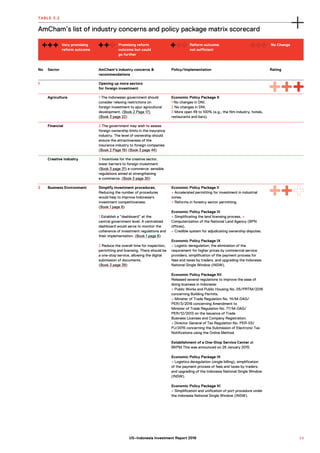
  • 9.
    Legal Certainty isthe foundation for business confidence and growth. Both US and Indonesian companies will be able to invest, grow and create jobs if there is greater legal certainty in terms of contract sanctity, enforcement of existing laws and an impartial judiciary. Collaboration and Communication are vital for the creation of an enabling economic environment and the development of rational laws and regulations. Effective communication as economic policies are developed to make use of the experience and expertise of the private sector will lead to effective policies to make Indonesia a world class economy. Innovation is the key to keeping pace in a dynamic global economy. Incentives for taking risks, finding new ways of doing things, investing in research and development and human resource capacity building are the keys to innovation. Bureaucratic and Policy Reform must continue and expand. Specific examples include the abolition of the Negative Investment List (DNI), rationalization of the work permit process, streamlining of permitting at all levels of government, and reform and proper incentivization of the civil service and judiciary. The Road to the Best Case Economic Sector Potential US Company Sentiment Achieving the best-case scenario will depend on actions taken by both the Indonesian and US governments. It is also dependent on external factors that cannot necessarily be controlled. There are, however, a series of economic reforms that can be undertaken by the Indonesian government that would increase the likelihood of achieving the best-case scenario. The process of economic reform has already been started by the Widodo administration, but will need to continue and expand to achieve the desired outcome. These include: The report also looks at nine industrial, extractive and service sectors. Each one is at a different stage of development with US companies playing different roles in each. The degree to which each sector is controlled by the government is a main factor in the performance of each of these sectors, now and into the future. Based upon a ranking system developed in the report, several sectors have a high degree of future potential. These include the creative economy, finance and infrastructure. Several sectors in which US companies have a significant presence have average prospects growing apace with GDP, such as oil and gas, consumer goods and agriculture. The final set of sectors have lower potential partly due to restrictive government policies that inhibit investment and create uncertainty. These include extractive, pharmaceutical/healthcare/ life sciences and information communications technology (ICT). A survey was also taken and interviews were conducted with the executives of US companies both in Indonesia and the US. Here are some of the findings: + When asked if the reform packages have had any impact on their own businesses, only 25 percent stated that they had “some impact,” while 75 percent stated that there was “no impact” or that it was still “too early to say.” + 87 percent felt that there had been “some improvement” in the investment climate under the Widodo administration; + 100 percent stated that the 12 economic reform packages had “some impact;” US–Indonesia Investment Report 2016 7Amcham Indonesia Investment Report 2016
  • 10.
    88 Vital &Growing: Adding Up the US-Indonesia Economic Relationship
  • 11.
    1 The Real Impact ofthe US–Indonesia Economic Relationship The first AmCham Indonesia/U.S. Chamber of Commerce1 Investment Report was published in 2013. That report focused on FDI and our analysis revealed that real US FDI into Indonesia was far higher than the officially published figures. We concluded, conservatively, that from 2004 to 2012, US FDI into Indonesia totaled about $65 billion. This contrasted significantly with most published data and suggested that the US, instead of being the fourth-largest investor in the country (at that time), was likely the largest investor in Indonesia. More narrowly defined official figures from Bank Indonesia showed US FDI for the same period as being just over a paltry $7 billion. Moreover, back in 2013, our findings indicated that 95 percent of total US FDI into Indonesia was in the oil and gas, mining and manufacturing sectors and, while the oil and gas and mining industries were by far the largest US–Indonesia Investment Report 2016 9Amcham Indonesia Investment Report 2016
  • 12.
    Top 10 realizedFDI by country, 2011–15, ranking for 2015 ($ billion) SOURCE BKPM (CEIC). TABLE 1.1 Rank Country 2011 2012 2013 2014 2015 1st Singapore 5.1 4.9 4.7 5.8 5.9 2nd Malaysia 0.6 0.5 0.7 1.8 3.1 3rd Japan 1.5 2.5 4.7 2.7 2.9 4th Netherlands 1.4 1.0 0.9 1.7 1.3 5th South Korea 1.2 1.9 2.2 1.1 1.2 6th Hong Kong 0.1 0.3 0.4 0.7 0.9 7th United States 1.5 1.2 2.4 1.3 0.9 8th British Virgin Islands 0.5 0.9 0.8 0.6 0.7 9th China 0.1 0.1 0.3 0.8 0.6 10th United Kingdom 0.4 0.9 1.1 1.6 0.5 Total FDI Realization 19.5 24.6 28.6 28.5 29.3 1 American Chamber of Commerce in Indonesia (AmCham) and the U.S. Chamber of Commerce have jointly produced the past three US-Indonesia Investment Reports (2013-15) and this current edition. 2 BKPM defines US direct investment abroad as the ownership or control, direct or indirect, by one US citizen of 10 percent or more of the voting securities if the foreign business enterprise is incorporated, or an equivalent interest if the foreign business enterprise is unincorporated. FDI is a fickle indicator for measuring the true value of an economic relationship. It can fluctuate widely depending on economic conditions. This is what led us this year to think about the importance of the US economic relationship with Indonesia in a new and maybe unique way. FDI sectors for US companies, the manufacturing sector was increasing in prominence at that time. However, the world is a very different place today than it was in 2013. After weathering the first few years after the 2008 global financial crisis remarkably well, largely due to the commodities boom, the Indonesian economy has been gradually dragged down by the collapse in commodity prices since 2012 and the economic slowdown in China. This has been compounded by the local currency falling more than 27percent since 2013, and the higher perceived risks of investing in emerging markets globally. Meanwhile, previously robust FDI by US companies in the oil and gas and mining industries took a major hit, with all firms cutting back investment and exploration, and some firms even deciding to pull out of the country. If we were to look at US FDI in the light of the current economic environment, while it is recovering well, it no longer tells such an impressive story. Based on US Department of Commerce data, in 2014 (the latest available year), realized US FDI into Indonesia rose to $13.5 billion, up from $11.3 billion in 2013, a 20 percent increase. Data from the Indonesia Investment Coordinating Board (BKPM), however, show far lower US numbers. BKPM indicates that realized FDI for 2015 made Singapore the leading investor ($5.9 billion), followed by Malaysia ($3.1 billion), Japan ($2.9 billion), the Netherlands ($1.3 billion) and South Korea ($1.2 billion).2 The US in contrast is said to be the seventh-largest investor, at just $0.9 billion in 2015. But FDI is a fickle indicator for measuring the true value of an economic relationship. It can fluctuate widely depending on economic conditions. This is what led us this year to think about the importance of the US economic relationship with Indonesia in a new and maybe unique way. 1 0 Vital & Growing: Adding Up the US-Indonesia Economic Relationship
  • 13.
    Based on morecomplete US Department of Commerce data for US realized FDI into Indonesia, Figure 1.1 below shows a very different story, however. While we see a clear slowdown in investment in the wake of the global financial crisis from 2011 through to 2013, realized FDI rebounded strongly in 2014. While admittedly we cannot compare the US Department of Commerce data for US realized FDI directly with the data from BKPM for other countries’ FDI, the US Department of Commerce data do nonetheless strongly suggest that the US is by far the largest foreign investor in Indonesia—and not just in 2014, but for several years going back in time. A strong recovery in realized US FDI inflows into Indonesia, 2010–14 ($ billion) SOURCE BUREAU OF ECONOMIC ANALYSIS (BEA), US DEPARTMENT OF COMMERCE. FIGURE 1.1 10.6 12 11.4 11.3 13.4 2010 2011 2012 2013 2014 14 13 12 11 10 The New Big Number We took a new approach in researching and developing this 2016 Investment Report. Instead of focusing purely on FDI – a relatively unpredictable and far from complete indicator of the true importance of the Indonesia-US economic relationship – we tried to be more ambitious. In analyzing the available data, we focused on a wide- ranging series of engagements that go far beyond the boundaries of traditional FDI to encompass financial services, domestic sales, government revenues, trade and FDI. As such, our aim in this year’s report is to capture, as best we can, the entire universe of economic activities that are shared between the US and Indonesia. In a nutshell, using our analysis based on the complete range of economic activities involved in the relationship between the two countries, we came up with a staggering figure: in 2014, our baseline year, the total value of all economic activities shared by Indonesia and the US amounted to $90.1 billion. As a share of Indonesia’s total GDP in 2014, this amounts to about 10.1 percent of the size of the Indonesian economy. A Brief Methodology Here we should digress briefly to explain the methodology behind these numbers, without going into too much detail. The full methodology can be found in Annex I of the main report. What does this number comprise, in addition to FDI? Basically, there are five major components in this Big Number. Realizing that FDI is just one part of a greater whole, we tried to capture four other areas of economic activity that are just as important, indeed sometimes far more important, than FDI. The five components are: (i) the sum of trade between the two countries, including imports and exports in both directions; (ii) the sum of financial flows between the two countries; (iii) the sum of domestic sales by US companies in Indonesia, and Indonesian companies in the US; (iv) government revenues derived from the operations of US companies in Indonesia (however, this relies only on VAT revenue, given data availability issues), and finally (v) the sum of realized FDI, not just of US companies in Indonesia, but also of Indonesian companies in the US. Given the unavailability of sufficient data 3 Definition of US companies: In our broad definition of US companies with economic activities in Indonesia, we include all those companies that are owned by holding companies registered in the US with the address of principal executive offices as being in the US. This also applies in those cases where operating offices may be located overseas and all their subsidiaries, and affiliates and their licensees are engaged in business activities in markets outside the US. 1 1US–Indonesia Investment Report 2016
  • 14.
    Growth of totaleconomic activities vs Indonesia GDP growth, 2010–15 (percent) SOURCE BEA, CEIC, AND IMF (CPIS) DATA, WITH AMCHAM INDONESIA STAFF CALCULATIONS. Total economic activities growth is rapidly outpacing Indonesia’s GDP growth, 2011–14 (Percent) FIGURE 1.2 FIGURE 1.3 Total Economic Activities 8.0 5.5 GDP 2010 2011 2012 2013 2014 18 16 14 12 10 8 6 4 2 0 –2–0.6 7.4 6.2 6.0 5.6 5.0 6.0 3.8 9.4 16.0 NOTE TOTAL ECONOMIC ACTIVITIES ARE CALCULATED BASED ON $, WHILE GDP GROWTH IS CALCULATED USING IDR. OUR DATA FOR ECONOMIC ACTIVITIES ARE THROUGH TO 2014, WHILE THE BPS DATA FOR GDP GROWTH ARE THROUGH TO 2015. SOURCE BEA, CEIC, AND IMF (CPIS) DATA, WITH AMCHAM INDONESIA STAFF CALCULATIONS. GDP GROWTH ECONOMIC ACTIVITIES GROWTH for 2015, we have chosen 2014 as our base year, for which total economic activities amount to $90.1 billion. This total figure then needs to be adapted in order to make it methodologically compatible with Indonesia’s GDP figure, as we need to convert the various sums (of trade, FDI, finance and sales) into balance figures. These balances when totaled then allow us to compare like for like, which indicates that the value of economic activities is equivalent to 10.1 percent of GDP for 2014. Due to the lack of all necessary data in 2014, figures for sales and government revenue are extrapolated from 2013. Recent Trends in the Indonesia-US Economic Relationship Once we have our formula for calculating total economic activities between Indonesia and the US, we can also calculate the value of total economic activities for previous years. This allows us to see if there are any trends in the nominal value of economic activities varies over time, and compare these trends with Indonesia’s GDP growth, as well as how constant (or not) the size of Indonesia-US economic activities are as a share of Indonesia’s annual GDP by year. The nominal value of economic activities has been increasing rapidly since 2010, while the annual equivalent share of Indonesia- US economic activities in Indonesia’s GDP has remained more or less fixed within the range of 8.8 to 10.1 percent. The average annual growth rate of the nominal value of economic activities is also compared with Indonesia’s annual average GDP growth over the same period (Figure 1.2). The compound annual growth rate (CAGR) for total economic activities between the two countries is 8.0 percent in the period 2010-15, while the CAGR of Indonesia’s GDP over the same period is 5.5 percent. When seen as a timeline from 2010 to 2014 (Figure 1.3), it would appear that, while there was a decline in 2011-12, Indonesia-US economic activities are growing robustly, while the Indonesian GDP remains below expectations . However, given their relative size, Indonesia-US economic activities alone can only have a limited impact on supporting overall Indonesian GDP growth: a 10 percent increase in the size of the economic relationship will only increase Indonesia’s GDP by 1 percent. 4 Note: the rate of growth of our Big Number is expressed based on IDR, and not using $. 1 2 Vital & Growing: Adding Up the US-Indonesia Economic Relationship
  • 15.
    Components of theBig Number It is useful to look in more detail into how the five components of the $90.1 billion number compare. However, we should note that by selecting 2014 as our base year we have had to use estimates for two of the five components, namely domestic sales and the total government revenues in Indonesia. These two figures are extrapolated from the data available from 2009 to 2013. The evolution of the five components of the Big Number, 2010-14 ($ bn, %) SOURCE BEA, CEIC, AND IMF (CPIS) DATA, WITH AMCHAM INDONESIA STAFF CALCULATIONS. TABLE 1.2 Total sales ($ bn) GoI revenue (VAT) ($ bn) FDI ($ bn) Financing (US bn) Trade ($ bn) Total economic activities ($ bn) Share of total economic activities vs. GDP (%) 2010 26.0 1.7 10.7 6.5 23.4 68.3 9.0 2011 30.8 1.8 12.2 9.2 26.5 80.5 9.0 2012 31.1 1.8 11.4 10.8 26.0 81.1 8.8 2013 31.2 1.7 12.4 10.5 28.0 83.8 9.2 2014 34.1 1.8 14.7 11.8 27.6 90.1 10.1 Component 1 Domestic Sales Component 2 Trade flows Component 3 Financing On this basis, of the five components in 2014—the sum of trade, the sum of FDI, the flows of finance, the sum of domestic sales and total revenues to the Indonesian government—the largest component is the sum of domestic sales. This accounted for an estimated $34.1 billion in 2014, equivalent to 37.9 percent of total economic activities. Not only this but the nominal value of domestic sales increased from $21.7 billion in 2009 to the current figure—a 57 percent increase over 5 years. This level of growth suggests that US companies in Indonesia have shared in and benefitted significantly from the expansion of the consumer sector of the economy and growth of the Indonesian middle class. Given Indonesia’s demographics and the continued levels of economic growth, domestic sales are set to continue being the main driver of the Indonesia-US economic relationship in the years to come. Second in size was the sum of trade, at $27.6 billion, or 30.7 percent of the total. Taken together, total sales and trade accounted for just under 68.6 percent of the relationship in 2014. While being such a large component of the economic relationship is highly significant in itself, there is a more important story here: the trade flows between Indonesia and the US are highly tipped in favor of Indonesia. Looking at 2014, imports from the US came in at $8.3 billion, while Indonesian exports to the US were more than double this figure, at $19.4 billion. Indeed, in each of the past 5 years Indonesian exports have been more than double US imports into Indonesia. The only caveat is that Indonesian exports to the US are heavily dependent on commodities but, despite this, Indonesia-US trade has grown by 53 percent over the past 5 years, or 10.6 percent on an annualized basis. The third component, financing, accounted for $11.8 billion in 2014, or 13.1 percent of the total. The financial component of the relationship is often overlooked, despite its obvious importance to both countries. This may be because it is also one of the hardest sectors for which to find disaggregated data. However, having met with most of the five major US banks operating in Indonesia, a clearer picture starts to emerge. While each of the five banks has its own strengths and specializations in the financial sector, together they collectively form a crucial platform for providing finance to Indonesia, for instance through US dollar sovereign bonds, quasi-sovereign 1 3US–Indonesia Investment Report 2016
  • 16.
    Component 4 FDI bonds (tostate-owned enterprises) and to the private sector. Looking at the past 2 years, US banks have been involved in roughly 60 to 75 percent of all US dollar bond issuances in Indonesia, which have raised about $25 billion in bond financing from 2014 to May 2016. In terms of the US dollar debt market, growth was about 86 percent in the period 2019- 14, or an impressive 17 percent on an annualized basis. Meanwhile, US banks in Indonesia also constitute some of the largest traders of equities in the domestic stock market, together with being major players in mergers and acquisitions (M&A). The fourth component is FDI, at $14.7 billion, or 16.3 percent of the relationship in 2014. FDI is the figure most often cited as a measure of the economic relationship, but it only ranks fourth out of our five major components. While it is undoubtedly true that investment policy reform often drives the broader reform agenda, other components actually contribute more to the total Indonesia- US economic relationship. FDI can also be volatile, proof of which can be seen in the fact that it is the only one of our components that declined due to the global economic crisis, from 2011 to 2012. That decline notwithstanding, total FDI (including Indonesian FDI in the US) increased by 47 percent during the period, from $10 billion in 2009 to $14.7 billion in 2014, an average annualized increase of 9.4 percent. 57“On this basis, of the five components in 2014—the sum of trade, the sum of FDI, the flows of finance, the sum of domestic sales and total revenues to the Indonesian government—the largest component is the sum of domestic sales. This accounted for an estimated $34.1 billion in 2014, equivalent to 37.9 percent of total economic activities. Not only this but the nominal value of domestic sales increased from $21.7 billion in 2009 to the current figure—a 57 percent increase over 5 years.” 1 4 Vital & Growing: Adding Up the US-Indonesia Economic Relationship
  • 17.
    Component 5 Government Revenues Thesmallest contribution to the relationship is Indonesian government revenues, which accounted for an estimated $1.8 billion, or just 2 percent of the total. Unfortunately, the unavailability of data means that this component is greatly understated, as we only have complete data on value- added tax (PPN), but not on non-tax revenue (NTR), including royalties on raw materials and excise on tobacco. However, even just taking VAT revenue into account, US companies still contributed 13 percent of total government tax revenue of $13.24 billion in 2014. While the smallest of our five components, it is nonetheless vital to the government of Indonesia. It is worth remembering that for many years US companies also have been Indonesia’s largest contributor to government revenue, although they are not necessarily the largest companies operating in Indonesia. For example, in recent years PT. Freeport Indonesia was the largest contributor to goverment revenues until the collapse in commodities prices and the implementation of the export ban on mineral ore, after which its dominant position has been taken over by PT. HM Sampoerna, another US company. (Note, both companies owe their prominent position not to VAT, but more to NTR in the form of royalties and excise, respectively, in addition to regular corporate income tax.) Other major contributors to NTR government revenues are in the oil and gas sector, including Chevron, ExxonMobil and ConocoPhillips. It is worth noting that despite the current low oil price environment, which has caused government revenue to plummet by around 43 percent,5 the oil and gas sector still plays a vital role in supporting regional development, including through the development of the oil and gas support services sector, which provides important multiplier effects. Furthermore, Indonesia’s production share from oil and gas is generally regarded as the second highest in the world. From the US company figures that we do have access to, it is safe to say that NTR to the government was at the very least around $4.7 billion in 2014. This would boost our sectoral Big Number for government revenue from US companies by 3.6 times. It is worth remembering that for many years US companies have been Indonesia’s largest contributor to government revenue, although they are not necessarily the largest companies operating in Indonesia. By way of comparison, looking back at 2009, at the start of the global financial crisis, the shares of the five components were relatively similar to 2014. Total economic activities in 2009 were valued at just shy of $57.4 billion, implying a 56.8 percent increase in the period 2009 to 2014. The main exception is that the share of financial flows was significantly lower, at just 10.96 percent compared with 13.05 percent in 2014. This would have almost certainly been due to the impact of the global economic crisis at that time. In the other four components, the shares in 2009 were 37.83 percent for total sales, 31.41 percent for the sum of trade, 17.4 percent for the sum of FDI, and 2.4 percent for total revenues to the Indonesian government. 5 2016 Oil and Gas Production in Indonesia (BOEPD): Chevron 251,000; ConocoPhillips: 241,000; and ExxonMobil: 170,000 (Source: WoodMackenzie: SKK Migas). 1 5US–Indonesia Investment Report 2016
  • 18.
    Comparison of totalUS economic activities with ASEAN peers, 2010–14 (Nominal price, $ billion) NOTE *IN THE 2014 DATA, GOVERNMENT REVENUE AND DOMESTIC SALES DATA ARE ESTIMATED FOLLOWING THE TREND IN CAGR. SOURCE: BEA, CEIC, AND IMF DATA, WITH AMCHAM INDONESIA STAFF CALCULATIONS. NOTE ** 2015 DATA ARE ESTIMATES Comparison of shares of US economic activities with ASEAN peers, 2010–14 (Percent) NOTE *IN THE 2014 DATA, GOVERNMENT REVENUE AND DOMESTIC SALES DATA ARE ESTIMATED FOLLOWING THE TREND IN CAGR. SOURCE BEA, CEIC, AND IMF DATA, WITH AMCHAM INDONESIA STAFF CALCULATIONS. Evolution of shares of ASEAN peers’ economic relationships with the US, 2010–14 (Percent) NOTE *IN THE 2014 DATA, GOVERNMENT REVENUE AND DOMESTIC SALES DATA ARE ESTIMATED FOLLOWING THE TREND IN CAGR. SOURCE: BEA, CEIC, AND IMF DATA, WITH AMCHAM INDONESIA STAFF CALCULATIONS. NOTE ** 2015 DATA ARE ESTIMATES TABLE 1.3 TABLE 1.4 FIGURE 1.4 Thailand Vietnam Philippines Malaysia Indonesia 2010 96.5 22.6 40.3 106.8 68.3 2011 105.5 26.6 43.9 112.2 80.5 2012 113.8 29.3 43.7 105.5 81.1 2013 117.0 34.4 43.4 109.4 83.8 2014* 130.8 41.2 48.9 118.2 90.1 2015** 137.0 50.4 48.4 121.1 92.1 Thailand Vietnam Philippines Malaysia Indonesia 2010 27.93 19.50 19.61 40.10 9.03 2011 28.90 19.65 19.80 39.10 9.02 2012 28.58 18.80 16.98 33.21 8.83 2013 28.22 20.07 16.69 35.24 9.15 2014* 32.43 22.12 17.31 37.32 10.12 2010 2011 2012 2013 2014* 2015** 50 45 40 35 30 25 20 15 10 5 MALAYSIA THAILAND VIETNAM PHILIPPINES INDONESIA 40.1 27.9 19.5 19.6 9.0 9.0 8.8 9.2 10.1 10.7 19.8 17.0 16.7 17.3 17.1 19.7 18.8 20.1 28.9 28.6 28.2 32.4 22.1 26.0 35.0 39.1 33.2 35.2 37.3 45.2 How the Indonesia-US Economic Relationship Compares in the Region We are not limited to looking at Indonesia only in terms of economic activities with the US. We can also look at the value of the economic relationship between the US and other countries in ASEAN, for instance. Here, using the same formula and different sources of data, we can see the nominal values relative to the size of the respective ASEAN economies (Table 1.3). Table 1.4 then shows these nominal values converted into percentage shares of total US economic activities against GDP for each respective year. This leads on to Figure 1.4, where we can see the different shares of GDP of the US economic relationship with different ASEAN countries, and observe how these have evolved over time. In comparison to Indonesia, we take as examples Malaysia, Thailand, Vietnam and the Philippines. 1 6 Vital & Growing: Adding Up the US-Indonesia Economic Relationship
  • 19.
    Indonesia’s position interms of the value of its total economic activities with the US compared with its ASEAN peers is probably about where it should be—not too high and not too low, and also relatively stable over the five-year period. In our five- country sample, the nominal value of the economic relationship between Indonesia and the US lies sandwiched between Malaysia and Thailand with the highest values, and the Philippines and Vietnam, with the lowest. While it is true to say that growing the size of the economy is what is most important here, the fact that in some countries the value of their economic activities with the US is growing faster than others may indicate that these countries are more open and attractive to US economic activities. While no one really knows what an optimal share of GDP should be in a country’s economic relationship with the US, this is not the most important issue. Far more important is that the size of the economic “pie”—i.e., the nominal total value of economic activities—is growing on an annual basis. If this growth is indeed occurring, while the share of the value of economic activities in GDP remains more or less constant, it infers that all economic relationships with a country are growing together and mutually benefiting each other. This, after all, is the ultimate goal. Indonesia’s position in terms of the value of its total economic activities with the US compared with its ASEAN peers is probably about where it should be– not too high and not too low, and also relatively stable over the five-year period. 1 7US–Indonesia Investment Report 2016
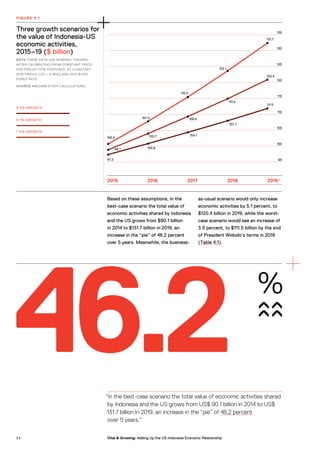
  • 20.
    1 81 8Vital & Growing: Adding Up the US-Indonesia Economic Relationship
  • 21.
    2 Indonesia’s Current Economic Position and Outlook Recent EconomicTrends in Indonesia The Indonesian economy has been struggling to maintain growth since 2012 in the face of lower commodity prices and slower global growth. Despite the recent slowdown, however, the country’s per capita GDP has grown steadily from $560 in 2000 to $3,630 in 2014. With Indonesia’s export revenues contracting throughout 2015, GDP growth slipped to 4.8 percent. While still respectable, especially for a commodities exporter, Indonesia will struggle to absorb new entrants into the country’s labor force at this rate of growth. Going forward, Indonesia will need to adapt to a less favorable global environment and focus even more on facilitating investment and reducing the costs of doing business. The fiscal stimulus provided by the government, aided by additional funds coming from the shift in public US–Indonesia Investment Report 2016 1 9Amcham Indonesia Investment Report 2016
  • 22.
    expenditure away fromwasteful fuel subsidies, will undoubtedly help to support economic expansion. There was, for instance, a threefold increase in infrastructure spending in the first quarter of 2016, together with a 10-fold spike in physical construction for the same quarter. However, government activity alone will not raise growth above 5 percent in 2016. The only way to ensure that growth rebounds will be through greater private sector activity, especially through private sector investment. This is where US companies can play an important role — especially in generating new jobs. Driven mainly by the increase in public spending at the end of the year, growth did pick up in the final quarter of 2015 to 5 percent year-on-year, after three previous quarters of 4.7 percent growth. However, at the same time consumption remained moderate, while exports and imports both continued to decline, highlighting the challenges faced by the private sector. Worryingly, the biggest contributor to the overall decline in the trade balance came from a contraction in manufacturing exports, which fell by 13.4 percent year-on-year. Weakening FDI and Stemming the Outflows of Capital Indonesia also experienced a significant decline in its financial account in 2015, as capital fled emerging markets generally. Total 2015 capital flows to Indonesia declined to just $17.1 billion in 2015, down from $45 billion in 2014. The outflows of capital from Indonesia were only stemmed by foreign investment into Indonesian government bonds toward the end of 2015, helping to stabilize the rupiah at 4.4 percent in February. Most of these investments flowed through US investment banks in Indonesia. A stronger rupiah and lower inflation helped Bank Indonesia to finally start easing its monetary policy in January with two consecutive cuts in interest rates of 25 basis points each. However, as we have seen in the past few months, BI will need to remain vigilant amid continuing global financial market volatility and the possibility of rising US interest rates putting pressure on the rupiah. Against this backdrop, the World Bank set its GDP growth projections at 5.1 percent in 2016 and 5.3 percent in 2017, with the figure for 2016 contingent on private sector spending picking up in the second half of the year. Beyond 2016, the economic recovery in Indonesia will ultimately rely on policies designed to attract far greater private investment and diversify the economy away from reliance on the extractive industries. The first welcome signs of this new approach were seen in September 2015, with the unveiling of the first of a continuing series of economic reform packages. 2 0 Vital & Growing: Adding Up the US-Indonesia Economic Relationship
  • 23.
    Both Indonesian andUS private sector companies need to move away from an over-reliance on Indonesian commodities in the wake of one of the greatest commodity booms ever seen, from 2003 to 2012 Shifting from Commodities to Manufacturing Both Indonesian and US private sector companies need to move away from an over-reliance on Indonesian commodities in the wake of one of the greatest commodity booms ever seen, from 2003-2012. One side- effect of the commodities boom was that it rendered investing in the Indonesian manufacturing sector less attractive to investors when easy returns could be made in commodities with little or no valued-added. Given that manufacturing tends to be highly labor-intensive and the extractive industries just the opposite, it should come as little surprise that while Indonesia comprises half of ASEAN’s total labor force it contributes only 16 percent of ASEAN’s manufacturing exports. In fact, looking more closely at data from the World Bank, Indonesia underwent a process of “premature deindustrialization” from about 2002 onwards, as commodities overtook manufacturing as the largest exports from 2005 onward. 2 1US–Indonesia Investment Report 2016
  • 24.
    Indonesia’s manufacturing is ashadow of its former self (Growth in GDP and real manufacturing output, %)6 SOURCE WORLD BANK STAFF CALCULATIONS. Indonesia’s economy has de-industrialized prematurely (Manufacturing as a share of GDP, %)7 SOURCE WORLD BANK STAFF CALCULATIONS SOURCE UN-COMTRADE; WORLD BANK STAFF CALCULATIONS. Indonesia’s global manufacturing market share is low and stagnant (Share in global manufacturing market, %)8 SOURCE UN-COMTRADE; WORLD BANK STAFF CALCULATIONS FIGURE 2.1 FIGURE 2.2 FIGURE 2.3 16 14 12 10 8 6 4 2 0 40 35 30 25 20 15 10 20 18 16 14 12 10 8 6 4 2 0 2.5 2.0 1.5 1.0 0.5 0 0 5,000 1990 Malaysia China Indonesia Vietnam 1995 2000 2005 2010 2015 10,000 20,00015,000 25,000 1990 1991 1992 1993 1994 1995 1996 2001 2002 2003 2004 2005 2006 2007 2008 2009 2010 2011 2012 2013 2014 Post 1997/98 Crisis GDP per–capita, PPP (constant 2011 int USD) Before 1997/98 Crisis GDP MANUFACTURING GROWTH 6 World Bank, 2016. Indonesian Economic Quarterly, June 2016. Resilience through reforms. 7 Ibid. 8 Ibid. CHINA THAILAND INDONESIA MALAYSIA 1990 1990 2005 2014 1990 2005 2014 2005 2014 1990 2005 2014 This de-industrialization is viewed as being premature because it is occurring far too early in the cycle of economic development compared with other countries in the region (Figure 2.2). With the focus of investment in Indonesia leaning heavily toward commodities in recent years, countries in the region with fewer natural resources have been busy expanding their shares of the global manufacturing market. As illustrated in Figure 2.3, this has led to stagnation in Indonesia’s market share of global manufacturing, while countries such as China and Malaysia have soared, and Vietnam’s manufacturing share has expanded rapidly since 2010, overtaking and surging ahead of Indonesia. 2 2 Vital & Growing: Adding Up the US-Indonesia Economic Relationship
  • 25.
    With the declinein commodity prices manufacturing is once again relatively attractive for investment. In addition, the rupiah’s sharp depreciation since 2013 helps to make Indonesian manufacturers more competitive. Rupiah depreciation against the US dollar, 2013–16 (Rupiah) NOTE ANNUAL AVERAGE EXCHANGE RATE FOR IDR/$: 2013, IDR 10,452; 2014, IDR 11,878; 2015: IDR 13,392; AND 2016 (UNTIL JULY), IDR 13,414. SOURCE BANK INDONESIA. FIGURE 2.4 9,500 10,500 11,500 12,500 13,500 14,500 15,500 2013 2014 2015 2016 Several issues are holding Indonesian manufacturing back. First, while Indonesia has the lowest wage costs in US dollar terms in the region, this advantage is erased by low labor productivity. In 2014, unit labor costs were higher in Indonesia than in the Philippines and Vietnam, as a result of low productivity. Malaysia’s unit labor costs are only slightly higher than Indonesia’s, despite the fact that Malaysian workers’ wages are 7-8 times higher. Second, efficient logistics are crucial for supplying the domestic market and competing internationally. Indonesia’s logistics costs account for 24 percent of GDP, compared with Thailand at only 16 percent. This is equivalent to Indonesia wasting $70 billion a year on inefficient and costly logistics. The inefficiencies and unreliability of logistics in Indonesia force companies to stock higher inventory, increasing costs. Third, regulatory procedures, licensing and permitting are overly complex and create delays, also increasing costs. Along with construction permits, paying taxes and enforcing contracts in Indonesia are among the most cumbersome in the world (World Bank, 2016). With the decline in commodity prices manufacturing is once again relatively attractive for investment. In addition, the rupiah’s sharp depreciation since 2013 should now help to make Indonesian manufacturers more competitive (Figure 2.4). The recent government reform packages appear to herald a new and fundamental shift toward reducing regulatory burdens and improving the business climate. The government has even expressed its interest in joining the Trans-Pacific Partnership (TPP). In this new and more positive outward- looking environment, US companies stand ready to contribute to boosting the manufacturing sector and helping Indonesia to regain its former prowess as a regional manufacturing powerhouse. 2 3US–Indonesia Investment Report 2016
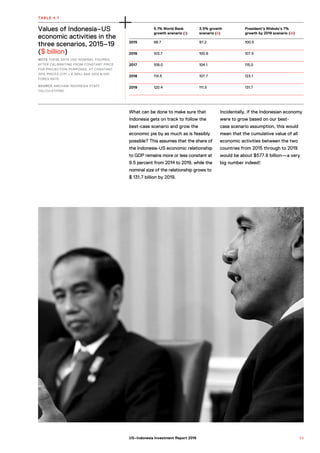

  • 26.
    2 42 4Vital & Growing: Adding Up the US-Indonesia Economic Relationship
  • 27.
    3 The Government’s Economic Reform Packages The Background President Widodoannounced the first in a series of economic policy reform packages in early September 2015, with a focus on much needed deregulation efforts. The packages have continued coming since then, with the twelfth and latest package released in late April of this year. Overall, they seem to demonstrate President Widodo’s resolve in pushing ahead with constructive and practical efforts to improve the investment climate and kick-start higher economic growth rates, after a disappointing slowdown in 2015. They also demonstrate the practical efficiency of decision-making under Coordinating Minister for the Economy Darmin Nasution, who was inaugurated into his position shortly before the deregulation packages started to come forth, in mid-2015. US–Indonesia Investment Report 2016 2 5Amcham Indonesia Investment Report 2016
  • 28.
    However, while theeconomic deregulation packages do hold promise and revising the rules is certainly important, a more fundamental objective lies in changing the incentive structures of the official who administer and uphold the rules. Even with the very best rules and permitting processes in place, companies will continue to find themselves under pressure if incentive structures persist in favoring rent-seeking behaviors within the civil service. As such, the President’s well-intentioned program of deregulation may run into the sand in the absence for more fundamental institutional reform. So, once again, this returns to one of the themes of this investment report: incentives need to be deliberately and carefully designed to encourage the appropriate behaviors from those empowered by them. If this can be achieved, then meaningful progress and change can be unleashed to dramatic effect. As we go to print, it is to be hoped that the recent cabinet reshuffle will support this process and help to ensure that the reform packages have the maximum impact. In the table below we summarize all of the 12 economic reform packages issued to date, as of July 2016. Policy Package Issues Addressed Issuance of 16 new regulations: to improve the ease of doing business performance of Indonesia, focusing on small businesses. The regulations include technical and permit policies related to the World Bank’s ease of doing business indicators (time needed to start a business, dealing with construction permits, paying taxes, obtaining credit, enforcing contracts, electricity sourcing, trading across borders, resolving insolvency and protecting minority investors). The new regulations aim to cut 94 procedures to 49 procedures, and 9 permits to 6 permits, reducing the time needed from 1,566 days to just 132 days. Finance facilitation for Export-Oriented People’s Business Credit (KURBE) for MSMEs, with interest set at 9% per year for tenors of 3 to 5 years. Reducing tax on Real Estate Investment Trusts (REITs) from 5% to 0.5% to avoid investment funds for Indonesian real estate projects from listing shares in Singapore, where tax treatment is more favorable. Simplify and unify port procedures applied by multiple ministries to better integrate with the Indonesia National Single Window (INSW) web portal. The aim is to reduce port dwell time at Tanjung Priok to below 3 days by end of 2017. Create roadmap and policies to support development of the pharmaceuticals industry Authorization for regional governments to cut taxes on property (BPHTB) from 5% to 1%. However, BPHTB is one of the few taxes regional governments can use to generate local revenue and regional governments may not comply. Removal of 35 sectors from the Negative Investment List (DNI), while reserving some for MSMEs. Notable sectors include the film industry, cold-chain distribution for the food industry, distribution and warehouse services, and entertainment venues such as bars, restaurants and recreation centers. Also, 20 closed sectors will be partially opened, including land-based transportation services (49%) and installation services for high voltage power facilities (49 percent). Presidential regulation to assign PLN to be in charge in accelerating electricity infrastructure by adding state equity to PLN and extending state guarantees. Relaxation of restrictions on imports of livestock and meat. Logistics deregulation, including the elimination of requirement for higher prices than PT Pos Indonesia by commercial service providers, simplification of payment process of fees and taxes for traders, and upgrading the INSW. Implementing a National One-Map Policy, to be used by all government ministries and agencies. Strengthening energy security through building and upgrading of oil refineries. Providing tax incentives for aircraft maintenance services (MRO-maintenance, repair and overhaul). Accelerating the land certification process. Providing tax incentives for labor-intensive industries employing more than 5,000 people and exporting 50% or more of production. Economic policy reform packages, September 2015 – July 2016 TABLE 3.1 XI X IX VIII VII 2 6 Vital & Growing: Adding Up the US-Indonesia Economic Relationship
  • 29.
    Tax incentives forthe development of Special Economic Zones (SEZ). Strengthening licensing management for water resources utilization, and that water-use permits remain valid, despite the Constitutional Court’s verdict in early 2015 that struck down the 2002 Water Law. Simplifying import licensing and payment procedures for food and the raw materials for drugs through a paperless mechanism using the INSW. Opportunity for companies to revalue their assets, which should be of most help to struggling state- owned companies. Eliminating double taxation for real estate investment trusts (REITs) to encourage more domestic REITs, instead of them listing in tax haven countries. Deregulating policies in the Sharia banking industry. Introducing new formula for calculating minimum wages by considering the variables of inflation and the economic growth rate, removing the unpredictability of the previous system. Decreasing fuel and electricity prices. The reforms cover diesel, aviation fuel, LPG, gas and electricity, but do not include petrol. Providing more affordable and wider access to the People’s Business Credit (KUR) program. Simplifying the land licensing process for investment. Also, computerization of national Land Agency (BPN) offices, resurveying of land plots nationwide, establishing a credible system for adjudicating ownership disputes, and compiling a centralized map of land-ownership nationwide. Interest-income tax exemptions for deposits by foreign-exchange earning exporters. Value-added tax exemptions for transportation sector items, including aircraft, trains, vessels, spare parts and related services. Accelerated permitting for investments that take place in industrial zones. Plans to set up two bonded zones by the 2016: one for fuel products in Banten; and one for manufactured goods in West Java. Swifter processing for granting tax allowances and tax holidays. Reforms in forestry sector permitting to reduce the number of permits for resource sector investors and accelerate processing. The ministry will reduce the number of permits from 14 to 6. Industrial Sector Deregulation by eliminating several regulations, permits, and bureaucracies within the ministries and related institutions that inhibits national trade. Trade Sector Eliminating regulations and requirements that are not relevant that have been set previously by 15 ministries or 18 units of licensing publisher as well as improving the efficiency in licensing services with Indonesia National Single Window (INSW). Empowerment of Cooperatives and SMEs Eliminating regulations and bureaucracies that are not relevant in order to strengthen the function of cooperatives and to increase SMEs in economic activity and the issuance of new regulations to strengthen regional cooperatives and to ease import for cooperatives and SMEs. Maritime & Fisheries (Fisherman) Presidential decree to convert diesel fuel to LPG for fuel cost savings of 70%. Tourism Sector The issuance of new regulations to add visa-free countries as well as the elimination of regulations that inhibit marine tourism. Ensuring Implementation of the Reforms In the second quarter of this year, concerns started to surface over the effective implementation of the economic reform packages. Despite the 12 packages released to date since September 2015, the Indonesian economy has struggled to bounce back, with growth of only 4.92 percent in the 1Q16. This was not only lower than expected but also lower than the 5.04 percent growth achieved in the 4Q15—the quarter after the start of the release of the packages. Investment growth was also lower QoQ in 1Q16. One example of the concern is that some of the implementing regulations needed for the reforms have not been issued. One notable case is the implementing regulation needed for the new Investment Negative List (DNI) issued in the tenth policy package. President Widodo seemed to respond to the concerns after the announcement of the twelfth package, which he cited as being the driver for his hoped-for improvement in Indonesian’s ranking in the World Bank Group’s Ease of Doing Business from 109 to 40. He went on to promise to establish a special task force to ensure implementation of the economic packages, with the President himself VI V IV III II I 2 7US–Indonesia Investment Report 2016
  • 30.
    acting as chairman.One of the first undertakings of the special task force will be to complete all of the 203 implementing regulations required to support the economic packages announced to date. At the time of writing, 193 of these regulation have been issued. This is a positive step and demonstrates the President’s own personal determination in making sure there is real progress towards full implementation. However, it should also be mentioned that the delays in implementation are also to some extent due to the tug-of-war between more reformist ministers who support the liberalization, and those who are more protectionist. In light of the recent cabinet reshuffle, it is hoped that the changes bode well for greater synergies across the cabinet and a stronger degree of consensus between ministries and ministers in achieving the government’s agenda. AmCham’s Recommendation and Reform Scorecard Taking all 12 economic reform packages into account, and looking back over all the recommendations made by AmCham in its three investment reports to date (2013-15) comprising 50 industry concerns in all, we have attempted to measure progress against these concerns. This is hardly a scientific exercise and rather subjective. Nonetheless, it does give a clearer indication of the extent of progress we have seen to date. The results are shown in Table 3.2 below, which lists the industry concerns that have been partially addressed, the reform measures taken, and a rough score from one to three of how effective the reforms are viewed in addressing the industry concerns. At this stage, we have decided not to try to measure the effective changes on the ground and how effectively the reforms have been implemented. In many cases it is still too soon to tell, and we will leave this exercise until a clearer understanding can be developed, hopefully in next year’s investment report. As Figure 3.1 illustrates, reform progress in addressing AmCham’s list of industry concerns has been relatively slow. Of the 50 industry concerns made over the past three years, only 12 have been addressed to any degree. Of these 12 recommendations, we categorize the reforms into three levels: (i) very promising, (ii) somewhat promising, but could go further, and (iii) inadequate in addressing the recommendation in question. There are five, four and three reforms in these categories, respectively. This means that reforms to date that are very promising or somewhat promising only address 16 percent of the industry concerns made by AmCham since 2013 in its three investment reports. While disappointing, this does still confirm that some progress is being made in addressing AmCham’s primary concerns, although clearly there is considerable scope for further progress. 2 8 Vital & Growing: Adding Up the US-Indonesia Economic Relationship
  • 31.
    No Sector AmCham’sindustry concerns & recommendations Policy/Implementation Rating 1 Opening up more sectors for foreign investment Agriculture 1 The Indonesian government should consider relaxing restrictions on foreign investment to spur agricultural development. (Book 2 Page 17) (Book 3 page 22) Economic Policy Package X 1 No changes in DNI. 2 No changes in DNI. 3 More open 49 to 100% (e.g., the film industry, hotels, restaurants and bars). Financial 2 The government may wish to assess foreign ownership limits in the insurance industry. The level of ownership should ensure the attractiveness of the insurance industry to foreign companies (Book 2 Page 19) (Book 3 page 44) Creative Industry 3 Incentives for the creative sector, lower barriers to foreign investment. (Book 3 page 31) e-commerce: sensible regulations aimed at strengthening e-commerce. (Book 3 page 30) 2 Business Environment Simplify investment procedures. Reducing the number of procedures would help to improve Indonesia's investment competitiveness. (Book 1 page 8) 1 Establish a “dashboard” at the central government level. A centralized dashboard would serve to monitor the coherence of investment regulations and their implementation. (Book 1 page 8) 2 Reduce the overall time for inspection, permitting and licensing. There should be a one-stop service, allowing the digital submission of documents. (Book 3 page 39) Economic Policy Package II + Accelerated permitting for investment in industrial zones. + Reforms in forestry sector permitting. Economic Policy Package III + Simplificating the land licensing process. + Computerization of the National Land Agency (BPN offices). + Credible system for adjudicating ownership disputes. Economic Policy Package IX + Logistic deregulation; the elimination of the requirement for higher prices by commercial service providers, simplification of the payment process for fees and taxes by traders, and upgrading the Indonesia National Single Window (INSW). Economic Policy Package XII Released several regulations to improve the ease of doing business in Indonesia: + Public Works and Public Housing No. 05/PRTM/2016 concerning Building Permits. + Minister of Trade Regulation No. 14/M-DAG/ PER/3/2016 concerning Amendment to Minister of Trade Regulation No. 77/M-DAG/ PER/12/2013 on the Issuance of Trade Business Licenses and Company Registration. + Director General of Tax Regulation No. PER-03/ PJ/2015 concerning the Submission of Electronic Tax Notifications using the Online Method. Establishment of a One-Stop Service Center at BKPM.This was announced on 26 January 2015. Economic Policy Package IX + Logistics deregulation (single billing), simplification of the payment process of fees and taxes by traders, and upgrading of the Indonesia National Single Window (INSW). Economic Policy Package XI + Simplification and unification of port procedure under the Indonesia National Single Window (INSW). AmCham’s list of industry concerns and policy package matrix scorecard TABLE 3.2 Very promising reform outcome Promising reform outcome but could go further Reform outcome not sufficient No Change 2 9US–Indonesia Investment Report 2016
  • 32.
    No Sector AmCham’sindustry concerns & recommendations Policy/Implementation Rating 3 Extractive Industry Overlapping mining permits Central and local governments would be well served if they all used the same reliable national map to avoid conflicts. (Book 2 page 11) Economic Policy Package VIII Implementing a National One-Map Policy to be used by all government ministries and agencies. 4 Business Environment Land acquisition 1 Improve implementation of the Law on Land Acquisition.(Book 1 page 9) 2 The government should build public awareness on the Land Acquisition Law and ensure that best practise learned from successful projects is applied in future. (Book 2 page 7) Economic Policy Package III + Simplification of the land licensing process for investment. + Resurveying of land plots nationwide.- Credible system for adjudicating ownership disputes. - Centralized map of land ownership nationwide Economic Policy Package VII + Accelerating the land certification process. Economic Policy Package VIII + Implementing a National One-Map Policy to be used by all government ministries and agencies. 5 Extractive Industry Regulations hindering operations in the mining sector The government should continue to intensify its efforts to ensure greater consistency in policies and laws governing the mining sector. (Book 3 page 35) Economic Policy Package I Debureaucratization by reducing the time span for permit extension requests in the mining sector. 6 Oil and Gas Simplification of permits and approvals in the oil and gas sector. (Book 1 page 8) Gradual implementation of the plan for BKPM One-Stop Shop service to take over some permitting and licensing processes from the Ministry of Energy and Mineral Resources. 7 Business Environment Competitive Tax Incentives The government should consider leveraging its tax incentive policy to foster a positive investment environment. It should also ensure that investment/ tax incentives are non-distorting, transparent, and broad-based. (Book 3 page 18) Economic Policy Package I + Deregulation of Permenkeu No. 106/PMK.010/2015 on Luxury Tax on Objects other than Motorbikes and Vehicles. Economic Policy Package II + Swifter processing for granting tax allowances and holidays, and interest-income tax exemptions for investments. + Value-added tax exemptions for the transportation sector. Economic Policy Package V + Companies can revalue their assets. + Elimination of double taxation for real-estate investment trusts (REITs) to encourage more domestic REITs, instead of them listing in tax haven countries. Economic Policy Package VI + Tax incentives for Special Economic Zones. Economic Policy Package VII + Labour-intensive tax incentives for those companies employing more than 5,000 people. Economic Policy Package VIII + Providing tax incentives for aircraft maintenance services (MRO-maintenance, repair and overhaul). Economic Policy Package XI + Reducing tax on REITs from 5% to 0.5%. + Authorization for regional governments to cut taxes on property from 5% to 1%. 3 0 Vital & Growing: Adding Up the US-Indonesia Economic Relationship
  • 33.
    No Sector AmCham’sindustry concerns & recommendations Policy/Implementation Rating 8 Business Environment Setting minimum wages Wages should be set using an agreed and transparent formula to avoid uncertainty. (Book 3 page 7) Economic Policy Package I + Deregulation of the government's regulation on the wage system. Economic Policy Package IV + New formula for calculating minimum wages by considering the variables of inflation and the economic growth rate, removing the unpredictability of the previous system. 9 Business Environment Increase government spending on infrastructure Increased infrastructure spending would promote economic competitiveness. (Book 1 page 8) Bold move to cut oil and gas subsidy and allocate it to infrastructure spending. For 2015, the allocated budget is IDR 290.3 trillion, an increase of IDR 100 Trillion for the previous year. 10 Information Technology Industry Implementation of on-shore data centers The government should clearly define the subject of the regulation, as it is only stated that the localization of data centers is an obligation for entities that are engaged in “public service.” How the government defines “public service” is crucial for the full implementation of the regulation.(Book 2 page 13) An unofficial update shared by Telecommunication Regulatory Authority (BRTI) mentions there is a proposal from the Ministry of Communications and Informatics to the President to delay implementation of GR/82/2012. 11 Consumer Goods and Pharma and Healthcare Harmonization of Indonesia's standards on Halal products with best practice in the region. The government should engage in extensive consultations with foreign and local investors in drafting the regulations to implement the draft Halal Law. (Book 3 page 27) The government is currently drafting implementing regulations and still moving forward with Indonesia’s own system. Halal certification will continue to be mandatory, which is out of line with global best practice. 12 Business Environment Manpower stop restricting expatriate employment (Book 3 page 6) and relax restrictions on foreign manpower. (Book 3 page 27) Adjustment of latest Manpower Regulation No. 16/2015 to render it less restrictive. 13 Creative Industry Reinforcement of ad-hoc institutional arrangements to promote coordination in IPR protection. (Book 3 page 30) A new Patent Law is currently being drafted. However, there is a lack of public consultation on the draft law. The law itself does not follow global patent best practice (especially in its interpretation of compulsory licensing). 14 Information Communication Technology Facilitate and encourage the development of software and human capital in the local economy through the local content policy, which is currently only focused on manufacturing content. (Book 3 Page 38) Revision on the Ministry's Regulation No. 69/2013 to accommodate the best software technology company in fulfilling minimum local content requirements (tingkat kandungan dalam negeri, or TKDN), currently in the consultation process. Notes Book 1 Partners in Prosperity: U.S. Investment in Indonesia Book 2 Indonesia’s New Path: Promoting Investment, Nurturing Prosperity Book 3 Taking Stock: US – Indonesia Investment 2015 The addressing of AmCham’s industry concerns has been slow, 2013–15 (Impact of 50 AmCham recommendations on policy) FIGURE 3.1 76% 6% 8% 10% Very promising reform outcome Promising reform outcome but could go further Reform outcome not sufficient No Change 3 1US–Indonesia Investment Report 2016
  • 34.
    3 23 2Vital & Growing: Adding Up the US-Indonesia Economic Relationship
  • 35.
    4 Looking Beyond Our 2014 Baseline ThreeScenarios for Growth Using our Big Number for 2014 as a baseline, it is possible to extrapolate into the future using a number of different scenarios of economic growth between now and 2020. We have selected three main scenarios as follows: (i) our business-as-usual scenario, which assumes a compound annual growth rate (CAGR) of 5.1 percent over the period (the current World Bank GDP growth projection for 2016); (ii) a worst-case scenario where Indonesia is hit by global financial shocks and experiences macroeconomic volatility that reduces economic growth to an average of 3.5 percent; and (iii) a best-case scenario whereby Indonesia achieves President Joko Widodo’s goal of 7 percent GDP growth by the end of his term in 2019. The growth trajectories are illustrated in Figure 4.1 below: US–Indonesia Investment Report 2016 3 3Amcham Indonesia Investment Report 2016
  • 36.
    Three growth scenariosfor the value of Indonesia-US economic activities, 2015–19 ($ billion) NOTE THESE DATA USE NOMINAL FIGURES, AFTER CALIBRATING FROM CONSTANT PRICE FOR PROJECTION PURPOSES. AT CONSTANT 2015 PRICES (CPI = 6.38%) AND 2014 $/IDR FOREX RATE. SOURCE AMCHAM STAFF CALCULATIONS. FIGURE 4.1 135 130 125 120 115 110 105 100 9597.2 100.5 107.5 103.7 100.6 104.1 107.7 111.5 109.0 114.5 120.4 131.7 115.0 123.1 2015 2016 2017 2018 2019* 98.7 3.5% GROWTH 5.1% GROWTH 7.0% GROWTH Based on these assumptions, in the best-case scenario the total value of economic activities shared by Indonesia and the US grows from $90.1 billion in 2014 to $131.7 billion in 2019, an increase in the “pie” of 46.2 percent over 5 years. Meanwhile, the business- as-usual scenario would only increase economic activities by 5.1 percent, to $120.4 billion in 2019, while the worst- case scenario would see an increase of 3.5 percent, to $111.5 billion by the end of President Widodo’s terms in 2019 (Table 4.1). 46.2“In the best-case scenario the total value of economic activities shared by Indonesia and the US grows from US$ 90.1 billion in 2014 to US$ 131.7 billion in 2019, an increase in the “pie” of 46.2 percent over 5 years.” 3 4 Vital & Growing: Adding Up the US-Indonesia Economic Relationship
  • 37.
    Values of Indonesia–US economicactivities in the three scenarios, 2015–19 ($ billion) NOTE THESE DATA USE NOMINAL FIGURES, AFTER CALIBRATING FROM CONSTANT PRICE FOR PROJECTION PURPOSES. AT CONSTANT 2015 PRICES (CPI = 6.38%) AND 2014 $/IDR FOREX RATE. SOURCE AMCHAM INDONESIA STAFF CALCULATIONS. TABLE 4.1 5.1% World Bank growth scenario (i) 3.5% growth scenario (ii) President’s Widodo’s 7% growth by 2019 scenario (iii) 2015 98.7 97.2 100.5 2016 103.7 100.6 107.5 2017 109.0 104.1 115.0 2018 114.5 107.7 123.1 2019 120.4 111.5 131.7 What can be done to make sure that Indonesia gets on track to follow the best-case scenario and grow the economic pie by as much as is feasibly possible? This assumes that the share of the Indonesia-US economic relationship to GDP remains more or less constant at 9.5 percent from 2014 to 2019, while the nominal size of the relationship grows to $ 131.7 billion by 2019. Incidentally, if the Indonesian economy were to grow based on our best- case scenario assumption, this would mean that the cumulative value of all economic activities between the two countries from 2015 through to 2019 would be about $577.8 billion—a very big number indeed! 3 5US–Indonesia Investment Report 2016
  • 38.
    3 63 6Vital & Growing: Adding Up the US-Indonesia Economic Relationship
  • 39.
    5Cross–Sectoral Analysis & Sector Ranking Inorder to analyze the nature of the involvement of US companies across our nine sectors, and the relative prospects for those sectors, we constructed a methodology to rank sectors according to four criteria. These four criteria are: 1 2 3 4 Total US economic activities of US companies in each sector. Overall share of US companies in each sector as a fraction of the total size of each sector. Compound annual growth rate (CAGR) of each sector in 2010-14. Year-on-year growth of each sector from 2014 to 2015.10 US–Indonesia Investment Report 2016 3 7Amcham Indonesia Investment Report 2016
  • 40.
    Sector rankings andbest overall sector for growth and investment TABLE 5.1 2015 AG CG CI PHLS FIN INF ICT O&G EXT Size of sector ($ bn) 116.54 319.74 76.92 9.22 48.92 167.44 30.39 28.58 37.10 Share of sector in the economy (% GDP) 14.61% 40.08% 9.64% 1.16% 6.13% 20.99% 3.81% 3.58% 4.65% US size in sector ($ bn) 7.16 22.75 7.96 0.28 1.81 5.38 1.03 15.08 17.99 Share of US presence in sector (%) 6.15% 7.12% 10.35% 3.08% 3.70% 3.21% 3.39% 52.75% 48.50% CAGR (%) 2010–14 3.06% 3.54% 5.50% 5.89% 6.73% 6.43% 2.51% 3.75% 1.70% Year-on-year growth (%) 2014–15 -1.91% -4.21% 0.28% 0.2% 1.05% 3.16% -2.39% -33.36% -17.57% Rank according to US size in sector 4 1 5 9 7 6 8 3 2 Rank according to growth of sector 2010–14 7 6 4 3 1 2 8 5 9 Rank according to % of US in sector 4 5 3 9 6 8 7 1 2 Rank According YoY growth 2014–15 5 7 3 4 2 1 6 9 8 Total of all variables score 20 19 15 25 16 17 29 18 21 Ranking best overall sector 6 5 1 8 2 3 9 4 7 1 2 3 4 5 6 7 8 9 Ranking best overall sector CI FIN INF O&G CG AG EXT PHLS ICT For each of these criteria, we ranked each sector from 1 to 9 and then added their rankings to give sector scores of 4-36. Then dividing them by 4 gives equal weighting to each of our four criteria. The result is a sectoral ranking from 1 to 9, where 1 is the most the sector with the greatest potential for growth and investment for US companies and 9 is the least. By including all four factors in this way—using our data on economic size, share of the sector, compound growth rate and latest year-on- year growth rate—we try to reflect as accurately as we can, albeit subjectively, what is happening in the overall Indonesian economy and how US companies are doing. These factors were chosen such that we could compare the potential for investment and growth in the various sectors in which US companies have investments. The absolute size of the sector, and the portion of the sector that is occupied by US companies, gives us an indication of the relative importance and opportunities for further investments in the sector. The CAGR (2010-14) gives historical perspective on sector growth, while the 2014-15 growth rate gives us information about the current direction and potential of the sector. The growth rates differ from those given by the Indonesian government, as they are based upon rupiah converted to US dollar values, thus reflecting the continued devaluation of the rupiah over the past 5 years. Ultimately, this is the value that US investors use in making their investment decisions and the return on the US dollar invested. Cross-sectoral comparisons are difficult at best and our ranking system does not take the policy and regulatory environment into account, which is highly subjective, but would probably also change the rankings of the sectors. 3 8 Vital & Growing: Adding Up the US-Indonesia Economic Relationship
  • 41.
    Ranking Based onUS Companies’ Economic Activities in the Sector This ranking simply states which sector has the largest amount of US company economic activity. The largest sector on this basis is the consumer goods sector, followed by the extractive sector, and oil and gas. This makes sense, as consumer goods in our definition is a vast catch-all sector of the economy, while extractive, and oil and gas, are also major sectors, regardless of the recent downturn in commodities prices. Conversely, the smallest sectors are pharmaceuticals, healthcare and life sciences, followed by ICT and finally by finance. Despite the importance of financial flows as a component of our Big Number, the relative size of the finance sector reflects actual booked revenue and taxes, as opposed to the huge size of financial transactions supported by the sector. Ranking Based on the Share of the US Presence in the Sector This ranking reflects the share of a sector filled by US companies. The percentage share number can also be viewed as a saturation number, indicating those sectors that have already reached a mature stage where US companies have little further scope for expansion. Not surprisingly, the ranking shows that the oil and gas, and extractive sectors both have the largest respective market shares. The creative industries sector comes in at a surprising third position, perhaps reflecting the relatively new nature of the industry and the leading edge and high penetration in this new area by US companies. Pharmaceuticals, healthcare and life sciences is the sector in which US companies have the smallest representation, while infrastructure has the next smallest US share (ranking eighth). This seems to confirm that US companies have had less involvement in large infrastructure projects of late. Ranking Based on the Growth Rate of the Sector Ranking Based on the Year–on –Year Growth Rate 2014-15 The calculated 2010-14 CAGR for the sectors helps to complete the overall picture by ranking sectors according to how well they have been doing in the recent past. Historically, the fastest growing sectors are finance, infrastructure, healthcare and life sciences, and the creative industries. It comes as no surprise that the worst performing sector is oil and gas given the decline in commodity prices, investment and production. The latest annual growth rate for 2014-15 reflects the current status of each sector. The growth rate has been impacted by the depreciation of the rupiah over the period, which fell by 11 percent during this period. During 2015, infrastructure and finance grew the fastest, with agriculture and consumer goods contracting, while the extractive and oil and gas sectors plummeted with -17.6 percent and -33.4 percent year-on-year declines. During 2015, infrastructure and finance grew the fastest, with agriculture and consumer goods contracting, while the extractive and oil and gas sectors plummeted with -17.6 percent and -33.4 percent year-on-year declines. 3 9US–Indonesia Investment Report 2016
  • 42.
    1st 2nd Creative IndustriesSector The creative industries sector is the newest of the sectors that we cover, exhibiting strong historical and current growth. It also is third best in terms of US company sector penetration. Although the creative economy did not rank top for any of the four factors, and faces challenges with excessive regulatory oversight together with inconsistent enforcement measures impacting the exploitation and distribution of creative content, a strong combination of market penetration and growth indicates that this sector has good potential. Financial Sector The nature of the finance sector is that companies take only a small amount of its huge overall turnover. This tends to understate the impact of the sector on overall economic activity, despite its obvious importance and overall size, as shown by the relative size of financial flows as a component of our Big Number. While US companies play a vital role in this sector and the overall economy, there are relatively few US players operating in Indonesia. With a CAGR of 6.73 percent over the past 5 years, growth in the sector is the best of all sectors. Given the US presence of just 3.7 percent, there should be significant scope for further US expansion in the sector, especially as the insurance market starts to open up and gains traction from the growing middle class. It may be difficult for US banks not already present in Indonesia to penetrate the market, given the regulatory environment. However, the large US banks already here are well positioned to benefit from future robust economic growth. Below are some thoughts on each of the sectors based upon their overall ranking from the most promising for growth and investment to the least promising. 4 0 Vital & Growing: Adding Up the US-Indonesia Economic Relationship
  • 43.
    Infrastructure Sector The infrastructuresector exhibits strong historical growth and the best recent growth rate of all of the sectors. Given the government’s priority on infrastructure, and the constraints on meeting the huge financial requirements needed, this should make the sector attractive to US companies going forward, although competition will be fierce from major Asian and European infrastructure companies. The potential in the sector is so large that US companies should be able to make inroads in the coming years. 3rd Given the US presence of just 3.7 percent, there should be significant scope for further US expansion in the sector, especially as the insurance market starts to open up and gains traction from the growing middle class 4 1US–Indonesia Investment Report 2016
  • 44.
    4th Oil & GasSector Being the largest sector in terms of US company presence, at 52.8 percent, and the third-largest sector in terms of US company economic activities, the oil and gas sector should be a good one for US companies. However, this has to be tempered by negative growth in the sector—it experienced the largest contraction in 2015. As a result, we rank the oil and gas sector fourth. This is a sector that has also reached maturity for US companies, and is likely to see a decline in the coming years as the impact of low commodity prices forces companies to scale back their operations. As a result, we are likely to see the ranking of the oil and gas sector decline in future years. However, this decline is not entirely due to falling prices; severe regulatory challenges were already in place for years before the price decline, discouraging investment. Collective efforts are required to correct persistent regulatory problems in order to improve the investment climate and reverse the declines. Given the size of the sector for Indonesia, further declines, if they occur, will have a large negative impact on total US company activities in Indonesia. Being the largest sector in terms of US company presence, at 52.8 percent, and the third-largest sector in terms of US company economic activities, the oil and gas sector should be a good one for US companies. However, this has to be tempered by negative growth in the sector—it experienced the largest contraction in 2015 4 2 Vital & Growing: Adding Up the US-Indonesia Economic Relationship
  • 45.
    Consumer Goods Sector Thisis the largest sector in the Indonesian economy and it provides the largest amount of US company economic activities. In terms of our ranking, the consumer goods sector comes in fifth overall, primarily due to relatively slow growth historically and negative growth in 2015. Overall, US companies are already well positioned in the sector and making strong revenues, but at the same time the sector has been hurt by slow growth and rupiah depreciation. If the Indonesian economy gradually recovers from the 2015 slowdown, growth in the sector should start to reverse its contraction of -4.21 percent in 2015, and move back toward its historical CAGR of 5.5 percent in 2010-14. It is likely therefore that going forward we can expect the consumer goods sector to not only consolidate its primary position for US companies in Indonesia, but also to attract further interest from US companies that have yet to start operations in Indonesia. 5th 6th Agriculture Sector The agriculture sector appears to be stable for US companies, with sizeable economic activities, together with a US presence slightly above the median. The growth rate, at a CAGR of 3.06 percent in 2010-14, is below the national GDP growth rate of 5.1 percent, which is probably largely due to the depreciation of the rupiah. At 6.2 percent presence in the sector, there is still ample scope for US companies to expand their penetration should government policies encourage higher levels of investment in agriculture. 4 3US–Indonesia Investment Report 2016
  • 46.
    7th Extractive Sector The extractivesector comes in seventh in our ranking, despite being second in US sectoral activity, at $18 billion, and market penetration at 48.5 percent. However, slow growth in the sector, at just 1.7 percent annually in 2010- 14, and a severe contraction of -17.6 percent in 2015, coupled with severe regulatory problems over the past few years, indicates that the extractive sector has reached maturity and offers little future potential for expansion. Indeed, if progress cannot be made to resolve current regulatory issues, then the sector’s ranking can be expected to decline further as the presence of US companies wanes and total US company economic activity declines as a result. Slow growth in the sector, at just 1.7 percent annually in 2010-14, and a severe contraction of -17.6 percent in 2015, coupled with severe regulatory problems over the past few years, indicates that the extractive sector has reached maturity and offers little future potential for expansion. 4 4 Vital & Growing: Adding Up the US-Indonesia Economic Relationship
  • 47.
    8th Pharma, Healthcare &Life Sciences The pharmaceuticals, healthcare and life sciences sector came in second to bottom of all of the sectors due to the small market penetration by US companies, as just 3.1 percent, as well as low US company economic activities, at only $265.5 million in 2015. The relatively strong growth rate of the sector, with a CAGR of 5.89 percent in 2010-14, indicates that there is considerable room for further penetration by US companies. However, future expansion may be constrained by implementing regulations for the 2014 Halal Law, which is set to have a major impact on pharmaceuticals. ICT Another relatively new industry, the ICT sector is at the bottom of the rankings due to the relatively small US company presence in the sector, which is dominated by the large domestic telecommunications companies, as well as slow historical growth and a contraction in 2015. The presence of US companies in the sector is also low, at just 3.4 percent, limiting the scope for total US company economic activities. Overall, this indicates good growth potential, not only for the sector but also for US companies, as the non-telecommunications portions of the sector develop. 9th 4 5US–Indonesia Investment Report 2016
  • 48.
    6 AmCham’s 2016 Investment Sentiment Survey In orderto better understand the current investment sentiment of US companies in Indonesia and the current characteristics of US companies already operating here, AmCham Indonesia conducted a combined investment survey and data questionnaire among large companies in May and June of this year. The survey provides the following insights. 4 64 6 Vital & Growing: Adding Up the US-Indonesia Economic Relationship
  • 49.
    Company Perceptions First ofall, we asked US companies whether they had seen an improvement in the investment climate over the past two years (i.e., since the Widodo administration took office). In response, 87 percent of companies felt that there had been “some improvement.” Meanwhile, when asked whether the 12 economic reform packages had had any impact on the business environment, fully 100 percent replied that they perceived “some impact.” This figure drops considerably when the same companies were asked if the packages had had any tangible impact of their own businesses. Here, only 25 percent felt there was “some impact,” while 75 percent felt there had been “no impact,” or that it was still “too early to say.” We then asked the companies about those areas they felt needed improvement in order for their businesses to prosper, asking them to rank five areas in terms of importance. The most important area of concern was Legal Certainty, with 50 percent of companies ranking this the highest priority. This was followed by Regulatory Reform, ranked first by 37 percent of companies, followed by the need for Policy Reform. This was followed by Infrastructure Improvements. The fifth most important area was seen as Improvements in Human Resources. Lastly, we asked the companies if they felt more positive today than they did two years ago about doing business. Here we found that while 50 percent of companies were “more positive” now, the other 50 percent were either “less positive” or “not sure.” The structural, procedural and behavioral changes underway need to be continuously encouraged to bring about more positive reforms. The Characteristics of US Companies in Indonesia In terms of the characteristics of the US companies in our survey, the average amount of total FDI invested in Indonesia was about $3 billion. Average revenue in 2015 was about $1.9 billion, with average total salaries of $83 million. Total salaries and employee compensation paid by US companies in 2015 were about $344 million. The figures for government revenue paid by the companies in our survey are also interesting, as they shed some light on the degree to which the government revenue component in our Big Number is understated. The average payments for total VAT (PPN), total indirect taxes (royalties and excise) and corporate income tax by US companies in 2015 were $171.3 million, $2.0 billion and $105 million, respectively. Meanwhile, the totals were $685.2 million for VAT, $4.0 billion for NTR, and $315.8 million for corporate income tax. It is interesting to note that the revenue from NTR is almost six times that from VAT. Bearing in mind that our Big Number uses data built on only VAT revenue, this means that our Big Number is understated by at least $4.7 billion, if we include both NTR and corporate income tax. Looking at investment intentions going forward, on average the US companies in our survey had plans to invest $334 million over the next 5 years. In terms of employment, the US companies in our survey employed about 112,000 workers in 2015, while fewer than 100 employees in these companies were expatriates—less than 0.1 percent. Therefore, US companies operating in Indonesia can be seen to be major employers of Indonesians, not expatriates. US–Indonesia Investment Report 2016 4 7Amcham Indonesia Investment Report 2016
  • 50.
    4 84 8Vital & Growing: Adding Up the US-Indonesia Economic Relationship
  • 51.
    7 Getting to a Best-Case Scenario WhatIs Holding Indonesia Back? It can be tempting at times to wonder why optimal progress toward growth, prosperity and equality seems to be so hard to achieve in Indonesia. Indonesia is well-endowed in many ways, yet it has struggled to unleash rapid economic progress and social empowerment—at least since the start of the Reformasi era. This may have its roots in the command-and- control economy of the Soeharto era that was established in the wake of economic collapse in the 1960s. This focus on control is still alive in today’s government bureaucracy. This has become further complicated in recent years by an apparent yearning to become self-sufficient without relying on international trade or investment. Despite the welcome efforts made by President Widodo to encourage investment, there is a strong perception that many Indonesians—both in the elite and the broader population—see foreign direct investment (FDI) as something of an embarrassment. When times are bad it may be tolerated, but when times are good then maybe it could be done away with completely. Even the Investment Coordinating Board (BKPM), which US–Indonesia Investment Report 2016 4 9Amcham Indonesia Investment Report 2016
  • 52.
    has been taskedin recent years with making international investment easier, was originally established as part of the broader command-and-control system to limit FDI, as opposed to enabling it. In light of this, its new role of investment facilitator has been challenging for BKPM, although it has taken the transition seriously. Over the course of the five governments that have come and gone since Reformasi in 1998, Indonesia has become increasingly inward- looking. As a consequence, the space that had previously been created for foreign private sector businesses has narrowed. A sense of complacency was also apparent after Indonesia avoided the direct impact of the global financial crisis in 2009-11, protected as it was by the commodities boom. Bureaucrats could claim that restrictive policies were having the desired effect, but in reality the collapse in commodity prices and the economic slowdown in China left Indonesia in the doldrums. It has become quite clear that the over-dependence on commodities since 1998 has come at the heavy price of deindustrialization and contraction of the once-powerful manufacturing sector. Today these policies, many of which are still being adhered to, have allowed other more open economies in the region, such as Vietnam, India and the Philippines, to power ahead of Indonesia. While some senior technocrats make the case for greater participation in the global economy— an idea backed by President Widodo with orders to streamline regulations— the reality is that many career bureaucrats have been resisting the directives as they continue to pursue regulatory complexity. While AmCham Indonesia and the U.S. Chamber of Commerce are mostly focused on issues that directly challenge our members in their respective sectors, we also view this broader context with concern. In the nine sector chapters of this investment report, we dwell on specifics but we also wish to offer some ideas—inspired by the President’s own rhetoric—for continuing to shift the country away from protectionism and policies that discourage private sector investment. We believe these ideas would help the Indonesian people and that if these shifts take root in the next year or two, it is quite possible to reach President Widodo’s goal of 7 percent GDP growth in 2019. This could also grow the size of the economic relationship between Indonesia and the US to $131.7 billion by that year, a potential 46 percent increase on its 2014 level. That should certainly be a goal worth striving for. While some senior technocrats make the case for greater participation in the global economy—an idea backed by President Widodo with orders to streamline regulations—the reality is that many career bureaucrats have been resisting the directives. 5 0 Vital & Growing: Adding Up the US-Indonesia Economic Relationship
  • 53.
    Ideas for a21st Century Global Economy In interviews with senior executives of major US companies operating in Indonesia, we have put together a short list of themes that resonate across sectors and that might be useful in helping Indonesia move toward becoming a truly 21st century global economy that embraces trade and investment and feels confident enough to become a competitive player in the global economic system. Achieving a best-case scenario Innovation We frequently hear that Indonesia must become more innovative. Clearly, in a world that is changing rapidly, in both creative and disruptive ways, Indonesia needs to embrace change if it is to avoid falling behind its peers. In Indonesia, however, (and not only in Indonesia) there are strong forces resisting innovation, as it threatens established controls. Not only do controls need to be loosened, but perhaps more importantly a vital ingredient for innovation is the opportunity to fail. Failure is an inseparable part of innovation and many, if not most, initial attempts at innovation result in failure. For innovation to take root across the business environment and society, failure and acceptance of risk must be accepted as part of this process. Ownership and equity One facet of the protectionist environment in Indonesia has long been an overemphasis on ownership and equity. Instead of focusing on performance and excellence, artificial limits have been placed on ownership through equity shares. The result is often an uncomfortable mix of “partners” and hesitation among foreign investors who feel uneasy about being limited to holding a minority stake in their businesses. The recent revision of the Negative Investment List (DNI) partially addressed this in a few sectors but huge potential could be unleashed by allowing the best and the most capable investors—regardless of whether they are foreign or local—to prove their worth by lifting restrictions on ownership. As long as companies follow the law, pay their taxes and create employment, generating wealth along the way, ownership percentages should be of secondary concern. Regulations: Control or enable? Excessive control can be stifling for innovation and investment. The government bureaucracy seems designed to exert control, often unnecessarily, and this has become a justification for government itself. This is in stark contrast to facilitating an enabling environment in which businesses, both local and foreign, can thrive and prosper. BKPM is a good example of change. It has moved from being an instrument for restricting and controlling investment to becoming a modern government agency focused on enabling business. Following this model, regulations should be seen as enabling tools, not restrictive barriers that may benefit a few to the detriment of the majority. Incentives We often hear from senior executives about the need for greater incentives in Indonesia to stimulate better performance and greater efficiency. In some sectors, increased incentives would help reverse a continuous erosion of the economic attractiveness of projects and significantly increase investment. The private sector is well acquainted with incentives—indeed they are widely used internally by companies to encourage better performance—but they need to be applied across an even wider range of activities, especially in the interaction between government and business. Applied correctly and with care, the right incentives could have the same transformational impact on government and investment as they have had in the private sector. 5 1US–Indonesia Investment Report 2016
  • 54.
    Let business decide Executivesfrequently raise concerns about government regulators interfering in what are essentially management and business decisions. We mention above the question of ownership limits as an example, but often just as debilitating are restrictions placed on hiring expatriates, including limiting the age of expatriate workers regardless of their competence. Hiring decisions should be made by companies themselves with the full understanding that employing expatriates is expensive and is often done as a last resort when local talent cannot be found. Frequently, expatriates create jobs and bring much needed revenue into the country. Government should not try to micromanage corporate hiring, and in an enabling environment for business, it would focus instead on monitoring compliance with necessary regulations and imposing sanctions, if needed. Actions that could transform the economy Based on the themes we have articulated above, we have come up with four possible actions that could unleash great economic potential if implemented. Some of them would be immensely challenging politically, while others would serve to strength what is already taking place but has yet to be fully optimized. Abolish the DNI The Negative Investment List (DNI) is an outdated throwback. It has been humorously referred to by a former Minister of Trade as the “Import Encouragement List” because, by discouraging investment through limiting equity ownership, it simply forces companies to make products abroad that could be made more cheaply in Indonesia—products that are then imported instead. It would take a brave politician to propose it, but the DNI should be abolished. Bureaucratic reform This is a daunting and far-reaching challenge that governments have chosen to avoid. For instance, there is an urgent need to improve the efficiency and transparency of government permitting and approvals. But the government bureaucracy remains largely unreformed and is not well-suited to the tasks required by a modernizing, rapidly changing and globally connected business environment. There is often antipathy and suspicion toward the private sector, especially the foreign private sector, and excessive regulation is seen as a means of promoting anti-business policies and cementing bureaucratic power. Overhauling personnel, imposing accountability and changing incentive structures are prerequisites for achieving higher levels of professionalism. The bureaucracy is a vital cog in the wheel of economic performance and efficiency, and all the regulatory improvements in the world are unlikely to have much impact without a professional and dynamic interface between the government and the real sector. One step would be to use early retirement to create new space for the hiring of young university graduates as has already been done in some ministries under the current government. This is a way to build new attitudes from the ground up. Collaboration and open communications Time and again, we hear a similar message: foreign companies want deeper collaboration with the government. Instead of being controlled from a distance by ministry officials, companies want to work in partnership with government to find win-win solutions. Often, regulations are introduced with seemingly little thought given to possible negative consequences. Business can help by being consulted early in the process instead of just being informed that changes are coming. A flexible enabling government that wants growth, investment and employment can work with senior executives in the private sector to 5 2 Vital & Growing: Adding Up the US-Indonesia Economic Relationship
  • 55.
    Freedom to establisha PMA Our last action could be an easy one. One of the outdated regulations in Indonesia is that any foreign company wanting to set up operations must apply for approval from the government first. This is unnecessary and should be abolished, in order to allow all companies the freedom to establish a foreign legal entity (PMA) simply by applying online to the Ministry of Law and Human Rights. We suggest welcoming foreign companies to set up, within the existing legal framework, and invest in Indonesia. Of course, this means they will have to follow the laws and regulations of the land, which will require ex post monitoring for compliance, and sanctions where laws and regulations are not respected. Such a shift would be very straightforward but it would send shock waves throughout the international investor community and advertise the fact that Indonesia really is open for business. With these steps Indonesia could finally move away from the potential to the fully possible. In the nine sectors we concentrate on, a full flowering of economic benefit could create the best outcomes for the private sector and the general population. ONE NOTE If this seems too ambitious in nine sectors at once, then perhaps Indonesia could start with just one sector of the nine—a pilot sector. One perfect place would be in what we call the consumer goods sector, as this contains much of the crucially important manufacturing sector. As we mention earlier, Indonesian manufacturing lost much of its prowess after the Asian financial crisis in 1997/98 and the later shift toward commodities. Now is the time to correct this error before it is too late, and return the manufacturing sector to its rightful place in the Indonesian economy. A full flowering of economic benefit could create the best outcomes for the private sector and the general population. obtain the perfect combination of skills and experience to overcome previous constraints in policymaking and regulation. This reasoning also extends to intra-government coordination, both between agencies and between the central government and regional governments. Clear, open communications among all government stakeholders maximizes the value of investments for companies and for Indonesia. The resulting synergies could turn Indonesia into a world-beater. 5 3US–Indonesia Investment Report 2016
  • 56.
    The Big Numberand Our Conclusions This investment report lays out the size and importance of the Indonesia-US economic relationship in a way that has never been done before. We show that, at $90.1 billion in 2014, it is far more important than simply looking at FDI flowing from the US to Indonesia, especially if looking at the data. The relationship is hugely important, not only to the US, but particularly to Indonesia, as it accounts for more than 10 percent of Indonesia’s GDP. With the suggestions and actions here and in the sectoral sections of this report, the Indonesia-US economic relationship will certainly grow. For the first time in several years, there are encouraging signs that the government is embracing greater openness. We believe that a fundamental change in the mindset of controlling – in contrast to enabling – foreign investors is needed, and that such a shift must be reflected throughout the government—not just by a handful of senior ministers. The more daring the reforms, the greater will be economic growth, with the hope that it can result in President Widodo’s goal of 7 percent GDP growth being achieved by 2019. This would increase the Indonesia-US economic relationship to $131.7 billion. This will be a tough challenge to meet, but the US private sector companies in Indonesia, and those on the verge of investing, stand ready to work in partnership with the government and people of Indonesia to make it happen. The more daring the reforms, the greater will be the growth, with the hope being that it can result in President Widodo’s goal of 7 percent GDP growth by 2019. 5 4 Vital & Growing: Adding Up the US-Indonesia Economic Relationship
  • 57.
  • 58.
    5 65 6Vital & Growing: Adding Up the US-Indonesia Economic Relationship
  • 59.
    8 Overview of Sectors US–Indonesia InvestmentReport 2016 5 7Amcham Indonesia Investment Report 2016
  • 60.
    Agriculture Indicator 2015 Source Totalsize of sector ($) $116.5 billion BPS Share of sector in the economy (% GDP) 14.6% BPS Sector ranking in the Indonesian economy 3rd largest BPS CAGR 2010-14 (%) 3.1% BPS YoY sector growth 2014-15 (%) -1.9% BPS Largest company in sector PT. Perkebunan Nusantara (PTPN) AmCham Largest US company in sector Cargill AmCham Size of US companies in sector ($) $7.2 billion BEA* % share of US companies in sector (%) 6.2% BEA* FDI (realized) by US companies in sector ($) $2.6 million BI Exports of US companies in sector ($) $5.1 billion US Census Imports of US companies in sector ($) $3.2 billion US Census Total workforce in the sector (formal sector only) 37.7 million BPS % employment of sector in total Indonesian workforce 32.9% BPS NOTE *BEA DATA FOR 2014 BPS BADAN PUSAT STATISTIK / STATISTICS INDONESIA BEA BUREAU OF ECONOMIC ANALYSIS, US DEPARTMENT OF COMMERCE S 1 TABLE 8.1 5 8 Vital & Growing: Adding Up the US-Indonesia Economic Relationship
  • 61.
    20 15 10 5 0 –5 –10 125 120 115 110 105 100 95 105.3 –4.5 14.6 1.8 –0.4 –2.8 –1.9 120.7 122.8 122.3118.8 116.5 2010 2011 2012 2013 2014 2015 Size and growth of the agriculture sector, 2010–15 ($ billion, constant 2010 prices) SOURCE BPS (THROUGH CEIC). FIGURE 8.1 SECTORAL GDP (US$ BILLION) (LHS) YOY CHANGE IN SECTOR GROWTH (%) (RHS) Sector Overview The agriculture sector, including fisheries and forestry, is a hugely important in Indonesia, employing about 33 percent of the country’s formal labor force, and many millions more in the informal agriculture sector. It is also of global importance because Indonesia is the largest producer of crude palm oil in the world, and a leading producer of high value commodities such as cocoa, rubber and coffee, and a major exporter of fish and seafood. In recent years, export crops have come to dominate land use across the archipelago to take advantage of spikes in global food prices. However, while Indonesia is a major exporter of several food commodities, it is also heavily reliant on imports of other food staples, such as soybeans, wheat, corn and sugar. For example, soybean imports from the US were valued at $794 million in 2015, according data from the US Census, and provide 2.2 million tons out of total national soybean consumption of 2.8 million tons annually. Almost all of Indonesia’s wheat is also imported, with imports from the US worth $105 million in 2015. Agriculture accounts for about 14.6 percent of Indonesia’ total economy, making it the third-largest sector of economic activity, valued at $116.5 billion in 2015. In terms of trade with the US, Indonesia’s agricultural exports to the US far outweigh its imports, with almost twice as much value being exported to the US as imported from the US, at $5.1 billion vs. $3.2 billion in 2015. It is also a major focus of US FDI, valued at $2.6 billion in realized 5 9US–Indonesia Investment Report 2016
  • 62.
    FDI in thesame year (US Census data). However, agriculture has struggled to grow since 2012 and has contracted in size annually since that year. The agricultural sector is highly fragmented, and is made up of state-owned plantations, known as PT. Perkebunan Nusantara (PTPN), large private plantations and food crop farms, together with millions of smallholders. Given that agriculture contributes about 14 percent to GDP, when taking into account the number of people employed implies very low levels of productivity. Another drag on productivity is that as younger people leave the land for the cities, the average age of farmers has been rising, with 80 percent of the country’s farmers now aged over 45. This holds back the implementation of new farming methods based on modern technology. Indonesia’s reliance on imports of soybeans, wheat, corn and sugar, and its difficulties in achieving self- sufficiency in the national staple, rice, have put food security on the national agenda. Concerns have also been raised due to the relative stagnation of the sector, with many crop yields in decline due to changing weather patterns in recent years and a decrease in both private and public sector investment. Food security is one of the top priorities of President Joko Widodo’s government. However, one of the worries among foreign investors is that, in the government’s view, it appears that food security equates to food self-sufficiency. While the intention may be commendable, such policies can have unintended and adverse consequences, and these potential impacts are not being taken into consideration in the policymaking process. The government has adopted numerous policies to try to boost yields and productivity in order to achieve its food security goals. Unfortunately, however, some of these policies have had the opposite effect to the ones intended, limiting the growth of the sector and causing domestic prices to rise for local consumers. In addition, as with infrastructure in general, agricultural infrastructure, especially irrigation and transportation systems, is in urgent need of upgrading. Only through such upgrading will productivity be enhanced and investment attracted back into the sector. It seems to be a major missed opportunity for Indonesia not to view investment in agriculture as going hand-in-hand with increased food security. In particular, foreign investment is constrained by restrictions on foreign ownership, while low levels of land registration and complicated land rights hinder both domestic and foreign investors. In recent years, especially with the rise of economic nationalism in the build-up to the general election in 2014, erratic policies seemingly not based on hard data and evidence Given that agriculture contributes about 14 percent to GDP, when taking into account the number of people employed implies very low levels of productivity 6 0 Vital & Growing: Adding Up the US-Indonesia Economic Relationship
  • 63.
    have led torestrictions on imports of agricultural commodities ranging from beef to onions, garlic and soybeans. As a result, Indonesian consumers have experienced major shortages driving significant price increases in these staples. Beef is an example of Indonesia’s apparent emphasis on self- sufficiency over food security: since quotas were introduced in 2011, beef prices have steadily increased and now stand at over IDR 130,000/kg. The average annual per capita consumption of beef in Indonesia is a mere 1.7kg, among the lowest levels in ASEAN. 1 As a result of unofficial restrictions on corn imports in 2015, the price of corn feed has risen from IDR 2,500/kg in early 2015 to around IDR 4,000/kg in 2016, which in turn has impacted the production of poultry, raising the price of chicken from IDR 8,000/kg to about IDR 14,000/kg over the same period.2 There are several challenges in agriculture that have led foreign investors to shy away from the sector. First is the legal framework. This shuts out much foreign investment by imposing restrictions on foreign ownership to a maximum of 30 percent (Law No. 13/2010 on Horticulture), fully effective from 2015. There is also the prioritization of domestic needs, which must be fulfilled before export can be allowed. The law also gives the government the authority to limit or prohibit the import of certain products to protect the “national interest.” Furthermore, if the price of imported products is lower than the “normal price” in Indonesia and causes a loss to domestic producers, the government is entitled to take anti-dumping measures. It is unclear what the “normal price” means in practice. This legal framework gives rise to the second major issue, which is erratic policymaking. In an attempt to slow down imports, the new licenses required by companies to import food products and the reintroduction of the old State Logistics Agency (Bulog) quota system have significantly increased the risks for companies in providing imports. Orders can be placed and shipments made from overseas to ports in Indonesia, but by the time a vessel docks the original one-month validity of the import license may have expired. As a result, vessels may have to wait months in port to obtain a new license, all the while incurring demurrage fees. Alternatively, restrictions imposed on one commodity, for example corn, may create a search for unrestricted (but less efficient) alternatives, for example feed wheat, to reduce the risk to suppliers. In this case, if the government were to then move to restrict feed wheat, this could pose serious existential risks to the sustainability of the meat industry in Indonesia. 1 http://www.insideindonesia.org/rethinking-indonesia-s-beef-self-sufficiency-agenda-2 2 USDA Foreign Agricultural Service. 2015. Gain Report. Grain and Feed Update. Global Agricultural Information Network. 6 1US–Indonesia Investment Report 2016
  • 64.
    There are similarerratic policies that affect plantations and processing. For example, while the Negative Investment List (DNI) has seen some improvements this year, there is a new rule that requires 20 percent of feedstock for food processing to come from the foreign investors’ own plantations, despite the fact that in many cases all feedstock for foreign firms comes from domestic smallholders. However, foreign companies need to comply with the restriction limiting plantation ownership to a maximum 100,000 ha. under one legal entity, which also limits their ability to cultivate a minimum 20 percent themselves. This then threatens major processing plant investments made by foreign investors, as they can no longer comply with the regulations in supplying feedstock for processing. Similarly, processing often requires blending in order to make international standard products, such as cocoa. This is why cocoa is imported from Ghana and the Ivory Coast. If restrictions are imposed on the import of cocoa in order to raise the price of domestic cocoa, this would make blending impossible and threaten the survival of the cocoa processing industry in Indonesia. Third, there is a serious data problem in the agriculture sector that the government is increasingly cognizant of. Agricultural production data from local governments are grossly over- estimated in comparison with industry data, and subsequent policy decisions are then made based on this erroneous information. The problem stems from the perverse incentives that encourage local governments to inflate production data. This issue is compounded by the relatively low level of human resources in the field. For example, total corn production in 2013 was 18.5 million tons, based on data from the Central Bureau of Statistics (BPS), while the industry reported total production of no more than 8 million tons. Import quotas based on such huge discrepancies cannot but lead to supply deficiencies and sudden price spikes. Foreign companies would be more than happy to share their expertise and data with the government to help build a data system that could be more effective and accurate. However, the incentives at the local level continue to encourage inflated production data. Fourth, there is a lack of evidence- based policymaking. Law No. 18/2012 on Food mandated the establishment of the Food Security Agency by 2015 reporting directly to the president. This should be a very positive development, as the agency can provide expert advice to policymakers prior to decision-making. However, the Food Security Agency (Badan Ketahanan Pangan, or BKP) is only as good as the data it is fed, and there are still wide disparities between industry and government agricultural data, making it impossible for the agency to develop reliable evidence-based analysis. The Role of US Companies in the Agriculture Sector The largest US companies operating in the agriculture sector include names such as Cargill, Monsanto, HM Sampoerna (Philip Morris International), Du Pont, Mars Inc., and Elanco Animal Health. As mentioned in the overview, the largest US agricultural import into Indonesia is soybean, which provides just under 80 percent of Indonesia’s total soybean consumption. The value of US soybean imports to Indonesia was $794 million in 2015. Soybeans are highly significant in the Indonesian diet, being used in tofu, which is hugely popular in many products. While there are efforts underway to try to boost local production, US imports will likely remain vital to the Indonesian tofu industry for the foreseeable future. The second-largest agricultural import from the US is raw cotton, at $293 million in 2015. The US is a major global cotton producer and exporter, and raw cotton is purchased by Indonesia to supply the local textile industry. The third-largest agricultural import to Indonesia from the US is pulpwood and wood pulp, which are mainly used in 6 2 Vital & Growing: Adding Up the US-Indonesia Economic Relationship
  • 65.
    the production ofpaper. US pulpwood and wood pulp imports into Indonesia were worth $261 million in 2015. In addition to these top three imports, animal feeds, dairy products and eggs, corn and wheat are all significant agricultural imports from the US, each in excess of $100 million in 2015. It is also worth mentioning that Indonesia is a major importer of US tobacco, which is used by HM Sampoerna, and other cigarette manufacturers, in the blending process with Indonesian tobacco in the manufacture of cigarettes. In 2015, the value of tobacco imports from the US was just over $60 million. Looking at Indonesia agricultural exports to the US, once again using US Census data, by far the largest export is fish and shellfish, valued at a staggering $1,677 million in 2015. This single export alone is worth more than the top four US agricultural imports to Indonesia combined. The second- largest product is natural rubber, with exports to the US worth $973 million in 2015, followed in third place by food oils and oilseeds at $673 million. Tobacco product exports to the US were $351 million in 2015, with green coffee worth $339 million, and teas and spices worth $252 million. 80the largest US agricultural import into Indonesia is soybean, which provides just under 80 percent of Indonesia’s total soybean consumption. The value of US soybean imports to Indonesia was $794 million in 2015. Soybeans are highly significant in the Indonesian diet, being used in tofu, which is hugely popular in many products. 6 3US–Indonesia Investment Report 2016
  • 66.
    Finally, looking brieflyat the major US companies operating in Indonesia, Cargill, active in the country since 1974, provides food, agriculture, financial and industrial products and services, employing 19,000 people here. The company is important in helping Indonesia to feed its large population, while reducing environmental impacts and improving people’s lives and communities. Its major products include animal nutrition products, cocoa, grains and oilseeds, palm oil and sugar. HM Sampoerna, a subsidiary of Philip Morris International, has significant agricultural operations and relationships with Indonesia farmers to cultivate the majority of the tobacco and cloves that go into global and local cigarette brands. Monsanto provides agricultural products that support Indonesian farmers to produce more from their land while conserving natural resources such as water and energy. The company provides Indonesia with seed brands in crops such as corn, oilseeds, and fruit and vegetables, together with leading in-the-seed trait technologies for farmers, which are aimed at protecting yields, supporting on-farm efficiency and reducing on- farm costs. Dupont provides a wide range of products, such as hybrid corn seeds and crop protection chemicals, food ingredients, soy proteins, enzymes for feeds, detergents, textiles and polymers for packaging. Mars Inc. is one of the world’s leading confectionary producers. As such, the company has major operations in Indonesia to cultivate cocoa for use in the production of chocolate. Lastly, Elanco Animal Health develops and markets products to improve animal health and protein production. It provides a line of science-based products and services that help to enhance the lives of animals, advance food safety and improve disease management and production efficiency of livestock and poultry. 6 4 Vital & Growing: Adding Up the US-Indonesia Economic Relationship
  • 67.
    + Major foreigninvestors in the agriculture sector regret the lack of consultation by the government with stakeholders. This is a lost opportunity, as the major stakeholders could be more closely involved in data collection on the government’s behalf, providing a more balanced and realistic view of the supply chain. One idea would be to use the resources and technical ability of stakeholders to provide regular input to the government on production with a view to informing decision-making. + The sad irony of the drive to achieve self- sufficiency in agriculture, while also boosting the incomes of farmers, is that the constant state intervention has the opposite effect, creating supply deficits, for example in beef, corn and soybeans. Therefore, one idea would be to allow market forces to play a greater role and provide incentives to responsible companies in the sector to boost yields. The government might consider selecting just one or two products as pilots and compare the results over time with more tightly controlled food commodities managed by Bulog. + The government might consider introducing incentives to attract far higher levels of FDI into poorer rural areas where unemployment and under-employment are high. This might include looking at income-tax breaks, land-tax refunds or subsidized electricity, as well as streamlining the various restrictions imposed on foreign investors in rural areas. This would likely lead to higher crop yields as foreign investors in turn incentivize smallholders and help create jobs. The various CSR programs that large investors would bring to remote rural regions would be another plus. Again, the government could start by experimenting with a small number of crops first, perhaps starting with cocoa. + Indonesia could use the experience of China to learn how to best incentivize agriculture. After all, China has more than five times as many mouths to feed as Indonesia and has achieved remarkable success in the past three decades in terms of agricultural output. Careful incentivizing of the sector using major foreign investors among others has been instrumental to this success. Indonesia could use win-win policies that have already succeeded in China. Ideas for Incentivizing Growth in the Agriculture Sector 6 5US–Indonesia Investment Report 2016
  • 68.
    Consumer Goods Indicator 2015Source Total size of sector ($) $319.7 billion BPS Share of sector in the economy (% GDP) 40.1% BPS Sector ranking in the Indonesian economy Largest sector BPS CAGR 2010-14 (%) 3.5% BPS YoY sector growth 2014-15 (%) -4.21% BPS Largest company in sector HM Sampoerna AmCham Largest US company in sector HM Sampoerna AmCham Size US companies in sector ($) $22.8 billion BEA** % share of US companies in sector 7.1% BEA** Domestic sales by US companies in sector ($) $8.5 billion BEA** FDI (realized) by US companies in sector ($) (BEA Version) $752.0 million BEA** FDI (realized) by US companies in sector ($) (BI Version) $95.3 million BI GoI revenue by US companies in sector ($) $476.8 million BEA** Exports of US companies in sector ($) $7.5 billion US Census Imports of US companies in sector ($) $4.2 billion US Census Total workforce in sector 41 million BPS % employment of total workforce 35.7% BPS % of workforce in the sector employed by US companies 0.1% BEA* NOTE *2013, AS NO BEA DATA FOR 2014-15. ** BEA DATA FOR 2014 BPS BADAN PUSAT STATISTIK / STATISTICS INDONESIA BEA BUREAU OF ECONOMIC ANALYSIS, US DEPARTMENT OF COMMERCE S 2 TABLE 8.2 6 6 Vital & Growing: Adding Up the US-Indonesia Economic Relationship
  • 69.
    350 340 330 320 310 300 290 280 270 260 35 30 25 20 15 10 5 0 –5 –10 290.4 –3.2 17.6 1.1 –1.2 –2.2 –4.2 341.4 345.2 341.1333.8 319.7 2010 2011 2012 2013 2014 2015 Size and growth of consumer goods sector, 2010–15 ($ billion, constant 2010 prices) SOURCE BPS (THROUGH CEIC). FIGURE 8.2 SECTORAL GDP (US$ BILLION) (LHS) YOY CHANGE IN SECTOR GROWTH (%) (RHS) Sector Overview With its rapidly growing middle- class and high rate of urbanization, Indonesia continues to offer significant growth opportunities in the consumer goods industry, despite the economic slowdown and lower levels of consumer confidence seen in 2015. The Boston Consulting Group (BCG)3 estimates that the size of the current middle class in Indonesia is about 74 million and that this could almost double to over 140 million by 2020. Meanwhile, Euromonitor International finds that Indonesia has the world’s fourth- largest middle-class with 17.3 million households as of 2014, behind the US at 25.3 million, India at 74 million and China at a huge 112 million.4 In addition, BCG finds that individual Indonesians seem to have internalized the promise of future growth, with 91 percent feeling financially secure—a higher percentage than anywhere else in the world. The Global Confidence Report in 2014, published by AC Nielsen, shows that the consumer confidence index (CCI) in Indonesia is 120, the second-most-optimistic in the world after India (129). This helps to explain why private consumption in Indonesia has accounted for an average of 56 percent of the country’s output over the past five years, protecting the economy to some extent from external shocks.5 The combination of a growing middle class, together with high levels of consumer confidence, offers a major opportunity for companies operating in the consumer goods sector in Southeast Asia’s largest market. Despite the slowdown in consumer spending witnessed in 2015, signs now point towards a gradual recovery into 2016. Sales of cars in the first 4 months of the year, at 360,000 units, are on a par with the first 4 months of 2015. This bodes well for a return to sales growth in the second half of 2016, and serves as a reminder that Indonesia continues to be Southeast Asia’s most promising consumer market. Nonetheless, the government needs to avoid killing the goose that lays the golden eggs of consumption growth, particularly following the downturn in 2015, and the weak nature of the current recovery. There are several issues that are cause for concern. First, an issue that affects all sectors, but that is particularly important in consumer goods, is the quality of the regulatory environment. Over-specified regulations, as well as conflicting regulations and onerous requirements to obtain numerous permits, are major disincentives to investment in the consumer goods sector and in the plans for companies in the sector to expand. One major US company in the sector informed us that it was required to have more than 6,000 permits. 3 http://jakartaglobe.beritasatu.com/economy/ indonesian-middle-class-will-reach-141-million- by-2020-bcg/ 4 http://blog.euromonitor.com/2015/09/ top-5-emerging-markets-with-the-best-middle- class-potential.html 5 https://www.bcgperspectives.com/content/ articles/center_consumer_customer_insight_ consumer_products_indonesias_rising_middle_ class_affluent_consumers/?chapter=2 6 7US–Indonesia Investment Report 2016
  • 70.
    Second, and amore detailed example of the first point, a cloud is still hanging over the food, beverage, drugs, cosmetics, and chemical and biological products sectors in Indonesia due to the promulgation of Halal Law No. 33/2014 in late 2014. The law states that halal checking will also include the manufacturing process, packaging, distribution, and sales and serving, so that Muslims can be assured that halal products are not mixed with non-halal products during production and distribution. Previously, halal certification was supervised by the Indonesian Council of Ulema (MUI). However, the law mandates the establishment of a new agency, the Halal Product Guarantee Agency (BPJPH), to be responsible for issuing halal certificates to producers. A halal certificate, once secured, will be valid for four years and subject to extensions. The government is required to issue implementing regulations before the end of this year and the law will become effective in stages, making halal labeling mandatory for all products available in Indonesia. Based on a current draft of the implementing regulations, the new rules will become effective for food by the end of 2016, for cosmetics by the end of 2017, and for pharmaceuticals by the end of 2018, although there is some possibility that further delays will be possible over concerns about negative economic and health impacts. Privately, both local and foreign investors have raised serious concerns over the sweeping nature of the Law. The EU’s Delegation to Indonesia has said that if the law is implemented “in the same spirit as its far-reaching provisions, it will no doubt put in place one of the most extensive and draconian halal regimes of any country.” What appears clear is that implementation of the law will add significant additional costs to products, especially those imported from overseas, implying unnecessary trade barriers on imports. The law will also hit SMEs particularly hard. Third, there is some concern in the industry that the government may use sales and excise taxes as a means of making up for weak tax revenue realization in 2015, in an attempt to achieve the higher tax revenue projections in the 2016 budget. The worry is that revisions to tax and a cloud is still hanging over the food, beverage, drugs, cosmetics, and chemical and biological products sectors in Indonesia due to the promulgation of Halal Law No. 33/2014 in late 2014. The law states that halal checking will also include the manufacturing process, packaging, distribution, and sales and serving, so that Muslims can be assured that halal products are not mixed with non-halal products during production and distribution 6 8 Vital & Growing: Adding Up the US-Indonesia Economic Relationship
  • 71.
    tariff rates maybe directed more towards existing taxpayers, particularly foreign investors, instead of making efforts to broaden the tax base by identifying new taxpayers, although the introduction of the tax amnesty program may help expand the tax base over time. Additional taxes in the form of VAT changes or higher excise rates could undermine consumer goods manufacturers, potentially affecting competitiveness and employment. It is worth mentioning that Indonesia’s largest taxpayer in 2015 was PT. HM Sampoerna, a subsidiary of Philip Morris International, at IDR 67.2 trillion (about $4.9 billion). Here the concern is that higher taxes and excise could adversely affect the labor-intensive hand-rolled cigarette segment, threatening thousands of jobs. Fourth, the draft Tobacco Law is another source of concern by limiting the share of imported tobacco to 20 percent. Foreign tobacco is a vital ingredient in the blending of local tobacco. In addition, the restriction would create problems of supply in the sector as Indonesia does not currently have the capacity to provide the necessary volume of tobacco needed by the industry. Based on Ministry of Agriculture data for 2015, the tobacco yield in Indonesia is under 200,000 tons annually, while the industry requires 400,000 tons. Meanwhile, the draft law also proposes to levy an import duty on imported tobacco at a minimum 60 percent. Such a duty would be in violation of the GATT agreement. Fifth, at the time of writing we are awaiting to see what become in the DPR of an Alcohol Prohibition Law. In its current draft form, the law will impose a full nationwide ban on the production, distribution and consumption of drinks containing an alcohol content of between 1 and 55 percent. Reminiscent of the disastrous prohibition experiment in the US in the 1920s, the law is strongly opposed by producers and tourist industry players. PT. Multi Bintang Indonesia, a Dutch- owned company that is Indonesia’s largest producer of beer, has put IDR 635 billion ($48 million) of expansion plans on hold pending the outcome of the draft law. It would appear that the reality of the economic costs of imposing prohibition are starting to 6 9US–Indonesia Investment Report 2016
  • 72.
    play on theminds of legislators there is an increasing likelihood that the passage of the draft law will be delayed. Finally, there is the concern shared by many foreign investors across the country that the ability to bring in foreign talent is becoming increasingly difficult. US companies in general employ a far higher share of Indonesians than foreign workers, with our 2016 survey of US companies showing that US companies employ on average about 1,160 Indonesia workers for every expat employee. However, there is often a limited availability of locally sourced skills and technical capacity. It is therefore crucially important that companies are allowed to bring in foreign talent according to their own needs, not only to maximize production but also to help transfer knowledge, expertise and experience to local employees. Restrictions on the employment of foreign workers, and the ease with which they can come and go depending on work requirements, also make it very hard for potential investors to consider making Indonesian a regional hub or ASEAN headquarters. While some of the more impractical suggestions such as forcing all foreign workers to become fluent in Indonesian have been quietly shelved, the issue remains of considerable concern, and appears to fly in the face of President Joko Widodo’s appeals for greater foreign investment in Indonesia. The Role of US Companies in the Sector As the largest sector in the economy, the consumer goods sector also sees the largest total economic activities by US companies across all nine sectors in our analysis, at $22.6 billion, or 7.1 percent of the total. The sector has remained robust despite the economic slowdown, posting a CAGR of 3.5 percent in 2010-14. However, the year-on-year growth seen in 2014- 15 was -4.2 percent, confirming that 2015 was a tough year. Noteworthy US companies operating in this sector include 3M, ACE Hardware, Amway, Coca Cola, General Motors, Goodyear, HM Sampoerna, Levi Strauss, Mattel, Procter and Gamble (P&G), UL (Underwriter Laboratories), and food outlets such as Starbucks, Burger King, KFC, McDonalds, Pizza Hut and Wendy’s. Our 2016 survey of US companies show[s] that US companies employ on average about 1,160 Indonesia workers for every expat employee. 7 0 Vital & Growing: Adding Up the US-Indonesia Economic Relationship
  • 73.
    + Improving the regulatoryenvironment would offer considerable benefits. This is a huge area, however, with few quick-fixes. Nonetheless, a concerted effort across ministries and government agencies could yield important results in areas such as removing unnecessary permits, improving regulatory compliance and enforcement, simplifying excise taxes, streamlining regulations on the payment of income tax and VAT, and reducing the number of permits required to employ foreigners and extend existing foreign employees’ contracts. + The draft Halal Law still looms over the sector and remains a major source of concern. To date, we have seen few signs that the Ministry of Religious Affairs is taking into account the views and concerns of companies operating in the sector, both Indonesia and foreign. The law will have a huge impact on the sector if implemented in its current form and assuming that the current technical aspects of the law stand. It can only be hoped that there will be a last minute review based on the impact of the law on business operations and subsequent inflation. Ideally, the law should be made voluntary, as opposed to mandatory. This would allow consumers to choose those products that suit their religious needs based on clear product descriptions, which would be more in line with the regulations in other countries across ASEAN. + Likewise, the draft Alcohol Prohibition Law poses risks for the sector. An alcohol ban would likely impact US companies operating in the tourism sector. It would be hoped that any restrictions on the availability of alcohol would be sensitive to the needs of the tourism sector and avoid impacting Indonesia’s policy objectives of promoting itself as a major tourism destination in the coming years. + The draft Tobacco Law is another source of concern by limiting the share of imported tobacco to 20 percent when it is clear that Indonesia does not possess the capacity to meet the needs of the domestic tobacco industry. A better approach might be to discuss with all stakeholders how to maximize local yields, while protecting the competitiveness of the industry by avoiding restrictions and excessive duties. This could help to achieve a win- win solution for all stakeholders, including Indonesian tobacco farmers. Ideas for Incentivizing Growth in the Consumer Goods Sector 7 1US–Indonesia Investment Report 2016
  • 74.
    Creative Industries Indicator 2015Source Total size of sector ($) $76.9 billion BPS Share of sector in the economy (% GDP) 9.6% BPS Sector ranking in the Indonesian economy 4th largest BPS CAGR 2010-14 (%) 7.1% BPS YoY sector growth 2014-15 (%) 0.3% BPS Largest company in sector MNC/MultiVision AmCham Largest US company in sector Disney AmCham Size of US companies in sector ($) $8.0 billion BEA** % share of US companies in sector 10.4% BEA** Domestic sales by US companies in sector ($) $2.5 billion BEA** FDI (realized) by US companies in sector ($) (BEA version) $827.0 million BEA** FDI (realized) by US companies in sector ($) (BI version) $10.5 million BI GoI revenue by US companies in sector ($) $98.7 million BEA** Exports of US companies in sector ($) $4.5 billion US Census Imports of US companies in sector ($) $364.2 million US Census Total workforce in the sector 17.9 million BPS Total workforce in the sector employed in US companies 15,900 BEA* % employment of sector in total Indonesian workforce 15.6% BPS % of workforce in the sector employed by US companies 0.1% BEA* S 3 NOTE *2013, AS NO BEA DATA FOR 2014-15. ** BEA DATA FOR 2014. BPS BADAN PUSAT STATISTIK / STATISTICS INDONESIA BEA BUREAU OF ECONOMIC ANALYSIS, US DEPARTMENT OF COMMERCE TABLE 8.3 7 2 Vital & Growing: Adding Up the US-Indonesia Economic Relationship
  • 75.
    61.9 74.2 78.278.7 76.7 76.9 90 80 70 60 50 40 30 20 10 0 25 15 5 –5 –2.8 19.8 5.4 0.6 –2.5 0.3 2010 2011 2012 2013 2014 2015 Size and growth of the creative industries sector, 2010–15 ($ million, constant 2010 prices) SOURCE BPS (THROUGH CEIC). FIGURE 8.3 SECTORAL GDP (US$ BILLION) (LHS) YOY CHANGE IN SECTOR GROWTH (%) (RHS) Sector Overview The creative industries sector is widely recognized as offering Indonesia significant potential for growth and high-quality job creation in the coming years. Indeed, it is AmCham Indonesia’s top ranking sector, based on our analysis of attractiveness. However, realizing the sector’s potential depends on putting in place an optimal policy mix that both attracts investment and unleashes domestic potential. First, it is worth noting what the sector comprises. In the Ministry of Trade definition there are 15 subsectors, namely, (i) advertising, (ii) architecture, (iii) art markets, (iv) crafts, (v) design, (vi) fashion, (vii) cinema, film production and photography, (viii) interactive games, (ix) music, (x) performing arts, (xi) printing and publishing, (xii) computer services and software (overlapping with ICT), (xiii) television and radio, (xiv) culinary and (xv) research and development. According to the ministry, creative industries have been one of the most successful sectors in Indonesia since 2002, when the ministry first acknowledged its existence and importance. Creative industries was moved from the Ministry of Trade to the Ministry of Tourism in 2011. In 2014, under the government of President Joko Widodo, a new standalone Creative Economy Agency (Badan Ekonomi Kreatif, or Bekraf) was established to promote the 15 subsectors. In regulatory matters, however, the Ministry of Education and Culture is seen as the leading government agency in the sector. 7 3US–Indonesia Investment Report 2016
  • 76.
    The creative industriessector was given a significant potential boost in the government’s 10th economic reform package that called for film production and distribution to be opened to full 100 percent foreign ownership, which is reflected in the latest revision of the Negative Investment List. The Ministry of Education and Culture will be responsible for ensuring implementation of the 10th economic reform package as it relates to the film subsector, with advice and assistance from BKPM and Bekraf. Domestic players have expressed the view that allowing more competition in the film industry will help support growth in the creative economy as a whole. Perhaps the Indonesian film industry could even emulate the lead of India, which now has the second-largest film industry in the world after the US, worth close to $2 billion a year. Although the change in the DNI is a big positive, several challenges remain including widespread piracy and issues surrounding copyright and trademark protection, there are worries over a possible ban on dubbing foreign films into Bahasa Indonesia, which could interfere with legitimate commercial decisions and stifle competition. There is also a need to increase the level of creative skills and knowledge available domestically. The high level of piracy in the country means that an estimated 90 percent of all audio-visual material is pirated in Indonesia. The Indonesian Record Industry Association (AIRI) believes that record music companies may suffer losses of up to $500 million annually due to illegal downloads of local music content by an estimated 6 million people. World Bank research6 has also found that players in the creative industries face a complicated process to register copyright, The high level of piracy in the country means that an estimated 90 percent of all audio-visual material is pirated in Indonesia. The Indonesian Record Industry Association (AIRI) believes that record music companies may suffer losses of up to $500 million annually due to illegal downloads of local music content by an estimated 6 million people. 6 World Bank. 2011. Trade Development Technical Note. Development of the Creative Industry. June 2011 7 4 Vital & Growing: Adding Up the US-Indonesia Economic Relationship
  • 77.
    discouraging artists, designersand authors from registering ownership of their creative products. The system is also sometimes abused, whereby third parties register a trademark of a competing brand as their own copyright. In addition, there is little point in holding copyright if copyright infringements continue to be rampant with few sanctions applied. Furthermore, the Indonesian censorship system is relatively strict, which only serves to encourage people to buy uncensored pirated DVD versions of films at one-tenth the price of the original censored versions. In 2015, the International Intellectual Property Alliance (IIPA) recommended that the US Trade Representative (USTR) keep Indonesia on its priority watch list, given the lack of improvement in protecting general intellectual property and copyright.7 This assessment came despite the fact that Indonesia passed a new Copyright Law No. 28/2014 in October 2014. At the time of writing, a Patent Law has been passed and a draft Trademark Law is being developed, while a draft Creative Economy Law is also being prepared. It remains to be seen if this legislation will be helpful to industry. The 2009 Film Law remains a significant concern. Although the necessary implementing regulations have not been issued, the possibility of a quota system for local film screening and provisions banning the dubbing of foreign films into Bahasa Indonesia have the potential to inhibit growth of the local film sector. A quota system would stifle growth in cinemas and audience numbers as there simply may not be sufficient local content to support screen growth in Indonesia under a quota system. The potential restrictions on dubbing are particularly problematic as this could limit commercial opportunities for some companies, especially when selling content to television stations. 7 World Bank. 2011. Trade Development Technical Note. Development of the Creative Industry. June 2011 7 5US–Indonesia Investment Report 2016
  • 78.
    A letter proposingthe dubbing ban was issued in July by the Film Censorship Agency (LSF), supposedly to comply with provisions in the Film Law that prohibit foreign movies from being dubbed into Bahasa Indonesia, except imported movies for educational and/ or research purposes. It is not clear that the censorship body has the authority to issue such a regulation since film regulation is covered by the Ministry of Education and Culture. The “dubbing ban,” whether it goes into effect or not, is another example of conflicting agencies, unclear actions, special-interest interference and regulatory confusion that creates uncertainty among investors. In the case of the film and music subsectors, certain production processes need to be outsourced internationally, for instance editing, copying and subtitling, all increasing production costs, while the current level of technology in Indonesia is often outdated and therefore heavily dependent on outsourcing technology- intensive activities. With the implementation of the new regulations allowing foreign investment, partnerships should soon be possible, allowing foreign players to introduce state-of-the-art technology locally. Another major concern is that Indonesia is not doing enough to encourage the development of its own creative local talent. The creative industries sector is after all driven by people and ideas, but Indonesians often work in roles as operators more than creators. Therefore, more effort needs to be directed into human capital development in the creative industries, with more educational institutions focusing on the needs and opportunities of the sector. One way policymakers can help spur growth of the local creative film industry and local talent is through the implementation of a production incentive program. The Government of Indonesia has previously shown interest in production incentives to attract international productions and we believe the opening of the sector provides an opportunity to implement policies that incentivize production and create meaningful ways to support the local creative industry and its talent. Another major concern is that Indonesia is not doing enough to encourage the development of its own creative local talent. The creative industries sector is after all driven by people and ideas, but Indonesians often work in roles as operators more than creators. 7 6 Vital & Growing: Adding Up the US-Indonesia Economic Relationship
  • 79.
    + Protecting IPRis still a major challenge in Indonesia, despite significant progress in recent years and the creation of a national task force to protect IPR. Further efforts are needed to raise public awareness and give the same attention to protecting the rights of foreign companies as is given to protecting local products and brands. + The Film Law has significant potential to hamper screen growth and the growth of the local film industry, if it is implemented. The government might consider reassessing the merits of introducing local quotas and dubbing, before drafting the implementing regulations. + As in other sectors of the economy, the Ministry of Manpower’s restrictions on allowing companies to employ foreign talent are stifling creativity and innovation in Indonesia, and turning away companies from investing here. Indonesia could look to how other countries in the region attract foreign talent into their creative industries sectors, for example in Singapore and China, and the benefits that this could bring in boosting creativity and helping to inspire and train local talent. + Depending on how the Ministry of Education and Culture drafts the implementing regulations of the draft Creative Economy Law, the hope is that these will be flexible and investor friendly, and not impose limitations on major US film houses working closely with smaller Indonesian film producers to develop and enhance the local film industry. Ideas for Incentivizing Growth in the Creative Industry Sector The Role of US Companies in the Creative Industries Sector Creative industry is one of the fastest growing sectors of the economy, posting a CAGR of 7.1 percent in 2010-14, although YoY growth dropped significantly in 2014-15. US companies are actively involved in the sector and stand to benefit from its rapid growth. US companies already contribute just under $8 billion to the sector in economic activities and occupy a 10.4 percent share. The biggest names in the film industry are the major Hollywood Studios, namely Disney, Time-Warner (Warner Bros.), Sony, Universal, Viacom (Paramount Pictures) and 21st Century Fox. Disney provides a good example of a diversified entertainment company that, in addition to producing well known movies, is also the world’s largest licenser of consumer products. Factories across Java benefit from orders for toys, dolls and apparel incorporating Disney characters. Disney also provides television and film content to local broadcasters who monetize their broadcasts through pay television subscriptions and advertising. While these legitimate businesses have a great deal of potential in Indonesia to create jobs, produce tax revenues and offer high quality and safe products and services to Indonesian consumers, there is also a major counterfeit industry in Indonesia, particularly at the lower end of the market, where the difference between original and counterfeit products can be hard to see. The widespread availability of counterfeit products harms the Indonesian economy. 7 7US–Indonesia Investment Report 2016
  • 80.
    Extractive Indicator 2015 Source Totalsize of sector ($) $37.1 billion BPS Share of sector in the economy (% GDP) 4.7% BPS Sector ranking in the Indonesian economy 6th largest BPS CAGR 2010-14 (%) 1.7% BPS YoY sector growth 2014-15 (%) -17.6% BPS Largest company in sector PT. Freeport Indonesia AmCham Largest US company in sector PT. Freeport Indonesia AmCham Size of US companies in sector ($) $18.0 billion BEA* % share of US companies in sector 48.5% BEA** FDI (realized) by US companies in sector ($) (combined extractive sector with oil and gas sector) $322.8 million BI Exports of US companies in sector ($) $780.0 million US Census Imports of US companies in sector ($) $250.9 million US Census Total workforce in the sector (including oil and gas) 1.32 million BPS % employment of sector in total Indonesian workforce (including oil and gas sector) 25,000 BPS S 4 NOTE *2013, AS NO BEA DATA FOR 2014-15. ** BEA DATA FOR 2014. BPS BADAN PUSAT STATISTIK / STATISTICS INDONESIA BEA BUREAU OF ECONOMIC ANALYSIS, US DEPARTMENT OF COMMERCE TABLE 8.4 7 8 Vital & Growing: Adding Up the US-Indonesia Economic Relationship
  • 81.
    42.1 54.8 54.150.9 45.0 37.1 40 30 20 10 0 –10 –20 60 50 40 30 20 10 0 –5.5 30.3 –1.4 –5.9 –11.6 –17.6 Size and growth of extractive (mining) sector, 2010–15 ($ billion, constant 2010 prices) SOURCE BPS (THROUGH CEIC). FIGURE 8.4 SECTORAL GDP (US$ BILLION) (LHS) YOY CHANGE IN SECTOR GROWTH (%) (RHS) 2010 2011 2012 2013 2014 2015 Sector Overview Falling commodity prices have had a major impact on Indonesia’s overall economic performance and the extractive industry has felt the pain. The downturn in commodity prices also coincides with the implementation of the Law on Mineral and Coal Mining No. 4/2009, which was promulgated with the aim of maximizing the benefits of the industry for Indonesia, while hoping to provide greater legal certainty for mining companies. However, six years on, the extractive industry is still struggling to achieve the goals of the Mining Law, while simultaneously having to cope with low prices. Indonesia has massive mining potential, as confirmed by the Fraser Mining Index whose “Best Practice Potential” index ranked Indonesia third out of a total 109 international mining jurisdictions in 2015, behind only Western Australia and Alaska. However, in terms of “Regulatory Quality Perceptions” Indonesia ranked a dismal 91 out of 109 in 2015 and, as a result, in terms of “Investment Attractiveness”, Indonesia ranked only 49 out of 109 in 2015. Based on the scores used in calculating these rankings, Indonesia’s ranking in the “Room for Improvement” category places it in bottom position, namely 109 out of 109 jurisdictions. Therefore, improving regulatory quality is paramount if Indonesia is serious about improving its attractiveness for investment in the extractive industry sector, especially in the current low commodity price environment. The consequences of this poor regulatory environment and the ban on raw mineral exports from January 2014 have had a major impact of mining exports: prior to 2014, mining exports accounted for more than 20 percent of total exports, while in 2015 they accounted for only 14 percent. Before the ban was (partially) implemented in 2014, Indonesia’s mining sector accounted for nearly 9 percent of the country’s GDP. However, this figure fell to around 4 percent of GDP in 2015, although clearly this is also a consequence of weakening commodity prices. There are a variety of challenges that currently confront the industry in Indonesia beyond the difficult global price environment. The main challenge lies in understanding and implementing the Mining Law and its associated regulations, which is posing several difficulties. As a result, the renegotiation of Contracts of Work (CoW) and Coal Contracts of Work (CCoW) is taking far longer than the initial one-year limit stipulated for the renegotiations after the effective 7 9US–Indonesia Investment Report 2016
  • 82.
    1.9 1.8 1.7 1.6 1.5 1.4 1.3 1.2 34 32 30 28 26 24 22 20 date of theMining Law. In particular, there are difficulties in reaching agreement on changes in royalty rates, in-country processing requirements, reductions in the size of CoW/CCoW concession areas, and new foreign divestment requirements to domestic shareholders. At the time of writing, the government has signed only one CoW amendment agreement (with PT. Vale Indonesia) with major mining companies. The government has issued various regulations since the mineral-ore export ban was imposed in January 2014, allowing some mining companies to continue exporting, providing these companies pay export levies up to January 2017 and also commit to building (or contribute to the building) of processing/refining facilities in Indonesia. There are ongoing discussions between the government and the major players in the sector on the types of minerals that can be exported as concentrates and the level to which other mineral ores need to be refined before they can be exported. Then there are also questions over the feasibility of processing some types of minerals economically, given current low prices internationally and the lack of infrastructure in some remote mining areas to support the processing facilities. As a result, many small mineral mining companies have closed down their operations and larger players have scaled back their activities and curtailed their exports, with a commensurate impact on Indonesia’s export revenues (Figure 8.5). At the time of this writing, DPR Commission VII (Energy, Natural Mineral Resources, Research and Technology) is in discussions over possible revisions to the Mining Law, particularly with regard to the mineral ore export ban. Overall, it seems clear that despite the huge and high-quality geological potential of Indonesian mineral and coal resources, the investment environment will remain problematic until the regulatory uncertainties can be resolved. As a consequence, Indonesia will struggle to attract any major new investment in the extractive sector and the vast bulk of Indonesia’s mineral wealth will remain unexploited. Total mining exports and mining revenues, 2012–15 ($ billion) SOURCE BPS AND BPK (THROUGH CEIC). FIGURE 8.5 1.7 1.8 1.6 1.3 33 32.8 24.7 20.9 131.7 2012 2013 2014 2015 EXPORT MINING: NON–PETROL & GAS (LHS) REVENUE ON GENERAL MINING (RHS) 8 0 Vital & Growing: Adding Up the US-Indonesia Economic Relationship
  • 83.
    The Role ofUS Companies in the Extractive Sector The extractive sector is second only to the oil and gas sector in terms of the presence of US companies, at 48.5 percent of the total industry. Sector growth has fallen off a cliff since 2012, and contracted by 17.6 percent in 2014-15. Despite this massive downturn, US economic activity still came in at $18 billion in 2015, second only to the US activity in the consumer goods sector. The two major US companies operating in the extractive sector in Indonesia are PT. Freeport Indonesia and PT. Newmont Nusa Tenggara. Both heavily impacted by the raw mineral ban imposed in 2014, Newmont is currently in the process of selling its main Indonesian asset, the open pit Batu Hijau copper and gold mine in Sumbawa, to a local buyer,10 and can be expected to exit from Indonesia in the near future. Freeport, on the other hand, is striving to come to an agreement with the government to guarantee its operating rights through to 2041 as agreed in its current CoW. PT. Freeport Indonesia plays a major role in the Indonesian economy, contributing 1.7 percent to the state budget and 0.8 percent of GDP in 2013.11 Freeport was for many years Indonesia’s largest taxpayer, although its position has been displaced in the wake of the collapse of commodities prices and the reduction in operations imposed by the export ban. Despite the export ban, Freeport still posted $367 million in taxes, royalties, dividends, fees and other payments in 2015, while providing jobs for almost 32,500 employees and contractors, of which just 152, or 1.26 percent, are expatriates. It has also invested $2.3 billion in a smelter in Gresik, East Java, which currently processes 1 million tons of ore a year, but which is due to rise to 3 million tons with expansion to the plant. Despite this, Freeport is currently required to apply for renewal of its export permits every six months. If the company cannot reach agreement on its long-term rights, it may be forced to reduce or defer its current annual investments of $1 billion in underground mining development projects, which are planned from 2016 to 2020. + The relationship between the government and PT. Freeport Indonesia is of paramount importance in enabling the company to fulfil its potential and make its full contribution to the Indonesian economy. Suffice to say, the government should consult with all stakeholders to create a more predictable and consistent legal and fiscal framework that will enable the private sector to make the major long- term investments necessary in order for the sector to play its full role in the growth of the Indonesian economy. + One possible solution to the issue of divestment obligations that should be seriously considered by the Ministry of Energy and Mineral Resources, together with Investment Coordinate Board (BKPM) and the Financial Services Authority (OJK) —not only for Freeport but for all major mining companies—is to use stock exchange offerings to enable foreign companies to at least partially fulfil their divestment obligations.   Ideas for Incentivizing Growth in the Extractive Sector 10 http://www.wsj.com/articles/newmont-mining-to-sell-indonesian-mine-for-920-million-1467285254 11 PT. Freeport Indonesia. 2016. Fact Sheet. Update 2016. 8 1US–Indonesia Investment Report 2016
  • 84.
    Finance Indicator 2015 Source Sizeof sector ($) $48.9 billion BPS Share of sector in the economy (% GDP) 6.1% BPS Sector ranking in the Indonesian economy 5th largest BPS CAGR 2010-14 (%) 6.7% BPS YoY sector growth 2014-15 (%) 1.1% BPS Largest company in sector Bank Mandiri AmCham Largest US company in sector Citibank AmCham Size of US companies in sector ($) $1.8 billion BEA** % share of US companies in sector 3.7% BEA** Domestic sales by US companies in sector ($) $946 million BEA** FDI (realized) by US companies in sector ($) (BEA version) $1.1 billion BEA** FDI (realized) by US companies in sector ($) (BI version) $17.7 million BI GoI revenue by US companies in sector ($) $41.4 million BEA* Total workforce in the sector 3,266,500 BPS Total workforce in the sector employed in US companies 5,300 BEA* % employment of sector in total Indonesian workforce 5.3% BPS % of workforce in the sector employed by US companies 0.2% BEA* S 5 NOTE *2013, AS NO BEA DATA FOR 2014-15. ** BEA DATA FOR 2014. BPS BADAN PUSAT STATISTIK / STATISTICS INDONESIA BEA BUREAU OF ECONOMIC ANALYSIS, US DEPARTMENT OF COMMERCE TABLE 8.5 8 2 Vital & Growing: Adding Up the US-Indonesia Economic Relationship
  • 85.
    37.3 43.8 47.849.4 48.4 48.9 25 20 15 10 5 0 –5 60 50 40 30 20 10 0 –0.2 17.5 8.9 3.3 –1.9 1.0 Size and growth of the finance sector, 2010–15 ($ billion, constant 2010 prices) SOURCE BPS (THROUGH CEIC). FIGURE 8.6 SECTORAL GDP (US$ BILLION) (LHS) YOY CHANGE IN SECTOR GROWTH (%) (RHS) 2010 2011 2012 2013 2014 2015 Banking Sub-Sector Overview In line with our analysis of total economic activities involving US companies operating in Indonesia, in this report we have extended our coverage to include not just the insurance sector but also the banking sector. As a result, we cover both sub- sectors in this section, starting with an overview of banking. Indonesia’s banking sector has enjoyed steady growth over the past five years, with consistent annual loan growth of about 20 percent. However, the sector expects to see a much lower level of loan growth this year, likely retreating into single digits. Increasing competition has meant that the average net interest margin (NIM) has narrowed somewhat, but nonetheless remains one of the highest in the region, with Indonesia’s banking system still one of the most profitable globally. In line with this, Indonesia’s banking industry is expected by S&P to post a return on assets (ROA) of 2 percent in 2016, a very good result when viewed globally.12 But despite its profitability, S&P goes on to say that Indonesia’s banking sector will continue to face slower growth and higher credit stress in 2016. Indonesian banks’ non- performing loans (NPLs) are expected to increase to 3 to 4 percent of total loans in 2016, up from 2.7 percent in November 2015. External debt, mostly held by the corporate sector, has almost doubled over the past four years, posing risks for the stability of the rupiah. However, lower interest rates will help to alleviate credit stress, with Bank Indonesia (BI) having cut its benchmark rate to 7 percent in February this year and then to 6.5 percent in June. The 7-day reverse repurchase rate—set to become BI’s new benchmark rate on 19 August— was also cut by 25 basis points (to 5.25 percent) in June. The economic slowdown, falling commodity prices and the depreciation of the rupiah, coupled with high growth in riskier segments, are all expected to weigh on asset quality and result in higher credit stress in 2016. Despite these headwinds, S&P maintains its stable outlook, given the sector’s sound capitalization and liquidity. A survey conducted by PwC in 201513 shows that foreign and joint-venture banks see the increase in regulatory requirements as the biggest challenge facing them, with banks encountering more regulation and greater levels of public scrutiny than ever before. For instance, these banks see regulations related to data on-shoring as the biggest concern. Foreign banks also express a need for more clarification on Basel III implementation, and on ownership and local incorporation rules. 12 http://www.alacrastore.com/s-and-p-credit- research/For-Indonesian-Banks-No-Respite- From-Headwinds-In-2016-1579635#sthash. srle2JsK.dpuf 13 PwC. 2015. Indonesian Banking Survey 2016. 8 3US–Indonesia Investment Report 2016
  • 86.
    Other worries includethe passage of the draft law on Financial System Crisis Prevention and Mitigation (PPKSK), previously known as the draft law on the Financial Stability Safety Net (JPSK).14 In its current form, the law will prevent government intervention or financial assistance in the event of a financial crisis that leads to the collapse of one or more systematically important domestic banks (DSIBs). The government will now have no authority to use state funds for bank takeovers or rescues. This approach might be feasible within a regulatory framework that genuinely brings about compliance, prudence and transparency, but otherwise it may risk exacerbating instability in the banking sector. However, there are some positive signs of regulatory progress. For example, the Financial Services Authority (OJK) has relaxed the requirements on commercial banks and branches of foreign banks entering into the foreign exchange management business and the government has also introduced tax exemption incentives for export proceeds (DHE) that are deposited in domestic banks. Bank Indonesia estimates that export proceeds flowing into deposit accounts could increase by $1 billion a month as a result of this move. The OJK has laid out a blueprint to consolidate the banking sector over the coming 10 to 15 years. There are currently 118 commercial banks operating in Indonesia and the OJK would like to see this number drop to 60 or 70 through consolidations. Meanwhile, the appetite from foreign investors remains strong, with interest especially being seen from Japanese, Chinese and South Korean banks. the Financial Services Authority (OJK) has relaxed the requirements on commercial banks and branches of foreign banks entering into the foreign exchange management business and the government has also introduced tax exemption incentives for export proceeds (DHE) that are deposited in domestic banks. 14 http://www.thejakartapost.com/news/2016/03/15/govt-left-toothless-financial-crisis-bill.html 8 4 Vital & Growing: Adding Up the US-Indonesia Economic Relationship
  • 87.
    The Role ofUS Companies in Banking There are five major US banks operating in Indonesia, namely Bank of America-Merrill Lynch, Citi Group, Goldman Sachs, JPMorgan Chase and Morgan Stanley. Together, they account for the bulk of the US economic activity in the finance sector (including insurance), at $1.8 billion, which is equivalent to a US share in the finance sector of 3.7 percent. Other US financial services companies that also operate in the sector include Ernst & Young, Mastercard, Visa and PwC. Citibank is one of the leading banks in Indonesia in terms of the sovereign, quasi-sovereign (state-owned enterprises) and corporate dollar bond market, with Citi involved in $6.6 billion out of a total of $10.2 billion in 2014, and $9.7 billion out of a total of $12.5 billion in 2015. So far this year, Citi accounts for all US dollar bond issuances in Indonesia, at $2.5 billion. This is an impressive record of achievement. Meanwhile, the other US banks focus in different areas, with Goldman Sachs the leader in terms of mergers and acquisitions (M&A) deals in 2014-15, at $3.1 billion, and also in Indonesia equity offerings in the same period, with a market share of almost 18 percent. Morgan Stanley on the other hand focuses mostly on equity trading on the Indonesia Stock Exchange (IDX), with a 6 percent market share in 2015, making it the largest single trader in the market. It is also a leading US bank involved in M&A business. + One way to attract larger capital inflows into Indonesia would be to broaden the range of more sophisticated banking products that could be offered to wealthy clients here and try to provide a similar range of products to those founds in major financial hubs like Singapore. With support from the OJK in developing and approving such products, Indonesia could compete for a share of regional money looking for more attractive rates of return. Ideas for Incentivizing Growth in the Banking Sub-Sector 8 5US–Indonesia Investment Report 2016
  • 88.
    Insurance Overview Indonesia’s general(non life) insurance industry, comprising 79 insurance companies (three state-owned, 60 domestic and 16 foreign/joint venture) and six reinsurance companies, holds enormous promise given the potential size of the market, the current low insurance density and the fact that, as of September 2015, only just over 2.5 percent of Indonesians held any kind of insurance policy. The Indonesian Life Insurance Association (AAJI), comprising 50 members, is optimistic that life insurance companies will post premium growth of 20 to 30 percent in 2016 with the aim of boosting market penetration.15 Indonesia’s life insurance industry recorded growth of 16.7 percent in new premium income to IDR 57.6 trillion ($4.14 billion) from January to September 2015, having declined by nearly 10 percent in 2014. The existing premium income of life insurers rose by 15 percent to IDR 43.21 trillion YoY as of September 2015, raising total premium income to IDR 100.80 trillion, a 16 percent YoY increase. In the life insurance segment, the 10 largest companies based on total premiums are dominated by joint ventures backed by multinationals, such as the UK’s Prudential, Canada’s Manulife Financial and Germany’s Allianz. State-owned PT. Jiwasraya Asuransi is the only local company in the top ten. Meanwhile, growth in general (non- life) insurance premiums is expected to be 15 to 20 percent in 2016, according to the Indonesian General Insurance Association (AAUI).16 Marine hull insurance is expected to make the largest contribution, helped by the government’s maritime axis program. General insurers expect to see moderate growth in property insurance, while a negative outlook is likely for vehicle insurance, given slowing automotive sales. For the nine months to September 2015, Indonesia’s general insurance posted 10 percent growth to IDR 42.3 trillion in premium revenue, up from IDR 38.5 trillion YoY, lower than the 14.8 percent increase for the same period in 2014. 16Indonesia’s life insurance industry recorded growth of 16.7 percent in new premium income to IDR 57.6 trillion ($4.14 billion) from January to September 2015, having declined by nearly 10 percent in 2014. The existing premium income of life insurers rose by 15 percent to IDR 43.21 trillion YoY as of September 2015, raising total premium income to IDR 100.80 trillion, a 16 percent YoY increase. 15 http://www.asiainsurancereview.com/News/View-NewsLetter-Article?id=34625&Type=eDaily 16 Ibid. 8 6 Vital & Growing: Adding Up the US-Indonesia Economic Relationship
  • 89.
    While the prospectsfor growth remain bright, especially as Indonesia recovers from the slowdown that began in 2014, there are serious challenges to future investment in the sector. For example, foreign players have expressed concern with the ongoing OJK directives regarding the on- shoring of data centers, as well as mandatory reinsurance cessions – both of which combine to create worries over security. In addition, there are concerns over never-ending DPR maneuvers to reduce newly confirmed foreign equity levels (set in the DNI) to far lower levels. There are also some concerns within the industry over the capacity of the OJK to cope with the necessary follow through and related audit requirements. These are vital in view of the constant flow of new regulations in the insurance industry, which could also give rise to unintended consequences. There appears to be a difference in the regulatory environment in the banking sector and the situation in the insurance industry. In this regard, it has been suggested by some industry experts that there is a tendency to sidestep international best industry practices, favoring perceived national interest concerns. Reinsurance exists in order to spread and diversify risk, and normally goes offshore because of the capacity and sophistication of reinsurance products available in the off-shore market. Direct insurers look for help in product development, pricing and underwriting from reinsurers abroad. Forcing reinsurance to stay in Indonesia, where capacity is limited and may fall short of international standards, will likely result in these internationally appreciated benefits being drastically curtailed, since domestic players cannot be expected to provide the same level of experience and expertise. This will deprive Indonesian insurance companies and their customers of more diverse and better products, and likely raise premiums for policyholders. The result could deprive Indonesia of a bigger pool of investment capital generated by the industry. The latest OJK regulation, passed earlier this year, to retain increased levels of liability within Indonesia obliges primary insurers to increase the amount of locally-procured reinsurance to a minimum 25 percent and to cede that liability to the existing four national reinsurance license-holders. At the same time, a new state-owned reinsurer, called Indonesia Re, has been created to supply the required reinsurance capacity. However, there are some concerns over the capitalization of this new state-backed reinsurance company and the degree to which it will be able to implement its mandate. The Indonesia Re CEO has stated that the company will need a capital injection of at least IDR 500 billion this year and boost its capital by IDR 2.0 to 2.5 trillion in 2017 to absorb reinsurance premiums repatriated from overseas.17 Another major issue is foreign ownership limits. Law No. 40/2014, which replaced Law No. 2/1992, is still awaiting implementing regulations. A previous regulation passed in 2008 allowed foreign companies to own up to 80 percent of Indonesian insurance companies, offering a relatively open investment environment. However, many multinational insurance companies have gone beyond this limit and in some cases even own up to 100 percent of the equity in their Indonesian entities. Although legislators have called on the OJK to lower the foreign ownership cap to 49 percent, the OJK has recently announced that it intends to maintain the 80 percent cap on foreign ownership “to calm the market,” according to a senior OJK official.18 An OJK regulation will likely be issued later in 2016, but the 80 percent cap is now clearly stated in the Negative Investment List (DNI), which comes as a relief to foreign-owned companies in the sector. However, a problem still remains for those 17 http://www.thejakartapost.com/news/2015/12/21/government-merges-two-state-owned-reinsurers.html 18 Interview with Peter Meyer, former head of PT. AIG Indonesia, dated 8 June 2016. 8 7US–Indonesia Investment Report 2016
  • 90.
    foreign-owned companies thathave exceeded the 80 percent limit and are now required by the OJK to divest the excess equity of that limit, especially as this will require raising large sums of money from domestic investors. One option being considered is for these companies to undertake initial public offerings (IPOs) on the Indonesia Stock Exchange (IDX). However, there are currently no insurance companies listed on the IDX and there are serious technical issues to be addressed before such IPOs would be feasible. The OJK also intends to implement the “single presence policy” stipulated in the 2014 law, which requires two sister companies owned by a single holding company to merge into one legal entity, mirroring a similar regulation in the banking sector. As we have noted in the section covering ICT in this report, data on- shoring also affects the insurance industry (similar to the banking sector) and is of considerable concern to foreign-owned companies here. Finally, the insurance industry faces structural issues typical of fast growing financial sectors. There is a considerable shortage of skilled labor to draw upon, while nurturing one’s own talent is unpopular in the domestic industry. It is also expensive, as according to DBS Bank, annual staff turnover in the industry stands at about 40 percent. This drives up salaries, the costs of which are then passed on to the customer. This issue is compounded by the strict rules regarding the use of foreign expertise in the industry. Meanwhile, there is a dearth of insurance industry-related training programs in Indonesia, making it hard for insurance companies to source well-trained staff locally. The Role of US Companies in the Insurance Sub-Sector The current presence of US insurance companies in the Indonesian insurance sector is low and has been significantly reduced in the years since the global financial crisis. There are several US companies worthy of mention: AIG is present in Indonesia, but is no longer in the top-ten companies and has a much-reduced level of operations in the wake of the global financial crisis and the company’s bail-out by the US government. AIG focuses on general insurance and has about 250 employees in its local office. Also in general insurance, ACE is present, which has recently changed its name to Chubb after ACE purchased Chubb in mid-2015. Aetna, a life and health insurance company, currently operates in Indonesia through a contractual arrangement with a domestic carrier, but is planning to set up its own Indonesian office in the near future. Cigna is present in the life and health insurance space, while New York Life, which previously had a presence in Indonesia through a local partner, is considering making a return to Indonesia. This previous partner, under the name of Sequis, localized the business in 2003 when the US company opted to withdraw from the marketplace. Lastly, RGA Insurance is one of the major foreign reinsurance companies operating in Indonesia. 8 8 Vital & Growing: Adding Up the US-Indonesia Economic Relationship
  • 91.
    + The OJKtogether with the IDX and in consultation with foreign-owned companies in the industry might consider establishing a working group to look into the technical details of enabling insurance companies to conduct IPOs as a way of listing on the IDX and divesting their equity levels down to the required 80 percent. + One of the most important aspects of the insurance industry, where products are being sold on the basis of contractual law, is a solid and consistent legal system. The absence of legal certainty can be extremely damaging to confidence. Hence, the government might consider looking into ways of bolstering legal certainty for the industry and as a means of reducing risks to investors. + In view of the shortage of skilled labor, the government might consider implementing a mandatory training program involving all insurance companies in Indonesia. This could be established with support from the OJK’s own supervisory sector for consumer protection and financial education. A possible model might be the “MAGANG” program, set up following the German model of vocational training, and conducted in cooperation with Trisakti University. Unfortunately, the program has not received much attention in recent years. As a concept, students worked in “sponsor” insurance companies for three days a week and studied insurance- related subjects at Trisakti for three days of the week. Students in the scheme acquired a DIII diploma after 3 years or a bachelor’s degree (S1) after 3.5 years, at which point the students were accepted as employees into the companies where they had been receiving their work experience. Ideas for Incentivizing Growth in the Insurance Sub-Sector 8 9US–Indonesia Investment Report 2016
  • 92.
    Information Communication Technology Indicator 2015 Source Totalsize of sector ($) $30.4 billion BPS Share of sector in the economy (% GDP) 3.8% BPS Sector ranking in the Indonesian economy 7th largest BPS CAGR 2010-14 (%) 2.5% BPS YoY sector growth 2014-15 (%) -2.4% BPS Largest company in sector PT. Telkom Indonesia AmCham Largest US company in sector Microsoft*** AmCham Size of US companies in sector ($) $1.0 billion BEA** % share of US companies in sector 3.4% BEA** Domestic sales by US companies in sector ($) $193.9 million BEA** FDI (realized) by US companies in sector ($) (BEA version) $73.0 million BEA** GoI revenue by US companies in sector ($) $17.7 million BEA Exports of US companies in sector ($) $623.2 million US Census Imports of US companies in sector ($) $103.0 million US Census Total workforce in the sector 5,106,800 BPS Total workforce in the sector employed in US companies 4,100 BEA* % employment of sector in total Indonesian workforce 4.4% BPS % of workforce in the sector employed by US companies 0.1% BEA* S 6 NOTE *2013, AS NO BEA DATA FOR 2014-15. ** BEA DATA FOR 2014. *** WHILE HEWLETT PACKARD HAS A LARGER OPERATIONAL OFFICE AND PRESENCE IN INDONESIA, DESPITE THE MODEST SIZE OF ITS OFFICE HERE MICROSOFT HAS GREATER TURNOVER DUE TO THE LARGER MULTIPLIER EFFECT CREATED BY ITS SOFTWARE SALES. BPS BADAN PUSAT STATISTIK / STATISTICS INDONESIA BEA BUREAU OF ECONOMIC ANALYSIS, US DEPARTMENT OF COMMERCE TABLE 8.6 9 0 Vital & Growing: Adding Up the US-Indonesia Economic Relationship
  • 93.
    28.2 32.1 33.232.7 31.1 30.4 15 10 5 0 –5 34 33 32 31 30 29 28 27 26 25 2.9 13.9 3.3 –1.5 –4.8 –2.4 Size and growth of the ICT sector, 2010–15 ($ billion, constant 2010 prices) SOURCE BPS (THROUGH CEIC). FIGURE 8.7 SECTORAL GDP (US$ BILLION) (LHS) YOY CHANGE IN SECTOR GROWTH (%) (RHS) 2010 2011 2012 2013 2014 2015 Sector Overview Indonesia has been the largest spender on ICT in Southeast Asia since 2011, with a total of about $13 billion in 2015. Telecommunications accounts for the largest share, at about 25 percent since 2011, with more than a 100-percent penetration rate. The public sector is a major consumer of ICT, accounting for about 10 percent of spending in Indonesia, with major infrastructures initiatives including the Palapa Ring Project (2016-19) and the ongoing National Broadband Plan (2015-19). Not everyone is rushing online, however, with SMEs showing a slow take-up in utilization of ICT; 36 percent were still offline and 37 percent had only basic digital access in 2015. Meanwhile, Indonesia is a net importer of ICT services, at $480 million in 2014. This is due to a combination of a limited domestic labor force and regulatory barriers related to investment, localization and data flows, that raise costs and keep the country from becoming a regional ICT hub. Despite these constraints, however, several large-scale IT outsourcing suppliers are present in the country, such as Hewlett Packard, IBM and others. Some ICT services are procured cross-border, for example IT help- desk services, conferencing tools, enterprise resource planning (ERP) software, and managed infrastructure services. With the exception of the government sector and companies in manufacturing, transportation and education, which prefer to use their own staff, most other companies in Indonesia tend to outsource (up to 90 percent) of their IT functions. Large multi-national companies in Indonesia are the main buyers of cross- border services due to existing global agreements with vendors, although local teams working for these providers usually support implementation. Another important and rapidly growing segment is e-commerce. The government’s recent move to relax foreign ownership rules for e-commerce businesses in Indonesia has been warmly welcomed and has given rise to expectations that the country’s major e-commerce companies, including foreign players, may seek listings on the Indonesia Stock Exchange as a way of boosting public confidence and involvement in the sector. With the recent openness, e-commerce is expected to grow from $18 billion in 2015, to $25 billion this year and then to $130 billion in 2017.19 However, one continuity uncertainty is that the industry is regulated by two ministries: “online retail” by the Ministry of Trade and “online marketplace” by the 19 Bisnis Indonesia in http://www.indonesia- investments.com/id/news/todays-headlines/e- commerce-in-indonesia-open-to-foreign- investment-ipos-welcomed/item6539 9 1US–Indonesia Investment Report 2016
  • 94.
    Ministry of Communicationsand Information Technology, despite the two e-commerce spaces being almost indistinguishable. There are several concerns currently holding ICT back. In order to address these issues it will be important for Indonesia to move towards a more competitive domestic environment, together with the liberalization of cross-border ICT services and data flows. One issue is Government Regulation (PP) No. 82/2012, which requires ICT operators providing public services to set up data centers and disaster recovery centers in Indonesia. The term “public services,” is vaguely defined and has caused confusion and led to many companies shunning the adoption of cross-border ICT services to avoid potentially violating the regulation. This has meant that while, on average, companies in Indonesia spend 1.85 percent of their revenue on ICT, only about 15 percent of this is spent on cross-border services, even though these are often more cost effective and technically advanced. The biggest impact is felt by companies in financial services, oil and gas, and the public sector. While already issued, the regulation has yet to be enforced, although enforcement is due to start in August 2016. Those who fear that forced localization of data centers will raise costs and damage competitiveness hope the regulation can be revised to heed industry concerns and define terms more clearly to avoid further uncertainty. There are also misperceptions in Indonesia that cross-border ICT services are more costly than domestic alternatives, and that there are major security concerns related to cross- border services. Compliance with on- shore data center requirements will add to costs and will not guarantee higher data security. In fact, storing data in Indonesia may entail higher risks. The Coordinating Minister for Political, Legal and Security Affairs has said Indonesia faces over 50,000 cyber- attacks daily and is the most targeted nation in the region after Vietnam. In addition, broadband infrastructure in Indonesia still suffers from limited bandwidth, international connectivity and domestic availability. Another major issue is local content requirements. In such a fast- moving and globalized industry, imposing rigid local content quotas is counterproductive: not only does it encourage ICT manufacturers to move The Coordinating Minister for Political, Legal and Security Affairs has said Indonesia faces over 50,000 cyber-attacks daily and is the most targeted nation in the region after Vietnam. 9 2 Vital & Growing: Adding Up the US-Indonesia Economic Relationship
  • 95.
    While Indonesia hashuge potential to become an attractive global ICT service hub, the issues mentioned above—poor infrastructure, regulatory restrictions and data on- shoring, together with a shortage of skilled local manpower—hold the sector back from having an enormous impact across the entire economy. elsewhere (there is evidence of several US companies operating in Indonesia, opting to manufacture in Vietnam due to the local content rules in Indonesia), but it also fails to take into account the huge potential multiplier effects of looking beyond the fixation on local content. Indonesia’s ICT infrastructure will need to be expanded and improved if it is to keep up with rapidly growing demand. It will be crucial for the government to ensure that the national Broadband Plan 2015-2019 is rolled out without delay. One problem is the lack of widespread stable electricity supply, which slows down broadband adoption. The World Bank has calculated that Indonesia’s fixed broadband subscription rate in 2014 was only 1.2 percent. In addition, Indonesia was ranked 12 out of 14 Asia Pacific countries in 2014 in terms of cloud readiness. In the absence of reasonably high bandwidth, stable internet connections and good submarine cable systems, the benefits of cross-border ICT services will be limited and hinder adoption. One other issue concerns Over-The- Top (OTT) operators in Indonesia, which comprise social media and app-based service providers such as Facebook, Google, Uber, Twitter, Instagram, etc. Efforts are currently afoot to require such foreign operators to establish formal businesses in Indonesia, if they have not done so already, with a view to charging VAT on sales. Such a move is not necessarily opposed by the industry but the details are unclear. Also of great concern is the risk of censorship on content should companies set up shop in the country. This would set off alarm bells. Finally, while SMEs are a major contributor towards the Indonesian economy, ICT adoption rates in SMEs are low due to lack of awareness. This can be corrected through workshops, conferences and networking events. While Indonesia has huge potential to become an attractive global ICT service hub, the issues mentioned above—poor infrastructure, regulatory restrictions and data on-shoring, together with a shortage of skilled local manpower—hold the sector back from having an enormous impact across the entire economy. 9 3US–Indonesia Investment Report 2016
  • 96.
    The Role ofUS Companies in the ICT Sector While size of the US-company presence in the ICT sector in Indonesia is modest, at just 3.4 percent, with total US economic activities of $1 billion in 2015, a wide range of US companies are operating in Indonesia. These include well-known names such as: Accenture, Apple, Cisco, Google, HP, IBM, Microsoft, Oracle, Motorola, Dell and Uber. These companies have helped Indonesia by introducing the very latest technology and aiding the multiplier effect across other sectors. In addition, the presence of Google has dramatically changed the way in which Indonesian students now learn; Uber has introduced new ways of commuting and urban travel; and Microsoft has revolutionized the office environment. While investments in the sector by US companies remain relatively modest, Indonesia’s rapidly developing ICT sector holds vast potential for future investments as long as the sector is properly regulated by the government. The concern, however, is that the government’s somewhat overweening ambition to force greater investment into the sector – especially in hardware and factories -- could easily backfire, resulting in US and other tech companies pulling out of Indonesia. The government’s ambitions for the sector demonstrate clearly however, that Indonesia no longer wants to be treated as simply a market. As such, US tech companies should rise to the challenge of finding creative partnerships with government and actively assisting the government in regulating the sector. Companies must look at serious investment initiatives in Indonesia should they wish to continue to operate in the longer term. Big names such as Apple are looking to invest in research and development facilities in Indonesia, consistent with other global initiatives. 9 4 Vital & Growing: Adding Up the US-Indonesia Economic Relationship
  • 97.
    + The government shouldcontinue to discuss with stakeholders the issues surrounding Government Regulation (PP) No. 82/2012 on data localization with a view to revising the regulation to make it clearer and less restrictive. + Indonesia could consider using a well- recognized international standard such as ISO 27018, which protects all personally identifiable information on the public cloud. This should go hand in hand with efforts to educate local companies about the standard in order to address misconceptions about cross-border data transfer and storage. By adopting such a standard, Indonesia will be a more attractive destination for cross- border ICT services. + Indonesia could also consider ensuring cross-border data security by adopting cloud security gateways such as tokenization, which replaces sensitive information with surrogate values in a “token.” Only tokens are transferred when there is a need to do so, while the original information is retained by the company, which has access to the cloud security gateway that returns original information from the token. If a cross-border service provider’s systems are compromised by hackers, only the useless tokens are stolen. + The government’s SME Indonesia Bisa (SIB) initiative, launched in 2013 and intended to raise ICT awareness in SMEs, should be extended and improved. + OTT services are inherently global. Any attempts to localize OTT could result in Indonesia becoming alienated from advancements in global technology and information. Requiring OTT services to have some “local presence” is plausible, but in order to do so the government must first develop a complete understanding of the sector. The government should actively consult with industry in preparing regulations and keep in mind that no country in the world (including the US) has succeeded in fully defining the ICT sector. + E-commerce is also global and attempts to localize e-commerce will only exclude Indonesia from global trade. Tough restrictions may result in foreign companies hesitating to invest and Indonesian traders’ losing access to the global market. While still upholding principles such as consumer protection and taxation, the government might focus on building e-commerce infrastructure, such as payment systems, logistics and delivery services. The government might also consider educating traditional SMEs in the use of digital marketing. Finally, as with OTT, the government should avoid attempting to draft any e-commerce related regulations alone, but instead should work closely with industry players and draw on their expertise. + While requiring a certain degree of local content is desirable, Indonesia needs to move up the value chain rather than becoming overly obsessed by local content in the traditional manufacturing sense. Rather than imposing tough local content requirements, the government should consider providing incentives for companies willing to invest in Indonesia. Options for investing should also be more flexible and better adapted to business needs and the country’s industrial capability. Requiring companies to have some local content is not necessarily opposed by US companies, but the government should be more flexible. Ideas for Incentivizing Growth in the ICT Sector 9 5US–Indonesia Investment Report 2016
  • 98.
    Infrastructure & Power Indicator 2015Source Total size of sector ($) $167.4 billion BPS Share of sector in the economy (% GDP) 21.0% BPS Sector ranking in the Indonesian economy 2nd largest BPS CAGR 2010-14 (%) 6.4% BPS YoY sector growth 2014-15 (%) 3.2% BPS Largest company in sector PT. PLN AmCham Largest US company in sector General Electric (GE) AmCham Size of US companies in sector (2014) $5.4 billion BEA** % share of US companies in sector (2014) 3.2% BEA** Domestic sales by US companies in sector ($) $5.4 billion BEA** FDI (realized) by US companies in sector ($) (BEA version) $826.0 million BEA** FDI (realized) by US companies in sector ($) (BI version) $3.1 million BI GoI revenue by US companies in sector ($) $229.2 million BEA** Total workforce in the sector 8.5 million BPS Total workforce in the sector employed in US companies 27,700 BEA* % employment of sector in total Indonesian workforce 7.4% BPS % of workforce in the sector employed by US companies 0.4% BEA* S 7 NOTE *2013, AS NO BEA DATA FOR 2015. ** BEA DATA FOR 2014. BPS BADAN PUSAT STATISTIK / STATISTICS INDONESIA BEA BUREAU OF ECONOMIC ANALYSIS, US DEPARTMENT OF COMMERCE TABLE 8.7 9 6 Vital & Growing: Adding Up the US-Indonesia Economic Relationship
  • 99.
    126.5 148.8 155.4158.3 162.3 167.4 20 10 0 –10 180 160 140 120 100 80 60 40 20 0 17.6 4.5 1.9 2.5 3.2 Size and growth of the infrastructure and power sector, 2010–15 ($ billion, constant 2010 prices) SOURCE BPS (THROUGH CEIC). FIGURE 8.8 SECTORAL GDP (US$ BILLION) (LHS) YOY CHANGE IN SECTOR GROWTH (%) (RHS) 2010 2011 2012 2013 2014 2015 Sector Overview In the government’s 2016 budget, infrastructure spending remains the largest single item, at IDR 313 trillion ($23.2 billion) for capital spending. This has been made possible by cutting most fuel subsidies back in 2014 soon after President Joko Widodo was inaugurated. The sum for 2016 will be an increase of 50 percent over 2015 spending of IDR 209 trillion, assuming all the funds can be spent (in 2015 IDR 67 trillion remained unspent at year end).20 This year, far greater efforts are also being made—driven by the president himself—to ensure that public funding for projects is released on time so that spending can take place as required. However, apart from the government’s drive to increase infrastructure spending, it is also critical to attract higher levels of domestic and foreign private sector investment in infrastructure, as the government will only be able to fund about 50 percent of its target level for infrastructure investment over the next five years. The period through 2019 will be hugely critical for Indonesia’s infrastructure sector. Having already posted significant increases in 2014 and 2015, the share of infrastructure spending is projected to remain high until 2019. Total infrastructure investment between 2015 and 2019 is projected by PwC to be around 87 percent higher than in the preceding five years, and this assumes that the government will fall short in its ambitious spending plans by around 19 percent.21 This assumption is based on historical spending patterns that were also at much lower levels than those projected for 2015-19, and also takes into account the range of bureaucratic, procurement, land and skills bottlenecks that the infrastructure sector will inevitably encounter as spending is ramped up. The government’s infrastructure spending plan for 2015-19 is IDR 2,216 trillion ($187 billion). However, the government also recognizes that the total infrastructure requirement is far higher, and has set an overall spending target of IDR 5,509 trillion ($466 billion) over the same period, or 7.2 percent of annual GDP.22 Including spending by local and regional governments, total public spending on infrastructure is estimated to make up about 50 percent of the total needed, with a further 19 percent coming from state-owned enterprises; this leaves 31 percent to come from the private sector. In order to support these ambitious plans, the government has also undertaken significant regulatory and policy reforms to create a more 20 World Bank. 2016. Closing Indonesia’s infrastructure gap: the key role of fiscal policy reforms. MFM Practice Notes. May 2016. Number 13. 21 PwC. 2015. Building Indonesia’s future: Unblocking the pipeline of infrastructure projects. 22 Expenditure figures from Bappenas (December 2014). Prioritas Kedaulatan Energi dan Infrastruktur RPJMN 2015-19. –1.4 9 7US–Indonesia Investment Report 2016
  • 100.
    conducive investment environment forprivate sector participation. Three reforms are particularly noteworthy. First, Presidential Regulation No. 38/2015 was issued in 2015 to stimulate investment in public- private partnership (PPP) projects by expanding the number of eligible sectors and offering a more favorable legal framework. Second, Law No. 2/2012 on Land Acquisition for the Public Interest finally became effective in 2015, and should make it easier to acquire land for infrastructure projects. The law limits the land acquisition procedure to a maximum of 583 days and should provide a crucial boost to projects held up by prolonged land acquisition disputes. Third, BKPM is now able to provide centralized licensing for certain sectors, making the investment approval process more straightforward. In addition to these much needed reforms, the government has also set up several public finance institutions, including the Indonesia Infrastructure Guarantee Fund (IIGF), the Indonesia Infrastructure Finance Company (SMI) and PT. Indonesia Infrastructure Finance (IIF). Despite the government’s best efforts, however, there are still many impediments to investment that threaten Indonesia’s drive towards upgrading its infrastructure. For instance, almost all the PPP projects listed as Ready for Tender in the Bappenas 2013 Book of PPP Projects are stalled. This is due to a variety of problems that are often sector-specific, but include land acquisition, legal uncertainty over the right of the private sector to participate, reluctance by SOEs to invest and problems within and between government institutions. In addition, many PPP projects are simply not in line with international best practices. Other issues, such as the Constitutional Court ruling rejecting private sector participation in the water sub-sector, as well as lower court rulings questioning the rights of offshore corporate bondholders, continue to cast a shadow over the sector. In power projects for the government’s 35 GW electricity capacity program it is not clear whether independent power producers (IPPs) will receive a government guarantee on tariffs. Meanwhile, the government changed the Negative Investment List (DNI) in 2014 to prevent foreign-majority equity ownership in power projects of less than 10 MW, hitting foreign interest in renewable energy projects. The Role of US Companies in the Infrastructure and Power Sector The drive to address the infrastructure deficit in Indonesia has drawn the attention of many US companies, especially in power and energy. However, as with many other sectors, regulatory uncertainty remains a major concern and has tempered the involvement of US companies. These challenges are all the greater in infrastructure due to the need for close coordination between government ministries. As a partial result of these constraints, the presence of US companies in the sector is the second-lowest of our nine sectors, at just 3.2 percent in 2015. This is despite the attractions of a relative high growth rate over 2010-14, at a CAGR of 6.4 percent. In 2015, the total size of US economic activity in the sector came in at $2.1 billion. While it is worth mentioning that many smaller US companies are involved in the sector, the main US players include Boeing, Caterpillar, Chevron, General Electric (GE), Honeywell, Lockheed Martin, Paiton Energy and PW Power Systems. Of these major companies, Caterpillar, through its Indonesia subsidiary PT. Trakindo, has over 40 years’ experience supplying heavy vehicles and equipment mainly to Indonesia’s extractive, oil and gas and infrastructure sectors, but also to the forestry, agriculture and marine sectors and training Indonesians to provide support for its equipment. Chevron’s history in Indonesia dates back about 80 years and the company is Indonesia’s largest producer of 9 8 Vital & Growing: Adding Up the US-Indonesia Economic Relationship
  • 101.
    crude oil, deliveringabout 40 percent of national production from Riau and Kalimantan, and providing electricity from its geothermal projects in West Java. GE has been in Indonesia since 1940, and provides the latest technology and solutions in aviation, transportation, power generation, energy, oil and gas, health and lighting. Similarly, as a diversified technology and manufacturing company, Honeywell, provides Indonesia with aerospace products and services, control technologies for buildings, homes and industry, and turbochargers, together with specialty materials. In addition to its links with the Indonesian military, Lockheed Martin is involved in Indonesia’s aviation sector, particularly radar systems and air surveillance coverage. PT. Paiton Energy is a US-owned independent power producer (IPP), which operates a 1,230 MW coal-fired power plant in Java. + Success in infrastructure and power still depends to a large degree on public spending. As such, it remains critical that the government’s policy of reducing energy subsidies is adhered to even in the face of future increases in the international cost of oil. This is the only way for the government to create sufficient fiscal space to fund the infrastructure spending boom. + Government coordination continues to be a major issue, with frequently poor coordination between central, provisional and district/city levels of government. A strong centralized strategy for infrastructure and PPPs, with clear roles for the different levels of government would make it easier for the private sector. + In view of the difficulties in developing infrastructure and power projects under public- private partnership (PPP) schemes, the government might consider developing a powerful management center directly under the president for coordinating and supporting PPP programs with a pipeline of ready-to-finance projects. This would also help to resolve some of the issues related to poor inter-governmental coordination. + Indonesia would benefit from a faster and more transparent procurement process, together with better project preparation at the feasibility study phase. The Committee for the Acceleration of Priority Infrastructure Delivery (KPPIP) should be supported in finding and training talented managers, especially at the regional government level. + The new Land Acquisition Law is welcome. However, the government might consider, in tandem with the new law, investing greater effort in providing clearer nationwide land tenure that is recognized at both national and regional government levels, as well as in Indonesian courts. Ideas for Incentivizing Growth in the Infrastructure and Power Sector 9 9US–Indonesia Investment Report 2016
  • 102.
    Oil & Gas Indicator2015 Source Size of sector ($) $28.6 billion BPS Size of sector (% GDP) 3.6% BPS CAGR (%) 2010-15 3.8% BPS YoY sector growth 2014-15 (%) -33.4% BPS Ranking in Indonesian economy 8th largest BPS Largest company in sector PT. Pertamina AmCham Largest US company in sector Chevron AmCham Size of US companies in sector $15.1 billion BEA** % share of US companies in sector 52.8% BEA** Domestic sales by US companies in sector ($) $18.8 billion BEA** FDI (realized) by US companies in sector ($) (combined extractive sector with extractive sector) $322.8 million BI FDI (realized) by US companies in sector ($) $322.8 million BI GoI revenue from US companies in sector ($) $1.1 billion BEA** Exports of US companies in sector ($) $713 million US Census Imports of US companies in sector ($) $22.1 million US Census Total workforce in the sector 1.32 million BPS Total workforce in the sector employed in US companies 25,000 BEA* % employment of sector in total Indonesian workforce (includes extractive sector) 1.2% BPS % of workforce in the sector employed by US companies 1.8% BEA* S 8 NOTE *2013, AS NO BEA DATA FOR 2015. ** BEA DATA FOR 2014. BPS BADAN PUSAT STATISTIK / STATISTICS INDONESIA BEA BUREAU OF ECONOMIC ANALYSIS, US DEPARTMENT OF COMMERCE TABLE 8.8 1 0 0 Vital & Growing: Adding Up the US-Indonesia Economic Relationship
  • 103.
    37.0 50.6 52.549.9 42.9 28.6 50 20 –10 –40 60 50 40 30 20 10 0 3.7 –5.1 –14.0 –33.4 Size and growth of the oil and gas sector, 2010–15 ($ billion, constant 2010 prices) SOURCE BPS (THROUGH CEIC). FIGURE 8.9 SECTORAL GDP (US$ BILLION) (LHS) YOY CHANGE IN SECTOR GROWTH (%) (RHS) 2010 2011 2012 2013 2014 2015 Sector Overview Oil production continued to decline in 2015, falling to its lowest level since 1969. Based on the BP Statistical Review 2016, Indonesia produced just 54 percent of its own total oil consumption in 2015, the lowest proportion ever, and the eighth consecutive annual decline in this ratio. In 2015, oil, which comprises 37.6 percent of Indonesia’s total energy demand, lost its position as the dominant fuel for the first time, giving up first place to coal, which rose to 41.1 percent of total energy consumption. Gas declined slightly from its 2014 level of 19.8 percent to 18.3 percent in 2015, with hydro surging from 1.9 percent in 2014 to 5.9 percent. Natural gas production was marginally lower in 2015 compared with 2014 and 12.4 percent down on its production peak in 2010.23 The oil and gas sector in Indonesia was valued at $28.6 billion in 2015, equivalent to 3.4 percent of the total economy, ranking it the 8th largest sector in the economy out of nine sectors. With the end of the commodities boom, the oil and gas sector has experienced a major slowdown since 20I2, falling from over $54 billion to $28.6 billion. Despite the decline, the oil and gas sector still plays a vital role in Indonesia’s economy, however, providing government revenue of about $11.9 billion in 2015 (Table 8.9), around 7.4 percent of total state revenues.24 However, the government take from the sector has fallen precipitously in the past few years, as Table 8.9 illustrates. 23 BP Statistical Review 2016. Indonesia’s Energy Market in 2015. 24 Source: Directorate General of Budget (MoF) through CEIC. –11.3 36.8 2011 2012 2013 2014 2015** Government take 35.9 35.4 31.2 26.8 11.9 Cost recovered 15.2 15.5 15.9 16.3 13.4 Contractors’ take 10.2 10.3 9.4 8.2 4.1 Total revenue 61.3 61.2 56.5 51.3 29.4 Revenue split between oil and gas contractors* and the government, 2011–15 ($ billion) NOTE * THIS INCLUDES ALL CONTRACTORS IN THE OIL AND GAS SECTOR, BOTH FOREIGN AND DOMESTIC. ** BASED ON FQR 4Q15 (UNAUDITED). SOURCE SKK MIGAS TABLE 8.9 1 0 1US–Indonesia Investment Report 2016
  • 104.
    This contraction hasbeen accompanied by dramatic changes in the landscape of the oil and gas industry, both in Indonesia and globally, with crude oil prices falling from $110/barrel in June 2014 to less than $30/barrel earlier this year and about $50/ barrel currently. This needs to be seen against a backdrop of other key changes in Indonesia itself. Oil and gas production has enjoyed a long and stable history in Indonesia, with a relatively well understood regulatory framework. Indeed, Indonesia has been an international pioneer in many areas, including the development of production sharing contracts (PSCs) and the commercialization of LNG. However, today the industry is in transition, with growing domestic demand for gas, the importation of LNG, and a decade-long decline in oil production, all giving rise to a shift away from oil towards gas. Previous government attempts to stimulate exploration have gained little traction, while other changes, such as the deferral of cost recovery, have generated concern over the sanctity of contracts. There has also been increasing uncertainty over contract extensions. For example, the PSC with Total Indonesie SA of France and Inpex of Japan for the Mahakam gas block in East Kalimantan was not renewed by the government last year, after several years of uncertainty, with the concession finally being awarded to PT. Pertamina. More recently, in March this year, the decision was made to opt for onshore liquefaction of LNG for the Masela/Abadi project in Maluku to exploit 11 trillion cubic feet of gas reserves under the Arafura Sea. Despite the upstream regulator, SKK Migas, the Minister of Energy and the contractors for the project, Inpex- Shell, favoring the offshore option for both cost and technical reasons, the government switched the project from a floating LNG plant to a land-based one. Many in the sector believe that this last-minute decision after years of planning sets a bad precedent for the investment climate in oil and gas and beyond. As a result of these and other issues and concerns, investment in oil and gas has slowed marginally from $16.1 billion in 2012, to $15.9 billion in 2015.25 But more worrying is the fact that growth in the sector collapsed by 33.4 percent in 2014-15, after achieving a modest CAGR of 3.8 percent in 2010-14. The number of new oil and gas contracts entered into also fell from 25 in 2012, to 14 in 2013, to 7 in 2014, and zero (out of 9 put out to tender) in 2015. So far this year, 11 contracts have been put out to tender, but none have yet been awarded. In terms of production wells drilled, there has been a dramatic decline since 2012 to all but zero.26 Meanwhile, drilled exploratory wells fell from an average of 104 in 2011-13, to 83 in 2014, and to just 52 in 2015. National oil production has fallen from 1.25 million barrels per day (bpd) in 2001 to below 820,000 bpd currently. A recent survey by PwC found that 53 major oil and gas companies in Indonesia are more pessimistic about their operations here than anywhere else in the world, with more than 60 percent saying they would not increase exploration activities in Indonesian within the next three years.27 In a recent analysis by Wood Mackenzie, an oil and gas consultancy, Indonesia’s oil production is expected to decline to 500,000 bpd by 2019, while oil imports are expected to surge from 800,000 bpd currently to 1.2 million bpd by 2019.28 Nonetheless, Indonesia still has 3.6 billion barrels of proven oil reserves and is the 20th largest producer, while it is ranked 10th in world gas production, the second-largest in 25 Source: SKK Migas. 26 PwC. 2014. Oil and Gas in Indonesia. Investment and Taxation Guide. 27 PwC. 2014. 2014 Investor Survey of the Indonesian Oil & Gas Industry: Opportunities, Risks and Rewards—a balancing act. 28 Wood Mackenzie. 2015. http://www.woodmac.com/reports/upstream-oil-and-gas-indonesia-upstream-summary-761975 1 0 2 Vital & Growing: Adding Up the US-Indonesia Economic Relationship
  • 105.
    the Asia Pacificregion after China. Its LNG exports account for about 8 percent of the world’s LNG exports and it is the world’s fourth-largest exporter. However, with Indonesia also struggling to maintain its LNG production levels and meeting stronger demand from the domestic market, this means that LNG imports are likely to increase. Indonesia also has huge coal bed methane (CBM) reserves of 453 Tcf, larger than the country’s LNG reserves and one of the largest reserves in the world. Indonesia’s shale gas reserves are even larger than its CBM, at an estimated 574 Tcf.29 Meanwhile, in the downstream segment, although the market was liberalized in 2001, progress has been slow and PT. Pertamina, the state- owned oil-and-gas company, still dominates the segment. Pertamina also owns and operates eight of the country’s nine oil refineries (the ninth belongs to the R&D arm of the Ministry of Energy and Mineral Resources). With installed capacity of only 1.05 million barrels per day, Indonesia has to import large quantities of refined fuel products to meet domestic demand. Given the plummeting crude oil prices seen earlier this year, it is hardly a surprise that the sector is going through hard times, and those difficulties are only exacerbated by regulatory uncertainties. There are several challenges that are unique to the Indonesian operating environment. First, and probably most importantly, is the uncertainty surrounding the extension of PSCs. The extension of 19 PSCs that will expire between now and 2018 is now in serious doubt after the experiences of Total and Inpex mentioned above. The concessions account for about 30 percent of national oil output and the Indonesian Petroleum Association (IPA) says that Indonesia risks becoming a net energy importer by 2019 unless such contracts are safeguarded in good time.30 Second is the current fiscal and tax regime, which provides the government with the second-highest levels of revenue-take in the world (Table 6.1),31 making it hard for oil and gas companies to compete globally. As the head of SKK Migas has recently written, “There is no point in offering incentives. As a first step, eliminating disincentives should be the top priority.”32 One example of a disincentive is onerous tax policies, such as valued-added tax (PPN). Tax assessments have been made that are clearly counter to PSC arrangements, and come without the consent of the Ministry of Energy and Mineral Resources and SKK Migas. Although PPN costs should normally be recovered within weeks, in practice this can often take years, affecting contractors’ cash flows when many of these companies are already operating at 30 percent capacity. This is one of the reasons behind the 100,000 lay- offs that the industry has recently seen across upstream oil and gas activities, coupled with a decline in government PPN revenue from the industry. Third, there is the issue of a land and building tax paid by contractors during the exploration phase of projects. While this has now been revoked, there are still late-filing cases in the Tax Court involving IDR 3.1 trillion ($233 million). Fourth is the prolonged and complicated licensing processes at both national and local levels. While simplified permitting processes at BKPM are encouraging, this attitude needs to filter down to the regional/ local government level, where problems still exist. Overall, far greater coordination is needed between government agencies, because while 29 PwC. 2014. Oil and Gas in Indonesia. Investment and Taxation Guide. 30 http://www.thejakartapost.com/news/2016/05/14/view-point-government-needs-wake-harsh-realities-oil-gas-industry.html 31 2016 Oil and Gas Production in Indonesia (BOEPD): Chevron 251,000; ConocoPhillips: 241,000; and ExxonMobil: 170,000 (Source: WoodMackenzie: SKK Migas). 32 http://www.thejakartapost.com/academia/2016/05/12/disincentives-stall-the-oil-gas-business.html 1 0 3US–Indonesia Investment Report 2016
  • 106.
    the Energy Ministry,SKK Migas and BKPM have greatly improved in the past two years, it remains hard to resolve issues outside the oil and gas sector’s control. There is a proposal in the DPR to revise the current Oil and Gas Law No. 22/2001 in 2016, although this has not been deliberated at the time of writing. This could be an opportunity to clarify previous inconsistencies between various laws and regulations, to remove the potential for conflicting provisions, while at the same time tightening loopholes. If the lessons learned from the current downturn in the industry could be put to good use in turning around the investment climate in oil and gas through the revision, then perhaps investment could be rekindled. The tragedy is that if the investment climate does not improve, then the huge potential reserves that may exist in remote and difficult-to-exploit eastern Indonesia may never be proven. The high cost and sophisticated technology needed to go after this potential will likely prove too challenging for Pertamina to exploit on its own. The Role of US Companies in the Oil and Gas Sector US companies comprise just over half of the sector, at $15.1 billion in 2015, or about 52.8 percent. The major US oil and gas players include Chevron, ConocoPhillips and ExxonMobil. US companies have traditionally had a very significant presence in the sector, however, the trend is toward increasing the role of Pertamina in coming years and reducing the role of foreign companies as fewer PSC extensions are granted. Despite the ongoing transition in the industry, US companies still post impressive figures: domestic sales by US companies totaled about $18.8 billion in 2015, while FDI for the year was $10.0 billion. Exports of US companies in the sector totaled $713.1 million, against imports of $22.1 million. In terms of government revenue, US companies contributed a total of about $1.1 billion in 2015. This contribution to the state is significantly lower than in previous years due to the slowdown in the sector. The oil and gas sector is not highly labor-intensive. While more than 1.3 million workers were employed in the industry if we include mining and quarrying (our extractive sector) in 2015, US companies only employed about 25,000 workers in the oil and gas sector in 2013, which is only 1.8 percent of the total number of workers engaged in the sector. 33 This figure of $10.0 billion in 2015 is provided by BEA, and is far higher than the BPS figure for US FDI in the sector foe the same year, at just $322.8 million. 1 0 4 Vital & Growing: Adding Up the US-Indonesia Economic Relationship
  • 107.
    34 McKinsey &Company. 2014. Global Energy and Materials: The ideas to reshape Indonesia’s energy sector. September 2014 + The parties to PSCs should respect the sanctity of the contracts. This means that the government should not move unilaterally to impose new obligations, or alter the terms of existing contracts through subsequent laws or regulations. Laws and regulations passed after the effective dates of PSCs should not be retroactive. + Urgent improvements are needed to ensure that tax assessments are consistent with existing PSC agreements, value- added tax is reimbursed in a timely manner and financial policies are designed to support continued investment. + Remove the value- added tax charged on the use of joint oil and gas pipelines, which the companies operating in the sector eventually charge back to the government under the investment cost recovery scheme. This would help oil and gas companies, particularly at this difficult time of low prices, by avoiding tying up cash for many months while companies go through the process of claiming tax refunds. + Reduce the length of time and complexity involved in the licensing process, both at the national and local levels. This could be achieved by encouraging better coordination between the various government agencies involved. + Accelerate the proposed revision of Oil and Gas Law No. 22/2001. The sooner a new legal framework can be applied the better, and this will bring clarity to current legal uncertainties. Longer-term ideas are as follows: + Accelerate the national gas infrastructure blueprint. Given the growing importance of natural gas in Indonesia’s future energy needs, it would make sense to invest in building LNG pipelines and regasification terminals from the main natural gas fields in Kalimantan, Sulawesi and Papua to the major areas of consumption on Java. McKinsey estimates that would cost about $2 billion.15 + Introduce greater incentives for oil and gas exploration. For example, risk-sharing contracts could be introduced to attract new companies to develop reserves. + Build local technological capacity and leaders in the sector. Indonesia should consider developing more cutting-edge oil and gas R&D centers to foster new technologies. This would help to provide more professionals able to use the new technologies required to continue production in maturing fields using the latest enhanced oil recovery (EOR) and improved oil recovery (IOR) techniques. Likewise, this will be important in exploiting unconventional technologies in the extraction of coal bed methane (CBM) and shale deposits. Ideas for Incentivizing Growth in the Oil and Gas Sector After the July 2016 cabinet reshuffle, Energy Minister Sudirman Said, who had won wide praise from the industry for his performance, was removed in favor of Archandra Tahar, who was quickly removed when it was found he holds a US passport. With the ministry in limbo and under the temporary guidance of Coordinating Maritime Minister Luhut Panjaitan, it is unclear what policy changes may occur or indeed who will be the eventual minister. The following are a few ideas for incentivizing growth in the sector, and there is hope that some of these might be included in future deregulation packages. We include several ideas aimed at removing disincentives to growth, while others look at ways to leverage Indonesia’s natural endowment in oil and gas to its advantage. 1 0 5US–Indonesia Investment Report 2016
  • 108.
    Pharmaceuticals, Healthcare & Life Sciences Indicator2015 Source Total size of sector ($) $9.2 billion BPS Share of sector in the economy (% GDP) 1.2% BPS Sector ranking in the Indonesian economy 9th largest BPS CAGR 2010-14 (%) 10.2% BPS YoY sector growth 2014-15 (%) 0.2% BPS Largest company in sector Kalbe Farma AmCham Largest US company in sector Pfizer AmCham Size of US companies in sector ($) $265.6 million BEA* % share of US companies in sector 3.1% BEA* Exports of US companies in sector ($) $172 million US Census Imports of US companies in sector ($) $93.4 million US Census FDI (realized) by US companies in sector ($) $322.8 million BI GoI revenue from US companies in sector ($) $1.1 billion BEA** Exports of US companies in sector ($) $713 million US Census Imports of US companies in sector ($) $22.1 million US Census S 9 NOTE *BEA DATA FOR 2014. BPS BADAN PUSAT STATISTIK / STATISTICS INDONESIA BEA BUREAU OF ECONOMIC ANALYSIS, US DEPARTMENT OF COMMERCE TABLE 8.10 1 0 6 Vital & Growing: Adding Up the US-Indonesia Economic Relationship
  • 109.
    7.3 8.7 9.29.3 9.2 9.2 25 10 –5 10 9 8 7 6 5 4 3 2 1 0 5.5 1.1 –1.0 0.2 Size and growth of the oil and gas sector, 2010–15 ($ billion, constant 2010 prices) SOURCE BPS (THROUGH CEIC). FIGURE 8.10 SECTORAL GDP (US$ BILLION) (LHS) YOY CHANGE IN SECTOR GROWTH (%) (RHS) 2010 2011 2012 2013 2014 2015 Sector Overview For the first time, this year’s AmCham Investment Report includes a chapter on pharmaceuticals, healthcare and life sciences. Life sciences companies are defined as those operating in three medical-related business activities: manufacturing, wholesale distribution and research and development, and overlaps to a large degree with the pharmaceuticals sector. Indonesia’s pharmaceuticals, healthcare and life sciences sector is still relatively minor compared with other countries in the region and Indonesia has consistently spent less than all its ASEAN peers (with the exceptions of Lao PDR, Myanmar and Brunei) on public health. As a result, low per capita incomes, subsidies, and low penetration and access to healthcare have kept spending low. Indonesia has lower numbers of hospital beds, doctors, nurses and midwives per 1,000 people than most of its ASEAN peers, and also still has a maternal mortality rate that is among the highest in the world.35 The International Pharmaceutical Manufacturers Group (IPMG) in Indonesia represents 34 international pharmaceutical companies in Indonesia. IPMG members have invested over $1 billion in large capital investment and clinical research in Indonesia in recent years. Member companies, including US companies, generate annual sales of roughly $1.0 billion from an estimated total market of $3.0 to $3.5 billion, representing only one third of the market. Furthermore, this market share has been eroded from about half over the past decade, proof that Indonesia is a challenging environment for international pharmaceutical companies. However, the sector is now in transition and could offer better prospects for expansion in the coming years, driven by the roll-out of the universal healthcare program to the entire population by 2019, through the new Social Security Agency (BPJS) and national health insurance (JKN). Touted as the largest health insurance system in the world, the JKN will not only cover all Indonesians, but also cover foreigners who have worked in the country for a minimum of 6 months. Private companies in the sector are well placed to fill the gap in Indonesia’s medical system, which continues to suffer from an uneven distribution of resources. Pharmaceutical companies have the potential to increase market share by facilitating a shift in patient flows away from public hospitals—likely to become overloaded with demand created by the JKN—towards private hospitals. At the same time, with a supply of new hospitals coming online, private sector healthcare companies can try to capture the trust of middle- 35 EY. 2015. Ripe for investment: the Indonesian health care industry post introduction of universal health coverage. 0.0 19.1 1 0 7US–Indonesia Investment Report 2016
  • 110.
    to upper-class Indonesianswho have often chosen to seek quality healthcare treatment in Malaysia, Singapore and Thailand. Government spending accounts for about 40 percent of total healthcare spending in Indonesia, with the remaining 60 percent going to the private sector. In the pharmaceutical segment, Indonesian companies account for about 70 percent of the market, while foreign companies provide the remaining 30 percent. The pharmaceuticals segment was worth IDR 77.6 trillion in 2015 ($5.8 billion) and this is expected to grow to IDR 85.6 trillion ($6 billion) in 2016, a 9.3 percent increase in rupiah terms. Meanwhile, the healthcare segment accounted for IDR 328.1 trillion in 2015 ($24.5 billion) and is forecast to grow by 9.3 percent in rupiah terms in 2016, to IDR 358.6 trillion ($25.1 billion).36 Despite double digit growth over the past few years, 2015 proved to be a challenging year due to continued rupiah depreciation, higher inflation putting pressure on margins, and slower economic growth. However, 2016 is expected to see a modest recovery on the path back to double- digit growth, especially as the JKN starts to gain traction. Furthermore, BPJS, which administers the JKN, has realized deficits mainly due to higher-than-expected claims of 104 percent vs. a budget of 90 percent.37 Given the government’s strong support for the JKN scheme, it is likely that government spending will rise in the coming years, while the insurance premiums for BPJS are expected to go up this year in order to reduce the government’s exposure. In addition, the growing middle class will support increases in the sector, given the expected increase in non- communicable diseases driven by the rather unhealthy lifestyles led by many Indonesians. For instance, 67 percent of adult Indonesian males smoke. The WHO predicts that by 2030, lifestyle- related diseases will account for 87 percent of deaths in Indonesia.38 The potential exists for investors to make a major difference in the health sector through strategic investments, bringing expertise, innovative solutions and the foundations of a robust healthcare system for the future. However, growth and investment have been undermined by regulatory challenges, long delays in drug approvals, the depreciation of the rupiah, lack of strong intellectual property enforcement, unethical practices and pricing controls. There are several areas in which investors can seek opportunities. First, the private sector can help to broaden healthcare coverage and quality. A major problem in Indonesia is the severe lack of qualified medical practitioners, especially in rural areas. Unfortunately, the government has introduced new non-tariff barriers to protect the monopoly of local doctors. However, Indonesia is likely to open medical practice to foreigners as part of the implementation of the ASEAN Economic Community (AEC). Second, while margins are under pressure due to low JKN rates that are often below cost, many Indonesians using the JKN system are confronted with lack of choice, long waiting times and overcrowding. This provides the private sector with an excellent opportunity to creative flexible and attractive packages to attract these patients back into private healthcare. For example, some operators have developed “tandem” hospitals offering both private and JKN healthcare, to share equipment, facilities and management expertise. Third, in addition to the shortage of experienced medical personnel, the Indonesian healthcare system is also short of good management teams. Foreign expertise is well placed to add value here and increase profitability. Lastly, the pharmaceuticals segment stands to benefit from the expansion in healthcare as up to 50 percent of the revenues of hospitals come from the sale of medicines to patients, while the medical equipment industry can also benefit by entering the medium- to low- end product segments. In terms of the biopharmaceutical industry, Indonesia could do more to encourage the expansion of the industry and help make Indonesia a hub for research and development on a par with Singapore. However, in order to achieve this goal, the government will need to ensure that the industry can operate in an open market and is protected with strong intellectual property enforcement regulated by an 36 https://www.giiresearch.com/report/bmi177846-pharmaceutical.html 37 EY. 2015. Ripe for investment: the Indonesian health care industry post introduction of universal health coverage. 38 World Health Organization. 2014. Indonesia Non-Communicable Diseases Profile. 1 0 8 Vital & Growing: Adding Up the US-Indonesia Economic Relationship
  • 111.
    efficient and transparentframework, and nurtures human capital and knowledge. One of the reasons why Indonesia has a very low number of clinical trials is that since 2009 biopharmaceutical firms have no longer been allowed to transfer blood samples of Indonesians outside the country. This makes Indonesia’s participation in large global clinical trials impossible. Another issue is that Indonesians receive new medicines at a late stage due to the lengthy approvals process. In Indonesia, pharmaceutical companies cannot start the approval process before drugs have been approved in the US or Europe, which means that some products only arrive in Indonesia four years after being launched in the US. Indeed, Indonesia has one of the longest drug approval times in the region and one of the lowest rates of approval relative to other markets. Finally, one way to attract more pharmaceutical investment is by having a strong patent regime. There are concerns with the new Patent Law, which is vague and could lead to infringements, and which does not seem to follow the global Trade-related Aspects of Intellectual Property Rights (TRIPS) agreement, to which Indonesia is a signatory. The Role of US Companies in the Pharmaceuticals, Healthcare and Life Sciences Sector The pharmaceuticals, healthcare and life sciences sector shows the lowest level of US company presence across all nine of our sectors, at just 3.1 percent in 2015. This despite the sector having relatively high growth of 5.9 percent in 2010-14, although this slipped to just 0.2 percent in 2014-15. Meanwhile, US companies’ economic activity in the sector was a mere $265.6 million in 2015. Hardly surprising then that based on our ranking of sectors in terms of US company attractiveness and participation, the pharmaceuticals, healthcare and life sciences sector ranks second to bottom. The major US companies involved in the sector in Indonesia include Abbot, Becton Dickinson, Boston Scientific, Eli Lilly, MSD (Merck, Sharp and Dohne) and Pfizer. Of these, the three largest are major global pharmaceuticals manufacturers, Eli Lily, MSD and Pfizer. The impression we have is that all the US companies already operating in Indonesia are poised to expand rapidly in the coming years should the regulation of the sector be conducive and welcoming. However, at the same time they are looking at the business environment from a global perspective. This means that if future regulations, such as the draft Halal Law, require pharmaceutical companies to comply with onerous requirements, then Indonesia will be in effect placing itself outside the global pharmaceutical system. In this case, the rationale for further business operations by US companies in this sector might evaporate. + The government should consider revamping the approval process for new medications so that Indonesians can benefit from potentially life- saving treatment far sooner. + The government could also do more to support research and development activities in pharmaceuticals in Indonesia as a component of making Indonesia an industry hub. This includes incentivizing and facilitating R&D as much as possible. One aspect of this could include changing the restrictions that make it impossible to transfer blood samples of Indonesians outside the country to support clinical trials. The implementing regulations of the new Patent Law should ensure much greater clarity on the requirement for compulsory licensing of drugs and on patentability. The Patent Law should follow the global Trade-Related Aspects of Intellectual Property Rights (TRIPS), to which Indonesia is already a signatory. + The government might reconsider restrictions on allowing foreign doctors to practice in Indonesia. Given the major shortage of doctors it would be far better to open medical practice in the country to foreigners – at least from fellow ASEAN countries – as part of the implementation of the AEC and its call for free movement of skilled professionals, including healthcare workers. + Given the shortage of experienced medical personnel in managing hospitals in Indonesia, the government should consider lifting restrictions on foreign personnel working in Indonesian healthcare management teams. This would help to increase the profitability of local hospitals. Ideas for Incentivizing Growth in the Pharmaceuticals, Healthcare and Life Sciences Sector 1 0 9US–Indonesia Investment Report 2016
  • 112.
    Annex I Calculating theSize of Indonesia-US Economic Activities 01 Trade Formula Calculating the Size of Indonesia-US Economic Activities This methodology explains how we make use of various data to build the model to produce our Big Number, namely the total value of Indonesia-US economic activities. The Big Number comprises five components, which are: trade; FDI; domestic sales; government revenue; and financing levels. We have tried as best as possible to capture flow data, the amount of economic activity in a given year, as the basis for the Big Number. Due its dynamic nature, finance activity is the one exception. Below we conduct a classification of each of these data components. This report uses US Bureau of Census data for the calculation of the sum of total trade activity between Indonesia and the US for the calculation of the Big Number. For percentage of GDP comparisons, net balance of trade was used so as to be consistent with GDP calculation methodology. Sum of Trade = ∑ Exports and Imports US Bureau of Census data were used as they are the most comprehensive and demonstrated the consistently greatest values for both exports from Indonesia and imports to Indonesia. Trade data are the most reported and thus there are many different sources. The differences between the data are discussed below. In order to discuss trade data in Indonesia, it is necessary to understand the generic data that are disseminated by Statistics Indonesia (Badan Pusat Statistik / BPS). BPS has two directorates that disseminate trade data. The first is the Directorate of Trade (Direktorat Harga, or price), while the second is the Directorate of National Accounts (Direktorat Neraca, or balance of trade) taken from the GDP composition of trade. Using the patterns of these two data sources issued quarterly (from 2010-15), we can see that there are discrepancies, as follows: Exports $2,292.23 million (5.19%) 6000 5000 4000 3000 2000 1000 0 –1000 –2000 –3000 3 Months 3 3 3 3 3 6 6 6 6 6 6 9 9 9 9 9 9 12 12 12 12 12 12 Trade data discrepancy between Directorate of Trade and Directorate of National Accounts, 2010–15 ($ million) NOTE TO CONVERT DG. NERACA (INTERNATIONAL TRADE FROM GDP COMPONENT) DATA, WHICH ARE COMPILED IN IDR BILLION, WE USE AN EXCHANGE RATE FROM IDR TO $ FROM BANK INDONESIA ON A QUARTERLY BASIS. SOURCE BPS (THROUGH CEIC). ANNEX FIGURE 1.1 EXPORT IMPORT 2010 2011 2012 2013 2014 2015 Imports $720.39 million (1.84%) 1 1 0 Vital & Growing: Adding Up the US-Indonesia Economic Relationship
  • 113.
    Staff at theDirectorate of Trade39 state that 95 percent of this directorate’s trade data are constructed from Directorate of Customs sources, while the remaining 5 percent are taken from PT. Pos Indonesia; border country institutions; and the trade survey at the sea border. Staff also state that this directorate only collects goods-only data and that data from this source contain differences with Bank Indonesia data. Bank Indonesia (BI) data are more useful in calculating Balance of Payments, while the BPS data are more useful for calculating trade flows. On the other hand, staff at the Directorate of National Accounts40 state that data are compiled for the purpose of calculating GDP. Staff explain that these data comprise Directorate of Customs data sources and also Free Trade Zone (Berikat) Trade activity,41 and also include projections based on an expat/ Indonesian diaspora Consumption Survey. The discrepancies between these two datasets are possibly caused by the conversion of currencies from IDR to $. To understand the broader perspectives on these trade data, especially in the Indonesia-US trade context, we have also made use of other data sources, using other institutions. These sources are listed below. Trade data sources ANNEX TABLE 1.1 No Import Ratio to BPS Data Purpose Source Commodities Coverage Regional Coverage Note 1 BPS Describes Indonesian Trade Performance http://www.bps. go.id/#accordion- daftar-subjek2 goods (HS; SITC) National, Provincial Main data collected from Customs note international goods flow. Start from 2015, BPS also uses other data such from PT. Pos Indonesia and trade at the sea border. Exports calculation uses FOB, while imports calculation uses CIF. All calculations are in $ per kg. 2 Bank Indonesia As a component of BoP calculation http://www.bi.go. id/seki/tabel/ TABEL5_17.xls http://www.bi.go. id/seki/tabel/ TABEL5_20.xls goods and services (HS) National Main data collected from Customs note international goods flow, while the final data are adjusted for making national accounts for monetary calculation purposes. Export calculations using FOB; and Import using CIF. All calculated in $ per kg. 3 UN Comtrade (Indonesia Report)/ (US Report) Describes Indonesia’s trade performance from an Indonesian perspective/US perspective http://comtrade. un.org/data/ http://comtrade. un.org/data/ goods (HS; SITC; BEC) & Services National 4 IMF Describes Indonesia’s trade performance from an Indonesian /US perspective http://data.imf. org/?sk=9D6028D4- F14A-464C-A2F2- 59B2CD424B85&sId= 1390030341854 goods National The term "country", does not (only) refer to the international law and practice, but also covers some non-sovereign territorial entities (based on the availability of data reported to the IMF). Export calculations use FOB, and import calculations use CIF, depending on the reporter. 5 US Census Describe Indonesia’s Trade Performance from US Perspective https://www.census. gov/foreign-trade/ balance/c5600.html goods (HS; SITC; BEC) National & US States The goods data are compiled from the documents collected by US Customs and reflect the movement of goods between foreign countries and the 50 states, the District of Columbia, Puerto Rico, the US Virgin Islands, and US Foreign Trade Zones. Imports use CIF, while exports use FAS. Monthly data are annually revised to eliminate any "carry over" effect. All calculated in $ per kg. 6 World Integrated Trade Solution (WITS) Describe Indonesia’s Trade Performance from an Indonesian Perspective http://wits. worldbank.org/ CountryProfile/ en/Country/IDN/ Year/2014/Summary goods National The World Bank – in collaboration with the United Nations Conference on Trade and Development (UNCTAD) and in consultation with organizations such as International Trade Center, United Nations Statistical Division (UNSD) and the World Trade Organization (WTO) – developed the World Integrated Trade Solution (WITS). This software allows users to access and retrieve information on trade and tariffs. 39 A staff member at the Directorate of Trade, BPS (Formally known as the Directorate of Prices, under the Deputy of Statistics of Distribution and Service Sectors). 40 Chief of Consolidation of Institutional Accounts. 41 Berikat is based on PMK No. 147/PMK.04/2011. 1 1 1US–Indonesia Investment Report 2016
  • 114.
    Here we conductedan exercise to understand the differences in data from the various sources. For this benchmarking, we use BPS data as the baseline, and calculated a ratio for the comparative data. We chose BPS Trade data because they are mainly used as a general parameter for making strategic planning decisions in Indonesian trade policy. In order to provide a clearer picture (bias of bilateral asymmetric of trade) of the datasets, we crossed checked both US and Indonesian sources. UNStats explains that there are three main and well-known reasons for asymmetries in bilateral merchandise trade:42 The application of different criteria for partner attribution in import and export statistics. The use of CIF-type values in import statistics and FOB-type values in export statistics. The application of different trade systems in data compilation. 1 2 3 Sector rankings and best overall sector for growth and investment ANNEX TABLE 1.2 No Export Ratio to BPS Data 2004 2005 2006 2007 2008 2009 2010 2011 2012 2013 2014 2015 Average 1 BI 0.90 0.95 0.96 0.96 0.97 0.97 0.98 0.98 0.99 1.00 1.00 1.08 0.98 2 UN Comtrade (Indonesia Report) 1.00 1.00 1.00 1.00 1.00 1.00 1.01 1.00 1.00 1.00 1.00 1.00 3 UN Comtrade (US Report) 1.33 1.31 1.28 1.31 1.28 1.26 1.23 1.21 1.27 1.26 1.23 1.39 1.28 4 IMF (Indonesia Report) 1.00 1.00 1.00 1.00 1.00 1.00 1.01 1.00 1.00 1.00 1.00 1.00 5 IMF (US Report) 1.33 1.31 1.28 1.31 1.28 1.26 1.23 1.16 1.21 1.20 1.17 1.25 6 US Census 1.23 1.22 1.20 1.23 1.21 1.19 1.16 1.16 1.21 1.20 1.17 1.32 1.21 7 World Development Indicator (WB) 1.00 1.00 1.00 1.00 1.00 1.00 1.01 1.00 1.00 1.00 1.00 1.00 No Import ratio to BPS data 2004 2005 2006 2007 2008 2009 2010 2011 2012 2013 2014 2015 Average 1 BI 1.21 1.04 1.02 1.03 0.96 0.83 0.80 0.88 0.84 0.99 1.00 1.10 0.97 2 UN Comtrade (Indonesia Report) 1.00 1.00 1.00 1.00 1.00 1.00 1.00 1.03 1.00 1.00 1.00 1.00 3 UN Comtrade (US Report) 0.83 0.79 0.76 0.88 0.75 0.72 0.74 0.71 0.69 1.00 1.01 1.03 0.83 4 IMF (Indonesia Report) 1.00 1.00 1.00 1.00 1.00 1.00 1.00 1.03 1.00 1.00 1.00 1.00 5 IMF (US Report) 0.83 0.79 0.76 0.88 0.75 0.72 0.74 0.71 0.69 1.00 1.01 0.81 6 US Census 0.83 0.79 0.76 0.83 0.72 0.72 0.74 0.71 0.69 1.00 1.01 1.03 0.82 7 World Development Indicator (WB) 1.00 1.00 1.00 1.00 1.00 1.00 1.00 1.03 1.01 42 Source: http://unstats.un.org/unsd/ tradekb/Knowledgebase/Bilateral-asymmetries 1 1 2 Vital & Growing: Adding Up the US-Indonesia Economic Relationship
  • 115.
    FDI data classificationmethods used by the different agencies ANNEX TABLE 1.4 No Source Export ($ million) Import ($ million) Export (%) Import (%) 1 BI -226.02 408.30 -2.22 4.03 2 UN Comtrade (Indonesia Report) 41.25 -42.28 0.31 -0.46 3 UN Comtrade (US Report) 3,628.09 1,301.80 27.98 23.49 4 IMF (Indonesia Report) 41.25 -42.28 0.31 25.93 5 IMF (US Report) 3,106.83 1,441.60 24.93 25.93 6 US Census 2,728.72 1,345.25 20.90 24.61 7 World Development Indicator (WB) 41.25 -52.36 0.31 -0.57 BKPM Bank Indonesia BPS BEA BKPM categorizes FDI (realization of investment as foreign) if a single share is held by a foreign investor, as mandated by the Investment Law. Besides the real sectors, as a monetary regulator, the investment concept of BI also covers monetary sectors. These include portfolio investments, and the oil & gas sector. Investment in BPS terms is an indicator that informs the GDP account. This indicator combines all terms of investment (including FDI which comprises about 13%) into a bundle variable described as Gross Fixed Capital Formation (GFCF). This is classified into machinery, vehicle, buildings, equipment, etc. In generating FDI data, BEA conducts a survey which generally uses the following: From these two tables, we know that the larger the number the larger the discrepancy with BPS data. In the export section, data from UN Comtrade from the US report have greater discrepancies with BPS data (about $3,628.08 million), followed by US Census data (about $2,728.72 million). The pattern seen in the IMF data in the US report is noteworthy. In the period 2004-10, the IMF follows the UN Comtrade data pattern. However, after 2010 it follows the US Census pattern. All sources compare like for like technically. As such, the sources can be used to compare like for like in terms of trade performance. Average nominal and percentage discrepancies of sources of BPS data 2004–15 ANNEX TABLE 1.3 02 FDI Formula FDI = ∑FDI Data In and Out (BEA) The institutions that provide government-to-government investment partnerships between countries are limited compared with trade data. Currently, only three Indonesian and one US institution provide such data, namely the Indonesia Investment Coordination Board (BKPM); Bank Indonesia (BI); Statistics Indonesia (BPS); and the Bureau of Economic Analysis of the US Department of Commerce (BEA). Multinational institutions that could be considered as third parties (i.e., neutral) usually only provide national aggregates of inward/outward investment and do not normally discuss specific interactions between two countries, such as Indonesia-US investment. In this report we have used BEA data. In the opinion of the editor, based on interviews with US companies, BEA data give the most accurate description of US FDI into Indonesia. Table 1.4 summarizes the differences in the FDI calculations by the different reporting agencies. The main problem is that the data cannot be compared on a like-for-like basis due to the use of different methodologies. The classification methods used by the different agencies are described below. 1 1 3US–Indonesia Investment Report 2016
  • 116.
    BKPM Bank IndonesiaBPS BEA This method excludes oil and gas investment, capital investment (only real sector noted), and only notes real sector and mid-size projects and above (over IDR 50 billion). The real investment also following working capital, wages, and equipment. This classification excludes the following sectors: oil & gas; banking and financial institutions; investments for which licenses are issued by technical departments; and household investments. BI categorizes foreign investment as one with a minimum of 10% foreign ownership. Investment data in BI only report the foreign ownership contributions, not the domestic capital portion of the investment. The data also include investments made by Indonesian nationals living abroad, as well as FDI within Indonesian borders. Moreover, the FDI figure includes investments in all sectors, unlike that of BKPM. The formula is as follows: GDP = Domestic Consumption + Government Spending + Investment + (Exports-Imports) Investment = Household Fixed Capital + Capital Expenditure + Change in Inventory Includes SMEs, large scale upstream oil & gas, large scale projects that are registered with BKPM, including large scale mining. Direct Investment Includes statistics on US direct investment abroad and FDI in the US. Direct investment is the ownership or control by an entity resident in one economy of 10 percent or more of a business enterprise resident in another economy. Major statistical categories include investment positions (stocks), income, and financial transactions (flows), with financial transactions broken down into equity, reinvestment of earnings, and debt instruments. These statistics are presented by country of affiliate/ investor and by industry of affiliate. Activities of US Multinational Enterprises Includes statistics related to the operations and finances of foreign affiliates of US multinational enterprises (MNEs) and US affiliates of foreign MNEs. These statistics cover items that are needed in analyzing the characteristics, performance, and economic impact of MNEs, such as sales, employment, capital expenditures, balance sheets, research and development, and value added. These statistics are presented by country of affiliate/investor and by industry of affiliate. These data also survey total companies, and employment of US/ negotiated MNEs of the US that impact affiliation countries (Indonesia) (BEA Country Facts) 03 Domestic Sales Formula Domestic Sales = ∑ Sales Data In and Out (BEA) This report takes its domestic sales data from the BEA, which is the only source that comprehensively publishes these data. The data taken from BEA are based on the US survey of US MNEs that operate in Indonesia. The estimates of personal consumption expenditures (PCE) for most goods, the so-called "PCE control group," are compiled using the "retail control method." This method ensures that the PCE control group has the same growth rate as the "retail control" group, a measure based on the total sales for most kinds of business from the US Census Bureau's monthly and annual retail trade surveys. PCE category estimates within the PCE control group are derived by extrapolation using indicator series based on the US Census Bureau retail sales data. Estimates of PCE prescription drugs are derived using trade source data as an indicator series. The PCE categories within the PCE control group are then summed, and the growth rate (percent change) of this total is compared with the growth rate of the US Census Bureau’s retail control group. Any difference in these two growth rates is distributed proportionately among the detailed categories within the PCE control group. For a detailed illustration of this method, see "Retail control method" in Chapter 4 of the Concepts and Methods of the US National Income and Product Accounts. A table showing the composition of the retail control and the PCE control group is provided in PCE retail control method.xls.43 43 See more at: http://www.bea.gov/faq/index.cfm?faq_id=519#sthash.8kydYaOG.dpuf 1 1 4 Vital & Growing: Adding Up the US-Indonesia Economic Relationship
  • 117.
    04 Government Revenue 05Financing Levels Formula Formula GR = Gross Value Added (BEA) * 10% VAT Total Portfolio Investment = Equity and Investment Fund Shares (IMF) + External Debt (MoF) Government revenue from US companies that operate in Indonesia is described by US BEA data on value added. This calculation was the best approximation of the amount of goods and services from which government revenue is derived, defined by us as value-added tax (VAT). The value added of an industry, also referred to as gross domestic product (GDP)- by-industry, is the contribution of a private industry or government sector to overall GDP. The components of value added consist of compensation of employees, taxes on production and imports less subsidies, and gross operating surplus. Gross value added equals the difference between an industry’s gross output (consisting of sales or receipts and other operating income, commodity taxes, and inventory changes) and the cost of its intermediate inputs (including energy, raw materials, semi-finished goods, and services that are purchased from all sources).44 The government revenue figure was calculated using the sales price/ compensation/advance payment/ installment (Tax Collection Basis) denominated in US dollars. VAT = 10% Tax x Collection Basis was then converted into rupiah (IDR) using the exchange rate mandated by the Ministry of Finance. Non-tax revenue (NTR), including royalties on raw materials and excise on tobacco, has not been included in our calculation due to scarcity of comprehensive data. Interviews with major US companies indicate that if NTR were included it would be safe to say that an additional $4.7 billion would have been added in 2014. This would have boosted the component of the Big Number for government revenue from US companies by 3.6 times, compromising 49.1 percent of total government revenue for that year. In this report we use IMF data for year- end amounts of equity and investment funds and the external debt data from the Ministry of Finance. Unlike the other components of the Big Number, where we have been able to capture the total amount of economic activity, we have used the year end ending balance of equity and investment fund shares and total external debt as proxies for the amount of economic activity in the finance sector. This is a case of mixing apples with oranges but, due the very dynamic nature of the industry with constant buying and selling of equity instruments and the origination and settling of debt instruments, it is difficult to determine the total level of activity with any certainty. If we were to take a very narrow definition of the activity in the financial sector we would only count the $1.81 billion in direct revenue to the banking sector. This would reduce the Big Number by a net $10 billion to a level of $80.1 for the baseline year of 2014. We have not done this as we believe this would significantly underestimate the impact of US financing on the Indonesian economy. While we do concede that using year-end levels as proxies is less than ideal, we hope that in next year’s report we will be able to delve further into the financing numbers and rely less, if at all, on proxies. The best way to understand the financial dynamics is through Balance of Payments (BoP) data. Based in this account matrix we can access information about a country’s cross- border transactions. There are two main components in this matrix: Current Account and Capital/ Financial Account. In the Current Account we 44 See more at: http://www.bea.gov/faq/index. cfm?faq_id=184#sthash.Sp9kkPyC.dpuf 1 1 5US–Indonesia Investment Report 2016
  • 118.
    can obtain informationon the trade balance, net income and net unilateral transfers. In the Capital/ Financial Account, we can see financial flows from FDI and portfolio transactions, which support Current Account transactions. Indonesia uses BoP data disseminated by Bank Indonesia. Here we can measure Indonesia’s economic performance based on transaction activity. The account matrix is as follows: Indicator 2011 2012 2013 2014 2015 Current Account 1,685.08 -24,418.05 -29,109.46 -27,499.21 -17,760.61 Current Account: Goods 33,825.00 8,679.59 5,833.23 6,982.57 13,281.02 Exports 191,108.71 187,346.55 182,089.23 175,292.79 148,340.62 Imports -157,283.71 -178,666.96 -176,255.99 -168,310.22 -135,059.60 Current Account: Services -9,803.27 -10,564.20 -12,070.48 -10,009.69 -8,493.36 Exports 21,888.15 23,660.23 22,944.08 23,530.93 21,890.86 Imports -31,691.42 -34,224.43 -35,014.57 -33,540.62 -30,384.22 Current Account: Primary Income -26,547.17 -26,627.83 -27,050.35 -29,691.96 -28,027.76 Receipts 2,581.12 2,649.63 2,601.77 2,129.61 2,825.97 Payments -29,128.28 -29,277.45 -29,652.13 -31,821.57 -30,853.73 Current Account: Secondary Income 4,210.51 4,094.38 4,178.15 5,219.87 5,479.48 Receipts 7,635.63 8,066.75 8,508.30 9,373.54 10,332.53 Payments -3,425.12 -3,972.37 -4,330.15 -4,153.67 -4,853.04 Capital & Financial Account 13,636.22 24,908.63 21,970.88 44,988.65 17,136.43 Capital Account 32.89 50.57 45.29 26.57 16.63 Receipts 32.89 50.57 45.29 26.57 16.63 Financial Account 13,603.33 24,858.06 21,925.58 44,962.07 17,119.80 Direct Investment 11,528.39 13,716.23 12,170.06 14,788.34 9,258.54 Portfolio Investment 3,806.37 9,206.43 10,872.61 26,067.40 16,706.88 Financial Derivatives 69.35 12.99 -334.36 -155.55 19.96 Other Investment -1,800.78 1,922.42 -782.72 4,261.88 -8,865.58 Net Errors and Omissions -3,464.68 -275.45 -186.15 -2,240.84 -473.87 Overall Balance 11,856.61 215.12 -7,324.73 15,248.59 -1,098.05 Reserves and Related Items -11,856.61 -215.12 7,324.73 -15,248.59 1,098.05 Memorandum: Reserve Asset Position 449,989.68 439,948.72 397,957.00 433,296.02 427,233.83 Balance of payments data 2011–15 SOURCE BANK INDONESIA ANNEX TABLE 1.5 1 1 6 Vital & Growing: Adding Up the US-Indonesia Economic Relationship
  • 119.
    Year Total portfolioinvestment Indonesia-US ($ million) Total portfolio investment Indonesia ($ million)/ BI data % of total portfolio 2010 1,142.80 13,201.98 8.66 2011 1,508.19 3,806.37 39.62 2012 422.14 9,206.43 4.59 2013 2,715.15 10,872.61 24.97 2014 5,738.78 26,067.40 22.02 2015 1,145.01 16,706.88 6.85 Total portfolio investment Indonesia- US, 2010–15 SOURCE IMF (CPIS SITE) AND BI. ANNEX TABLE 1.6 There are three institution that disseminate information concerning Balance of Trade for Indonesia and US BoT, namely BI, BEA and the IMF. BI data do not provide any information about transactions in detail. The BEA has details, but only for 22 strategic countries, and Indonesia is not among these countries. The only source that could give a picture of this indicator by economy is the IMF. The summary of the data is as follows: These data are derived from creditors, which represent the asset data. The IMF states that the more reliable and detailed cross-border positions data can usually be collected on an economy’s holdings of portfolio investment because the holder (creditor) will usually know which securities it holds. On the liabilities side, the issuer of a security (debtor) may not know the residency of the holder because the securities may be held by foreign custodians or other intermediaries. Using the assets data reported by CPIS participating economies, the IMF derives liabilities data for all economies (CPIS reporters, as well as non-reporters). These data are termed “derived liabilities.” A subset of economies also report liabilities data (an encouraged item in the CPIS).45 In data terms, the portfolio consists of two components: (i) equity and investment fund shares; and (ii) total debt securities (long and short). Here we use alternative data for the debt calculation from the Ministry of Finance (external debt). 5.1 Indonesia: External Debt SOURCE MINISTRY OF FINANCE Background The 1997/98 Asian financial crisis, which had a major impact on Indonesia, raised the government’s awareness of the need to monitor its external debt much more carefully. As such, good and reliable data on external debt are required to facilitate control. The need for these data has prompted close cooperation between Bank Indonesia and the Ministry of Finance in order to provide Indonesia’s external debt statistics. Indonesia’s external debt statistics are expected to help monitor Indonesia’s economic activities and also provide a transparent and objective assessment for domestic and international stakeholders. External debt is defined as debt owed by residents domiciled within an economic territory to non- residents and refers to the IMF's External Debt Statistics: Guide for Compilers and Users (2003). Government and central bank external debt data were obtained from the Ministry of Finance and Bank Indonesia. Private external debt data were obtained from Bank Indonesia and are derived from foreign borrowings reported by the private sector. The data of the private sector debt issued in Indonesia and owned by non- residents are obtained from reports by custodian banks. 45 http://www.imf.org/external/np/sec/ pr/2014/pr14125.htm 1 1 7US–Indonesia Investment Report 2016
  • 120.
    Currencies Government external debtdata are obtained by converting external debt into local denomination using Bank Indonesia’s middle rate at the end of the period under review. Data on disbursement transactions are converted using the transaction rate as of the transaction date, while data on external debt service schedule are converted using the exchange rate on 31 December of the previous year. Data on the private external debt outstanding and transaction are obtained through conversion from the original currency of Bank Indonesia middle rate at the end of the period. Classification of Economic Sector Classification of economic sectors is based on the economic sectors used by BPS to estimate the value of GDP. Debt-Service Payment Schedule Data on the government external debt service schedule are obtained from the Ministry of Finance. Meanwhile, data on the central bank external debt are obtained from Bank Indonesia. This schedule of debt service payment is based on actual and estimated loan disbursements, the latter with reference to the payment terms set out in loan agreements. Similarly, the schedule of debt service payments for private sector debt is obtained from Bank Indonesia and compiled based on outstanding debt. Annex II Cross–Sectoral Analysis and Sector Ranking In order to analyze the nature of the involvement of US companies across our nine sectors, and the relative prospects for those sectors, we constructed a methodology to rank sectors according to four criteria. These four criteria are as follows: (i) Size of US companies’ economic activities in a sector These data comprise four indicators which measure US companies’ economic activities by sector in Indonesia, as follows: Size of US companies in a sector = domestic sales + FDI + trade + VAT 1 Domestic sales (source: BEA) 2 FDI (source: BEA) 3 Trade (source: US Census) 4 VAT (source: BEA) Note These data are disaggregated into the nine sectors in our analysis, as follows: 1 Oil & gas 2 Extractive 3 Agriculture 4 Consumer goods 5 Infrastructure and power 6 Pharmaceuticals, healthcare and life sciences 7 Finance (banking and insurance) 8 ICT 9 Creative industries 1 1 8 Vital & Growing: Adding Up the US-Indonesia Economic Relationship
  • 121.
    (ii) Presence ofUS companies in a sector Presence = (US Company Activity in Sector/Total Activity in Sector) * 100 The presence of US companies in a sector was calculated by taking the total economic activity of US companies in the sector and dividing it by the total amount of activity in the sector for each of the years in the report. It is expressed as a percentage. (iii) Compound annual growth rate (CAGR) of each sector, 2010-14 Our ranking system also uses the compound annual growth rate (CAGR) for each sector, namely the mean annual growth rate of the sector over a specified period of time longer than one year, in this case 2010-14.46 CAGR = –1( ( ) )Ending Value Beginning Value 1 # of years For this case, we use GDP data by sector at constant prices to generate a sectoral growth number. Given that Indonesian GDP data by sector are available in rupiah, we convert these values into US dollars using an Indonesian exchange rate (IDR) using the Ministry of Finance year-end exchange rate. (iv) Annual nominal growth rate by sector, 2014-15 GR = ((Ending year-beginning year)/ending year)*100 The fourth criterion is the annual growth rate by sector. Here we use nominal values directly in US dollars (i.e., without converting first into Indonesian rupiah). The number is used to indicate the most recent trend in the sector compared with its five-year CAGR. Each sector was then given a rank as compared to other sectors with 1 being the best and 9 being the worst performing. The four criteria were added to give a total ranging from 1 to 36. The total numbers were then compared to give ultimate sectoral ranking. 46 Read more: Compound Annual Growth Rate (CAGR) Definition | Investopedia http://www. investopedia.com/terms/c/cagr.asp#ixzz4Ck79dA00 1 1 9US–Indonesia Investment Report 2016
  • 122.
    Big Number ANNEX TABLE3.1 Currency $ Bn $ Bn $ Bn $ Bn $ Bn $ Bn $ Bn $ Bn $ Bn Sources BEA BEA BEA Categories Total Sales Value Added TAX (Gov. Rev) FDI Year In Out Sum In Out Sum In Out Sum 2006 9.5 9.5 2007 0.3 0.3 0.0 0.0 15.0 0.1 15.1 2008 0.3 0.3 0.0 0.0 16.3 0.1 16.4 2009 21.5 0.3 21.7 1.4 0.0 1.4 9.7 0.2 10.0 2010 25.7 0.3 26.0 1.7 0.0 1.7 10.6 0.1 10.7 2011 30.5 0.3 30.8 1.8 0.0 1.8 12.0 0.2 12.2 2012 30.8 0.3 31.1 1.8 0.0 1.8 11.4 -0.1 11.4 2013 30.9 0.3 31.2 1.7 0.0 1.7 11.3 1.1 12.4 2014 33.8 0.3 34.1 1.8 0.0 1.8 13.5 1.2 14.7 2015 37.0 0.4 37.4 1.9 0.0 1.9 14.0 1.7 15.7 Annex III The Big Number Note The yellow highlighted line for 2014 indicates our baseline year. The red numbers indicate estimates based on extrapolation from previous years’ numbers. 1 2 0 Vital & Growing: Adding Up the US-Indonesia Economic Relationship
  • 123.
    $ Bn $Bn $ Bn $ Bn $ Bn $ Bn $ Bn $ Bn IDR Tr $ Bn % of GDP IMF MoF U.S Census BPS BPS BPS Financial Sectors Trade Total Economic Activities GDP GDP GDP In Out External Debt Sum X M Sum Big# Constant Constant Constant 0.0 8.7 8.7 13.4 3.1 16.5 34.7 0.0 0.0 14.3 4.0 18.3 33.7 0.0 0.0 15.8 5.6 21.4 38.1 0.0 6.3 6.3 12.9 5.1 18.0 57.4 6,393.7 543.3 10.6 0.9 5.6 6.5 16.5 6.9 23.4 68.3 6,864.1 755.9 9.0 1.2 8.0 9.2 19.1 7.4 26.5 80.5 7,287.6 892.9 9.0 0.1 10.7 10.8 18.0 8.0 26.0 81.1 7,727.1 918.1 8.8 0.4 10.1 10.5 18.9 9.1 28.0 83.8 8,156.5 915.3 9.2 0.1 11.7 11.8 19.4 8.3 27.6 90.1 8,566.3 890.4 10.1 0.1 10.2 10.3 19.6 7.1 26.7 92.1 8,976.9 861.9 10.7 1 2 1US–Indonesia Investment Report 2016
  • 124.