ROAD-MAP FOR
NBA ACCREDITATION OF
PHARMACY COLLEGES
------------------------------------------------------------------
Dr. Brijesh Taksande M. Pharm, Ph. D
Professor in Pharmacology,
IQAC Coordinator
SMT. KISHORITAI BHOYAR COLLEGE OF
PHARMACY, KAMPTEE
1
Formal recognition of the quality of an
educational program / institution through impartial
assessment by an external - independent agency
on the basis of well defined criteria.
2
What is Accreditation
1. Helps the institution to know its strengths, weaknesses
and opportunities.
2. Initiates innovative and modern methods of teaching and
evaluation.
3. Gives institutions a new sense of direction and identity.
4. Provides society with reliable information on quality of
education offered.
5. Funding from government agencies (AICTE, FIST, DST,
ICMR).
3
Purpose of Accreditation
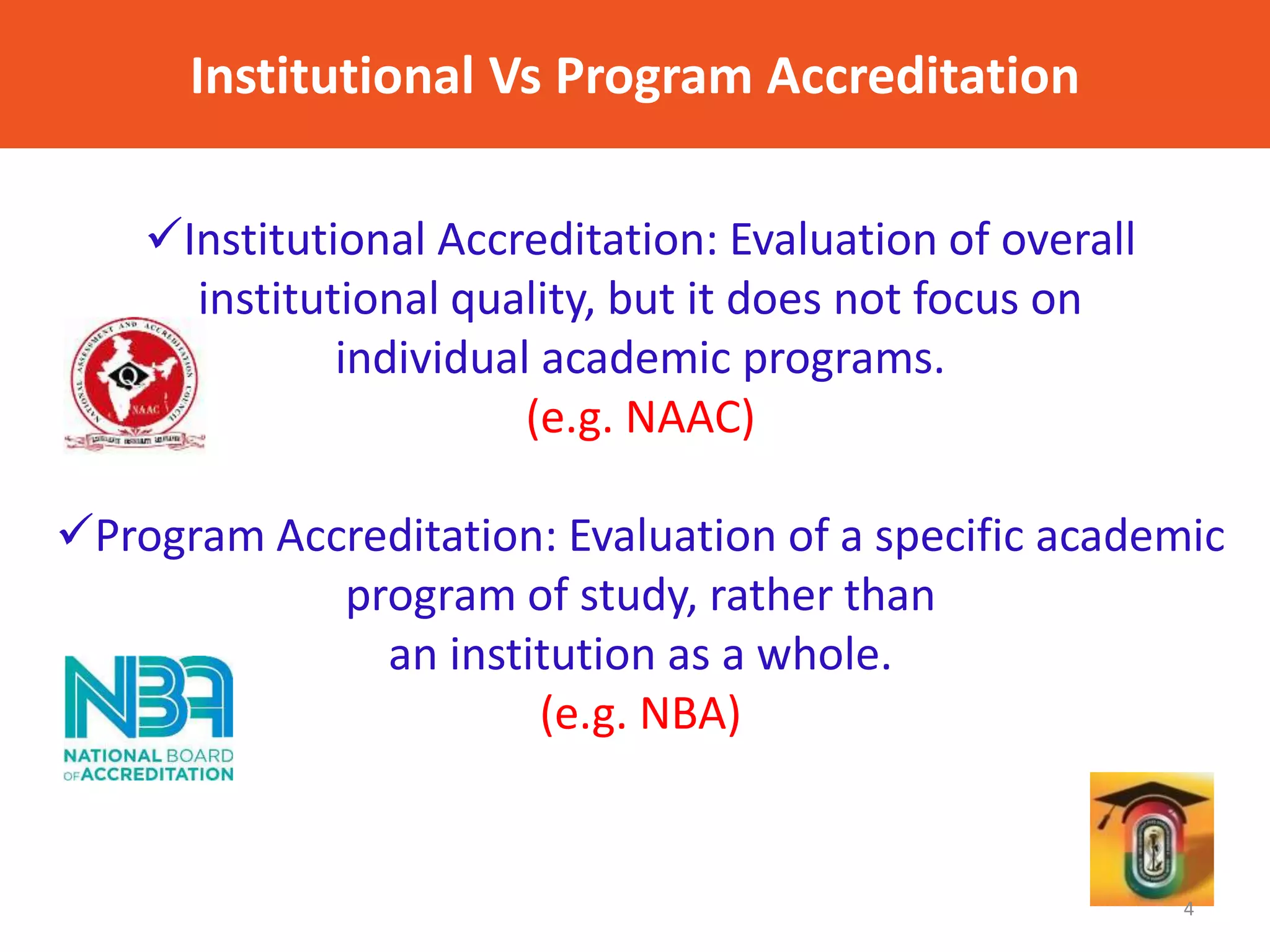
Institutional Accreditation: Evaluation of overall
institutional quality, but it does not focus on
individual academic programs.
(e.g. NAAC)
Program Accreditation: Evaluation of a specific academic
program of study, rather than
an institution as a whole.
(e.g. NBA)
4
Institutional Vs Program Accreditation
Starting with a clear picture of what is important for
students to be able to do…
Then organizing the curriculum, delivery and
assessment to make sure learning happens…
Outcome Based Education (OBE)
6
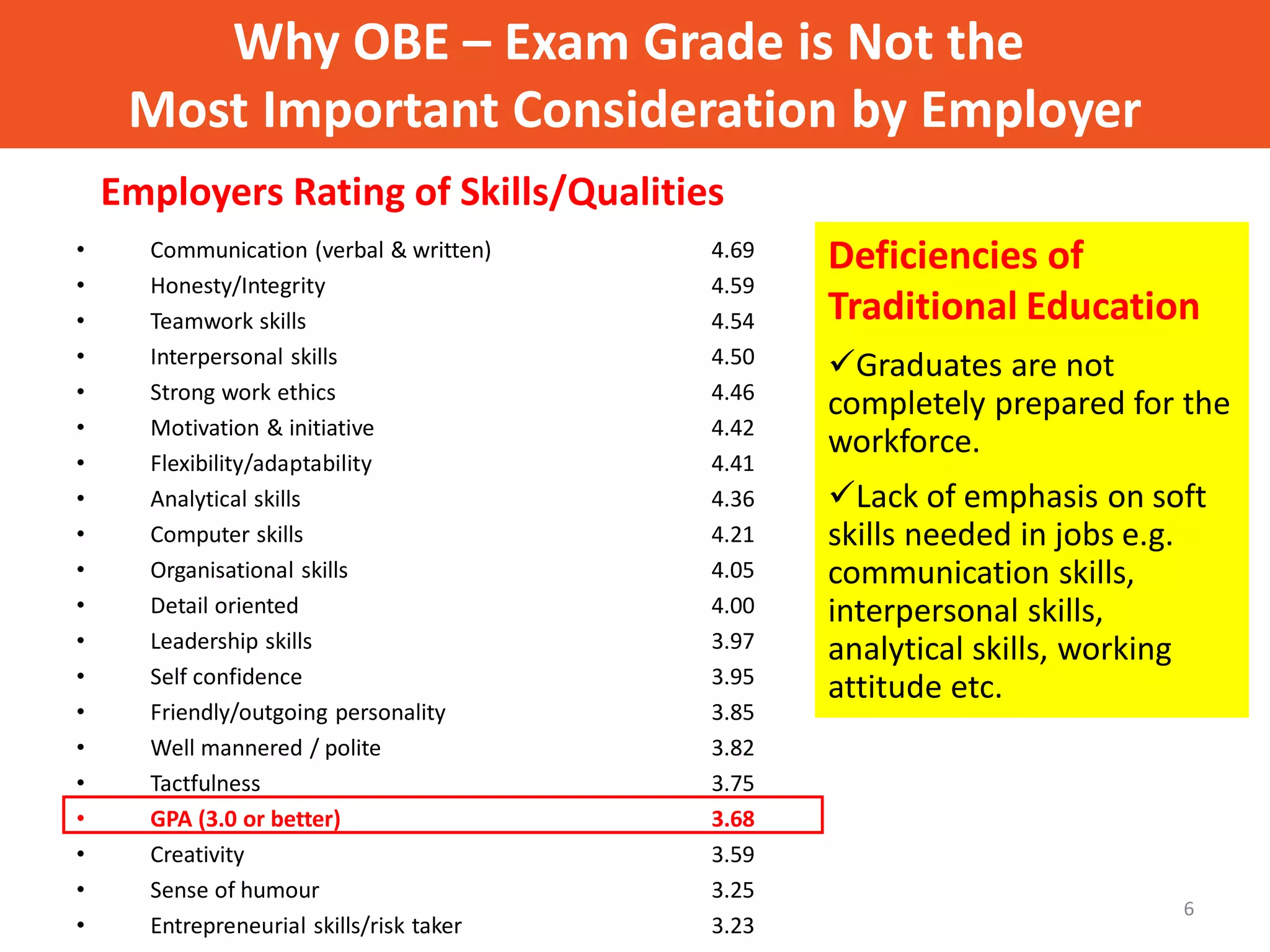
• Communication (verbal & written) 4.69
• Honesty/Integrity 4.59
• Teamwork skills 4.54
• Interpersonal skills 4.50
• Strong work ethics 4.46
• Motivation & initiative 4.42
• Flexibility/adaptability 4.41
• Analytical skills 4.36
• Computer skills 4.21
• Organisational skills 4.05
• Detail oriented 4.00
• Leadership skills 3.97
• Self confidence 3.95
• Friendly/outgoing personality 3.85
• Well mannered / polite 3.82
• Tactfulness 3.75
• GPA (3.0 or better) 3.68
• Creativity 3.59
• Sense of humour 3.25
• Entrepreneurial skills/risk taker 3.23
Employers Rating of Skills/Qualities
Why OBE – Exam Grade is Not the
Most Important Consideration by Employer
Deficiencies of
Traditional Education
Graduates are not
completely prepared for the
workforce.
Lack of emphasis on soft
skills needed in jobs e.g.
communication skills,
interpersonal skills,
analytical skills, working
attitude etc.
7
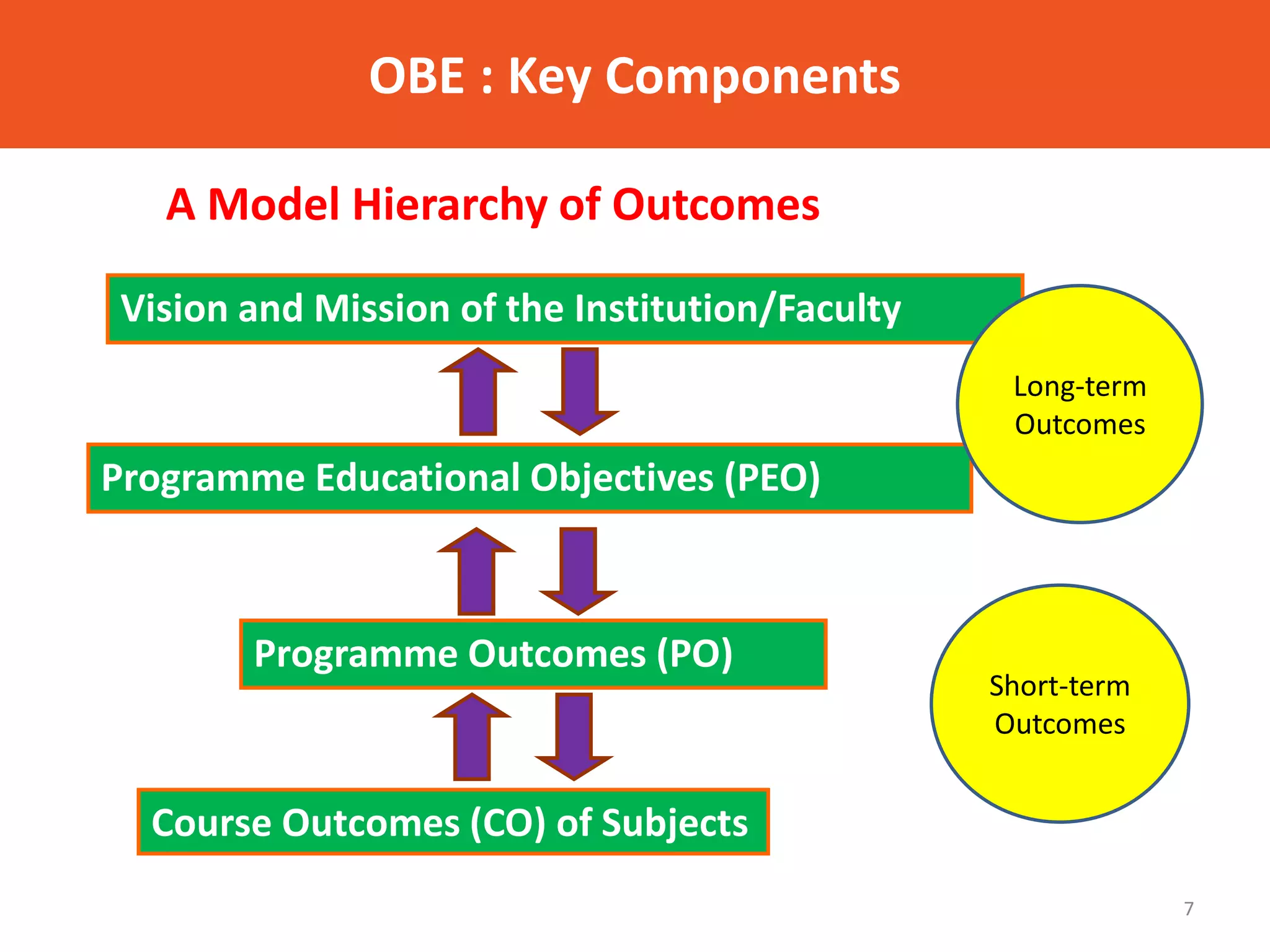
Vision and Mission of the Institution/Faculty
Programme Educational Objectives (PEO)
Programme Outcomes (PO)
Course Outcomes (CO) of Subjects
A Model Hierarchy of Outcomes
OBE : Key Components
Short-term
Outcomes
Long-term
Outcomes
8
Vision is a futuristic statement that the institution would
like to achieve over a long period of time
Mission statements are essentially the means to achieve
the vision
For example,
Vision: Create high-quality Pharmacy professionals
Mission: offer a well-balanced programme of
instruction, practical experience in pharmaceutical
sciences and opportunities for overall personality
development.
Vision and Mission
9
Program educational objectives are broad statements that
describe the career and professional accomplishments
that the program is preparing the graduates to achieve.
Guidelines for the PEOs
PEOs should be consistent with the mission of the Institution
PEOs should be achievable by the program
PEOs should be specific to the program and not too broad
PEOs should be based on the needs of the program
Program Educational Objectives (PEOs)
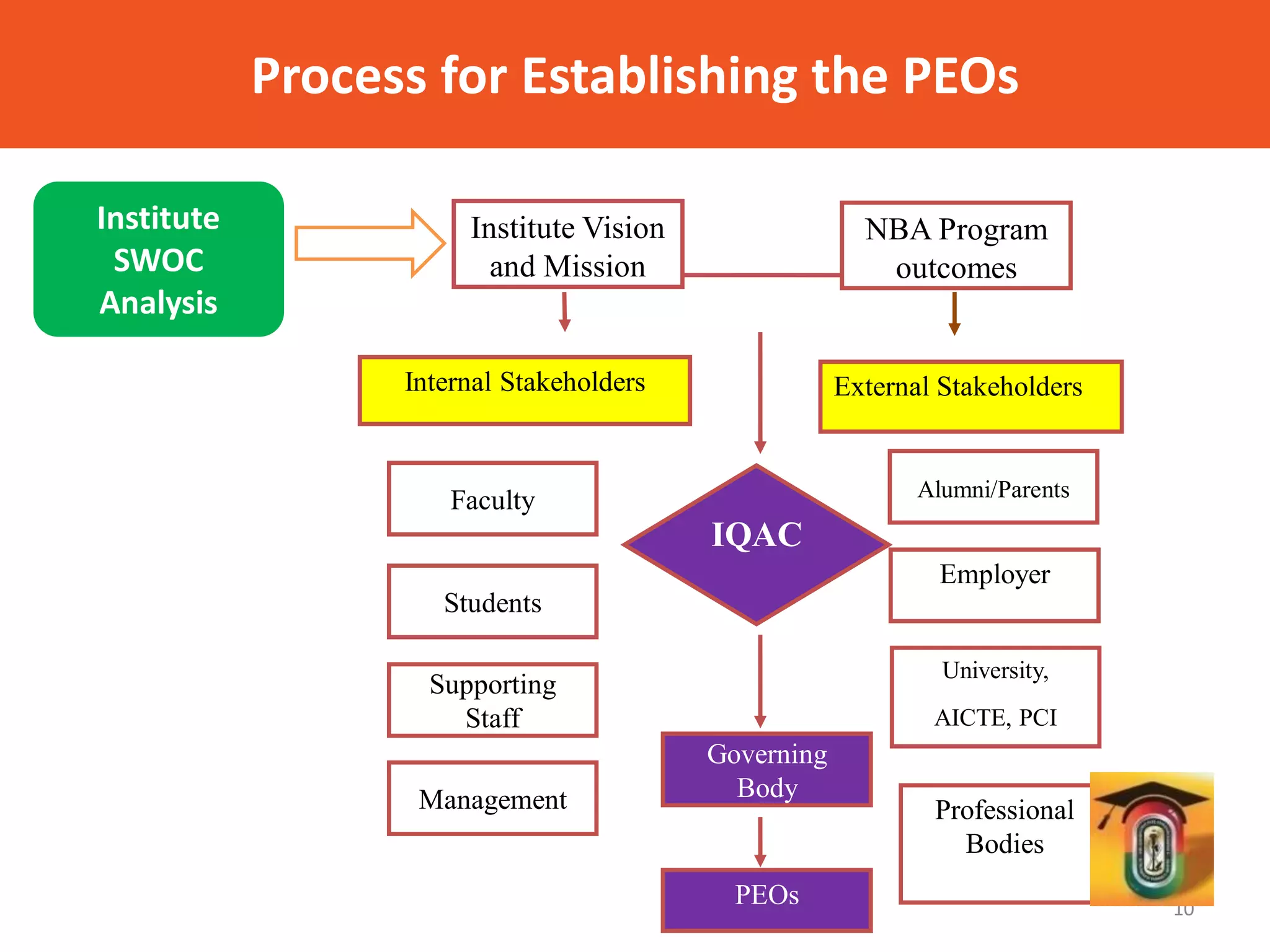
Institute Vision
and Mission
NBA Program
outcomes
IQAC
Internal Stakeholders External Stakeholders
Faculty
Students
Supporting
Staff
Management
Alumni/Parents
Employer
University,
AICTE, PCI
Governing
Body
PEOs
Professional
Bodies
Institute
SWOC
Analysis
10
Process for Establishing the PEOs
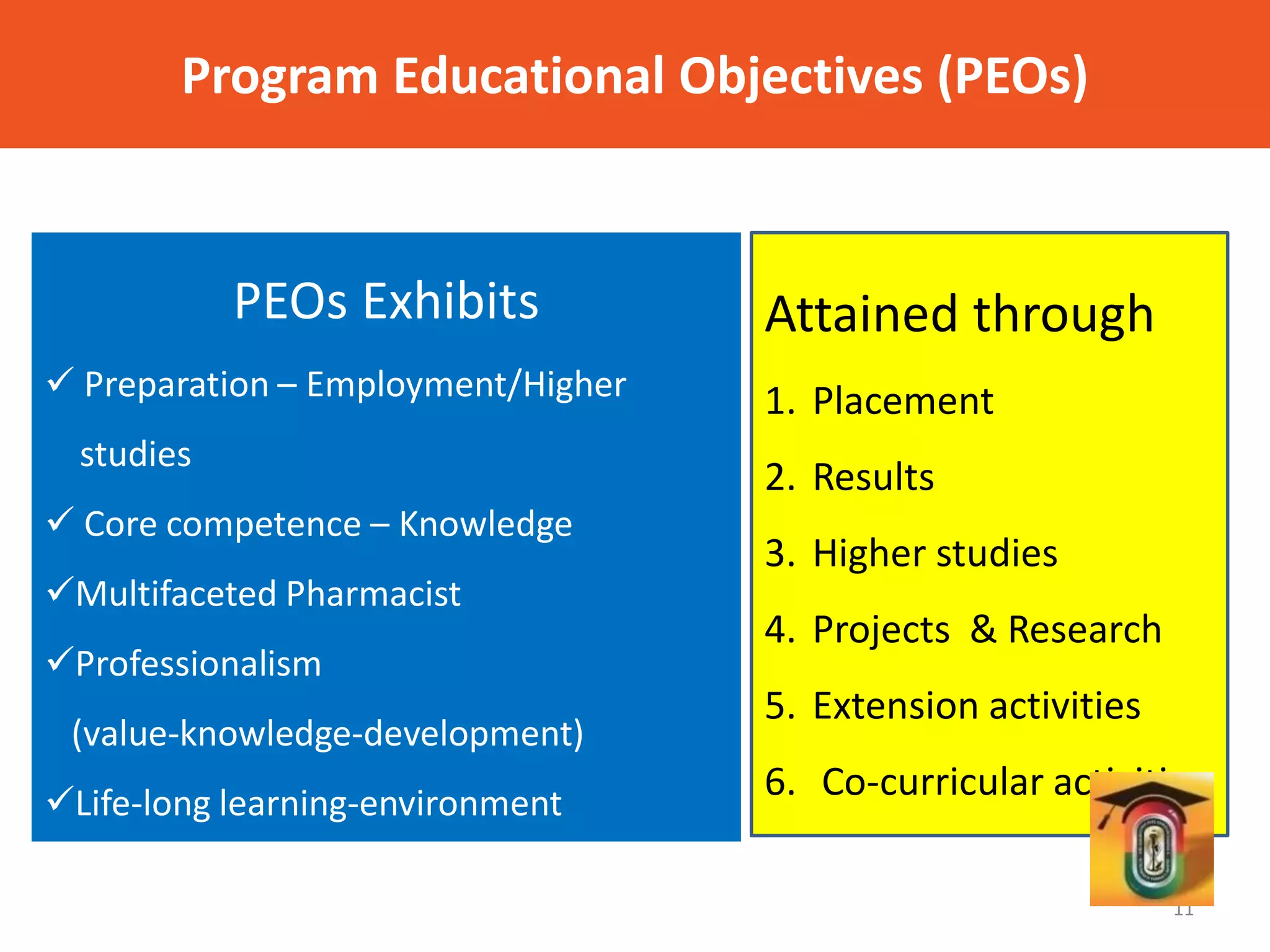
Attained through
1. Placement
2. Results
3. Higher studies
4. Projects & Research
5. Extension activities
6. Co-curricular activities
11
PEOs Exhibits
 Preparation – Employment/Higher
studies
 Core competence – Knowledge
Multifaceted Pharmacist
Professionalism
(value-knowledge-development)
Life-long learning-environment
Program Educational Objectives (PEOs)
12
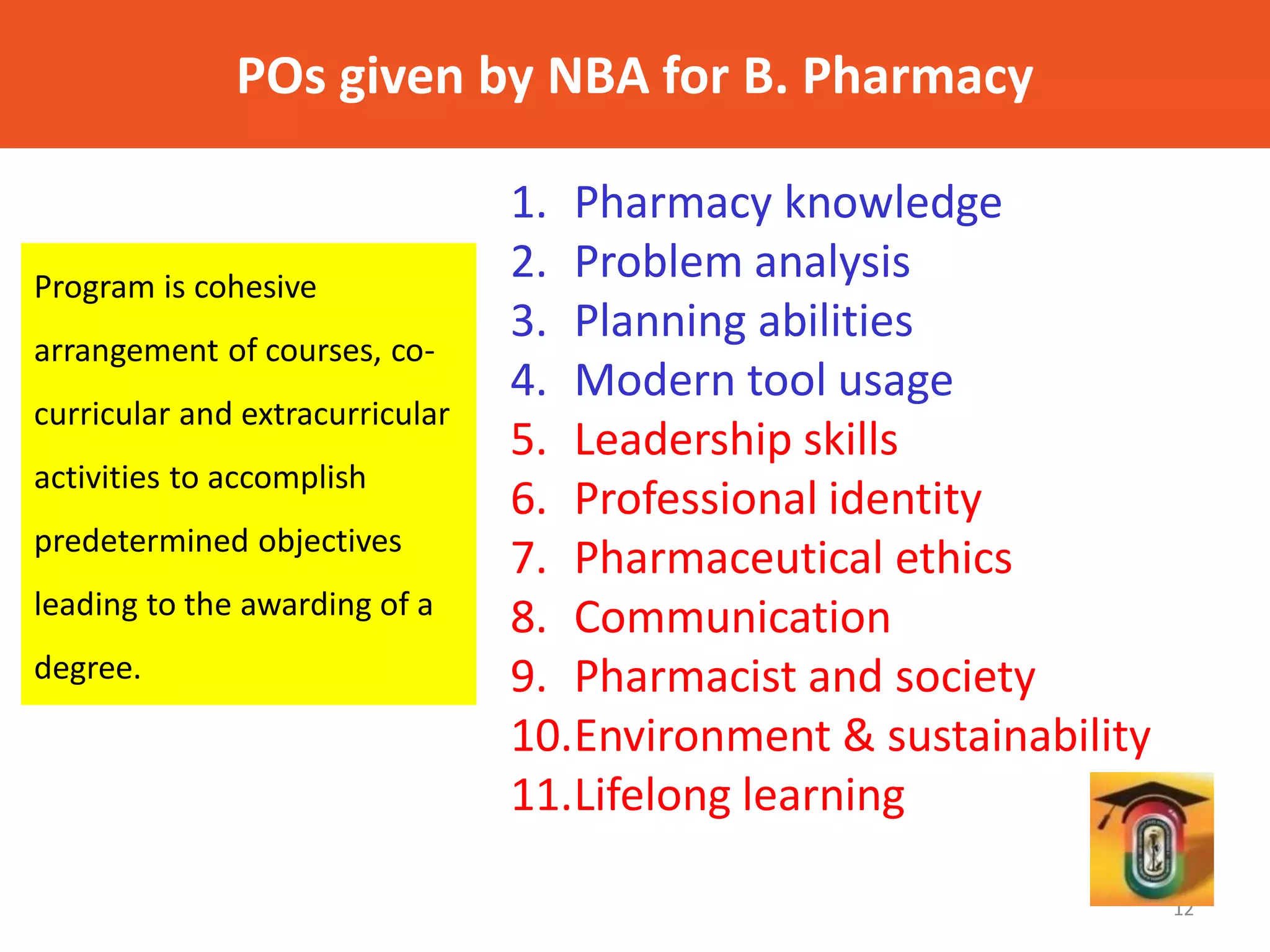
1. Pharmacy knowledge
2. Problem analysis
3. Planning abilities
4. Modern tool usage
5. Leadership skills
6. Professional identity
7. Pharmaceutical ethics
8. Communication
9. Pharmacist and society
10.Environment & sustainability
11.Lifelong learning
Program is cohesive
arrangement of courses, co-
curricular and extracurricular
activities to accomplish
predetermined objectives
leading to the awarding of a
degree.
POs given by NBA for B. Pharmacy
13
0
20
40
60
80
100
120
PO1 PO2 PO3 PO4 PO5 PO6 PO7 PO8 PO9 PO10 PO11
Percentage
Compliance of curriculum with POs
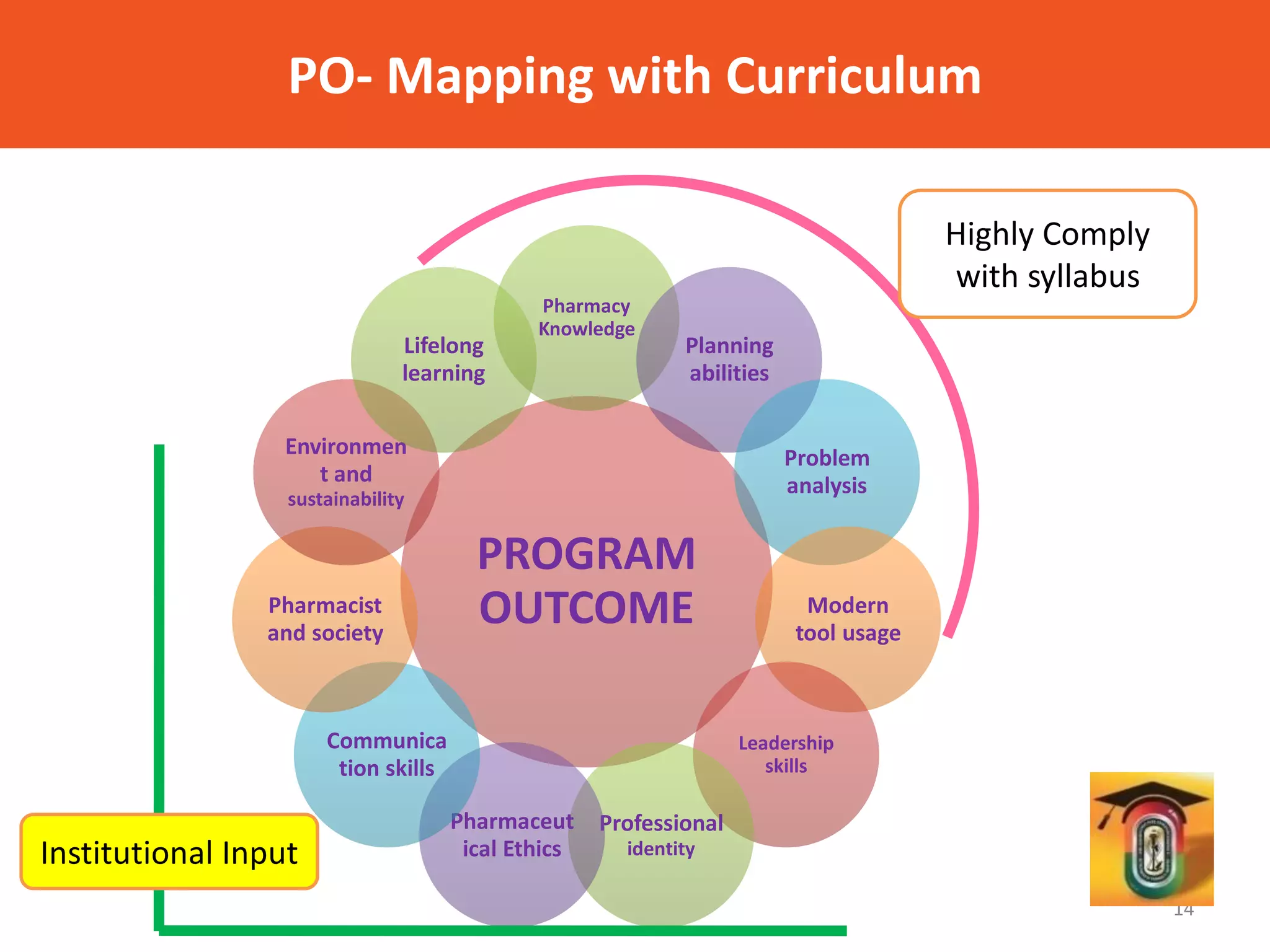
PROGRAM
OUTCOME
Pharmacy
Knowledge
Planning
abilities
Problem
analysis
Modern
tool usage
Leadership
skills
Professional
identity
Pharmaceut
ical Ethics
Communica
tion skills
Pharmacist
and society
Environmen
t and
sustainability
Lifelong
learning
Highly Comply
with syllabus
14
Institutional Input
PO- Mapping with Curriculum
15
Professional
Society Activity
• Professional
identity
• Pharmaceutical
ethics
• Pharmacist and
society
• Lifelong learning
Student
Projects
• Leadership skills
• Communication
skills
• Problem analysis
Co-curricular
Activities
• Leadership skills
• Communication
skills
• Lifelong learning
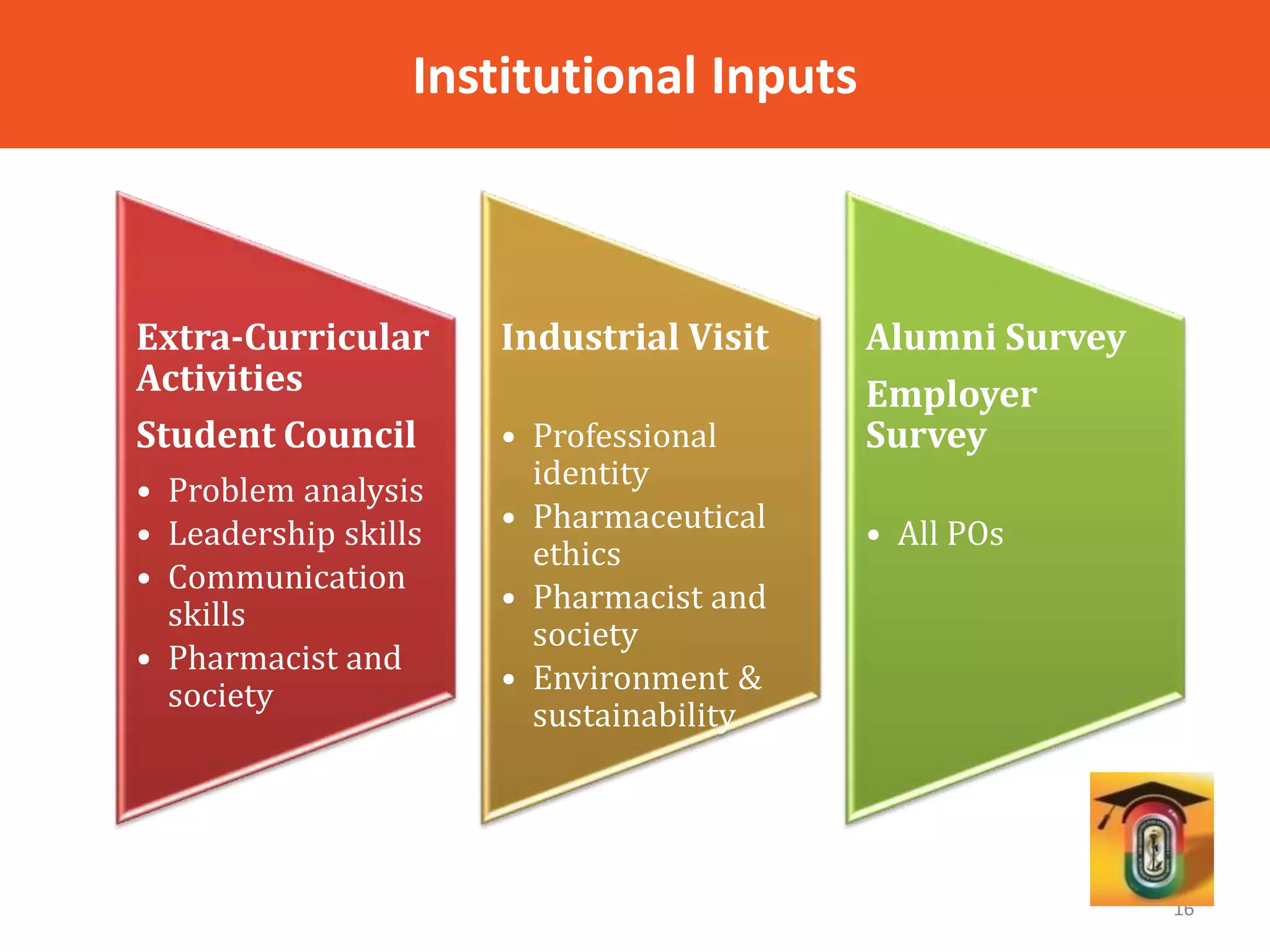
Institutional Inputs
16
Extra-Curricular
Activities
Student Council
• Problem analysis
• Leadership skills
• Communication
skills
• Pharmacist and
society
Industrial Visit
• Professional
identity
• Pharmaceutical
ethics
• Pharmacist and
society
• Environment &
sustainability
Alumni Survey
Employer
Survey
• All POs
Institutional Inputs
Course is a unit of teaching, which encompasses various
topics, that typically lasts one semester/year, is led by
one or more faculty (Subjects).
 Institute specific.
The CO statements should be drafted in order to exhibit
skill, knowledge and attitude amongst the students
after completion of course with helps of Bloom’s
Taxonomy.
17
Course Outcomes
18
Course Outcomes
PS101 PHARMACEUTICS I BT level
At the end of the semester students should be able to……
CO1
Describe the key components of pharmaceutical industry
(Understand)
L2
CO2
Explain the need and classify various dosage forms
(Understand)
L2
CO3
Explain and classify the various route of administration with
respect to dosage forms (Understand)
L2
CO4
Analyze the prescription and calculate the dose for infants and
children (Analyze)
L4
CO5
Prepare and dispense monophasic dosage forms for internal
and external administration (Apply)
L3
CO6
Prepare and dispense biphasic dosage forms for internal and
external administration (Apply)
L3
Q. No. Question COs Marks
1a
Write the contribution of Louis Pastuer and Antony Van Leeuwenhoek in
microbiology.
CO1 2.50
1b Explain whittakar’s five kingdom system. CO1 2.50
1c Write applications of microbiology in pharmaceuticals. CO1 2.50
2
Classify microscope. Explain resolving power, magnification power and
numerical aperture.
CO5, CO2 5
3a Classify bacteria on the basis of nutritional requirements. CO2 2.50
3b Explain growth curve of bacteria. CO3 2.50
4 Describe external structure of bacterial cell wall with functions. CO3 5
5
Explain principle of electron microscopy. Give comparison between compound
microscope, SEM and TEM.
CO2 5
6a Actinomycetes and Rickettsia CO1 2.50
6b Methods of isolation of pure culture CO5, CO3 2.50
6c Cytoplasm of bacteria CO3 2..50
COs Level Distribution
COs Level Planned Marks Planned Distribution
CO1 10 29.17 %
CO2 12.50 34.72 %
CO3 12.50 36.11 %
CO5 7.50 20.83 %
19
Mapping of CO with Questions Papers
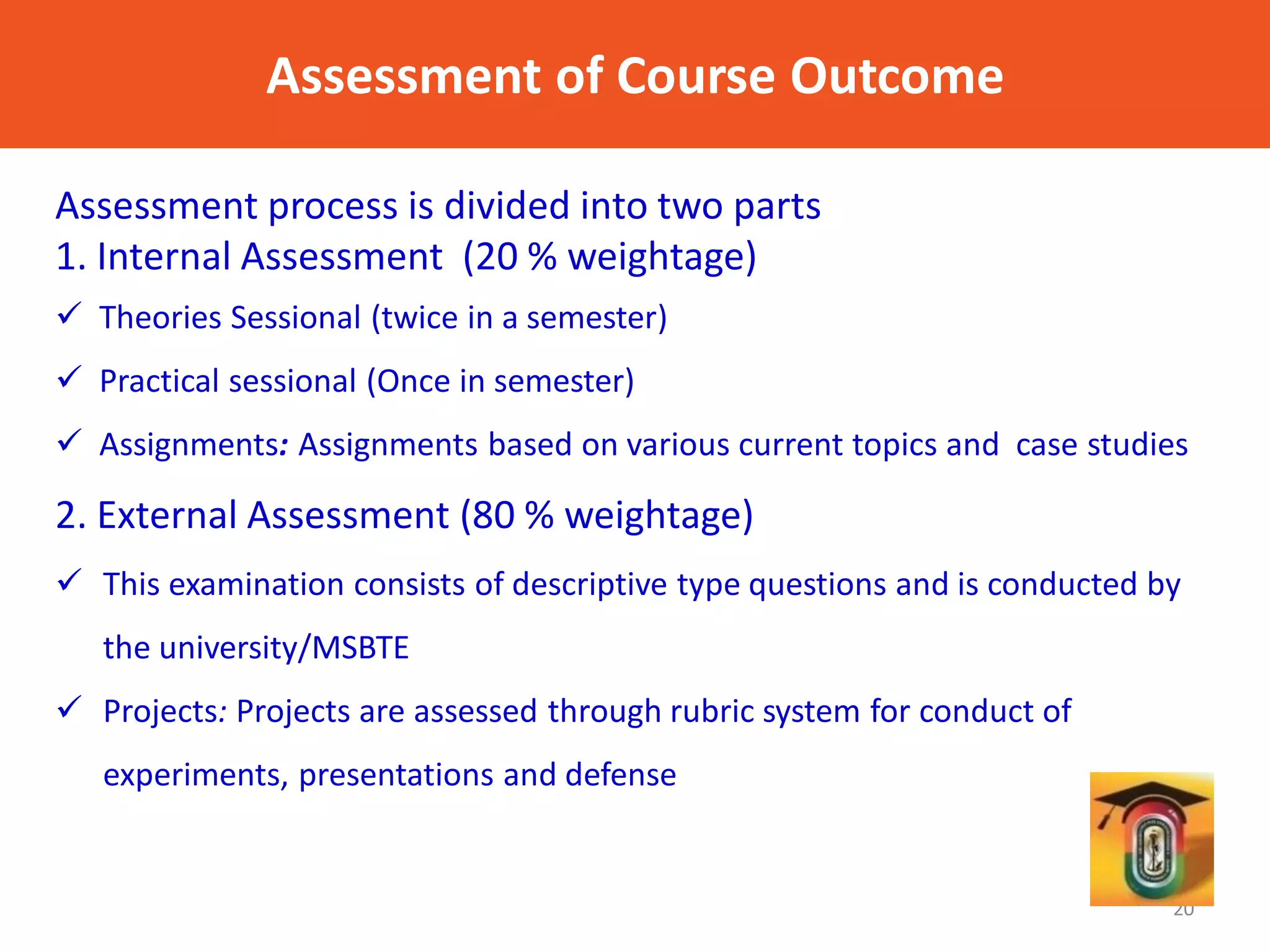
Assessment process is divided into two parts
1. Internal Assessment (20 % weightage)
 Theories Sessional (twice in a semester)
 Practical sessional (Once in semester)
 Assignments: Assignments based on various current topics and case studies
2. External Assessment (80 % weightage)
 This examination consists of descriptive type questions and is conducted by
the university/MSBTE
 Projects: Projects are assessed through rubric system for conduct of
experiments, presentations and defense
20
Assessment of Course Outcome
 If 50 % of students gets above 60 % Marks then the level is low 1.
 If 60 % of students gets above 60 % Marks then the level is medium 2.
If 70 % of students gets above 60 % Marks then the level is high 3.
COURSE EXAM CO1 CO2 CO3 CO4 CO5 CO6 AVG
20% of
Internal / 80
% of
external
Total
HAP
INT 1.0 3.0 3.0 3.0 3.0 3.0 2.66 0.53
2.33
EXT 2.0 2.0 2.0 2.0 2.0 2.0 2.0 1.8
Attainment of Course Outcome
21
Target of Course Outcome
Course Outcome
CO-PO
Mapping
Setting the target of
CO Assessment
Assessment through internal and
university examinations (Direct)
CO Attainment
PO Attainment
Indirect methods
(surveys and other
activities)
22
PO- Assessment and Evaluation
Course : Pharmaceutics- I
CO PO1 PO2 PO3 PO4 PO5 PO6 PO7 PO8 PO9 PO10 PO11
CO1 3 1 1 - - 2 2 - 1 - 2
CO2 2 2 1 - - 2 1 - 1 - 1
CO3 2 1 1 1 - 2 1 - 2 - 1
CO4 2 1 1 1 - 2 1 - 1 - 1
CO5 2 2 2 2 - 2 2 - 2 - 1
CO6 2 2 2 - 2 2 - 2 - 1
AVG 2.2 1.5 1.3 1.5 - 2 1.5 - 1.5 - 1.17
Average of course –PO mapping of all courses gives the target for
PO attainment of the particular program
23
Mapping of CO with PO
Direct Assessment
methods
(80% weightage)
Theory sessional examination or Internal assessment
tests
Practical sessional Examinations
Annual theory and practical examinations
Assignments
Indirect
assessment
methods
(20% weightage)
Alumni survey
Program Exit Survey
Employer Survey
24
PO- Assessment Methods
25
Code/PO 1 2 3 4 5 6 7 8 9 10 11
PYT101 2.51 2.8 2.8 3 1.2 1.2 1.2 1.2 1.2 2.8
PYT102 2.93 2.93 2.93 2.93 2.93 2.93 2.93 2.93 2.93
PYT103 2 2.8 2 2 2 2.8 2 2 2 2 2
PYT407 3 3 3 3 3 3 3 3 3 3 3
PYT408 1.21 1.21 1.21 1.21 1.21 1.21 1.21 1.21 1 1 1.21
Direct Attainment 1.76 1.93 1.80 1.83 1.91 1.71 1.78 1.84 1.75 1.75 1.74
Indirect Attainment 2.49 2.55 2.48 2.55 2.52 2.36 2.55 2.27 2.46 2.52 2.55
80% of Direct
Attainment
1.41 1.54 1.44 1.46 1.53 1.37 1.42 1.47 1.4 1.4 1.39
20% of Indirect
Attainment
0.498 0.51 0.496 0.51 0.504 0.472 0.51 0.454 0.49 0.5 0.51
Final PO Attainment 1.91 2.05 1.936 1.97 2.03 1.84 1.93 1.93 1.89 1.90 1.90
PO Attainment
NBA
ACCREDITATION
26
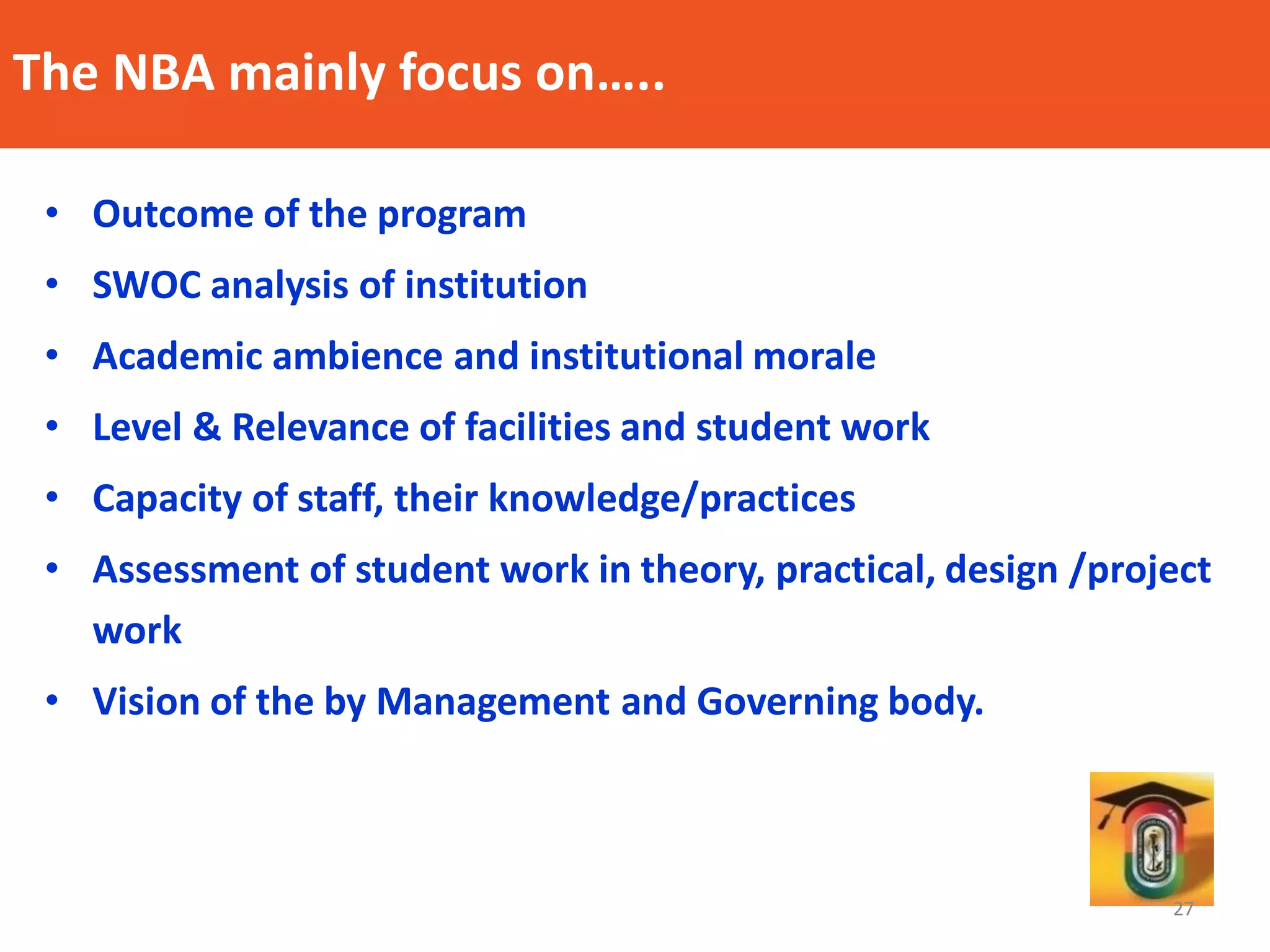
• Outcome of the program
• SWOC analysis of institution
• Academic ambience and institutional morale
• Level & Relevance of facilities and student work
• Capacity of staff, their knowledge/practices
• Assessment of student work in theory, practical, design /project
work
• Vision of the by Management and Governing body.
27
The NBA mainly focus on…..
Accredited Programme for 6 Years
[when cumulative score is above 750]
Accredited Programme for 3 Years
[when cumulative score is between 600 and 749]
Not Accredited
[when cumulative score is below 600]
28
What is the NBA’s Quality Grading ?
4
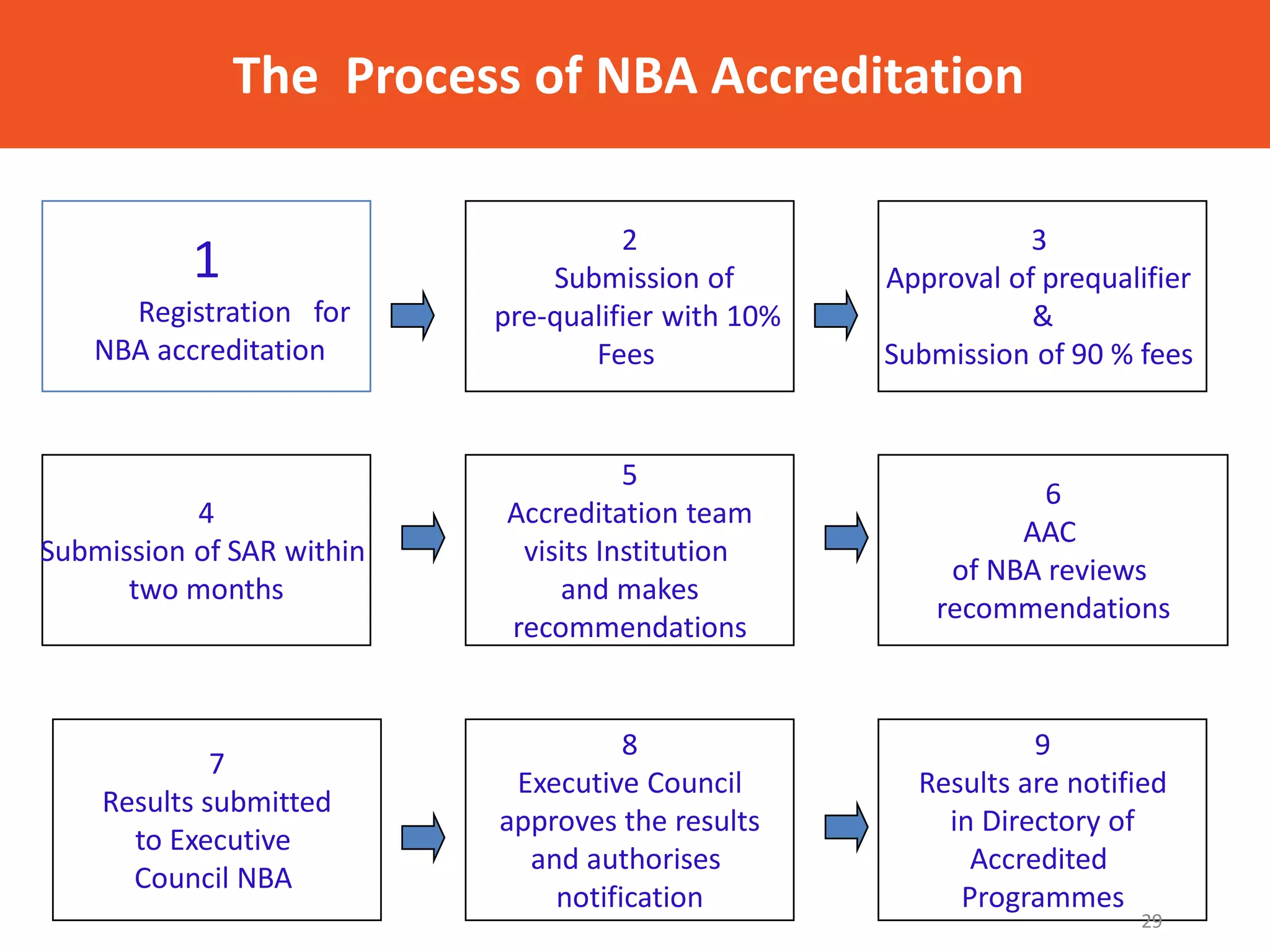
Submission of SAR within
two months
8
Executive Council
approves the results
and authorises
notification
9
Results are notified
in Directory of
Accredited
Programmes
6
AAC
of NBA reviews
recommendations
5
Accreditation team
visits Institution
and makes
recommendations
7
Results submitted
to Executive
Council NBA
29
The Process of NBA Accreditation
1
Registration for
NBA accreditation
2
Submission of
pre-qualifier with 10%
Fees
3
Approval of prequalifier
&
Submission of 90 % fees
30
Diploma in Pharmacy: Minimum eligibility criteria
31
UG Pharmacy: Minimum Eligibility Criteria
32
Diploma in Pharmacy: Minimum Eligibility Criteria
33
Diploma in Pharmacy: Desirable Parameters
34
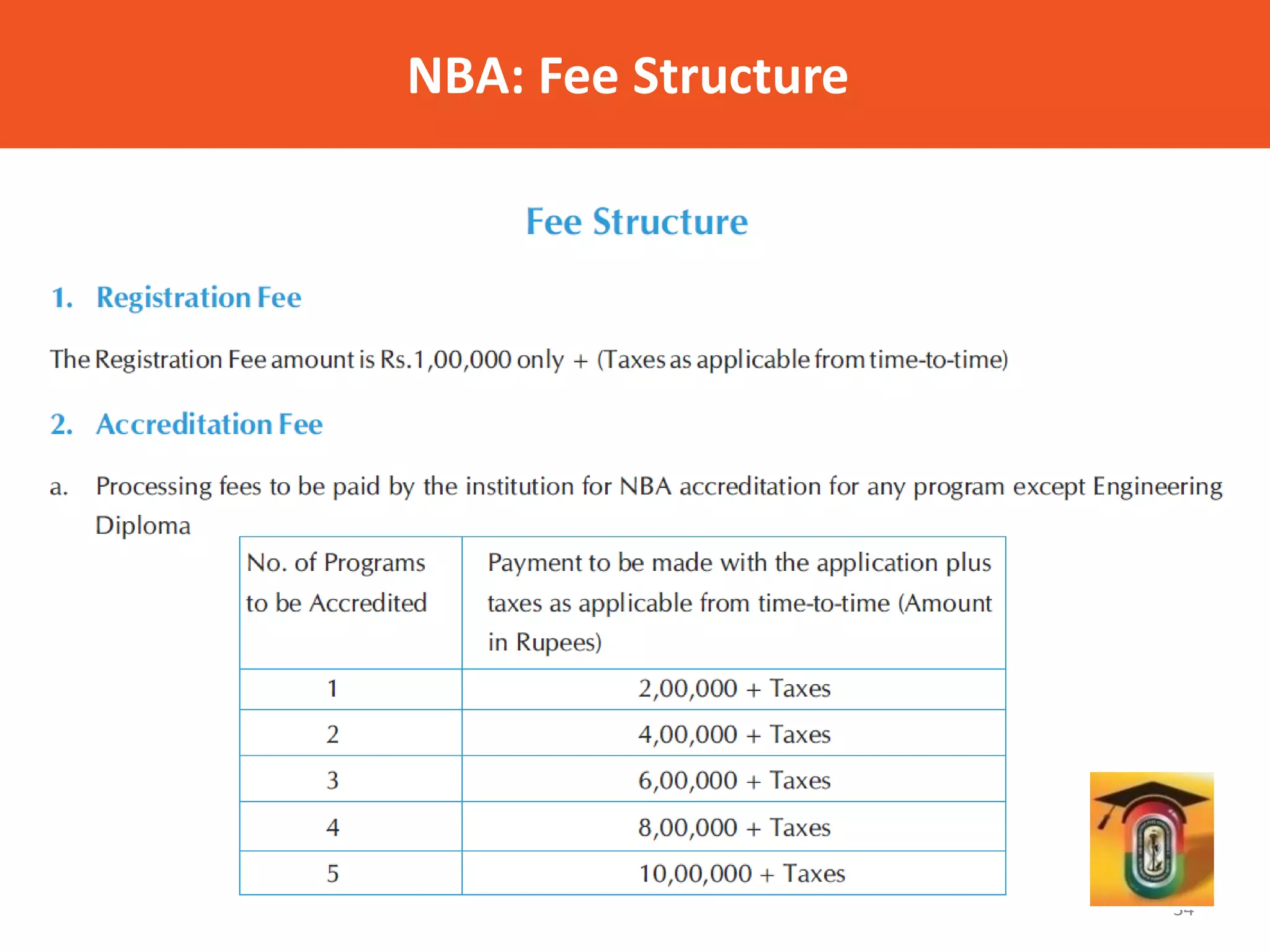
NBA: Fee Structure
Criteria
No.
Criteria (UG Pharmacy) Marks/ Weightage
Program Level Criteria
1 Vision, Mission, Program Educational Objectives 50
2
Program Curriculum and Teaching – Learning
Processes
150
3 Course Outcomes and Program Outcomes 100
4 Students’ Performance 180
5 Faculty Information and Contributions 175
6 Facilities and Technical Support 120
7 Continuous Improvement 75
Institute Level Criteria
8 Student Support Systems 50
9
Governance, Institutional Support and Financial
Resources
100
Total 1000 35
36
Criterion
No.
Criterion (Diploma in Pharmacy) Marks/ Weightage
1 Vision, Mission and Program Educational
objectives
50
2 Program Curriculum and Teaching Learning
Process
50
3 Course Outcome and Program Outcome 60
4 Student’s Performance 75
5 Faculty Information and Contributions 75
6 Facilities and Technical Support 100
7 Continuous Improvement 30
8 Governance, Institutional Support and
Financial Resources
60
Total 500
PART A: Institutional Information
PART B: Criteria Summary
PART C: Declaration by the Institution
37
NBA SAR Contents
38
1.1. State the Vision and Mission (5)
Availability of the Vision & Mission statements of the Department (2)
Appropriateness/Relevance of the Statements (3)
1.2. State the Program Educational Objectives (PEOs) (5)
Listing of the Program Educational Objectives (3 to 5 PEOs) (5)
1.3. Indicate where and how the Vision, Mission and PEOs are
published and disseminated among stakeholders (15)
Adequacy in respect of publication & dissemination (3)
Process of dissemination among stakeholders (4)
Extent of awareness of Vision, Mission & PEOs among the stakeholders (8)
CRITERION 1
Vision, Mission and PEOs(50)
23-Oct-18 39
1.4. State the process for defining the Vision & Mission and PEOs
of the program (10)
Description of process implemented for defining the Vision, Mission (5)
Description of process implemented for defining the PEOs (5)
1.5. Establish consistency of PEOs with Mission of the Institute
(15)
Preparation of a matrix of PEOs and elements of Mission statement (5)
Consistency/justification of co-relation parameters of the above matrix (10)
CRITERION 1
Vision, Mission and PEOs(50)
40
2.1. Program Curriculum (40)
2.1.1 Delivery of Syllabus Contents and compliance of the
curriculum for attainment of POs (10)
Process used to identify extent of compliance of university curriculum for
attaining Pos (6)
List the curricular gaps for the attainment of defined Pos (4)
2.1.2 State the delivery details of the contents beyond the Syllabus
for the attainment of POs (20)
A. Steps taken to get identified gaps included in the curriculum.(e.g. letter to
university/BOS) (4)
B. Delivery details of content beyond syllabus (10)
C. Mapping of content beyond syllabus with the POs (6)
2.1.3. Adherence to Academic Calendar (10)
Demonstrate notified academic calendar & its adherence (10)
CRITERION 2
Program Curriculum and Teaching Learning Process (150)
41
2.2. Teaching-Learning Processes (110).
2.2.1 Initiatives in teaching and learning process (25)
A. Use of various instructional methods and pedagogical initiatives (4)
B. Methodologies to support weak students and encourage bright students(4)
C. Quality of classroom teaching (Observation in a Class) (4)
D. Conduct of experiments (Observation in Lab) (4)
E. Continuous Assessment in the laboratory (3)
F. Student feedback on teaching learning process and actions taken (6)
2.2.2 Quality of internal semester question papers, assignments
and evaluation (10)
A. Process for internal semester question paper setting, evaluation and effective
process
implementation (2)
B. Process to ensure questions from outcomes/learning levels perspective (2)
C. Evidence of COs coverage in class test / mid-term tests (3)
D. Quality of Assignment and its relevance to COs (3)
CRITERION 2
Program Curriculum and Teaching Learning Process (150)
42
2.2.3 Quality of Students projects (15)
A. Identification of projects and allocation methodology (2)
B. Types and relevance of the projects and their contribution towards
attainment of POs (3)
C. Process for monitoring and evaluation (3)
D. Process to assess individual and team performance (2)
E. Quality of completed projects/working prototypes (3)
F. Evidences of papers published /Awards received by projects etc. (2)
2.2.4 Initiatives related to Industry and/or Hospital interaction
(20)
A. Industry supported laboratories (5)
B. Industry involvement in the program design and partial delivery of any
regular courses for
students (5)
C. Hospital involvement in the program like collaborative initiatives with the
hospitals etc. (10)
CRITERION 2
Program Curriculum and Teaching Learning Process (150)
2.2.5. Initiatives related to skill Development programs/industry
internship/ training/hospital pharmacy (10)
A. Industrial training/tours for students (2)
B. Industrial /internship /summer training of more than two weeks and post
training Assessment (5)
C. Student feedback on initiative (3)
2.2.6 Continuous Evaluation Process (10)
Process followed and its effectiveness (10)
2.2.7 Quality of Experiments (20)
Quality from the equipment set-up (20)
CRITERION 2
Program Curriculum and Teaching Learning Process (150)
PLAN
DO
CHECK
Regular interactions in
theory classes,
Laboratory Practical
Evaluation
Preparation of academic
calendar
Teaching and Lesson plan
Faculty meetings
Remedial actions,
Periodic Feedback system
44
CURRICULAR PLANNING AND IMPLEMENTATION
The course file for each subject should be maintained by individual
faculty member to monitor all the activities related to course
delivery.
It includes……
•Academic calendar
• Time table
•Teaching plan
•Lesson plan
• Course outcome
•Attendance register
•Question bank
•List of reference books
•Marks of the sessional examination
• Details of remedial classes
Should be regularly
checked by Principal
or HOD
45
Course File
Students Centric
Teaching Methods
Mode of
delivery
Lecture
with chalk
board Power
point
presentati
ons
Lab work
Projects
Assignments
Industry
Experts
Seminars
Remedial
classes
Tutorial
Classes
46
Innovation and
Creativity
In Teaching-
Learning
Flipped
Class
Moodle
Mentoring
system
Online you
tube video
Lectures
Think Pair
share
47
48
ACTIVITY REPORT CARD
NAME OF THE ACTIVITY:
COORDINATOR NAME:
VENUE:
DATE: TIME: AM/PM
NUMBER OF PARTICIPANTS: NATURE: Outdoor/Indoor
SUPPORT/ASSISTANCE:
TOPIC/SUBJECT OF THE
ACTIVITY
OBJECTIVES
METHODOLOGY
OUTCOMES Relevance to PO
SR.
No.
DOCUMENTS TO BE
ATTACHED
YES/NO SR.
No.
DOCUMENTS TO BE
ATTACHED
YES/NO
01. Notice &Letters 08. Details of Guest
02. Communication/Letter 09. List of participation
03. Activity report 10. News clip with details
04. Photos 11. Certificate
05. Financial details 12. Information Brochure
06. Feedback form 13. Soft Copy
07. Feedback analysis 14. Any other
BRIEF INFORMATION ABOUT THE ACTIVITY
PROOFS & DOCUMENTS ATTACHED (Tick mark the proofs attached):
49
3.1. Establish the correlation between the courses and the
Program Outcomes (20)
3.1.1. Course Outcomes (05)
Number of Outcomes for a Course is expected to be around 6.
A. Evidence of COs being defined for every course (5)
CRITERION 3
Course Outcomes and Program Outcomes 100
50
3.1.2. CO-PO matrices of courses selected in 3.1.1
(four matrices to be mentioned; one per semester from 1st to 8th semester; at
least one per year) (05)
CO PO1 PO2 PO3 PO4 PO5 PO6 PO7 PO8 PO9 PO10 PO11
C202.
1
C202.
2
--
C202
Correlation levels 1, 2 or 3 as defined below: 1: Slight (Low) 2: Moderate
(Medium) 3: Substantial (High) If there is no correlation, put ‘-’
A. Explanation of table to be ascertained (5)
CRITERION 3
Course Outcomes and Program Outcomes 100
51
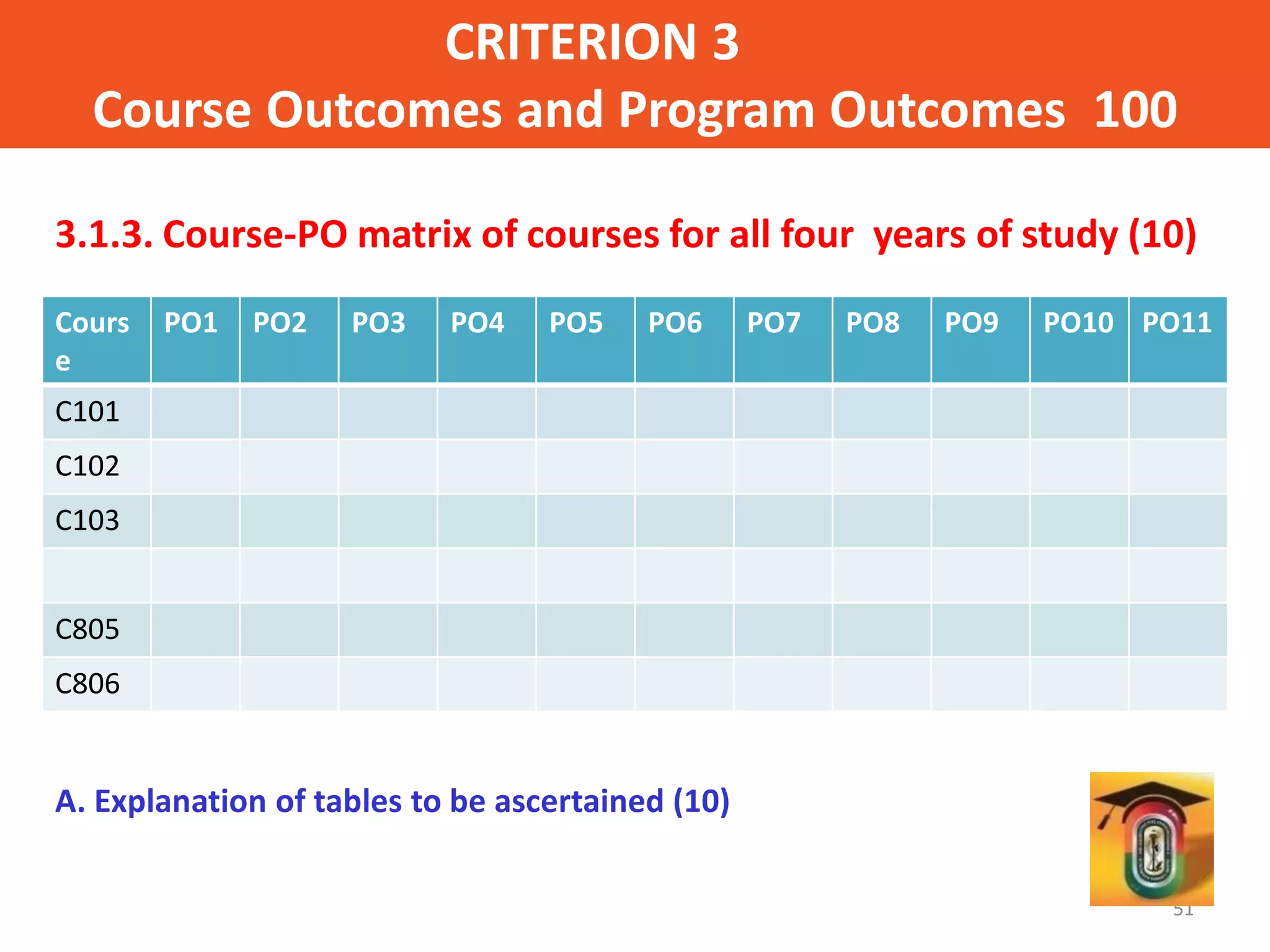
3.1.3. Course-PO matrix of courses for all four years of study (10)
Cours
e
PO1 PO2 PO3 PO4 PO5 PO6 PO7 PO8 PO9 PO10 PO11
C101
C102
C103
C805
C806
A. Explanation of tables to be ascertained (10)
CRITERION 3
Course Outcomes and Program Outcomes 100
52
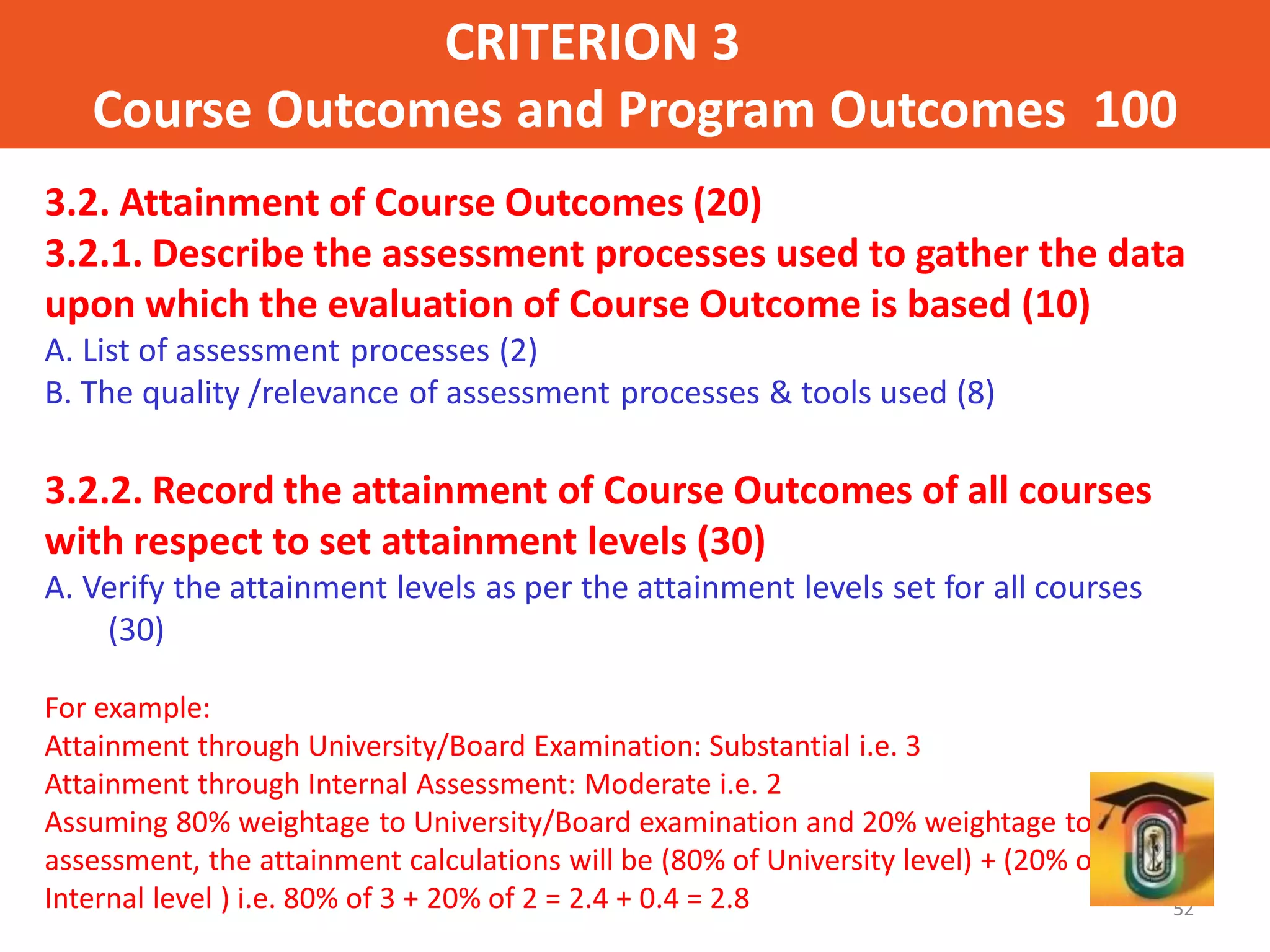
3.2. Attainment of Course Outcomes (20)
3.2.1. Describe the assessment processes used to gather the data
upon which the evaluation of Course Outcome is based (10)
A. List of assessment processes (2)
B. The quality /relevance of assessment processes & tools used (8)
3.2.2. Record the attainment of Course Outcomes of all courses
with respect to set attainment levels (30)
A. Verify the attainment levels as per the attainment levels set for all courses
(30)
For example:
Attainment through University/Board Examination: Substantial i.e. 3
Attainment through Internal Assessment: Moderate i.e. 2
Assuming 80% weightage to University/Board examination and 20% weightage to Internal
assessment, the attainment calculations will be (80% of University level) + (20% of
Internal level ) i.e. 80% of 3 + 20% of 2 = 2.4 + 0.4 = 2.8
CRITERION 3
Course Outcomes and Program Outcomes 100
53
3.3. Attainment of Program Outcomes (40)
3.3.1. Describe assessment tools and processes used for
assessing the attainment of each PO (10)
A. List of assessment tools & processes (3)
B. The quality/relevance of assessment tools/processes used (7)
CRITERION 3
Course Outcomes and Program Outcomes 100
54
3.3.2. Provide results of evaluation of each PO (30)
Course PO1 PO2 PO3 PO4 PO5 PO6 PO7 PO8 PO9
C101
C102
-
-
-
C806
Direct
Attainment
Indirect
Attainment
A. Verification of documents, results and level of attainment of each PO (20)
B. Overall levels of attainment (10)
CRITERION 3
Course Outcomes and Program Outcomes 100
55
4.1. Enrolment Ratio (Admissions) (20)
A. >= 90% students enrolled at the First Year Level on average basis during the
previous three academic years starting from current academic year (20)
B. >= 80% students enrolled at the First Year Level on average basis during the
previous three academic years starting from current academic year (18)
C. >= 70% students enrolled at the First Year Level on average basis during the
previous three academic years starting from current academic year (16)
D. >= 60% students enrolled at the First Year Level on average basis during the
previous three academic years starting from current academic year (12)
E. >= 50% students enrolled at the First Year Level on average basis during the
previous three academic years starting from current academic year (08)
F. Otherwise ‘0’.
CRITERION 4
Student’s Performance (180)
56
4.2. Success Rate in the stipulated period of the program (50)
4.2.1. Success rate without backlogs in any year of study (30)
SI= Number of students who graduated in minimum stipulated time)/ Number of
students admitted
Average SI = Mean of success index (SI) for past three batches
Success rate = 30*Average SI
4.2.2. Success rate with backlog in stipulated period of study (20)
SI= (Number of students who graduated from the program in the stipulated period
of course duration)/ {(Number of students admitted in the first year of that batch)
plus (lateral entry students admitted in second year of study)}
Average SI = mean of success index (SI) for past three batches Success rate = 20 ×
Average SI
CRITERION 4
Student’s Performance (180)
4.3. Academic Performance in Final Year (10)
Academic Performance = Average API
Academic Performance Index(API) = ((Mean of Final Year Grade Point
Average of all successful Students on a 10 point scale) or (Mean of the
percentage of marks of all successful students in Final Year/10)) x
(successful students/number of students appeared in the examination)
4.4. Academic Performance in Third Year (10)
4.5. Academic Performance in Second Year (10)
4.6. Academic Performance in First Year (20)
CRITERION 4
Student’s Performance (180)
58
4.7. Placement and Higher Studies (40)
Assessment Points = 40 × (x + y)/N
N: Total No. of Final Year Students (N)
x : Number of students placed in Industries/ Hospitals/ Government sector
through on/off campus recruitment or opted for Entrepreneurship
y: No. of students admitted to higher studies with valid scores in various
qualifying exams
CRITERION 4
Student’s Performance (180)
4.8 Professional Activities (20)
4.8.1. Professional societies / chapters and organizing pharmacy events (5)
A. Availability & activities of professional societies/chapters (2)
B. Number, quality of pharmacy related events (organized at institute) (3)
(Level - Institute/State/National/International)
4.8.2. Publication of technical magazines, newsletters, etc. (5)
List the publications mentioned along with the names of the editors, publishers,
etc.
A. Quality & Relevance of the contents and Print Material (3)
B. Participation of Students from the program (2)
4.8.3. Participation in inter-institute events by students of the program
of study (10) (Provide a table indicating those publications, which received awards
in the events/conferences organized by other institutes
A. Events within the state (1), B. Events outside the state (2)
C. Prizes/awards received in such events (7)
CRITERION 4
Student’s Performance (180)
60
5.1. Student-Faculty Ratio (SFR) (20)
Student Faculty Ratio (SFR) = N/F
S = Number of Students in the Department = UG1 + PG1 + PG2
F = Total Number of Regular Faculty Members in the Department
15.00 - 15.50 - 20 marks
15.51 - 16.50 – 18 marks
16.51 - 17.50 - 16 marks
17.51 – 18.50 - 14 marks
18.51 – 19.50 - 12 marks
19.51 – 20.00 - 10 marks
CRITERION 5
Faculty Information and Contributions (175)
Checks for faculty count:
1. Is the institution providing central/state
government pay scales?
2. Is the institution providing consolidated salary
consistent with point 1?
3. Is the intuition providing terminal benefits to
faculty-gratuity, P.F., etc.?
4. Is the institution deducting IT at source?
5.2. Faculty Cadre Proportion (20)
The reference Faculty cadre proportion is 1(F1):2(F2):6(F3)
F1: Number of Professors required = 1/9 x Number of Faculty
required to comply with 15:1 Student-Faculty ratio.
F2: Number of Associate Professors required = 2/9 x Number of
Faculty required to comply with 15:1 Student-Faculty ratio.
F3: Number of Assistant Professors required = 6/9 x Number of
Faculty required to comply with 15:1 Student-Faculty ratio
CRITERION 5
Faculty Information and Contributions (175)
62
5.3. Faculty Qualification (20)
FQ = 2 x [{10X +6Y}/F] where
X is no. of faculty with Ph.D.,
Y is no. of faculty with M. Pharm.,
F is no. of faculty required to comply 1:15 Faculty Student ratio
(no. of faculty and no. of students required to be calculated as per 5.1)
5.4. Faculty Retention (20)
% of faculty retained during the period of assessment keeping CAYm3 as base year
≥ 90% of required Faculties retained (20)
≥ 75% of required Faculties retained (16)
≥ 60% of required Faculties retained (12)
≥ 50% of required Faculties retained (8)
Otherwise (0)
CRITERION 5
Faculty Information and Contributions (175)
5.5. Innovations by the Faculty in Teaching and Learning (15)
These activities may include innovations including, however not limited to, use of ICT, in
instruction delivery, instructional methods, assessment, evaluation and inclusive class rooms
that lead to effective, efficient and engaging instruction.
A. The work must be made available on Institute Website (2)
B. The work must be available for peer review and critique (3)
C. The work must be reproducible and developed further by other scholars (2)
D. Statement of clear goals, use of appropriate methods, significance of results, effective
presentation and reflective critique (8)
5.4. Faculty as participants in Faculty Development/Training Activities
(15)
For each year: Assessment = 3×Sum/0.5 Required Faculty (RF) RF as per 1:15 ratio
Average assessment over three years (Marks limited to 15)
Faculty scores maximum five points for participation
Participant in 2 to 5 days Workshop/Faculty Development Program: 3 Points
Participant >5 days Workshop/Faculty Development Program: 5 points
CRITERION 5
Faculty Information and Contributions (175)
64
CRITERION 5
Faculty Information and Contributions (175)
5.6. Research and Development (40)
5.6.1. Academic Research (10)
A. Number of quality publications in refereed/SCI Journals, citations, Books/Chapters etc. (6)
B. Ph.D. guided /Ph.D. awarded during the assessment period (4)
5.6.2. Sponsored Research (10)
5.6.3. Consultancy (from Industry) (10)
Funded research from outside; Cumulative for CAYm1, CAYm2 and CAYm3):
Amount > 25 Lacs – 10 Marks
Amount >= 22 Lacs and <= 25 lacs – 9 Marks
Amount >= 19 Lacs and < 22 lacs – 8 Marks
Amount >= 16 Lacs and < 19 lacs – 7 Marks
Amount >= 13 Lacs and < 16 lacs – 6 Mark
Amount >= 10 Lacs and < 13 lacs – 5 Marks
Amount >= 08 Lacs and < 10 lacs – 4 Mark
Amount >= 06 Lacs and < 08 lacs – 3 Mark
Amount >= 05 Lacs and < 06 lacs – 2 Marks
Amount >= 04 Lacs and < 05 lacs – 1 Mark
Amount <= 4 Lacs – 0 Mark
5.6.4. Honorary Consultancy from Central/State/Local Government
Organizations (5)
5.6.5. Development activities (5)
A. Product Development (1)
B. Research laboratories (2)
C. Instructional materials (1)
D. Working models/charts/monograms etc. (1)
5.7. Faculty Performance Appraisal and Development System (20)
A. A well defined performance appraisal and development system instituted for all
the assessment
years as stipulated by the regulatory authority (5)
B. Its implementation and effectiveness (15)
5.8. Visiting/Adjunct Faculty (5)
Provision of Visiting /Adjunct/Emeritus faculty etc.(2)
Minimum 50 hours per year interactionper year : 3
CRITERION 5
Faculty Information and Contributions (175)
66
6.1. Availability of adequate, well-equipped classrooms to meet
the curriculum requirements (20)
Adequate well-equipped classrooms to meet the curriculum (20)
6.2. Faculty rooms (10)
Availability of Conducive sitting place (10)
6.3. Laboratories including preparation room (wherever
applicable), instrument/machine room and computer labs along
with equipment and relevant facilities (60)
A. Adequate well-equipped laboratories to run all the program-specific
curriculum (40)
B. Adequate well-equipped computer laboratory and IT infrastructure (20)
CRITERION 6
Facilities 120
67
6.4. Drug Museum (5)
Type & quality of collection in the museum with proper labeling and display (5)
6.5. Medicinal Plant Garden (5)
Area, demarcation, temporary/permanent arrangement, planting of plants under
the shade in demarcated areas, adequacy of the plants (5)
6.6. Non Teaching Support (20)
6.6.1. Availability of adequate and qualified technical supporting
staff for program specific laboratories (10)
6.6.2. Incentives, skill upgrade, and professional advancement (10)
CRITERION 6
Facilities 120
7.1. Improvement in Success Index of Students without the backlog
(15)
Assessment shall be based on improvement trends in success indices. Marks are
awarded accordingly.
If SI ≥ 85% in all the assessment years then full marks.
7.2. Improvement in Placement and Higher Studies (15)
Assessment is based on improvement in:
Placement: number, quality placement, core industry, pay packages etc.
Higher studies: performance in GPAT etc., and admissions in premier institutions
CRITERION 7
Continuous Improvement 75
69
CRITERION 7
Continuous Improvement 75
7.3. Improvement in the API of the Final Year Students (10)
7.4. Improvement in the quality of students admitted to the program
(15)
Assessment is based on improvement in terms of ranks/score in qualifying state
level/national level entrances tests, percentage marks in Physics, Chemistry and
Mathematics in 12th Standard and percentage marks of the lateral entry students.
7.5. Actions taken based on the results of evaluation of each of the
POs (20)
Identify the areas of weaknesses in the program based on the analysis of evaluation of
POs attainment levels. Measures identified and implemented to improve POs
attainment levels for the assessment years.
A. Documentation of POs attainment levels (5)
B. Actions taken based on the actual attainment levels of the POs (15)
8.1. Mentoring system to help at individual levels (5)
A. Details of the mentoring system that has been developed for the students for
various purposes and also state the efficacy of such system (5)
8.2. Feedback analysis and reward /corrective measures taken, if any (10)
A. Methodology being followed for analysis of feedback and its effectiveness (5)
B. Record of corrective measures taken (5)
8.3. Feedback on facilities (5)
A. Feedback collection, analysis and corrective action (5)
8.4. Self Learning (5)
The institution needs to specify facilities, materials and scope for self-learning,
learning beyond syllabus and creation of facilities for self-learning and learning
beyond syllabus (5)
CRITERION 8
Student Support Systems 50
71
8.5. Career Guidance, Training, Placement (10)
A. Availability of career guidance facilities (2)
B. Counselling for higher studies (2)
C. Industry interaction for training (3)
D. Placement support (3)
8.6. Entrepreneurship Cell (5)
8.7. Co-curricular and Extra-curricular Activities (10)
A. Availability of sports and cultural facilities (3)
B. NCC and/or NSS and other clubs (3)
C. Annual students activities (4)
CRITERION 8
Student Support Systems 50
CRITERION 8
Student Support Systems 50
9.1. Organization, Governance and Transparency (50)
9.1.1. Governing body, administrative setup, functions of various
bodies, service rules procedures, recruitment and promotional
policies (10)
A. List the Governing Body Composition, senate, and all other academic and
administrative bodies; their memberships, functions, and responsibilities;
frequency of the meetings; participation details of external members and
attendance therein (4)
B. The published service rules, policies and procedures with year of publication (3)
C. Minutes of the meetings and action-taken reports (3)
CRITERION 9
Governance, Institutional Support and Financial Resources (100)
9.1.2. Decentralization in working and grievance redressal
mechanism (15)
A. List the names of the faculty members who have been delegated powers for
taking administrative decisions (2)
B. Specify the mechanism and composition of grievance redressal cell (5)
C. Documentary evidence in aspect of actions taken as per ‘A’ & ‘B’ above (8)
9.1.3. Delegation of financial powers (15)
A. Financial powers delegated to the Principal, Heads of Departments and
relevant in-charges (3)
B. Demonstration of utilization of financial powers for each of the assessment
years (12)
CRITERION 9
Governance, Institutional Support and Financial Resources (100)
74
9.1.4. Transparency and availability of correct/unambiguous information in
public domain (10)
A. Information on the policies, rules, processes is to be made available on web site (4)
B. Dissemination of the information about student, faculty and staff (6)
9.2. Budget Allocation, Utilization, and Public Accounting at Institute level (30)
9.2.1. Adequacy of budget allocation (10)
A. Quantum of budget allocation for three years (4)
B. Justification on adequacy of budget allocated for three years (6)
9.2.2. Utilization of allocated funds (15)
A. Budget utilization for three years (10)
B. Consistency with the audited statement (5)
9.2.3. Availability of the audited statements on the institute’s Website (5)
A. Availability of Audited statements on website (5)
CRITERION 9
Governance, Institutional Support and Financial Resources (100)
75
9.3. Library and Internet (20)
9.3.1. Quality of learning resources (hard/soft) (10)
Availability of relevant learning resources including e-resources and Digital Library
(5)
Accessibility to students (5)
9.3.2. Internet (10)
A. Available bandwidth (4)
B. Wi-Fi availability (2)
C. Internet access in labs, classrooms, library and offices of all Departments (2)
D. Security mechanism (2)
CRITERION 9
Governance, Institutional Support and Financial Resources (100)
1. Institute specific documents
2. Programme specific documents
3. Criteria wise documents
LIST OF DOCUMENTS/RECORDS TO BE MADE
AVAILABLE DURING THE VISIT:
76
List of Documents
77
1. Composition of General Council/Board of Governors, Senate and other Academic and Administrative
bodies, their functions and responsibilities. List of all the meetings of these bodies held in the past three
years along with the attendance records, minutes and action-taken reports of a few meetings of such
bodies along with the list of current faculty members who are members of such bodies;
2. Rules, policies and procedures published by the institution including service book and academic
regulations along with the proof that the employees / students have been made aware of the rules and
procedures;
3. Budget allocation and utilization: Audited Statement of Accounts;
4. Informative website along with its address;
5. Library resources – books and journal holdings;
6. Listing of core, computing and manufacturing, etc;
7. Records of T & P, career and guidance cells;
8. Records of safety checks and critical installations;
9. Medical care records and usages of ambulance, etc;
10. Academic calendar, schedule of tutorial and makeup classes;
11. Course Files containing course details, expected Course Outcomes, sets of question papers,
assignments, evaluation schemes, etc. for first year students;
12. Analysis for assessment and attainment of outcomes; list of additional topics to meet the outcomes;
13. Feedback form, analysis of feedback and corrective actions;
14. Documented feedback received from the stake-holders (e.g., Industries, Parents, Alumni, Financiers,
etc.) of the Institution;
15. List of faculty along with their qualifications teaching first year courses;
16. Results of First Year students; and
17. Documents related to number of seats filled in the first year.
Institute Specific Documents
78
1. NBA accreditation reports of the past visits, if any;
2. Department budget and allocations (last 3 years data);
3. Admission – seats filled and ranks ( last 3 years data);
4. List/Number of students who cleared the program in 4 years (last 3 years data);
5. Average Grade point (CGPA) (last 3 years data of students’ CGPA/ percentage);
6. Placement and higher studies data (last 3 years data);
7. Professional society activities, events, conferences organized, etc.;
8. List of students’ papers along with hard-copies of the publications; professional
society publications/magazines, etc.;
9. Sample best and average project reports/theses;
10. Details of faculty student ratio;
11. Faculty details with their service books, salary details, sample appointment letters,
promotion and award letters/certificates;
12. Faculty list with designation, qualification, joining date, publication, R & D,
interaction details;
13. List of faculty publications along with DOIs and publication/citation details;
14. List of R & D and consultancy projects along with approvals and project completion
reports;
15. List and proofs of faculty interaction with outside world;
Programme Specific Documents
79
16. List of class rooms, faculty rooms;
17. List of program specific labs and computing facilities within the department;
18. List of non-teaching staff with their appointment letters, etc.;
19. List of short-term courses, workshop arranged and course-modules developed;
20. Records of new program specific facility created, if any;
21. Records of overall program specific improvements, if any;
22. Curriculum, POs, PEOs, Mission and Vision statements;
23. Mapping of Course Outcomes with POs and PSOs;
24. Course files, plan of course delivery, question papers, answer scripts, assignments,
reports of assignments, project reports, report of design projects, list of laboratory
experiments, reports of laboratory experiments, etc.;
25. Rubrics developed to validate the POs and PSOs;
26. Improvement in curriculum for mapping POs and PSOs;
27. Direct and indirect assessment to show attainment of POs and PSOs;
28. Analysis of assessment and attainment of outcomes;
29. Actions identified for improvement and their impact analysis;
30. Stake-holders involvement in the process of improvement of POs and PSOs; and
31. Budget allocation and utilization.
Programme Specific Documents
80
DAY-I
09:30-09-45 hr :Meeting of the team members at the Institute.
09:45-10:00 hr : Meeting with management of the institution.
10:00-11:00 hr : Presentation of activities of the institution by the principal/Director
11:00-13:30 hr : Visit to central facilities—central library, central computer centre,
Workshop, labs., IQAC, Medical facility, Canteen
Facility, Students' hostels, Sports facility, T&P facility.
13:30-14:00 hr: Lunch break
14:00-16:00 hr: Visit to Departments by experts (Chairman will check the documents).
16:00-16:30 hr: Meeting with students.
16:30-17:00 hr: Meeting with nonteaching staff.
17:00-17:30 hr : Meeting with faculty.
19:00-20:30 hr: Meeting of the team members at the hotel.
Tentative visit schedule
81
Day II
09:00-13:30 hr: Visit to Departments by experts (Chairman may interact
separately with a group of final year students and selected
faculty members and may visit selected Departments).
13:30-14:00 hr: Lunch break.
14:00-15:30 hr: Meeting with employers, parents and alumni.
15:30-17:30 hr: Meeting of the IQAC members at the institute.
19:00-20:30 hr: Finalization of reports at the hotel.
Day III
10:00-11:00 hr: Exit meeting
(To inform the institute authorities by the chairman on the Strengths and
Weaknesses of the programmes under review, on hearing him the institute may
wish to withdraw specific programme(s) from the Accreditation process, this has
to be given in writing by the Head of the Institution in the presence of other
experts) at the institute.
Tentative visit schedule
THANK YOU ………
82

Road-Map for NBA Accreditation of Pharmacy Colleges

  • 1.
    ROAD-MAP FOR NBA ACCREDITATIONOF PHARMACY COLLEGES ------------------------------------------------------------------ Dr. Brijesh Taksande M. Pharm, Ph. D Professor in Pharmacology, IQAC Coordinator SMT. KISHORITAI BHOYAR COLLEGE OF PHARMACY, KAMPTEE 1
  • 2.
    Formal recognition ofthe quality of an educational program / institution through impartial assessment by an external - independent agency on the basis of well defined criteria. 2 What is Accreditation
  • 3.
    1. Helps theinstitution to know its strengths, weaknesses and opportunities. 2. Initiates innovative and modern methods of teaching and evaluation. 3. Gives institutions a new sense of direction and identity. 4. Provides society with reliable information on quality of education offered. 5. Funding from government agencies (AICTE, FIST, DST, ICMR). 3 Purpose of Accreditation
  • 4.
    Institutional Accreditation: Evaluationof overall institutional quality, but it does not focus on individual academic programs. (e.g. NAAC) Program Accreditation: Evaluation of a specific academic program of study, rather than an institution as a whole. (e.g. NBA) 4 Institutional Vs Program Accreditation
  • 5.
    Starting with aclear picture of what is important for students to be able to do… Then organizing the curriculum, delivery and assessment to make sure learning happens… Outcome Based Education (OBE)
  • 6.
    6 • Communication (verbal& written) 4.69 • Honesty/Integrity 4.59 • Teamwork skills 4.54 • Interpersonal skills 4.50 • Strong work ethics 4.46 • Motivation & initiative 4.42 • Flexibility/adaptability 4.41 • Analytical skills 4.36 • Computer skills 4.21 • Organisational skills 4.05 • Detail oriented 4.00 • Leadership skills 3.97 • Self confidence 3.95 • Friendly/outgoing personality 3.85 • Well mannered / polite 3.82 • Tactfulness 3.75 • GPA (3.0 or better) 3.68 • Creativity 3.59 • Sense of humour 3.25 • Entrepreneurial skills/risk taker 3.23 Employers Rating of Skills/Qualities Why OBE – Exam Grade is Not the Most Important Consideration by Employer Deficiencies of Traditional Education Graduates are not completely prepared for the workforce. Lack of emphasis on soft skills needed in jobs e.g. communication skills, interpersonal skills, analytical skills, working attitude etc.
  • 7.
    7 Vision and Missionof the Institution/Faculty Programme Educational Objectives (PEO) Programme Outcomes (PO) Course Outcomes (CO) of Subjects A Model Hierarchy of Outcomes OBE : Key Components Short-term Outcomes Long-term Outcomes
  • 8.
    8 Vision is afuturistic statement that the institution would like to achieve over a long period of time Mission statements are essentially the means to achieve the vision For example, Vision: Create high-quality Pharmacy professionals Mission: offer a well-balanced programme of instruction, practical experience in pharmaceutical sciences and opportunities for overall personality development. Vision and Mission
  • 9.
    9 Program educational objectivesare broad statements that describe the career and professional accomplishments that the program is preparing the graduates to achieve. Guidelines for the PEOs PEOs should be consistent with the mission of the Institution PEOs should be achievable by the program PEOs should be specific to the program and not too broad PEOs should be based on the needs of the program Program Educational Objectives (PEOs)
  • 10.
    Institute Vision and Mission NBAProgram outcomes IQAC Internal Stakeholders External Stakeholders Faculty Students Supporting Staff Management Alumni/Parents Employer University, AICTE, PCI Governing Body PEOs Professional Bodies Institute SWOC Analysis 10 Process for Establishing the PEOs
  • 11.
    Attained through 1. Placement 2.Results 3. Higher studies 4. Projects & Research 5. Extension activities 6. Co-curricular activities 11 PEOs Exhibits  Preparation – Employment/Higher studies  Core competence – Knowledge Multifaceted Pharmacist Professionalism (value-knowledge-development) Life-long learning-environment Program Educational Objectives (PEOs)
  • 12.
    12 1. Pharmacy knowledge 2.Problem analysis 3. Planning abilities 4. Modern tool usage 5. Leadership skills 6. Professional identity 7. Pharmaceutical ethics 8. Communication 9. Pharmacist and society 10.Environment & sustainability 11.Lifelong learning Program is cohesive arrangement of courses, co- curricular and extracurricular activities to accomplish predetermined objectives leading to the awarding of a degree. POs given by NBA for B. Pharmacy
  • 13.
    13 0 20 40 60 80 100 120 PO1 PO2 PO3PO4 PO5 PO6 PO7 PO8 PO9 PO10 PO11 Percentage Compliance of curriculum with POs
  • 14.
    PROGRAM OUTCOME Pharmacy Knowledge Planning abilities Problem analysis Modern tool usage Leadership skills Professional identity Pharmaceut ical Ethics Communica tionskills Pharmacist and society Environmen t and sustainability Lifelong learning Highly Comply with syllabus 14 Institutional Input PO- Mapping with Curriculum
  • 15.
    15 Professional Society Activity • Professional identity •Pharmaceutical ethics • Pharmacist and society • Lifelong learning Student Projects • Leadership skills • Communication skills • Problem analysis Co-curricular Activities • Leadership skills • Communication skills • Lifelong learning Institutional Inputs
  • 16.
    16 Extra-Curricular Activities Student Council • Problemanalysis • Leadership skills • Communication skills • Pharmacist and society Industrial Visit • Professional identity • Pharmaceutical ethics • Pharmacist and society • Environment & sustainability Alumni Survey Employer Survey • All POs Institutional Inputs
  • 17.
    Course is aunit of teaching, which encompasses various topics, that typically lasts one semester/year, is led by one or more faculty (Subjects).  Institute specific. The CO statements should be drafted in order to exhibit skill, knowledge and attitude amongst the students after completion of course with helps of Bloom’s Taxonomy. 17 Course Outcomes
  • 18.
    18 Course Outcomes PS101 PHARMACEUTICSI BT level At the end of the semester students should be able to…… CO1 Describe the key components of pharmaceutical industry (Understand) L2 CO2 Explain the need and classify various dosage forms (Understand) L2 CO3 Explain and classify the various route of administration with respect to dosage forms (Understand) L2 CO4 Analyze the prescription and calculate the dose for infants and children (Analyze) L4 CO5 Prepare and dispense monophasic dosage forms for internal and external administration (Apply) L3 CO6 Prepare and dispense biphasic dosage forms for internal and external administration (Apply) L3
  • 19.
    Q. No. QuestionCOs Marks 1a Write the contribution of Louis Pastuer and Antony Van Leeuwenhoek in microbiology. CO1 2.50 1b Explain whittakar’s five kingdom system. CO1 2.50 1c Write applications of microbiology in pharmaceuticals. CO1 2.50 2 Classify microscope. Explain resolving power, magnification power and numerical aperture. CO5, CO2 5 3a Classify bacteria on the basis of nutritional requirements. CO2 2.50 3b Explain growth curve of bacteria. CO3 2.50 4 Describe external structure of bacterial cell wall with functions. CO3 5 5 Explain principle of electron microscopy. Give comparison between compound microscope, SEM and TEM. CO2 5 6a Actinomycetes and Rickettsia CO1 2.50 6b Methods of isolation of pure culture CO5, CO3 2.50 6c Cytoplasm of bacteria CO3 2..50 COs Level Distribution COs Level Planned Marks Planned Distribution CO1 10 29.17 % CO2 12.50 34.72 % CO3 12.50 36.11 % CO5 7.50 20.83 % 19 Mapping of CO with Questions Papers
  • 20.
    Assessment process isdivided into two parts 1. Internal Assessment (20 % weightage)  Theories Sessional (twice in a semester)  Practical sessional (Once in semester)  Assignments: Assignments based on various current topics and case studies 2. External Assessment (80 % weightage)  This examination consists of descriptive type questions and is conducted by the university/MSBTE  Projects: Projects are assessed through rubric system for conduct of experiments, presentations and defense 20 Assessment of Course Outcome
  • 21.
     If 50% of students gets above 60 % Marks then the level is low 1.  If 60 % of students gets above 60 % Marks then the level is medium 2. If 70 % of students gets above 60 % Marks then the level is high 3. COURSE EXAM CO1 CO2 CO3 CO4 CO5 CO6 AVG 20% of Internal / 80 % of external Total HAP INT 1.0 3.0 3.0 3.0 3.0 3.0 2.66 0.53 2.33 EXT 2.0 2.0 2.0 2.0 2.0 2.0 2.0 1.8 Attainment of Course Outcome 21 Target of Course Outcome
  • 22.
    Course Outcome CO-PO Mapping Setting thetarget of CO Assessment Assessment through internal and university examinations (Direct) CO Attainment PO Attainment Indirect methods (surveys and other activities) 22 PO- Assessment and Evaluation
  • 23.
    Course : Pharmaceutics-I CO PO1 PO2 PO3 PO4 PO5 PO6 PO7 PO8 PO9 PO10 PO11 CO1 3 1 1 - - 2 2 - 1 - 2 CO2 2 2 1 - - 2 1 - 1 - 1 CO3 2 1 1 1 - 2 1 - 2 - 1 CO4 2 1 1 1 - 2 1 - 1 - 1 CO5 2 2 2 2 - 2 2 - 2 - 1 CO6 2 2 2 - 2 2 - 2 - 1 AVG 2.2 1.5 1.3 1.5 - 2 1.5 - 1.5 - 1.17 Average of course –PO mapping of all courses gives the target for PO attainment of the particular program 23 Mapping of CO with PO
  • 24.
    Direct Assessment methods (80% weightage) Theorysessional examination or Internal assessment tests Practical sessional Examinations Annual theory and practical examinations Assignments Indirect assessment methods (20% weightage) Alumni survey Program Exit Survey Employer Survey 24 PO- Assessment Methods
  • 25.
    25 Code/PO 1 23 4 5 6 7 8 9 10 11 PYT101 2.51 2.8 2.8 3 1.2 1.2 1.2 1.2 1.2 2.8 PYT102 2.93 2.93 2.93 2.93 2.93 2.93 2.93 2.93 2.93 PYT103 2 2.8 2 2 2 2.8 2 2 2 2 2 PYT407 3 3 3 3 3 3 3 3 3 3 3 PYT408 1.21 1.21 1.21 1.21 1.21 1.21 1.21 1.21 1 1 1.21 Direct Attainment 1.76 1.93 1.80 1.83 1.91 1.71 1.78 1.84 1.75 1.75 1.74 Indirect Attainment 2.49 2.55 2.48 2.55 2.52 2.36 2.55 2.27 2.46 2.52 2.55 80% of Direct Attainment 1.41 1.54 1.44 1.46 1.53 1.37 1.42 1.47 1.4 1.4 1.39 20% of Indirect Attainment 0.498 0.51 0.496 0.51 0.504 0.472 0.51 0.454 0.49 0.5 0.51 Final PO Attainment 1.91 2.05 1.936 1.97 2.03 1.84 1.93 1.93 1.89 1.90 1.90 PO Attainment
  • 26.
  • 27.
    • Outcome ofthe program • SWOC analysis of institution • Academic ambience and institutional morale • Level & Relevance of facilities and student work • Capacity of staff, their knowledge/practices • Assessment of student work in theory, practical, design /project work • Vision of the by Management and Governing body. 27 The NBA mainly focus on…..
  • 28.
    Accredited Programme for6 Years [when cumulative score is above 750] Accredited Programme for 3 Years [when cumulative score is between 600 and 749] Not Accredited [when cumulative score is below 600] 28 What is the NBA’s Quality Grading ?
  • 29.
    4 Submission of SARwithin two months 8 Executive Council approves the results and authorises notification 9 Results are notified in Directory of Accredited Programmes 6 AAC of NBA reviews recommendations 5 Accreditation team visits Institution and makes recommendations 7 Results submitted to Executive Council NBA 29 The Process of NBA Accreditation 1 Registration for NBA accreditation 2 Submission of pre-qualifier with 10% Fees 3 Approval of prequalifier & Submission of 90 % fees
  • 30.
    30 Diploma in Pharmacy:Minimum eligibility criteria
  • 31.
    31 UG Pharmacy: MinimumEligibility Criteria
  • 32.
    32 Diploma in Pharmacy:Minimum Eligibility Criteria
  • 33.
    33 Diploma in Pharmacy:Desirable Parameters
  • 34.
  • 35.
    Criteria No. Criteria (UG Pharmacy)Marks/ Weightage Program Level Criteria 1 Vision, Mission, Program Educational Objectives 50 2 Program Curriculum and Teaching – Learning Processes 150 3 Course Outcomes and Program Outcomes 100 4 Students’ Performance 180 5 Faculty Information and Contributions 175 6 Facilities and Technical Support 120 7 Continuous Improvement 75 Institute Level Criteria 8 Student Support Systems 50 9 Governance, Institutional Support and Financial Resources 100 Total 1000 35
  • 36.
    36 Criterion No. Criterion (Diploma inPharmacy) Marks/ Weightage 1 Vision, Mission and Program Educational objectives 50 2 Program Curriculum and Teaching Learning Process 50 3 Course Outcome and Program Outcome 60 4 Student’s Performance 75 5 Faculty Information and Contributions 75 6 Facilities and Technical Support 100 7 Continuous Improvement 30 8 Governance, Institutional Support and Financial Resources 60 Total 500
  • 37.
    PART A: InstitutionalInformation PART B: Criteria Summary PART C: Declaration by the Institution 37 NBA SAR Contents
  • 38.
    38 1.1. State theVision and Mission (5) Availability of the Vision & Mission statements of the Department (2) Appropriateness/Relevance of the Statements (3) 1.2. State the Program Educational Objectives (PEOs) (5) Listing of the Program Educational Objectives (3 to 5 PEOs) (5) 1.3. Indicate where and how the Vision, Mission and PEOs are published and disseminated among stakeholders (15) Adequacy in respect of publication & dissemination (3) Process of dissemination among stakeholders (4) Extent of awareness of Vision, Mission & PEOs among the stakeholders (8) CRITERION 1 Vision, Mission and PEOs(50)
  • 39.
    23-Oct-18 39 1.4. Statethe process for defining the Vision & Mission and PEOs of the program (10) Description of process implemented for defining the Vision, Mission (5) Description of process implemented for defining the PEOs (5) 1.5. Establish consistency of PEOs with Mission of the Institute (15) Preparation of a matrix of PEOs and elements of Mission statement (5) Consistency/justification of co-relation parameters of the above matrix (10) CRITERION 1 Vision, Mission and PEOs(50)
  • 40.
    40 2.1. Program Curriculum(40) 2.1.1 Delivery of Syllabus Contents and compliance of the curriculum for attainment of POs (10) Process used to identify extent of compliance of university curriculum for attaining Pos (6) List the curricular gaps for the attainment of defined Pos (4) 2.1.2 State the delivery details of the contents beyond the Syllabus for the attainment of POs (20) A. Steps taken to get identified gaps included in the curriculum.(e.g. letter to university/BOS) (4) B. Delivery details of content beyond syllabus (10) C. Mapping of content beyond syllabus with the POs (6) 2.1.3. Adherence to Academic Calendar (10) Demonstrate notified academic calendar & its adherence (10) CRITERION 2 Program Curriculum and Teaching Learning Process (150)
  • 41.
    41 2.2. Teaching-Learning Processes(110). 2.2.1 Initiatives in teaching and learning process (25) A. Use of various instructional methods and pedagogical initiatives (4) B. Methodologies to support weak students and encourage bright students(4) C. Quality of classroom teaching (Observation in a Class) (4) D. Conduct of experiments (Observation in Lab) (4) E. Continuous Assessment in the laboratory (3) F. Student feedback on teaching learning process and actions taken (6) 2.2.2 Quality of internal semester question papers, assignments and evaluation (10) A. Process for internal semester question paper setting, evaluation and effective process implementation (2) B. Process to ensure questions from outcomes/learning levels perspective (2) C. Evidence of COs coverage in class test / mid-term tests (3) D. Quality of Assignment and its relevance to COs (3) CRITERION 2 Program Curriculum and Teaching Learning Process (150)
  • 42.
    42 2.2.3 Quality ofStudents projects (15) A. Identification of projects and allocation methodology (2) B. Types and relevance of the projects and their contribution towards attainment of POs (3) C. Process for monitoring and evaluation (3) D. Process to assess individual and team performance (2) E. Quality of completed projects/working prototypes (3) F. Evidences of papers published /Awards received by projects etc. (2) 2.2.4 Initiatives related to Industry and/or Hospital interaction (20) A. Industry supported laboratories (5) B. Industry involvement in the program design and partial delivery of any regular courses for students (5) C. Hospital involvement in the program like collaborative initiatives with the hospitals etc. (10) CRITERION 2 Program Curriculum and Teaching Learning Process (150)
  • 43.
    2.2.5. Initiatives relatedto skill Development programs/industry internship/ training/hospital pharmacy (10) A. Industrial training/tours for students (2) B. Industrial /internship /summer training of more than two weeks and post training Assessment (5) C. Student feedback on initiative (3) 2.2.6 Continuous Evaluation Process (10) Process followed and its effectiveness (10) 2.2.7 Quality of Experiments (20) Quality from the equipment set-up (20) CRITERION 2 Program Curriculum and Teaching Learning Process (150)
  • 44.
    PLAN DO CHECK Regular interactions in theoryclasses, Laboratory Practical Evaluation Preparation of academic calendar Teaching and Lesson plan Faculty meetings Remedial actions, Periodic Feedback system 44 CURRICULAR PLANNING AND IMPLEMENTATION
  • 45.
    The course filefor each subject should be maintained by individual faculty member to monitor all the activities related to course delivery. It includes…… •Academic calendar • Time table •Teaching plan •Lesson plan • Course outcome •Attendance register •Question bank •List of reference books •Marks of the sessional examination • Details of remedial classes Should be regularly checked by Principal or HOD 45 Course File
  • 46.
    Students Centric Teaching Methods Modeof delivery Lecture with chalk board Power point presentati ons Lab work Projects Assignments Industry Experts Seminars Remedial classes Tutorial Classes 46
  • 47.
  • 48.
    48 ACTIVITY REPORT CARD NAMEOF THE ACTIVITY: COORDINATOR NAME: VENUE: DATE: TIME: AM/PM NUMBER OF PARTICIPANTS: NATURE: Outdoor/Indoor SUPPORT/ASSISTANCE: TOPIC/SUBJECT OF THE ACTIVITY OBJECTIVES METHODOLOGY OUTCOMES Relevance to PO SR. No. DOCUMENTS TO BE ATTACHED YES/NO SR. No. DOCUMENTS TO BE ATTACHED YES/NO 01. Notice &Letters 08. Details of Guest 02. Communication/Letter 09. List of participation 03. Activity report 10. News clip with details 04. Photos 11. Certificate 05. Financial details 12. Information Brochure 06. Feedback form 13. Soft Copy 07. Feedback analysis 14. Any other BRIEF INFORMATION ABOUT THE ACTIVITY PROOFS & DOCUMENTS ATTACHED (Tick mark the proofs attached):
  • 49.
    49 3.1. Establish thecorrelation between the courses and the Program Outcomes (20) 3.1.1. Course Outcomes (05) Number of Outcomes for a Course is expected to be around 6. A. Evidence of COs being defined for every course (5) CRITERION 3 Course Outcomes and Program Outcomes 100
  • 50.
    50 3.1.2. CO-PO matricesof courses selected in 3.1.1 (four matrices to be mentioned; one per semester from 1st to 8th semester; at least one per year) (05) CO PO1 PO2 PO3 PO4 PO5 PO6 PO7 PO8 PO9 PO10 PO11 C202. 1 C202. 2 -- C202 Correlation levels 1, 2 or 3 as defined below: 1: Slight (Low) 2: Moderate (Medium) 3: Substantial (High) If there is no correlation, put ‘-’ A. Explanation of table to be ascertained (5) CRITERION 3 Course Outcomes and Program Outcomes 100
  • 51.
    51 3.1.3. Course-PO matrixof courses for all four years of study (10) Cours e PO1 PO2 PO3 PO4 PO5 PO6 PO7 PO8 PO9 PO10 PO11 C101 C102 C103 C805 C806 A. Explanation of tables to be ascertained (10) CRITERION 3 Course Outcomes and Program Outcomes 100
  • 52.
    52 3.2. Attainment ofCourse Outcomes (20) 3.2.1. Describe the assessment processes used to gather the data upon which the evaluation of Course Outcome is based (10) A. List of assessment processes (2) B. The quality /relevance of assessment processes & tools used (8) 3.2.2. Record the attainment of Course Outcomes of all courses with respect to set attainment levels (30) A. Verify the attainment levels as per the attainment levels set for all courses (30) For example: Attainment through University/Board Examination: Substantial i.e. 3 Attainment through Internal Assessment: Moderate i.e. 2 Assuming 80% weightage to University/Board examination and 20% weightage to Internal assessment, the attainment calculations will be (80% of University level) + (20% of Internal level ) i.e. 80% of 3 + 20% of 2 = 2.4 + 0.4 = 2.8 CRITERION 3 Course Outcomes and Program Outcomes 100
  • 53.
    53 3.3. Attainment ofProgram Outcomes (40) 3.3.1. Describe assessment tools and processes used for assessing the attainment of each PO (10) A. List of assessment tools & processes (3) B. The quality/relevance of assessment tools/processes used (7) CRITERION 3 Course Outcomes and Program Outcomes 100
  • 54.
    54 3.3.2. Provide resultsof evaluation of each PO (30) Course PO1 PO2 PO3 PO4 PO5 PO6 PO7 PO8 PO9 C101 C102 - - - C806 Direct Attainment Indirect Attainment A. Verification of documents, results and level of attainment of each PO (20) B. Overall levels of attainment (10) CRITERION 3 Course Outcomes and Program Outcomes 100
  • 55.
    55 4.1. Enrolment Ratio(Admissions) (20) A. >= 90% students enrolled at the First Year Level on average basis during the previous three academic years starting from current academic year (20) B. >= 80% students enrolled at the First Year Level on average basis during the previous three academic years starting from current academic year (18) C. >= 70% students enrolled at the First Year Level on average basis during the previous three academic years starting from current academic year (16) D. >= 60% students enrolled at the First Year Level on average basis during the previous three academic years starting from current academic year (12) E. >= 50% students enrolled at the First Year Level on average basis during the previous three academic years starting from current academic year (08) F. Otherwise ‘0’. CRITERION 4 Student’s Performance (180)
  • 56.
    56 4.2. Success Ratein the stipulated period of the program (50) 4.2.1. Success rate without backlogs in any year of study (30) SI= Number of students who graduated in minimum stipulated time)/ Number of students admitted Average SI = Mean of success index (SI) for past three batches Success rate = 30*Average SI 4.2.2. Success rate with backlog in stipulated period of study (20) SI= (Number of students who graduated from the program in the stipulated period of course duration)/ {(Number of students admitted in the first year of that batch) plus (lateral entry students admitted in second year of study)} Average SI = mean of success index (SI) for past three batches Success rate = 20 × Average SI CRITERION 4 Student’s Performance (180)
  • 57.
    4.3. Academic Performancein Final Year (10) Academic Performance = Average API Academic Performance Index(API) = ((Mean of Final Year Grade Point Average of all successful Students on a 10 point scale) or (Mean of the percentage of marks of all successful students in Final Year/10)) x (successful students/number of students appeared in the examination) 4.4. Academic Performance in Third Year (10) 4.5. Academic Performance in Second Year (10) 4.6. Academic Performance in First Year (20) CRITERION 4 Student’s Performance (180)
  • 58.
    58 4.7. Placement andHigher Studies (40) Assessment Points = 40 × (x + y)/N N: Total No. of Final Year Students (N) x : Number of students placed in Industries/ Hospitals/ Government sector through on/off campus recruitment or opted for Entrepreneurship y: No. of students admitted to higher studies with valid scores in various qualifying exams CRITERION 4 Student’s Performance (180)
  • 59.
    4.8 Professional Activities(20) 4.8.1. Professional societies / chapters and organizing pharmacy events (5) A. Availability & activities of professional societies/chapters (2) B. Number, quality of pharmacy related events (organized at institute) (3) (Level - Institute/State/National/International) 4.8.2. Publication of technical magazines, newsletters, etc. (5) List the publications mentioned along with the names of the editors, publishers, etc. A. Quality & Relevance of the contents and Print Material (3) B. Participation of Students from the program (2) 4.8.3. Participation in inter-institute events by students of the program of study (10) (Provide a table indicating those publications, which received awards in the events/conferences organized by other institutes A. Events within the state (1), B. Events outside the state (2) C. Prizes/awards received in such events (7) CRITERION 4 Student’s Performance (180)
  • 60.
    60 5.1. Student-Faculty Ratio(SFR) (20) Student Faculty Ratio (SFR) = N/F S = Number of Students in the Department = UG1 + PG1 + PG2 F = Total Number of Regular Faculty Members in the Department 15.00 - 15.50 - 20 marks 15.51 - 16.50 – 18 marks 16.51 - 17.50 - 16 marks 17.51 – 18.50 - 14 marks 18.51 – 19.50 - 12 marks 19.51 – 20.00 - 10 marks CRITERION 5 Faculty Information and Contributions (175) Checks for faculty count: 1. Is the institution providing central/state government pay scales? 2. Is the institution providing consolidated salary consistent with point 1? 3. Is the intuition providing terminal benefits to faculty-gratuity, P.F., etc.? 4. Is the institution deducting IT at source?
  • 61.
    5.2. Faculty CadreProportion (20) The reference Faculty cadre proportion is 1(F1):2(F2):6(F3) F1: Number of Professors required = 1/9 x Number of Faculty required to comply with 15:1 Student-Faculty ratio. F2: Number of Associate Professors required = 2/9 x Number of Faculty required to comply with 15:1 Student-Faculty ratio. F3: Number of Assistant Professors required = 6/9 x Number of Faculty required to comply with 15:1 Student-Faculty ratio CRITERION 5 Faculty Information and Contributions (175)
  • 62.
    62 5.3. Faculty Qualification(20) FQ = 2 x [{10X +6Y}/F] where X is no. of faculty with Ph.D., Y is no. of faculty with M. Pharm., F is no. of faculty required to comply 1:15 Faculty Student ratio (no. of faculty and no. of students required to be calculated as per 5.1) 5.4. Faculty Retention (20) % of faculty retained during the period of assessment keeping CAYm3 as base year ≥ 90% of required Faculties retained (20) ≥ 75% of required Faculties retained (16) ≥ 60% of required Faculties retained (12) ≥ 50% of required Faculties retained (8) Otherwise (0) CRITERION 5 Faculty Information and Contributions (175)
  • 63.
    5.5. Innovations bythe Faculty in Teaching and Learning (15) These activities may include innovations including, however not limited to, use of ICT, in instruction delivery, instructional methods, assessment, evaluation and inclusive class rooms that lead to effective, efficient and engaging instruction. A. The work must be made available on Institute Website (2) B. The work must be available for peer review and critique (3) C. The work must be reproducible and developed further by other scholars (2) D. Statement of clear goals, use of appropriate methods, significance of results, effective presentation and reflective critique (8) 5.4. Faculty as participants in Faculty Development/Training Activities (15) For each year: Assessment = 3×Sum/0.5 Required Faculty (RF) RF as per 1:15 ratio Average assessment over three years (Marks limited to 15) Faculty scores maximum five points for participation Participant in 2 to 5 days Workshop/Faculty Development Program: 3 Points Participant >5 days Workshop/Faculty Development Program: 5 points CRITERION 5 Faculty Information and Contributions (175)
  • 64.
    64 CRITERION 5 Faculty Informationand Contributions (175) 5.6. Research and Development (40) 5.6.1. Academic Research (10) A. Number of quality publications in refereed/SCI Journals, citations, Books/Chapters etc. (6) B. Ph.D. guided /Ph.D. awarded during the assessment period (4) 5.6.2. Sponsored Research (10) 5.6.3. Consultancy (from Industry) (10) Funded research from outside; Cumulative for CAYm1, CAYm2 and CAYm3): Amount > 25 Lacs – 10 Marks Amount >= 22 Lacs and <= 25 lacs – 9 Marks Amount >= 19 Lacs and < 22 lacs – 8 Marks Amount >= 16 Lacs and < 19 lacs – 7 Marks Amount >= 13 Lacs and < 16 lacs – 6 Mark Amount >= 10 Lacs and < 13 lacs – 5 Marks Amount >= 08 Lacs and < 10 lacs – 4 Mark Amount >= 06 Lacs and < 08 lacs – 3 Mark Amount >= 05 Lacs and < 06 lacs – 2 Marks Amount >= 04 Lacs and < 05 lacs – 1 Mark Amount <= 4 Lacs – 0 Mark
  • 65.
    5.6.4. Honorary Consultancyfrom Central/State/Local Government Organizations (5) 5.6.5. Development activities (5) A. Product Development (1) B. Research laboratories (2) C. Instructional materials (1) D. Working models/charts/monograms etc. (1) 5.7. Faculty Performance Appraisal and Development System (20) A. A well defined performance appraisal and development system instituted for all the assessment years as stipulated by the regulatory authority (5) B. Its implementation and effectiveness (15) 5.8. Visiting/Adjunct Faculty (5) Provision of Visiting /Adjunct/Emeritus faculty etc.(2) Minimum 50 hours per year interactionper year : 3 CRITERION 5 Faculty Information and Contributions (175)
  • 66.
    66 6.1. Availability ofadequate, well-equipped classrooms to meet the curriculum requirements (20) Adequate well-equipped classrooms to meet the curriculum (20) 6.2. Faculty rooms (10) Availability of Conducive sitting place (10) 6.3. Laboratories including preparation room (wherever applicable), instrument/machine room and computer labs along with equipment and relevant facilities (60) A. Adequate well-equipped laboratories to run all the program-specific curriculum (40) B. Adequate well-equipped computer laboratory and IT infrastructure (20) CRITERION 6 Facilities 120
  • 67.
    67 6.4. Drug Museum(5) Type & quality of collection in the museum with proper labeling and display (5) 6.5. Medicinal Plant Garden (5) Area, demarcation, temporary/permanent arrangement, planting of plants under the shade in demarcated areas, adequacy of the plants (5) 6.6. Non Teaching Support (20) 6.6.1. Availability of adequate and qualified technical supporting staff for program specific laboratories (10) 6.6.2. Incentives, skill upgrade, and professional advancement (10) CRITERION 6 Facilities 120
  • 68.
    7.1. Improvement inSuccess Index of Students without the backlog (15) Assessment shall be based on improvement trends in success indices. Marks are awarded accordingly. If SI ≥ 85% in all the assessment years then full marks. 7.2. Improvement in Placement and Higher Studies (15) Assessment is based on improvement in: Placement: number, quality placement, core industry, pay packages etc. Higher studies: performance in GPAT etc., and admissions in premier institutions CRITERION 7 Continuous Improvement 75
  • 69.
    69 CRITERION 7 Continuous Improvement75 7.3. Improvement in the API of the Final Year Students (10) 7.4. Improvement in the quality of students admitted to the program (15) Assessment is based on improvement in terms of ranks/score in qualifying state level/national level entrances tests, percentage marks in Physics, Chemistry and Mathematics in 12th Standard and percentage marks of the lateral entry students. 7.5. Actions taken based on the results of evaluation of each of the POs (20) Identify the areas of weaknesses in the program based on the analysis of evaluation of POs attainment levels. Measures identified and implemented to improve POs attainment levels for the assessment years. A. Documentation of POs attainment levels (5) B. Actions taken based on the actual attainment levels of the POs (15)
  • 70.
    8.1. Mentoring systemto help at individual levels (5) A. Details of the mentoring system that has been developed for the students for various purposes and also state the efficacy of such system (5) 8.2. Feedback analysis and reward /corrective measures taken, if any (10) A. Methodology being followed for analysis of feedback and its effectiveness (5) B. Record of corrective measures taken (5) 8.3. Feedback on facilities (5) A. Feedback collection, analysis and corrective action (5) 8.4. Self Learning (5) The institution needs to specify facilities, materials and scope for self-learning, learning beyond syllabus and creation of facilities for self-learning and learning beyond syllabus (5) CRITERION 8 Student Support Systems 50
  • 71.
    71 8.5. Career Guidance,Training, Placement (10) A. Availability of career guidance facilities (2) B. Counselling for higher studies (2) C. Industry interaction for training (3) D. Placement support (3) 8.6. Entrepreneurship Cell (5) 8.7. Co-curricular and Extra-curricular Activities (10) A. Availability of sports and cultural facilities (3) B. NCC and/or NSS and other clubs (3) C. Annual students activities (4) CRITERION 8 Student Support Systems 50 CRITERION 8 Student Support Systems 50
  • 72.
    9.1. Organization, Governanceand Transparency (50) 9.1.1. Governing body, administrative setup, functions of various bodies, service rules procedures, recruitment and promotional policies (10) A. List the Governing Body Composition, senate, and all other academic and administrative bodies; their memberships, functions, and responsibilities; frequency of the meetings; participation details of external members and attendance therein (4) B. The published service rules, policies and procedures with year of publication (3) C. Minutes of the meetings and action-taken reports (3) CRITERION 9 Governance, Institutional Support and Financial Resources (100)
  • 73.
    9.1.2. Decentralization inworking and grievance redressal mechanism (15) A. List the names of the faculty members who have been delegated powers for taking administrative decisions (2) B. Specify the mechanism and composition of grievance redressal cell (5) C. Documentary evidence in aspect of actions taken as per ‘A’ & ‘B’ above (8) 9.1.3. Delegation of financial powers (15) A. Financial powers delegated to the Principal, Heads of Departments and relevant in-charges (3) B. Demonstration of utilization of financial powers for each of the assessment years (12) CRITERION 9 Governance, Institutional Support and Financial Resources (100)
  • 74.
    74 9.1.4. Transparency andavailability of correct/unambiguous information in public domain (10) A. Information on the policies, rules, processes is to be made available on web site (4) B. Dissemination of the information about student, faculty and staff (6) 9.2. Budget Allocation, Utilization, and Public Accounting at Institute level (30) 9.2.1. Adequacy of budget allocation (10) A. Quantum of budget allocation for three years (4) B. Justification on adequacy of budget allocated for three years (6) 9.2.2. Utilization of allocated funds (15) A. Budget utilization for three years (10) B. Consistency with the audited statement (5) 9.2.3. Availability of the audited statements on the institute’s Website (5) A. Availability of Audited statements on website (5) CRITERION 9 Governance, Institutional Support and Financial Resources (100)
  • 75.
    75 9.3. Library andInternet (20) 9.3.1. Quality of learning resources (hard/soft) (10) Availability of relevant learning resources including e-resources and Digital Library (5) Accessibility to students (5) 9.3.2. Internet (10) A. Available bandwidth (4) B. Wi-Fi availability (2) C. Internet access in labs, classrooms, library and offices of all Departments (2) D. Security mechanism (2) CRITERION 9 Governance, Institutional Support and Financial Resources (100)
  • 76.
    1. Institute specificdocuments 2. Programme specific documents 3. Criteria wise documents LIST OF DOCUMENTS/RECORDS TO BE MADE AVAILABLE DURING THE VISIT: 76 List of Documents
  • 77.
    77 1. Composition ofGeneral Council/Board of Governors, Senate and other Academic and Administrative bodies, their functions and responsibilities. List of all the meetings of these bodies held in the past three years along with the attendance records, minutes and action-taken reports of a few meetings of such bodies along with the list of current faculty members who are members of such bodies; 2. Rules, policies and procedures published by the institution including service book and academic regulations along with the proof that the employees / students have been made aware of the rules and procedures; 3. Budget allocation and utilization: Audited Statement of Accounts; 4. Informative website along with its address; 5. Library resources – books and journal holdings; 6. Listing of core, computing and manufacturing, etc; 7. Records of T & P, career and guidance cells; 8. Records of safety checks and critical installations; 9. Medical care records and usages of ambulance, etc; 10. Academic calendar, schedule of tutorial and makeup classes; 11. Course Files containing course details, expected Course Outcomes, sets of question papers, assignments, evaluation schemes, etc. for first year students; 12. Analysis for assessment and attainment of outcomes; list of additional topics to meet the outcomes; 13. Feedback form, analysis of feedback and corrective actions; 14. Documented feedback received from the stake-holders (e.g., Industries, Parents, Alumni, Financiers, etc.) of the Institution; 15. List of faculty along with their qualifications teaching first year courses; 16. Results of First Year students; and 17. Documents related to number of seats filled in the first year. Institute Specific Documents
  • 78.
    78 1. NBA accreditationreports of the past visits, if any; 2. Department budget and allocations (last 3 years data); 3. Admission – seats filled and ranks ( last 3 years data); 4. List/Number of students who cleared the program in 4 years (last 3 years data); 5. Average Grade point (CGPA) (last 3 years data of students’ CGPA/ percentage); 6. Placement and higher studies data (last 3 years data); 7. Professional society activities, events, conferences organized, etc.; 8. List of students’ papers along with hard-copies of the publications; professional society publications/magazines, etc.; 9. Sample best and average project reports/theses; 10. Details of faculty student ratio; 11. Faculty details with their service books, salary details, sample appointment letters, promotion and award letters/certificates; 12. Faculty list with designation, qualification, joining date, publication, R & D, interaction details; 13. List of faculty publications along with DOIs and publication/citation details; 14. List of R & D and consultancy projects along with approvals and project completion reports; 15. List and proofs of faculty interaction with outside world; Programme Specific Documents
  • 79.
    79 16. List ofclass rooms, faculty rooms; 17. List of program specific labs and computing facilities within the department; 18. List of non-teaching staff with their appointment letters, etc.; 19. List of short-term courses, workshop arranged and course-modules developed; 20. Records of new program specific facility created, if any; 21. Records of overall program specific improvements, if any; 22. Curriculum, POs, PEOs, Mission and Vision statements; 23. Mapping of Course Outcomes with POs and PSOs; 24. Course files, plan of course delivery, question papers, answer scripts, assignments, reports of assignments, project reports, report of design projects, list of laboratory experiments, reports of laboratory experiments, etc.; 25. Rubrics developed to validate the POs and PSOs; 26. Improvement in curriculum for mapping POs and PSOs; 27. Direct and indirect assessment to show attainment of POs and PSOs; 28. Analysis of assessment and attainment of outcomes; 29. Actions identified for improvement and their impact analysis; 30. Stake-holders involvement in the process of improvement of POs and PSOs; and 31. Budget allocation and utilization. Programme Specific Documents
  • 80.
    80 DAY-I 09:30-09-45 hr :Meetingof the team members at the Institute. 09:45-10:00 hr : Meeting with management of the institution. 10:00-11:00 hr : Presentation of activities of the institution by the principal/Director 11:00-13:30 hr : Visit to central facilities—central library, central computer centre, Workshop, labs., IQAC, Medical facility, Canteen Facility, Students' hostels, Sports facility, T&P facility. 13:30-14:00 hr: Lunch break 14:00-16:00 hr: Visit to Departments by experts (Chairman will check the documents). 16:00-16:30 hr: Meeting with students. 16:30-17:00 hr: Meeting with nonteaching staff. 17:00-17:30 hr : Meeting with faculty. 19:00-20:30 hr: Meeting of the team members at the hotel. Tentative visit schedule
  • 81.
    81 Day II 09:00-13:30 hr:Visit to Departments by experts (Chairman may interact separately with a group of final year students and selected faculty members and may visit selected Departments). 13:30-14:00 hr: Lunch break. 14:00-15:30 hr: Meeting with employers, parents and alumni. 15:30-17:30 hr: Meeting of the IQAC members at the institute. 19:00-20:30 hr: Finalization of reports at the hotel. Day III 10:00-11:00 hr: Exit meeting (To inform the institute authorities by the chairman on the Strengths and Weaknesses of the programmes under review, on hearing him the institute may wish to withdraw specific programme(s) from the Accreditation process, this has to be given in writing by the Head of the Institution in the presence of other experts) at the institute. Tentative visit schedule
  • 82.