Programs Academic Information | 2024-26
Diploma in Pharmacy
dbuu.ac.in
Page 1 of 9 Applicable – 2024-2026 || School of Pharmacy and Research
l
PROGRAM ACADEMIC
INFORMATION
2024-26
Diploma in Pharmacy
*Prepared as per the Pharmacy Council of India Gazette notification (14-55/2020-PCI).
Programs Academic Information | 2024-26
Diploma in Pharmacy
dbuu.ac.in
Page 2 of 9 Applicable – 2024-2026 || School of Pharmacy and Research
l
Table of Contents
Section 1: Program General Information 3
Section 2: Program Educational Objectives 3
Section 3: Competencies of Indian Pharmacy Diploma Holders 4
Section 4: Competency Mapping with the course 6
Section 5: International standards / subject benchmark 7
Section 6: Courses and their completion hours 7
Year 1 8
Year 2 9
Programs Academic Information | 2024-26
Diploma in Pharmacy
dbuu.ac.in
Page 3 of 9 Applicable – 2024-2026 || School of Pharmacy and Research
l
Section 1: Program General Information
Program Diploma in Pharmacy
Level Diploma
Course Duration 2 years
Section 2: Program Educational Objectives
Broad goals that address institutional and program mission statements and are
responsive to the expressed interests of various groups of program stakeholders.
PEO-1: To produce pharmacy diploma holders able to discharge the
responsibilities of pharmacist with adequate understanding of supportive
areas connected to the health care system.
PEO-2: To inculcate leadership quality with planning ability and effective oral and
written communication skills to pharmacists.
PEO-3: To encourage ethical principles and professional values to develop
pharmacists with professional identity for identity for serving the society.
Programs Academic Information | 2024-26
Diploma in Pharmacy
dbuu.ac.in
Page 4 of 9 Applicable – 2024-2026 || School of Pharmacy and Research
l
Section 3: Competencies for Indian Pharmacy Diploma Holder
Competency is defined as “A distinct composite of knowledge, skill, attitude and value that is
essential to the practice of the profession in real life contexts”. The candidates who
successfully complete the Diploma in Pharmacy (D. Pharm) program of Education Regulations
2020 (ER-2020), from the institutions approved by the Pharmacy Council of India are expected
to attain the following professional competencies.:
1. Review Prescriptions
2. Dispense Prescription / Non-Prescription Medicines
3. Provide Patient Counselling / Education
4. Hospital and Community Pharmacy Management
5. Expertise on Medications
6. Proficiency on drugs / pharmaceuticals
7. Entrepreneurship and Leadership
8. Deliver Primary and Preventive Healthcare
9. Professional, Ethical and Legal Practice
10. Continuing Professional Development
1. Review Prescriptions: The student should receive and handle prescriptions in a professional
manner and be able to check for their completeness and correctness. Also, the prescribers
should be contacted for any clarifications and corrections in the prescriptions with
suggestions if any.
2. Dispense Prescription / Non-Prescription Medicines: The student should be able to
dispense the various scheduled drugs / medicines as per the implications of the Drug &
Cosmetics Act and Rules thereunder. Also, the non-prescription medicines (over-the-counter
drugs) should be dispensed judicially to the patients as required.
3. Provide Patient Counselling / Education: The student should be able to effectively counsel /
educate the patients / caretakers about the prescription / nonprescription medicines and
other health related issues. Effective communication includes using both oral and written
communication skills and various communication techniques.
Programs Academic Information | 2024-26
Diploma in Pharmacy
dbuu.ac.in
Page 5 of 9 Applicable – 2024-2026 || School of Pharmacy and Research
l
4. Hospital and Community Pharmacy Management: The student should be able to manage
the drug distribution system as per the policies and guidelines of the hospital pharmacy, good
community pharmacy practice and the recommendations of regulatory agencies. Also, be
able to manage the procurement, inventory, and distribution of medicines in hospital /
community pharmacy settings.
5. Expertise on Medications: The student should be able to provide an expert opinion on
medications to health care professionals on safe and effective medication-use, relevant
policies and procedures based on available evidences.
6. Proficiency on Pharmaceutical Formulations: The student should be able to describe the
chemistry, characteristics, types, merits and demerits of both drugs and excipients used in
pharmaceutical formulations based on her/his knowledge and scientific resources.
7. Entrepreneurship and Leadership: The student should be able to acquire the
entrepreneurial skills in the dynamic professional environments. Also, be able to achieve
leadership skills through teamwork and sound decision- making skills.
8. Deliver Primary and Preventive Healthcare: The student should be able to contribute to
various healthcare programs of the nation including disease prevention initiatives to improve
public health. Also contribute to the promotion of national health policies.
9. Professional, Ethical and Legal Practice: The student should be able to deliver professional
services in accordance with legal, ethical, and professional guidelines with integrity.
10. Continuing Professional Development: The student should be able to recognize the gaps
in the knowledge and skills in the effective delivery of professional services from time to time
and be self-motivated to bridge such gaps by attending continuing professional development
programs.
Programs Academic Information | 2024-26
Diploma in Pharmacy
dbuu.ac.in
Page 6 of 9 Applicable – 2024-2026 || School of Pharmacy and Research
l
Section 4: Competency Mapping with the Courses
Competencies
Pharmaceutics
Pharmaceutical
Chemistry
Pharmacognosy
Human
Anatomy
&
Physiology
Social
Pharmacy
Pharmacology
Community
Pharmacy
&
Management
Biochemistry
&
Clinical
Pathology
Pharmacotherapeuti
cs
Hospital
&
Clinical
Pharmacy
Pharmacy
Law
&
Ethics
Practical
Training
Review the Prescriptions
√ √ √ √ √ √ √ √ √ √ √
Dispense Prescription/Non-
prescription medicines √ √ √ √ √ √ √ √ √ √ √
Provide patient counselling /
Education √ √ √ √ √ √ √ √ √ √ √ √
Hospital and Community Pharmacy
management √ √ √ √ √
Expertise on Medications
√ √ √ √ √ √ √ √ √ √ √ √
Proficiency on Pharmaceutical
Formulations √ √ √ √ √ √
Entrepreneurship & Leadership
√ √ √
Deliver Primary & Preventive
Healthcare √ √ √ √ √ √ √ √ √
Professional, Legal & Ethical Practice
√ √ √ √ √ √
Continuing Professional Development
√ √ √ √ √ √ √ √ √ √
Section 5: National standards and subject benchmarks
Details of the National standards / subject benchmark statements referred and web link
for the same.
National standards / benchmarks URL
Pharmacy Council of India https://www.pci.nic.in/
Programs Academic Information | 2024-26
Diploma in Pharmacy
dbuu.ac.in
Page 7 of 9 Applicable – 2024-2026 || School of Pharmacy and Research
l
S.
No
Course Code
Course Title
Total Theory/
Practical
Hours
Total
Tutorial
Hours
Theory/
Practical
Hours per
Week
TutorialHours
per Week
Theory
1 ER20-11T Pharmaceutics 75 25 3 1
2 ER20-12T
Pharmaceutical
Chemistry
75 25 3 1
3 ER20-13T Pharmacognosy 75 25 3 1
4 ER20-14T
Human Anatomy&
Physiology
75 25 3 1
5 ER20-15T Social Pharmacy 75 25 3 1
Practical
6 ER20-11P Pharmaceutics 75 - 3 -
7 ER20-12P
Pharmaceutical
Chemistry
75 - 3 -
8 ER20-13P Pharmacognosy 75 - 3 -
9 ER20-14P
Human Anatomy&
Physiology
75 - 3 -
10 ER20-15P Social Pharmacy 75 - 3 -
Year – 01 Courses and their completion hours
Programs Academic Information | 2024-26
Diploma in Pharmacy
dbuu.ac.in
Page 8 of 9 Applicable – 2024-2026 || School of Pharmacy and Research
l
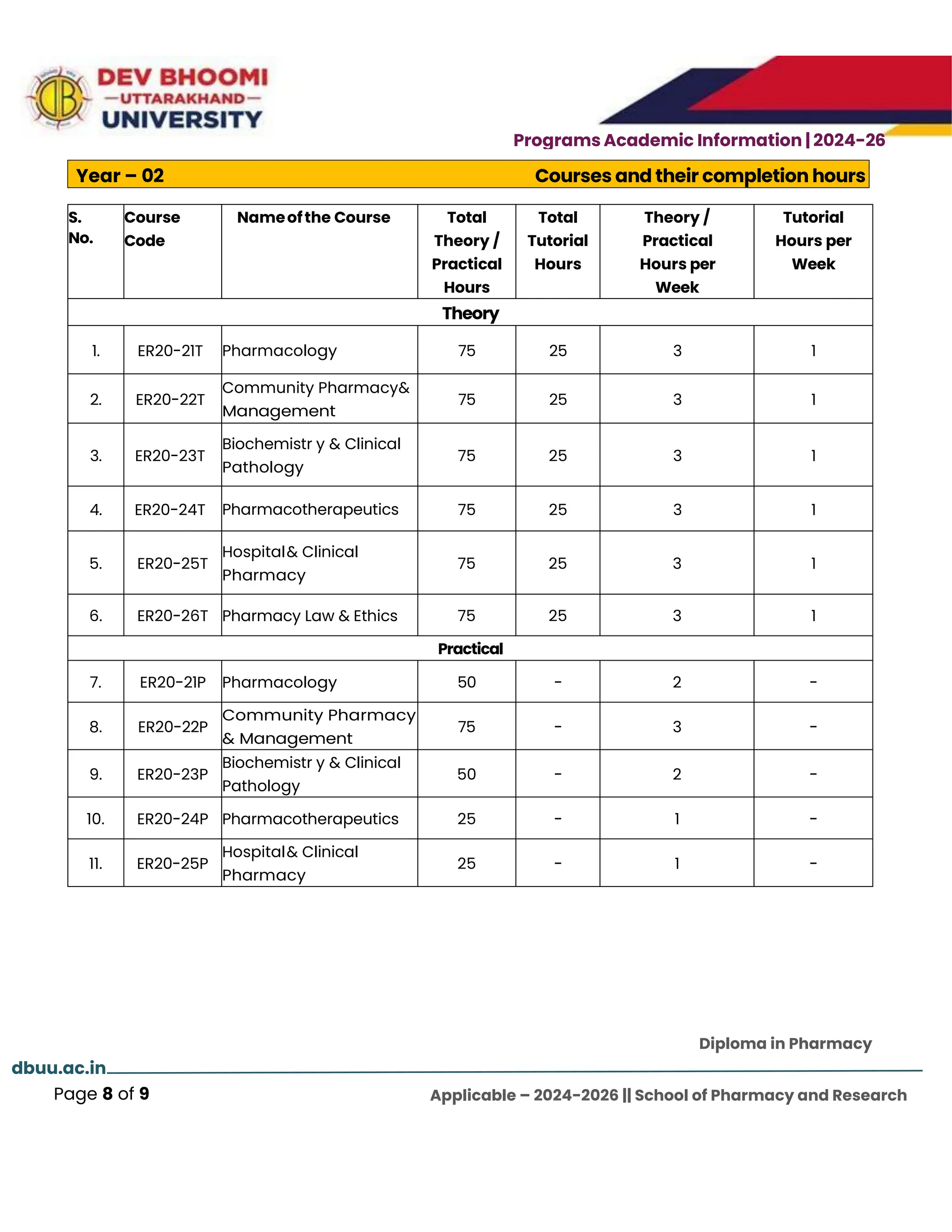
S.
No.
Course
Code
Nameofthe Course Total
Theory /
Practical
Hours
Total
Tutorial
Hours
Theory /
Practical
Hours per
Week
Tutorial
Hours per
Week
Theory
1. ER20-21T Pharmacology 75 25 3 1
2. ER20-22T
Community Pharmacy&
Management
75 25 3 1
3. ER20-23T
Biochemistr y & Clinical
Pathology
75 25 3 1
4. ER20-24T Pharmacotherapeutics 75 25 3 1
5. ER20-25T
Hospital& Clinical
Pharmacy
75 25 3 1
6. ER20-26T Pharmacy Law & Ethics 75 25 3 1
Practical
7. ER20-21P Pharmacology 50 - 2 -
8. ER20-22P
Community Pharmacy
& Management
75 - 3 -
9. ER20-23P
Biochemistr y & Clinical
Pathology
50 - 2 -
10. ER20-24P Pharmacotherapeutics 25 - 1 -
11. ER20-25P
Hospital& Clinical
Pharmacy
25 - 1 -
Year – 02 Courses and their completion hours
Programs Academic Information | 2024-26
Diploma in Pharmacy
dbuu.ac.in
Page 9 of 9 Applicable – 2024-2026 || School of Pharmacy and Research
l
***
Practice: Learning by Doing
Students have to demonstrate their knowledge acquired and skill developed on learning a
course through the following individual and/or combined learning attributes
1. Practical Sessions (Wet lab / Dry Lab)
2. Industrial exposure through regular visits in companies.
3. Hospital Training
4. Field Visit
5. Assignments

Diploma in Pharmacy Course Syllabus .pdf

  • 1.
    Programs Academic Information| 2024-26 Diploma in Pharmacy dbuu.ac.in Page 1 of 9 Applicable – 2024-2026 || School of Pharmacy and Research l PROGRAM ACADEMIC INFORMATION 2024-26 Diploma in Pharmacy *Prepared as per the Pharmacy Council of India Gazette notification (14-55/2020-PCI).
  • 2.
    Programs Academic Information| 2024-26 Diploma in Pharmacy dbuu.ac.in Page 2 of 9 Applicable – 2024-2026 || School of Pharmacy and Research l Table of Contents Section 1: Program General Information 3 Section 2: Program Educational Objectives 3 Section 3: Competencies of Indian Pharmacy Diploma Holders 4 Section 4: Competency Mapping with the course 6 Section 5: International standards / subject benchmark 7 Section 6: Courses and their completion hours 7 Year 1 8 Year 2 9
  • 3.
    Programs Academic Information| 2024-26 Diploma in Pharmacy dbuu.ac.in Page 3 of 9 Applicable – 2024-2026 || School of Pharmacy and Research l Section 1: Program General Information Program Diploma in Pharmacy Level Diploma Course Duration 2 years Section 2: Program Educational Objectives Broad goals that address institutional and program mission statements and are responsive to the expressed interests of various groups of program stakeholders. PEO-1: To produce pharmacy diploma holders able to discharge the responsibilities of pharmacist with adequate understanding of supportive areas connected to the health care system. PEO-2: To inculcate leadership quality with planning ability and effective oral and written communication skills to pharmacists. PEO-3: To encourage ethical principles and professional values to develop pharmacists with professional identity for identity for serving the society.
  • 4.
    Programs Academic Information| 2024-26 Diploma in Pharmacy dbuu.ac.in Page 4 of 9 Applicable – 2024-2026 || School of Pharmacy and Research l Section 3: Competencies for Indian Pharmacy Diploma Holder Competency is defined as “A distinct composite of knowledge, skill, attitude and value that is essential to the practice of the profession in real life contexts”. The candidates who successfully complete the Diploma in Pharmacy (D. Pharm) program of Education Regulations 2020 (ER-2020), from the institutions approved by the Pharmacy Council of India are expected to attain the following professional competencies.: 1. Review Prescriptions 2. Dispense Prescription / Non-Prescription Medicines 3. Provide Patient Counselling / Education 4. Hospital and Community Pharmacy Management 5. Expertise on Medications 6. Proficiency on drugs / pharmaceuticals 7. Entrepreneurship and Leadership 8. Deliver Primary and Preventive Healthcare 9. Professional, Ethical and Legal Practice 10. Continuing Professional Development 1. Review Prescriptions: The student should receive and handle prescriptions in a professional manner and be able to check for their completeness and correctness. Also, the prescribers should be contacted for any clarifications and corrections in the prescriptions with suggestions if any. 2. Dispense Prescription / Non-Prescription Medicines: The student should be able to dispense the various scheduled drugs / medicines as per the implications of the Drug & Cosmetics Act and Rules thereunder. Also, the non-prescription medicines (over-the-counter drugs) should be dispensed judicially to the patients as required. 3. Provide Patient Counselling / Education: The student should be able to effectively counsel / educate the patients / caretakers about the prescription / nonprescription medicines and other health related issues. Effective communication includes using both oral and written communication skills and various communication techniques.
  • 5.
    Programs Academic Information| 2024-26 Diploma in Pharmacy dbuu.ac.in Page 5 of 9 Applicable – 2024-2026 || School of Pharmacy and Research l 4. Hospital and Community Pharmacy Management: The student should be able to manage the drug distribution system as per the policies and guidelines of the hospital pharmacy, good community pharmacy practice and the recommendations of regulatory agencies. Also, be able to manage the procurement, inventory, and distribution of medicines in hospital / community pharmacy settings. 5. Expertise on Medications: The student should be able to provide an expert opinion on medications to health care professionals on safe and effective medication-use, relevant policies and procedures based on available evidences. 6. Proficiency on Pharmaceutical Formulations: The student should be able to describe the chemistry, characteristics, types, merits and demerits of both drugs and excipients used in pharmaceutical formulations based on her/his knowledge and scientific resources. 7. Entrepreneurship and Leadership: The student should be able to acquire the entrepreneurial skills in the dynamic professional environments. Also, be able to achieve leadership skills through teamwork and sound decision- making skills. 8. Deliver Primary and Preventive Healthcare: The student should be able to contribute to various healthcare programs of the nation including disease prevention initiatives to improve public health. Also contribute to the promotion of national health policies. 9. Professional, Ethical and Legal Practice: The student should be able to deliver professional services in accordance with legal, ethical, and professional guidelines with integrity. 10. Continuing Professional Development: The student should be able to recognize the gaps in the knowledge and skills in the effective delivery of professional services from time to time and be self-motivated to bridge such gaps by attending continuing professional development programs.
  • 6.
    Programs Academic Information| 2024-26 Diploma in Pharmacy dbuu.ac.in Page 6 of 9 Applicable – 2024-2026 || School of Pharmacy and Research l Section 4: Competency Mapping with the Courses Competencies Pharmaceutics Pharmaceutical Chemistry Pharmacognosy Human Anatomy & Physiology Social Pharmacy Pharmacology Community Pharmacy & Management Biochemistry & Clinical Pathology Pharmacotherapeuti cs Hospital & Clinical Pharmacy Pharmacy Law & Ethics Practical Training Review the Prescriptions √ √ √ √ √ √ √ √ √ √ √ Dispense Prescription/Non- prescription medicines √ √ √ √ √ √ √ √ √ √ √ Provide patient counselling / Education √ √ √ √ √ √ √ √ √ √ √ √ Hospital and Community Pharmacy management √ √ √ √ √ Expertise on Medications √ √ √ √ √ √ √ √ √ √ √ √ Proficiency on Pharmaceutical Formulations √ √ √ √ √ √ Entrepreneurship & Leadership √ √ √ Deliver Primary & Preventive Healthcare √ √ √ √ √ √ √ √ √ Professional, Legal & Ethical Practice √ √ √ √ √ √ Continuing Professional Development √ √ √ √ √ √ √ √ √ √ Section 5: National standards and subject benchmarks Details of the National standards / subject benchmark statements referred and web link for the same. National standards / benchmarks URL Pharmacy Council of India https://www.pci.nic.in/
  • 7.
    Programs Academic Information| 2024-26 Diploma in Pharmacy dbuu.ac.in Page 7 of 9 Applicable – 2024-2026 || School of Pharmacy and Research l S. No Course Code Course Title Total Theory/ Practical Hours Total Tutorial Hours Theory/ Practical Hours per Week TutorialHours per Week Theory 1 ER20-11T Pharmaceutics 75 25 3 1 2 ER20-12T Pharmaceutical Chemistry 75 25 3 1 3 ER20-13T Pharmacognosy 75 25 3 1 4 ER20-14T Human Anatomy& Physiology 75 25 3 1 5 ER20-15T Social Pharmacy 75 25 3 1 Practical 6 ER20-11P Pharmaceutics 75 - 3 - 7 ER20-12P Pharmaceutical Chemistry 75 - 3 - 8 ER20-13P Pharmacognosy 75 - 3 - 9 ER20-14P Human Anatomy& Physiology 75 - 3 - 10 ER20-15P Social Pharmacy 75 - 3 - Year – 01 Courses and their completion hours
  • 8.
    Programs Academic Information| 2024-26 Diploma in Pharmacy dbuu.ac.in Page 8 of 9 Applicable – 2024-2026 || School of Pharmacy and Research l S. No. Course Code Nameofthe Course Total Theory / Practical Hours Total Tutorial Hours Theory / Practical Hours per Week Tutorial Hours per Week Theory 1. ER20-21T Pharmacology 75 25 3 1 2. ER20-22T Community Pharmacy& Management 75 25 3 1 3. ER20-23T Biochemistr y & Clinical Pathology 75 25 3 1 4. ER20-24T Pharmacotherapeutics 75 25 3 1 5. ER20-25T Hospital& Clinical Pharmacy 75 25 3 1 6. ER20-26T Pharmacy Law & Ethics 75 25 3 1 Practical 7. ER20-21P Pharmacology 50 - 2 - 8. ER20-22P Community Pharmacy & Management 75 - 3 - 9. ER20-23P Biochemistr y & Clinical Pathology 50 - 2 - 10. ER20-24P Pharmacotherapeutics 25 - 1 - 11. ER20-25P Hospital& Clinical Pharmacy 25 - 1 - Year – 02 Courses and their completion hours
  • 9.
    Programs Academic Information| 2024-26 Diploma in Pharmacy dbuu.ac.in Page 9 of 9 Applicable – 2024-2026 || School of Pharmacy and Research l *** Practice: Learning by Doing Students have to demonstrate their knowledge acquired and skill developed on learning a course through the following individual and/or combined learning attributes 1. Practical Sessions (Wet lab / Dry Lab) 2. Industrial exposure through regular visits in companies. 3. Hospital Training 4. Field Visit 5. Assignments