BASICS OF RESPIRATORY
FAILURE
DR. BIPUL BORTHAKUR (PROFESSOR)
DEPT OF ORTHOPAEDICS, SMCH
DEFINITION
 The inability of the respiratory system to adequately
oxygenate the blood with or without a concurrent
alteration in carbon dioxide elimination
Acute and Chronic
 Depending on underlying cause
 Acute
eg: drug overdose, pneumonia, pneumothorax
 Chronic
eg: severe COPD
TYPES
Type I
hypoxemic respiratory failure
Type II
hypercapneic respiratory
failure
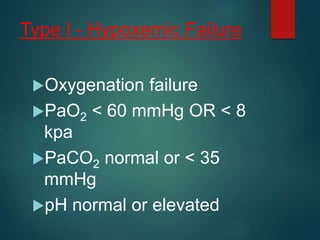
Type I - Hypoxemic Failure
Oxygenation failure
PaO2 < 60 mmHg OR < 8
kpa
PaCO2 normal or < 35
mmHg
pH normal or elevated
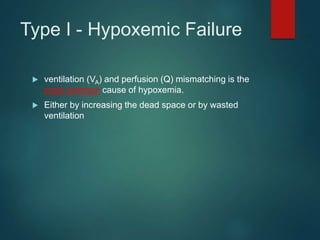
Type I - Hypoxemic Failure
 ventilation (VA) and perfusion (Q) mismatching is the
most common cause of hypoxemia.
 Either by increasing the dead space or by wasted
ventilation
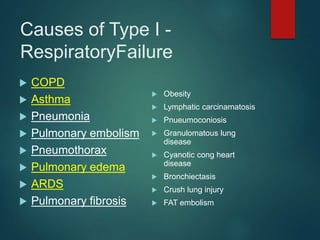
Causes of Type I -
RespiratoryFailure
 COPD
 Asthma
 Pneumonia
 Pulmonary embolism
 Pneumothorax
 Pulmonary edema
 ARDS
 Pulmonary fibrosis
 Obesity
 Lymphatic carcinamatosis
 Pnueumoconiosis
 Granulomatous lung
disease
 Cyanotic cong heart
disease
 Bronchiectasis
 Crush lung injury
 FAT embolism
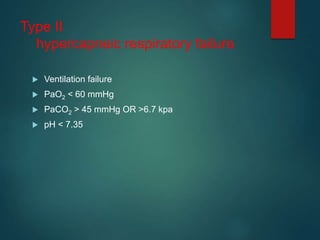
Type II
hypercapneic respiratory failure
 Ventilation failure
 PaO2 < 60 mmHg
 PaCO2 > 45 mmHg OR >6.7 kpa
 pH < 7.35
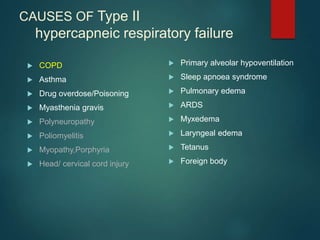
CAUSES OF Type II
hypercapneic respiratory failure
 COPD
 Asthma
 Drug overdose/Poisoning
 Myasthenia gravis
 Polyneuropathy
 Poliomyelitis
 Myopathy,Porphyria
 Head/ cervical cord injury
 Primary alveolar hypoventilation
 Sleep apnoea syndrome
 Pulmonary edema
 ARDS
 Myxedema
 Laryngeal edema
 Tetanus
 Foreign body
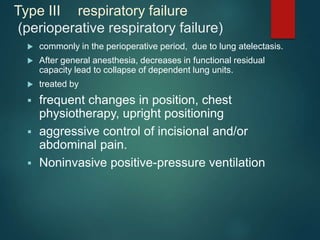
Type III respiratory failure
(perioperative respiratory failure)
 commonly in the perioperative period, due to lung atelectasis.
 After general anesthesia, decreases in functional residual
capacity lead to collapse of dependent lung units.
 treated by
 frequent changes in position, chest
physiotherapy, upright positioning
 aggressive control of incisional and/or
abdominal pain.
 Noninvasive positive-pressure ventilation
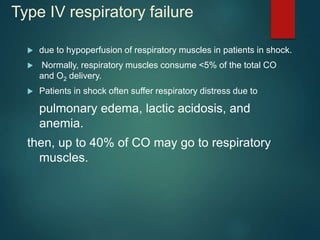
Type IV respiratory failure
 due to hypoperfusion of respiratory muscles in patients in shock.
 Normally, respiratory muscles consume <5% of the total CO
and O2 delivery.
 Patients in shock often suffer respiratory distress due to
pulmonary edema, lactic acidosis, and
anemia.
then, up to 40% of CO may go to respiratory
muscles.
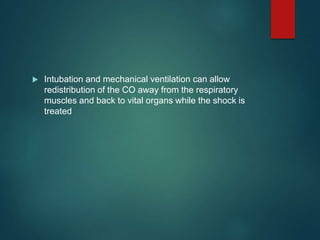
 Intubation and mechanical ventilation can allow
redistribution of the CO away from the respiratory
muscles and back to vital organs while the shock is
treated
Patient Presentation
Neurological
Restlessness
Anxiety
Confusion
Headache
convulsions
Lethargy to coma
Patient Presentation
 Neurological
Hypercapnoea also produce
tremor,myoclonic jerks, asterexis etc.
Increased CNS blood flow causes raised ICT- headache and
papilloedema.
Headache on waking up is common in chronic hypercapnia, may be
due to increased CO2 retention in sleep
Patient Presentation
Cardiovascular
Tachycardia
Elevated blood pressure
early
Eventual hypotension.
Cardiac dysrythmias
Patient Presentation
Skin
Hypercarbia – warm,flushed
skin with a bounding pulse,
wet.
Hypoxemia -cold and wet
Patient Presentation
Respiratory
Increased rate and depth
(hyperpnea)
Central cyanosis, due to
hypoxemia
Dyspnea - subjective feeling of
difficult breathing
Patient Presentation
Renal
Decreased UOP
Erythropoietin release with
hypoxemia
Excretion of H+ and retention of
HCO3
- with respiratory acidosis
Patient Presentation
Gastrointestinal
Decreased bowel sounds
Reduced gastric pH with
tissue hypoxia , leads to
gastric erosions and
bleeding
Immediate determination of upper airway
patency
Examination for central and peripheral
cyanosis
Measurement of the respiratory rate
Observation of the depth and pattern of
respiration
Initial Assessment and Stabilization
of Respiratory Failure
Assess the configuration of the chest
wall and its movement during the
respiratory cycle
Palpation and auscultation over each
hemithorax
Signs of respiratory distress including
flaring of nostrils, pursed-lip breathing,
and use of accessory muscles of
respiration
Above observations allow an
initial assessment of respiratory
drive, pump function, and delivery
of gas to the lungs
INVESTIGATIONS
 ARTERIAL BLOOD GAS MEASUREMENT
 PULSE OXIMETRY
NON INVASIVE, BUT NO INFORMATION
REGARDING Va ,PCO2
PULSE OXIMETRY
 There is a relationship between the amount of oxygen dissolved in the
blood and the amount attached to the hemoglobin.
 Normal Oxyhemoglobin Dissociation Curve
 97% saturation = 97 PaO2 (normal)
 90% saturation = 60 PaO2 (danger)
 80% saturation = 45 PaO2 (severe hypoxia)
MANAGEMENT
 Initial therapy be implemented before the specific DIAGNOSIS
 Adequate airway protection, oxygenation, and ventilation should be assured
and stabilize the Patient
 Hypoxemia and hypercarbia can rapidly lead to circulatory failure and death
 THEN, if possible treat the primary condition.
Type I respiratory failure
 GOAL: to increase the oxygen saturation to 85 to 90 %
by giving oxygen at increasing FiO2.
 Maintain adequate cardiac output and correct anemia.
 Treat contitions like fever, agitation, overfeeding,
vigorous respiratory activity & sepsis which increase
O2 demand
Type I respiratory failure
 prolonged exposure to high FiO2(>50%)/prolonged
duration of treatment is avoided, due to pulmonary
toxicity.
Type I respiratory failure
 Indications of mechanical ventilation are:
1. Inadequate oxygenation despite of high FiO2
2. Increasing PaCO2 associated with altered mental
status or increasing fatigue
3. Failure to control secretions
Type II respiratory failure
 Most commonly COPD, there is some degree of c/c
resp failure leading to hypercapnea.
 Acute on c/c: acidemia and increase in bicarbonate in
ABG
Type II respiratory failure
1. Relief of hypoxia
 By giving supplemental O2.
by nasal prongs at flow of 1 to 3 L/ min
Or by venturi mask with flow set to 24 to 28 %.
Recheck arterial blood gases/O2 saturation to look for
improvement.
PaO2 of > 50 mmHg is considered as adequate
Type II respiratory failure
 Avoid sedatives, as they decrease ventilatory drive
 To improve acidosis and hypercapnea and
oxygenation respiratory stimulants like doxapram can
be tried, by close monitoring of ABG.
Type II respiratory failure
 Non invasive positive pressure ventilation.
 Advantage : avoiding intubation
 Aims at improving ventilation and gas exchange and reduces
work of respiratory muscles
Mechanical Ventilation in
respiratory failure Indications
1. Failure to attain PaO2 of 60 mmHg despite of
FiO2 of 0.6
2. Rapidly increasing hypercapnea, producing
uncompensated acidosis
3. Mental confusion either due to
hypoxemia/hypercapnea
4. Tachypnoea(>35/min)
5. Clinical judgement of impending exhuation of
the patient
Airway acsess
 Nasotracheal/ orotracheal intubation
dis adv: laryngeal/ tracheal trauma,
used only up to 72 hrs
 Tracheostomy:
complications; hemorrhage, infection
erosion of tube to esophagus, tracheal
stenosis, tube blockade and
respiratory infection
Ventilator settings
 Tidal volume of approx 10 ml/kg
 RR of 10 to 20/ min
 So minute ventilation is 100 to 150 ml/kg
In COPD/asthma
 In COPD tidal volume is kept at a little lower level(7 – 9 ml/kg) to
avoid auto PEEP and to prevent high inflation pressures to
already over inflated lungs to prevent barotrauma.
 I:E ratio is kept at 1:4 or 1:5 to minimise air trapping
 Peak inflation pressures are kept under 30 – 35 cm H2O
 FiO2 is kept at 35%
In COPD/asthma
 Regular monitoring of blood gases is needed.
 Adjust inspired O2 and level of PEEP to PaO2 and
minute ventilation against PaCO2
Auto PEEP/ intrinsic PEEP
 Develops in COPD due to decreased elastic recoil, decreased
expiratory flow and expiratory time due to tachypnoea- air
trapping and positive alveolar pressure at end of breathing.
 Can impede venous return and decrease cardiac output.
Increase chance of barotrauma
In ARDS..
 Tidal volume is kept low to prevent barotruama and
pnuemothorax and maintaining CVP at a lower range;
 PEEP is maintained at a higher range to minimise FiO2 and
prevent alveolar collapse
 I:E ratio is kept >1:1
 This results in better survival than conventional ventilation
strategies.
Managenment of patient on
ventilator
 Monitor ECG, heart rate, BP, oxygenation, ABG, urine output
 Do not lower PaCO2 suddenly in a patient whom the resting
level is known to be high.
 Better to aim at treating acidosis
 Adeqaute sedation
 Regular suction of airways
 Adequate nutrition : enteral/ parenteral
Weaning..
 Some times difficult with COPD
 Can be tried when underlying condition/
infection has subsided, SaO2>90% with FiO2
< 0.4 and PEEP<5,alveolar ventilation is
adequate with pH normal, cardiovascular
function is stable, upper airway function is
normal,
 Weaning index; ratio of beathing frequency to tidal
volume(breaths/min/L) <105 in spont ventilation thru tube,
succesful Extubation is likley
Weaning modes
 T piece and CPAP Weaning: best tolerated by patients
with mechanical ventilation for brief periods
 SIMV & PSV modes
best for intubated for extended periods &require
gradual respiratory-muscle reconditioning
complications
 Barotrauma(1 – 8%)
more common with ARDS
Assc with high peak airway pressures,
High levels of external and auto PEEP,
High tidal volumes
 GI bleeding due to gastric erosions
 Nosocomial pneumonia
 Cardiac arrhythmias, pulmonary embolism etc
Prognosis
 Best predictor of mortality in patients with acute on chronic
respiratory failure is degree of acidemia.
 pH< 7.26 is assc with higher mortality.
 Long term mortality of patients who survive an episode of acute
respiratory failure depends on underlying illness.
Eg: COPD, 50% survival at end of 3 years
THANK YOU
“tasmādasaktaḥ satataṃ kāryaṃ karma samācara
asakto hyācarankarma paramāpnoti pūruṣaḥ”
“go on efficiently doing your duty at all times without
attachment.
doing work without attachment man attains the supreme.”

Respiratory failure

  • 1.
    BASICS OF RESPIRATORY FAILURE DR.BIPUL BORTHAKUR (PROFESSOR) DEPT OF ORTHOPAEDICS, SMCH
  • 2.
    DEFINITION  The inabilityof the respiratory system to adequately oxygenate the blood with or without a concurrent alteration in carbon dioxide elimination
  • 3.
    Acute and Chronic Depending on underlying cause  Acute eg: drug overdose, pneumonia, pneumothorax  Chronic eg: severe COPD
  • 4.
    TYPES Type I hypoxemic respiratoryfailure Type II hypercapneic respiratory failure
  • 5.
    Type I -Hypoxemic Failure Oxygenation failure PaO2 < 60 mmHg OR < 8 kpa PaCO2 normal or < 35 mmHg pH normal or elevated
  • 6.
    Type I -Hypoxemic Failure  ventilation (VA) and perfusion (Q) mismatching is the most common cause of hypoxemia.  Either by increasing the dead space or by wasted ventilation
  • 7.
    Causes of TypeI - RespiratoryFailure  COPD  Asthma  Pneumonia  Pulmonary embolism  Pneumothorax  Pulmonary edema  ARDS  Pulmonary fibrosis  Obesity  Lymphatic carcinamatosis  Pnueumoconiosis  Granulomatous lung disease  Cyanotic cong heart disease  Bronchiectasis  Crush lung injury  FAT embolism
  • 8.
    Type II hypercapneic respiratoryfailure  Ventilation failure  PaO2 < 60 mmHg  PaCO2 > 45 mmHg OR >6.7 kpa  pH < 7.35
  • 9.
    CAUSES OF TypeII hypercapneic respiratory failure  COPD  Asthma  Drug overdose/Poisoning  Myasthenia gravis  Polyneuropathy  Poliomyelitis  Myopathy,Porphyria  Head/ cervical cord injury  Primary alveolar hypoventilation  Sleep apnoea syndrome  Pulmonary edema  ARDS  Myxedema  Laryngeal edema  Tetanus  Foreign body
  • 10.
    Type III respiratoryfailure (perioperative respiratory failure)  commonly in the perioperative period, due to lung atelectasis.  After general anesthesia, decreases in functional residual capacity lead to collapse of dependent lung units.  treated by  frequent changes in position, chest physiotherapy, upright positioning  aggressive control of incisional and/or abdominal pain.  Noninvasive positive-pressure ventilation
  • 11.
    Type IV respiratoryfailure  due to hypoperfusion of respiratory muscles in patients in shock.  Normally, respiratory muscles consume <5% of the total CO and O2 delivery.  Patients in shock often suffer respiratory distress due to pulmonary edema, lactic acidosis, and anemia. then, up to 40% of CO may go to respiratory muscles.
  • 12.
     Intubation andmechanical ventilation can allow redistribution of the CO away from the respiratory muscles and back to vital organs while the shock is treated
  • 13.
  • 14.
    Patient Presentation  Neurological Hypercapnoeaalso produce tremor,myoclonic jerks, asterexis etc. Increased CNS blood flow causes raised ICT- headache and papilloedema. Headache on waking up is common in chronic hypercapnia, may be due to increased CO2 retention in sleep
  • 15.
    Patient Presentation Cardiovascular Tachycardia Elevated bloodpressure early Eventual hypotension. Cardiac dysrythmias
  • 16.
    Patient Presentation Skin Hypercarbia –warm,flushed skin with a bounding pulse, wet. Hypoxemia -cold and wet
  • 17.
    Patient Presentation Respiratory Increased rateand depth (hyperpnea) Central cyanosis, due to hypoxemia Dyspnea - subjective feeling of difficult breathing
  • 18.
    Patient Presentation Renal Decreased UOP Erythropoietinrelease with hypoxemia Excretion of H+ and retention of HCO3 - with respiratory acidosis
  • 19.
    Patient Presentation Gastrointestinal Decreased bowelsounds Reduced gastric pH with tissue hypoxia , leads to gastric erosions and bleeding
  • 20.
    Immediate determination ofupper airway patency Examination for central and peripheral cyanosis Measurement of the respiratory rate Observation of the depth and pattern of respiration Initial Assessment and Stabilization of Respiratory Failure
  • 21.
    Assess the configurationof the chest wall and its movement during the respiratory cycle Palpation and auscultation over each hemithorax Signs of respiratory distress including flaring of nostrils, pursed-lip breathing, and use of accessory muscles of respiration
  • 22.
    Above observations allowan initial assessment of respiratory drive, pump function, and delivery of gas to the lungs
  • 23.
    INVESTIGATIONS  ARTERIAL BLOODGAS MEASUREMENT  PULSE OXIMETRY NON INVASIVE, BUT NO INFORMATION REGARDING Va ,PCO2
  • 24.
    PULSE OXIMETRY  Thereis a relationship between the amount of oxygen dissolved in the blood and the amount attached to the hemoglobin.  Normal Oxyhemoglobin Dissociation Curve  97% saturation = 97 PaO2 (normal)  90% saturation = 60 PaO2 (danger)  80% saturation = 45 PaO2 (severe hypoxia)
  • 25.
    MANAGEMENT  Initial therapybe implemented before the specific DIAGNOSIS  Adequate airway protection, oxygenation, and ventilation should be assured and stabilize the Patient  Hypoxemia and hypercarbia can rapidly lead to circulatory failure and death  THEN, if possible treat the primary condition.
  • 26.
    Type I respiratoryfailure  GOAL: to increase the oxygen saturation to 85 to 90 % by giving oxygen at increasing FiO2.  Maintain adequate cardiac output and correct anemia.  Treat contitions like fever, agitation, overfeeding, vigorous respiratory activity & sepsis which increase O2 demand
  • 27.
    Type I respiratoryfailure  prolonged exposure to high FiO2(>50%)/prolonged duration of treatment is avoided, due to pulmonary toxicity.
  • 28.
    Type I respiratoryfailure  Indications of mechanical ventilation are: 1. Inadequate oxygenation despite of high FiO2 2. Increasing PaCO2 associated with altered mental status or increasing fatigue 3. Failure to control secretions
  • 29.
    Type II respiratoryfailure  Most commonly COPD, there is some degree of c/c resp failure leading to hypercapnea.  Acute on c/c: acidemia and increase in bicarbonate in ABG
  • 30.
    Type II respiratoryfailure 1. Relief of hypoxia  By giving supplemental O2. by nasal prongs at flow of 1 to 3 L/ min Or by venturi mask with flow set to 24 to 28 %. Recheck arterial blood gases/O2 saturation to look for improvement. PaO2 of > 50 mmHg is considered as adequate
  • 31.
    Type II respiratoryfailure  Avoid sedatives, as they decrease ventilatory drive  To improve acidosis and hypercapnea and oxygenation respiratory stimulants like doxapram can be tried, by close monitoring of ABG.
  • 32.
    Type II respiratoryfailure  Non invasive positive pressure ventilation.  Advantage : avoiding intubation  Aims at improving ventilation and gas exchange and reduces work of respiratory muscles
  • 33.
    Mechanical Ventilation in respiratoryfailure Indications 1. Failure to attain PaO2 of 60 mmHg despite of FiO2 of 0.6 2. Rapidly increasing hypercapnea, producing uncompensated acidosis 3. Mental confusion either due to hypoxemia/hypercapnea 4. Tachypnoea(>35/min) 5. Clinical judgement of impending exhuation of the patient
  • 34.
    Airway acsess  Nasotracheal/orotracheal intubation dis adv: laryngeal/ tracheal trauma, used only up to 72 hrs  Tracheostomy: complications; hemorrhage, infection erosion of tube to esophagus, tracheal stenosis, tube blockade and respiratory infection
  • 35.
    Ventilator settings  Tidalvolume of approx 10 ml/kg  RR of 10 to 20/ min  So minute ventilation is 100 to 150 ml/kg
  • 36.
    In COPD/asthma  InCOPD tidal volume is kept at a little lower level(7 – 9 ml/kg) to avoid auto PEEP and to prevent high inflation pressures to already over inflated lungs to prevent barotrauma.  I:E ratio is kept at 1:4 or 1:5 to minimise air trapping  Peak inflation pressures are kept under 30 – 35 cm H2O  FiO2 is kept at 35%
  • 37.
    In COPD/asthma  Regularmonitoring of blood gases is needed.  Adjust inspired O2 and level of PEEP to PaO2 and minute ventilation against PaCO2
  • 38.
    Auto PEEP/ intrinsicPEEP  Develops in COPD due to decreased elastic recoil, decreased expiratory flow and expiratory time due to tachypnoea- air trapping and positive alveolar pressure at end of breathing.  Can impede venous return and decrease cardiac output. Increase chance of barotrauma
  • 39.
    In ARDS..  Tidalvolume is kept low to prevent barotruama and pnuemothorax and maintaining CVP at a lower range;  PEEP is maintained at a higher range to minimise FiO2 and prevent alveolar collapse  I:E ratio is kept >1:1  This results in better survival than conventional ventilation strategies.
  • 40.
    Managenment of patienton ventilator  Monitor ECG, heart rate, BP, oxygenation, ABG, urine output  Do not lower PaCO2 suddenly in a patient whom the resting level is known to be high.  Better to aim at treating acidosis  Adeqaute sedation  Regular suction of airways  Adequate nutrition : enteral/ parenteral
  • 41.
    Weaning..  Some timesdifficult with COPD  Can be tried when underlying condition/ infection has subsided, SaO2>90% with FiO2 < 0.4 and PEEP<5,alveolar ventilation is adequate with pH normal, cardiovascular function is stable, upper airway function is normal,  Weaning index; ratio of beathing frequency to tidal volume(breaths/min/L) <105 in spont ventilation thru tube, succesful Extubation is likley
  • 42.
    Weaning modes  Tpiece and CPAP Weaning: best tolerated by patients with mechanical ventilation for brief periods  SIMV & PSV modes best for intubated for extended periods &require gradual respiratory-muscle reconditioning
  • 43.
    complications  Barotrauma(1 –8%) more common with ARDS Assc with high peak airway pressures, High levels of external and auto PEEP, High tidal volumes  GI bleeding due to gastric erosions  Nosocomial pneumonia  Cardiac arrhythmias, pulmonary embolism etc
  • 44.
    Prognosis  Best predictorof mortality in patients with acute on chronic respiratory failure is degree of acidemia.  pH< 7.26 is assc with higher mortality.  Long term mortality of patients who survive an episode of acute respiratory failure depends on underlying illness. Eg: COPD, 50% survival at end of 3 years
  • 45.
    THANK YOU “tasmādasaktaḥ satataṃkāryaṃ karma samācara asakto hyācarankarma paramāpnoti pūruṣaḥ” “go on efficiently doing your duty at all times without attachment. doing work without attachment man attains the supreme.”