PREVIOUS NEXTCopyright ©2012 BioPharm Systems, Inc.
Best Practices for Medical Coding with MedDRA
A summary of diverse client practice
October 10, 2012
• Caroline Halsey
Director of Project Management,
EMEA
BioPharm Systems
• Rodney Lemery, MPH, PhD
Vice President, Safety and
Pharmacovigilance
BioPharm Systems
1
PREVIOUS NEXT
• Welcome and introduction
• Issues and Decisions around Coding Practice
– Who should code
– Which terms to code
– How to ensure quality
– How to optimise technology to save time
– Re-coding after new MedDRA versions
• Issues and Decisions around Analysis
– Data analysis and grouping
– SMQ Definition and Use
– Signal Detection
Agenda
2 Copyright ©2012 BioPharm Systems, Inc.
PREVIOUS NEXT
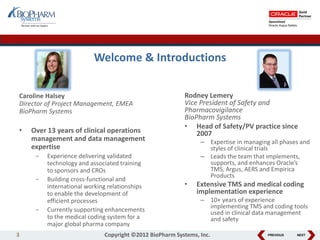
Welcome & Introductions
3 Copyright ©2012 BioPharm Systems, Inc.
Rodney Lemery
Vice President of Safety and
Pharmacovigilance
BioPharm Systems
• Head of Safety/PV practice since
2007
– Expertise in managing all phases and
styles of clinical trials
– Leads the team that implements,
supports, and enhances Oracle’s
TMS, Argus, AERS and Empirica
Products
• Extensive TMS and medical coding
implementation experience
– 10+ years of experience
implementing TMS and coding tools
used in clinical data management
and safety
Caroline Halsey
Director of Project Management, EMEA
BioPharm Systems
• Over 13 years of clinical operations
management and data management
expertise
- Experience delivering validated
technology and associated training
to sponsors and CROs
- Building cross-functional and
international working relationships
to enable the development of
efficient processes
- Currently supporting enhancements
to the medical coding system for a
major global pharma company
PREVIOUS NEXT
Welcome & Introductions
Safety and Pharmacovigilance Practice Services
Implementations
Manage implementations of Oracle
TMS, Custom medical coding system
development, Argus Safety, AERS and
Empirica Topics.
Integrations
Build interfaces between TMS, Argus
and other clinical systems.
Training
Develop and/or deliver standard and
custom training classes and materials
for various dictionaries of interest.
Process Guidance
Provide insight, advice, and solutions
to specific medical/drug coding or
safety related issues.
4 Copyright ©2012 BioPharm Systems, Inc.
PREVIOUS NEXTCopyright ©2012 BioPharm Systems, Inc.
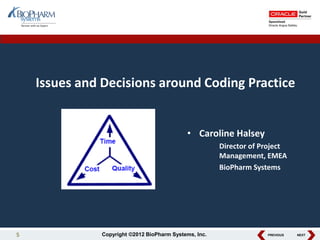
Issues and Decisions around Coding Practice
• Caroline Halsey
Director of Project
Management, EMEA
BioPharm Systems
5
PREVIOUS NEXT
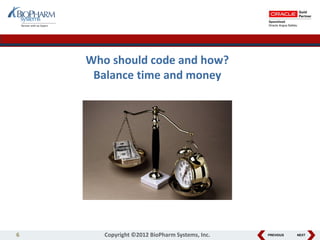
Who should code and how?
Balance time and money
6 Copyright ©2012 BioPharm Systems, Inc.
PREVIOUS NEXT
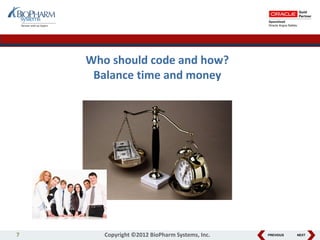
Who should code and how?
Balance time and money
7 Copyright ©2012 BioPharm Systems, Inc.
PREVIOUS NEXT
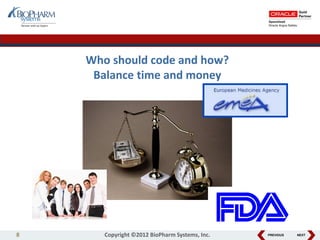
Who should code and how?
Balance time and money
8 Copyright ©2012 BioPharm Systems, Inc.
PREVIOUS NEXT
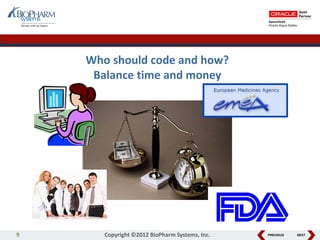
Who should code and how?
Balance time and money
9 Copyright ©2012 BioPharm Systems, Inc.
PREVIOUS NEXT
Who should code?
• HCP
– The hiring of health care professionals (RN, LVN/LPN,
Pharmacists, Dieticians, Public Health Practitioners, Research
MDs others)
• Non-HCP with Coding Committee Review
• This method is very common assuming that HCP are present
in the central coding committee
10 Copyright ©2012 BioPharm Systems, Inc.
PREVIOUS NEXT
Which terms to code
• ICH regulatory requirement
– coding of reported Adverse Events and Serious Adverse Events to the
MedDRA dictionary when submitting electronic reports
• FDA
– anticipated MedDRA requirement but it is not yet CFR
• Our client base (“Industry Standard” ~64 pharma, OTC, biotech
and device companies)
– Code at least Adverse Events
– Optionally code:
• Medical History
• Lab
• Con-Med Indications
11 Copyright ©2012 BioPharm Systems, Inc.
PREVIOUS NEXT
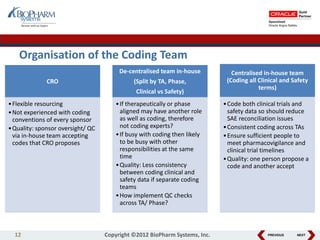
CRO
•Flexible resourcing
•Not experienced with coding
conventions of every sponsor
•Quality: sponsor oversight/ QC
via in-house team accepting
codes that CRO proposes
De-centralised team in-house
(Split by TA, Phase,
Clinical vs Safety)
•If therapeutically or phase
aligned may have another role
as well as coding, therefore
not coding experts?
•If busy with coding then likely
to be busy with other
responsibilities at the same
time
•Quality: Less consistency
between coding clinical and
safety data if separate coding
teams
•How implement QC checks
across TA/ Phase?
Centralised in-house team
(Coding all Clinical and Safety
terms)
•Code both clinical trials and
safety data so should reduce
SAE reconciliation issues
•Consistent coding across TAs
•Ensure sufficient people to
meet pharmacovigilance and
clinical trial timelines
•Quality: one person propose a
code and another accept
12 Copyright ©2012 BioPharm Systems, Inc.
Organisation of the Coding Team
PREVIOUS NEXT
CRO
•Flexible resourcing
•Not experienced with coding
conventions of every sponsor
•Quality: sponsor oversight/ QC
via in-house team accepting
codes that CRO proposes
De-centralised team in-house
(Split by TA, Phase,
Clinical vs Safety)
•If therapeutically or phase
aligned may have another role
as well as coding, therefore
not coding experts?
•If busy with coding then likely
to be busy with other
responsibilities at the same
time
•Quality: Less consistency
between coding clinical and
safety data if separate coding
teams
•How implement QC checks
across TA/ Phase?
Centralised in-house team
(Coding all Clinical and Safety
terms)
•Code both clinical trials and
safety data so should reduce
SAE reconciliation issues
•Consistent coding across TAs
•Ensure sufficient people to
meet pharmacovigilance and
clinical trial timelines
•Quality: one person propose a
code and another accept
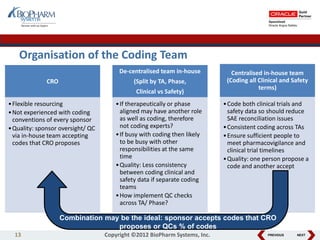
Combination may be the ideal: sponsor accepts codes that CRO
proposes or QCs % of codes
13 Copyright ©2012 BioPharm Systems, Inc.
Organisation of the Coding Team
PREVIOUS NEXT
CRO
•Flexible resourcing
•Not experienced with coding
conventions of every sponsor
•Quality: sponsor oversight/ QC
via in-house team accepting
codes that CRO proposes
De-centralised team in-house
(Split by TA, Phase,
Clinical vs Safety)
•If therapeutically or phase
aligned may have another role
as well as coding, therefore
not coding experts?
•If busy with coding then likely
to be busy with other
responsibilities at the same
time
•Quality: Less consistency
between coding clinical and
safety data if separate coding
teams
•How implement QC checks
across TA/ Phase?
Centralised in-house team
(Coding all Clinical and Safety
terms)
•Code both clinical trials and
safety data so should reduce
SAE reconciliation issues
•Consistent coding across TAs
•Ensure sufficient people to
meet pharmacovigilance and
clinical trial timelines
•Quality: one person propose a
code and another accept
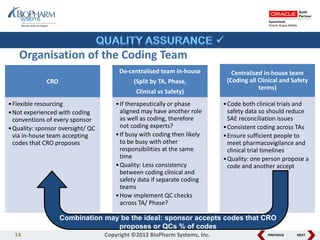
Combination may be the ideal: sponsor accepts codes that CRO
proposes or QCs % of codes
14 Copyright ©2012 BioPharm Systems, Inc.
Organisation of the Coding Team
PREVIOUS NEXT15 Copyright ©2012 BioPharm Systems, Inc.
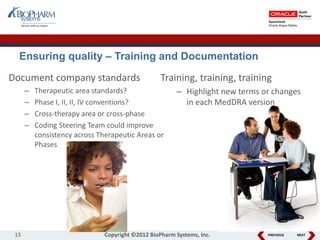
Training, training, training
– Highlight new terms or changes
in each MedDRA version
Document company standards
– Therapeutic area standards?
– Phase I, II, II, IV conventions?
– Cross-therapy area or cross-phase
– Coding Steering Team could improve
consistency across Therapeutic Areas or
Phases
Ensuring quality – Training and Documentation
PREVIOUS NEXT
Ensuring Quality – QC and QA
• In-stream
– 100% for adverse events
– Could be lower % for medical history and con med indications
• Quality Control
– Four-eyes process:
• Proposer + Acceptor
• Proposer could be @ CRO and Acceptor @ sponsor
• Quality Assurance
– QC of the Acceptor stage via review of listings
• Regularly review and discuss real examples
of coding solutions and errors amongst the
coding team
16 Copyright ©2012 BioPharm Systems, Inc.
PREVIOUS NEXT
Time savers - technology
• Short term expenditure on
technology can lead to long term
savings in human resources
– Automate where possible and enable
human coders to focus on where they
can add value
• Technology can include:
– Autocoding based on synonym lists
– Coding distinct terms
– Automation of work assignment
17 Copyright ©2012 BioPharm Systems, Inc.
PREVIOUS NEXT
Autocoding
• Auto-encoding reported verbatim terms to previously
coded data is an option within many commercial coding
systems
• Can involve:
– Company synonym lists that grow over time e.g. synonyms of LLT
Cardiac pain/PT Angina pectoris:
• Shooting pain in heart
• Heart pain
• Twinges in heart
– Autocoding algorithm – normalisation of text and removing
erroneous characters
• E.g. “Ache/pain ongoing on heart” transforms to “Pain heart” and is
then coded to “Cardiac pain”
18 Copyright ©2012 BioPharm Systems, Inc.
PREVIOUS NEXT
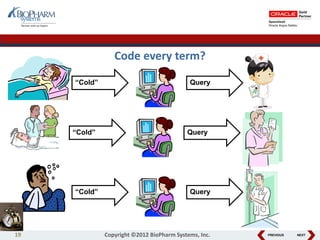
Code every term?
“Cold” Query
“Cold” Query
“Cold” Query
19 Copyright ©2012 BioPharm Systems, Inc.
PREVIOUS NEXT
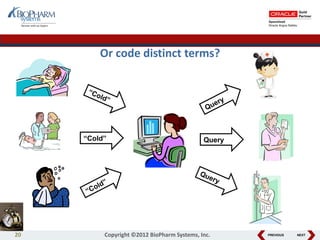
Or code distinct terms?
“Cold” Query
20 Copyright ©2012 BioPharm Systems, Inc.
PREVIOUS NEXT
Terms out of context
• Risk with autocoding, coding distinct terms and with
centralised coding team …reviewing terms out of context
– “Chest pain” especially in clinical trials
• No other information is present to indicate if this is
general chest pain, cardiac, GI related, respiratory
related etc.
– “Chest pain” in Post Marketing
• Hospitalisation report indicates an ECG performed with
indications of cardiac arrhythmias and a likely mild MI.
• Best practice: manual review of autocoded adverse event
coding
• Consider: BUT does context cause bias/ lead to assumptions
in coding?
21 Copyright ©2012 BioPharm Systems, Inc.
PREVIOUS NEXT
Coding Med Hist, Labs and AE terms all in one place
• Is the verbatim “ALT increased” on the AE form the
same as “ALT increased” on the Lab form?
• If you coded “ALT increased” to “Alanine aminotransferase
increased” in the lab data then it will code the AE verbatim
the same
• Is this acceptable?
• Should you query the AE term for a definitive or provisional diagnosis
rather than the sign/symptom?
22 Copyright ©2012 BioPharm Systems, Inc.
PREVIOUS NEXT
Work Assignment
• Automation of work assignment enables team leaders to add
value elsewhere rather than spend time assigning individual’s
work
• Use technology to assign priorities per person/ role/ group
• Then adjust priorities as needed:
• Safety vs clinical terms
• One clinical trial vs others
23 Copyright ©2012 BioPharm Systems, Inc.
PREVIOUS NEXT
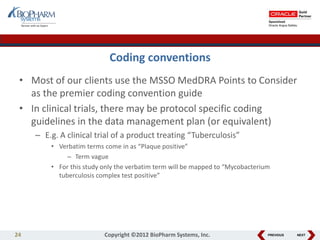
Coding conventions
• Most of our clients use the MSSO MedDRA Points to Consider
as the premier coding convention guide
• In clinical trials, there may be protocol specific coding
guidelines in the data management plan (or equivalent)
– E.g. A clinical trial of a product treating “Tuberculosis”
• Verbatim terms come in as “Plaque positive”
– Term vague
• For this study only the verbatim term will be mapped to “Mycobacterium
tuberculosis complex test positive”
24 Copyright ©2012 BioPharm Systems, Inc.
PREVIOUS NEXT
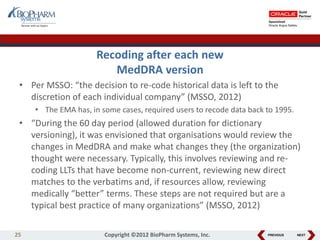
Recoding after each new
MedDRA version
• Per MSSO: “the decision to re-code historical data is left to the
discretion of each individual company” (MSSO, 2012)
• The EMA has, in some cases, required users to recode data back to 1995.
• “During the 60 day period (allowed duration for dictionary
versioning), it was envisioned that organisations would review the
changes in MedDRA and make what changes they (the organization)
thought were necessary. Typically, this involves reviewing and re-
coding LLTs that have become non-current, reviewing new direct
matches to the verbatims and, if resources allow, reviewing
medically “better” terms. These steps are not required but are a
typical best practice of many organizations” (MSSO, 2012)
25 Copyright ©2012 BioPharm Systems, Inc.
PREVIOUS NEXT
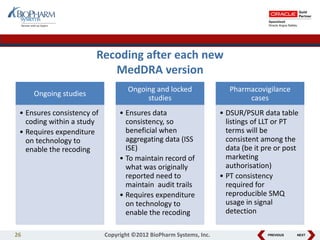
Recoding after each new
MedDRA version
Ongoing studies
• Ensures consistency of
coding within a study
• Requires expenditure
on technology to
enable the recoding
Ongoing and locked
studies
• Ensures data
consistency, so
beneficial when
aggregating data (ISS
ISE)
• To maintain record of
what was originally
reported need to
maintain audit trails
• Requires expenditure
on technology to
enable the recoding
Pharmacovigilance
cases
• DSUR/PSUR data table
listings of LLT or PT
terms will be
consistent among the
data (be it pre or post
marketing
authorisation)
• PT consistency
required for
reproducible SMQ
usage in signal
detection
26 Copyright ©2012 BioPharm Systems, Inc.
PREVIOUS NEXTCopyright ©2012 BioPharm Systems, Inc.
Issues and Decisions around Analysis
• Rodney Lemery, MPH,
PhD
Vice President, Safety and
Pharmacovigilance
BioPharm Systems
27
PREVIOUS NEXT
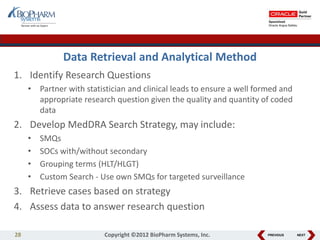
Data Retrieval and Analytical Method
1. Identify Research Questions
• Partner with statistician and clinical leads to ensure a well formed and
appropriate research question given the quality and quantity of coded
data
2. Develop MedDRA Search Strategy, may include:
• SMQs
• SOCs with/without secondary
• Grouping terms (HLT/HLGT)
• Custom Search - Use own SMQs for targeted surveillance
3. Retrieve cases based on strategy
4. Assess data to answer research question
28 Copyright ©2012 BioPharm Systems, Inc.
PREVIOUS NEXT
Data Retrieval and Analytical Method
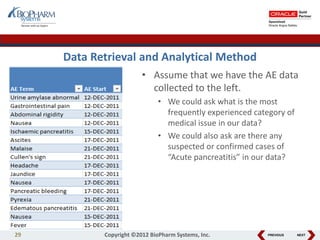
• Assume that we have the AE data
collected to the left.
• We could ask what is the most
frequently experienced category of
medical issue in our data?
• We could also ask are there any
suspected or confirmed cases of
“Acute pancreatitis” in our data?
29 Copyright ©2012 BioPharm Systems, Inc.
PREVIOUS NEXT
Data Retrieval and Analytical Method
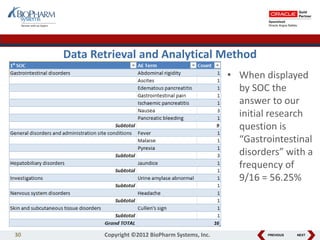
• When displayed
by SOC the
answer to our
initial research
question is
“Gastrointestinal
disorders” with a
frequency of
9/16 = 56.25%
30 Copyright ©2012 BioPharm Systems, Inc.
PREVIOUS NEXT
Data Retrieval and Analytical Method
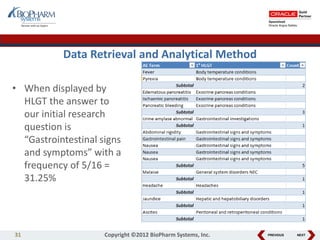
• When displayed by
HLGT the answer to
our initial research
question is
“Gastrointestinal signs
and symptoms” with a
frequency of 5/16 =
31.25%
31 Copyright ©2012 BioPharm Systems, Inc.
PREVIOUS NEXT
Data Retrieval and Analytical Method
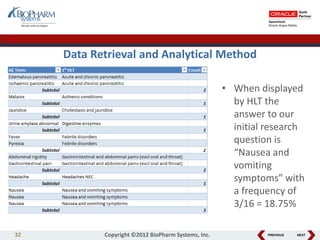
• When displayed
by HLT the
answer to our
initial research
question is
“Nausea and
vomiting
symptoms” with
a frequency of
3/16 = 18.75%
32 Copyright ©2012 BioPharm Systems, Inc.
PREVIOUS NEXT
Standardised MedDRA Queries
• Groupings of relevant MedDRA terms at PT level to
represent a particular area of interest, for data
retrieval & analysis
• Provided by MSSO with each new MedDRA version
• Used to identify cases of interest in your data (Mozzicato,
2007)
33 Copyright ©2012 BioPharm Systems, Inc.
PREVIOUS NEXT
Standardised MedDRA Queries
• Rationale behind development of SMQs (CIOMS,
2004)
• The size (~ 18 000 PTs) and complexity of MedDRA
terminology carries the risk that
• Different users may select differing sets of terms while trying to
retrieve cases related to the same drug safety problem
• Globally standardised search queries/analysis will give broader
acceptance in signal detection methods
34 Copyright ©2012 BioPharm Systems, Inc.
PREVIOUS NEXT
Standardised MedDRA Queries
• SMQs contain PT and LLT terms for the “…signs,
symptoms, diagnoses, syndromes, clinical findings,
laboratory and disorders, other test data, etc, related
to the condition of interest…” (Mozzicato, 2007)
35 Copyright ©2012 BioPharm Systems, Inc.
PREVIOUS NEXT
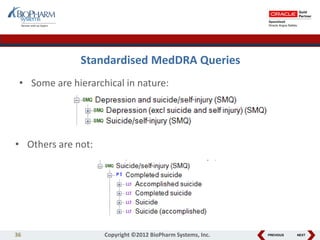
Standardised MedDRA Queries
• Some are hierarchical in nature:
36 Copyright ©2012 BioPharm Systems, Inc.
• Others are not:
PREVIOUS NEXT
Features of SMQs – Broad vs Narrow
• SMQ relations with dictionary terms may be identified as
broad or narrow.
• Narrow terms: highly likely to represent the condition of interest
• Narrow search retrieves narrow terms
• Broad terms: help to identify all possible cases
• Including some that may prove to be of little or no interest
• A broad search retrieves broad terms
• Algorithms within SMQs are used to further define cases of suspected
medical conditions
• Based on rules defined in the algorithm by the MSSO
• Processed programmatically during a search operation
37 Copyright ©2012 BioPharm Systems, Inc.
PREVIOUS NEXT
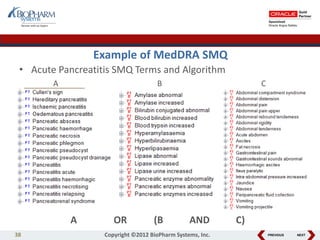
Example of MedDRA SMQ
• Acute Pancreatitis SMQ Terms and Algorithm
A B C
38 Copyright ©2012 BioPharm Systems, Inc.
A OR (B AND C)
PREVIOUS NEXT
Data Retrieval and Analytical Method
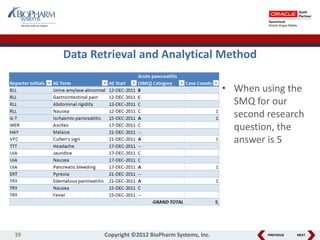
• When using the
SMQ for our
second research
question, the
answer is 5
39 Copyright ©2012 BioPharm Systems, Inc.
PREVIOUS NEXT
Use of MedDRA in Signal Detection
• In terms of spontaneous safety data reporting and signal
detection methods, use of MedDRA can have a dynamic impact
on the statistical results
• In our data above, let’s suppose our research question was “Do
persons exposed to our product report ‘Acute Pancreatitis’ at a
greater rate than those not taking our product?”
• The next slides look at the ability to use the MedDRA hierarchy to
calculate a disproportionality score in an attempt to answer this question
• We will borrow from the field of epidemiology (specifically case-
control studies) and calculate a type of Odds Ratio (Waller, van
Puijenbroek, Egberts, & Evans, 2004)
40 Copyright ©2012 BioPharm Systems, Inc.
PREVIOUS NEXT
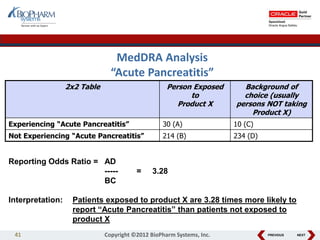
MedDRA Analysis
“Acute Pancreatitis”
2x2 Table Person Exposed
to
Product X
Background of
choice (usually
persons NOT taking
Product X)
Experiencing “Acute Pancreatitis” 30 (A) 10 (C)
Not Experiencing “Acute Pancreatitis” 214 (B) 234 (D)
41 Copyright ©2012 BioPharm Systems, Inc.
Reporting Odds Ratio = AD
----- = 3.28
BC
Interpretation: Patients exposed to product X are 3.28 times more likely to
report “Acute Pancreatitis” than patients not exposed to
product X
PREVIOUS NEXT
Company MedDRA Queries
• A trend we are now seeing are companies using their
own SMQs not found in the MedDRA dictionary
– Company or Custom MedDRA Queries (CMQ)
– A list of targeted PT and LLTs is gathered into an over-arching
clinical construct
• Each PT/LLT is assigned a Broad or Narrow context and if required, complex
algorithms can also be used
• The data is then mined for cases using the CMQ in
exactly the same manner as an SMQ
42 Copyright ©2012 BioPharm Systems, Inc.
PREVIOUS NEXT
Company MedDRA Queries
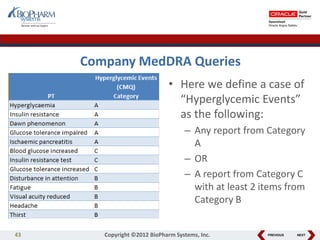
• Here we define a case of
“Hyperglycemic Events”
as the following:
– Any report from Category
A
– OR
– A report from Category C
with at least 2 items from
Category B
43 Copyright ©2012 BioPharm Systems, Inc.
PREVIOUS NEXT
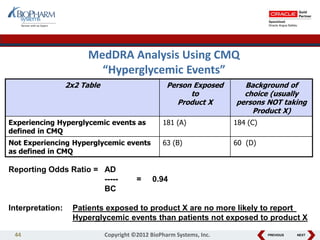
MedDRA Analysis Using CMQ
“Hyperglycemic Events”
2x2 Table Person Exposed
to
Product X
Background of
choice (usually
persons NOT taking
Product X)
Experiencing Hyperglycemic events as
defined in CMQ
181 (A) 184 (C)
Not Experiencing Hyperglycemic events
as defined in CMQ
63 (B) 60 (D)
44 Copyright ©2012 BioPharm Systems, Inc.
Reporting Odds Ratio = AD
----- = 0.94
BC
Interpretation: Patients exposed to product X are no more likely to report
Hyperglycemic events than patients not exposed to product X
PREVIOUS NEXT
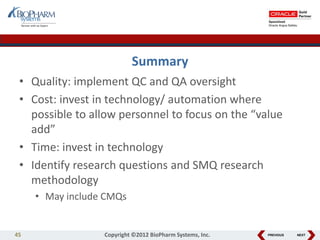
Summary
• Quality: implement QC and QA oversight
• Cost: invest in technology/ automation where
possible to allow personnel to focus on the “value
add”
• Time: invest in technology
• Identify research questions and SMQ research
methodology
• May include CMQs
45 Copyright ©2012 BioPharm Systems, Inc.
PREVIOUS NEXT
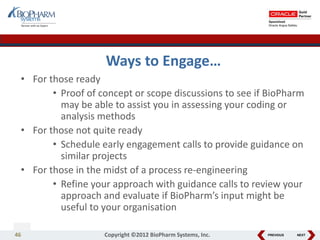
Ways to Engage…
• For those ready
• Proof of concept or scope discussions to see if BioPharm
may be able to assist you in assessing your coding or
analysis methods
• For those not quite ready
• Schedule early engagement calls to provide guidance on
similar projects
• For those in the midst of a process re-engineering
• Refine your approach with guidance calls to review your
approach and evaluate if BioPharm’s input might be
useful to your organisation
46 Copyright ©2012 BioPharm Systems, Inc.
PREVIOUS NEXT
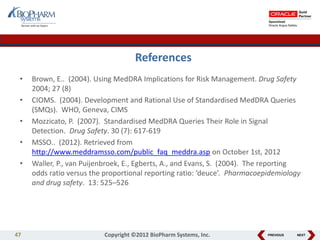
References
• Brown, E.. (2004). Using MedDRA Implications for Risk Management. Drug Safety
2004; 27 (8)
• CIOMS. (2004). Development and Rational Use of Standardised MedDRA Queries
(SMQs). WHO, Geneva, CIMS
• Mozzicato, P. (2007). Standardised MedDRA Queries Their Role in Signal
Detection. Drug Safety. 30 (7): 617-619
• MSSO.. (2012). Retrieved from
http://www.meddramsso.com/public_faq_meddra.asp on October 1st, 2012
• Waller, P., van Puijenbroek, E., Egberts, A., and Evans, S. (2004). The reporting
odds ratio versus the proportional reporting ratio: ‘deuce’. Pharmacoepidemiology
and drug safety. 13: 525–526
47 Copyright ©2012 BioPharm Systems, Inc.
PREVIOUS NEXT
Q&A
• Please feel free to enter your questions in the
chat area of the screen
48 Copyright ©2012 BioPharm Systems, Inc.
PREVIOUS NEXT
Contact Us
• North America Sales Contact:
• Rod Roderick
• rroderick@biopharm.com
• +1 877 654 0033
• Europe/Middle East/Africa Sales Contact:
• Rudolf Coetzee
• rcoetzee@biopharm.com
• +44 (0) 1865 910200
• General Inquiries:
• info@biopharm.com
49 Copyright ©2012 BioPharm Systems, Inc.

Best Practices on Medical Coding in MedDRA

  • 1.
    PREVIOUS NEXTCopyright ©2012BioPharm Systems, Inc. Best Practices for Medical Coding with MedDRA A summary of diverse client practice October 10, 2012 • Caroline Halsey Director of Project Management, EMEA BioPharm Systems • Rodney Lemery, MPH, PhD Vice President, Safety and Pharmacovigilance BioPharm Systems 1
  • 2.
    PREVIOUS NEXT • Welcomeand introduction • Issues and Decisions around Coding Practice – Who should code – Which terms to code – How to ensure quality – How to optimise technology to save time – Re-coding after new MedDRA versions • Issues and Decisions around Analysis – Data analysis and grouping – SMQ Definition and Use – Signal Detection Agenda 2 Copyright ©2012 BioPharm Systems, Inc.
  • 3.
    PREVIOUS NEXT Welcome &Introductions 3 Copyright ©2012 BioPharm Systems, Inc. Rodney Lemery Vice President of Safety and Pharmacovigilance BioPharm Systems • Head of Safety/PV practice since 2007 – Expertise in managing all phases and styles of clinical trials – Leads the team that implements, supports, and enhances Oracle’s TMS, Argus, AERS and Empirica Products • Extensive TMS and medical coding implementation experience – 10+ years of experience implementing TMS and coding tools used in clinical data management and safety Caroline Halsey Director of Project Management, EMEA BioPharm Systems • Over 13 years of clinical operations management and data management expertise - Experience delivering validated technology and associated training to sponsors and CROs - Building cross-functional and international working relationships to enable the development of efficient processes - Currently supporting enhancements to the medical coding system for a major global pharma company
  • 4.
    PREVIOUS NEXT Welcome &Introductions Safety and Pharmacovigilance Practice Services Implementations Manage implementations of Oracle TMS, Custom medical coding system development, Argus Safety, AERS and Empirica Topics. Integrations Build interfaces between TMS, Argus and other clinical systems. Training Develop and/or deliver standard and custom training classes and materials for various dictionaries of interest. Process Guidance Provide insight, advice, and solutions to specific medical/drug coding or safety related issues. 4 Copyright ©2012 BioPharm Systems, Inc.
  • 5.
    PREVIOUS NEXTCopyright ©2012BioPharm Systems, Inc. Issues and Decisions around Coding Practice • Caroline Halsey Director of Project Management, EMEA BioPharm Systems 5
  • 6.
    PREVIOUS NEXT Who shouldcode and how? Balance time and money 6 Copyright ©2012 BioPharm Systems, Inc.
  • 7.
    PREVIOUS NEXT Who shouldcode and how? Balance time and money 7 Copyright ©2012 BioPharm Systems, Inc.
  • 8.
    PREVIOUS NEXT Who shouldcode and how? Balance time and money 8 Copyright ©2012 BioPharm Systems, Inc.
  • 9.
    PREVIOUS NEXT Who shouldcode and how? Balance time and money 9 Copyright ©2012 BioPharm Systems, Inc.
  • 10.
    PREVIOUS NEXT Who shouldcode? • HCP – The hiring of health care professionals (RN, LVN/LPN, Pharmacists, Dieticians, Public Health Practitioners, Research MDs others) • Non-HCP with Coding Committee Review • This method is very common assuming that HCP are present in the central coding committee 10 Copyright ©2012 BioPharm Systems, Inc.
  • 11.
    PREVIOUS NEXT Which termsto code • ICH regulatory requirement – coding of reported Adverse Events and Serious Adverse Events to the MedDRA dictionary when submitting electronic reports • FDA – anticipated MedDRA requirement but it is not yet CFR • Our client base (“Industry Standard” ~64 pharma, OTC, biotech and device companies) – Code at least Adverse Events – Optionally code: • Medical History • Lab • Con-Med Indications 11 Copyright ©2012 BioPharm Systems, Inc.
  • 12.
    PREVIOUS NEXT CRO •Flexible resourcing •Notexperienced with coding conventions of every sponsor •Quality: sponsor oversight/ QC via in-house team accepting codes that CRO proposes De-centralised team in-house (Split by TA, Phase, Clinical vs Safety) •If therapeutically or phase aligned may have another role as well as coding, therefore not coding experts? •If busy with coding then likely to be busy with other responsibilities at the same time •Quality: Less consistency between coding clinical and safety data if separate coding teams •How implement QC checks across TA/ Phase? Centralised in-house team (Coding all Clinical and Safety terms) •Code both clinical trials and safety data so should reduce SAE reconciliation issues •Consistent coding across TAs •Ensure sufficient people to meet pharmacovigilance and clinical trial timelines •Quality: one person propose a code and another accept 12 Copyright ©2012 BioPharm Systems, Inc. Organisation of the Coding Team
  • 13.
    PREVIOUS NEXT CRO •Flexible resourcing •Notexperienced with coding conventions of every sponsor •Quality: sponsor oversight/ QC via in-house team accepting codes that CRO proposes De-centralised team in-house (Split by TA, Phase, Clinical vs Safety) •If therapeutically or phase aligned may have another role as well as coding, therefore not coding experts? •If busy with coding then likely to be busy with other responsibilities at the same time •Quality: Less consistency between coding clinical and safety data if separate coding teams •How implement QC checks across TA/ Phase? Centralised in-house team (Coding all Clinical and Safety terms) •Code both clinical trials and safety data so should reduce SAE reconciliation issues •Consistent coding across TAs •Ensure sufficient people to meet pharmacovigilance and clinical trial timelines •Quality: one person propose a code and another accept Combination may be the ideal: sponsor accepts codes that CRO proposes or QCs % of codes 13 Copyright ©2012 BioPharm Systems, Inc. Organisation of the Coding Team
  • 14.
    PREVIOUS NEXT CRO •Flexible resourcing •Notexperienced with coding conventions of every sponsor •Quality: sponsor oversight/ QC via in-house team accepting codes that CRO proposes De-centralised team in-house (Split by TA, Phase, Clinical vs Safety) •If therapeutically or phase aligned may have another role as well as coding, therefore not coding experts? •If busy with coding then likely to be busy with other responsibilities at the same time •Quality: Less consistency between coding clinical and safety data if separate coding teams •How implement QC checks across TA/ Phase? Centralised in-house team (Coding all Clinical and Safety terms) •Code both clinical trials and safety data so should reduce SAE reconciliation issues •Consistent coding across TAs •Ensure sufficient people to meet pharmacovigilance and clinical trial timelines •Quality: one person propose a code and another accept Combination may be the ideal: sponsor accepts codes that CRO proposes or QCs % of codes 14 Copyright ©2012 BioPharm Systems, Inc. Organisation of the Coding Team
  • 15.
    PREVIOUS NEXT15 Copyright©2012 BioPharm Systems, Inc. Training, training, training – Highlight new terms or changes in each MedDRA version Document company standards – Therapeutic area standards? – Phase I, II, II, IV conventions? – Cross-therapy area or cross-phase – Coding Steering Team could improve consistency across Therapeutic Areas or Phases Ensuring quality – Training and Documentation
  • 16.
    PREVIOUS NEXT Ensuring Quality– QC and QA • In-stream – 100% for adverse events – Could be lower % for medical history and con med indications • Quality Control – Four-eyes process: • Proposer + Acceptor • Proposer could be @ CRO and Acceptor @ sponsor • Quality Assurance – QC of the Acceptor stage via review of listings • Regularly review and discuss real examples of coding solutions and errors amongst the coding team 16 Copyright ©2012 BioPharm Systems, Inc.
  • 17.
    PREVIOUS NEXT Time savers- technology • Short term expenditure on technology can lead to long term savings in human resources – Automate where possible and enable human coders to focus on where they can add value • Technology can include: – Autocoding based on synonym lists – Coding distinct terms – Automation of work assignment 17 Copyright ©2012 BioPharm Systems, Inc.
  • 18.
    PREVIOUS NEXT Autocoding • Auto-encodingreported verbatim terms to previously coded data is an option within many commercial coding systems • Can involve: – Company synonym lists that grow over time e.g. synonyms of LLT Cardiac pain/PT Angina pectoris: • Shooting pain in heart • Heart pain • Twinges in heart – Autocoding algorithm – normalisation of text and removing erroneous characters • E.g. “Ache/pain ongoing on heart” transforms to “Pain heart” and is then coded to “Cardiac pain” 18 Copyright ©2012 BioPharm Systems, Inc.
  • 19.
    PREVIOUS NEXT Code everyterm? “Cold” Query “Cold” Query “Cold” Query 19 Copyright ©2012 BioPharm Systems, Inc.
  • 20.
    PREVIOUS NEXT Or codedistinct terms? “Cold” Query 20 Copyright ©2012 BioPharm Systems, Inc.
  • 21.
    PREVIOUS NEXT Terms outof context • Risk with autocoding, coding distinct terms and with centralised coding team …reviewing terms out of context – “Chest pain” especially in clinical trials • No other information is present to indicate if this is general chest pain, cardiac, GI related, respiratory related etc. – “Chest pain” in Post Marketing • Hospitalisation report indicates an ECG performed with indications of cardiac arrhythmias and a likely mild MI. • Best practice: manual review of autocoded adverse event coding • Consider: BUT does context cause bias/ lead to assumptions in coding? 21 Copyright ©2012 BioPharm Systems, Inc.
  • 22.
    PREVIOUS NEXT Coding MedHist, Labs and AE terms all in one place • Is the verbatim “ALT increased” on the AE form the same as “ALT increased” on the Lab form? • If you coded “ALT increased” to “Alanine aminotransferase increased” in the lab data then it will code the AE verbatim the same • Is this acceptable? • Should you query the AE term for a definitive or provisional diagnosis rather than the sign/symptom? 22 Copyright ©2012 BioPharm Systems, Inc.
  • 23.
    PREVIOUS NEXT Work Assignment •Automation of work assignment enables team leaders to add value elsewhere rather than spend time assigning individual’s work • Use technology to assign priorities per person/ role/ group • Then adjust priorities as needed: • Safety vs clinical terms • One clinical trial vs others 23 Copyright ©2012 BioPharm Systems, Inc.
  • 24.
    PREVIOUS NEXT Coding conventions •Most of our clients use the MSSO MedDRA Points to Consider as the premier coding convention guide • In clinical trials, there may be protocol specific coding guidelines in the data management plan (or equivalent) – E.g. A clinical trial of a product treating “Tuberculosis” • Verbatim terms come in as “Plaque positive” – Term vague • For this study only the verbatim term will be mapped to “Mycobacterium tuberculosis complex test positive” 24 Copyright ©2012 BioPharm Systems, Inc.
  • 25.
    PREVIOUS NEXT Recoding aftereach new MedDRA version • Per MSSO: “the decision to re-code historical data is left to the discretion of each individual company” (MSSO, 2012) • The EMA has, in some cases, required users to recode data back to 1995. • “During the 60 day period (allowed duration for dictionary versioning), it was envisioned that organisations would review the changes in MedDRA and make what changes they (the organization) thought were necessary. Typically, this involves reviewing and re- coding LLTs that have become non-current, reviewing new direct matches to the verbatims and, if resources allow, reviewing medically “better” terms. These steps are not required but are a typical best practice of many organizations” (MSSO, 2012) 25 Copyright ©2012 BioPharm Systems, Inc.
  • 26.
    PREVIOUS NEXT Recoding aftereach new MedDRA version Ongoing studies • Ensures consistency of coding within a study • Requires expenditure on technology to enable the recoding Ongoing and locked studies • Ensures data consistency, so beneficial when aggregating data (ISS ISE) • To maintain record of what was originally reported need to maintain audit trails • Requires expenditure on technology to enable the recoding Pharmacovigilance cases • DSUR/PSUR data table listings of LLT or PT terms will be consistent among the data (be it pre or post marketing authorisation) • PT consistency required for reproducible SMQ usage in signal detection 26 Copyright ©2012 BioPharm Systems, Inc.
  • 27.
    PREVIOUS NEXTCopyright ©2012BioPharm Systems, Inc. Issues and Decisions around Analysis • Rodney Lemery, MPH, PhD Vice President, Safety and Pharmacovigilance BioPharm Systems 27
  • 28.
    PREVIOUS NEXT Data Retrievaland Analytical Method 1. Identify Research Questions • Partner with statistician and clinical leads to ensure a well formed and appropriate research question given the quality and quantity of coded data 2. Develop MedDRA Search Strategy, may include: • SMQs • SOCs with/without secondary • Grouping terms (HLT/HLGT) • Custom Search - Use own SMQs for targeted surveillance 3. Retrieve cases based on strategy 4. Assess data to answer research question 28 Copyright ©2012 BioPharm Systems, Inc.
  • 29.
    PREVIOUS NEXT Data Retrievaland Analytical Method • Assume that we have the AE data collected to the left. • We could ask what is the most frequently experienced category of medical issue in our data? • We could also ask are there any suspected or confirmed cases of “Acute pancreatitis” in our data? 29 Copyright ©2012 BioPharm Systems, Inc.
  • 30.
    PREVIOUS NEXT Data Retrievaland Analytical Method • When displayed by SOC the answer to our initial research question is “Gastrointestinal disorders” with a frequency of 9/16 = 56.25% 30 Copyright ©2012 BioPharm Systems, Inc.
  • 31.
    PREVIOUS NEXT Data Retrievaland Analytical Method • When displayed by HLGT the answer to our initial research question is “Gastrointestinal signs and symptoms” with a frequency of 5/16 = 31.25% 31 Copyright ©2012 BioPharm Systems, Inc.
  • 32.
    PREVIOUS NEXT Data Retrievaland Analytical Method • When displayed by HLT the answer to our initial research question is “Nausea and vomiting symptoms” with a frequency of 3/16 = 18.75% 32 Copyright ©2012 BioPharm Systems, Inc.
  • 33.
    PREVIOUS NEXT Standardised MedDRAQueries • Groupings of relevant MedDRA terms at PT level to represent a particular area of interest, for data retrieval & analysis • Provided by MSSO with each new MedDRA version • Used to identify cases of interest in your data (Mozzicato, 2007) 33 Copyright ©2012 BioPharm Systems, Inc.
  • 34.
    PREVIOUS NEXT Standardised MedDRAQueries • Rationale behind development of SMQs (CIOMS, 2004) • The size (~ 18 000 PTs) and complexity of MedDRA terminology carries the risk that • Different users may select differing sets of terms while trying to retrieve cases related to the same drug safety problem • Globally standardised search queries/analysis will give broader acceptance in signal detection methods 34 Copyright ©2012 BioPharm Systems, Inc.
  • 35.
    PREVIOUS NEXT Standardised MedDRAQueries • SMQs contain PT and LLT terms for the “…signs, symptoms, diagnoses, syndromes, clinical findings, laboratory and disorders, other test data, etc, related to the condition of interest…” (Mozzicato, 2007) 35 Copyright ©2012 BioPharm Systems, Inc.
  • 36.
    PREVIOUS NEXT Standardised MedDRAQueries • Some are hierarchical in nature: 36 Copyright ©2012 BioPharm Systems, Inc. • Others are not:
  • 37.
    PREVIOUS NEXT Features ofSMQs – Broad vs Narrow • SMQ relations with dictionary terms may be identified as broad or narrow. • Narrow terms: highly likely to represent the condition of interest • Narrow search retrieves narrow terms • Broad terms: help to identify all possible cases • Including some that may prove to be of little or no interest • A broad search retrieves broad terms • Algorithms within SMQs are used to further define cases of suspected medical conditions • Based on rules defined in the algorithm by the MSSO • Processed programmatically during a search operation 37 Copyright ©2012 BioPharm Systems, Inc.
  • 38.
    PREVIOUS NEXT Example ofMedDRA SMQ • Acute Pancreatitis SMQ Terms and Algorithm A B C 38 Copyright ©2012 BioPharm Systems, Inc. A OR (B AND C)
  • 39.
    PREVIOUS NEXT Data Retrievaland Analytical Method • When using the SMQ for our second research question, the answer is 5 39 Copyright ©2012 BioPharm Systems, Inc.
  • 40.
    PREVIOUS NEXT Use ofMedDRA in Signal Detection • In terms of spontaneous safety data reporting and signal detection methods, use of MedDRA can have a dynamic impact on the statistical results • In our data above, let’s suppose our research question was “Do persons exposed to our product report ‘Acute Pancreatitis’ at a greater rate than those not taking our product?” • The next slides look at the ability to use the MedDRA hierarchy to calculate a disproportionality score in an attempt to answer this question • We will borrow from the field of epidemiology (specifically case- control studies) and calculate a type of Odds Ratio (Waller, van Puijenbroek, Egberts, & Evans, 2004) 40 Copyright ©2012 BioPharm Systems, Inc.
  • 41.
    PREVIOUS NEXT MedDRA Analysis “AcutePancreatitis” 2x2 Table Person Exposed to Product X Background of choice (usually persons NOT taking Product X) Experiencing “Acute Pancreatitis” 30 (A) 10 (C) Not Experiencing “Acute Pancreatitis” 214 (B) 234 (D) 41 Copyright ©2012 BioPharm Systems, Inc. Reporting Odds Ratio = AD ----- = 3.28 BC Interpretation: Patients exposed to product X are 3.28 times more likely to report “Acute Pancreatitis” than patients not exposed to product X
  • 42.
    PREVIOUS NEXT Company MedDRAQueries • A trend we are now seeing are companies using their own SMQs not found in the MedDRA dictionary – Company or Custom MedDRA Queries (CMQ) – A list of targeted PT and LLTs is gathered into an over-arching clinical construct • Each PT/LLT is assigned a Broad or Narrow context and if required, complex algorithms can also be used • The data is then mined for cases using the CMQ in exactly the same manner as an SMQ 42 Copyright ©2012 BioPharm Systems, Inc.
  • 43.
    PREVIOUS NEXT Company MedDRAQueries • Here we define a case of “Hyperglycemic Events” as the following: – Any report from Category A – OR – A report from Category C with at least 2 items from Category B 43 Copyright ©2012 BioPharm Systems, Inc.
  • 44.
    PREVIOUS NEXT MedDRA AnalysisUsing CMQ “Hyperglycemic Events” 2x2 Table Person Exposed to Product X Background of choice (usually persons NOT taking Product X) Experiencing Hyperglycemic events as defined in CMQ 181 (A) 184 (C) Not Experiencing Hyperglycemic events as defined in CMQ 63 (B) 60 (D) 44 Copyright ©2012 BioPharm Systems, Inc. Reporting Odds Ratio = AD ----- = 0.94 BC Interpretation: Patients exposed to product X are no more likely to report Hyperglycemic events than patients not exposed to product X
  • 45.
    PREVIOUS NEXT Summary • Quality:implement QC and QA oversight • Cost: invest in technology/ automation where possible to allow personnel to focus on the “value add” • Time: invest in technology • Identify research questions and SMQ research methodology • May include CMQs 45 Copyright ©2012 BioPharm Systems, Inc.
  • 46.
    PREVIOUS NEXT Ways toEngage… • For those ready • Proof of concept or scope discussions to see if BioPharm may be able to assist you in assessing your coding or analysis methods • For those not quite ready • Schedule early engagement calls to provide guidance on similar projects • For those in the midst of a process re-engineering • Refine your approach with guidance calls to review your approach and evaluate if BioPharm’s input might be useful to your organisation 46 Copyright ©2012 BioPharm Systems, Inc.
  • 47.
    PREVIOUS NEXT References • Brown,E.. (2004). Using MedDRA Implications for Risk Management. Drug Safety 2004; 27 (8) • CIOMS. (2004). Development and Rational Use of Standardised MedDRA Queries (SMQs). WHO, Geneva, CIMS • Mozzicato, P. (2007). Standardised MedDRA Queries Their Role in Signal Detection. Drug Safety. 30 (7): 617-619 • MSSO.. (2012). Retrieved from http://www.meddramsso.com/public_faq_meddra.asp on October 1st, 2012 • Waller, P., van Puijenbroek, E., Egberts, A., and Evans, S. (2004). The reporting odds ratio versus the proportional reporting ratio: ‘deuce’. Pharmacoepidemiology and drug safety. 13: 525–526 47 Copyright ©2012 BioPharm Systems, Inc.
  • 48.
    PREVIOUS NEXT Q&A • Pleasefeel free to enter your questions in the chat area of the screen 48 Copyright ©2012 BioPharm Systems, Inc.
  • 49.
    PREVIOUS NEXT Contact Us •North America Sales Contact: • Rod Roderick • rroderick@biopharm.com • +1 877 654 0033 • Europe/Middle East/Africa Sales Contact: • Rudolf Coetzee • rcoetzee@biopharm.com • +44 (0) 1865 910200 • General Inquiries: • info@biopharm.com 49 Copyright ©2012 BioPharm Systems, Inc.