Presentation Topic:
Porosity
Presented to:
Sir Toufeeq Ahmed
Presented by:
Samiullah
Roll Number:
5208
Section:
A
Department:
Geology
University Of Haripur
Contents
1) Porosity defination
2) Factors effecting porosity
3) Types of porosity
4) Determination of porosity
Defination:
The ratio of the pore volume in a rock
to the bulk volume of that rock.
 Denoted by φ.
 Express in Percent.
 Mathematical Form: φ = Vp/Vb
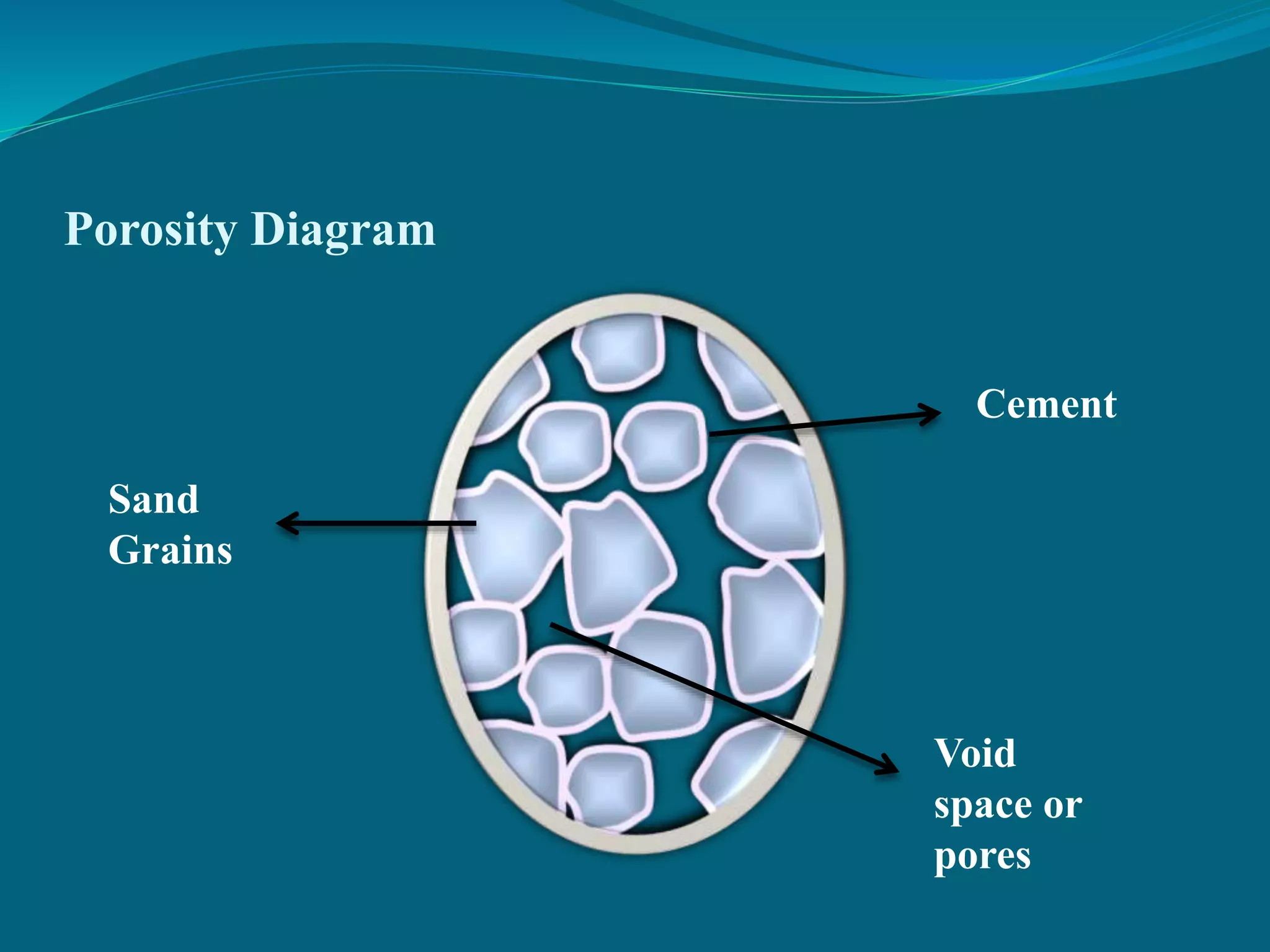
Porosity Diagram
Sand
Grains
Cement
Void
space or
pores
Factors effecting porosity
1) Particle sphericity and angularity
2) Packing
3) Sorting (variable grain sizes)
4) Cementing materials
5) Overburden stress (compaction)
Types of porosity
There are two types of porosity
1) Primary porosity
2) Secondry porosity
1) Primary porosity
The porosity of the rock that formed at the time of its deposition.
2) Secondry porosity
Develops after deposition of the rock.
For example:
Fracture spaces formed in fractured reservoirs
Further types of porosity
They are further subdivided into
1) Total porosity
2) Effective porosity
3) Microporosity
4) Mesoporosity
5) Macroporosity
1) Total Porosity
The ratio of the entire pore space in a rock to its bulk volume.
2) Effective Porosity
The measure of the void space that is filled by recoverable oil and gas
φ = Vol. of interconnected pores + Vol. of deadend
Total or bulk vol. of reservoir rock
In very pure sandstone Total porosity is equal to Effective porosity
3) Microporosity
In solids , the term 'microporosity' refers to pores smaller than 2 nm
in diameter.
4) Mesoporosity
In solids , the term 'mesoporosity' refers to pores greater than 2 nm
and less than 50 nm in diameter.
5) Macroporosity
In solids , the term 'macroporosity' refers to pores greater than 50
nm in diameter.
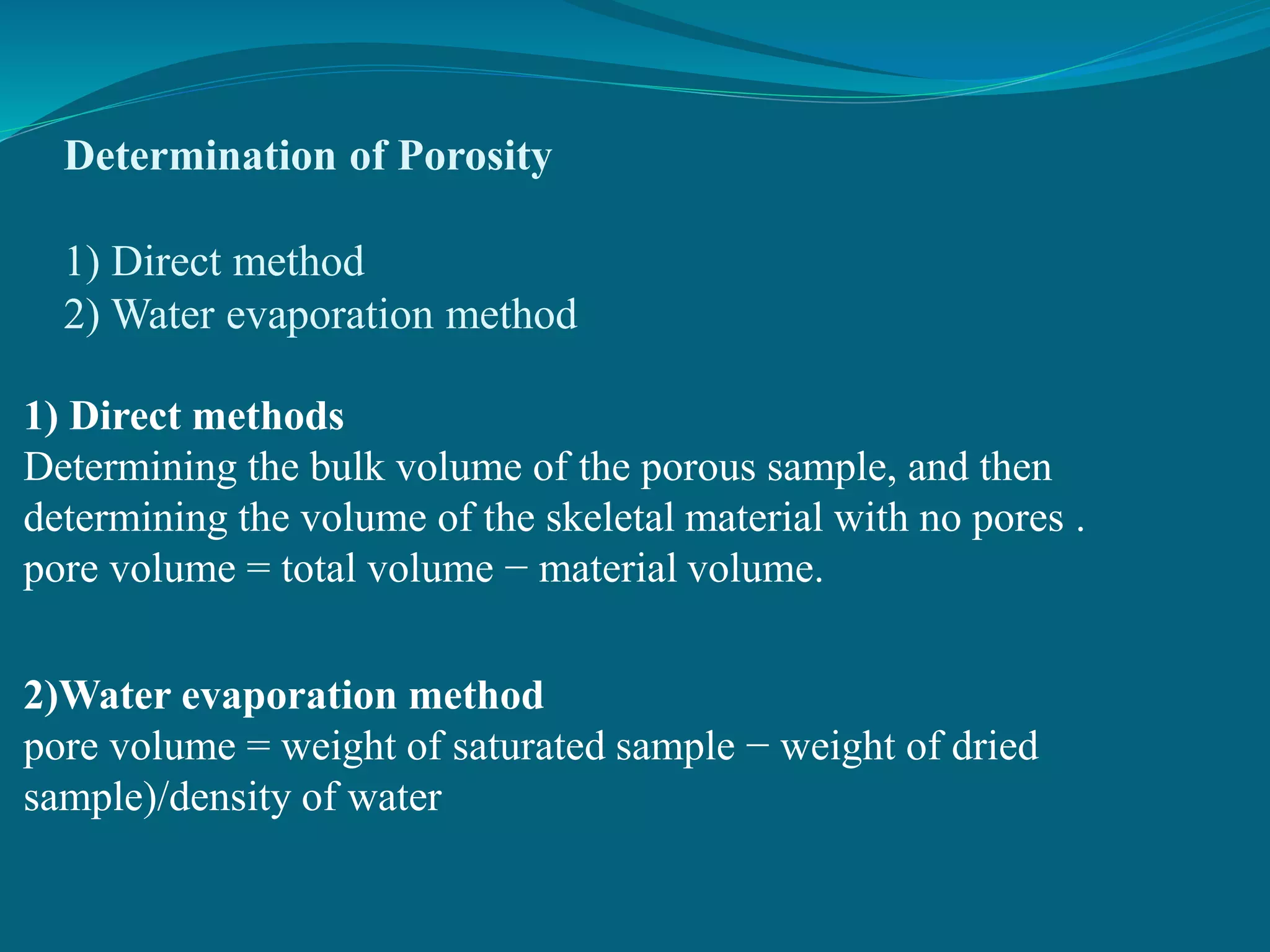
Determination of Porosity
1) Direct method
2) Water evaporation method
1) Direct methods
Determining the bulk volume of the porous sample, and then
determining the volume of the skeletal material with no pores .
pore volume = total volume − material volume.
2)Water evaporation method
pore volume = weight of saturated sample − weight of dried
sample)/density of water

Porosity and types

  • 1.
    Presentation Topic: Porosity Presented to: SirToufeeq Ahmed Presented by: Samiullah Roll Number: 5208 Section: A Department: Geology University Of Haripur
  • 2.
    Contents 1) Porosity defination 2)Factors effecting porosity 3) Types of porosity 4) Determination of porosity
  • 3.
    Defination: The ratio ofthe pore volume in a rock to the bulk volume of that rock.  Denoted by φ.  Express in Percent.  Mathematical Form: φ = Vp/Vb
  • 4.
  • 5.
    Factors effecting porosity 1)Particle sphericity and angularity 2) Packing 3) Sorting (variable grain sizes) 4) Cementing materials 5) Overburden stress (compaction)
  • 6.
    Types of porosity Thereare two types of porosity 1) Primary porosity 2) Secondry porosity 1) Primary porosity The porosity of the rock that formed at the time of its deposition. 2) Secondry porosity Develops after deposition of the rock. For example: Fracture spaces formed in fractured reservoirs
  • 7.
    Further types ofporosity They are further subdivided into 1) Total porosity 2) Effective porosity 3) Microporosity 4) Mesoporosity 5) Macroporosity 1) Total Porosity The ratio of the entire pore space in a rock to its bulk volume. 2) Effective Porosity The measure of the void space that is filled by recoverable oil and gas φ = Vol. of interconnected pores + Vol. of deadend Total or bulk vol. of reservoir rock In very pure sandstone Total porosity is equal to Effective porosity
  • 8.
    3) Microporosity In solids, the term 'microporosity' refers to pores smaller than 2 nm in diameter. 4) Mesoporosity In solids , the term 'mesoporosity' refers to pores greater than 2 nm and less than 50 nm in diameter. 5) Macroporosity In solids , the term 'macroporosity' refers to pores greater than 50 nm in diameter.
  • 9.
    Determination of Porosity 1)Direct method 2) Water evaporation method 1) Direct methods Determining the bulk volume of the porous sample, and then determining the volume of the skeletal material with no pores . pore volume = total volume − material volume. 2)Water evaporation method pore volume = weight of saturated sample − weight of dried sample)/density of water