RESERVOIR PETROPHYSICS
LABORATORY DETERMINATION
OF POROSITY
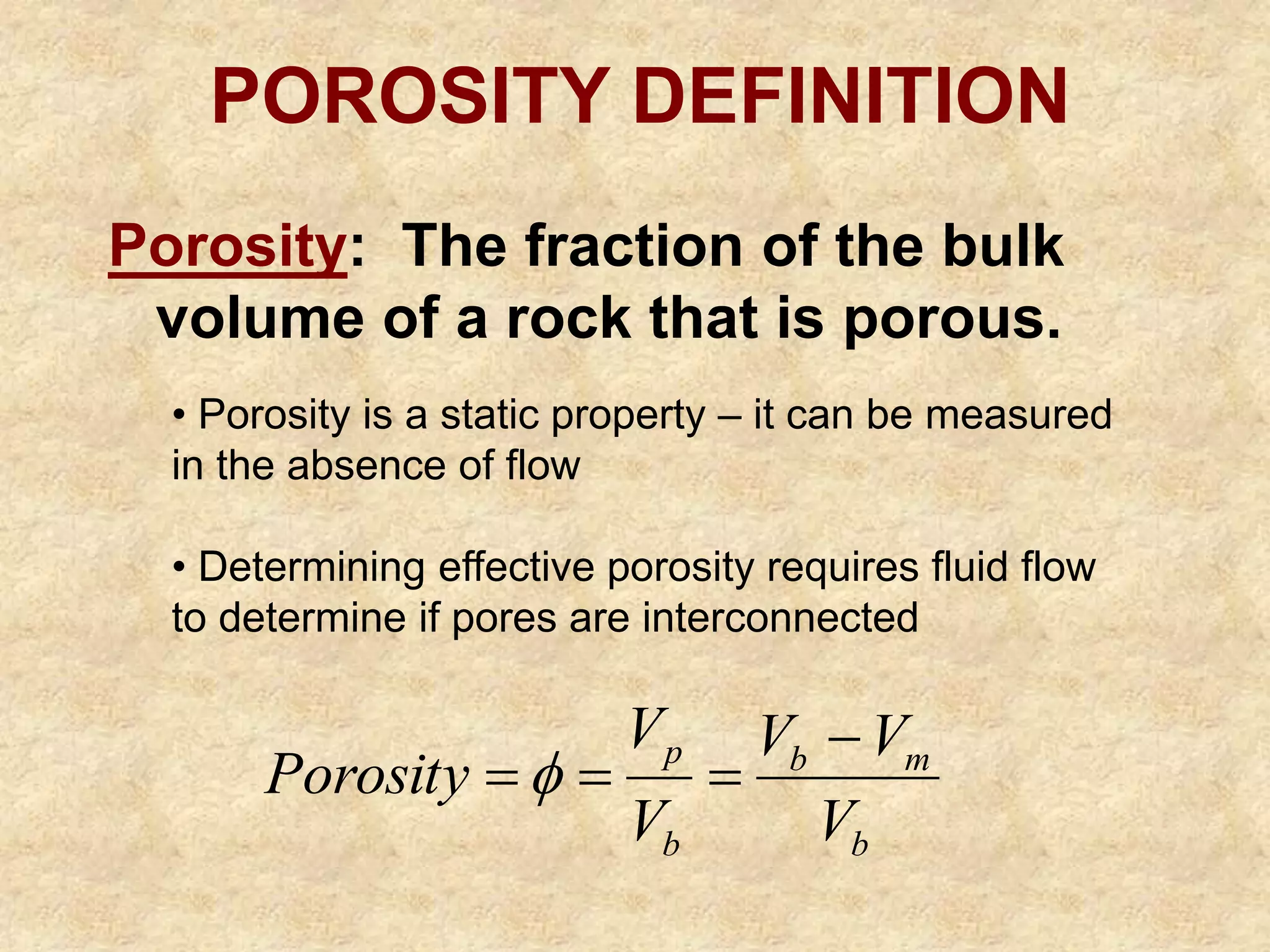
Porosity: The fraction of the bulk
volume of a rock that is porous.
b
m
b
b
p
V
V
V
V
V
Porosity




POROSITY DEFINITION
• Porosity is a static property – it can be measured
in the absence of flow
• Determining effective porosity requires fluid flow
to determine if pores are interconnected
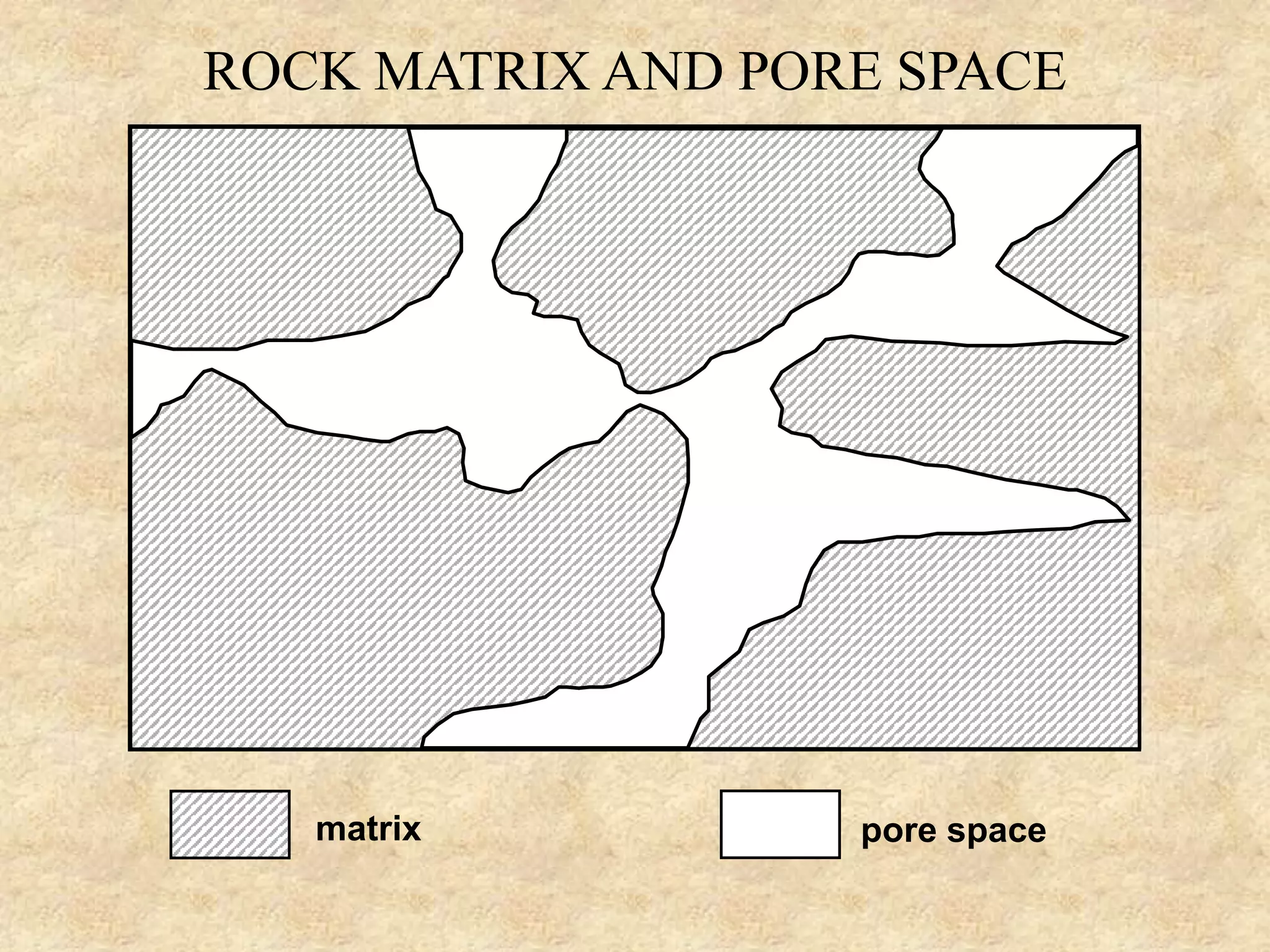
ROCK MATRIX AND PORE SPACE
matrix pore space
MEASUREMENT OF POROSITY
1. Core samples (measure two of: Vb, Vp, or Vm)
2. Openhole wireline logs
LABORATORY DETERMINATION
OF POROSITY
• Most methods use small samples (core plugs)
• multiple samples must be analyzed to get
statistically representative results
• sampling technique is important
• often all samples are taken from “sweet
spots” skewing analysis
To determine porosity, measure 2 of 3
volumetric parameters:
1. Bulk volume, Vb
2. Matrix volume, Vm (also called grain volume)
3. Pore volume, Vp
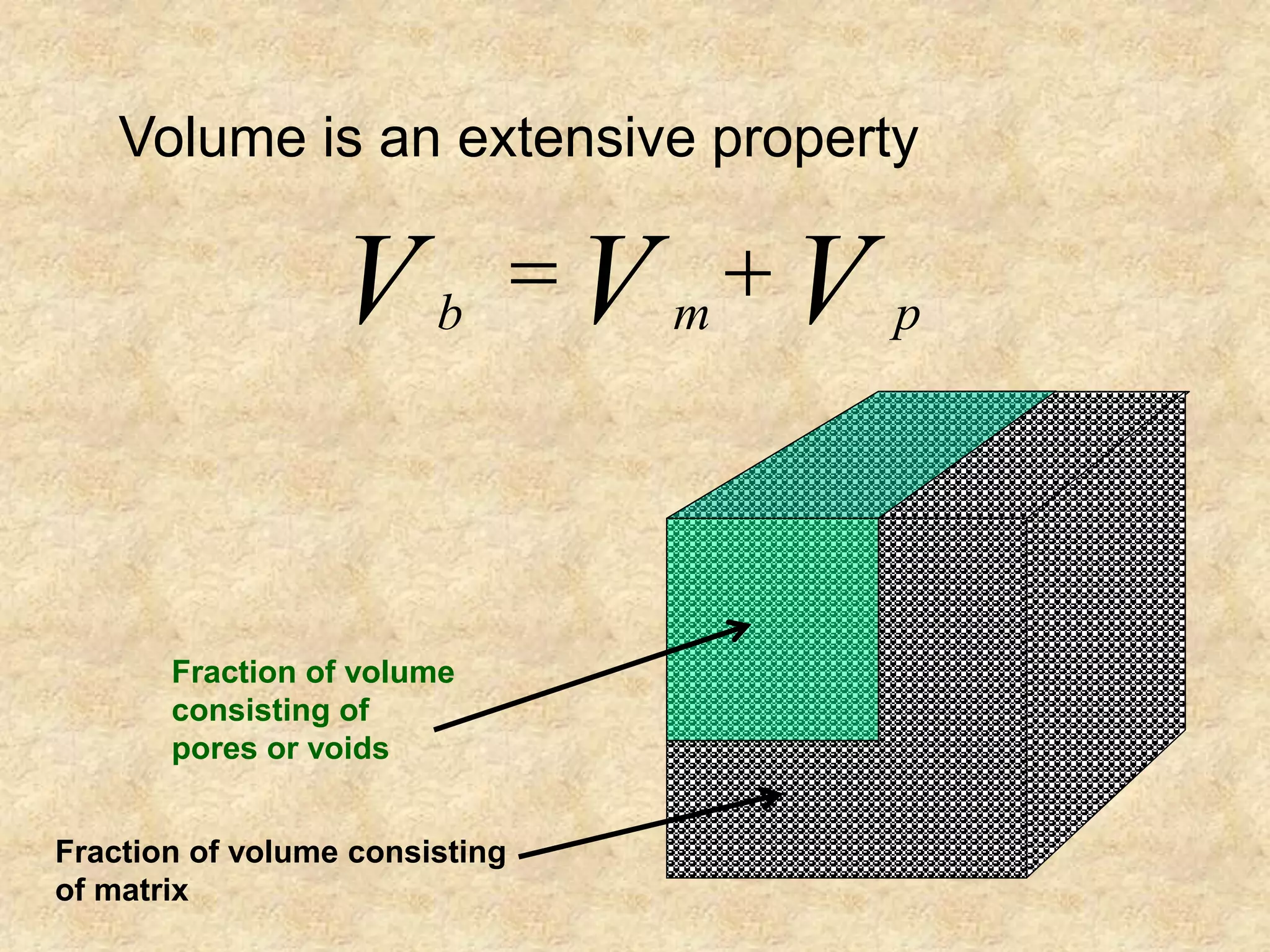
V
V
V p
m
b


Fraction of volume
consisting of
pores or voids
Fraction of volume consisting
of matrix
Volume is an extensive property
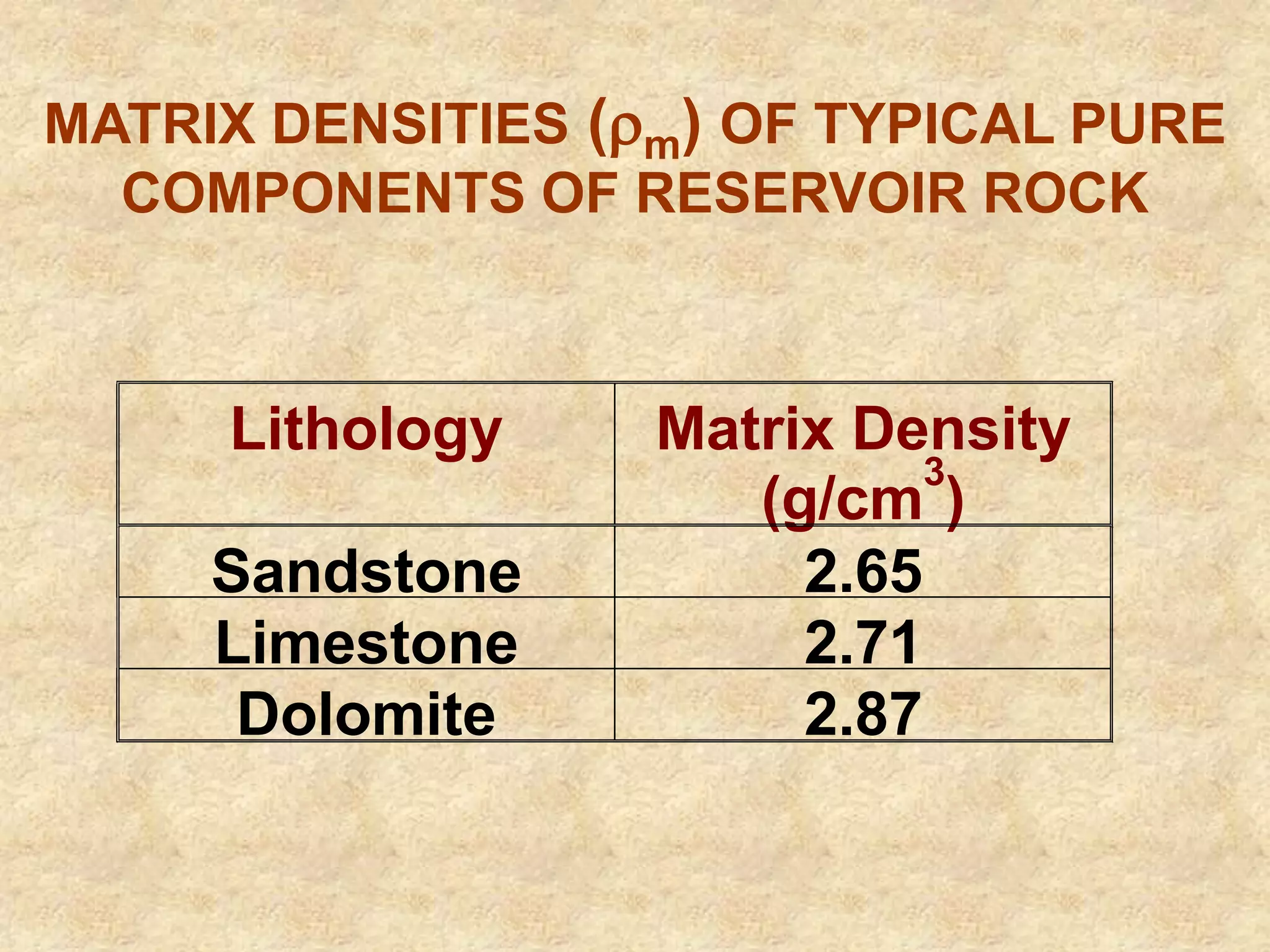
MATRIX DENSITIES (m) OF TYPICAL PURE
COMPONENTS OF RESERVOIR ROCK
Lithology Matrix Density
(g/cm
3
)
Sandstone 2.65
Limestone 2.71
Dolomite 2.87
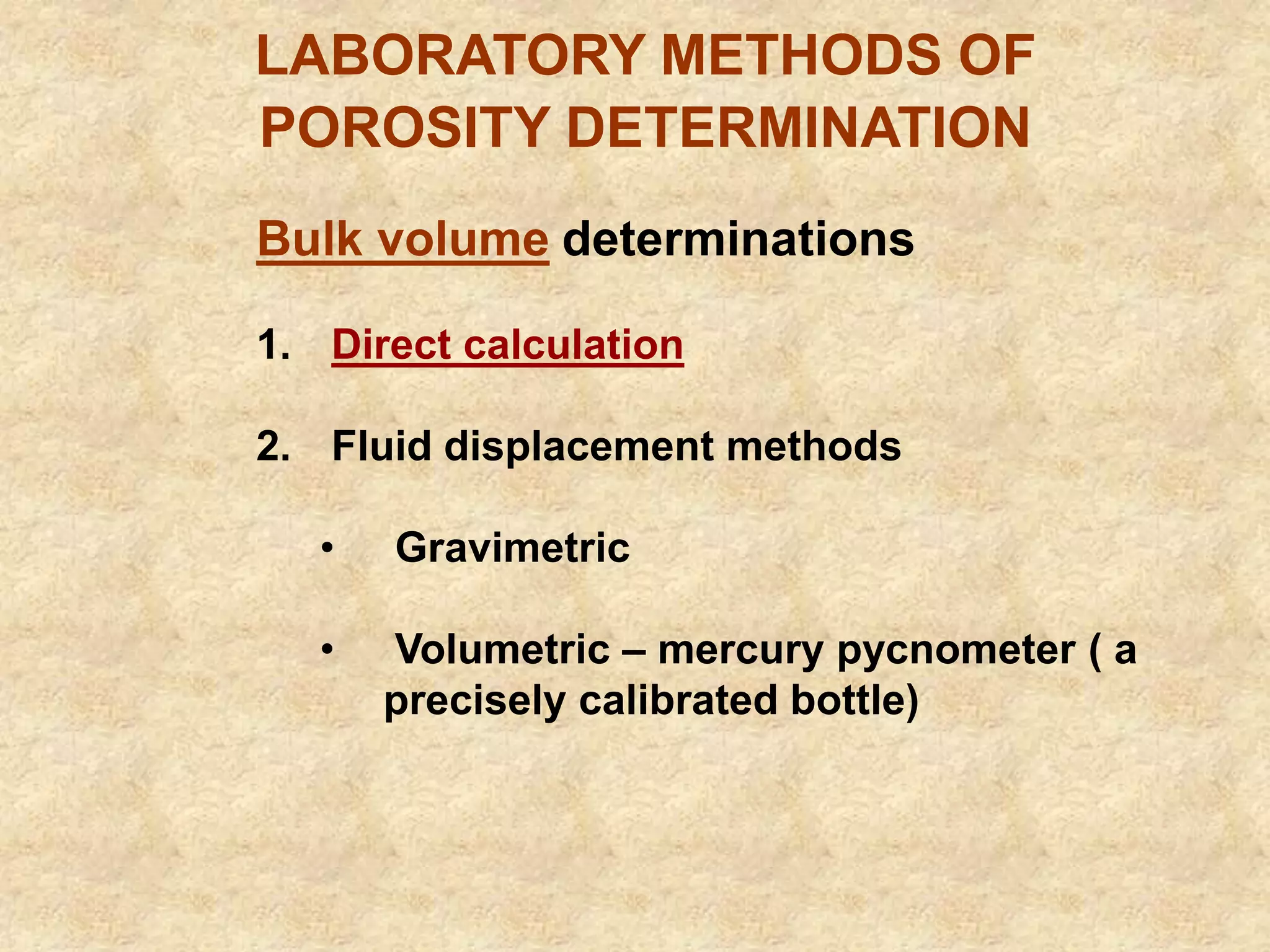
LABORATORY METHODS OF
POROSITY DETERMINATION
Bulk volume determinations
1. Direct calculation
2. Fluid displacement methods
• Gravimetric
• Volumetric – mercury pycnometer ( a
precisely calibrated bottle)
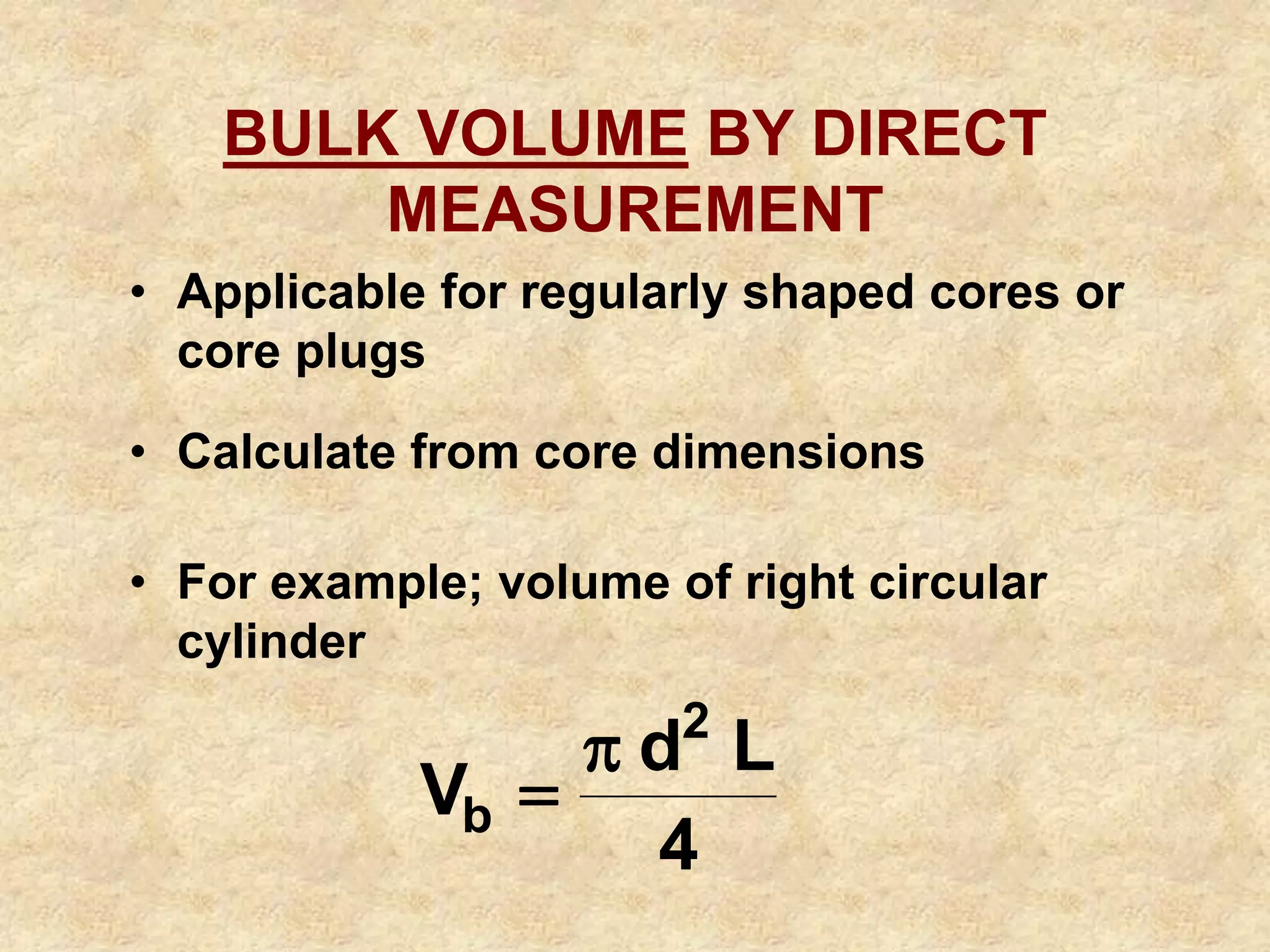
BULK VOLUME BY DIRECT
MEASUREMENT
• Applicable for regularly shaped cores or
core plugs
• Calculate from core dimensions
• For example; volume of right circular
cylinder
4
L
d
V
2
b


LABORATORY METHODS OF
POROSITY DETERMINATION
Bulk volume determinations
1. Direct calculation
2. Fluid displacement methods
• Gravimetric (Archimedes) methods
• Volumetric – in pycnometer
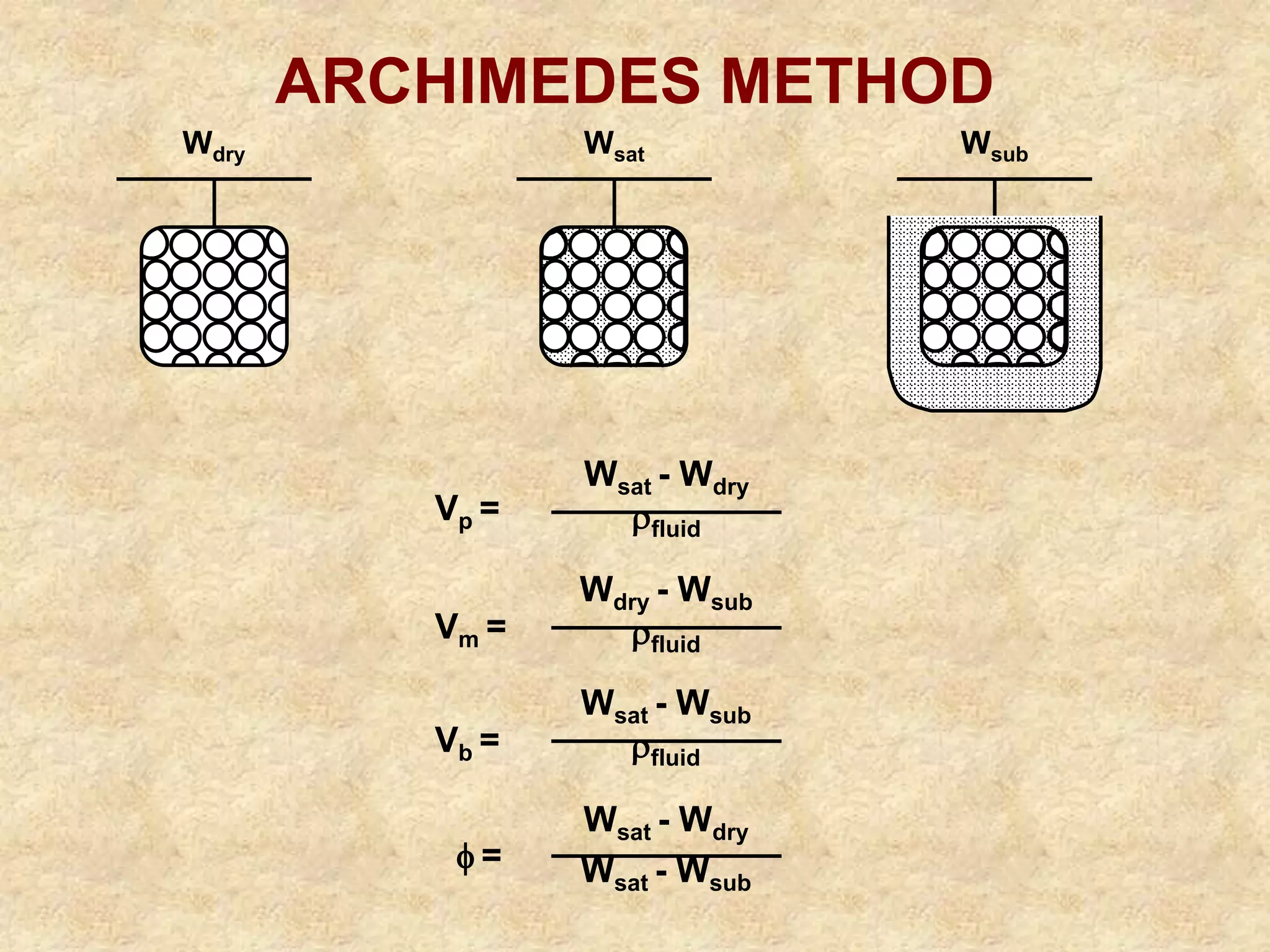
ARCHIMEDES METHOD
Wsat Wsub
Wdry
Vp =
Wsat - Wdry
fluid
Vm =
Wdry - Wsub
fluid
 =
Wsat - Wdry
Wsat - Wsub
Vb =
Wsat - Wsub
fluid
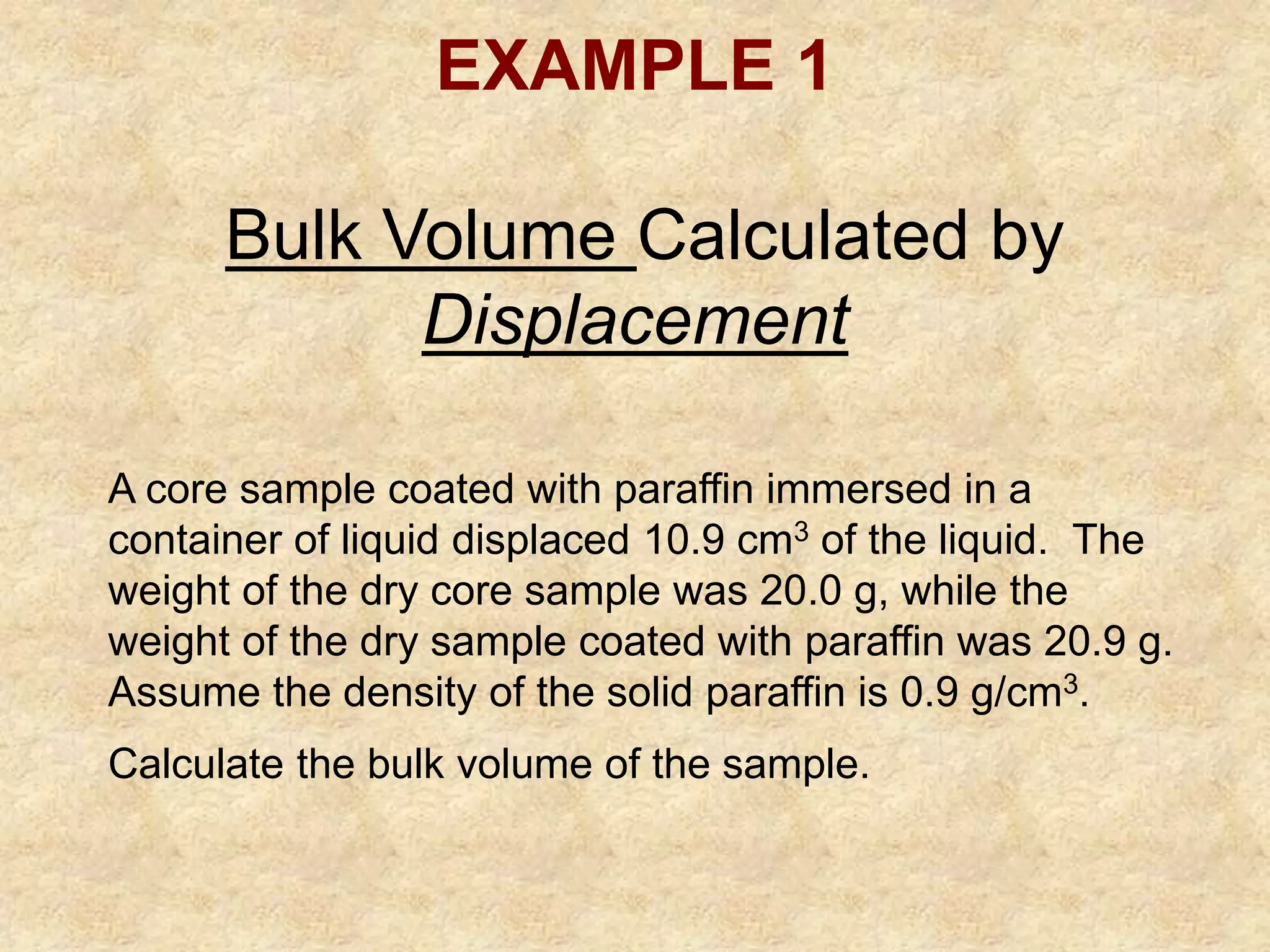
EXAMPLE 1
Bulk Volume Calculated by
Displacement
A core sample coated with paraffin immersed in a
container of liquid displaced 10.9 cm3 of the liquid. The
weight of the dry core sample was 20.0 g, while the
weight of the dry sample coated with paraffin was 20.9 g.
Assume the density of the solid paraffin is 0.9 g/cm3.
Calculate the bulk volume of the sample.
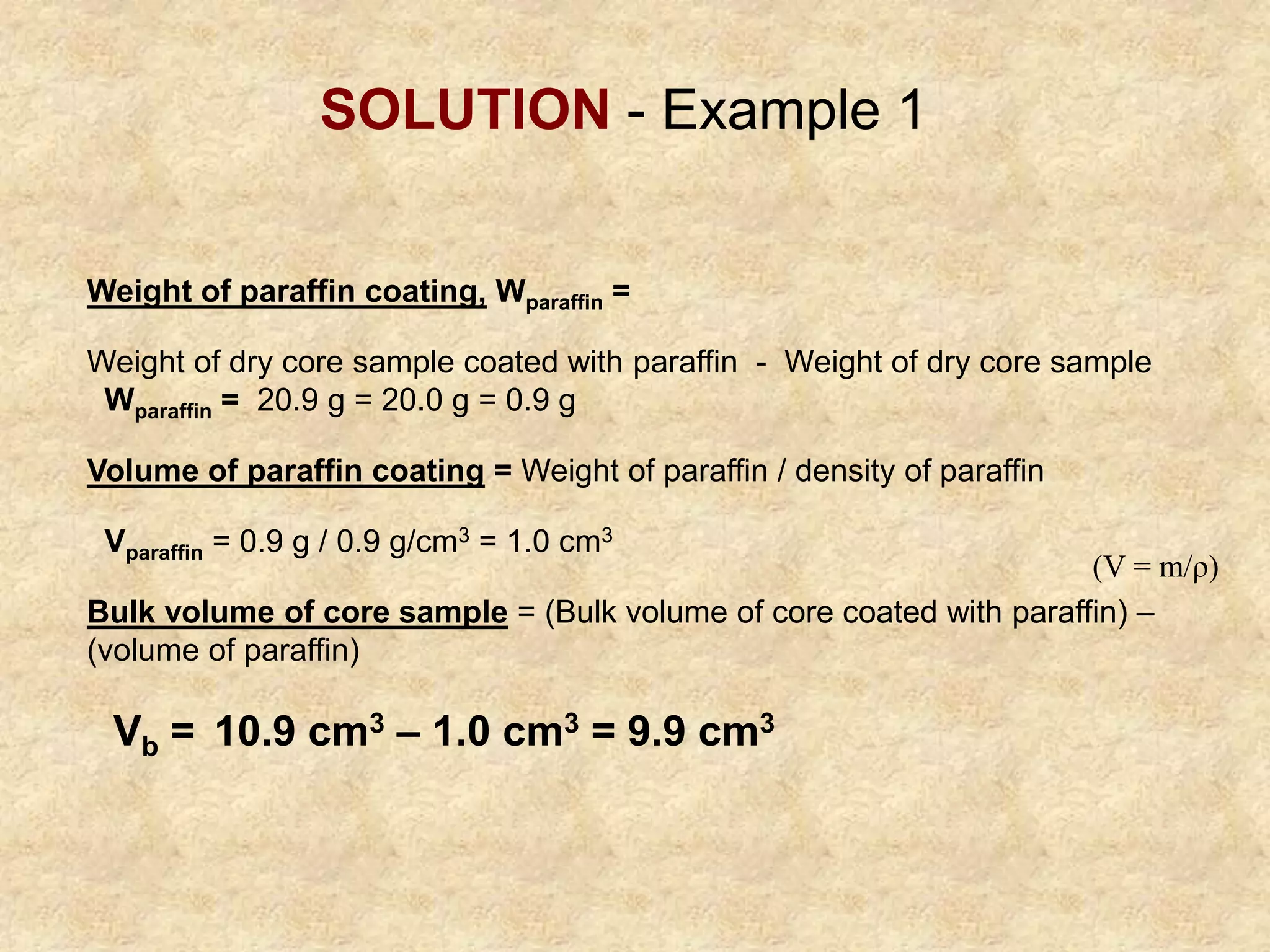
Weight of paraffin coating, Wparaffin =
Weight of dry core sample coated with paraffin - Weight of dry core sample
Wparaffin = 20.9 g = 20.0 g = 0.9 g
Volume of paraffin coating = Weight of paraffin / density of paraffin
Vparaffin = 0.9 g / 0.9 g/cm3 = 1.0 cm3
Bulk volume of core sample = (Bulk volume of core coated with paraffin) –
(volume of paraffin)
Vb = 10.9 cm3 – 1.0 cm3 = 9.9 cm3
SOLUTION - Example 1
(V = m/ρ)
LABORATORY METHODS OF
POROSITY DETERMINATION
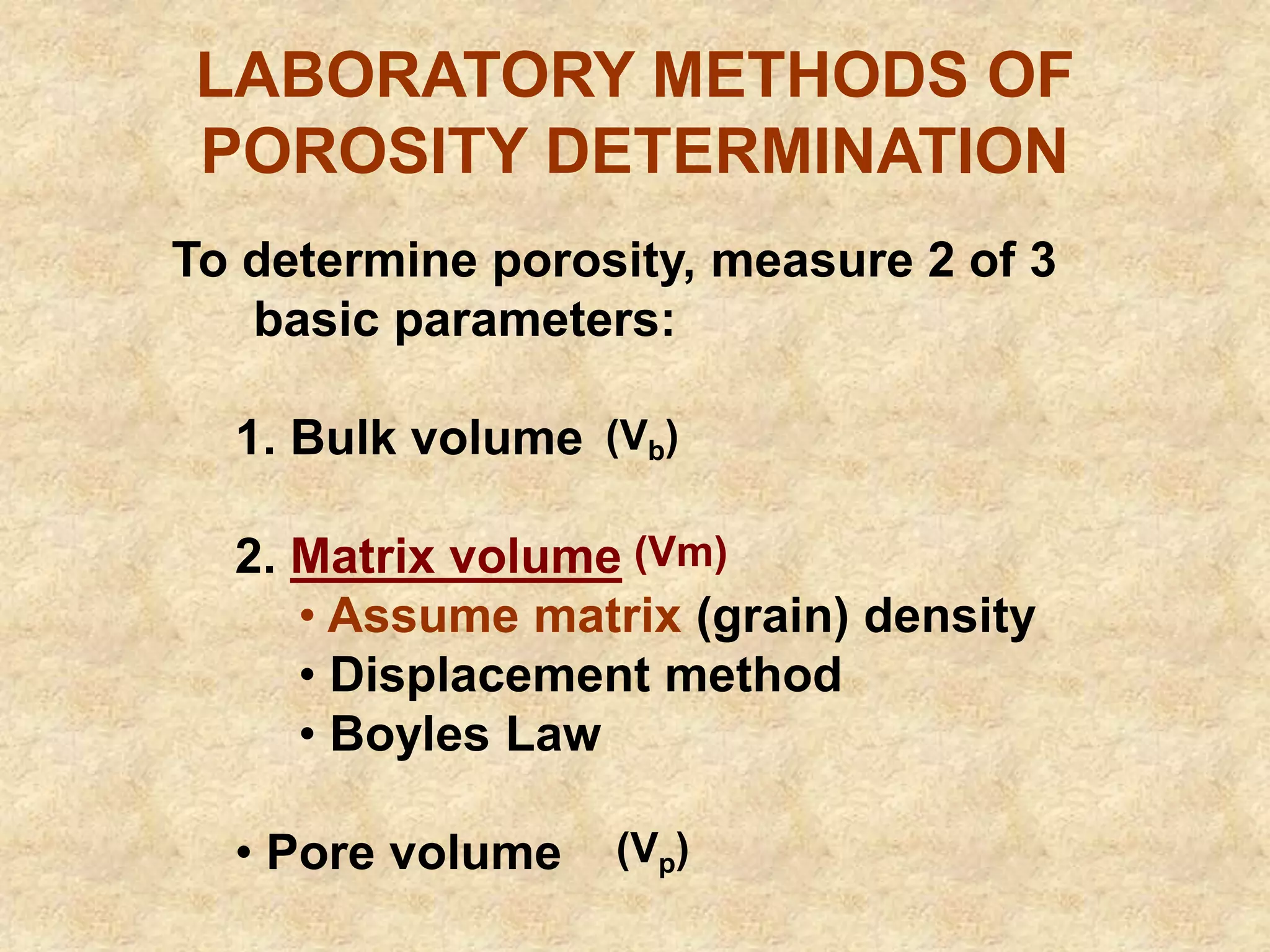
To determine porosity, measure 2 of 3
basic parameters:
1. Bulk volume
2. Matrix volume
• Assume matrix (grain) density
• Displacement method
• Boyles Law
• Pore volume
(Vm)
(Vb)
(Vp)
LABORATORY METHODS OF
POROSITY DETERMINATION
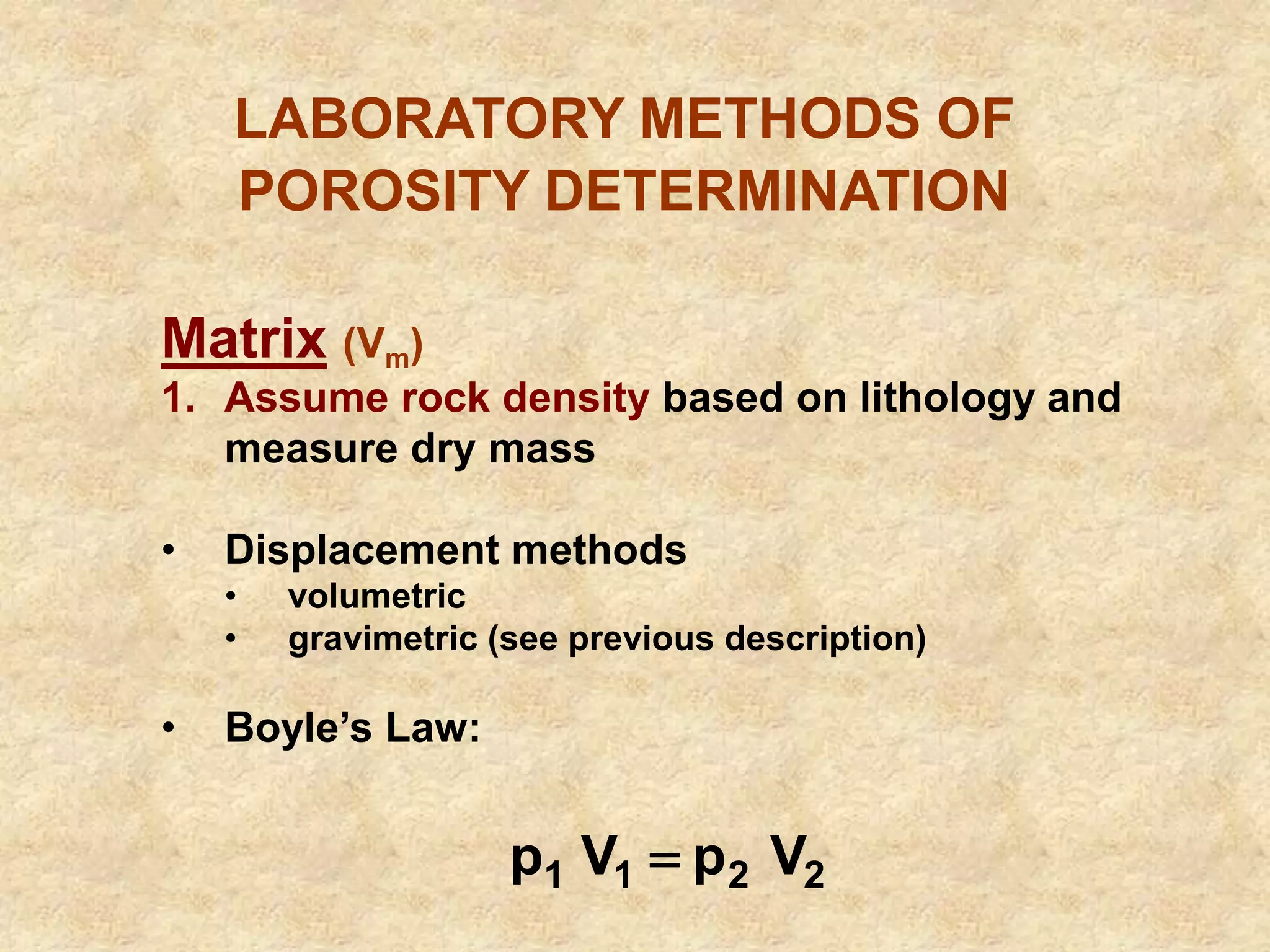
Matrix (Vm)
1. Assume rock density based on lithology and
measure dry mass
• Displacement methods
• volumetric
• gravimetric (see previous description)
• Boyle’s Law:
2
2
1
1 V
p
V
p 
MATRIX VOLUME FROM
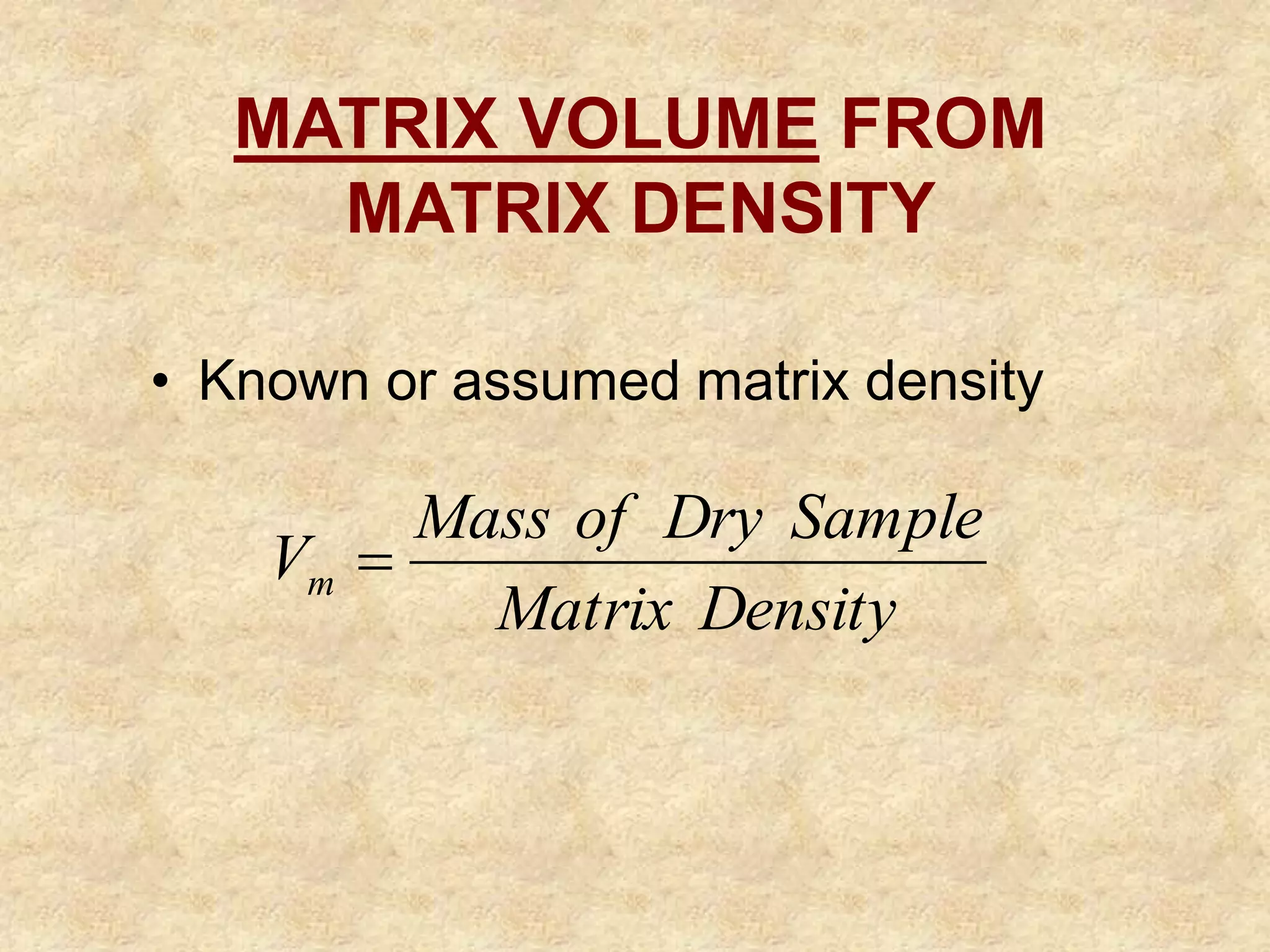
MATRIX DENSITY
• Known or assumed matrix density
Density
Matrix
Sample
Dry
of
Mass
Vm 
APPLICABILITY AND
ACCURACY OF MATRIX
MEASUREMENT TECHNIQUES
• Known or assumed matrix density
– Accurate only if matrix density is known
and not assumed
– Core samples are often mixtures of several
components with varying matrix densities,
so density must be measured
LABORATORY METHODS OF
POROSITY DETERMINATION
To determine porosity, measure 2 of 3
basic parameters:
1. Bulk volume
2. Matrix volume
• Assumed matrix (grain) density
• Displacement method
• Boyles Law
3. Pore volume
(Vm)
(Vb)
(Vp)
MATRIX VOLUME FROM
DISPLACEMENT METHOD
• Reduce sample to particle size
• Measure matrix volume of particles by
– Volumetric method
– Archimedes method (gravimetric
measurement)
EXAMPLE 2
SOLUTION
Calculating the Matrix Volume and
Porosity of a Core Sample Using the
Displacement Method
SOLUTION - Example 2
Calculate the Porosity of a Core Sample Using the
Displacement Method and Matrix Volume
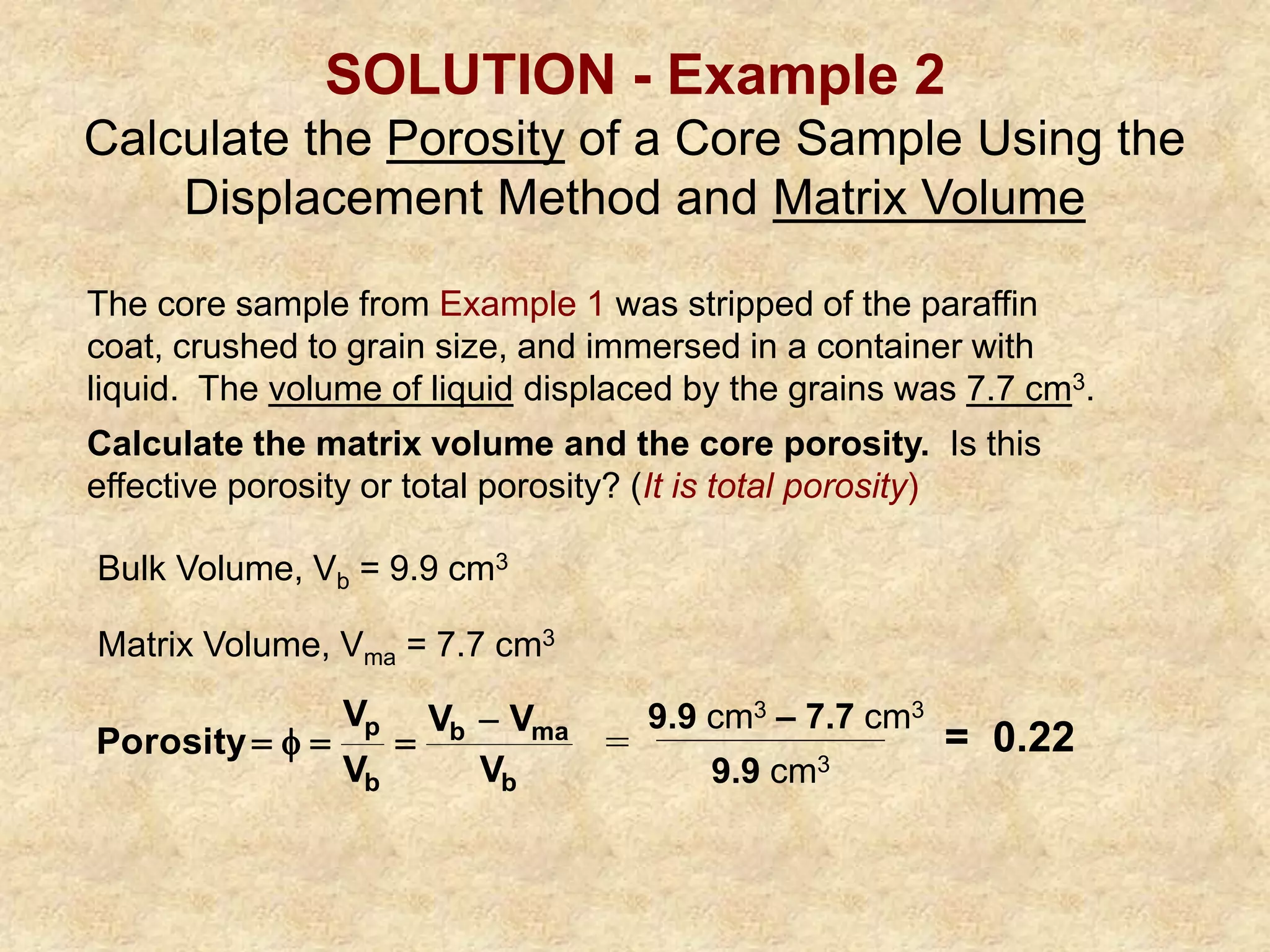
The core sample from Example 1 was stripped of the paraffin
coat, crushed to grain size, and immersed in a container with
liquid. The volume of liquid displaced by the grains was 7.7 cm3.
Calculate the matrix volume and the core porosity. Is this
effective porosity or total porosity? (It is total porosity)
Bulk Volume, Vb = 9.9 cm3
Matrix Volume, Vma = 7.7 cm3
b
ma
b
b
p
V
V
V
V
V
Porosity




 =
9.9 cm3 – 7.7 cm3
9.9 cm3
= 0.22
LABORATORY METHODS OF
POROSITY DETERMINATION
To determine porosity, measure 2 of 3
basic parameters:
1. Bulk volume
2. Matrix volume
• Assumed matrix (grain) density
• Displacement method
• Boyles Law (Gas Expansion)
3. Pore volume
(Vm)
(Vb)
(Vp)
MATRIX VOLUME FROM
GAS EXPANSION METHOD
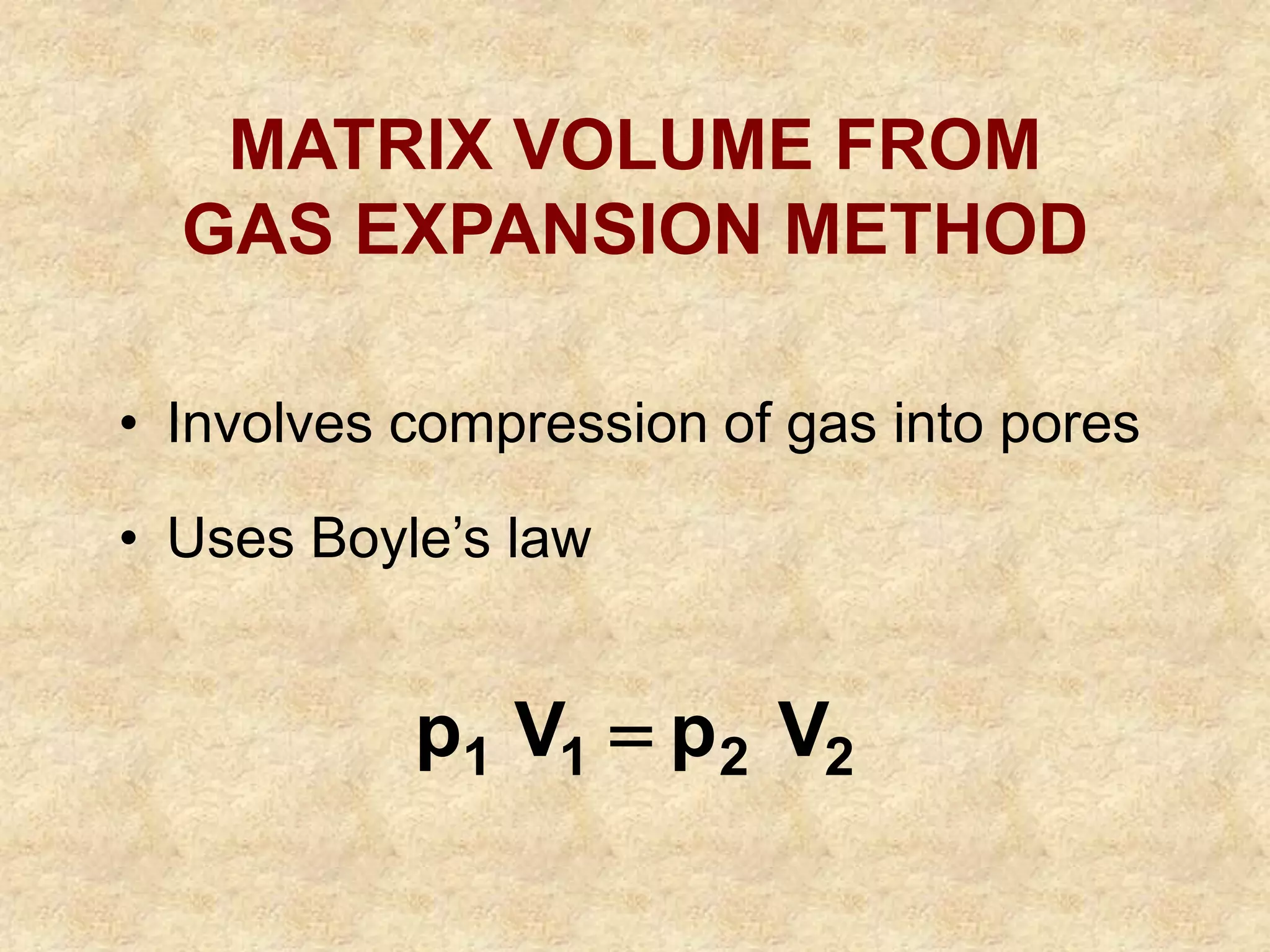
• Involves compression of gas into pores
• Uses Boyle’s law
2
2
1
1 V
p
V
p 
GAS EXPANSION METHOD
TO CALCULATE Vma
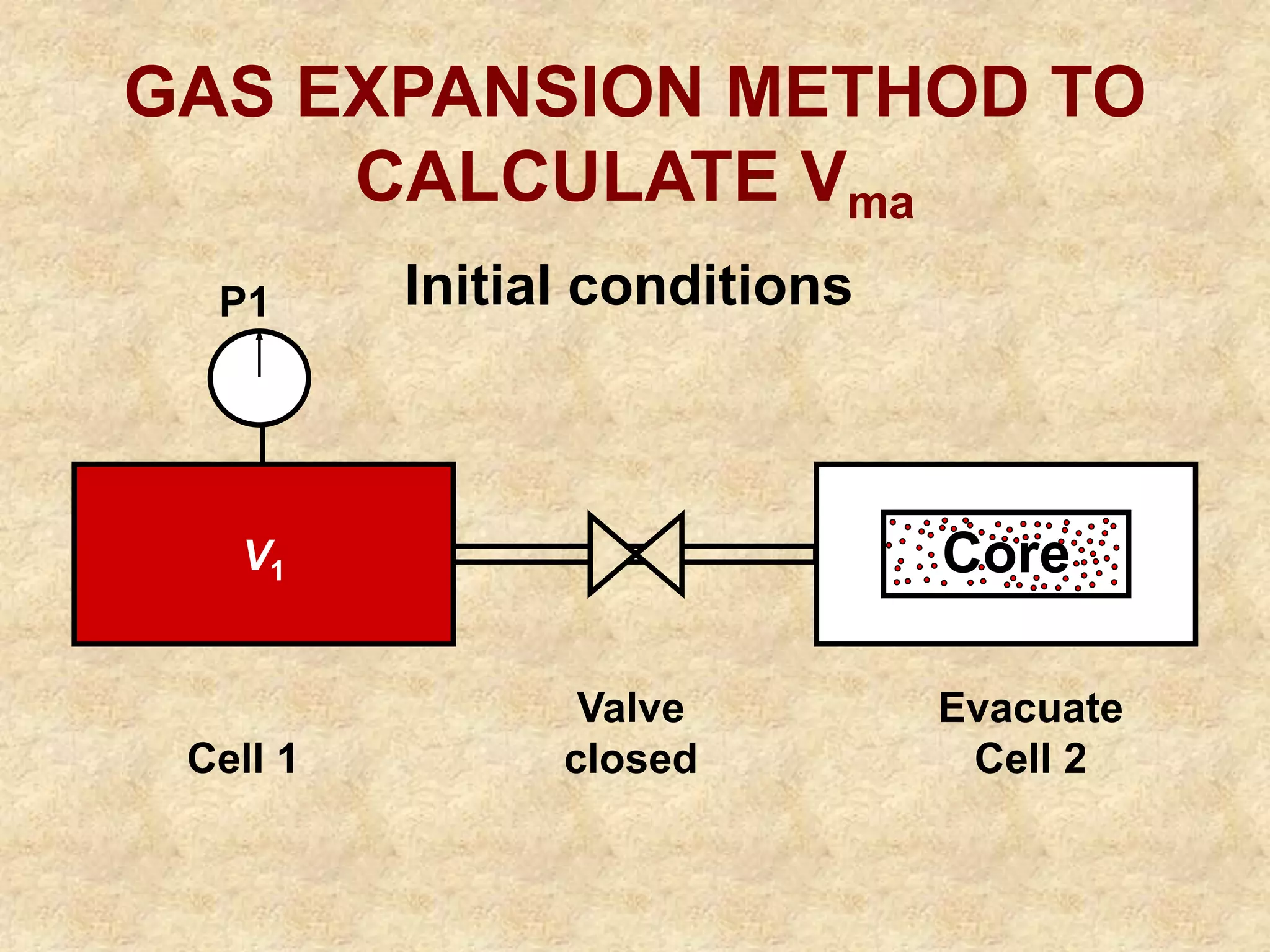
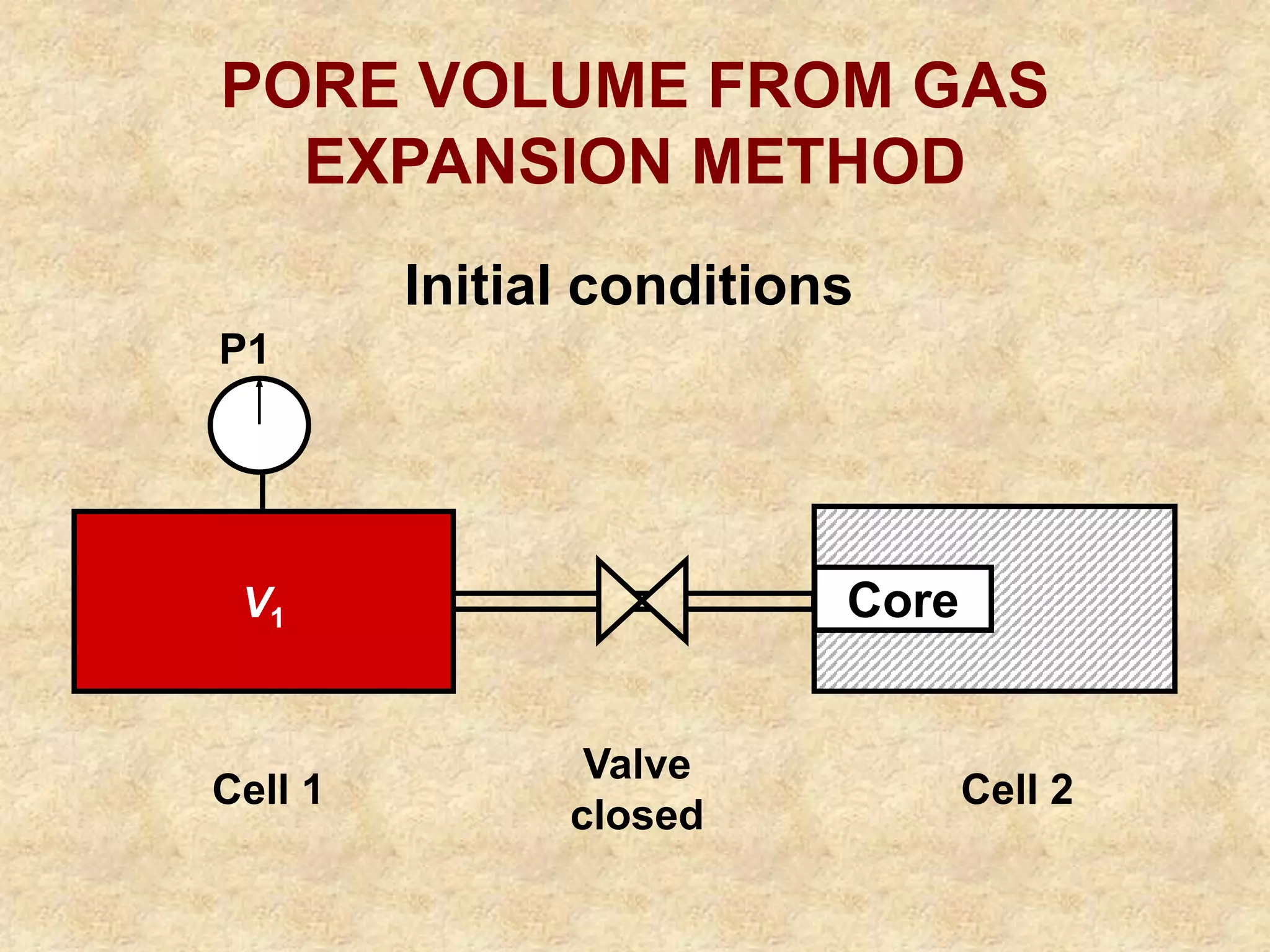
• Initial conditions, with volumes of 2
cells known
• Place core in second cell, evacuate
gas (air) from second cell
• Open valve
Valve
closed
Cell 1
Evacuate
Cell 2
GAS EXPANSION METHOD TO
CALCULATE Vma
Initial conditions
V1
P1
Core
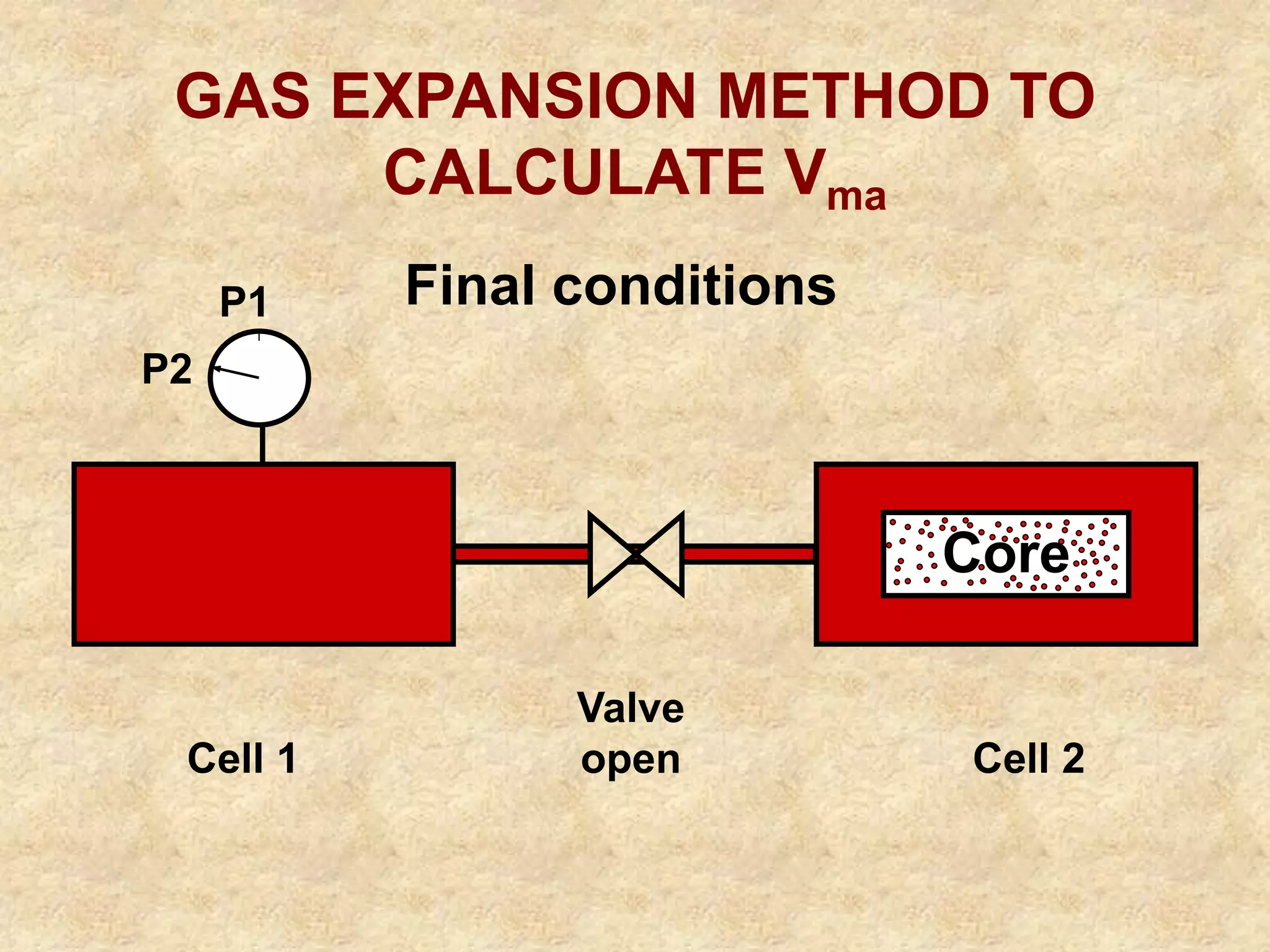
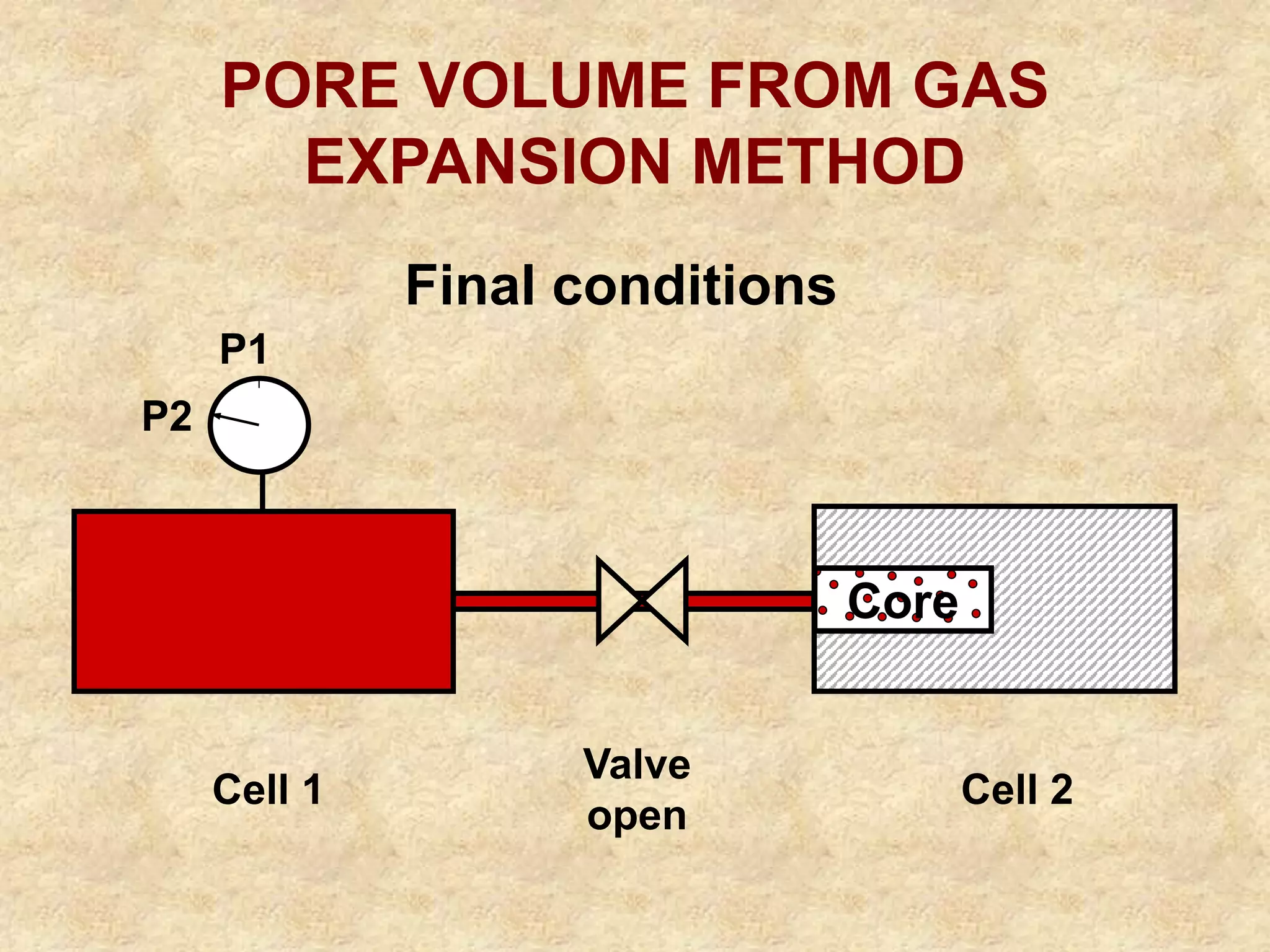
Valve
open
Final conditions
P2
Core
Cell 1
GAS EXPANSION METHOD TO
CALCULATE Vma
Cell 2
P1
GAS EXPANSION METHOD TO
CALCULATE Vma
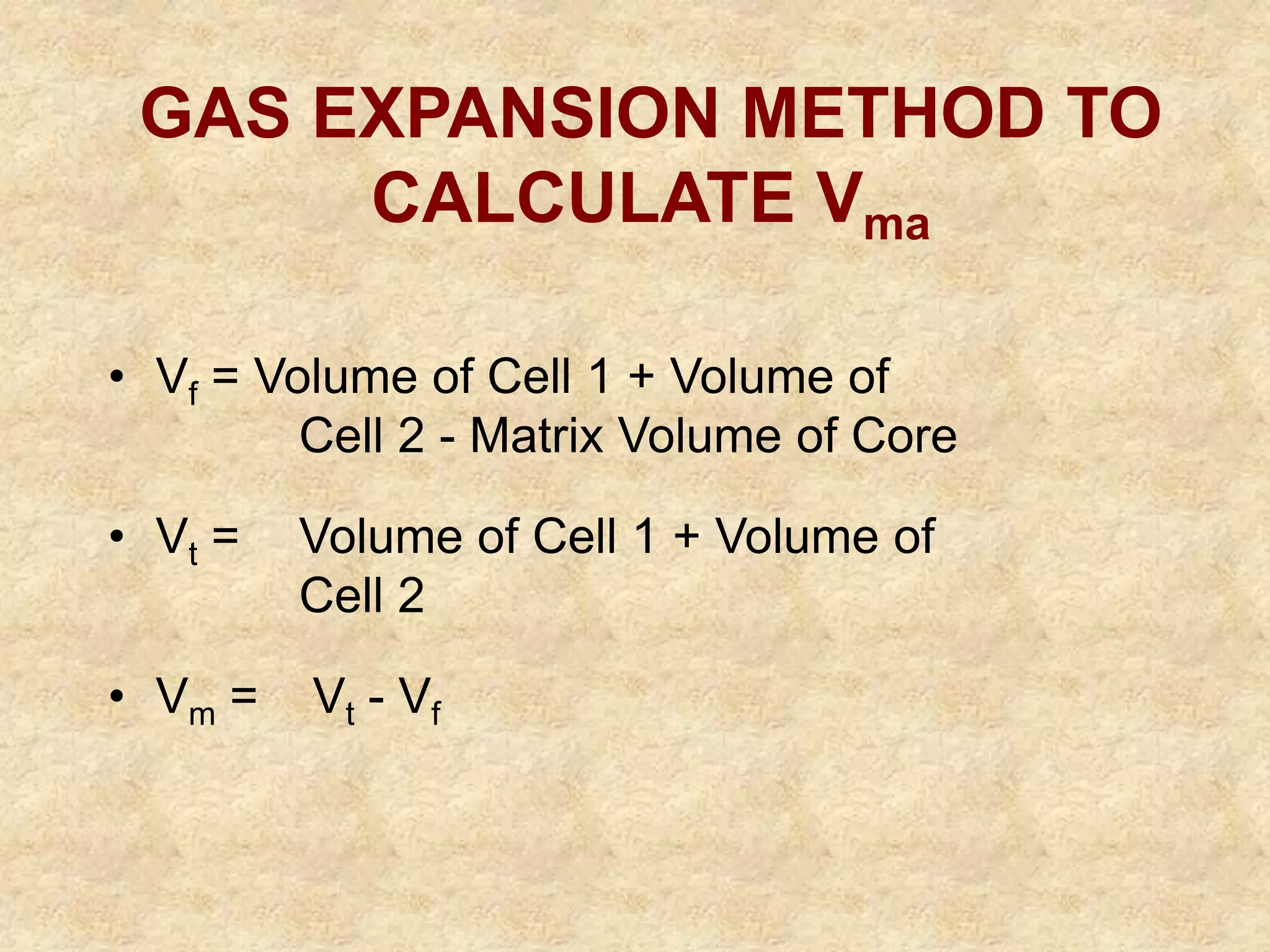
• Vf = Volume of Cell 1 + Volume of
Cell 2 - Matrix Volume of Core
• Vt = Volume of Cell 1 + Volume of
Cell 2
• Vm = Vt - Vf
APPLICABILITY AND
ACCURACY OF MATRIX
MEASUREMENT TECHNIQUES
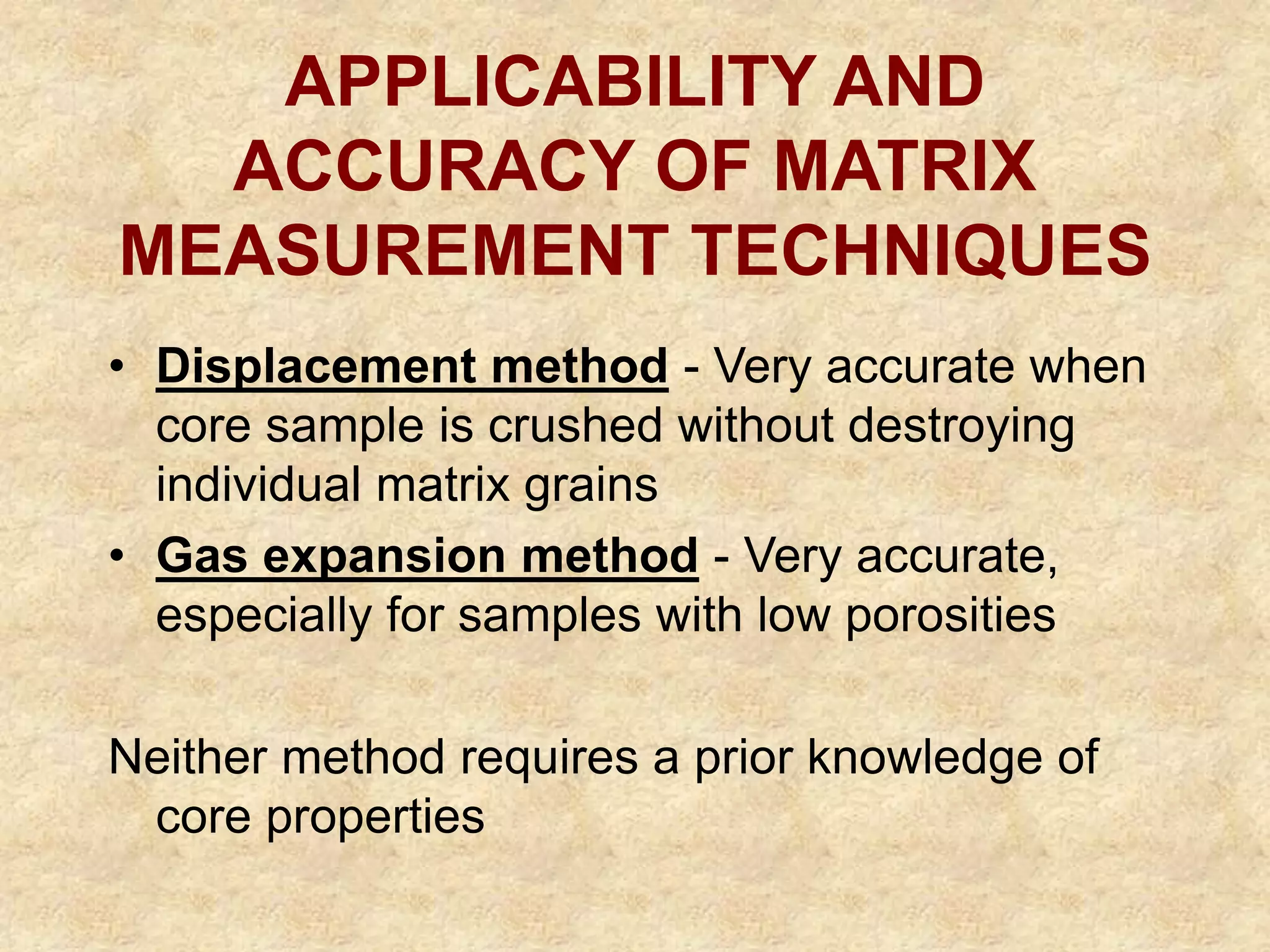
• Displacement method - Very accurate when
core sample is crushed without destroying
individual matrix grains
• Gas expansion method - Very accurate,
especially for samples with low porosities
Neither method requires a prior knowledge of
core properties
LABORATORY METHODS OF
POROSITY DETERMINATION
To determine porosity, measure 2 of 3
basic parameters:
1. Bulk volume
2. Matrix volume
3. Pore volume
(Vm)
(Vb)
(Vp)
LABORATORY METHODS OF
POROSITY DETERMINATION
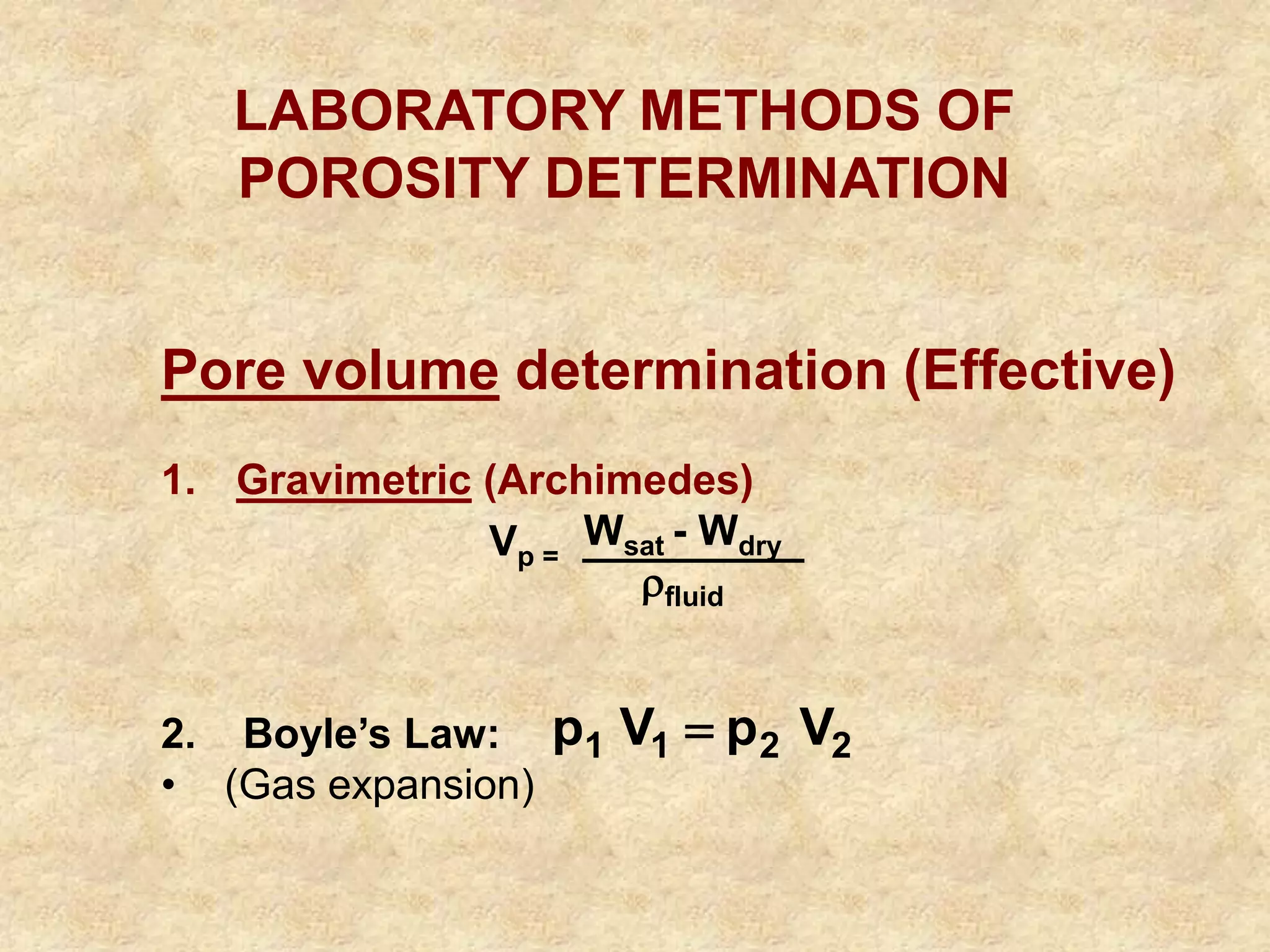
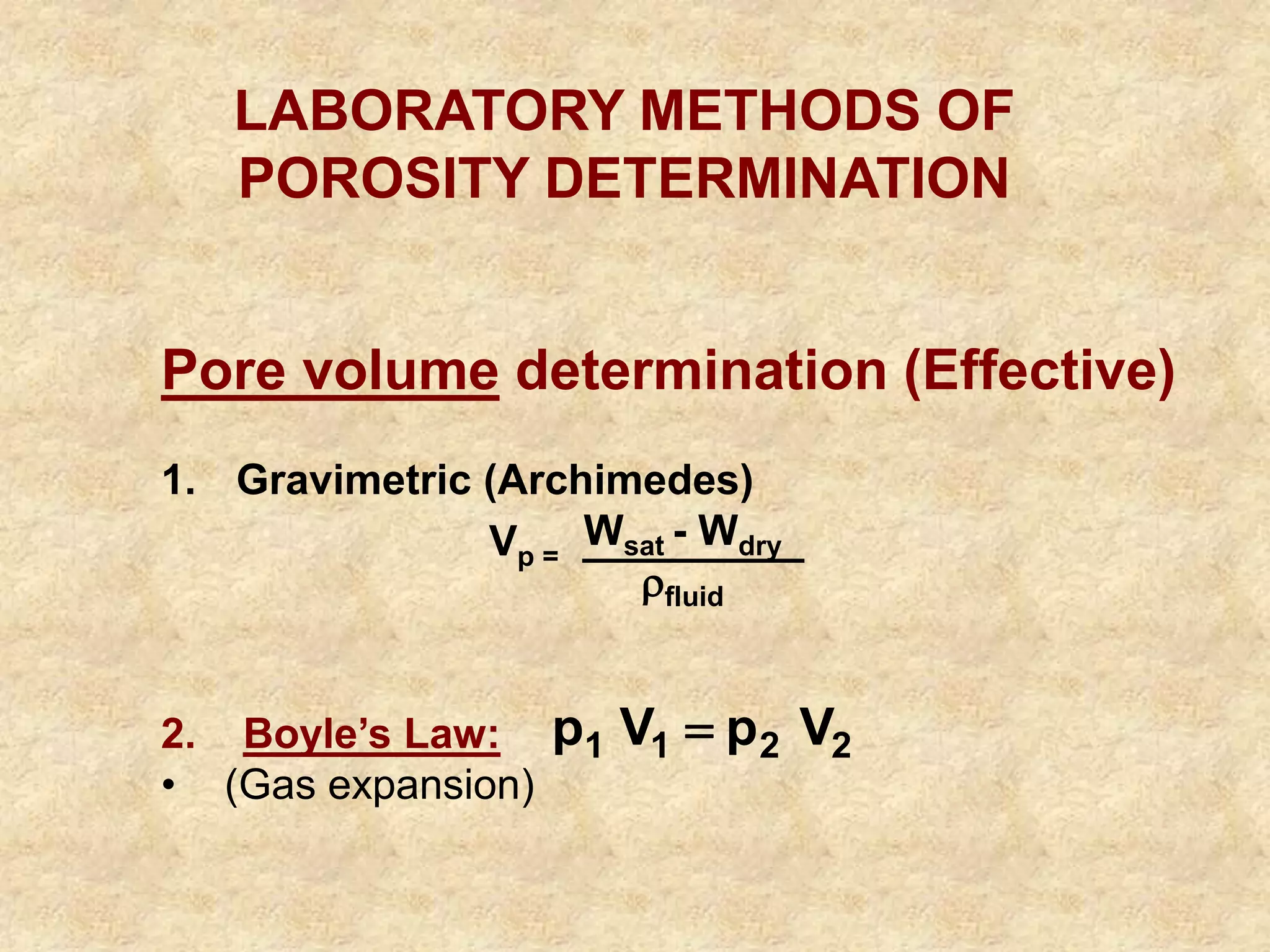
Pore volume determination (Effective)
1. Gravimetric (Archimedes)
Wsat - Wdry
fluid
2. Boyle’s Law:
• (Gas expansion)
Vp =
2
2
1
1 V
p
V
p 
PORE VOLUME FROM
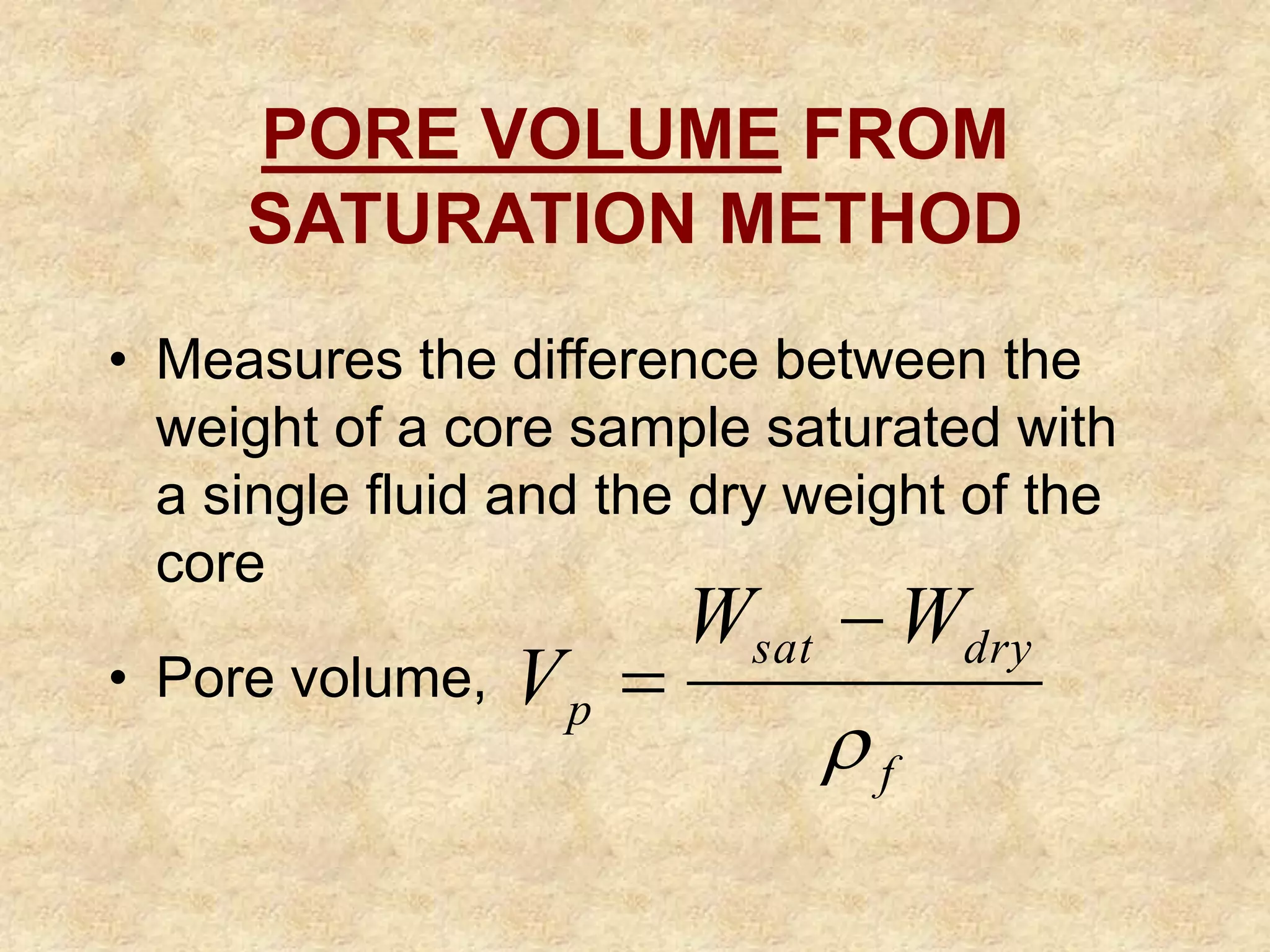
SATURATION METHOD
• Measures the difference between the
weight of a core sample saturated with
a single fluid and the dry weight of the
core
• Pore volume,
f
dry
sat
p
W
W
V



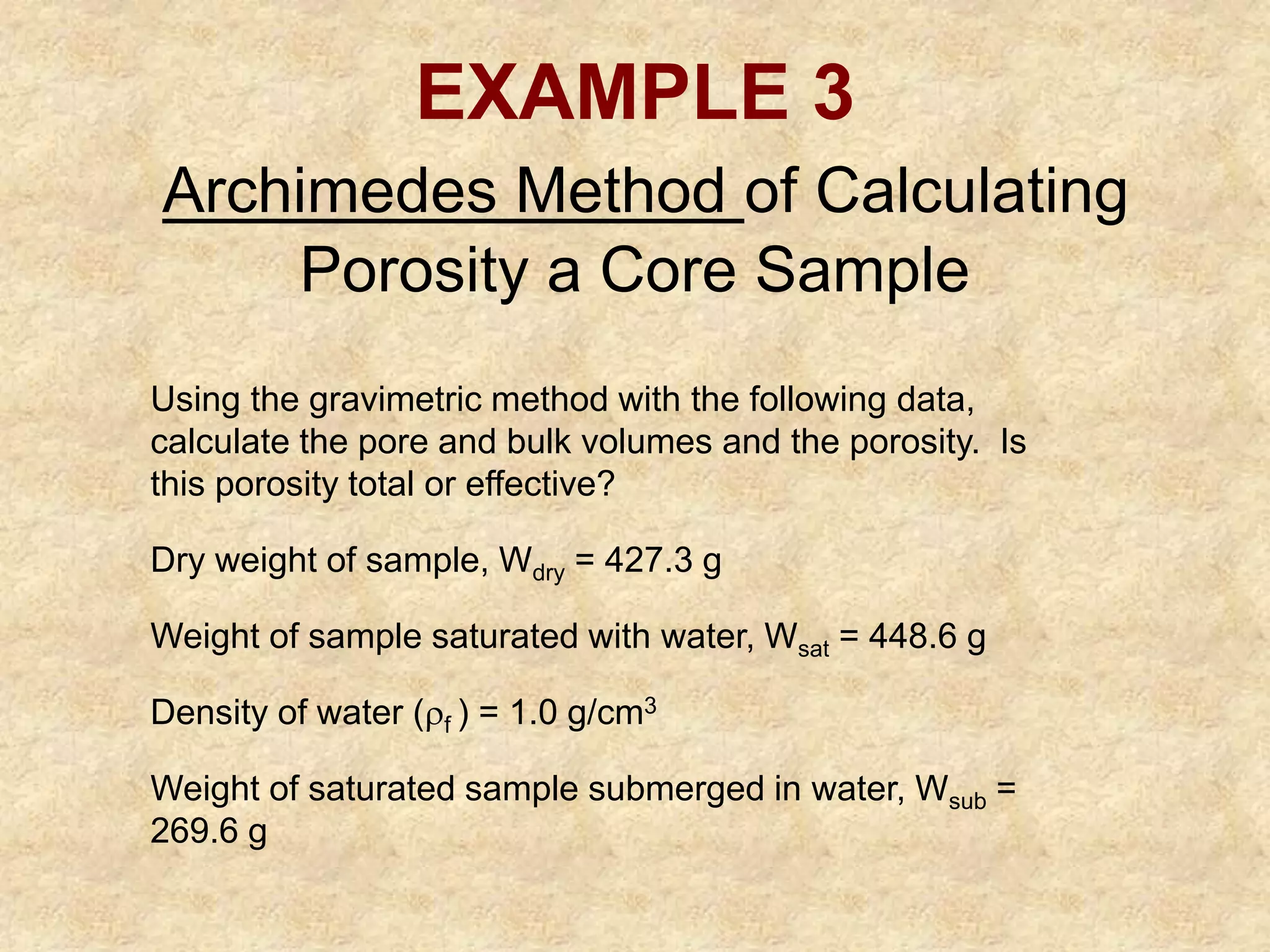
EXAMPLE 3
Archimedes Method of Calculating
Porosity a Core Sample
Using the gravimetric method with the following data,
calculate the pore and bulk volumes and the porosity. Is
this porosity total or effective?
Dry weight of sample, Wdry = 427.3 g
Weight of sample saturated with water, Wsat = 448.6 g
Density of water (f ) = 1.0 g/cm3
Weight of saturated sample submerged in water, Wsub =
269.6 g
EXAMPLE 3
Solution
Archimedes Method of Calculating
Porosity a Core Sample
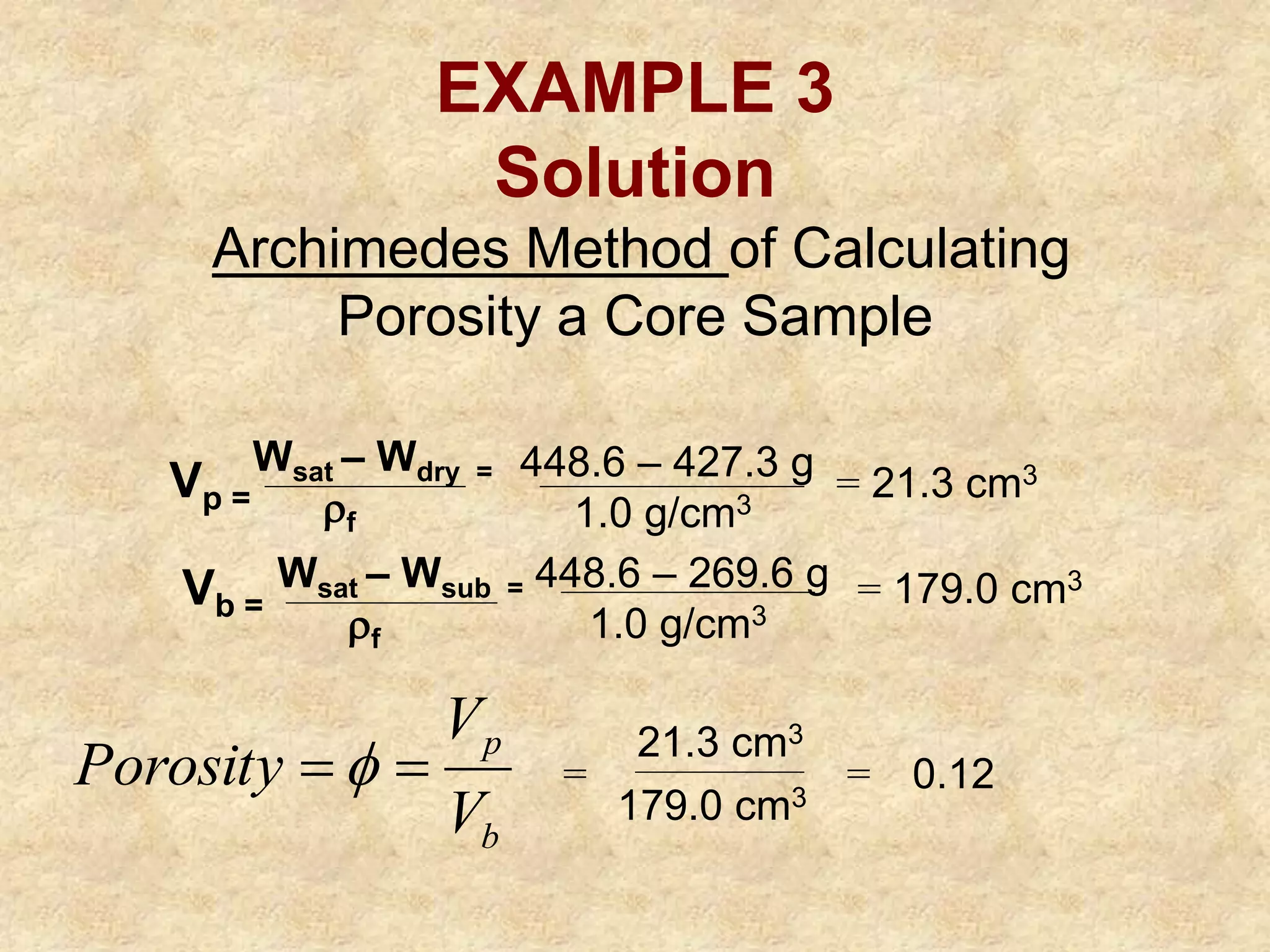
Vp =
Wsat – Wdry =
f
448.6 – 427.3 g
1.0 g/cm3
= 21.3 cm3
Vb =
Wsat – Wsub =
f
448.6 – 269.6 g
1.0 g/cm3
= 179.0 cm3
b
p
V
V
Porosity 
 0.12
21.3 cm3
=
179.0 cm3
=
Applicability and Accuracy of
Pore Volume Measurement
Techniques
• Saturation (Archimedes) method
– Accurate in better quality rocks if effective
pore spaces can be completely saturated
– In poorer quality rocks, difficult to completely
saturate sample
– Saturating fluid may react with minerals in
the core (e.g., swelling clays)
LABORATORY METHODS OF
POROSITY DETERMINATION
Pore volume determination (Effective)
1. Gravimetric (Archimedes)
Wsat - Wdry
fluid
2. Boyle’s Law:
• (Gas expansion)
Vp =
2
2
1
1 V
p
V
p 
Core
PORE VOLUME FROM GAS
EXPANSION METHOD
V1
Valve
closed
Cell 1 Cell 2
P1
Initial conditions
Final conditions
Valve
open
Core
PORE VOLUME FROM GAS
EXPANSION METHOD
Cell 1 Cell 2
P1
P2
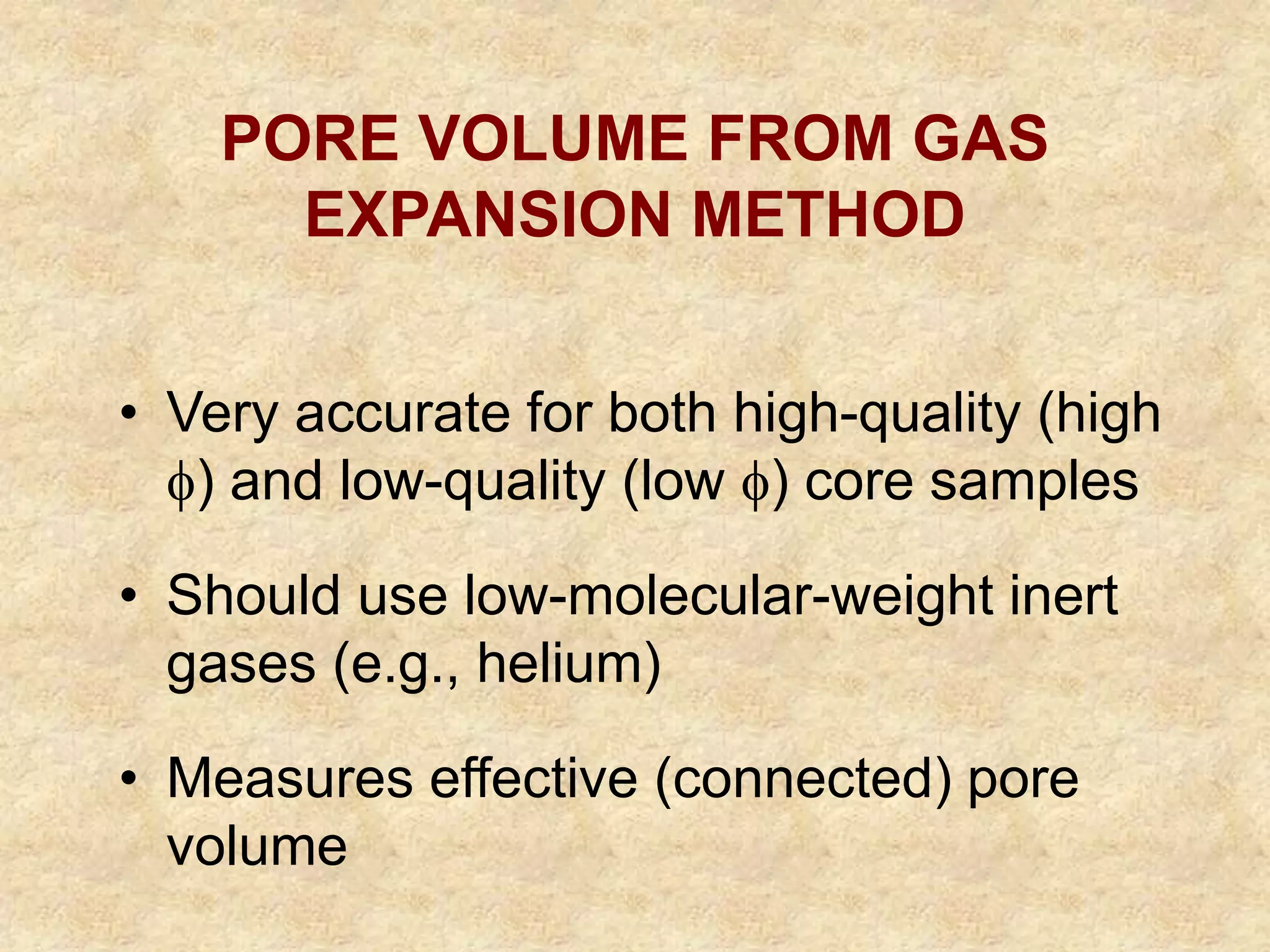
• Very accurate for both high-quality (high
) and low-quality (low ) core samples
• Should use low-molecular-weight inert
gases (e.g., helium)
• Measures effective (connected) pore
volume
PORE VOLUME FROM GAS
EXPANSION METHOD
SUMMARY
1. Bulk volume
2. Matrix volume
3. Pore volume
To determine porosity, measure 2 of 3
basic parameters:
CORES
• Allow direct measurement of reservoir
properties
• Used to correlate indirect measurements,
such as wireline/LWD logs
• Used to test compatibility of injection fluids
• Used to predict borehole stability
• Used to estimate probability of formation
failure and sand production
b
ma
b
b
p
V
V
V
V
V
φ
Porosity




)
)(
(
)
)(
1
(
)
(
V
m
V
V
V
V
V
V
V
b
m
b
p
p
m
b









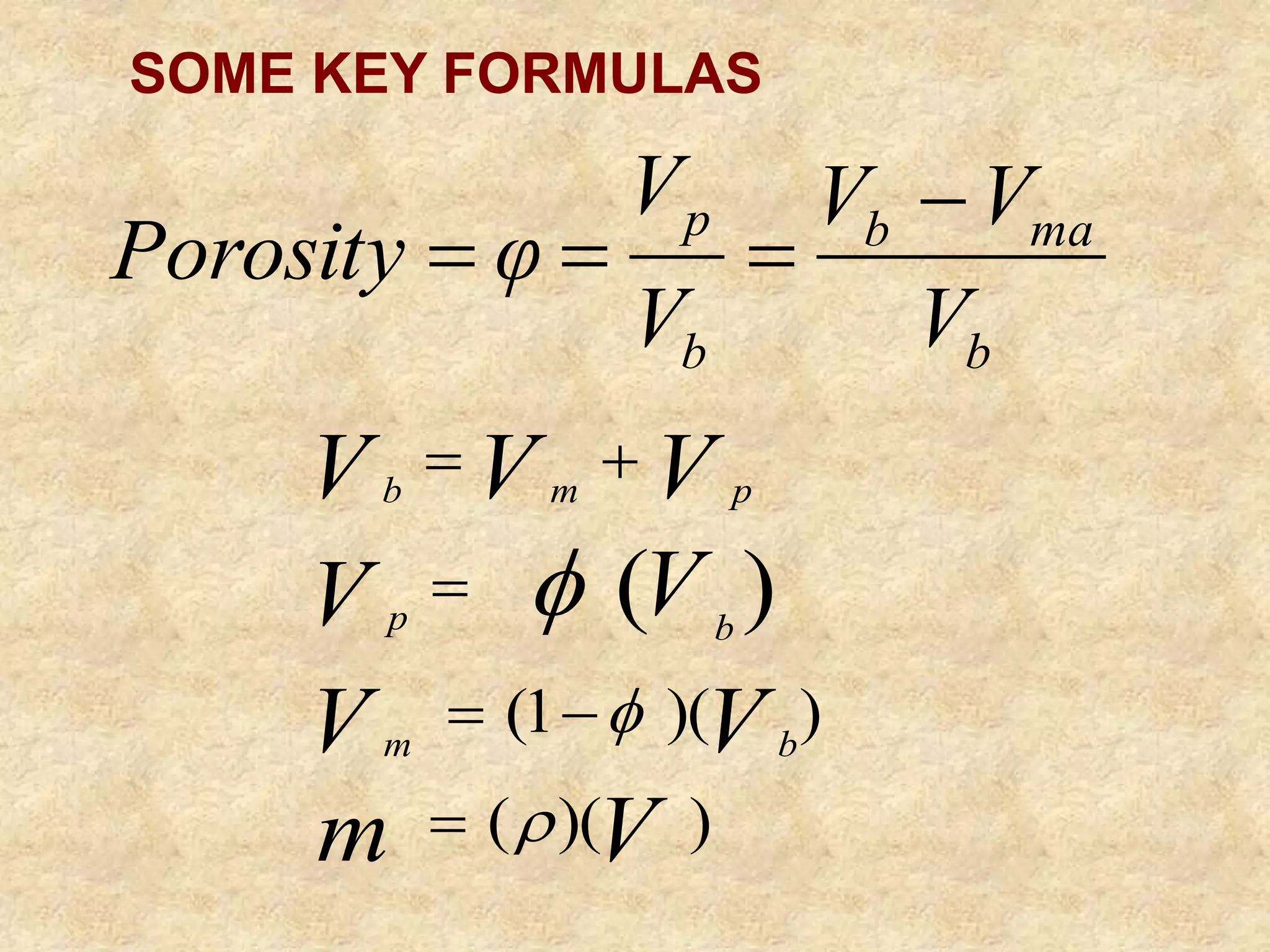
SOME KEY FORMULAS
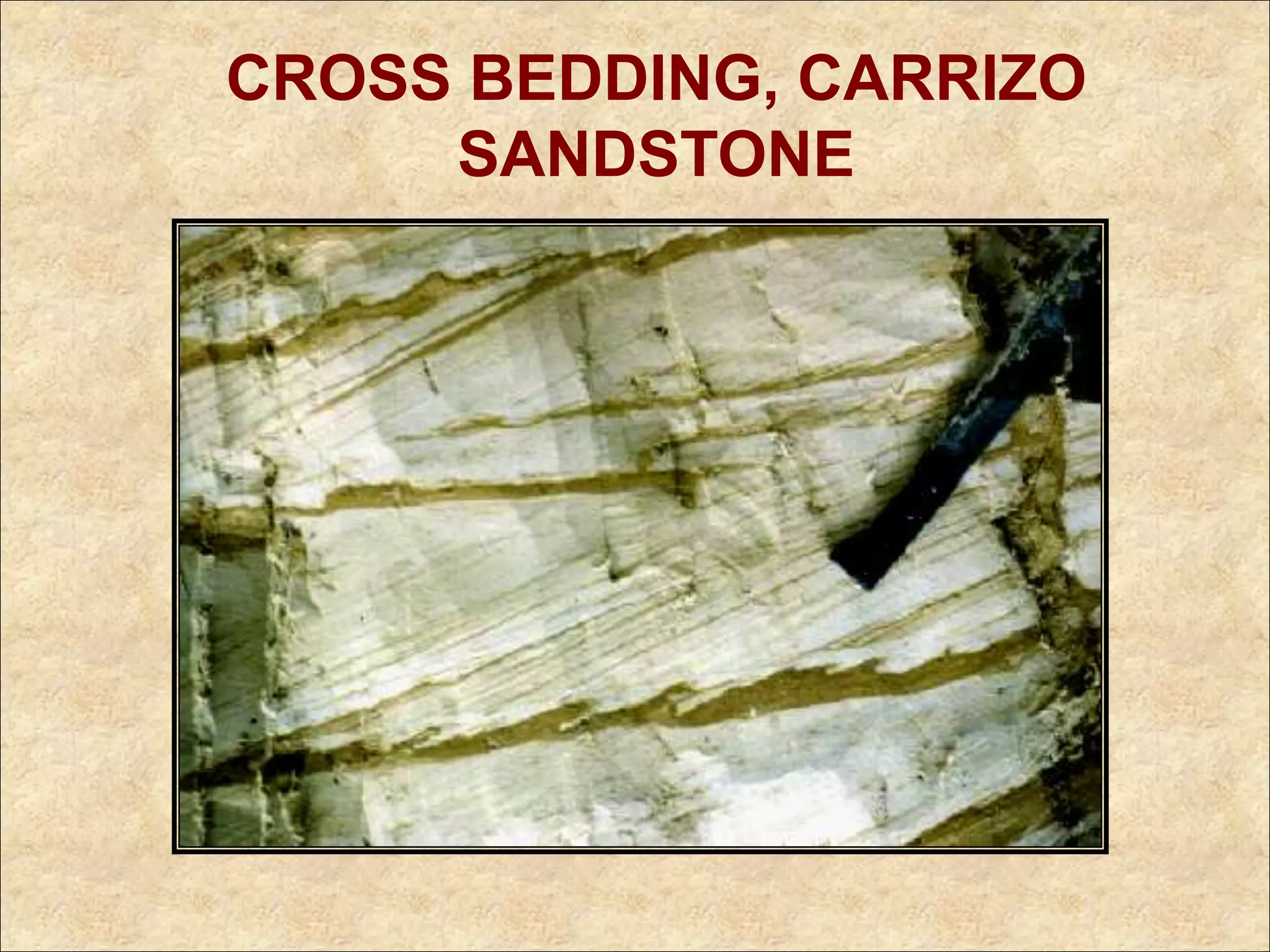
CROSS BEDDING, CARRIZO
SANDSTONE

PETE311_06A_Class03 RESERVOIR PETROPHYSICS.ppt

  • 1.
  • 2.
    Porosity: The fractionof the bulk volume of a rock that is porous. b m b b p V V V V V Porosity     POROSITY DEFINITION • Porosity is a static property – it can be measured in the absence of flow • Determining effective porosity requires fluid flow to determine if pores are interconnected
  • 3.
    ROCK MATRIX ANDPORE SPACE matrix pore space
  • 4.
    MEASUREMENT OF POROSITY 1.Core samples (measure two of: Vb, Vp, or Vm) 2. Openhole wireline logs
  • 5.
    LABORATORY DETERMINATION OF POROSITY •Most methods use small samples (core plugs) • multiple samples must be analyzed to get statistically representative results • sampling technique is important • often all samples are taken from “sweet spots” skewing analysis To determine porosity, measure 2 of 3 volumetric parameters: 1. Bulk volume, Vb 2. Matrix volume, Vm (also called grain volume) 3. Pore volume, Vp
  • 6.
    V V V p m b   Fraction ofvolume consisting of pores or voids Fraction of volume consisting of matrix Volume is an extensive property
  • 7.
    MATRIX DENSITIES (m)OF TYPICAL PURE COMPONENTS OF RESERVOIR ROCK Lithology Matrix Density (g/cm 3 ) Sandstone 2.65 Limestone 2.71 Dolomite 2.87
  • 8.
    LABORATORY METHODS OF POROSITYDETERMINATION Bulk volume determinations 1. Direct calculation 2. Fluid displacement methods • Gravimetric • Volumetric – mercury pycnometer ( a precisely calibrated bottle)
  • 9.
    BULK VOLUME BYDIRECT MEASUREMENT • Applicable for regularly shaped cores or core plugs • Calculate from core dimensions • For example; volume of right circular cylinder 4 L d V 2 b  
  • 10.
    LABORATORY METHODS OF POROSITYDETERMINATION Bulk volume determinations 1. Direct calculation 2. Fluid displacement methods • Gravimetric (Archimedes) methods • Volumetric – in pycnometer
  • 11.
    ARCHIMEDES METHOD Wsat Wsub Wdry Vp= Wsat - Wdry fluid Vm = Wdry - Wsub fluid  = Wsat - Wdry Wsat - Wsub Vb = Wsat - Wsub fluid
  • 12.
    EXAMPLE 1 Bulk VolumeCalculated by Displacement A core sample coated with paraffin immersed in a container of liquid displaced 10.9 cm3 of the liquid. The weight of the dry core sample was 20.0 g, while the weight of the dry sample coated with paraffin was 20.9 g. Assume the density of the solid paraffin is 0.9 g/cm3. Calculate the bulk volume of the sample.
  • 13.
    Weight of paraffincoating, Wparaffin = Weight of dry core sample coated with paraffin - Weight of dry core sample Wparaffin = 20.9 g = 20.0 g = 0.9 g Volume of paraffin coating = Weight of paraffin / density of paraffin Vparaffin = 0.9 g / 0.9 g/cm3 = 1.0 cm3 Bulk volume of core sample = (Bulk volume of core coated with paraffin) – (volume of paraffin) Vb = 10.9 cm3 – 1.0 cm3 = 9.9 cm3 SOLUTION - Example 1 (V = m/ρ)
  • 14.
    LABORATORY METHODS OF POROSITYDETERMINATION To determine porosity, measure 2 of 3 basic parameters: 1. Bulk volume 2. Matrix volume • Assume matrix (grain) density • Displacement method • Boyles Law • Pore volume (Vm) (Vb) (Vp)
  • 15.
    LABORATORY METHODS OF POROSITYDETERMINATION Matrix (Vm) 1. Assume rock density based on lithology and measure dry mass • Displacement methods • volumetric • gravimetric (see previous description) • Boyle’s Law: 2 2 1 1 V p V p 
  • 16.
    MATRIX VOLUME FROM MATRIXDENSITY • Known or assumed matrix density Density Matrix Sample Dry of Mass Vm 
  • 17.
    APPLICABILITY AND ACCURACY OFMATRIX MEASUREMENT TECHNIQUES • Known or assumed matrix density – Accurate only if matrix density is known and not assumed – Core samples are often mixtures of several components with varying matrix densities, so density must be measured
  • 18.
    LABORATORY METHODS OF POROSITYDETERMINATION To determine porosity, measure 2 of 3 basic parameters: 1. Bulk volume 2. Matrix volume • Assumed matrix (grain) density • Displacement method • Boyles Law 3. Pore volume (Vm) (Vb) (Vp)
  • 19.
    MATRIX VOLUME FROM DISPLACEMENTMETHOD • Reduce sample to particle size • Measure matrix volume of particles by – Volumetric method – Archimedes method (gravimetric measurement)
  • 20.
    EXAMPLE 2 SOLUTION Calculating theMatrix Volume and Porosity of a Core Sample Using the Displacement Method
  • 21.
    SOLUTION - Example2 Calculate the Porosity of a Core Sample Using the Displacement Method and Matrix Volume The core sample from Example 1 was stripped of the paraffin coat, crushed to grain size, and immersed in a container with liquid. The volume of liquid displaced by the grains was 7.7 cm3. Calculate the matrix volume and the core porosity. Is this effective porosity or total porosity? (It is total porosity) Bulk Volume, Vb = 9.9 cm3 Matrix Volume, Vma = 7.7 cm3 b ma b b p V V V V V Porosity      = 9.9 cm3 – 7.7 cm3 9.9 cm3 = 0.22
  • 22.
    LABORATORY METHODS OF POROSITYDETERMINATION To determine porosity, measure 2 of 3 basic parameters: 1. Bulk volume 2. Matrix volume • Assumed matrix (grain) density • Displacement method • Boyles Law (Gas Expansion) 3. Pore volume (Vm) (Vb) (Vp)
  • 23.
    MATRIX VOLUME FROM GASEXPANSION METHOD • Involves compression of gas into pores • Uses Boyle’s law 2 2 1 1 V p V p 
  • 24.
    GAS EXPANSION METHOD TOCALCULATE Vma • Initial conditions, with volumes of 2 cells known • Place core in second cell, evacuate gas (air) from second cell • Open valve
  • 25.
    Valve closed Cell 1 Evacuate Cell 2 GASEXPANSION METHOD TO CALCULATE Vma Initial conditions V1 P1 Core
  • 26.
    Valve open Final conditions P2 Core Cell 1 GASEXPANSION METHOD TO CALCULATE Vma Cell 2 P1
  • 27.
    GAS EXPANSION METHODTO CALCULATE Vma • Vf = Volume of Cell 1 + Volume of Cell 2 - Matrix Volume of Core • Vt = Volume of Cell 1 + Volume of Cell 2 • Vm = Vt - Vf
  • 28.
    APPLICABILITY AND ACCURACY OFMATRIX MEASUREMENT TECHNIQUES • Displacement method - Very accurate when core sample is crushed without destroying individual matrix grains • Gas expansion method - Very accurate, especially for samples with low porosities Neither method requires a prior knowledge of core properties
  • 29.
    LABORATORY METHODS OF POROSITYDETERMINATION To determine porosity, measure 2 of 3 basic parameters: 1. Bulk volume 2. Matrix volume 3. Pore volume (Vm) (Vb) (Vp)
  • 30.
    LABORATORY METHODS OF POROSITYDETERMINATION Pore volume determination (Effective) 1. Gravimetric (Archimedes) Wsat - Wdry fluid 2. Boyle’s Law: • (Gas expansion) Vp = 2 2 1 1 V p V p 
  • 31.
    PORE VOLUME FROM SATURATIONMETHOD • Measures the difference between the weight of a core sample saturated with a single fluid and the dry weight of the core • Pore volume, f dry sat p W W V   
  • 32.
    EXAMPLE 3 Archimedes Methodof Calculating Porosity a Core Sample Using the gravimetric method with the following data, calculate the pore and bulk volumes and the porosity. Is this porosity total or effective? Dry weight of sample, Wdry = 427.3 g Weight of sample saturated with water, Wsat = 448.6 g Density of water (f ) = 1.0 g/cm3 Weight of saturated sample submerged in water, Wsub = 269.6 g
  • 33.
    EXAMPLE 3 Solution Archimedes Methodof Calculating Porosity a Core Sample Vp = Wsat – Wdry = f 448.6 – 427.3 g 1.0 g/cm3 = 21.3 cm3 Vb = Wsat – Wsub = f 448.6 – 269.6 g 1.0 g/cm3 = 179.0 cm3 b p V V Porosity   0.12 21.3 cm3 = 179.0 cm3 =
  • 34.
    Applicability and Accuracyof Pore Volume Measurement Techniques • Saturation (Archimedes) method – Accurate in better quality rocks if effective pore spaces can be completely saturated – In poorer quality rocks, difficult to completely saturate sample – Saturating fluid may react with minerals in the core (e.g., swelling clays)
  • 35.
    LABORATORY METHODS OF POROSITYDETERMINATION Pore volume determination (Effective) 1. Gravimetric (Archimedes) Wsat - Wdry fluid 2. Boyle’s Law: • (Gas expansion) Vp = 2 2 1 1 V p V p 
  • 36.
    Core PORE VOLUME FROMGAS EXPANSION METHOD V1 Valve closed Cell 1 Cell 2 P1 Initial conditions
  • 37.
    Final conditions Valve open Core PORE VOLUMEFROM GAS EXPANSION METHOD Cell 1 Cell 2 P1 P2
  • 38.
    • Very accuratefor both high-quality (high ) and low-quality (low ) core samples • Should use low-molecular-weight inert gases (e.g., helium) • Measures effective (connected) pore volume PORE VOLUME FROM GAS EXPANSION METHOD
  • 39.
    SUMMARY 1. Bulk volume 2.Matrix volume 3. Pore volume To determine porosity, measure 2 of 3 basic parameters:
  • 40.
    CORES • Allow directmeasurement of reservoir properties • Used to correlate indirect measurements, such as wireline/LWD logs • Used to test compatibility of injection fluids • Used to predict borehole stability • Used to estimate probability of formation failure and sand production
  • 41.
  • 42.