Submitted by ,
Balendu Kumar
viii a
Roll No: 43
NON-METALS
METALS AND
Elements can be
classified as :
METALS
NON METALS
on the basis of their
properties…
INTRODUCTION
A metal is a chemical element that is a good conductor of
both electricity and heat and forms cations and ionic bonds
with non-metals. In chemistry, a metal is an element,
compound, or alloy characterized by high electrical
conductivity. In a metal, atoms readily lose electrons to form
positive ions (cations). Those ions are surrounded by
delocalized electrons, which are responsible for the
conductivity.
SilverRhenium Iridium
Physical properties of metals :-
• Metals are solids. (except mercury)
• Metals are hard. (except Lithium, Potassium, Sodium)
• Metals have metallic lustre. (shine)
• Metals are malleable. (can be beaten into thin sheets)
• Metals are ductile. (can be drawn into wires)
• Metals have high melting points. (Gallium and Ceasium have low
melting points. They melt in the palm of the hand)
• Metals have high boiling points.
• Metals are good conductors of heat. ( Best conductors are silver
and copper. Poor conductors are Lead and Mercury)
• Metals are good conductors of electricity. ( Best conductors are
Silver and Copper)
• Metals are sonorus. (produce sound when beaten)
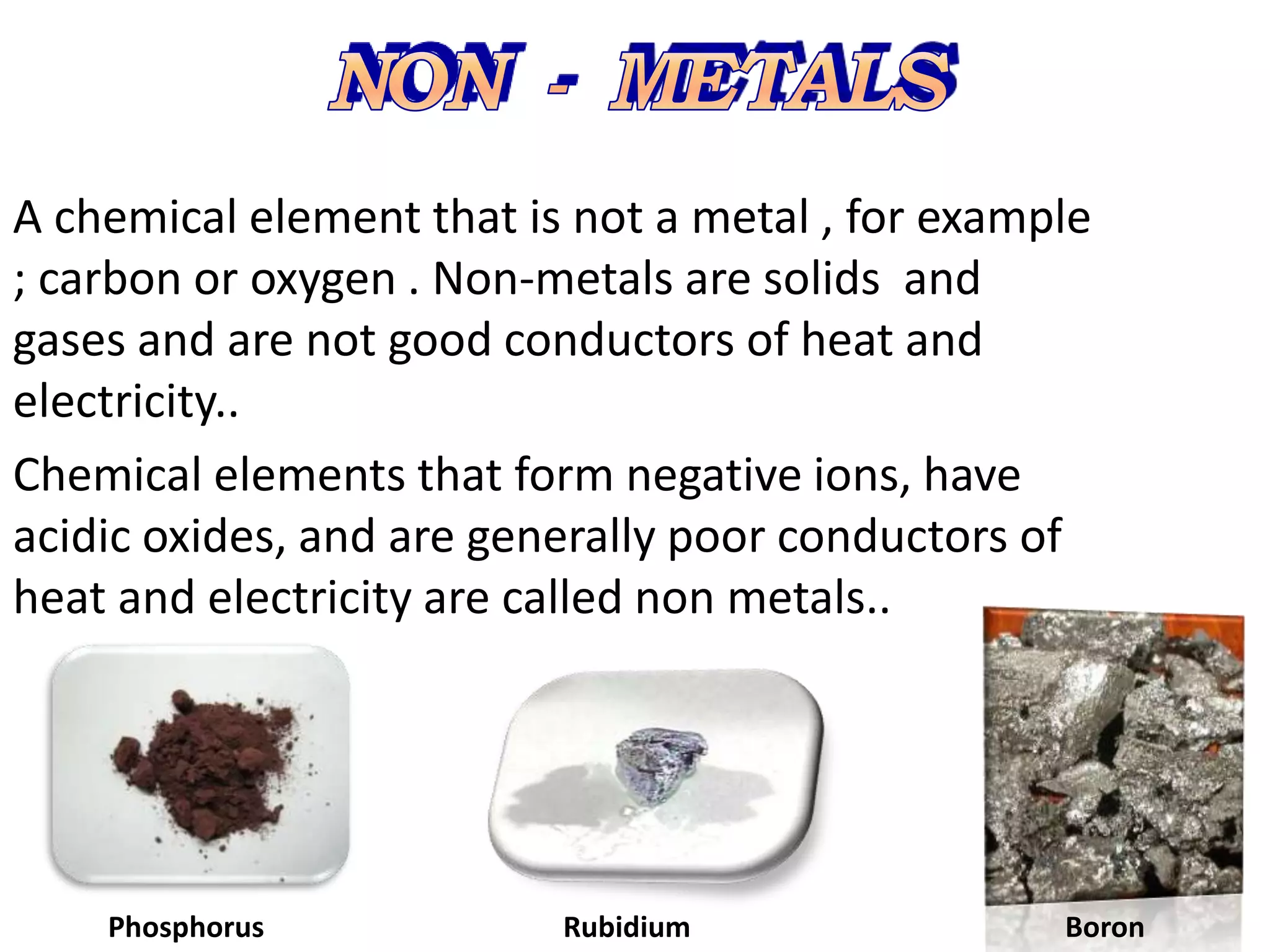
A chemical element that is not a metal , for example
; carbon or oxygen . Non-metals are solids and
gases and are not good conductors of heat and
electricity..
Chemical elements that form negative ions, have
acidic oxides, and are generally poor conductors of
heat and electricity are called non metals..
Rubidium BoronPhosphorus
Physical properties of non metals :-
• Non metals may be solids, liquids or gases. (Solids – Carbon,
Sulphur, Phosphorus etc. Liquid – Bromine, Gases – Oxygen,
Hydrogen, Nitrogen etc.)
• Non metals are soft. (except diamond which is the hardest natural
substance)
• Non metals do not have lustre.( except iodine crystals)
• Non metals are not malleable.
• Non metals are not ductile.
• Non metals which are solids and liquids have low melting points.
• Non metals which are solids and liquids have low boiling points.
• Non metals are bad conductors of heat.
• Non metals are bad conductors of electricity. (except graphite)
• Non metals are not sonorus.
Metals and non metals differ from
each other in their chemical
properties also. Let us compare
the chemical properties of metals
with those of non metals. They are
as follows-
1.)Reaction with oxygen
2.)Reaction with water
3.)Reaction with acids
4.)Displacement Reaction
5.)Reaction with Bases
Chemical properties of metals and non – metals :-
a) Reaction with oxygen :-
Metals react with oxygen to form metallic oxides. These oxides are
basic oxides because they react with water to form bases.
Eg. Magnesium burns in air to form magnesium oxide. Magnesium
reacts with water to form magnesium hydroxide.
2 Mg + O2 2 MgO
MgO + H2O Mg(OH)2
Non metals react with oxygen to form non metallic oxides. These
oxides are acidic oxides because they react with water to form
acids.
Eg. Sulphur burns in air to form sulphur dioxide. Sulphur dioxide
reacts with water to form sulphurous acid.
S + O2 SO2
SO2 + H2O H2SO3
b) Reaction with water :-
Metals react with water to form metal hydroxides and hydrogen.
Eg. Sodium reacts with water to form sodium hydroxide and
hydrogen.
2 Na + 2 H2O 2 Na OH + H2
Magnesium reacts with water to form magnesium hydroxide and
hydrogen.
Mg + H2O Mg(OH)2 + H2
Non metals do not react with water.
b) Reaction with water :-
Metals react with acids to form metallic salts and hydrogen.
Eg. Zinc reacts with dilute hydrochloric acid to form zinc chloride
and hydrogen.
Zn + 2 HCl ZnCl2 + H2
Most non metals do not react with acids. Some non metals like sulphur reacts
with concentrated nitric acid to form sulphur dioxide, nitrogen dioxide and water.
S + 4 HNO3 SO2 + 4 NO2 +2 H2O
d) Displacement Reaction :-
A more reactive metal displaces a less reactive metal from its salt solution.
(Displacement reaction)
Magnesium displaces copper from copper sulphate solution.
Mg + CuSO4 MgSO4 + Cu
Zinc displaces copper from copper sulphate solution.
Zn + CuSO4 ZnSO4 + Cu
Iron displaces copper from copper sulphate solution
Fe + CuSO4 FeSO4 + Cu
after 15 – 20 minutes
Metals have been an integral part of our
daily life since ancient times. They have
played an important part in the
development of various civilisations.Iron
is the most widely used metal. It is used
for making cooking vessels,water boilers
etc.Aluminium being a very light metal, is
used for making aircraft bodies .Silver is
used for making jewellery,decoration
pieces,tableware etc.Gold and silver wires
are used for high electrical contacts in
computers.
Some of common uses are-
1.)Iodine is used as antiseptic.
2.)Oxygen is essential for all human beings.
3.)Sulphur is used for making fire crackers.
4.)Phosphorous is used in match box industry and fertilizers.

Metals and non metals without animatiopn

  • 1.
    Submitted by , BalenduKumar viii a Roll No: 43
  • 2.
  • 3.
    Elements can be classifiedas : METALS NON METALS on the basis of their properties… INTRODUCTION
  • 4.
    A metal isa chemical element that is a good conductor of both electricity and heat and forms cations and ionic bonds with non-metals. In chemistry, a metal is an element, compound, or alloy characterized by high electrical conductivity. In a metal, atoms readily lose electrons to form positive ions (cations). Those ions are surrounded by delocalized electrons, which are responsible for the conductivity. SilverRhenium Iridium
  • 5.
    Physical properties ofmetals :- • Metals are solids. (except mercury) • Metals are hard. (except Lithium, Potassium, Sodium) • Metals have metallic lustre. (shine) • Metals are malleable. (can be beaten into thin sheets) • Metals are ductile. (can be drawn into wires) • Metals have high melting points. (Gallium and Ceasium have low melting points. They melt in the palm of the hand) • Metals have high boiling points. • Metals are good conductors of heat. ( Best conductors are silver and copper. Poor conductors are Lead and Mercury) • Metals are good conductors of electricity. ( Best conductors are Silver and Copper) • Metals are sonorus. (produce sound when beaten)
  • 6.
    A chemical elementthat is not a metal , for example ; carbon or oxygen . Non-metals are solids and gases and are not good conductors of heat and electricity.. Chemical elements that form negative ions, have acidic oxides, and are generally poor conductors of heat and electricity are called non metals.. Rubidium BoronPhosphorus
  • 7.
    Physical properties ofnon metals :- • Non metals may be solids, liquids or gases. (Solids – Carbon, Sulphur, Phosphorus etc. Liquid – Bromine, Gases – Oxygen, Hydrogen, Nitrogen etc.) • Non metals are soft. (except diamond which is the hardest natural substance) • Non metals do not have lustre.( except iodine crystals) • Non metals are not malleable. • Non metals are not ductile. • Non metals which are solids and liquids have low melting points. • Non metals which are solids and liquids have low boiling points. • Non metals are bad conductors of heat. • Non metals are bad conductors of electricity. (except graphite) • Non metals are not sonorus.
  • 8.
    Metals and nonmetals differ from each other in their chemical properties also. Let us compare the chemical properties of metals with those of non metals. They are as follows- 1.)Reaction with oxygen 2.)Reaction with water 3.)Reaction with acids 4.)Displacement Reaction 5.)Reaction with Bases
  • 9.
    Chemical properties ofmetals and non – metals :- a) Reaction with oxygen :- Metals react with oxygen to form metallic oxides. These oxides are basic oxides because they react with water to form bases. Eg. Magnesium burns in air to form magnesium oxide. Magnesium reacts with water to form magnesium hydroxide. 2 Mg + O2 2 MgO MgO + H2O Mg(OH)2 Non metals react with oxygen to form non metallic oxides. These oxides are acidic oxides because they react with water to form acids. Eg. Sulphur burns in air to form sulphur dioxide. Sulphur dioxide reacts with water to form sulphurous acid. S + O2 SO2 SO2 + H2O H2SO3
  • 10.
    b) Reaction withwater :- Metals react with water to form metal hydroxides and hydrogen. Eg. Sodium reacts with water to form sodium hydroxide and hydrogen. 2 Na + 2 H2O 2 Na OH + H2 Magnesium reacts with water to form magnesium hydroxide and hydrogen. Mg + H2O Mg(OH)2 + H2 Non metals do not react with water. b) Reaction with water :- Metals react with acids to form metallic salts and hydrogen. Eg. Zinc reacts with dilute hydrochloric acid to form zinc chloride and hydrogen. Zn + 2 HCl ZnCl2 + H2 Most non metals do not react with acids. Some non metals like sulphur reacts with concentrated nitric acid to form sulphur dioxide, nitrogen dioxide and water. S + 4 HNO3 SO2 + 4 NO2 +2 H2O
  • 11.
    d) Displacement Reaction:- A more reactive metal displaces a less reactive metal from its salt solution. (Displacement reaction) Magnesium displaces copper from copper sulphate solution. Mg + CuSO4 MgSO4 + Cu Zinc displaces copper from copper sulphate solution. Zn + CuSO4 ZnSO4 + Cu Iron displaces copper from copper sulphate solution Fe + CuSO4 FeSO4 + Cu after 15 – 20 minutes
  • 12.
    Metals have beenan integral part of our daily life since ancient times. They have played an important part in the development of various civilisations.Iron is the most widely used metal. It is used for making cooking vessels,water boilers etc.Aluminium being a very light metal, is used for making aircraft bodies .Silver is used for making jewellery,decoration pieces,tableware etc.Gold and silver wires are used for high electrical contacts in computers.
  • 13.
    Some of commonuses are- 1.)Iodine is used as antiseptic. 2.)Oxygen is essential for all human beings. 3.)Sulphur is used for making fire crackers. 4.)Phosphorous is used in match box industry and fertilizers.