LITERATURE SEARCH
PROF. B.N. KUMBHAR
2NET, 2SET, M. L. I. Sc. M., Phil , PGDLIM,
PGDLAN.
PhD (Pursuing)
Librarian
DADA PATIL MAHAVIDYALAYA, KARJAT,
DIST -AHMEDNAGAR
E-mail: kumbharbn@gmail.com
INTRODUCTION
Literature, a body of written
works. The name has traditionally
been applied to those imaginative
works of poetry and prose
distinguished by the intentions of
their authors and the perceived
aesthetic excellence of their
execution.
DEFINITION
Literature is a term used to describe
written or spoken material. Broadly
speaking, "literature" is used to describe
anything from creative writing to more
technical or scientific works, but the term
is most commonly used to refer to works
of the creative imagination, including
works of poetry, drama, fiction, and
nonfiction.
WHAT IS SEARCHING ?
• To look for specific data in a file or an occurrence of
text in a file.
A search implies either scanning content sequentially
or single algorithms to compare
multiple indexes to find a match.
• A search on the Web yields a list of Web pages that
contain all the words in the search criteria .
• Contrast with a "direct lookup," whereby a single
index is used to keep track of data.
LITERATURE SEARCH
• A literature search is a well thought out and
organized search for all of the literature
published on a topic.
• A well-structured literature search is the
most effective and efficient way to locate
sound evidence on the subject you are
researching.
• Evidence may be found in books, journals,
government documents and the internet.
LITERATURE SEARCH
• A literature search is a systematic and
thorough search of all types of
published literature in order to identify
a breadth of good quality references
relevant to a specific topic.
• The success of your research project is
dependent on a thorough review of the
academic literature at the outset.
Creating a Question
• Creating a well-focused question is the first step in a
literature search.
• Having a clear idea of what you are researching will
keep you on track with your searching, saving you
valuable time.
• A focused question will give you a better start with
your search because it will help you determine
appropriate keywords and limitations for your topic.
• When forming your question, make sure you are
specific about your research topic.
LITERATURE REVIEW
A literature review is a text of a
scholarly paper, which includes
the current knowledge
including substantive findings,
as well as theoretical and
methodological contributions to
a particular topic.
LITERATURE REVIEW
A literature review is an
assessment of a body of
research that addresses a
research question.
LITERATURE REVIEW
• Identifies what is already known
about an area of study
• It may also:
• Identify questions a body of research
does not answer
• Make a case for why further study of
research questions is important to a
field
RESEARCH QUESTION
A research question defines the scope of an
area of inquiry. It asks about the causal
relationship between x and y. It is founded
on a deep understanding of works in the
relevant area(s) of study and informed by
both what is known and not yet known in
that area.
RESEARCH PURPOSE
•The research question guides
your literature review by
establishing its parameters and
articulating a researchable
question.
RESEARCH PROCESS
To frame a research question
• Identify an area of study which is of interest
• Refine this area of study based on an exploration of the
literature
• Examine research variables (e.g., gender, age, context,
area, duration, climate. etc.) which influence your
question
• Map the literature to identify relationships. Mapped
relationships may highlight issues or connections within
the field.
• Draw on what you have learned to draft your research
question
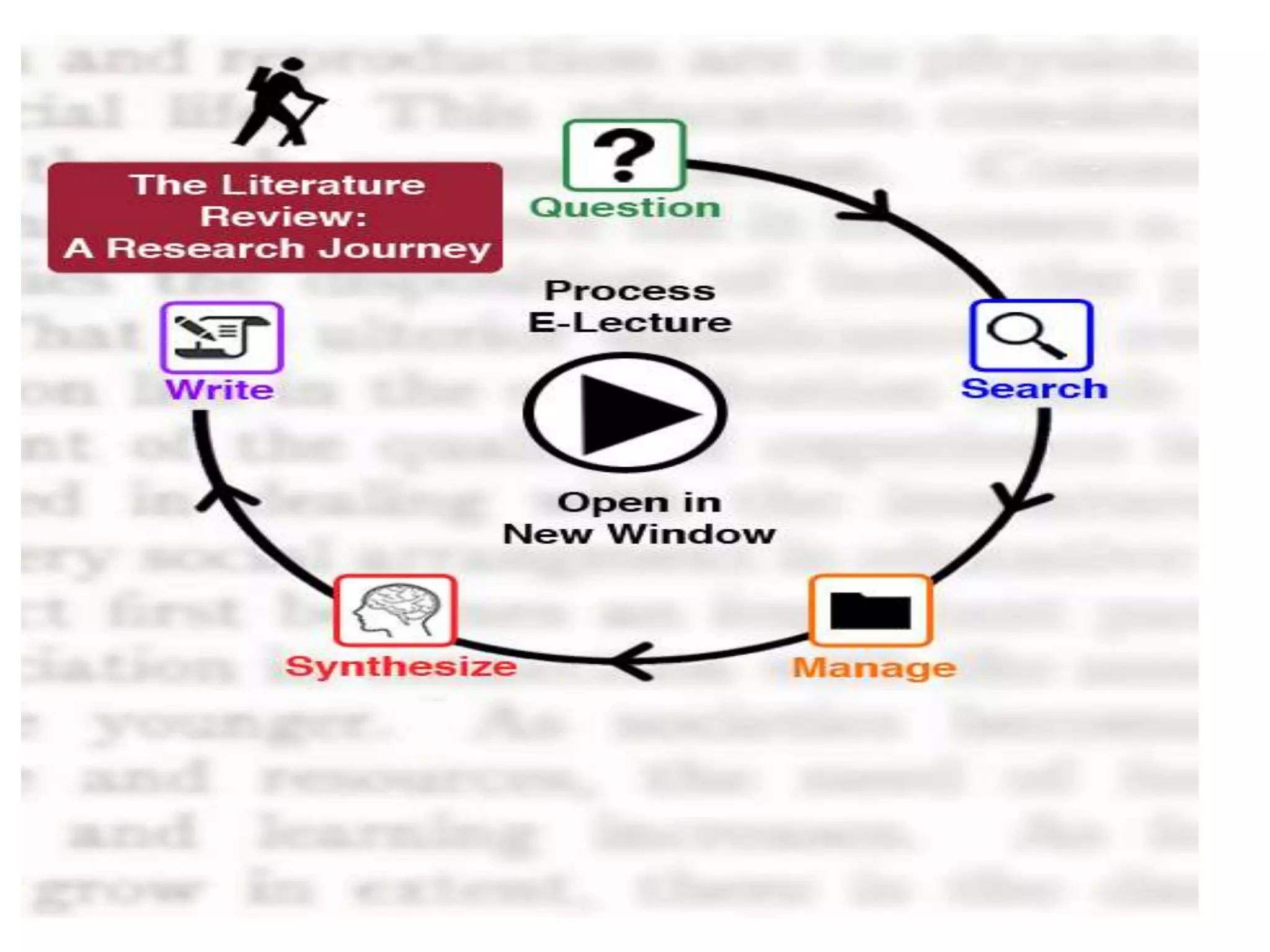
LITERATURE REVIEW :PROCESS
• It is a research journey with several
steps:
• Framing a research question
• Searching relevant bodies of literature
• Managing search results
• Synthesizing the research literature
• Writing an assessment of the literature
SEARCHING
• Purpose:
• Search the literature to gather the works of
scholars who have addressed your research
question.
• Process:
• Save time! Work with a librarian.
• Get the big picture. Search broad concepts , the
library catalog.
• Mine reference lists. Use Journals Search to find
the full text of articles cited.
SEARCHING cont…
• Identify article databases for bodies of
literature relevant to your research
question.
• Use language from your research
question to begin your search and then
map your language to the subject
vocabulary of the databases you're
searching in.
• Use cited reference searching to find later
works that cite a particularly useful work.
SOURCES OF INFORMATION/
Where to search?
• DIGITAL LIBRARIES
• INSTITUTIONAL REPOSITORIES
• SUBJECT GATEWAYS
• PORTALS
• CONFERENCE PAPERS
• GOVT.PUBLICATIONS
• IMAGES
• LAWS AND STATUES
• NEWSPAPER ARTICLES
• STANDARDS
• STATISTICS –YEAR BOOKS
• THESES and DISSERTATIONS
Digital Resources
• Search Engines
• Library Portals
• Library Resources
• E-Books
• E-Journals
• E- News Papers
• E-Statistics
• E-Theses and
Dissertations
• Databases
• Library Networks
• Subject Gate ways
• FAQ’s
• Digital Archives
• Discussion Forums
• Virtual Conferences
• Virtual Help Desks
SOURCES OF INFORMATION
• ONLINE DICTIONARIES
• SUBJECT DICTIONARIES
• ONLINE ENCYCLOPEDIAS
• SUBJECT ENCYCLOPEDIAS
• THESAURUS
• ONLINE BOOKS –GOOGLE BOOKS
• FREE E-BOOKS
• BOOK CHAPTERS
SOURCES OF INFORMATION
• OPEN ACCESS JOURNALS -DOAJ
• OPEN ACCESS BOOKS- DOAB
• GREY LITERATURE -UNPUBLISHED
• SHODHGANGA –INFLIBNET
• SHODHGANGOTRI –INFLIBNET
• GOOGLE SCHOLAR
• ACADEMIC WEB SITES
SOURCES OF INFORMATION
• SPCIAL LIBRARIES –
• NCL PUNE –CHEMISTRY
• IUCAA PUNE - PHYSICS
• POLITICAL SCIENCE, ECONOMICS –GIPE
PUNE
• WEB OPACS OF LIBRARIES AND INFO.
CENTRES
• TRANSLATION CENTRES –NISCAIR
• TRANLATION EXPERTS OF SUBJECT
SOURCES OF INFORMATION
• Books
Books can be a good start on a topic, giving
you general or specific information. Check
that the book you are referring to is
up to date
• You can find books on your area of
research in an academic or special library.
• Consult with the librarian to help you find
any books that you need.
SOURCES OF INFORMATION:
Journals
Journal articles are one of the best
sources of information as they can be
selected for being current and specific.
Most of the important and ground-
breaking research is published in
journals. Journal articles are best
found using citation databases,
SOURCES OF INFORMATION cont..
Internet
Internet sources are an invaluable source of
evidence. A lot of research and statistics are
published on the internet, especially those
sponsored by government, academic and non-for-
profit agencies e.g. Govt. of India ,TERI,
BARC,TIFR, IUCAA, GIPE.etc.
• Useful information, and government Reports,
Statistical Reports, (Census Report) policy, is
available in full and is free to download.
INTERNET:SOURCE OF INFORMATION
• Be extra careful in evaluating sites, as
anyone can put information on the
internet. There are good web portals,
such as Intuit.
• (www.intute.ac.uk)
• which serve as gateways to the
Internet. These portals provide links to
websites.
DEVELOP SEARCH STRATEGY
• Define Your Keywords
• It is very important to use targeted
keywords.
• Break up the topic you are
researching into its main concepts,
• then define keywords for each
concept.
Define your keywords
• Next, expand the list by writing down
synonyms and alternative phrasings
for each keyword.
• Also, use terms that you plan to
include in your own manuscript;
• this will indicate how relevant those
terms are in the field or whether you
should use more precise terms to
define your concepts.
AND
Connecting your keywords with AND tells
the search tool that all the words must be
present.
OR
Connecting your keywords with OR tells
the search tool that any of the words can
be present.
NOT
Using NOT in front of a key word tells the
search tool to exclude any page contains
that word. Some engines require you to
use AND NOT
SEARCH STRATEGY
• A search strategy is the planned
and structured organization of
terms used to search a database.
• The search strategy will also
indicate how these terms have
been combined in order to retrieve
optimal results.
SEARCH STRATEGY cont..
• Because you will be searching several
databases which work in different ways,
you will need to construct separate search
strategies specific to the database you are
using.
• This process is often referred to as
"tailoring" your search. You may also
decide to develop separate search strategies
for different sections or aspects of your
research.
Refining your search
 There is no such thing as the perfect
search.
 Every database search involves a
trade-off between sensitivity
(the proportion of all relevant studies in
the database that your search
retrieved) and specificity (the
proportion of all studies retrieved by
your search that are relevant).
Refining your search
• The more sensitive your search
strategy is, the less likely you are
to miss important papers.
• The disadvantage is that you are
also more likely to retrieve some
irrelevant references as well.
Refining your search cont…
• Balance your need to find all the key
papers against the work involved in
sifting through large numbers of results
• Take into account how much time you
have and the purpose of your literature
review. For example there is no point
searching for non-English-language
journal articles if you can't understand
them or have them translated
Refining your search cont…
• Consider the parameters of your project
before you start to search and be
transparent about any information you
exclude.
• Check your spelling
• It is very easy to make a simple typing or
spelling error (which will need correcting!)
• Has anything actually been written on
your chosen topic?
Refining your search cont..
• If you are writing a literature review and
cannot find any relevant research
(having used all the right techniques)
you may need to discuss the possibility
of changing to a new topic with your
supervisor.
• Is the search question too narrow?
• The sections on defining your search
question and identifying search
terms may help you broaden your topic.
Refining your search cont..
• Have you used Boolean operators
correctly?
• Have you used AND where you
should have used OR.
• Do you need to search more
databases?
• LISA,LISTA, SCOPUS, WEB OF
KNOWLEDGE etc.
Refining your search cont..
• Deciding which Database to Search?
• Scopus, web of knowledge, IEEE,
ASME, ASCE etc.
• Could you add more search terms to
your search strategy?
• You may need to think of alternative
words and spellings
• Are your date limits too restrictive?
CONCLUSION
• ICT KNOELEDGE- INFORMATION LITERACY
• SUBJECT EXPERT NETWORK PARICIPATION
• HIGH IMPACT FACTOR JOURNALS OF SUBJECT
• RESEARCH BODIES OF SUBJECT
• SPECIAL LIBRARIES AND INFORMATION
CENTERS OF SUBJECT
• LIBRARIAN CLOSE CONTACT
• SUBSCRIBE E-MAILALERT,RSS
• SOCIAL NETWOK SITES FOR RESEARCHER
• INSTITUTIONAL REPOSITORIES
• DIGITAL LIBRARIES
Literature search

Literature search

  • 1.
    LITERATURE SEARCH PROF. B.N.KUMBHAR 2NET, 2SET, M. L. I. Sc. M., Phil , PGDLIM, PGDLAN. PhD (Pursuing) Librarian DADA PATIL MAHAVIDYALAYA, KARJAT, DIST -AHMEDNAGAR E-mail: kumbharbn@gmail.com
  • 2.
    INTRODUCTION Literature, a bodyof written works. The name has traditionally been applied to those imaginative works of poetry and prose distinguished by the intentions of their authors and the perceived aesthetic excellence of their execution.
  • 6.
    DEFINITION Literature is aterm used to describe written or spoken material. Broadly speaking, "literature" is used to describe anything from creative writing to more technical or scientific works, but the term is most commonly used to refer to works of the creative imagination, including works of poetry, drama, fiction, and nonfiction.
  • 7.
    WHAT IS SEARCHING? • To look for specific data in a file or an occurrence of text in a file. A search implies either scanning content sequentially or single algorithms to compare multiple indexes to find a match. • A search on the Web yields a list of Web pages that contain all the words in the search criteria . • Contrast with a "direct lookup," whereby a single index is used to keep track of data.
  • 9.
    LITERATURE SEARCH • Aliterature search is a well thought out and organized search for all of the literature published on a topic. • A well-structured literature search is the most effective and efficient way to locate sound evidence on the subject you are researching. • Evidence may be found in books, journals, government documents and the internet.
  • 10.
    LITERATURE SEARCH • Aliterature search is a systematic and thorough search of all types of published literature in order to identify a breadth of good quality references relevant to a specific topic. • The success of your research project is dependent on a thorough review of the academic literature at the outset.
  • 11.
    Creating a Question •Creating a well-focused question is the first step in a literature search. • Having a clear idea of what you are researching will keep you on track with your searching, saving you valuable time. • A focused question will give you a better start with your search because it will help you determine appropriate keywords and limitations for your topic. • When forming your question, make sure you are specific about your research topic.
  • 14.
    LITERATURE REVIEW A literaturereview is a text of a scholarly paper, which includes the current knowledge including substantive findings, as well as theoretical and methodological contributions to a particular topic.
  • 15.
    LITERATURE REVIEW A literaturereview is an assessment of a body of research that addresses a research question.
  • 16.
    LITERATURE REVIEW • Identifieswhat is already known about an area of study • It may also: • Identify questions a body of research does not answer • Make a case for why further study of research questions is important to a field
  • 18.
    RESEARCH QUESTION A researchquestion defines the scope of an area of inquiry. It asks about the causal relationship between x and y. It is founded on a deep understanding of works in the relevant area(s) of study and informed by both what is known and not yet known in that area.
  • 20.
    RESEARCH PURPOSE •The researchquestion guides your literature review by establishing its parameters and articulating a researchable question.
  • 21.
    RESEARCH PROCESS To framea research question • Identify an area of study which is of interest • Refine this area of study based on an exploration of the literature • Examine research variables (e.g., gender, age, context, area, duration, climate. etc.) which influence your question • Map the literature to identify relationships. Mapped relationships may highlight issues or connections within the field. • Draw on what you have learned to draft your research question
  • 23.
    LITERATURE REVIEW :PROCESS •It is a research journey with several steps: • Framing a research question • Searching relevant bodies of literature • Managing search results • Synthesizing the research literature • Writing an assessment of the literature
  • 25.
    SEARCHING • Purpose: • Searchthe literature to gather the works of scholars who have addressed your research question. • Process: • Save time! Work with a librarian. • Get the big picture. Search broad concepts , the library catalog. • Mine reference lists. Use Journals Search to find the full text of articles cited.
  • 27.
    SEARCHING cont… • Identifyarticle databases for bodies of literature relevant to your research question. • Use language from your research question to begin your search and then map your language to the subject vocabulary of the databases you're searching in. • Use cited reference searching to find later works that cite a particularly useful work.
  • 29.
    SOURCES OF INFORMATION/ Whereto search? • DIGITAL LIBRARIES • INSTITUTIONAL REPOSITORIES • SUBJECT GATEWAYS • PORTALS • CONFERENCE PAPERS • GOVT.PUBLICATIONS • IMAGES • LAWS AND STATUES • NEWSPAPER ARTICLES • STANDARDS • STATISTICS –YEAR BOOKS • THESES and DISSERTATIONS
  • 31.
    Digital Resources • SearchEngines • Library Portals • Library Resources • E-Books • E-Journals • E- News Papers • E-Statistics • E-Theses and Dissertations • Databases • Library Networks • Subject Gate ways • FAQ’s • Digital Archives • Discussion Forums • Virtual Conferences • Virtual Help Desks
  • 32.
    SOURCES OF INFORMATION •ONLINE DICTIONARIES • SUBJECT DICTIONARIES • ONLINE ENCYCLOPEDIAS • SUBJECT ENCYCLOPEDIAS • THESAURUS • ONLINE BOOKS –GOOGLE BOOKS • FREE E-BOOKS • BOOK CHAPTERS
  • 33.
    SOURCES OF INFORMATION •OPEN ACCESS JOURNALS -DOAJ • OPEN ACCESS BOOKS- DOAB • GREY LITERATURE -UNPUBLISHED • SHODHGANGA –INFLIBNET • SHODHGANGOTRI –INFLIBNET • GOOGLE SCHOLAR • ACADEMIC WEB SITES
  • 34.
    SOURCES OF INFORMATION •SPCIAL LIBRARIES – • NCL PUNE –CHEMISTRY • IUCAA PUNE - PHYSICS • POLITICAL SCIENCE, ECONOMICS –GIPE PUNE • WEB OPACS OF LIBRARIES AND INFO. CENTRES • TRANSLATION CENTRES –NISCAIR • TRANLATION EXPERTS OF SUBJECT
  • 35.
    SOURCES OF INFORMATION •Books Books can be a good start on a topic, giving you general or specific information. Check that the book you are referring to is up to date • You can find books on your area of research in an academic or special library. • Consult with the librarian to help you find any books that you need.
  • 36.
    SOURCES OF INFORMATION: Journals Journalarticles are one of the best sources of information as they can be selected for being current and specific. Most of the important and ground- breaking research is published in journals. Journal articles are best found using citation databases,
  • 37.
    SOURCES OF INFORMATIONcont.. Internet Internet sources are an invaluable source of evidence. A lot of research and statistics are published on the internet, especially those sponsored by government, academic and non-for- profit agencies e.g. Govt. of India ,TERI, BARC,TIFR, IUCAA, GIPE.etc. • Useful information, and government Reports, Statistical Reports, (Census Report) policy, is available in full and is free to download.
  • 38.
    INTERNET:SOURCE OF INFORMATION •Be extra careful in evaluating sites, as anyone can put information on the internet. There are good web portals, such as Intuit. • (www.intute.ac.uk) • which serve as gateways to the Internet. These portals provide links to websites.
  • 39.
    DEVELOP SEARCH STRATEGY •Define Your Keywords • It is very important to use targeted keywords. • Break up the topic you are researching into its main concepts, • then define keywords for each concept.
  • 40.
    Define your keywords •Next, expand the list by writing down synonyms and alternative phrasings for each keyword. • Also, use terms that you plan to include in your own manuscript; • this will indicate how relevant those terms are in the field or whether you should use more precise terms to define your concepts.
  • 41.
    AND Connecting your keywordswith AND tells the search tool that all the words must be present. OR Connecting your keywords with OR tells the search tool that any of the words can be present. NOT Using NOT in front of a key word tells the search tool to exclude any page contains that word. Some engines require you to use AND NOT
  • 42.
    SEARCH STRATEGY • Asearch strategy is the planned and structured organization of terms used to search a database. • The search strategy will also indicate how these terms have been combined in order to retrieve optimal results.
  • 43.
    SEARCH STRATEGY cont.. •Because you will be searching several databases which work in different ways, you will need to construct separate search strategies specific to the database you are using. • This process is often referred to as "tailoring" your search. You may also decide to develop separate search strategies for different sections or aspects of your research.
  • 44.
    Refining your search There is no such thing as the perfect search.  Every database search involves a trade-off between sensitivity (the proportion of all relevant studies in the database that your search retrieved) and specificity (the proportion of all studies retrieved by your search that are relevant).
  • 45.
    Refining your search •The more sensitive your search strategy is, the less likely you are to miss important papers. • The disadvantage is that you are also more likely to retrieve some irrelevant references as well.
  • 46.
    Refining your searchcont… • Balance your need to find all the key papers against the work involved in sifting through large numbers of results • Take into account how much time you have and the purpose of your literature review. For example there is no point searching for non-English-language journal articles if you can't understand them or have them translated
  • 47.
    Refining your searchcont… • Consider the parameters of your project before you start to search and be transparent about any information you exclude. • Check your spelling • It is very easy to make a simple typing or spelling error (which will need correcting!) • Has anything actually been written on your chosen topic?
  • 48.
    Refining your searchcont.. • If you are writing a literature review and cannot find any relevant research (having used all the right techniques) you may need to discuss the possibility of changing to a new topic with your supervisor. • Is the search question too narrow? • The sections on defining your search question and identifying search terms may help you broaden your topic.
  • 49.
    Refining your searchcont.. • Have you used Boolean operators correctly? • Have you used AND where you should have used OR. • Do you need to search more databases? • LISA,LISTA, SCOPUS, WEB OF KNOWLEDGE etc.
  • 50.
    Refining your searchcont.. • Deciding which Database to Search? • Scopus, web of knowledge, IEEE, ASME, ASCE etc. • Could you add more search terms to your search strategy? • You may need to think of alternative words and spellings • Are your date limits too restrictive?
  • 51.
    CONCLUSION • ICT KNOELEDGE-INFORMATION LITERACY • SUBJECT EXPERT NETWORK PARICIPATION • HIGH IMPACT FACTOR JOURNALS OF SUBJECT • RESEARCH BODIES OF SUBJECT • SPECIAL LIBRARIES AND INFORMATION CENTERS OF SUBJECT • LIBRARIAN CLOSE CONTACT • SUBSCRIBE E-MAILALERT,RSS • SOCIAL NETWOK SITES FOR RESEARCHER • INSTITUTIONAL REPOSITORIES • DIGITAL LIBRARIES