Research Design
 D.A. Asir John Samuel, BSc (Psy),
 MPT (Neuro Paed), MAc, DYScEd,
            C/BLS, FAGE
Meaning of research design
• The arrangement of conditions for
  collection and analysis of data in a
  manner that aims to combine
  relevance to the research purpose
  with economy in procedure


             Dr. Asir John Samuel (PT), Lecturer, ACP   2
Need for research design
•   Smooth sailing of various research operations
•   Yielding maximal information
•   Minimal expenditure of effort, time & money
•   Plan for house
•   Advance planning of methods to be adopted
    for collecting relevant data and techniques to
    be used in analysis


                   Dr. Asir John Samuel (PT), Lecturer, ACP   3
Need for research design
• Efficient and appropriate design must be
  prepared before starting research operation
  OR futile
• Organize ideas in a form
• Possible to look for flaws & inadequacies
• Need for providing comprehensive review


               Dr. Asir John Samuel (PT), Lecturer, ACP   4
Features of good research design
•   Flexible
•   Appropriate
•   Efficient
•   Economical
•   Minimises bias
•   Maximises the reliability of collected data and
    analysed

                   Dr. Asir John Samuel (PT), Lecturer, ACP   5
Features of good research design
•   A research design should consider,
-   Means of obtaining information
-   Objective of the problem to be studied
-   Nature of the problem to be studied
-   Availability of time and money
•   Emphasis on discovery of ideas and insights
•   Hypothesis if casual relationship b/w variables

                   Dr. Asir John Samuel (PT), Lecturer, ACP   6
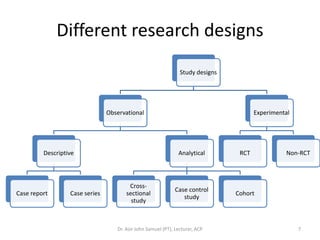
Different research designs
                                                                Study designs


                                Observational                                          Experimental


         Descriptive                                           Analytical        RCT             Non-RCT


                                        Cross-
                                                              Case control
Case report       Case series          sectional                                Cohort
                                                                 study
                                         study


                                   Dr. Asir John Samuel (PT), Lecturer, ACP                           7
Case report
• Studies describing the characteristics of a
  single patient


               Dr. Asir John Samuel (PT), Lecturer, ACP   8
Case report-merits
• Record unusual medical occurrences and can
  give the first clues in identification of a new
  disease or adverse effects of an exposure
• Only means of surveillance for rare clinical
  events
• Serve to elucidate the mechanism of disease
  and treatment


                 Dr. Asir John Samuel (PT), Lecturer, ACP   9
Case report-Demerits
• Cannot be used to test for the presence of
  valid statistical association because it is based
  on the experience of one person


                 Dr. Asir John Samuel (PT), Lecturer, ACP   10
Case series
• Studies describing the characteristics of a
  group of patients with similar diagnosis
• Collection of 5 & more cases


               Dr. Asir John Samuel (PT), Lecturer, ACP   11
Case series-merits
• Helps in formulating a useful hypothesis
  regarding risk factors of disease or identifying
  a new disease or outcome of new treatment
• Informative for very rare disease with few
  established risk factors
• May suggest the emergence of a new disease
  or epidemic


                 Dr. Asir John Samuel (PT), Lecturer, ACP   12
Case series-Demerits
Cannot be used to test for the presence of valid
statistical association due to absence of a
comparison group


                Dr. Asir John Samuel (PT), Lecturer, ACP   13
Cross-sectional studies
• Single examination of a cross section of
  population at one point of time
• Helps to generate a hypothesis
• Used to investigate non fatal diseases
• Both exposure and outcome (disease) are
  determined simultaneously for each subject
• Provide information about the frequencey or
  characteristic of disease
               Dr. Asir John Samuel (PT), Lecturer, ACP   14
Cross-sectional studies-Merits
• Provide information about the frequency of an
  attribute and potential risk factors
• Helps to generate a hypothesis
• Can give a good picture about the health care
  needs of the population at the point of time
• Can be used to investigate multiple exposure
  and multiple outcome
• Suitable for chronic cases
                Dr. Asir John Samuel (PT), Lecturer, ACP   15
Cross-sectional studies-Demerits
• Difficult to establish the time of sequence of
  events
• They are not suitable to investigate rare
  diseases, rare exposure or disease of short
  duration
• Being based on prevalent rather than incident
  cases
• Limited value to investigate etiological
  relationship
                Dr. Asir John Samuel (PT), Lecturer, ACP   16
Case control study

• Type of analytical study

• By observation and analysis

• Retrospective evaluation to determine who
  was exposed and who was not exposed –
  retrospective study


                 Dr. Asir John Samuel (PT), Lecturer, ACP   17
Case control study

• To examine the possible relation of an
  exposure to certain disease

- Identify the individual having the disease –
  case

- Individual   don’t             have                 the   disease   –
  comparison purpose
                 Dr. Asir John Samuel (PT), Lecturer, ACP             18
Case control study

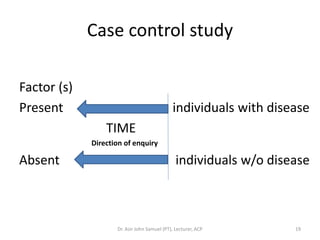
Factor (s)
Present                                      individuals with disease
                 TIME
             Direction of enquiry

Absent                                         individuals w/o disease


                    Dr. Asir John Samuel (PT), Lecturer, ACP       19
Case control study

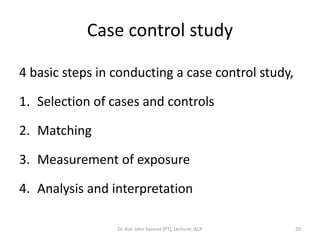
4 basic steps in conducting a case control study,

1. Selection of cases and controls

2. Matching

3. Measurement of exposure

4. Analysis and interpretation

                 Dr. Asir John Samuel (PT), Lecturer, ACP   20
Case control study – Merits
• Quick, less expensive
• Well suited for disease with long latent period
• Optimal for evaluation of rare diseases
• Can study etiological factors for a single
  disease
• Requires small sample than a cohort study
• No attrition (drop outs) problem
• Ethical problems are minimal, no risk to
  subjects
                 Dr. Asir John Samuel (PT), Lecturer, ACP   21
Case control study- Demerits

• More prone to bias

• Selection of appropriate control group may be
  difficult

• Inefficient for evaluation of rare exposure

• Cannot directly measure incidence, can only
  estimate relative risk
                 Dr. Asir John Samuel (PT), Lecturer, ACP   22
Cohort study
• Forward looking study

• Prospective study

• Incidence study

• Longitudinal study

• There is regular follow up over a period of
  time
                Dr. Asir John Samuel (PT), Lecturer, ACP   23
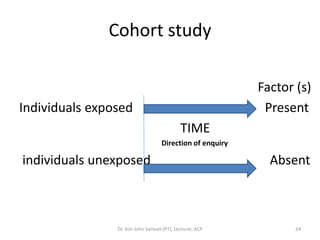
Cohort study

                                                           Factor (s)
Individuals exposed                                         Present
                                             TIME
                                    Direction of enquiry

individuals unexposed                                        Absent


                Dr. Asir John Samuel (PT), Lecturer, ACP          24
Cohort study

• Proceeds from cause to effect

• Exposure has occurred when the study is
  initiated, but the disease has not occurred


                 Dr. Asir John Samuel (PT), Lecturer, ACP   25
Cohort
• A group of people who share a common
  characteristic or experience within a defined
  time period
• Cohort must be free from disease under study
• Both groups (study cohort & control cohort)
  should be equally susceptible for the disease
  under study
• Should be comparable in all possible variables
                 Dr. Asir John Samuel (PT), Lecturer, ACP   26
Cohort study
• Elements of a cohort study,

1. Selection of study subjects

2. Obtaining data on exposure

3. Selection of comparison group

4. Follow-up

5. Analysis
                 Dr. Asir John Samuel (PT), Lecturer, ACP   27
Cohort study - Merits
• Incidence can be calculated

• Examines multiple effects of a single exposure

• Provides direct estimate of relative risk

• Minimizes bias

• Dose-response ratios can be calculated

• Elucidates temporal relationship b/w exposure
  & disease        Dr. Asir John Samuel (PT), Lecturer, ACP   28
Cohort study - Demerits
• Inefficient for rare diseases

• Expensive and time consuming

• Involves large sample size

• Alters people behaviour

• Changes in standard methods or diagnostic
  criteria of disease over prolonged follow-up
                  Dr. Asir John Samuel (PT), Lecturer, ACP   29
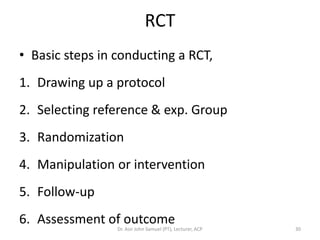
RCT
• Basic steps in conducting a RCT,
1. Drawing up a protocol
2. Selecting reference & exp. Group
3. Randomization
4. Manipulation or intervention
5. Follow-up
6. Assessment of outcome
                 Dr. Asir John Samuel (PT), Lecturer, ACP   30
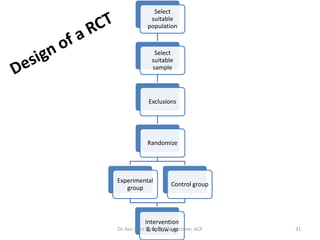
Select
               suitable
              population


                 Select
                suitable
                sample


              Exclusions


              Randomize


Experimental
                         Control group
   group


              Intervention
               & follow-up
Dr. Asir John Samuel (PT), Lecturer, ACP   31
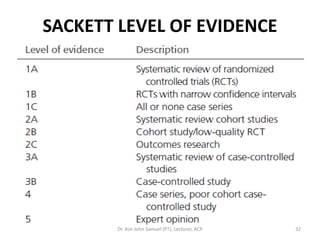
SACKETT LEVEL OF EVIDENCE


       Dr. Asir John Samuel (PT), Lecturer, ACP   32
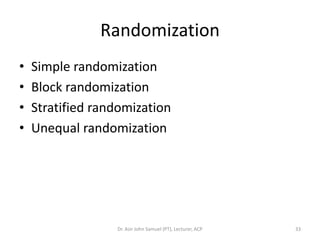
Randomization
•   Simple randomization
•   Block randomization
•   Stratified randomization
•   Unequal randomization


                  Dr. Asir John Samuel (PT), Lecturer, ACP   33

3.research design

  • 1.
    Research Design D.A.Asir John Samuel, BSc (Psy), MPT (Neuro Paed), MAc, DYScEd, C/BLS, FAGE
  • 2.
    Meaning of researchdesign • The arrangement of conditions for collection and analysis of data in a manner that aims to combine relevance to the research purpose with economy in procedure Dr. Asir John Samuel (PT), Lecturer, ACP 2
  • 3.
    Need for researchdesign • Smooth sailing of various research operations • Yielding maximal information • Minimal expenditure of effort, time & money • Plan for house • Advance planning of methods to be adopted for collecting relevant data and techniques to be used in analysis Dr. Asir John Samuel (PT), Lecturer, ACP 3
  • 4.
    Need for researchdesign • Efficient and appropriate design must be prepared before starting research operation OR futile • Organize ideas in a form • Possible to look for flaws & inadequacies • Need for providing comprehensive review Dr. Asir John Samuel (PT), Lecturer, ACP 4
  • 5.
    Features of goodresearch design • Flexible • Appropriate • Efficient • Economical • Minimises bias • Maximises the reliability of collected data and analysed Dr. Asir John Samuel (PT), Lecturer, ACP 5
  • 6.
    Features of goodresearch design • A research design should consider, - Means of obtaining information - Objective of the problem to be studied - Nature of the problem to be studied - Availability of time and money • Emphasis on discovery of ideas and insights • Hypothesis if casual relationship b/w variables Dr. Asir John Samuel (PT), Lecturer, ACP 6
  • 7.
    Different research designs Study designs Observational Experimental Descriptive Analytical RCT Non-RCT Cross- Case control Case report Case series sectional Cohort study study Dr. Asir John Samuel (PT), Lecturer, ACP 7
  • 8.
    Case report • Studiesdescribing the characteristics of a single patient Dr. Asir John Samuel (PT), Lecturer, ACP 8
  • 9.
    Case report-merits • Recordunusual medical occurrences and can give the first clues in identification of a new disease or adverse effects of an exposure • Only means of surveillance for rare clinical events • Serve to elucidate the mechanism of disease and treatment Dr. Asir John Samuel (PT), Lecturer, ACP 9
  • 10.
    Case report-Demerits • Cannotbe used to test for the presence of valid statistical association because it is based on the experience of one person Dr. Asir John Samuel (PT), Lecturer, ACP 10
  • 11.
    Case series • Studiesdescribing the characteristics of a group of patients with similar diagnosis • Collection of 5 & more cases Dr. Asir John Samuel (PT), Lecturer, ACP 11
  • 12.
    Case series-merits • Helpsin formulating a useful hypothesis regarding risk factors of disease or identifying a new disease or outcome of new treatment • Informative for very rare disease with few established risk factors • May suggest the emergence of a new disease or epidemic Dr. Asir John Samuel (PT), Lecturer, ACP 12
  • 13.
    Case series-Demerits Cannot beused to test for the presence of valid statistical association due to absence of a comparison group Dr. Asir John Samuel (PT), Lecturer, ACP 13
  • 14.
    Cross-sectional studies • Singleexamination of a cross section of population at one point of time • Helps to generate a hypothesis • Used to investigate non fatal diseases • Both exposure and outcome (disease) are determined simultaneously for each subject • Provide information about the frequencey or characteristic of disease Dr. Asir John Samuel (PT), Lecturer, ACP 14
  • 15.
    Cross-sectional studies-Merits • Provideinformation about the frequency of an attribute and potential risk factors • Helps to generate a hypothesis • Can give a good picture about the health care needs of the population at the point of time • Can be used to investigate multiple exposure and multiple outcome • Suitable for chronic cases Dr. Asir John Samuel (PT), Lecturer, ACP 15
  • 16.
    Cross-sectional studies-Demerits • Difficultto establish the time of sequence of events • They are not suitable to investigate rare diseases, rare exposure or disease of short duration • Being based on prevalent rather than incident cases • Limited value to investigate etiological relationship Dr. Asir John Samuel (PT), Lecturer, ACP 16
  • 17.
    Case control study •Type of analytical study • By observation and analysis • Retrospective evaluation to determine who was exposed and who was not exposed – retrospective study Dr. Asir John Samuel (PT), Lecturer, ACP 17
  • 18.
    Case control study •To examine the possible relation of an exposure to certain disease - Identify the individual having the disease – case - Individual don’t have the disease – comparison purpose Dr. Asir John Samuel (PT), Lecturer, ACP 18
  • 19.
    Case control study Factor(s) Present individuals with disease TIME Direction of enquiry Absent individuals w/o disease Dr. Asir John Samuel (PT), Lecturer, ACP 19
  • 20.
    Case control study 4basic steps in conducting a case control study, 1. Selection of cases and controls 2. Matching 3. Measurement of exposure 4. Analysis and interpretation Dr. Asir John Samuel (PT), Lecturer, ACP 20
  • 21.
    Case control study– Merits • Quick, less expensive • Well suited for disease with long latent period • Optimal for evaluation of rare diseases • Can study etiological factors for a single disease • Requires small sample than a cohort study • No attrition (drop outs) problem • Ethical problems are minimal, no risk to subjects Dr. Asir John Samuel (PT), Lecturer, ACP 21
  • 22.
    Case control study-Demerits • More prone to bias • Selection of appropriate control group may be difficult • Inefficient for evaluation of rare exposure • Cannot directly measure incidence, can only estimate relative risk Dr. Asir John Samuel (PT), Lecturer, ACP 22
  • 23.
    Cohort study • Forwardlooking study • Prospective study • Incidence study • Longitudinal study • There is regular follow up over a period of time Dr. Asir John Samuel (PT), Lecturer, ACP 23
  • 24.
    Cohort study Factor (s) Individuals exposed Present TIME Direction of enquiry individuals unexposed Absent Dr. Asir John Samuel (PT), Lecturer, ACP 24
  • 25.
    Cohort study • Proceedsfrom cause to effect • Exposure has occurred when the study is initiated, but the disease has not occurred Dr. Asir John Samuel (PT), Lecturer, ACP 25
  • 26.
    Cohort • A groupof people who share a common characteristic or experience within a defined time period • Cohort must be free from disease under study • Both groups (study cohort & control cohort) should be equally susceptible for the disease under study • Should be comparable in all possible variables Dr. Asir John Samuel (PT), Lecturer, ACP 26
  • 27.
    Cohort study • Elementsof a cohort study, 1. Selection of study subjects 2. Obtaining data on exposure 3. Selection of comparison group 4. Follow-up 5. Analysis Dr. Asir John Samuel (PT), Lecturer, ACP 27
  • 28.
    Cohort study -Merits • Incidence can be calculated • Examines multiple effects of a single exposure • Provides direct estimate of relative risk • Minimizes bias • Dose-response ratios can be calculated • Elucidates temporal relationship b/w exposure & disease Dr. Asir John Samuel (PT), Lecturer, ACP 28
  • 29.
    Cohort study -Demerits • Inefficient for rare diseases • Expensive and time consuming • Involves large sample size • Alters people behaviour • Changes in standard methods or diagnostic criteria of disease over prolonged follow-up Dr. Asir John Samuel (PT), Lecturer, ACP 29
  • 30.
    RCT • Basic stepsin conducting a RCT, 1. Drawing up a protocol 2. Selecting reference & exp. Group 3. Randomization 4. Manipulation or intervention 5. Follow-up 6. Assessment of outcome Dr. Asir John Samuel (PT), Lecturer, ACP 30
  • 31.
    Select suitable population Select suitable sample Exclusions Randomize Experimental Control group group Intervention & follow-up Dr. Asir John Samuel (PT), Lecturer, ACP 31
  • 32.
    SACKETT LEVEL OFEVIDENCE Dr. Asir John Samuel (PT), Lecturer, ACP 32
  • 33.
    Randomization • Simple randomization • Block randomization • Stratified randomization • Unequal randomization Dr. Asir John Samuel (PT), Lecturer, ACP 33