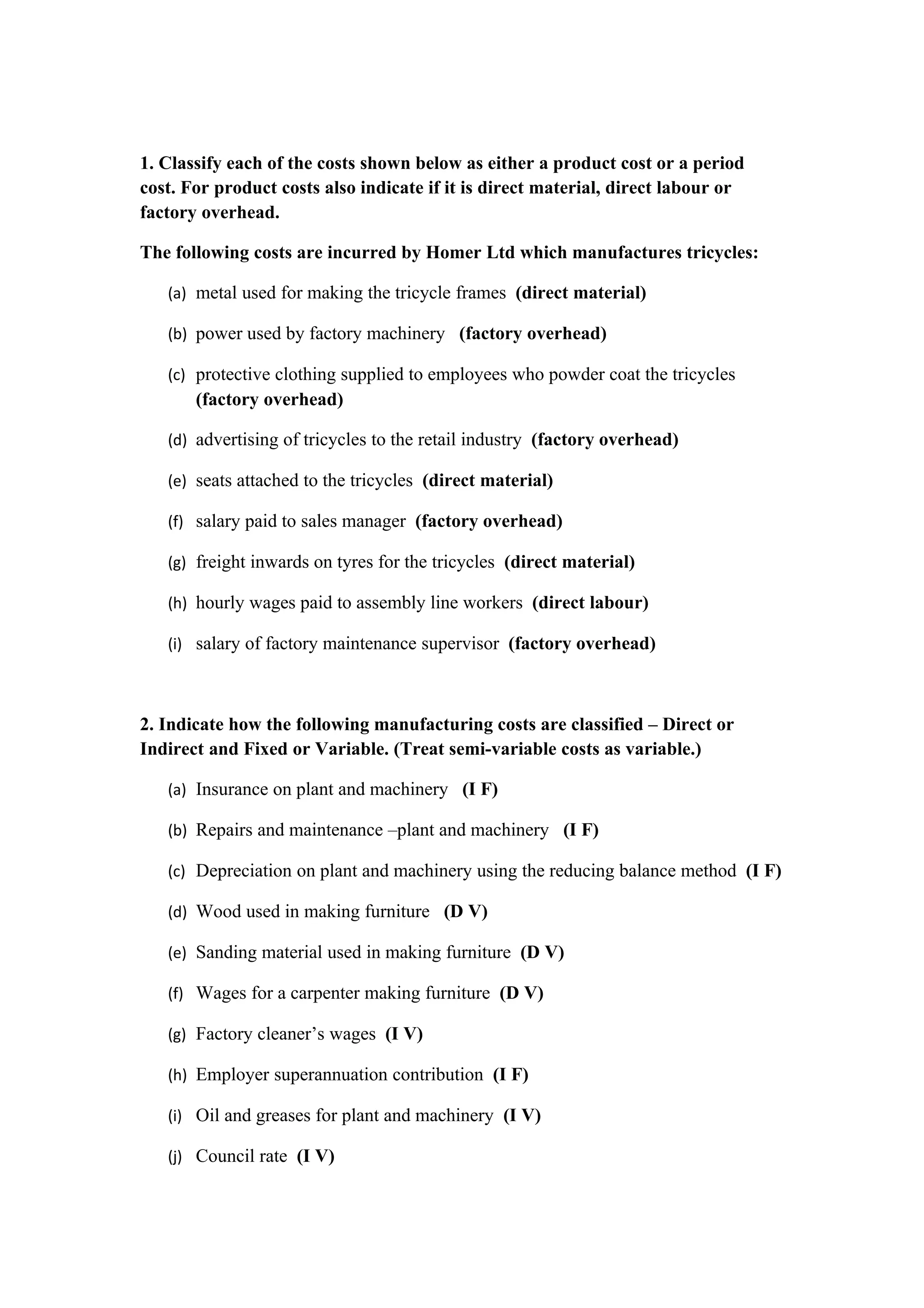
1. Classify each of the costs shown below as either a product cost or a period
cost. For product costs also indicate if it is direct material, direct labour or
factory overhead.

The following costs are incurred by Homer Ltd which manufactures tricycles:

   (a) metal used for making the tricycle frames (direct material)

   (b) power used by factory machinery (factory overhead)

   (c) protective clothing supplied to employees who powder coat the tricycles
       (factory overhead)

   (d) advertising of tricycles to the retail industry (factory overhead)

   (e) seats attached to the tricycles (direct material)

   (f) salary paid to sales manager (factory overhead)

   (g) freight inwards on tyres for the tricycles (direct material)

   (h) hourly wages paid to assembly line workers (direct labour)

   (i) salary of factory maintenance supervisor (factory overhead)


2. Indicate how the following manufacturing costs are classified – Direct or
Indirect and Fixed or Variable. (Treat semi-variable costs as variable.)

   (a) Insurance on plant and machinery (I F)

   (b) Repairs and maintenance –plant and machinery (I F)

   (c) Depreciation on plant and machinery using the reducing balance method (I F)

   (d) Wood used in making furniture (D V)

   (e) Sanding material used in making furniture (D V)

   (f) Wages for a carpenter making furniture (D V)

   (g) Factory cleaner’s wages (I V)

   (h) Employer superannuation contribution (I F)

   (i) Oil and greases for plant and machinery (I V)

   (j) Council rate (I V)
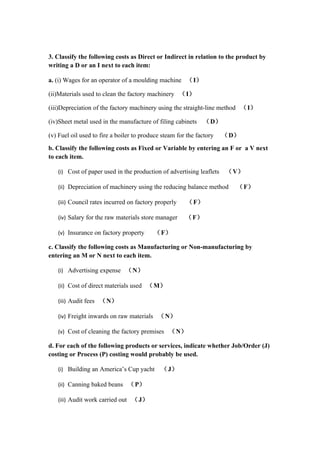
3. Classify the following costs as Direct or Indirect in relation to the product by
writing a D or an I next to each item:

a. (i) Wages for an operator of a moulding machine (I)

(ii)Materials used to clean the factory machinery (I)

(iii)Depreciation of the factory machinery using the straight-line method (I)

(iv)Sheet metal used in the manufacture of filing cabinets    (D)

(v) Fuel oil used to fire a boiler to produce steam for the factory   (D)
b. Classify the following costs as Fixed or Variable by entering an F or a V next
to each item.

   (i) Cost of paper used in the production of advertising leaflets   (V)

   (ii) Depreciation of machinery using the reducing balance method     (F)

   (iii) Council rates incurred on factory properly    (F)

   (iv) Salary for the raw materials store manager     (F)

   (v) Insurance on factory property      (F)

c. Classify the following costs as Manufacturing or Non-manufacturing by
entering an M or N next to each item.

   (i) Advertising expense (N)

   (ii) Cost of direct materials used (M)

   (iii) Audit fees (N)

   (iv) Freight inwards on raw materials (N)

   (v) Cost of cleaning the factory premises (N)

d. For each of the following products or services, indicate whether Job/Order (J)
costing or Process (P) costing would probably be used.

   (i) Building an America’s Cup yacht       (J)

   (ii) Canning baked beans (P)

   (iii) Audit work carried out (J)
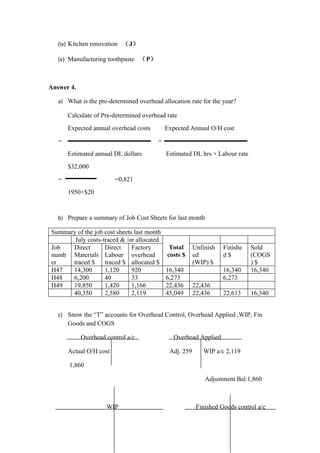
(iv) Kitchen renovation (J)

   (v) Manufacturing toothpaste (P)


Answer 4.

   a) What is the pre-determined overhead allocation rate for the year?

       Calculate of Pre-determined overhead rate
       Expected annual overhead costs        Expected Annual O/H cost
   =                                     =
       Estimated annual DL dollars           Estimated DL hrs × Labour rate
       $32,000
   =                     =0,821
       1950×$20


   b) Prepare a summary of Job Cost Sheets for last month

Summary of the job cost sheets last month
       July costs-traced & /or allocated
Job   Direct       Direct     Factory         Total      Unfinish   Finishe   Sold
numb Materials Labour overhead               costs $     ed         d$        (COGS
er    traced $     traced $ allocated $                  (WIP) $              )$
H47   14,300       1,120      920            16,340                 16,340    16,340
H48   6,200        40         33             6,273                  6,273
H49   19,850       1,420      1,166          22,436      22,436
      40,350       2,580      2,119          45,049      22,436     22,613    16,340


   c) Snow the “T” accounts for Overhead Control, Overhead Applied ,WIP, Fin
       Goods and COGS

            Overhead control a/c               Overhead Applied

       Actual O/H cost                        Adj. 259      WIP a/c 2,119

       1,860

                                                             Adjustment Bal.1,860


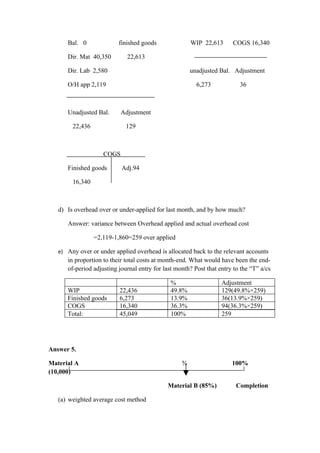
                     WIP                                  Finished Goods control a/c
Bal. 0              finished goods               WIP 22,613      COGS 16,340

      Dir. Mat 40,350        22,613

      Dir. Lab 2,580                                   unadjusted Bal. Adjustment

      O/H app 2,119                                      6,273            36


      Unadjusted Bal.      Adjustment

        22,436               129


                    COGS

      Finished goods       Adj.94

        16,340


   d) Is overhead over or under-applied for last month, and by how much?

      Answer: variance between Overhead applied and actual overhead cost

                 =2,119-1,860=259 over applied

   e) Any over or under applied overhead is allocated back to the relevant accounts
      in proportion to their total costs at month-end. What would have been the end-
      of-period adjusting journal entry for last month? Post that entry to the “T” a/cs

                                               %                   Adjustment
      WIP                 22,436               49.8%               129(49.8%×259)
      Finished goods      6,273                13.9%               36(13.9%×259)
      COGS                16,340               36.3%               94(36.3%×259)
      Total:              45,049               100%                259


Answer 5.

Material A                                         ¾                   100%
(10,000)

                                             Material B (85%)            Completion

   (a) weighted average cost method
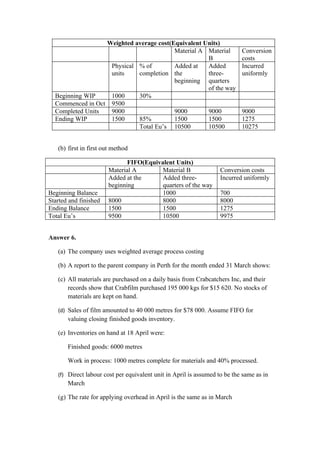
Weighted average cost(Equivalent Units)
                                         Material A Material               Conversion
                                                    B                      costs
                   Physical % of         Added at   Added                  Incurred
                   units    completion the          three-                 uniformly
                                         beginning quarters
                                                    of the way
  Beginning WIP    1000     30%
  Commenced in Oct 9500
  Completed Units  9000                  9000       9000                   9000
  Ending WIP       1500     85%          1500       1500                   1275
                            Total Eu’s 10500        10500                  10275


   (b) first in first out method

                              FIFO(Equivalent Units)
                       Material A        Material B                Conversion costs
                       Added at the      Added three-              Incurred uniformly
                       beginning         quarters of the way
Beginning Balance                        1000                      700
Started and finished   8000              8000                      8000
Ending Balance         1500              1500                      1275
Total Eu’s             9500              10500                     9975


Answer 6.

   (a) The company uses weighted average process costing

   (b) A report to the parent company in Perth for the month ended 31 March shows:

   (c) All materials are purchased on a daily basis from Crabcatchers Inc, and their
       records show that Crabfilm purchased 195 000 kgs for $15 620. No stocks of
       materials are kept on hand.

   (d) Sales of film amounted to 40 000 metres for $78 000. Assume FIFO for
       valuing closing finished goods inventory.

   (e) Inventories on hand at 18 April were:

       Finished goods: 6000 metres

       Work in process: 1000 metres complete for materials and 40% processed.

   (f) Direct labour cost per equivalent unit in April is assumed to be the same as in
       March

   (g) The rate for applying overhead in April is the same as in March
(h) No spoilage or lost units occurred in April.

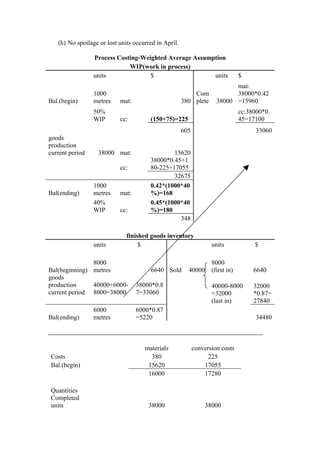
                 Process Costing-Weighted Average Assumption
                             WIP(work in process)
                 units              $                   units                   $
                                                                           mat:
                 1000                                     Com              38000*0.42
Bal.(begin)      metres    mat:                       380 plete      38000 =15960
                 50%                                                            cc:38000*0.
                 WIP       cc:         (150+75)=225                             45=17100
                                                      605                             33060
goods
production
current period    38000 mat:                   15620
                                       38000*0.45+1
                           cc:         80-225=17055
                                               32675
                 1000                  0.42*(1000*40
Bal(ending)      metres    mat:        %)=168
                 40%                   0.45*(1000*40
                 WIP       cc:         %)=180
                                                 348

                              finished goods inventory
                 units             $                               units             $

               8000                                                8000
Bal(beginning) metres                   6640 Sold       40000      (first in)        6640
goods
production     40000+6000-        38000*0.8                        40000-8000        32000
current period 8000=38000         7=33060                          =32000            *0.87=
                                                                   (last in)         27840
                 6000             6000*0.87
Bal(ending)      metres           =5220                                               34480


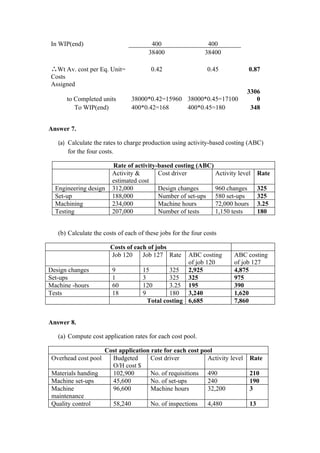
                                     materials              conversion costs
Costs                                  380                        225
Bal.(begin)                           15620                     17055
                                      16000                     17280

Quantities
Completed
units                                  38000                    38000
In WIP(end)                             400                    400
                                       38400                  38400

∴Wt Av. cost per Eq. Unit=              0.42                   0.45         0.87
Costs
Assigned
                                                                           3306
      to Completed units        38000*0.42=15960 38000*0.45=17100             0
         To WIP(end)            400*0.42=168     400*0.45=180               348


Answer 7.

   (a) Calculate the rates to charge production using activity-based costing (ABC)
       for the four costs.

                         Rate of activity-based costing (ABC)
                         Activity &       Cost driver         Activity level     Rate
                         estimated cost
  Engineering design     312,000          Design changes      960 changes        325
  Set-up                 188,000          Number of set-ups 580 set-ups          325
  Machining              234,000          Machine hours       72,000 hours       3.25
  Testing                207,000          Number of tests     1,150 tests        180


   (b) Calculate the costs of each of these jobs for the four costs

                        Costs of each of jobs
                        Job 120     Job 127 Rate     ABC costing      ABC costing
                                                     of job 120       of job 127
Design changes           9           15        325 2,925              4,875
Set-ups                  1           3         325 325                975
Machine -hours           60          120       3.25 195               390
Tests                    18          9         180 3,240              1,620
                                       Total costing 6,685            7,860


Answer 8.

   (a) Compute cost application rates for each cost pool.

                    Cost application rate for each cost pool
 Overhead cost pool   Budgeted       Cost driver          Activity level    Rate
                      O/H cost $
 Materials handing    102,900        No. of requisitions 490                210
 Machine set-ups      45,600         No. of set-ups       240               190
 Machine              96,600         Machine hours        32,200            3
 maintenance
 Quality control      58,240         No. of inspections   4,480             13
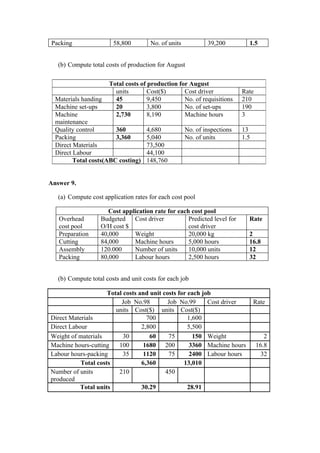
Packing                 58,800         No. of units           39,200         1.5


   (b) Compute total costs of production for August

                      Total costs of production for August
                        units        Cost($)      Cost driver              Rate
  Materials handing     45           9,450        No. of requisitions      210
  Machine set-ups       20           3,800        No. of set-ups           190
  Machine               2,730        8,190        Machine hours            3
  maintenance
  Quality control       360          4,680            No. of inspections   13
  Packing               3,360        5,040            No. of units         1.5
  Direct Materials                   73,500
  Direct Labour                      44,100
         Total costs(ABC costing)    148,760


Answer 9.

   (a) Compute cost application rates for each cost pool

                      Cost application rate for each cost pool
   Overhead        Budgeted Cost driver             Predicted level for      Rate
   cost pool       O/H cost $                       cost driver
   Preparation     40,000      Weight               20,000 kg                2
   Cutting         84,000      Machine hours        5,000 hours              16.8
   Assembly        120.000     Number of units      10,000 units             12
   Packing         80,000      Labour hours         2,500 hours              32


   (b) Compute total costs and unit costs for each job

                     Total costs and unit costs for each job
                          Job No.98         Job No.99      Cost driver           Rate
                        units Cost($) units Cost($)
Direct Materials                    700             1,600
Direct Labour                     2,800             5,500
Weight of materials        30        60     75        150 Weight                     2
Machine hours-cutting    100       1680 200          3360 Machine hours           16.8
Labour hours-packing       35      1120     75       2400 Labour hours              32
           Total costs            6,360           13,010
Number of units          210               450
produced
           Total units            30.29             28.91
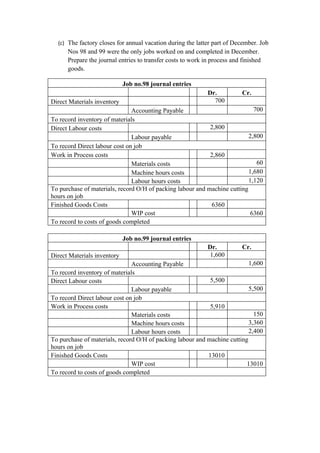
(c) The factory closes for annual vacation during the latter part of December. Job
      Nos 98 and 99 were the only jobs worked on and completed in December.
      Prepare the journal entries to transfer costs to work in process and finished
      goods.

                             Job no.98 journal entries
                                                             Dr.           Cr.
Direct Materials inventory                                     700
                               Accounting Payable                            700
To record inventory of materials
Direct Labour costs                                         2,800
                               Labour payable                              2,800
To record Direct labour cost on job
Work in Process costs                                       2,860
                               Materials costs                                60
                               Machine hours costs                         1,680
                               Labour hours costs                          1,120
To purchase of materials, record O/H of packing labour and machine cutting
hours on job
Finished Goods Costs                                         6360
                               WIP cost                                     6360
To record to costs of goods completed

                             Job no.99 journal entries
                                                             Dr.           Cr.
Direct Materials inventory                                    1,600
                               Accounting Payable                          1,600
To record inventory of materials
Direct Labour costs                                         5,500
                               Labour payable                              5,500
To record Direct labour cost on job
Work in Process costs                                       5,910
                               Materials costs                               150
                               Machine hours costs                         3,360
                               Labour hours costs                          2,400
To purchase of materials, record O/H of packing labour and machine cutting
hours on job
Finished Goods Costs                                       13010
                               WIP cost                                   13010
To record to costs of goods completed

602 management accounting assessment1

  • 1.
    1. Classify eachof the costs shown below as either a product cost or a period cost. For product costs also indicate if it is direct material, direct labour or factory overhead. The following costs are incurred by Homer Ltd which manufactures tricycles: (a) metal used for making the tricycle frames (direct material) (b) power used by factory machinery (factory overhead) (c) protective clothing supplied to employees who powder coat the tricycles (factory overhead) (d) advertising of tricycles to the retail industry (factory overhead) (e) seats attached to the tricycles (direct material) (f) salary paid to sales manager (factory overhead) (g) freight inwards on tyres for the tricycles (direct material) (h) hourly wages paid to assembly line workers (direct labour) (i) salary of factory maintenance supervisor (factory overhead) 2. Indicate how the following manufacturing costs are classified – Direct or Indirect and Fixed or Variable. (Treat semi-variable costs as variable.) (a) Insurance on plant and machinery (I F) (b) Repairs and maintenance –plant and machinery (I F) (c) Depreciation on plant and machinery using the reducing balance method (I F) (d) Wood used in making furniture (D V) (e) Sanding material used in making furniture (D V) (f) Wages for a carpenter making furniture (D V) (g) Factory cleaner’s wages (I V) (h) Employer superannuation contribution (I F) (i) Oil and greases for plant and machinery (I V) (j) Council rate (I V)
  • 2.
    3. Classify thefollowing costs as Direct or Indirect in relation to the product by writing a D or an I next to each item: a. (i) Wages for an operator of a moulding machine (I) (ii)Materials used to clean the factory machinery (I) (iii)Depreciation of the factory machinery using the straight-line method (I) (iv)Sheet metal used in the manufacture of filing cabinets (D) (v) Fuel oil used to fire a boiler to produce steam for the factory (D) b. Classify the following costs as Fixed or Variable by entering an F or a V next to each item. (i) Cost of paper used in the production of advertising leaflets (V) (ii) Depreciation of machinery using the reducing balance method (F) (iii) Council rates incurred on factory properly (F) (iv) Salary for the raw materials store manager (F) (v) Insurance on factory property (F) c. Classify the following costs as Manufacturing or Non-manufacturing by entering an M or N next to each item. (i) Advertising expense (N) (ii) Cost of direct materials used (M) (iii) Audit fees (N) (iv) Freight inwards on raw materials (N) (v) Cost of cleaning the factory premises (N) d. For each of the following products or services, indicate whether Job/Order (J) costing or Process (P) costing would probably be used. (i) Building an America’s Cup yacht (J) (ii) Canning baked beans (P) (iii) Audit work carried out (J)
  • 3.
    (iv) Kitchen renovation(J) (v) Manufacturing toothpaste (P) Answer 4. a) What is the pre-determined overhead allocation rate for the year? Calculate of Pre-determined overhead rate Expected annual overhead costs Expected Annual O/H cost = = Estimated annual DL dollars Estimated DL hrs × Labour rate $32,000 = =0,821 1950×$20 b) Prepare a summary of Job Cost Sheets for last month Summary of the job cost sheets last month July costs-traced & /or allocated Job Direct Direct Factory Total Unfinish Finishe Sold numb Materials Labour overhead costs $ ed d$ (COGS er traced $ traced $ allocated $ (WIP) $ )$ H47 14,300 1,120 920 16,340 16,340 16,340 H48 6,200 40 33 6,273 6,273 H49 19,850 1,420 1,166 22,436 22,436 40,350 2,580 2,119 45,049 22,436 22,613 16,340 c) Snow the “T” accounts for Overhead Control, Overhead Applied ,WIP, Fin Goods and COGS Overhead control a/c Overhead Applied Actual O/H cost Adj. 259 WIP a/c 2,119 1,860 Adjustment Bal.1,860 WIP Finished Goods control a/c
  • 4.
    Bal. 0 finished goods WIP 22,613 COGS 16,340 Dir. Mat 40,350 22,613 Dir. Lab 2,580 unadjusted Bal. Adjustment O/H app 2,119 6,273 36 Unadjusted Bal. Adjustment 22,436 129 COGS Finished goods Adj.94 16,340 d) Is overhead over or under-applied for last month, and by how much? Answer: variance between Overhead applied and actual overhead cost =2,119-1,860=259 over applied e) Any over or under applied overhead is allocated back to the relevant accounts in proportion to their total costs at month-end. What would have been the end- of-period adjusting journal entry for last month? Post that entry to the “T” a/cs % Adjustment WIP 22,436 49.8% 129(49.8%×259) Finished goods 6,273 13.9% 36(13.9%×259) COGS 16,340 36.3% 94(36.3%×259) Total: 45,049 100% 259 Answer 5. Material A ¾ 100% (10,000) Material B (85%) Completion (a) weighted average cost method
  • 5.
    Weighted average cost(EquivalentUnits) Material A Material Conversion B costs Physical % of Added at Added Incurred units completion the three- uniformly beginning quarters of the way Beginning WIP 1000 30% Commenced in Oct 9500 Completed Units 9000 9000 9000 9000 Ending WIP 1500 85% 1500 1500 1275 Total Eu’s 10500 10500 10275 (b) first in first out method FIFO(Equivalent Units) Material A Material B Conversion costs Added at the Added three- Incurred uniformly beginning quarters of the way Beginning Balance 1000 700 Started and finished 8000 8000 8000 Ending Balance 1500 1500 1275 Total Eu’s 9500 10500 9975 Answer 6. (a) The company uses weighted average process costing (b) A report to the parent company in Perth for the month ended 31 March shows: (c) All materials are purchased on a daily basis from Crabcatchers Inc, and their records show that Crabfilm purchased 195 000 kgs for $15 620. No stocks of materials are kept on hand. (d) Sales of film amounted to 40 000 metres for $78 000. Assume FIFO for valuing closing finished goods inventory. (e) Inventories on hand at 18 April were: Finished goods: 6000 metres Work in process: 1000 metres complete for materials and 40% processed. (f) Direct labour cost per equivalent unit in April is assumed to be the same as in March (g) The rate for applying overhead in April is the same as in March
  • 6.
    (h) No spoilageor lost units occurred in April. Process Costing-Weighted Average Assumption WIP(work in process) units $ units $ mat: 1000 Com 38000*0.42 Bal.(begin) metres mat: 380 plete 38000 =15960 50% cc:38000*0. WIP cc: (150+75)=225 45=17100 605 33060 goods production current period 38000 mat: 15620 38000*0.45+1 cc: 80-225=17055 32675 1000 0.42*(1000*40 Bal(ending) metres mat: %)=168 40% 0.45*(1000*40 WIP cc: %)=180 348 finished goods inventory units $ units $ 8000 8000 Bal(beginning) metres 6640 Sold 40000 (first in) 6640 goods production 40000+6000- 38000*0.8 40000-8000 32000 current period 8000=38000 7=33060 =32000 *0.87= (last in) 27840 6000 6000*0.87 Bal(ending) metres =5220 34480 materials conversion costs Costs 380 225 Bal.(begin) 15620 17055 16000 17280 Quantities Completed units 38000 38000
  • 7.
    In WIP(end) 400 400 38400 38400 ∴Wt Av. cost per Eq. Unit= 0.42 0.45 0.87 Costs Assigned 3306 to Completed units 38000*0.42=15960 38000*0.45=17100 0 To WIP(end) 400*0.42=168 400*0.45=180 348 Answer 7. (a) Calculate the rates to charge production using activity-based costing (ABC) for the four costs. Rate of activity-based costing (ABC) Activity & Cost driver Activity level Rate estimated cost Engineering design 312,000 Design changes 960 changes 325 Set-up 188,000 Number of set-ups 580 set-ups 325 Machining 234,000 Machine hours 72,000 hours 3.25 Testing 207,000 Number of tests 1,150 tests 180 (b) Calculate the costs of each of these jobs for the four costs Costs of each of jobs Job 120 Job 127 Rate ABC costing ABC costing of job 120 of job 127 Design changes 9 15 325 2,925 4,875 Set-ups 1 3 325 325 975 Machine -hours 60 120 3.25 195 390 Tests 18 9 180 3,240 1,620 Total costing 6,685 7,860 Answer 8. (a) Compute cost application rates for each cost pool. Cost application rate for each cost pool Overhead cost pool Budgeted Cost driver Activity level Rate O/H cost $ Materials handing 102,900 No. of requisitions 490 210 Machine set-ups 45,600 No. of set-ups 240 190 Machine 96,600 Machine hours 32,200 3 maintenance Quality control 58,240 No. of inspections 4,480 13
  • 8.
    Packing 58,800 No. of units 39,200 1.5 (b) Compute total costs of production for August Total costs of production for August units Cost($) Cost driver Rate Materials handing 45 9,450 No. of requisitions 210 Machine set-ups 20 3,800 No. of set-ups 190 Machine 2,730 8,190 Machine hours 3 maintenance Quality control 360 4,680 No. of inspections 13 Packing 3,360 5,040 No. of units 1.5 Direct Materials 73,500 Direct Labour 44,100 Total costs(ABC costing) 148,760 Answer 9. (a) Compute cost application rates for each cost pool Cost application rate for each cost pool Overhead Budgeted Cost driver Predicted level for Rate cost pool O/H cost $ cost driver Preparation 40,000 Weight 20,000 kg 2 Cutting 84,000 Machine hours 5,000 hours 16.8 Assembly 120.000 Number of units 10,000 units 12 Packing 80,000 Labour hours 2,500 hours 32 (b) Compute total costs and unit costs for each job Total costs and unit costs for each job Job No.98 Job No.99 Cost driver Rate units Cost($) units Cost($) Direct Materials 700 1,600 Direct Labour 2,800 5,500 Weight of materials 30 60 75 150 Weight 2 Machine hours-cutting 100 1680 200 3360 Machine hours 16.8 Labour hours-packing 35 1120 75 2400 Labour hours 32 Total costs 6,360 13,010 Number of units 210 450 produced Total units 30.29 28.91
  • 9.
    (c) The factorycloses for annual vacation during the latter part of December. Job Nos 98 and 99 were the only jobs worked on and completed in December. Prepare the journal entries to transfer costs to work in process and finished goods. Job no.98 journal entries Dr. Cr. Direct Materials inventory 700 Accounting Payable 700 To record inventory of materials Direct Labour costs 2,800 Labour payable 2,800 To record Direct labour cost on job Work in Process costs 2,860 Materials costs 60 Machine hours costs 1,680 Labour hours costs 1,120 To purchase of materials, record O/H of packing labour and machine cutting hours on job Finished Goods Costs 6360 WIP cost 6360 To record to costs of goods completed Job no.99 journal entries Dr. Cr. Direct Materials inventory 1,600 Accounting Payable 1,600 To record inventory of materials Direct Labour costs 5,500 Labour payable 5,500 To record Direct labour cost on job Work in Process costs 5,910 Materials costs 150 Machine hours costs 3,360 Labour hours costs 2,400 To purchase of materials, record O/H of packing labour and machine cutting hours on job Finished Goods Costs 13010 WIP cost 13010 To record to costs of goods completed