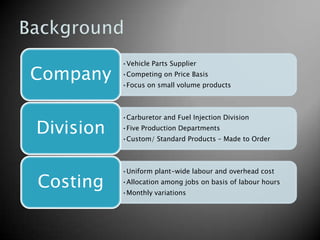
•Vehicle Parts Supplier

Company    •Competing on Price Basis
           •Focus on small volume products


           •Carburetor and Fuel Injection Division

Division   •Five Production Departments
           •Custom/ Standard Products – Made to Order


           •Uniform plant-wide labour and overhead cost

Costing    •Allocation among jobs on basis of labour hours
           •Monthly variations
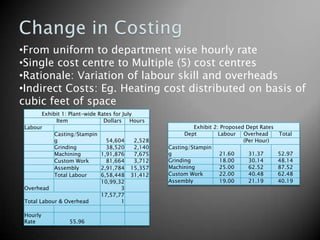
•From uniform to department wise hourly rate
•Single cost centre to Multiple (5) cost centres
•Rationale: Variation of labour skill and overheads
•Indirect Costs: Eg. Heating cost distributed on basis of
cubic feet of space
        Exhibit 1: Plant-wide Rates for July
             Item               Dollars Hours
 Labour                                                       Exhibit 2: Proposed Dept Rates
            Casting/Stampin                                Dept         Labour Overhead        Total
            g                    54,604      2,528                               (Per Hour)
            Grinding             38,520      2,140   Casting/Stampin
            Machining          1,91,876      7,675   g                  21.60      31.37       52.97
            Custom Work          81,664      3,712   Grinding           18.00      30.14       48.14
            Assembly           2,91,784 15,357       Machining          25.00      62.52       87.52
            Total Labour       6,58,448 31,412       Custom Work        22.00      40.48       62.48
                               10,99,32              Assembly           19.00      21.19       40.19
 Overhead                              3
                               17,57,77
 Total Labour & Overhead               1

 Hourly
 Rate             55.96
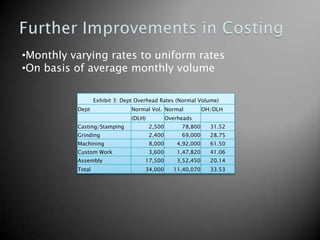
•Monthly varying rates to uniform rates
•On basis of average monthly volume

                  Exhibit 3: Dept Overhead Rates (Normal Volume)
          Dept                  Normal Vol. Normal             OH/DLH
                                (DLH)           Overheads
          Casting/Stamping              2,500        78,800      31.52
          Grinding                      2,400        69,000      28.75
          Machining                     8,000       4,92,000     61.50
          Custom Work                   3,600       1,47,820     41.06
          Assembly                   17,500         3,52,450     20.14
          Total                      34,000       11,40,070      33.53
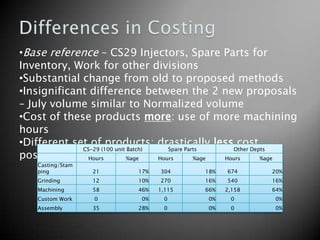
•Base reference – CS29 Injectors, Spare Parts for
Inventory, Work for other divisions
•Substantial change from old to proposed methods
•Insignificant difference between the 2 new proposals
– July volume similar to Normalized volume
•Cost of these products more: use of more machining
hours
•Different set of products: drastically less cost
             CS-29 (100 unit Batch)    Spare Parts     Other Depts
possible       Hours         %age   Hours       %age Hours      %age
    Casting/Stam
    ping           21        17%   304       18%   674       20%
    Grinding       12        10%   270       16%   540       16%
    Machining      58        46%   1,115     66%   2,158     64%
    Custom Work    0         0%     0         0%    0         0%
    Assembly       35        28%    0         0%    0         0%
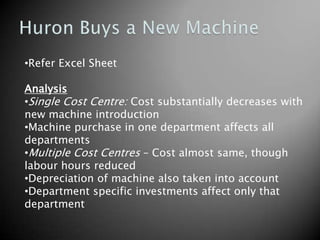
•Refer Excel Sheet

Analysis
•Single Cost Centre: Cost substantially decreases with
new machine introduction
•Machine purchase in one department affects all
departments
•Multiple Cost Centres – Cost almost same, though
labour hours reduced
•Depreciation of machine also taken into account
•Department specific investments affect only that
department
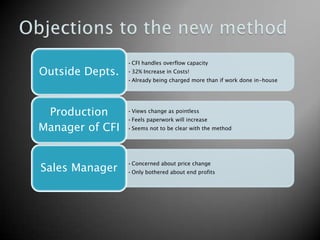
• CFI handles overflow capacity
Outside Depts.   • 32% Increase in Costs!
                 • Already being charged more than if work done in-house


 Production      • Views change as pointless
                 • Feels paperwork will increase
Manager of CFI   • Seems not to be clear with the method


Sales Manager
                 • Concerned about price change
                 • Only bothered about end profits
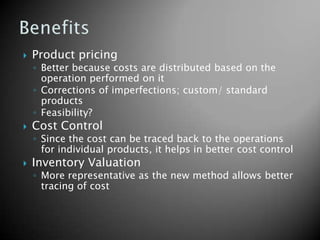
   Product pricing
    ◦ Better because costs are distributed based on the
      operation performed on it
    ◦ Corrections of imperfections; custom/ standard
      products
    ◦ Feasibility?
   Cost Control
    ◦ Since the cost can be traced back to the operations
      for individual products, it helps in better cost control
   Inventory Valuation
    ◦ More representative as the new method allows better
      tracing of cost
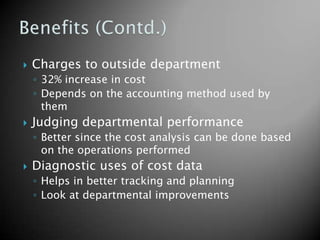
   Charges to outside department
    ◦ 32% increase in cost
    ◦ Depends on the accounting method used by
      them
   Judging departmental performance
    ◦ Better since the cost analysis can be done based
      on the operations performed
   Diagnostic uses of cost data
    ◦ Helps in better tracking and planning
    ◦ Look at departmental improvements
Thank You!

Huron Automotive - An Accounting Analysis

  • 2.
    •Vehicle Parts Supplier Company •Competing on Price Basis •Focus on small volume products •Carburetor and Fuel Injection Division Division •Five Production Departments •Custom/ Standard Products – Made to Order •Uniform plant-wide labour and overhead cost Costing •Allocation among jobs on basis of labour hours •Monthly variations
  • 3.
    •From uniform todepartment wise hourly rate •Single cost centre to Multiple (5) cost centres •Rationale: Variation of labour skill and overheads •Indirect Costs: Eg. Heating cost distributed on basis of cubic feet of space Exhibit 1: Plant-wide Rates for July Item Dollars Hours Labour Exhibit 2: Proposed Dept Rates Casting/Stampin Dept Labour Overhead Total g 54,604 2,528 (Per Hour) Grinding 38,520 2,140 Casting/Stampin Machining 1,91,876 7,675 g 21.60 31.37 52.97 Custom Work 81,664 3,712 Grinding 18.00 30.14 48.14 Assembly 2,91,784 15,357 Machining 25.00 62.52 87.52 Total Labour 6,58,448 31,412 Custom Work 22.00 40.48 62.48 10,99,32 Assembly 19.00 21.19 40.19 Overhead 3 17,57,77 Total Labour & Overhead 1 Hourly Rate 55.96
  • 4.
    •Monthly varying ratesto uniform rates •On basis of average monthly volume Exhibit 3: Dept Overhead Rates (Normal Volume) Dept Normal Vol. Normal OH/DLH (DLH) Overheads Casting/Stamping 2,500 78,800 31.52 Grinding 2,400 69,000 28.75 Machining 8,000 4,92,000 61.50 Custom Work 3,600 1,47,820 41.06 Assembly 17,500 3,52,450 20.14 Total 34,000 11,40,070 33.53
  • 5.
    •Base reference –CS29 Injectors, Spare Parts for Inventory, Work for other divisions •Substantial change from old to proposed methods •Insignificant difference between the 2 new proposals – July volume similar to Normalized volume •Cost of these products more: use of more machining hours •Different set of products: drastically less cost CS-29 (100 unit Batch) Spare Parts Other Depts possible Hours %age Hours %age Hours %age Casting/Stam ping 21 17% 304 18% 674 20% Grinding 12 10% 270 16% 540 16% Machining 58 46% 1,115 66% 2,158 64% Custom Work 0 0% 0 0% 0 0% Assembly 35 28% 0 0% 0 0%
  • 6.
    •Refer Excel Sheet Analysis •SingleCost Centre: Cost substantially decreases with new machine introduction •Machine purchase in one department affects all departments •Multiple Cost Centres – Cost almost same, though labour hours reduced •Depreciation of machine also taken into account •Department specific investments affect only that department
  • 7.
    • CFI handlesoverflow capacity Outside Depts. • 32% Increase in Costs! • Already being charged more than if work done in-house Production • Views change as pointless • Feels paperwork will increase Manager of CFI • Seems not to be clear with the method Sales Manager • Concerned about price change • Only bothered about end profits
  • 8.
    Product pricing ◦ Better because costs are distributed based on the operation performed on it ◦ Corrections of imperfections; custom/ standard products ◦ Feasibility?  Cost Control ◦ Since the cost can be traced back to the operations for individual products, it helps in better cost control  Inventory Valuation ◦ More representative as the new method allows better tracing of cost
  • 9.
    Charges to outside department ◦ 32% increase in cost ◦ Depends on the accounting method used by them  Judging departmental performance ◦ Better since the cost analysis can be done based on the operations performed  Diagnostic uses of cost data ◦ Helps in better tracking and planning ◦ Look at departmental improvements
  • 10.