Support for distal extensionSupport for distal extension
Partial DenturePartial Denture
IntroductionIntroduction
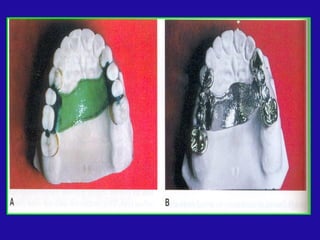
 In a tooth supported partial denture ,aIn a tooth supported partial denture ,a
metal base or the frame-work thatmetal base or the frame-work that
supports an acrylic resin base issupports an acrylic resin base is
connected to and is part of a rigid frame-connected to and is part of a rigid frame-
work that permits the direct transfer ofwork that permits the direct transfer of
occlusal forces to abutment teeth throughocclusal forces to abutment teeth through
the occlusal restthe occlusal rest
 The resiliency of ridge tissues ,theThe resiliency of ridge tissues ,the
ridge configuration ,and type of boneridge configuration ,and type of bone
that supports these tissues are notthat supports these tissues are not
factors in denture supportfactors in denture support
 Hence the abutments are the soleHence the abutments are the sole
support for the RPDsupport for the RPD
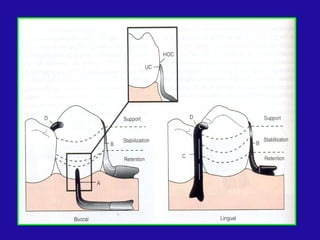
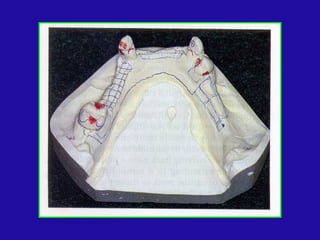
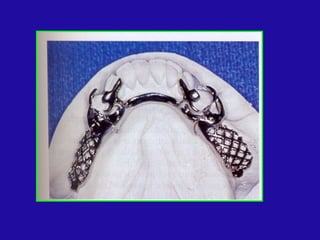
Distal extension dentureDistal extension denture
basebase
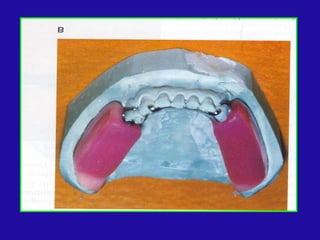
 DEB does not have the advantage ofDEB does not have the advantage of
total tooth support as one or moretotal tooth support as one or more
bases are extensions covering thebases are extensions covering the
residual ridge distal to last abutmentresidual ridge distal to last abutment
teethteeth
 Therefore it is dependent on theTherefore it is dependent on the
residual ridge for a portion of support,residual ridge for a portion of support,
stability, and retentionstability, and retention
Factors influencing support ofFactors influencing support of
DEBDEB
 Contour and quality of residual ridgeContour and quality of residual ridge
 Extent of residual ridge coverage of dentureExtent of residual ridge coverage of denture
basebase
 Type and accuracy of impressionType and accuracy of impression
registrationregistration
 Accuracy of fit of denture baseAccuracy of fit of denture base
 Design of partial denture frame-workDesign of partial denture frame-work
 Total occlusal load appliedTotal occlusal load applied
Contour and quality ofContour and quality of
residual ridgeresidual ridge
 The ideal residual ridge to support aThe ideal residual ridge to support a
denture base would consist of corticaldenture base would consist of cortical
bone that covers a dense cancellousbone that covers a dense cancellous
bone, with a broad rounded crest withbone, with a broad rounded crest with
high vertical slopes and covered byhigh vertical slopes and covered by
firm,dense fibrous connective tissuefirm,dense fibrous connective tissue
 Easily displaceable tissues will notEasily displaceable tissues will not
adequately support a denture baseadequately support a denture base
 Buccal shelf area is better suited forBuccal shelf area is better suited for
primary stress- bearing role as it isprimary stress- bearing role as it is
covered by firm, dense, fibrouscovered by firm, dense, fibrous
connective tissue supported by corticalconnective tissue supported by cortical
bonebone
 This region bears more of horizontalThis region bears more of horizontal
relationship to vertical forces than torelationship to vertical forces than to
other regions of residual ridgeother regions of residual ridge
 The slopes of residual ridge wouldThe slopes of residual ridge would
become the primary stress – bearingbecome the primary stress – bearing
area to resist horizontal or off – verticalarea to resist horizontal or off – vertical
forcesforces
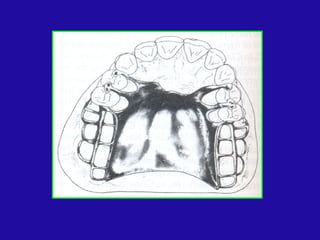
 In the maxillary arch the crest of residualIn the maxillary arch the crest of residual
ridge is the primary stress bearing area toridge is the primary stress bearing area to
vertically directed forcesvertically directed forces
 Some resistance are also offered by buccalSome resistance are also offered by buccal
& lingual slopes of the ridge& lingual slopes of the ridge
Extent of residual ridgeExtent of residual ridge
coverage by denture basecoverage by denture base
 The broader the coverage, the greaterThe broader the coverage, the greater
the distribution of load, which resultsthe distribution of load, which results
in less load per unit areain less load per unit area
 The denture base should cover as muchThe denture base should cover as much
of the residual ridge as possible & beof the residual ridge as possible & be
extended to maximum amount withinextended to maximum amount within
the physiologic tolerance of tissuesthe physiologic tolerance of tissues
Type & accuracy ofType & accuracy of
impression registrationimpression registration
 Residual ridge may have two formsResidual ridge may have two forms
 1.1. ANATOMIC FORMANATOMIC FORM
 2. FUNCTIONAL FORM2. FUNCTIONAL FORM
 Anatomic form is the surface contour ofAnatomic form is the surface contour of
the ridge when it is not supporting anythe ridge when it is not supporting any
loadload
 Functional form is the surfaceFunctional form is the surface
contour of the ridge when it iscontour of the ridge when it is
supporting any functional loadsupporting any functional load
 McLean and others recognized theMcLean and others recognized the
need to record the tissues that support aneed to record the tissues that support a
DEB in their functional form & thenDEB in their functional form & then
relate them to the remainder of the archrelate them to the remainder of the arch
by means of secondary impressionby means of secondary impression
 This was called functional impressionThis was called functional impression
as it recorded the ridge relation underas it recorded the ridge relation under
functionfunction
Accuracy of the fit of theAccuracy of the fit of the
denture basedenture base
 Support of DEB is enhanced bySupport of DEB is enhanced by
intimate contact of tissue surface of theintimate contact of tissue surface of the
base & the tissues that cover thebase & the tissues that cover the
residual ridgeresidual ridge
 The denture base must be related to theThe denture base must be related to the
partial denture frame-work in the samepartial denture frame-work in the same
manner as the basal seat tissues weremanner as the basal seat tissues were
related to the abutment teeth whenrelated to the abutment teeth when
impression was madeimpression was made
DESIGN OF PARTIALDESIGN OF PARTIAL
DENTURE FRAME- WORKDENTURE FRAME- WORK
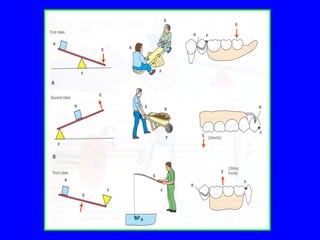
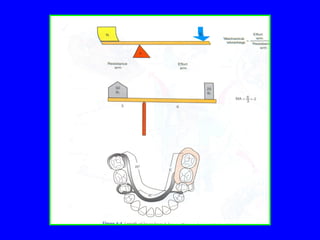
 some rotational movement of DEB aroundsome rotational movement of DEB around
posteriorly placed direct retainers isposteriorly placed direct retainers is
inevitable under functional loadinginevitable under functional loading
 The greatest movement takes place at theThe greatest movement takes place at the
most posterior extent of denture basemost posterior extent of denture base
 As the fulcrum line of denture is movedAs the fulcrum line of denture is moved
anteriorly more of residual ridge is used toanteriorly more of residual ridge is used to
support the denture base, therebysupport the denture base, thereby
distributing stresses over a proportionallydistributing stresses over a proportionally
greater area.greater area.
 Hence use of indirect retainer isHence use of indirect retainer is
recommendedrecommended
TOTAL OCCLUSAL LOADTOTAL OCCLUSAL LOAD
APPLIEDAPPLIED
 It is influenced by number of artificialIt is influenced by number of artificial
teeth, the width of their occlusalteeth, the width of their occlusal
surfaces & their occlusal efficiencysurfaces & their occlusal efficiency
 The reduction of size of occlusal tableThe reduction of size of occlusal table
reduces the vertical & horizontal forcesreduces the vertical & horizontal forces
that act on the partial dentures &that act on the partial dentures &
lessens the stress on abutment teeth &lessens the stress on abutment teeth &
supporting tissuessupporting tissues
support for distal extension partial denture

support for distal extension partial denture

  • 1.
    Support for distalextensionSupport for distal extension Partial DenturePartial Denture
  • 2.
    IntroductionIntroduction  In atooth supported partial denture ,aIn a tooth supported partial denture ,a metal base or the frame-work thatmetal base or the frame-work that supports an acrylic resin base issupports an acrylic resin base is connected to and is part of a rigid frame-connected to and is part of a rigid frame- work that permits the direct transfer ofwork that permits the direct transfer of occlusal forces to abutment teeth throughocclusal forces to abutment teeth through the occlusal restthe occlusal rest
  • 3.
     The resiliencyof ridge tissues ,theThe resiliency of ridge tissues ,the ridge configuration ,and type of boneridge configuration ,and type of bone that supports these tissues are notthat supports these tissues are not factors in denture supportfactors in denture support  Hence the abutments are the soleHence the abutments are the sole support for the RPDsupport for the RPD
  • 6.
    Distal extension dentureDistalextension denture basebase  DEB does not have the advantage ofDEB does not have the advantage of total tooth support as one or moretotal tooth support as one or more bases are extensions covering thebases are extensions covering the residual ridge distal to last abutmentresidual ridge distal to last abutment teethteeth  Therefore it is dependent on theTherefore it is dependent on the residual ridge for a portion of support,residual ridge for a portion of support, stability, and retentionstability, and retention
  • 11.
    Factors influencing supportofFactors influencing support of DEBDEB  Contour and quality of residual ridgeContour and quality of residual ridge  Extent of residual ridge coverage of dentureExtent of residual ridge coverage of denture basebase  Type and accuracy of impressionType and accuracy of impression registrationregistration  Accuracy of fit of denture baseAccuracy of fit of denture base  Design of partial denture frame-workDesign of partial denture frame-work  Total occlusal load appliedTotal occlusal load applied
  • 13.
    Contour and qualityofContour and quality of residual ridgeresidual ridge
  • 14.
     The idealresidual ridge to support aThe ideal residual ridge to support a denture base would consist of corticaldenture base would consist of cortical bone that covers a dense cancellousbone that covers a dense cancellous bone, with a broad rounded crest withbone, with a broad rounded crest with high vertical slopes and covered byhigh vertical slopes and covered by firm,dense fibrous connective tissuefirm,dense fibrous connective tissue  Easily displaceable tissues will notEasily displaceable tissues will not adequately support a denture baseadequately support a denture base
  • 15.
     Buccal shelfarea is better suited forBuccal shelf area is better suited for primary stress- bearing role as it isprimary stress- bearing role as it is covered by firm, dense, fibrouscovered by firm, dense, fibrous connective tissue supported by corticalconnective tissue supported by cortical bonebone  This region bears more of horizontalThis region bears more of horizontal relationship to vertical forces than torelationship to vertical forces than to other regions of residual ridgeother regions of residual ridge  The slopes of residual ridge wouldThe slopes of residual ridge would become the primary stress – bearingbecome the primary stress – bearing area to resist horizontal or off – verticalarea to resist horizontal or off – vertical forcesforces
  • 22.
     In themaxillary arch the crest of residualIn the maxillary arch the crest of residual ridge is the primary stress bearing area toridge is the primary stress bearing area to vertically directed forcesvertically directed forces  Some resistance are also offered by buccalSome resistance are also offered by buccal & lingual slopes of the ridge& lingual slopes of the ridge
  • 24.
    Extent of residualridgeExtent of residual ridge coverage by denture basecoverage by denture base
  • 25.
     The broaderthe coverage, the greaterThe broader the coverage, the greater the distribution of load, which resultsthe distribution of load, which results in less load per unit areain less load per unit area  The denture base should cover as muchThe denture base should cover as much of the residual ridge as possible & beof the residual ridge as possible & be extended to maximum amount withinextended to maximum amount within the physiologic tolerance of tissuesthe physiologic tolerance of tissues
  • 26.
    Type & accuracyofType & accuracy of impression registrationimpression registration
  • 27.
     Residual ridgemay have two formsResidual ridge may have two forms  1.1. ANATOMIC FORMANATOMIC FORM  2. FUNCTIONAL FORM2. FUNCTIONAL FORM  Anatomic form is the surface contour ofAnatomic form is the surface contour of the ridge when it is not supporting anythe ridge when it is not supporting any loadload  Functional form is the surfaceFunctional form is the surface contour of the ridge when it iscontour of the ridge when it is supporting any functional loadsupporting any functional load
  • 28.
     McLean andothers recognized theMcLean and others recognized the need to record the tissues that support aneed to record the tissues that support a DEB in their functional form & thenDEB in their functional form & then relate them to the remainder of the archrelate them to the remainder of the arch by means of secondary impressionby means of secondary impression  This was called functional impressionThis was called functional impression as it recorded the ridge relation underas it recorded the ridge relation under functionfunction
  • 29.
    Accuracy of thefit of theAccuracy of the fit of the denture basedenture base
  • 30.
     Support ofDEB is enhanced bySupport of DEB is enhanced by intimate contact of tissue surface of theintimate contact of tissue surface of the base & the tissues that cover thebase & the tissues that cover the residual ridgeresidual ridge  The denture base must be related to theThe denture base must be related to the partial denture frame-work in the samepartial denture frame-work in the same manner as the basal seat tissues weremanner as the basal seat tissues were related to the abutment teeth whenrelated to the abutment teeth when impression was madeimpression was made
  • 31.
    DESIGN OF PARTIALDESIGNOF PARTIAL DENTURE FRAME- WORKDENTURE FRAME- WORK
  • 32.
     some rotationalmovement of DEB aroundsome rotational movement of DEB around posteriorly placed direct retainers isposteriorly placed direct retainers is inevitable under functional loadinginevitable under functional loading  The greatest movement takes place at theThe greatest movement takes place at the most posterior extent of denture basemost posterior extent of denture base  As the fulcrum line of denture is movedAs the fulcrum line of denture is moved anteriorly more of residual ridge is used toanteriorly more of residual ridge is used to support the denture base, therebysupport the denture base, thereby distributing stresses over a proportionallydistributing stresses over a proportionally greater area.greater area.  Hence use of indirect retainer isHence use of indirect retainer is recommendedrecommended
  • 34.
    TOTAL OCCLUSAL LOADTOTALOCCLUSAL LOAD APPLIEDAPPLIED
  • 35.
     It isinfluenced by number of artificialIt is influenced by number of artificial teeth, the width of their occlusalteeth, the width of their occlusal surfaces & their occlusal efficiencysurfaces & their occlusal efficiency  The reduction of size of occlusal tableThe reduction of size of occlusal table reduces the vertical & horizontal forcesreduces the vertical & horizontal forces that act on the partial dentures &that act on the partial dentures & lessens the stress on abutment teeth &lessens the stress on abutment teeth & supporting tissuessupporting tissues