ANATOMY AND PHYSIOLOGY OF
THE CONJUNCTIVA
Presented By
Arundhati Hatikakoty
Bachelor of Optometry 3rd year
Roll no- 302
Introduction
Conjoin = to join
So the name conjuctiva has
been given to this mucous
membrane owing to the fact
that it joins the eyeball to
the lids
It is a translucent mucous
membrane which lines the
posterior surface of the
eyelids and anterior aspect
of the eyeball
The normal conjuctiva is
o Pink
o Smooth
o Thin
o Transparent
There are normally
large deep blood vesells
that run vertically
Functions of conjunctiva
The conjunctiva helps lubricate the eye by
producing mucus and tears, although a
smaller volume of tears than the lacrimal
gland
It also contributes to immune surveillance and
helps to prevent the entrance of microbes into
the eye
Parts of the conjunctiva
Conjunctiva
Palpebral
Marginal
Tarsal
Orbital
Bulbar
Scleral Limbal
Fornix
Superior
Inferior
Lateral
Medial
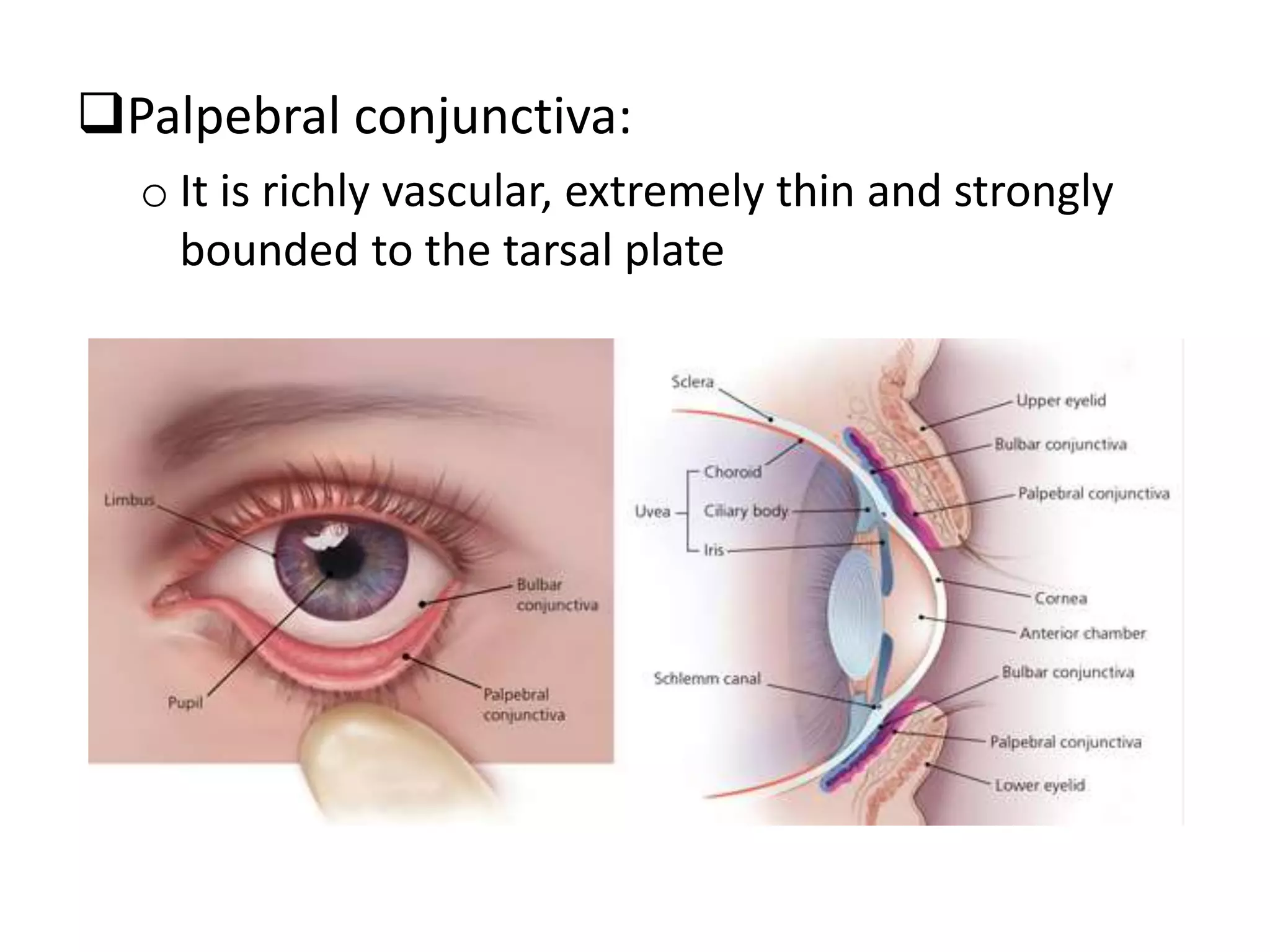
Palpebral conjunctiva:
o It is richly vascular, extremely thin and strongly
bounded to the tarsal plate
o It lines the lids and is subdivided into
marginal
tarsal
orbital
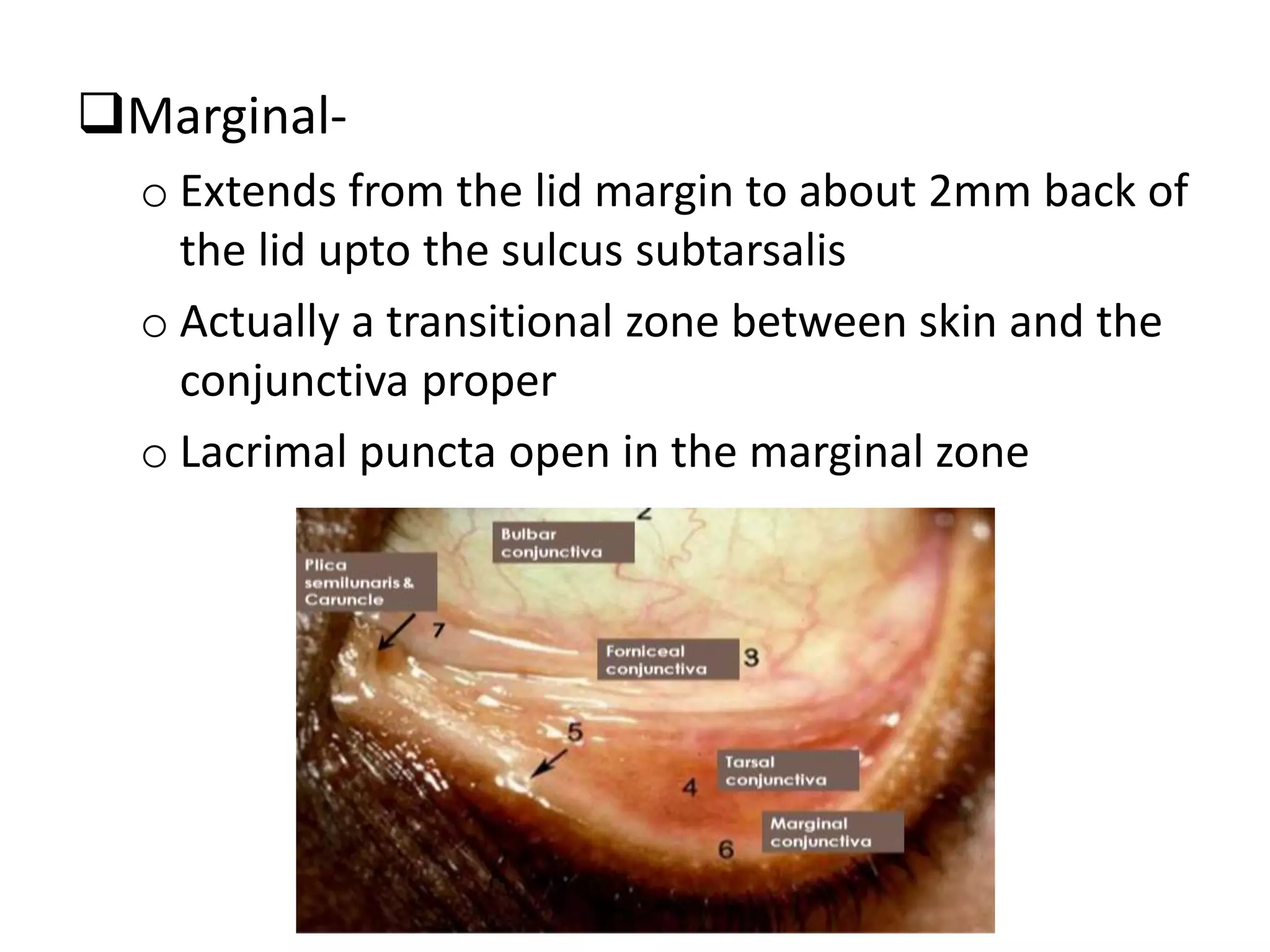
Marginal-
o Extends from the lid margin to about 2mm back of
the lid upto the sulcus subtarsalis
o Actually a transitional zone between skin and the
conjunctiva proper
o Lacrimal puncta open in the marginal zone
Tarsal-
o Thin, transparent and highly vascular
o Firmly adherent to the whole tarsal plate in the
upper lid and only to half width of the tarsus in
the lower lid
o The tarsal glands are seen through it as yellow
streaks
Orbital-
o It lies loose between the tarsal plate and the
fornix
o Orbital margin of the upper eyelid is loose and lies
over the muller’s muscle
Bulbar conjunctiva-
o It is transparent and lies
loose over the
underlying structures
and thus can be moved
easily
o It is separated from the
anterior sclera by
episcleral tissue and
tenon’s capsule
o The average thickness is 33 microns
o It is also known as ocular conjunctiva
o It is further of two types
Limbal
Scleral
Limbal-
o A 3mm ridge of bulbar conjunctiva around the
cornea is called limbal conjunctiva
o Strongly adherent to sclero-corneal junction
Scleral-
o Covers the eyeball above the anterior sclera and
hence known as scleral conjunctiva
o Thin, transparent & loosely attached to underlying
sclera
o Separated from the sclera by episcleral vessels and
Tenon’s capsule
Conjunctival fornix:
o It is thin, transparent , continuous circular cul-de-
sac
o It is broken only on the medial side by caruncle
and the plica semilunaris
o It joins the bulbar conjunctiva with the palpebral
conjunctiva
Superior
Lateral
Medial
inferior
 It is further of four types
Superior
o Located at the level of superior orbital margin
o Extends from slightly upper border of the tarsal
plate to a distance about 10mm from the upper
limbus
o Here we can find the glands of Krause and
Mullers’s muscle in the subconjunctival tissue
Inferior fornix
o Extends from slightly below the lower border of
the lower tarsal plate to a distance about 8mm
from the lower limbus
o Located near the inferior orbital margin
o Helps in maintaining the recess of the inferior
fornix during movements of the lower lid
Lateral
o Small in size like a cul de sac
o Extends to just behind the equator of the eyeball
o It is 14mm from the lateral limbus and about 5mm
from the lateral canthus
Medial
o It is a shallow cul de sac in which lie the caruncle
and plica seminlunaris dipped in pool of tears
called as tear lake
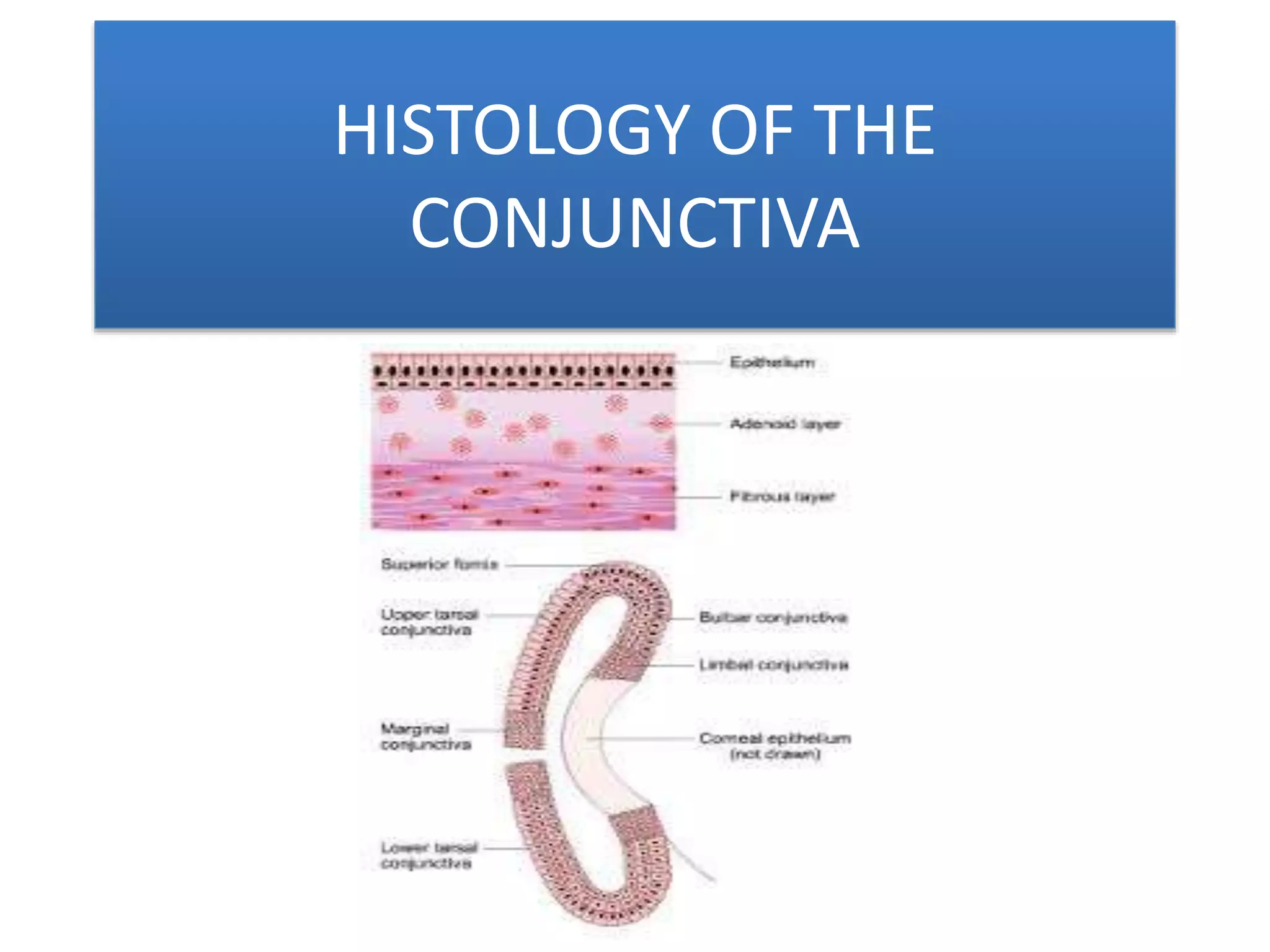
HISTOLOGY OF THE
CONJUNCTIVA
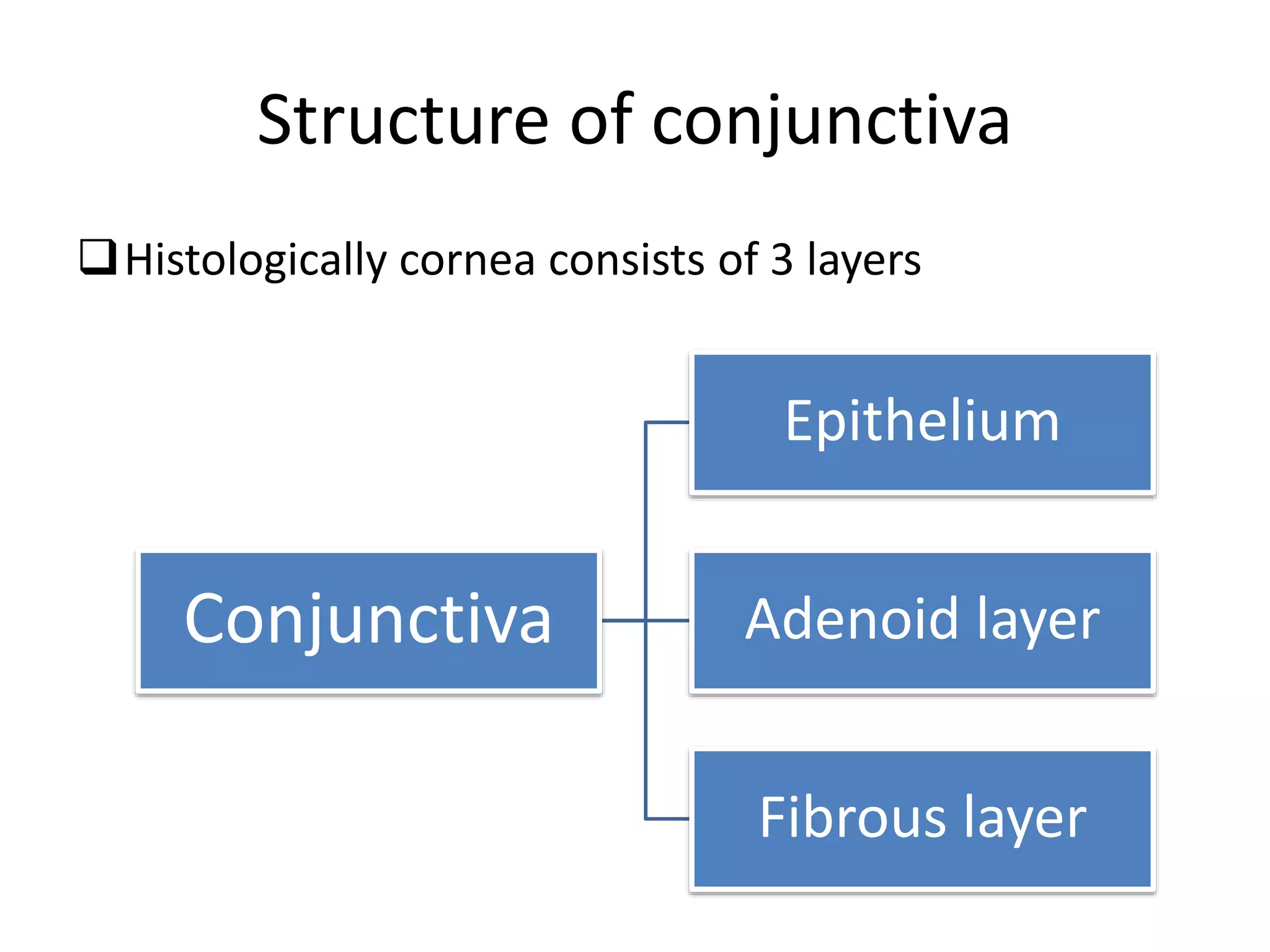
Structure of conjunctiva
Histologically cornea consists of 3 layers
Conjunctiva
Epithelium
Adenoid layer
Fibrous layer
Epithelium
a. The layers of epithelial cells in the conjunctiva
vary from region to region and its different parts
are
oMarginal conjunctiva-
o Have 5 layers non keratinised stratified squamous type of
epithelium
o Superficial layer- squamous cell
o Intermediate 3 layers- polyhedral cells
o Deepest layer- goblet cells
oTarsal conjunctiva-
o Has 2 layer epithelium in the upper eyelid
o Superficial layer- cylindrical cells
o Deep layers- cubical cells
o Lower tarsal conjunctiva is made of 3-4 layers of cells like the
cubical, polygonal, elongated wedge shaped and cone shaped
cells
The Epithelium
The Adenoid
Layer
The Fibrous
Layer
The Epithelium
o Fornix and bulbar conjunctiva
o 3 layered epithelium
o Superficial layer- cylindrical ells
o Middle layer- polyhedral cells
o Deep layer- cuboidal cells
o Limbal conjunctiva
o 8-10 layers of stratified squamous epithelium
o Most superficial 1-2 layers- squamous cells
o Intermediate several layers- polygonal cells
o Basal layer- cylindrical or cubical cells
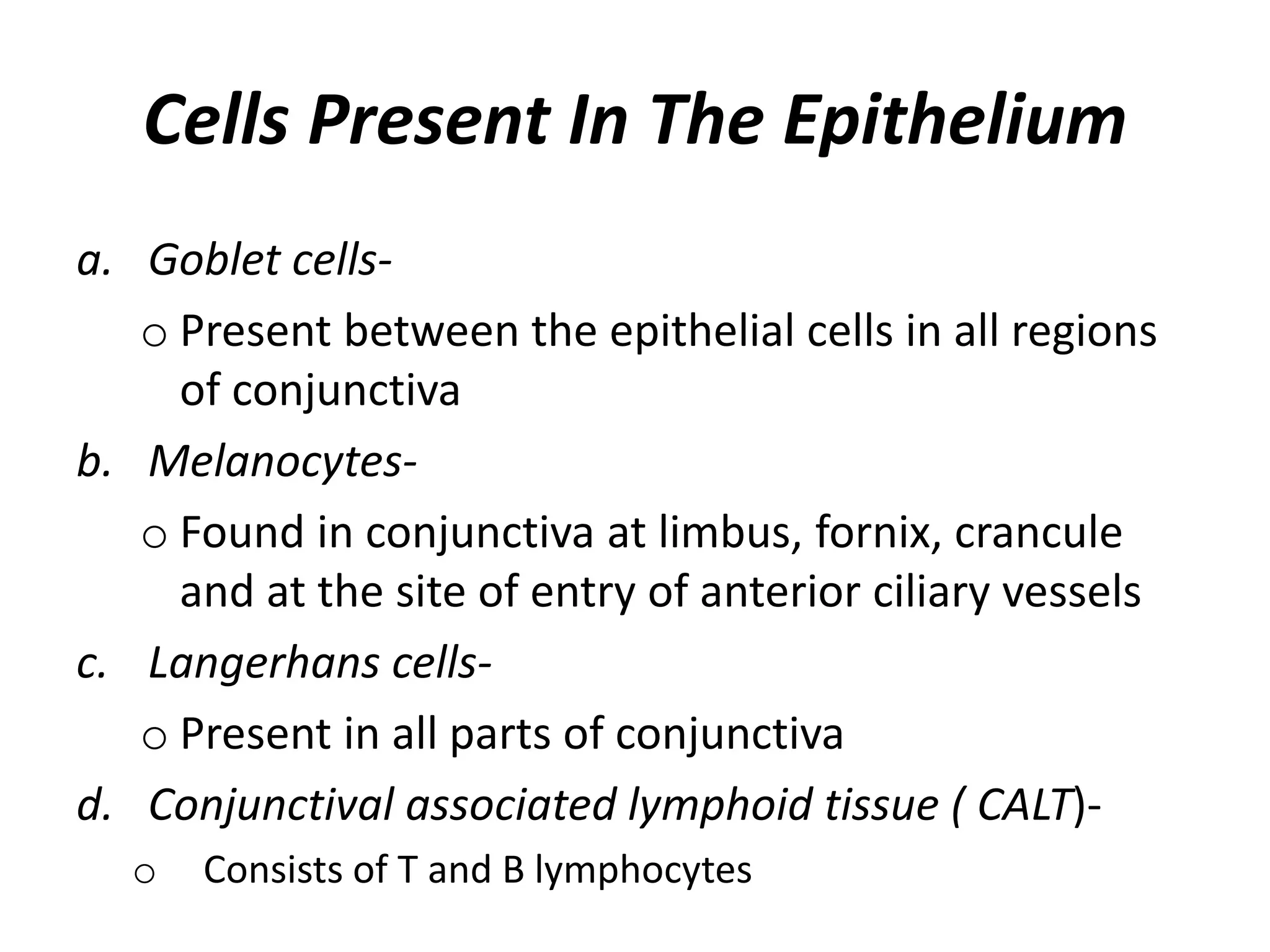
Cells Present In The Epithelium
a. Goblet cells-
o Present between the epithelial cells in all regions
of conjunctiva
b. Melanocytes-
o Found in conjunctiva at limbus, fornix, crancule
and at the site of entry of anterior ciliary vessels
c. Langerhans cells-
o Present in all parts of conjunctiva
d. Conjunctival associated lymphoid tissue ( CALT)-
o Consists of T and B lymphocytes
d. Mucosal associated lymphoid tissue(MALT)
o MALT of the gut and bronchi are also found in the
conjunctiva
Adenoid layer
o Also called as lymphoid
layer
o Consists of fine
connective tissue
reticulum in the meshes
of which lie the
lymphocytes
o Most developed in the
fornices and ends at the
subtarsal fold
o Develops after 2-3
months of life
The Adenoid Layer
 Fibrous layer
o Consists of a meshwork of collagenous and elastic
fibres
o Thicker than the adenoid layer
o Except in the tarsal conjunctiva where it is very
thin
o This layer consist vessels and nerves of the
conjunctiva
o The adenoid layer and the fibrous layer are
collectively called as substantia propia
The Epithelium
The Adenoid
Layer
The Fibrous
Layer
The fibrous layer
Conjunctival glands
Mucin
secretory
glans
• Goblet cells
• Crypts of henle
• Glands of manz
Acessory
lacrimal
glands
• Glands of krause
• Glands of
wolfring
 Goblet cells
o Round or oval in shape with
an eccentric flat nucleus
o Unicellular mucous cells
located abundantly within
the epithelium of all regions
of conjunctiva
o These cells are formed from
the deepest cells of the
conjunctiva
o Once discharging their
content- the mucin they are
destroyed
o Density is more in children
than adults
o More in the bulbar
conjunctiva and inferior
fornix
Henle’s glands
o Not true glands but folds of mucous membrane
present in the palpebral conjunctiva
o These are tubular structures with lumina of 15-30
µm
Glands of manz
o Found in limbal conjunctiva in animals
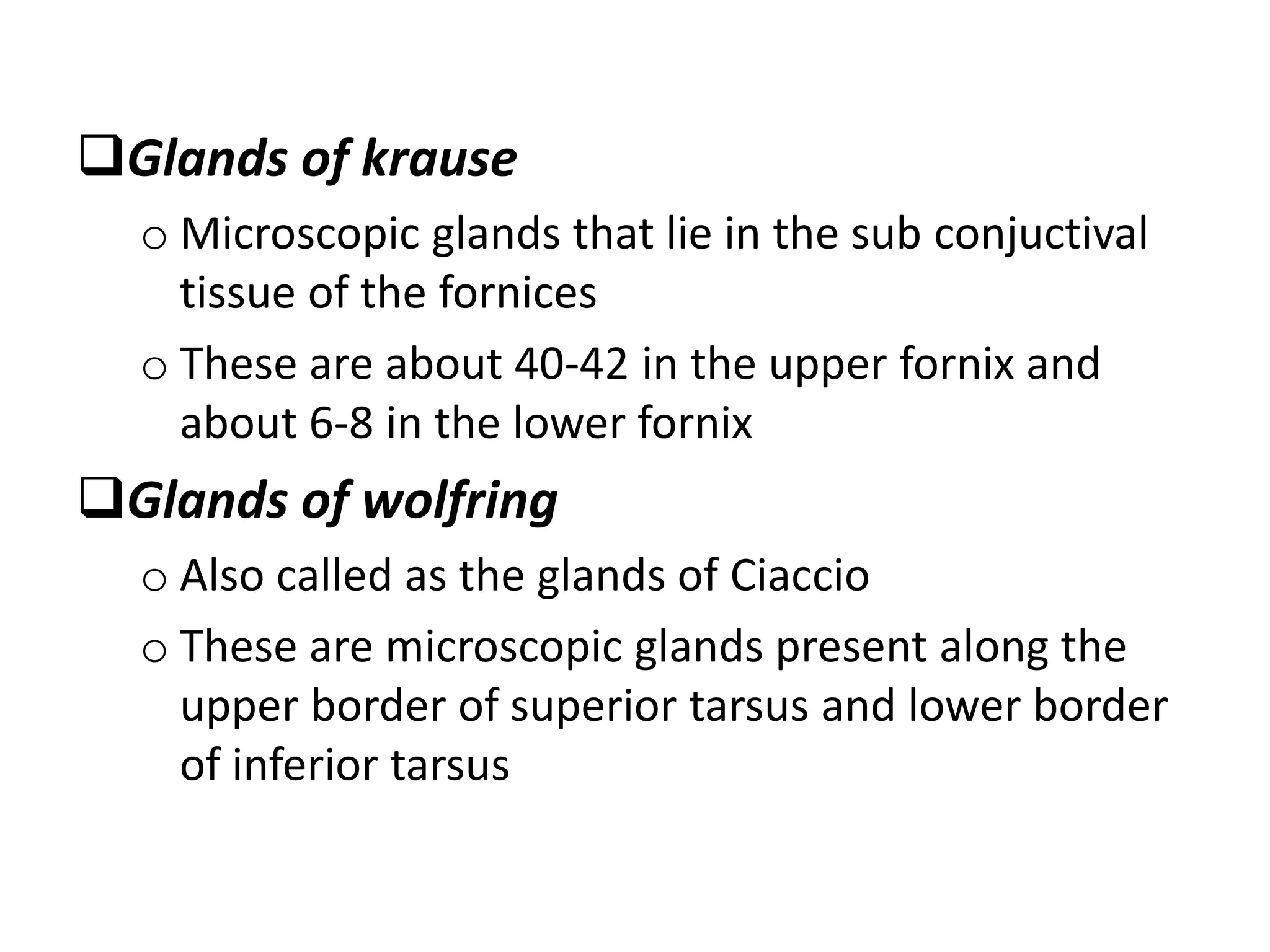
Glands of krause
o Microscopic glands that lie in the sub conjuctival
tissue of the fornices
o These are about 40-42 in the upper fornix and
about 6-8 in the lower fornix
Glands of wolfring
o Also called as the glands of Ciaccio
o These are microscopic glands present along the
upper border of superior tarsus and lower border
of inferior tarsus
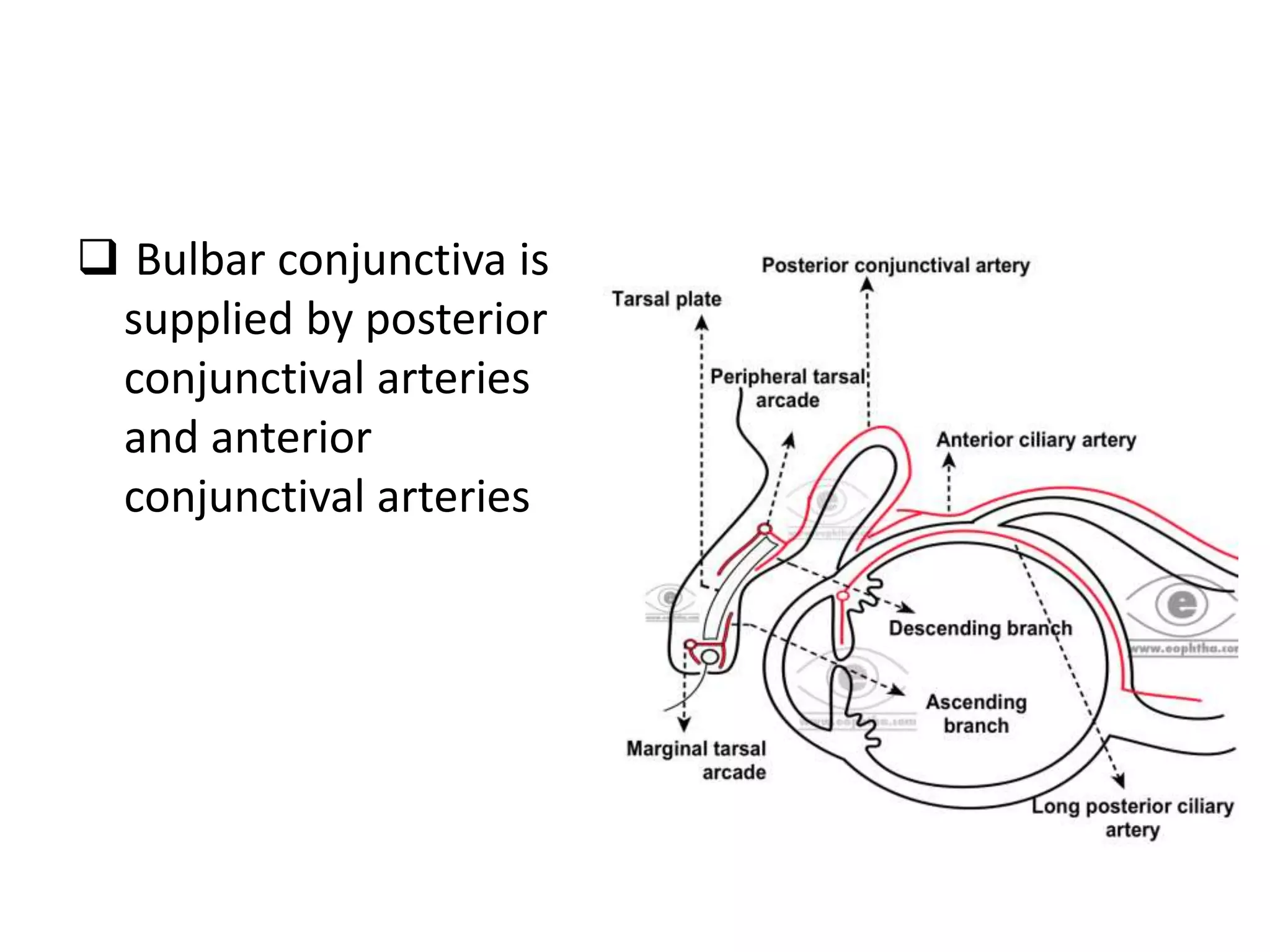
Blood supply
Arteries supplying the conjunctiva are derived
from 3 sources. They are:
1. Marginal arcade of the eyelid
2. Peripheral arterial arcade of the eyelid
3. Anterior ciliary artery
 The palpebral conjunctiva and the fornices
are supplied by branches from the marginal
and peripheral arcades of the artery
 Bulbar conjunctiva is
supplied by posterior
conjunctival arteries
and anterior
conjunctival arteries
Venous drainage
The veins from
conjunctiva drain into
the venous plexus of
eyelids which in turn
drain into the superior
and inferior ophthalmic
veins.
A cicumcorneal zone of
limbus drain into the
anterior cilliary veins
Lymphatic drainage
Lymphatics from the
lateral side drain into
the periauricular lymph
nodes
The lymphatics from
the medial side drain
the submandibular
lymph nodes
Nerve supply
A circumcorneal zone of the conjunctiva is supplied
from the long ciliary nerves
Rest of the conjunctiva is supplied by the branches
from the lacrimal, infratrochlear, supratrochlear,
supraorbital and the frontal nevers
Anatomy
References-
o AK Khurana, Anatomy and physiology of the eye 2nd
edition, page no- 306-372
o AK Khurana, Comprehensive ophthalmology 4th
edition, page no- 51-54
o AI Lens, Ocular Anatomy and Physiology, page 50-53
o A. M. R. Agur, Grant's Atlas of Anatomy, page 650
o https://en.wikipedia.org/wiki/Conjunctiva#Function
o https://www.slideshare.net/pranaykumarshinde/conj
unctiva-anatomy-and-physiology?qid=5cf7b98a-e6f5-
4369-bccd-0b1168d7d77e&v=&b=&from_search=6
THANK YOU

Anatomy of the conjunctiva

  • 1.
    ANATOMY AND PHYSIOLOGYOF THE CONJUNCTIVA Presented By Arundhati Hatikakoty Bachelor of Optometry 3rd year Roll no- 302
  • 2.
    Introduction Conjoin = tojoin So the name conjuctiva has been given to this mucous membrane owing to the fact that it joins the eyeball to the lids It is a translucent mucous membrane which lines the posterior surface of the eyelids and anterior aspect of the eyeball
  • 3.
    The normal conjuctivais o Pink o Smooth o Thin o Transparent There are normally large deep blood vesells that run vertically
  • 4.
    Functions of conjunctiva Theconjunctiva helps lubricate the eye by producing mucus and tears, although a smaller volume of tears than the lacrimal gland It also contributes to immune surveillance and helps to prevent the entrance of microbes into the eye
  • 5.
    Parts of theconjunctiva
  • 6.
    Parts of theconjunctiva Conjunctiva Palpebral Marginal Tarsal Orbital Bulbar Scleral Limbal Fornix Superior Inferior Lateral Medial
  • 7.
    Palpebral conjunctiva: o Itis richly vascular, extremely thin and strongly bounded to the tarsal plate
  • 8.
    o It linesthe lids and is subdivided into marginal tarsal orbital
  • 9.
    Marginal- o Extends fromthe lid margin to about 2mm back of the lid upto the sulcus subtarsalis o Actually a transitional zone between skin and the conjunctiva proper o Lacrimal puncta open in the marginal zone
  • 10.
    Tarsal- o Thin, transparentand highly vascular o Firmly adherent to the whole tarsal plate in the upper lid and only to half width of the tarsus in the lower lid o The tarsal glands are seen through it as yellow streaks
  • 11.
    Orbital- o It liesloose between the tarsal plate and the fornix o Orbital margin of the upper eyelid is loose and lies over the muller’s muscle
  • 12.
    Bulbar conjunctiva- o Itis transparent and lies loose over the underlying structures and thus can be moved easily o It is separated from the anterior sclera by episcleral tissue and tenon’s capsule
  • 13.
    o The averagethickness is 33 microns o It is also known as ocular conjunctiva o It is further of two types Limbal Scleral
  • 14.
    Limbal- o A 3mmridge of bulbar conjunctiva around the cornea is called limbal conjunctiva o Strongly adherent to sclero-corneal junction Scleral- o Covers the eyeball above the anterior sclera and hence known as scleral conjunctiva o Thin, transparent & loosely attached to underlying sclera o Separated from the sclera by episcleral vessels and Tenon’s capsule
  • 15.
    Conjunctival fornix: o Itis thin, transparent , continuous circular cul-de- sac o It is broken only on the medial side by caruncle and the plica semilunaris o It joins the bulbar conjunctiva with the palpebral conjunctiva
  • 16.
  • 17.
    Superior o Located atthe level of superior orbital margin o Extends from slightly upper border of the tarsal plate to a distance about 10mm from the upper limbus o Here we can find the glands of Krause and Mullers’s muscle in the subconjunctival tissue
  • 18.
    Inferior fornix o Extendsfrom slightly below the lower border of the lower tarsal plate to a distance about 8mm from the lower limbus o Located near the inferior orbital margin o Helps in maintaining the recess of the inferior fornix during movements of the lower lid
  • 19.
    Lateral o Small insize like a cul de sac o Extends to just behind the equator of the eyeball o It is 14mm from the lateral limbus and about 5mm from the lateral canthus Medial o It is a shallow cul de sac in which lie the caruncle and plica seminlunaris dipped in pool of tears called as tear lake
  • 20.
  • 21.
    Structure of conjunctiva Histologicallycornea consists of 3 layers Conjunctiva Epithelium Adenoid layer Fibrous layer
  • 22.
    Epithelium a. The layersof epithelial cells in the conjunctiva vary from region to region and its different parts are oMarginal conjunctiva- o Have 5 layers non keratinised stratified squamous type of epithelium o Superficial layer- squamous cell o Intermediate 3 layers- polyhedral cells o Deepest layer- goblet cells oTarsal conjunctiva- o Has 2 layer epithelium in the upper eyelid o Superficial layer- cylindrical cells o Deep layers- cubical cells o Lower tarsal conjunctiva is made of 3-4 layers of cells like the cubical, polygonal, elongated wedge shaped and cone shaped cells
  • 23.
    The Epithelium The Adenoid Layer TheFibrous Layer The Epithelium
  • 24.
    o Fornix andbulbar conjunctiva o 3 layered epithelium o Superficial layer- cylindrical ells o Middle layer- polyhedral cells o Deep layer- cuboidal cells o Limbal conjunctiva o 8-10 layers of stratified squamous epithelium o Most superficial 1-2 layers- squamous cells o Intermediate several layers- polygonal cells o Basal layer- cylindrical or cubical cells
  • 25.
    Cells Present InThe Epithelium a. Goblet cells- o Present between the epithelial cells in all regions of conjunctiva b. Melanocytes- o Found in conjunctiva at limbus, fornix, crancule and at the site of entry of anterior ciliary vessels c. Langerhans cells- o Present in all parts of conjunctiva d. Conjunctival associated lymphoid tissue ( CALT)- o Consists of T and B lymphocytes
  • 26.
    d. Mucosal associatedlymphoid tissue(MALT) o MALT of the gut and bronchi are also found in the conjunctiva
  • 27.
    Adenoid layer o Alsocalled as lymphoid layer o Consists of fine connective tissue reticulum in the meshes of which lie the lymphocytes o Most developed in the fornices and ends at the subtarsal fold o Develops after 2-3 months of life The Adenoid Layer
  • 28.
     Fibrous layer oConsists of a meshwork of collagenous and elastic fibres o Thicker than the adenoid layer o Except in the tarsal conjunctiva where it is very thin o This layer consist vessels and nerves of the conjunctiva o The adenoid layer and the fibrous layer are collectively called as substantia propia
  • 29.
    The Epithelium The Adenoid Layer TheFibrous Layer The fibrous layer
  • 30.
    Conjunctival glands Mucin secretory glans • Gobletcells • Crypts of henle • Glands of manz Acessory lacrimal glands • Glands of krause • Glands of wolfring
  • 32.
     Goblet cells oRound or oval in shape with an eccentric flat nucleus o Unicellular mucous cells located abundantly within the epithelium of all regions of conjunctiva o These cells are formed from the deepest cells of the conjunctiva o Once discharging their content- the mucin they are destroyed o Density is more in children than adults o More in the bulbar conjunctiva and inferior fornix
  • 33.
    Henle’s glands o Nottrue glands but folds of mucous membrane present in the palpebral conjunctiva o These are tubular structures with lumina of 15-30 µm Glands of manz o Found in limbal conjunctiva in animals
  • 34.
    Glands of krause oMicroscopic glands that lie in the sub conjuctival tissue of the fornices o These are about 40-42 in the upper fornix and about 6-8 in the lower fornix Glands of wolfring o Also called as the glands of Ciaccio o These are microscopic glands present along the upper border of superior tarsus and lower border of inferior tarsus
  • 35.
    Blood supply Arteries supplyingthe conjunctiva are derived from 3 sources. They are: 1. Marginal arcade of the eyelid 2. Peripheral arterial arcade of the eyelid 3. Anterior ciliary artery  The palpebral conjunctiva and the fornices are supplied by branches from the marginal and peripheral arcades of the artery
  • 36.
     Bulbar conjunctivais supplied by posterior conjunctival arteries and anterior conjunctival arteries
  • 37.
    Venous drainage The veinsfrom conjunctiva drain into the venous plexus of eyelids which in turn drain into the superior and inferior ophthalmic veins. A cicumcorneal zone of limbus drain into the anterior cilliary veins
  • 38.
    Lymphatic drainage Lymphatics fromthe lateral side drain into the periauricular lymph nodes The lymphatics from the medial side drain the submandibular lymph nodes
  • 39.
    Nerve supply A circumcornealzone of the conjunctiva is supplied from the long ciliary nerves Rest of the conjunctiva is supplied by the branches from the lacrimal, infratrochlear, supratrochlear, supraorbital and the frontal nevers
  • 41.
  • 42.
    References- o AK Khurana,Anatomy and physiology of the eye 2nd edition, page no- 306-372 o AK Khurana, Comprehensive ophthalmology 4th edition, page no- 51-54 o AI Lens, Ocular Anatomy and Physiology, page 50-53 o A. M. R. Agur, Grant's Atlas of Anatomy, page 650 o https://en.wikipedia.org/wiki/Conjunctiva#Function o https://www.slideshare.net/pranaykumarshinde/conj unctiva-anatomy-and-physiology?qid=5cf7b98a-e6f5- 4369-bccd-0b1168d7d77e&v=&b=&from_search=6
  • 43.