Anatomy of Conjunctiva
Optomety Fans
www.optometry.fans
Anatomy of Conjunctiva
• Conjunctiva is a transparent mucous membrane
which lines the posterior surface of the eyelids
and anterior of the eyeball.
• The name conjunctiva has been given to this
mucous membrane due to the fact that it joins the
eyeball to the lids.
• It stretches from the lid margin to the limbus, and
encloses a complex space called conjunctival sac
which is open in front at the palpebral fissure
PARTS OF CONJUNCTIVA
1. Palpebral Conjunctiva
• Marginal Conjunctiva
• Tarsal Conjunctiva
• Orbital Conjunctiva
2. Bulbar Conjunctiva
3. Conjunctival fornix
Conjunctiva
Palpebral
Conjunctiva
Marginal
Conjunctiva
Tarsal
Conjunctiva
Orbital
Conjunctiva
Bulbar
Conjunctiva
Limbal
Conjunctiva
Conjunctival
fornix
Superior Fornix
Inferior Fornix
Lateral Fornix
Medial Fornix
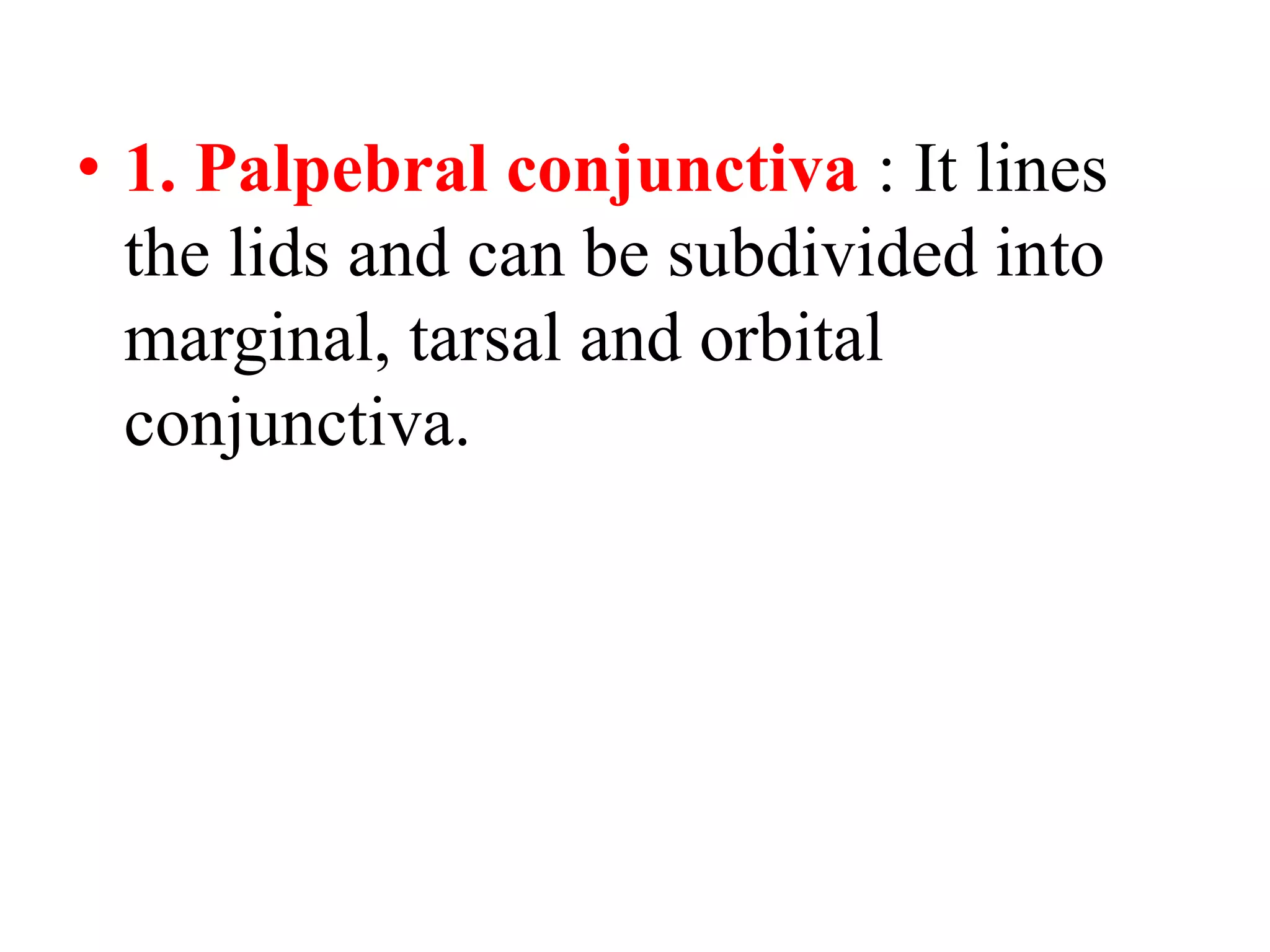
• 1. Palpebral conjunctiva : It lines
the lids and can be subdivided into
marginal, tarsal and orbital
conjunctiva.
Marginal conjunctiva
• It extends from the lid margin to about 2 mm
on the back of lid up to a shallow groove, the
sulcus subtarsalis.
• It is actually a transitional zone between skin
and the conjunctiva proper
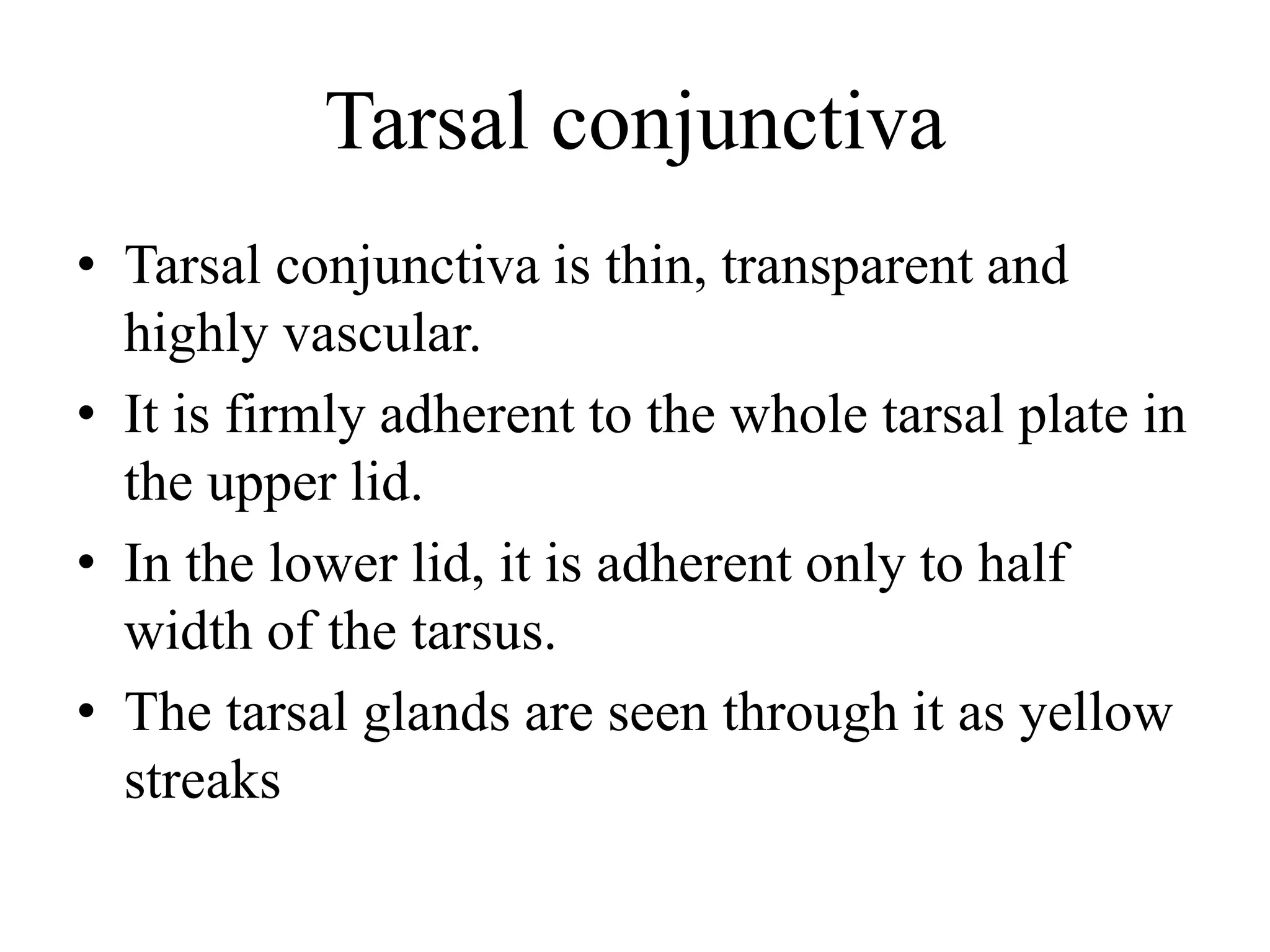
Tarsal conjunctiva
• Tarsal conjunctiva is thin, transparent and
highly vascular.
• It is firmly adherent to the whole tarsal plate in
the upper lid.
• In the lower lid, it is adherent only to half
width of the tarsus.
• The tarsal glands are seen through it as yellow
streaks
Orbital conjunctiva
• Orbital part of palpebral conjunctiva lies loose
between the tarsal plate and fornix.
Bulbar Conjunctiva
• It is thin, transparent and lies loose over the underlying
structures and thus can be moved easily.
• It is separated from the anterior sclera by episcleral
tissue and Tenon’s capsule.
• A 3 mm ridge of bulbar conjunctiva around the cornea
is called limbal conjunctiva.
• In the area of limbus, the conjunctiva, Tenon’s capsule
and the episcleral tissue are fused into a dense tissue
which is strongly adherent to the underlying
corneoscleral junction.
• At the limbus, the epithelium of conjunctiva becomes
continuous with that of cornea
Conjunctival Fornix
• It is a continuous circular culde-sac which is
broken only on the medial side by caruncle and
the plica semilunaris.
• Conjunctival fornix joins the bulbar
conjunctiva with the palpebral conjunctiva.
• It can be subdivided into superior, inferior,
medial and lateral fornices
Structure of conjunctiva
• Histologically the conjunctiva consists of three
layers namely
• Epithelium
• Adenoid layer
• Fibrous layer
Glands of conjunctiva
Gland of Conjunctiva
Mucine secretory gland
Goblet cell
Crypts of
henle
Gland of
Manz
Accessory Lacrimal Gland
Gland of Krause
Gland of Wolfrings
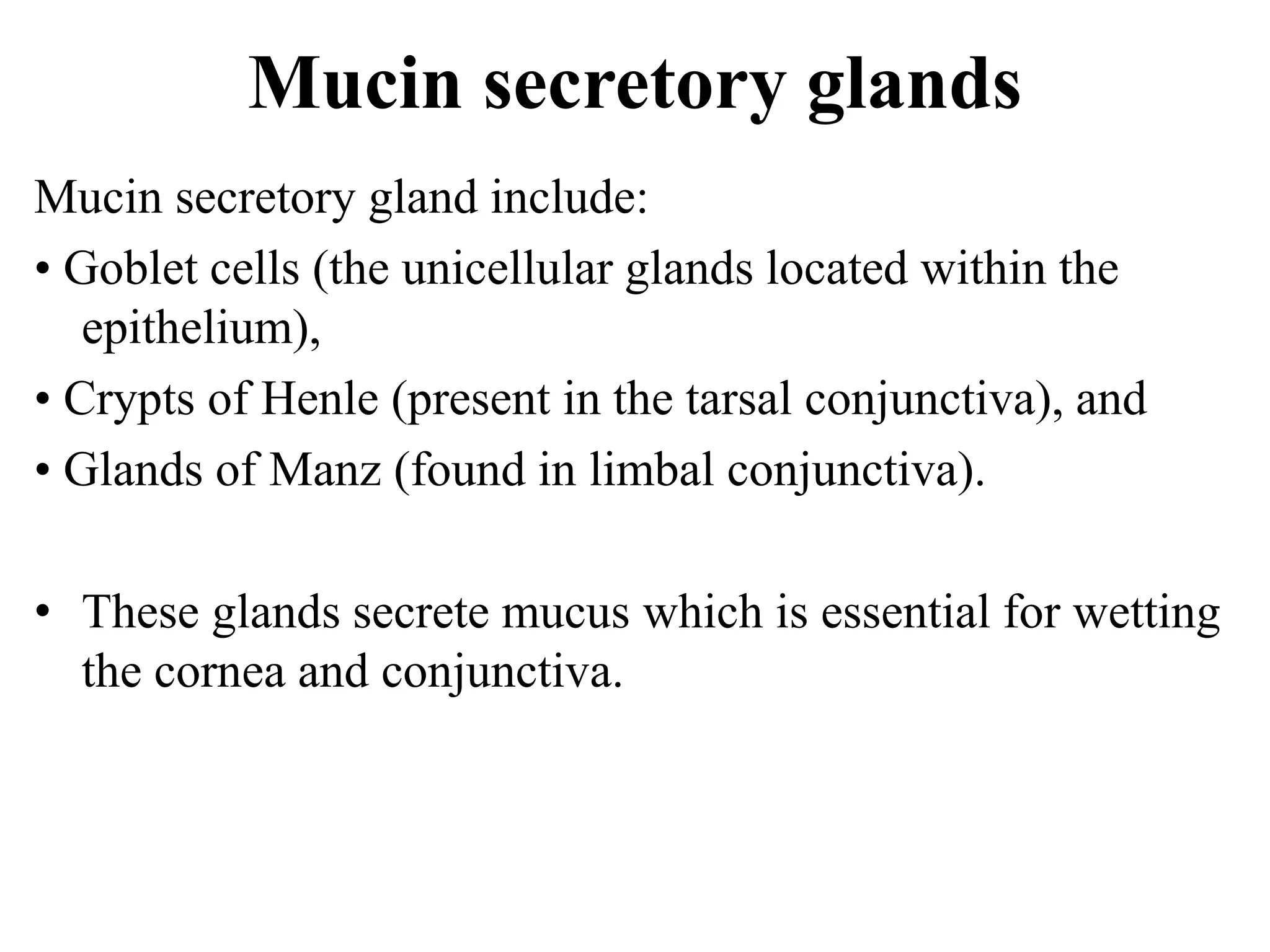
Mucin secretory glands
Mucin secretory gland include:
• Goblet cells (the unicellular glands located within the
epithelium),
• Crypts of Henle (present in the tarsal conjunctiva), and
• Glands of Manz (found in limbal conjunctiva).
• These glands secrete mucus which is essential for wetting
the cornea and conjunctiva.
Accessory lacrimal glands
Accessory lacrimal glands includes..
• Glands of Krause, present in subconjunctival
connective tissue of fornices, about 42 in the
upper fornix and 8 in the lower fornix, and
• Glands of Wolfring, present along the upper
border of superior tarsus and along the lower
border of inferior tarsus.
Plica semilunaris
• It is a pinkish crescentric fold of conjunctiva,
present in the medial canthus.
• Its lateral free border is concave.
• It is a vestigeal structure in human beings and
represents the nictitating membrane of lower
animals
Caruncle
• The caruncle is a small, ovoid, pinkish mass,
situated in the inner canthus, just medial to the
plica semilunaris.
• In reality, it is a piece of modified skin and so
is covered with stratified squamous epithelium
and contains sweat glands, sebaceous glands
and hair follicles.
Anatomy of conjunctiva.pptx

Anatomy of conjunctiva.pptx

  • 1.
    Anatomy of Conjunctiva OptometyFans www.optometry.fans
  • 2.
    Anatomy of Conjunctiva •Conjunctiva is a transparent mucous membrane which lines the posterior surface of the eyelids and anterior of the eyeball. • The name conjunctiva has been given to this mucous membrane due to the fact that it joins the eyeball to the lids. • It stretches from the lid margin to the limbus, and encloses a complex space called conjunctival sac which is open in front at the palpebral fissure
  • 4.
    PARTS OF CONJUNCTIVA 1.Palpebral Conjunctiva • Marginal Conjunctiva • Tarsal Conjunctiva • Orbital Conjunctiva 2. Bulbar Conjunctiva 3. Conjunctival fornix
  • 5.
  • 6.
    • 1. Palpebralconjunctiva : It lines the lids and can be subdivided into marginal, tarsal and orbital conjunctiva.
  • 7.
    Marginal conjunctiva • Itextends from the lid margin to about 2 mm on the back of lid up to a shallow groove, the sulcus subtarsalis. • It is actually a transitional zone between skin and the conjunctiva proper
  • 8.
    Tarsal conjunctiva • Tarsalconjunctiva is thin, transparent and highly vascular. • It is firmly adherent to the whole tarsal plate in the upper lid. • In the lower lid, it is adherent only to half width of the tarsus. • The tarsal glands are seen through it as yellow streaks
  • 9.
    Orbital conjunctiva • Orbitalpart of palpebral conjunctiva lies loose between the tarsal plate and fornix.
  • 10.
    Bulbar Conjunctiva • Itis thin, transparent and lies loose over the underlying structures and thus can be moved easily. • It is separated from the anterior sclera by episcleral tissue and Tenon’s capsule. • A 3 mm ridge of bulbar conjunctiva around the cornea is called limbal conjunctiva. • In the area of limbus, the conjunctiva, Tenon’s capsule and the episcleral tissue are fused into a dense tissue which is strongly adherent to the underlying corneoscleral junction. • At the limbus, the epithelium of conjunctiva becomes continuous with that of cornea
  • 11.
    Conjunctival Fornix • Itis a continuous circular culde-sac which is broken only on the medial side by caruncle and the plica semilunaris. • Conjunctival fornix joins the bulbar conjunctiva with the palpebral conjunctiva. • It can be subdivided into superior, inferior, medial and lateral fornices
  • 12.
    Structure of conjunctiva •Histologically the conjunctiva consists of three layers namely • Epithelium • Adenoid layer • Fibrous layer
  • 13.
    Glands of conjunctiva Glandof Conjunctiva Mucine secretory gland Goblet cell Crypts of henle Gland of Manz Accessory Lacrimal Gland Gland of Krause Gland of Wolfrings
  • 14.
    Mucin secretory glands Mucinsecretory gland include: • Goblet cells (the unicellular glands located within the epithelium), • Crypts of Henle (present in the tarsal conjunctiva), and • Glands of Manz (found in limbal conjunctiva). • These glands secrete mucus which is essential for wetting the cornea and conjunctiva.
  • 15.
    Accessory lacrimal glands Accessorylacrimal glands includes.. • Glands of Krause, present in subconjunctival connective tissue of fornices, about 42 in the upper fornix and 8 in the lower fornix, and • Glands of Wolfring, present along the upper border of superior tarsus and along the lower border of inferior tarsus.
  • 16.
    Plica semilunaris • Itis a pinkish crescentric fold of conjunctiva, present in the medial canthus. • Its lateral free border is concave. • It is a vestigeal structure in human beings and represents the nictitating membrane of lower animals
  • 18.
    Caruncle • The caruncleis a small, ovoid, pinkish mass, situated in the inner canthus, just medial to the plica semilunaris. • In reality, it is a piece of modified skin and so is covered with stratified squamous epithelium and contains sweat glands, sebaceous glands and hair follicles.