TUNING FORK
BY - Anant Arun
-Student of B.ASLP From SAIMS
-Date – 11/04/2018
INDEX
 Tuning Fork
 Types of Tuning Fork
 Weber Test
 Rinne Test
 Bing Test
 Schwabach Test
TUNING FORK
 The tuning fork is a device , usually made of steel ,
magnesium or aluminium that is used to tune
musical instruments or by singers to obtain certain
pitches.
 A tuning fork emits a tone at a particular pitch and has
clear musical quality.
 The tuning fork is set into vibration by holding the stem
in the hand and stricking one of the times against a firm
but resilient surface.
 Tuning fork with frequencies less than 512 Hz may be
felt (tactile sensation) making it difficult to use for
assessing auditory sensation
TYPES OF TUNING FORK TESTS.
 Weber Test
 Rinne Test
 Bing Test
 Schwabach Test
 named after the four german otologist who described
them (Martin & Clark , 2003 )
 The schwabach test is no longer used today .
WEBER TEST
 The Weber Test was named after ‘ Ernst Heinnich Weber ‘
 Principle
 Weber test is based on ‘ strenger principle ‘
 Strenger principle : if two tones are identical in all ways
except in loudness the sound will be perceived louder in
better ear.
 Purpose
 The purpose of the weber test is to determine if an
affected ear has a conductive hearing loss or a
sensorineural hearing loss.
 Procedure
 The weber test is performed by placing the stem of the
vibrating tuning fork on the midline of the head ( usually
on the upper forehead )
 The weber test can also be performed with an audiometer by
placing the bone vibrator on the midline of the head.
 Other sites are also used , such as the tap or the back of the
head , the chin or the upper teeth. (In most cases the upper
teeth produces the loudest bone counducted sound)
 The patient is asked to report where he hear the tone , that is
whether he hears the tone in the middle of the head (midline)
or an one side or the other
 The weber test is called a test of lateralization.
 The weber test results are reported as –
1. Weber midline
2. Weber left
3. Weber right ( to indicate where the patient lateralized the
tone)
 Implications
 If the hearing is normal or there is a symmetrical (same on
both side ) conductive sensorineural or mixed hearing loss,
the patient should perceive the tone in the midline or equally
in both ears.
 If the hearing loss is present in only one of the ears , the
patient should not perceive the sound in the midline ,
but should perceive the tone louder in one of the ear (
and not necessarily the good ear )
 If the person perceives the tone in the normal hearing
ear , it means that the affected ear has a sensorineural
hearing loss.
 If the person perceives the tone in the affected ear , it
means that the affected eear has a conductive hearing
loss.
RINNE TEST
 The rinne test was named after German otologist
Heinrich adolf Rinne (1819-1868)
 Principle
 The rinne test is based on the principle that it takes a
greater level of vibration to stimulus by BC than by AC , so
the more efficient AC stimulation is perceived as louder or
can be heard longer.
 Purpose
 The purpose of the rinne test is to determine whether or
not the patient has a conductive hearing loss by
comparing the perception of the tone by BC to the
perception by AC
 Procedure
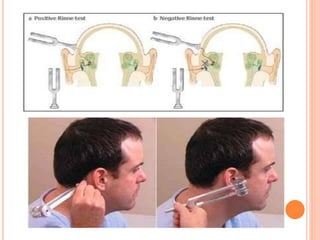
 The rinne test is performed by placing the tuning fork on the
mastoid process to test by BC and then , without restriking
it , moving it next to the auricle to test by AC.
 The tuning fork is moved back and forth a few times
between the mastoid and the auricle and the patient is
asked to report if the tone sounds louder when the tuning
fork is on the mastoid process or when it is next to the
auricle.
 A modification of the rinne test is sometimes used where
the patient indicates when the BC stimulation can no longer
be heard , at which time the tuning fork is moved , without
restriking it , to the AC condition and the patient is asked if
he can hear it again.
 The rinne can be used to test each ear however , the non
test ear must be masked out with a noise in order to be
sure the response is coming from the test ear.
 The Rinne test results are reported as,
1. POSITIVE RINNE
2. NEGATIVE RINNE
 Implications
 In case of conductive hearing loss , the AC tone should be
softer or not heard at all compared to the BC tone . The
Rinne Test is reported as a “negative Rinne“ (or BC>AC).
 In case of normal hearing or sensorineural hearing loss , the
person will hear a louder tone when the fork is at the ear .
This is called “ positive rinne” ( or AC > BC ).
 In case of unilateral sensorineural hearing loss , the person
reports the sound behind the ear is louder than the sound
presented in the front of the ear . But , actually the front
sound is louder , this is called “ false negative rinne “
 In cases of conductive hearing loss ( minimal to mild ), the
patient reports the front sound louder than the sound behind
the ear . But, actually the sound behind the ear is louder.
This is called “ false positive rinne “
BING TEST
 The bing test was devised by German otologist : Albert
Bing
 Principle
 The bing test is based on the principe of occlusion effect
when the ear canal is closed off, the sounds generated in the
cartilageneous portion of the external ear canal do not escape
and are slightly amplified by resonance , called the occlusion
effect.
 Purpose
 The purpose of the bing test is to determine whether or not
the patient has a conductive hearing loss.
 Procedure
 The bing test is performed by striking the tuning fork and
placing it on the mastoid process and while listening to the
tone the patient is asked to alternatelyclose and open the
external ear canal by pushingin on the tragus.
 The patient is asked whether or not the tone sounds louder
when the ear canal is occluded ( closed ) compared to when
it is unoccluded ( open ).
 The occlusion effect occurs for low frequencies , the bing test
must be done at 250 Hz or 500 Hz.
 Implications
 If the patient has normal hearing or a sensorineural hearing
loss , the tone sounds louder in the occluded condition (
position bing ).
 If the patient has a conductive hearing loss , the tone does
not sound louder when the ear canal is occluded ( negative
bings ).
SCHWABACH TEST
 Principle
 The Schwabach test is based on the principle that the
examiner should have normal hearing , or when the tuning
fork is vibrated the sound fades after sometime.
 Purpose
 The schwabach test , introduced in 1890 , is a test for bone
conduction . The purpose is to compare the hearing sensitivity
of a patient with the sensitivity of the examiner.
 Procedure
 The tuning fork is set into vibration , and the stem is placed
alternately against the mastoid process of the patient and of
the examiner.
 Each time the fork is pressed against the patient’s head , the
patient makes a signal if the tone is heard.
 When the patient no longer hears the tone , the examiner
immediately places the stem of the tuning fork behind his or
her own ear and using a watch , notes the number of sounds
that the tone is audible after the patient stop hearing it.
 The schwabach test results are reported as ,
1. Normal Schwabach
2. Diminished Schwabach
3. Prolonged Schwabach
4. False Normal Schwabach
 Implications
 If the both examiners and patients have normal hearing ,
both will stop hearing the tone emitted by the fork at
approximately the same time . This is called a Normal
Schwabach
 If the patient have senserineural hearing loss , hearing by
bone conduction is impared and they will stop hearing the
sound much sooner than the examiner . This is called a
Diminished Schwabach.
THE
END
THANK YOU
FOR SUGGESTION
@ = anantarun27@gmail.com
Instagram = anant_arun

Tuning fork

  • 1.
    TUNING FORK BY -Anant Arun -Student of B.ASLP From SAIMS -Date – 11/04/2018
  • 2.
    INDEX  Tuning Fork Types of Tuning Fork  Weber Test  Rinne Test  Bing Test  Schwabach Test
  • 3.
    TUNING FORK  Thetuning fork is a device , usually made of steel , magnesium or aluminium that is used to tune musical instruments or by singers to obtain certain pitches.  A tuning fork emits a tone at a particular pitch and has clear musical quality.  The tuning fork is set into vibration by holding the stem in the hand and stricking one of the times against a firm but resilient surface.  Tuning fork with frequencies less than 512 Hz may be felt (tactile sensation) making it difficult to use for assessing auditory sensation
  • 4.
    TYPES OF TUNINGFORK TESTS.  Weber Test  Rinne Test  Bing Test  Schwabach Test  named after the four german otologist who described them (Martin & Clark , 2003 )  The schwabach test is no longer used today .
  • 5.
    WEBER TEST  TheWeber Test was named after ‘ Ernst Heinnich Weber ‘  Principle  Weber test is based on ‘ strenger principle ‘  Strenger principle : if two tones are identical in all ways except in loudness the sound will be perceived louder in better ear.  Purpose  The purpose of the weber test is to determine if an affected ear has a conductive hearing loss or a sensorineural hearing loss.  Procedure  The weber test is performed by placing the stem of the vibrating tuning fork on the midline of the head ( usually on the upper forehead )
  • 6.
     The webertest can also be performed with an audiometer by placing the bone vibrator on the midline of the head.  Other sites are also used , such as the tap or the back of the head , the chin or the upper teeth. (In most cases the upper teeth produces the loudest bone counducted sound)  The patient is asked to report where he hear the tone , that is whether he hears the tone in the middle of the head (midline) or an one side or the other  The weber test is called a test of lateralization.  The weber test results are reported as – 1. Weber midline 2. Weber left 3. Weber right ( to indicate where the patient lateralized the tone)  Implications  If the hearing is normal or there is a symmetrical (same on both side ) conductive sensorineural or mixed hearing loss, the patient should perceive the tone in the midline or equally in both ears.
  • 7.
     If thehearing loss is present in only one of the ears , the patient should not perceive the sound in the midline , but should perceive the tone louder in one of the ear ( and not necessarily the good ear )  If the person perceives the tone in the normal hearing ear , it means that the affected ear has a sensorineural hearing loss.  If the person perceives the tone in the affected ear , it means that the affected eear has a conductive hearing loss.
  • 8.
    RINNE TEST  Therinne test was named after German otologist Heinrich adolf Rinne (1819-1868)  Principle  The rinne test is based on the principle that it takes a greater level of vibration to stimulus by BC than by AC , so the more efficient AC stimulation is perceived as louder or can be heard longer.  Purpose  The purpose of the rinne test is to determine whether or not the patient has a conductive hearing loss by comparing the perception of the tone by BC to the perception by AC
  • 9.
     Procedure  Therinne test is performed by placing the tuning fork on the mastoid process to test by BC and then , without restriking it , moving it next to the auricle to test by AC.  The tuning fork is moved back and forth a few times between the mastoid and the auricle and the patient is asked to report if the tone sounds louder when the tuning fork is on the mastoid process or when it is next to the auricle.  A modification of the rinne test is sometimes used where the patient indicates when the BC stimulation can no longer be heard , at which time the tuning fork is moved , without restriking it , to the AC condition and the patient is asked if he can hear it again.  The rinne can be used to test each ear however , the non test ear must be masked out with a noise in order to be sure the response is coming from the test ear.
  • 10.
     The Rinnetest results are reported as, 1. POSITIVE RINNE 2. NEGATIVE RINNE  Implications  In case of conductive hearing loss , the AC tone should be softer or not heard at all compared to the BC tone . The Rinne Test is reported as a “negative Rinne“ (or BC>AC).  In case of normal hearing or sensorineural hearing loss , the person will hear a louder tone when the fork is at the ear . This is called “ positive rinne” ( or AC > BC ).  In case of unilateral sensorineural hearing loss , the person reports the sound behind the ear is louder than the sound presented in the front of the ear . But , actually the front sound is louder , this is called “ false negative rinne “  In cases of conductive hearing loss ( minimal to mild ), the patient reports the front sound louder than the sound behind the ear . But, actually the sound behind the ear is louder. This is called “ false positive rinne “
  • 12.
    BING TEST  Thebing test was devised by German otologist : Albert Bing  Principle  The bing test is based on the principe of occlusion effect when the ear canal is closed off, the sounds generated in the cartilageneous portion of the external ear canal do not escape and are slightly amplified by resonance , called the occlusion effect.  Purpose  The purpose of the bing test is to determine whether or not the patient has a conductive hearing loss.  Procedure  The bing test is performed by striking the tuning fork and placing it on the mastoid process and while listening to the tone the patient is asked to alternatelyclose and open the external ear canal by pushingin on the tragus.
  • 13.
     The patientis asked whether or not the tone sounds louder when the ear canal is occluded ( closed ) compared to when it is unoccluded ( open ).  The occlusion effect occurs for low frequencies , the bing test must be done at 250 Hz or 500 Hz.  Implications  If the patient has normal hearing or a sensorineural hearing loss , the tone sounds louder in the occluded condition ( position bing ).  If the patient has a conductive hearing loss , the tone does not sound louder when the ear canal is occluded ( negative bings ).
  • 14.
    SCHWABACH TEST  Principle The Schwabach test is based on the principle that the examiner should have normal hearing , or when the tuning fork is vibrated the sound fades after sometime.  Purpose  The schwabach test , introduced in 1890 , is a test for bone conduction . The purpose is to compare the hearing sensitivity of a patient with the sensitivity of the examiner.  Procedure  The tuning fork is set into vibration , and the stem is placed alternately against the mastoid process of the patient and of the examiner.  Each time the fork is pressed against the patient’s head , the patient makes a signal if the tone is heard.
  • 15.
     When thepatient no longer hears the tone , the examiner immediately places the stem of the tuning fork behind his or her own ear and using a watch , notes the number of sounds that the tone is audible after the patient stop hearing it.  The schwabach test results are reported as , 1. Normal Schwabach 2. Diminished Schwabach 3. Prolonged Schwabach 4. False Normal Schwabach  Implications  If the both examiners and patients have normal hearing , both will stop hearing the tone emitted by the fork at approximately the same time . This is called a Normal Schwabach  If the patient have senserineural hearing loss , hearing by bone conduction is impared and they will stop hearing the sound much sooner than the examiner . This is called a Diminished Schwabach.
  • 16.
  • 17.
  • 18.
    FOR SUGGESTION @ =anantarun27@gmail.com Instagram = anant_arun