TUNING FORK TESTS
RAJA VIGNESH
INTRODUCTION
• Tuning fork tests are performed with tuning
forks of different frequencies such as 128,
256, 512, 1024, 2048 and 4096 Hz, but for
routine clinical practice, tuning fork of 512 Hz
is ideal.
• Forks of lower frequencies produce sense of
bone vibration while those of higher
frequencies have a shorter decay time and are
thus not routinely preferred.
• A tuning fork is activated by striking it gently
against the examiner’s elbow, heel of hand or
the rubber heel of the shoe.
TUNING
FORK
TESTS
• The clinically useful tuning fork tests
include:
1. Rinne Test
2. Weber Test
3. Absolute Bone Conduction (ABC)
Test
4. Schwabach’s Test
5. Bing Test
6. Gelle’s Test
RINNE TEST
• In this test air conduction of the ear is compared with its bone
conduction.
• A vibrating tuning fork is placed on the patient’s mastoid and
when he stops hearing, it is brought beside the meatus. If he still
hears, AC is more than BC. Alternatively, the patient is asked to
compare the loudness of sound heard through air and bone
conduction.
• Rinne test is called positive when AC is longer or louder than BC.
It is seen in normal persons or those having sensorineural
deafness. A negative Rinne (BC > AC) is seen in conductive
deafness. A negative Rinne indicates a minimum air-bone gap of
15–20 dB.
RINNE TEST
A prediction of air-bone gap can be made if tuning forks of 256,
512 and 1024 Hz are used.
• A Rinne test equal or negative for 256 Hz but positive for 512 Hz
indicates air-bone gap of 20–30 dB.
• A Rinne test negative for 256 and 512 Hz but positive for 1024
Hz indicates air-bone gap of 30–45 dB.
• A Rinne negative for all the three tuning forks of 256, 512 and
1024 Hz indicates air-bone gap of 45–60 dB.
Remember that a negative Rinne for 256, 512 and 1024 Hz
indicates a minimum AB gap of 15, 30, 45 dB, respectively
FALSE NEGATIVE RINNE
• False Negative Rinne is seen in severe unilateral sensorineural
hearing loss. Patient does not perceive any sound of tuning fork
by air conduction but responds to bone conduction testing.
• This response to bone conduction is, in reality, from the opposite
ear because of transcranial transmission of sound. In such cases,
correct diagnosis can be made by masking the nontest ear with
Barany’s noise box while testing for bone conduction.
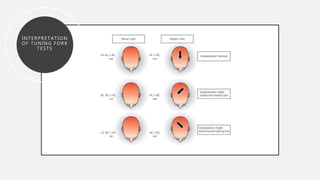
WEBER TEST
• In this test, a vibrating tuning fork is placed in the middle of the
forehead or the vertex and the patient is asked in which ear the
sound is heard.
• Normally, it is heard equally in both ears. It is lateralized to the
worse ear in conductive deafness and to the better ear in
sensorineural deafness. In weber test, sound travels directly to
the cochlea via bone.
• Lateralization of sound in weber test with a tuning fork of 512 Hz
implies a conductive loss of 15–25 dB in ipsilateral ear or a
sensorineural loss in the contralateral ear
INTERPRETATION
OF TUNING FORK
TESTS
ABSOLUTE BONE CONDUCTION (ABC)
TEST
• Bone conduction is a measure of cochlear function. In ABC test,
patient’s bone conduction is compared with that of the examiner
(presuming that the examiner has normal hearing).
• External auditory meatus of both the patient and examiner
should be occluded (by pressing the tragus inwards) to prevent
ambient noise entering through AC route.
• In conductive deafness, the patient and the examiner hear the
fork for the same duration of time. In sensorineural deafness, the
patient hears the fork for a shorter duration
SCHWABACH’S TEST
• Here again BC of patient is compared with that of the normal
hearing person (examiner) but meatus is not occluded. It has the
same significance as absolute bone conduction test. Schwabach
is reduced in sensorineural deafness and lengthened in
conductive deafness.
BING TEST
• It is a test of bone conduction and examines the effect of
occlusion of ear canal on the hearing.
• A vibrating tuning fork is placed on the mastoid while the
examiner alternately closes and opens the ear canal by pressing
on the tragus inwards.
• A normal person or one with sensorineural hearing loss hears
louder when ear canal is occluded and softer when the canal is
open (Bing positive). A patient with conductive hearing loss will
appreciate no change (Bing negative).
GELLE’S TEST
• It is also a test of bone conduction and examines the effect of increased
air pressure in ear canal on the hearing.
• Normally, when air pressure is increased in the ear canal by Siegel’s
speculum, it pushes the tympanic membrane and ossicles inwards, raises
the intralabyrinthine pressure and causes immobility of basilar
membrane and decreased hearing, but no change in hearing is observed
when ossicular chain is fixed or disconnected. Gelle’s test is performed
by placing a vibrating fork on the mastoid while changes in air pressure
in the ear canal are brought about by Siegel’s speculum. Gelle’s test is
positive in normal persons and in those with sensorineural hearing loss.
• It is negative when ossicular chain is fixed or disconnected. It was a
popular test to find out stapes fixation in otosclerosis but has now been
superceded by tympanometry.
REFERENCES
• Diseases of Ear, Nose and Throat & Head and Neck Surgery
(7th Edition) – PL Dhingra, Shruti Dhingra.
• ENT: An Introduction and Practical Guide - by James Tysome
and Rahul Kanegaonkar.

Tuning fork tests - ENT

  • 1.
  • 2.
    INTRODUCTION • Tuning forktests are performed with tuning forks of different frequencies such as 128, 256, 512, 1024, 2048 and 4096 Hz, but for routine clinical practice, tuning fork of 512 Hz is ideal. • Forks of lower frequencies produce sense of bone vibration while those of higher frequencies have a shorter decay time and are thus not routinely preferred. • A tuning fork is activated by striking it gently against the examiner’s elbow, heel of hand or the rubber heel of the shoe.
  • 3.
    TUNING FORK TESTS • The clinicallyuseful tuning fork tests include: 1. Rinne Test 2. Weber Test 3. Absolute Bone Conduction (ABC) Test 4. Schwabach’s Test 5. Bing Test 6. Gelle’s Test
  • 4.
    RINNE TEST • Inthis test air conduction of the ear is compared with its bone conduction. • A vibrating tuning fork is placed on the patient’s mastoid and when he stops hearing, it is brought beside the meatus. If he still hears, AC is more than BC. Alternatively, the patient is asked to compare the loudness of sound heard through air and bone conduction. • Rinne test is called positive when AC is longer or louder than BC. It is seen in normal persons or those having sensorineural deafness. A negative Rinne (BC > AC) is seen in conductive deafness. A negative Rinne indicates a minimum air-bone gap of 15–20 dB.
  • 5.
    RINNE TEST A predictionof air-bone gap can be made if tuning forks of 256, 512 and 1024 Hz are used. • A Rinne test equal or negative for 256 Hz but positive for 512 Hz indicates air-bone gap of 20–30 dB. • A Rinne test negative for 256 and 512 Hz but positive for 1024 Hz indicates air-bone gap of 30–45 dB. • A Rinne negative for all the three tuning forks of 256, 512 and 1024 Hz indicates air-bone gap of 45–60 dB. Remember that a negative Rinne for 256, 512 and 1024 Hz indicates a minimum AB gap of 15, 30, 45 dB, respectively
  • 6.
    FALSE NEGATIVE RINNE •False Negative Rinne is seen in severe unilateral sensorineural hearing loss. Patient does not perceive any sound of tuning fork by air conduction but responds to bone conduction testing. • This response to bone conduction is, in reality, from the opposite ear because of transcranial transmission of sound. In such cases, correct diagnosis can be made by masking the nontest ear with Barany’s noise box while testing for bone conduction.
  • 7.
    WEBER TEST • Inthis test, a vibrating tuning fork is placed in the middle of the forehead or the vertex and the patient is asked in which ear the sound is heard. • Normally, it is heard equally in both ears. It is lateralized to the worse ear in conductive deafness and to the better ear in sensorineural deafness. In weber test, sound travels directly to the cochlea via bone. • Lateralization of sound in weber test with a tuning fork of 512 Hz implies a conductive loss of 15–25 dB in ipsilateral ear or a sensorineural loss in the contralateral ear
  • 8.
  • 9.
    ABSOLUTE BONE CONDUCTION(ABC) TEST • Bone conduction is a measure of cochlear function. In ABC test, patient’s bone conduction is compared with that of the examiner (presuming that the examiner has normal hearing). • External auditory meatus of both the patient and examiner should be occluded (by pressing the tragus inwards) to prevent ambient noise entering through AC route. • In conductive deafness, the patient and the examiner hear the fork for the same duration of time. In sensorineural deafness, the patient hears the fork for a shorter duration
  • 10.
    SCHWABACH’S TEST • Hereagain BC of patient is compared with that of the normal hearing person (examiner) but meatus is not occluded. It has the same significance as absolute bone conduction test. Schwabach is reduced in sensorineural deafness and lengthened in conductive deafness.
  • 11.
    BING TEST • Itis a test of bone conduction and examines the effect of occlusion of ear canal on the hearing. • A vibrating tuning fork is placed on the mastoid while the examiner alternately closes and opens the ear canal by pressing on the tragus inwards. • A normal person or one with sensorineural hearing loss hears louder when ear canal is occluded and softer when the canal is open (Bing positive). A patient with conductive hearing loss will appreciate no change (Bing negative).
  • 12.
    GELLE’S TEST • Itis also a test of bone conduction and examines the effect of increased air pressure in ear canal on the hearing. • Normally, when air pressure is increased in the ear canal by Siegel’s speculum, it pushes the tympanic membrane and ossicles inwards, raises the intralabyrinthine pressure and causes immobility of basilar membrane and decreased hearing, but no change in hearing is observed when ossicular chain is fixed or disconnected. Gelle’s test is performed by placing a vibrating fork on the mastoid while changes in air pressure in the ear canal are brought about by Siegel’s speculum. Gelle’s test is positive in normal persons and in those with sensorineural hearing loss. • It is negative when ossicular chain is fixed or disconnected. It was a popular test to find out stapes fixation in otosclerosis but has now been superceded by tympanometry.
  • 13.
    REFERENCES • Diseases ofEar, Nose and Throat & Head and Neck Surgery (7th Edition) – PL Dhingra, Shruti Dhingra. • ENT: An Introduction and Practical Guide - by James Tysome and Rahul Kanegaonkar.