Organizational Structure
Dr. Amjad Idries
Structure should take care of:
• Tasks and reporting;
• Role and position;
• Accountability;
• Performance measures;
Structure should take care of:
• Procedures and rules;
• Communication;
• Control and coordination;
• Responsive for (market diversity) & (client
needs)
Types of structures:
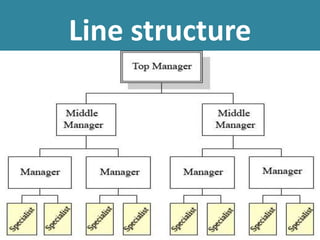
(1)Line: direct vertical relations (authority and
communication, reporting)
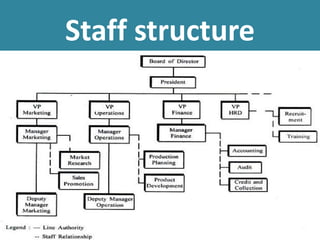
(2) Staff: no additional level of hierarchy only
advisory role (no authority)
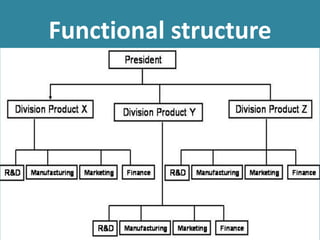
(3) Functional: modified staff structure, line
managers take orders from staff departments
discuss the role of: authority, responsibility, accountability
Line structure
Staff structure
Functional structure
Types of structures:
• Formal & informal: formal based on authority
and formal communication channels. Informal
is spontaneous based on power and informal
communications.
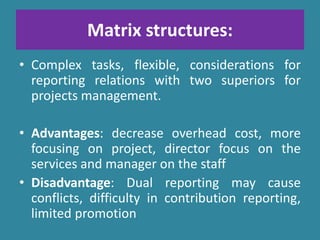
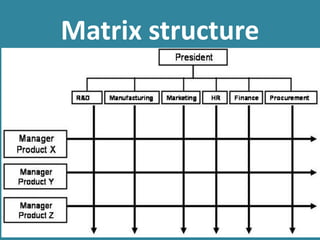
Matrix structures:
• Complex tasks, flexible, considerations for
reporting relations with two superiors for
projects management.
• Advantages: decrease overhead cost, more
focusing on project, director focus on the
services and manager on the staff
• Disadvantage: Dual reporting may cause
conflicts, difficulty in contribution reporting,
limited promotion
Matrix structure
Changing the organizational
structure and strategic direction
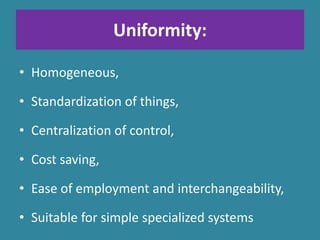
Uniformity:
• Homogeneous,
• Standardization of things,
• Centralization of control,
• Cost saving,
• Ease of employment and interchangeability,
• Suitable for simple specialized systems
Diversity:
• Specialization,
• Decentralization,
• Uncertainty,
• Suitable for (in case of regional or product or customer
or goal diversity) variety,
• Increase the motivation and satisfaction,
• Lead to diversification,
• Better budget behavior
Centralization-Decentralization:
• Distribution of power (de-concentration):
transfer authority and functions down,
• Delegation: transfer executive power to staff,
• Devolution: transfer of management functions.
• Advantages of DC: cost consciousness and
accountability increased,
• Disadvantage of DC: skills and capacity, politics,
corruption, costly
Networks:
• Dominated or equal-partner networks, needs
for networking, between different partners,
• Virtual organizations: (lack of physical
structure, only communication, mobile work,
boundary-less legality, flexible and responsive

Organizational Structure

  • 1.
  • 2.
    Structure should takecare of: • Tasks and reporting; • Role and position; • Accountability; • Performance measures;
  • 3.
    Structure should takecare of: • Procedures and rules; • Communication; • Control and coordination; • Responsive for (market diversity) & (client needs)
  • 4.
    Types of structures: (1)Line:direct vertical relations (authority and communication, reporting) (2) Staff: no additional level of hierarchy only advisory role (no authority) (3) Functional: modified staff structure, line managers take orders from staff departments discuss the role of: authority, responsibility, accountability
  • 5.
  • 6.
  • 7.
  • 8.
    Types of structures: •Formal & informal: formal based on authority and formal communication channels. Informal is spontaneous based on power and informal communications.
  • 9.
    Matrix structures: • Complextasks, flexible, considerations for reporting relations with two superiors for projects management. • Advantages: decrease overhead cost, more focusing on project, director focus on the services and manager on the staff • Disadvantage: Dual reporting may cause conflicts, difficulty in contribution reporting, limited promotion
  • 10.
  • 11.
  • 12.
    Uniformity: • Homogeneous, • Standardizationof things, • Centralization of control, • Cost saving, • Ease of employment and interchangeability, • Suitable for simple specialized systems
  • 13.
    Diversity: • Specialization, • Decentralization, •Uncertainty, • Suitable for (in case of regional or product or customer or goal diversity) variety, • Increase the motivation and satisfaction, • Lead to diversification, • Better budget behavior
  • 14.
    Centralization-Decentralization: • Distribution ofpower (de-concentration): transfer authority and functions down, • Delegation: transfer executive power to staff, • Devolution: transfer of management functions. • Advantages of DC: cost consciousness and accountability increased, • Disadvantage of DC: skills and capacity, politics, corruption, costly
  • 15.
    Networks: • Dominated orequal-partner networks, needs for networking, between different partners, • Virtual organizations: (lack of physical structure, only communication, mobile work, boundary-less legality, flexible and responsive