INTRODUCTION
2
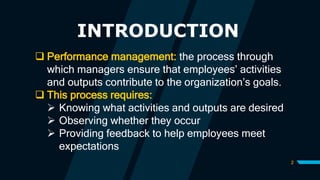
 Performance management: the process through
which managers ensure that employees’ activities
and outputs contribute to the organization’s goals.
 This process requires:
 Knowing what activities and outputs are desired
 Observing whether they occur
 Providing feedback to help employees meet
expectations
3
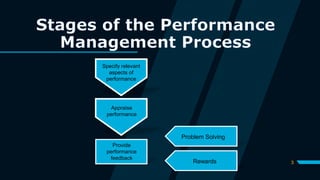
Specify relevant
aspects of
performance
Appraise
performance
Provide
performance
feedback
Problem Solving
Rewards
4
Purpose of Performance
Management
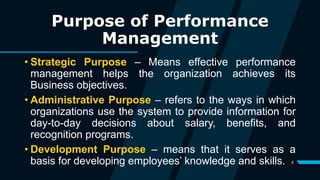
• Strategic Purpose – Means effective performance
management helps the organization achieves its
Business objectives.
• Administrative Purpose – refers to the ways in which
organizations use the system to provide information for
day-to-day decisions about salary, benefits, and
recognition programs.
• Development Purpose – means that it serves as a
basis for developing employees’ knowledge and skills.
5
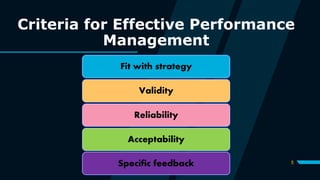
Criteria for Effective Performance
Management
Fit with strategy
Validity
Reliability
Acceptability
Specific feedback
6
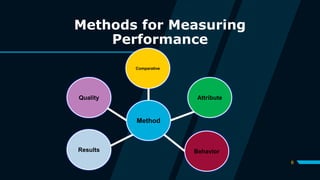
Methods for Measuring
Performance
Method
Attribute
Behavior
Results
Quality
Comparative
7
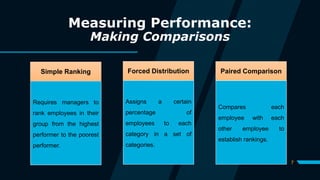
Measuring Performance:
Making Comparisons
Requires managers to
rank employees in their
group from the highest
performer to the poorest
performer.
Assigns a certain
percentage of
employees to each
category in a set of
categories.
Compares each
employee with each
other employee to
establish rankings.
Simple Ranking Forced Distribution Paired Comparison
8
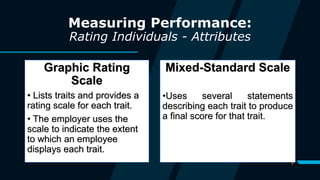
Measuring Performance:
Rating Individuals - Attributes
Graphic Rating
Scale
• Lists traits and provides a
rating scale for each trait.
• The employer uses the
scale to indicate the extent
to which an employee
displays each trait.
Mixed-Standard Scale
•Uses several statements
describing each trait to produce
a final score for that trait.
9
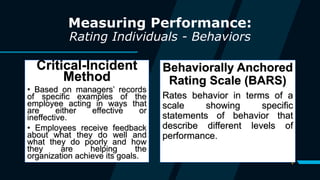
Measuring Performance:
Rating Individuals - Behaviors
Critical-Incident
Method
• Based on managers’ records
of specific examples of the
employee acting in ways that
are either effective or
ineffective.
• Employees receive feedback
about what they do well and
what they do poorly and how
they are helping the
organization achieve its goals.
Behaviorally Anchored
Rating Scale (BARS)
Rates behavior in terms of a
scale showing specific
statements of behavior that
describe different levels of
performance.
10
Measuring Performance:
Rating Individuals – Behaviors (continued)
Behavioral
Observational Scale
(BOS)
• A variation of a BARS which uses
all behaviors necessary for
effective performance to rate
performance at a task.
• A BOS also asks the manager to
rate the frequency with which the
employee has exhibited the
behavior during the rating period.
Organization Behavior
Modification (OBM)
A plan for managing the
behavior of employees through
a formal system of feedback
and reinforcement.
11
Measuring Performance:
Measuring Results
• Management by Objectives (MBO): people at
each level of the organization set goals in a
process that flows from top to bottom, so that all
levels are contributing to the organization’s
overall goals.
• These goals become the standards for evaluating
each employee’s performance.
12
Measuring Performance:
Measuring Quality
• The principles of total quality management
(TQM), provide methods for performance
measurement and management.
• With TQM, performance measurement
combines measurement of attributes and
result.
• Subject Feedback
• Statistical quality control
13
Sources of Performance
Information
• 360-Degree Performance Appraisal:
performance measurement that combines
information from the employees’:
• Managers
• Peers
• Subordinates
• Self
• Customers
14
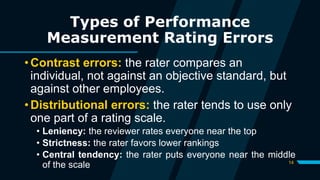
Types of Performance
Measurement Rating Errors
• Contrast errors: the rater compares an
individual, not against an objective standard, but
against other employees.
• Distributional errors: the rater tends to use only
one part of a rating scale.
• Leniency: the reviewer rates everyone near the top
• Strictness: the rater favors lower rankings
• Central tendency: the rater puts everyone near the middle
of the scale
15
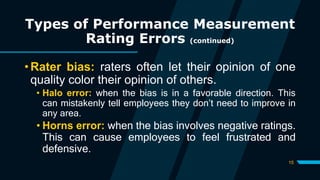
Types of Performance Measurement
Rating Errors (continued)
• Rater bias: raters often let their opinion of one
quality color their opinion of others.
• Halo error: when the bias is in a favorable direction. This
can mistakenly tell employees they don’t need to improve in
any area.
• Horns error: when the bias involves negative ratings.
This can cause employees to feel frustrated and
defensive.
16
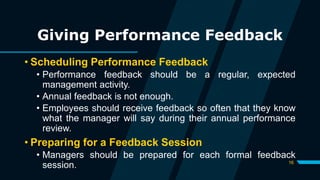
Giving Performance Feedback
• Scheduling Performance Feedback
• Performance feedback should be a regular, expected
management activity.
• Annual feedback is not enough.
• Employees should receive feedback so often that they know
what the manager will say during their annual performance
review.
• Preparing for a Feedback Session
• Managers should be prepared for each formal feedback
session.
17
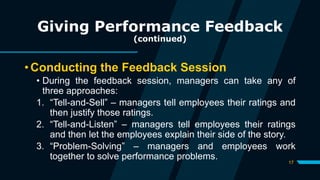
Giving Performance Feedback
(continued)
• Conducting the Feedback Session
• During the feedback session, managers can take any of
three approaches:
1. “Tell-and-Sell” – managers tell employees their ratings and
then justify those ratings.
2. “Tell-and-Listen” – managers tell employees their ratings
and then let the employees explain their side of the story.
3. “Problem-Solving” – managers and employees work
together to solve performance problems.
18
Legal and Ethical Issues in
Performance Management
• Legal: Performance management processes are
often scrutinized in cases of discrimination or
dismissal.
• Ethical: Employee monitoring via electronic
devices and computers may raise concerns over
employee privacy. Legal and Ethical Issues in
Performance Management
19
Legal Requirements for
Performance Management
• Lawsuits related to performance management
usually involve charges of:
• Discrimination
• Unjust dismissal
• To protect against both kinds of lawsuits, it is
important to have a legally defensible
performance management system.
20
Legal Requirements for
Performance Management (continued)
• A legally defensible performance management
system includes:
• Based on valid job analyses, with requirements for job
success clearly communicated to employees.
• Performance measurement should evaluate behaviors or
results, rather than traits.
• Multiple raters (including self-appraisals) should be used.
• All performance ratings should be reviewed by upper-level
managers.
• There should be an appeals mechanism for employees.
END……
21

Assessing Performance and Developing Employees.pptx

  • 2.
    INTRODUCTION 2  Performance management:the process through which managers ensure that employees’ activities and outputs contribute to the organization’s goals.  This process requires:  Knowing what activities and outputs are desired  Observing whether they occur  Providing feedback to help employees meet expectations
  • 3.
  • 4.
    4 Purpose of Performance Management •Strategic Purpose – Means effective performance management helps the organization achieves its Business objectives. • Administrative Purpose – refers to the ways in which organizations use the system to provide information for day-to-day decisions about salary, benefits, and recognition programs. • Development Purpose – means that it serves as a basis for developing employees’ knowledge and skills.
  • 5.
    5 Criteria for EffectivePerformance Management Fit with strategy Validity Reliability Acceptability Specific feedback
  • 6.
  • 7.
    7 Measuring Performance: Making Comparisons Requiresmanagers to rank employees in their group from the highest performer to the poorest performer. Assigns a certain percentage of employees to each category in a set of categories. Compares each employee with each other employee to establish rankings. Simple Ranking Forced Distribution Paired Comparison
  • 8.
    8 Measuring Performance: Rating Individuals- Attributes Graphic Rating Scale • Lists traits and provides a rating scale for each trait. • The employer uses the scale to indicate the extent to which an employee displays each trait. Mixed-Standard Scale •Uses several statements describing each trait to produce a final score for that trait.
  • 9.
    9 Measuring Performance: Rating Individuals- Behaviors Critical-Incident Method • Based on managers’ records of specific examples of the employee acting in ways that are either effective or ineffective. • Employees receive feedback about what they do well and what they do poorly and how they are helping the organization achieve its goals. Behaviorally Anchored Rating Scale (BARS) Rates behavior in terms of a scale showing specific statements of behavior that describe different levels of performance.
  • 10.
    10 Measuring Performance: Rating Individuals– Behaviors (continued) Behavioral Observational Scale (BOS) • A variation of a BARS which uses all behaviors necessary for effective performance to rate performance at a task. • A BOS also asks the manager to rate the frequency with which the employee has exhibited the behavior during the rating period. Organization Behavior Modification (OBM) A plan for managing the behavior of employees through a formal system of feedback and reinforcement.
  • 11.
    11 Measuring Performance: Measuring Results •Management by Objectives (MBO): people at each level of the organization set goals in a process that flows from top to bottom, so that all levels are contributing to the organization’s overall goals. • These goals become the standards for evaluating each employee’s performance.
  • 12.
    12 Measuring Performance: Measuring Quality •The principles of total quality management (TQM), provide methods for performance measurement and management. • With TQM, performance measurement combines measurement of attributes and result. • Subject Feedback • Statistical quality control
  • 13.
    13 Sources of Performance Information •360-Degree Performance Appraisal: performance measurement that combines information from the employees’: • Managers • Peers • Subordinates • Self • Customers
  • 14.
    14 Types of Performance MeasurementRating Errors • Contrast errors: the rater compares an individual, not against an objective standard, but against other employees. • Distributional errors: the rater tends to use only one part of a rating scale. • Leniency: the reviewer rates everyone near the top • Strictness: the rater favors lower rankings • Central tendency: the rater puts everyone near the middle of the scale
  • 15.
    15 Types of PerformanceMeasurement Rating Errors (continued) • Rater bias: raters often let their opinion of one quality color their opinion of others. • Halo error: when the bias is in a favorable direction. This can mistakenly tell employees they don’t need to improve in any area. • Horns error: when the bias involves negative ratings. This can cause employees to feel frustrated and defensive.
  • 16.
    16 Giving Performance Feedback •Scheduling Performance Feedback • Performance feedback should be a regular, expected management activity. • Annual feedback is not enough. • Employees should receive feedback so often that they know what the manager will say during their annual performance review. • Preparing for a Feedback Session • Managers should be prepared for each formal feedback session.
  • 17.
    17 Giving Performance Feedback (continued) •Conducting the Feedback Session • During the feedback session, managers can take any of three approaches: 1. “Tell-and-Sell” – managers tell employees their ratings and then justify those ratings. 2. “Tell-and-Listen” – managers tell employees their ratings and then let the employees explain their side of the story. 3. “Problem-Solving” – managers and employees work together to solve performance problems.
  • 18.
    18 Legal and EthicalIssues in Performance Management • Legal: Performance management processes are often scrutinized in cases of discrimination or dismissal. • Ethical: Employee monitoring via electronic devices and computers may raise concerns over employee privacy. Legal and Ethical Issues in Performance Management
  • 19.
    19 Legal Requirements for PerformanceManagement • Lawsuits related to performance management usually involve charges of: • Discrimination • Unjust dismissal • To protect against both kinds of lawsuits, it is important to have a legally defensible performance management system.
  • 20.
    20 Legal Requirements for PerformanceManagement (continued) • A legally defensible performance management system includes: • Based on valid job analyses, with requirements for job success clearly communicated to employees. • Performance measurement should evaluate behaviors or results, rather than traits. • Multiple raters (including self-appraisals) should be used. • All performance ratings should be reviewed by upper-level managers. • There should be an appeals mechanism for employees.
  • 21.