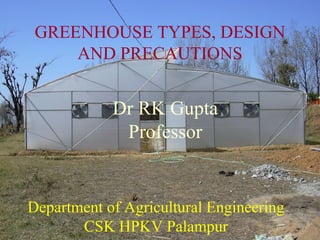
GREENHOUSE TYPES, DESIGN
AND PRECAUTIONS
Dr RK Gupta
Professor
Department of Agricultural Engineering
CSK HPKV Palampur
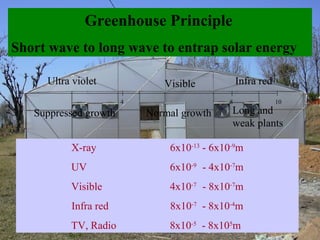
Greenhouse Principle
Short wave to long wave to entrap solar energy
1 4 8 10
Ultra violet Visible Infra red
Suppressed growth Normal growth Long and
weak plants
X-ray 6x10-13
- 6x10⁻⁹
m
UV 6x10⁻⁹
- 4x10⁻⁷
m
Visible 4x10⁻⁷
- 8x10⁻⁷
m
Infra red 8x10⁻⁷
- 8x10⁻⁴
m
TV, Radio 8x10⁻⁵
- 8x10⁵
m
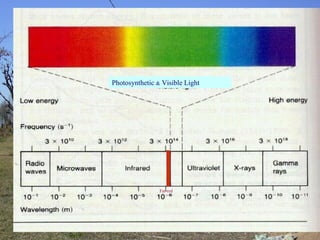
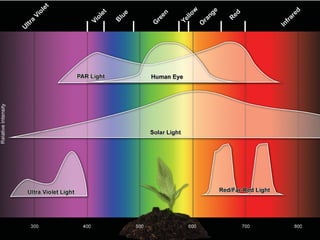
Photosynthetic & Visible Light
Far-red
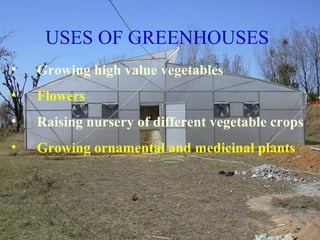
USES OF GREENHOUSES
• Growing high value vegetables
• Flowers
• Raising nursery of different vegetable crops
• Growing ornamental and medicinal plants
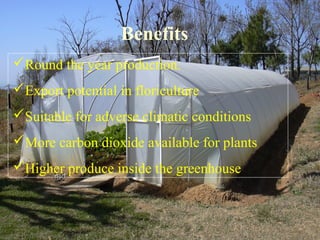
Benefits
Round the year production.
Export potential in floriculture
Suitable for adverse climatic conditions
More carbon dioxide available for plants
Higher produce inside the greenhouse
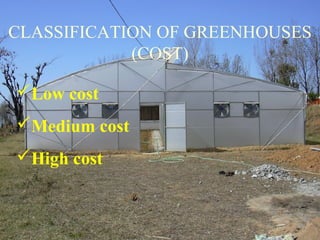
CLASSIFICATION OF GREENHOUSES
(COST)
Low cost
Medium cost
High cost
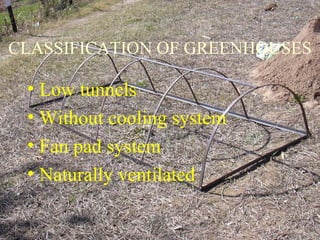
CLASSIFICATION OF GREENHOUSES
• Low tunnels
• Without cooling system
• Fan pad system
• Naturally ventilated
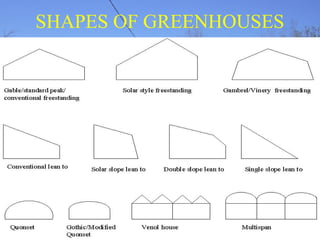
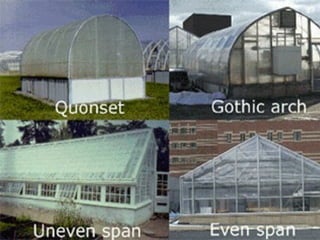
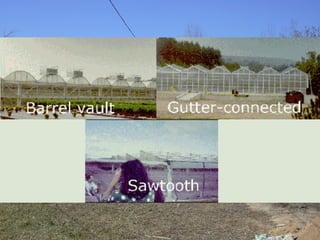
SHAPES OF GREENHOUSES
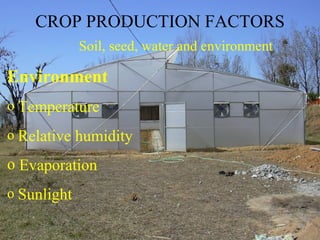
Soil, seed, water and environment
Environment
o Temperature
o Relative humidity
o Evaporation
o Sunlight
CROP PRODUCTION FACTORS
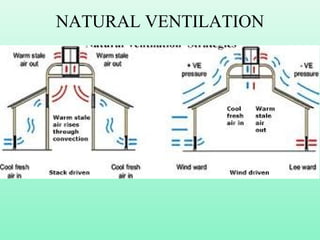
NATURAL VENTILATION
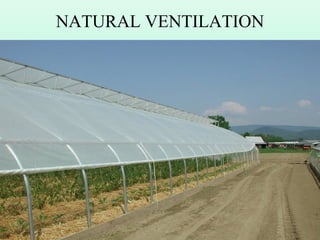
NATURAL VENTILATION
NATURAL VENTILATION
• Percent of roof space ventilated has increased
over time with design improvements
• Success is very crop specific
• Even fully retractable roof designs are now
available
• Cheaper to operate than active cooling
systems, but construction costs aren’t less
expensive
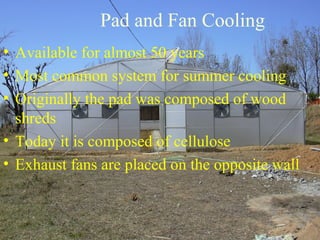
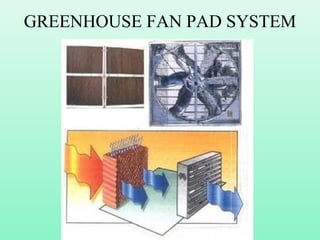
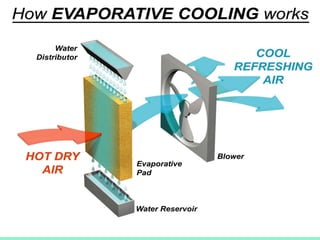
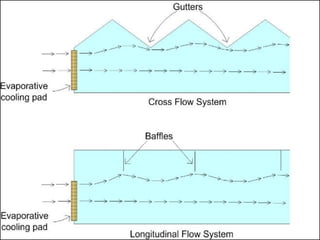
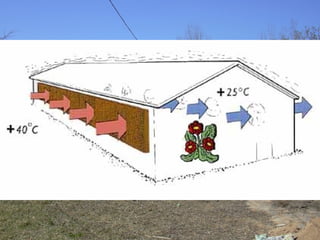
Pad and Fan Cooling
• Available for almost 50 years
• Most common system for summer cooling
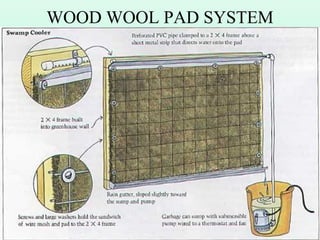
• Originally the pad was composed of wood
shreds
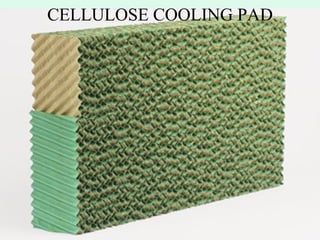
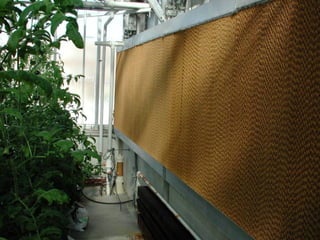
• Today it is composed of cellulose
• Exhaust fans are placed on the opposite wall
GREENHOUSE FAN PAD SYSTEM
WOOD WOOL PAD SYSTEM
CELLULOSE COOLING PAD
SOIL, WATER AND SEED
• Good quality soil
• Permanent source of water
• Very good quality seed
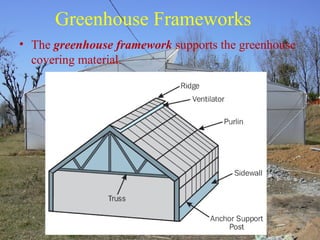
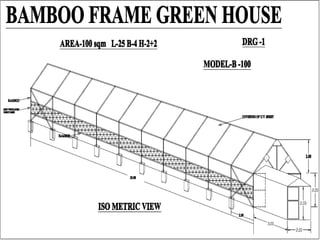
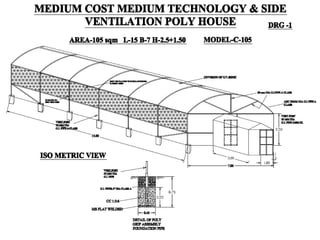
Greenhouse Frameworks
• The greenhouse framework supports the greenhouse
covering material.
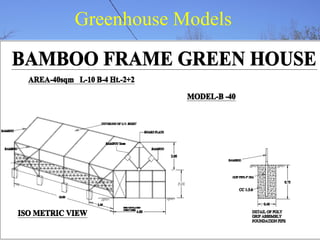
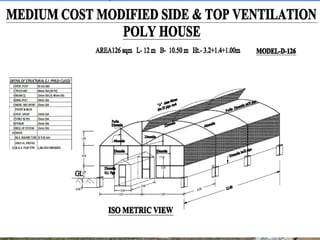
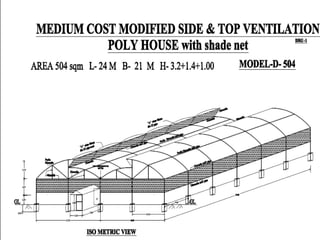
Greenhouse Models
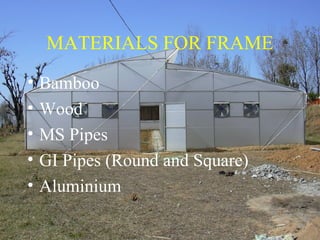
MATERIALS FOR FRAME
• Bamboo
• Wood
• MS Pipes
• GI Pipes (Round and Square)
• Aluminium
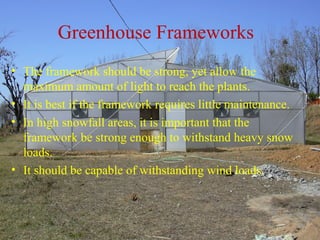
Greenhouse Frameworks
• The framework should be strong, yet allow the
maximum amount of light to reach the plants.
• It is best if the framework requires little maintenance.
• In high snowfall areas, it is important that the
framework be strong enough to withstand heavy snow
loads.
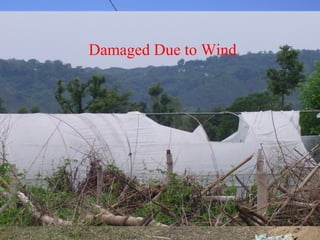
• It should be capable of withstanding wind loads.
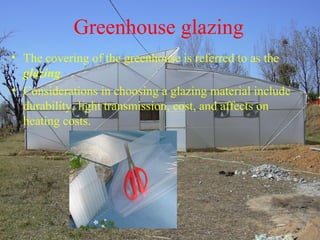
Greenhouse glazing
• The covering of the greenhouse is referred to as the
glazing.
• Considerations in choosing a glazing material include
durability, light transmission, cost, and affects on
heating costs.
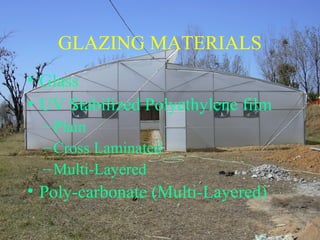
GLAZING MATERIALS
• Glass
• UV Stabilized Polyethylene film
–Plain
–Cross Laminated
–Multi-Layered
• Poly-carbonate (Multi-Layered)
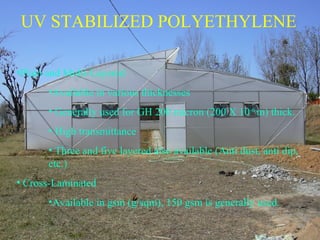
UV STABILIZED POLYETHYLENE
•Plain and Multi-Layered
•Available in various thicknesses
• Generally used for GH 200 micron (200 X 10-6
m) thick.
• High transmittance
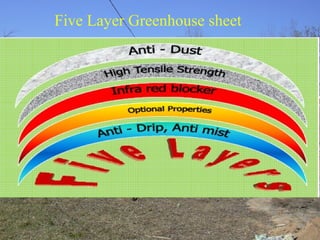
• Three and five layered also available (Anti dust, anti dip,
etc.)
• Cross-Laminated
•Available in gsm (g/sqm), 150 gsm is generally used.
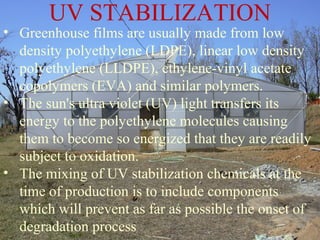
• Greenhouse films are usually made from low
density polyethylene (LDPE), linear low density
polyethylene (LLDPE), ethylene-vinyl acetate
copolymers (EVA) and similar polymers.
• The sun's ultra violet (UV) light transfers its
energy to the polyethylene molecules causing
them to become so energized that they are readily
subject to oxidation.
• The mixing of UV stabilization chemicals at the
time of production is to include components
which will prevent as far as possible the onset of
degradation process
UV STABILIZATION
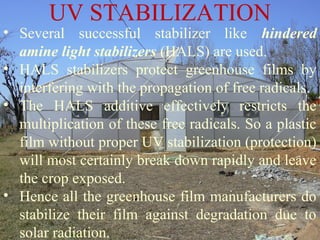
• Several successful stabilizer like hindered
amine light stabilizers (HALS) are used.
• HALS stabilizers protect greenhouse films by
interfering with the propagation of free radicals.
• The HALS additive effectively restricts the
multiplication of these free radicals. So a plastic
film without proper UV stabilization (protection)
will most certainly break down rapidly and leave
the crop exposed.
• Hence all the greenhouse film manufacturers do
stabilize their film against degradation due to
solar radiation.
UV STABILIZATION
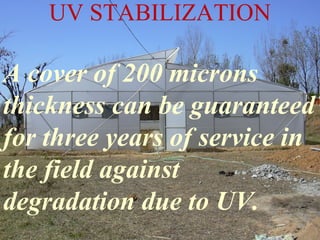
A cover of 200 microns
thickness can be guaranteed
for three years of service in
the field against
degradation due to UV.
UV STABILIZATION
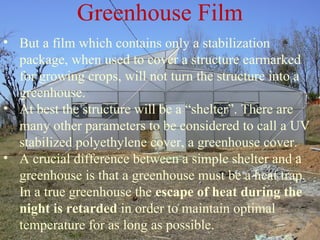
• But a film which contains only a stabilization
package, when used to cover a structure earmarked
for growing crops, will not turn the structure into a
greenhouse.
• At best the structure will be a “shelter”. There are
many other parameters to be considered to call a UV
stabilized polyethylene cover, a greenhouse cover.
• A crucial difference between a simple shelter and a
greenhouse is that a greenhouse must be a heat trap.
In a true greenhouse the escape of heat during the
night is retarded in order to maintain optimal
temperature for as long as possible.
Greenhouse Film
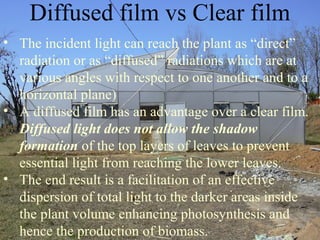
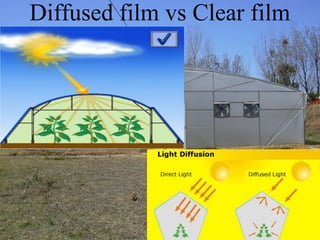
• The incident light can reach the plant as “direct”
radiation or as “diffused” radiations which are at
various angles with respect to one another and to a
horizontal plane)
• A diffused film has an advantage over a clear film.
Diffused light does not allow the shadow
formation of the top layers of leaves to prevent
essential light from reaching the lower leaves.
• The end result is a facilitation of an effective
dispersion of total light to the darker areas inside
the plant volume enhancing photosynthesis and
hence the production of biomass.
Diffused film vs Clear film
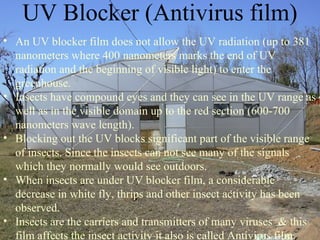
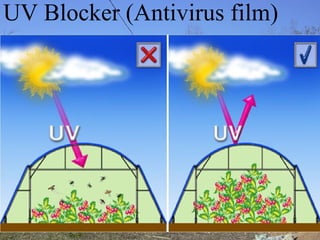
• An UV blocker film does not allow the UV radiation (up to 381
nanometers where 400 nanometers marks the end of UV
radiation and the beginning of visible light) to enter the
greenhouse.
• Insects have compound eyes and they can see in the UV range as
well as in the visible domain up to the red section (600-700
nanometers wave length).
• Blocking out the UV blocks significant part of the visible range
of insects. Since the insects can not see many of the signals
which they normally would see outdoors.
• When insects are under UV blocker film, a considerable
decrease in white fly, thrips and other insect activity has been
observed.
• Insects are the carriers and transmitters of many viruses & this
film affects the insect activity it also is called Antivirus film.
UV Blocker (Antivirus film)
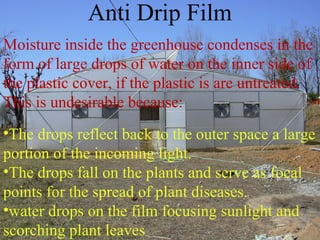
Moisture inside the greenhouse condenses in the
form of large drops of water on the inner side of
the plastic cover, if the plastic is are untreated.
This is undesirable because:
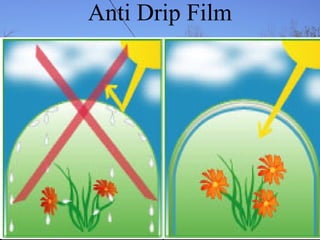
•The drops reflect back to the outer space a large
portion of the incoming light.
•The drops fall on the plants and serve as focal
points for the spread of plant diseases.
•water drops on the film focusing sunlight and
scorching plant leaves
Anti Drip Film
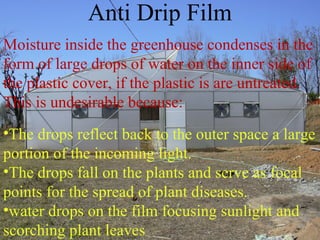
Moisture inside the greenhouse condenses in the
form of large drops of water on the inner side of
the plastic cover, if the plastic is are untreated.
This is undesirable because:
•The drops reflect back to the outer space a large
portion of the incoming light.
•The drops fall on the plants and serve as focal
points for the spread of plant diseases.
•water drops on the film focusing sunlight and
scorching plant leaves
Anti Drip Film
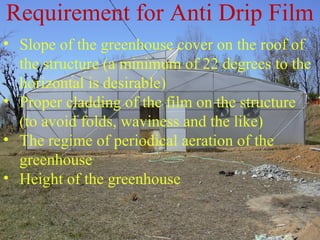
• Slope of the greenhouse cover on the roof of
the structure (a minimum of 22 degrees to the
horizontal is desirable)
• Proper cladding of the film on the structure
(to avoid folds, waviness and the like)
• The regime of periodical aeration of the
greenhouse
• Height of the greenhouse
Requirement for Anti Drip Film
Anti Drip Film
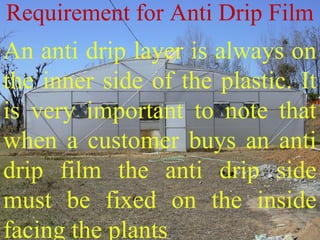
An anti drip layer is always on
the inner side of the plastic. It
is very important to note that
when a customer buys an anti
drip film the anti drip side
must be fixed on the inside
facing the plants
Requirement for Anti Drip Film
Thermic Film
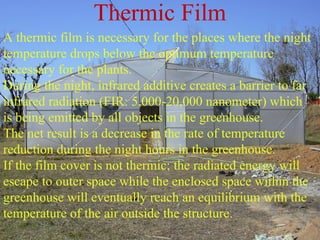
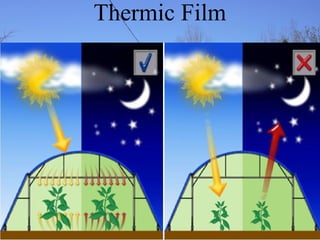
A thermic film is necessary for the places where the night
temperature drops below the optimum temperature
necessary for the plants.
During the night, infrared additive creates a barrier to far
infrared radiation (FIR: 5,000-20,000 nanometer) which
is being emitted by all objects in the greenhouse.
The net result is a decrease in the rate of temperature
reduction during the night hours in the greenhouse.
If the film cover is not thermic; the radiated energy will
escape to outer space while the enclosed space within the
greenhouse will eventually reach an equilibrium with the
temperature of the air outside the structure.
Thermic Film
Five Layer Greenhouse sheet
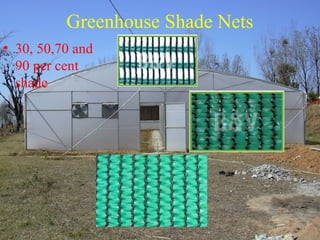
Greenhouse Shade Nets
• 30, 50,70 and
90 per cent
shade
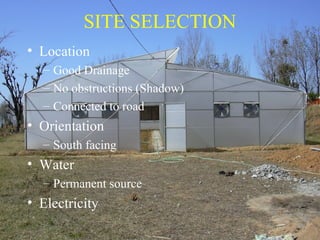
SITE SELECTION
• Location
– Good Drainage
– No obstructions (Shadow)
– Connected to road
• Orientation
– South facing
• Water
– Permanent source
• Electricity
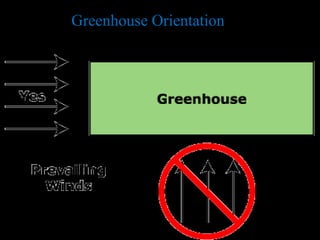
Greenhouse Orientation
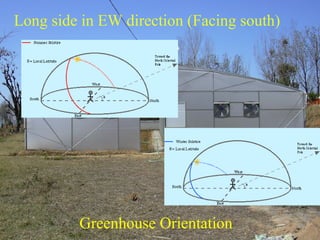
Long side in EW direction (Facing south)
Greenhouse Orientation
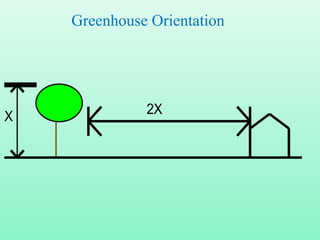
X 2X
Greenhouse Orientation
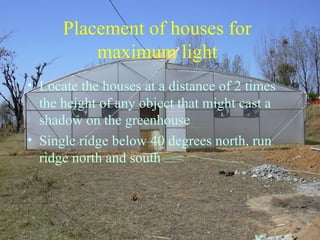
• Locate the houses at a distance of 2 times
the height of any object that might cast a
shadow on the greenhouse
• Single ridge below 40 degrees north, run
ridge north and south
Placement of houses for
maximum light
SIZE
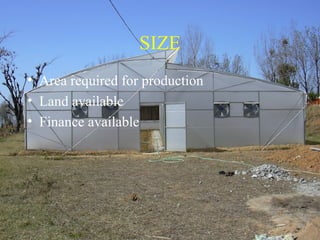
• Area required for production
• Land available
• Finance available
PROCEDURE FOR CONSTRUCTION
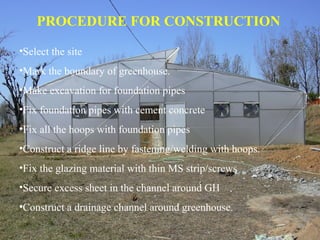
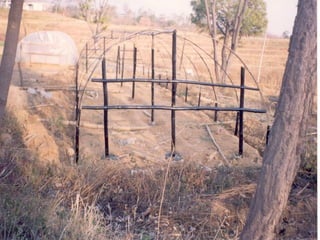
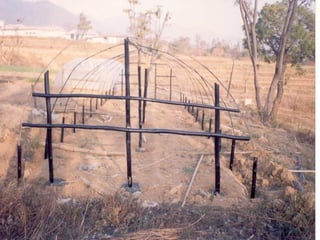
•Select the site
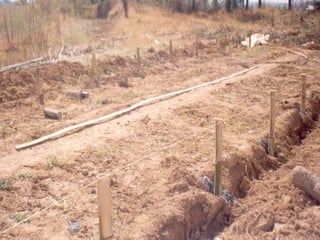
•Mark the boundary of greenhouse.
•Make excavation for foundation pipes
•Fix foundation pipes with cement concrete
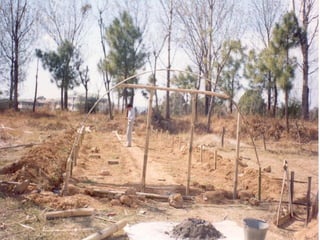
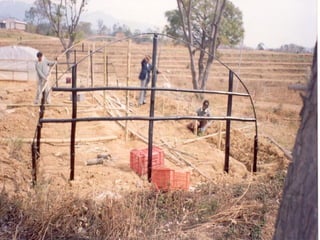
•Fix all the hoops with foundation pipes
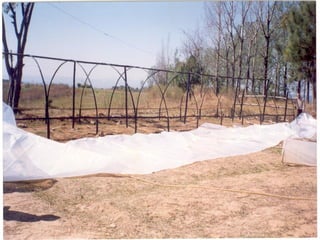
•Construct a ridge line by fastening/welding with hoops.
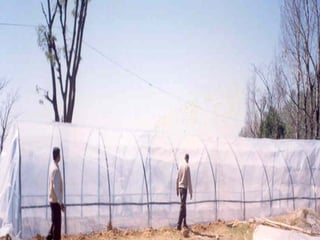
•Fix the glazing material with thin MS strip/screws
•Secure excess sheet in the channel around GH
•Construct a drainage channel around greenhouse.
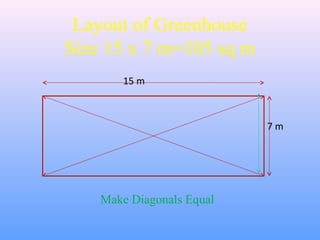
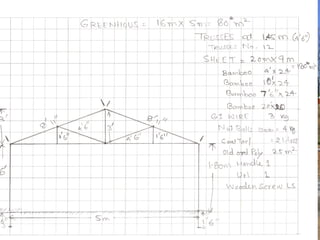
Layout of Greenhouse
Size 15 x 7 m=105 sq m
15 m
7 m
Make Diagonals Equal
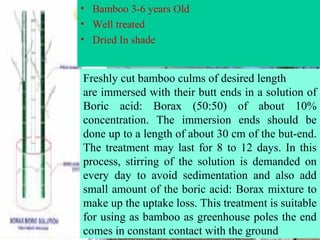
Freshly cut bamboo culms of desired length
are immersed with their butt ends in a solution of
Boric acid: Borax (50:50) of about 10%
concentration. The immersion ends should be
done up to a length of about 30 cm of the but-end.
The treatment may last for 8 to 12 days. In this
process, stirring of the solution is demanded on
every day to avoid sedimentation and also add
small amount of the boric acid: Borax mixture to
make up the uptake loss. This treatment is suitable
for using as bamboo as greenhouse poles the end
comes in constant contact with the ground
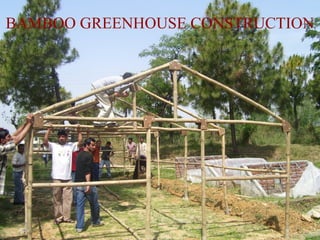
• Bamboo 3-6 years Old
• Well treated
• Dried In shade
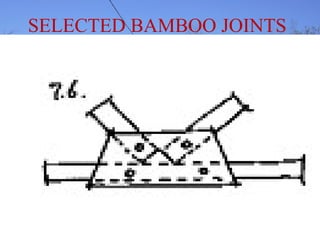
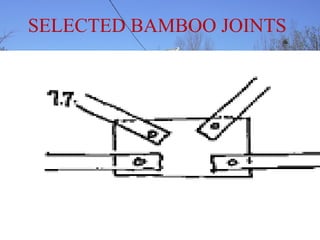
SELECTED BAMBOO JOINTS
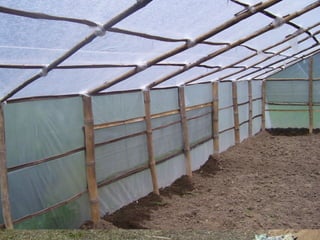
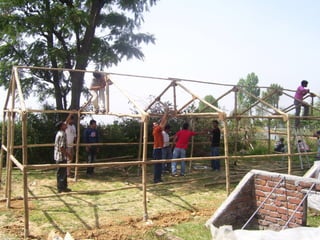
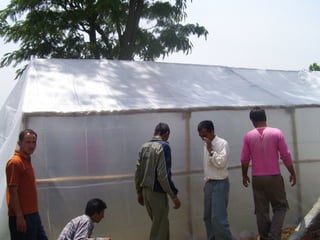
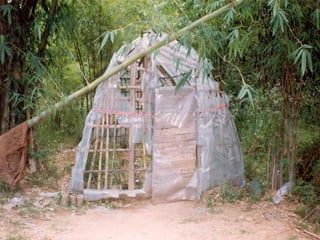
BAMBOO GREENHOUSE CONSTRUCTION
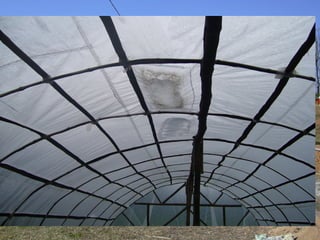
Damaged Due to Wind
Greenhouse Frame Maintenance
• Check to make sure that any moving parts
such as greenhouse door hinges are not
accumulating corrosion and if it looks like it
may need oil for lubrication, don't put it off
until later.
• Check for any stress fractures in the
greenhouse frame and also check to make
sure none of the fasteners holding your
greenhouse together have come loose. If
they have come loose, tighten them securely.
Greenhouse Frame Maintenance
• If your greenhouse frame is painted wood,
check occasionally for any loose or blistering
paint. If you find the paint is cracking or
blistering, promptly scrape the paint off and
allow to dry completely before sealing and re-
painting the area.
• If your greenhouse frame is constructed of
painted metal and you find rust forming, use a
wire brush to remove any rust and then clean,
prime & paint the affected area.
Greenhouse Cover Maintenance
Your greenhouse glazing should also be
maintained regularly.
•Should the glazing become dirty, your plants'
ability to receive sunlight transmission is
reduced considerably. Make sure that cleaning
of your greenhouse glazing is a priority before
winter.
•If your greenhouse is covered with a
greenhouse poly film, make sure to wash it
thoroughly with a mild liquid soap and water
Greenhouse Cover Maintenance
Greenhouse sheet should NOT be expected to
perform longer than recommended by the
manufacturer. Your greenhouse plants will only
suffer if you put off replacing your greenhouse
plastic past the recommended replacement
interval due to decreased transmission of
sunlight.
THANK YOU

Greenhouse/Polyhouse Designs

  • 1.
    GREENHOUSE TYPES, DESIGN ANDPRECAUTIONS Dr RK Gupta Professor Department of Agricultural Engineering CSK HPKV Palampur
  • 2.
    Greenhouse Principle Short waveto long wave to entrap solar energy 1 4 8 10 Ultra violet Visible Infra red Suppressed growth Normal growth Long and weak plants X-ray 6x10-13 - 6x10⁻⁹ m UV 6x10⁻⁹ - 4x10⁻⁷ m Visible 4x10⁻⁷ - 8x10⁻⁷ m Infra red 8x10⁻⁷ - 8x10⁻⁴ m TV, Radio 8x10⁻⁵ - 8x10⁵ m
  • 3.
  • 5.
    USES OF GREENHOUSES •Growing high value vegetables • Flowers • Raising nursery of different vegetable crops • Growing ornamental and medicinal plants
  • 6.
    Benefits Round the yearproduction. Export potential in floriculture Suitable for adverse climatic conditions More carbon dioxide available for plants Higher produce inside the greenhouse
  • 7.
    CLASSIFICATION OF GREENHOUSES (COST) Lowcost Medium cost High cost
  • 8.
    CLASSIFICATION OF GREENHOUSES •Low tunnels • Without cooling system • Fan pad system • Naturally ventilated
  • 9.
  • 12.
    Soil, seed, waterand environment Environment o Temperature o Relative humidity o Evaporation o Sunlight CROP PRODUCTION FACTORS
  • 13.
  • 14.
  • 15.
    NATURAL VENTILATION • Percentof roof space ventilated has increased over time with design improvements • Success is very crop specific • Even fully retractable roof designs are now available • Cheaper to operate than active cooling systems, but construction costs aren’t less expensive
  • 16.
    Pad and FanCooling • Available for almost 50 years • Most common system for summer cooling • Originally the pad was composed of wood shreds • Today it is composed of cellulose • Exhaust fans are placed on the opposite wall
  • 17.
  • 18.
  • 19.
  • 24.
    SOIL, WATER ANDSEED • Good quality soil • Permanent source of water • Very good quality seed
  • 25.
    Greenhouse Frameworks • Thegreenhouse framework supports the greenhouse covering material.
  • 26.
  • 31.
    MATERIALS FOR FRAME •Bamboo • Wood • MS Pipes • GI Pipes (Round and Square) • Aluminium
  • 32.
    Greenhouse Frameworks • Theframework should be strong, yet allow the maximum amount of light to reach the plants. • It is best if the framework requires little maintenance. • In high snowfall areas, it is important that the framework be strong enough to withstand heavy snow loads. • It should be capable of withstanding wind loads.
  • 33.
    Greenhouse glazing • Thecovering of the greenhouse is referred to as the glazing. • Considerations in choosing a glazing material include durability, light transmission, cost, and affects on heating costs.
  • 34.
    GLAZING MATERIALS • Glass •UV Stabilized Polyethylene film –Plain –Cross Laminated –Multi-Layered • Poly-carbonate (Multi-Layered)
  • 35.
    UV STABILIZED POLYETHYLENE •Plainand Multi-Layered •Available in various thicknesses • Generally used for GH 200 micron (200 X 10-6 m) thick. • High transmittance • Three and five layered also available (Anti dust, anti dip, etc.) • Cross-Laminated •Available in gsm (g/sqm), 150 gsm is generally used.
  • 37.
    • Greenhouse filmsare usually made from low density polyethylene (LDPE), linear low density polyethylene (LLDPE), ethylene-vinyl acetate copolymers (EVA) and similar polymers. • The sun's ultra violet (UV) light transfers its energy to the polyethylene molecules causing them to become so energized that they are readily subject to oxidation. • The mixing of UV stabilization chemicals at the time of production is to include components which will prevent as far as possible the onset of degradation process UV STABILIZATION
  • 38.
    • Several successfulstabilizer like hindered amine light stabilizers (HALS) are used. • HALS stabilizers protect greenhouse films by interfering with the propagation of free radicals. • The HALS additive effectively restricts the multiplication of these free radicals. So a plastic film without proper UV stabilization (protection) will most certainly break down rapidly and leave the crop exposed. • Hence all the greenhouse film manufacturers do stabilize their film against degradation due to solar radiation. UV STABILIZATION
  • 39.
    A cover of200 microns thickness can be guaranteed for three years of service in the field against degradation due to UV. UV STABILIZATION
  • 40.
    • But afilm which contains only a stabilization package, when used to cover a structure earmarked for growing crops, will not turn the structure into a greenhouse. • At best the structure will be a “shelter”. There are many other parameters to be considered to call a UV stabilized polyethylene cover, a greenhouse cover. • A crucial difference between a simple shelter and a greenhouse is that a greenhouse must be a heat trap. In a true greenhouse the escape of heat during the night is retarded in order to maintain optimal temperature for as long as possible. Greenhouse Film
  • 41.
    • The incidentlight can reach the plant as “direct” radiation or as “diffused” radiations which are at various angles with respect to one another and to a horizontal plane) • A diffused film has an advantage over a clear film. Diffused light does not allow the shadow formation of the top layers of leaves to prevent essential light from reaching the lower leaves. • The end result is a facilitation of an effective dispersion of total light to the darker areas inside the plant volume enhancing photosynthesis and hence the production of biomass. Diffused film vs Clear film
  • 42.
    Diffused film vsClear film
  • 43.
    • An UVblocker film does not allow the UV radiation (up to 381 nanometers where 400 nanometers marks the end of UV radiation and the beginning of visible light) to enter the greenhouse. • Insects have compound eyes and they can see in the UV range as well as in the visible domain up to the red section (600-700 nanometers wave length). • Blocking out the UV blocks significant part of the visible range of insects. Since the insects can not see many of the signals which they normally would see outdoors. • When insects are under UV blocker film, a considerable decrease in white fly, thrips and other insect activity has been observed. • Insects are the carriers and transmitters of many viruses & this film affects the insect activity it also is called Antivirus film. UV Blocker (Antivirus film)
  • 44.
  • 45.
    Moisture inside thegreenhouse condenses in the form of large drops of water on the inner side of the plastic cover, if the plastic is are untreated. This is undesirable because: •The drops reflect back to the outer space a large portion of the incoming light. •The drops fall on the plants and serve as focal points for the spread of plant diseases. •water drops on the film focusing sunlight and scorching plant leaves Anti Drip Film
  • 46.
    Moisture inside thegreenhouse condenses in the form of large drops of water on the inner side of the plastic cover, if the plastic is are untreated. This is undesirable because: •The drops reflect back to the outer space a large portion of the incoming light. •The drops fall on the plants and serve as focal points for the spread of plant diseases. •water drops on the film focusing sunlight and scorching plant leaves Anti Drip Film
  • 47.
    • Slope ofthe greenhouse cover on the roof of the structure (a minimum of 22 degrees to the horizontal is desirable) • Proper cladding of the film on the structure (to avoid folds, waviness and the like) • The regime of periodical aeration of the greenhouse • Height of the greenhouse Requirement for Anti Drip Film
  • 48.
  • 49.
    An anti driplayer is always on the inner side of the plastic. It is very important to note that when a customer buys an anti drip film the anti drip side must be fixed on the inside facing the plants Requirement for Anti Drip Film
  • 50.
    Thermic Film A thermicfilm is necessary for the places where the night temperature drops below the optimum temperature necessary for the plants. During the night, infrared additive creates a barrier to far infrared radiation (FIR: 5,000-20,000 nanometer) which is being emitted by all objects in the greenhouse. The net result is a decrease in the rate of temperature reduction during the night hours in the greenhouse. If the film cover is not thermic; the radiated energy will escape to outer space while the enclosed space within the greenhouse will eventually reach an equilibrium with the temperature of the air outside the structure.
  • 51.
  • 52.
  • 53.
    Greenhouse Shade Nets •30, 50,70 and 90 per cent shade
  • 54.
    SITE SELECTION • Location –Good Drainage – No obstructions (Shadow) – Connected to road • Orientation – South facing • Water – Permanent source • Electricity
  • 55.
  • 56.
    Long side inEW direction (Facing south) Greenhouse Orientation
  • 57.
  • 58.
    • Locate thehouses at a distance of 2 times the height of any object that might cast a shadow on the greenhouse • Single ridge below 40 degrees north, run ridge north and south Placement of houses for maximum light
  • 59.
    SIZE • Area requiredfor production • Land available • Finance available
  • 60.
    PROCEDURE FOR CONSTRUCTION •Selectthe site •Mark the boundary of greenhouse. •Make excavation for foundation pipes •Fix foundation pipes with cement concrete •Fix all the hoops with foundation pipes •Construct a ridge line by fastening/welding with hoops. •Fix the glazing material with thin MS strip/screws •Secure excess sheet in the channel around GH •Construct a drainage channel around greenhouse.
  • 61.
    Layout of Greenhouse Size15 x 7 m=105 sq m 15 m 7 m Make Diagonals Equal
  • 72.
    Freshly cut bambooculms of desired length are immersed with their butt ends in a solution of Boric acid: Borax (50:50) of about 10% concentration. The immersion ends should be done up to a length of about 30 cm of the but-end. The treatment may last for 8 to 12 days. In this process, stirring of the solution is demanded on every day to avoid sedimentation and also add small amount of the boric acid: Borax mixture to make up the uptake loss. This treatment is suitable for using as bamboo as greenhouse poles the end comes in constant contact with the ground • Bamboo 3-6 years Old • Well treated • Dried In shade
  • 73.
  • 74.
  • 75.
  • 79.
  • 80.
    Greenhouse Frame Maintenance •Check to make sure that any moving parts such as greenhouse door hinges are not accumulating corrosion and if it looks like it may need oil for lubrication, don't put it off until later. • Check for any stress fractures in the greenhouse frame and also check to make sure none of the fasteners holding your greenhouse together have come loose. If they have come loose, tighten them securely.
  • 81.
    Greenhouse Frame Maintenance •If your greenhouse frame is painted wood, check occasionally for any loose or blistering paint. If you find the paint is cracking or blistering, promptly scrape the paint off and allow to dry completely before sealing and re- painting the area. • If your greenhouse frame is constructed of painted metal and you find rust forming, use a wire brush to remove any rust and then clean, prime & paint the affected area.
  • 82.
    Greenhouse Cover Maintenance Yourgreenhouse glazing should also be maintained regularly. •Should the glazing become dirty, your plants' ability to receive sunlight transmission is reduced considerably. Make sure that cleaning of your greenhouse glazing is a priority before winter. •If your greenhouse is covered with a greenhouse poly film, make sure to wash it thoroughly with a mild liquid soap and water
  • 83.
    Greenhouse Cover Maintenance Greenhousesheet should NOT be expected to perform longer than recommended by the manufacturer. Your greenhouse plants will only suffer if you put off replacing your greenhouse plastic past the recommended replacement interval due to decreased transmission of sunlight.
  • 84.

Editor's Notes

  • #22 Cellulose pads are impregnated with soluble antirot salts, rigidifying saturants, and wetting agents to give it lasting durability and wettability.
  • #24 Cellulose pads are impregnated with soluble antirot salts, rigidifying saturants, and wetting agents to give it lasting durability and wettability.