
Classification of bone tumors
Prepaired by:
1-Amin makhdoom
Twitter:ameen_km
introduction
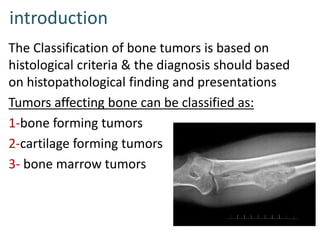
The Classification of bone tumors is based on
histological criteria & the diagnosis should based
on histopathological finding and presentations
Tumors affecting bone can be classified as:
1-bone forming tumors
2-cartilage forming tumors
3- bone marrow tumors
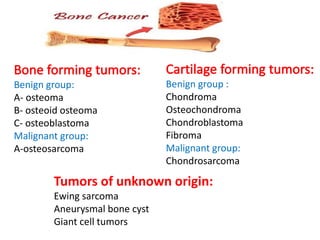
Benign group:
A- osteoma
B- osteoid osteoma
C- osteoblastoma
Malignant group:
A-osteosarcoma
Benign group :
Chondroma
Osteochondroma
Chondroblastoma
Fibroma
Malignant group:
Chondrosarcoma
Tumors of unknown origin:
Ewing sarcoma
Aneurysmal bone cyst
Giant cell tumors
Bone forming tumors:
These tumors produce unminralized osteoid or minrilized woven bone.
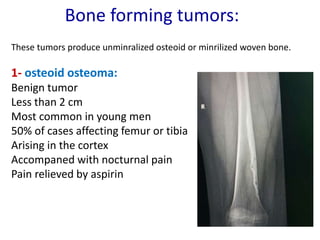
1- osteoid osteoma:
Benign tumor
Less than 2 cm
Most common in young men
50% of cases affecting femur or tibia
Arising in the cortex
Accompaned with nocturnal pain
Pain relieved by aspirin
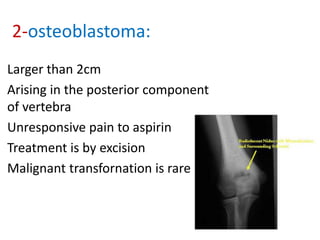
2-osteoblastoma:
• Larger than 2cm
• Arising in the posterior component
of vertebra
• Unresponsive pain to aspirin
• Treatment is by excision
• Malignant transfornation is rare
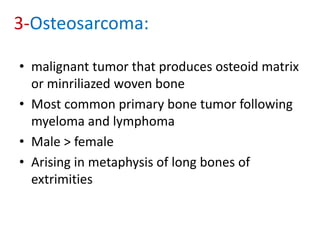
3-Osteosarcoma:
• malignant tumor that produces osteoid matrix
or minriliazed woven bone
• Most common primary bone tumor following
myeloma and lymphoma
• Male > female
• Arising in metaphysis of long bones of
extrimities
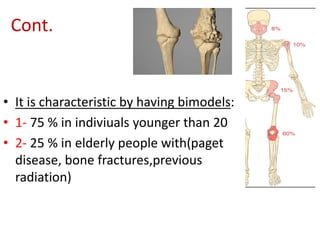
Cont.
• It is characteristic by having bimodels:
• 1- 75 % in indiviuals younger than 20
• 2- 25 % in elderly people with(paget
disease, bone fractures,previous
radiation)
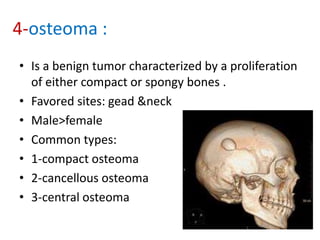
4-osteoma :
• Is a benign tumor characterized by a proliferation
of either compact or spongy bones .
• Favored sites: gead &neck
• Male>female
• Common types:
• 1-compact osteoma
• 2-cancellous osteoma
• 3-central osteoma
Cartilage forming tumors:
• Benign tumor that exhibits a cartilage gap
• The tumor is attached by a bony stalk
• 85 % of cases are solitary: diagnosed in late
adulscence and early adulthood
• 15 % is part of exostosis syndrom: diagnosed
during childhood
• Male > female by 3 times
1-osteochondroma
Cont.
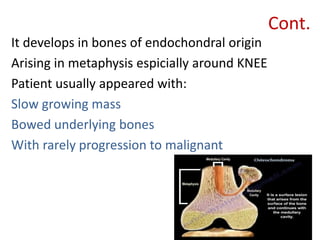
It develops in bones of endochondral origin
Arising in metaphysis espicially around KNEE
Patient usually appeared with:
Slow growing mass
Bowed underlying bones
With rarely progression to malignant
2- chondroma:
• Benign tumor of hyaline cartilage ocurr in
bones of endochondral origin.
• Appear as solitary in metaphyseal region
• Common sites:
• Short tubular bones of hands &feet
• Affecting age in between 20-50
Cont.
• It has 2 subtypes:-
• If arrising in medullary cavity, it is called :
• Enchondroma
• If arising in bone surface, it is called:
• juxtacortical chondroma
• Most cases detected as incidental finding
• On X-ray, it shows noduls of artilage
2- chondrosarcoma:
• Malignant tumor that is sub classified into :
1-Conventional
2-Dedifferentiated
3-Clear cell
4-mesenchymal
90 % of cases are conventional
Clear cells &mesenchymal occur in children
Cont.
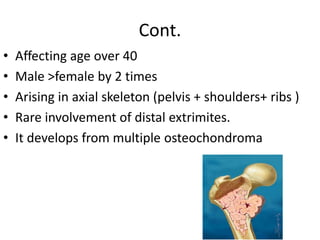
• Affecting age over 40
• Male >female by 2 times
• Arising in axial skeleton (pelvis + shoulders+ ribs )
• Rare involvement of distal extrimites.
• It develops from multiple osteochondroma
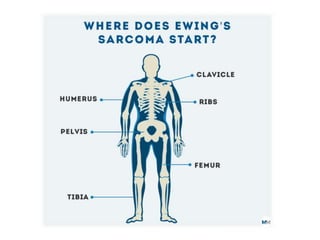
Bone marrow tumors
• Malignant tumor composed of primptive
round cell with various degree in
neuroectodermal differentiation
• It constitue 10% of primary malignant bone
tumors
• second most common bone scroma in
children
• 80% of cases are younger than 20
Ewing sarcoma
Classification of bone tumors.pptxpbl

Classification of bone tumors.pptxpbl

  • 1.
    Classification of bonetumors Prepaired by: 1-Amin makhdoom Twitter:ameen_km
  • 2.
    introduction The Classification ofbone tumors is based on histological criteria & the diagnosis should based on histopathological finding and presentations Tumors affecting bone can be classified as: 1-bone forming tumors 2-cartilage forming tumors 3- bone marrow tumors
  • 3.
    Benign group: A- osteoma B-osteoid osteoma C- osteoblastoma Malignant group: A-osteosarcoma Benign group : Chondroma Osteochondroma Chondroblastoma Fibroma Malignant group: Chondrosarcoma Tumors of unknown origin: Ewing sarcoma Aneurysmal bone cyst Giant cell tumors
  • 4.
    Bone forming tumors: Thesetumors produce unminralized osteoid or minrilized woven bone. 1- osteoid osteoma: Benign tumor Less than 2 cm Most common in young men 50% of cases affecting femur or tibia Arising in the cortex Accompaned with nocturnal pain Pain relieved by aspirin
  • 5.
    2-osteoblastoma: • Larger than2cm • Arising in the posterior component of vertebra • Unresponsive pain to aspirin • Treatment is by excision • Malignant transfornation is rare
  • 6.
    3-Osteosarcoma: • malignant tumorthat produces osteoid matrix or minriliazed woven bone • Most common primary bone tumor following myeloma and lymphoma • Male > female • Arising in metaphysis of long bones of extrimities
  • 7.
    Cont. • It ischaracteristic by having bimodels: • 1- 75 % in indiviuals younger than 20 • 2- 25 % in elderly people with(paget disease, bone fractures,previous radiation)
  • 8.
    4-osteoma : • Isa benign tumor characterized by a proliferation of either compact or spongy bones . • Favored sites: gead &neck • Male>female • Common types: • 1-compact osteoma • 2-cancellous osteoma • 3-central osteoma
  • 9.
    Cartilage forming tumors: •Benign tumor that exhibits a cartilage gap • The tumor is attached by a bony stalk • 85 % of cases are solitary: diagnosed in late adulscence and early adulthood • 15 % is part of exostosis syndrom: diagnosed during childhood • Male > female by 3 times 1-osteochondroma
  • 10.
    Cont. It develops inbones of endochondral origin Arising in metaphysis espicially around KNEE Patient usually appeared with: Slow growing mass Bowed underlying bones With rarely progression to malignant
  • 11.
    2- chondroma: • Benigntumor of hyaline cartilage ocurr in bones of endochondral origin. • Appear as solitary in metaphyseal region • Common sites: • Short tubular bones of hands &feet • Affecting age in between 20-50
  • 12.
    Cont. • It has2 subtypes:- • If arrising in medullary cavity, it is called : • Enchondroma • If arising in bone surface, it is called: • juxtacortical chondroma • Most cases detected as incidental finding • On X-ray, it shows noduls of artilage
  • 13.
    2- chondrosarcoma: • Malignanttumor that is sub classified into : 1-Conventional 2-Dedifferentiated 3-Clear cell 4-mesenchymal 90 % of cases are conventional Clear cells &mesenchymal occur in children
  • 14.
    Cont. • Affecting ageover 40 • Male >female by 2 times • Arising in axial skeleton (pelvis + shoulders+ ribs ) • Rare involvement of distal extrimites. • It develops from multiple osteochondroma
  • 15.
    Bone marrow tumors •Malignant tumor composed of primptive round cell with various degree in neuroectodermal differentiation • It constitue 10% of primary malignant bone tumors • second most common bone scroma in children • 80% of cases are younger than 20 Ewing sarcoma