Alkanes Compounds
Methane
Hydrocarbons
Certain organic compounds contain only two elements, hydrogen and carbon, and
hence are known as hydrocarbons. On the basis of structure, hydrocarbons are
divided into two main classes, aliphatic and aromatic. Aliphatic hydrocarbons are
further divided into families: alkanes, alkenes, alkynes, and their cyclic analogs
(cycloalkanes, etc.). We shall take up these families in the order given.
Structure of methane
The simplest member of the alkane family and, indeed, one of the simplest of all
organic compounds is methane, CH4 . We shall study this single compound at some
length, since most of what we learn about it can be carried over with minor
modifications to any alkane.
We shall ordinarily write methane with a dash to represent each pair of electrons
shared by carbon and hydrogen (I). To focus our attention on individual electrons,
we may sometimes indicate a pair of electrons by a pair of dots (II). Finally, when
we wish to consider the actual shape of the molecule, we shall use a simple three-
dimensional picture (III).
Reactions
1. Oxidation
2. Halogenation
Alkanes
Nomenclature
The names methane, ethane, propane, butane, and pentane are used for alkanes
containing respectively one, two, three, four, and five carbon atoms. So we give the
names of many larger alkanes. Except for the first four members of the family, the
name is simply derived from the Greek (or Latin) prefix for the particular number of
carbons in the alkane; thus pentane for five, hexane for six, heptane for seven, octane
for eight, and so on.
Alkyl groups
The general formula for an alkyl group is Cn H 2n+1 , since it contains one less
hydrogen than the parent alkane, Cn H 2n+2 .
The symbol R is used to represent any alkyl group, the CH3 group is called methyl
wherever it appears, CH3Br being methyl bromide, CH3 I, methyl iodide, and
CH3OH, methyl alcohol. In an analogous way, the C2H5 group is ethyl; C3H7 ,
propyl; C4H9 , butyl; and so on.
These groups are named simply by dropping -ane from the name of the
corresponding alkane and replacing it by -yl. They are known collectively as alkyl
groups.
IUPAC names of alkanes
Essentially the rules of the IUPAC system are:
1. Select as the parent structure the longest continuous chain, and then consider the
compound to have been derived from this structure by the replacement of hydrogen
by various alkyl groups. Isobutane (I) can be considered to arise
from propane by the replacement of a hydrogen atom by a methyl group, and thus
may be named methylpropane.
2. Where necessary, as in the isomeric methylpentanes (II and III), indicate by a
number the carbon to which the alkyl group is attached.
3. In numbering the parent carbon chain, start at whichever end results in the use of
the lowest numbers; thus II is called 2-methylpentane rather than 4-methylpentane.
4. If the same alkyl group occurs more than once as a side chain, indicate this by the
prefix di-. tri-, tetra-, etc., to show how many of these alkyl groups there are, and
indicate by various numbers the positions of each group, as in 2,2,4-
trimethylpentane(IV).
5. If there are several different alkyl groups attached to the parent chain, name them
in order of increasing size or in alphabetical order; as in 4-methyl- 3,3-diethyl-5-
isopropyloctane (V).
There are additional rules and conventions used in naming very complicated
alkanes, but the five fundamental rules mentioned here will suffice for the
compounds we are likely to encounter.
Classes of carbon atoms and hydrogen atoms
A primary (1) carbon atom is attached to only one other carbon atom; a secondary
(2) is attached to two others; and a tertiary (3) to three others. For example:
Each hydrogen atom is similarly classified, being given the same designation of
primary, secondary, or tertiary as the carbon atom to which it is attached. We shall
make constant use of these designations in our consideration of the relative
reactivities of various parts of an alkane molecule.
Physical properties
Preparation
1. Hydogenation of alkenes
2. Reduction of alkyl halides
(a) Hydrolysis of Grignard reagent.
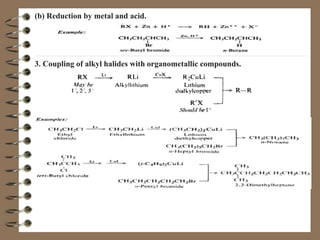
(b) Reduction by metal and acid.
3. Coupling of alkyl halides with organometallic compounds.
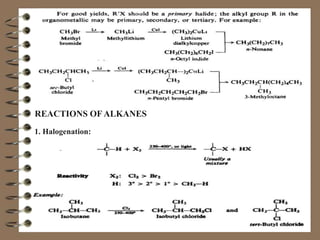
REACTIONS OF ALKANES
1. Halogenation:
2. Combustion:

Alkanes compounds

  • 1.
  • 2.
    Methane Hydrocarbons Certain organic compoundscontain only two elements, hydrogen and carbon, and hence are known as hydrocarbons. On the basis of structure, hydrocarbons are divided into two main classes, aliphatic and aromatic. Aliphatic hydrocarbons are further divided into families: alkanes, alkenes, alkynes, and their cyclic analogs (cycloalkanes, etc.). We shall take up these families in the order given.
  • 3.
    Structure of methane Thesimplest member of the alkane family and, indeed, one of the simplest of all organic compounds is methane, CH4 . We shall study this single compound at some length, since most of what we learn about it can be carried over with minor modifications to any alkane. We shall ordinarily write methane with a dash to represent each pair of electrons shared by carbon and hydrogen (I). To focus our attention on individual electrons, we may sometimes indicate a pair of electrons by a pair of dots (II). Finally, when we wish to consider the actual shape of the molecule, we shall use a simple three- dimensional picture (III).
  • 4.
  • 5.
    Alkanes Nomenclature The names methane,ethane, propane, butane, and pentane are used for alkanes containing respectively one, two, three, four, and five carbon atoms. So we give the names of many larger alkanes. Except for the first four members of the family, the name is simply derived from the Greek (or Latin) prefix for the particular number of carbons in the alkane; thus pentane for five, hexane for six, heptane for seven, octane for eight, and so on.
  • 6.
    Alkyl groups The generalformula for an alkyl group is Cn H 2n+1 , since it contains one less hydrogen than the parent alkane, Cn H 2n+2 . The symbol R is used to represent any alkyl group, the CH3 group is called methyl wherever it appears, CH3Br being methyl bromide, CH3 I, methyl iodide, and CH3OH, methyl alcohol. In an analogous way, the C2H5 group is ethyl; C3H7 , propyl; C4H9 , butyl; and so on. These groups are named simply by dropping -ane from the name of the corresponding alkane and replacing it by -yl. They are known collectively as alkyl groups.
  • 7.
    IUPAC names ofalkanes Essentially the rules of the IUPAC system are: 1. Select as the parent structure the longest continuous chain, and then consider the compound to have been derived from this structure by the replacement of hydrogen by various alkyl groups. Isobutane (I) can be considered to arise from propane by the replacement of a hydrogen atom by a methyl group, and thus may be named methylpropane. 2. Where necessary, as in the isomeric methylpentanes (II and III), indicate by a number the carbon to which the alkyl group is attached. 3. In numbering the parent carbon chain, start at whichever end results in the use of the lowest numbers; thus II is called 2-methylpentane rather than 4-methylpentane. 4. If the same alkyl group occurs more than once as a side chain, indicate this by the prefix di-. tri-, tetra-, etc., to show how many of these alkyl groups there are, and indicate by various numbers the positions of each group, as in 2,2,4- trimethylpentane(IV).
  • 8.
    5. If thereare several different alkyl groups attached to the parent chain, name them in order of increasing size or in alphabetical order; as in 4-methyl- 3,3-diethyl-5- isopropyloctane (V). There are additional rules and conventions used in naming very complicated alkanes, but the five fundamental rules mentioned here will suffice for the compounds we are likely to encounter. Classes of carbon atoms and hydrogen atoms A primary (1) carbon atom is attached to only one other carbon atom; a secondary (2) is attached to two others; and a tertiary (3) to three others. For example:
  • 9.
    Each hydrogen atomis similarly classified, being given the same designation of primary, secondary, or tertiary as the carbon atom to which it is attached. We shall make constant use of these designations in our consideration of the relative reactivities of various parts of an alkane molecule. Physical properties
  • 10.
    Preparation 1. Hydogenation ofalkenes 2. Reduction of alkyl halides (a) Hydrolysis of Grignard reagent.
  • 11.
    (b) Reduction bymetal and acid. 3. Coupling of alkyl halides with organometallic compounds.
  • 12.
  • 13.