SENSORY PROCESSING IN
CHILDREN:
DO SENSORY INTEGRATION TECHNIQUES SUPPORT
LANGUAGE?
Alana Fabish
Graduate Student Clinician – JAC School
Fall 2015
SENSORY INTEGRATION
 SI definition originally proposed by Jean Ayres in 1972:
 “the ability to organize sensory information for use” (p. 1)
 Sensory Integration and the Child published in 1979
 Purpose: for parents to recognize sensory integration
dysfunction in their children, understand what was going on,
and provide parents with ways to help their children
 Expanded definition of SI in 1989
 “Sensory integration is the neurological process that
organizes sensation from one’s own body and from the
environment and makes it possible to use the body effectively
within the environment. The spatial and temporal aspects of
inputs from different sensory modalities are interpreted,
associated, and unified. SI is information processing…the
brain must select, enhance, inhibit, compare, and associate
the sensory information in a flexible, constantly changing
pattern; in other words, the brain must integrate it.” (Ayres, p.
11)
Ayers, 1972, 1979, 1989
SENSORY INTEGRATION AND THEORY
 Involves all of the senses, but focuses on 3 less
cortically processed ones:
 Vestibular
 Tactile
 Proprioceptive
 These 3 senses are the basis/foundation which
certain skills are formed and maintained
 Auditory-language, eye-hand coordination, etc.
 Brainstem and thalamus are critical in SI
 Vestibular info: processed in brainstem
 Tactile/proprioceptive info: processed in both
 SI Theory: increased efficiency enhances higher
functioning (i.e. complex learning, behavior)
Mauer, 1999
SENSORY INTEGRATION THERAPY
 Defined as a specialty in occupational therapy
 Focused on assessment and treatment of people with
sensory integrative/sensory processing dysfunction
 Based on the principle of neuroplasticity in CNS
 Some of the neural processes responsible for
interpreting and integrating sensory information can be
“remediated” due to this principle
 Control of tactile, vestibular, and proprioceptive sensory
inputs can potentially enhance functioning of the
nervous system (Fisher et al., 1991)
 There are a variety of approaches used in therapy
 Sensorimotor, Neurodevelopmental, Developmental,
Behavioral, Sensory integrative
Mauer, 1999
SENSORY INTEGRATION THERAPY
POPULATIONS
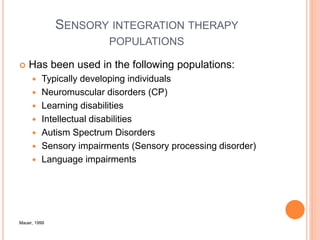
 Has been used in the following populations:
 Typically developing individuals
 Neuromuscular disorders (CP)
 Learning disabilities
 Intellectual disabilities
 Autism Spectrum Disorders
 Sensory impairments (Sensory processing disorder)
 Language impairments
Mauer, 1999
SENSORY INTEGRATION DYSFUNCTION LEADING TO
SENSORY PROCESSING DISORDER
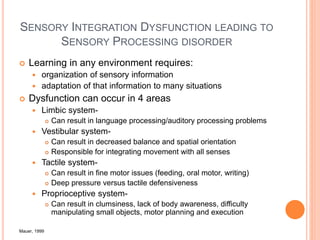
 Learning in any environment requires:
 organization of sensory information
 adaptation of that information to many situations
 Dysfunction can occur in 4 areas
 Limbic system-
 Can result in language processing/auditory processing problems
 Vestibular system-
 Can result in decreased balance and spatial orientation
 Responsible for integrating movement with all senses
 Tactile system-
 Can result in fine motor issues (feeding, oral motor, writing)
 Deep pressure versus tactile defensiveness
 Proprioceptive system-
 Can result in clumsiness, lack of body awareness, difficulty
manipulating small objects, motor planning and execution
Mauer, 1999
SENSORY PROCESSING IN INFANTS
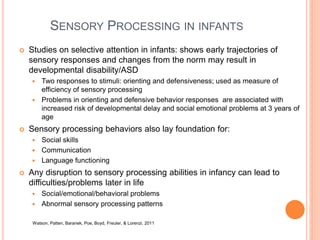
 Studies on selective attention in infants: shows early trajectories of
sensory responses and changes from the norm may result in
developmental disability/ASD
 Two responses to stimuli: orienting and defensiveness; used as measure of
efficiency of sensory processing
 Problems in orienting and defensive behavior responses are associated with
increased risk of developmental delay and social emotional problems at 3 years of
age
 Sensory processing behaviors also lay foundation for:
 Social skills
 Communication
 Language functioning
 Any disruption to sensory processing abilities in infancy can lead to
difficulties/problems later in life
 Social/emotional/behavioral problems
 Abnormal sensory processing patterns
Watson, Patten, Baranek, Poe, Boyd, Freuler, & Lorenzi, 2011
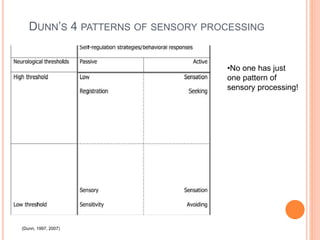
DUNN’S 4 PATTERNS OF SENSORY PROCESSING
(Dunn, 1997, 2007)
•No one has just
one pattern of
sensory processing!
ASD SENSORY PROCESSING PATTERNS
 Different/unusual responses to sensory stimuli than
typically developing peers and peers with other
developmental disabilities
 3 accepted sensory-processing constructs:
 Hyporesponsiveness- absence of expected response to
stimuli, delayed response, higher response threshold
 Low arousal, low registration
 Hyperresponsiveness- exaggerated behavioral reaction,
aversive response, or avoidance of sensory stimuli
 Sensation avoiding, sensory sensitivity
 Sensory seeking- actions or behaviors that seek to
intensify sensory experiences
 Sensory seeking
 Patterns are NOT mutually exclusive; may co-occur
or differ based on modality type
Watson et. al, 2011
ASD SENSORY PROCESSING PATTERNS
 Hyperresponsiveness was not correlated with social-
communicative symptom severity (measured with
modified ADOS)
 Hyporesponsiveness was associated with social-
communicative symptom severity; negatively associated
with language skills and social adaptive skills
 Sensory seeking negatively associated with language
skills
Watson et. al, 2011
SENSORY INTEGRATION THERAPY AND
LANGUAGE- EARLY RESEARCH
 Sensory integration therapy doesn’t directly
address language
 Some studies have documented improvement in motor,
language, academic, and cognitive skills using
traditional SI therapy (Fallon et. al, 1992)
 Research criticized these early studies due to:
 Low sample size (N)
 Varying types of SI treatment
 Inconsistent outcomes
Mauer, 1999
SENSORY INTEGRATION THERAPY AND
LANGUAGE- LATER RESEARCH
 1999: Meta-analysis of SIT with adults and children
with various language/motor/cognitive disorders (Vargas
& Camilli, 1999)
 Significant effect on psychoeducational & motor
outcomes
 No effect on behavior, language, or sensory-perceptual
outcomes
 2008: Review of research since 1994 on SIT (Leong &
Carter, 2008)
 Inadequate evidence to support SIT outside of research
purposes
USING SENSORY INTEGRATION
 Allows child to organize themselves
 Promotes better attention
 Working on less cortically processed senses promotes
generalization to higher-level senses
 Visual
 Auditory
 Calms the child/primes the child for higher sensory input
 Creates an environment that lends itself to:
 Language production
 Language comprehension
SENSORY-BASED ACTIVITIES
 Incorporate sensory activities into our therapy
sessions rather than using sensory integration
therapy (SIT)
 ASHA’s National Center for EBP produced a systematic
review of Sensory-Based Interventions
 Their recommendations: “incorporating sensory-based
activities (e.g., tactile stimulation, vestibular stimulation) with
skill-based treatments may be motivating or make treatment
more enjoyable for the child. However, further research is
needed to better understand the nature of sensory processing
disorder and the associated treatments as well as any role of
the SLP or audiologist.” (pg. 13)
 No studies using SIT showed gains in language abilities
Schooling, Coleman, & Cannon, 2012
FACILITATING LANGUAGE IN THERAPY
 Hyporesponsiveness:
 take advantage of stimuli that have caught the child’s attention;
build communicative interactions around that stimulus
 Hyperresponsiveness/hyporesponsiveness seen
together:
 accommodate co-occurring or shifting sensory behaviors within
your sessions; accommodations must change based on child’s
behavior
 Sensory seeking:
 Incorporate unique, child-specific stimuli that might engage child
and motivate better attention during your sessions
 Must always consider the child’s underlying sensory
response patterns to provide successful intervention
 Response patterns may affect success in language, social, and
communication development
Watson et. al, 2011
EXAMPLES OF SENSORY-BASED ACTIVITIES
 Hyporesponsive children:
 Sensory corner with sensory box
 Many textures and weights
 Vibration to stimulate oral-motor awareness
 Deep pressure touch
 Weighted blanket at rest time
 Bouncing and rocking on a ball or swinging
 Best to use a “heavy work” activity before doing a sit-down activity
 For SLP’s: incorporate some gross motor tasks to allow child to organize
their sensory system before putting language demands on them
 Sand/water play
 Vibrating toys/toys that light up
 Provide different play surfaces
 Speak with varying intonation; highlight important words using
stress, prosody, and intonation
 Brightly colored toys to gain and keep child’s attention
 Give child heavy objects to carry
 Use scented lotion on child and your hands
Dunn, 2007
EXAMPLES OF SENSORY-BASED ACTIVITIES
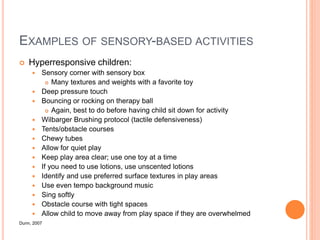
 Hyperresponsive children:
 Sensory corner with sensory box
 Many textures and weights with a favorite toy
 Deep pressure touch
 Bouncing or rocking on therapy ball
 Again, best to do before having child sit down for activity
 Wilbarger Brushing protocol (tactile defensiveness)
 Tents/obstacle courses
 Chewy tubes
 Allow for quiet play
 Keep play area clear; use one toy at a time
 If you need to use lotions, use unscented lotions
 Identify and use preferred surface textures in play areas
 Use even tempo background music
 Sing softly
 Obstacle course with tight spaces
 Allow child to move away from play space if they are overwhelmed
Dunn, 2007
EXAMPLES OF SENSORY-BASED ACTIVITIES
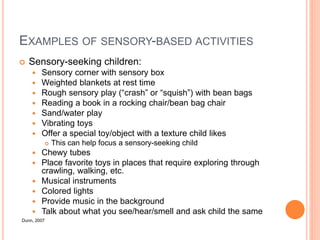
 Sensory-seeking children:
 Sensory corner with sensory box
 Weighted blankets at rest time
 Rough sensory play (“crash” or “squish”) with bean bags
 Reading a book in a rocking chair/bean bag chair
 Sand/water play
 Vibrating toys
 Offer a special toy/object with a texture child likes
 This can help focus a sensory-seeking child
 Chewy tubes
 Place favorite toys in places that require exploring through
crawling, walking, etc.
 Musical instruments
 Colored lights
 Provide music in the background
 Talk about what you see/hear/smell and ask child the same
Dunn, 2007
CONCLUSIONS
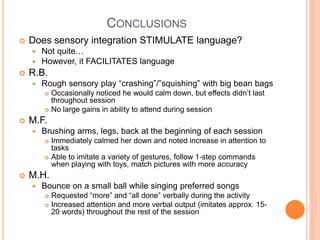
 Does sensory integration STIMULATE language?
 Not quite…
 However, it FACILITATES language
 R.B.
 Rough sensory play “crashing”/”squishing” with big bean bags
 Occasionally noticed he would calm down, but effects didn’t last
throughout session
 No large gains in ability to attend during session
 M.F.
 Brushing arms, legs, back at the beginning of each session
 Immediately calmed her down and noted increase in attention to
tasks
 Able to imitate a variety of gestures, follow 1-step commands
when playing with toys, match pictures with more accuracy
 M.H.
 Bounce on a small ball while singing preferred songs
 Requested “more” and “all done” verbally during the activity
 Increased attention and more verbal output (imitates approx. 15-
20 words) throughout the rest of the session
CONCLUSIONS
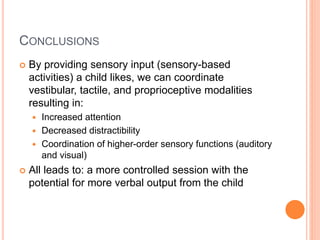
 By providing sensory input (sensory-based
activities) a child likes, we can coordinate
vestibular, tactile, and proprioceptive modalities
resulting in:
 Increased attention
 Decreased distractibility
 Coordination of higher-order sensory functions (auditory
and visual)
 All leads to: a more controlled session with the
potential for more verbal output from the child
REFERENCES
 Ayres, A. J. (1972). Sensory integration and learning disorders. Los Angeles, CA: WPS.
 Ayres, A.J. (1979). Sensory integration and the child. Los Angeles, CA: WPS.
 Dunn, W. (1997). The impact of sensory processing abilities on the daily lives of young children and
families: A conceptual model. Infants and Young Children, 9, 23-35.
 Dunn, W. (2007). Supporting children to participate successfully in everyday life by using sensory
processing knowledge. Infants & Young Children, 20, 84-101.
 Fisher, A. G., Murray, E. A., & Bundy, A. C. (1991). Sensory integration: Theory and practice.
Philadelphia, PA: F. A. Davis.
 Leong, H., & Carter, M. (2008). Research on the efficacy of sensory integration therapy: Past, present
and future. Australasian Journal of Special Education, 32, 83–89.
 Mauer, D.M. (1999). Issues and applications of sensory integration theory and treatment with children
with language disorders. Language, Speech, and Hearing Services in Schools, 30, 383-392.
 Schooling, T., Coleman, J., & Cannon, L. (2012). The effect of sensory-based interventions on
communication outcomes in children: A systematic review. National Center for Evidence-Based Practice
in Communication Disorders, 1-47.
 Vargas, S., & Camilli, G. (1999). A meta-analysis of research on sensory integration treatment. The
American Journal of Occupational Therapy, 53, 189–198.
 Watson, L.R., Patten, E., Baranek, G.T., Poe, M., Boyd, B.A., Freuler, A., & Lorenzi, J. (2011).
Differential associations between sensory response patterns and language, social, and communication
measures in children with autism or other developmental disabilities. Journal of Speech, Language, and
Hearing Research, 54, 1562-157 DOI: 10.1044/1092-4388(2011/10-0029)6.

Sensory Integration and Processing

  • 1.
    SENSORY PROCESSING IN CHILDREN: DOSENSORY INTEGRATION TECHNIQUES SUPPORT LANGUAGE? Alana Fabish Graduate Student Clinician – JAC School Fall 2015
  • 2.
    SENSORY INTEGRATION  SIdefinition originally proposed by Jean Ayres in 1972:  “the ability to organize sensory information for use” (p. 1)  Sensory Integration and the Child published in 1979  Purpose: for parents to recognize sensory integration dysfunction in their children, understand what was going on, and provide parents with ways to help their children  Expanded definition of SI in 1989  “Sensory integration is the neurological process that organizes sensation from one’s own body and from the environment and makes it possible to use the body effectively within the environment. The spatial and temporal aspects of inputs from different sensory modalities are interpreted, associated, and unified. SI is information processing…the brain must select, enhance, inhibit, compare, and associate the sensory information in a flexible, constantly changing pattern; in other words, the brain must integrate it.” (Ayres, p. 11) Ayers, 1972, 1979, 1989
  • 3.
    SENSORY INTEGRATION ANDTHEORY  Involves all of the senses, but focuses on 3 less cortically processed ones:  Vestibular  Tactile  Proprioceptive  These 3 senses are the basis/foundation which certain skills are formed and maintained  Auditory-language, eye-hand coordination, etc.  Brainstem and thalamus are critical in SI  Vestibular info: processed in brainstem  Tactile/proprioceptive info: processed in both  SI Theory: increased efficiency enhances higher functioning (i.e. complex learning, behavior) Mauer, 1999
  • 4.
    SENSORY INTEGRATION THERAPY Defined as a specialty in occupational therapy  Focused on assessment and treatment of people with sensory integrative/sensory processing dysfunction  Based on the principle of neuroplasticity in CNS  Some of the neural processes responsible for interpreting and integrating sensory information can be “remediated” due to this principle  Control of tactile, vestibular, and proprioceptive sensory inputs can potentially enhance functioning of the nervous system (Fisher et al., 1991)  There are a variety of approaches used in therapy  Sensorimotor, Neurodevelopmental, Developmental, Behavioral, Sensory integrative Mauer, 1999
  • 5.
    SENSORY INTEGRATION THERAPY POPULATIONS Has been used in the following populations:  Typically developing individuals  Neuromuscular disorders (CP)  Learning disabilities  Intellectual disabilities  Autism Spectrum Disorders  Sensory impairments (Sensory processing disorder)  Language impairments Mauer, 1999
  • 6.
    SENSORY INTEGRATION DYSFUNCTIONLEADING TO SENSORY PROCESSING DISORDER  Learning in any environment requires:  organization of sensory information  adaptation of that information to many situations  Dysfunction can occur in 4 areas  Limbic system-  Can result in language processing/auditory processing problems  Vestibular system-  Can result in decreased balance and spatial orientation  Responsible for integrating movement with all senses  Tactile system-  Can result in fine motor issues (feeding, oral motor, writing)  Deep pressure versus tactile defensiveness  Proprioceptive system-  Can result in clumsiness, lack of body awareness, difficulty manipulating small objects, motor planning and execution Mauer, 1999
  • 7.
    SENSORY PROCESSING ININFANTS  Studies on selective attention in infants: shows early trajectories of sensory responses and changes from the norm may result in developmental disability/ASD  Two responses to stimuli: orienting and defensiveness; used as measure of efficiency of sensory processing  Problems in orienting and defensive behavior responses are associated with increased risk of developmental delay and social emotional problems at 3 years of age  Sensory processing behaviors also lay foundation for:  Social skills  Communication  Language functioning  Any disruption to sensory processing abilities in infancy can lead to difficulties/problems later in life  Social/emotional/behavioral problems  Abnormal sensory processing patterns Watson, Patten, Baranek, Poe, Boyd, Freuler, & Lorenzi, 2011
  • 8.
    DUNN’S 4 PATTERNSOF SENSORY PROCESSING (Dunn, 1997, 2007) •No one has just one pattern of sensory processing!
  • 9.
    ASD SENSORY PROCESSINGPATTERNS  Different/unusual responses to sensory stimuli than typically developing peers and peers with other developmental disabilities  3 accepted sensory-processing constructs:  Hyporesponsiveness- absence of expected response to stimuli, delayed response, higher response threshold  Low arousal, low registration  Hyperresponsiveness- exaggerated behavioral reaction, aversive response, or avoidance of sensory stimuli  Sensation avoiding, sensory sensitivity  Sensory seeking- actions or behaviors that seek to intensify sensory experiences  Sensory seeking  Patterns are NOT mutually exclusive; may co-occur or differ based on modality type Watson et. al, 2011
  • 10.
    ASD SENSORY PROCESSINGPATTERNS  Hyperresponsiveness was not correlated with social- communicative symptom severity (measured with modified ADOS)  Hyporesponsiveness was associated with social- communicative symptom severity; negatively associated with language skills and social adaptive skills  Sensory seeking negatively associated with language skills Watson et. al, 2011
  • 11.
    SENSORY INTEGRATION THERAPYAND LANGUAGE- EARLY RESEARCH  Sensory integration therapy doesn’t directly address language  Some studies have documented improvement in motor, language, academic, and cognitive skills using traditional SI therapy (Fallon et. al, 1992)  Research criticized these early studies due to:  Low sample size (N)  Varying types of SI treatment  Inconsistent outcomes Mauer, 1999
  • 12.
    SENSORY INTEGRATION THERAPYAND LANGUAGE- LATER RESEARCH  1999: Meta-analysis of SIT with adults and children with various language/motor/cognitive disorders (Vargas & Camilli, 1999)  Significant effect on psychoeducational & motor outcomes  No effect on behavior, language, or sensory-perceptual outcomes  2008: Review of research since 1994 on SIT (Leong & Carter, 2008)  Inadequate evidence to support SIT outside of research purposes
  • 13.
    USING SENSORY INTEGRATION Allows child to organize themselves  Promotes better attention  Working on less cortically processed senses promotes generalization to higher-level senses  Visual  Auditory  Calms the child/primes the child for higher sensory input  Creates an environment that lends itself to:  Language production  Language comprehension
  • 14.
    SENSORY-BASED ACTIVITIES  Incorporatesensory activities into our therapy sessions rather than using sensory integration therapy (SIT)  ASHA’s National Center for EBP produced a systematic review of Sensory-Based Interventions  Their recommendations: “incorporating sensory-based activities (e.g., tactile stimulation, vestibular stimulation) with skill-based treatments may be motivating or make treatment more enjoyable for the child. However, further research is needed to better understand the nature of sensory processing disorder and the associated treatments as well as any role of the SLP or audiologist.” (pg. 13)  No studies using SIT showed gains in language abilities Schooling, Coleman, & Cannon, 2012
  • 15.
    FACILITATING LANGUAGE INTHERAPY  Hyporesponsiveness:  take advantage of stimuli that have caught the child’s attention; build communicative interactions around that stimulus  Hyperresponsiveness/hyporesponsiveness seen together:  accommodate co-occurring or shifting sensory behaviors within your sessions; accommodations must change based on child’s behavior  Sensory seeking:  Incorporate unique, child-specific stimuli that might engage child and motivate better attention during your sessions  Must always consider the child’s underlying sensory response patterns to provide successful intervention  Response patterns may affect success in language, social, and communication development Watson et. al, 2011
  • 16.
    EXAMPLES OF SENSORY-BASEDACTIVITIES  Hyporesponsive children:  Sensory corner with sensory box  Many textures and weights  Vibration to stimulate oral-motor awareness  Deep pressure touch  Weighted blanket at rest time  Bouncing and rocking on a ball or swinging  Best to use a “heavy work” activity before doing a sit-down activity  For SLP’s: incorporate some gross motor tasks to allow child to organize their sensory system before putting language demands on them  Sand/water play  Vibrating toys/toys that light up  Provide different play surfaces  Speak with varying intonation; highlight important words using stress, prosody, and intonation  Brightly colored toys to gain and keep child’s attention  Give child heavy objects to carry  Use scented lotion on child and your hands Dunn, 2007
  • 17.
    EXAMPLES OF SENSORY-BASEDACTIVITIES  Hyperresponsive children:  Sensory corner with sensory box  Many textures and weights with a favorite toy  Deep pressure touch  Bouncing or rocking on therapy ball  Again, best to do before having child sit down for activity  Wilbarger Brushing protocol (tactile defensiveness)  Tents/obstacle courses  Chewy tubes  Allow for quiet play  Keep play area clear; use one toy at a time  If you need to use lotions, use unscented lotions  Identify and use preferred surface textures in play areas  Use even tempo background music  Sing softly  Obstacle course with tight spaces  Allow child to move away from play space if they are overwhelmed Dunn, 2007
  • 18.
    EXAMPLES OF SENSORY-BASEDACTIVITIES  Sensory-seeking children:  Sensory corner with sensory box  Weighted blankets at rest time  Rough sensory play (“crash” or “squish”) with bean bags  Reading a book in a rocking chair/bean bag chair  Sand/water play  Vibrating toys  Offer a special toy/object with a texture child likes  This can help focus a sensory-seeking child  Chewy tubes  Place favorite toys in places that require exploring through crawling, walking, etc.  Musical instruments  Colored lights  Provide music in the background  Talk about what you see/hear/smell and ask child the same Dunn, 2007
  • 19.
    CONCLUSIONS  Does sensoryintegration STIMULATE language?  Not quite…  However, it FACILITATES language  R.B.  Rough sensory play “crashing”/”squishing” with big bean bags  Occasionally noticed he would calm down, but effects didn’t last throughout session  No large gains in ability to attend during session  M.F.  Brushing arms, legs, back at the beginning of each session  Immediately calmed her down and noted increase in attention to tasks  Able to imitate a variety of gestures, follow 1-step commands when playing with toys, match pictures with more accuracy  M.H.  Bounce on a small ball while singing preferred songs  Requested “more” and “all done” verbally during the activity  Increased attention and more verbal output (imitates approx. 15- 20 words) throughout the rest of the session
  • 20.
    CONCLUSIONS  By providingsensory input (sensory-based activities) a child likes, we can coordinate vestibular, tactile, and proprioceptive modalities resulting in:  Increased attention  Decreased distractibility  Coordination of higher-order sensory functions (auditory and visual)  All leads to: a more controlled session with the potential for more verbal output from the child
  • 21.
    REFERENCES  Ayres, A.J. (1972). Sensory integration and learning disorders. Los Angeles, CA: WPS.  Ayres, A.J. (1979). Sensory integration and the child. Los Angeles, CA: WPS.  Dunn, W. (1997). The impact of sensory processing abilities on the daily lives of young children and families: A conceptual model. Infants and Young Children, 9, 23-35.  Dunn, W. (2007). Supporting children to participate successfully in everyday life by using sensory processing knowledge. Infants & Young Children, 20, 84-101.  Fisher, A. G., Murray, E. A., & Bundy, A. C. (1991). Sensory integration: Theory and practice. Philadelphia, PA: F. A. Davis.  Leong, H., & Carter, M. (2008). Research on the efficacy of sensory integration therapy: Past, present and future. Australasian Journal of Special Education, 32, 83–89.  Mauer, D.M. (1999). Issues and applications of sensory integration theory and treatment with children with language disorders. Language, Speech, and Hearing Services in Schools, 30, 383-392.  Schooling, T., Coleman, J., & Cannon, L. (2012). The effect of sensory-based interventions on communication outcomes in children: A systematic review. National Center for Evidence-Based Practice in Communication Disorders, 1-47.  Vargas, S., & Camilli, G. (1999). A meta-analysis of research on sensory integration treatment. The American Journal of Occupational Therapy, 53, 189–198.  Watson, L.R., Patten, E., Baranek, G.T., Poe, M., Boyd, B.A., Freuler, A., & Lorenzi, J. (2011). Differential associations between sensory response patterns and language, social, and communication measures in children with autism or other developmental disabilities. Journal of Speech, Language, and Hearing Research, 54, 1562-157 DOI: 10.1044/1092-4388(2011/10-0029)6.

Editor's Notes

  • #9 Sensory seeking- don’t notice stimuli easily, but they crave sensory experiences Sensory avoiding- withdraw from situations quickly Sensory sensitivity- tend to be reactive, high detection skills but will stay in their environment and react to what’s happening Low registration- Don’t notice what others notice due to high threshold, miss things due to passive regulation
  • #11 ADOS- Autism Diagnostic Observation Scale