Teaching Students with  Autism Spectrum Disorder EDU 5101 Kevin Neuenswander
What is Sensory/Integration Processing? We receive information about the world around us through our senses.  We have a constant flow of information coming into our nervous system every second of every day. All this information is received in our brain & organized & sorted in an efficient manner.  The brain then uses this information to help us form our behaviors, emotions, & readiness to perform learning tasks.
5 Steps  of Sensory Processing/Integration Registration -awareness that we have touched, seen. Orientation -Focusing on or regarding the input. Interpretation -relating emotions & past experiences. Organization -determine if a response is necessary Execution of response -which may be ignoring.
What is Sensory/Integration Processing? Most people take in sensory information & process it without even thinking about it. -Optimal state-all seven areas of sensory processing work  effectively.  Some people take in sensory information & recognize it immediately & are very aware of the sensation. -Sensory defensiveness-high alert or arousal level Some people take in sensory information & difficulty registering the sensation. -Low arousal.
Sensory & ASD Students High incidence of sensory processing challenges Can be hypersensitive/over reactive Can be hyposensitive/under reactive Result in behavioral/social/emotional & academic difficulties
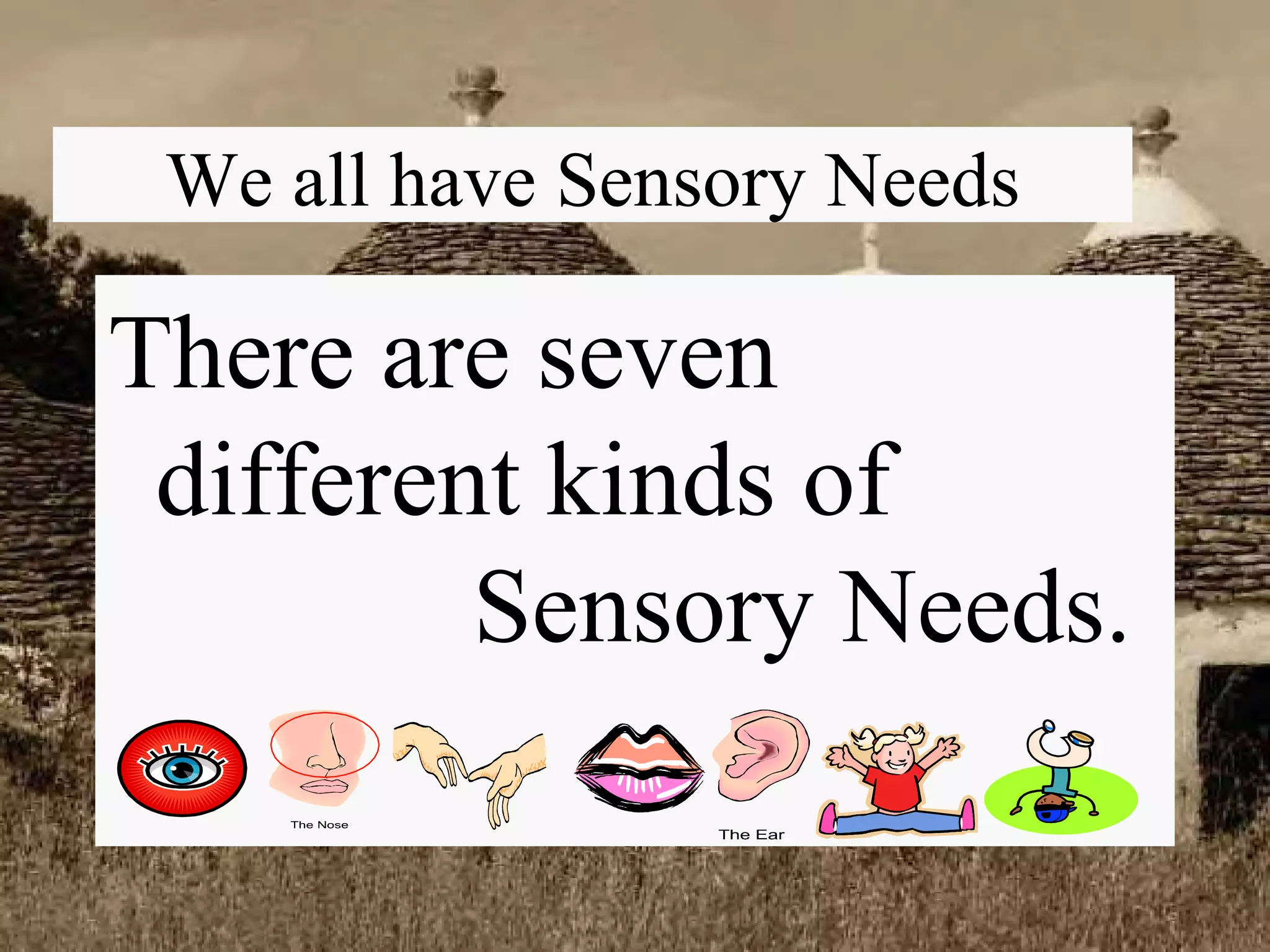
We all have Sensory Needs There are seven  different kinds of    Sensory Needs.
Variation in light Variation in color Visual distractions Visual
Olfactory Variations in types of odors Variations in intensity of odors
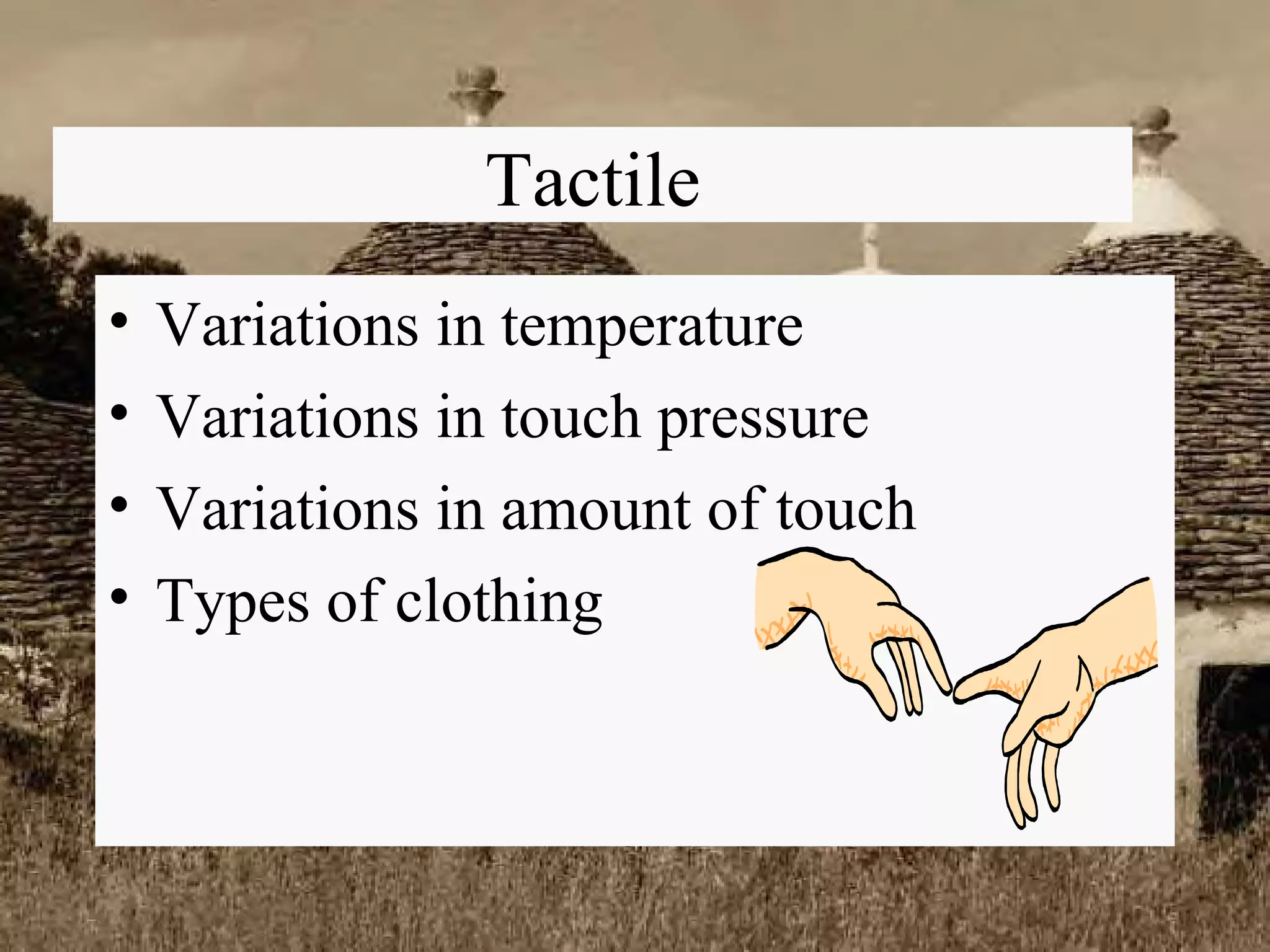
Tactile Variations in temperature Variations in touch pressure Variations in amount of touch Types of clothing
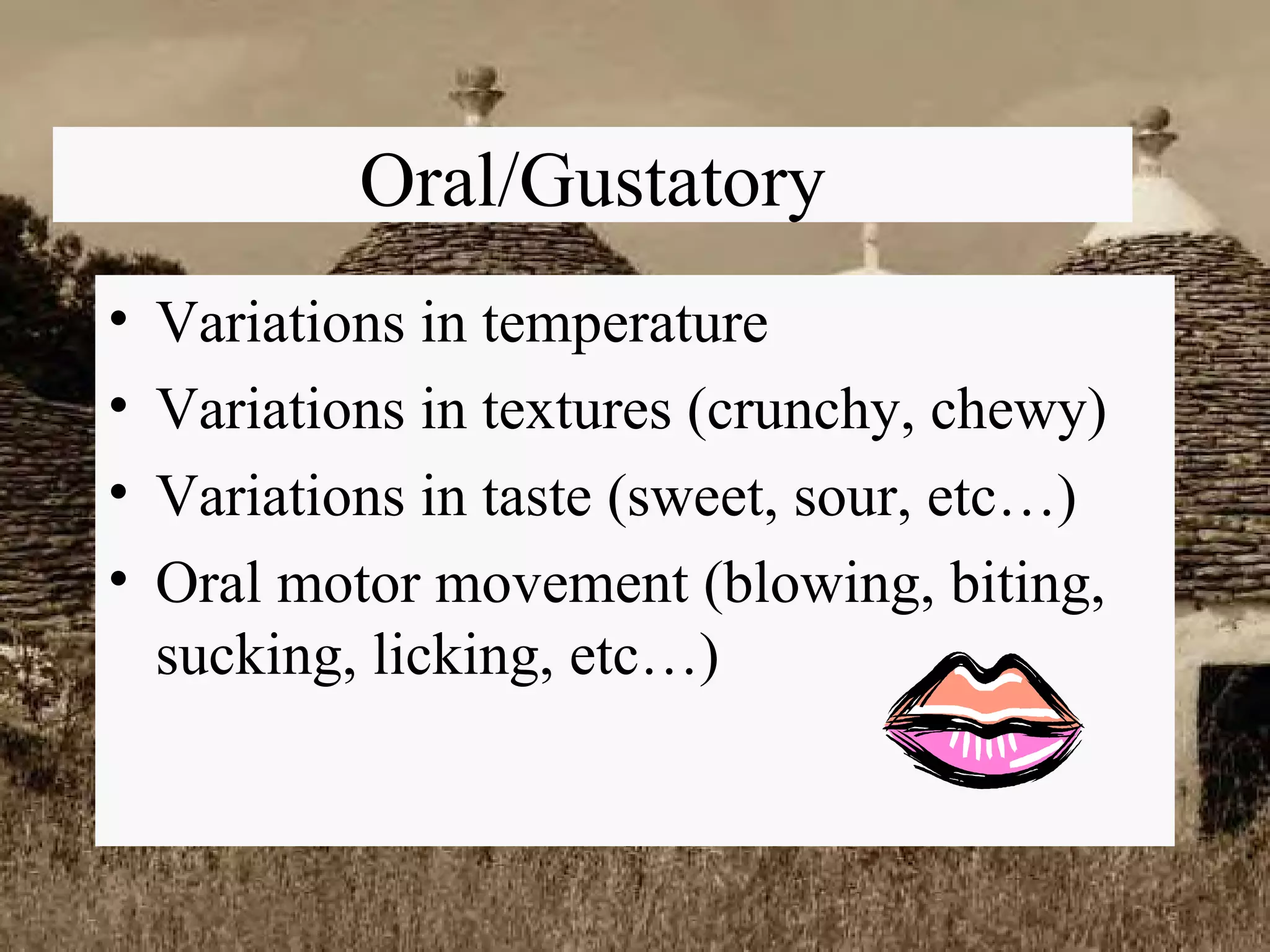
Oral/Gustatory Variations in temperature Variations in textures (crunchy, chewy) Variations in taste (sweet, sour, etc…) Oral motor movement (blowing, biting, sucking, licking, etc…)
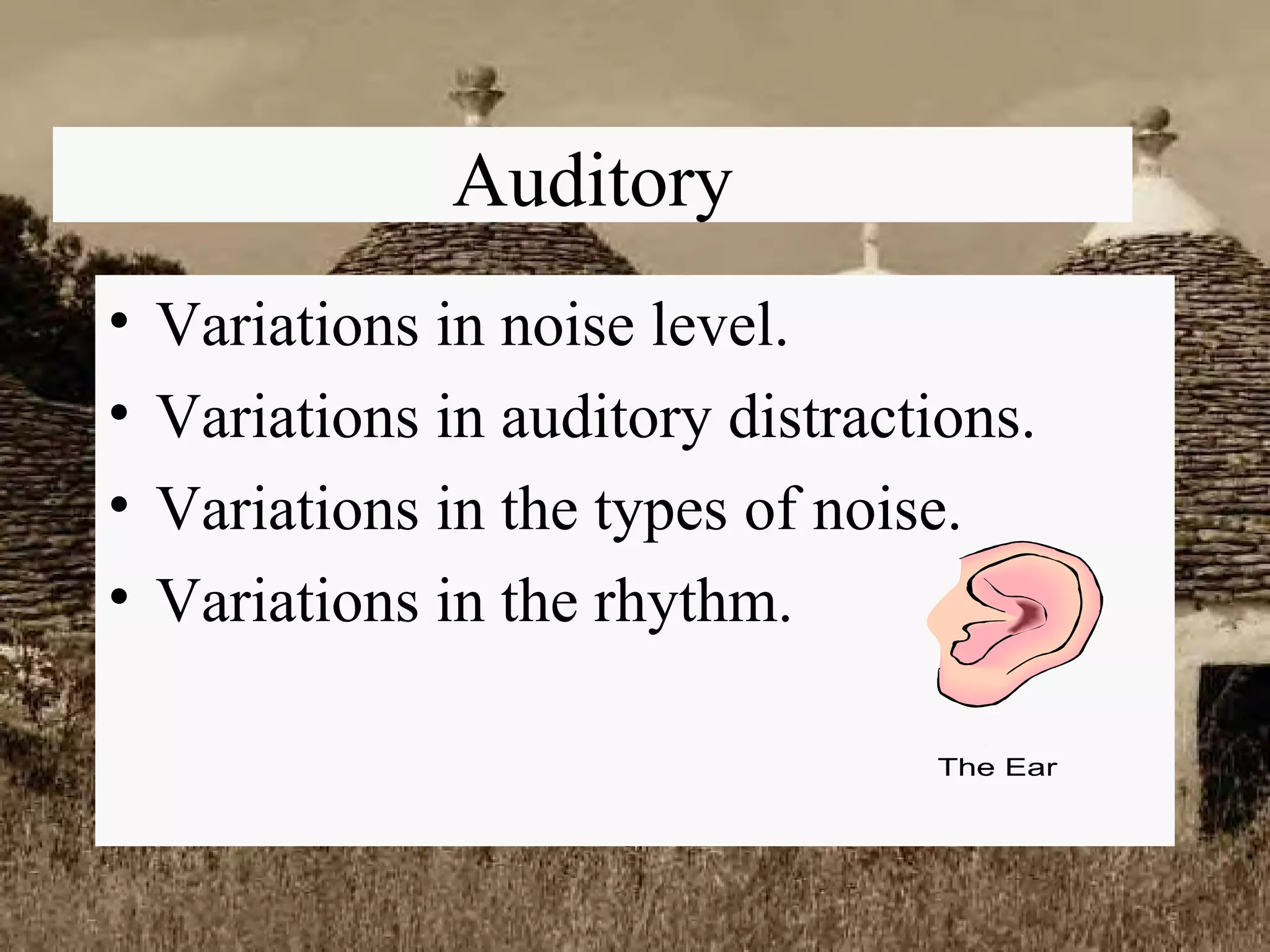
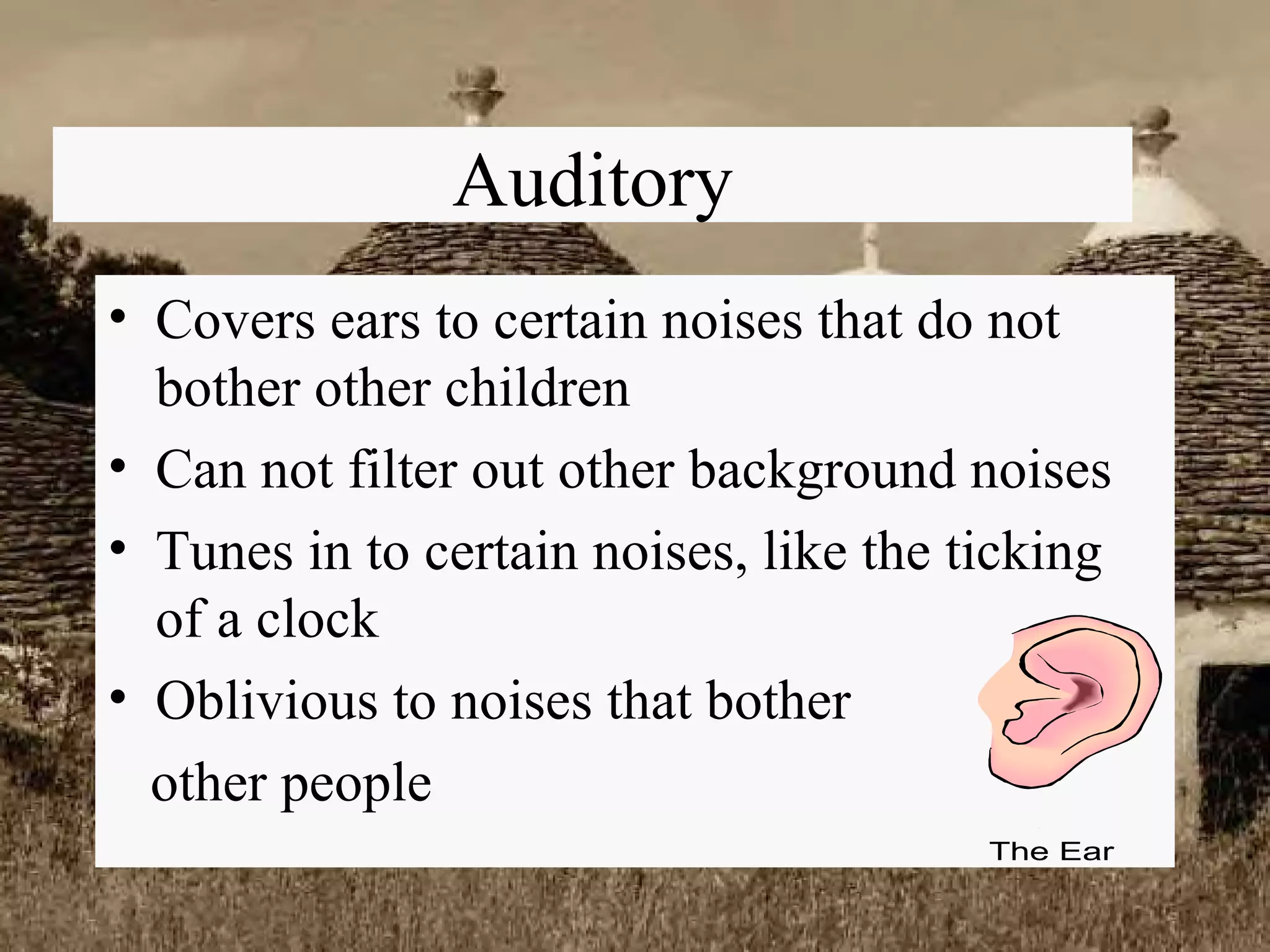
Auditory Variations in noise level. Variations in auditory distractions. Variations in the types of noise. Variations in the rhythm.
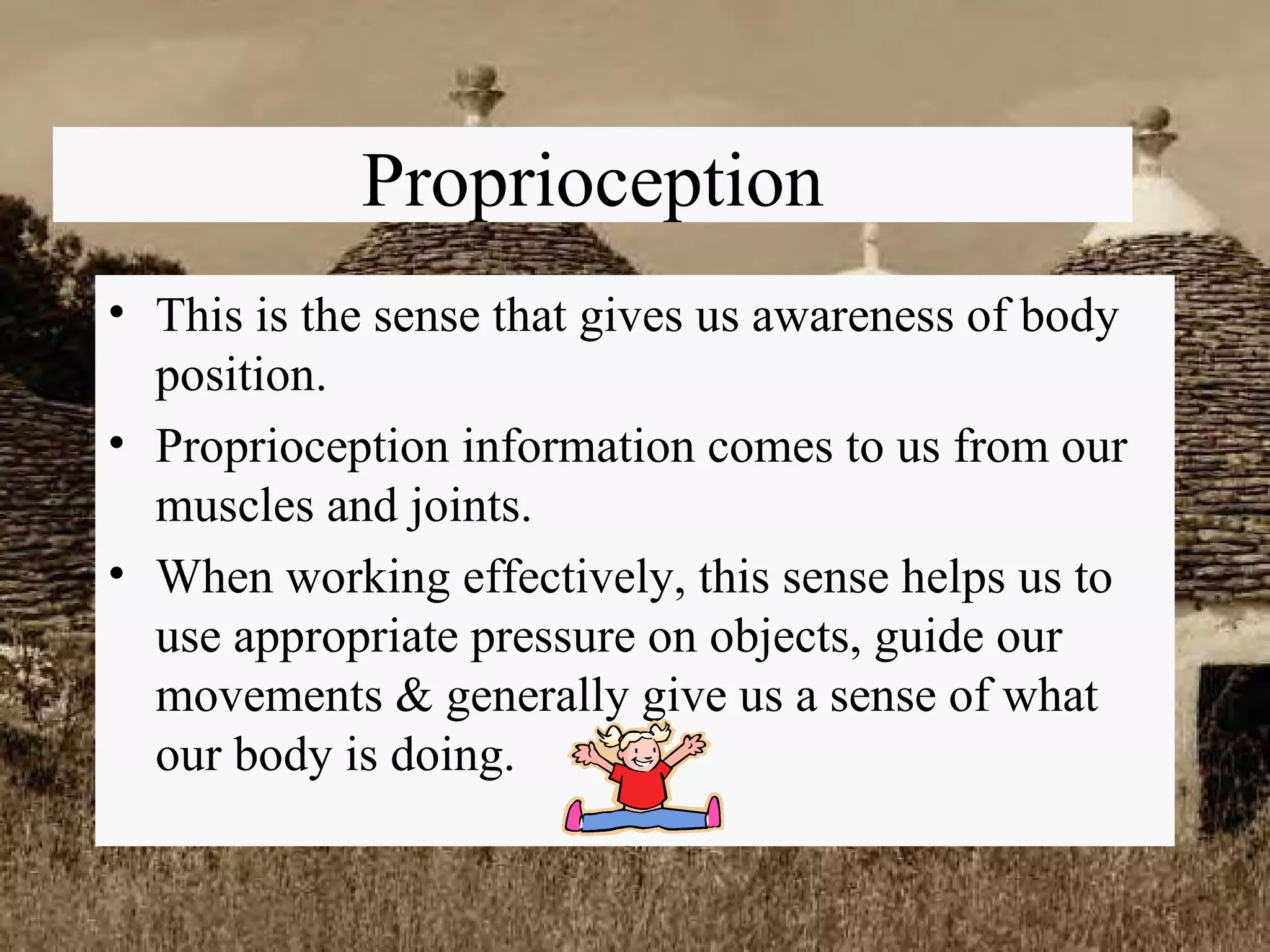
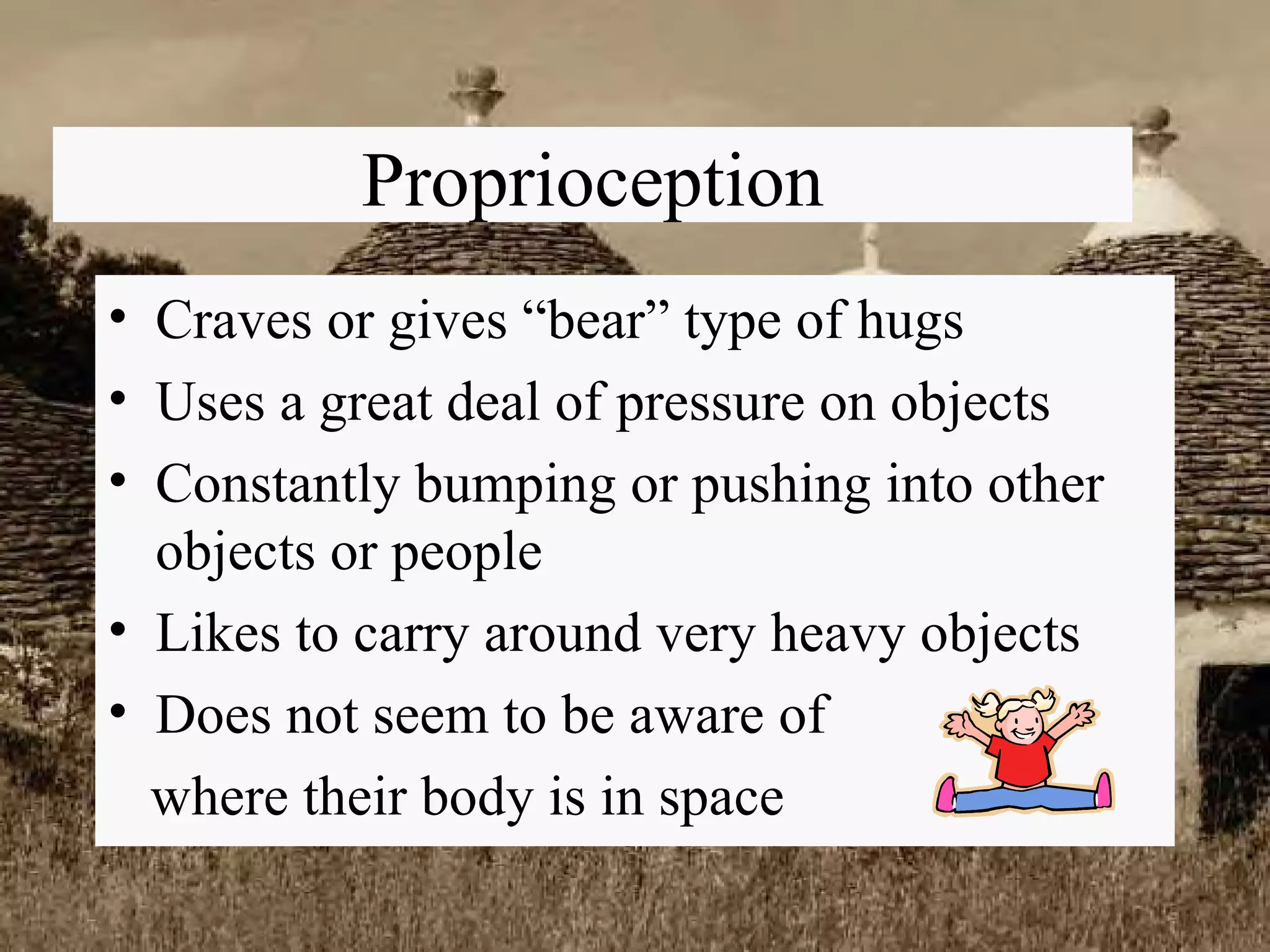
Proprioception This is the sense that gives us awareness of body position. Proprioception information comes to us from our muscles and joints. When working effectively, this sense helps us to use appropriate pressure on objects, guide our movements & generally give us a sense of what our body is doing.
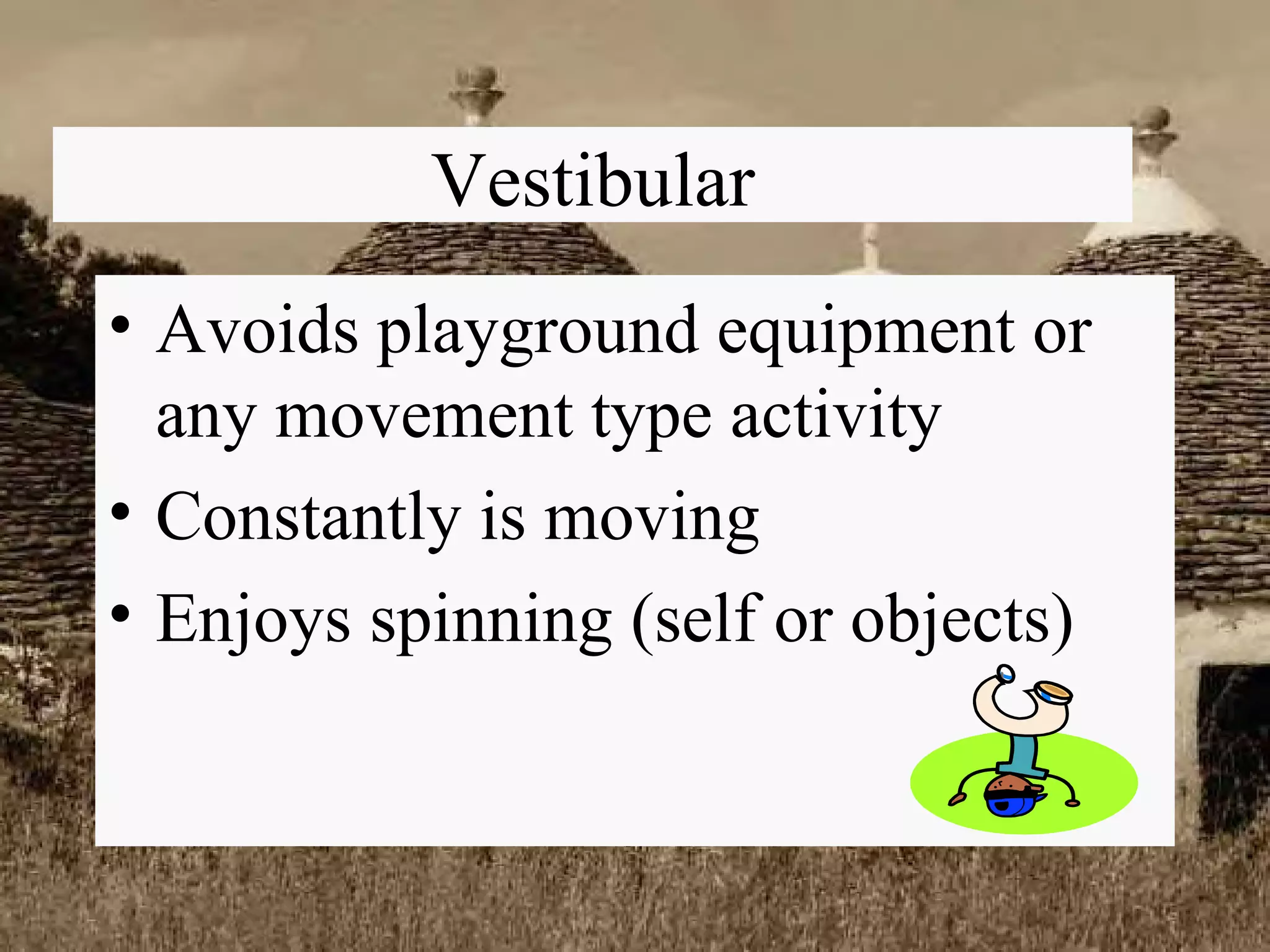
Vestibular This is the sense of movement. Information comes to us from changes in head position. It is the foundation for the orientation of our body. Under active or overactive vestibular systems systems affective a person’s ability to play, interact with the environment & learn.
   Take the Sensory-Motor  Preference Checklist (for  Adults)    Share results with the people  at your table.
Regulation of Sensory System In order for students to be ready to learn, they need to be at an  optimal level of arousal . Low arousal students  may appear lethargic, inattentive & sometimes be difficult to motivate. Sometimes they can display hyperactive behaviors in an attempt to avoid a stat of lower arousal. High arousal students  are usually considered antsy, quick to emotional reactions & may have behavioral outbursts.  May enter a flight, fright or fight reaction to everyday sensory stimulation.
Signs of Sensory Processing Difficulties Sensory processing is considered a problem  if it interferes with the child’s ability to function normally within the environment. This may be manifested either by behavior challenges, emotional outburst, unwillingness to participate in activities.
What you  might see:
Visual Stares at visual objects Can not handle many visual distractions Bothered by lights or certain colors Interested in only certain colors
Olfactory Seeks out certain smells Agitated by certain smells Constantly sniffs things
Tactile Irritability or withdrawal to touch Avoidance of certain types of textures May not enjoy playing with messy materials Does not enjoy touching tactile materials Always touching objects or other people Oblivious to pain
Oral Constantly putting things in their mouth Licking objects Avoidance of certain types of food textures, or on the contrary, craves certain types of food Will only eat food at a certain temperature
Auditory Covers ears to certain noises that do not bother other children Can not filter out other background noises Tunes in to certain noises, like the ticking of a clock Oblivious to noises that bother  other people
Proprioception Craves or gives “bear” type of hugs Uses a great deal of pressure on objects Constantly bumping or pushing into other objects or people Likes to carry around very heavy objects Does not seem to be aware of  where their body is in space
Vestibular Avoids playground equipment or any movement type activity Constantly is moving Enjoys spinning (self or objects)
Sensory Diet Providing activities which will help the child reach an optimal level of arousal. The diet is based on the  needs of the child , & what activities help the child to  cope with his/her environment . It is  individual for each child , what works for one child may not work for another child. The diet can be provided in sensory breaks throughout the day or given continuously in the child’s day. Sensory breaks should be given before an anticipated problem or certain times of the day to avoid any challenging behavior.
Behavior Management Behavior Modification Vs.
Stop thinking about  “removing the child” as  the “REAL” answer to  the problem. If the inappropriate behavior is  occurring… what has to change? The teacher The Task The Setting If what you are doing was going to eliminate the problem behavior…it would already have worked.
Structure, Order, Routines Use a visual schedule before & after every activity Review rules daily Break large tasks/activities into 3 steps Use timers Activities should be no more than 20-30 min. Provide advanced notice prior to changing activities Prepare for short planned transitions
Structure, Order, Routines  (cont.) Provide structured breaks Minimize down time Build sensory opportunities into the daily classroom schedule Decrease fine motor tasks Hands on materials Pair new activities with favorite items-sandwich Focus on strengths & weaknesses Data driven
Visual supports-used daily & consistently Social-understand the rules, know what he/she is supposed to do Communication-Receptive, Expressive (Stranger Test), given choices, directions are in simple language Cognitive level-is work too difficult, do they understand the task? Reinforcement-4 positive to 1 negative Ga State Project http://education.gsu.edu/autism/ Structure, Order, Routines  (cont.)
Form vs. Function Any challenging behavior that persists over time is “working” for the child. The students is being reinforced for the inappropriate behavior. The student has little to no incentive to change. The student needs to get what he’s getting or he wouldn’t be doing the inappropriate behavior in the first place. You can’t “punish” the behavior out of existence, if you could have it would already have eliminated the problem behavior Research shows that for every year a behavior has been “working” 1 month of consistent intervention is needed to change the behavior.
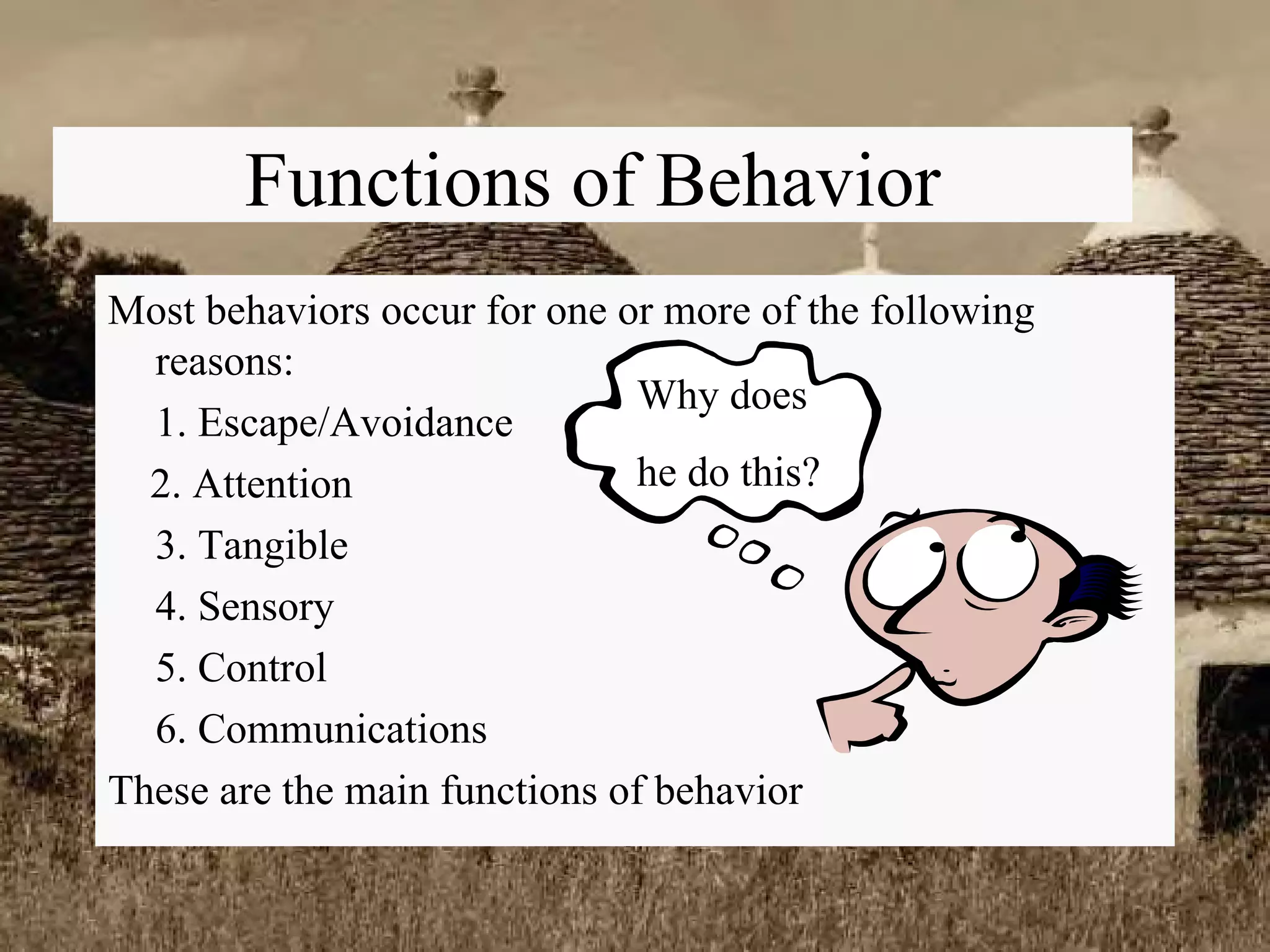
Functions of Behavior Most behaviors occur for one or more of the following reasons: 1. Escape/Avoidance 2. Attention 3. Tangible 4. Sensory 5. Control 6. Communications These are the main functions of behavior  Why does he do this?
Escape Strategies Increase use of visual supports Shorten activities Slow down lesson/change task difficulty Teach to request for a break/help Use hands on activities-areas of interests Tutor/remediate Build in choices-give them the power-control Increase student Preference/Interest-incorporate student hobbies/interests into activities Increase predictability-Provide cues for upcoming change in activities.
Attention Strategies Verbal vs. Physical Attention Reinforce (R+) them for being good Teach the child an appropriate way to get attention- switch calling teacher Only reinforce the method being taught not inappropriate behavior Ignore & redirect silently-get them on task for 20 seconds then R+ Scheduled Attention-Adult or peer attention is made available on some type of schedule. Change location-Place student in close proximity  to staff Provide Preferred Activities during time when you  can not provide attention.
Tangible Suggestions Clarify rules Build in opportunities for the item into class schedule Develop routines First work, then break Teach appropriate requesting skills for the desired item. Reinforce appropriate requesting skills for the desired item. Use desired items to assist with instruction Provide a warning-indicate that activity is about to end…5 minutes, 3 minutes. Schedule a transitional activity-schedule a moderately preferred activity between highly preferred & highly non-preferred activities
Sensory Suggestions Fill environment with interesting & stimulating activities that provide similar reinforcement. - back rubs, vibrating tube, tickle game Structured, scheduled sensory diet Allow for breaks to move-put up items, sharpen pencil Opportunities for instruction/work in different settings on the floor, sitting standing Don’t wait until they are demanding it,  do it ahead of time.
Control Suggestions Does the behavior occur when told “No” or “Stop”? Does the behavior occur when teacher is delivering an instruction to the student? -  Like things the same Doesn’t like change Repetitive behavior Characteristic of ASD: Build in choices-give them the power-control The rule is… Routines/Advance organizers Social Stories Slight differences
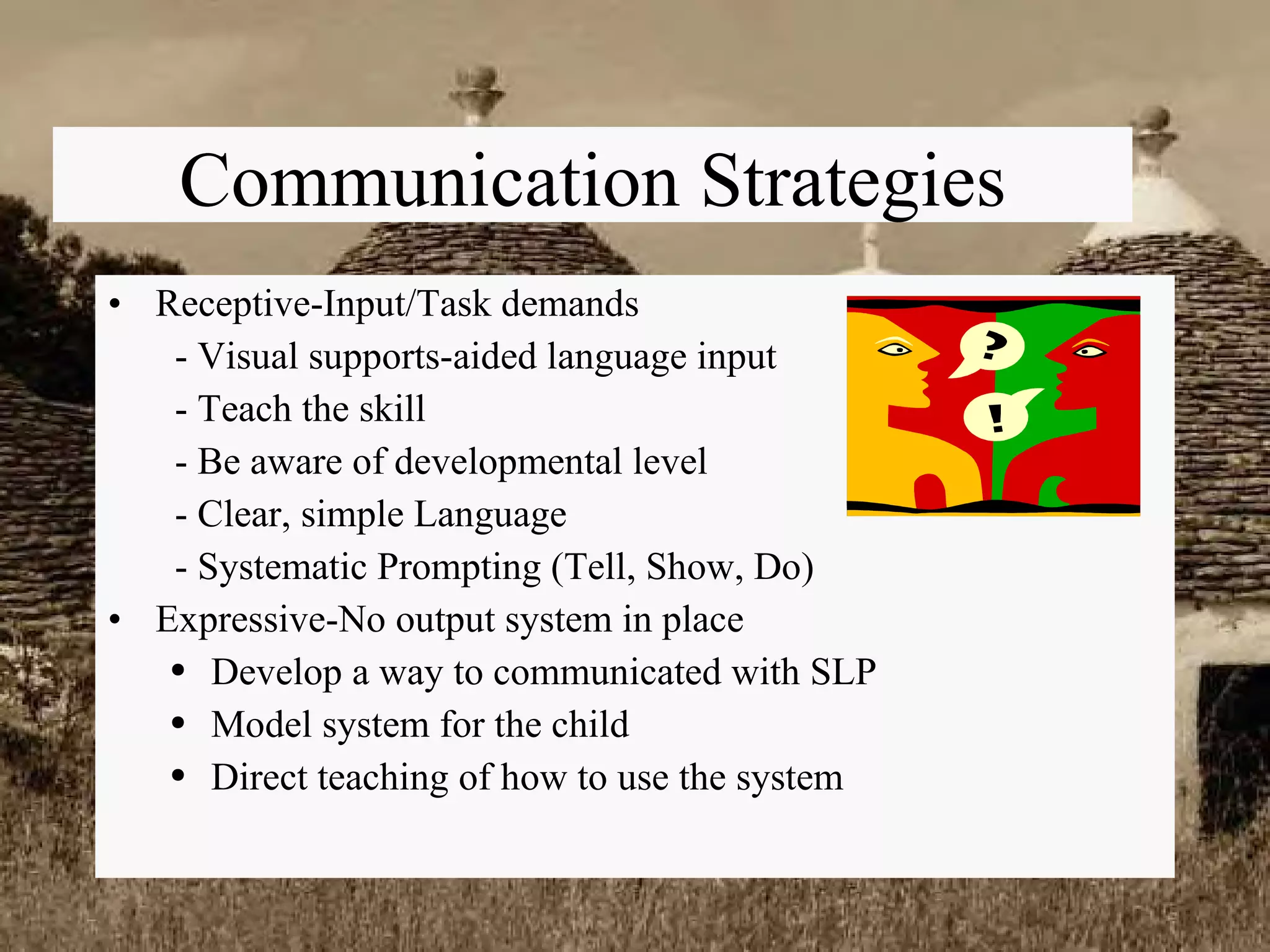
Communication Strategies Receptive-Input/Task demands   - Visual supports-aided language input   - Teach the skill   - Be aware of developmental level   - Clear, simple Language   - Systematic Prompting (Tell, Show, Do) Expressive-No output system in place Develop a way to communicated with SLP Model system for the child Direct teaching of how to use the system
Tips Never suggest a child to do something. (Let’s put the toys away) Directions are positive & clear Tell, show, Do Prompting Close proximity when giving directions-no more than 3 feet away Two directions only-keep it simple Reduce teacher talk
Tips  (continued) Visual cue card-wait card, walk, sit Count down 5-4-3-2-1  Clear Rules Review Video taping/tape recorder Chip system
Tips  (continued) 1, 2, 3 strikes your out First work, then break Develop communication Consistency with team- same language Parental input Sensory diet

Teaching Students With Asd

  • 1.
    Teaching Students with Autism Spectrum Disorder EDU 5101 Kevin Neuenswander
  • 2.
    What is Sensory/IntegrationProcessing? We receive information about the world around us through our senses. We have a constant flow of information coming into our nervous system every second of every day. All this information is received in our brain & organized & sorted in an efficient manner. The brain then uses this information to help us form our behaviors, emotions, & readiness to perform learning tasks.
  • 3.
    5 Steps of Sensory Processing/Integration Registration -awareness that we have touched, seen. Orientation -Focusing on or regarding the input. Interpretation -relating emotions & past experiences. Organization -determine if a response is necessary Execution of response -which may be ignoring.
  • 4.
    What is Sensory/IntegrationProcessing? Most people take in sensory information & process it without even thinking about it. -Optimal state-all seven areas of sensory processing work effectively. Some people take in sensory information & recognize it immediately & are very aware of the sensation. -Sensory defensiveness-high alert or arousal level Some people take in sensory information & difficulty registering the sensation. -Low arousal.
  • 5.
    Sensory & ASDStudents High incidence of sensory processing challenges Can be hypersensitive/over reactive Can be hyposensitive/under reactive Result in behavioral/social/emotional & academic difficulties
  • 6.
    We all haveSensory Needs There are seven different kinds of Sensory Needs.
  • 7.
    Variation in lightVariation in color Visual distractions Visual
  • 8.
    Olfactory Variations intypes of odors Variations in intensity of odors
  • 9.
    Tactile Variations intemperature Variations in touch pressure Variations in amount of touch Types of clothing
  • 10.
    Oral/Gustatory Variations intemperature Variations in textures (crunchy, chewy) Variations in taste (sweet, sour, etc…) Oral motor movement (blowing, biting, sucking, licking, etc…)
  • 11.
    Auditory Variations innoise level. Variations in auditory distractions. Variations in the types of noise. Variations in the rhythm.
  • 12.
    Proprioception This isthe sense that gives us awareness of body position. Proprioception information comes to us from our muscles and joints. When working effectively, this sense helps us to use appropriate pressure on objects, guide our movements & generally give us a sense of what our body is doing.
  • 13.
    Vestibular This isthe sense of movement. Information comes to us from changes in head position. It is the foundation for the orientation of our body. Under active or overactive vestibular systems systems affective a person’s ability to play, interact with the environment & learn.
  • 14.
    Take the Sensory-Motor Preference Checklist (for Adults)  Share results with the people at your table.
  • 15.
    Regulation of SensorySystem In order for students to be ready to learn, they need to be at an optimal level of arousal . Low arousal students may appear lethargic, inattentive & sometimes be difficult to motivate. Sometimes they can display hyperactive behaviors in an attempt to avoid a stat of lower arousal. High arousal students are usually considered antsy, quick to emotional reactions & may have behavioral outbursts. May enter a flight, fright or fight reaction to everyday sensory stimulation.
  • 16.
    Signs of SensoryProcessing Difficulties Sensory processing is considered a problem if it interferes with the child’s ability to function normally within the environment. This may be manifested either by behavior challenges, emotional outburst, unwillingness to participate in activities.
  • 17.
    What you might see:
  • 18.
    Visual Stares atvisual objects Can not handle many visual distractions Bothered by lights or certain colors Interested in only certain colors
  • 19.
    Olfactory Seeks outcertain smells Agitated by certain smells Constantly sniffs things
  • 20.
    Tactile Irritability orwithdrawal to touch Avoidance of certain types of textures May not enjoy playing with messy materials Does not enjoy touching tactile materials Always touching objects or other people Oblivious to pain
  • 21.
    Oral Constantly puttingthings in their mouth Licking objects Avoidance of certain types of food textures, or on the contrary, craves certain types of food Will only eat food at a certain temperature
  • 22.
    Auditory Covers earsto certain noises that do not bother other children Can not filter out other background noises Tunes in to certain noises, like the ticking of a clock Oblivious to noises that bother other people
  • 23.
    Proprioception Craves orgives “bear” type of hugs Uses a great deal of pressure on objects Constantly bumping or pushing into other objects or people Likes to carry around very heavy objects Does not seem to be aware of where their body is in space
  • 24.
    Vestibular Avoids playgroundequipment or any movement type activity Constantly is moving Enjoys spinning (self or objects)
  • 25.
    Sensory Diet Providingactivities which will help the child reach an optimal level of arousal. The diet is based on the needs of the child , & what activities help the child to cope with his/her environment . It is individual for each child , what works for one child may not work for another child. The diet can be provided in sensory breaks throughout the day or given continuously in the child’s day. Sensory breaks should be given before an anticipated problem or certain times of the day to avoid any challenging behavior.
  • 26.
  • 27.
    Stop thinking about “removing the child” as the “REAL” answer to the problem. If the inappropriate behavior is occurring… what has to change? The teacher The Task The Setting If what you are doing was going to eliminate the problem behavior…it would already have worked.
  • 28.
    Structure, Order, RoutinesUse a visual schedule before & after every activity Review rules daily Break large tasks/activities into 3 steps Use timers Activities should be no more than 20-30 min. Provide advanced notice prior to changing activities Prepare for short planned transitions
  • 29.
    Structure, Order, Routines (cont.) Provide structured breaks Minimize down time Build sensory opportunities into the daily classroom schedule Decrease fine motor tasks Hands on materials Pair new activities with favorite items-sandwich Focus on strengths & weaknesses Data driven
  • 30.
    Visual supports-used daily& consistently Social-understand the rules, know what he/she is supposed to do Communication-Receptive, Expressive (Stranger Test), given choices, directions are in simple language Cognitive level-is work too difficult, do they understand the task? Reinforcement-4 positive to 1 negative Ga State Project http://education.gsu.edu/autism/ Structure, Order, Routines (cont.)
  • 31.
    Form vs. FunctionAny challenging behavior that persists over time is “working” for the child. The students is being reinforced for the inappropriate behavior. The student has little to no incentive to change. The student needs to get what he’s getting or he wouldn’t be doing the inappropriate behavior in the first place. You can’t “punish” the behavior out of existence, if you could have it would already have eliminated the problem behavior Research shows that for every year a behavior has been “working” 1 month of consistent intervention is needed to change the behavior.
  • 32.
    Functions of BehaviorMost behaviors occur for one or more of the following reasons: 1. Escape/Avoidance 2. Attention 3. Tangible 4. Sensory 5. Control 6. Communications These are the main functions of behavior Why does he do this?
  • 33.
    Escape Strategies Increaseuse of visual supports Shorten activities Slow down lesson/change task difficulty Teach to request for a break/help Use hands on activities-areas of interests Tutor/remediate Build in choices-give them the power-control Increase student Preference/Interest-incorporate student hobbies/interests into activities Increase predictability-Provide cues for upcoming change in activities.
  • 34.
    Attention Strategies Verbalvs. Physical Attention Reinforce (R+) them for being good Teach the child an appropriate way to get attention- switch calling teacher Only reinforce the method being taught not inappropriate behavior Ignore & redirect silently-get them on task for 20 seconds then R+ Scheduled Attention-Adult or peer attention is made available on some type of schedule. Change location-Place student in close proximity to staff Provide Preferred Activities during time when you can not provide attention.
  • 35.
    Tangible Suggestions Clarifyrules Build in opportunities for the item into class schedule Develop routines First work, then break Teach appropriate requesting skills for the desired item. Reinforce appropriate requesting skills for the desired item. Use desired items to assist with instruction Provide a warning-indicate that activity is about to end…5 minutes, 3 minutes. Schedule a transitional activity-schedule a moderately preferred activity between highly preferred & highly non-preferred activities
  • 36.
    Sensory Suggestions Fillenvironment with interesting & stimulating activities that provide similar reinforcement. - back rubs, vibrating tube, tickle game Structured, scheduled sensory diet Allow for breaks to move-put up items, sharpen pencil Opportunities for instruction/work in different settings on the floor, sitting standing Don’t wait until they are demanding it, do it ahead of time.
  • 37.
    Control Suggestions Doesthe behavior occur when told “No” or “Stop”? Does the behavior occur when teacher is delivering an instruction to the student? - Like things the same Doesn’t like change Repetitive behavior Characteristic of ASD: Build in choices-give them the power-control The rule is… Routines/Advance organizers Social Stories Slight differences
  • 38.
    Communication Strategies Receptive-Input/Taskdemands - Visual supports-aided language input - Teach the skill - Be aware of developmental level - Clear, simple Language - Systematic Prompting (Tell, Show, Do) Expressive-No output system in place Develop a way to communicated with SLP Model system for the child Direct teaching of how to use the system
  • 39.
    Tips Never suggesta child to do something. (Let’s put the toys away) Directions are positive & clear Tell, show, Do Prompting Close proximity when giving directions-no more than 3 feet away Two directions only-keep it simple Reduce teacher talk
  • 40.
    Tips (continued)Visual cue card-wait card, walk, sit Count down 5-4-3-2-1 Clear Rules Review Video taping/tape recorder Chip system
  • 41.
    Tips (continued)1, 2, 3 strikes your out First work, then break Develop communication Consistency with team- same language Parental input Sensory diet