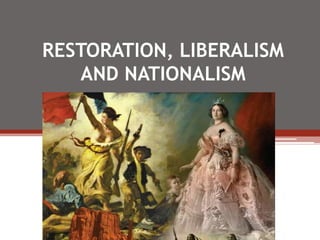



RESTORATION, LIBERALISM
AND NATIONALISM
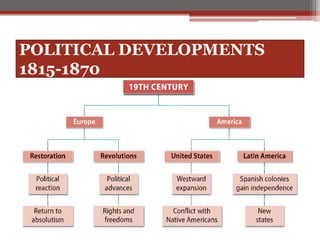
POLITICAL DEVELOPMENTS
1815-1870
THE RESTORATION IN EUROPE
1815-1820
THE RESTORATION IN EUROPE
1815-1820
Europe after the Napoleonic Empire
• What was the Restoration?
▫ It was a return to the political system of the
Ancien Régime after Napoleon´s defeat in 1815.
THE RESTORATION IN EUROPE
1815-1820
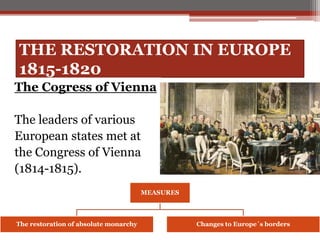
The Cogress of Vienna
The leaders of various
European states met at
the Congress of Vienna
(1814-1815).
MEASURES
The restoration of absolute monarchy Changes to Europe´s borders
THE RESTORATION IN EUROPE
1815-1820
The Cogress of Vienna
The restoration of
absolute monarchy
The European
monarchs who had
been deposed by
Napoleon returned
to power.
However, some of
these monarchs had
to accept
constitutional limits
to their power
THE RESTORATION IN EUROPE
1815-1820
The Cogress of Vienna
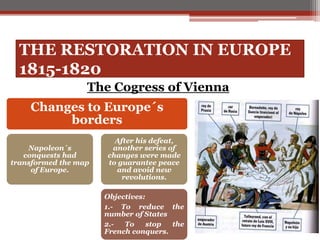
Changes to Europe´s
borders
Napoleon´s
conquests had
transformed the map
of Europe.
After his defeat,
another series of
changes were made
to guarantee peace
and avoid new
revolutions.
Objectives:
1.- To reduce the
number of States
2.- To stop the
French conquers.
THE RESTORATION IN EUROPE
1815-1820
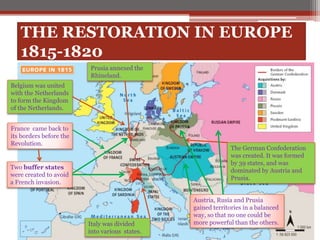
The Cogress of ViennaBelgium was united
with the Netherlands
to form the Kingdom
of the Netherlands.
Prusia annexed the
Rhineland.
Italy was divided
into various states.
The German Confederation
was created. It was formed
by 39 states, and was
dominated by Austria and
Prusia.
France came back to
its borders before the
Revolution.
Two buffer states
were created to avoid
a French invasion.
Austria, Rusia and Prusia
gained territories in a balanced
way, so that no one could be
more powerful than the others.
THE RESTORATION IN EUROPE
1815-1820
The Cogress of Vienna
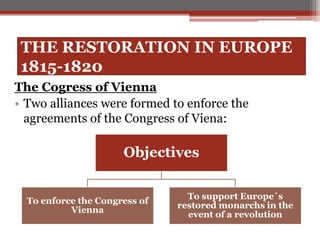
• Two alliances were formed to enforce the
agreements of the Congress of Viena:
Objectives
To enforce the Congress of
Vienna
To support Europe´s
restored monarchs in the
event of a revolution
THE RESTORATION IN EUROPE
1815-1820
The Cogress of Vienna
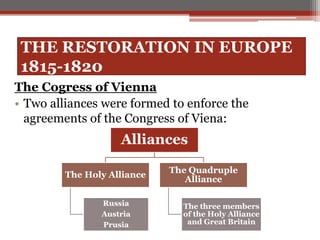
• Two alliances were formed to enforce the
agreements of the Congress of Viena:
Alliances
The Holy Alliance
Russia
Austria
Prusia
The Quadruple
Alliance
The three members
of the Holy Alliance
and Great Britain
LIBERALISM, NATIONALISM
AND DEMOCRACY
LIBERALISM, NATIONALISM
AND DEMOCRACY
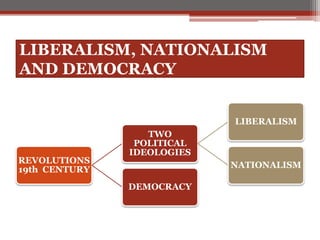
REVOLUTIONS
19th CENTURY
TWO
POLITICAL
IDEOLOGIES
LIBERALISM
NATIONALISM
DEMOCRACY
LIBERALISM, NATIONALISM
AND DEMOCRACY
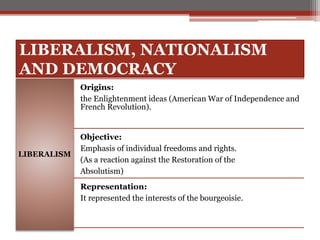
LIBERALISM
Origins:
the Enlightenment ideas (American War of Independence and
French Revolution).
Objective:
Emphasis of individual freedoms and rights.
(As a reaction against the Restoration of the
Absolutism)
Representation:
It represented the interests of the bourgeoisie.
LIBERALISM, NATIONALISM
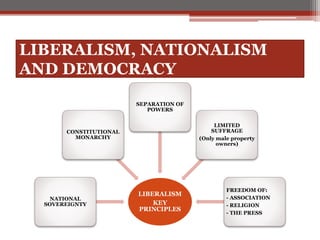
AND DEMOCRACY
LIBERALISM
KEY
PRINCIPLES
NATIONAL
SOVEREIGNTY
CONSTITUTIONAL
MONARCHY
SEPARATION OF
POWERS
LIMITED
SUFFRAGE
(Only male property
owners)
FREEDOM OF:
- ASSOCIATION
- RELIGION
- THE PRESS
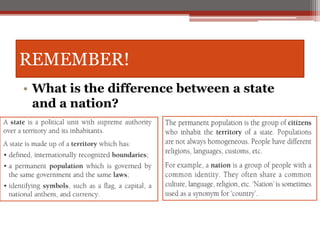
REMEMBER!
• What is the difference between a state
and a nation?
LIBERALISM, NATIONALISM
AND DEMOCRACY
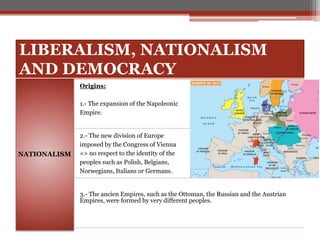
NATIONALISM
Origins:
1.- The expansion of the Napoleonic
Empire.
2.- The new division of Europe
imposed by the Congress of Vienna
=> no respect to the identity of the
peoples such as Polish, Belgians,
Norwegians, Italians or Germans.
3.- The ancien Empires, such as the Ottoman, the Russian and the Austrian
Empires, were formed by very different peoples.
LIBERALISM, NATIONALISM
AND DEMOCRACY
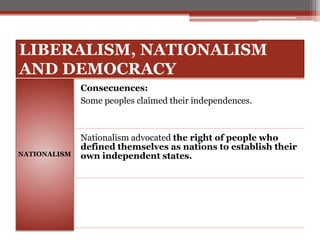
NATIONALISM
Consecuences:
Some peoples claimed their independences.
Nationalism advocated the right of people who
defined themselves as nations to establish their
own independent states.
LIBERALISM, NATIONALISM
AND DEMOCRACY
NATIONALISM
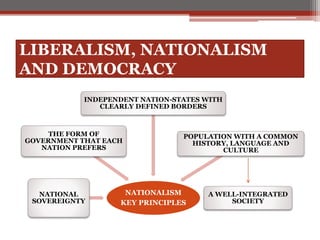
KEY PRINCIPLES
NATIONAL
SOVEREIGNTY
THE FORM OF
GOVERNMENT THAT EACH
NATION PREFERS
INDEPENDENT NATION-STATES WITH
CLEARLY DEFINED BORDERS
POPULATION WITH A COMMON
HISTORY, LANGUAGE AND
CULTURE
A WELL-INTEGRATED
SOCIETY
LIBERALISM, NATIONALISM
AND DEMOCRACY
DEMOCRACY
In the 19th century, democratic movements
defended ordinary people´s right to
participate in politics.
Representation:
The middle and working classes.
LIBERALISM, NATIONALISM
AND DEMOCRACY
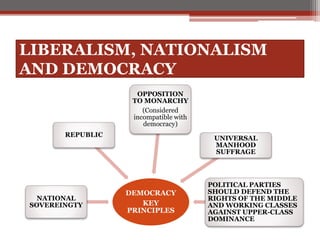
DEMOCRACY
KEY
PRINCIPLES
NATIONAL
SOVEREINGTY
REPUBLIC
OPPOSITION
TO MONARCHY
(Considered
incompatible with
democracy)
UNIVERSAL
MANHOOD
SUFFRAGE
POLITICAL PARTIES
SHOULD DEFEND THE
RIGHTS OF THE MIDDLE
AND WORKING CLASSES
AGAINST UPPER-CLASS
DOMINANCE
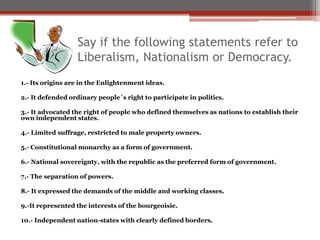
Say if the following statements refer to
Liberalism, Nationalism or Democracy.
1.- Its origins are in the Enlightenment ideas.
2.- It defended ordinary people´s right to participate in politics.
3.- It advocated the right of people who defined themselves as nations to establish their
own independent states.
4.- Limited suffrage, restricted to male property owners.
5.- Constitutional monarchy as a form of government.
6.- National sovereignty, with the republic as the preferred form of government.
7.- The separation of powers.
8.- It expressed the demands of the middle and working classes.
9.-It represented the interests of the bourgeoisie.
10.- Independent nation-states with clearly defined borders.
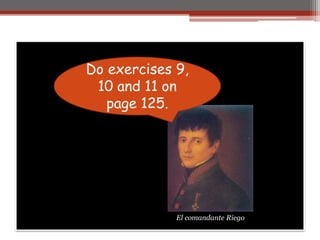
Do exercises 9,
10 and 11 on
page 125.
El comandante Riego
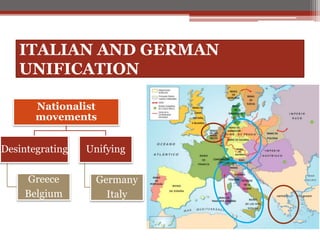
ITALIAN AND GERMAN
UNIFICATION
Nationalist
movements
Desintegrating
Greece
Belgium
Unifying
Germany
Italy
ITALIAN AND GERMAN
UNIFICATION
• How were Italian and German territories like until
the mid-19th century?
▫ They were divided into numerous independent states.
• What happened during the first half of the 19th
century in these modern-day countries?
▫ Nationalists movements emerged.
• What was the result of these movements?
▫ These states were unified to form two new nation-states:
Italy and Germany.
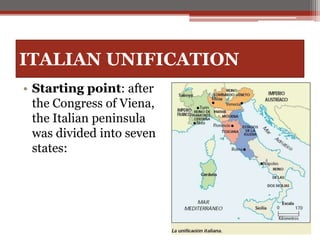
ITALIAN UNIFICATION
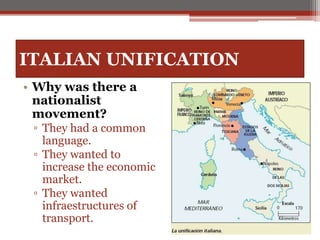
• Starting point: after
the Congress of Viena,
the Italian peninsula
was divided into seven
states:
ITALIAN UNIFICATION
• Why was there a
nationalist
movement?
▫ They had a common
language.
▫ They wanted to
increase the economic
market.
▫ They wanted
infraestructures of
transport.
ITALIAN UNIFICATION
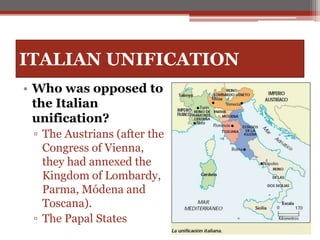
• Who was opposed to
the Italian
unification?
▫ The Austrians (after the
Congress of Vienna,
they had annexed the
Kingdom of Lombardy,
Parma, Módena and
Toscana).
▫ The Papal States
ITALIAN UNIFICATION
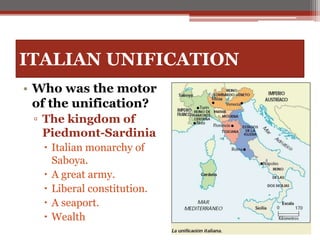
• Who was the motor
of the unification?
▫ The kingdom of
Piedmont-Sardinia
 Italian monarchy of
Saboya.
 A great army.
 Liberal constitution.
 A seaport.
 Wealth
ITALIAN UNIFICATION
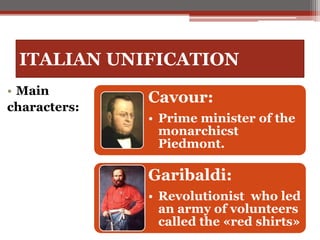
• Main
characters:
Cavour:
• Prime minister of the
monarchicst
Piedmont.
Garibaldi:
• Revolutionist who led
an army of volunteers
called the «red shirts»
ITALIAN UNIFICATION
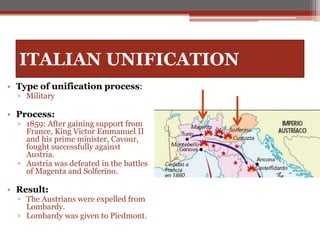
• Type of unification process:
▫ Military
• Process:
▫ 1859: After gaining support from
France, King Victor Emmanuel II
and his prime minister, Cavour,
fought successfully against
Austria.
▫ Austria was defeated in the battles
of Magenta and Solferino.
• Result:
▫ The Austrians were expelled from
Lombardy.
▫ Lombardy was given to Piedmont.
ITALIAN UNIFICATION
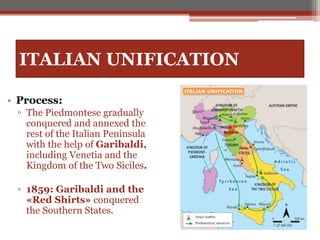
• Process:
▫ The Piedmontese gradually
conquered and annexed the
rest of the Italian Peninsula
with the help of Garibaldi,
including Venetia and the
Kingdom of the Two Siciles.
▫ 1859: Garibaldi and the
«Red Shirts» conquered
the Southern States.
GERMAN UNIFICATION
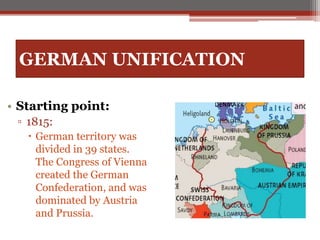
• Starting point:
▫ 1815:
 German territory was
divided in 39 states.
The Congress of Vienna
created the German
Confederation, and was
dominated by Austria
and Prussia.
GERMAN UNIFICATION
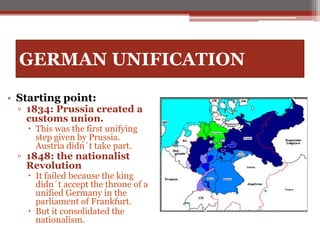
• Starting point:
▫ 1834: Prussia created a
customs union.
 This was the first unifying
step given by Prussia.
Austria didn´t take part.
▫ 1848: the nationalist
Revolution
 It failed because the king
didn´t accept the throne of a
unified Germany in the
parliament of Frankfurt.
 But it consolidated the
nationalism.
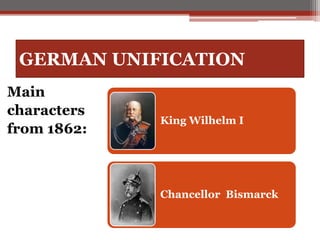
GERMAN UNIFICATION
Main
characters
from 1862:
King Wilhelm I
Chancellor Bismarck
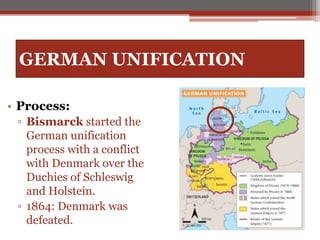
GERMAN UNIFICATION
• Process:
▫ Bismarck started the
German unification
process with a conflict
with Denmark over the
Duchies of Schleswig
and Holstein.
▫ 1864: Denmark was
defeated.
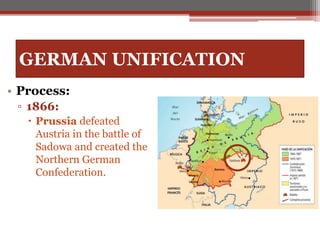
GERMAN UNIFICATION
• Process:
▫ 1866:
 Prussia defeated
Austria in the battle of
Sadowa and created the
Northern German
Confederation.
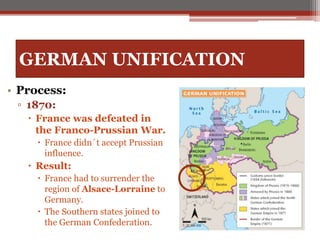
GERMAN UNIFICATION
• Process:
▫ 1870:
 France was defeated in
the Franco-Prussian War.
 France didn´t accept Prussian
influence.
 Result:
 France had to surrender the
region of Alsace-Lorraine to
Germany.
 The Southern states joined to
the German Confederation.
GERMAN UNIFICATION
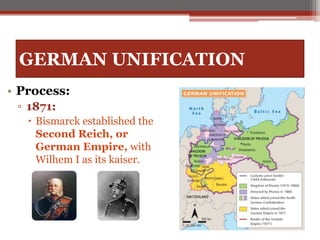
• Process:
▫ 1871:
 Bismarck established the
Second Reich, or
German Empire, with
Wilhem I as its kaiser.
AMERICA DURING THE 19th
CENTURY
AMERICA DURING THE 19th
CENTURY
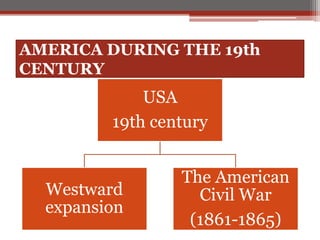
USA
19th century
Westward
expansion
The American
Civil War
(1861-1865)
AMERICA DURING THE 19th
CENTURY
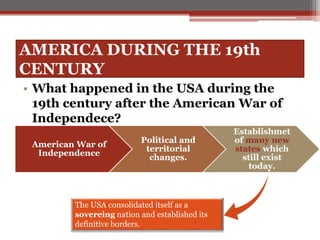
• What happened in the USA during the
19th century after the American War of
Independece?
American War of
Independence
Political and
territorial
changes.
Establishmet
of many new
states which
still exist
today.
The USA consolidated itself as a
sovereing nation and established its
definitive borders.
EXPANSION IN THE UNITED
STATES
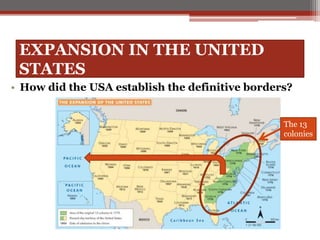
• How did the USA establish the definitive borders?
The 13
colonies
EXPANSION IN THE UNITED
STATES
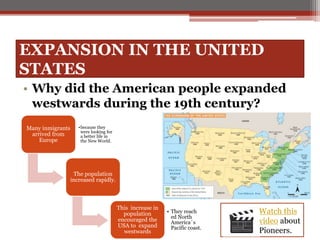
• Why did the American people expanded
westwards during the 19th century?
Many inmigrants
arrived from
Europe
•because they
were looking for
a better life in
the New World.
The population
increased rapidly.
This increase in
population
encouraged the
USA to expand
westwards
• They reach
ed North
America´s
Pacific coast.
Watch this
video about
Pioneers.
EXPANSION IN THE UNITED
STATES
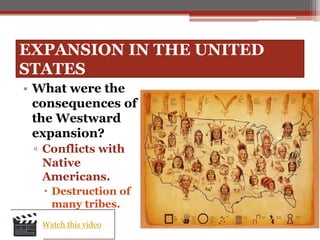
• What were the
consequences of
the Westward
expansion?
▫ Conflicts with
Native
Americans.
 Destruction of
many tribes.
Watch this video
EXPANSION IN THE UNITED
STATES
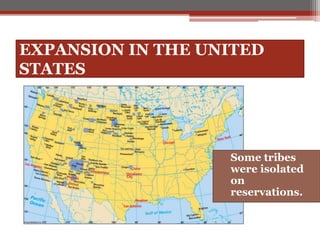
Some tribes
were isolated
on
reservations.
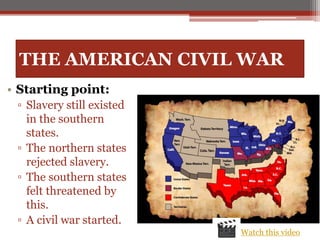
THE AMERICAN CIVIL WAR
• Starting point:
▫ Slavery still existed
in the southern
states.
▫ The northern states
rejected slavery.
▫ The southern states
felt threatened by
this.
▫ A civil war started.
Watch this video
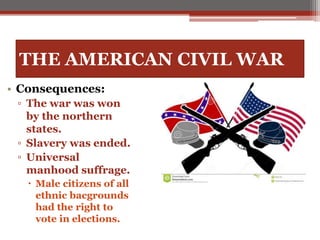
THE AMERICAN CIVIL WAR
• Consequences:
▫ The war was won
by the northern
states.
▫ Slavery was ended.
▫ Universal
manhood suffrage.
 Male citizens of all
ethnic bacgrounds
had the right to
vote in elections.
• Las revoluciones liberales
• La independencia de América Latina
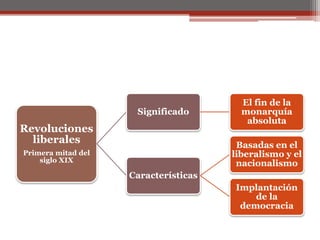
Revoluciones
liberales
Primera mitad del
siglo XIX
Significado
El fin de la
monarquía
absoluta
Características
Basadas en el
liberalismo y el
nacionalismo
Implantación
de la
democracia
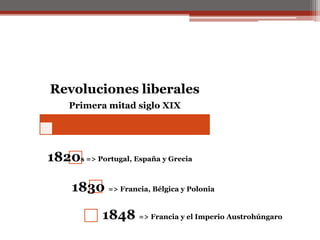
Revoluciones liberales
Primera mitad siglo XIX
1820s => Portugal, España y Grecia
1830 => Francia, Bélgica y Polonia
1848 => Francia y el Imperio Austrohúngaro
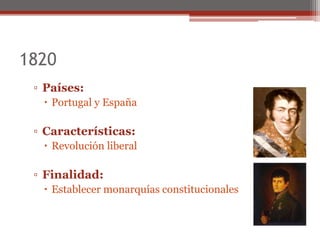
1820
▫ Países:
 Portugal y España
▫ Características:
 Revolución liberal
▫ Finalidad:
 Establecer monarquías constitucionales
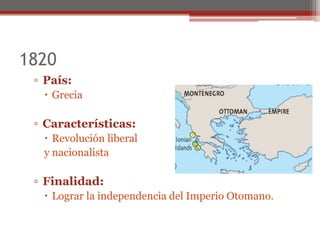
1820
▫ País:
 Grecia
▫ Características:
 Revolución liberal
y nacionalista
▫ Finalidad:
 Lograr la independencia del Imperio Otomano.
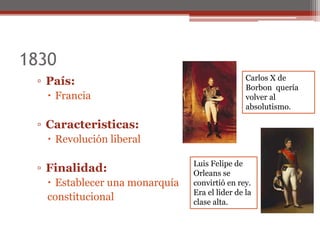
1830
▫ País:
 Francia
▫ Caracteristicas:
 Revolución liberal
▫ Finalidad:
 Establecer una monarquía
constitucional
Carlos X de
Borbon quería
volver al
absolutismo.
Luis Felipe de
Orleans se
convirtió en rey.
Era el lider de la
clase alta.
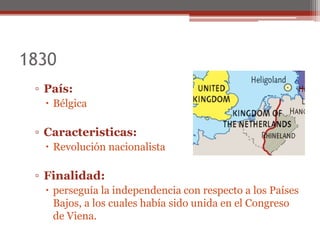
1830
▫ País:
 Bélgica
▫ Caracteristicas:
 Revolución nacionalista
▫ Finalidad:
 perseguía la independencia con respecto a los Países
Bajos, a los cuales había sido unida en el Congreso
de Viena.
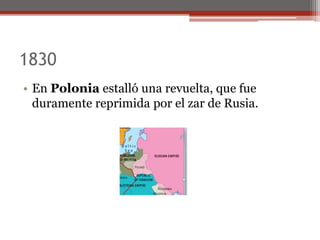
1830
• En Polonia estalló una revuelta, que fue
duramente reprimida por el zar de Rusia.
1848
▫ Países:
 Francia y el Imperio Austriaco
▫ Características:
 Revoluciones más radicales
 Ideología democrática
▫ Finalidad:
 La clase media y el proletariado demandan reformas
democráticas para acceder al poder.
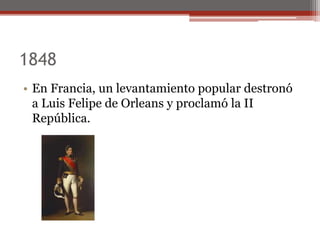
1848
• En Francia, un levantamiento popular destronó
a Luis Felipe de Orleans y proclamó la II
República.
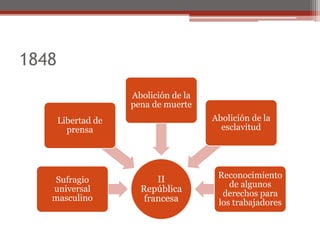
1848
II
República
francesa
Sufragio
universal
masculino
Libertad de
prensa
Abolición de la
pena de muerte
Abolición de la
esclavitud
Reconocimiento
de algunos
derechos para
los trabajadores
1848
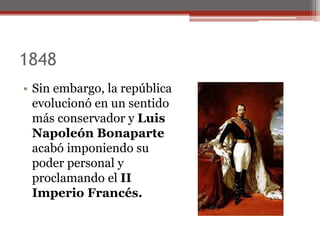
• Sin embargo, la república
evolucionó en un sentido
más conservador y Luis
Napoleón Bonaparte
acabó imponiendo su
poder personal y
proclamando el II
Imperio Francés.
1848
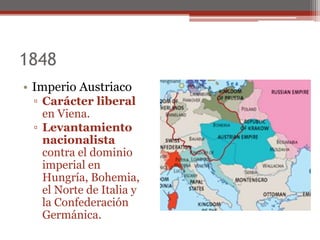
• Imperio Austriaco
▫ Carácter liberal
en Viena.
▫ Levantamiento
nacionalista
contra el dominio
imperial en
Hungría, Bohemia,
el Norte de Italia y
la Confederación
Germánica.
CAUSAS
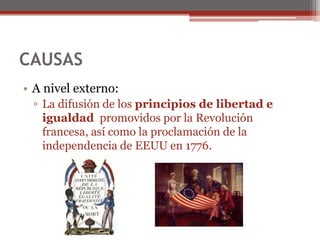
• A nivel externo:
▫ La difusión de los principios de libertad e
igualdad promovidos por la Revolución
francesa, así como la proclamación de la
independencia de EEUU en 1776.
CAUSAS
• A nivel interno:
▫ Descontento de la burguesía criolla que veía
a España como un freno para su economía:
 ya que obstaculizaba el comercio e imponía fuertes
cargas fiscales.
 Además, la mayoría de los cargos de la
administración colonial estaban en manos de
españoles peninsulares, que eran un grupo
privilegiado.
CAUSAS
• Los criollos instigaron los levantamientos a favor
de la independencia, apoyada también por
indios y mestizos.
1ª FASE (1808-1814)
• Los primeros movimientos independentistas se
iniciaron con el estallido de la Guerra de la
Independencia en España.
• Las autoridades americanas no acataron la
monarquía de José Bonaparte y formaron
Juntas en las colonias, que empezaron a
autogobernarse.
1ª FASE
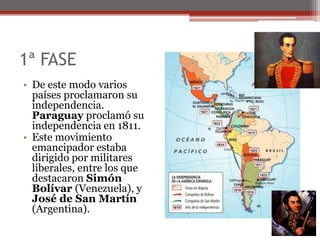
• De este modo varios
países proclamaron su
independencia.
Paraguay proclamó su
independencia en 1811.
• Este movimiento
emancipador estaba
dirigido por militares
liberales, entre los que
destacaron Simón
Bolívar (Venezuela), y
José de San Martín
(Argentina).
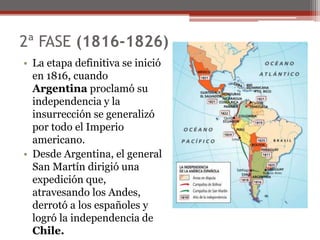
2ª FASE (1816-1826)
• La etapa definitiva se inició
en 1816, cuando
Argentina proclamó su
independencia y la
insurrección se generalizó
por todo el Imperio
americano.
• Desde Argentina, el general
San Martín dirigió una
expedición que,
atravesando los Andes,
derrotó a los españoles y
logró la independencia de
Chile.
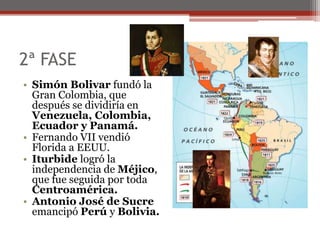
2ª FASE
• Simón Bolivar fundó la
Gran Colombia, que
después se dividiría en
Venezuela, Colombia,
Ecuador y Panamá.
• Fernando VII vendió
Florida a EEUU.
• Iturbide logró la
independencia de Méjico,
que fue seguida por toda
Centroamérica.
• Antonio José de Sucre
emancipó Perú y Bolivia.
2ª FASE
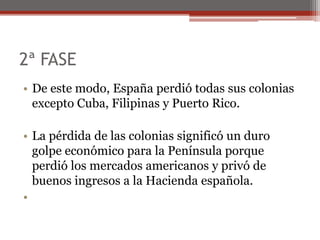
• De este modo, España perdió todas sus colonias
excepto Cuba, Filipinas y Puerto Rico.
• La pérdida de las colonias significó un duro
golpe económico para la Península porque
perdió los mercados americanos y privó de
buenos ingresos a la Hacienda española.
•
Isabel Aguña
Profesora de Geografía e Historia
Sección Bilingüe
Fuente: Oxford Education HISTORY 4ºESO

Tema 6

  • 1.
  • 2.
  • 3.
    THE RESTORATION INEUROPE 1815-1820
  • 4.
    THE RESTORATION INEUROPE 1815-1820 Europe after the Napoleonic Empire • What was the Restoration? ▫ It was a return to the political system of the Ancien Régime after Napoleon´s defeat in 1815.
  • 5.
    THE RESTORATION INEUROPE 1815-1820 The Cogress of Vienna The leaders of various European states met at the Congress of Vienna (1814-1815). MEASURES The restoration of absolute monarchy Changes to Europe´s borders
  • 6.
    THE RESTORATION INEUROPE 1815-1820 The Cogress of Vienna The restoration of absolute monarchy The European monarchs who had been deposed by Napoleon returned to power. However, some of these monarchs had to accept constitutional limits to their power
  • 7.
    THE RESTORATION INEUROPE 1815-1820 The Cogress of Vienna Changes to Europe´s borders Napoleon´s conquests had transformed the map of Europe. After his defeat, another series of changes were made to guarantee peace and avoid new revolutions. Objectives: 1.- To reduce the number of States 2.- To stop the French conquers.
  • 8.
    THE RESTORATION INEUROPE 1815-1820 The Cogress of ViennaBelgium was united with the Netherlands to form the Kingdom of the Netherlands. Prusia annexed the Rhineland. Italy was divided into various states. The German Confederation was created. It was formed by 39 states, and was dominated by Austria and Prusia. France came back to its borders before the Revolution. Two buffer states were created to avoid a French invasion. Austria, Rusia and Prusia gained territories in a balanced way, so that no one could be more powerful than the others.
  • 9.
    THE RESTORATION INEUROPE 1815-1820 The Cogress of Vienna • Two alliances were formed to enforce the agreements of the Congress of Viena: Objectives To enforce the Congress of Vienna To support Europe´s restored monarchs in the event of a revolution
  • 10.
    THE RESTORATION INEUROPE 1815-1820 The Cogress of Vienna • Two alliances were formed to enforce the agreements of the Congress of Viena: Alliances The Holy Alliance Russia Austria Prusia The Quadruple Alliance The three members of the Holy Alliance and Great Britain
  • 11.
  • 12.
    LIBERALISM, NATIONALISM AND DEMOCRACY REVOLUTIONS 19thCENTURY TWO POLITICAL IDEOLOGIES LIBERALISM NATIONALISM DEMOCRACY
  • 13.
    LIBERALISM, NATIONALISM AND DEMOCRACY LIBERALISM Origins: theEnlightenment ideas (American War of Independence and French Revolution). Objective: Emphasis of individual freedoms and rights. (As a reaction against the Restoration of the Absolutism) Representation: It represented the interests of the bourgeoisie.
  • 14.
    LIBERALISM, NATIONALISM AND DEMOCRACY LIBERALISM KEY PRINCIPLES NATIONAL SOVEREIGNTY CONSTITUTIONAL MONARCHY SEPARATIONOF POWERS LIMITED SUFFRAGE (Only male property owners) FREEDOM OF: - ASSOCIATION - RELIGION - THE PRESS
  • 15.
    REMEMBER! • What isthe difference between a state and a nation?
  • 16.
    LIBERALISM, NATIONALISM AND DEMOCRACY NATIONALISM Origins: 1.-The expansion of the Napoleonic Empire. 2.- The new division of Europe imposed by the Congress of Vienna => no respect to the identity of the peoples such as Polish, Belgians, Norwegians, Italians or Germans. 3.- The ancien Empires, such as the Ottoman, the Russian and the Austrian Empires, were formed by very different peoples.
  • 17.
    LIBERALISM, NATIONALISM AND DEMOCRACY NATIONALISM Consecuences: Somepeoples claimed their independences. Nationalism advocated the right of people who defined themselves as nations to establish their own independent states.
  • 18.
    LIBERALISM, NATIONALISM AND DEMOCRACY NATIONALISM KEYPRINCIPLES NATIONAL SOVEREIGNTY THE FORM OF GOVERNMENT THAT EACH NATION PREFERS INDEPENDENT NATION-STATES WITH CLEARLY DEFINED BORDERS POPULATION WITH A COMMON HISTORY, LANGUAGE AND CULTURE A WELL-INTEGRATED SOCIETY
  • 19.
    LIBERALISM, NATIONALISM AND DEMOCRACY DEMOCRACY Inthe 19th century, democratic movements defended ordinary people´s right to participate in politics. Representation: The middle and working classes.
  • 20.
    LIBERALISM, NATIONALISM AND DEMOCRACY DEMOCRACY KEY PRINCIPLES NATIONAL SOVEREINGTY REPUBLIC OPPOSITION TOMONARCHY (Considered incompatible with democracy) UNIVERSAL MANHOOD SUFFRAGE POLITICAL PARTIES SHOULD DEFEND THE RIGHTS OF THE MIDDLE AND WORKING CLASSES AGAINST UPPER-CLASS DOMINANCE
  • 21.
    Say if thefollowing statements refer to Liberalism, Nationalism or Democracy. 1.- Its origins are in the Enlightenment ideas. 2.- It defended ordinary people´s right to participate in politics. 3.- It advocated the right of people who defined themselves as nations to establish their own independent states. 4.- Limited suffrage, restricted to male property owners. 5.- Constitutional monarchy as a form of government. 6.- National sovereignty, with the republic as the preferred form of government. 7.- The separation of powers. 8.- It expressed the demands of the middle and working classes. 9.-It represented the interests of the bourgeoisie. 10.- Independent nation-states with clearly defined borders.
  • 22.
    Do exercises 9, 10and 11 on page 125. El comandante Riego
  • 23.
  • 24.
    ITALIAN AND GERMAN UNIFICATION •How were Italian and German territories like until the mid-19th century? ▫ They were divided into numerous independent states. • What happened during the first half of the 19th century in these modern-day countries? ▫ Nationalists movements emerged. • What was the result of these movements? ▫ These states were unified to form two new nation-states: Italy and Germany.
  • 25.
    ITALIAN UNIFICATION • Startingpoint: after the Congress of Viena, the Italian peninsula was divided into seven states:
  • 26.
    ITALIAN UNIFICATION • Whywas there a nationalist movement? ▫ They had a common language. ▫ They wanted to increase the economic market. ▫ They wanted infraestructures of transport.
  • 27.
    ITALIAN UNIFICATION • Whowas opposed to the Italian unification? ▫ The Austrians (after the Congress of Vienna, they had annexed the Kingdom of Lombardy, Parma, Módena and Toscana). ▫ The Papal States
  • 28.
    ITALIAN UNIFICATION • Whowas the motor of the unification? ▫ The kingdom of Piedmont-Sardinia  Italian monarchy of Saboya.  A great army.  Liberal constitution.  A seaport.  Wealth
  • 29.
    ITALIAN UNIFICATION • Main characters: Cavour: •Prime minister of the monarchicst Piedmont. Garibaldi: • Revolutionist who led an army of volunteers called the «red shirts»
  • 30.
    ITALIAN UNIFICATION • Typeof unification process: ▫ Military • Process: ▫ 1859: After gaining support from France, King Victor Emmanuel II and his prime minister, Cavour, fought successfully against Austria. ▫ Austria was defeated in the battles of Magenta and Solferino. • Result: ▫ The Austrians were expelled from Lombardy. ▫ Lombardy was given to Piedmont.
  • 31.
    ITALIAN UNIFICATION • Process: ▫The Piedmontese gradually conquered and annexed the rest of the Italian Peninsula with the help of Garibaldi, including Venetia and the Kingdom of the Two Siciles. ▫ 1859: Garibaldi and the «Red Shirts» conquered the Southern States.
  • 32.
    GERMAN UNIFICATION • Startingpoint: ▫ 1815:  German territory was divided in 39 states. The Congress of Vienna created the German Confederation, and was dominated by Austria and Prussia.
  • 33.
    GERMAN UNIFICATION • Startingpoint: ▫ 1834: Prussia created a customs union.  This was the first unifying step given by Prussia. Austria didn´t take part. ▫ 1848: the nationalist Revolution  It failed because the king didn´t accept the throne of a unified Germany in the parliament of Frankfurt.  But it consolidated the nationalism.
  • 34.
  • 35.
    GERMAN UNIFICATION • Process: ▫Bismarck started the German unification process with a conflict with Denmark over the Duchies of Schleswig and Holstein. ▫ 1864: Denmark was defeated.
  • 36.
    GERMAN UNIFICATION • Process: ▫1866:  Prussia defeated Austria in the battle of Sadowa and created the Northern German Confederation.
  • 37.
    GERMAN UNIFICATION • Process: ▫1870:  France was defeated in the Franco-Prussian War.  France didn´t accept Prussian influence.  Result:  France had to surrender the region of Alsace-Lorraine to Germany.  The Southern states joined to the German Confederation.
  • 38.
    GERMAN UNIFICATION • Process: ▫1871:  Bismarck established the Second Reich, or German Empire, with Wilhem I as its kaiser.
  • 39.
    AMERICA DURING THE19th CENTURY
  • 40.
    AMERICA DURING THE19th CENTURY USA 19th century Westward expansion The American Civil War (1861-1865)
  • 41.
    AMERICA DURING THE19th CENTURY • What happened in the USA during the 19th century after the American War of Independece? American War of Independence Political and territorial changes. Establishmet of many new states which still exist today. The USA consolidated itself as a sovereing nation and established its definitive borders.
  • 42.
    EXPANSION IN THEUNITED STATES • How did the USA establish the definitive borders? The 13 colonies
  • 43.
    EXPANSION IN THEUNITED STATES • Why did the American people expanded westwards during the 19th century? Many inmigrants arrived from Europe •because they were looking for a better life in the New World. The population increased rapidly. This increase in population encouraged the USA to expand westwards • They reach ed North America´s Pacific coast. Watch this video about Pioneers.
  • 44.
    EXPANSION IN THEUNITED STATES • What were the consequences of the Westward expansion? ▫ Conflicts with Native Americans.  Destruction of many tribes. Watch this video
  • 45.
    EXPANSION IN THEUNITED STATES Some tribes were isolated on reservations.
  • 46.
    THE AMERICAN CIVILWAR • Starting point: ▫ Slavery still existed in the southern states. ▫ The northern states rejected slavery. ▫ The southern states felt threatened by this. ▫ A civil war started. Watch this video
  • 47.
    THE AMERICAN CIVILWAR • Consequences: ▫ The war was won by the northern states. ▫ Slavery was ended. ▫ Universal manhood suffrage.  Male citizens of all ethnic bacgrounds had the right to vote in elections.
  • 48.
    • Las revolucionesliberales • La independencia de América Latina
  • 50.
    Revoluciones liberales Primera mitad del sigloXIX Significado El fin de la monarquía absoluta Características Basadas en el liberalismo y el nacionalismo Implantación de la democracia
  • 51.
    Revoluciones liberales Primera mitadsiglo XIX 1820s => Portugal, España y Grecia 1830 => Francia, Bélgica y Polonia 1848 => Francia y el Imperio Austrohúngaro
  • 52.
    1820 ▫ Países:  Portugaly España ▫ Características:  Revolución liberal ▫ Finalidad:  Establecer monarquías constitucionales
  • 53.
    1820 ▫ País:  Grecia ▫Características:  Revolución liberal y nacionalista ▫ Finalidad:  Lograr la independencia del Imperio Otomano.
  • 54.
    1830 ▫ País:  Francia ▫Caracteristicas:  Revolución liberal ▫ Finalidad:  Establecer una monarquía constitucional Carlos X de Borbon quería volver al absolutismo. Luis Felipe de Orleans se convirtió en rey. Era el lider de la clase alta.
  • 55.
    1830 ▫ País:  Bélgica ▫Caracteristicas:  Revolución nacionalista ▫ Finalidad:  perseguía la independencia con respecto a los Países Bajos, a los cuales había sido unida en el Congreso de Viena.
  • 56.
    1830 • En Poloniaestalló una revuelta, que fue duramente reprimida por el zar de Rusia.
  • 57.
    1848 ▫ Países:  Franciay el Imperio Austriaco ▫ Características:  Revoluciones más radicales  Ideología democrática ▫ Finalidad:  La clase media y el proletariado demandan reformas democráticas para acceder al poder.
  • 58.
    1848 • En Francia,un levantamiento popular destronó a Luis Felipe de Orleans y proclamó la II República.
  • 59.
    1848 II República francesa Sufragio universal masculino Libertad de prensa Abolición dela pena de muerte Abolición de la esclavitud Reconocimiento de algunos derechos para los trabajadores
  • 60.
    1848 • Sin embargo,la república evolucionó en un sentido más conservador y Luis Napoleón Bonaparte acabó imponiendo su poder personal y proclamando el II Imperio Francés.
  • 61.
    1848 • Imperio Austriaco ▫Carácter liberal en Viena. ▫ Levantamiento nacionalista contra el dominio imperial en Hungría, Bohemia, el Norte de Italia y la Confederación Germánica.
  • 63.
    CAUSAS • A nivelexterno: ▫ La difusión de los principios de libertad e igualdad promovidos por la Revolución francesa, así como la proclamación de la independencia de EEUU en 1776.
  • 64.
    CAUSAS • A nivelinterno: ▫ Descontento de la burguesía criolla que veía a España como un freno para su economía:  ya que obstaculizaba el comercio e imponía fuertes cargas fiscales.  Además, la mayoría de los cargos de la administración colonial estaban en manos de españoles peninsulares, que eran un grupo privilegiado.
  • 65.
    CAUSAS • Los criollosinstigaron los levantamientos a favor de la independencia, apoyada también por indios y mestizos.
  • 66.
    1ª FASE (1808-1814) •Los primeros movimientos independentistas se iniciaron con el estallido de la Guerra de la Independencia en España. • Las autoridades americanas no acataron la monarquía de José Bonaparte y formaron Juntas en las colonias, que empezaron a autogobernarse.
  • 67.
    1ª FASE • Deeste modo varios países proclamaron su independencia. Paraguay proclamó su independencia en 1811. • Este movimiento emancipador estaba dirigido por militares liberales, entre los que destacaron Simón Bolívar (Venezuela), y José de San Martín (Argentina).
  • 68.
    2ª FASE (1816-1826) •La etapa definitiva se inició en 1816, cuando Argentina proclamó su independencia y la insurrección se generalizó por todo el Imperio americano. • Desde Argentina, el general San Martín dirigió una expedición que, atravesando los Andes, derrotó a los españoles y logró la independencia de Chile.
  • 69.
    2ª FASE • SimónBolivar fundó la Gran Colombia, que después se dividiría en Venezuela, Colombia, Ecuador y Panamá. • Fernando VII vendió Florida a EEUU. • Iturbide logró la independencia de Méjico, que fue seguida por toda Centroamérica. • Antonio José de Sucre emancipó Perú y Bolivia.
  • 70.
    2ª FASE • Deeste modo, España perdió todas sus colonias excepto Cuba, Filipinas y Puerto Rico. • La pérdida de las colonias significó un duro golpe económico para la Península porque perdió los mercados americanos y privó de buenos ingresos a la Hacienda española. •
  • 71.
    Isabel Aguña Profesora deGeografía e Historia Sección Bilingüe Fuente: Oxford Education HISTORY 4ºESO