Categorical Propositions
Theory of Deduction
Theory of Deduction
• The theory of deduction is intended to
explain the relationship between
premisses and conclusion of a valid
argument, and to provide techniques for
the appraisal of deductive arguments, that
is, for discriminating between valid and
invalid deductions.
Two Theories to Accomplish this
Task
• “Classical” or “Aristotelian” Logic
• “Modern” or “Modern Symbolic” Logic
Aristotelian Logic
• The Aristotelian study of
deduction focused on arguments
containing propositions called
“categorical propositions” which
involve categories or classes.
Categorical Propositions
• Such propositions affirm or deny,
that some class S is included in
some other class P, in whole or in
part.
Example
No athletes are vegetarians.
All football players are athletes.
Therefore ??????
Explanation
In the argument the three
categorical propositions are about:
the class of all athletes ,
the class of all vegetarians, and
the class of all vegetarians.
Class Defined
• A class is a collection of all
objects that have some specified
characteristics in common
Relationships Between Classes
• There are various ways in which two
classes may be related to each other.
• These various relationships between
classes are affirmed or denied by
categorical propositions.
• There can be just four standard forms of
categorical propositions.
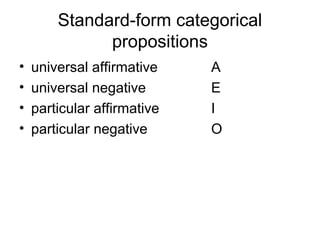
Standard-form categorical
propositions
• universal affirmative A
• universal negative E
• particular affirmative I
• particular negative O
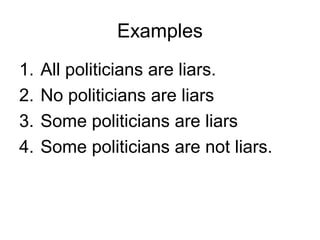
Examples
1. All politicians are liars.
2. No politicians are liars
3. Some politicians are liars
4. Some politicians are not liars.
Universal affirmative proposition (A)
• All politicians are liars is a universal
affirmative proposition. It contains two
classes, the class of all politicians and the
class of all liars, saying that the first class
is included in the second.
• A universal affirmative proposition says
that every member of the first class is also
the member of the second class.
A
• In this example, the subject term
“politicians” designates the class of all
politicians, and the predicate term “liars”
designates the class of all liars.
• Any universal affirmative proposition may
be written schematically as
• All S is P
• Where the letters S and P represent the subject
and predicate terms, respectively.
Universal negative proposition (E)
• No politicians are liars is a universal
negative proposition. It denies of
politicians that they are liars.
• A universal negative propositions says
that the firs class is wholly excluded from
the second, which is to say that there is no
member of the first class that is also a
member of the second.
E
• Any universal negative proposition may be
written schematically as
• No S is P.
Where the letters S and P represent the
subject and predicate terms.
Particular affirmative proposition (I)
• Some politicians are liars is a particular
affirmative proposition.
• It affirms that some members of the class
of all politicians are (also) members of the
class of all liars.
• This proposition neither affirms nor denies
that all politicians are liars.
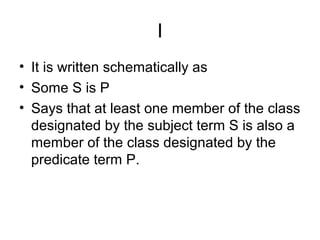
I
• It is written schematically as
• Some S is P
• Says that at least one member of the class
designated by the subject term S is also a
member of the class designated by the
predicate term P.
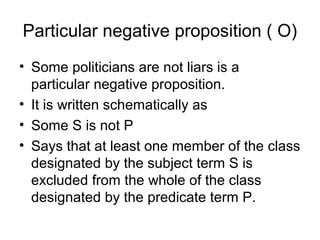
Particular negative proposition ( O)
• Some politicians are not liars is a
particular negative proposition.
• It is written schematically as
• Some S is not P
• Says that at least one member of the class
designated by the subject term S is
excluded from the whole of the class
designated by the predicate term P.

Categorical propositions

  • 1.
  • 2.
    Theory of Deduction •The theory of deduction is intended to explain the relationship between premisses and conclusion of a valid argument, and to provide techniques for the appraisal of deductive arguments, that is, for discriminating between valid and invalid deductions.
  • 3.
    Two Theories toAccomplish this Task • “Classical” or “Aristotelian” Logic • “Modern” or “Modern Symbolic” Logic
  • 4.
    Aristotelian Logic • TheAristotelian study of deduction focused on arguments containing propositions called “categorical propositions” which involve categories or classes.
  • 5.
    Categorical Propositions • Suchpropositions affirm or deny, that some class S is included in some other class P, in whole or in part.
  • 6.
    Example No athletes arevegetarians. All football players are athletes. Therefore ??????
  • 7.
    Explanation In the argumentthe three categorical propositions are about: the class of all athletes , the class of all vegetarians, and the class of all vegetarians.
  • 8.
    Class Defined • Aclass is a collection of all objects that have some specified characteristics in common
  • 9.
    Relationships Between Classes •There are various ways in which two classes may be related to each other. • These various relationships between classes are affirmed or denied by categorical propositions. • There can be just four standard forms of categorical propositions.
  • 10.
    Standard-form categorical propositions • universalaffirmative A • universal negative E • particular affirmative I • particular negative O
  • 11.
    Examples 1. All politiciansare liars. 2. No politicians are liars 3. Some politicians are liars 4. Some politicians are not liars.
  • 12.
    Universal affirmative proposition(A) • All politicians are liars is a universal affirmative proposition. It contains two classes, the class of all politicians and the class of all liars, saying that the first class is included in the second. • A universal affirmative proposition says that every member of the first class is also the member of the second class.
  • 13.
    A • In thisexample, the subject term “politicians” designates the class of all politicians, and the predicate term “liars” designates the class of all liars. • Any universal affirmative proposition may be written schematically as • All S is P • Where the letters S and P represent the subject and predicate terms, respectively.
  • 14.
    Universal negative proposition(E) • No politicians are liars is a universal negative proposition. It denies of politicians that they are liars. • A universal negative propositions says that the firs class is wholly excluded from the second, which is to say that there is no member of the first class that is also a member of the second.
  • 15.
    E • Any universalnegative proposition may be written schematically as • No S is P. Where the letters S and P represent the subject and predicate terms.
  • 16.
    Particular affirmative proposition(I) • Some politicians are liars is a particular affirmative proposition. • It affirms that some members of the class of all politicians are (also) members of the class of all liars. • This proposition neither affirms nor denies that all politicians are liars.
  • 17.
    I • It iswritten schematically as • Some S is P • Says that at least one member of the class designated by the subject term S is also a member of the class designated by the predicate term P.
  • 18.
    Particular negative proposition( O) • Some politicians are not liars is a particular negative proposition. • It is written schematically as • Some S is not P • Says that at least one member of the class designated by the subject term S is excluded from the whole of the class designated by the predicate term P.