
Jarrar © 2013 1
Dr. Mustafa Jarrar
Sina Institute, University of Birzeit
mjarrar@birzeit.edu
www.jarrar.info
Lecture Notes on Inference Methods,
University of Birzeit, Palestine
Spring Semester, 2014
Artificial Intelligence
Section 7.5 (& extra)
Inference Methods
In Propositional Logic
Jarrar © 2013 2
Watch this lecture and download the slides from
http://jarrar-courses.blogspot.com/2011/11/artificial-intelligence-fall-2011.html
Jarrar © 2013 3
This lecture
• Enumeration Method
• Inference rules
• Resolution
• Forward and backward Chaining
Lecture Keywords:
،‫الشكلي‬ ‫المنطق‬ ،‫المنطق‬‫االستنتاج‬‫االستنباط‬ ،،‫االستنتاج‬ ‫قواعد‬ ،
‫ا‬ ‫،صحة‬ ‫االستنتاج‬ ‫طرق‬‫ل‬‫جمل‬،‫المنطقية‬‫التناقض‬ ،‫الحدود‬
Logic, Propositional Logic, Inference Methods, Deduction, Reasoning, Enumeration Method,​ ​Inference
rules,​ ​Resolution, refutation theorem-proving technique, Forward Chaining,​ ​Backward Chaining​, Conjunctive
Normal Form,Horn clauses, entailment, Logical Implication, Soundness, Completeness ،satisfiable,
Unsatisfiable
Information and material largely based on [1]
Jarrar © 2013 4
Inference Methods
• Enumeration Method
• Inference rules
• Resolution
• Forward and backward Chaining
Jarrar © 2013 5
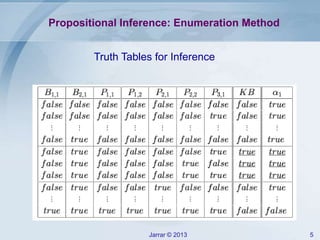
Truth Tables for Inference
Propositional Inference: Enumeration Method
Jarrar © 2013 6
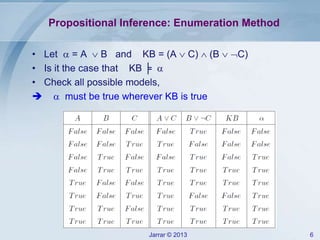
Propositional Inference: Enumeration Method
• Let  = A  B and KB = (A  C)  (B  C)
• Is it the case that KB ╞ 
• Check all possible models,
  must be true wherever KB is true
Jarrar © 2013 7
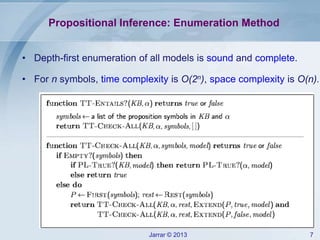
Propositional Inference: Enumeration Method
• Depth-first enumeration of all models is sound and complete.
• For n symbols, time complexity is O(2n), space complexity is O(n).
Jarrar © 2013 8
Inference Methods
• Enumeration Method
• Inference rules
• Resolution
• Forward and backward Chaining
Jarrar © 2013 9
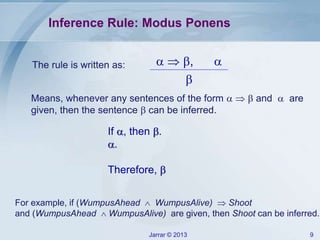
Inference Rule: Modus Ponens
The rule is written as:   , 

Means, whenever any sentences of the form    and  are
given, then the sentence  can be inferred.
If , then .
.
Therefore, 
For example, if (WumpusAhead  WumpusAlive)  Shoot
and (WumpusAhead  WumpusAlive) are given, then Shoot can be inferred.
Jarrar © 2013 10
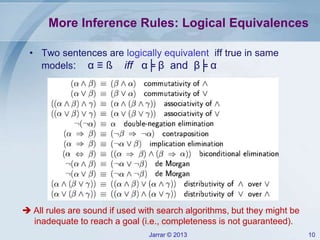
More Inference Rules: Logical Equivalences
• Two sentences are logically equivalent iff true in same
models: α ≡ ß iff α╞ β and β╞ α
 All rules are sound if used with search algorithms, but they might be
inadequate to reach a goal (i.e., completeness is not guaranteed).
Jarrar © 2013 11
Inference Methods
• Enumeration Method
• Inference rules
• Resolution
• Forward and backward Chaining
Proof by contradiction, i.e., show KB  α unsatisfiable.
Jarrar © 2013 12
Resolution
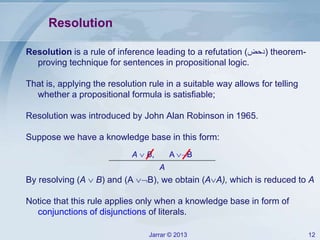
Resolution is a rule of inference leading to a refutation (‫)دحض‬ theorem-
proving technique for sentences in propositional logic.
That is, applying the resolution rule in a suitable way allows for telling
whether a propositional formula is satisfiable;
Resolution was introduced by John Alan Robinson in 1965.
Suppose we have a knowledge base in this form:
By resolving (A  B) and (A B), we obtain (AA), which is reduced to A
Notice that this rule applies only when a knowledge base in form of
conjunctions of disjunctions of literals.
A  B, A B
A
Jarrar © 2013 13
Resolution
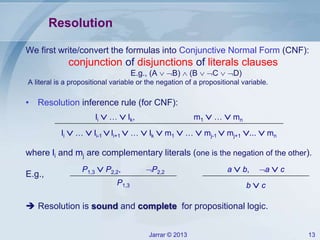
We first write/convert the formulas into Conjunctive Normal Form (CNF):
conjunction of disjunctions of literals clauses
E.g., (A  B)  (B  C  D)
A literal is a propositional variable or the negation of a propositional variable.
• Resolution inference rule (for CNF):
where li and mj are complementary literals (one is the negation of the other).
E.g.,
 Resolution is sound and complete for propositional logic.
li  …  lk, m1  …  mn
li  …  li-1 li+1  …  lk  m1  …  mj-1  mj+1 ...  mn
P1,3  P2,2, P2,2
P1,3
a  b, a  c
b  c
Jarrar © 2013 14
Conversion to CNF
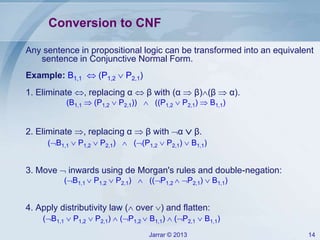
Any sentence in propositional logic can be transformed into an equivalent
sentence in Conjunctive Normal Form.
Example: B1,1  (P1,2  P2,1)
1. Eliminate , replacing α  β with (α  β)(β  α).
(B1,1  (P1,2  P2,1))  ((P1,2  P2,1)  B1,1)
2. Eliminate , replacing α  β with α  β.
(B1,1  P1,2  P2,1)  ((P1,2  P2,1)  B1,1)
3. Move  inwards using de Morgan's rules and double-negation:
(B1,1  P1,2  P2,1)  ((P1,2  P2,1)  B1,1)
4. Apply distributivity law ( over ) and flatten:
(B1,1  P1,2  P2,1)  (P1,2  B1,1)  (P2,1  B1,1)
Jarrar © 2013 15
Resolution Algorithm
Any sentence in propositional logic can be transformed into an equivalent
sentence in conjunctive normal form.
Steps:
• All sentences in KB and the negation of the sentence to be proved (the conjecture) are
conjunctively connected.
• The resulting sentence is transformed into a conjunctive normal form with the conjuncts
viewed as elements in a set, S, of clauses.
• The resolution rule is applied to all possible pairs of clauses that contain
complementary literals. After each application of the resolution rule, the resulting
sentence is simplified by removing repeated literals. If the sentence contains
complementary literals, it is discarded (as a tautology). If not, and if it is not yet present
in the clause set S, it is added to S, and is considered for further resolution inferences.
• If after applying a resolution rule the empty clause is derived, the complete formula is
unsatisfiable (or contradictory), and hence it can be concluded that the initial conjecture
follows from the axioms.
• If, on the other hand, the empty clause cannot be derived, and the resolution rule
cannot be applied to derive any more new clauses, the conjecture is not a theorem of
the original knowledge base.
[2]
Jarrar © 2013 16
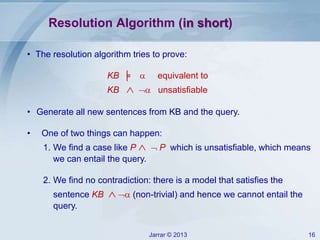
• The resolution algorithm tries to prove:
KB ╞  equivalent to
KB   unsatisfiable
• Generate all new sentences from KB and the query.
• One of two things can happen:
1. We find a case like P  P which is unsatisfiable, which means
we can entail the query.
2. We find no contradiction: there is a model that satisfies the
sentence KB   (non-trivial) and hence we cannot entail the
query.
Resolution Algorithm (in short)
Jarrar © 2013 17
Resolution Algorithm
• Proof by contradiction, i.e., show KB  α unsatisfiable.
[1]
Jarrar © 2013 18
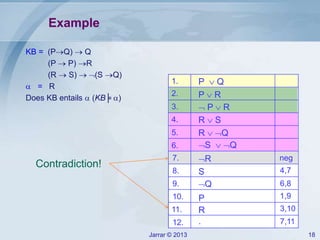
Example
KB = (PQ)  Q
(P  P) R
(R  S)  (S Q)
 = R
Does KB entails  (KB╞ )
P  Q1.
P  R2.
 P  R3.
R  S4.
R  Q5.
S  Q6.
R neg7.
S 4,78.
Q 6,89.
P 1,910.
R 3,1011.
. 7,1112.
Contradiction!
Jarrar © 2013 19
Exercise 1
KB = (B1,1  (P1,2 P2,1)) Breeze in [1,1] iff there is a Pit in [1,2] or [2.1].
 B1,1 There is on Breeze in [1,1]
 = P1,2 No Pit in [1,2]?
Does KB entails  (KB╞ )
KB  
False in
all worldsTrue!
Jarrar © 2013 20
Exercise 2
KB = (B1,1  (P1,2 P2,1)) Breeze in [1,1] iff there is a it is [1,2] or [2.1].
 B1,1 There is on Breeze in [1,1]
 = P1,2 Pit in [1,2]?
Does KB entails  (KB╞ )
Jarrar © 2013 21
Completeness of the Resolution Method
• Self reading from the book
• You should be able to prove the completeness of the resolution
method (at least informally).
Jarrar © 2013 22
Inference Methods
• Enumeration Method
• Inference rules
• Resolution
• Forward and backward Chaining
Jarrar © 2013 23
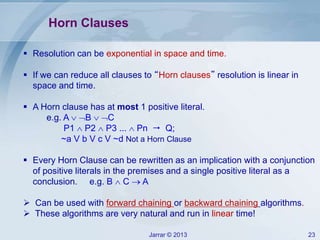
Horn Clauses
 Resolution can be exponential in space and time.
 If we can reduce all clauses to “Horn clauses” resolution is linear in
space and time.
 A Horn clause has at most 1 positive literal.
e.g. A  B  C
P1  P2  P3 ...  Pn  Q;
~a V b V c V ~d Not a Horn Clause
 Every Horn Clause can be rewritten as an implication with a conjunction
of positive literals in the premises and a single positive literal as a
conclusion. e.g. B  C  A
 Can be used with forward chaining or backward chaining algorithms.
 These algorithms are very natural and run in linear time!
Jarrar © 2013 24
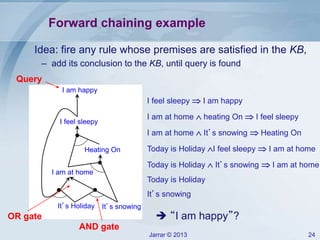
It’s Holiday It’s snowing
I am at home
Heating On
I feel sleepy
I am happy
AND gate
OR gate
Query
 “I am happy”?
Forward chaining example
Idea: fire any rule whose premises are satisfied in the KB,
– add its conclusion to the KB, until query is found
I feel sleepy  I am happy
I am at home  heating On  I feel sleepy
I am at home  It’s snowing  Heating On
Today is Holiday I feel sleepy  I am at home
Today is Holiday  It’s snowing  I am at home
Today is Holiday
It’s snowing
Jarrar © 2013 25
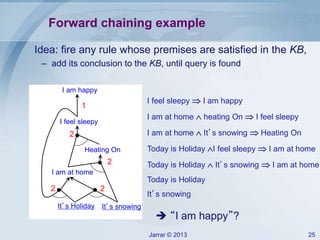
Forward chaining example
It’s Holiday It’s snowing
I am at home
Heating On
I feel sleepy
I am happy
2
2
2 2
1
Idea: fire any rule whose premises are satisfied in the KB,
– add its conclusion to the KB, until query is found
 “I am happy”?
I feel sleepy  I am happy
I am at home  heating On  I feel sleepy
I am at home  It’s snowing  Heating On
Today is Holiday I feel sleepy  I am at home
Today is Holiday  It’s snowing  I am at home
Today is Holiday
It’s snowing
Jarrar © 2013 26
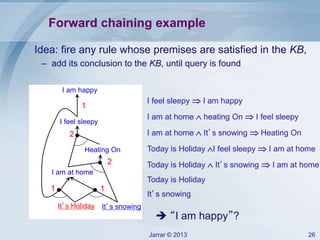
Forward chaining example
It’s Holiday It’s snowing
I am at home
Heating On
I feel sleepy
I am happy
2
2
1 1
1
Idea: fire any rule whose premises are satisfied in the KB,
– add its conclusion to the KB, until query is found
 “I am happy”?
I feel sleepy  I am happy
I am at home  heating On  I feel sleepy
I am at home  It’s snowing  Heating On
Today is Holiday I feel sleepy  I am at home
Today is Holiday  It’s snowing  I am at home
Today is Holiday
It’s snowing
Jarrar © 2013 27
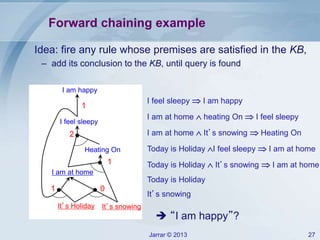
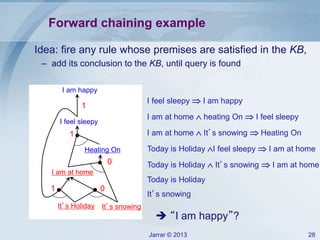
Forward chaining example
It’s Holiday It’s snowing
I am at home
Heating On
I feel sleepy
I am happy
2
1
1 0
1
Idea: fire any rule whose premises are satisfied in the KB,
– add its conclusion to the KB, until query is found
 “I am happy”?
I feel sleepy  I am happy
I am at home  heating On  I feel sleepy
I am at home  It’s snowing  Heating On
Today is Holiday I feel sleepy  I am at home
Today is Holiday  It’s snowing  I am at home
Today is Holiday
It’s snowing
Jarrar © 2013 28
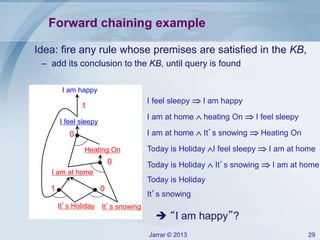
Forward chaining example
It’s Holiday It’s snowing
I am at home
Heating On
I feel sleepy
I am happy
1
0
1 0
1
Idea: fire any rule whose premises are satisfied in the KB,
– add its conclusion to the KB, until query is found
 “I am happy”?
I feel sleepy  I am happy
I am at home  heating On  I feel sleepy
I am at home  It’s snowing  Heating On
Today is Holiday I feel sleepy  I am at home
Today is Holiday  It’s snowing  I am at home
Today is Holiday
It’s snowing
Jarrar © 2013 29
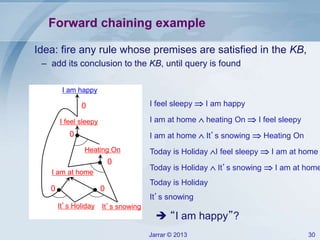
Forward chaining example
It’s Holiday It’s snowing
I am at home
Heating On
I feel sleepy
I am happy
0
0
1 0
1
Idea: fire any rule whose premises are satisfied in the KB,
– add its conclusion to the KB, until query is found
 “I am happy”?
I feel sleepy  I am happy
I am at home  heating On  I feel sleepy
I am at home  It’s snowing  Heating On
Today is Holiday I feel sleepy  I am at home
Today is Holiday  It’s snowing  I am at home
Today is Holiday
It’s snowing
Jarrar © 2013 30
I feel sleepy  I am happy
I am at home  heating On  I feel sleepy
I am at home  It’s snowing  Heating On
Today is Holiday I feel sleepy  I am at home
Today is Holiday  It’s snowing  I am at home
Today is Holiday
It’s snowing
Forward chaining example
It’s Holiday It’s snowing
I am at home
Heating On
I feel sleepy
I am happy
0
0
0 0
0
Idea: fire any rule whose premises are satisfied in the KB,
– add its conclusion to the KB, until query is found
 “I am happy”?
Jarrar © 2013 31
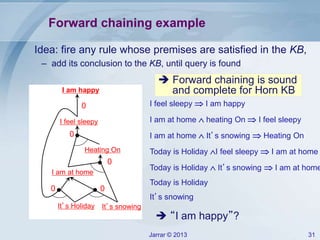
Forward chaining example
It’s Holiday It’s snowing
I am at home
Heating On
I feel sleepy
I am happy
0
0
0 0
0 I feel sleepy  I am happy
I am at home  heating On  I feel sleepy
I am at home  It’s snowing  Heating On
Today is Holiday I feel sleepy  I am at home
Today is Holiday  It’s snowing  I am at home
Today is Holiday
It’s snowing
Idea: fire any rule whose premises are satisfied in the KB,
– add its conclusion to the KB, until query is found
 Forward chaining is sound
and complete for Horn KB
 “I am happy”?
Jarrar © 2013 32
Think about this
Suppose that the goal is to conclude the color of a pet named Fritz,
given that (he croaks and eats flies), and that the Knowledge base
contains the following :
1. If (X croaks and eats flies) - Then (X is a frog)
2. If (X chirps and sings) - Then (X is a canary)
3. If (X is a frog) - Then (X is green)
4. If (X is a canary) - Then (X is yellow)
This Knowledge base would be searched and the first rule would be selected, because its antecedent (If
Fritz croaks and eats flies) matches our given data. Now the consequents (Then X is a frog) is added to
the data. The rule base is again searched and this time the third rule is selected, because its antecedent (If
Fritz is a frog) matches our data that was just confirmed. Now the new consequent (Then Fritz is green) is
added to our data. Nothing more can be inferred from this information, but we have now accomplished our
goal of determining the color of Fritz.
Croaks ‫ينعق‬
Frog ‫ضفدع‬
Chirps ‫يغرد‬
Canary ‫كناري‬
Jarrar © 2013 33
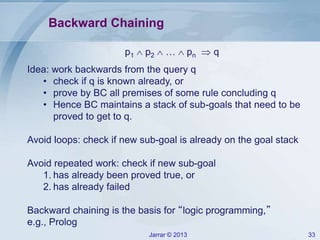
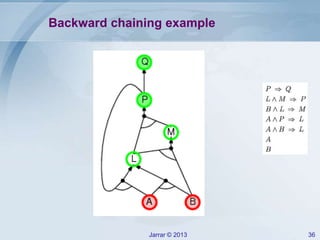
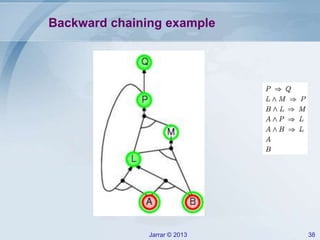
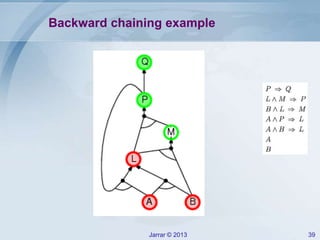
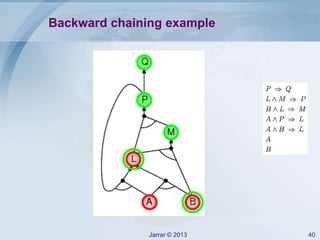
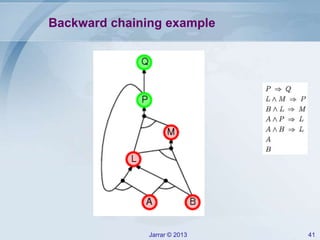
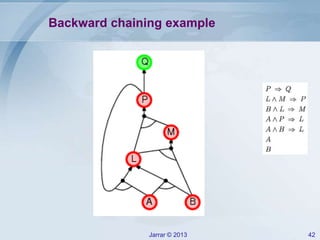
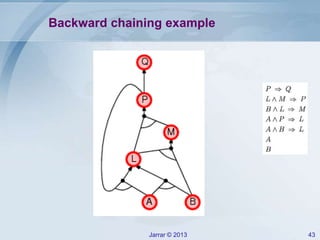
Backward Chaining
p1  p2  …  pn  q
Idea: work backwards from the query q
• check if q is known already, or
• prove by BC all premises of some rule concluding q
• Hence BC maintains a stack of sub-goals that need to be
proved to get to q.
Avoid loops: check if new sub-goal is already on the goal stack
Avoid repeated work: check if new sub-goal
1. has already been proved true, or
2. has already failed
Backward chaining is the basis for “logic programming,”
e.g., Prolog
Jarrar © 2013 34
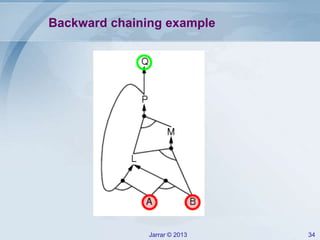
Backward chaining example
Jarrar © 2013 35
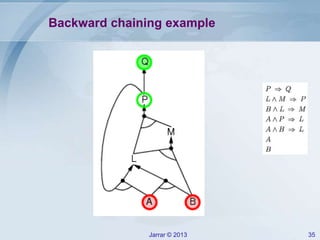
Backward chaining example
Jarrar © 2013 36
Backward chaining example
Jarrar © 2013 37
Backward chaining example
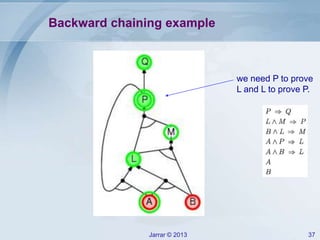
we need P to prove
L and L to prove P.
Jarrar © 2013 38
Backward chaining example
Jarrar © 2013 39
Backward chaining example
Jarrar © 2013 40
Backward chaining example
Jarrar © 2013 41
Backward chaining example
Jarrar © 2013 42
Backward chaining example
Jarrar © 2013 43
Backward chaining example
Jarrar © 2013 44
Forward vs. Backward Chaining
• FC is data-driven, automatic, senseless processing,
– e.g., object recognition, routine decisions
• May do lots of work that is irrelevant to the goal
• BC is goal-driven, (bottom-up reasoning) appropriate for
problem-solving,
– e.g., Where are my keys?
• Complexity of BC can be much less than linear in size of KB
Jarrar © 2013 45
Summary
• Logical agents apply inference to a knowledge base to derive new
information and make decisions.
• Basic concepts of logic:
– syntax: formal structure of sentences
– semantics: truth of sentences wrt models
– entailment: necessary truth of one sentence given another
– inference: deriving sentences from other sentences
– soundness: derivations produce only entailed sentences
– completeness: derivations can produce all entailed sentences
• Resolution is sound and complete for propositional logic
• Forward, backward chaining are linear-time, complete for Horn clauses
• Propositional logic lacks expressive power
Jarrar © 2013 46
References
[1] S. Russell and P. Norvig: Artificial Intelligence: A Modern Approach Prentice Hall, 2003, Second
Edition
[2] Leitsch, Alexander (1997), The resolution calculus, EATCS Monographs in Theoretical Computer
Science, Springer, p. 11, Before applying the inference method itself, we transform the formulas to
quantifier-free conjunctive normal form.

Jarrar: Propositional Logic Inference Methods

  • 1.
    Jarrar © 20131 Dr. Mustafa Jarrar Sina Institute, University of Birzeit mjarrar@birzeit.edu www.jarrar.info Lecture Notes on Inference Methods, University of Birzeit, Palestine Spring Semester, 2014 Artificial Intelligence Section 7.5 (& extra) Inference Methods In Propositional Logic
  • 2.
    Jarrar © 20132 Watch this lecture and download the slides from http://jarrar-courses.blogspot.com/2011/11/artificial-intelligence-fall-2011.html
  • 3.
    Jarrar © 20133 This lecture • Enumeration Method • Inference rules • Resolution • Forward and backward Chaining Lecture Keywords: ،‫الشكلي‬ ‫المنطق‬ ،‫المنطق‬‫االستنتاج‬‫االستنباط‬ ،،‫االستنتاج‬ ‫قواعد‬ ، ‫ا‬ ‫،صحة‬ ‫االستنتاج‬ ‫طرق‬‫ل‬‫جمل‬،‫المنطقية‬‫التناقض‬ ،‫الحدود‬ Logic, Propositional Logic, Inference Methods, Deduction, Reasoning, Enumeration Method,​ ​Inference rules,​ ​Resolution, refutation theorem-proving technique, Forward Chaining,​ ​Backward Chaining​, Conjunctive Normal Form,Horn clauses, entailment, Logical Implication, Soundness, Completeness ،satisfiable, Unsatisfiable Information and material largely based on [1]
  • 4.
    Jarrar © 20134 Inference Methods • Enumeration Method • Inference rules • Resolution • Forward and backward Chaining
  • 5.
    Jarrar © 20135 Truth Tables for Inference Propositional Inference: Enumeration Method
  • 6.
    Jarrar © 20136 Propositional Inference: Enumeration Method • Let  = A  B and KB = (A  C)  (B  C) • Is it the case that KB ╞  • Check all possible models,   must be true wherever KB is true
  • 7.
    Jarrar © 20137 Propositional Inference: Enumeration Method • Depth-first enumeration of all models is sound and complete. • For n symbols, time complexity is O(2n), space complexity is O(n).
  • 8.
    Jarrar © 20138 Inference Methods • Enumeration Method • Inference rules • Resolution • Forward and backward Chaining
  • 9.
    Jarrar © 20139 Inference Rule: Modus Ponens The rule is written as:   ,   Means, whenever any sentences of the form    and  are given, then the sentence  can be inferred. If , then . . Therefore,  For example, if (WumpusAhead  WumpusAlive)  Shoot and (WumpusAhead  WumpusAlive) are given, then Shoot can be inferred.
  • 10.
    Jarrar © 201310 More Inference Rules: Logical Equivalences • Two sentences are logically equivalent iff true in same models: α ≡ ß iff α╞ β and β╞ α  All rules are sound if used with search algorithms, but they might be inadequate to reach a goal (i.e., completeness is not guaranteed).
  • 11.
    Jarrar © 201311 Inference Methods • Enumeration Method • Inference rules • Resolution • Forward and backward Chaining Proof by contradiction, i.e., show KB  α unsatisfiable.
  • 12.
    Jarrar © 201312 Resolution Resolution is a rule of inference leading to a refutation (‫)دحض‬ theorem- proving technique for sentences in propositional logic. That is, applying the resolution rule in a suitable way allows for telling whether a propositional formula is satisfiable; Resolution was introduced by John Alan Robinson in 1965. Suppose we have a knowledge base in this form: By resolving (A  B) and (A B), we obtain (AA), which is reduced to A Notice that this rule applies only when a knowledge base in form of conjunctions of disjunctions of literals. A  B, A B A
  • 13.
    Jarrar © 201313 Resolution We first write/convert the formulas into Conjunctive Normal Form (CNF): conjunction of disjunctions of literals clauses E.g., (A  B)  (B  C  D) A literal is a propositional variable or the negation of a propositional variable. • Resolution inference rule (for CNF): where li and mj are complementary literals (one is the negation of the other). E.g.,  Resolution is sound and complete for propositional logic. li  …  lk, m1  …  mn li  …  li-1 li+1  …  lk  m1  …  mj-1  mj+1 ...  mn P1,3  P2,2, P2,2 P1,3 a  b, a  c b  c
  • 14.
    Jarrar © 201314 Conversion to CNF Any sentence in propositional logic can be transformed into an equivalent sentence in Conjunctive Normal Form. Example: B1,1  (P1,2  P2,1) 1. Eliminate , replacing α  β with (α  β)(β  α). (B1,1  (P1,2  P2,1))  ((P1,2  P2,1)  B1,1) 2. Eliminate , replacing α  β with α  β. (B1,1  P1,2  P2,1)  ((P1,2  P2,1)  B1,1) 3. Move  inwards using de Morgan's rules and double-negation: (B1,1  P1,2  P2,1)  ((P1,2  P2,1)  B1,1) 4. Apply distributivity law ( over ) and flatten: (B1,1  P1,2  P2,1)  (P1,2  B1,1)  (P2,1  B1,1)
  • 15.
    Jarrar © 201315 Resolution Algorithm Any sentence in propositional logic can be transformed into an equivalent sentence in conjunctive normal form. Steps: • All sentences in KB and the negation of the sentence to be proved (the conjecture) are conjunctively connected. • The resulting sentence is transformed into a conjunctive normal form with the conjuncts viewed as elements in a set, S, of clauses. • The resolution rule is applied to all possible pairs of clauses that contain complementary literals. After each application of the resolution rule, the resulting sentence is simplified by removing repeated literals. If the sentence contains complementary literals, it is discarded (as a tautology). If not, and if it is not yet present in the clause set S, it is added to S, and is considered for further resolution inferences. • If after applying a resolution rule the empty clause is derived, the complete formula is unsatisfiable (or contradictory), and hence it can be concluded that the initial conjecture follows from the axioms. • If, on the other hand, the empty clause cannot be derived, and the resolution rule cannot be applied to derive any more new clauses, the conjecture is not a theorem of the original knowledge base. [2]
  • 16.
    Jarrar © 201316 • The resolution algorithm tries to prove: KB ╞  equivalent to KB   unsatisfiable • Generate all new sentences from KB and the query. • One of two things can happen: 1. We find a case like P  P which is unsatisfiable, which means we can entail the query. 2. We find no contradiction: there is a model that satisfies the sentence KB   (non-trivial) and hence we cannot entail the query. Resolution Algorithm (in short)
  • 17.
    Jarrar © 201317 Resolution Algorithm • Proof by contradiction, i.e., show KB  α unsatisfiable. [1]
  • 18.
    Jarrar © 201318 Example KB = (PQ)  Q (P  P) R (R  S)  (S Q)  = R Does KB entails  (KB╞ ) P  Q1. P  R2.  P  R3. R  S4. R  Q5. S  Q6. R neg7. S 4,78. Q 6,89. P 1,910. R 3,1011. . 7,1112. Contradiction!
  • 19.
    Jarrar © 201319 Exercise 1 KB = (B1,1  (P1,2 P2,1)) Breeze in [1,1] iff there is a Pit in [1,2] or [2.1].  B1,1 There is on Breeze in [1,1]  = P1,2 No Pit in [1,2]? Does KB entails  (KB╞ ) KB   False in all worldsTrue!
  • 20.
    Jarrar © 201320 Exercise 2 KB = (B1,1  (P1,2 P2,1)) Breeze in [1,1] iff there is a it is [1,2] or [2.1].  B1,1 There is on Breeze in [1,1]  = P1,2 Pit in [1,2]? Does KB entails  (KB╞ )
  • 21.
    Jarrar © 201321 Completeness of the Resolution Method • Self reading from the book • You should be able to prove the completeness of the resolution method (at least informally).
  • 22.
    Jarrar © 201322 Inference Methods • Enumeration Method • Inference rules • Resolution • Forward and backward Chaining
  • 23.
    Jarrar © 201323 Horn Clauses  Resolution can be exponential in space and time.  If we can reduce all clauses to “Horn clauses” resolution is linear in space and time.  A Horn clause has at most 1 positive literal. e.g. A  B  C P1  P2  P3 ...  Pn  Q; ~a V b V c V ~d Not a Horn Clause  Every Horn Clause can be rewritten as an implication with a conjunction of positive literals in the premises and a single positive literal as a conclusion. e.g. B  C  A  Can be used with forward chaining or backward chaining algorithms.  These algorithms are very natural and run in linear time!
  • 24.
    Jarrar © 201324 It’s Holiday It’s snowing I am at home Heating On I feel sleepy I am happy AND gate OR gate Query  “I am happy”? Forward chaining example Idea: fire any rule whose premises are satisfied in the KB, – add its conclusion to the KB, until query is found I feel sleepy  I am happy I am at home  heating On  I feel sleepy I am at home  It’s snowing  Heating On Today is Holiday I feel sleepy  I am at home Today is Holiday  It’s snowing  I am at home Today is Holiday It’s snowing
  • 25.
    Jarrar © 201325 Forward chaining example It’s Holiday It’s snowing I am at home Heating On I feel sleepy I am happy 2 2 2 2 1 Idea: fire any rule whose premises are satisfied in the KB, – add its conclusion to the KB, until query is found  “I am happy”? I feel sleepy  I am happy I am at home  heating On  I feel sleepy I am at home  It’s snowing  Heating On Today is Holiday I feel sleepy  I am at home Today is Holiday  It’s snowing  I am at home Today is Holiday It’s snowing
  • 26.
    Jarrar © 201326 Forward chaining example It’s Holiday It’s snowing I am at home Heating On I feel sleepy I am happy 2 2 1 1 1 Idea: fire any rule whose premises are satisfied in the KB, – add its conclusion to the KB, until query is found  “I am happy”? I feel sleepy  I am happy I am at home  heating On  I feel sleepy I am at home  It’s snowing  Heating On Today is Holiday I feel sleepy  I am at home Today is Holiday  It’s snowing  I am at home Today is Holiday It’s snowing
  • 27.
    Jarrar © 201327 Forward chaining example It’s Holiday It’s snowing I am at home Heating On I feel sleepy I am happy 2 1 1 0 1 Idea: fire any rule whose premises are satisfied in the KB, – add its conclusion to the KB, until query is found  “I am happy”? I feel sleepy  I am happy I am at home  heating On  I feel sleepy I am at home  It’s snowing  Heating On Today is Holiday I feel sleepy  I am at home Today is Holiday  It’s snowing  I am at home Today is Holiday It’s snowing
  • 28.
    Jarrar © 201328 Forward chaining example It’s Holiday It’s snowing I am at home Heating On I feel sleepy I am happy 1 0 1 0 1 Idea: fire any rule whose premises are satisfied in the KB, – add its conclusion to the KB, until query is found  “I am happy”? I feel sleepy  I am happy I am at home  heating On  I feel sleepy I am at home  It’s snowing  Heating On Today is Holiday I feel sleepy  I am at home Today is Holiday  It’s snowing  I am at home Today is Holiday It’s snowing
  • 29.
    Jarrar © 201329 Forward chaining example It’s Holiday It’s snowing I am at home Heating On I feel sleepy I am happy 0 0 1 0 1 Idea: fire any rule whose premises are satisfied in the KB, – add its conclusion to the KB, until query is found  “I am happy”? I feel sleepy  I am happy I am at home  heating On  I feel sleepy I am at home  It’s snowing  Heating On Today is Holiday I feel sleepy  I am at home Today is Holiday  It’s snowing  I am at home Today is Holiday It’s snowing
  • 30.
    Jarrar © 201330 I feel sleepy  I am happy I am at home  heating On  I feel sleepy I am at home  It’s snowing  Heating On Today is Holiday I feel sleepy  I am at home Today is Holiday  It’s snowing  I am at home Today is Holiday It’s snowing Forward chaining example It’s Holiday It’s snowing I am at home Heating On I feel sleepy I am happy 0 0 0 0 0 Idea: fire any rule whose premises are satisfied in the KB, – add its conclusion to the KB, until query is found  “I am happy”?
  • 31.
    Jarrar © 201331 Forward chaining example It’s Holiday It’s snowing I am at home Heating On I feel sleepy I am happy 0 0 0 0 0 I feel sleepy  I am happy I am at home  heating On  I feel sleepy I am at home  It’s snowing  Heating On Today is Holiday I feel sleepy  I am at home Today is Holiday  It’s snowing  I am at home Today is Holiday It’s snowing Idea: fire any rule whose premises are satisfied in the KB, – add its conclusion to the KB, until query is found  Forward chaining is sound and complete for Horn KB  “I am happy”?
  • 32.
    Jarrar © 201332 Think about this Suppose that the goal is to conclude the color of a pet named Fritz, given that (he croaks and eats flies), and that the Knowledge base contains the following : 1. If (X croaks and eats flies) - Then (X is a frog) 2. If (X chirps and sings) - Then (X is a canary) 3. If (X is a frog) - Then (X is green) 4. If (X is a canary) - Then (X is yellow) This Knowledge base would be searched and the first rule would be selected, because its antecedent (If Fritz croaks and eats flies) matches our given data. Now the consequents (Then X is a frog) is added to the data. The rule base is again searched and this time the third rule is selected, because its antecedent (If Fritz is a frog) matches our data that was just confirmed. Now the new consequent (Then Fritz is green) is added to our data. Nothing more can be inferred from this information, but we have now accomplished our goal of determining the color of Fritz. Croaks ‫ينعق‬ Frog ‫ضفدع‬ Chirps ‫يغرد‬ Canary ‫كناري‬
  • 33.
    Jarrar © 201333 Backward Chaining p1  p2  …  pn  q Idea: work backwards from the query q • check if q is known already, or • prove by BC all premises of some rule concluding q • Hence BC maintains a stack of sub-goals that need to be proved to get to q. Avoid loops: check if new sub-goal is already on the goal stack Avoid repeated work: check if new sub-goal 1. has already been proved true, or 2. has already failed Backward chaining is the basis for “logic programming,” e.g., Prolog
  • 34.
    Jarrar © 201334 Backward chaining example
  • 35.
    Jarrar © 201335 Backward chaining example
  • 36.
    Jarrar © 201336 Backward chaining example
  • 37.
    Jarrar © 201337 Backward chaining example we need P to prove L and L to prove P.
  • 38.
    Jarrar © 201338 Backward chaining example
  • 39.
    Jarrar © 201339 Backward chaining example
  • 40.
    Jarrar © 201340 Backward chaining example
  • 41.
    Jarrar © 201341 Backward chaining example
  • 42.
    Jarrar © 201342 Backward chaining example
  • 43.
    Jarrar © 201343 Backward chaining example
  • 44.
    Jarrar © 201344 Forward vs. Backward Chaining • FC is data-driven, automatic, senseless processing, – e.g., object recognition, routine decisions • May do lots of work that is irrelevant to the goal • BC is goal-driven, (bottom-up reasoning) appropriate for problem-solving, – e.g., Where are my keys? • Complexity of BC can be much less than linear in size of KB
  • 45.
    Jarrar © 201345 Summary • Logical agents apply inference to a knowledge base to derive new information and make decisions. • Basic concepts of logic: – syntax: formal structure of sentences – semantics: truth of sentences wrt models – entailment: necessary truth of one sentence given another – inference: deriving sentences from other sentences – soundness: derivations produce only entailed sentences – completeness: derivations can produce all entailed sentences • Resolution is sound and complete for propositional logic • Forward, backward chaining are linear-time, complete for Horn clauses • Propositional logic lacks expressive power
  • 46.
    Jarrar © 201346 References [1] S. Russell and P. Norvig: Artificial Intelligence: A Modern Approach Prentice Hall, 2003, Second Edition [2] Leitsch, Alexander (1997), The resolution calculus, EATCS Monographs in Theoretical Computer Science, Springer, p. 11, Before applying the inference method itself, we transform the formulas to quantifier-free conjunctive normal form.