WRITE DON’T CITE:
WIKIPEDIA IN
EDUCATION
P r e s e n t e d b y
P r u M i t c h e l l
Australian School Library
Association Inc.
Housekeeping
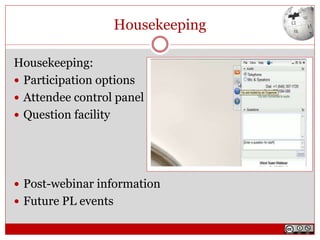
Housekeeping:
 Participation options
 Attendee control panel
 Question facility
 Post-webinar information
 Future PL events
Presenter
• ASLA member
• Manager Information Services, Australian Council
for Educational Research
• 2006 ‘Wikis in education’ in
Wikis: tools for information work & collaboration
• 2009 GLAM Wiki conference
• 2013 Committee Wikimedia Australia
• 2014 Wikimedia Future of Education
• 2014 ALIA Wikipedia and Libraries
• 2016 VALA WikiBomb and Wikidata tour
Pru Mitchell
Session overview
1. Why write [edit] Wikipedia
2. Editing activities
3. How to work with Wikipedia
4. Questions and Answers
Using Wikipedia as a source
1. I have followed a link to Wikipedia
2. I have read a Wikipedia article to find
information
3. I know at least 3 ways to evaluate a
Wikipedia article
4. I have cited Wikipedia
Editing Wikipedia
4. I have a Wikipedia username
5. I have edited something in Wikipedia
6. I have added a reference to Wikipedia
7. I have created a new Wikipedia article
Wikipedia’s media files
8. I understand Wikipedia's licence CC by-sa
9. I have used a media file from Wikimedia
Commons
10. I have uploaded my own media content to
Wikimedia Commons
Teaching with Wikipedia
• Engaged students, global audience, real world purpose
• Unique assignment, peer feedback, cool and different
• Media literacy, identify bias, evaluate credibility
• Constructing knowledge, content gaps
• Discourse, collaboration, community of practice
• Expository writing, literature review, citation
• Critical thinking, process reflection
• Plagiarism, close paraphrasing, copyright
• Digital citizenship, online etiquette, wiki code
Wikipedia writing style
• Wikipedia is an encyclopedia
• no original research
• neutral point of view
• statements must be verifiable
• must reference reliable published sources
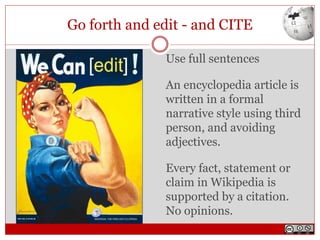
Go forth and edit - and CITE
Use full sentences
An encyclopedia article is
written in a formal
narrative style using third
person, and avoiding
adjectives.
Every fact, statement or
claim in Wikipedia is
supported by a citation.
No opinions.
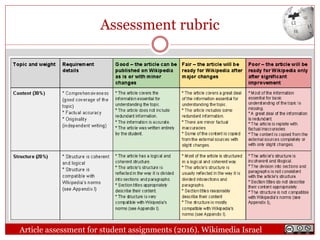
Assessment rubric
Article assessment for student assignments (2016). Wikimedia Israel
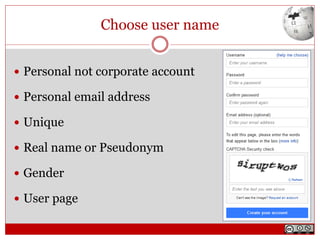
Choose user name
 Personal not corporate account
 Personal email address
 Unique
 Real name or Pseudonym
 Gender
 User page
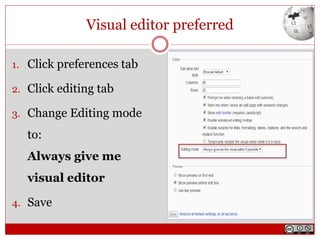
Visual editor preferred
1. Click preferences tab
2. Click editing tab
3. Change Editing mode
to:
Always give me
visual editor
4. Save
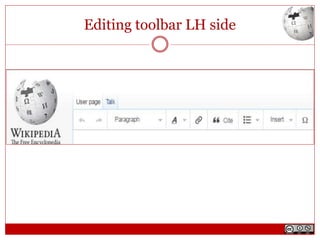
Editing toolbar LH side
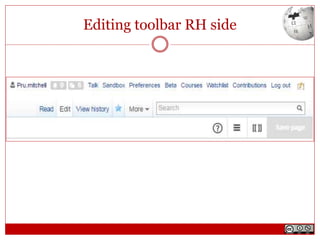
Editing toolbar RH side
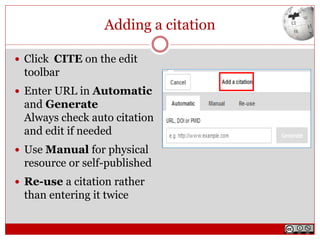
Adding a citation
 Click CITE on the edit
toolbar
 Enter URL in Automatic
and Generate
Always check auto citation
and edit if needed
 Use Manual for physical
resource or self-published
 Re-use a citation rather
than entering it twice
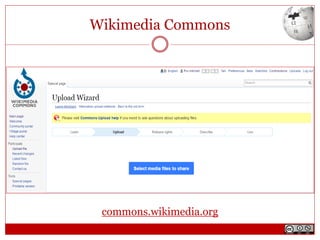
Wikimedia Commons
commons.wikimedia.org
Beware when editing...
 Article on your school
 Article on an organisation you are affiliated with
 Article on a person
 Cannot use own website or publications as proof of
notability, and no PR material
 Can use reviews by independent people, independent
newspaper reports, books, etc
 OK to cite their publications in the article, but not
sufficient alone to prove notability
Wikimedia Australia
 Volunteers
 We’re here to help …
 Advice on using Wikipedia (or other projects)
 Wikipedia edit training
 Donations welcome
Post-webinar information
Certificate of attendance
will be emailed
Membership information is available at
http://www.asla.org.au/membership.aspx
Future Webinars
http://www.asla.org.au/Professional-learning/webinars.aspx
Follow ASLA on Twitter
https://twitter.com/aslanational
Like us on Facebook
https://www.facebook.com/ASLAOnline
20

Write don't cite: Wikipedia in education

  • 1.
    WRITE DON’T CITE: WIKIPEDIAIN EDUCATION P r e s e n t e d b y P r u M i t c h e l l Australian School Library Association Inc.
  • 2.
    Housekeeping Housekeeping:  Participation options Attendee control panel  Question facility  Post-webinar information  Future PL events
  • 3.
    Presenter • ASLA member •Manager Information Services, Australian Council for Educational Research • 2006 ‘Wikis in education’ in Wikis: tools for information work & collaboration • 2009 GLAM Wiki conference • 2013 Committee Wikimedia Australia • 2014 Wikimedia Future of Education • 2014 ALIA Wikipedia and Libraries • 2016 VALA WikiBomb and Wikidata tour Pru Mitchell
  • 4.
    Session overview 1. Whywrite [edit] Wikipedia 2. Editing activities 3. How to work with Wikipedia 4. Questions and Answers
  • 5.
    Using Wikipedia asa source 1. I have followed a link to Wikipedia 2. I have read a Wikipedia article to find information 3. I know at least 3 ways to evaluate a Wikipedia article 4. I have cited Wikipedia
  • 6.
    Editing Wikipedia 4. Ihave a Wikipedia username 5. I have edited something in Wikipedia 6. I have added a reference to Wikipedia 7. I have created a new Wikipedia article
  • 7.
    Wikipedia’s media files 8.I understand Wikipedia's licence CC by-sa 9. I have used a media file from Wikimedia Commons 10. I have uploaded my own media content to Wikimedia Commons
  • 8.
    Teaching with Wikipedia •Engaged students, global audience, real world purpose • Unique assignment, peer feedback, cool and different • Media literacy, identify bias, evaluate credibility • Constructing knowledge, content gaps • Discourse, collaboration, community of practice • Expository writing, literature review, citation • Critical thinking, process reflection • Plagiarism, close paraphrasing, copyright • Digital citizenship, online etiquette, wiki code
  • 9.
    Wikipedia writing style •Wikipedia is an encyclopedia • no original research • neutral point of view • statements must be verifiable • must reference reliable published sources
  • 10.
    Go forth andedit - and CITE Use full sentences An encyclopedia article is written in a formal narrative style using third person, and avoiding adjectives. Every fact, statement or claim in Wikipedia is supported by a citation. No opinions.
  • 11.
    Assessment rubric Article assessmentfor student assignments (2016). Wikimedia Israel
  • 12.
    Choose user name Personal not corporate account  Personal email address  Unique  Real name or Pseudonym  Gender  User page
  • 13.
    Visual editor preferred 1.Click preferences tab 2. Click editing tab 3. Change Editing mode to: Always give me visual editor 4. Save
  • 14.
  • 15.
  • 16.
    Adding a citation Click CITE on the edit toolbar  Enter URL in Automatic and Generate Always check auto citation and edit if needed  Use Manual for physical resource or self-published  Re-use a citation rather than entering it twice
  • 17.
  • 18.
    Beware when editing... Article on your school  Article on an organisation you are affiliated with  Article on a person  Cannot use own website or publications as proof of notability, and no PR material  Can use reviews by independent people, independent newspaper reports, books, etc  OK to cite their publications in the article, but not sufficient alone to prove notability
  • 19.
    Wikimedia Australia  Volunteers We’re here to help …  Advice on using Wikipedia (or other projects)  Wikipedia edit training  Donations welcome
  • 20.
    Post-webinar information Certificate ofattendance will be emailed Membership information is available at http://www.asla.org.au/membership.aspx Future Webinars http://www.asla.org.au/Professional-learning/webinars.aspx Follow ASLA on Twitter https://twitter.com/aslanational Like us on Facebook https://www.facebook.com/ASLAOnline 20

Editor's Notes

  • #2 Do you worry that students these days read too many encyclopedia articles? Why is an encyclopedia in the top 10 most visited websites list? With their passion for sharing knowledge many library staff support Wikipedia's vision of 'a world in which every single person on the planet is given free access to the sum of all human knowledge'. This webinar for school library staff considers critical thinking projects that show students how Wikipedia works, and helps move them from being consumers to creators. Participants will evaluate content and citations to consider how Wikipedia can be a reliable source of neutral, verifiable, established background information on current curriculum topics.
  • #5 This is what we hope to get through this evening. By the end of this session you have an idea of what is involved in editing Wikipedia, and contributing content. You will have some examples of how you could incorporate editing activities into school-based programmes once you are familiar with and have done some editing yourself - and how to get help when you do that. I will leave time for questions and answers – but them in the question box as we go and we will stop along the way to deal with these.
  • #6 In the ASLA webinar last year we looked at using Wikipedia as a source. This is step 1, and if you were part of the webinar last year I hope you can now tick each of these – and perhaps if I surveyed your students now you have passed on the skill of evaluating to them, and they can tick the top 3. The survey has a checklist of some ways people engage with Wikipedia, and it would help to know which of these boxes each of you ticks. * Unless you have actively resisted, I suspect most of you have been led to Wikipedia from somewhere online at some point. It is pretty hard to avoid this. It ranks highly in search engines. * By far the majority of people who use Wikipedia use it as an information source. It provides an overview or introduction to practically any topic. We hope that all users of any information source have the information literacy skills to evaluate that source, and this forms a key part of our role as educators and librarians.
  • #7 These skills are the focus for tonight’s webinar. Editing Wikipedia is something anyone can do, and something we would love everyone to be part of. It would be wonderful if every time you benefited from useful information in Wikipedia you resolved to contribute an edit that will enhance the encyclopaedia for another. We don’t have time for you to actually edit tonight, but if the technology works - you can watch me edit and then follow up with the slides as a guide offline.
  • #8 There are other ways that you can contribute to Wikipedia, and in particular uploading photos, video, graphs, audio files
  • #9 More motivated, interested, self-aware, thoughtful, capable researchers #RNWOW project Catholic girls school in Melbourne. Year 9s Term 4 2015 History
  • #10 Wikipedia is not a primary source, like a direct interview, or a secondary source, like an academic paper or a news story. Wikipedia is an encyclopedia. It is a collection of information from secondary sources, assembled into articles that provide a general overview. Like other encyclopedias, Wikipedia should be used as a starting point. It can provide a broad overview of a subject and help you find high-quality primary and secondary sources. This writing style is not commonly taught in schools so requires some guidance – by reading encyclopedias especially Wikipedia
  • #11 #RNWOW – very committed teacher and teacher librarian. 4 weeks of guided collecting content and sources on their topic and drafting – not enough work on drafts 1 double lesson editing workshop. Guided work in their personal sandbox, then moved into main Wikipedia space. Some didn’t wait and were deleted. Learning experience http://www3.olmcheidelberg.catholic.edu.au/news-app/27-November-2015-The-WoW-project-in-Year-9?eid=3285865&cat=Learning-and-Wellbeing
  • #12 Example of a rubric – reinforces that the content, structure and sources are more important than the editing. Found Year 9 was perhaps bottom level of writing style for a whole article. https://upload.wikimedia.org/wikipedia/commons/2/2b/Article_Assessment_for_Student_Assignments_%E2%80%93_For_Teacher.pdf Content 30% Structure 20% Encyclopaedic writing style 15% Level of language 15% Use of sources 20% Extra textual work – bonus 5% Eg links to other articles, pictures, graphs and categories
  • #17 You can auto-generate from a URL, DOI Note the Re-use option if you are using the same reference several times in the article
  • #19 http://en.wikipedia.org/wiki/Wikipedia:Biographies_of_living_persons Material about living persons added to any Wikipedia page must be written with the greatest care and attention to verifiability, neutrality, and avoiding original research.