The Website-Which-
Must-Not-Be-Named:
 Using Wikipedia to
 Teach Information
      Literacy
                  Ilka Datig
 Instruction & Electronic Services Librarian
           Mary Baldwin College
What was the most controversial
Wikipedia entry in 2010, according
     to number of footnotes?
Organization
• Introduction
   o Why we should use Wikipedia

• Examples of classroom activities
   o   Background information/brainstorming a topic
   o   Evaluating credibility
   o   Citations/References/Bibliography
   o   Information production

• Further reading
• Q&A
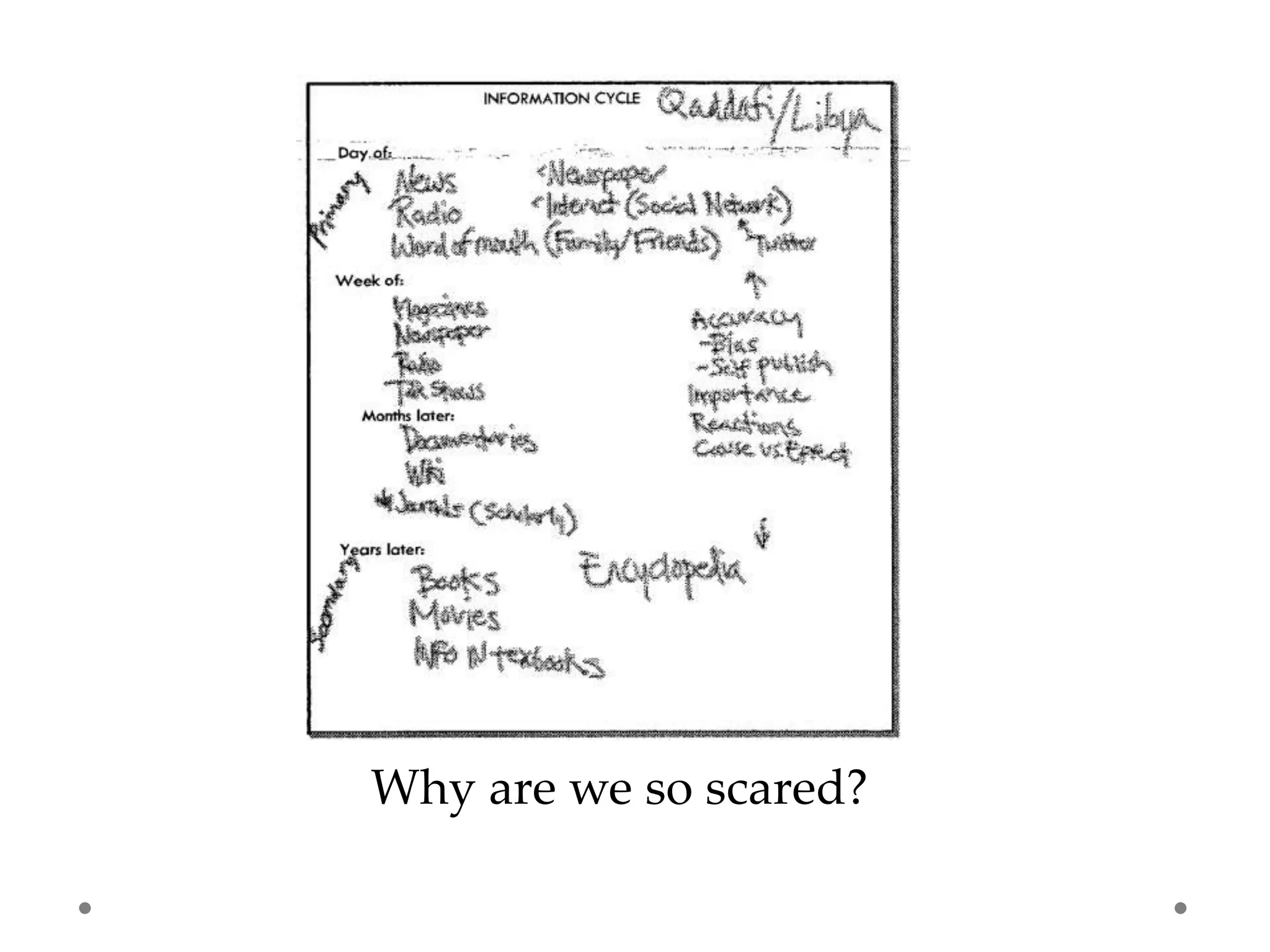
Why are we so scared?
Ubiquity
• 6th most popular website in 2011 (Alexa)
• Project Information Literacy:
   o 84% use for information-gathering for course-
     related research (Head & Eisenberg, 2009)
• SOPA Blackout
   o “Oh. My. God. As soon as I need wikipedia for
     homework, it suddenly is „shut down‟. I HATE YOU
     WIKIPEDIA” (Tsukayama, 2012)
Class activities
• My experience: one-credit Information Literacy
  courses
• One-shot sessions – I‟d love to hear your advice!
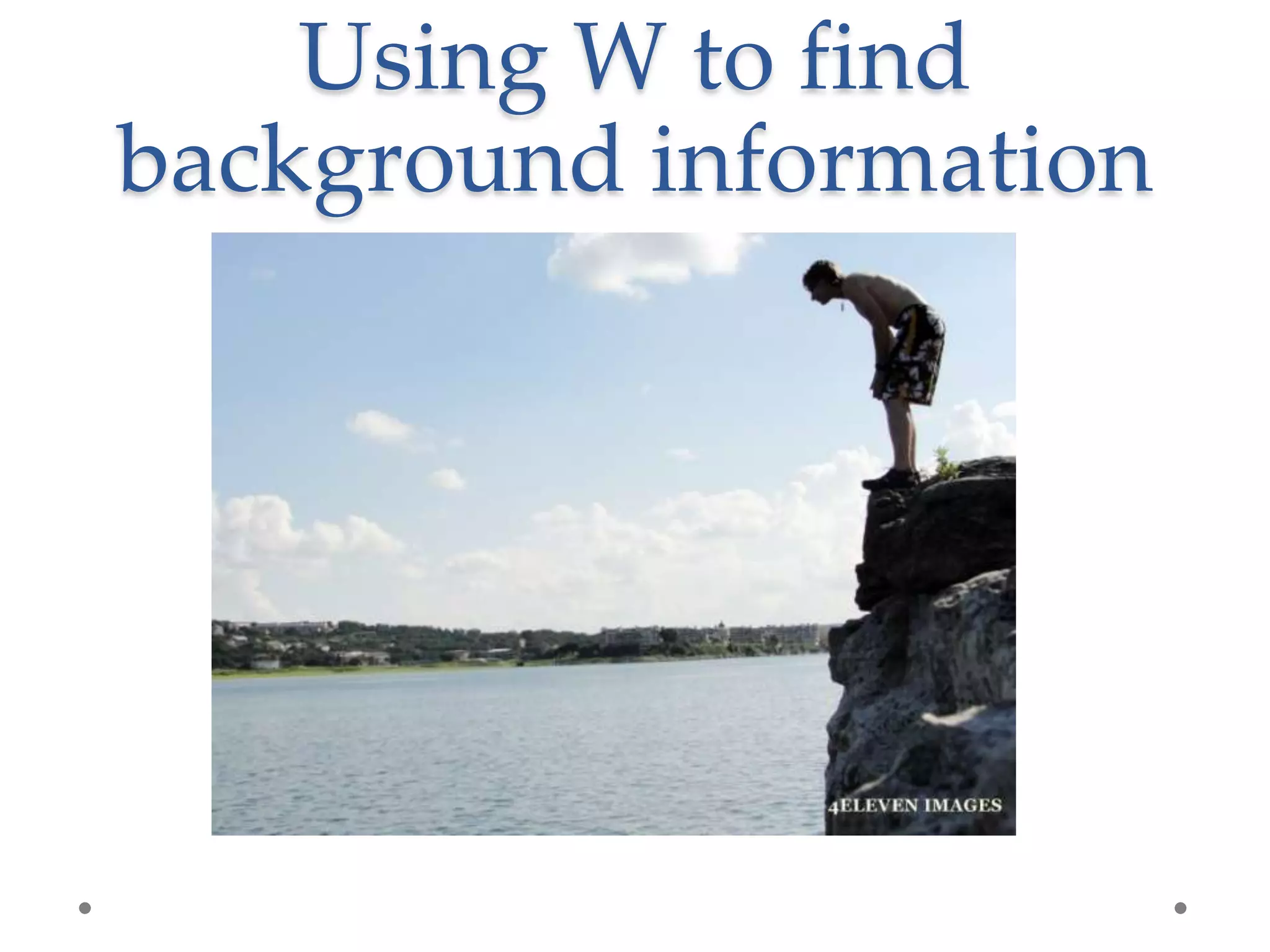
Using W to find
background information
Using W to find
 background information
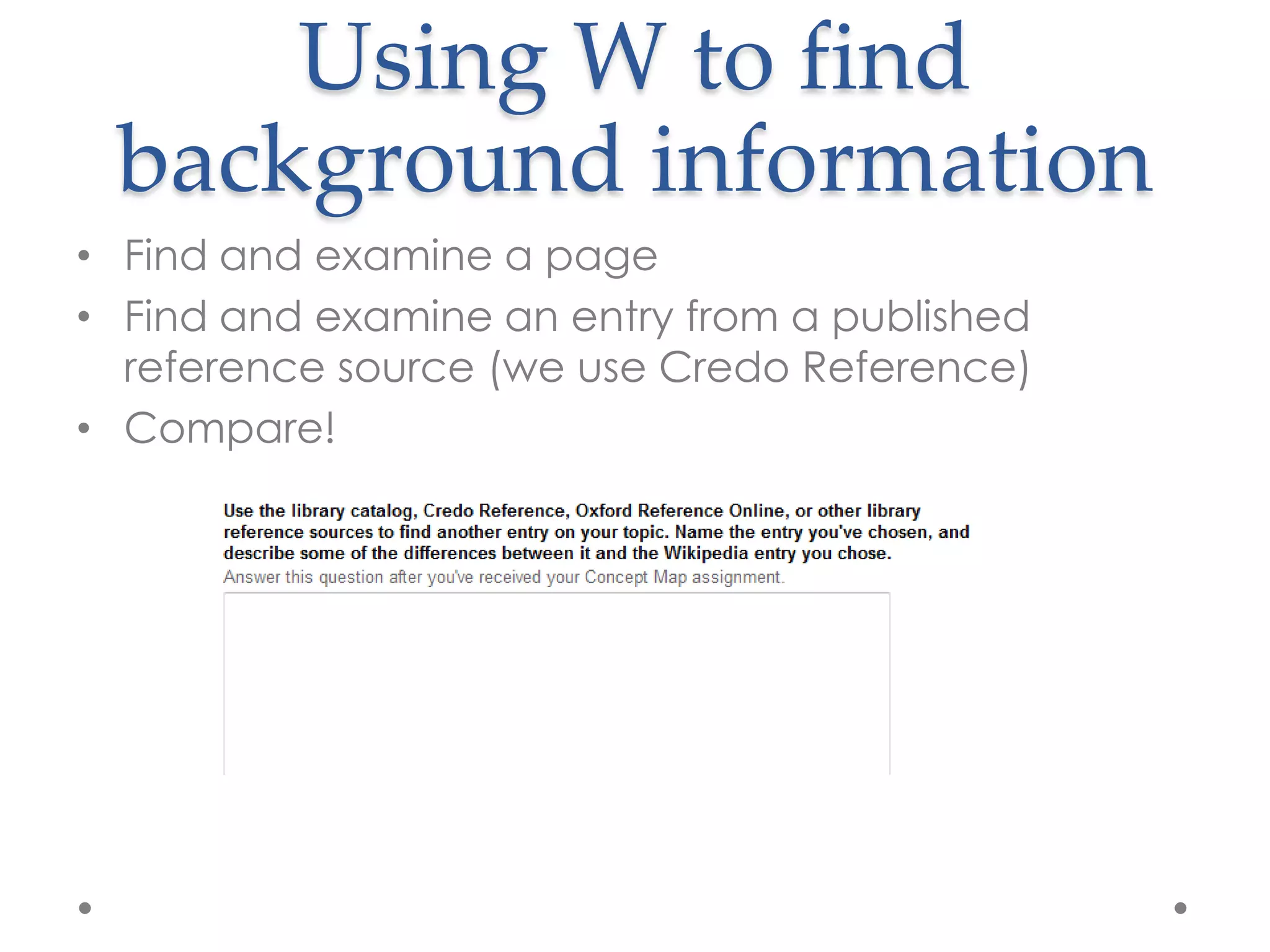
• Find and examine a page
• Find and examine an entry from a published
  reference source (we use Credo Reference)
• Compare!
Using W to find
  background information
• “This article differs from the wiki article in that 1.)
  there is significantly more information offered on the
  subject and consequently 2.) many more
  references which makes the information much
  more credible”
• “In this article, there were more detailed graphs and
  back-up information to support the topic.”
• “This article differed from the wiki document in that
  it had empirical data, and a longer list of
  references. Wikipedia was more appealing to the
  reader's eye, e.g. there were colorful pictures of
  generated structures of different biomolecules.”
Using W to find
  background information
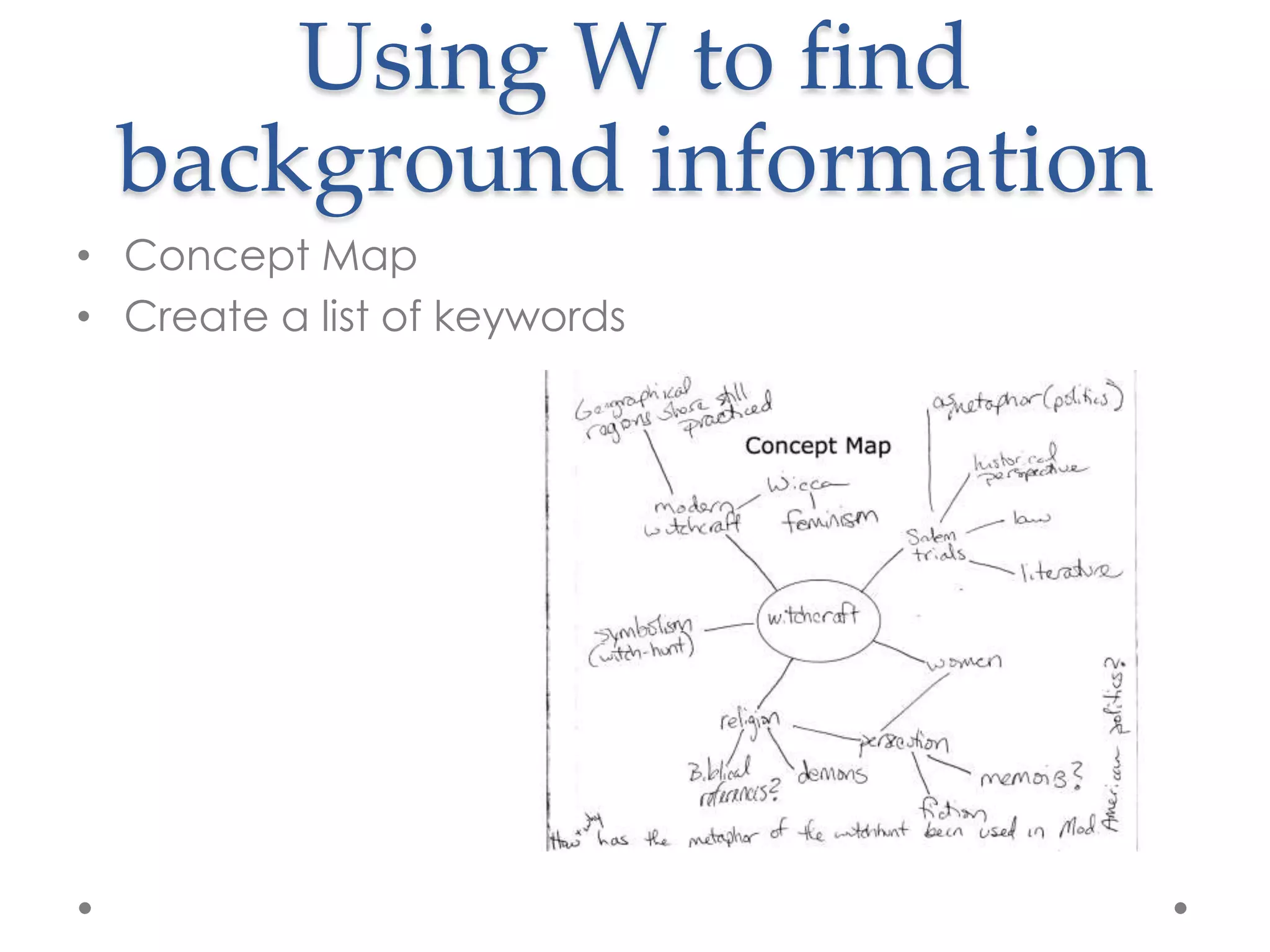
• Concept Map
• Create a list of keywords
Using W to find
 background information
• ACRL Standard One
  o “The information literate student determines the nature and extent of the
    information needed” (ACRL, 2000)

• „Summarizations and not actual research‟
  (Jennings, 2008, p. 435)
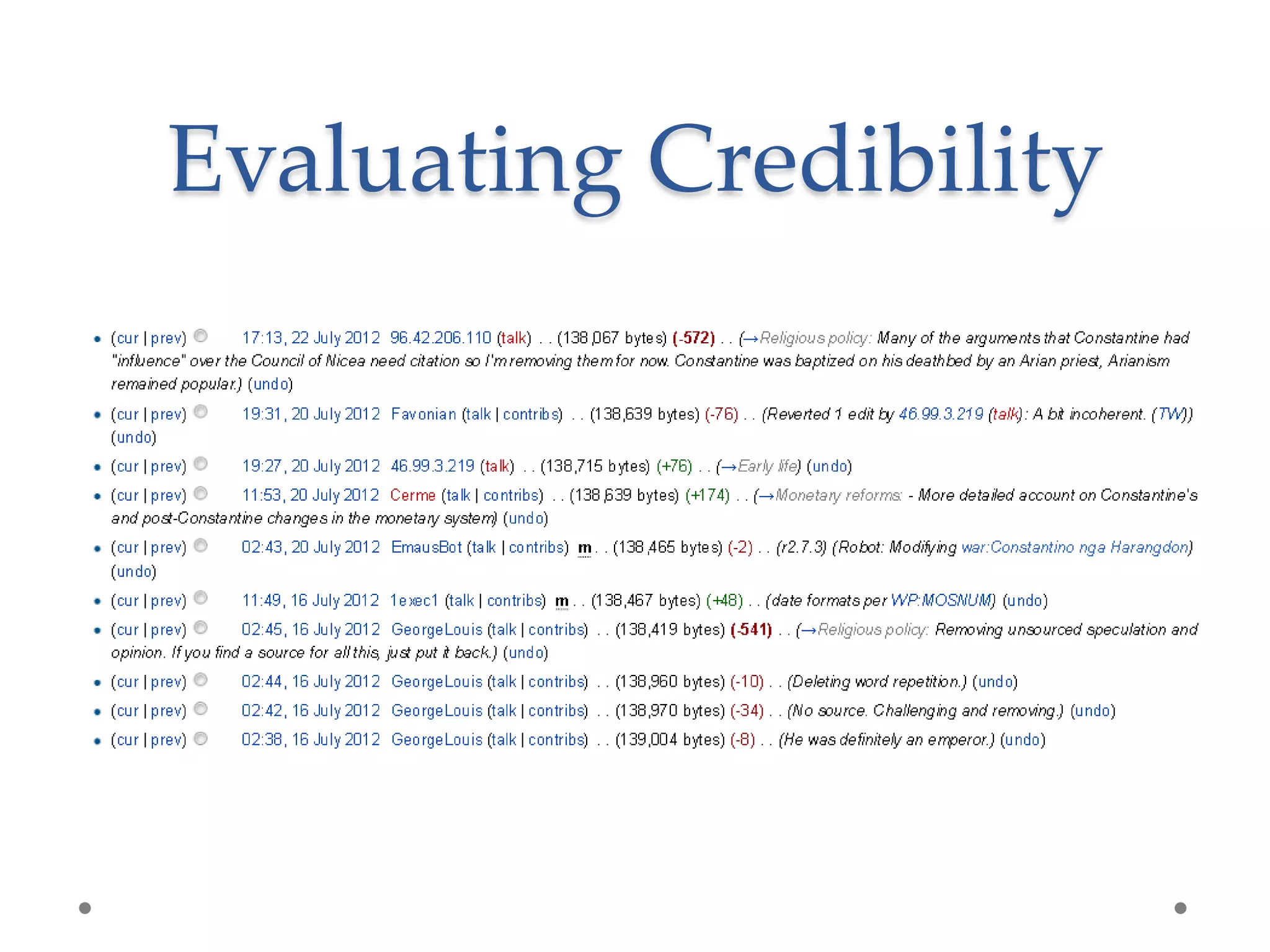
Evaluating Credibility
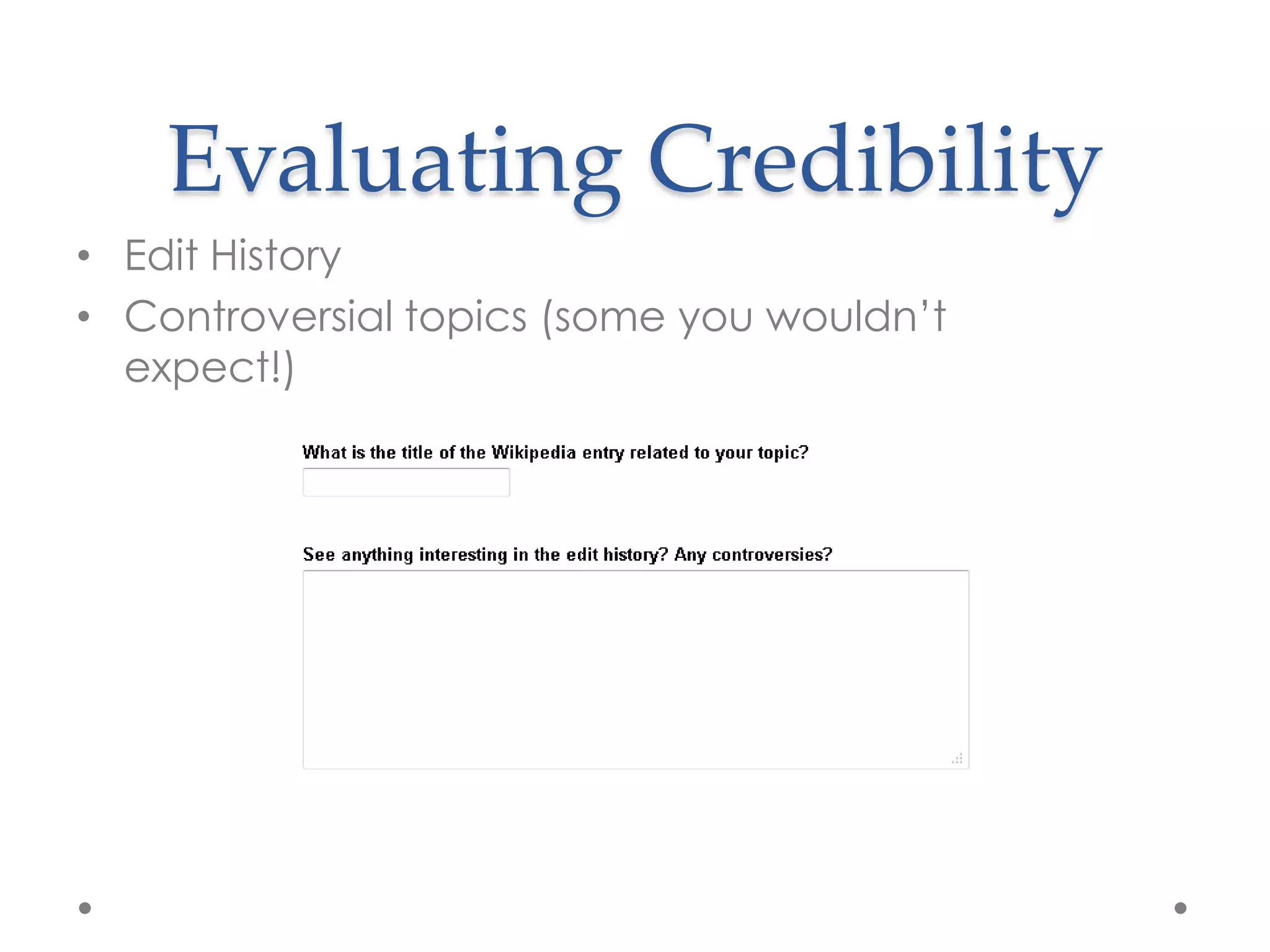
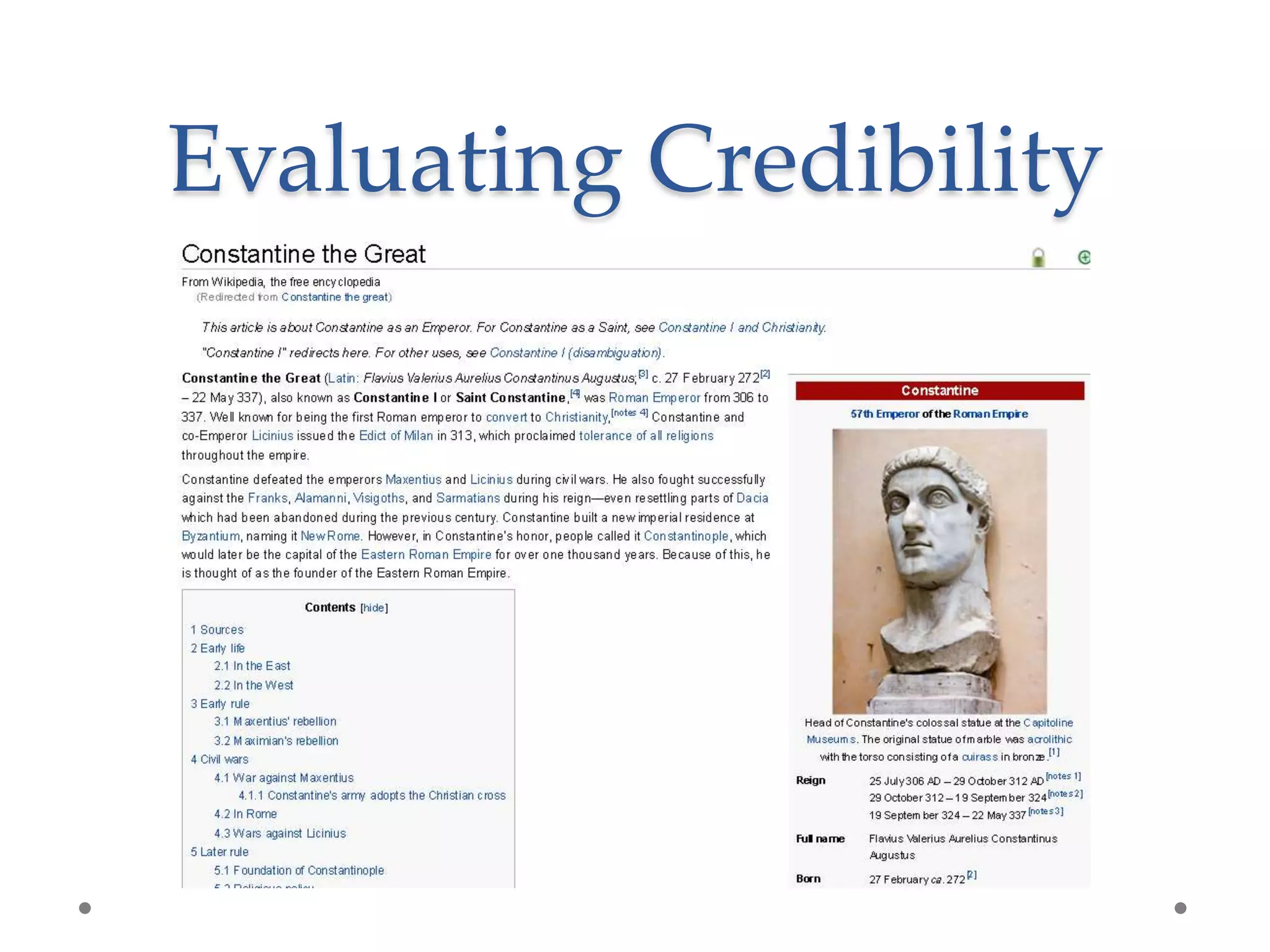
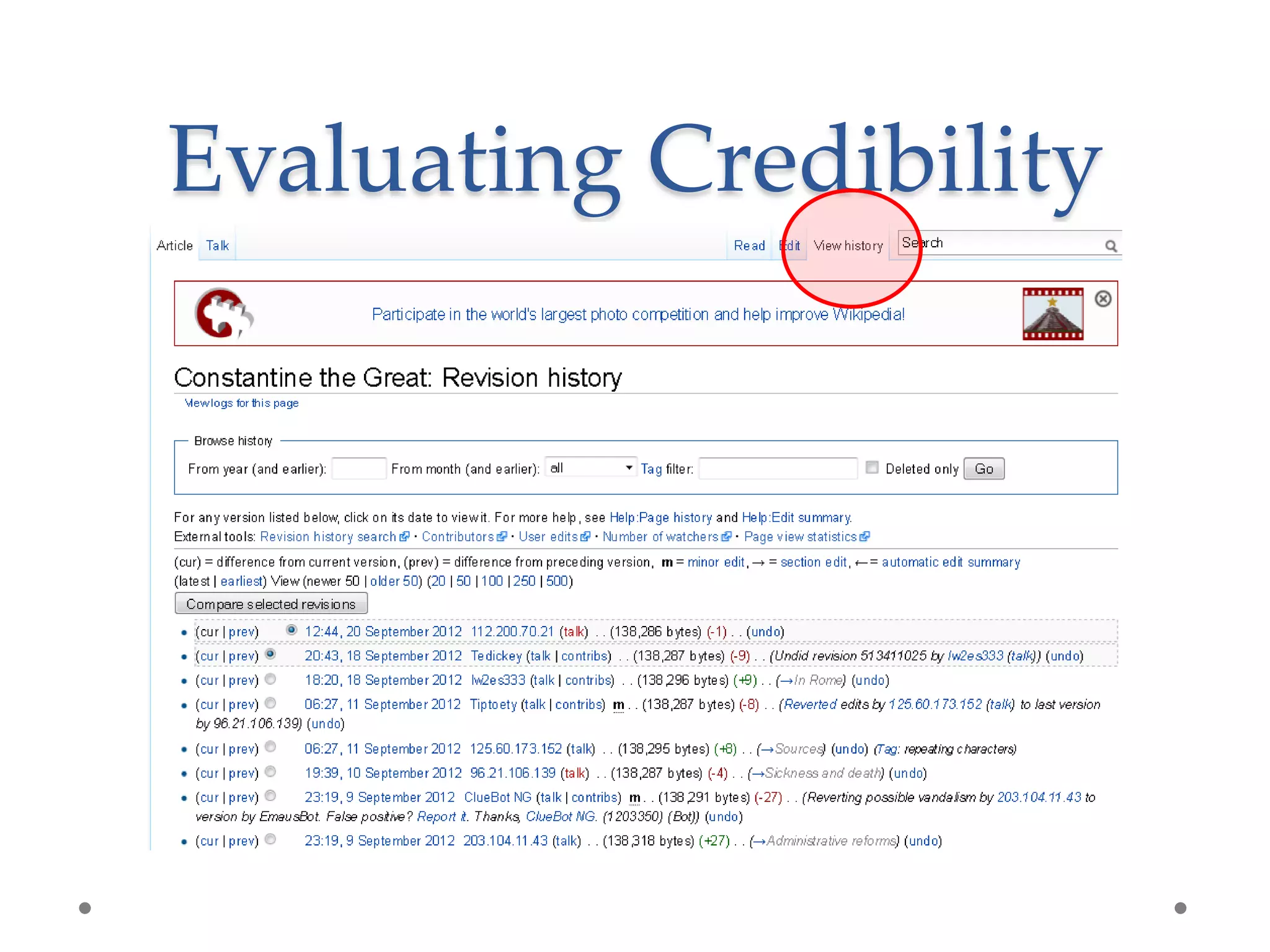
• Edit History
• Controversial topics (some you wouldn‟t
  expect!)
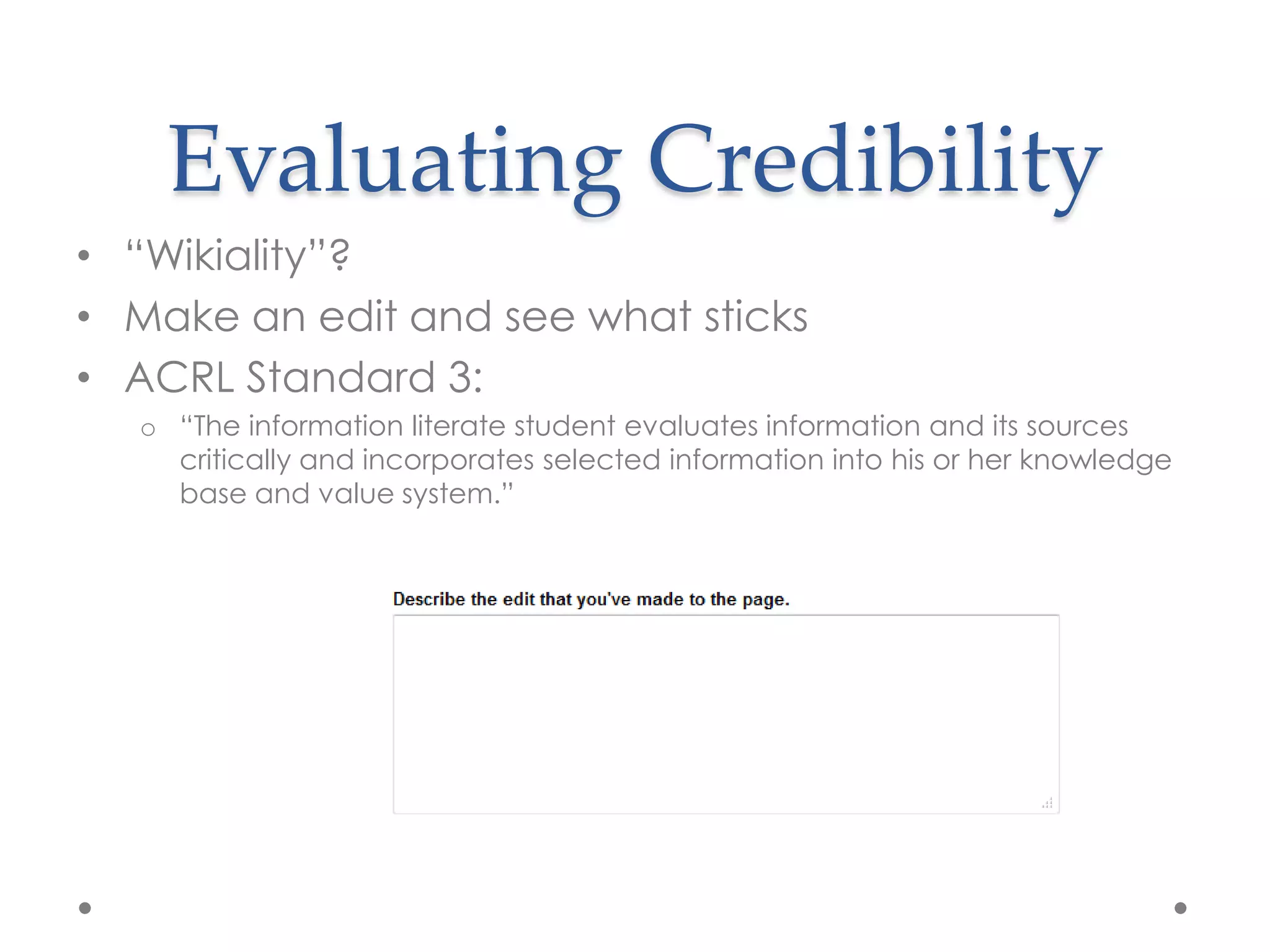
Evaluating Credibility
• “Wikiality”?
• Make an edit and see what sticks
• ACRL Standard 3:
  o “The information literate student evaluates information and its sources
    critically and incorporates selected information into his or her knowledge
    base and value system.”
Citations/References/
    Bibliography
Citations/References/
         Bibliography
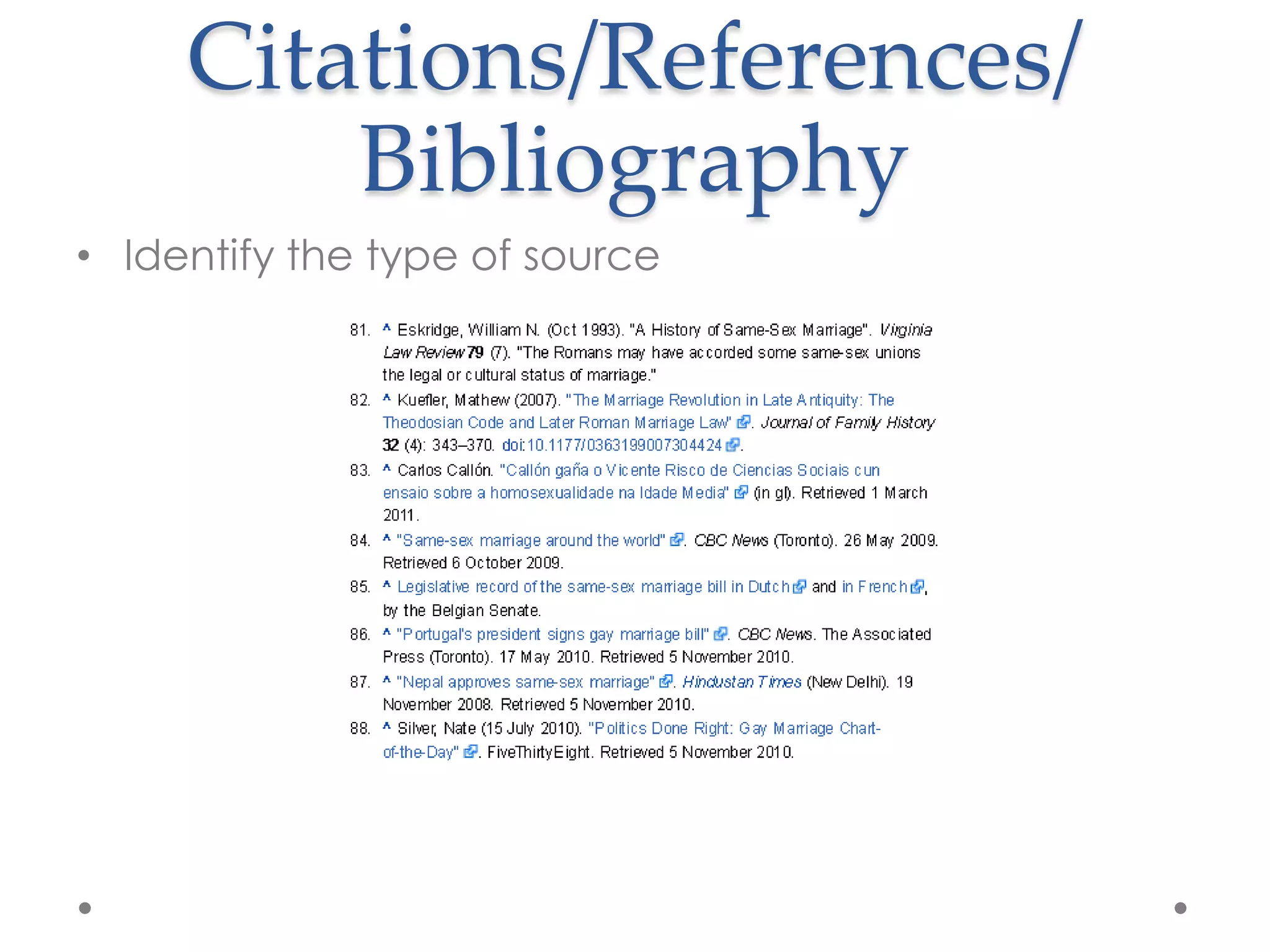
• Identify the type of source
Citations/References/
          Bibliography
• Follow linked sources
• Explain how to find non-linked sources
• ACRL Standard 2:
   o “The information literate student accesses needed information effectively
     and efficiently.”
Citations/References/
         Bibliography
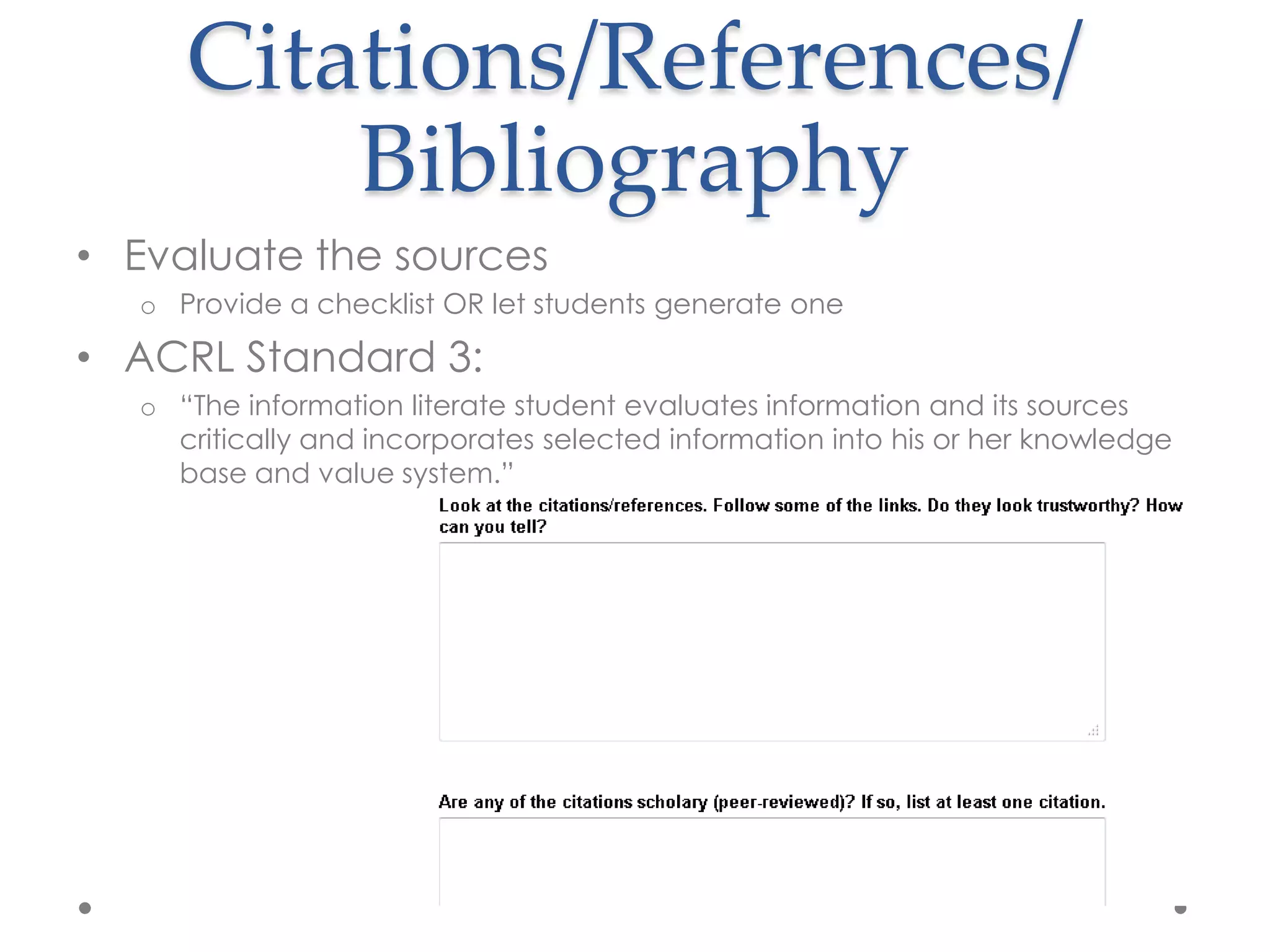
• Evaluate the sources
  o Provide a checklist OR let students generate one

• ACRL Standard 3:
  o “The information literate student evaluates information and its sources
    critically and incorporates selected information into his or her knowledge
    base and value system.”
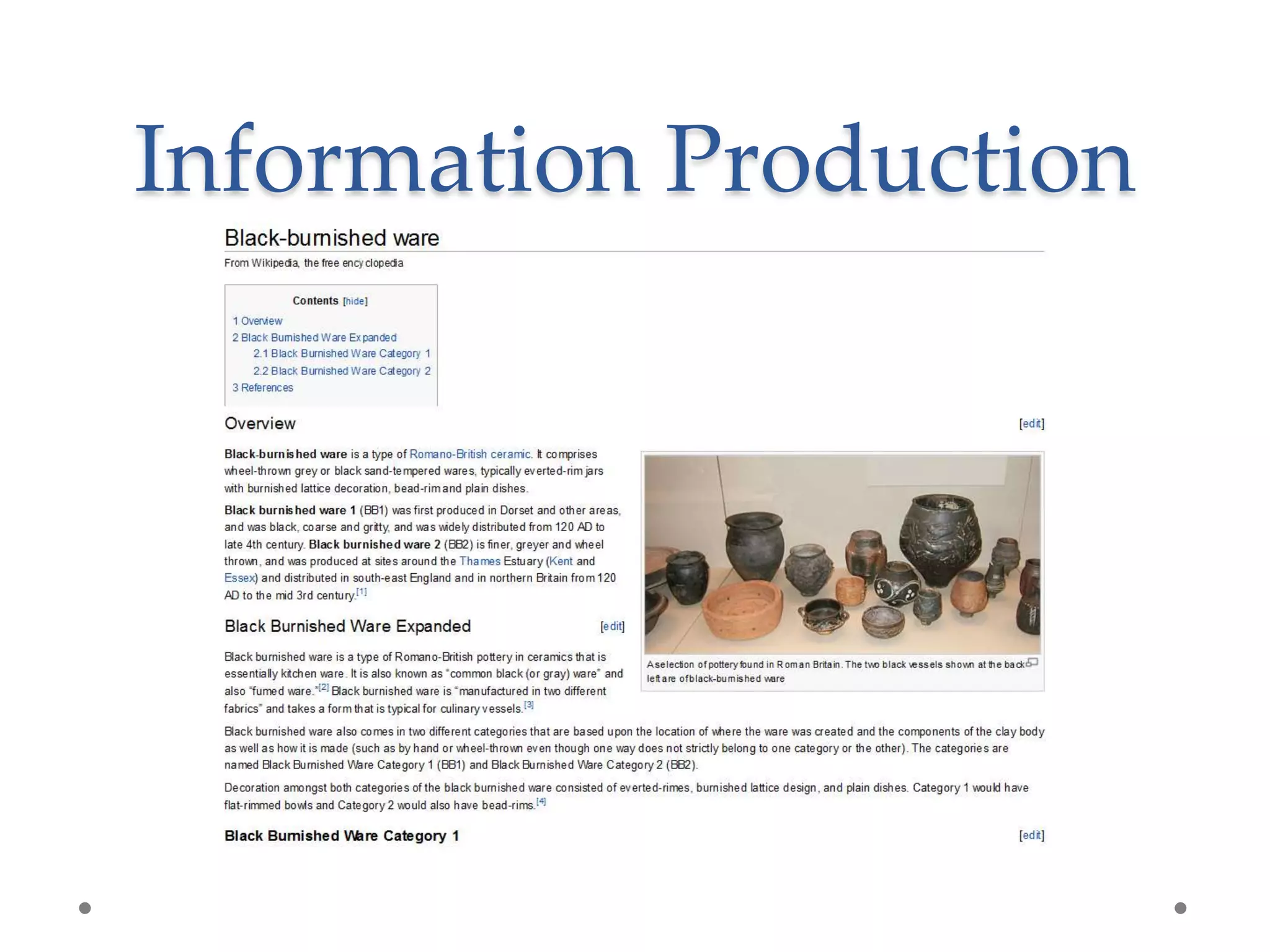
Information Production
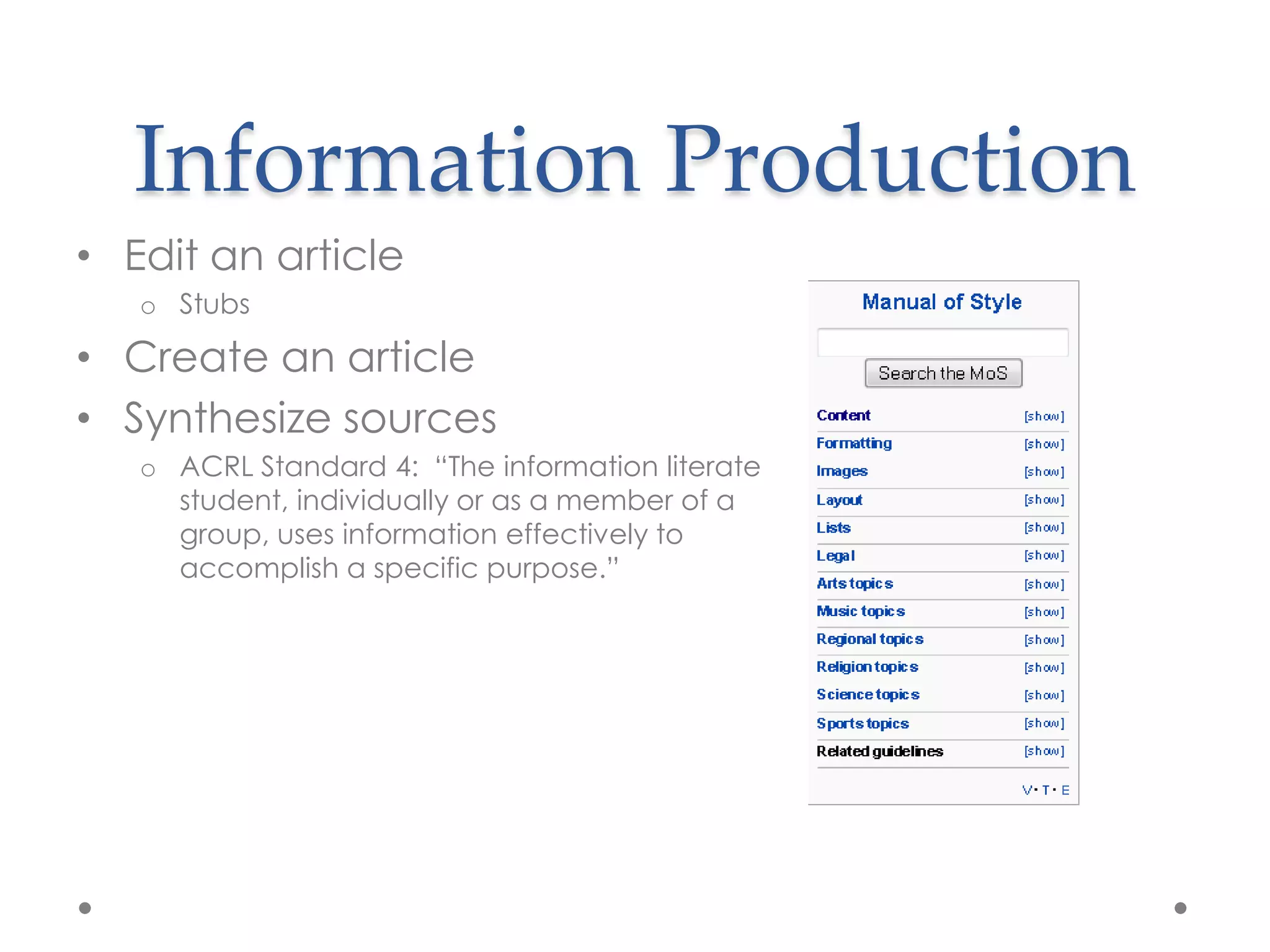
• Edit an article
   o Stubs

• Create an article
• Synthesize sources
   o ACRL Standard 4: “The information literate
     student, individually or as a member of a
     group, uses information effectively to
     accomplish a specific purpose.”
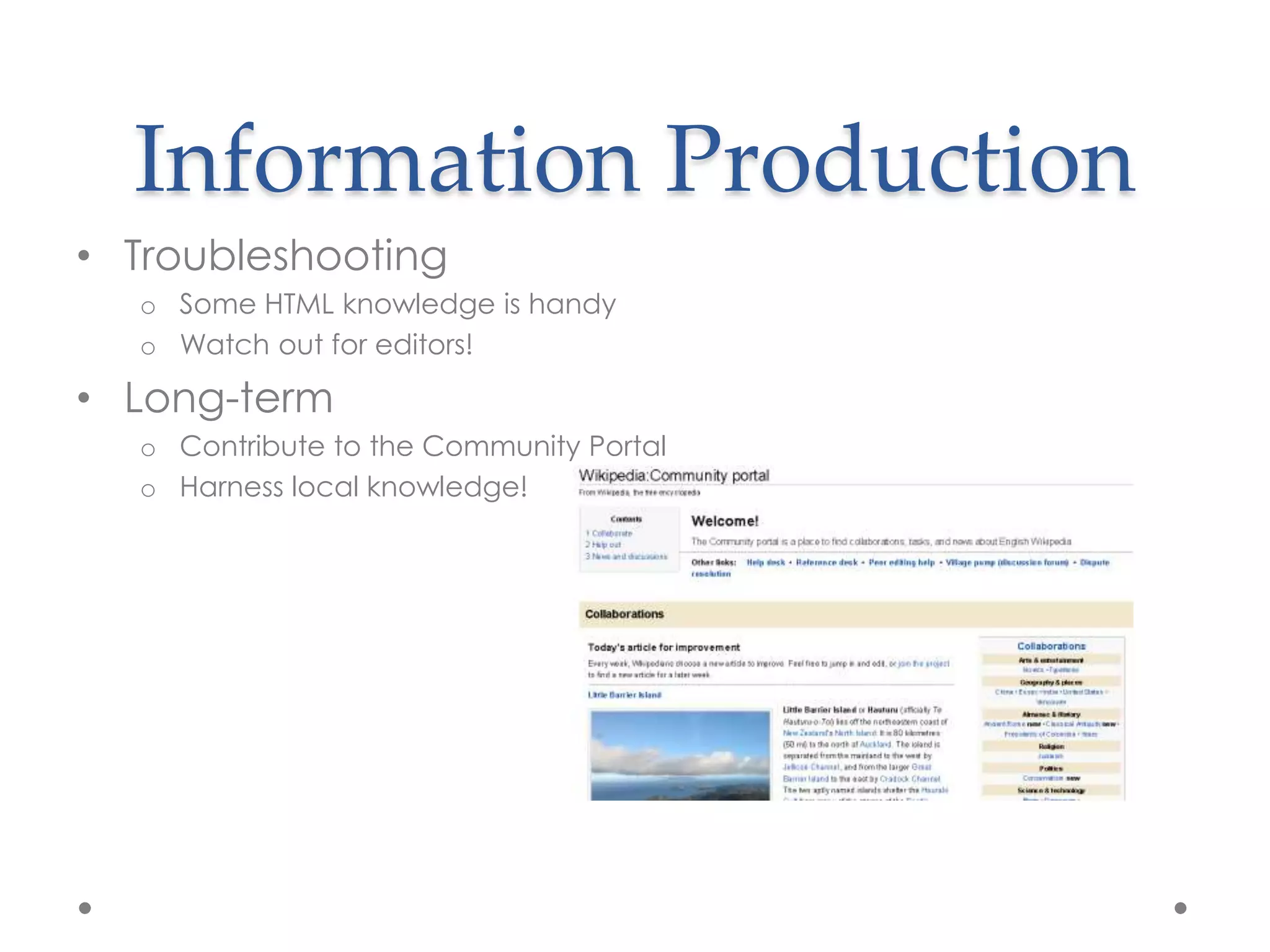
Information Production
• Troubleshooting
  o Some HTML knowledge is handy
  o Watch out for editors!

• Long-term
  o Contribute to the Community Portal
  o Harness local knowledge!
Further Reading
• Baker, Sarah. “A Place for Wikipedia or Putting
  Wikipedia in its Place.” New Horizons for Learning.
  Winter (2012): n.p. Web. 21 September 2012.
• Head, Alison & Eisenberg, Michael. “How Today‟s
  College Students Use Wikipedia for Course-Related
  Research.” First Monday 15.3 (2010): n.p. Web. 21
  September 2012.
• Jennings, Eric. 2008. “Using Wikipedia to Teach
  Information Literacy.” College & Undergraduate
  Libraries. 15(4):432-437. Print.
Further Reading
• Kraft, Michelle. “College Students Use of Wikipedia
  for Course Related Research”. The Krafty Librarian.
  N.p. 24 March 2010. Web. 21 September 2012.
• Lorenzen, Michael. “Teaching with Wikipedia.” The
  Information Literacy Land of Confusion. N.p. 15
  February 2008. Web. 21 September 2012.
• Ludwig, Sarah. “Letting Go of Boolean Operators:
  Rethinking How Research Is Taught in Schools.”
  TechSource. ALA. 2 July 2012. Web. 21 September
  2012.
Citations
• Most controversial Wikipedia entries in 2010 (by
  number of footnotes):
  http://www.deseretnews.com/top/97/0/10-
  controversial-Wikipedia-topics.html
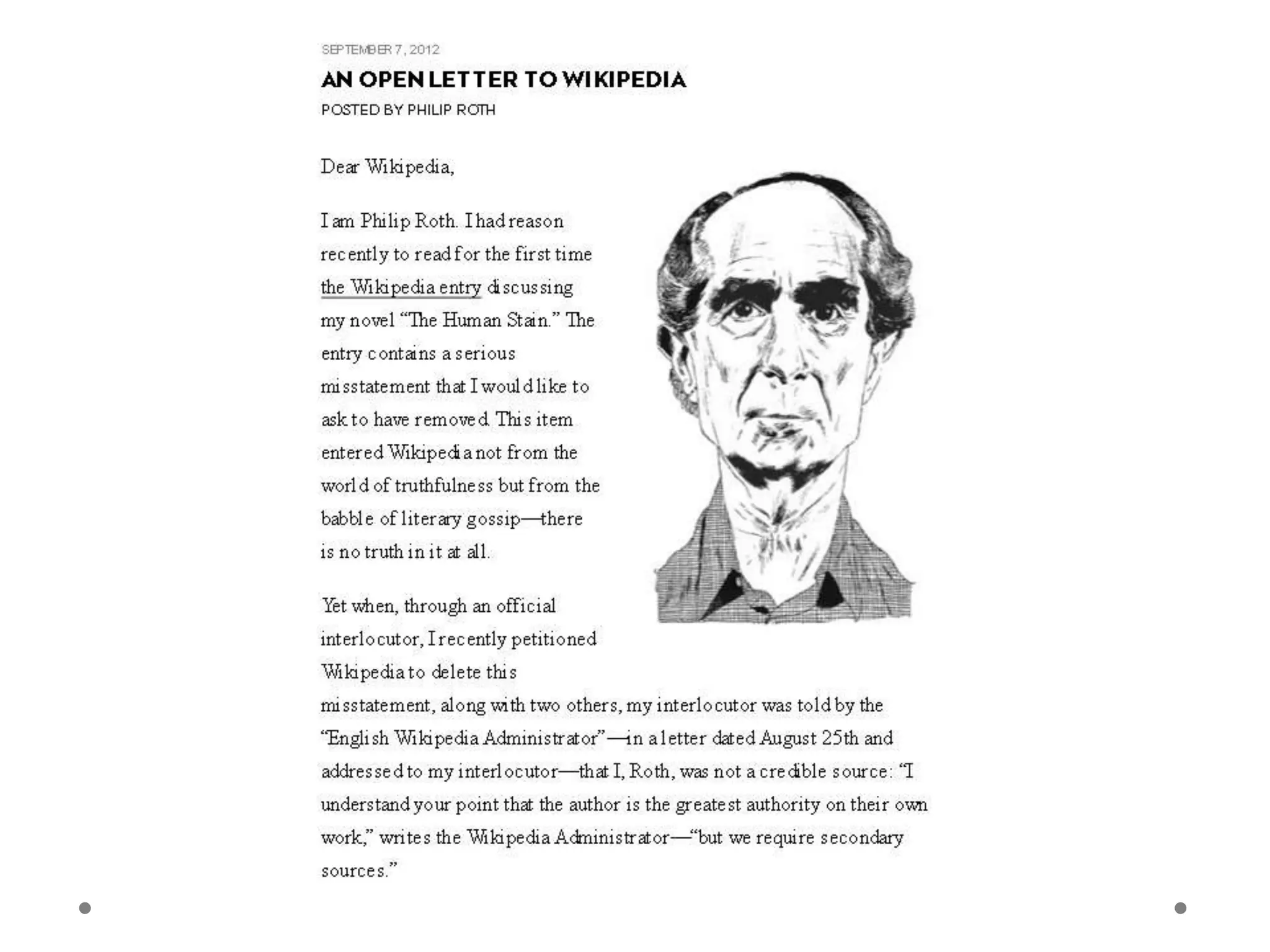
• An Open Letter to Wikipedia by Philip Roth:
  http://www.newyorker.com/online/blogs/books/201
  2/09/an-open-letter-to-
  wikipedia.html#ixzz25nx4uGsB
• Head & Eisenberg‟s study of how college students
  seek info:
  http://projectinfolit.org/pdfs/PIL_Fall2009_Year1Rep
  ort_12_2009.pdf
Citations
• List of most popular websites by Alexa:
  http://www.alexa.com/topsites
• Student reaction to SOPA blackout by Tsukuyama:
  http://www.washingtonpost.com/business/technolo
  gy/no-wiki-sopa-blackout-has-students-hitting-the-
  panic-button/2012/01/18/gIQAlS4Z8P_story.html
• ACRL‟s Information Literacy Competency Standards
  for Higher Education:
  http://www.ala.org/acrl/standards/informationlitera
  cycompetency
Wikipedia
• Helpful Wikipedia Links
   o Manual of style: http://en.wikipedia.org/wiki/Wikipedia:Manual_of_Style
   o Information on stubs: http://en.wikipedia.org/wiki/Wikipedia:Stub
   o Community portal:
     http://en.wikipedia.org/wiki/Wikipedia:Community_portal
Image credits
• 4eleven images @ Flickr
• Ben Oh @ Flickr
• Auntie P @ Flickr
Questions?

Slideshare: The Website-Which-Must-Not-Be-Named: Using
Wikipedia to Teach Information Literacy

idatig@mbc.edu

The Website-Which-Must-Not-Be-Named: Using Wikipedia to Teach Information Literacy

  • 1.
    The Website-Which- Must-Not-Be-Named: UsingWikipedia to Teach Information Literacy Ilka Datig Instruction & Electronic Services Librarian Mary Baldwin College
  • 2.
    What was themost controversial Wikipedia entry in 2010, according to number of footnotes?
  • 4.
    Organization • Introduction o Why we should use Wikipedia • Examples of classroom activities o Background information/brainstorming a topic o Evaluating credibility o Citations/References/Bibliography o Information production • Further reading • Q&A
  • 5.
    Why are weso scared?
  • 6.
    Ubiquity • 6th mostpopular website in 2011 (Alexa) • Project Information Literacy: o 84% use for information-gathering for course- related research (Head & Eisenberg, 2009) • SOPA Blackout o “Oh. My. God. As soon as I need wikipedia for homework, it suddenly is „shut down‟. I HATE YOU WIKIPEDIA” (Tsukayama, 2012)
  • 7.
    Class activities • Myexperience: one-credit Information Literacy courses • One-shot sessions – I‟d love to hear your advice!
  • 8.
    Using W tofind background information
  • 9.
    Using W tofind background information • Find and examine a page • Find and examine an entry from a published reference source (we use Credo Reference) • Compare!
  • 10.
    Using W tofind background information • “This article differs from the wiki article in that 1.) there is significantly more information offered on the subject and consequently 2.) many more references which makes the information much more credible” • “In this article, there were more detailed graphs and back-up information to support the topic.” • “This article differed from the wiki document in that it had empirical data, and a longer list of references. Wikipedia was more appealing to the reader's eye, e.g. there were colorful pictures of generated structures of different biomolecules.”
  • 11.
    Using W tofind background information • Concept Map • Create a list of keywords
  • 12.
    Using W tofind background information • ACRL Standard One o “The information literate student determines the nature and extent of the information needed” (ACRL, 2000) • „Summarizations and not actual research‟ (Jennings, 2008, p. 435)
  • 13.
  • 14.
    Evaluating Credibility • EditHistory • Controversial topics (some you wouldn‟t expect!)
  • 15.
  • 16.
  • 17.
  • 18.
    Evaluating Credibility • “Wikiality”? •Make an edit and see what sticks • ACRL Standard 3: o “The information literate student evaluates information and its sources critically and incorporates selected information into his or her knowledge base and value system.”
  • 19.
  • 20.
    Citations/References/ Bibliography • Identify the type of source
  • 21.
    Citations/References/ Bibliography • Follow linked sources • Explain how to find non-linked sources • ACRL Standard 2: o “The information literate student accesses needed information effectively and efficiently.”
  • 22.
    Citations/References/ Bibliography • Evaluate the sources o Provide a checklist OR let students generate one • ACRL Standard 3: o “The information literate student evaluates information and its sources critically and incorporates selected information into his or her knowledge base and value system.”
  • 23.
  • 24.
    Information Production • Editan article o Stubs • Create an article • Synthesize sources o ACRL Standard 4: “The information literate student, individually or as a member of a group, uses information effectively to accomplish a specific purpose.”
  • 25.
    Information Production • Troubleshooting o Some HTML knowledge is handy o Watch out for editors! • Long-term o Contribute to the Community Portal o Harness local knowledge!
  • 26.
    Further Reading • Baker,Sarah. “A Place for Wikipedia or Putting Wikipedia in its Place.” New Horizons for Learning. Winter (2012): n.p. Web. 21 September 2012. • Head, Alison & Eisenberg, Michael. “How Today‟s College Students Use Wikipedia for Course-Related Research.” First Monday 15.3 (2010): n.p. Web. 21 September 2012. • Jennings, Eric. 2008. “Using Wikipedia to Teach Information Literacy.” College & Undergraduate Libraries. 15(4):432-437. Print.
  • 27.
    Further Reading • Kraft,Michelle. “College Students Use of Wikipedia for Course Related Research”. The Krafty Librarian. N.p. 24 March 2010. Web. 21 September 2012. • Lorenzen, Michael. “Teaching with Wikipedia.” The Information Literacy Land of Confusion. N.p. 15 February 2008. Web. 21 September 2012. • Ludwig, Sarah. “Letting Go of Boolean Operators: Rethinking How Research Is Taught in Schools.” TechSource. ALA. 2 July 2012. Web. 21 September 2012.
  • 28.
    Citations • Most controversialWikipedia entries in 2010 (by number of footnotes): http://www.deseretnews.com/top/97/0/10- controversial-Wikipedia-topics.html • An Open Letter to Wikipedia by Philip Roth: http://www.newyorker.com/online/blogs/books/201 2/09/an-open-letter-to- wikipedia.html#ixzz25nx4uGsB • Head & Eisenberg‟s study of how college students seek info: http://projectinfolit.org/pdfs/PIL_Fall2009_Year1Rep ort_12_2009.pdf
  • 29.
    Citations • List ofmost popular websites by Alexa: http://www.alexa.com/topsites • Student reaction to SOPA blackout by Tsukuyama: http://www.washingtonpost.com/business/technolo gy/no-wiki-sopa-blackout-has-students-hitting-the- panic-button/2012/01/18/gIQAlS4Z8P_story.html • ACRL‟s Information Literacy Competency Standards for Higher Education: http://www.ala.org/acrl/standards/informationlitera cycompetency
  • 30.
    Wikipedia • Helpful WikipediaLinks o Manual of style: http://en.wikipedia.org/wiki/Wikipedia:Manual_of_Style o Information on stubs: http://en.wikipedia.org/wiki/Wikipedia:Stub o Community portal: http://en.wikipedia.org/wiki/Wikipedia:Community_portal
  • 31.
    Image credits • 4elevenimages @ Flickr • Ben Oh @ Flickr • Auntie P @ Flickr
  • 32.
    Questions? Slideshare: The Website-Which-Must-Not-Be-Named:Using Wikipedia to Teach Information Literacy idatig@mbc.edu

Editor's Notes

  • #18 Going to be different depending on subject.