[citation needed]
INFORMATION LITERACY
LESSONS
IN WIKIPEDIA
P R U M I T C H E L L
Australian School Library
Association Inc.
Presenter
• ASLA member
• Manager Information Services, Australian Council
for Educational Research
• 2006 ‘Wikis in education’ in
Wikis: tools for information work & collaboration
• 2007 education.au Jimmy Wales visit
• 2008 Wikimedia Australia inauguration
• 2009 GLAM Wiki conference
• 2013 Committee Wikimedia Australia
• 2014 Wikimedia Future of Education
• 2014 ALIA Wikipedia and Libraries
Pru Mitchell
Session overview
1. Why Wikipedia and school libraries?
www.surveymonkey.com/s/WPLibraries
2. How does Wikipedia work?
3. Information literacy lessons in Wikipedia
Using Wikipedia as a source
1. I have followed a link to Wikipedia
2. I have read a Wikipedia article to find
information
3. I know at least 3 ways to evaluate a
Wikipedia article
Editing Wikipedia
4. I have edited something in Wikipedia
5. I have edited a reference in Wikipedia
6. I have a Wikipedia username
7. I have created a new Wikipedia article
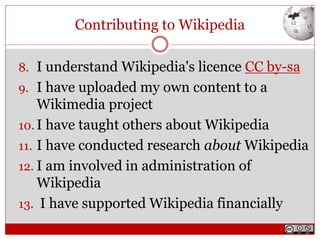
Contributing to Wikipedia
8. I understand Wikipedia's licence CC by-sa
9. I have uploaded my own content to a
Wikimedia project
10. I have taught others about Wikipedia
11. I have conducted research about Wikipedia
12. I am involved in administration of
Wikipedia
13. I have supported Wikipedia financially
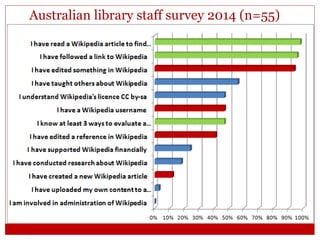
Australian library staff survey 2014 (n=55)
Why teach about Wikipedia?
 It’s where your students
are going
#7 site rank globally
 It is free to access, free to
copy [with attribution]
 It’s not for profit and all
about sharing knowledge
 Wikipedia is different
from other sources
 Does CRAP test apply?
School librarians transform learning 2014 AASL
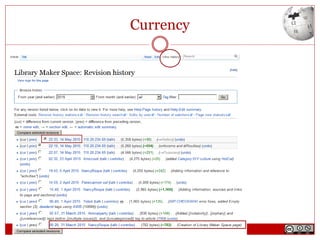
Currency
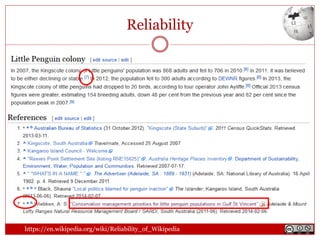
Reliability
https://en.wikipedia.org/wiki/Reliability_of_Wikipedia
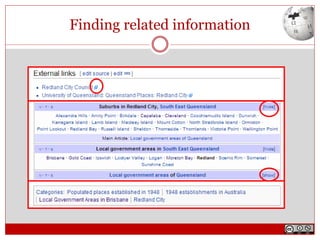
Finding related information
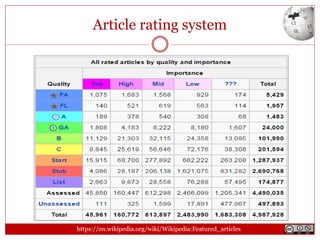
Article rating system
https://en.wikipedia.org/wiki/Wikipedia:Featured_articles
Authority
 Anonymous editors
• are not registered
• first-time /
occasional editors 
or vandals 
 New editors
• registered but not yet
trusted
 Trusted editors
• 4 days and 10 “good”
edits to establish
trust
 Administrators and
bureaucrats
 Bots
 No paid editors
Who can edit Wikipedia?
Anyone
[View history] to see more
https://en.wikipedia.org/wiki/Wikipedia:Why_create_an_account
User name
User’s edits
Talk to /about this user
User’s role
Username created
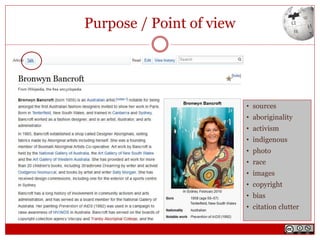
Purpose / Point of view
• sources
• aboriginality
• activism
• indigenous
• photo
• race
• images
• copyright
• bias
• citation clutter
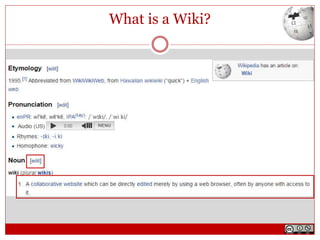
What is a Wiki?
What is Wikipedia?
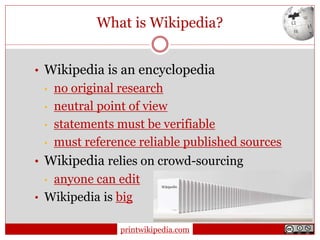
• Wikipedia is an encyclopedia
• no original research
• neutral point of view
• statements must be verifiable
• must reference reliable published sources
• Wikipedia relies on crowd-sourcing
• anyone can edit
• Wikipedia is big
printwikipedia.com
Wikipedia’s five pillars
Imagine a world in which
every single human being
can freely share in the sum of all knowledge
Neutrality - Verifiability – Consensus
Civility - Openness
http://en.wikipedia.org/wiki/Wikipedia:Five_pillars
Evaluating a Wikipedia article
1. Is the length and structure of article an
indication of the importance of this subject?
2. Click on edit history activity: when was the
last edit?
3. Talk page checked for debates: what are the
issues in this article?
4. Check the references [or lack of]
 Are all claims referenced (especially if controversial )?
 What is the quality of the sources?
 How relevant are the sources?
https://upload.wikimedia.org/wikipedia/commons/9/96/Evaluating_Wikipedia_brochure_%28Wiki_Education_Foundation%29.pdf
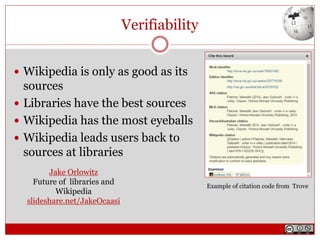
Verifiability
 Wikipedia is only as good as its
sources
 Libraries have the best sources
 Wikipedia has the most eyeballs
 Wikipedia leads users back to
sources at libraries
Jake Orlowitz
Future of libraries and
Wikipedia
slideshare.net/JakeOcaasi
Example of citation code from Trove
How safe is Wikipedia?
 Yes, there’s vandalism and spam, but …
 Every edit is recorded, all old versions are saved and can be
easily restored after vandalism
 Abuse Filter – automated tool for preventing common
patterns of abuse
 Recent Change Patrol – people who monitor recent
edits across all topics for obvious vandalism
 Watchers – people who monitor pages of interest to them
– monitor for subtle vandalism
 “The beast of one billion eyes” – readers want
Wikipedia to be right not wrong
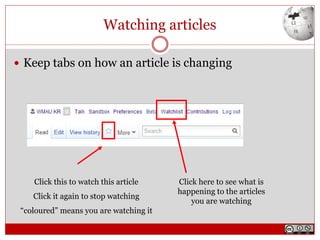
Watching articles
 Keep tabs on how an article is changing
Click this to watch this article
Click it again to stop watching
“coloured” means you are watching it
Click here to see what is
happening to the articles
you are watching
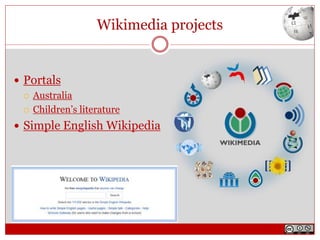
Wikimedia projects
 Portals
 Australia
 Children’s literature
 Simple English Wikipedia
People and organisations
 Cannot use their own website or publications as proof
of notability, nor material that uncritically repeats their
PR
 Can use reviews by independent people about them,
independent newspaper reports, library books, etc
 It is still OK to cite their publications in the article, but
not sufficient alone to prove notability
 An officially gazetted town, suburb, bounded locality is
notable
 Wikipedia Biographies of living persons policy
Teaching with Wikipedia
• Engaged students, global audience, real world purpose
• Unique assignment, peer feedback, cool and different
• Media literacy, identify bias, evaluate credibility
• Constructing knowledge, content gaps
• Discourse, collaboration, community of practice
• Expository writing, literature review, citation
• Critical thinking, process reflection
• Plagiarism, close paraphrasing, copyright
• Digital citizenship, online etiquette, wiki code
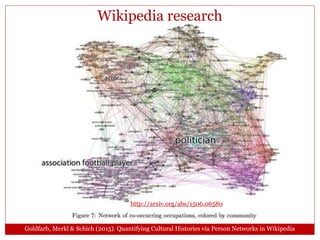
http://arxiv.org/abs/1506.06580
Wikipedia research
Goldfarb, Merkl & Schich (2015). Quantifying Cultural Histories via Person Networks in Wikipedia
Wikimedia Australia
 Volunteers
 We’re here to help …
 Advice on using Wikipedia (or other projects)
 Wikipedia edit training
 Groups or one-on-one
 Donations welcome

Citation needed: Information literacy lessons from Wikipedia

  • 1.
    [citation needed] INFORMATION LITERACY LESSONS INWIKIPEDIA P R U M I T C H E L L Australian School Library Association Inc.
  • 2.
    Presenter • ASLA member •Manager Information Services, Australian Council for Educational Research • 2006 ‘Wikis in education’ in Wikis: tools for information work & collaboration • 2007 education.au Jimmy Wales visit • 2008 Wikimedia Australia inauguration • 2009 GLAM Wiki conference • 2013 Committee Wikimedia Australia • 2014 Wikimedia Future of Education • 2014 ALIA Wikipedia and Libraries Pru Mitchell
  • 3.
    Session overview 1. WhyWikipedia and school libraries? www.surveymonkey.com/s/WPLibraries 2. How does Wikipedia work? 3. Information literacy lessons in Wikipedia
  • 4.
    Using Wikipedia asa source 1. I have followed a link to Wikipedia 2. I have read a Wikipedia article to find information 3. I know at least 3 ways to evaluate a Wikipedia article
  • 5.
    Editing Wikipedia 4. Ihave edited something in Wikipedia 5. I have edited a reference in Wikipedia 6. I have a Wikipedia username 7. I have created a new Wikipedia article
  • 6.
    Contributing to Wikipedia 8.I understand Wikipedia's licence CC by-sa 9. I have uploaded my own content to a Wikimedia project 10. I have taught others about Wikipedia 11. I have conducted research about Wikipedia 12. I am involved in administration of Wikipedia 13. I have supported Wikipedia financially
  • 7.
    Australian library staffsurvey 2014 (n=55)
  • 8.
    Why teach aboutWikipedia?  It’s where your students are going #7 site rank globally  It is free to access, free to copy [with attribution]  It’s not for profit and all about sharing knowledge  Wikipedia is different from other sources  Does CRAP test apply? School librarians transform learning 2014 AASL
  • 9.
  • 10.
  • 11.
  • 12.
  • 13.
    Authority  Anonymous editors •are not registered • first-time / occasional editors  or vandals   New editors • registered but not yet trusted  Trusted editors • 4 days and 10 “good” edits to establish trust  Administrators and bureaucrats  Bots  No paid editors Who can edit Wikipedia? Anyone [View history] to see more https://en.wikipedia.org/wiki/Wikipedia:Why_create_an_account User name User’s edits Talk to /about this user User’s role Username created
  • 14.
    Purpose / Pointof view • sources • aboriginality • activism • indigenous • photo • race • images • copyright • bias • citation clutter
  • 15.
    What is aWiki?
  • 16.
    What is Wikipedia? •Wikipedia is an encyclopedia • no original research • neutral point of view • statements must be verifiable • must reference reliable published sources • Wikipedia relies on crowd-sourcing • anyone can edit • Wikipedia is big printwikipedia.com
  • 17.
    Wikipedia’s five pillars Imaginea world in which every single human being can freely share in the sum of all knowledge Neutrality - Verifiability – Consensus Civility - Openness http://en.wikipedia.org/wiki/Wikipedia:Five_pillars
  • 18.
    Evaluating a Wikipediaarticle 1. Is the length and structure of article an indication of the importance of this subject? 2. Click on edit history activity: when was the last edit? 3. Talk page checked for debates: what are the issues in this article? 4. Check the references [or lack of]  Are all claims referenced (especially if controversial )?  What is the quality of the sources?  How relevant are the sources? https://upload.wikimedia.org/wikipedia/commons/9/96/Evaluating_Wikipedia_brochure_%28Wiki_Education_Foundation%29.pdf
  • 19.
    Verifiability  Wikipedia isonly as good as its sources  Libraries have the best sources  Wikipedia has the most eyeballs  Wikipedia leads users back to sources at libraries Jake Orlowitz Future of libraries and Wikipedia slideshare.net/JakeOcaasi Example of citation code from Trove
  • 20.
    How safe isWikipedia?  Yes, there’s vandalism and spam, but …  Every edit is recorded, all old versions are saved and can be easily restored after vandalism  Abuse Filter – automated tool for preventing common patterns of abuse  Recent Change Patrol – people who monitor recent edits across all topics for obvious vandalism  Watchers – people who monitor pages of interest to them – monitor for subtle vandalism  “The beast of one billion eyes” – readers want Wikipedia to be right not wrong
  • 21.
    Watching articles  Keeptabs on how an article is changing Click this to watch this article Click it again to stop watching “coloured” means you are watching it Click here to see what is happening to the articles you are watching
  • 22.
    Wikimedia projects  Portals Australia  Children’s literature  Simple English Wikipedia
  • 23.
    People and organisations Cannot use their own website or publications as proof of notability, nor material that uncritically repeats their PR  Can use reviews by independent people about them, independent newspaper reports, library books, etc  It is still OK to cite their publications in the article, but not sufficient alone to prove notability  An officially gazetted town, suburb, bounded locality is notable  Wikipedia Biographies of living persons policy
  • 24.
    Teaching with Wikipedia •Engaged students, global audience, real world purpose • Unique assignment, peer feedback, cool and different • Media literacy, identify bias, evaluate credibility • Constructing knowledge, content gaps • Discourse, collaboration, community of practice • Expository writing, literature review, citation • Critical thinking, process reflection • Plagiarism, close paraphrasing, copyright • Digital citizenship, online etiquette, wiki code
  • 25.
    http://arxiv.org/abs/1506.06580 Wikipedia research Goldfarb, Merkl& Schich (2015). Quantifying Cultural Histories via Person Networks in Wikipedia
  • 26.
    Wikimedia Australia  Volunteers We’re here to help …  Advice on using Wikipedia (or other projects)  Wikipedia edit training  Groups or one-on-one  Donations welcome

Editor's Notes

  • #2 Can you imagine a world in which every single person on the planet is given free access to the sum of all human knowledge? Every day Wikipedia’s audacious vision comes closer to reality, as humans (and other information services) exploit this top-ranking information source. This session is an opportunity for educators to learn about how Wikipedia works to realise its position as a ‘neutral compilation of verifiable, established facts.’ Participants will consider what information literacy education looks like in 2015, and how Wikipedia projects provide a way to move from a consumer to creator culture of learning.
  • #4 .
  • #5 In a thing as huge as Wikipedia there are many ways people experience the beast. The survey has a checklist of some ways people engage with Wikipedia, and it would help to know which of these boxes each of you ticks. * Unless you have actively resisted, I suspect most of you have been led to Wikipedia from somewhere online at some point. It is pretty hard to avoid this. It ranks highly in search engines. * By far the majority of people who use Wikipedia use it as an information source. It provides an overview or introduction to practically any topic. We hope that all users of any information source have the information literacy skills to evaluate that source, and this forms a key part of our role as educators and librarians. Can you complete the rest of the questions on this checklist, and then identify at least 3 ways you would evaluate an article in Wikipedia. https://www.surveymonkey.com/s/WPLibraries
  • #6 Editing Wikipedia is something anyone can do, and something we would love everyone to be part of. It would be wonderful if every time you benefited from useful information in Wikipedia you resolved to contribute an edit that will enhance the encyclopaedia for another. This session is not an editing workshop – happy to do that for you another time.
  • #7 There are other ways that you can contribute to Wikipedia, and we will consider some of these later on. A big thanks to any of you or your institutions that do contribute content, education or research – and to those who donate to keep the Wikipedia servers running.
  • #8 These are results from information sessions around Australia run by ALIA last year. It shows lots more people had edited something perhaps than we have seen tonight, although only half of those had edited a reference in Wikipedia. As I said, we are not looking at editing tonight but if you or your students are going to edit there are many reasons why it is good to sign up and get yourself a Wikipedia username rather than editing anonymously – especially from within your school network. Something that is of some concern is that some who are teaching others about Wikipedia do not know three ways to evaluate a Wikipedia article. We hope to address that tonight.
  • #9 Discoverability: Wikipedia articles are in the top search results from most search engines, and serves as the infobox in Google search results screen Ranked #7 [June 2015] in Alexa http://www.alexa.com/topsites Free to access, free to copy, – more so, than copyrighted content which has restrictions on distribution and re-publishing The image on this slide from School Librarians Transform Learning illustrates “Sources students are ‘very likely’ to use in a research assignment [from the results of the Pew Internet report: Purcell, K et al (2012). How teens do research in the digital world. Pew Internet http://www.pewinternet.org/2012/11/01/how-teens-do-research-in-the-digital-world http://www.ala.org/aasl/sites/ala.org.aasl/files/content/aaslissues/advocacy/AASL_Infographic_FINAL.pdf The AASL infographic School Librarians Transform Learning is part of the digital supplement to the Sept/Oct 2014 issue of ALA’s American Libraries magazine. Members of the media and public are permitted to repost the PDF info-graphic, provided no alterations are made and that the posting is for educational, non-commercial purposes only. [www.ala.org/aasl/digitalsupplement] ©2014 American Association of School Librarians. All rights reserved. Infographic based on: Purcell, K et al (2012). How teens do research in the digital world. Pew Internet http://www.pewinternet.org/2012/11/01/how-teens-do-research-in-the-digital-world
  • #11 Check the references.
  • #13 Can be corrected: errors fixed quickly when found: “Many eyeballs make all bugs shallow” From the bottom: List: Great for teaching Stub: Short article, no major content. Start: Some content, not enough references, needs a lot of expansion. C and B class: Better articles, still need work. Good Article: Peer reviewed. Could do with refinement, but good writing, coverage and sourcing. A class: Excellent article. Normally peer reviewed. Featured List: Featured Article: The best Wikipedia has to offer. Extensive peer review. Criteria for Featured article
  • #14 Contributors to Wikipedia can remain anonymous. This raises concerns: Do they have the experience to write the claims they are adding? Do they have the judgment to act as administrators? Are they neutral commentators, or do they have a conflict of interest? Paid editors not welcome Evaluating editors Who made the change? How long has the change been in the article? How many edits do they have? Do they normally work in this area? What do they say about themselves? Do they have any warnings? Are they blocked? https://en.wikipedia.org/w/index.php?title=Kingscote,_South_Australia&action=history
  • #15 https://en.wikipedia.org/wiki/Talk:Bronwyn_Bancroft
  • #16 A collaborative website which wiki is a web page that anyone can make changes to The version you see can be changed at any time, by any person, without any tools other than a web browser. This means that each Wikipedia page is in a constant state of change as different people make contributions. Not the [edit] option everywhere.
  • #17 Wikipedia is not a primary source, like a direct interview, or a secondary source, like an academic paper or a news story. Wikipedia is an encyclopedia. It is a collection of information from primary and secondary sources, assembled into articles that provide a general overview. Like other encyclopedias, Wikipedia should be used as a starting point. It can provide a broad overview of a subject and help you find high-quality primary and secondary sources. Wikipedia can help students to: • Get an overview of a subject • Get a list of recommended works about a subject • Discover related topics Wikipedia is written collaboratively by largely anonymous volunteers who write without pay. Anyone with Internet access can write and make changes to Wikipedia articles, except in limited cases where editing is restricted to prevent disruption or vandalism. Users can contribute anonymously, under a pseudonym, or, if they choose to, with their real identity. Statistics from www.slideshare.net/JakeOcaasi/wikipedia-and-libraries-increasing-your-librarys-visibility 30 million articles - 286 languages - 2 billion edits - 8000 views per second - 500 million monthly visitors - 5th most popular website [citation needed]
  • #18 Founded in 2001. Now the #1 encyclopaedia in the world We are not the first to noticed how closely Wikipedia’s mission and ideology mirror those of libraries, particularly public libraries. It is a huge commitment, and Wikipedia works actively to make it a reality for all human beings and for all knowledge. It is a useful exercise to consider how well our library networks and practices are doing in this area. It is particularly useful to consider how Wikipedia and libraries can work in partnership to realise this more effectively. Throughout this presentation there links to key Wikipedia documents and policies which we won’t necessarily have time to cover in full. These keywords: neutrality, verifiability, consensus, civility and openness sum up the statements contained in the Wikipedia Five Pillars: https://en.wikipedia.org/wiki/Wikipedia:Five_pillars.
  • #19 Evaluating Wikipedia Tracing the evolution and evaluating the quality of articles
  • #20 Wikipedia Trove provides Wikipedia citation for resources
  • #23 20 million registered editors 80,000 active users 1,400 administrators 200 employees
  • #24 http://en.wikipedia.org/wiki/Wikipedia:Biographies_of_living_persons Material about living persons added to any Wikipedia page must be written with the greatest care and attention to verifiability, neutrality, and avoiding original research.
  • #25 More motivated, interested, self-aware, thoughtful, capable researchers
  • #26 @Wikidata http://arxiv.org/abs/1506.06580  Quantifying Cultural Histories via Person Networks in Wikipedia