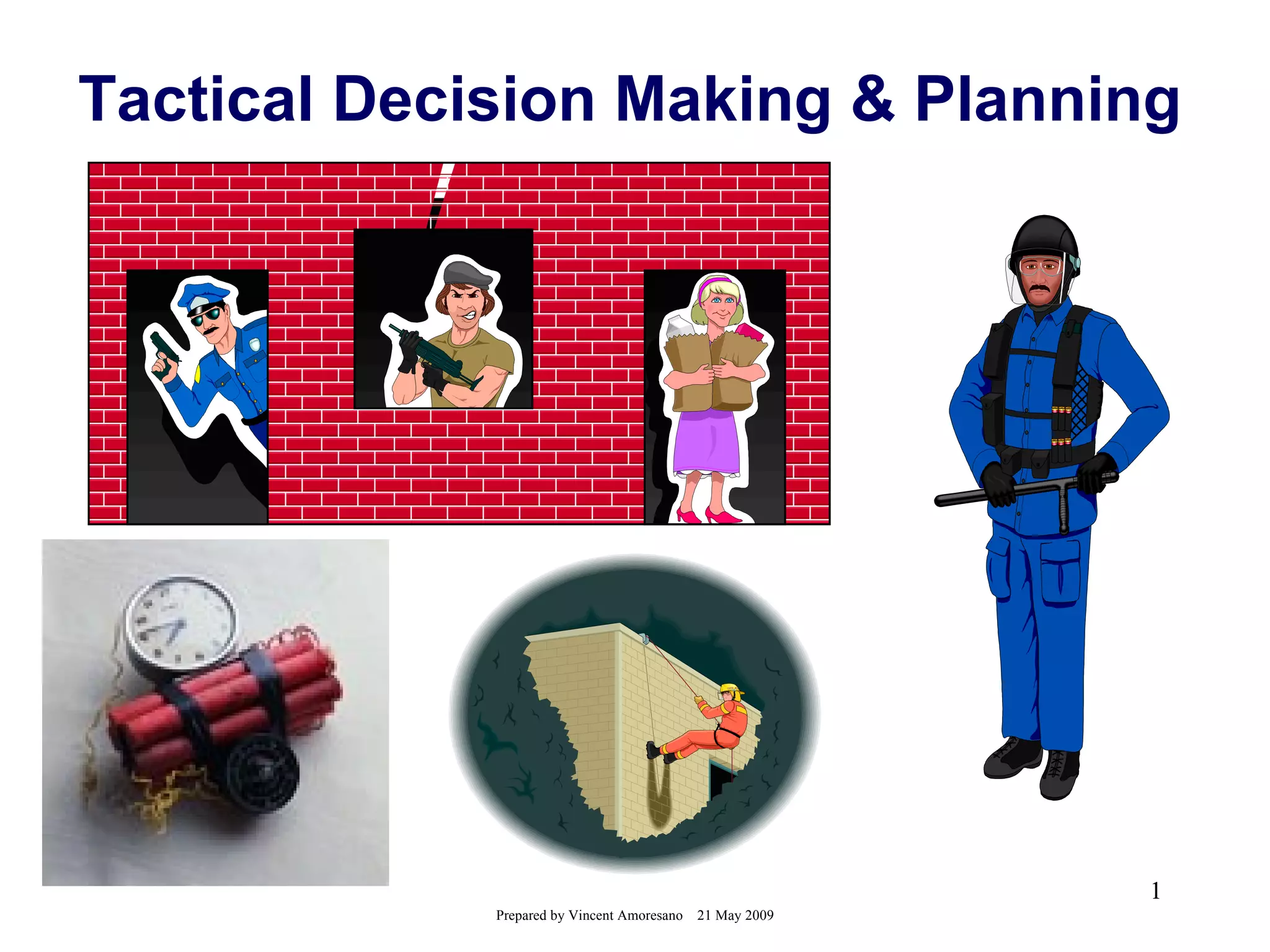
Tactical Decision Making & Planning


                                                           1
             Prepared by Vincent Amoresano   21 May 2009
Learning Objectives
 Apply the Analytical and Intuitive Decision-Making
  Models to determine an appropriate course of action

 Plan a moderately complex tactical operation using the
  eight-step Tactical Planning Procedure

 Develop a 5 paragraph Operations Order that contains
  all essential items required to control, coordinate and
  support the tactical operation


                       Prepared by Vincent Amoresano   21 May 2009
                                                                     2
Key Points for Crisis
        Leadership
Crisis often destroys communications
Crisis leaders must be technically
 competent and understand their
 subordinates
Parallel between combat and crisis
 leadership
              Prepared by Vincent Amoresano   21 May 2009
                                                            3
Major Aspects of
Crisis Leadership
    Flexibility
    Innovation
    Simplicity
   Empowerment

     Prepared by Vincent Amoresano   21 May 2009
                                                   4
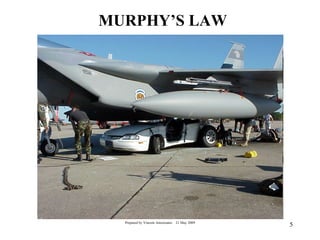
MURPHY’S LAW


  Prepared by Vincent Amoresano   21 May 2009
                                                5
Planning and Decision Making are
basic ingredients of leadership. More
than anything else, the ability to make
sound, timely decisions separates the
leader from the non-leader. It is the
responsibility of leaders to make high-
quality decisions that are accepted and
executed in a timely manner.

              Prepared by Vincent Amoresano   21 May 2009
                                                            6
Decision Making Defined

Tactical decision making is the
ability to choose which solution or
course of action would have the
best probability to accomplish
mission success.

             Prepared by Vincent Amoresano   21 May 2009
                                                           7
The decision-making process can be
generalized in two categories:

1. Analytical decision-making approach

3. Intuitive decision-making approach


              Prepared by Vincent Amoresano   21 May 2009
                                                            8
Analytical Decision Making

The analytical decision-making approach is
used to analyze a situation or problem to
determine the best solution. The leader or
team apply a systematic process to insure
effective decisions and plans.


               Prepared by Vincent Amoresano   21 May 2009
                                                             9
Analytical Decision Making
             (Benefits)
 Carefully taking a problem apart

 Collecting and testing the information required
  for the problem or task

 Conducting a comparison of the solutions or
  options

 Selecting an alternative, which should preferably
  be the best solution


                                                      10
Analytical Decision Making
           (Challenges)
•  Requires explicit instructions
•  Requires detailed analysis
•  Procedure based process
• Process oriented—can be separated
  from reality
• Requires multiple options

            Prepared by Vincent Amoresano   21 May 2009
                                                          11
Analytical Decision Making Challenges
             (continued)
• Comparison criteria are subject to
  change
• Focuses on optimal solution
• Limited opportunity for creativity
• Consumes time


             Prepared by Vincent Amoresano   21 May 2009
                                                           12
Intuitive Decision Making
Intuitive decision making is a decision-
making process that relies on experience
to recognize key elements of a particular
problem to arrive at an appropriate
decision. The goal is to determine and
implement the first solution that could
result in success


              Prepared by Vincent Amoresano   21 May 2009
                                                            13
Intuitive Decision Making
            (Benefits)
Time effective
Focuses on the first best solution
 rather than the optimal solution
Can be updated and infused with
 additional experience constantly.


             Prepared by Vincent Amoresano   21 May 2009
                                                           14
Intuitive Decision Making
          (Challenges)

• Mismatched experience
• Obsolescence
• Distortion


           Prepared by Vincent Amoresano   21 May 2009
                                                         15
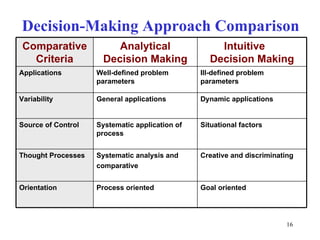
Decision-Making Approach Comparison
 Comparative            Analytical                  Intuitive
   Criteria          Decision Making              Decision Making
Applications        Well-defined problem        Ill-defined problem
                    parameters                  parameters

Variability         General applications        Dynamic applications


Source of Control   Systematic application of   Situational factors
                    process


Thought Processes   Systematic analysis and     Creative and discriminating
                    comparative


Orientation         Process oriented            Goal oriented


                                                                         16
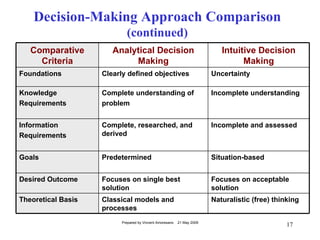
Decision-Making Approach Comparison
                           (continued)
   Comparative         Analytical Decision                                Intuitive Decision
     Criteria               Making                                              Making
Foundations         Clearly defined objectives                         Uncertainty

Knowledge           Complete understanding of                          Incomplete understanding
Requirements        problem


Information         Complete, researched, and                          Incomplete and assessed
Requirements        derived


Goals               Predetermined                                      Situation-based


Desired Outcome     Focuses on single best                             Focuses on acceptable
                    solution                                           solution
Theoretical Basis   Classical models and                               Naturalistic (free) thinking
                    processes
                         Prepared by Vincent Amoresano   21 May 2009
                                                                                               17
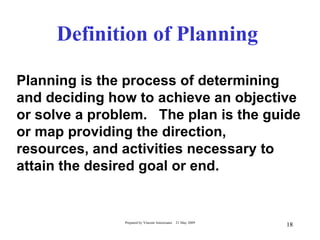
Definition of Planning

Planning is the process of determining
and deciding how to achieve an objective
or solve a problem. The plan is the guide
or map providing the direction,
resources, and activities necessary to
attain the desired goal or end.

               Prepared by Vincent Amoresano   21 May 2009
                                                             18
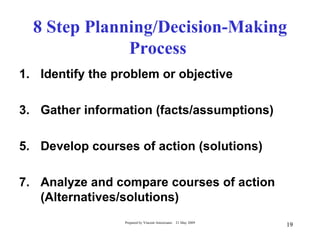
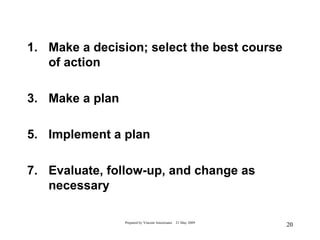
8 Step Planning/Decision-Making
              Process
1. Identify the problem or objective
3. Gather information (facts/assumptions)

5. Develop courses of action (solutions)

7. Analyze and compare courses of action
   (Alternatives/solutions)
                 Prepared by Vincent Amoresano   21 May 2009
                                                               19
1. Make a decision; select the best course
   of action

3. Make a plan

5. Implement a plan

7. Evaluate, follow-up, and change as
   necessary

                 Prepared by Vincent Amoresano   21 May 2009
                                                               20
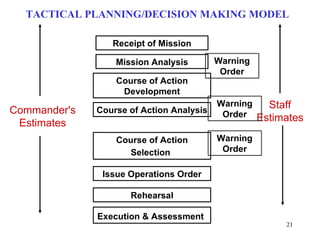
TACTICAL PLANNING/DECISION MAKING MODEL

                 Receipt of Mission

                  Mission Analysis        Warning
                                           Order
                  Course of Action
                   Development
                                          Warning  Staff
Commander's   Course of Action Analysis    Order Estimates
 Estimates
                  Course of Action        Warning
                     Selection             Order

               Issue Operations Order

                     Rehearsal

              Execution & Assessment
                                                      21
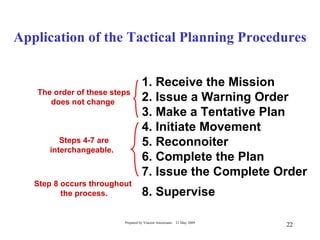
Application of the Tactical Planning Procedures


                                   1. Receive the Mission
   The order of these steps
      does not change              2. Issue a Warning Order
                                   3. Make a Tentative Plan
                                   4. Initiate Movement
         Steps 4-7 are             5. Reconnoiter
      interchangeable.
                                   6. Complete the Plan
                                   7. Issue the Complete Order
   Step 8 occurs throughout
          the process.             8. Supervise

                         Prepared by Vincent Amoresano   21 May 2009
                                                                       22
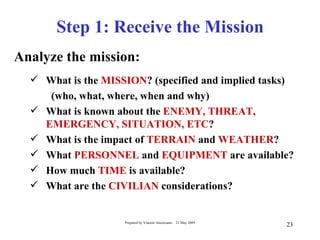
Step 1: Receive the Mission
Analyze the mission:
   What is the MISSION? (specified and implied tasks)
     (who, what, where, when and why)
   What is known about the ENEMY, THREAT,
    EMERGENCY, SITUATION, ETC?
   What is the impact of TERRAIN and WEATHER?
   What PERSONNEL and EQUIPMENT are available?
   How much TIME is available?
   What are the CIVILIAN considerations?


                    Prepared by Vincent Amoresano   21 May 2009
                                                                  23
Step 1: Receive the Mission (cont’d)
Time Analysis (1/3 – 2/3 Rule)
• Leader uses no more than 1/3 of available time for
  planning and issuing the Operations Order.

• Subordinates get 2/3 of available time to plan and
  prepare for operation (arrive at designated location
  and ready to deploy).

• Use backwards planning to schedule preparation
  time.
                     Prepared by Vincent Amoresano   21 May 2009
                                                                   24
Step 2: Issue a Warning Order
• Issue immediately after mission analysis
• Do not sacrifice time to gain more info
• At a minimum Warning Order should include:
   – Mission or nature of the operation
   – Who is participating in the operation
   – Time of operation
   – Time and place for issuance of Operations
     Order

  This enables the squads and other subordinate units
  to begin the parallel planning process
                 Prepared by Vincent Amoresano   21 May 2009   25
Step 3: Make a Tentative Plan
Consider:
  MISSION? (specified and implied tasks)
  ENEMY, THREAT, EMERGENCY,
   SITUATION, ETC
  TERRAIN and WEATHER
  PERSONNEL and EQUIPMENT
  TIME (refine time if necessary)
  CIVIL CONSIDERATIONS (safety, traffic, etc.)


                 Prepared by Vincent Amoresano   21 May 2009
                                                               26
Step 4: Start Necessary Movement
• May occur at any point in the Tactical
  Planning Process
• Includes movement to positions closer to the
  objective, initial inspections, equipment, etc.
• If the reconnaissance reveals a change in the
  situation, the plan must be adjusted
  accordingly.

 The steps do not have to be accomplished in order

                   Prepared by Vincent Amoresano   21 May 2009
                                                                 27
Step 5: Conduct Reconnaissance
• Reconnaissance is used to confirm terrain
  and/or enemy analysis and tactical options
• Situation and time available dictate the type
  and detail of reconnaissance
   – Map, terrain model, aerial photo, ground
• Plan and conduct a leader’s reconnaissance for
  every mission.
• Consider risk of detection.


                    Prepared by Vincent Amoresano   21 May 2009
                                                                  28
Step 6: Complete the Plan
  Develop Operations Order
    • Tentative plan
    • Reconnaissance
    • Additional guidance
  Review plan
    • Satisfy Commander’s mission and intent
  Alter tentative plan?
    • Reconnaissance
    • Changes to current situation
  Use five paragraph format


              Prepared by Vincent Amoresano   21 May 2009
                                                            29
Step 7: Issue the Complete Order
• Issue orally or written
• Issue while observing the situational/objective
  area if possible
• Supplements to Operations Orders:
   – Terrain models
   – Sand Table
   – Map boards/Overlays
   – Sketches
• All subordinates MUST understand the plan
   – Use briefbacks

                   Prepared by Vincent Amoresano   21 May 2009
                                                                 30
Step 8: Supervise - Rehearsals

• Must be habitual during training in order to
  effectively employ units tactically.
• Clarifies Commander’s intent.
• Reinforces scheme of maneuver.
• Ensures understanding and instills confidence
  in participants.
• Provides feedback and exposes problems in the
  plan.

                 Prepared by Vincent Amoresano   21 May 2009
                                                               31
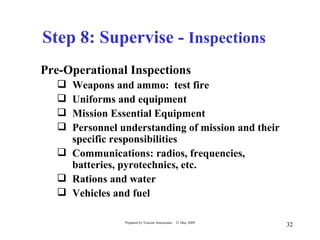
Step 8: Supervise - Inspections
Pre-Operational Inspections
   Weapons and ammo: test fire
   Uniforms and equipment
   Mission Essential Equipment
   Personnel understanding of mission and their
    specific responsibilities
   Communications: radios, frequencies,
    batteries, pyrotechnics, etc.
   Rations and water
   Vehicles and fuel

                Prepared by Vincent Amoresano   21 May 2009
                                                              32
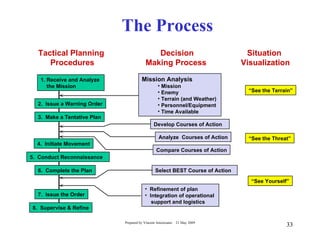
The Process
  Tactical Planning                         Decision                           Situation
     Procedures                          Making Process                       Visualization

   1. Receive and Analyze              Mission Analysis
      the Mission                                • Mission
                                                 • Enemy                        “See the Terrain”
                                                 • Terrain (and Weather)
  2. Issue a Warning Order                       • Personnel/Equipment
                                                 • Time Available
  3. Make a Tentative Plan
                                              Develop Courses of Action

                                                 Analyze Courses of Action      “See the Threat”
  4. Initiate Movement
                                                Compare Courses of Action
5. Conduct Reconnaissance

  6. Complete the Plan                         Select BEST Course of Action

                                                                                 “See Yourself”
                                         • Refinement of plan
  7. Issue the Order                     • Integration of operational
                                            support and logistics
8. Supervise & Refine

                             Prepared by Vincent Amoresano   21 May 2009
                                                                                              33
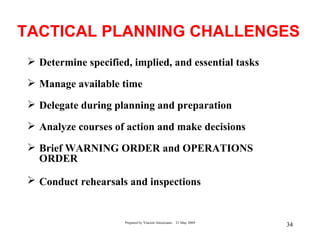
TACTICAL PLANNING CHALLENGES
 Determine specified, implied, and essential tasks

 Manage available time

 Delegate during planning and preparation

 Analyze courses of action and make decisions

 Brief WARNING ORDER and OPERATIONS
  ORDER

 Conduct rehearsals and inspections


                     Prepared by Vincent Amoresano   21 May 2009
                                                                   34
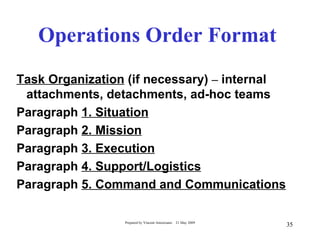
Operations Order Format
Task Organization (if necessary) – internal
 attachments, detachments, ad-hoc teams
Paragraph 1. Situation
Paragraph 2. Mission
Paragraph 3. Execution
Paragraph 4. Support/Logistics
Paragraph 5. Command and Communications

                 Prepared by Vincent Amoresano   21 May 2009
                                                               35
Operations Order Format (cont’d)
1. Situation
 Situation – crime, emergency situation,
  problem, etc.
 Intelligence – all information available on the
  activity (or facts and assumptions), terrain,
  weather, visibility, hazards, obstacles, etc.
 External Units Involved – tactical, support,
  reinforcing, attachments, detachments, higher
  headquarters; units on right, left, etc.
                  Prepared by Vincent Amoresano   21 May 2009
                                                                36
Operations Order Format (cont’d)

2. Mission

 Clear, concise statement of what you want to
  achieve.
 State the essential task or tasks to be
  accomplished by the entire unit, to include on-
  order missions. The who, what, when, where,
  and why for unit.
 Clearly define the unit’s objective.

                   Prepared by Vincent Amoresano   21 May 2009
                                                                 37
Operations Order Format (cont’d)
3. Execution
 Concept of operation – summary of overall
  course of action
 Movement instructions
 Specific tasks to elements or individuals
      • Maneuver
      • Support
 Coordination instructions/activities – timelines,
  effective times, control measures, required
  contact with other units.
                  Prepared by Vincent Amoresano   21 May 2009
                                                                38
Operations Order Format (cont’d)
4. Support/Logistics
 Specific instructions for logistical needs
   – General
   – Material and Services
      • Supply
      • Transportation
      • Services
      • Maintenance
      • Medical
   – Personnel
   – Miscellaneous
 Spell out any changes in policy or standard procedures
                      Prepared by Vincent Amoresano   21 May 2009
                                                                    39
Operations Order Format (cont’d)

5. Command and Communications

 Establishes chain of command
 Establishes radio/telephone operating procedures
 Establishes special signals and codes
 Establishes additional reporting or administrative
  requirements

                    Prepared by Vincent Amoresano   21 May 2009
                                                                  40
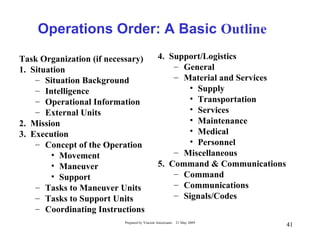
Operations Order: A Basic Outline
Task Organization (if necessary)               4. Support/Logistics
1. Situation                                       – General
    – Situation Background                         – Material and Services
    – Intelligence                                    • Supply
    – Operational Information                         • Transportation
    – External Units                                  • Services
2. Mission                                            • Maintenance
3. Execution                                          • Medical
    – Concept of the Operation                        • Personnel
        • Movement                                 – Miscellaneous
        • Maneuver                             5. Command & Communications
        • Support                                  – Command
    – Tasks to Maneuver Units                      – Communications
    – Tasks to Support Units                       – Signals/Codes
    – Coordinating Instructions
                           Prepared by Vincent Amoresano   21 May 2009
                                                                             41
Elements of Good Plan
Establishes objective: provides for
 accomplishment of task
It is based upon facts and valid
 assumptions: all pertinent data has
 been considered
Provides for optimum effective use
 of existing resources
Provides organizational structure
             Prepared by Vincent Amoresano   21 May 2009
                                                           42
1. Provides for required additional
   resources
2. It is effectively communicated to,
   and understood by every worker
   involved in executing the plan
3. Provides for decentralization:
   delegation of authority
4. Provides for direct control:
   coordination between units
               Prepared by Vincent Amoresano   21 May 2009
                                                             43
2. It is simple: it reduces all elements
   to the simplest form
3. It is flexible: there is room for
   adjustment
4. It provides for control
5. It is coordinated

             Prepared by Vincent Amoresano   21 May 2009
                                                           44
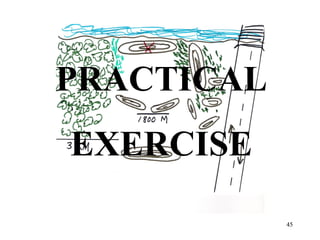
PRACTICAL
EXERCISE

            45
Questions???


               46

Police Tactical Decision Making & Planning

  • 1.
    Tactical Decision Making& Planning 1 Prepared by Vincent Amoresano 21 May 2009
  • 2.
    Learning Objectives  Applythe Analytical and Intuitive Decision-Making Models to determine an appropriate course of action  Plan a moderately complex tactical operation using the eight-step Tactical Planning Procedure  Develop a 5 paragraph Operations Order that contains all essential items required to control, coordinate and support the tactical operation Prepared by Vincent Amoresano 21 May 2009 2
  • 3.
    Key Points forCrisis Leadership Crisis often destroys communications Crisis leaders must be technically competent and understand their subordinates Parallel between combat and crisis leadership Prepared by Vincent Amoresano 21 May 2009 3
  • 4.
    Major Aspects of CrisisLeadership Flexibility Innovation Simplicity Empowerment Prepared by Vincent Amoresano 21 May 2009 4
  • 5.
    MURPHY’S LAW Prepared by Vincent Amoresano 21 May 2009 5
  • 6.
    Planning and DecisionMaking are basic ingredients of leadership. More than anything else, the ability to make sound, timely decisions separates the leader from the non-leader. It is the responsibility of leaders to make high- quality decisions that are accepted and executed in a timely manner. Prepared by Vincent Amoresano 21 May 2009 6
  • 7.
    Decision Making Defined Tacticaldecision making is the ability to choose which solution or course of action would have the best probability to accomplish mission success. Prepared by Vincent Amoresano 21 May 2009 7
  • 8.
    The decision-making processcan be generalized in two categories: 1. Analytical decision-making approach 3. Intuitive decision-making approach Prepared by Vincent Amoresano 21 May 2009 8
  • 9.
    Analytical Decision Making Theanalytical decision-making approach is used to analyze a situation or problem to determine the best solution. The leader or team apply a systematic process to insure effective decisions and plans. Prepared by Vincent Amoresano 21 May 2009 9
  • 10.
    Analytical Decision Making (Benefits)  Carefully taking a problem apart  Collecting and testing the information required for the problem or task  Conducting a comparison of the solutions or options  Selecting an alternative, which should preferably be the best solution 10
  • 11.
    Analytical Decision Making (Challenges) • Requires explicit instructions • Requires detailed analysis • Procedure based process • Process oriented—can be separated from reality • Requires multiple options Prepared by Vincent Amoresano 21 May 2009 11
  • 12.
    Analytical Decision MakingChallenges (continued) • Comparison criteria are subject to change • Focuses on optimal solution • Limited opportunity for creativity • Consumes time Prepared by Vincent Amoresano 21 May 2009 12
  • 13.
    Intuitive Decision Making Intuitivedecision making is a decision- making process that relies on experience to recognize key elements of a particular problem to arrive at an appropriate decision. The goal is to determine and implement the first solution that could result in success Prepared by Vincent Amoresano 21 May 2009 13
  • 14.
    Intuitive Decision Making (Benefits) Time effective Focuses on the first best solution rather than the optimal solution Can be updated and infused with additional experience constantly. Prepared by Vincent Amoresano 21 May 2009 14
  • 15.
    Intuitive Decision Making (Challenges) • Mismatched experience • Obsolescence • Distortion Prepared by Vincent Amoresano 21 May 2009 15
  • 16.
    Decision-Making Approach Comparison Comparative Analytical Intuitive Criteria Decision Making Decision Making Applications Well-defined problem Ill-defined problem parameters parameters Variability General applications Dynamic applications Source of Control Systematic application of Situational factors process Thought Processes Systematic analysis and Creative and discriminating comparative Orientation Process oriented Goal oriented 16
  • 17.
    Decision-Making Approach Comparison (continued) Comparative Analytical Decision Intuitive Decision Criteria Making Making Foundations Clearly defined objectives Uncertainty Knowledge Complete understanding of Incomplete understanding Requirements problem Information Complete, researched, and Incomplete and assessed Requirements derived Goals Predetermined Situation-based Desired Outcome Focuses on single best Focuses on acceptable solution solution Theoretical Basis Classical models and Naturalistic (free) thinking processes Prepared by Vincent Amoresano 21 May 2009 17
  • 18.
    Definition of Planning Planningis the process of determining and deciding how to achieve an objective or solve a problem. The plan is the guide or map providing the direction, resources, and activities necessary to attain the desired goal or end. Prepared by Vincent Amoresano 21 May 2009 18
  • 19.
    8 Step Planning/Decision-Making Process 1. Identify the problem or objective 3. Gather information (facts/assumptions) 5. Develop courses of action (solutions) 7. Analyze and compare courses of action (Alternatives/solutions) Prepared by Vincent Amoresano 21 May 2009 19
  • 20.
    1. Make adecision; select the best course of action 3. Make a plan 5. Implement a plan 7. Evaluate, follow-up, and change as necessary Prepared by Vincent Amoresano 21 May 2009 20
  • 21.
    TACTICAL PLANNING/DECISION MAKINGMODEL Receipt of Mission Mission Analysis Warning Order Course of Action Development Warning Staff Commander's Course of Action Analysis Order Estimates Estimates Course of Action Warning Selection Order Issue Operations Order Rehearsal Execution & Assessment 21
  • 22.
    Application of theTactical Planning Procedures 1. Receive the Mission The order of these steps does not change 2. Issue a Warning Order 3. Make a Tentative Plan 4. Initiate Movement Steps 4-7 are 5. Reconnoiter interchangeable. 6. Complete the Plan 7. Issue the Complete Order Step 8 occurs throughout the process. 8. Supervise Prepared by Vincent Amoresano 21 May 2009 22
  • 23.
    Step 1: Receivethe Mission Analyze the mission:  What is the MISSION? (specified and implied tasks) (who, what, where, when and why)  What is known about the ENEMY, THREAT, EMERGENCY, SITUATION, ETC?  What is the impact of TERRAIN and WEATHER?  What PERSONNEL and EQUIPMENT are available?  How much TIME is available?  What are the CIVILIAN considerations? Prepared by Vincent Amoresano 21 May 2009 23
  • 24.
    Step 1: Receivethe Mission (cont’d) Time Analysis (1/3 – 2/3 Rule) • Leader uses no more than 1/3 of available time for planning and issuing the Operations Order. • Subordinates get 2/3 of available time to plan and prepare for operation (arrive at designated location and ready to deploy). • Use backwards planning to schedule preparation time. Prepared by Vincent Amoresano 21 May 2009 24
  • 25.
    Step 2: Issuea Warning Order • Issue immediately after mission analysis • Do not sacrifice time to gain more info • At a minimum Warning Order should include: – Mission or nature of the operation – Who is participating in the operation – Time of operation – Time and place for issuance of Operations Order This enables the squads and other subordinate units to begin the parallel planning process Prepared by Vincent Amoresano 21 May 2009 25
  • 26.
    Step 3: Makea Tentative Plan Consider: MISSION? (specified and implied tasks) ENEMY, THREAT, EMERGENCY, SITUATION, ETC TERRAIN and WEATHER PERSONNEL and EQUIPMENT TIME (refine time if necessary) CIVIL CONSIDERATIONS (safety, traffic, etc.) Prepared by Vincent Amoresano 21 May 2009 26
  • 27.
    Step 4: StartNecessary Movement • May occur at any point in the Tactical Planning Process • Includes movement to positions closer to the objective, initial inspections, equipment, etc. • If the reconnaissance reveals a change in the situation, the plan must be adjusted accordingly. The steps do not have to be accomplished in order Prepared by Vincent Amoresano 21 May 2009 27
  • 28.
    Step 5: ConductReconnaissance • Reconnaissance is used to confirm terrain and/or enemy analysis and tactical options • Situation and time available dictate the type and detail of reconnaissance – Map, terrain model, aerial photo, ground • Plan and conduct a leader’s reconnaissance for every mission. • Consider risk of detection. Prepared by Vincent Amoresano 21 May 2009 28
  • 29.
    Step 6: Completethe Plan  Develop Operations Order • Tentative plan • Reconnaissance • Additional guidance  Review plan • Satisfy Commander’s mission and intent  Alter tentative plan? • Reconnaissance • Changes to current situation  Use five paragraph format Prepared by Vincent Amoresano 21 May 2009 29
  • 30.
    Step 7: Issuethe Complete Order • Issue orally or written • Issue while observing the situational/objective area if possible • Supplements to Operations Orders: – Terrain models – Sand Table – Map boards/Overlays – Sketches • All subordinates MUST understand the plan – Use briefbacks Prepared by Vincent Amoresano 21 May 2009 30
  • 31.
    Step 8: Supervise- Rehearsals • Must be habitual during training in order to effectively employ units tactically. • Clarifies Commander’s intent. • Reinforces scheme of maneuver. • Ensures understanding and instills confidence in participants. • Provides feedback and exposes problems in the plan. Prepared by Vincent Amoresano 21 May 2009 31
  • 32.
    Step 8: Supervise- Inspections Pre-Operational Inspections  Weapons and ammo: test fire  Uniforms and equipment  Mission Essential Equipment  Personnel understanding of mission and their specific responsibilities  Communications: radios, frequencies, batteries, pyrotechnics, etc.  Rations and water  Vehicles and fuel Prepared by Vincent Amoresano 21 May 2009 32
  • 33.
    The Process Tactical Planning Decision Situation Procedures Making Process Visualization 1. Receive and Analyze Mission Analysis the Mission • Mission • Enemy “See the Terrain” • Terrain (and Weather) 2. Issue a Warning Order • Personnel/Equipment • Time Available 3. Make a Tentative Plan Develop Courses of Action Analyze Courses of Action “See the Threat” 4. Initiate Movement Compare Courses of Action 5. Conduct Reconnaissance 6. Complete the Plan Select BEST Course of Action “See Yourself” • Refinement of plan 7. Issue the Order • Integration of operational support and logistics 8. Supervise & Refine Prepared by Vincent Amoresano 21 May 2009 33
  • 34.
    TACTICAL PLANNING CHALLENGES Determine specified, implied, and essential tasks  Manage available time  Delegate during planning and preparation  Analyze courses of action and make decisions  Brief WARNING ORDER and OPERATIONS ORDER  Conduct rehearsals and inspections Prepared by Vincent Amoresano 21 May 2009 34
  • 35.
    Operations Order Format TaskOrganization (if necessary) – internal attachments, detachments, ad-hoc teams Paragraph 1. Situation Paragraph 2. Mission Paragraph 3. Execution Paragraph 4. Support/Logistics Paragraph 5. Command and Communications Prepared by Vincent Amoresano 21 May 2009 35
  • 36.
    Operations Order Format(cont’d) 1. Situation  Situation – crime, emergency situation, problem, etc.  Intelligence – all information available on the activity (or facts and assumptions), terrain, weather, visibility, hazards, obstacles, etc.  External Units Involved – tactical, support, reinforcing, attachments, detachments, higher headquarters; units on right, left, etc. Prepared by Vincent Amoresano 21 May 2009 36
  • 37.
    Operations Order Format(cont’d) 2. Mission  Clear, concise statement of what you want to achieve.  State the essential task or tasks to be accomplished by the entire unit, to include on- order missions. The who, what, when, where, and why for unit.  Clearly define the unit’s objective. Prepared by Vincent Amoresano 21 May 2009 37
  • 38.
    Operations Order Format(cont’d) 3. Execution  Concept of operation – summary of overall course of action  Movement instructions  Specific tasks to elements or individuals • Maneuver • Support  Coordination instructions/activities – timelines, effective times, control measures, required contact with other units. Prepared by Vincent Amoresano 21 May 2009 38
  • 39.
    Operations Order Format(cont’d) 4. Support/Logistics  Specific instructions for logistical needs – General – Material and Services • Supply • Transportation • Services • Maintenance • Medical – Personnel – Miscellaneous  Spell out any changes in policy or standard procedures Prepared by Vincent Amoresano 21 May 2009 39
  • 40.
    Operations Order Format(cont’d) 5. Command and Communications  Establishes chain of command  Establishes radio/telephone operating procedures  Establishes special signals and codes  Establishes additional reporting or administrative requirements Prepared by Vincent Amoresano 21 May 2009 40
  • 41.
    Operations Order: ABasic Outline Task Organization (if necessary) 4. Support/Logistics 1. Situation – General – Situation Background – Material and Services – Intelligence • Supply – Operational Information • Transportation – External Units • Services 2. Mission • Maintenance 3. Execution • Medical – Concept of the Operation • Personnel • Movement – Miscellaneous • Maneuver 5. Command & Communications • Support – Command – Tasks to Maneuver Units – Communications – Tasks to Support Units – Signals/Codes – Coordinating Instructions Prepared by Vincent Amoresano 21 May 2009 41
  • 42.
    Elements of GoodPlan Establishes objective: provides for accomplishment of task It is based upon facts and valid assumptions: all pertinent data has been considered Provides for optimum effective use of existing resources Provides organizational structure Prepared by Vincent Amoresano 21 May 2009 42
  • 43.
    1. Provides forrequired additional resources 2. It is effectively communicated to, and understood by every worker involved in executing the plan 3. Provides for decentralization: delegation of authority 4. Provides for direct control: coordination between units Prepared by Vincent Amoresano 21 May 2009 43
  • 44.
    2. It issimple: it reduces all elements to the simplest form 3. It is flexible: there is room for adjustment 4. It provides for control 5. It is coordinated Prepared by Vincent Amoresano 21 May 2009 44
  • 45.
  • 46.

Editor's Notes