RULES OF ARREST
Philippine National Law
2TYPES OF LAW
1. Civil Law
3. Criminal Law
Philippine National Law
• Security management firms must recognize the
difference between civil and criminal law.
• In many cases, security guards can not intervene
in civil law and are limited in their capacity to
address criminal law.
• In relation to the operation of the business,
companies also must be able to evaluate their
exposure to civil liability that is associated with
their security operations.
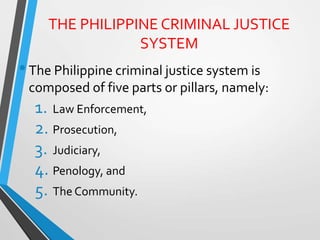
THE PHILIPPINE CRIMINAL JUSTICE
SYSTEM
•The Philippine criminal justice system is
composed of five parts or pillars, namely:
1. Law Enforcement,
2. Prosecution,
3. Judiciary,
4. Penology, and
5. The Community.
ARREST
Definition of Arrest
– is the taking of a person into
custody in order that he may be
bound to answer for the commission
of an offense.
2 KINDS OF ARREST:
1.Arrest withWarrant; and
2.Warrantless Arrest/ Citizen’s
Arrest.
It shall be the duty of the
officer executing the warrant
to:
a)Arrest the accused, and
b)Deliver arrested person to the
nearest police station or jail.
Note: Without unnecessary delay.
Duty of Arresting Officer
The head of the office to whom the warrant of
arrest was delivered for execution shall cause
the warrant to be executed within ten (10)
days from its receipt.Within ten (10) days
after the expiration of the period, the officer
to whom it was assigned for execution shall
make a report to the judge who issued the
warrant. In case of his failure to execute the
warrant, he shall state the reason why no
arrest was made.
Execution of Warrant of Arrest
ARREST WITHOUTWARRANT
A peace officer or a private person
may, without a warrant, arrest a person;
(1) When, in his presence, the person
to be arrested
has committed,
is actually committing, or
is attempting to commit
an offense or a crime;
ARREST WITHOUTWARRANT; WHEN
LAWFUL?
(2) When an offense has just been committed
and he has probable cause to believe based on
personal knowledge of facts or circumstances
that the person to be arrested has committed it;
and
(3) When the person to be arrested is a
prisoner who has escaped from a penal
establishment or place where he is serving final
judgment or is temporarily confined while his
case is pending, or has escaped while being
transferred from one confinement to another.
TIME OF MAKING AN ARREST
– An arrest may be made on
any day and at any time of the
day or night.
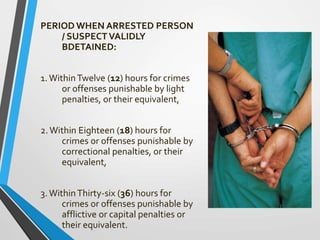
PERIOD WHEN ARRESTED PERSON
/ SUSPECTVALIDLY
BDETAINED:
1.WithinTwelve (12) hours for crimes
or offenses punishable by light
penalties, or their equivalent,
2.Within Eighteen (18) hours for
crimes or offenses punishable by
correctional penalties, or their
equivalent,
3.WithinThirty-six (36) hours for
crimes or offenses punishable by
afflictive or capital penalties or
their equivalent.
CUSTODIAL RIGHTS OF A PERSON / SUSPECT
Section 12, Article III of the 1987 Constitution (Miranda
Doctrine)
1. The right to be informed of his rights.
2. The right to remain silent and to be reminded that
anything he says can and will be used against him;
3. The right to an attorney or to counsel, preferably of his
own choice; if not, one will be provided for him;
4. Right against torture, force, violence, threat, intimidation
or any other means which vitiate the free will of the
person;
5. Right against secret detention places, solitary,
incommunicado, or other similar forms of detention
PRELIMINARY INVESTIGATION
Preliminary Investigation Defined; When
Required?
- Preliminary investigation is an inquiry or
proceeding to determine whether there is
sufficient ground to bring about a well-
founded belief that a crime has been
committed and the respondent is
probably guilty thereof, and should be
held for trial. Except as provided in
section 7 of this Rule, a preliminary
investigation is required to be conducted
before the filing of a complaint or
information for an offense where the
penalty prescribed by law is at least four
(4) years, two (2) months and one (1) day
without regard to the fine.
OFFICERS AUTHORIZEDTO CONDUCT
PRELIMINARY INVESTIGATION.
The following may conduct preliminary
investigations:
1. Provincial or City Prosecutors and their
assistants;
2. Judges of the Municipal Trial Courts and
MunicipalCircuitTrial Courts;
3. National and Regional State Prosecutors;
and
4. Other officers as may be authorized by law.
RIGHTS OFTHE ACCUSED
Rights of the accused at the trial
– In all criminal prosecutions, the
accused shall be entitled to the following
rights:
(a) To be presumed innocent until the
contrary is proved beyond reasonable
doubt;
(b) To be informed of the nature and
cause of the accusation against him;
c)To be present and defend in person and by counsel at
every stage of the proceedings, from arraignment to
promulgation of judgment.The accused may,
however, waive his right to be present at the trial
pursuant to the stipulations set forth in his bail,
unless his presence specifically ordered by the court
for purposes of identification.The absence of the
accused without justifiable cause at the trial of which
he had notice shall be considered a waiver of his
right to be present thereat;
d)To testify as a witness in his own but subject to cross
examination on the matters covered by the direct
examination. His silence shall not in any manner
prejudice him;
RIGHTS OFTHE ACCUSED
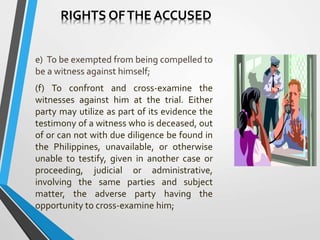
e) To be exempted from being compelled to
be a witness against himself;
(f) To confront and cross-examine the
witnesses against him at the trial. Either
party may utilize as part of its evidence the
testimony of a witness who is deceased, out
of or can not with due diligence be found in
the Philippines, unavailable, or otherwise
unable to testify, given in another case or
proceeding, judicial or administrative,
involving the same parties and subject
matter, the adverse party having the
opportunity to cross-examine him;
RIGHTS OFTHE ACCUSED
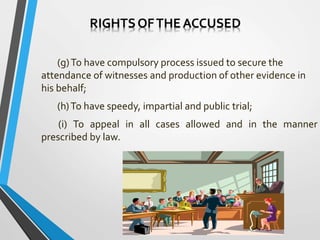
(g)To have compulsory process issued to secure the
attendance of witnesses and production of other evidence in
his behalf;
(h)To have speedy, impartial and public trial;
(i) To appeal in all cases allowed and in the manner
prescribed by law.
THANK YOU!

Rules of Arrest.ppt

  • 1.
  • 2.
    Philippine National Law 2TYPESOF LAW 1. Civil Law 3. Criminal Law
  • 3.
    Philippine National Law •Security management firms must recognize the difference between civil and criminal law. • In many cases, security guards can not intervene in civil law and are limited in their capacity to address criminal law. • In relation to the operation of the business, companies also must be able to evaluate their exposure to civil liability that is associated with their security operations.
  • 4.
    THE PHILIPPINE CRIMINALJUSTICE SYSTEM •The Philippine criminal justice system is composed of five parts or pillars, namely: 1. Law Enforcement, 2. Prosecution, 3. Judiciary, 4. Penology, and 5. The Community.
  • 5.
    ARREST Definition of Arrest –is the taking of a person into custody in order that he may be bound to answer for the commission of an offense.
  • 6.
    2 KINDS OFARREST: 1.Arrest withWarrant; and 2.Warrantless Arrest/ Citizen’s Arrest.
  • 7.
    It shall bethe duty of the officer executing the warrant to: a)Arrest the accused, and b)Deliver arrested person to the nearest police station or jail. Note: Without unnecessary delay. Duty of Arresting Officer
  • 8.
    The head ofthe office to whom the warrant of arrest was delivered for execution shall cause the warrant to be executed within ten (10) days from its receipt.Within ten (10) days after the expiration of the period, the officer to whom it was assigned for execution shall make a report to the judge who issued the warrant. In case of his failure to execute the warrant, he shall state the reason why no arrest was made. Execution of Warrant of Arrest
  • 9.
    ARREST WITHOUTWARRANT A peaceofficer or a private person may, without a warrant, arrest a person; (1) When, in his presence, the person to be arrested has committed, is actually committing, or is attempting to commit an offense or a crime;
  • 10.
    ARREST WITHOUTWARRANT; WHEN LAWFUL? (2)When an offense has just been committed and he has probable cause to believe based on personal knowledge of facts or circumstances that the person to be arrested has committed it; and (3) When the person to be arrested is a prisoner who has escaped from a penal establishment or place where he is serving final judgment or is temporarily confined while his case is pending, or has escaped while being transferred from one confinement to another.
  • 11.
    TIME OF MAKINGAN ARREST – An arrest may be made on any day and at any time of the day or night.
  • 12.
    PERIOD WHEN ARRESTEDPERSON / SUSPECTVALIDLY BDETAINED: 1.WithinTwelve (12) hours for crimes or offenses punishable by light penalties, or their equivalent, 2.Within Eighteen (18) hours for crimes or offenses punishable by correctional penalties, or their equivalent, 3.WithinThirty-six (36) hours for crimes or offenses punishable by afflictive or capital penalties or their equivalent.
  • 13.
    CUSTODIAL RIGHTS OFA PERSON / SUSPECT Section 12, Article III of the 1987 Constitution (Miranda Doctrine) 1. The right to be informed of his rights. 2. The right to remain silent and to be reminded that anything he says can and will be used against him; 3. The right to an attorney or to counsel, preferably of his own choice; if not, one will be provided for him; 4. Right against torture, force, violence, threat, intimidation or any other means which vitiate the free will of the person; 5. Right against secret detention places, solitary, incommunicado, or other similar forms of detention
  • 14.
    PRELIMINARY INVESTIGATION Preliminary InvestigationDefined; When Required? - Preliminary investigation is an inquiry or proceeding to determine whether there is sufficient ground to bring about a well- founded belief that a crime has been committed and the respondent is probably guilty thereof, and should be held for trial. Except as provided in section 7 of this Rule, a preliminary investigation is required to be conducted before the filing of a complaint or information for an offense where the penalty prescribed by law is at least four (4) years, two (2) months and one (1) day without regard to the fine.
  • 15.
    OFFICERS AUTHORIZEDTO CONDUCT PRELIMINARYINVESTIGATION. The following may conduct preliminary investigations: 1. Provincial or City Prosecutors and their assistants; 2. Judges of the Municipal Trial Courts and MunicipalCircuitTrial Courts; 3. National and Regional State Prosecutors; and 4. Other officers as may be authorized by law.
  • 16.
    RIGHTS OFTHE ACCUSED Rightsof the accused at the trial – In all criminal prosecutions, the accused shall be entitled to the following rights: (a) To be presumed innocent until the contrary is proved beyond reasonable doubt; (b) To be informed of the nature and cause of the accusation against him;
  • 17.
    c)To be presentand defend in person and by counsel at every stage of the proceedings, from arraignment to promulgation of judgment.The accused may, however, waive his right to be present at the trial pursuant to the stipulations set forth in his bail, unless his presence specifically ordered by the court for purposes of identification.The absence of the accused without justifiable cause at the trial of which he had notice shall be considered a waiver of his right to be present thereat; d)To testify as a witness in his own but subject to cross examination on the matters covered by the direct examination. His silence shall not in any manner prejudice him; RIGHTS OFTHE ACCUSED
  • 18.
    e) To beexempted from being compelled to be a witness against himself; (f) To confront and cross-examine the witnesses against him at the trial. Either party may utilize as part of its evidence the testimony of a witness who is deceased, out of or can not with due diligence be found in the Philippines, unavailable, or otherwise unable to testify, given in another case or proceeding, judicial or administrative, involving the same parties and subject matter, the adverse party having the opportunity to cross-examine him; RIGHTS OFTHE ACCUSED
  • 19.
    (g)To have compulsoryprocess issued to secure the attendance of witnesses and production of other evidence in his behalf; (h)To have speedy, impartial and public trial; (i) To appeal in all cases allowed and in the manner prescribed by law.
  • 20.