BY: CHELDY SYGACO ELUMBA-PABLEO,MPA,LI.B
CRIMINAL LAW I
1. MALFEASANCE AND MISFEASANCE
2. BRIBERY
3. FRAUDS AND ILLEGAL EXACTIONS AND TRANSACTIONS
4. MALVERSATION OF PUBLIC FUNDS AND PROPERTY
5. INFIDELITY IN THE CUSTODY OF PRISONERS
6. INFIDELITY IN THE CUSTODY OF DOCUMENTS
7. REVELATION OF SECRETS
8. OTHER OFFENSES/IRREGULARITIES BY PUBLIC OFFICERS
• One must be:
1. Taking part in the performance of public function in the government, or
performing in said Government or any of its branches public duties as an
employee, agent, or subordinate official, of any rank or class
2. That his authority to take part in the performance of public functions or to
perform public duties must be—
A. By direct provision of the law
B. By popular election, or
C. By appointment by competent authority (Azarcon vs Sandiganbayan,
supra)
1. DERELICTION OF DUTY– is misconduct in office or prevarication,
such as rendering an unjust judgment knowingly (In re: Climaco,
55 SCRA 107)
2. MALFEASANCE– the doing something which in the first place
should not be done because it is wrong;
3. MISFEASANCE– error or mistake in the performance of duty;
4. NONFEASANCE– omission to perform a duty required of the
public officer.
• Misconduct, misfeasance, or malfeasance warranting
removal from office of an officer, must have direct
relation to and be connected with the performance of
official duties amounting either to maladministration
or wilful, intentional neglect and failure to discharge
the duties of the office (Tenza vs Espinelli)
• Under 204 of RPC
1. Offender is a judge;
2. He renders a judgment in a case submitted to him for
decision;
3. The judgment is unjust;
4. He knew that the said judgment is unjust.
A judgment is said to be unjust when it is contrary to the
standards of conduct prescribed by law. (Louis Vuitton S.A. vs
Judge Villanueva, supra)
• Is both a criminal and an administrative charge.
• AS A CRIME, the gist of the offense is that an unjust
judgment be rendered maliciously or on bad faith that
is, knows it to be unjust and is contrary to law is not
supported by the evidence or both. (Dela Cruz vs
Conception)
1. It must be shown beyond doubt that the judgment is unjust as it is
contrary to law or is not supported by evidence.
2. Made with conscious and deliberate intent to do an injustice.
3. Inexcusable negligence or ignorance even though he acted without
malice, he failed to observe in performance of his duty with diligence,
prudence and care in rendering public service.
NOTE: A judge when required to exercise his judgment or discretion
cannot be subjected to liability---civil, criminal or administrative for his
official acts, no matter how erroneous, as long as he acts in good faith.
• Is a crime of the public officer who receives a gift, present,
offer or promise by reason or in connection with the
performance of his official duties.
1. Direct Bribery
2. Indirect Bribery
3. Qualified Bribery
• Consist of the commission of acts which amount to crime, those which do
not amount to a crime and the omission to perform an act incumbent
upon a public officer thus:
1. THE ACT CONSTITUTE A CRIME in which case mere agreement
consummates the crime of direct bribery. (agree to perform an act
constituting a crime)
2. THE ACT DOES NOT CONSTITUTE A CRIME, the officer must accept the
gift, mere agreement will not suffice. (gift was accepted by the officer,
gift must be tangible)
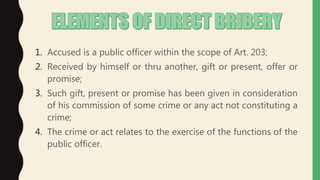
1. Accused is a public officer within the scope of Art. 203;
2. Received by himself or thru another, gift or present, offer or
promise;
3. Such gift, present or promise has been given in consideration
of his commission of some crime or any act not constituting a
crime;
4. The crime or act relates to the exercise of the functions of the
public officer.
1. Direct Bribery
2. Falsification of official/public document
1. Corruption of Public Officer
2. Falsification of public document, as principal by
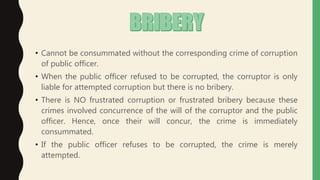
• Cannot be consummated without the corresponding crime of corruption
of public officer.
• When the public officer refused to be corrupted, the corruptor is only
liable for attempted corruption but there is no bribery.
• There is NO frustrated corruption or frustrated bribery because these
crimes involved concurrence of the will of the corruptor and the public
officer. Hence, once their will concur, the crime is immediately
consummated.
• If the public officer refuses to be corrupted, the crime is merely
attempted.
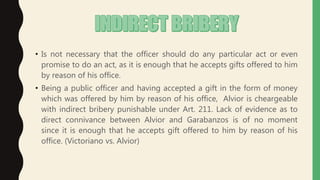
• Is not necessary that the officer should do any particular act or even
promise to do an act, as it is enough that he accepts gifts offered to him
by reason of his office.
• Being a public officer and having accepted a gift in the form of money
which was offered by him by reason of his office, Alvior is cheargeable
with indirect bribery punishable under Art. 211. Lack of evidence as to
direct connivance between Alvior and Garabanzos is of no moment
since it is enough that he accepts gift offered to him by reason of his
office. (Victoriano vs. Alvior)
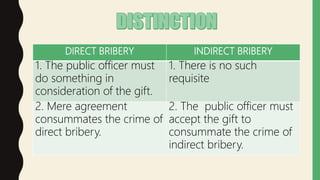
DIRECT BRIBERY INDIRECT BRIBERY
1. The public officer must
do something in
consideration of the gift.
1. There is no such
requisite
2. Mere agreement
consummates the crime of
direct bribery.
2. The public officer must
accept the gift to
consummate the crime of
indirect bribery.
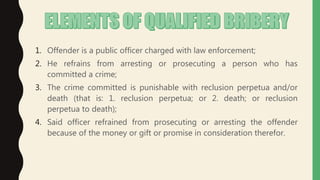
1. Offender is a public officer charged with law enforcement;
2. He refrains from arresting or prosecuting a person who has
committed a crime;
3. The crime committed is punishable with reclusion perpetua and/or
death (that is: 1. reclusion perpetua; or 2. death; or reclusion
perpetua to death);
4. Said officer refrained from prosecuting or arresting the offender
because of the money or gift or promise in consideration therefor.
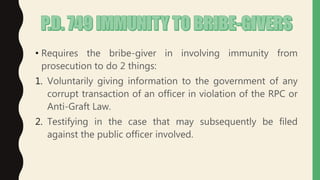
• Requires the bribe-giver in involving immunity from
prosecution to do 2 things:
1. Voluntarily giving information to the government of any
corrupt transaction of an officer in violation of the RPC or
Anti-Graft Law.
2. Testifying in the case that may subsequently be filed
against the public officer involved.
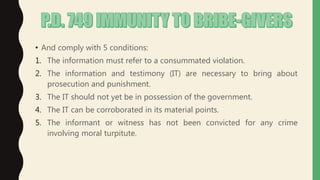
• And comply with 5 conditions:
1. The information must refer to a consummated violation.
2. The information and testimony (IT) are necessary to bring about
prosecution and punishment.
3. The IT should not yet be in possession of the government.
4. The IT can be corroborated in its material points.
5. The informant or witness has not been convicted for any crime
involving moral turpitute.
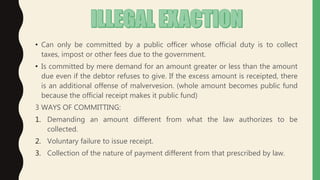
• Can only be committed by a public officer whose official duty is to collect
taxes, impost or other fees due to the government.
• Is committed by mere demand for an amount greater or less than the amount
due even if the debtor refuses to give. If the excess amount is receipted, there
is an additional offense of malvervesion. (whole amount becomes public fund
because the official receipt makes it public fund)
3 WAYS OF COMMITTING:
1. Demanding an amount different from what the law authorizes to be
collected.
2. Voluntary failure to issue receipt.
3. Collection of the nature of payment different from that prescribed by law.
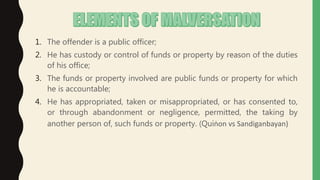
1. The offender is a public officer;
2. He has custody or control of funds or property by reason of the duties
of his office;
3. The funds or property involved are public funds or property for which
he is accountable;
4. He has appropriated, taken or misappropriated, or has consented to,
or through abandonment or negligence, permitted, the taking by
another person of, such funds or property. (Quiṅon vs Sandiganbayan)
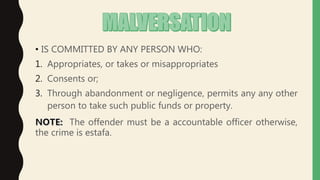
• IS COMMITTED BY ANY PERSON WHO:
1. Appropriates, or takes or misappropriates
2. Consents or;
3. Through abandonment or negligence, permits any any other
person to take such public funds or property.
The offender must be a accountable officer otherwise,
the crime is estafa.
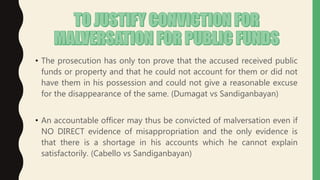
• The prosecution has only ton prove that the accused received public
funds or property and that he could not account for them or did not
have them in his possession and could not give a reasonable excuse
for the disappearance of the same. (Dumagat vs Sandiganbayan)
• An accountable officer may thus be convicted of malversation even if
NO DIRECT evidence of misappropriation and the only evidence is
that there is a shortage in his accounts which he cannot explain
satisfactorily. (Cabello vs Sandiganbayan)
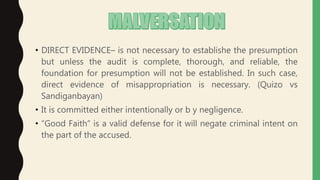
• DIRECT EVIDENCE– is not necessary to establishe the presumption
but unless the audit is complete, thorough, and reliable, the
foundation for presumption will not be established. In such case,
direct evidence of misappropriation is necessary. (Quizo vs
Sandiganbayan)
• It is committed either intentionally or b y negligence.
• “Good Faith” is a valid defense for it will negate criminal intent on
the part of the accused.
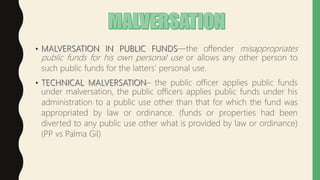
—the offender misappropriates
public funds for his own personal use or allows any other person to
such public funds for the latters’ personal use.
– the public officer applies public funds
under malversation, the public officers applies public funds under his
administration to a public use other than that for which the fund was
appropriated by law or ordinance. (funds or properties had been
diverted to any public use other what is provided by law or ordinance)
(PP vs Palma Gil)
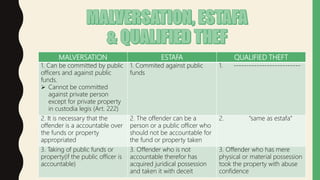
MALVERSATION ESTAFA QUALIFIED THEFT
1. Can be committed by public
officers and against public
funds.
 Cannot be committed
against private person
except for private property
in custodia legis (Art. 222)
1. Commited against public
funds
1. --------------------------
2. It is necessary that the
offender is a accountable over
the funds or property
appropriated
2. The offender can be a
person or a public officer who
should not be accountable for
the fund or property taken
2. “same as estafa”
3. Taking of public funds or
property(if the public officer is
accountable)
3. Offender who is not
accountable therefor has
acquired juridical possession
and taken it with deceit
3. Offender who has mere
physical or material possession
took the property with abuse
confidence
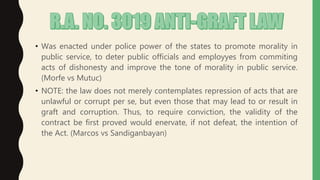
• Was enacted under police power of the states to promote morality in
public service, to deter public officials and employyes from commiting
acts of dishonesty and improve the tone of morality in public service.
(Morfe vs Mutuc)
• NOTE: the law does not merely contemplates repression of acts that are
unlawful or corrupt per se, but even those that may lead to or result in
graft and corruption. Thus, to require conviction, the validity of the
contract be first proved would enervate, if not defeat, the intention of
the Act. (Marcos vs Sandiganbayan)
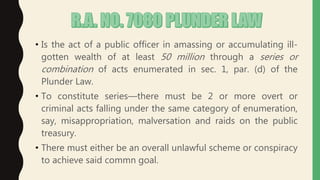
• Is the act of a public officer in amassing or accumulating ill-
gotten wealth of at least 50 million through a series or
combination of acts enumerated in sec. 1, par. (d) of the
Plunder Law.
• To constitute series—there must be 2 or more overt or
criminal acts falling under the same category of enumeration,
say, misappropriation, malversation and raids on the public
treasury.
• There must either be an overall unlawful scheme or conspiracy
to achieve said commn goal.
•What the prosecutionnneeds to prove beyond
reasonable doubt is only a number of acts
sufficient to form a combination or series which
would constitute a pattern and involving an
amount of at least 50 million.
• Refers not only in physical maltreatment but also moral, psychological
snd other kinds of maltreatment because the phrase physical injuries or
damaged caused and cruel or humiliating manner.
1. By overdoing himself in the correction or handling of a prisoner or
detention prisoner under his charge;
2. By imposing punishments not authorized by the regulations;
3. By inflicting such punishment in a cruel and humiliating manner
Crimes committed by public officer

Crimes committed by public officer

  • 1.
    BY: CHELDY SYGACOELUMBA-PABLEO,MPA,LI.B CRIMINAL LAW I
  • 2.
    1. MALFEASANCE ANDMISFEASANCE 2. BRIBERY 3. FRAUDS AND ILLEGAL EXACTIONS AND TRANSACTIONS 4. MALVERSATION OF PUBLIC FUNDS AND PROPERTY 5. INFIDELITY IN THE CUSTODY OF PRISONERS 6. INFIDELITY IN THE CUSTODY OF DOCUMENTS 7. REVELATION OF SECRETS 8. OTHER OFFENSES/IRREGULARITIES BY PUBLIC OFFICERS
  • 3.
    • One mustbe: 1. Taking part in the performance of public function in the government, or performing in said Government or any of its branches public duties as an employee, agent, or subordinate official, of any rank or class 2. That his authority to take part in the performance of public functions or to perform public duties must be— A. By direct provision of the law B. By popular election, or C. By appointment by competent authority (Azarcon vs Sandiganbayan, supra)
  • 4.
    1. DERELICTION OFDUTY– is misconduct in office or prevarication, such as rendering an unjust judgment knowingly (In re: Climaco, 55 SCRA 107) 2. MALFEASANCE– the doing something which in the first place should not be done because it is wrong; 3. MISFEASANCE– error or mistake in the performance of duty; 4. NONFEASANCE– omission to perform a duty required of the public officer.
  • 5.
    • Misconduct, misfeasance,or malfeasance warranting removal from office of an officer, must have direct relation to and be connected with the performance of official duties amounting either to maladministration or wilful, intentional neglect and failure to discharge the duties of the office (Tenza vs Espinelli)
  • 6.
    • Under 204of RPC 1. Offender is a judge; 2. He renders a judgment in a case submitted to him for decision; 3. The judgment is unjust; 4. He knew that the said judgment is unjust. A judgment is said to be unjust when it is contrary to the standards of conduct prescribed by law. (Louis Vuitton S.A. vs Judge Villanueva, supra)
  • 7.
    • Is botha criminal and an administrative charge. • AS A CRIME, the gist of the offense is that an unjust judgment be rendered maliciously or on bad faith that is, knows it to be unjust and is contrary to law is not supported by the evidence or both. (Dela Cruz vs Conception)
  • 8.
    1. It mustbe shown beyond doubt that the judgment is unjust as it is contrary to law or is not supported by evidence. 2. Made with conscious and deliberate intent to do an injustice. 3. Inexcusable negligence or ignorance even though he acted without malice, he failed to observe in performance of his duty with diligence, prudence and care in rendering public service. NOTE: A judge when required to exercise his judgment or discretion cannot be subjected to liability---civil, criminal or administrative for his official acts, no matter how erroneous, as long as he acts in good faith.
  • 9.
    • Is acrime of the public officer who receives a gift, present, offer or promise by reason or in connection with the performance of his official duties. 1. Direct Bribery 2. Indirect Bribery 3. Qualified Bribery
  • 10.
    • Consist ofthe commission of acts which amount to crime, those which do not amount to a crime and the omission to perform an act incumbent upon a public officer thus: 1. THE ACT CONSTITUTE A CRIME in which case mere agreement consummates the crime of direct bribery. (agree to perform an act constituting a crime) 2. THE ACT DOES NOT CONSTITUTE A CRIME, the officer must accept the gift, mere agreement will not suffice. (gift was accepted by the officer, gift must be tangible)
  • 11.
    1. Accused isa public officer within the scope of Art. 203; 2. Received by himself or thru another, gift or present, offer or promise; 3. Such gift, present or promise has been given in consideration of his commission of some crime or any act not constituting a crime; 4. The crime or act relates to the exercise of the functions of the public officer.
  • 12.
    1. Direct Bribery 2.Falsification of official/public document 1. Corruption of Public Officer 2. Falsification of public document, as principal by
  • 13.
    • Cannot beconsummated without the corresponding crime of corruption of public officer. • When the public officer refused to be corrupted, the corruptor is only liable for attempted corruption but there is no bribery. • There is NO frustrated corruption or frustrated bribery because these crimes involved concurrence of the will of the corruptor and the public officer. Hence, once their will concur, the crime is immediately consummated. • If the public officer refuses to be corrupted, the crime is merely attempted.
  • 14.
    • Is notnecessary that the officer should do any particular act or even promise to do an act, as it is enough that he accepts gifts offered to him by reason of his office. • Being a public officer and having accepted a gift in the form of money which was offered by him by reason of his office, Alvior is cheargeable with indirect bribery punishable under Art. 211. Lack of evidence as to direct connivance between Alvior and Garabanzos is of no moment since it is enough that he accepts gift offered to him by reason of his office. (Victoriano vs. Alvior)
  • 15.
    DIRECT BRIBERY INDIRECTBRIBERY 1. The public officer must do something in consideration of the gift. 1. There is no such requisite 2. Mere agreement consummates the crime of direct bribery. 2. The public officer must accept the gift to consummate the crime of indirect bribery.
  • 16.
    1. Offender isa public officer charged with law enforcement; 2. He refrains from arresting or prosecuting a person who has committed a crime; 3. The crime committed is punishable with reclusion perpetua and/or death (that is: 1. reclusion perpetua; or 2. death; or reclusion perpetua to death); 4. Said officer refrained from prosecuting or arresting the offender because of the money or gift or promise in consideration therefor.
  • 17.
    • Requires thebribe-giver in involving immunity from prosecution to do 2 things: 1. Voluntarily giving information to the government of any corrupt transaction of an officer in violation of the RPC or Anti-Graft Law. 2. Testifying in the case that may subsequently be filed against the public officer involved.
  • 18.
    • And complywith 5 conditions: 1. The information must refer to a consummated violation. 2. The information and testimony (IT) are necessary to bring about prosecution and punishment. 3. The IT should not yet be in possession of the government. 4. The IT can be corroborated in its material points. 5. The informant or witness has not been convicted for any crime involving moral turpitute.
  • 19.
    • Can onlybe committed by a public officer whose official duty is to collect taxes, impost or other fees due to the government. • Is committed by mere demand for an amount greater or less than the amount due even if the debtor refuses to give. If the excess amount is receipted, there is an additional offense of malvervesion. (whole amount becomes public fund because the official receipt makes it public fund) 3 WAYS OF COMMITTING: 1. Demanding an amount different from what the law authorizes to be collected. 2. Voluntary failure to issue receipt. 3. Collection of the nature of payment different from that prescribed by law.
  • 20.
    1. The offenderis a public officer; 2. He has custody or control of funds or property by reason of the duties of his office; 3. The funds or property involved are public funds or property for which he is accountable; 4. He has appropriated, taken or misappropriated, or has consented to, or through abandonment or negligence, permitted, the taking by another person of, such funds or property. (Quiṅon vs Sandiganbayan)
  • 21.
    • IS COMMITTEDBY ANY PERSON WHO: 1. Appropriates, or takes or misappropriates 2. Consents or; 3. Through abandonment or negligence, permits any any other person to take such public funds or property. The offender must be a accountable officer otherwise, the crime is estafa.
  • 22.
    • The prosecutionhas only ton prove that the accused received public funds or property and that he could not account for them or did not have them in his possession and could not give a reasonable excuse for the disappearance of the same. (Dumagat vs Sandiganbayan) • An accountable officer may thus be convicted of malversation even if NO DIRECT evidence of misappropriation and the only evidence is that there is a shortage in his accounts which he cannot explain satisfactorily. (Cabello vs Sandiganbayan)
  • 23.
    • DIRECT EVIDENCE–is not necessary to establishe the presumption but unless the audit is complete, thorough, and reliable, the foundation for presumption will not be established. In such case, direct evidence of misappropriation is necessary. (Quizo vs Sandiganbayan) • It is committed either intentionally or b y negligence. • “Good Faith” is a valid defense for it will negate criminal intent on the part of the accused.
  • 24.
    —the offender misappropriates publicfunds for his own personal use or allows any other person to such public funds for the latters’ personal use. – the public officer applies public funds under malversation, the public officers applies public funds under his administration to a public use other than that for which the fund was appropriated by law or ordinance. (funds or properties had been diverted to any public use other what is provided by law or ordinance) (PP vs Palma Gil)
  • 25.
    MALVERSATION ESTAFA QUALIFIEDTHEFT 1. Can be committed by public officers and against public funds.  Cannot be committed against private person except for private property in custodia legis (Art. 222) 1. Commited against public funds 1. -------------------------- 2. It is necessary that the offender is a accountable over the funds or property appropriated 2. The offender can be a person or a public officer who should not be accountable for the fund or property taken 2. “same as estafa” 3. Taking of public funds or property(if the public officer is accountable) 3. Offender who is not accountable therefor has acquired juridical possession and taken it with deceit 3. Offender who has mere physical or material possession took the property with abuse confidence
  • 26.
    • Was enactedunder police power of the states to promote morality in public service, to deter public officials and employyes from commiting acts of dishonesty and improve the tone of morality in public service. (Morfe vs Mutuc) • NOTE: the law does not merely contemplates repression of acts that are unlawful or corrupt per se, but even those that may lead to or result in graft and corruption. Thus, to require conviction, the validity of the contract be first proved would enervate, if not defeat, the intention of the Act. (Marcos vs Sandiganbayan)
  • 27.
    • Is theact of a public officer in amassing or accumulating ill- gotten wealth of at least 50 million through a series or combination of acts enumerated in sec. 1, par. (d) of the Plunder Law. • To constitute series—there must be 2 or more overt or criminal acts falling under the same category of enumeration, say, misappropriation, malversation and raids on the public treasury. • There must either be an overall unlawful scheme or conspiracy to achieve said commn goal.
  • 28.
    •What the prosecutionnneedsto prove beyond reasonable doubt is only a number of acts sufficient to form a combination or series which would constitute a pattern and involving an amount of at least 50 million.
  • 29.
    • Refers notonly in physical maltreatment but also moral, psychological snd other kinds of maltreatment because the phrase physical injuries or damaged caused and cruel or humiliating manner. 1. By overdoing himself in the correction or handling of a prisoner or detention prisoner under his charge; 2. By imposing punishments not authorized by the regulations; 3. By inflicting such punishment in a cruel and humiliating manner