Electrooculogram
EOG
Recommendations and
Guidelines prepared by the
International Society for
Clinical Electrophysiology of
Vision (ISCEV)

Source of information
• The Journal of Korean Medicine
Ophthalmology and Otolaryngology and
Dermatology
• international Society for Clinical
Electrophysiology of Vision (ISCEV)
• Case, Description, and Review of Revised AAO
Recommendations
• Birmingham & Midland Eye Centre … UK
• Clinical and Experimental Optometry March 2014
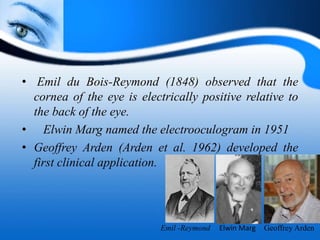
• Emil du Bois-Reymond (1848) observed that the
cornea of the eye is electrically positive relative to
the back of the eye.
• Elwin Marg named the electrooculogram in 1951
• Geoffrey Arden (Arden et al. 1962) developed the
first clinical application.
Geoffrey ArdenElwin MargEmil -Reymond
EOG
is an electrophysiological test of
function of the outer retina and
retinal pigment epithelium in which
the change in the electrical potential
between the cornea and the ocular
fundus is recorded during successive
periods of dark and light adaptation.
• The EOG is concerned with the slower changes
in the standing potential of the eye rather than
the rapid activity of the retinal neurones which
produces the ERG.
• In the clinical test, there is an initial drop in the
standing potential during a period of dark
adaption, followed by an increase in potential
occurring over several minutes when the eye is
subsequently exposed to light. This is the basis
of the EOG
• The changes in the potential which occur when
the retinal illumination is altered appear to be
related to the metabolism of the pigment
epithelium , Any disease therefore which affects
the rods or the pigment epithelium will give an
abnormal EOG result
• Disturbances of vision due to diseases of the
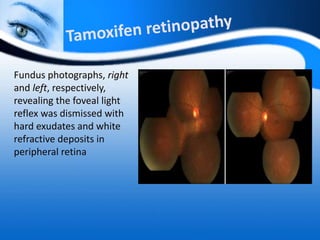
optic nerve, however , will not cause any electro -
diagnostic abnormality.
INTERNATIONAL SOCIETY FOR
CLINICAL ELECTROPHYSIOLOGY
OF VISION (ISCEV)
The Standardised Electro-
oculogram (EOG)
The Standard Method
• Pupils Apply dilating drops before any other
action to allow pupil dilation to be relatively
complete by the start of the test (see notes
below). Their size should be checked at the
start and end of the test and recorded at the
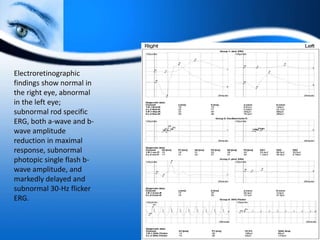
end of the test.
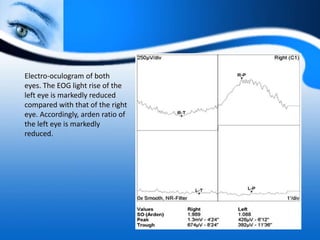
• Electrodes After suitable skin preparation,
place small recording electrodes, close to the
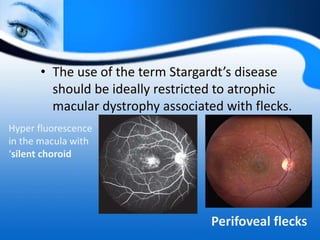
canthi of each eye
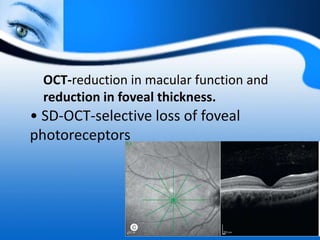
The Standard Method
Connect the electrodes from each eye to
separate channels of a differential amplifier.
The ‘ground’ electrode can be placed on the
forehead.
The electrodes, amplifier (to provide recordings
of the saccades which appear as square
waves) and impedance meter must be
approved for medical use.
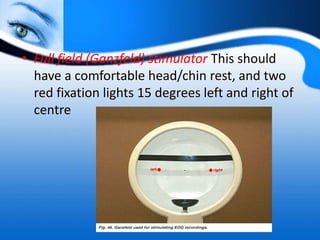
• Full field (Ganzfeld) stimulator This should
have a comfortable head/chin rest, and two
red fixation lights 15 degrees left and right of
centre
• Pre-adaptation The test subject should be in
stable indoor lighting for as long as possible
before the test, and should not be exposed to
any large changes in lighting (lighter/darker)
during this period, such as indirect
ophthalmoscopy. As near as is practical, the
pre-test light exposure should be the same
for all test subjects.
• Preparing the test subject Explain the
procedure including, ‘chin/head on
rest/restraint in stimulator, 15 min dark, 15 min
light, fixation lights alternate in simple
rhythmic manner, for 10 s each minute, when
lights change, move eyes in single sweep to
next one, do not turn head, do not anticipate
the changes’.
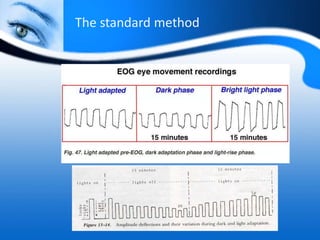
• Dark phase In total darkness for 15 min,
except for the dim fixation lights, alternate
the fixation lights every 1 s for 10 s every
1 min, and record the resulting EOG
potentials. The test subject should remain
looking into the stimulator the whole time if
possible, and should be warned of the start
of each measurement sequence to ensure
attention.
• Light phase Bring on the ganzfeld
background light of 100 photopic cd/m2 .
If necessary, bring this on gradually over a
short period (e.g. 20 s) for patient
comfort, especially in cases of
photophobia. Continue recording every
1 min as above. Keep the test subject
forward in the stimulator bowl for the
whole time and with eyes open.
while moving the eyes back and forth
alternating between the two red lights.
The movement of the eyes produces a voltage
swing of approximately 5 mill volts between
the electrodes on each side of the eye, which
is charted on graph paper or stored in the
memory of a computer.
Potentials decrease progressively lowest value
called ‘dark trough’ in 8-12 min
• Light insensitive part of EOG
• Switch on record in light adapted state
• Progressive increase in potential, peak is
called ‘light peak’ in 10 min
• Potentials decrease progressively reaching
Light sensitive part of EOG
• Light sensitive – [ Light peak ]
- Contributed by rods and cones
• Light insensitive – [ Dark trough ]
• - Contributed by RPE ,
Photoreceptors ,inner nuclear layer
The standard method
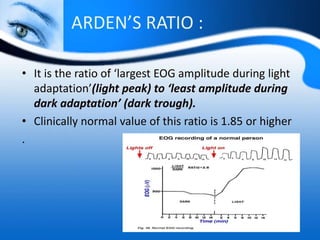
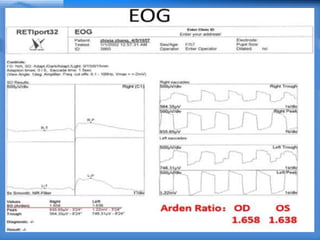
ARDEN’S RATIO :
• It is the ratio of ‘largest EOG amplitude during light
adaptation’(light peak) to ‘least amplitude during
dark adaptation’ (dark trough).
• Clinically normal value of this ratio is 1.85 or higher
.
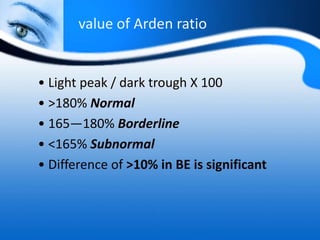
value of Arden ratio
• Light peak / dark trough X 100
• >180% Normal
• 165—180% Borderline
• <165% Subnormal
• Difference of >10% in BE is significant
The standard method
• As validity of results depends upon
consistent tracking of fixation target
over 30 min., this test is not suitable in
uncooperative patients & children.
• Also EOG depends up on a minimum
degree of light adaptation so it is not
reliable in patients with dense cataracts.
The standard method
• Good pt cooperation is required For EOG to
be normal,
• it requires as little as 20-25 % of normal
functioning retina. Thus abnormal EOG
indicates a dense pathology involving
entire retina.
• Thus abnormal EOG indicates a dense
pathology involving entire retina.
Reporting
• According to the 2017 ISCEV standards,[2] the report of
EOG should include
• Light peak: dark trough ratio (this terminology is
preferred over conventional Arden ratio)
• Amplitude of dark trough (mv)
• Time from the start of light phase to light peak (when
present)
• type of adapting light source
• pupil size
• Difficulties/deviation from protocol including patient
compliance, inconsistent eye movements
Standing potentials
• This Standard recommends the reporting of
the minimum standing potential (minimum
dark trough), taken from the underlying
response curve.
• This value is not often used in diagnosis , but
if the value is abnormally low (less than
150 μV) it may indicate an inactive retina (e.
g. total retinal detachment), and the
calculated Arden ratio may be unreliable
Potential Indications
• Inherited retinal dystrophies
• Toxic and nutritional eye disease
VISUAL ELECTRODIAGNOSTICS
A Guide according to ISCEv
• Similar to ERG,EOG is amass response
phenomenon and not effected by localized
disorder.
• All condition effecting the B wave amplitude
effects EOG , hence EOG is at best complementary
test to ERG
• Only in certain condition like Best vitelliform
dystrophy of the retina , gain special diagnostic
importance as, its effected early even when the
ERG was normal.
• Other examples of ERG to EOG
dissociation :
Diffuse fundus flavimaculatous dystrophy
(Stargardt’s dystrophy)
Pattern dystrophy of RPE
( Butterfly Macular Dystrophy)
Chloroquine retinopathy
Metallosis bulbi
ELECTRO DIAGNOSTIC CLINIC,
MOORFIELD،S EYE HOSPITAL,
LONDON )ON DECEMBER 28, 2017(
Updated information (Arden, Barrada
and Kelsey, 1962).
• In retinal detachment the EOG immediately
becomes grossly abnormal and there is no
corresponding rise in potential when the
illumination is increased.
• Electro diagnostic tests are of importance
when a detachment is suspected and the
fundus cannot be viewed directly due to the
presence of cataract or corneal opacities.
The EOG is more sensitive, however, and is
pathological even before ERG or fundus
changes becomes manifest , These tests
thus provide a method of early diagnosis.
especially useful in hereditary diseases
of this kind.
• In an occlusion of the central retinal vein or one
of its branches, the EOG in most cases shows a
reduced light rise
• Electro diagnostic tests are found to be of
prognostic value here; a normal EOG and an ERG
in which the b-wave is not diminished indicating
a good prognosis as far as recovery of visual
function is concerned
Myopia
• A low EOG result is obtained in certain cases of
degenerative myopia, probably because the
earliest degenerative changes occur in the pigment
epithelium. Later on the ERG is also affected and
the typical fundus picture is seen. Electro -
diagnostic tests are of assistance here in
diagnosing progressive myopia in early cases or in
childhood.
Choroidal Lesions
• In conditions such as acute choroiditis
which affect the outer layers of the
retina only, an abnormal EOG will be
obtained, although in most cases the
ERG remains unaffected.
Vitamin A Deficiency
• Vitamin A deficiency may induce ocular
changes including night blindness. The
waveform of the ERG is affected and an
abnormal EOG is also recorded.
This usually returns to normal when the
metabolic error is corrected, provided the
deficiency is not prolonged, in which case
permanent damage may occur.
The EOG is abnormal in:
• Best vitelliform macular dystrophy (early stage) and in carriers
• Stargart macular dystrophy (advanced stage)
• Pattern dystrophies (normal or modestly subnormal)
• Retinitis pigmentosa and rod-cone dystrophies
• Acquired cone and cone-rod dystrophies
• Fundus Albipunctatus (no notable light rise with dark adaptation of
15 minutes)
• Choroideremia
• Gyrate atrophy
• Diffuse choroidal atrophy
• Diffuse chronic chorioretinal inflammation
• Hypertensive retinopathy
• Retinal detachment
• Silicone oil exposure during retinal detachment repair
surgery, even 4 mo after removal
• Chloroquine and hydroxychloroquine toxicity
• Didanosine use (can be reversible after stopping therapy)
• Desferrioxamine
• Diabetes, worsening with the duration of diabetes
• Retained intraocular iron particles (siderosis bulbi)
• Progressive high myopia
• Choroidal malignant melanoma
The EOG is normal in:
• Dominantly inherited drusen of Bruch's
membrane
• Congenital achromatopisa
• Progressive diffuse cone dystrophy
• Autosomal recessive and X-linked recessive
congenital stationary nyctylopia
• Carotid occlusive disease
• Optic nerve disease
• Drugs that reduce systemic
standing potential :
• IV 20% mannitol (reduced by
43%) hyperosmolarity-induced response
• IV 500 mg acetazolamide
• Timolol
• Conditions that increased
systemic standing potential :
• Retinal hypoxia
• Silicone oil exposure and removal
AN AUTOSOMAL DOMINANT DISORDER,
THE EOG IS ABNORMAL EVEN IN A
CARRIER PATIENT WHO HAS NO FUNDUS
CHANGES AND IS CLINICALLY
ASYMPTOMATIC.
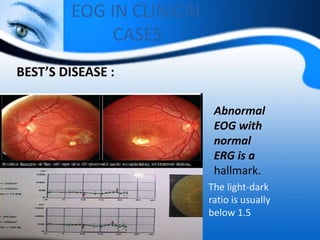
Best vitelliform dystrophy
EOG IN CLINICAL
CASES
Abnormal
EOG with
normal
ERG is a
hallmark.
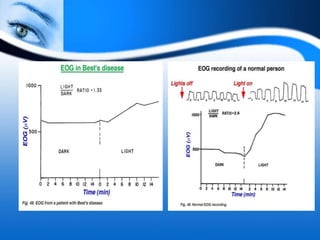
BEST’S DISEASE :
The light-dark
ratio is usually
below 1.5
• A Case of Adult-Onset Vitelliform
Dystrophy Treated with Intravitreal
Injection of Bevacizumab
• Journal of the Korean
Ophthalmology
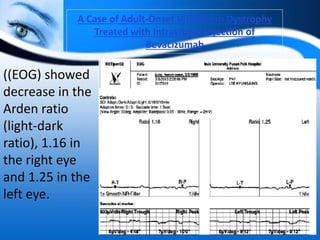
A Case of Adult-Onset Vitelliform Dystrophy
Treated with Intravitreal Injection of
Bevacizumab
((EOG) showed
decrease in the
Arden ratio
(light-dark
ratio), 1.16 in
the right eye
and 1.25 in the
left eye.
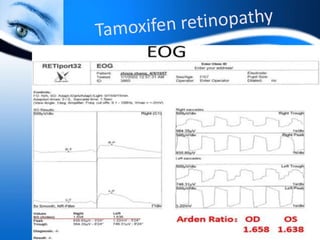
• Tamoxifen retinopathy
• Journal of the Korean
Ophthalmology
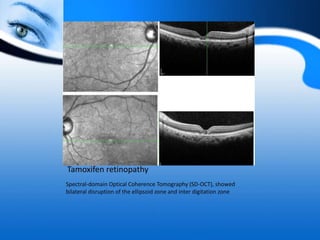
Tamoxifen retinopathy
Spectral-domain Optical Coherence Tomography (SD-OCT), showed
bilateral disruption of the ellipsoid zone and inter digitation zone
Fundus photographs, right
and left, respectively,
revealing the foveal light
reflex was dismissed with
hard exudates and white
refractive deposits in
peripheral retina
CONFLICTING EVIDENCE AS TO UTILITY AND ABNORMALITY
IN TOXICITY
TESTS NO LONGER RECOMMENDED ACCORDING TO
REVISED AAO RECOMMENDATIONS
Bull's eye maculopathy;
Hydroxychloroquine;
Rheumatoid arthritis
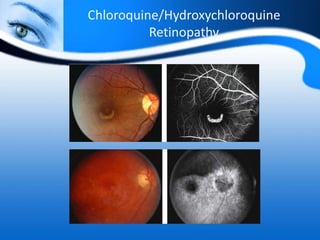
• Potentially blinding Progressive loss of RPE
and photoreceptors in a parafoveal pattern,
producing a
• “Bull’s-eye” maculopathy and paracentral
scotoma
• Associated with many years of CQ/HCQ use
Chloroquine/Hydroxychloroquine
Retinopathy
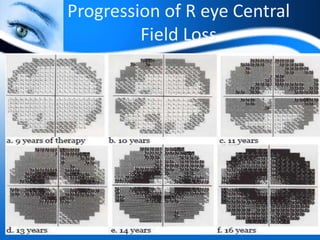
Progression of R eye Central
Field Loss
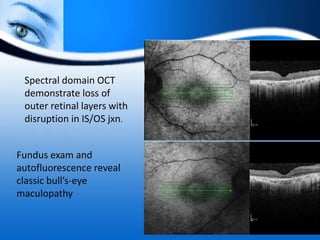
Spectral domain OCT
demonstrate loss of
outer retinal layers with
disruption in IS/OS jxn.
Fundus exam and
autofluorescence reveal
classic bull’s-eye
maculopathy
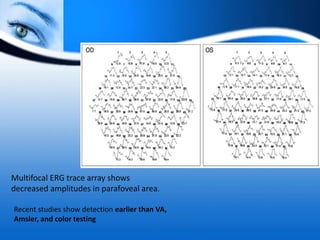
Multifocal ERG trace array shows
decreased amplitudes in parafoveal area.
Recent studies show detection earlier than VA,
Amsler, and color testing
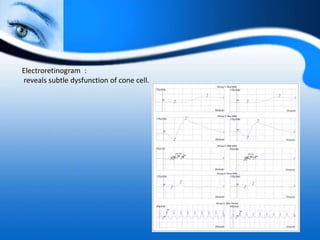
Electroretinogram :
reveals subtle dysfunction of cone cell.
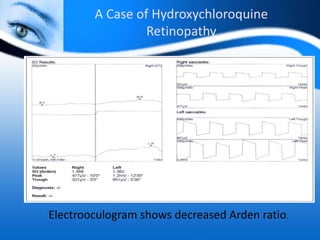
A Case of Hydroxychloroquine
Retinopathy
Electrooculogram shows decreased Arden ratio.
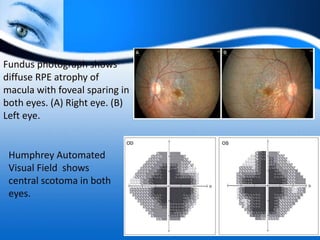
Fundus photograph shows
diffuse RPE atrophy of
macula with foveal sparing in
both eyes. (A) Right eye. (B)
Left eye.
Humphrey Automated
Visual Field shows
central scotoma in both
eyes.
ACUTE ZONAL OCCULT OUTER
RETINOPATHY, RESPONSIVE TO AN
IMMUNOSUPPRESSIVE AGENT:
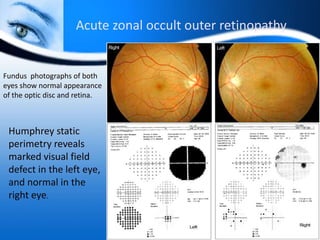
Acute zonal occult outer retinopathy
Fundus photographs of both
eyes show normal appearance
of the optic disc and retina.
Humphrey static
perimetry reveals
marked visual field
defect in the left eye,
and normal in the
right eye.
Electroretinographic
findings show normal in
the right eye, abnormal
in the left eye;
subnormal rod specific
ERG, both a-wave and b-
wave amplitude
reduction in maximal
response, subnormal
photopic single flash b-
wave amplitude, and
markedly delayed and
subnormal 30-Hz flicker
ERG.
Electro-oculogram of both
eyes. The EOG light rise of the
left eye is markedly reduced
compared with that of the right
eye. Accordingly, arden ratio of
the left eye is markedly
reduced.
•Stargardt’s dystrophy
• Birmingham & Midland Eye Centre
UK
• The use of the term Stargardt’s disease
should be ideally restricted to atrophic
macular dystrophy associated with flecks.
Perifoveal flecks
Hyper fluorescence
in the macula with
‘silent choroid
OCT-reduction in macular function and
reduction in foveal thickness.
• SD-OCT-selective loss of foveal
photoreceptors
• EOG- tends to be subnormal
• ERG-The photopic and scotopic ERG is
generally normal, although in advanced
stages slight reduction in amplitudes of ERG
are noted.
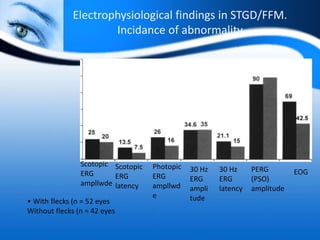
The most consistent electrophysiological
abnormality in STGD/ FFM is the
reduction of the PERG. ERG and EOG
abnormalities occur more often in the
presence of flecks.
Electrophysiological findings in STGD/FFM.
Incidance of abnormality
• With flecks (n = 52 eyes
Without flecks (n = 42 eyes
Scotopic
ERG
ampllwde
Scotopic
ERG
latency
EOGPERG
(PSO)
amplitude
30 Hz
ERG
latency
30 Hz
ERG
ampli
tude
Photopic
ERG
ampllwd
e
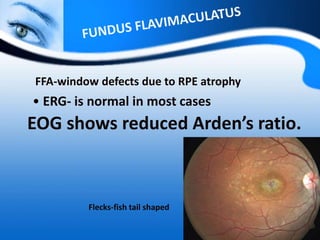
Flecks-fish tail shaped
FFA-window defects due to RPE atrophy
• ERG- is normal in most cases
EOG shows reduced Arden’s ratio.
• reflecting the function of the retinal
pigment epithelium (RPE). Therefore, is a
useful test to evaluate and monitor RPE
function in retinitis pigmentosa
• Clinical and Experimental Optometry ,
2013, Optometrists Association Australia
a 53-year-old man, who reported
having difficulty seeing at night,
first noticed a few years ago.
Static perimetry showed markedly
constricted visual fields and visual
acuities were 6/7.5+ right eye and
6/9.5 left eye
(i), Typical EOG traces from a healthy subject
the mildly reduced dark phase and
considerably reduced light phase
response exhibited by the RP individual.
• ERG and EOG abnormalities in carriers
of X-linked retinitis pigmentosa
• The results of this study suggest that the
use of both tests, including measurement of
the scotopic b wave latency, may increase
the carrier detection rate
• Birmingham & Midland Eye Centre … UK
THANK YOU

Electrooculogram- EOG

  • 1.
    Electrooculogram EOG Recommendations and Guidelines preparedby the International Society for Clinical Electrophysiology of Vision (ISCEV)
  • 2.
    Source of information •The Journal of Korean Medicine Ophthalmology and Otolaryngology and Dermatology • international Society for Clinical Electrophysiology of Vision (ISCEV) • Case, Description, and Review of Revised AAO Recommendations • Birmingham & Midland Eye Centre … UK • Clinical and Experimental Optometry March 2014
  • 3.
    • Emil duBois-Reymond (1848) observed that the cornea of the eye is electrically positive relative to the back of the eye. • Elwin Marg named the electrooculogram in 1951 • Geoffrey Arden (Arden et al. 1962) developed the first clinical application. Geoffrey ArdenElwin MargEmil -Reymond
  • 4.
    EOG is an electrophysiologicaltest of function of the outer retina and retinal pigment epithelium in which the change in the electrical potential between the cornea and the ocular fundus is recorded during successive periods of dark and light adaptation.
  • 5.
    • The EOGis concerned with the slower changes in the standing potential of the eye rather than the rapid activity of the retinal neurones which produces the ERG. • In the clinical test, there is an initial drop in the standing potential during a period of dark adaption, followed by an increase in potential occurring over several minutes when the eye is subsequently exposed to light. This is the basis of the EOG
  • 6.
    • The changesin the potential which occur when the retinal illumination is altered appear to be related to the metabolism of the pigment epithelium , Any disease therefore which affects the rods or the pigment epithelium will give an abnormal EOG result • Disturbances of vision due to diseases of the optic nerve, however , will not cause any electro - diagnostic abnormality.
  • 7.
    INTERNATIONAL SOCIETY FOR CLINICALELECTROPHYSIOLOGY OF VISION (ISCEV) The Standardised Electro- oculogram (EOG)
  • 8.
    The Standard Method •Pupils Apply dilating drops before any other action to allow pupil dilation to be relatively complete by the start of the test (see notes below). Their size should be checked at the start and end of the test and recorded at the end of the test. • Electrodes After suitable skin preparation, place small recording electrodes, close to the canthi of each eye
  • 9.
    The Standard Method Connectthe electrodes from each eye to separate channels of a differential amplifier. The ‘ground’ electrode can be placed on the forehead. The electrodes, amplifier (to provide recordings of the saccades which appear as square waves) and impedance meter must be approved for medical use.
  • 11.
    • Full field(Ganzfeld) stimulator This should have a comfortable head/chin rest, and two red fixation lights 15 degrees left and right of centre
  • 12.
    • Pre-adaptation Thetest subject should be in stable indoor lighting for as long as possible before the test, and should not be exposed to any large changes in lighting (lighter/darker) during this period, such as indirect ophthalmoscopy. As near as is practical, the pre-test light exposure should be the same for all test subjects.
  • 13.
    • Preparing thetest subject Explain the procedure including, ‘chin/head on rest/restraint in stimulator, 15 min dark, 15 min light, fixation lights alternate in simple rhythmic manner, for 10 s each minute, when lights change, move eyes in single sweep to next one, do not turn head, do not anticipate the changes’.
  • 14.
    • Dark phaseIn total darkness for 15 min, except for the dim fixation lights, alternate the fixation lights every 1 s for 10 s every 1 min, and record the resulting EOG potentials. The test subject should remain looking into the stimulator the whole time if possible, and should be warned of the start of each measurement sequence to ensure attention.
  • 15.
    • Light phaseBring on the ganzfeld background light of 100 photopic cd/m2 . If necessary, bring this on gradually over a short period (e.g. 20 s) for patient comfort, especially in cases of photophobia. Continue recording every 1 min as above. Keep the test subject forward in the stimulator bowl for the whole time and with eyes open.
  • 16.
    while moving theeyes back and forth alternating between the two red lights. The movement of the eyes produces a voltage swing of approximately 5 mill volts between the electrodes on each side of the eye, which is charted on graph paper or stored in the memory of a computer.
  • 17.
    Potentials decrease progressivelylowest value called ‘dark trough’ in 8-12 min • Light insensitive part of EOG • Switch on record in light adapted state • Progressive increase in potential, peak is called ‘light peak’ in 10 min • Potentials decrease progressively reaching Light sensitive part of EOG
  • 18.
    • Light sensitive– [ Light peak ] - Contributed by rods and cones • Light insensitive – [ Dark trough ] • - Contributed by RPE , Photoreceptors ,inner nuclear layer
  • 19.
  • 20.
    ARDEN’S RATIO : •It is the ratio of ‘largest EOG amplitude during light adaptation’(light peak) to ‘least amplitude during dark adaptation’ (dark trough). • Clinically normal value of this ratio is 1.85 or higher .
  • 21.
    value of Ardenratio • Light peak / dark trough X 100 • >180% Normal • 165—180% Borderline • <165% Subnormal • Difference of >10% in BE is significant
  • 22.
    The standard method •As validity of results depends upon consistent tracking of fixation target over 30 min., this test is not suitable in uncooperative patients & children. • Also EOG depends up on a minimum degree of light adaptation so it is not reliable in patients with dense cataracts.
  • 23.
    The standard method •Good pt cooperation is required For EOG to be normal, • it requires as little as 20-25 % of normal functioning retina. Thus abnormal EOG indicates a dense pathology involving entire retina. • Thus abnormal EOG indicates a dense pathology involving entire retina.
  • 25.
    Reporting • According tothe 2017 ISCEV standards,[2] the report of EOG should include • Light peak: dark trough ratio (this terminology is preferred over conventional Arden ratio) • Amplitude of dark trough (mv) • Time from the start of light phase to light peak (when present) • type of adapting light source • pupil size • Difficulties/deviation from protocol including patient compliance, inconsistent eye movements
  • 26.
    Standing potentials • ThisStandard recommends the reporting of the minimum standing potential (minimum dark trough), taken from the underlying response curve. • This value is not often used in diagnosis , but if the value is abnormally low (less than 150 μV) it may indicate an inactive retina (e. g. total retinal detachment), and the calculated Arden ratio may be unreliable
  • 28.
    Potential Indications • Inheritedretinal dystrophies • Toxic and nutritional eye disease VISUAL ELECTRODIAGNOSTICS A Guide according to ISCEv
  • 29.
    • Similar toERG,EOG is amass response phenomenon and not effected by localized disorder. • All condition effecting the B wave amplitude effects EOG , hence EOG is at best complementary test to ERG • Only in certain condition like Best vitelliform dystrophy of the retina , gain special diagnostic importance as, its effected early even when the ERG was normal.
  • 30.
    • Other examplesof ERG to EOG dissociation : Diffuse fundus flavimaculatous dystrophy (Stargardt’s dystrophy) Pattern dystrophy of RPE ( Butterfly Macular Dystrophy) Chloroquine retinopathy Metallosis bulbi
  • 31.
    ELECTRO DIAGNOSTIC CLINIC, MOORFIELD،SEYE HOSPITAL, LONDON )ON DECEMBER 28, 2017( Updated information (Arden, Barrada and Kelsey, 1962).
  • 32.
    • In retinaldetachment the EOG immediately becomes grossly abnormal and there is no corresponding rise in potential when the illumination is increased. • Electro diagnostic tests are of importance when a detachment is suspected and the fundus cannot be viewed directly due to the presence of cataract or corneal opacities.
  • 33.
    The EOG ismore sensitive, however, and is pathological even before ERG or fundus changes becomes manifest , These tests thus provide a method of early diagnosis. especially useful in hereditary diseases of this kind.
  • 34.
    • In anocclusion of the central retinal vein or one of its branches, the EOG in most cases shows a reduced light rise • Electro diagnostic tests are found to be of prognostic value here; a normal EOG and an ERG in which the b-wave is not diminished indicating a good prognosis as far as recovery of visual function is concerned
  • 35.
    Myopia • A lowEOG result is obtained in certain cases of degenerative myopia, probably because the earliest degenerative changes occur in the pigment epithelium. Later on the ERG is also affected and the typical fundus picture is seen. Electro - diagnostic tests are of assistance here in diagnosing progressive myopia in early cases or in childhood.
  • 36.
    Choroidal Lesions • Inconditions such as acute choroiditis which affect the outer layers of the retina only, an abnormal EOG will be obtained, although in most cases the ERG remains unaffected.
  • 37.
    Vitamin A Deficiency •Vitamin A deficiency may induce ocular changes including night blindness. The waveform of the ERG is affected and an abnormal EOG is also recorded. This usually returns to normal when the metabolic error is corrected, provided the deficiency is not prolonged, in which case permanent damage may occur.
  • 38.
    The EOG isabnormal in: • Best vitelliform macular dystrophy (early stage) and in carriers • Stargart macular dystrophy (advanced stage) • Pattern dystrophies (normal or modestly subnormal) • Retinitis pigmentosa and rod-cone dystrophies • Acquired cone and cone-rod dystrophies • Fundus Albipunctatus (no notable light rise with dark adaptation of 15 minutes) • Choroideremia • Gyrate atrophy • Diffuse choroidal atrophy • Diffuse chronic chorioretinal inflammation • Hypertensive retinopathy
  • 39.
    • Retinal detachment •Silicone oil exposure during retinal detachment repair surgery, even 4 mo after removal • Chloroquine and hydroxychloroquine toxicity • Didanosine use (can be reversible after stopping therapy) • Desferrioxamine • Diabetes, worsening with the duration of diabetes • Retained intraocular iron particles (siderosis bulbi) • Progressive high myopia • Choroidal malignant melanoma
  • 40.
    The EOG isnormal in: • Dominantly inherited drusen of Bruch's membrane • Congenital achromatopisa • Progressive diffuse cone dystrophy • Autosomal recessive and X-linked recessive congenital stationary nyctylopia • Carotid occlusive disease • Optic nerve disease
  • 41.
    • Drugs thatreduce systemic standing potential : • IV 20% mannitol (reduced by 43%) hyperosmolarity-induced response • IV 500 mg acetazolamide • Timolol
  • 42.
    • Conditions thatincreased systemic standing potential : • Retinal hypoxia • Silicone oil exposure and removal
  • 43.
    AN AUTOSOMAL DOMINANTDISORDER, THE EOG IS ABNORMAL EVEN IN A CARRIER PATIENT WHO HAS NO FUNDUS CHANGES AND IS CLINICALLY ASYMPTOMATIC. Best vitelliform dystrophy
  • 44.
    EOG IN CLINICAL CASES Abnormal EOGwith normal ERG is a hallmark. BEST’S DISEASE : The light-dark ratio is usually below 1.5
  • 45.
    • A Caseof Adult-Onset Vitelliform Dystrophy Treated with Intravitreal Injection of Bevacizumab • Journal of the Korean Ophthalmology
  • 46.
    A Case ofAdult-Onset Vitelliform Dystrophy Treated with Intravitreal Injection of Bevacizumab ((EOG) showed decrease in the Arden ratio (light-dark ratio), 1.16 in the right eye and 1.25 in the left eye.
  • 47.
    • Tamoxifen retinopathy •Journal of the Korean Ophthalmology
  • 48.
    Tamoxifen retinopathy Spectral-domain OpticalCoherence Tomography (SD-OCT), showed bilateral disruption of the ellipsoid zone and inter digitation zone
  • 49.
    Fundus photographs, right andleft, respectively, revealing the foveal light reflex was dismissed with hard exudates and white refractive deposits in peripheral retina
  • 51.
    CONFLICTING EVIDENCE ASTO UTILITY AND ABNORMALITY IN TOXICITY TESTS NO LONGER RECOMMENDED ACCORDING TO REVISED AAO RECOMMENDATIONS Bull's eye maculopathy; Hydroxychloroquine; Rheumatoid arthritis
  • 52.
    • Potentially blindingProgressive loss of RPE and photoreceptors in a parafoveal pattern, producing a • “Bull’s-eye” maculopathy and paracentral scotoma • Associated with many years of CQ/HCQ use
  • 53.
  • 54.
    Progression of Reye Central Field Loss
  • 55.
    Spectral domain OCT demonstrateloss of outer retinal layers with disruption in IS/OS jxn. Fundus exam and autofluorescence reveal classic bull’s-eye maculopathy
  • 56.
    Multifocal ERG tracearray shows decreased amplitudes in parafoveal area. Recent studies show detection earlier than VA, Amsler, and color testing
  • 57.
    Electroretinogram : reveals subtledysfunction of cone cell.
  • 58.
    A Case ofHydroxychloroquine Retinopathy Electrooculogram shows decreased Arden ratio.
  • 59.
    Fundus photograph shows diffuseRPE atrophy of macula with foveal sparing in both eyes. (A) Right eye. (B) Left eye. Humphrey Automated Visual Field shows central scotoma in both eyes.
  • 60.
    ACUTE ZONAL OCCULTOUTER RETINOPATHY, RESPONSIVE TO AN IMMUNOSUPPRESSIVE AGENT:
  • 61.
    Acute zonal occultouter retinopathy Fundus photographs of both eyes show normal appearance of the optic disc and retina. Humphrey static perimetry reveals marked visual field defect in the left eye, and normal in the right eye.
  • 62.
    Electroretinographic findings show normalin the right eye, abnormal in the left eye; subnormal rod specific ERG, both a-wave and b- wave amplitude reduction in maximal response, subnormal photopic single flash b- wave amplitude, and markedly delayed and subnormal 30-Hz flicker ERG.
  • 63.
    Electro-oculogram of both eyes.The EOG light rise of the left eye is markedly reduced compared with that of the right eye. Accordingly, arden ratio of the left eye is markedly reduced.
  • 64.
  • 65.
    • The useof the term Stargardt’s disease should be ideally restricted to atrophic macular dystrophy associated with flecks. Perifoveal flecks Hyper fluorescence in the macula with ‘silent choroid
  • 66.
    OCT-reduction in macularfunction and reduction in foveal thickness. • SD-OCT-selective loss of foveal photoreceptors
  • 67.
    • EOG- tendsto be subnormal • ERG-The photopic and scotopic ERG is generally normal, although in advanced stages slight reduction in amplitudes of ERG are noted.
  • 68.
    The most consistentelectrophysiological abnormality in STGD/ FFM is the reduction of the PERG. ERG and EOG abnormalities occur more often in the presence of flecks.
  • 69.
    Electrophysiological findings inSTGD/FFM. Incidance of abnormality • With flecks (n = 52 eyes Without flecks (n = 42 eyes Scotopic ERG ampllwde Scotopic ERG latency EOGPERG (PSO) amplitude 30 Hz ERG latency 30 Hz ERG ampli tude Photopic ERG ampllwd e
  • 70.
    Flecks-fish tail shaped FFA-windowdefects due to RPE atrophy • ERG- is normal in most cases EOG shows reduced Arden’s ratio.
  • 71.
    • reflecting thefunction of the retinal pigment epithelium (RPE). Therefore, is a useful test to evaluate and monitor RPE function in retinitis pigmentosa • Clinical and Experimental Optometry , 2013, Optometrists Association Australia
  • 72.
    a 53-year-old man,who reported having difficulty seeing at night, first noticed a few years ago. Static perimetry showed markedly constricted visual fields and visual acuities were 6/7.5+ right eye and 6/9.5 left eye
  • 73.
    (i), Typical EOGtraces from a healthy subject the mildly reduced dark phase and considerably reduced light phase response exhibited by the RP individual.
  • 74.
    • ERG andEOG abnormalities in carriers of X-linked retinitis pigmentosa • The results of this study suggest that the use of both tests, including measurement of the scotopic b wave latency, may increase the carrier detection rate • Birmingham & Midland Eye Centre … UK
  • 75.