THE HALL EFFECT
HALL EFFECT: THE DISCOVERY
Discovered by Edwin Hall in 1879.
Quantum Hall Effect discovered in 1975
THE HALL EFFECT
Lorentz Force:
F = q[E + (v x B)]
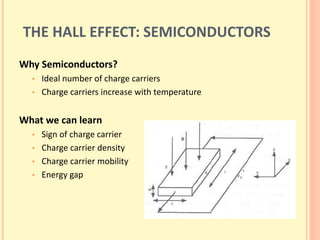
•Hall voltage is produced by charge accumulation on sidewalls
•Charge accumulation balances Lorentz Force
•Charge accumulation increases resistance
THE HALL EFFECT: SEMICONDUCTORS
Why Semiconductors?
• Ideal number of charge carriers
• Charge carriers increase with temperature
What we can learn
• Sign of charge carrier
• Charge carrier density
• Charge carrier mobility
• Energy gap
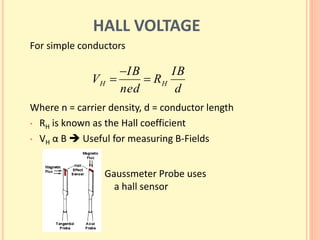
HALL VOLTAGE

VH 
IB
ned
 RH
IB
d
For simple conductors
Where n = carrier density, d = conductor length
• RH is known as the Hall coefficient
• VH α B  Useful for measuring B-Fields
Gaussmeter Probe uses
a hall sensor
HALL COEFFICIENT
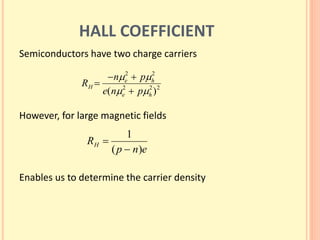
Semiconductors have two charge carriers
However, for large magnetic fields
Enables us to determine the carrier density

RH 
ne
2
 ph
2
e(ne
2
 ph
2
)2

RH 
1
(p  n)e
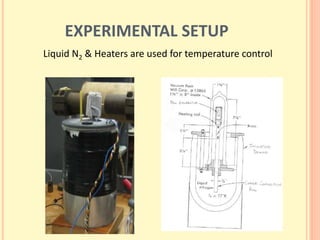
EXPERIMENTAL SETUP
Liquid N2 & Heaters are used for temperature control
NEW EXPERIMENTAL SETUP
Motivation
Old automated system inadequate
• Previous groups frustrated with results
Goal
Create new DAQ+LabVIEW system
• More reliable measurements
• Easy user interface
• Easy data collection
Measure
• Hall Voltage
• Current through Semiconductor
• Temperature
• Magnetic Field
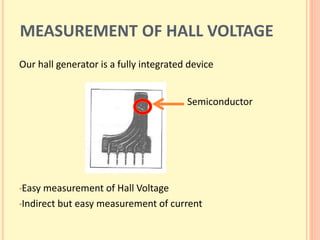
MEASUREMENT OF HALL VOLTAGE
Our hall generator is a fully integrated device
•Easy measurement of Hall Voltage
•Indirect but easy measurement of current
Semiconductor
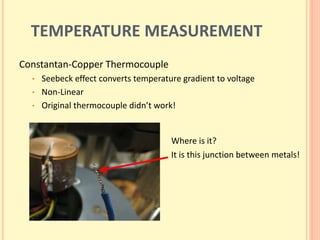
TEMPERATURE MEASUREMENT
Constantan-Copper Thermocouple
• Seebeck effect converts temperature gradient to voltage
• Non-Linear
• Original thermocouple didn’t work!
Where is it?
It is this junction between metals!
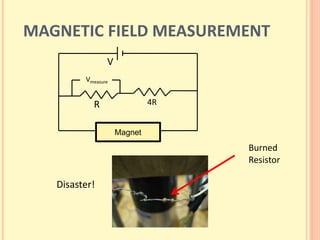
MAGNETIC FIELD MEASUREMENT
R
Magnet
Disaster!
4R
V
Vmeasure
Burned
Resistor
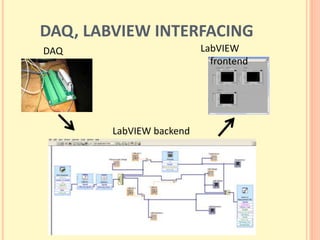
DAQ, LABVIEW INTERFACING
DAQ
LabVIEW backend
LabVIEW
frontend
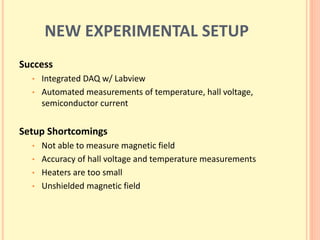
NEW EXPERIMENTAL SETUP
Success
• Integrated DAQ w/ Labview
• Automated measurements of temperature, hall voltage,
semiconductor current
Setup Shortcomings
• Not able to measure magnetic field
• Accuracy of hall voltage and temperature measurements
• Heaters are too small
• Unshielded magnetic field
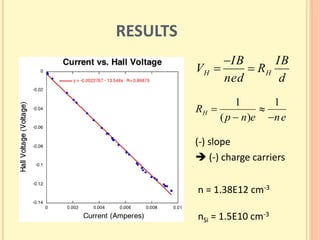
RESULTS
n = 1.38E12 cm-3
nSi = 1.5E10 cm-3

VH 
IB
ned
 RH
IB
d

RH 
1
(p  n)e

1
ne
(-) slope
 (-) charge carriers
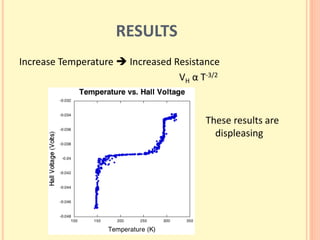
RESULTS
Increase Temperature  Increased Resistance
VH α T-3/2
These results are
displeasing
RESULTS
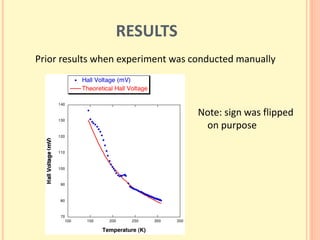
Prior results when experiment was conducted manually
Note: sign was flipped
on purpose
THANK YOU FOR WATCHING

THE HALL EFFECT

  • 1.
  • 2.
    HALL EFFECT: THEDISCOVERY Discovered by Edwin Hall in 1879. Quantum Hall Effect discovered in 1975
  • 3.
    THE HALL EFFECT LorentzForce: F = q[E + (v x B)] •Hall voltage is produced by charge accumulation on sidewalls •Charge accumulation balances Lorentz Force •Charge accumulation increases resistance
  • 4.
    THE HALL EFFECT:SEMICONDUCTORS Why Semiconductors? • Ideal number of charge carriers • Charge carriers increase with temperature What we can learn • Sign of charge carrier • Charge carrier density • Charge carrier mobility • Energy gap
  • 5.
    HALL VOLTAGE  VH  IB ned RH IB d For simple conductors Where n = carrier density, d = conductor length • RH is known as the Hall coefficient • VH α B  Useful for measuring B-Fields Gaussmeter Probe uses a hall sensor
  • 6.
    HALL COEFFICIENT Semiconductors havetwo charge carriers However, for large magnetic fields Enables us to determine the carrier density  RH  ne 2  ph 2 e(ne 2  ph 2 )2  RH  1 (p  n)e
  • 7.
    EXPERIMENTAL SETUP Liquid N2& Heaters are used for temperature control
  • 8.
    NEW EXPERIMENTAL SETUP Motivation Oldautomated system inadequate • Previous groups frustrated with results Goal Create new DAQ+LabVIEW system • More reliable measurements • Easy user interface • Easy data collection Measure • Hall Voltage • Current through Semiconductor • Temperature • Magnetic Field
  • 9.
    MEASUREMENT OF HALLVOLTAGE Our hall generator is a fully integrated device •Easy measurement of Hall Voltage •Indirect but easy measurement of current Semiconductor
  • 10.
    TEMPERATURE MEASUREMENT Constantan-Copper Thermocouple •Seebeck effect converts temperature gradient to voltage • Non-Linear • Original thermocouple didn’t work! Where is it? It is this junction between metals!
  • 11.
  • 12.
    DAQ, LABVIEW INTERFACING DAQ LabVIEWbackend LabVIEW frontend
  • 13.
    NEW EXPERIMENTAL SETUP Success •Integrated DAQ w/ Labview • Automated measurements of temperature, hall voltage, semiconductor current Setup Shortcomings • Not able to measure magnetic field • Accuracy of hall voltage and temperature measurements • Heaters are too small • Unshielded magnetic field
  • 14.
    RESULTS n = 1.38E12cm-3 nSi = 1.5E10 cm-3  VH  IB ned  RH IB d  RH  1 (p  n)e  1 ne (-) slope  (-) charge carriers
  • 15.
    RESULTS Increase Temperature Increased Resistance VH α T-3/2 These results are displeasing
  • 16.
    RESULTS Prior results whenexperiment was conducted manually Note: sign was flipped on purpose
  • 17.
    THANK YOU FORWATCHING

Editor's Notes

  • #2 Note: This presentation was created in powerpoint 2008, so it was created as .pptx. It is best when viewed in powerpoint 2007/2008. Otherwise, a lot of the formatting may screw up