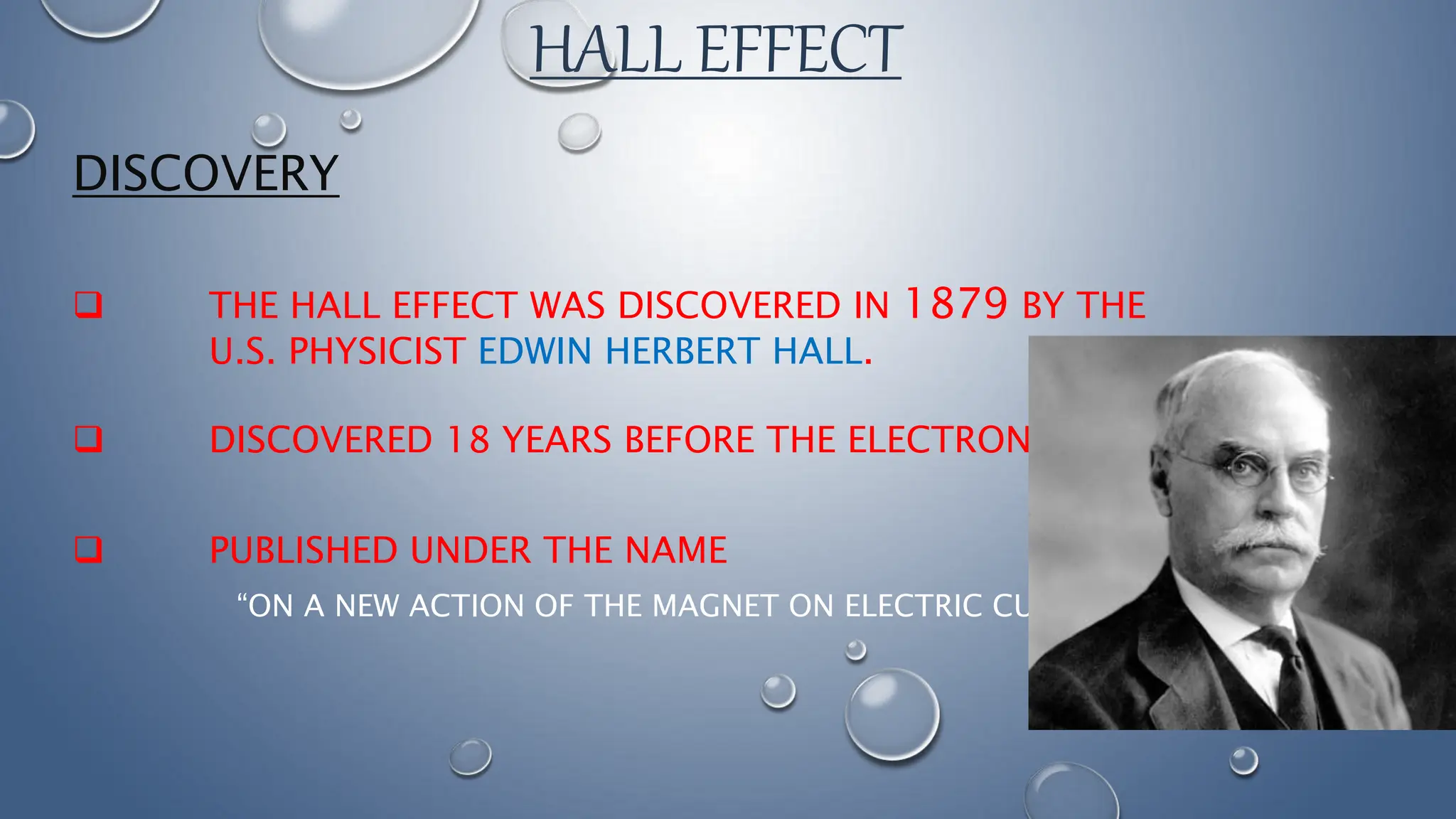
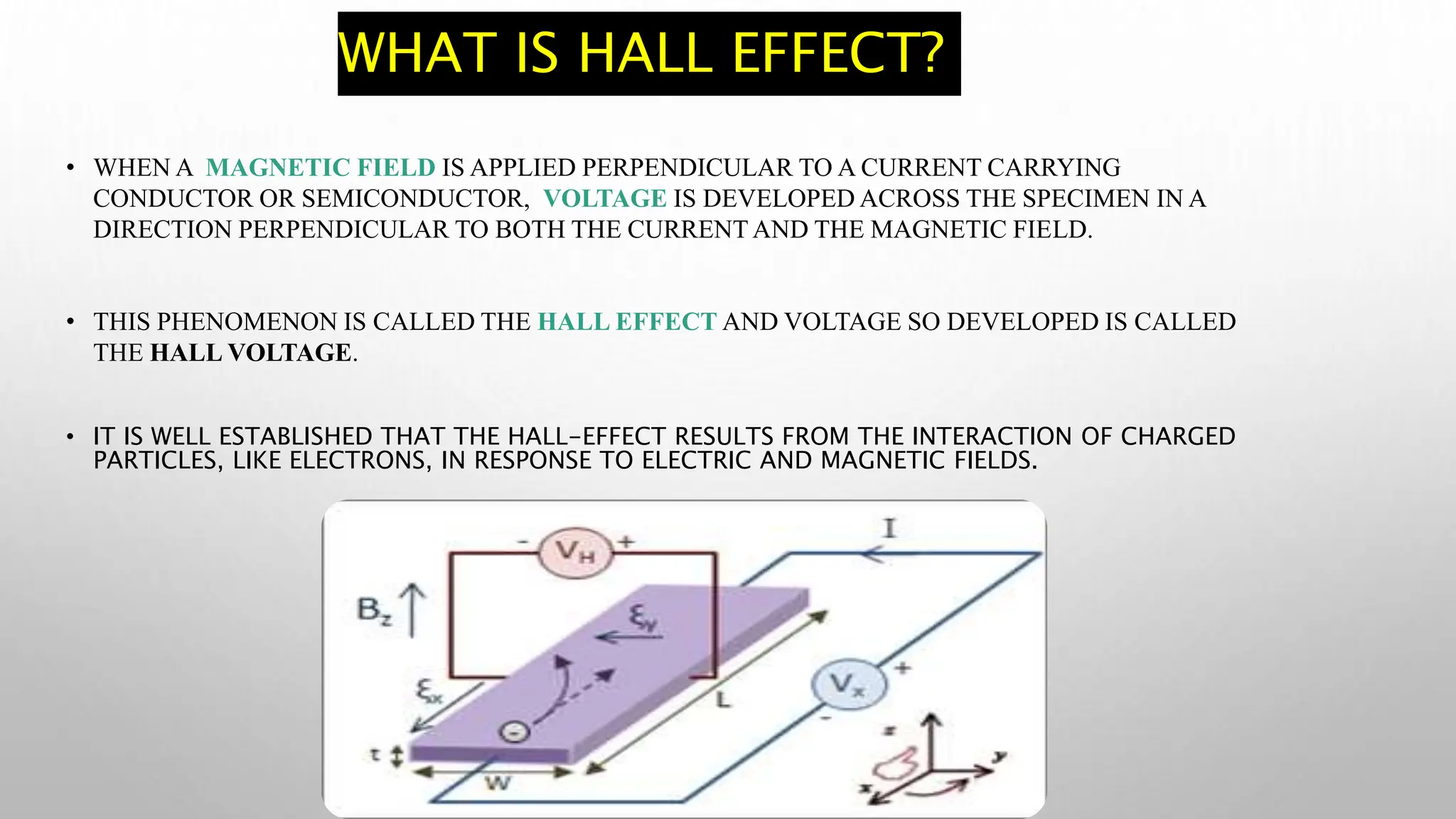
The Hall effect, discovered by Edwin Hall in 1879, describes the generation of a voltage across a conductor when a magnetic field is applied perpendicular to the flow of electric current. This phenomenon occurs due to the Lorentz force acting on charged particles, resulting in the development of Hall voltage. It is notably utilized in p-type semiconductors where the movement of positive charge carriers enables the measurement of magnetic fields through devices such as Hall sensors.