
Talim Mutaallim(1)Slideshare
•Download as PPT, PDF•
4 likes•2,576 views

Powerpoint presentation in the 2nd lesson (intermediate Islam) course on "Learning how to learn".

Recommended
Recommended
More Related Content
What's hot
What's hot (20)
Viewers also liked
Viewers also liked (14)
Similar to Talim Mutaallim(1)Slideshare
Similar to Talim Mutaallim(1)Slideshare (20)
More from Zhulkeflee Ismail
More from Zhulkeflee Ismail (20)
Recently uploaded
Recently uploaded (20)
Talim Mutaallim(1)Slideshare
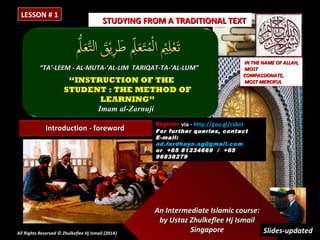
- 1. LESSON # 1 STUDYING FROM A TRADITIONAL TEXT “TA’-LEEM - AL-MUTA-’AL-LIM TARIQAT-TA-’AL-LUM” “INSTRUCTION OF THE STUDENT : THE METHOD OF LEARNING” Imam al-Zarnuji Introduction - foreword All Rights Reserved © Zhulkeflee Hj Ismail (2014) ) IN THE NAME OF ALLAH, MOST COMPASSIONATE, MOST MERCIFUL Register via - http://goo.gl/cs6nI For further queries, contact E -mail: ad.fardhayn.sg@gmail.com or +65 81234669 / +65 96838279 An Intermediate Islamic course: by Ustaz Zhulkeflee Hj Ismail Singapore Slides-updated
- 2. In the Name of Allah. The Most Compassionate, the Most Merciful. All the Praises belong to Allah, Lord (Sustainer, Cherisher) of the Worlds. Salutations of blessings and Peace be upon (Muhammad) The Noblest of the Prophets and messengers (of Allah) and upon his household and all his companions. All Rights Reserved © Zhulkeflee Hj Ismail (2014) )
- 3. AN ANALYSIS OF THE PROBLEM BESETTING THE UMMAH All Rights Reserved © Zhulkeflee Hj Ismail (2014) )
- 4. ‘ILM All Rights Reserved © Zhulkeflee Hj Ismail (2014) ) ADAB
- 5. All Rights Reserved © Zhulkeflee Hj Ismail (2014) )
- 6. External Loss of Adab (B) Internal (A) Confusion and Error in Knowledge . It is because of (A) the confusion and error in Knowledge that lead to condition for (B) The loss of Adab in the community. Both internally and externally. 6 All Rights Reserved © Zhulkeflee Hj Ismail (2014) )
- 7. (C) Rise / election of False leaders External Loss of Adab (B) Internal (A) Confusion and Error in Knowledge Figure 1 The condition arising out of (A) and (B) is: (C) “The rise of leaders who are not qualified for valid leadership of the Muslim Community, who do not possess the high moral, intellectual and spiritual standards required for Islamic leadership..” 7 All Rights Reserved © Zhulkeflee Hj Ismail (2014) )
- 8. (C) Rise / election of False leaders External Loss of Adab (B) Internal (A) Confusion and Error in Knowledge [1] [2] “These false leaders then usurped Islamic leadership, who (then) perpetuate the condition in (A) [1] above and ensure the continued control of the affairs of the Community by leaders like them who dominate in all fields.” [2] The loss of Adab in the community. Thus restoration of Adab has higher priority for Adab precedes even learning. Wan Mohd Nor Wan Daud’s “The Educational Philosophy and Practice of Syed Muhammad Naquib Al-Attas” (ISTAC publication 1998) p 74 8 All Rights Reserved © Zhulkeflee Hj Ismail (2014) )
- 9. (C) Rise / election of False leaders External Loss of Adab (B) Internal (A) Confusion and Error in Knowledge “This state of perpetual confusion at all levels of societal leadership is ingeniously termed by al-Attas as the loss of adab. The loss of Adab in the community. Thus restoration of Adab has higher priority for Adab precedes even learning. Wan Mohd Nor Wan Daud’s “The Educational Philosophy and Practice of Syed Muhammad Naquib Al-Attas” (ISTAC publication 1998) p 74 [1] [2] 9 All Rights Reserved © Zhulkeflee Hj Ismail (2014) )
- 10. With the “loss of Adab”, even the knowledge of who the true leaders and scholars is lost, and the confusion compounded. Actually this confusion in knowledge can be corrected through Education. Yet, education in man cannot be truly done without his having basic “Adab” itself. Thus the importance of restoring the “Adab” in every Muslim. It may even have to begin by correcting their misuse of “terms” (istilah) and clarifying wrongly assumed “definition” (ta’rifat) that may have caused whatever misunderstandings. 10 All Rights Reserved © Zhulkeflee Hj Ismail (2014) )
- 11. Prof. Syed Muhammad Naquib Al-Attas : “The learned and wise among Muslims must use constant vigilance in detecting erroneous usage in language which impinges upon semantic change in major key elements and creates general confusion and error in the understanding of Islam and of its worldview.” Quote: “The Concept of Education in Islam” pp. 37-38 All Rights Reserved © Zhulkeflee Hj Ismail (2014) )
- 12. EPISTEMOLOGY Thus, perspective of Education in Islam can be defined: “... Recognition and acknowledgement, progressively instilled into man, of the proper places of things in the order of creation, such that it leads to the recognition and acknowledgement of the proper place of God in the order of being and existence.” Quoted from: “The Educational Philosophy and Practice of Syed Muhammad Naquib Al-Attas” by Wan Mohd Nor Wan Daud (ISTAC publication). In other words, it is all about – “ADAB ” All Rights Reserved © Zhulkeflee Hj Ismail (2014) )
- 13. “ …. it is very much related to the Islamic concept of Education for ADAB is recognition and acknowledgement of the Reality, and knowing of one’s place in the order of things; capable of putting the right thing in their rightful place, in their rightful manner; rendering just due to whomsoever has the right, and in our acquisition of rightful things to be in accordance with the right proportion and under the right circumstance …. It is very closely related to the Islamic concept of al-’Adl (the justice), the upholding of which leads to TAQWA (the consciousness of Allah)” Ustaz Zhulkeflee Hj Ismail – course on “Islamic Concept of Adab” All Rights Reserved © Zhulkeflee Hj Ismail (2014) )
- 14. Syed M. Naquib Al-Attas asserts is: “... to produce a good man. What is meant by good in our concept of ‘good man’? The fundamental element inherent in the concept of education in Islam is the inculcation of ‘adab’ (ta’dib), for it is ‘adab’ in the all-inclusive sense I mean, as encompassing the spiritual and material life of a man that instils the quality of goodness that is sought after. Education is what the Prophet Muhammad s.a.w. meant by Adab. TASAWWUR ISLAM All Rights Reserved © Zhulkeflee Hj Ismail (2014) )
- 15. LEST WE FORGET PERSPECTIVE FROM AN ISLAMIC WORLDVIEW TASAWWUR ISLAM All Rights Reserved © Zhulkeflee Hj Ismail (2014) )
- 16. Ta’lim ( (generally it means, “to teach” or “the teaching” of knowledge as different from information, but a profound understanding of this word requires us to know the root word “‘ilm” which is different from “ma’lumat ” Ta’allum ( ) “to learn or be taught knowledge” consider definition of knowledge ( ) . TASAWWUR ISLAM All Rights Reserved © Zhulkeflee Hj Ismail (2014) )
- 17. Tarbiyyah ( ) – although used by many Islamist to refer to education (perhaps influenced by the Western methodology), it’s use to refer to ‘education’ is not appropriate due to its narrow and limited scope when applied to the Islamic approach to education, because our Islamic worldview regarding man is unlike those from the Western outlook that still regards man as an animal specie (although evolved). TASAWWUR ISLAM All Rights Reserved © Zhulkeflee Hj Ismail (2014) )
- 18. Tarbiyyah ( ) – has the meanings “education, upbringing, breeding, raising (of animals), instruction, pedagogy, etc. From which we have term “murabbin” ( ) “educator, (as well as) breeder, tutor etc. Yet, it is too general a term and can also be applied in terms of raising, breeding and training of animals. TASAWWUR ISLAM All Rights Reserved © Zhulkeflee Hj Ismail (2014) )
- 19. Darasa ( ( – “to learn, to study under a teacher, instructor, lecturer etc. ( mudarris - Thus a school is called a “madrasah” ( ). ) TASAWWUR ISLAM All Rights Reserved © Zhulkeflee Hj Ismail (2014) )
- 20. TASAWWUR ISLAM All Rights Reserved © Zhulkeflee Hj Ismail (2014) )
- 21. “Ta’-dib” ( term ‘Adab’ ( ) – preferred term for ‘education’, from the ) meaning: – “good breeding, nurture, manners, refinement, cultured, decorum, propriety, social grace, educated, etc.” TASAWWUR ISLAM All Rights Reserved © Zhulkeflee Hj Ismail (2014) )
- 22. Hadith from Ibn Mas’ud r.a.: IN-NA HAA-DZAL – QUR-’AA-N – MA’ – DA-BA- TULLAA-HA – FIL – ARDH – FA-TA’ – LA-MUU – MIN – MA’ – DA –BA-TIH “Verily! The Qur’an is Allah’s Banquet on earth, so learn thoroughly, then, from (or of) His Banquet.” [1] [1] S.M.Naquib Al-Attas “Islam and Secularism” page 150 All Rights Reserved © Zhulkeflee Hj Ismail (2014) ) TASAWWUR ISLAM
- 23. Thus,“ Adab” in the original basic sense (in Arabic) is the “inviting to a banquet.” The idea of a banquet implies the host is a man of honour and prestige, and that many people are present; that the people who are present are those who in the host’s estimation are deserving of the honour of the invitation, and they are therefore people of refined qualities and upbringing who are expected to behave as befits their station, in speech, conduct and etiquette.” [1] [1] S.M.Naquib Al-Attas “Islam and Secularism” page 149 All Rights Reserved © Zhulkeflee Hj Ismail (2014) ) TASAWWUR ISLAM
- 24. “From amongst the rights of a children upon their parents are, that they be instilled (to be educated by them) with Adab and to be given a good name.” (Hadith of the Prophet s.a.w. reported by Baihaqy from Ibnu ‘Abbas r.a.) TASAWWUR ISLAM All Rights Reserved © Zhulkeflee Hj Ismail (2014) )
- 25. “Educate (nurture – ‘addibu’) your children with the best education (ADAB).” (Hadith of the Prophet s.a.w. narrated by Ibnu Majah ) TASAWWUR ISLAM All Rights Reserved © Zhulkeflee Hj Ismail (2014) )
- 26. PROPHET MUHAMMAD S.A.A.W. SAID: AD-DA-BANI – ROB-BEE - FA -AH-SA-NA – TA’ –DI-BEE “My Lord educated me, and made my education most excellent.” (Hadith) TASAWWUR ISLAM All Rights Reserved © Zhulkeflee Hj Ismail (2014) )
- 27. AD-DI-BUU -AU-LAA-DA-KUM – ‘ALAA – THA-LAA-THA- HI-SWAL, HUB-BUNA-BIY-YI-KUM, WA –HUB-BU –AA-LI –BAI-TI-HI, WA –TI-LA-WA-TIL-QUR-’AAN “Educate (nurture with Adab – ‘addibu ’) your children upon three things: To Love your Prophet (s.a.w.), and to love the Family members of his household (Aali Muhammad), and (learn) to recite Al-Qur’an.” (Hadith of the Prophet s.a.w. narrated by Tabrani) TASAWWUR ISLAM All Rights Reserved © Zhulkeflee Hj Ismail (2014) )
- 28. ‘AL-LI-MUU – AU-LAA-DA-KUM – WA – AH-LEE-KUMUL-KHAY-RA WA– AD-DI-BU HUM “ Teach your children and your family members with the best, and educate them (instil in them Adab).” ((Hadith of the Prophet s.a.w. reported by ‘Abdur Razaq and Sa’id ibn Manshur as quoted by Dr. ‘Abdullah Nashih ‘Ulwan) TASAWWUR ISLAM All Rights Reserved © Zhulkeflee Hj Ismail (2014) )
- 29. MAA- NA–HALA – WAA-LI-DUN - WA –LA-DAN MIN – NUH-LIN – AF-DWA-LA – MIN – A-DA-BIN - HASAN “There is no gift (that you can give) to your children better than (instilling in them) the good Adab.” (Hadith of the Prophet reported by Tirmidzi ) TASAWWUR ISLAM All Rights Reserved © Zhulkeflee Hj Ismail (2014) )
- 30. AK-RI-MUU – AU-LAA-DA-KUM – WA– AH-SI-NUU –A-DA-BA-HUM. “Honour your children by (educating) instilling in them the best Adab.” (Hadith of the Prophet s.a.w. reported by Ibnu Majah from Ibnu ‘Abbas r.a.) TASAWWUR ISLAM All Rights Reserved © Zhulkeflee Hj Ismail (2014) )
- 31. “THE SIGN OF THE TRULY LEARNED IS HUMILITY IN THE PRESENCE OF THE ALLKNOWING – WHILE THE HEEDLESS AND ARROGANT MAY BREACH THE ADAB” TASAWWUR ISLAM All Rights Reserved © Zhulkeflee Hj Ismail (2014) )
- 32. NOW TO PROCEED … All Rights Reserved © Zhulkeflee Hj Ismail (2014) )
- 33. E H T K O O B TA’-LEEM - AL-MUTA-’AL-LIM TARIQAT-TA-’AL-LUM ORIGINALLY WRITTEN BY AL-IMAM SHEIKH TAJUDDIN NU’MAN IBN IBRAHIM IBN AL-KHALIL ZARNUJI (MAY ALLAH REWARD AND BLESS HIM) ENGLISH TRANSLATION OF THIS TRADITIONAL BOOK, BY G.E. VON GRUNEBAUM AND THEODORA M. ABEL THE STARLATCH PRESS CHICAGO. All Rights Reserved © Zhulkeflee Hj Ismail (2014) )
- 34. The foreword written by: Sheikh Hamza Yusuf Hanson “In traditional learning circles, the preface or forward of scholars, commentators, annotators etc. placed as addendum to the classical text being studied, are not to be neglected – as these may help to even place us in the proper frame and approach; forewarns us of certain aspects; highlighting to us important background and overview; especially linking what is in the text with relevant contemporary circumstances ..... Remember and be grateful, for it is there to illuminate and not merely to decorate. ” Zhulkeflee Hj Ismail “AN-NASEEHAH” All Rights Reserved © Zhulkeflee Hj Ismail (2014) )
- 35. Islamic community is one rooted in the concept of “Adab”, which usually is glossed by translator as “courtesy.” But indeed, it is much more profound in its scope. “Adab” also signifies “erudition”, and in certain academic context, as “humanities” – “discipline” The man of letters is one who puts words in their proper place, and this nuance resides in the essence of the word “Adab” All Rights Reserved © Zhulkeflee Hj Ismail (2014) )
- 36. In Arabic language, the imperative or command mood is the same as the mood used for requests without any difference other than the tone of voice of the person giving the command or making the request. Arabic grammarians remark that the difference is whether the one employing the mood is over or under the one being commanded or requested, i.e. Whether on is in position of authority or subject to authority. What this implies is that people are aware of their place in a hierarchy. All Rights Reserved © Zhulkeflee Hj Ismail (2014) )
- 37. We now live in a time when “hierarchy” is a tabooed word. The idea of one being over another is an anathema to modern man...... But to the ancients, this was a sign of good breeding (upbringing). After all, how could a pious scholar be equated with an ignorant man? As Allah s.w.t. says: Say: "Are they the same - those who know and those who do not know?” (Q: Az-Zumar: 39:9) All Rights Reserved © Zhulkeflee Hj Ismail (2014) )
- 38. Our Prophet Muhammad s.a.w. said: This does not negate another Hadith which he said: “people are equal like the teeth of the comb.” Before the Shari’ah, all people are equal, but in their accomplishment and divine success (Tawfiq), they differ markedly. And should such differences ever cease, then humanity is endangered. All Rights Reserved © Zhulkeflee Hj Ismail (2014) )
- 39. Our Prophet Muhammad s.a.w. said: This profound Hadith implies that the leveling of accomplishments, knowledge, talents in a society, by its very nature, is a sign that excellence is removed from human works. This is the modern age of nihilistic All Rights Reserved © Zhulkeflee Hj Ismail (2014) ) * leveling.
- 40. ADDITIONAL NOTES Nihilism * has been defined as: “belief in nothing as opposed to the absence of belief.” [1] Being divorced from conventional norms of virtue, value, or morality, such an idea is bound to manifest itself in a destructive cynicism. As nihilism evolved into a political idea, primarily in 19th Century Czarist Russia, its inherent destructiveness was to be gradually actualized. [1] Roger Scruton, A Dictionary of Political Thought (New York: Hill and Wang, 1982), p. 324. All Rights Reserved © Zhulkeflee Hj Ismail (2014) )
- 41. ADDITIONAL NOTES The essence of that actualization is captured by Roger Scruton in his comments on Bakunin’s, The Revolutionary Catechism: “The basic idea was that, since society is founded on lies, and all moral, religious and humanitarian beliefs are just instruments of concealment, all beliefs and values must be torn down and the disposition to hope and worship be eliminated, so that the world could be seen as it really is.” [2] [2] Roger Scruton, A Dictionary of Political Thought (New York: Hill and Wang, 1982), p. 324. All Rights Reserved © Zhulkeflee Hj Ismail (2014) )
- 42. ADDITIONAL NOTES This defining characteristic, informs the assessment of Dr. Cornel West in his popular work, Race Matters. He says: “Nihilism is to be understood here not as a philosophical doctrine that there is no rational ground for legitimate standards of authority; it is, far more, the lived experience of coping with a life of horrifying meaninglessness, hopelessness, and loveless-ness. The frightening result is the numbing detachment from others and a self-destructive disposition towards the world. Life without meaning, hope, and love breeds a cold-hearted, mean-spirited outlook that destroys both the individual and others.” [3] [3] Dr. Cornel West, Race Matters (New York: Vintage Books, 2001), 22-23.. All Rights Reserved © Zhulkeflee Hj Ismail (2014) )
- 43. Excellence is removed from our schools by dumbing down of students and levelling them to functional illiterates. It (excellence) is removed from our politics because those chosen to lead are mainly those who covet it (i.e. leadership) and not those who are morally, intellectually, and spiritually qualified for office. At the root of Islamic tradition, however, there is “Adab”, and at the root of “Adab” is knowledge (‘ilm) acquired painstakingly at the hands of those who know. All Rights Reserved © Zhulkeflee Hj Ismail (2014) )
- 44. Muslims, unlike many modern non-Muslim relativists, believe that knowledge is not only absolute but is a gift from God to man, beginning with the first man and continuing until today in an unbroken chain of prophetic dispensations (‘ulum al-deen). What behoves men and women of every generation is to learn this knowledge and exert themselves to the utmost in order to understand it and apply it in the context of their society and its particular needs. All Rights Reserved © Zhulkeflee Hj Ismail (2014) )
- 45. To learn this knowledge- which in itself leads to adab (or proper comportment) with Allah, His Messenger, and Allah’s creation- one requires a modicum of adab at the outset. This is the core subject of this book: what a teacher and a student need to know in order to render fruitful the process of learning and teaching. In reality, it is Allah who is the true Teacher; and both the mortal teacher and student are indeed learners on a shared journey. All Rights Reserved © Zhulkeflee Hj Ismail (2014) )
- 46. For the Muslim, knowledge is not ultimately taken from men but from the Maker of men and from His beloved Prophet s.a.w, who is a man but not like other men, in the same way a ruby is a stone but not like other stones. In the early history of Islam, the men and women of sacred knowledge were able to take directly from the sacred texts of the Quran and Hadith without recourse to others except for the purpose of ascertaining the veracity of the transmission of the Prophet’s statements and to learn the primary texts. All Rights Reserved © Zhulkeflee Hj Ismail (2014) )
- 47. As time passed, spiritual aspirations waned and people lost the ability to even master the vehicle of the Arabic language to a level that enabled one to fully understand the texts. As such, knowledge became codified in secondary and then tertiary texts, and men became keys to understanding those texts. There is something deeply unsatisfying about studying secondary texts, and, even worse, tertiary texts. All Rights Reserved © Zhulkeflee Hj Ismail (2014) )
- 48. Children who are at the first stage of learning mathematical symbols cannot read Euclid’s Elements. Similarly, a child learning basic vocabulary cannot jump directly to understanding Shakespeare’s sonnets. The Arabs say, “The food of adults is poison when given to children.” We are indeed spiritual and intellectual children, and until we mature through learning and mastering our own tradition, we cannot safely trust ourselves to delve into primary texts for other than blessings and moral guidance. All Rights Reserved © Zhulkeflee Hj Ismail (2014) )
- 49. Legal guidance taken directly from texts is only permissible when one has reached the highest level of intellectual mastery in the Islamic scholarly tradition. The reprinting of this book is a start in that direction and should be learned at the outset of one’s journey. I personally first read this text as a young student of sacred law in the United Arab Emirates over eighteen years ago and took it with me on my journey to the land of Chinqit and the Maghrib to study with men who embodied its meanings. All Rights Reserved © Zhulkeflee Hj Ismail (2014) )
- 50. I still read it from time to time and am reminded of its permanent relevance to the lifelong learner, which is, in fact, one of the defining characteristics of being a Muslim. Our Prophet s.a.w. said: “Learning is from the cradle to the grave,” We are only recently coming to understand the profound implications of that statement in light of recent neurological breakthroughs concerning how the brain learns from the outset of birth until death when the proper stimuli for learning are given. All Rights Reserved © Zhulkeflee Hj Ismail (2014) )
- 51. Our Muslim nation (ummah) is suffering from ignorance and nothing more. Ignorance, moreover, is a permanent status if adab is lost. In the West, scholars are still honoured with endowments to continue their research unfettered by the concerns of such mundane things as rent and the price of onions. Unfortunately, in the Muslim world, some of our greatest scholars are impoverished and forced to take undignified jobs with tyrannical government, thus losing their freedom and their respect among the people. All Rights Reserved © Zhulkeflee Hj Ismail (2014) )
- 52. Endowments ( sing. Waqf ) that once acted as social security for students and teachers all over the Muslim world have been usurped by the ministries of endowments ( awqaf ). Our madrasahs are now museums; our teachers are mere employees; and our students of sacred law no longer come from the intellectually gifted sons and daughters of our community but rather from uneducated families motivated by the possibility of securing the job of Imam in a government masjid All Rights Reserved © Zhulkeflee Hj Ismail (2014) )
- 53. This is often coupled with a mentality if extreme poverty and a crude desire for the empty stuff of this world. Our Prophet s.a.w. said: “True wealth is the wealth of the soul.” All Rights Reserved © Zhulkeflee Hj Ismail (2014) )
- 54. There is no doubt that in order to maintain his dignity with Allah and then with men, a scholar must have a rich soul with no dependencies on man. On the other hand, our Prophet s.a.w. said: “Poverty is nearly a type of disbelief.” All Rights Reserved © Zhulkeflee Hj Ismail (2014) )
- 55. No scholar should live in poverty unless he so chooses and no student sincere in his studies should suffer the concerns of material well-being. The way out of this is two-fold: First, the teachers and students must purify their intentions and be sincere in making their pursuits purely for the sake of Allah and for the honour of His beloved Messenger’s community. All Rights Reserved © Zhulkeflee Hj Ismail (2014) )
- 56. Allah has promised that those who have piety will be provided for whence they did not expect. They must also head the advice of Sidi Ahmad Zarruq who says in his book al-i’anah,: “Never expect anything from the creation of Allah but rather expect things from the Creator, Allah.” All Rights Reserved © Zhulkeflee Hj Ismail (2014) )
- 57. All Rights Reserved © Zhulkeflee Hj Ismail (2014) )
- 58. “And whoever (is conscious of and ) fears Allah – TAQWA – He (Allah) will make for him a way out . And will provide for him from where he does not expect. And whoever relies – TAWAKKAL - upon Allah then He is sufficient for him. Indeed, Allah will accomplish His purpose. Allah has already set for everything a [decreed] extent. ” (Qur’an : Talaq : 65: 2-3) All Rights Reserved © Zhulkeflee Hj Ismail (2014) )
- 59. Second, businessmen and other people of means must reinvigorate our endowments, particularly in places where the hand of the government cannot reach and does not usurp. This is certainly the case in the West, and this book should be a starting point for the revival of this Islamic intellectual tradition that has always been the preamble to Islamic Renaissance; and we have 1400 years of history to prove this point for anyone who doubts its validity. Hamza Yusuf Hanson All Rights Reserved © Zhulkeflee Hj Ismail (2014) )
- 60. All welcome to visit my web-blog: http://an-naseehah.blogspot.com/ http://introductiontotauhid.blogspot.com/ http://oyoubelievers.blogspot.com/ http://al-amthaal.blogspot.com/ http://zhulkeflee-archive.blogspot.com/ http://criteriaforaholybook-quran.blogspot.com/ http://with-the-truthful.blogspot.com/ http ://muqaddam-nurul.blogspot.com/ All Rights Reserved © Zhulkeflee Hj Ismail (2014) ) 60