Chapter 8
Mining Additional Perspectives

 prof.dr.ir. Wil van der Aalst
 www.processmining.org
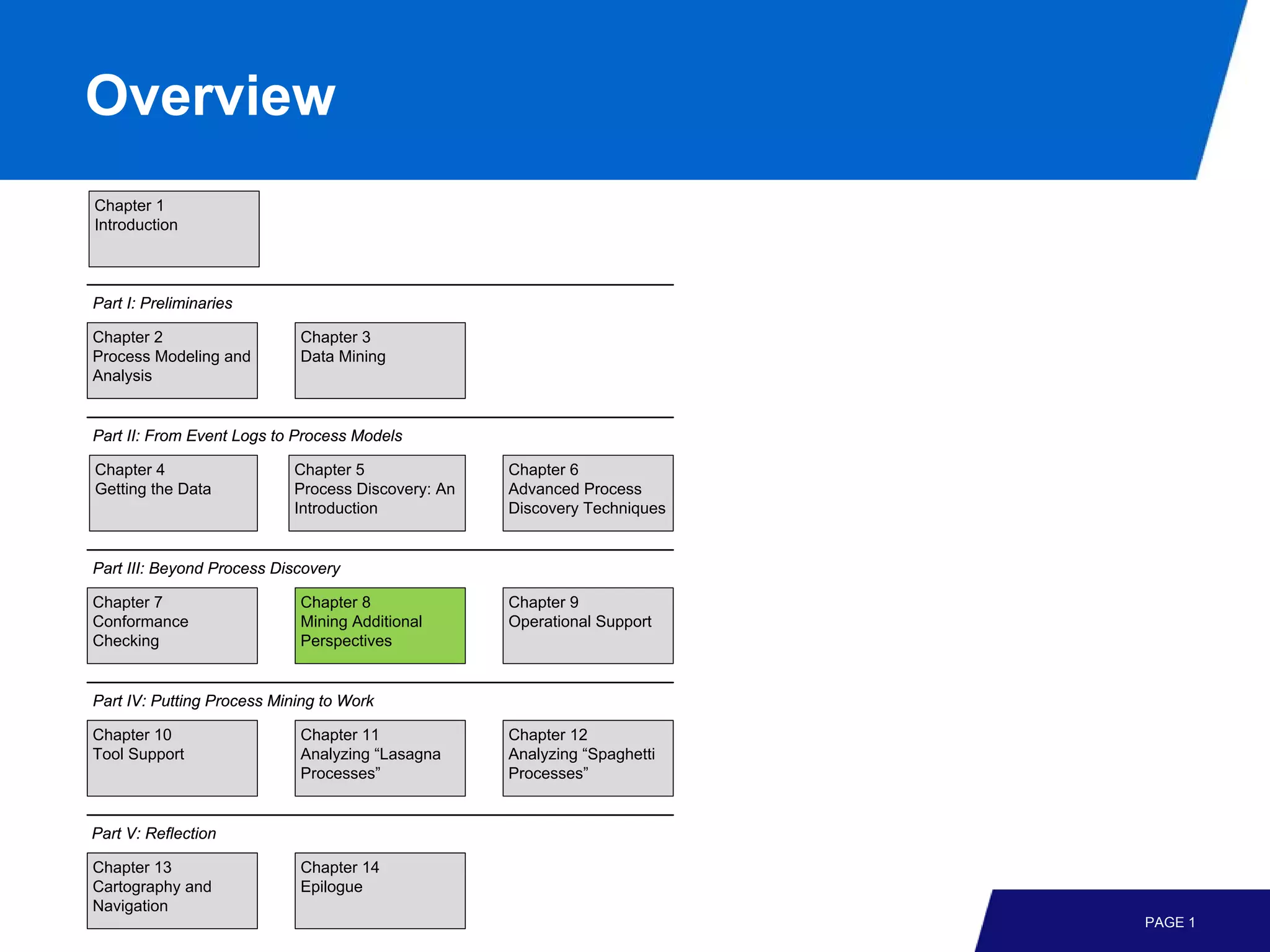
Overview
Chapter 1
Introduction


Part I: Preliminaries

Chapter 2                   Chapter 3
Process Modeling and        Data Mining
Analysis


Part II: From Event Logs to Process Models

Chapter 4                  Chapter 5               Chapter 6
Getting the Data           Process Discovery: An   Advanced Process
                           Introduction            Discovery Techniques


Part III: Beyond Process Discovery

Chapter 7                   Chapter 8              Chapter 9
Conformance                 Mining Additional      Operational Support
Checking                    Perspectives


Part IV: Putting Process Mining to Work

Chapter 10                  Chapter 11             Chapter 12
Tool Support                Analyzing “Lasagna     Analyzing “Spaghetti
                            Processes”             Processes”


Part V: Reflection

Chapter 13                  Chapter 14
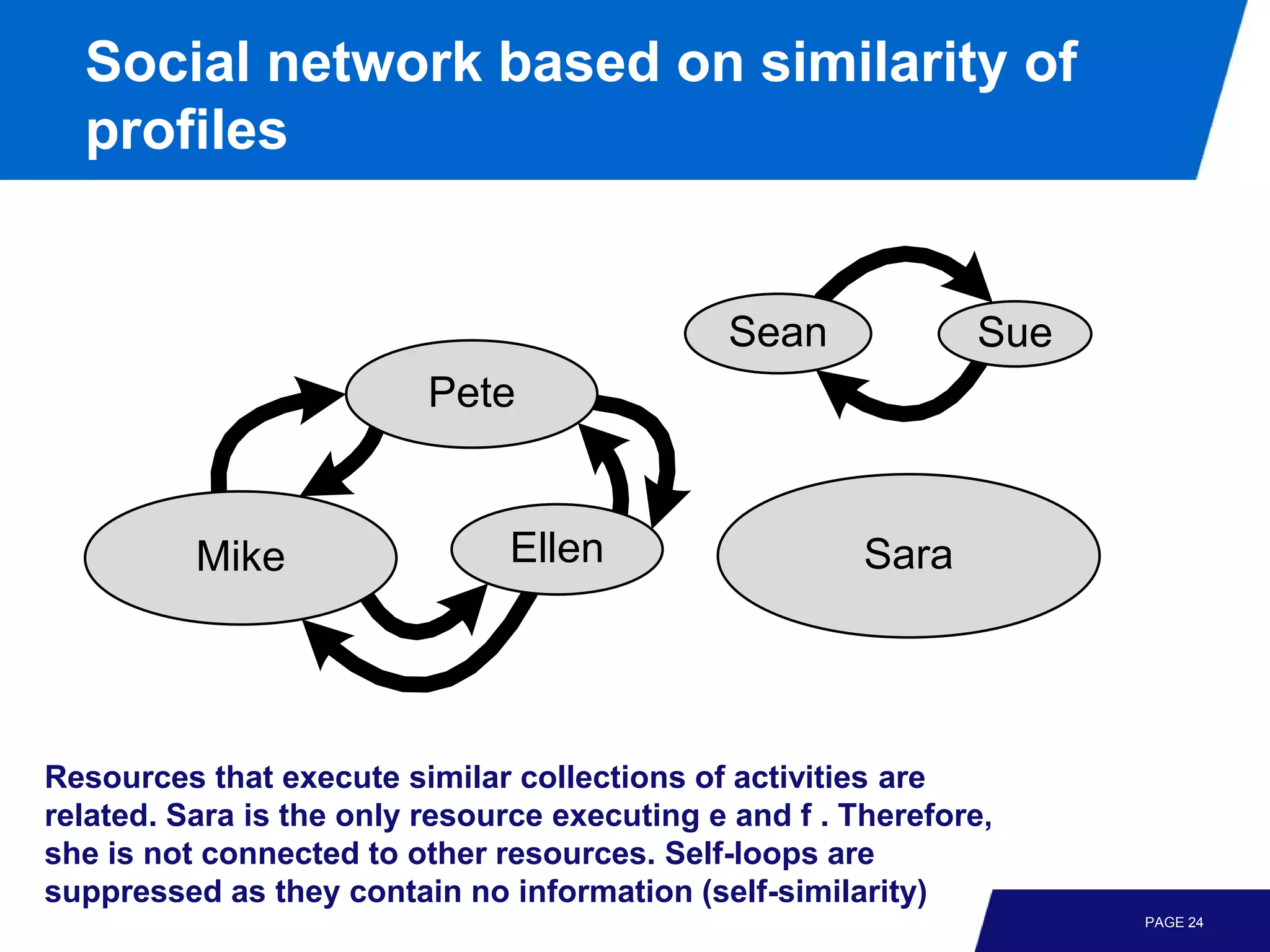
Cartography and             Epilogue
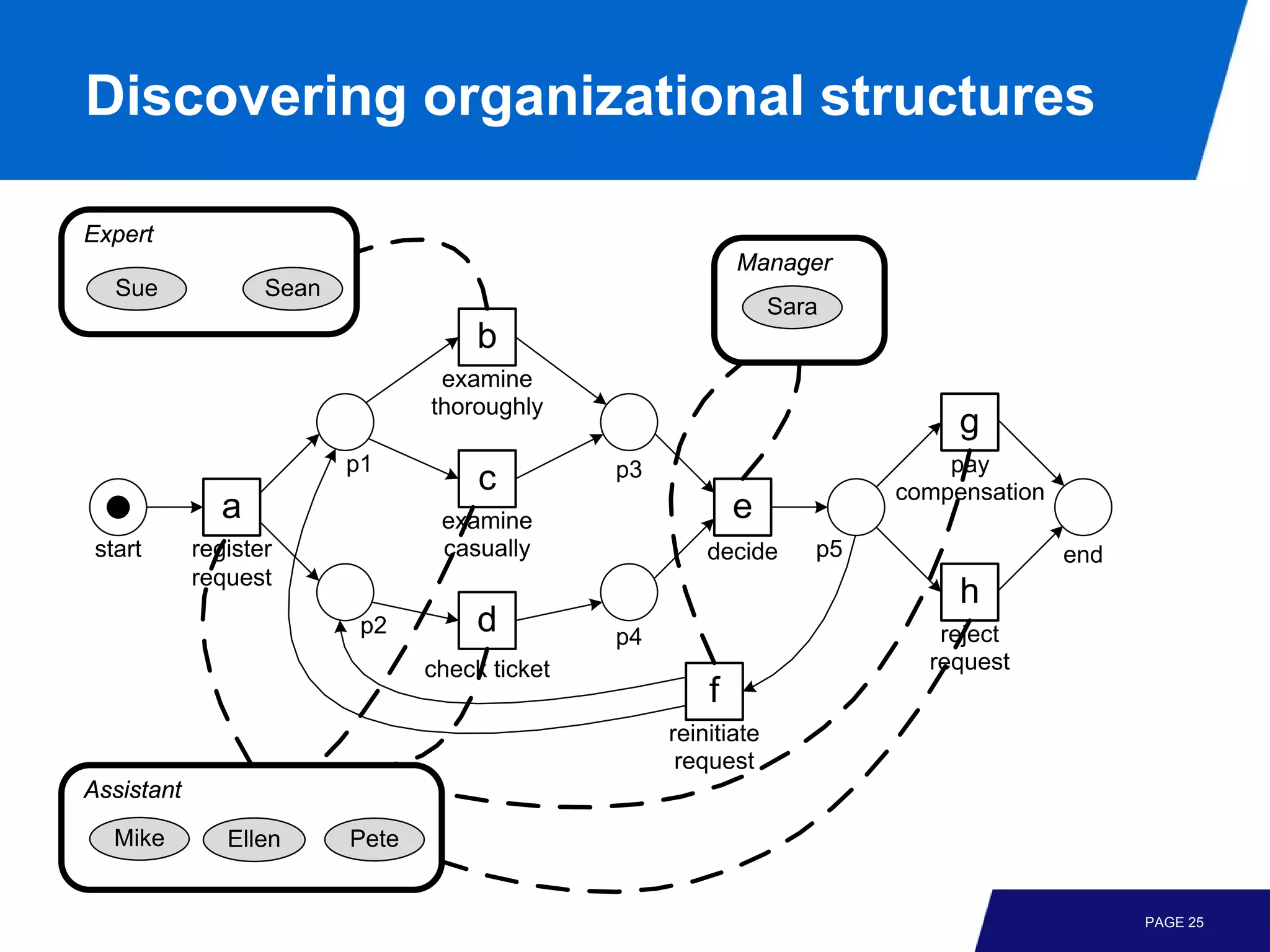
Navigation
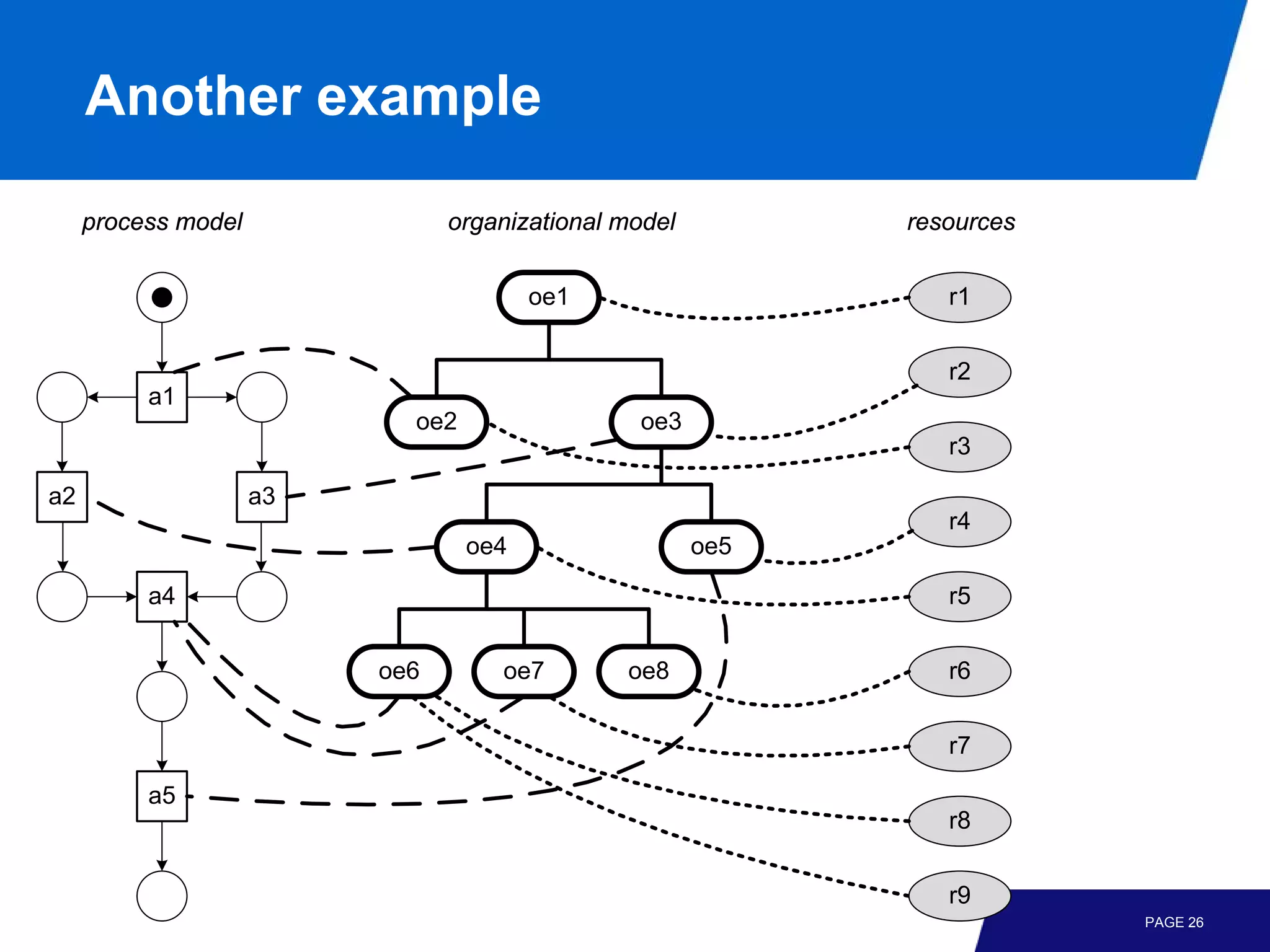
                                                                          PAGE 1
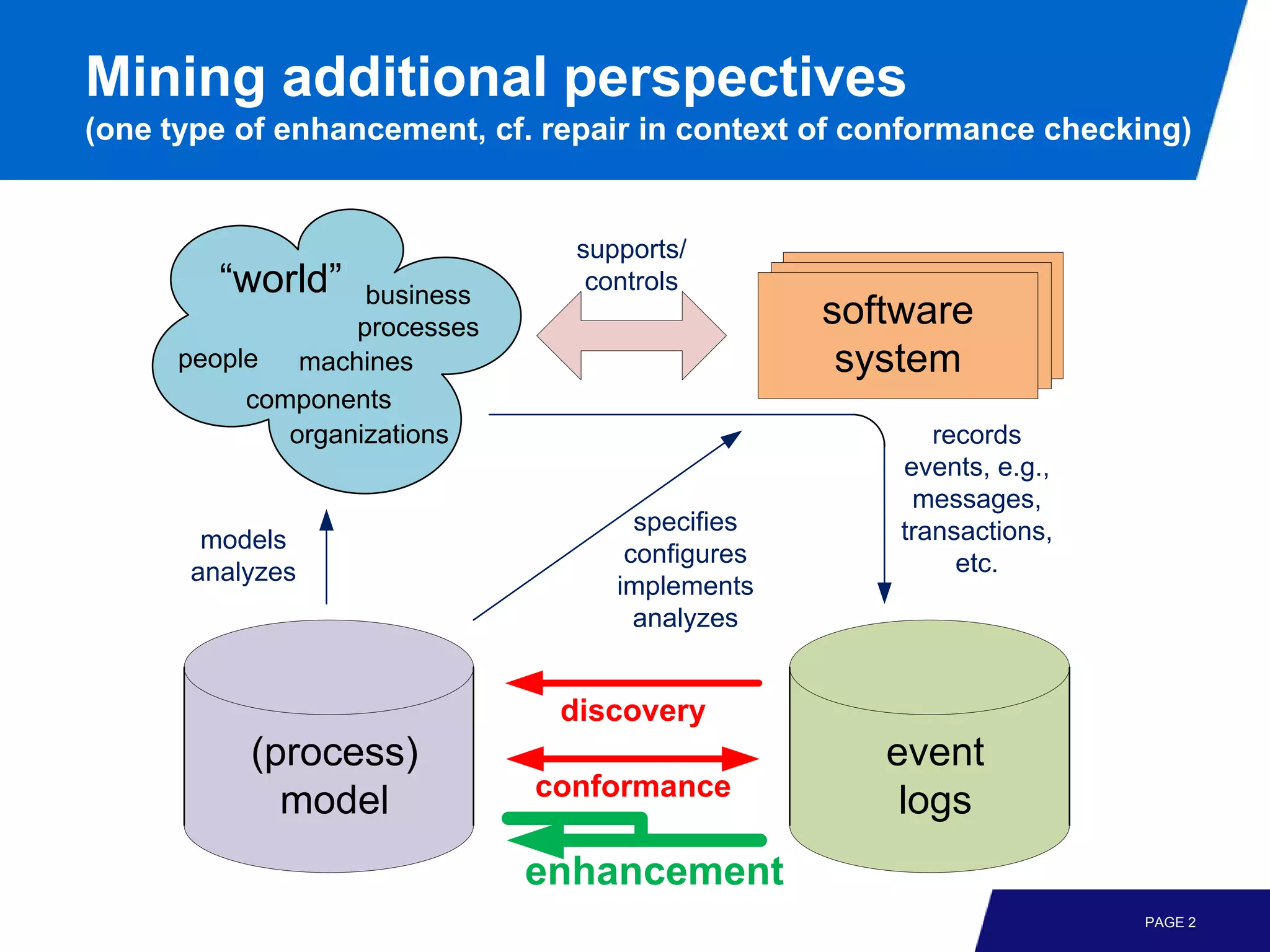
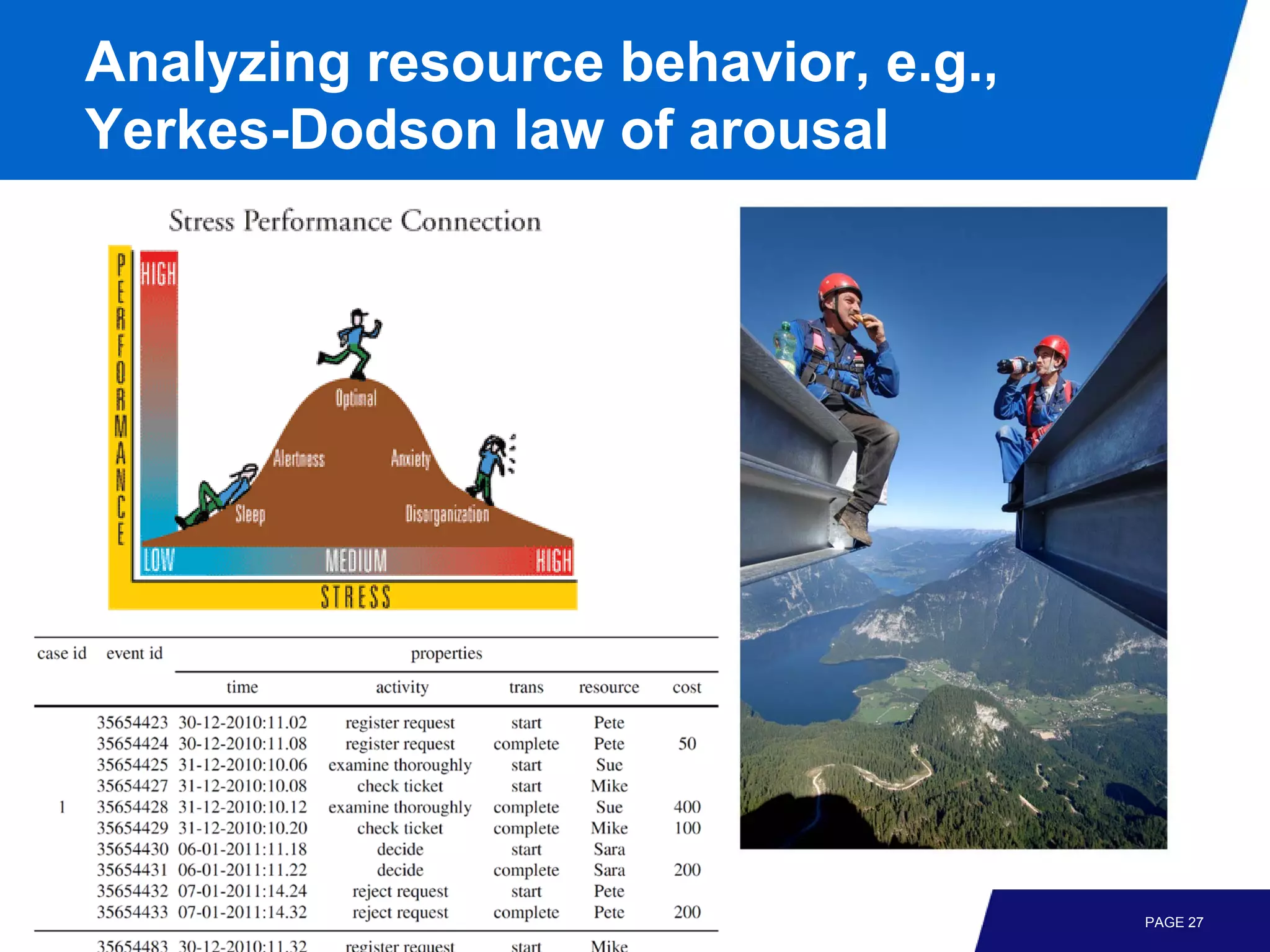
Mining additional perspectives
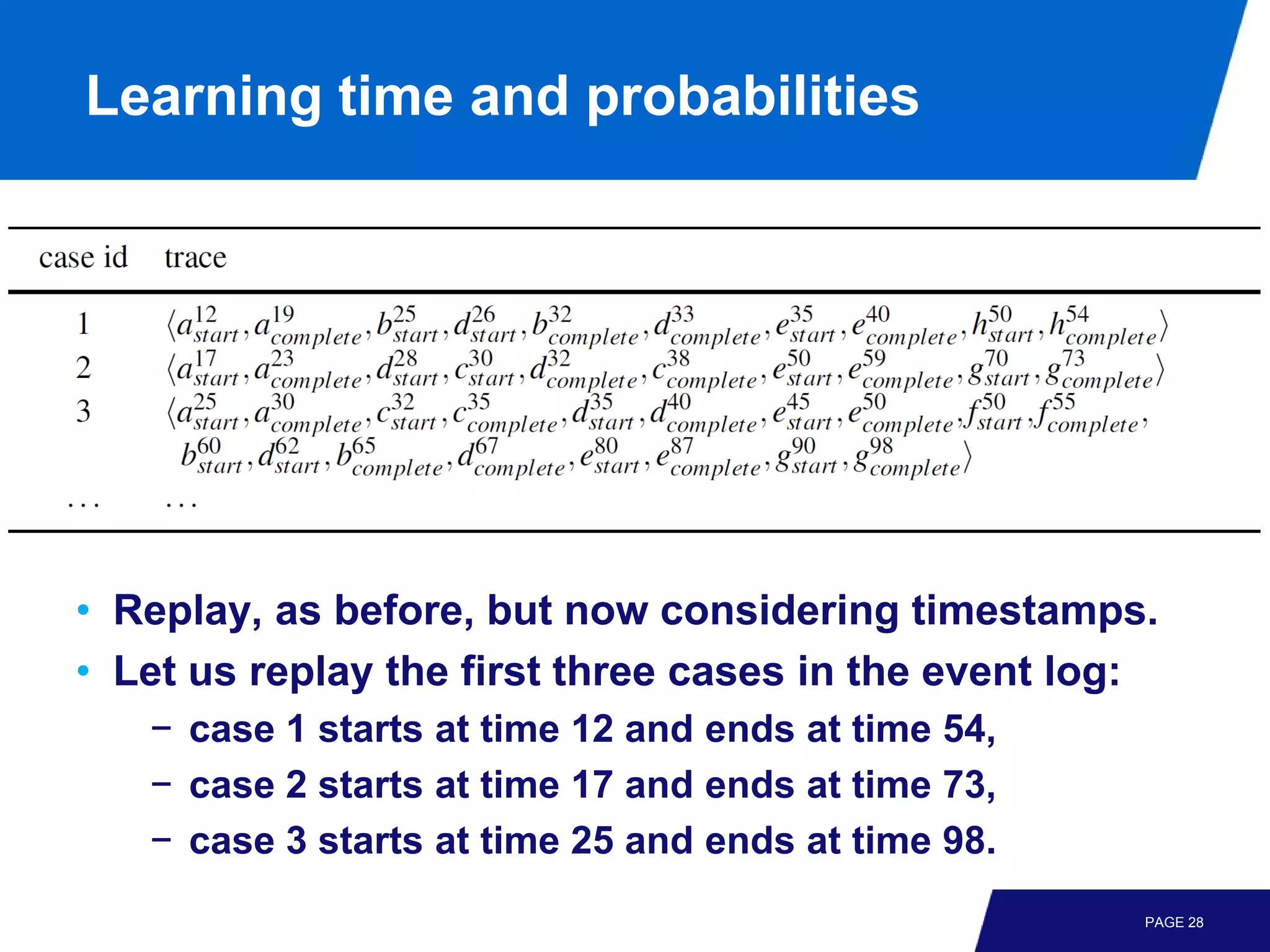
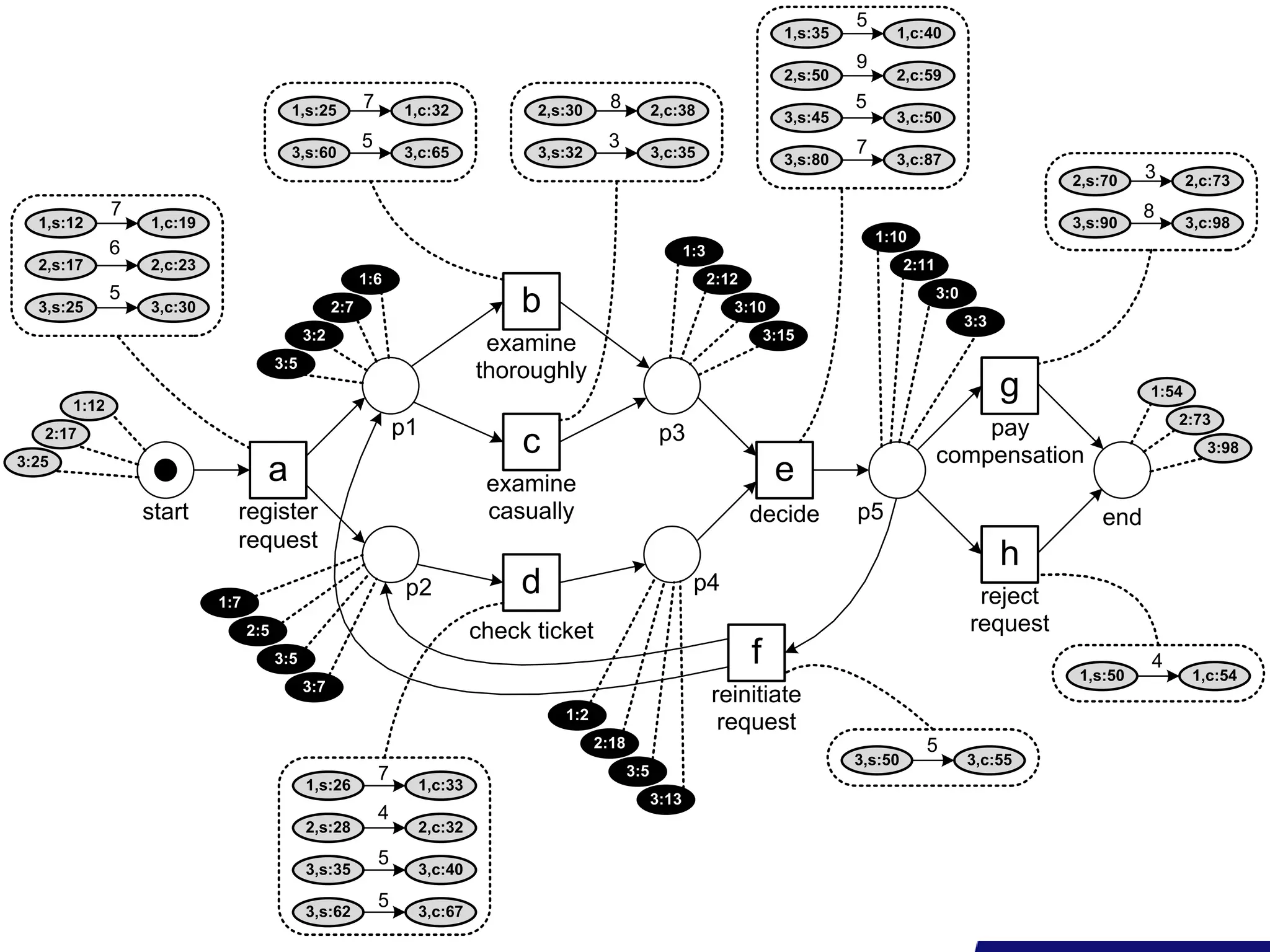
(one type of enhancement, cf. repair in context of conformance checking)


                                 supports/
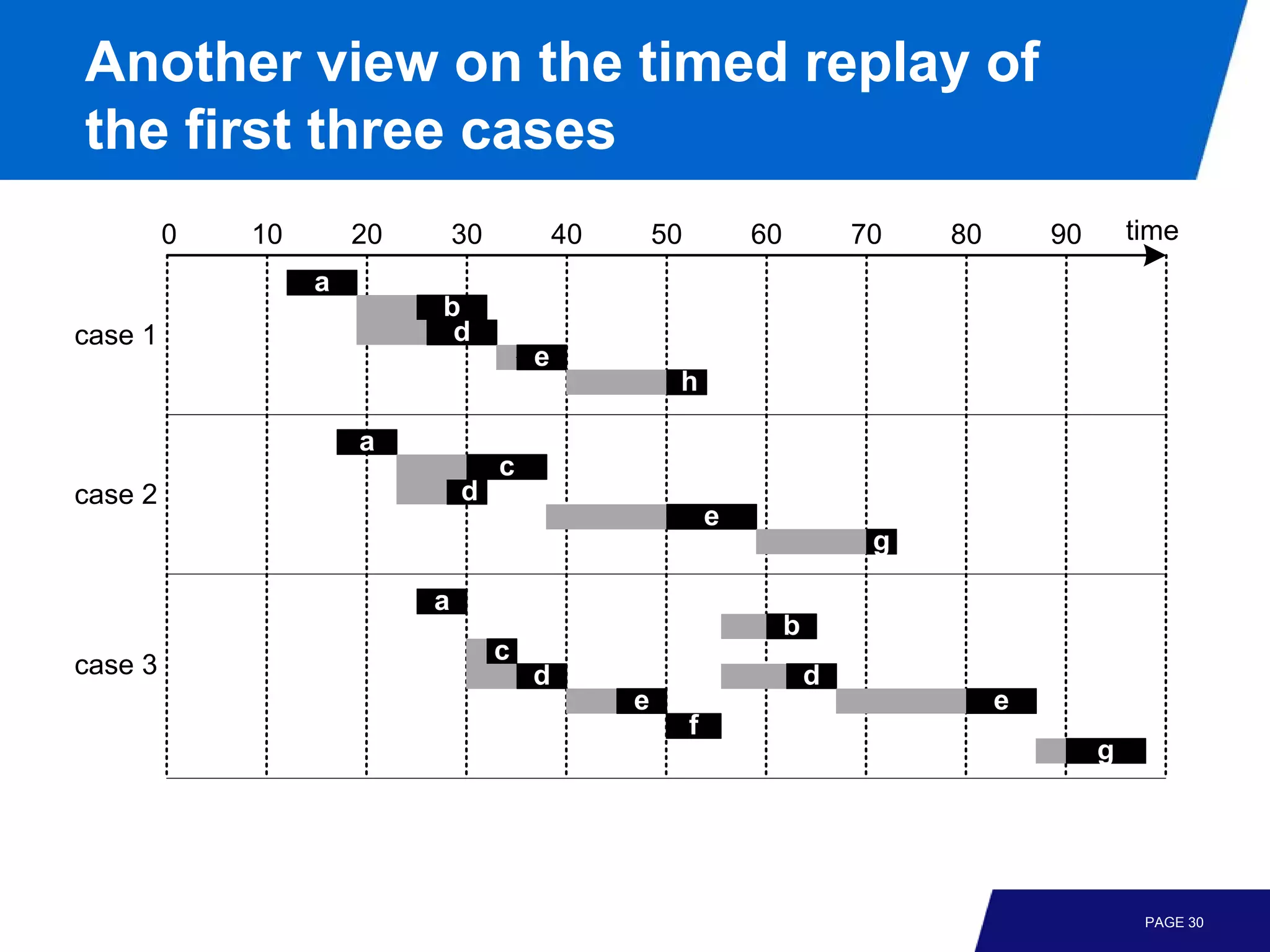
         “world”    business
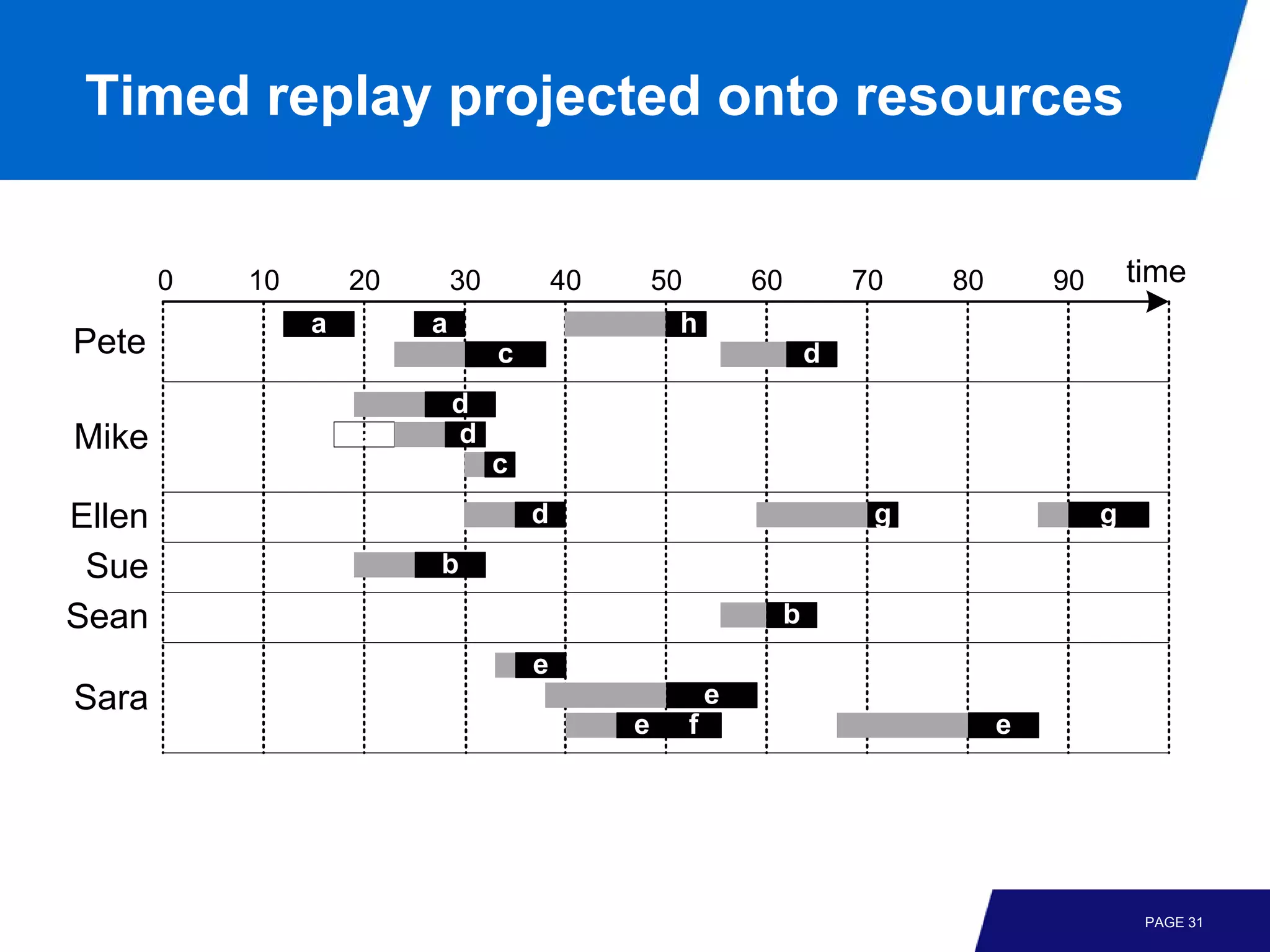
                                  controls
                   processes                      software
      people   machines                            system
           components
              organizations                              records
                                                      events, e.g.,
                                                       messages,
                                      specifies       transactions,
       models
                                     configures            etc.
      analyzes
                                    implements
                                      analyzes


                                discovery
           (process)                                 event
                               conformance
             model                                    logs
                               enhancement
                                                                      PAGE 2
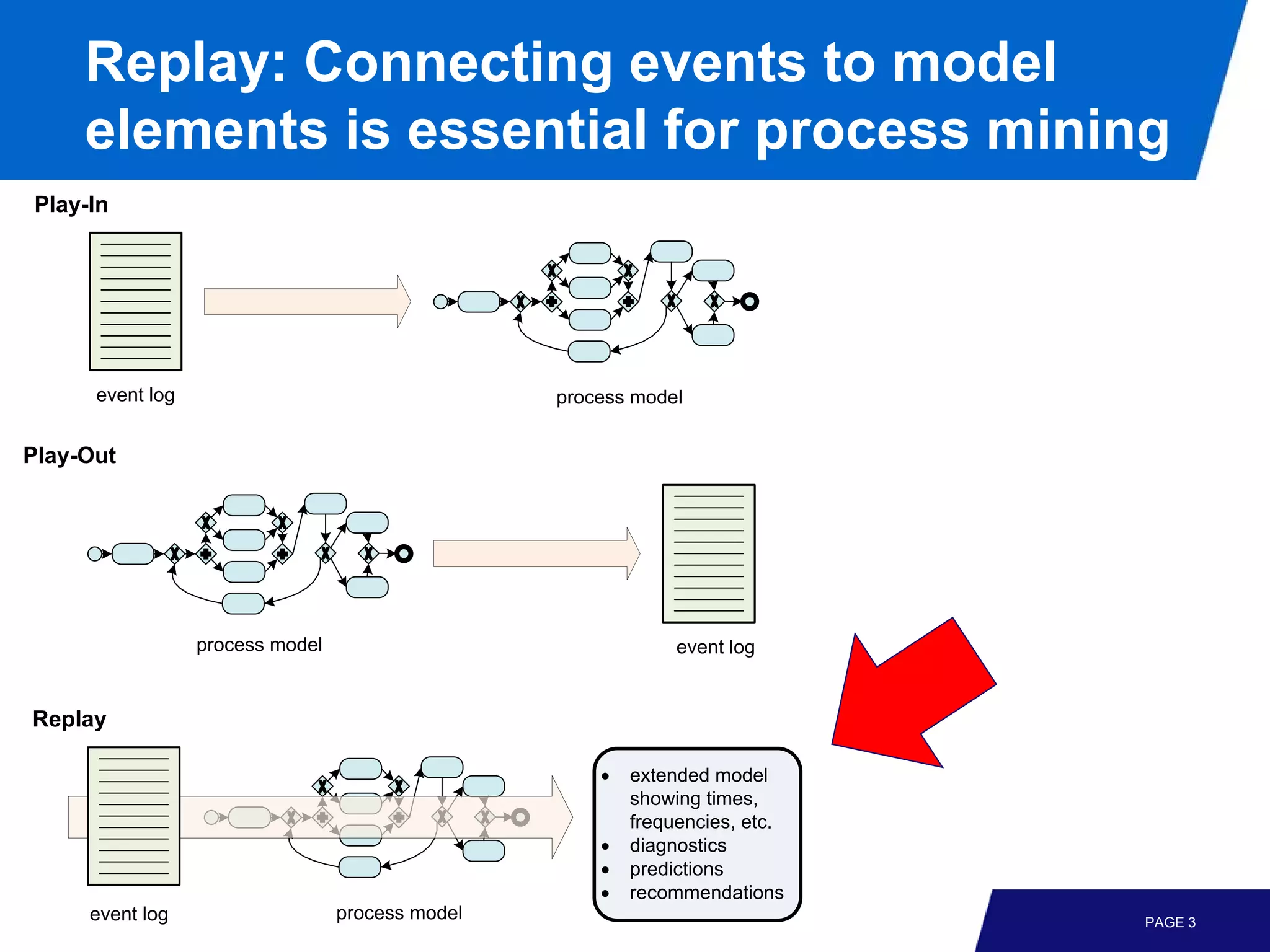
Replay: Connecting events to model
     elements is essential for process mining
Play-In


      event log                                   process model


Play-Out


                  process model                                event log


Replay

                                                      •   extended model
                                                          showing times,
                                                          frequencies, etc.
                                                      •   diagnostics
                                                      •   predictions
                                                      •   recommendations
     event log                    process model                               PAGE 3
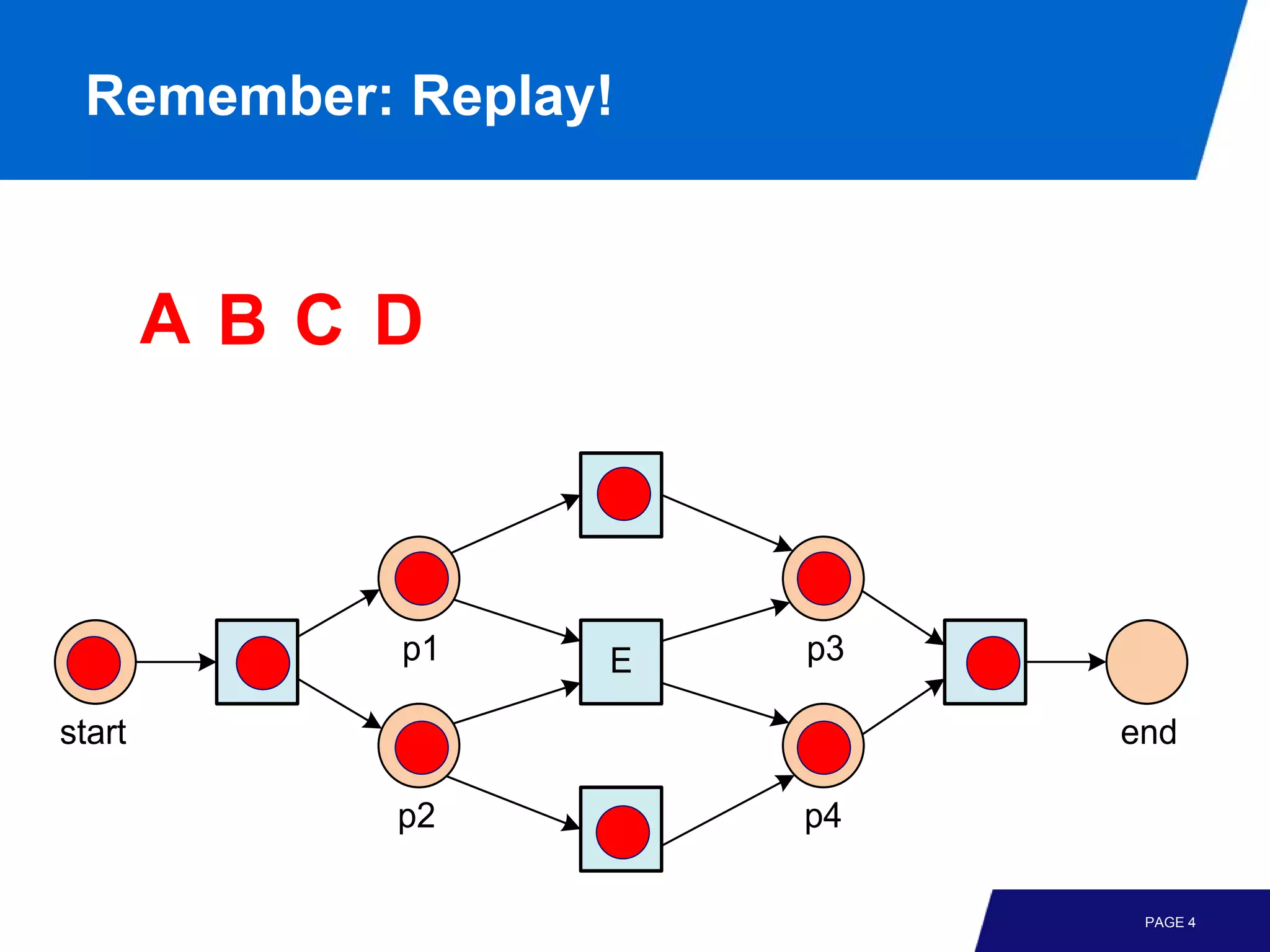
Remember: Replay!


        ABC D

                  B


         A   p1   E   p3   D

start                          end

             p2   C   p4

                                PAGE 4
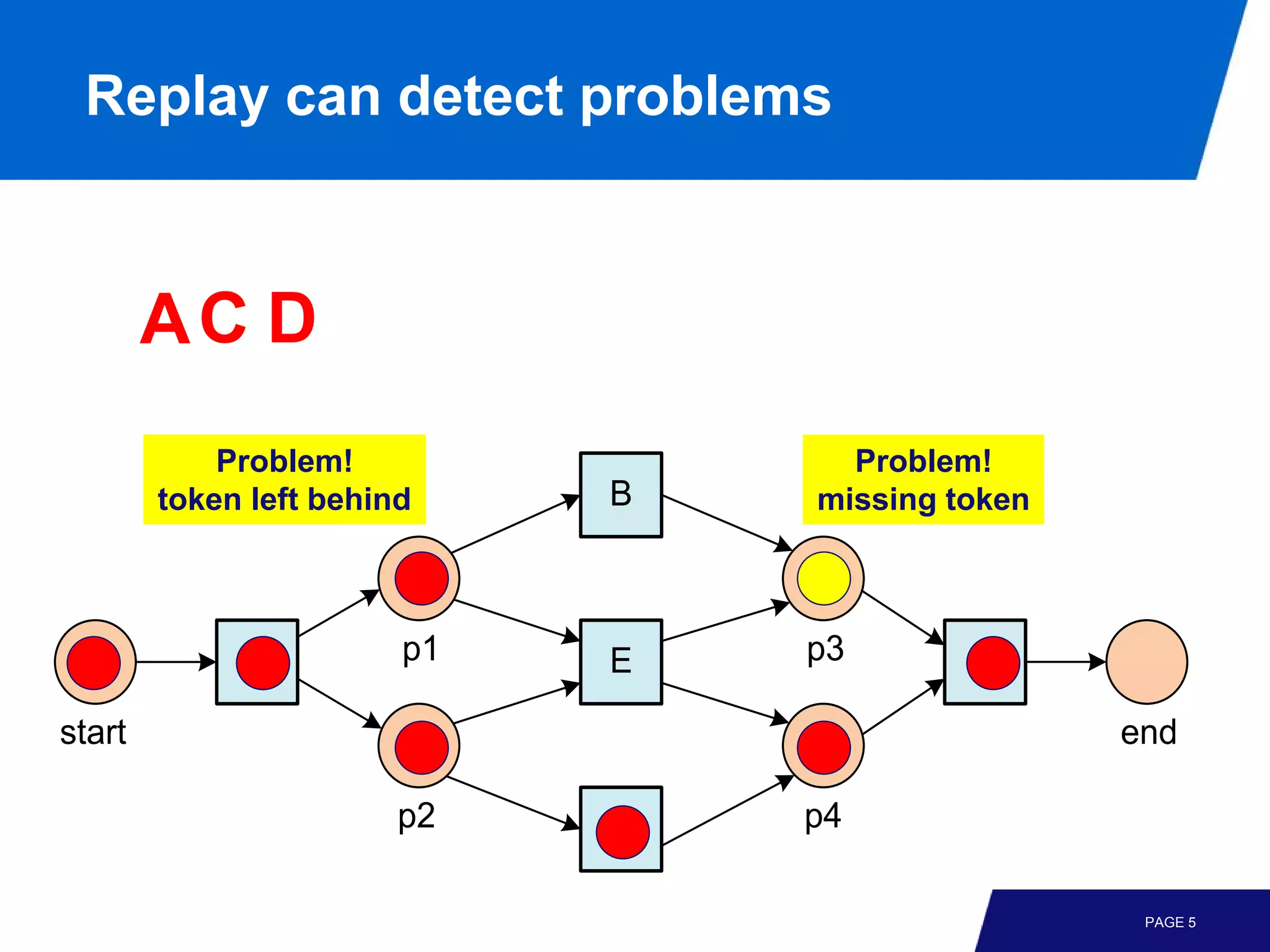
Replay can detect problems


        AC D
            Problem!               Problem!
        token left behind    B   missing token


             A          p1   E   p3       D

start                                            end

                        p2   C   p4

                                                  PAGE 5
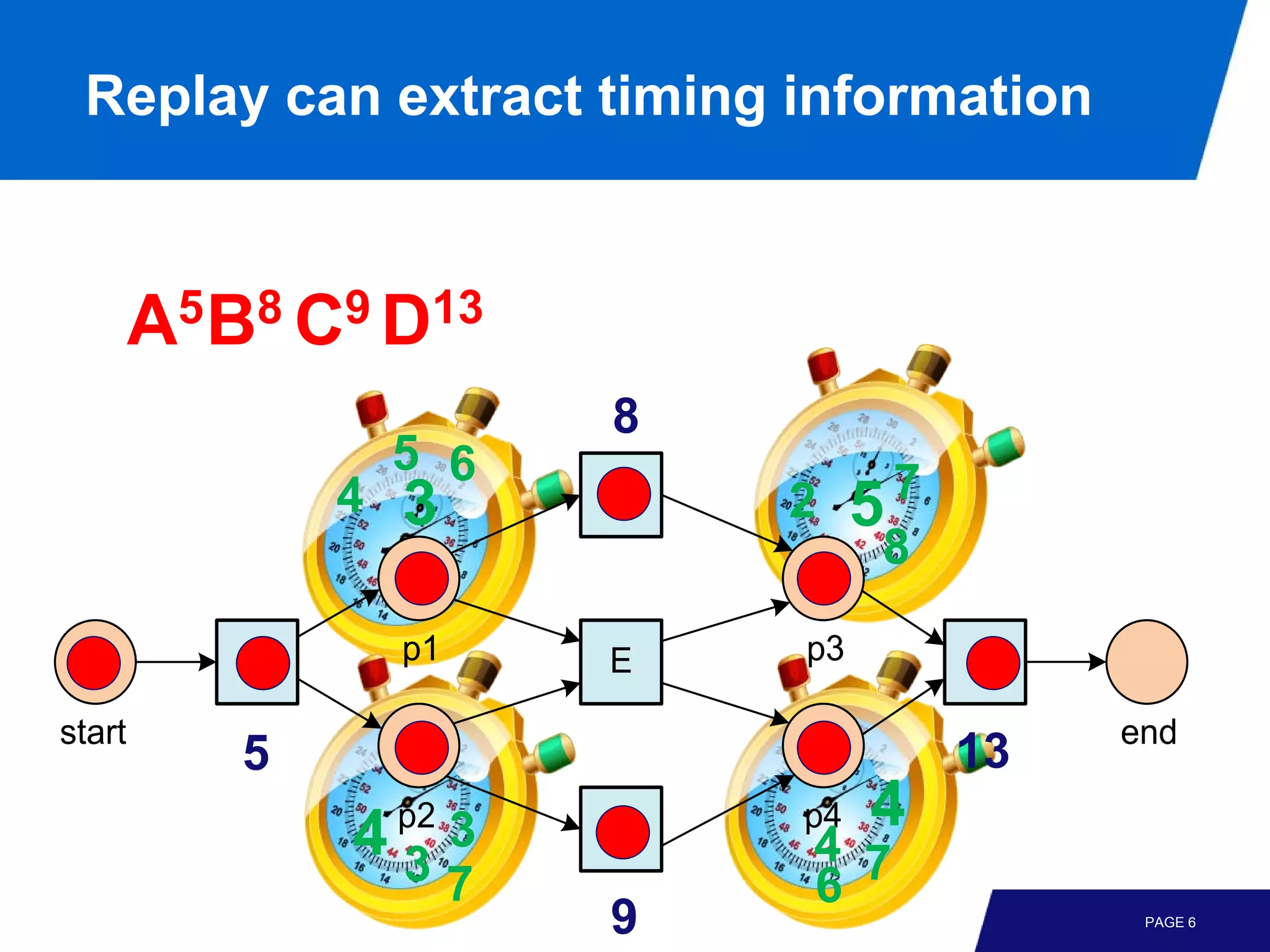
Replay can extract timing information


        A5 B8 C9 D13
                         8
                   5 6
               4                    7
                   3     B   2    5
                                   8

           A       p1    E   p3         D

start                                        end
           5                            13
               4   p2
                    3    C   p4   4
                   37        4 7
                             6
                         9                    PAGE 6
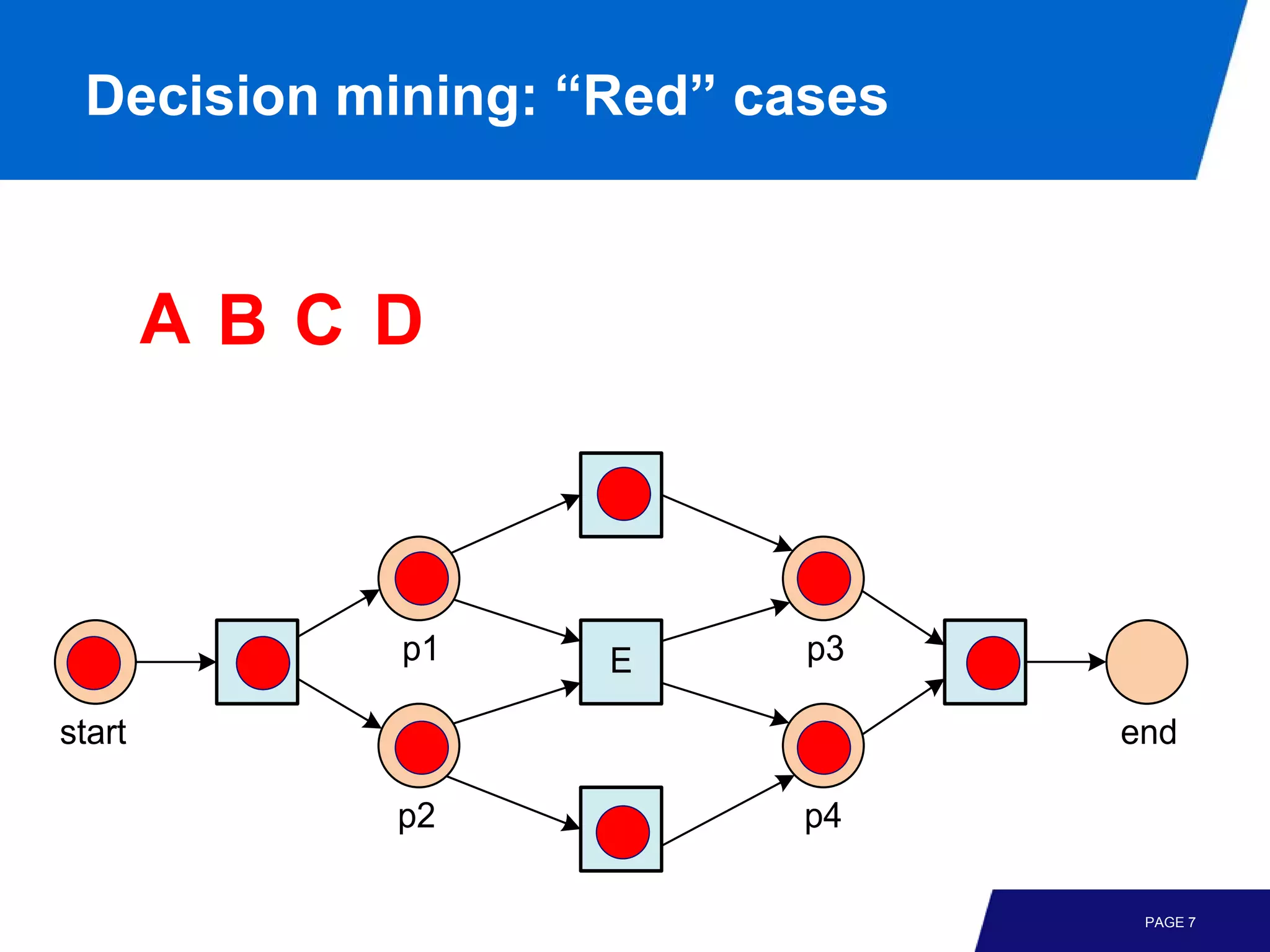
Decision mining: “Red” cases


        ABC D

                   B


         A   p1    E      p3    D

start                               end

             p2    C      p4

                                     PAGE 7
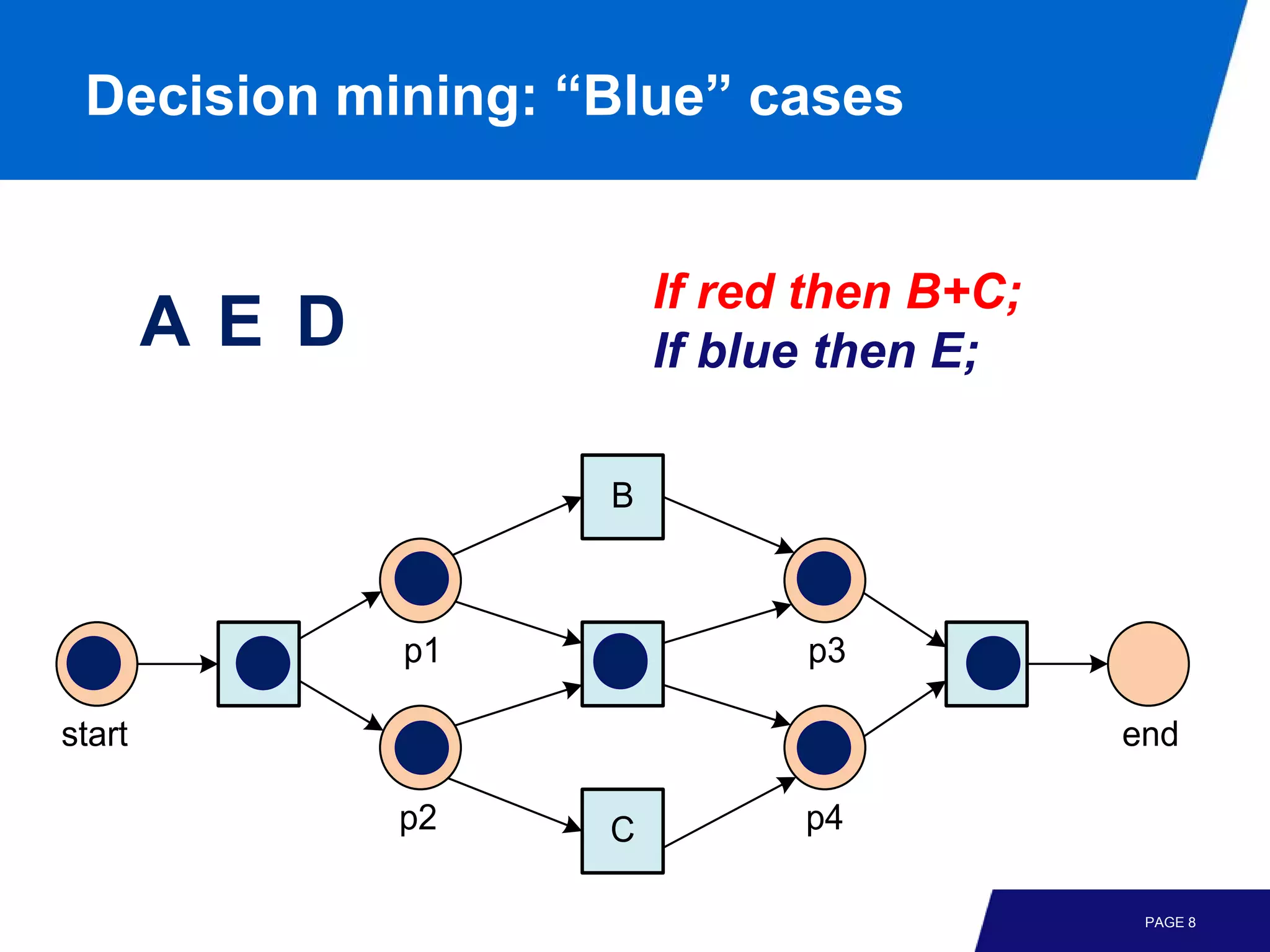
Decision mining: “Blue” cases


                        If red then B+C;
        AE D            If blue then E;

                    B


          A    p1   E         p3     D

start                                      end

               p2   C         p4

                                            PAGE 8
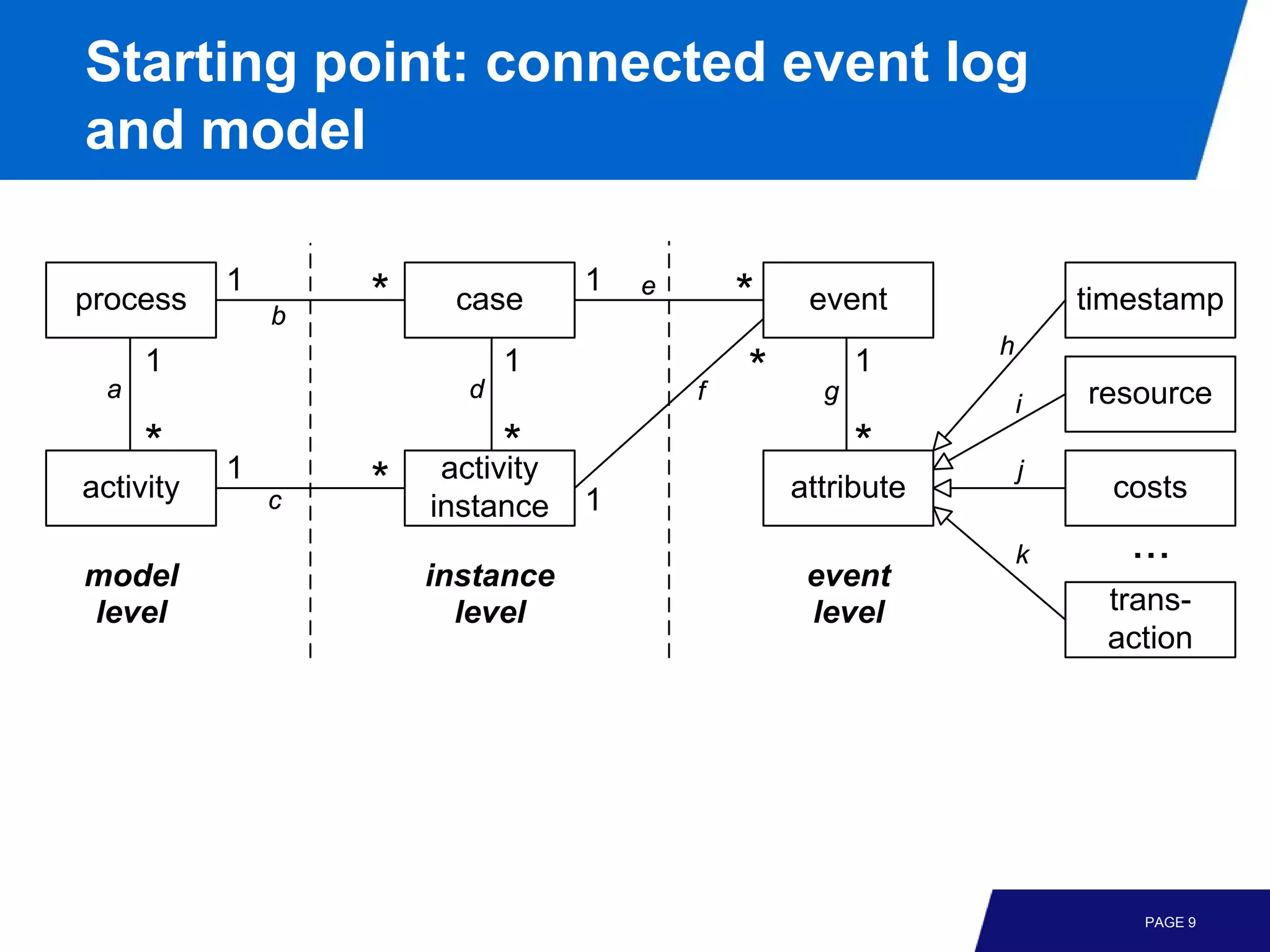
Starting point: connected event log
and model

           1                       1
process        b
                   *    case           e
                                               *    event              timestamp
                                                               h
      1                      1                 *         1
  a                      d                 f         g                 resource
                                                                   i
      *    1
                             *
                        activity
                                                         *         j
activity       c   *   instance    1               attribute             costs

                                                                   k      ...
model                  instance                     event
level                    level                      level               trans-
                                                                        action


                                                                           PAGE 9
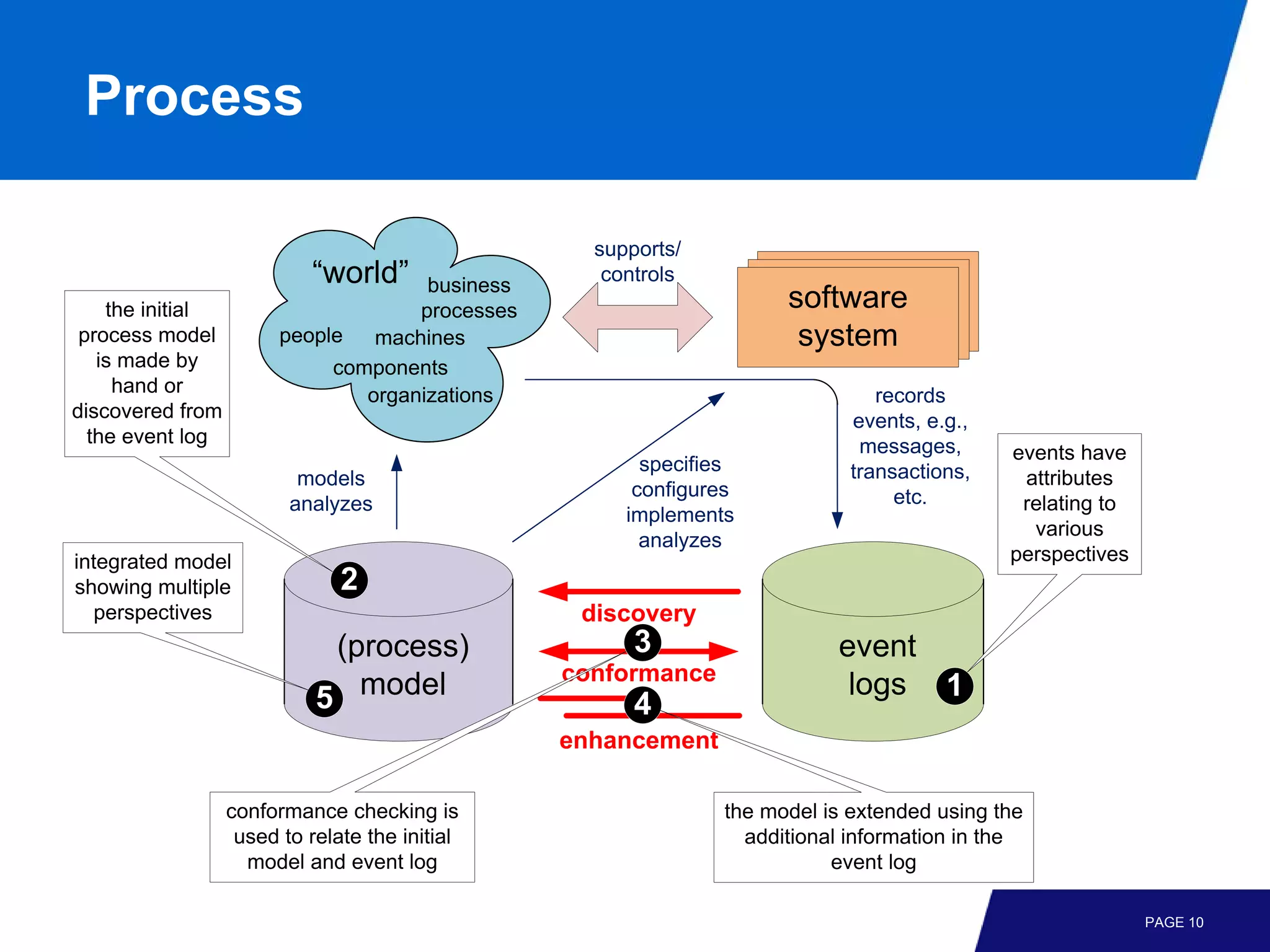
Process

                                                   supports/
                           “world”    business
                                                    controls
    the initial                      processes                        software
 process model          people   machines                              system
   is made by                components
     hand or                    organizations                                   records
discovered from                                                              events, e.g.,
  the event log                                                               messages,      events have
                                                        specifies            transactions,
                          models                                                              attributes
                                                       configures                 etc.
                         analyzes                                                             relating to
                                                      implements
                                                                                               various
                                                        analyzes
integrated model                                                                             perspectives
showing multiple               2
   perspectives                                   discovery
                             (process)                 3                   event
                                                 conformance
                            5 model                    4
                                                                            logs 1
                                                 enhancement

                  conformance checking is                       the model is extended using the
                   used to relate the initial                     additional information in the
                    model and event log                                    event log

                                                                                                            PAGE 10
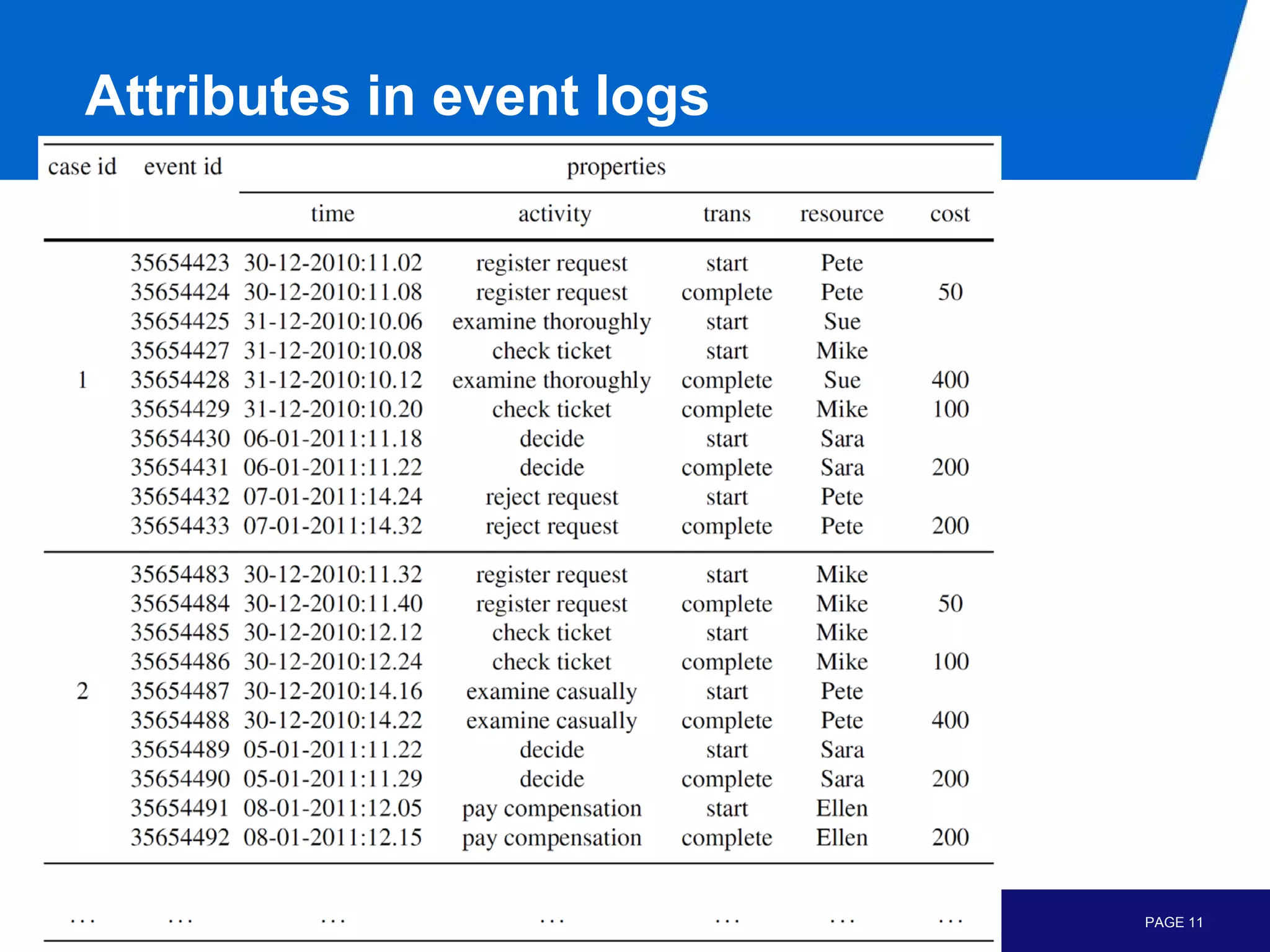
Attributes in event logs


                           PAGE 11
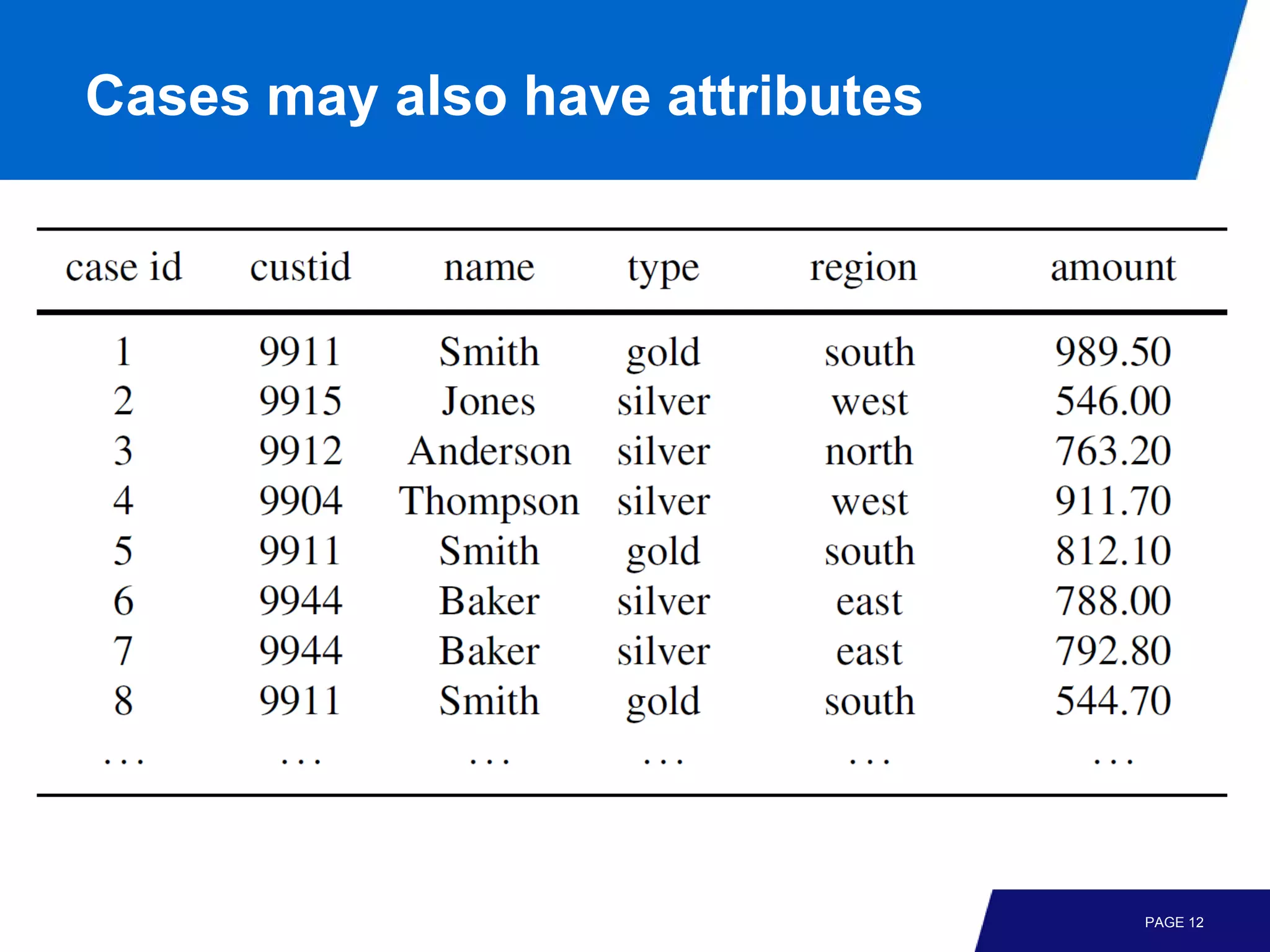
Cases may also have attributes


                                 PAGE 12
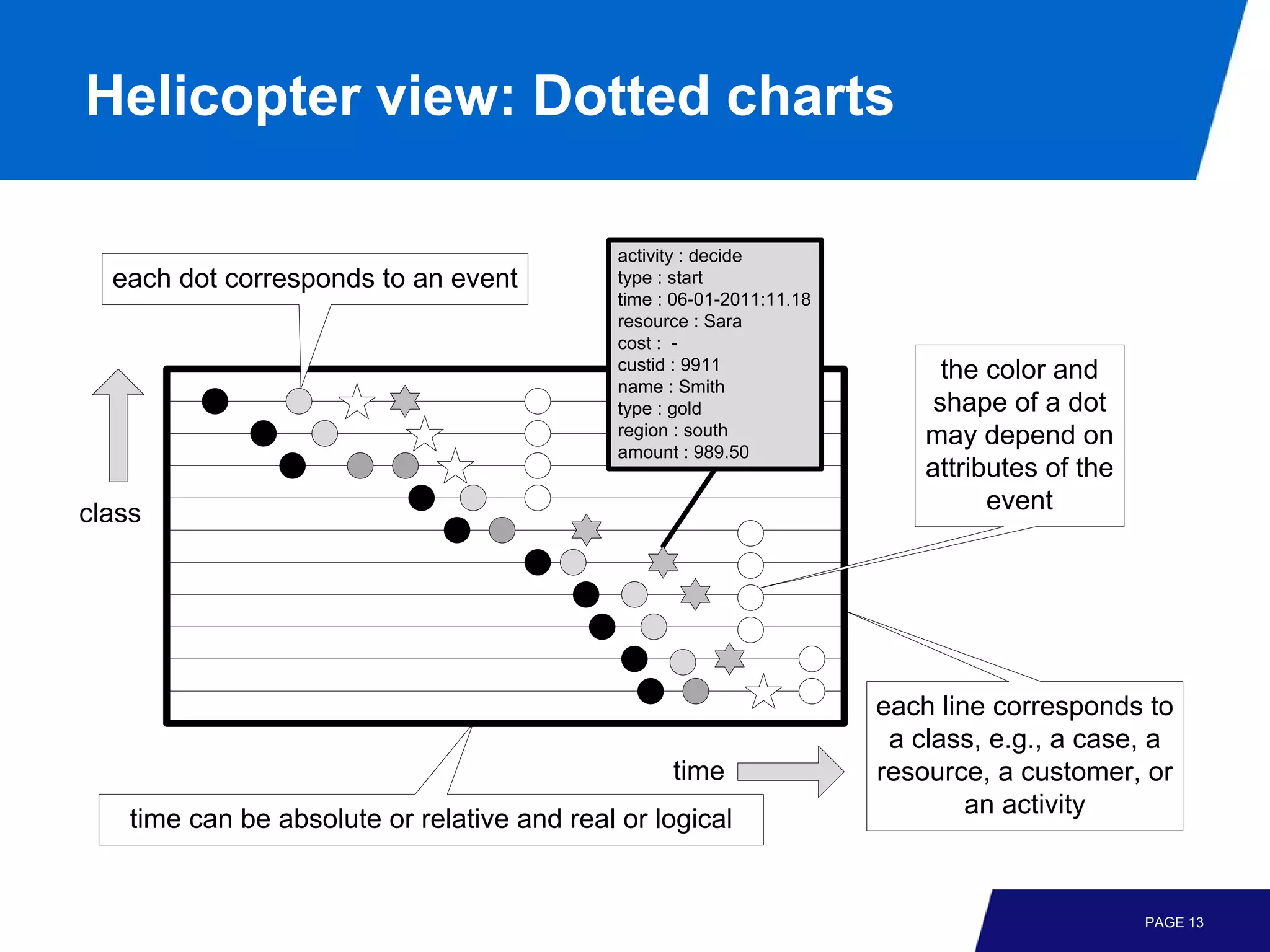
Helicopter view: Dotted charts

                                              activity : decide
  each dot corresponds to an event            type : start
                                              time : 06-01-2011:11.18
                                              resource : Sara
                                              cost : -
                                              custid : 9911                   the color and
                                              name : Smith
                                              type : gold                    shape of a dot
                                              region : south                may depend on
                                              amount : 989.50
                                                                            attributes of the
class                                                                             event


                                                                        each line corresponds to
                                                                         a class, e.g., a case, a
                                                    time                resource, a customer, or
                                                                                an activity
    time can be absolute or relative and real or logical


                                                                                                PAGE 13
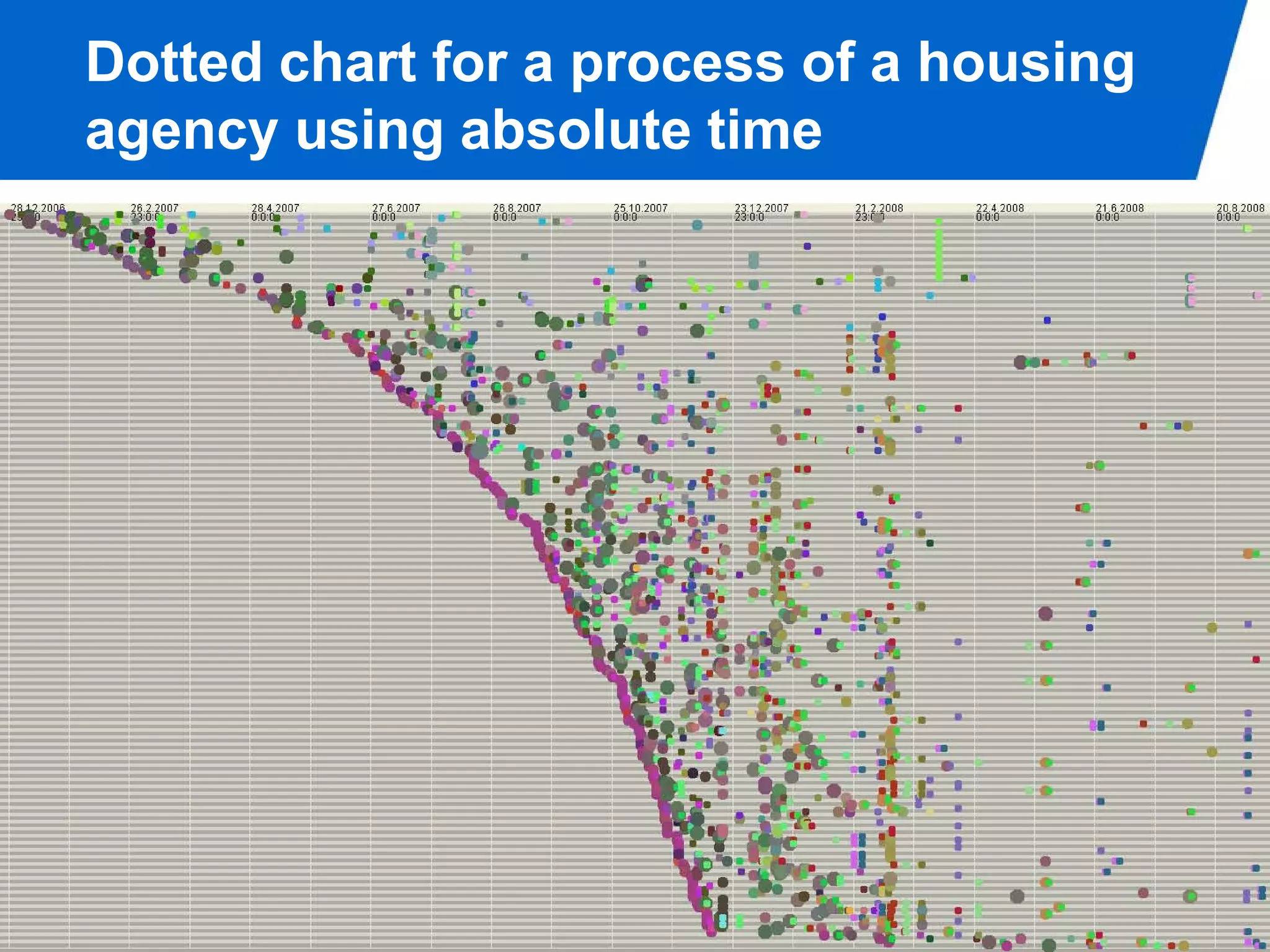
Dotted chart for a process of a housing
agency using absolute time


                                          PAGE 14
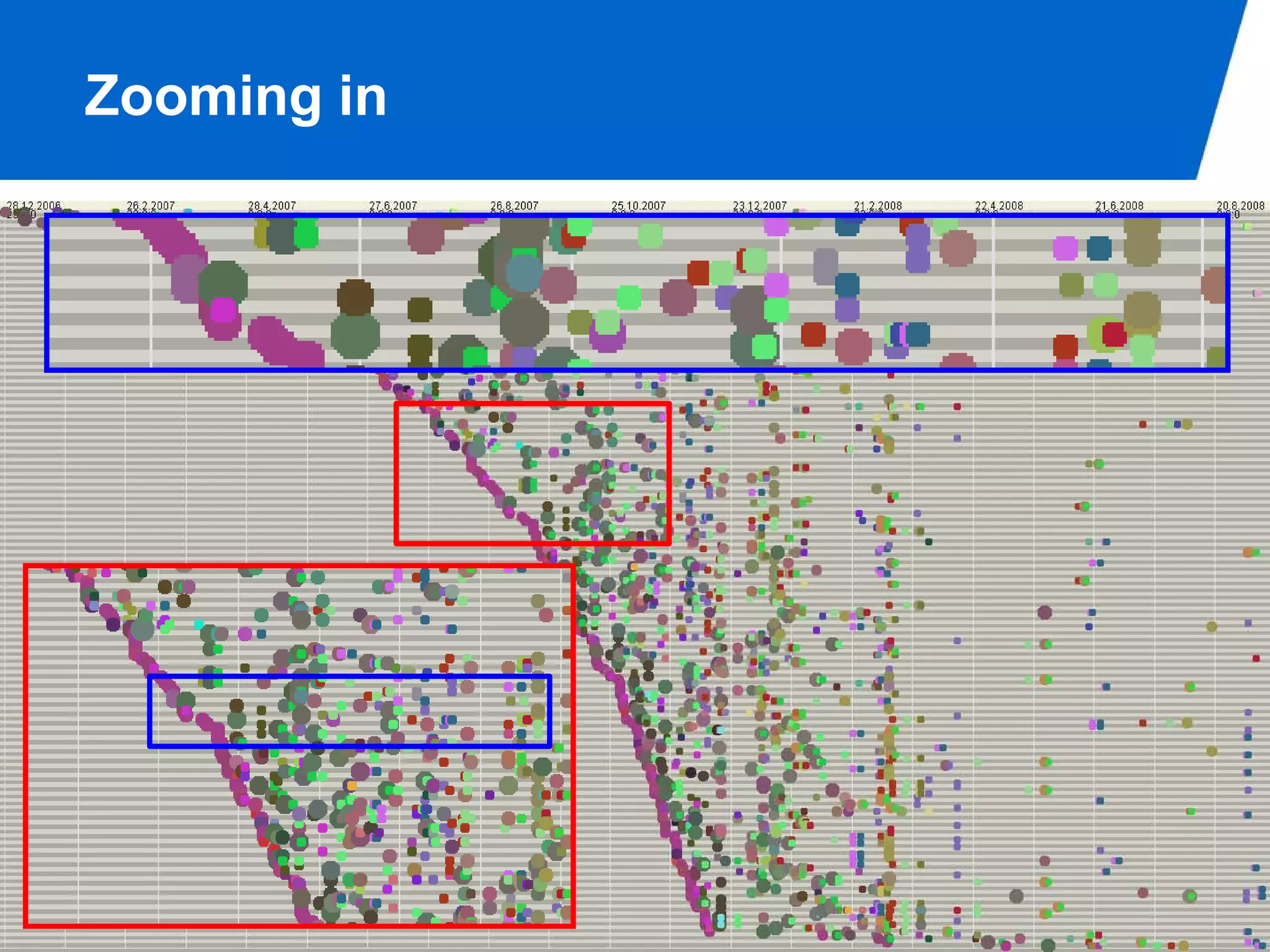
Zooming in


             PAGE 15
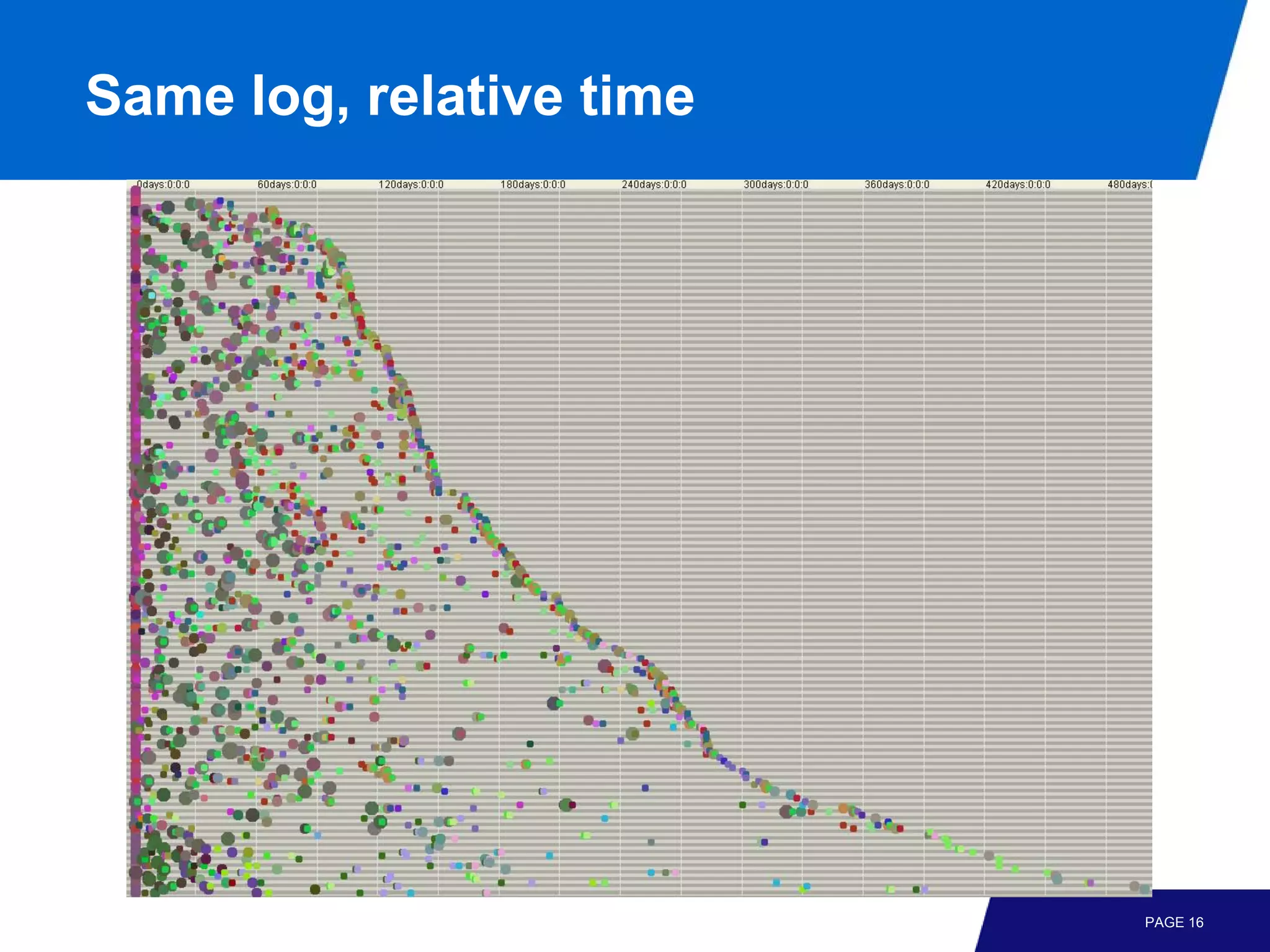
Same log, relative time


                          PAGE 16
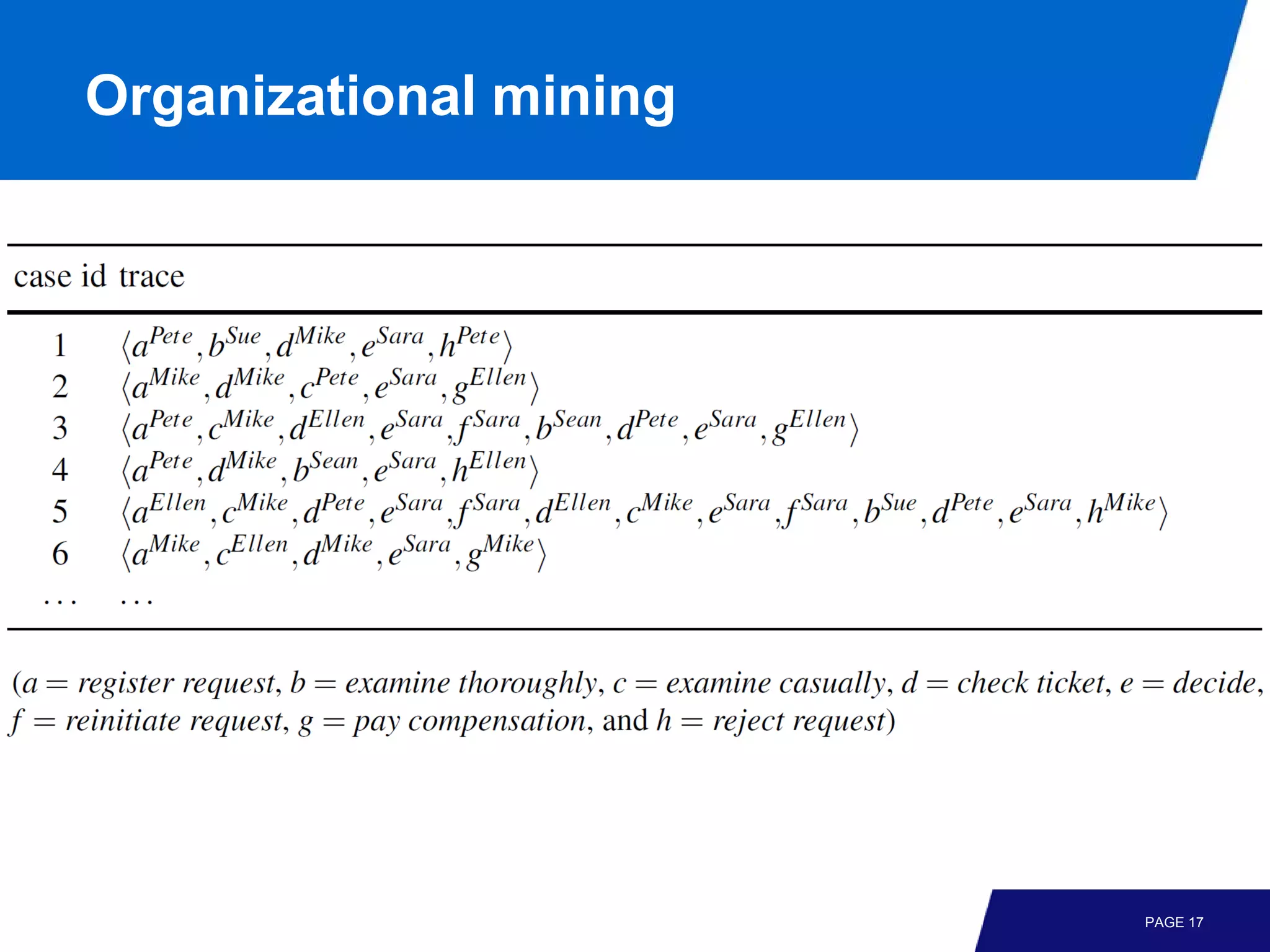
Organizational mining


                        PAGE 17
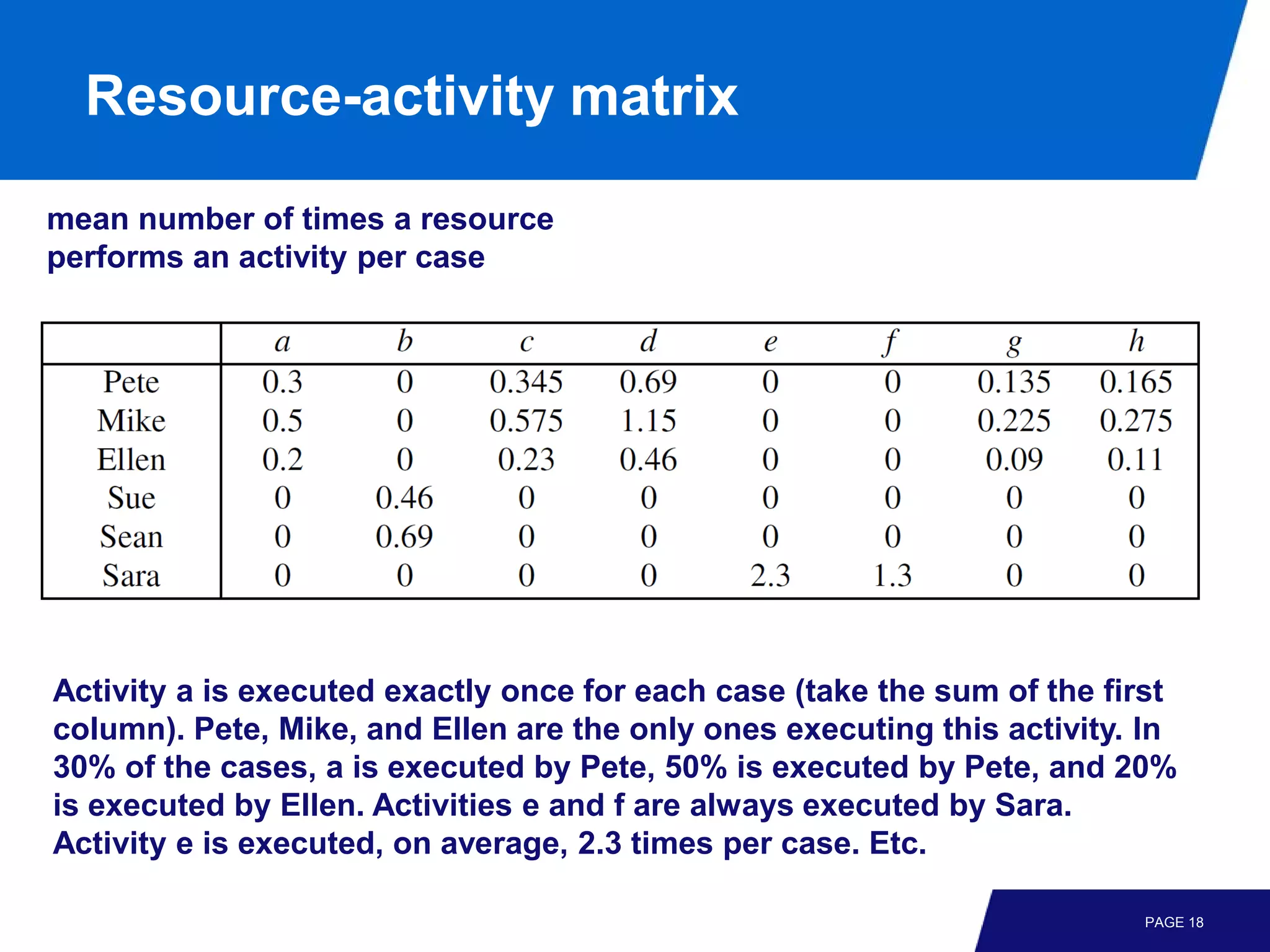
Resource-activity matrix

mean number of times a resource
performs an activity per case


Activity a is executed exactly once for each case (take the sum of the first
column). Pete, Mike, and Ellen are the only ones executing this activity. In
30% of the cases, a is executed by Pete, 50% is executed by Pete, and 20%
is executed by Ellen. Activities e and f are always executed by Sara.
Activity e is executed, on average, 2.3 times per case. Etc.

                                                                         PAGE 18
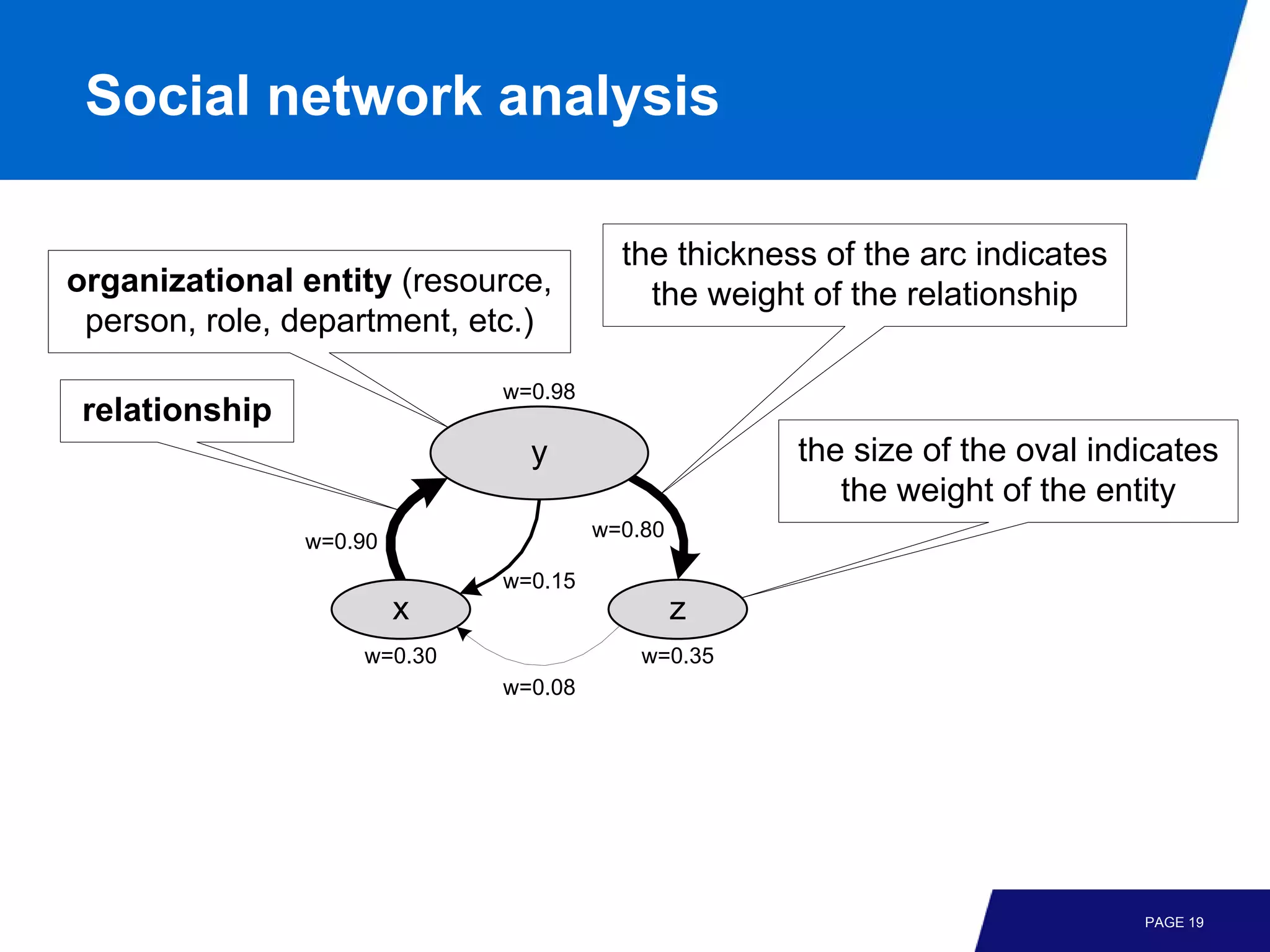
Social network analysis

                                        the thickness of the arc indicates
organizational entity (resource,          the weight of the relationship
 person, role, department, etc.)

                             w=0.98
 relationship
                               y                    the size of the oval indicates
                                                       the weight of the entity
                                      w=0.80
                w=0.90
                             w=0.15
                         x                     z
                    w=0.30                w=0.35
                             w=0.08


                                                                             PAGE 19
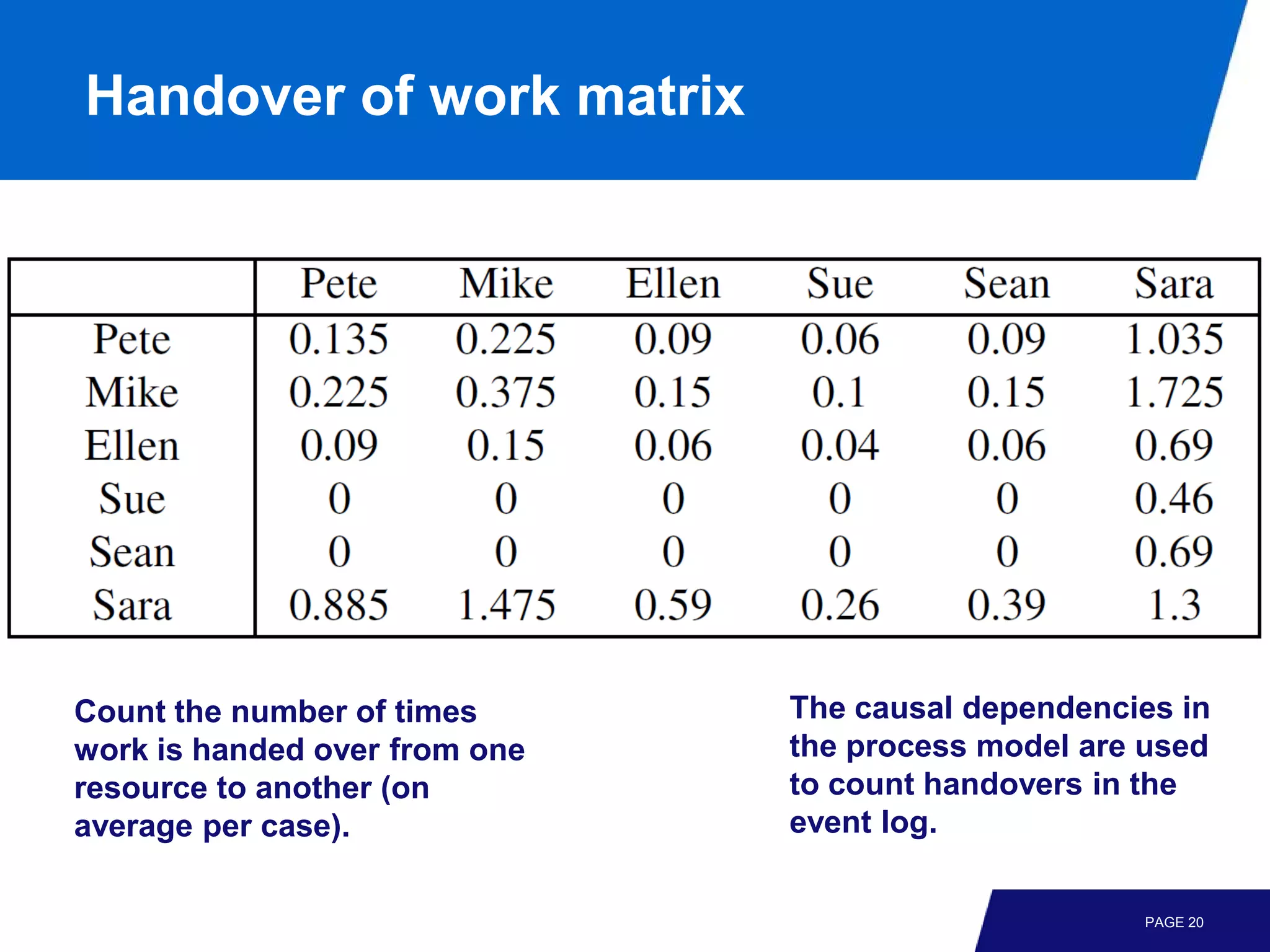
Handover of work matrix


Count the number of times      The causal dependencies in
work is handed over from one   the process model are used
resource to another (on        to count handovers in the
average per case).             event log.

                                                    PAGE 20
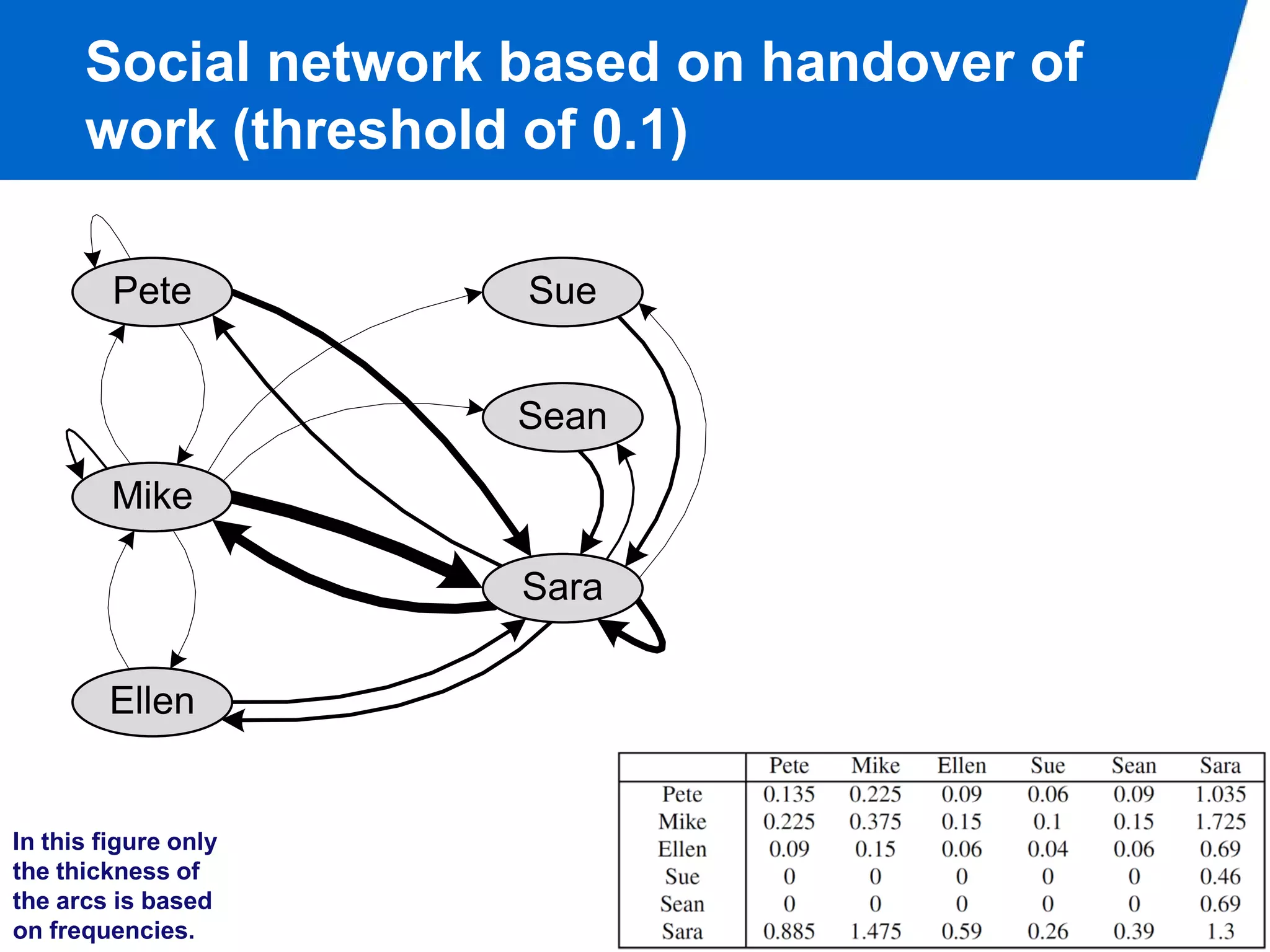
Social network based on handover of
      work (threshold of 0.1)

         Pete         Sue


                      Sean

         Mike

                      Sara

        Ellen


In this figure only
the thickness of
the arcs is based
                                            PAGE 21
on frequencies.
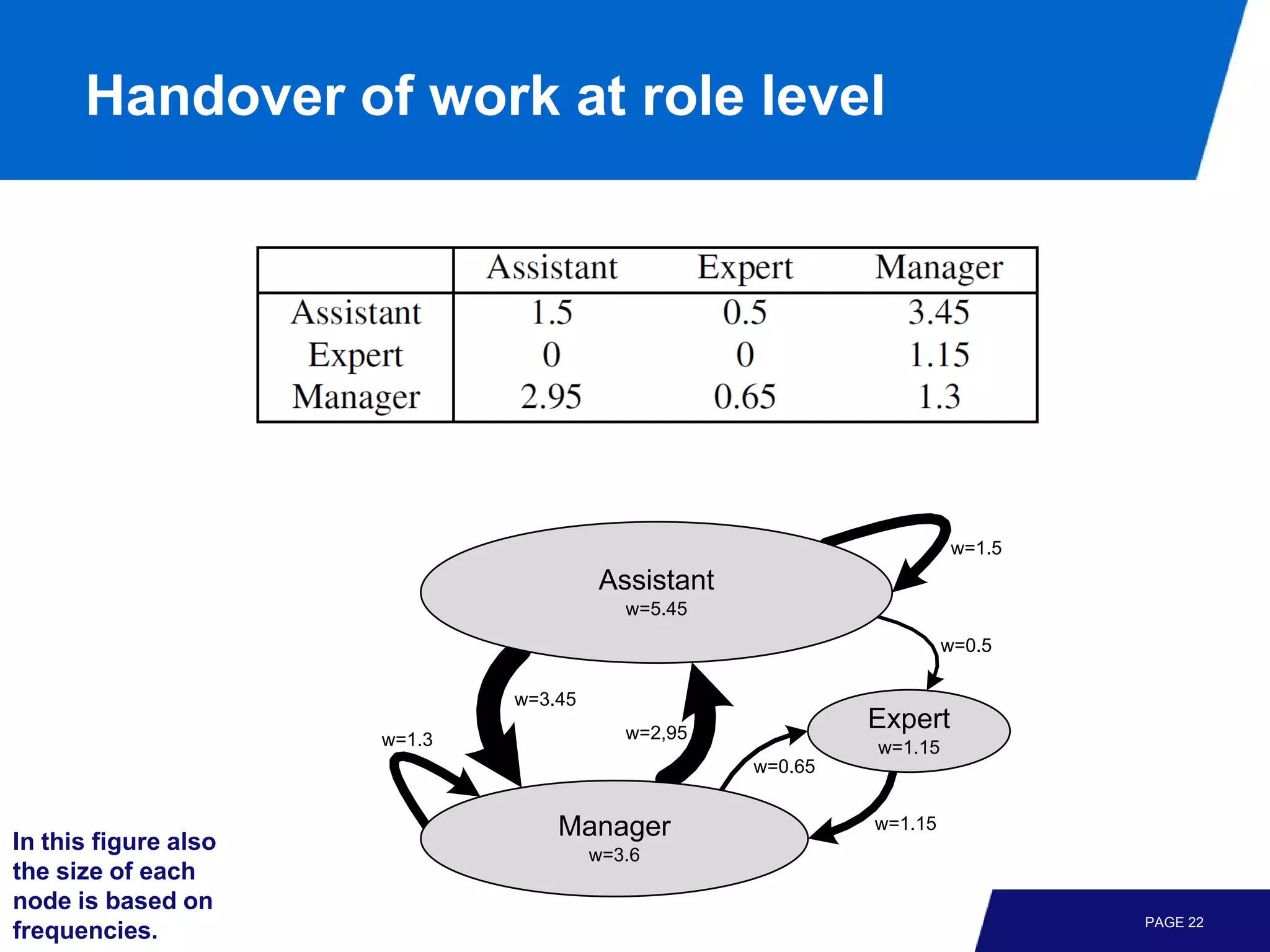
Handover of work at role level


                                                                     w=1.5
                                       Assistant
                                          w=5.45
                                                                     w=0.5

                              w=3.45
                                          w=2,95
                                                            Expert
                      w=1.3                                 w=1.15
                                                   w=0.65


In this figure also
                                  Manager                   w=1.15
                                       w=3.6
the size of each
node is based on
                                                                             PAGE 22
frequencies.
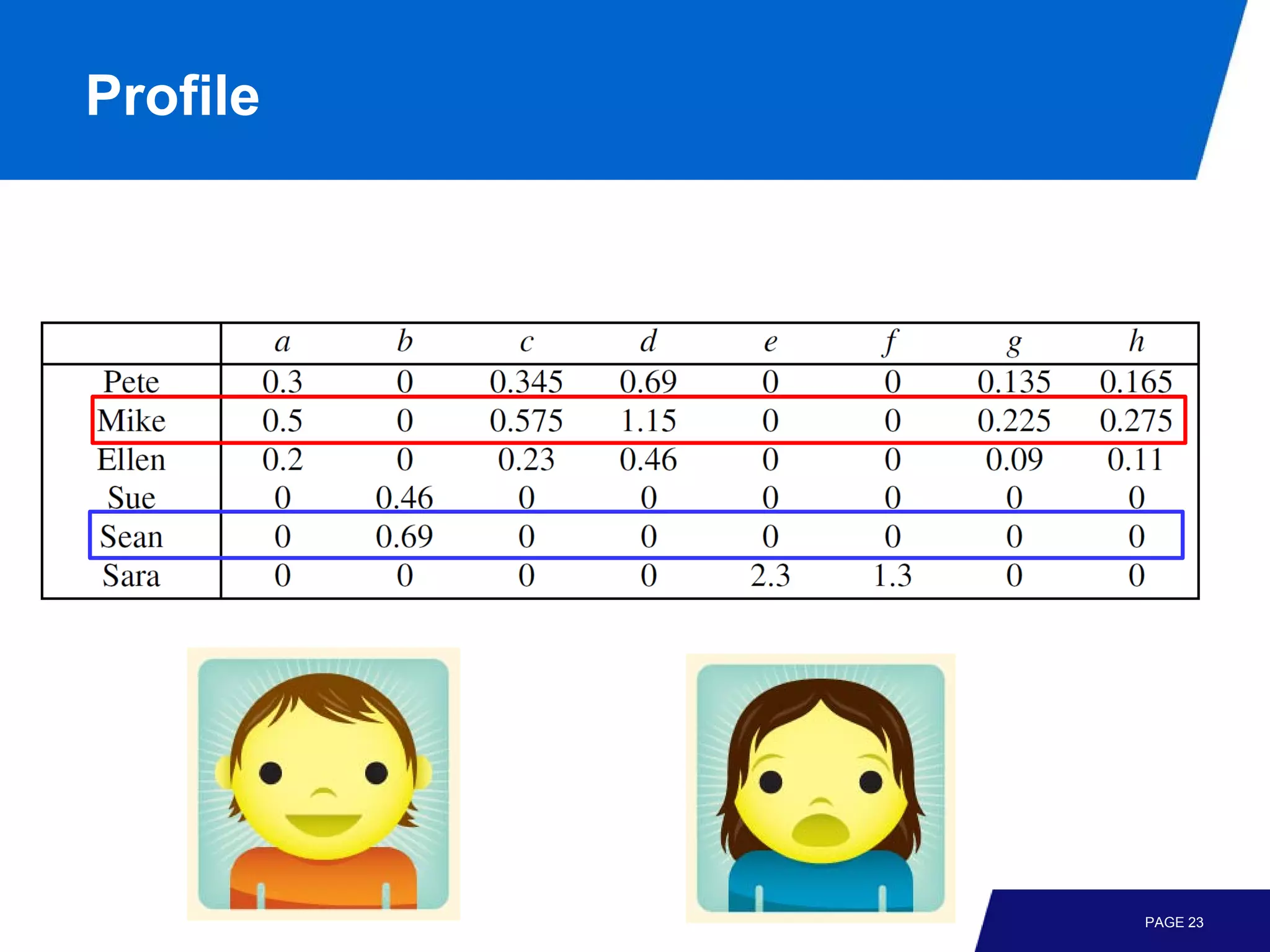
Profile


          PAGE 23
Social network based on similarity of
  profiles


                                              Sean             Sue
                          Pete


          Mike                 Ellen                    Sara


Resources that execute similar collections of activities are
related. Sara is the only resource executing e and f . Therefore,
she is not connected to other resources. Self-loops are
suppressed as they contain no information (self-similarity)
                                                                     PAGE 24
Discovering organizational structures

Expert
                                                             Manager
   Sue             Sean
                                                                  Sara
                                      b
                                  examine
                                 thoroughly
                                                                               g
                          p1                    p3                            pay
                                      c                                   compensation
               a                  examine                    e
 start      register              casually               decide      p5                  end
            request
                                                                               h
                           p2         d         p4                           reject
                                 check ticket                               request
                                                         f
                                                     reinitiate
                                                      request
Assistant

   Mike        Ellen      Pete


                                                                                               PAGE 25
Another example

     process model              organizational model         resources


                                        oe1                     r1


                                                                r2
          a1
                            oe2                 oe3
                                                                r3

a2                   a3
                                                                r4
                                  oe4                  oe5

          a4                                                    r5


                          oe6       oe7        oe8              r6


                                                                r7

          a5
                                                                r8


                                                                r9
                                                                         PAGE 26
Analyzing resource behavior, e.g.,
Yerkes-Dodson law of arousal


                                     PAGE 27
Learning time and probabilities


• Replay, as before, but now considering timestamps.
• Let us replay the first three cases in the event log:
   − case 1 starts at time 12 and ends at time 54,
   − case 2 starts at time 17 and ends at time 73,
   − case 3 starts at time 25 and ends at time 98.
                                                      PAGE 28
5
                                                                                                                                     1,s:35         1,c:40
                                                                                                                                              9
                                                                                                                                     2,s:50         2,c:59

                                         1,s:25          7       1,c:32              2,s:30     8          2,c:38                             5
                                                                                                                                     3,s:45         3,c:50
                                                         5                                     3                                              7
                                         3,s:60                  3,c:65              3,s:32                3,c:35                    3,s:80         3,c:87
                                                                                                                                                                              2,s:70   3      2,c:73
              7                                                                                                                                                                        8
  1,s:12          1,c:19                                                                                                                                                      3,s:90          3,c:98
                                                                                                                                                  1:10
              6                                                                                                   1:3
  2,s:17          2,c:23                                                                                                                               2:11
                                                         1:6                                                            2:12
              5
  3,s:25          3,c:30                           2:7                              b                                      3:10
                                                                                                                                                              3:0
                                                                                                                                                                    3:3
                                             3:2                                                                                   3:15
                                                                                examine
                                       3:5
                                                                               thoroughly
       1:12
                                                                                                                                                                          g            1:54
                                                                                                                                                                                           2:73
                                                                 p1                                         p3                                                    pay
   2:17
                                                                                    c                                                                         compensation                       3:98
3:25
                                   a                                            examine                                             e
                  start      register                                           casually                                       decide         p5                                 end
                             request
                                                                                                                                                                          h
                           1:7
                                                                  p2                d                              p4
                                                                                                                                                                     reject
                                 2:5                                           check ticket                                                                         request
                                       3:5                                                                                     f                                              1,s:50
                                                                                                                                                                                       4
                                                                                                                                                                                              1,c:54
                                             3:7
                                                                                                                        reinitiate
                                                                                        1:2
                                                                                                                         request
                                                                                              2:18                                                       5
                                                                                                                                              3,s:50                3,c:55
                                                             7                                       3:5
                                             1,s:26                   1,c:33
                                                                                                           3:13
                                                             4
                                             2,s:28                   2,c:32
                                                             5
                                             3,s:35                   3,c:40

                                                             5
                                             3,s:62                   3,c:67
                                                                                                                                                                                       PAGE 29
Another view on the timed replay of
the first three cases
         0   10       20       30           40       50           60           70   80       90       time
                  a
                           b
case 1                      d
                                        e
                                                      h

                      a
                                    c
case 2                         d
                                                              e
                                                                                g

                           a
                                                                       b
                                    c
case 3                                  d                                  d
                                                 e                                       e
                                                          f
                                                                                                  g


                                                                                                       PAGE 30
Timed replay projected onto resources


        0   10       20       30           40       50           60           70   80       90       time
                 a        a                          h
Pete                               c                                      d
                              d
Mike                 a        d
                                   c
Ellen                                  d                                       g                 g
 Sue                      b
Sean                                                                  b
                                       e
Sara                                                         e
                                                e        f                              e


                                                                                                      PAGE 31
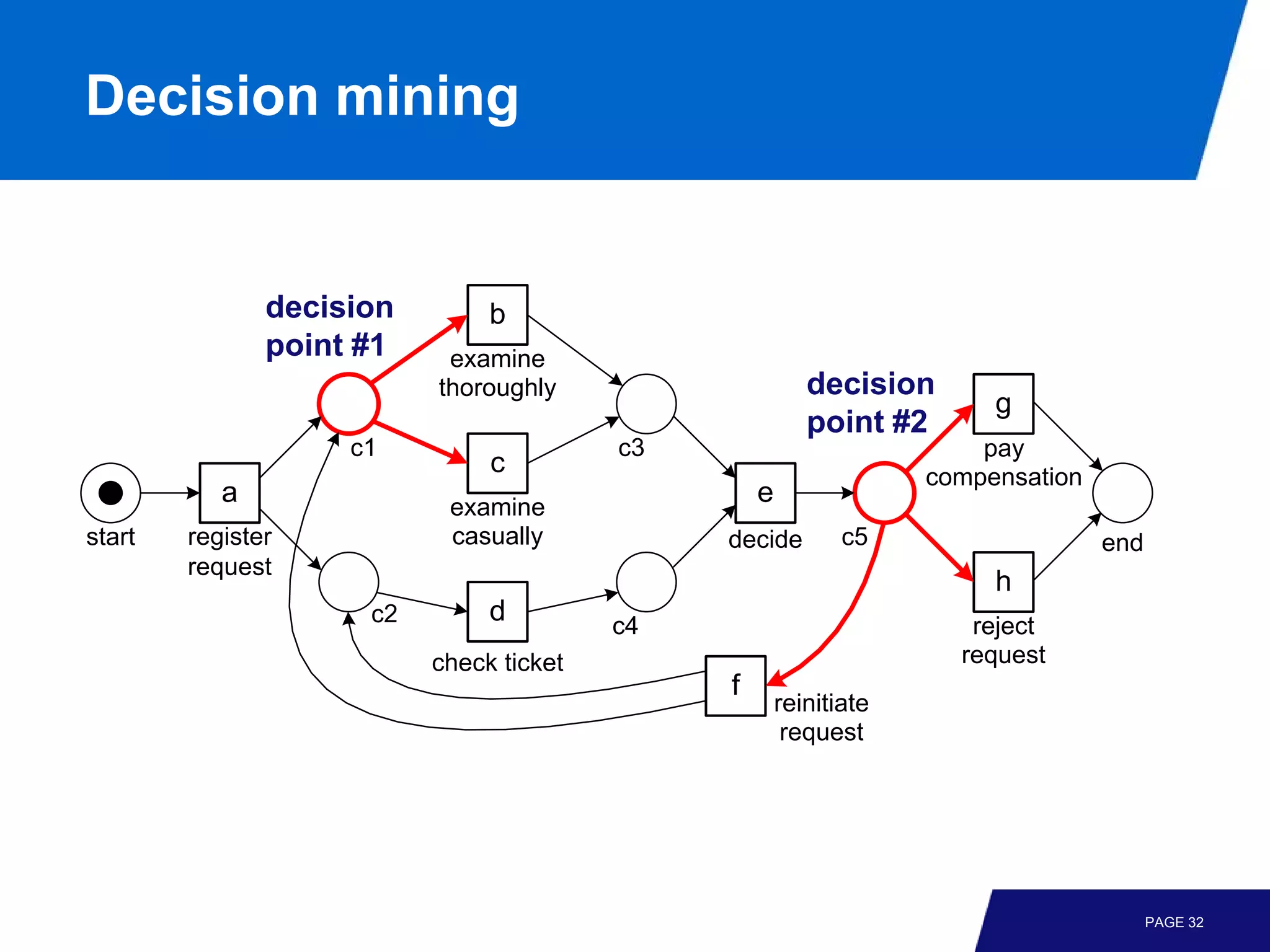
Decision mining


               decision        b
               point #1    examine
                          thoroughly                     decision
                                                                        g
                                                         point #2
                    c1                   c3                            pay
                               c                                   compensation
           a               examine
                                                  e
start   register           casually           decide         c5                   end
        request
                                                                        h
                     c2        d         c4                           reject
                          check ticket                               request
                                              f
                                                      reinitiate
                                                       request


                                                                                        PAGE 32
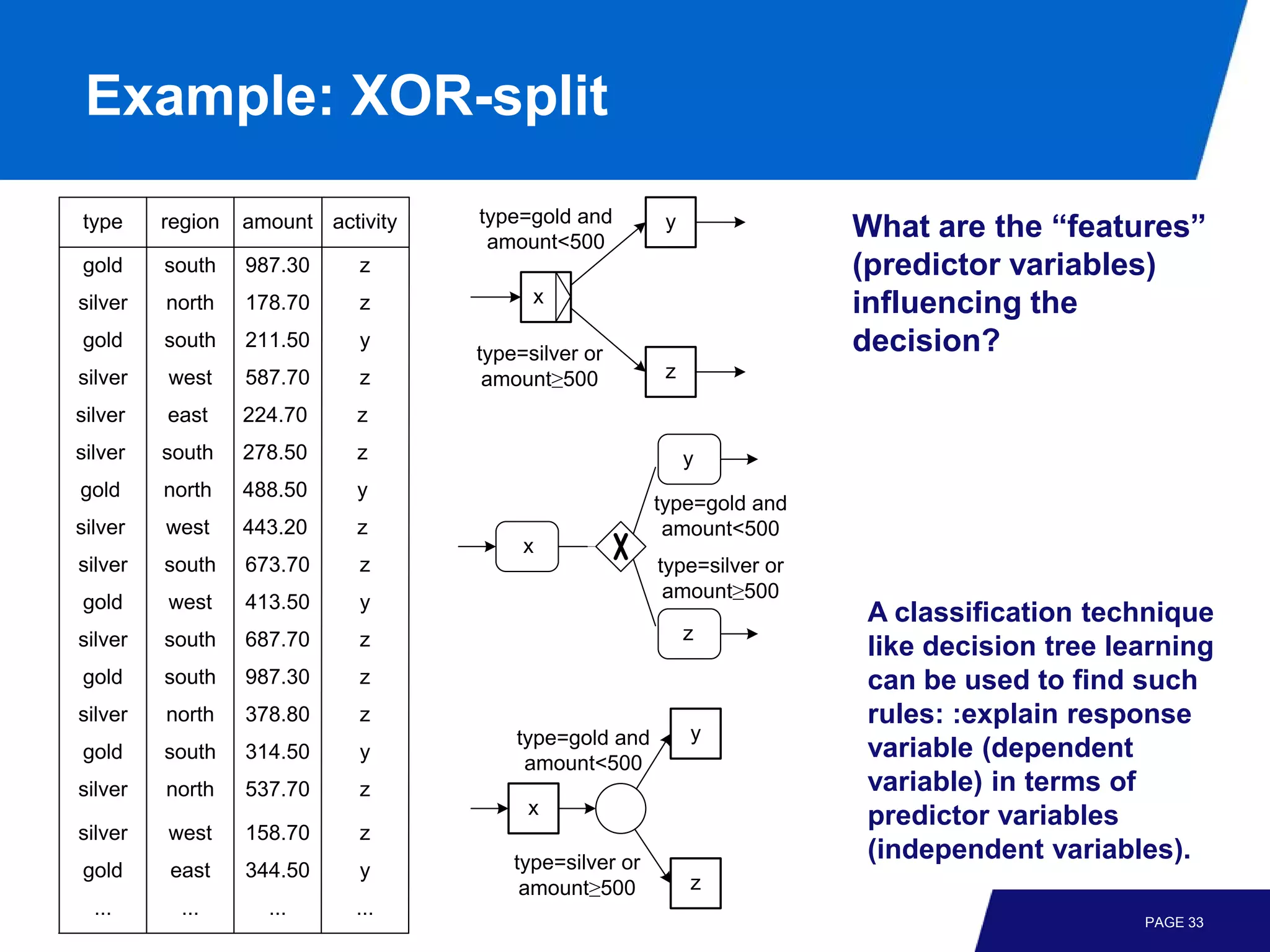
Example: XOR-split

type     region   amount activity   type=gold and         y
                                     amount<500
                                                                          What are the “features”
gold     south    987.30     z                                            (predictor variables)
silver   north    178.70     z            x                               influencing the
gold     south    211.50     y
                                    type=silver or                        decision?
silver   west     587.70     z       amount≥500           z

silver   east     224.70     z
silver   south    278.50     z                                y
gold     north    488.50     y
                                                         type=gold and
silver   west     443.20     z                            amount<500
                                         x
silver   south    673.70     z                           type=silver or
                                                          amount≥500
gold     west     413.50     y
                                                                          A classification technique
silver   south    687.70     z                                z
                                                                          like decision tree learning
gold     south    987.30     z                                            can be used to find such
silver   north    378.80     z                                            rules: :explain response
                                        type=gold and         y
gold     south    314.50     y
                                         amount<500
                                                                          variable (dependent
silver   north    537.70     z                                            variable) in terms of
                                         x                                predictor variables
silver   west     158.70     z
                                        type=silver or
                                                                          (independent variables).
gold     east     344.50     y
                                         amount≥500           z
  ...      ...      ...      ...
                                                                                               PAGE 33
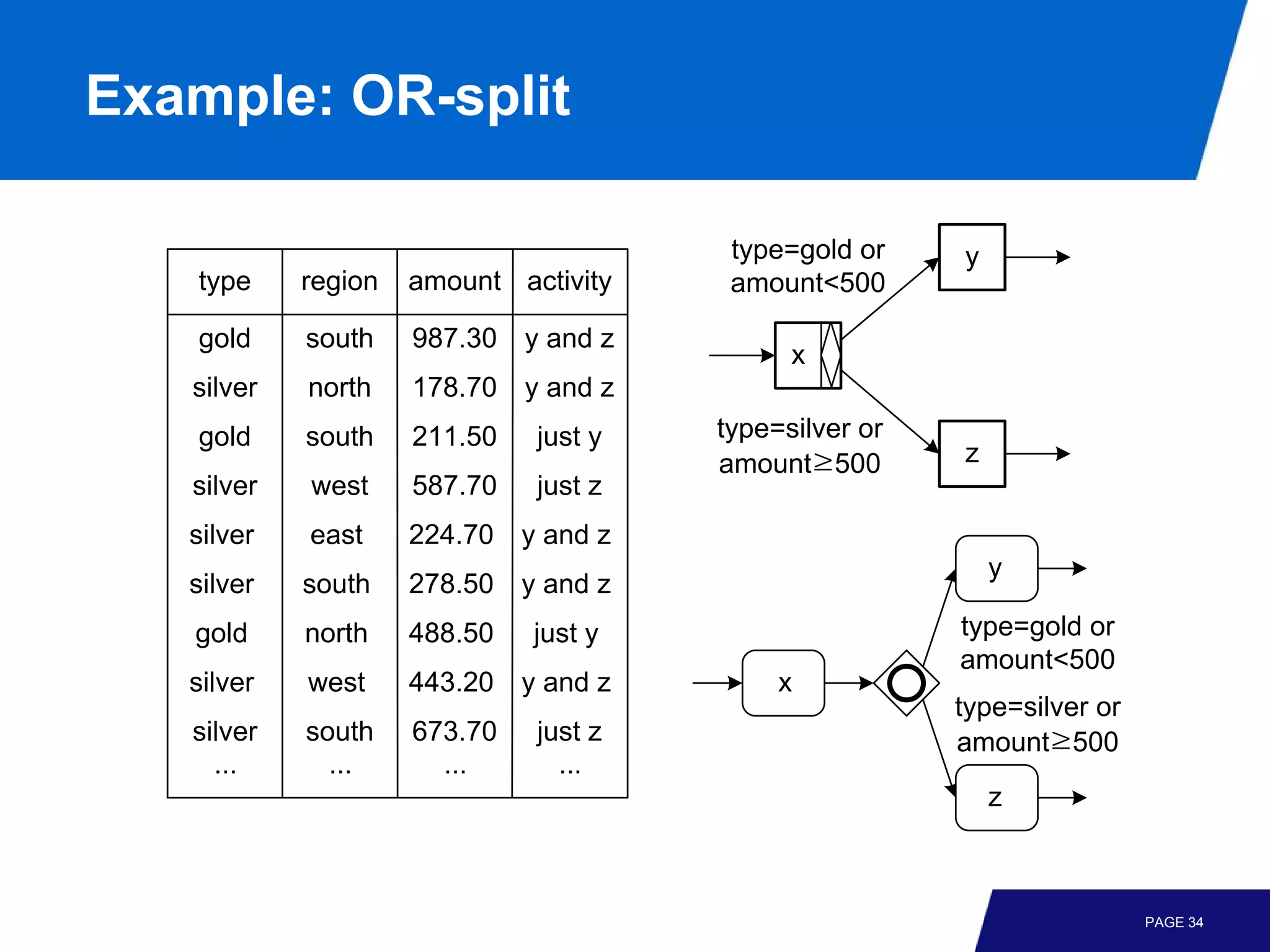
Example: OR-split

                                        type=gold or    y
   type     region   amount activity    amount<500
   gold     south    987.30 y and z
                                             x
   silver   north    178.70 y and z
   gold     south    211.50   just y   type=silver or
                                       amount≥500       z
   silver   west     587.70   just z
   silver   east     224.70 y and z
                                                            y
   silver   south    278.50 y and z
   gold     north    488.50   just y                    type=gold or
                                                        amount<500
   silver   west     443.20 y and z         x
                                                        type=silver or
   silver   south    673.70   just z                    amount≥500
     ...      ...      ...      ...
                                                            z


                                                                         PAGE 34
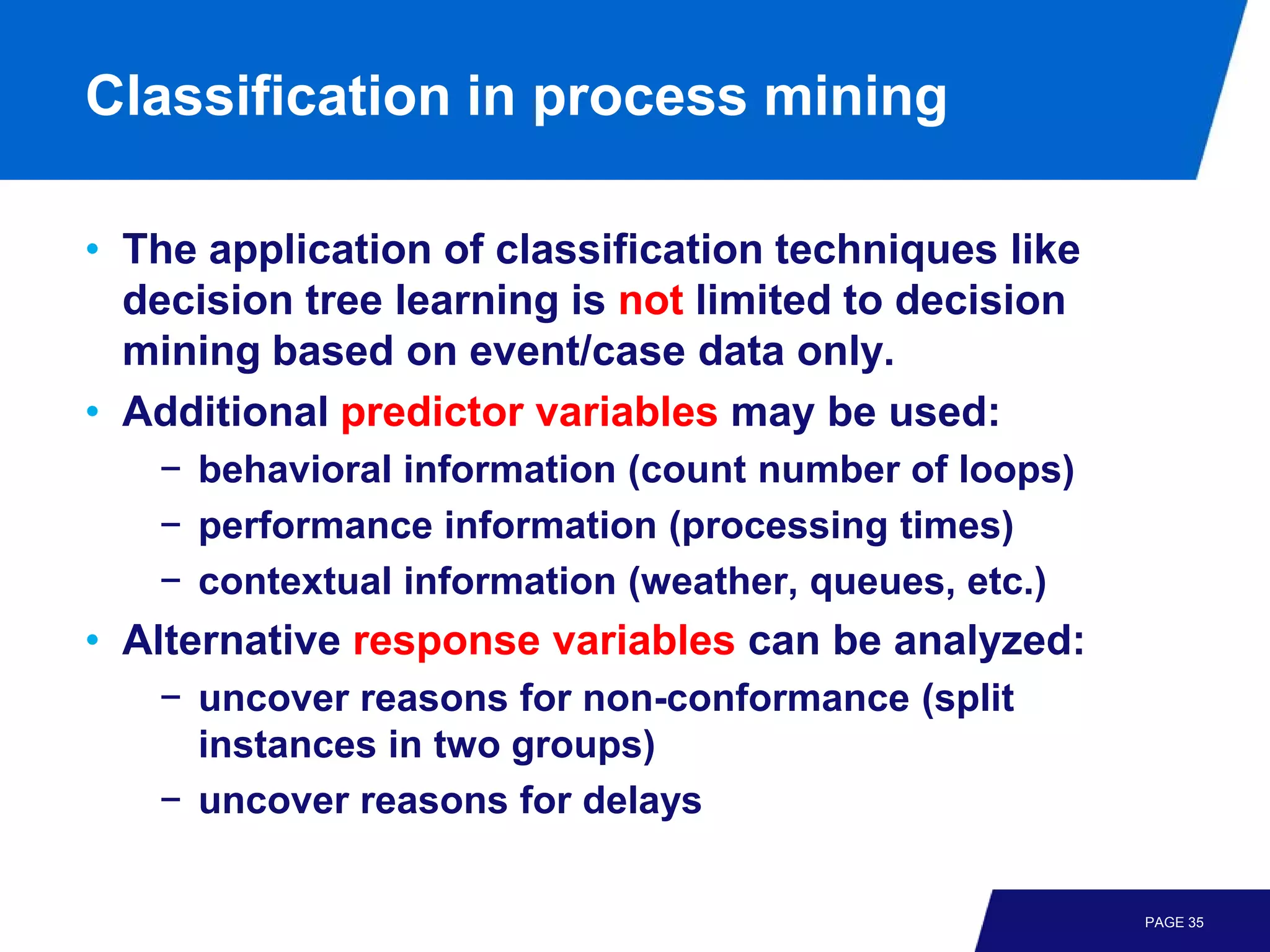
Classification in process mining

• The application of classification techniques like
  decision tree learning is not limited to decision
  mining based on event/case data only.
• Additional predictor variables may be used:
   − behavioral information (count number of loops)
   − performance information (processing times)
   − contextual information (weather, queues, etc.)
• Alternative response variables can be analyzed:
   − uncover reasons for non-conformance (split
     instances in two groups)
   − uncover reasons for delays

                                                      PAGE 35
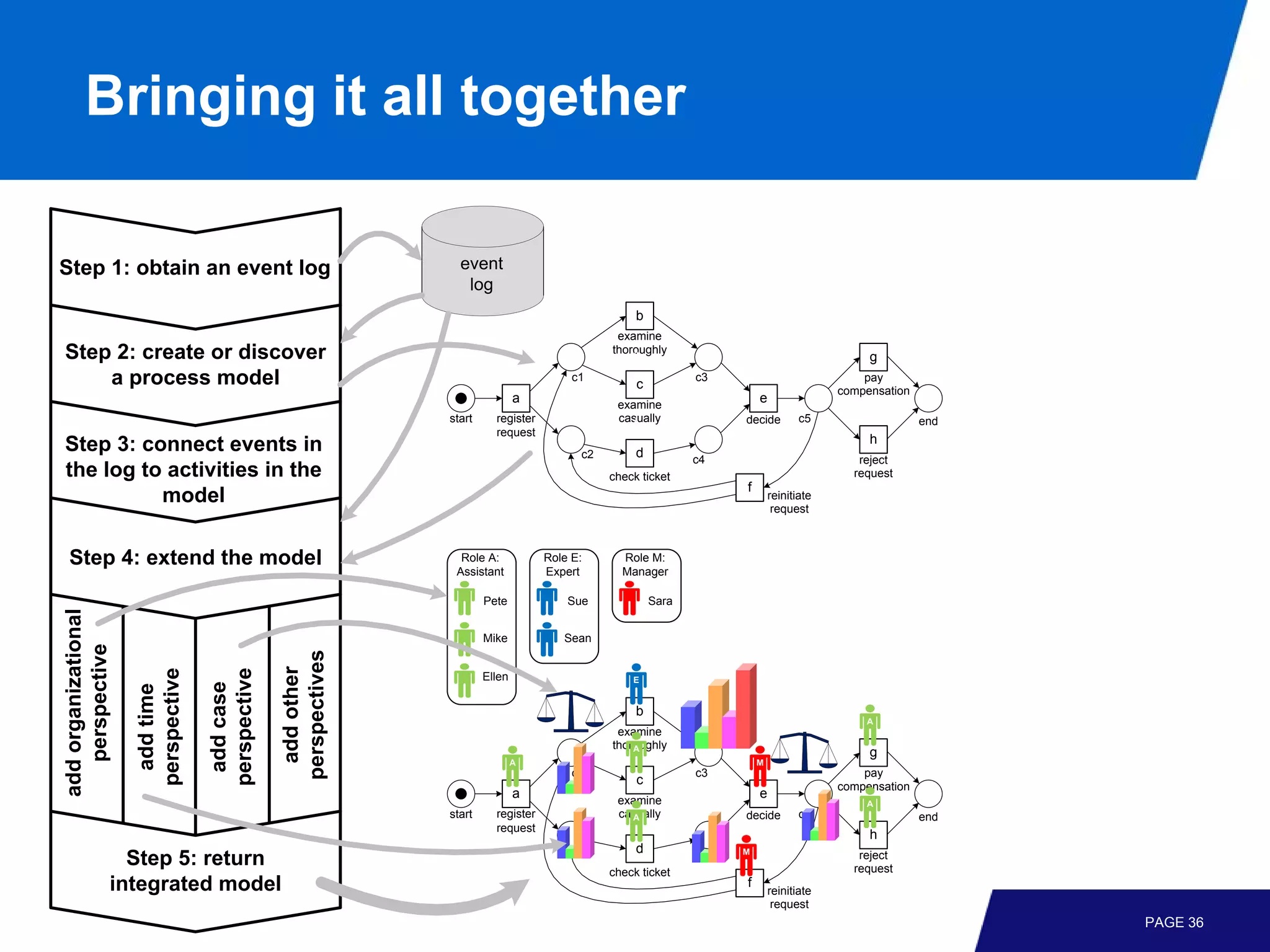
Bringing it all together

Step 1: obtain an event log                                       event
                                                                   log
                                                                                                     b
                                                                                                 examine
Step 2: create or discover                                                                      thoroughly
                                                                                                    A
                                                                                                                                               g
                                                                                A                                        M
    a process model                                                                       c1
                                                                                                     c
                                                                                                                c3                            pay
                                                                                                                                          compensation
                                                                                a                examine
                                                                                                                         e
                                                                start     register               casually
                                                                                                   A                 decide         c5                   end
                                                                          request
                                                                                                                                               h
Step 3: connect events in                                                                  c2        d          c4                           reject
the log to activities in the                                                                    check ticket                                request
                                                                                                                     f
          model                                                                                                              reinitiate
                                                                                                                              request


 Step 4: extend the model                                         Role A:            Role E:      Role M:
                                                                 Assistant           Expert       Manager

                                                                        Pete             Sue             Sara
add organizational


                                                                        Mike            Sean
   perspective


                                                 perspectives
                                                  add other
                     perspective


                                   perspective


                                                                        Ellen                       E
                                    add case
                      add time


                                                                                                     b
                                                                                                                                              A
                                                                                                 examine
                                                                                                thoroughly
                                                                                                    A
                                                                                                                                               g
                                                                                A                                        M
                                                                                          c1                    c3                            pay
                                                                                                     c                                    compensation
                                                                                a                examine
                                                                                                                         e
                                                                                                                                              A
                                                                start     register               casually
                                                                                                   A                 decide         c5                   end
                                                                          request
                                                                                                                                               h
                                                                                           c2        d               M
                   Step 5: return                                                                               c4                           reject
                                                                                                                                            request
                                                                                                check ticket
                 integrated model                                                                                    f
                                                                                                                             reinitiate
                                                                                                                              request
                                                                                                                                                               PAGE 36

Process Mining - Chapter 8 - Mining Additional Perspectives

  • 1.
    Chapter 8 Mining AdditionalPerspectives prof.dr.ir. Wil van der Aalst www.processmining.org
  • 2.
    Overview Chapter 1 Introduction Part I:Preliminaries Chapter 2 Chapter 3 Process Modeling and Data Mining Analysis Part II: From Event Logs to Process Models Chapter 4 Chapter 5 Chapter 6 Getting the Data Process Discovery: An Advanced Process Introduction Discovery Techniques Part III: Beyond Process Discovery Chapter 7 Chapter 8 Chapter 9 Conformance Mining Additional Operational Support Checking Perspectives Part IV: Putting Process Mining to Work Chapter 10 Chapter 11 Chapter 12 Tool Support Analyzing “Lasagna Analyzing “Spaghetti Processes” Processes” Part V: Reflection Chapter 13 Chapter 14 Cartography and Epilogue Navigation PAGE 1
  • 3.
    Mining additional perspectives (onetype of enhancement, cf. repair in context of conformance checking) supports/ “world” business controls processes software people machines system components organizations records events, e.g., messages, specifies transactions, models configures etc. analyzes implements analyzes discovery (process) event conformance model logs enhancement PAGE 2
  • 4.
    Replay: Connecting eventsto model elements is essential for process mining Play-In event log process model Play-Out process model event log Replay • extended model showing times, frequencies, etc. • diagnostics • predictions • recommendations event log process model PAGE 3
  • 5.
    Remember: Replay! ABC D B A p1 E p3 D start end p2 C p4 PAGE 4
  • 6.
    Replay can detectproblems AC D Problem! Problem! token left behind B missing token A p1 E p3 D start end p2 C p4 PAGE 5
  • 7.
    Replay can extracttiming information A5 B8 C9 D13 8 5 6 4 7 3 B 2 5 8 A p1 E p3 D start end 5 13 4 p2 3 C p4 4 37 4 7 6 9 PAGE 6
  • 8.
    Decision mining: “Red”cases ABC D B A p1 E p3 D start end p2 C p4 PAGE 7
  • 9.
    Decision mining: “Blue”cases If red then B+C; AE D If blue then E; B A p1 E p3 D start end p2 C p4 PAGE 8
  • 10.
    Starting point: connectedevent log and model 1 1 process b * case e * event timestamp h 1 1 * 1 a d f g resource i * 1 * activity * j activity c * instance 1 attribute costs k ... model instance event level level level trans- action PAGE 9
  • 11.
    Process supports/ “world” business controls the initial processes software process model people machines system is made by components hand or organizations records discovered from events, e.g., the event log messages, events have specifies transactions, models attributes configures etc. analyzes relating to implements various analyzes integrated model perspectives showing multiple 2 perspectives discovery (process) 3 event conformance 5 model 4 logs 1 enhancement conformance checking is the model is extended using the used to relate the initial additional information in the model and event log event log PAGE 10
  • 12.
    Attributes in eventlogs PAGE 11
  • 13.
    Cases may alsohave attributes PAGE 12
  • 14.
    Helicopter view: Dottedcharts activity : decide each dot corresponds to an event type : start time : 06-01-2011:11.18 resource : Sara cost : - custid : 9911 the color and name : Smith type : gold shape of a dot region : south may depend on amount : 989.50 attributes of the class event each line corresponds to a class, e.g., a case, a time resource, a customer, or an activity time can be absolute or relative and real or logical PAGE 13
  • 15.
    Dotted chart fora process of a housing agency using absolute time PAGE 14
  • 16.
    Zooming in PAGE 15
  • 17.
    Same log, relativetime PAGE 16
  • 18.
  • 19.
    Resource-activity matrix mean numberof times a resource performs an activity per case Activity a is executed exactly once for each case (take the sum of the first column). Pete, Mike, and Ellen are the only ones executing this activity. In 30% of the cases, a is executed by Pete, 50% is executed by Pete, and 20% is executed by Ellen. Activities e and f are always executed by Sara. Activity e is executed, on average, 2.3 times per case. Etc. PAGE 18
  • 20.
    Social network analysis the thickness of the arc indicates organizational entity (resource, the weight of the relationship person, role, department, etc.) w=0.98 relationship y the size of the oval indicates the weight of the entity w=0.80 w=0.90 w=0.15 x z w=0.30 w=0.35 w=0.08 PAGE 19
  • 21.
    Handover of workmatrix Count the number of times The causal dependencies in work is handed over from one the process model are used resource to another (on to count handovers in the average per case). event log. PAGE 20
  • 22.
    Social network basedon handover of work (threshold of 0.1) Pete Sue Sean Mike Sara Ellen In this figure only the thickness of the arcs is based PAGE 21 on frequencies.
  • 23.
    Handover of workat role level w=1.5 Assistant w=5.45 w=0.5 w=3.45 w=2,95 Expert w=1.3 w=1.15 w=0.65 In this figure also Manager w=1.15 w=3.6 the size of each node is based on PAGE 22 frequencies.
  • 24.
    Profile PAGE 23
  • 25.
    Social network basedon similarity of profiles Sean Sue Pete Mike Ellen Sara Resources that execute similar collections of activities are related. Sara is the only resource executing e and f . Therefore, she is not connected to other resources. Self-loops are suppressed as they contain no information (self-similarity) PAGE 24
  • 26.
    Discovering organizational structures Expert Manager Sue Sean Sara b examine thoroughly g p1 p3 pay c compensation a examine e start register casually decide p5 end request h p2 d p4 reject check ticket request f reinitiate request Assistant Mike Ellen Pete PAGE 25
  • 27.
    Another example process model organizational model resources oe1 r1 r2 a1 oe2 oe3 r3 a2 a3 r4 oe4 oe5 a4 r5 oe6 oe7 oe8 r6 r7 a5 r8 r9 PAGE 26
  • 28.
    Analyzing resource behavior,e.g., Yerkes-Dodson law of arousal PAGE 27
  • 29.
    Learning time andprobabilities • Replay, as before, but now considering timestamps. • Let us replay the first three cases in the event log: − case 1 starts at time 12 and ends at time 54, − case 2 starts at time 17 and ends at time 73, − case 3 starts at time 25 and ends at time 98. PAGE 28
  • 30.
    5 1,s:35 1,c:40 9 2,s:50 2,c:59 1,s:25 7 1,c:32 2,s:30 8 2,c:38 5 3,s:45 3,c:50 5 3 7 3,s:60 3,c:65 3,s:32 3,c:35 3,s:80 3,c:87 2,s:70 3 2,c:73 7 8 1,s:12 1,c:19 3,s:90 3,c:98 1:10 6 1:3 2,s:17 2,c:23 2:11 1:6 2:12 5 3,s:25 3,c:30 2:7 b 3:10 3:0 3:3 3:2 3:15 examine 3:5 thoroughly 1:12 g 1:54 2:73 p1 p3 pay 2:17 c compensation 3:98 3:25 a examine e start register casually decide p5 end request h 1:7 p2 d p4 reject 2:5 check ticket request 3:5 f 1,s:50 4 1,c:54 3:7 reinitiate 1:2 request 2:18 5 3,s:50 3,c:55 7 3:5 1,s:26 1,c:33 3:13 4 2,s:28 2,c:32 5 3,s:35 3,c:40 5 3,s:62 3,c:67 PAGE 29
  • 31.
    Another view onthe timed replay of the first three cases 0 10 20 30 40 50 60 70 80 90 time a b case 1 d e h a c case 2 d e g a b c case 3 d d e e f g PAGE 30
  • 32.
    Timed replay projectedonto resources 0 10 20 30 40 50 60 70 80 90 time a a h Pete c d d Mike a d c Ellen d g g Sue b Sean b e Sara e e f e PAGE 31
  • 33.
    Decision mining decision b point #1 examine thoroughly decision g point #2 c1 c3 pay c compensation a examine e start register casually decide c5 end request h c2 d c4 reject check ticket request f reinitiate request PAGE 32
  • 34.
    Example: XOR-split type region amount activity type=gold and y amount<500 What are the “features” gold south 987.30 z (predictor variables) silver north 178.70 z x influencing the gold south 211.50 y type=silver or decision? silver west 587.70 z amount≥500 z silver east 224.70 z silver south 278.50 z y gold north 488.50 y type=gold and silver west 443.20 z amount<500 x silver south 673.70 z type=silver or amount≥500 gold west 413.50 y A classification technique silver south 687.70 z z like decision tree learning gold south 987.30 z can be used to find such silver north 378.80 z rules: :explain response type=gold and y gold south 314.50 y amount<500 variable (dependent silver north 537.70 z variable) in terms of x predictor variables silver west 158.70 z type=silver or (independent variables). gold east 344.50 y amount≥500 z ... ... ... ... PAGE 33
  • 35.
    Example: OR-split type=gold or y type region amount activity amount<500 gold south 987.30 y and z x silver north 178.70 y and z gold south 211.50 just y type=silver or amount≥500 z silver west 587.70 just z silver east 224.70 y and z y silver south 278.50 y and z gold north 488.50 just y type=gold or amount<500 silver west 443.20 y and z x type=silver or silver south 673.70 just z amount≥500 ... ... ... ... z PAGE 34
  • 36.
    Classification in processmining • The application of classification techniques like decision tree learning is not limited to decision mining based on event/case data only. • Additional predictor variables may be used: − behavioral information (count number of loops) − performance information (processing times) − contextual information (weather, queues, etc.) • Alternative response variables can be analyzed: − uncover reasons for non-conformance (split instances in two groups) − uncover reasons for delays PAGE 35
  • 37.
    Bringing it alltogether Step 1: obtain an event log event log b examine Step 2: create or discover thoroughly A g A M a process model c1 c c3 pay compensation a examine e start register casually A decide c5 end request h Step 3: connect events in c2 d c4 reject the log to activities in the check ticket request f model reinitiate request Step 4: extend the model Role A: Role E: Role M: Assistant Expert Manager Pete Sue Sara add organizational Mike Sean perspective perspectives add other perspective perspective Ellen E add case add time b A examine thoroughly A g A M c1 c3 pay c compensation a examine e A start register casually A decide c5 end request h c2 d M Step 5: return c4 reject request check ticket integrated model f reinitiate request PAGE 36