© Wil van der Aalst (use only with permission & acknowledgements)
prof.dr.ir. Wil van der Aalst
RWTH Aachen University
W: vdaalst.com T:@wvdaalst
Process Mining
BPM on Steroids
CPOs@BPM&O 2019
7-3-2019 Flora Köln
Miguel Valdes
CEO and co-founder of BonitaSoft at BPM 2017
© Wil van der Aalst (use only with permission & acknowledgements)
Traditional BPM: Wallpaper models and problematic implementations
slow
disconnected
expensive
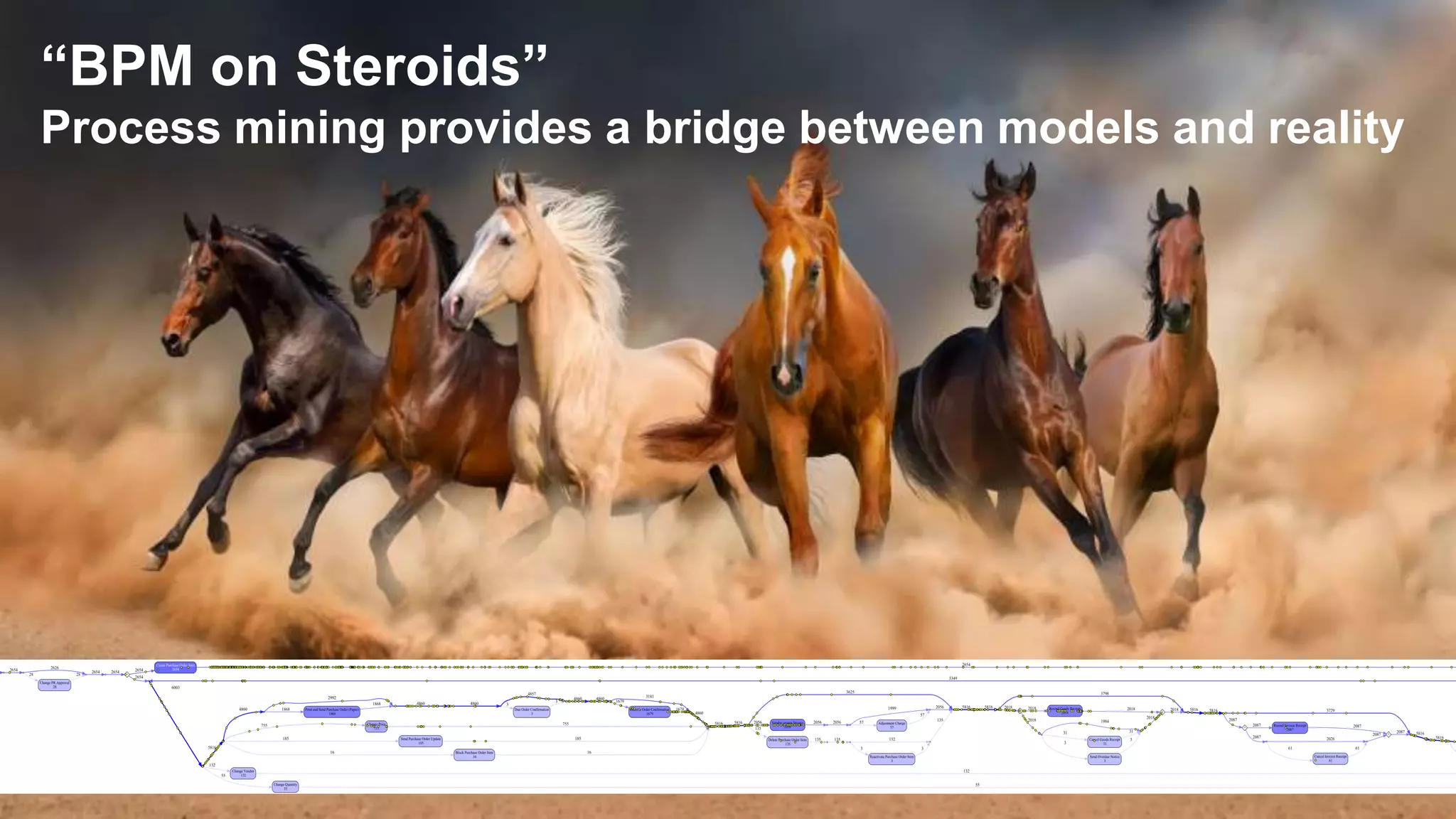
“BPM on Steroids”
Process mining provides a bridge between models and reality
© Wil van der Aalst (use only with permission & acknowledgements)
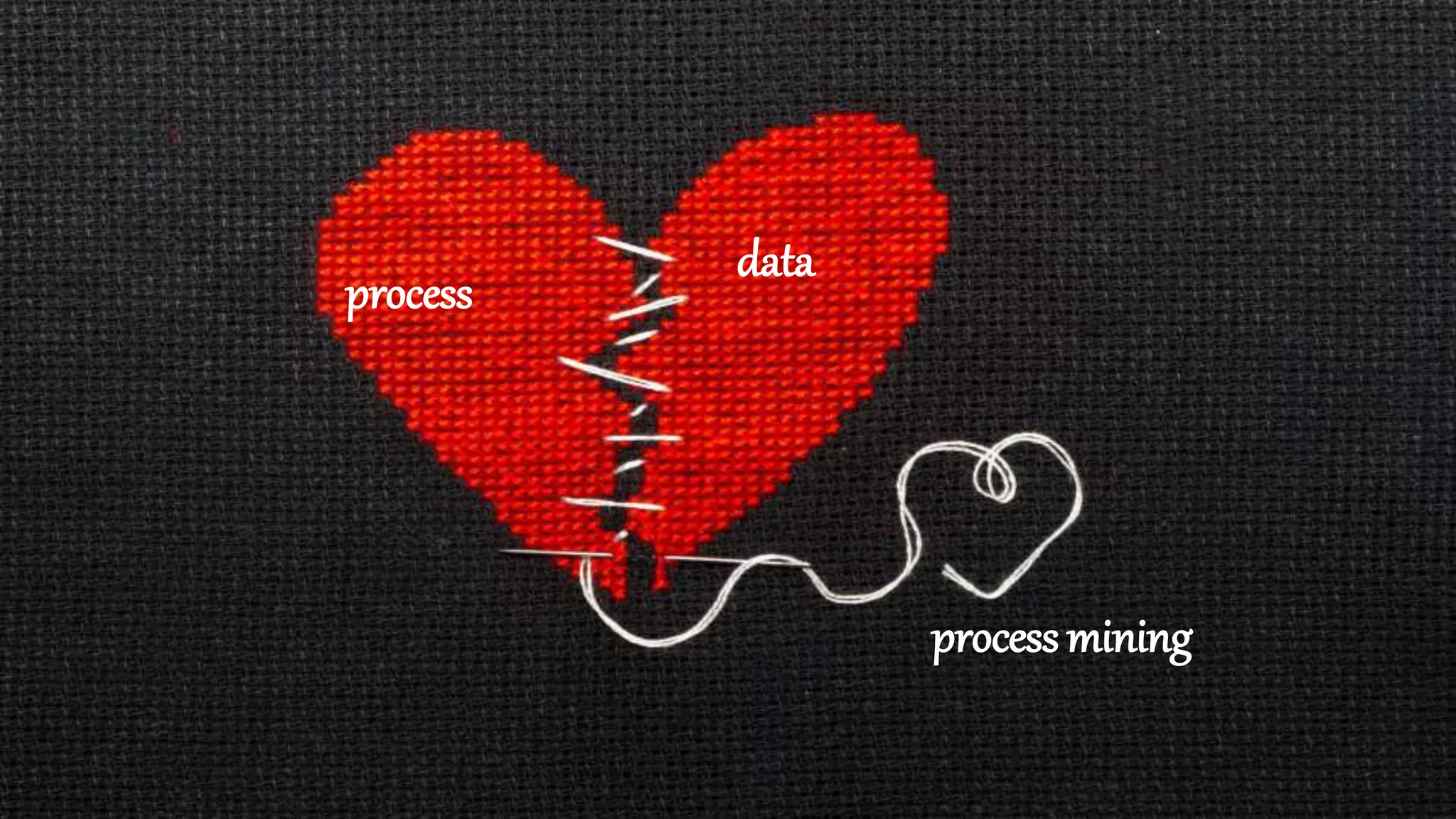
process
data
processmining
© Wil van der Aalst (use only with permission & acknowledgements)
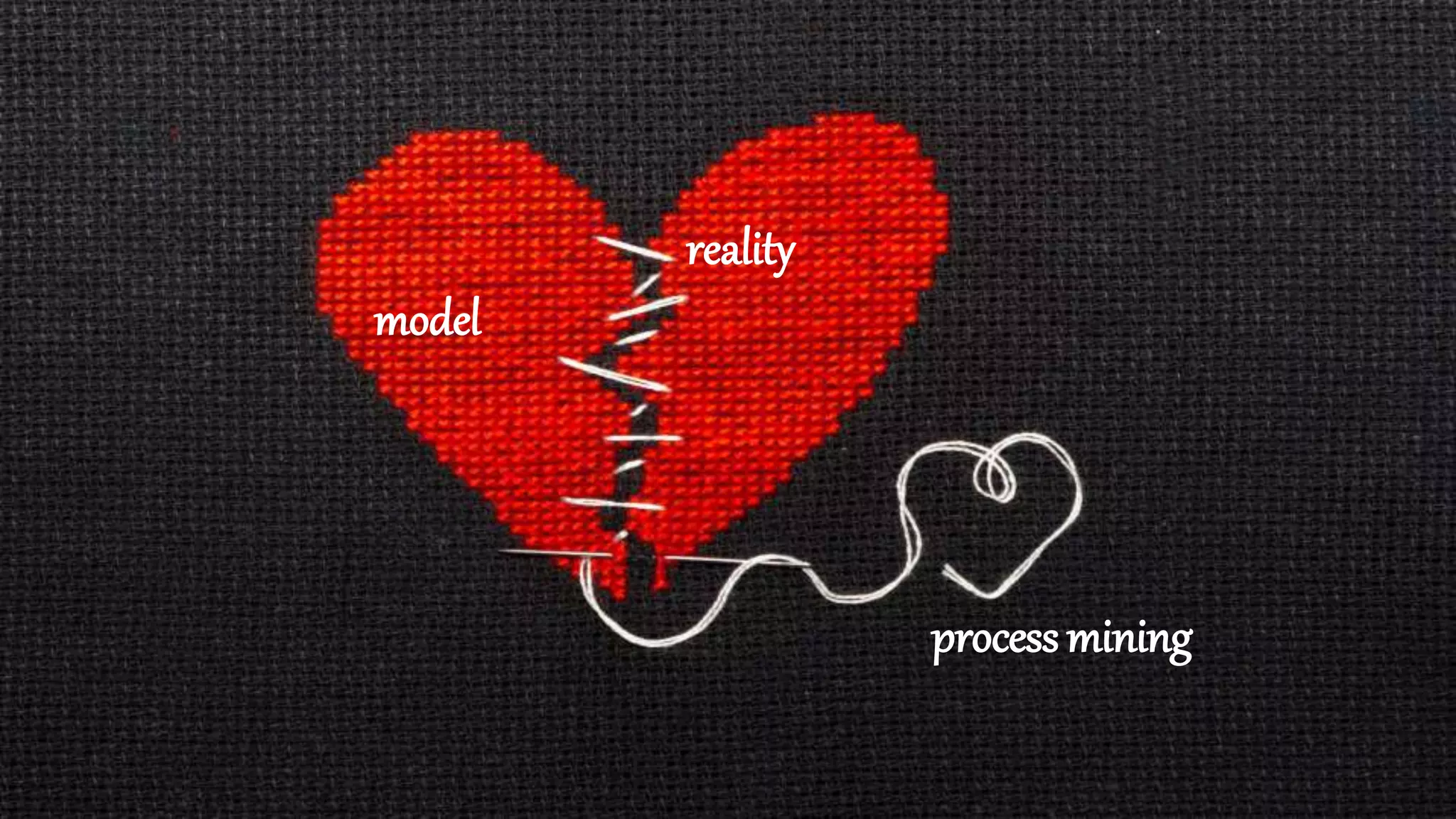
model
reality
processmining
© Wil van der Aalst (use only with permission & acknowledgements)
IT
processmining
© Wil van der Aalst (use only with permission & acknowledgements)
machine
learning
data
mining
algorithms
statistics privacy,
security,
law &
ethics
behavioral
/social
science
business
models &
marketing
visualization
& visual
analytics
distributed
systems
databases
predictive
analytics
stochastics
operations
manage-
ment &
research
business
process
management
process
automation
&
optimi-
zation
formal methods
& concurrency
theory
business
process
improve-
ment
workflow
manage-
ment
data
science
process
science
process
mining
www.pads.rwth-aachen.de
Data Science, Process Science, Process Mining, Business Process Management, Data Mining, Process
Discovery, Conformance Checking, Simulation, and Responsible Data Science.
Foundations
of Process
Mining
Dealing
with XXXX
Event Data
Automated
Operational
Process
Improvement
Responsible
Process
Mining
© Wil van der Aalst (use only with permission & acknowledgements)
A Personal Journey (between process and data)
• Petri nets (1988-now)
• WFM systems (1995-2005)
• BPM (2000-now)
• Process Mining (1999-now)
• Director DSC/e (2013-2018)
• AvH-RWTH-FIT(2018-now)
© Wil van der Aalst (use only with permission & acknowledgements)
A Personal Journey (not just paper)
Woflan
over 100.000 participants in the first process mining course
© Wil van der Aalst (use only with permission & acknowledgements)© Wil van der Aalst (use only with permission & acknowledgements)
What is Process
Mining?
© Wil van der Aalst (RWTH Aachen University)
12
start from raw data
csv / excel file with
2 × 80,609 events (= rows)
about
12,666 cases (= orders)
referring to
8 unique activities
© Wil van der Aalst (RWTH Aachen University)
13
Let’s focus on the events of order 9012
© Wil van der Aalst (RWTH Aachen University)
14
12,666 cases (orders)
80,609 events (only
using completes)
discovered
using ILP miner
© Wil van der Aalst (RWTH Aachen University)
15
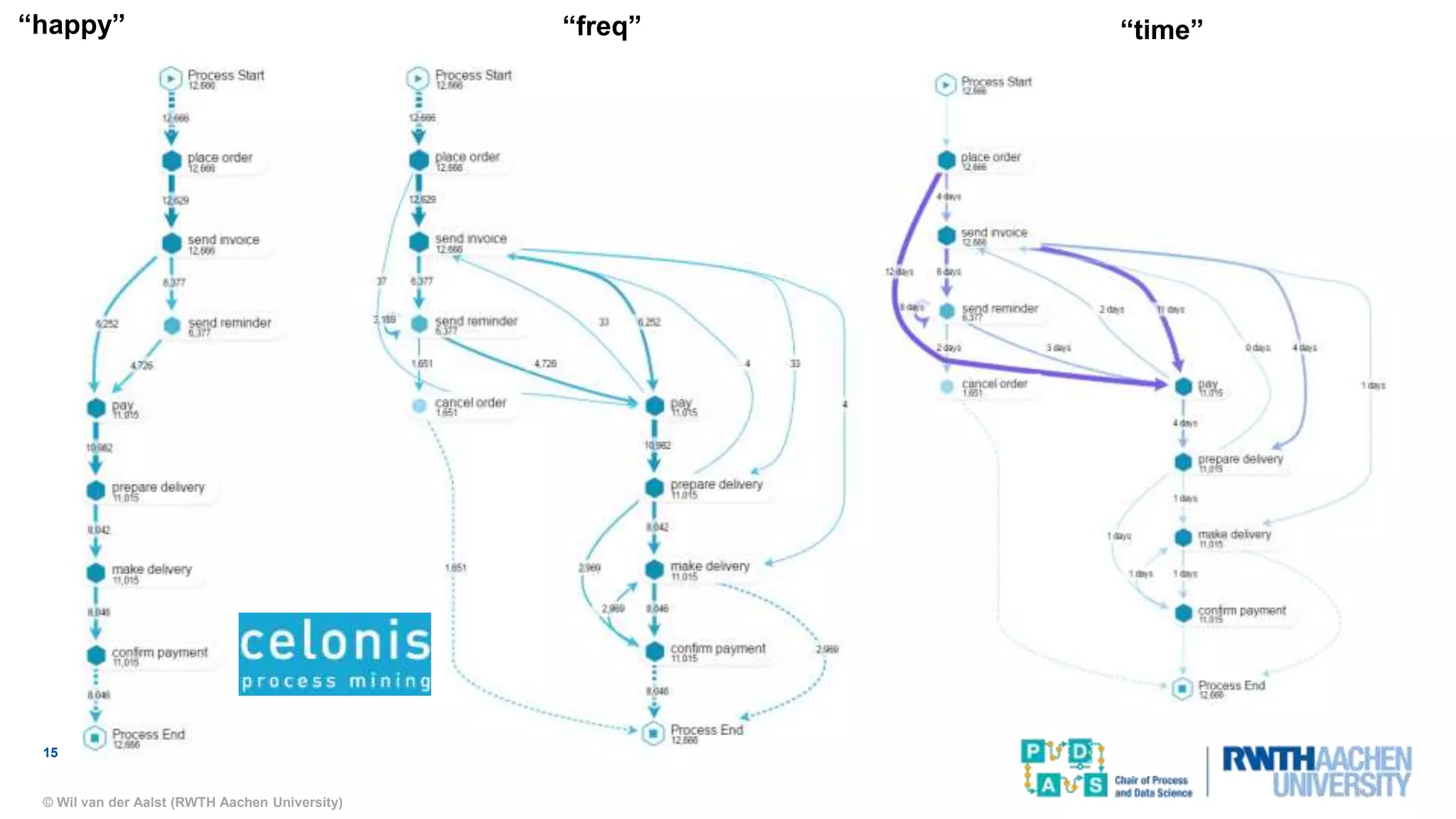
“happy” “freq” “time”
© Wil van der Aalst (RWTH Aachen University)
16
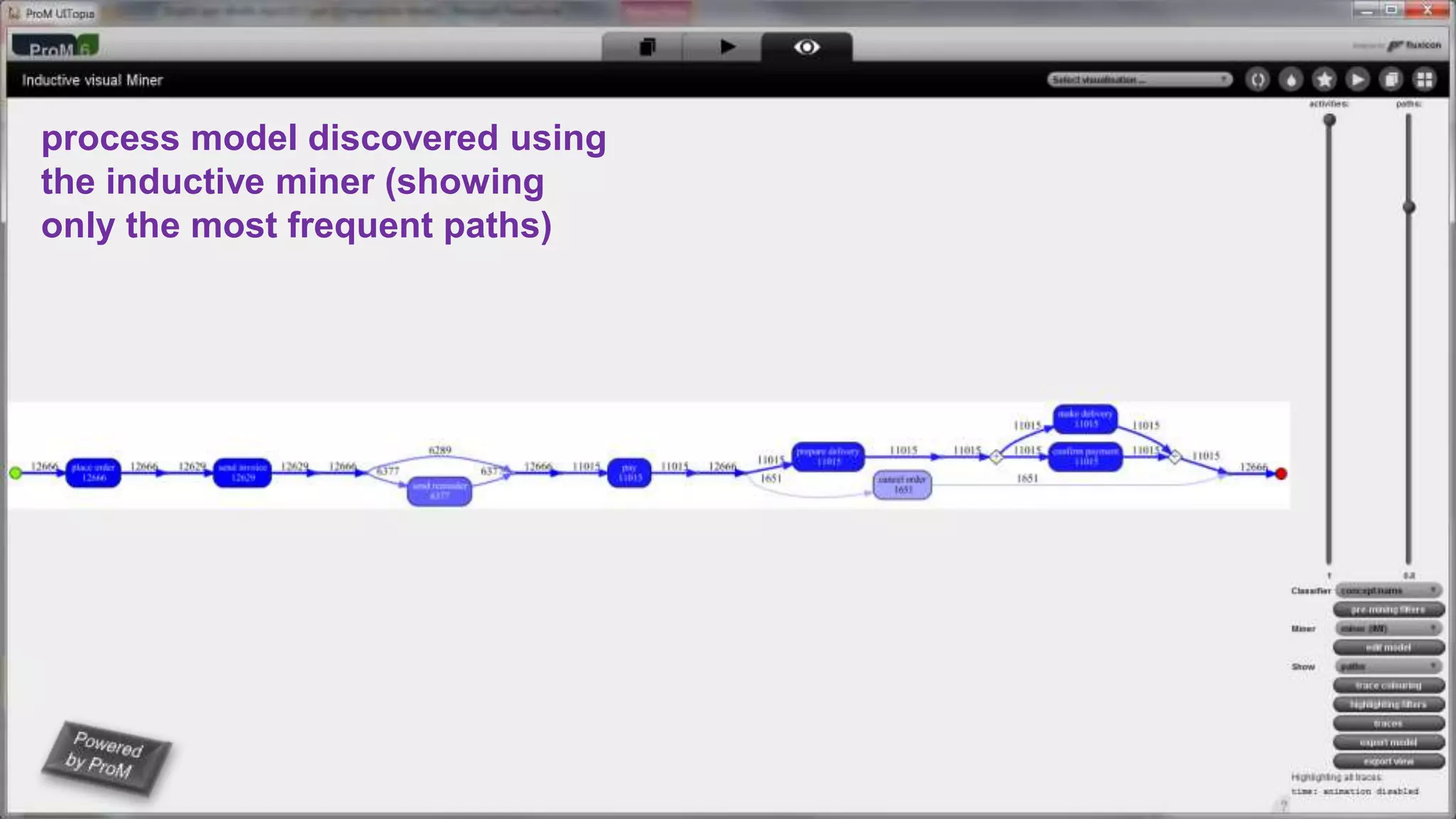
process model discovered using
the inductive miner (showing
only the most frequent paths)
© Wil van der Aalst (RWTH Aachen University)
17
zooming in
© Wil van der Aalst (RWTH Aachen University)
18
using conformance checking
to see all deviations
happened in
reality but not
allowed by the
model
required by the
model but did not
happen
© Wil van der Aalst (RWTH Aachen University)
19
bottleneck analysis: enriching
the model with performance
information
© Wil van der Aalst (RWTH Aachen University)
20
animating the event log
showing real cases
seamless abstraction
► one log many possible views
© Wil van der Aalst (RWTH Aachen University)
22
create purchase
requisition
create purchase
order
approve purchase
order
receive order
confirmation
receive goods receive invoice
pay invoice
Purchase-to-Pay
• Simple process found in
almost any organization.
• Data available in e.g. SAP.
• Most cases follow the so-
called “happy path”.
• 80/20 rule applies.
© Wil van der Aalst (RWTH Aachen University)
23
Real process may look like this:
700,000 cases may exhibit 7,000 unique variants
© Wil van der Aalst (RWTH Aachen University)
24
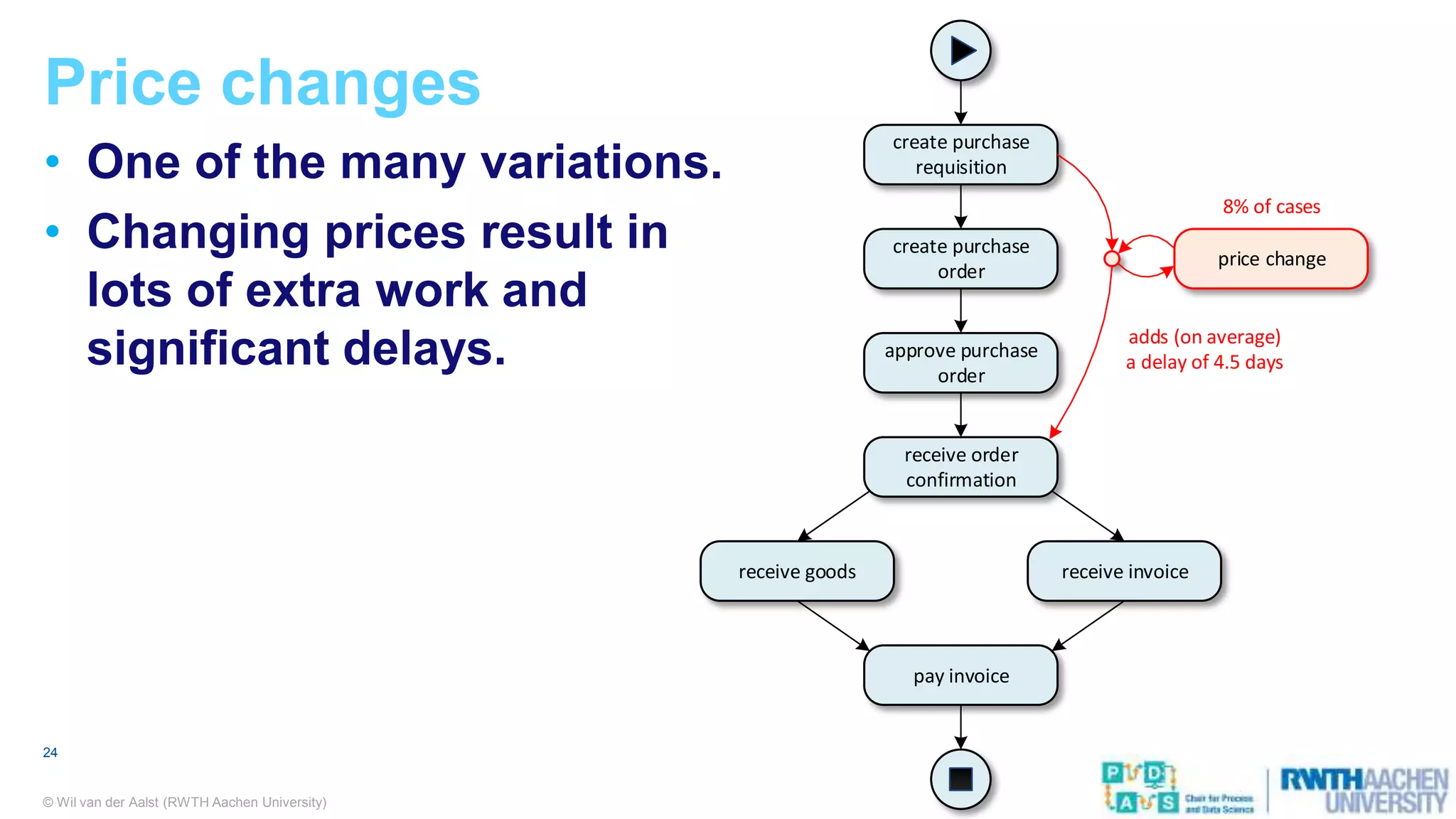
Price changes
• One of the many variations.
• Changing prices result in
lots of extra work and
significant delays.
create purchase
requisition
create purchase
order
approve purchase
order
receive order
confirmation
receive goods receive invoice
pay invoice
price change
8% of cases
adds (on average)
a delay of 4.5 days
© Wil van der Aalst (RWTH Aachen University)
25
Pay before receipt
• Goods are paid before they
have been received.
• Goods arrived too late or
not at all.
• May indicate fraud.
create purchase
requisition
create purchase
order
approve purchase
order
receive order
confirmation
receive goods receive invoice
pay invoice
2% of cases
goods are paid but
never received
© Wil van der Aalst (RWTH Aachen University)
26
Two additional
variations
• Orders created without
requisition.
• Rejected orders
generating rework.
 7000-4 = 6996 variants to go …
 Can be sorted based on
frequency or impact.
create purchase
requisition
create purchase
order
approve purchase
order
receive order
confirmation
receive goods receive invoice
pay invoice
rejected purchase
order
modify purchase
order
6% of cases
purchase order
created without
requisition
3% of cases
purchase order is
rejected resulting in
rework and a delay of
on average 8.2 days
© Wil van der Aalst (RWTH Aachen University)
27
Performance
problems
• Delays inside the
process.
• Excessive flow
times.
• Not meeting Service
Level Agreements
(SLAs).
create purchase
requisition
create purchase
order
approve purchase
order
receive order
confirmation
receive goods receive invoice
pay invoice
!
!
It takes to long to pay
invoices resulting in
complaints and fines
(15% more than 3
weeks).
The approval of
purchase orders takes
too long (28% more
than 10 days).
Drill down to event
data and uncover the
root causes.
© Wil van der Aalst (RWTH Aachen University)
28
Compliance problems
Activities may be:
• skipped,
• done too early or too late,
• done by the wrong person,
• should not have happened
at all.
create purchase
requisition
create purchase
order
approve purchase
order
receive order
confirmation
receive goods receive invoice
pay invoice
! Orders are created
without a purchase
requisition.
!Invoices are paid
before the goods
arrive.
Drill down to event
data and uncover the
root causes.
© Wil van der Aalst (RWTH Aachen University)
Using process mining, one can …
© Wil van der Aalst (RWTH Aachen University)
discover the real processes
© Wil van der Aalst (RWTH Aachen University)
check compliance
© Wil van der Aalst (RWTH Aachen University)
uncover and quantify deviations
© Wil van der Aalst (RWTH Aachen University)
find root causes for process variations
© Wil van der Aalst (RWTH Aachen University)
find bottlenecks
© Wil van der Aalst (RWTH Aachen University)
find root causes for delays
© Wil van der Aalst (RWTH Aachen University)
predict process outcomes
© Wil van der Aalst (RWTH Aachen University)
foresee deviations and bottlenecks
© Wil van der Aalst (RWTH Aachen University)
PM is great!
How to start?
What will happen next?
© Wil van der Aalst (use only with permission & acknowledgements)© Wil van der Aalst (use only with permission & acknowledgements)
Technology transfer
© Wil van der Aalst (RWTH Aachen University)
Applications: Always about compliance and performance
• Processes supported by ERP and CRM systems (e.g., SAP).
• Healthcare (range of hospitals).
• Logistics and production (e.g., with Vanderlande).
• E-learning (e.g., based on Coursera).
• E-government (see CoSeLog project).
• Smart homes / quantified self (with Philips).
• High-tech systems.
• Auditing.
• Fraud detection.
• Etc.
© Wil van der Aalst (RWTH Aachen University)
Technology transfer
challenges
ideas
new techniques
and approaches
data
© Wil van der Aalst (RWTH Aachen University)
Tooling
• ProM is the de facto standard in the scientific world.
• Ideas initially developed in ProM have been adopted by commercial
vendors.
• Currently, more than 25 commercial vendors offering process mining
software (Celonis, Fluxicon, ProcessGold, QPR, etc.).
>1500 plug-ins
© Wil van der Aalst (RWTH Aachen University)
1500 plug-ins
© Wil van der Aalst (RWTH Aachen University)
Usability
© Wil van der Aalst (RWTH Aachen University)
Technology transfer (e.g., Celonis)
[2012] process discovery
inspired by heuristic miner
(2002) and fuzzy miner
(2006)
[2018] process discovery
based on the inductive miner
(2013)
[2013] token
animation and
sliders (2006)
[2017] token-based
conformance checking
(2005)
[2017] process-
based root cause
analysis (2006)
10
5
11
12
7
© Wil van der Aalst (RWTH Aachen University)
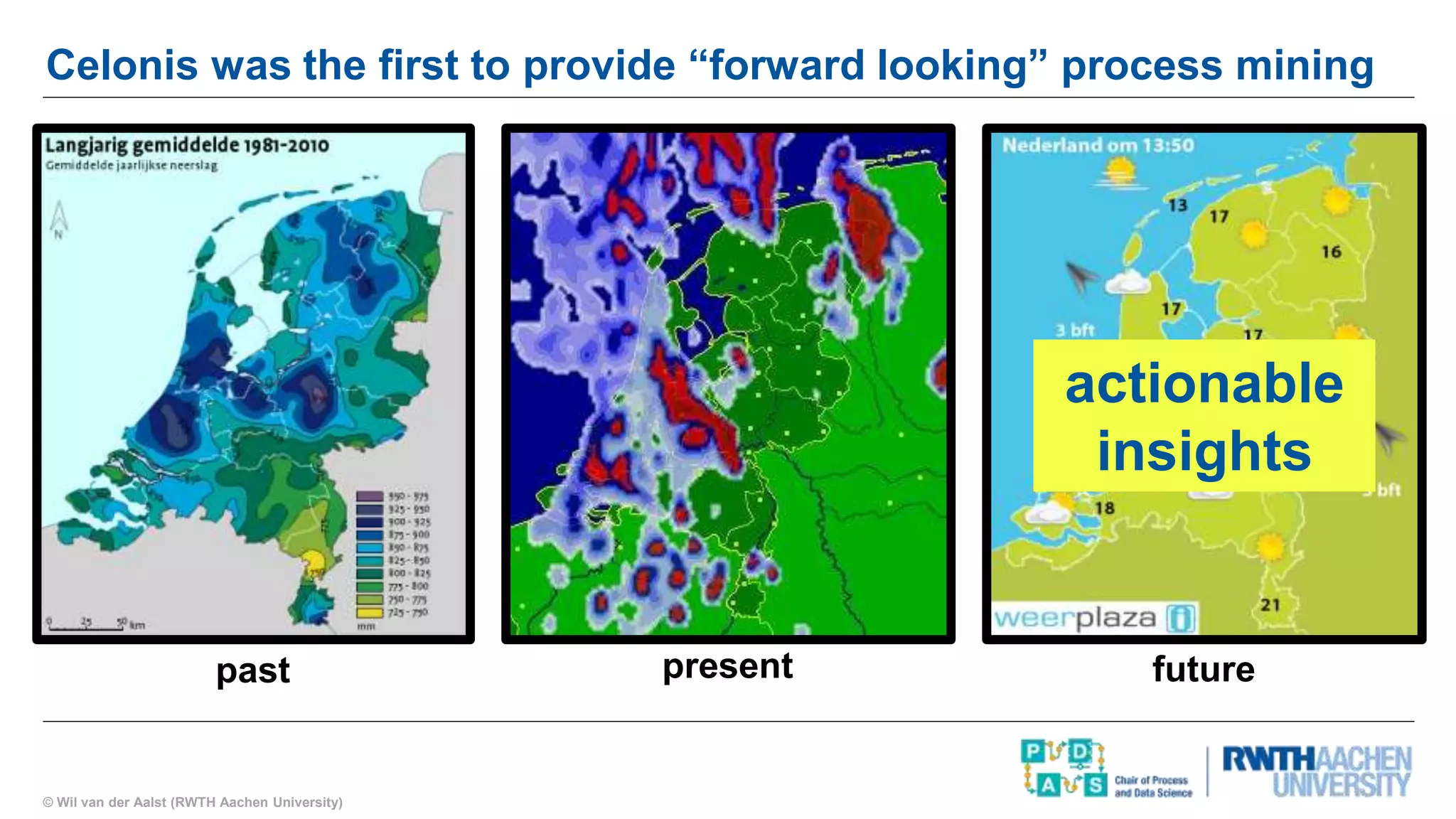
Celonis was the first to provide “forward looking” process mining
past present future
actionable
insights
© Wil van der Aalst (RWTH Aachen University)
Adoption & Practical Relevance
Identified as a new market
segment by Gartner.
(April 2018)
Celonis gets
Unicorn status
Many large SAP customers are
already using process mining
© Wil van der Aalst (use only with permission & acknowledgements)© Wil van der Aalst (use only with permission & acknowledgements)
What is next?
Robotic Process
Automation
(RPA) & PM
© Wil van der Aalst (use only with permission & acknowledgements)
1 of 17 variants
8% of cases covered
© Wil van der Aalst (use only with permission & acknowledgements)
5 of 17 variants
88% of cases covered
© Wil van der Aalst (use only with permission & acknowledgements)
17 of 17 variants
100% of cases covered
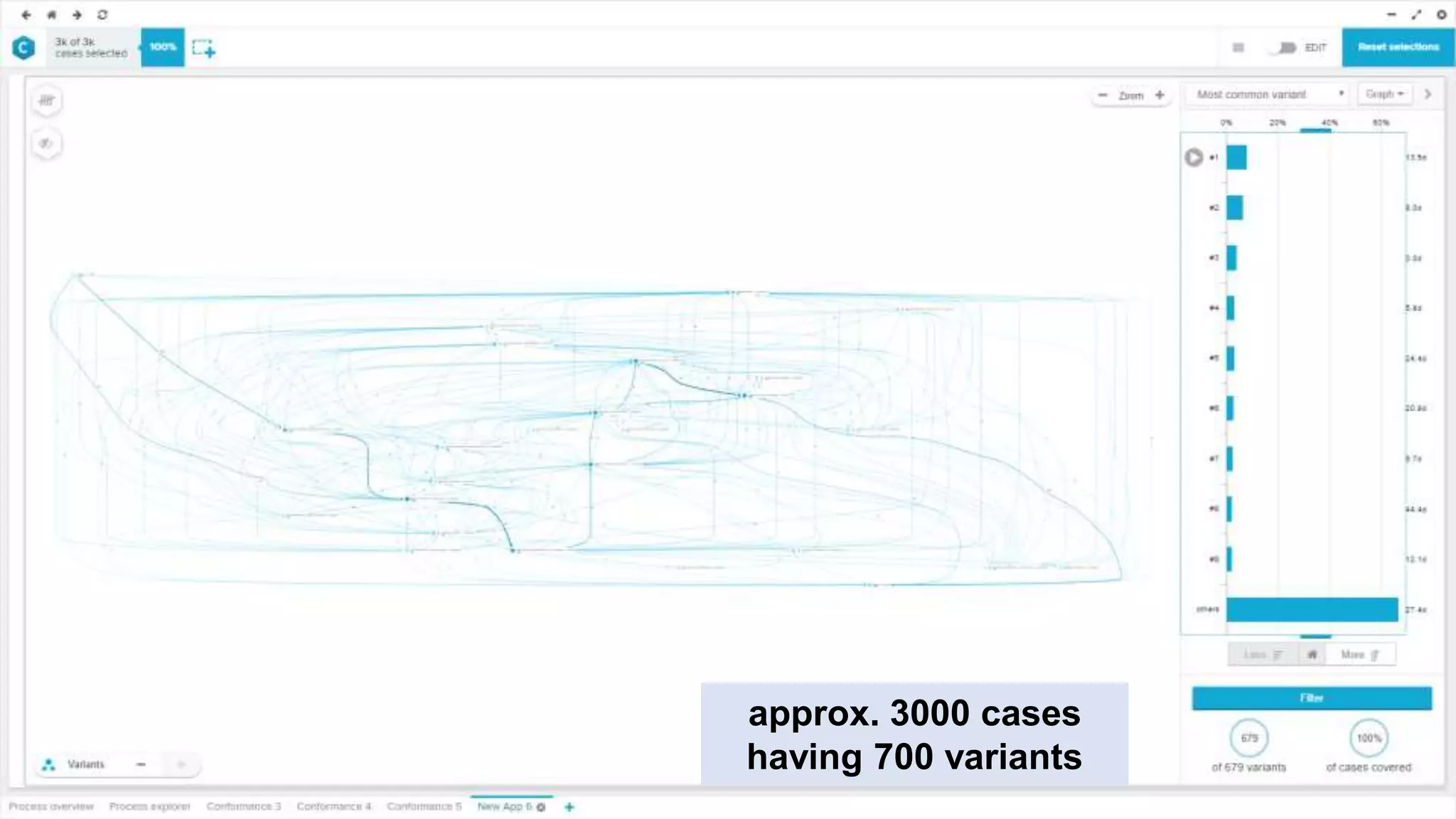
approx. 3000 cases
having 700 variants
208 cases having
203 variants
© Wil van der Aalst (use only with permission & acknowledgements)
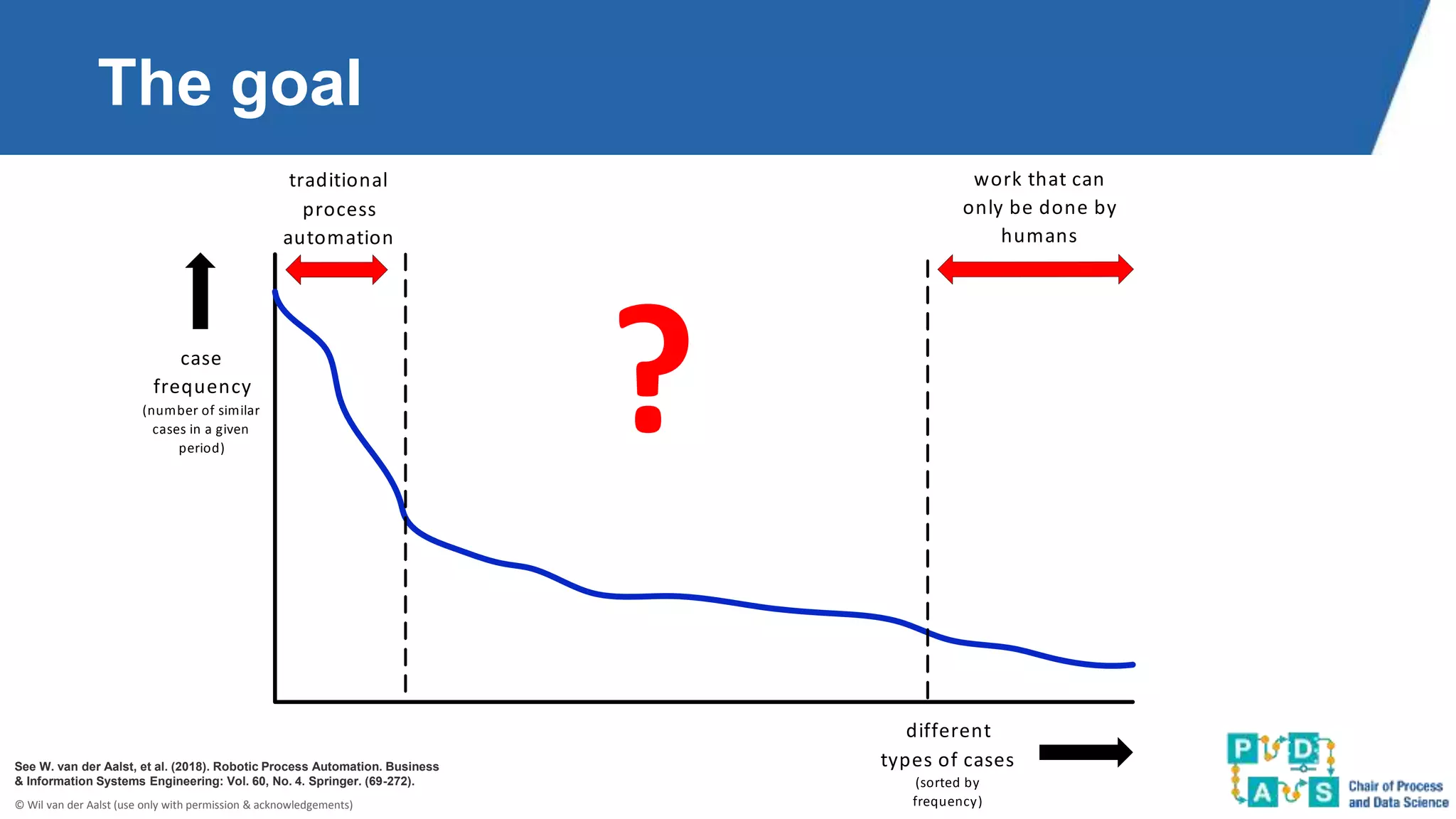
The goal
case
frequency
(number of similar
cases in a given
period)
different
types of cases
(sorted by
frequency)
many cases follow the
same structured process ,
making automation
economically feasible
there is repetitive work ,
but not frequent enough
to justify automation
Infrequent/exceptional
cases that need to be
handled in an ad-hoc
manner
See W. van der Aalst, et al. (2018). Robotic Process Automation. Business
& Information Systems Engineering: Vol. 60, No. 4. Springer. (69-272).
© Wil van der Aalst (use only with permission & acknowledgements)
The goal
case
frequency
(number of similar
cases in a given
period)
different
types of cases
(sorted by
frequency)
traditional
process
automation
work that can
only be done by
humans
?
See W. van der Aalst, et al. (2018). Robotic Process Automation. Business
& Information Systems Engineering: Vol. 60, No. 4. Springer. (69-272).
© Wil van der Aalst (use only with permission & acknowledgements)
The goal
case
frequency
(number of similar
cases in a given
period)
different
types of cases
(sorted by
frequency)
traditional
process
automation
Robotic Process Automation
(RPA)
candidates
work that can
only be done by
humans
See W. van der Aalst, et al. (2018). Robotic Process Automation. Business
& Information Systems Engineering: Vol. 60, No. 4. Springer. (69-272).
© Wil van der Aalst (use only with permission & acknowledgements)
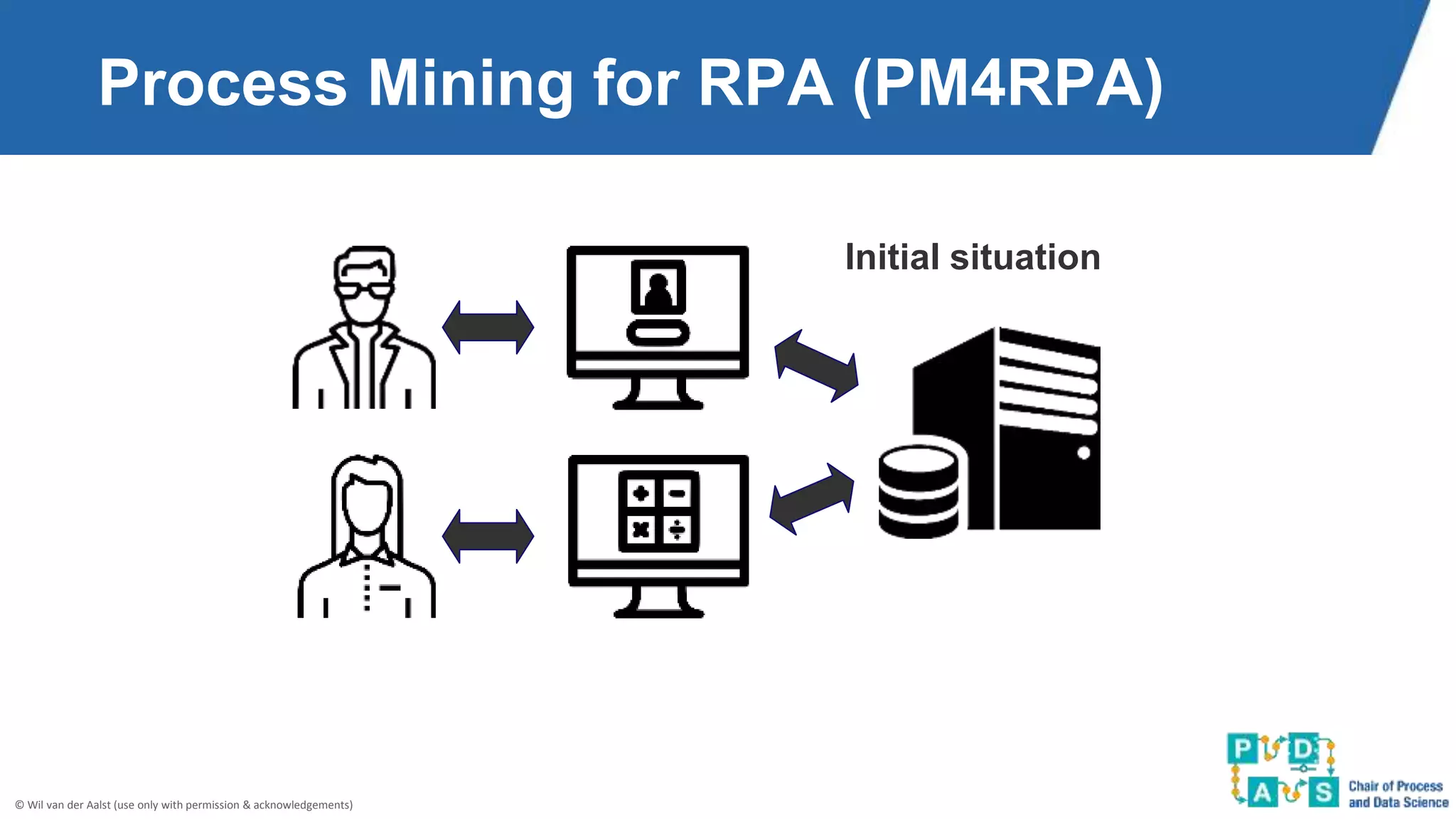
Process Mining for RPA (PM4RPA)
Initial situation
© Wil van der Aalst (use only with permission & acknowledgements)
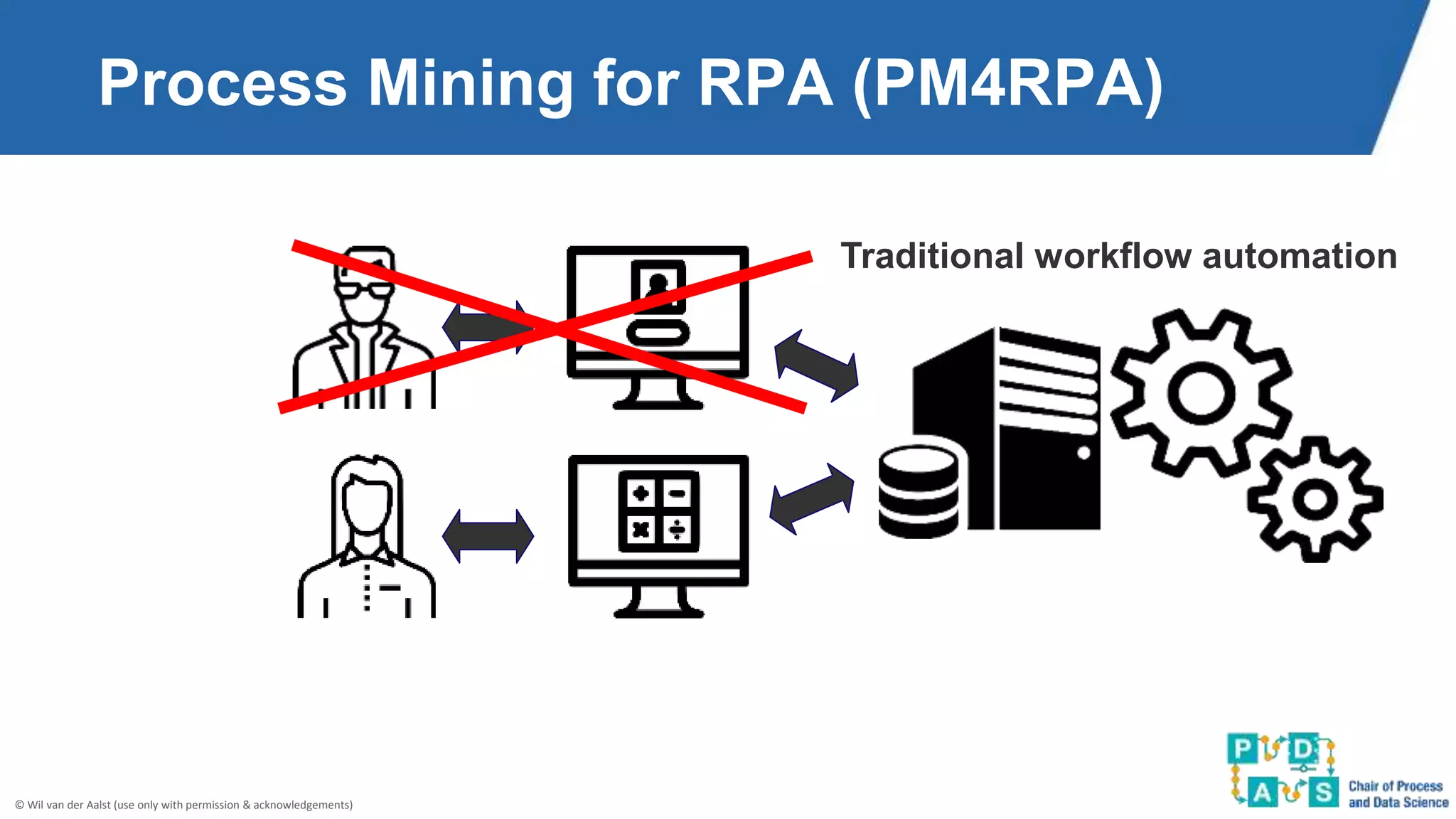
Process Mining for RPA (PM4RPA)
Traditional workflow automation
© Wil van der Aalst (use only with permission & acknowledgements)
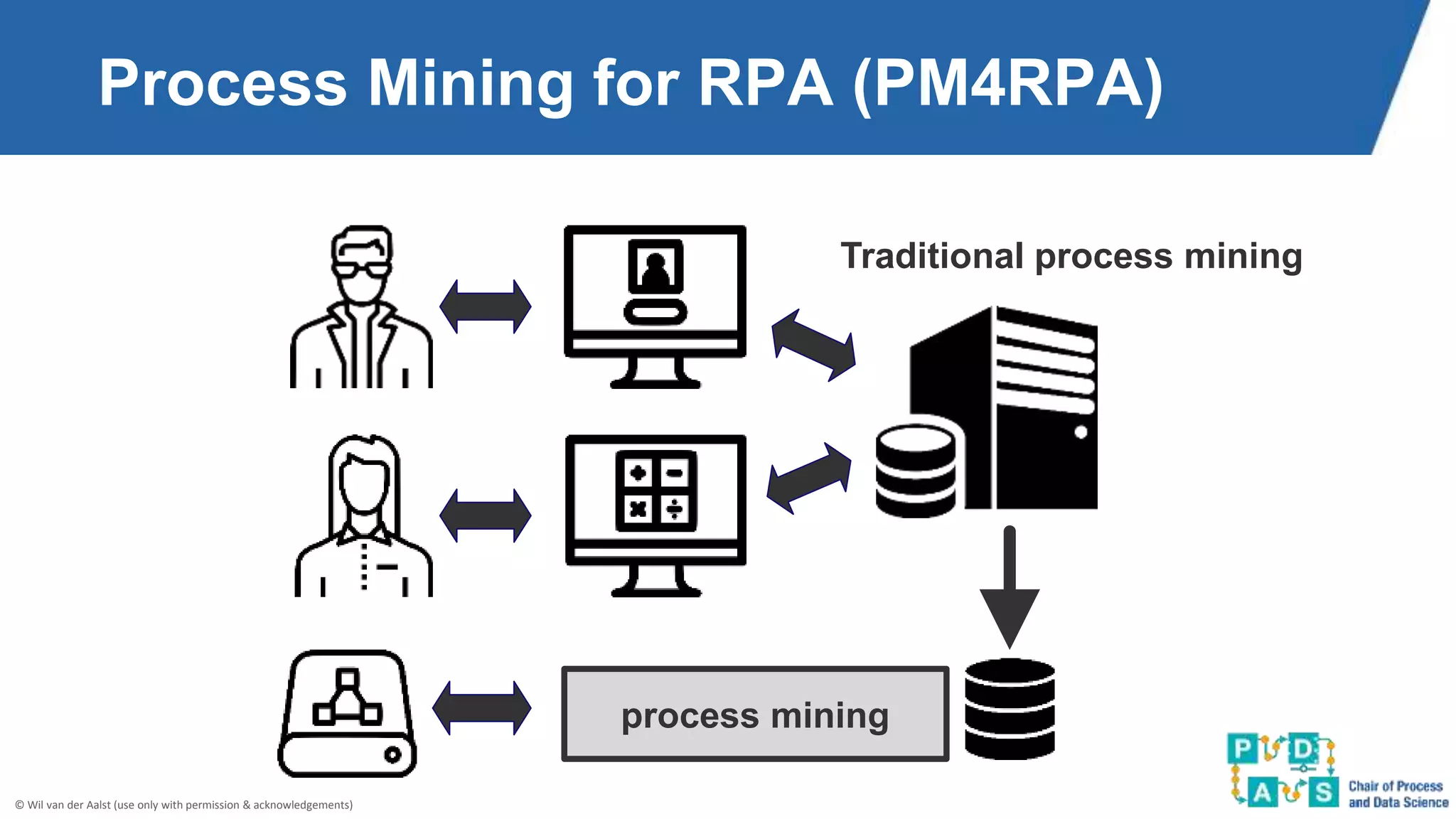
Process Mining for RPA (PM4RPA)
Traditional process mining
process mining
© Wil van der Aalst (use only with permission & acknowledgements)
Process Mining for RPA (PM4RPA)
process mining
case
frequency
(number of similar
cases in a given
period)
different
types of cases
(sorted by
frequency)
traditional
process
automation
work that can
only be done by
humans
?
What to automate in a traditional manner?
What to support using RPA?
What is best done by people?
RPA-I
© Wil van der Aalst (use only with permission & acknowledgements)
Process Mining for RPA (PM4RPA)
process mining
Does the robot behave as expected?
How to distribute the work (static)?
RPA-II
© Wil van der Aalst (use only with permission & acknowledgements)
Process Mining for RPA (PM4RPA)
process mining
When and how to dynamically transfer work?
How to actively improve compliance/performance?
How to detect drifts and act upon these?
RPA-III
Hybrid Process
Models (HPM)
© Wil van der Aalst (use only with permission & acknowledgements)
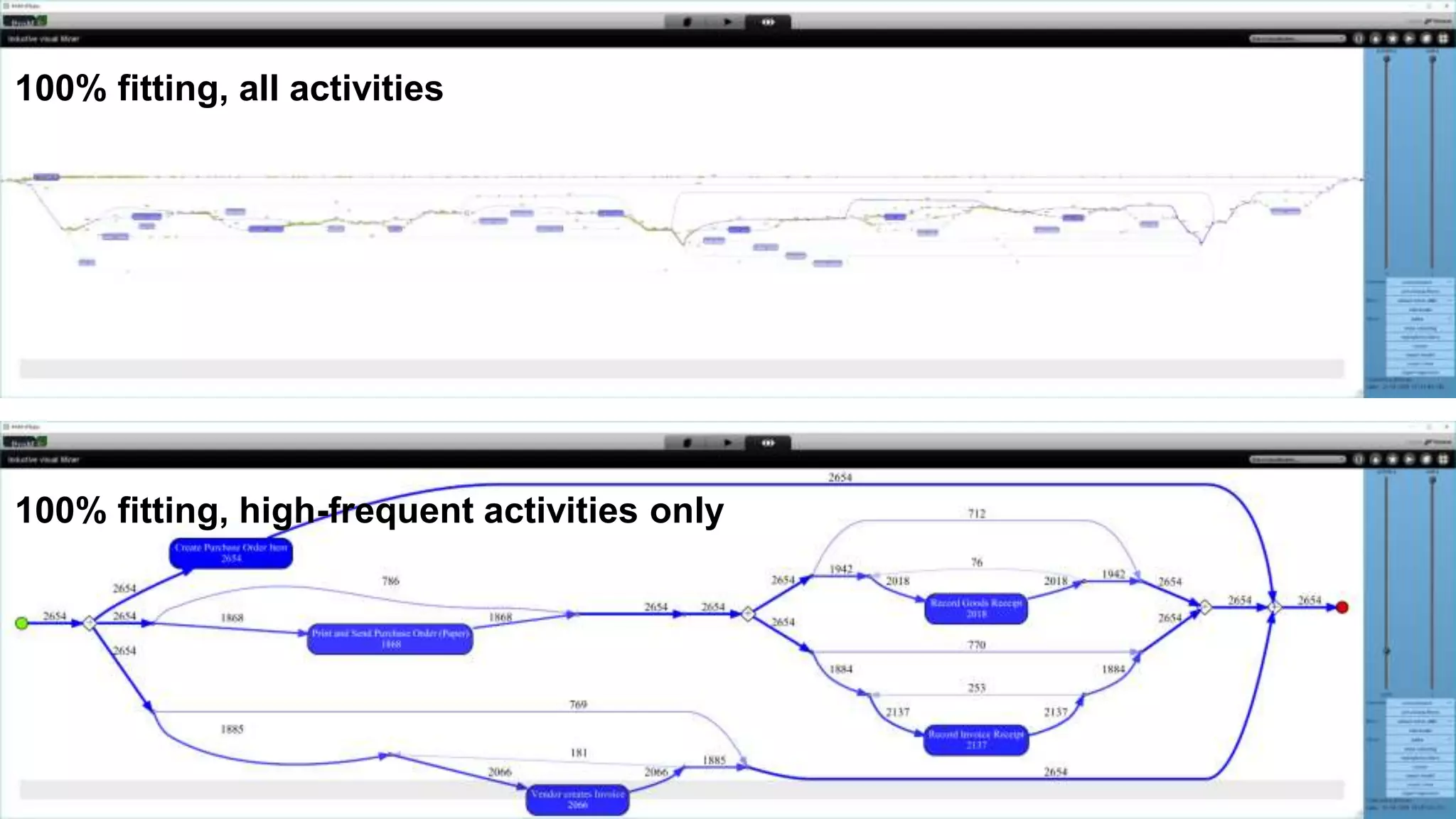
Informal models: providing insights but not very precise.
Can be simplified but this does not improve precision.
Complex and overfitting the data.
© Wil van der Aalst (use only with permission & acknowledgements)
100% fitting, all activities
100% fitting, high-frequent activities only
© Wil van der Aalst (use only with permission & acknowledgements)
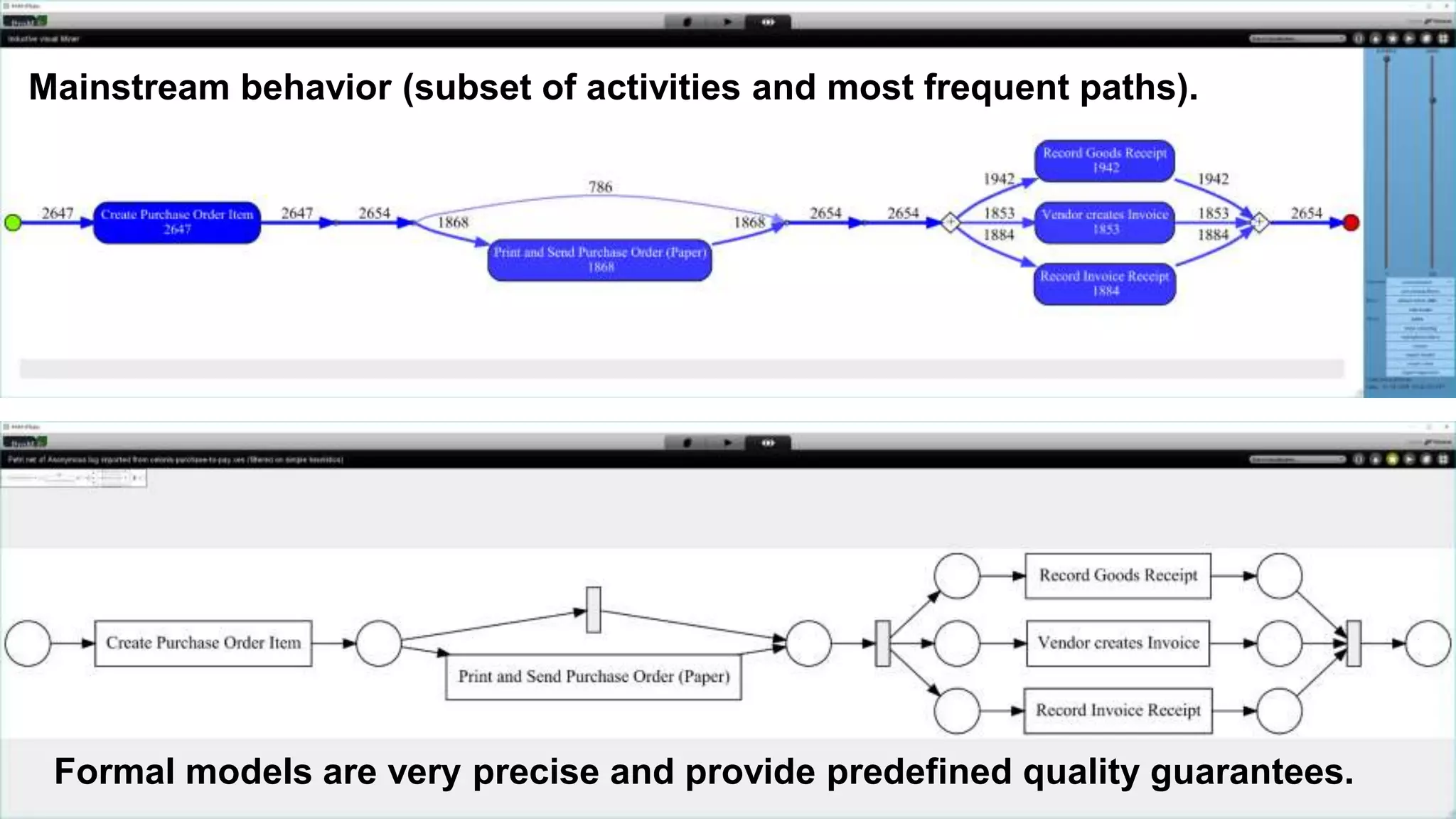
Mainstream behavior (subset of activities and most frequent paths).
Formal models are very precise and provide predefined quality guarantees.
© Wil van der Aalst (use only with permission & acknowledgements)
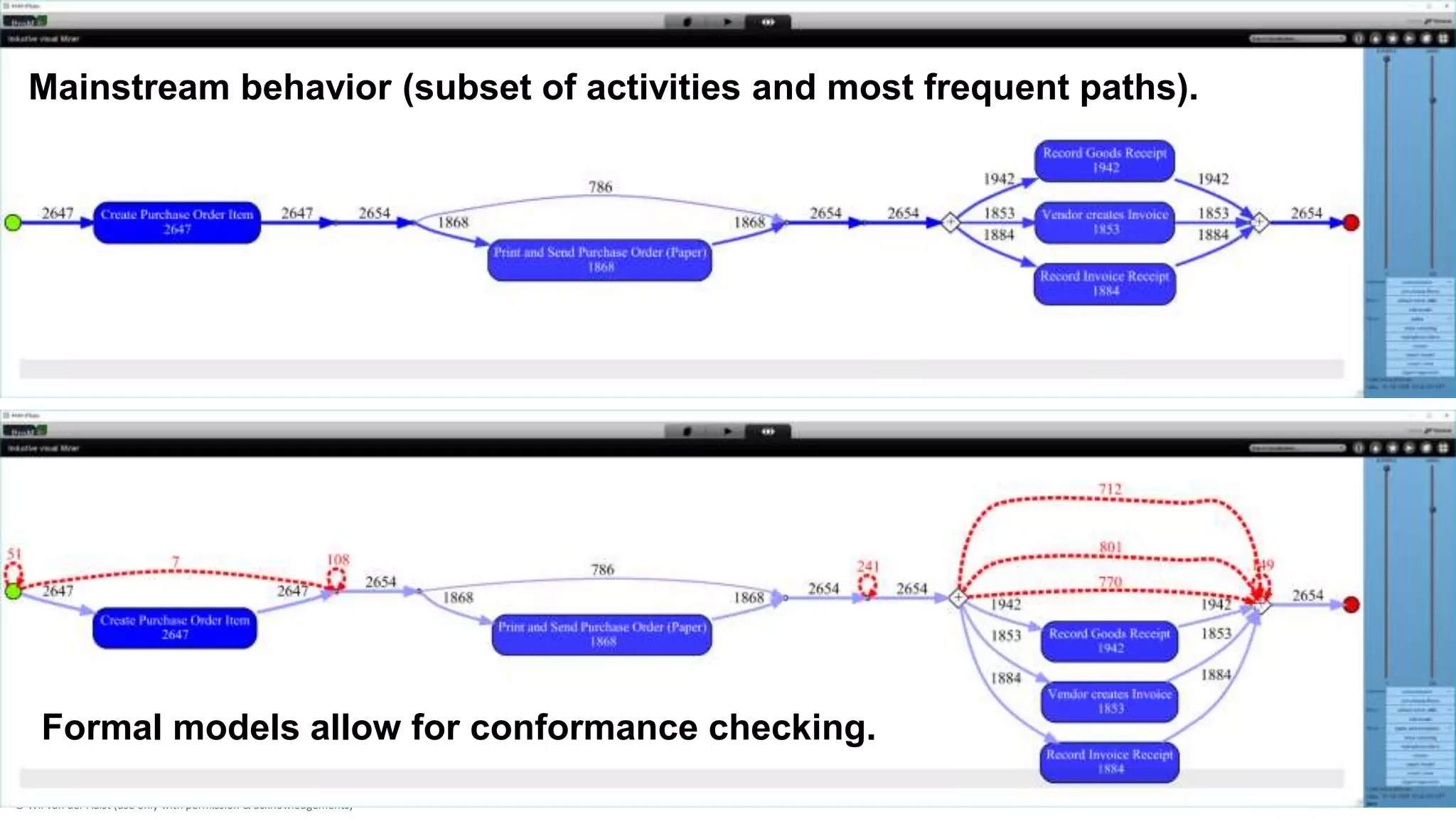
Mainstream behavior (subset of activities and most frequent paths).
Formal models allow for conformance checking.
© Wil van der Aalst (use only with permission & acknowledgements)
informal when needed
& fast and scalable
precise (having formal
semantics) whenever
possible & useful
Hybrid process models
Wil van der Aalst et al.
Learning Hybrid Process
Models from Events - Process
Discovery Without Faking
Confidence. BPM 2017: 59-76
Comparative
Process Mining
(CPM)
© Wil van der Aalst (use only with permission & acknowledgements)
Comparative process mining
(variants of the same process in different organizations)
© Wil van der Aalst (use only with permission & acknowledgements)
Comparative process mining
(variants of the same process in the same organization)
© Wil van der Aalst (use only with permission & acknowledgements)
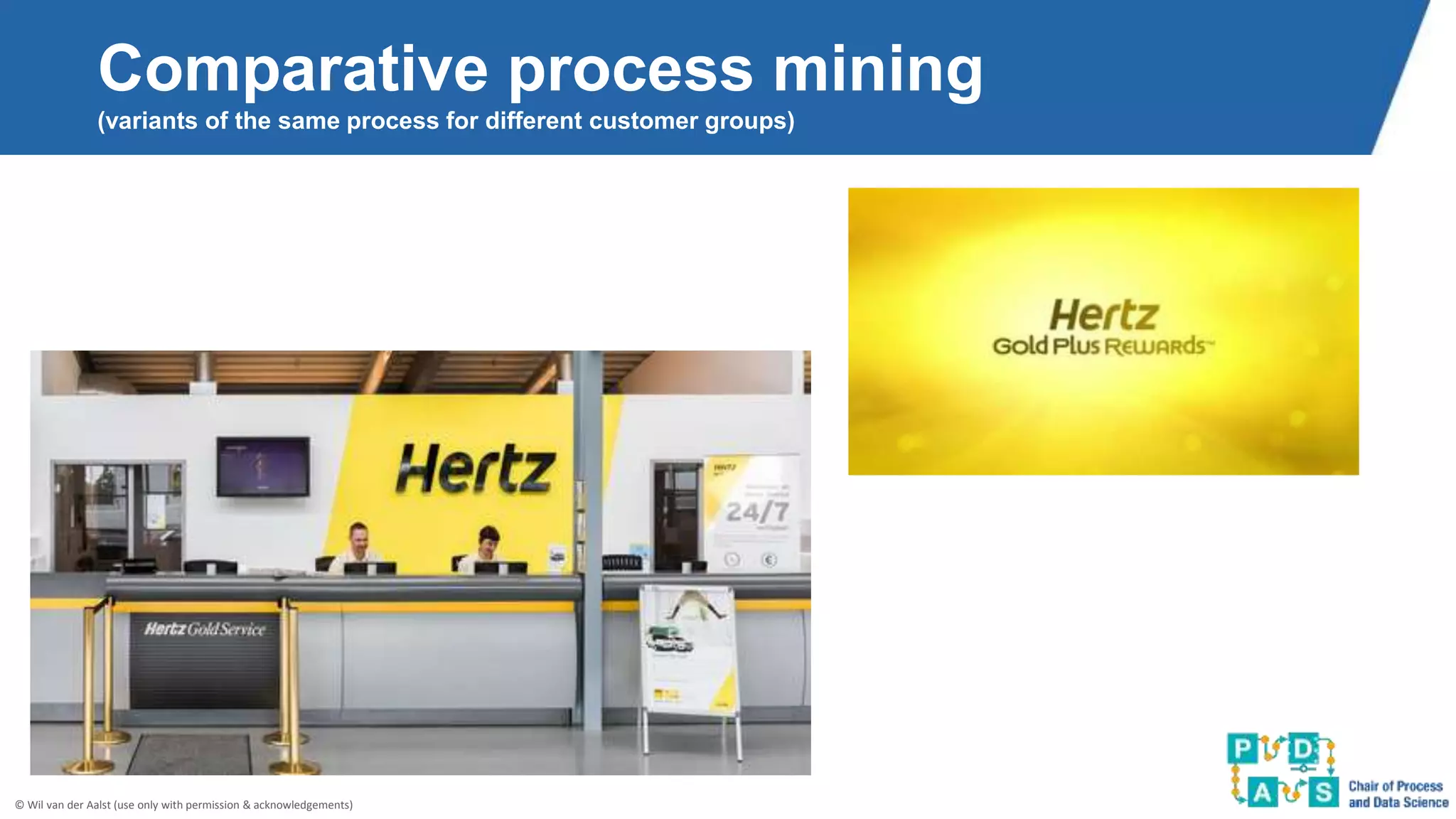
Comparative process mining
(variants of the same process for different customer groups)
© Wil van der Aalst (use only with permission & acknowledgements)
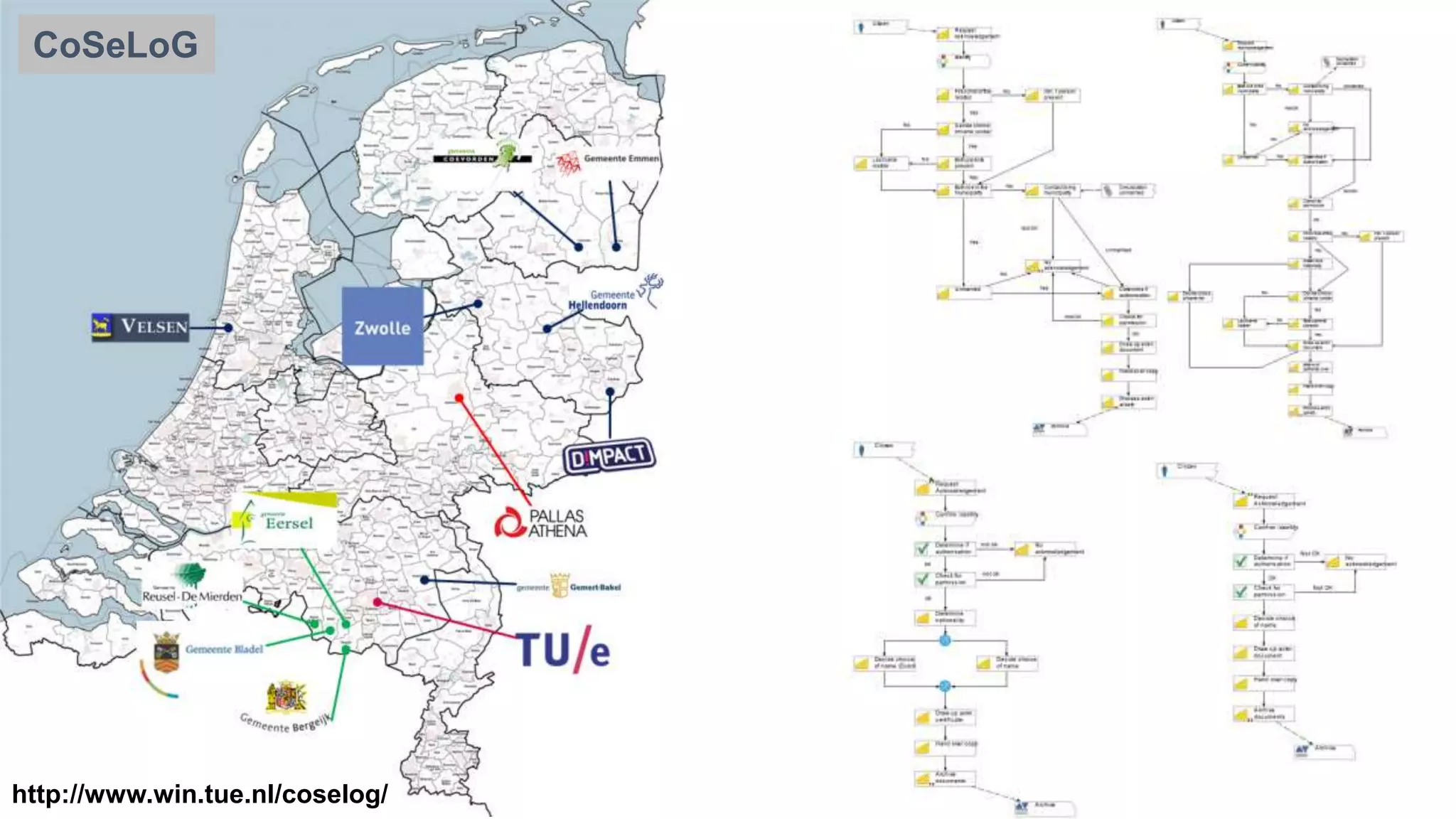
CoSeLoG
http://www.win.tue.nl/coselog/
© Wil van der Aalst (use only with permission & acknowledgements)
UWV (Employee Insurance Agency) manages employee
insurances (unemployment, disabilities, health, etc.).
Elham Ramezani Taghiabadi,
Understanding non-compliance,
PhD thesis 2017.
© Wil van der Aalst (use only with permission & acknowledgements)
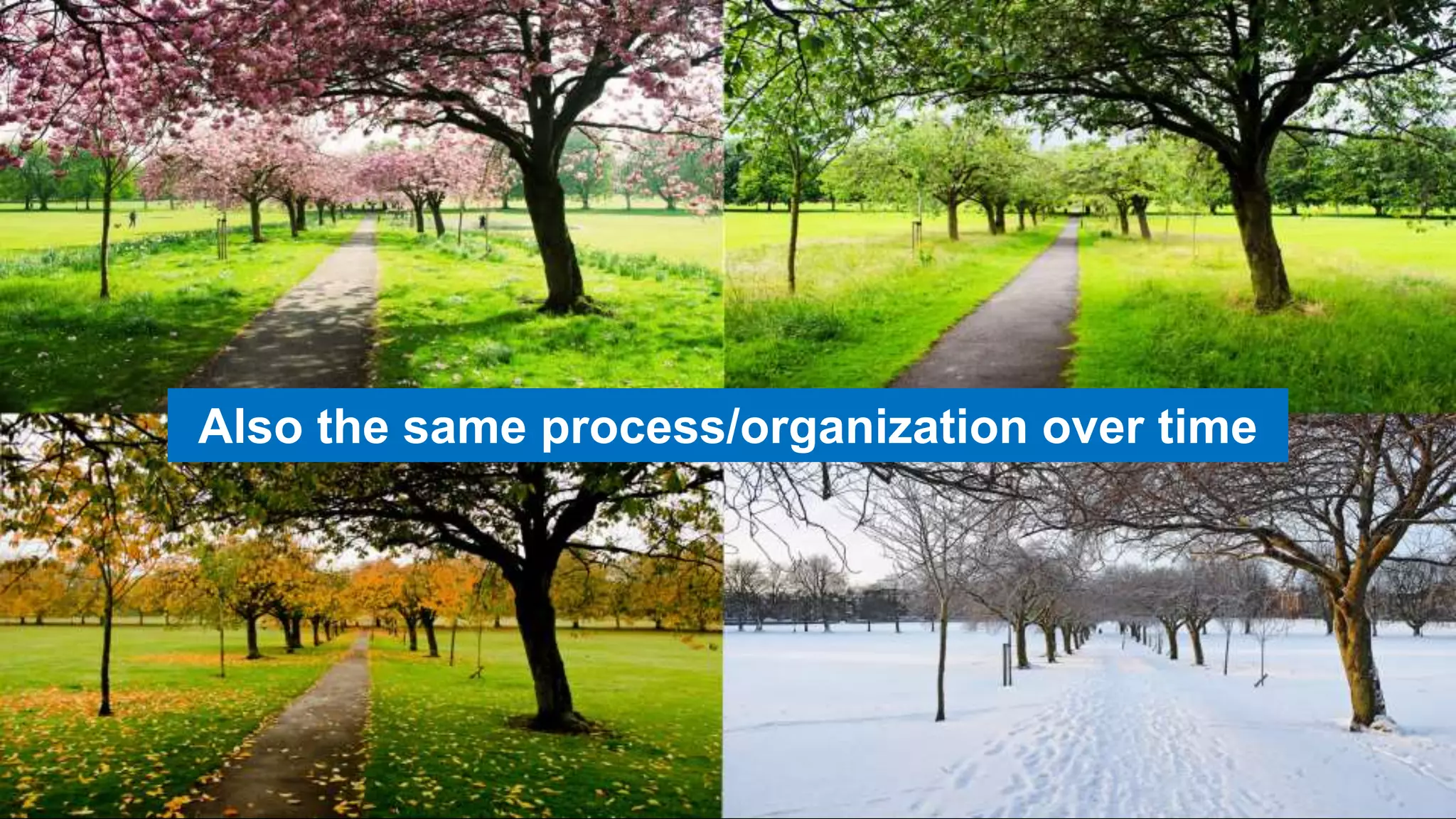
Also the same process/organization over time
© Wil van der Aalst (use only with permission & acknowledgements)
Find the seven differences
© Wil van der Aalst (use only with permission & acknowledgements)
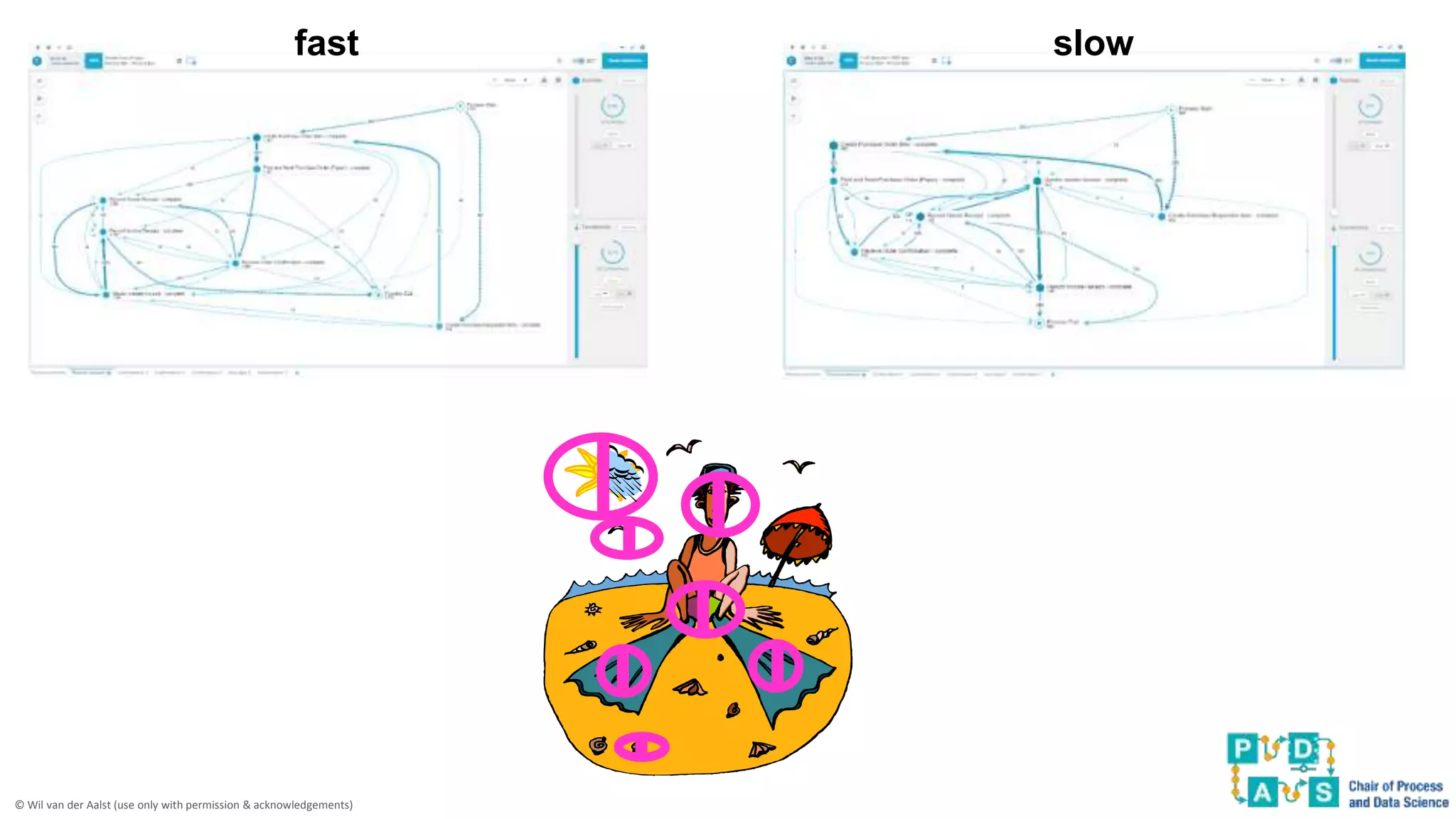
fast slow
© Wil van der Aalst (use only with permission & acknowledgements)
Approaches
• Process cubes (data warehouse for event data).
• Analysis workflow support.
• Delta analysis (model-to-model).
• Conformance checking (log-to-model).
Wil van der Aalst. Process Cubes: Slicing, Dicing, Rolling Up and Drilling Down Event
Data for Process Mining. AP-BPM 2013: 1-22.
Alfredo Bolt, Massimiliano de Leoni, Wil van der Aalst. Process variant comparison: Using
event logs to detect differences in behavior and business rules. Inf. Syst. 74(Part): 53-66
(2018).
Alfredo Bolt, Massimiliano de Leoni, Wil M. P. van der Aalst, Pierre Gorissen. Business
Process Reporting Using Process Mining, Analytic Workflows and Process Cubes: A Case
Study in Education. SIMPDA (Revised Selected Papers) 2015: 28-53.
Interactive
Process Mining
(IPM)
© Wil van der Aalst (use only with permission & acknowledgements)
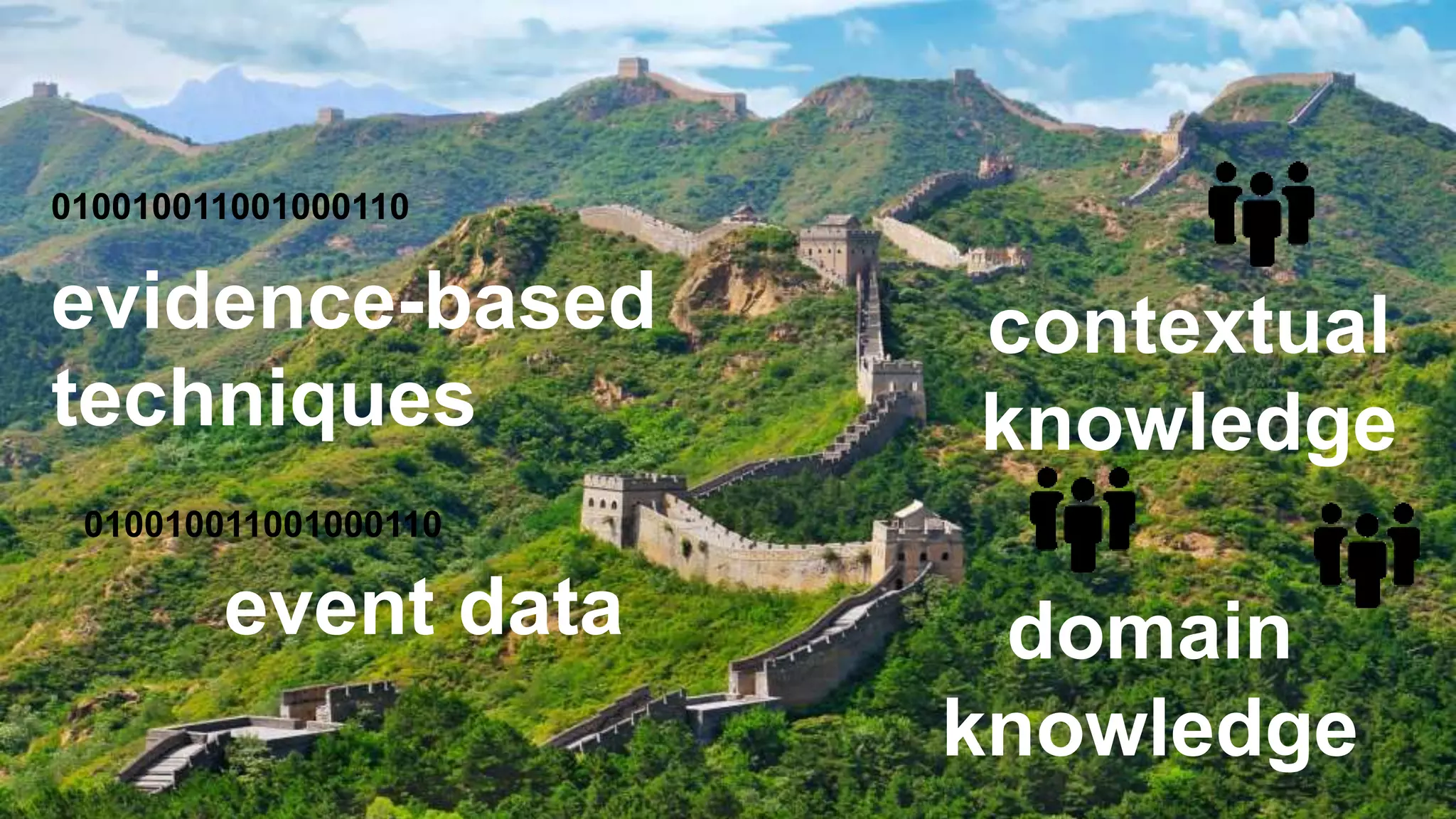
event data
evidence-based
techniques
domain
knowledge
contextual
knowledge
010010011001000110
010010011001000110
© Wil van der Aalst (use only with permission & acknowledgements)
Traditional process modeling
conformance
and
performance
diagnostics
manual modeling followed
by conformance checking
improve model or process
© Wil van der Aalst (use only with permission & acknowledgements)
Traditional process discovery
conformance
and
performance
diagnostics
process discovery followed
by conformance checking
improve process
© Wil van der Aalst (use only with permission & acknowledgements)
Interactive process mining
Alok Dixit, E. Verbeek, J. Buijs, W. van der Aalst. Interactive Data-
Driven Process Model Construction. ER 2018: 251-265
conformance
and
performance
diagnostics
guided process discovery
and improvement
generates modeling
suggestions based
on the data
autocomplete
possibility
immediate
feedback on any
modeling decision
helps to explore the
“evidence” in a very
direct manner
Performance-
Driven Process
Modeling (PDPM)
© Wil van der Aalst (use only with permission & acknowledgements)
Performance-Driven Process Modeling
Best model or best process ?
© Wil van der Aalst (use only with permission & acknowledgements)
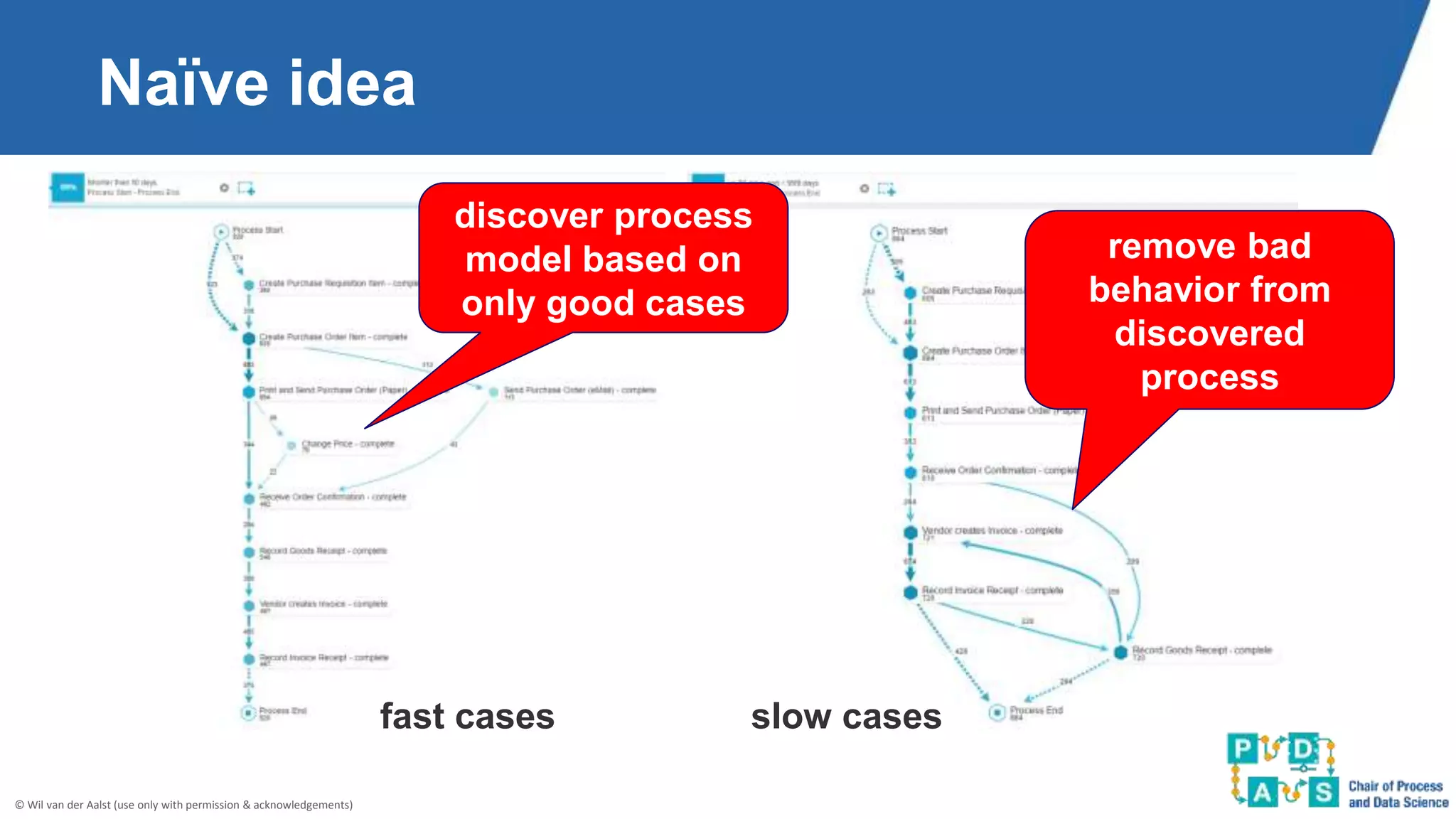
Naïve idea
fast cases slow cases
discover process
model based on
only good cases
remove bad
behavior from
discovered
process
© Wil van der Aalst (use only with permission & acknowledgements)
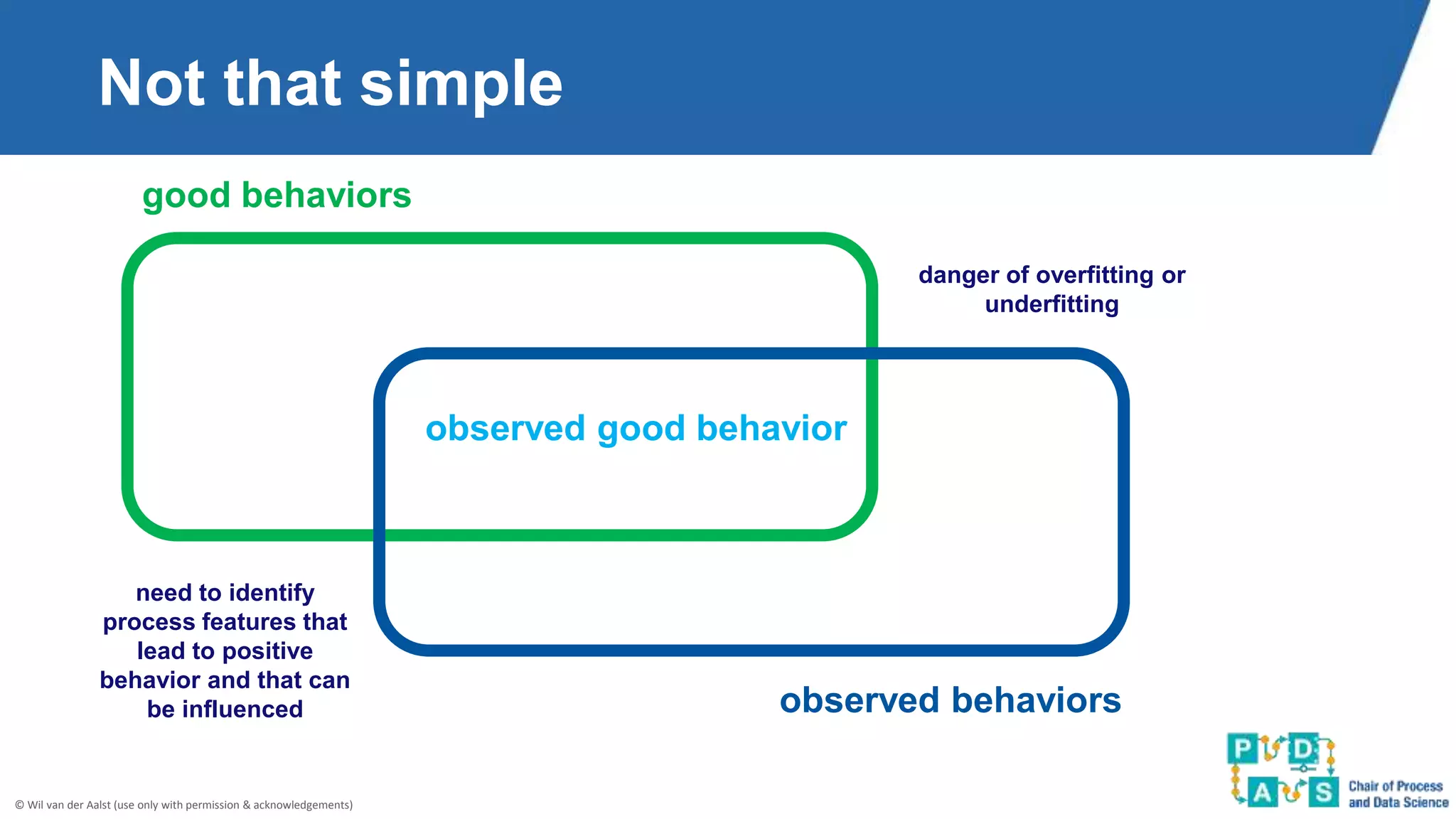
Not that simple
good behaviors
observed behaviors
observed good behavior
danger of overfitting or
underfitting
need to identify
process features that
lead to positive
behavior and that can
be influenced
Responsible
Process Mining
(RPM)
© Wil van der Aalst (RWTH Aachen University)
With great power comes great responsibility!!
Responsible
Process
Mining
(RPM)
© Wil van der Aalst (RWTH Aachen University)
Event data are highly sensitive even when
names are removed!
www.responsibledatascience.org
Fairness
Accuracy
Confidentiality
Transparency
Value
© Wil van der Aalst (RWTH Aachen University)
Examples of ongoing RPM research
Who the blame for delays and
non-compliance?
(avoiding to blame the most experienced/overloaded worker)
How to discover process
models without having events?
(events are like votes in a e-voting system)
© Wil van der Aalst (use only with permission & acknowledgements)
To conclude
© Wil van der Aalst (RWTH Aachen University)
VisiCalc Killer App
for Apple II (1979)
Spreadsheets can do anything
with numbers
Excel is like toilet paper …
The more
sheets, the
better!
© Wil van der Aalst (RWTH Aachen University)
Process mining can do
anything with event logs!
The bigger the
log, the better.
The more logs,
the better.
© Wil van der Aalst (RWTH Aachen University)
Process mining is generic
like a spreadsheet and can
do anything with events
(rather than numbers).
Therefore, it is there to stay
(unlike many hyped topics).
International Conference
on Process Mining
Aachen, June 23-25, 2019
International Conference
on Process Mining
Aachen, June 23-25, 2019
© Wil van der Aalst (use only with permission & acknowledgements)
www.pads.rwth-aachen.de
Foundations
of Process
Mining
Dealing
with XXXX
Event Data
Automated
Operational
Process
Improvement
Responsible
Process
Mining
Thanks

Process Mining: BPM on Steroids (CPOs@BPM&O 2019 Keynote)

  • 1.
    © Wil vander Aalst (use only with permission & acknowledgements) prof.dr.ir. Wil van der Aalst RWTH Aachen University W: vdaalst.com T:@wvdaalst Process Mining BPM on Steroids CPOs@BPM&O 2019 7-3-2019 Flora Köln
  • 2.
    Miguel Valdes CEO andco-founder of BonitaSoft at BPM 2017
  • 3.
    © Wil vander Aalst (use only with permission & acknowledgements) Traditional BPM: Wallpaper models and problematic implementations slow disconnected expensive
  • 4.
    “BPM on Steroids” Processmining provides a bridge between models and reality
  • 5.
    © Wil vander Aalst (use only with permission & acknowledgements) process data processmining
  • 6.
    © Wil vander Aalst (use only with permission & acknowledgements) model reality processmining
  • 7.
    © Wil vander Aalst (use only with permission & acknowledgements) IT processmining
  • 8.
    © Wil vander Aalst (use only with permission & acknowledgements) machine learning data mining algorithms statistics privacy, security, law & ethics behavioral /social science business models & marketing visualization & visual analytics distributed systems databases predictive analytics stochastics operations manage- ment & research business process management process automation & optimi- zation formal methods & concurrency theory business process improve- ment workflow manage- ment data science process science process mining
  • 9.
    www.pads.rwth-aachen.de Data Science, ProcessScience, Process Mining, Business Process Management, Data Mining, Process Discovery, Conformance Checking, Simulation, and Responsible Data Science. Foundations of Process Mining Dealing with XXXX Event Data Automated Operational Process Improvement Responsible Process Mining
  • 10.
    © Wil vander Aalst (use only with permission & acknowledgements) A Personal Journey (between process and data) • Petri nets (1988-now) • WFM systems (1995-2005) • BPM (2000-now) • Process Mining (1999-now) • Director DSC/e (2013-2018) • AvH-RWTH-FIT(2018-now)
  • 11.
    © Wil vander Aalst (use only with permission & acknowledgements) A Personal Journey (not just paper) Woflan over 100.000 participants in the first process mining course
  • 12.
    © Wil vander Aalst (use only with permission & acknowledgements)© Wil van der Aalst (use only with permission & acknowledgements) What is Process Mining?
  • 13.
    © Wil vander Aalst (RWTH Aachen University) 12 start from raw data csv / excel file with 2 × 80,609 events (= rows) about 12,666 cases (= orders) referring to 8 unique activities
  • 14.
    © Wil vander Aalst (RWTH Aachen University) 13 Let’s focus on the events of order 9012
  • 15.
    © Wil vander Aalst (RWTH Aachen University) 14 12,666 cases (orders) 80,609 events (only using completes) discovered using ILP miner
  • 16.
    © Wil vander Aalst (RWTH Aachen University) 15 “happy” “freq” “time”
  • 17.
    © Wil vander Aalst (RWTH Aachen University) 16 process model discovered using the inductive miner (showing only the most frequent paths)
  • 18.
    © Wil vander Aalst (RWTH Aachen University) 17 zooming in
  • 19.
    © Wil vander Aalst (RWTH Aachen University) 18 using conformance checking to see all deviations happened in reality but not allowed by the model required by the model but did not happen
  • 20.
    © Wil vander Aalst (RWTH Aachen University) 19 bottleneck analysis: enriching the model with performance information
  • 21.
    © Wil vander Aalst (RWTH Aachen University) 20 animating the event log showing real cases
  • 22.
    seamless abstraction ► onelog many possible views
  • 23.
    © Wil vander Aalst (RWTH Aachen University) 22 create purchase requisition create purchase order approve purchase order receive order confirmation receive goods receive invoice pay invoice Purchase-to-Pay • Simple process found in almost any organization. • Data available in e.g. SAP. • Most cases follow the so- called “happy path”. • 80/20 rule applies.
  • 24.
    © Wil vander Aalst (RWTH Aachen University) 23 Real process may look like this: 700,000 cases may exhibit 7,000 unique variants
  • 25.
    © Wil vander Aalst (RWTH Aachen University) 24 Price changes • One of the many variations. • Changing prices result in lots of extra work and significant delays. create purchase requisition create purchase order approve purchase order receive order confirmation receive goods receive invoice pay invoice price change 8% of cases adds (on average) a delay of 4.5 days
  • 26.
    © Wil vander Aalst (RWTH Aachen University) 25 Pay before receipt • Goods are paid before they have been received. • Goods arrived too late or not at all. • May indicate fraud. create purchase requisition create purchase order approve purchase order receive order confirmation receive goods receive invoice pay invoice 2% of cases goods are paid but never received
  • 27.
    © Wil vander Aalst (RWTH Aachen University) 26 Two additional variations • Orders created without requisition. • Rejected orders generating rework.  7000-4 = 6996 variants to go …  Can be sorted based on frequency or impact. create purchase requisition create purchase order approve purchase order receive order confirmation receive goods receive invoice pay invoice rejected purchase order modify purchase order 6% of cases purchase order created without requisition 3% of cases purchase order is rejected resulting in rework and a delay of on average 8.2 days
  • 28.
    © Wil vander Aalst (RWTH Aachen University) 27 Performance problems • Delays inside the process. • Excessive flow times. • Not meeting Service Level Agreements (SLAs). create purchase requisition create purchase order approve purchase order receive order confirmation receive goods receive invoice pay invoice ! ! It takes to long to pay invoices resulting in complaints and fines (15% more than 3 weeks). The approval of purchase orders takes too long (28% more than 10 days). Drill down to event data and uncover the root causes.
  • 29.
    © Wil vander Aalst (RWTH Aachen University) 28 Compliance problems Activities may be: • skipped, • done too early or too late, • done by the wrong person, • should not have happened at all. create purchase requisition create purchase order approve purchase order receive order confirmation receive goods receive invoice pay invoice ! Orders are created without a purchase requisition. !Invoices are paid before the goods arrive. Drill down to event data and uncover the root causes.
  • 30.
    © Wil vander Aalst (RWTH Aachen University) Using process mining, one can …
  • 31.
    © Wil vander Aalst (RWTH Aachen University) discover the real processes
  • 32.
    © Wil vander Aalst (RWTH Aachen University) check compliance
  • 33.
    © Wil vander Aalst (RWTH Aachen University) uncover and quantify deviations
  • 34.
    © Wil vander Aalst (RWTH Aachen University) find root causes for process variations
  • 35.
    © Wil vander Aalst (RWTH Aachen University) find bottlenecks
  • 36.
    © Wil vander Aalst (RWTH Aachen University) find root causes for delays
  • 37.
    © Wil vander Aalst (RWTH Aachen University) predict process outcomes
  • 38.
    © Wil vander Aalst (RWTH Aachen University) foresee deviations and bottlenecks
  • 39.
    © Wil vander Aalst (RWTH Aachen University) PM is great! How to start? What will happen next?
  • 40.
    © Wil vander Aalst (use only with permission & acknowledgements)© Wil van der Aalst (use only with permission & acknowledgements) Technology transfer
  • 41.
    © Wil vander Aalst (RWTH Aachen University) Applications: Always about compliance and performance • Processes supported by ERP and CRM systems (e.g., SAP). • Healthcare (range of hospitals). • Logistics and production (e.g., with Vanderlande). • E-learning (e.g., based on Coursera). • E-government (see CoSeLog project). • Smart homes / quantified self (with Philips). • High-tech systems. • Auditing. • Fraud detection. • Etc.
  • 42.
    © Wil vander Aalst (RWTH Aachen University) Technology transfer challenges ideas new techniques and approaches data
  • 43.
    © Wil vander Aalst (RWTH Aachen University) Tooling • ProM is the de facto standard in the scientific world. • Ideas initially developed in ProM have been adopted by commercial vendors. • Currently, more than 25 commercial vendors offering process mining software (Celonis, Fluxicon, ProcessGold, QPR, etc.). >1500 plug-ins
  • 44.
    © Wil vander Aalst (RWTH Aachen University) 1500 plug-ins
  • 45.
    © Wil vander Aalst (RWTH Aachen University) Usability
  • 46.
    © Wil vander Aalst (RWTH Aachen University) Technology transfer (e.g., Celonis) [2012] process discovery inspired by heuristic miner (2002) and fuzzy miner (2006) [2018] process discovery based on the inductive miner (2013) [2013] token animation and sliders (2006) [2017] token-based conformance checking (2005) [2017] process- based root cause analysis (2006) 10 5 11 12 7
  • 47.
    © Wil vander Aalst (RWTH Aachen University) Celonis was the first to provide “forward looking” process mining past present future actionable insights
  • 48.
    © Wil vander Aalst (RWTH Aachen University) Adoption & Practical Relevance Identified as a new market segment by Gartner. (April 2018) Celonis gets Unicorn status Many large SAP customers are already using process mining
  • 49.
    © Wil vander Aalst (use only with permission & acknowledgements)© Wil van der Aalst (use only with permission & acknowledgements) What is next?
  • 50.
  • 51.
    © Wil vander Aalst (use only with permission & acknowledgements) 1 of 17 variants 8% of cases covered
  • 52.
    © Wil vander Aalst (use only with permission & acknowledgements) 5 of 17 variants 88% of cases covered
  • 53.
    © Wil vander Aalst (use only with permission & acknowledgements) 17 of 17 variants 100% of cases covered
  • 54.
  • 55.
  • 56.
    © Wil vander Aalst (use only with permission & acknowledgements) The goal case frequency (number of similar cases in a given period) different types of cases (sorted by frequency) many cases follow the same structured process , making automation economically feasible there is repetitive work , but not frequent enough to justify automation Infrequent/exceptional cases that need to be handled in an ad-hoc manner See W. van der Aalst, et al. (2018). Robotic Process Automation. Business & Information Systems Engineering: Vol. 60, No. 4. Springer. (69-272).
  • 57.
    © Wil vander Aalst (use only with permission & acknowledgements) The goal case frequency (number of similar cases in a given period) different types of cases (sorted by frequency) traditional process automation work that can only be done by humans ? See W. van der Aalst, et al. (2018). Robotic Process Automation. Business & Information Systems Engineering: Vol. 60, No. 4. Springer. (69-272).
  • 58.
    © Wil vander Aalst (use only with permission & acknowledgements) The goal case frequency (number of similar cases in a given period) different types of cases (sorted by frequency) traditional process automation Robotic Process Automation (RPA) candidates work that can only be done by humans See W. van der Aalst, et al. (2018). Robotic Process Automation. Business & Information Systems Engineering: Vol. 60, No. 4. Springer. (69-272).
  • 59.
    © Wil vander Aalst (use only with permission & acknowledgements) Process Mining for RPA (PM4RPA) Initial situation
  • 60.
    © Wil vander Aalst (use only with permission & acknowledgements) Process Mining for RPA (PM4RPA) Traditional workflow automation
  • 61.
    © Wil vander Aalst (use only with permission & acknowledgements) Process Mining for RPA (PM4RPA) Traditional process mining process mining
  • 62.
    © Wil vander Aalst (use only with permission & acknowledgements) Process Mining for RPA (PM4RPA) process mining case frequency (number of similar cases in a given period) different types of cases (sorted by frequency) traditional process automation work that can only be done by humans ? What to automate in a traditional manner? What to support using RPA? What is best done by people? RPA-I
  • 63.
    © Wil vander Aalst (use only with permission & acknowledgements) Process Mining for RPA (PM4RPA) process mining Does the robot behave as expected? How to distribute the work (static)? RPA-II
  • 64.
    © Wil vander Aalst (use only with permission & acknowledgements) Process Mining for RPA (PM4RPA) process mining When and how to dynamically transfer work? How to actively improve compliance/performance? How to detect drifts and act upon these? RPA-III
  • 65.
  • 66.
    © Wil vander Aalst (use only with permission & acknowledgements) Informal models: providing insights but not very precise. Can be simplified but this does not improve precision.
  • 67.
  • 68.
    © Wil vander Aalst (use only with permission & acknowledgements) 100% fitting, all activities 100% fitting, high-frequent activities only
  • 69.
    © Wil vander Aalst (use only with permission & acknowledgements) Mainstream behavior (subset of activities and most frequent paths). Formal models are very precise and provide predefined quality guarantees.
  • 70.
    © Wil vander Aalst (use only with permission & acknowledgements) Mainstream behavior (subset of activities and most frequent paths). Formal models allow for conformance checking.
  • 71.
    © Wil vander Aalst (use only with permission & acknowledgements) informal when needed & fast and scalable precise (having formal semantics) whenever possible & useful Hybrid process models Wil van der Aalst et al. Learning Hybrid Process Models from Events - Process Discovery Without Faking Confidence. BPM 2017: 59-76
  • 72.
  • 73.
    © Wil vander Aalst (use only with permission & acknowledgements) Comparative process mining (variants of the same process in different organizations)
  • 74.
    © Wil vander Aalst (use only with permission & acknowledgements) Comparative process mining (variants of the same process in the same organization)
  • 75.
    © Wil vander Aalst (use only with permission & acknowledgements) Comparative process mining (variants of the same process for different customer groups)
  • 76.
    © Wil vander Aalst (use only with permission & acknowledgements) CoSeLoG http://www.win.tue.nl/coselog/
  • 77.
    © Wil vander Aalst (use only with permission & acknowledgements) UWV (Employee Insurance Agency) manages employee insurances (unemployment, disabilities, health, etc.). Elham Ramezani Taghiabadi, Understanding non-compliance, PhD thesis 2017.
  • 78.
    © Wil vander Aalst (use only with permission & acknowledgements) Also the same process/organization over time
  • 79.
    © Wil vander Aalst (use only with permission & acknowledgements) Find the seven differences
  • 80.
    © Wil vander Aalst (use only with permission & acknowledgements)
  • 81.
    © Wil vander Aalst (use only with permission & acknowledgements) fast slow
  • 82.
    © Wil vander Aalst (use only with permission & acknowledgements) Approaches • Process cubes (data warehouse for event data). • Analysis workflow support. • Delta analysis (model-to-model). • Conformance checking (log-to-model). Wil van der Aalst. Process Cubes: Slicing, Dicing, Rolling Up and Drilling Down Event Data for Process Mining. AP-BPM 2013: 1-22. Alfredo Bolt, Massimiliano de Leoni, Wil van der Aalst. Process variant comparison: Using event logs to detect differences in behavior and business rules. Inf. Syst. 74(Part): 53-66 (2018). Alfredo Bolt, Massimiliano de Leoni, Wil M. P. van der Aalst, Pierre Gorissen. Business Process Reporting Using Process Mining, Analytic Workflows and Process Cubes: A Case Study in Education. SIMPDA (Revised Selected Papers) 2015: 28-53.
  • 83.
  • 84.
    © Wil vander Aalst (use only with permission & acknowledgements) event data evidence-based techniques domain knowledge contextual knowledge 010010011001000110 010010011001000110
  • 85.
    © Wil vander Aalst (use only with permission & acknowledgements) Traditional process modeling conformance and performance diagnostics manual modeling followed by conformance checking improve model or process
  • 86.
    © Wil vander Aalst (use only with permission & acknowledgements) Traditional process discovery conformance and performance diagnostics process discovery followed by conformance checking improve process
  • 87.
    © Wil vander Aalst (use only with permission & acknowledgements) Interactive process mining Alok Dixit, E. Verbeek, J. Buijs, W. van der Aalst. Interactive Data- Driven Process Model Construction. ER 2018: 251-265 conformance and performance diagnostics guided process discovery and improvement generates modeling suggestions based on the data autocomplete possibility immediate feedback on any modeling decision helps to explore the “evidence” in a very direct manner
  • 88.
  • 89.
    © Wil vander Aalst (use only with permission & acknowledgements) Performance-Driven Process Modeling Best model or best process ?
  • 90.
    © Wil vander Aalst (use only with permission & acknowledgements) Naïve idea fast cases slow cases discover process model based on only good cases remove bad behavior from discovered process
  • 91.
    © Wil vander Aalst (use only with permission & acknowledgements) Not that simple good behaviors observed behaviors observed good behavior danger of overfitting or underfitting need to identify process features that lead to positive behavior and that can be influenced
  • 92.
  • 93.
    © Wil vander Aalst (RWTH Aachen University) With great power comes great responsibility!! Responsible Process Mining (RPM)
  • 94.
    © Wil vander Aalst (RWTH Aachen University) Event data are highly sensitive even when names are removed!
  • 95.
  • 96.
    © Wil vander Aalst (RWTH Aachen University) Examples of ongoing RPM research Who the blame for delays and non-compliance? (avoiding to blame the most experienced/overloaded worker) How to discover process models without having events? (events are like votes in a e-voting system)
  • 97.
    © Wil vander Aalst (use only with permission & acknowledgements) To conclude
  • 98.
    © Wil vander Aalst (RWTH Aachen University) VisiCalc Killer App for Apple II (1979) Spreadsheets can do anything with numbers Excel is like toilet paper … The more sheets, the better!
  • 99.
    © Wil vander Aalst (RWTH Aachen University) Process mining can do anything with event logs! The bigger the log, the better. The more logs, the better.
  • 100.
    © Wil vander Aalst (RWTH Aachen University) Process mining is generic like a spreadsheet and can do anything with events (rather than numbers). Therefore, it is there to stay (unlike many hyped topics).
  • 101.
    International Conference on ProcessMining Aachen, June 23-25, 2019
  • 102.
    International Conference on ProcessMining Aachen, June 23-25, 2019
  • 103.
    © Wil vander Aalst (use only with permission & acknowledgements) www.pads.rwth-aachen.de Foundations of Process Mining Dealing with XXXX Event Data Automated Operational Process Improvement Responsible Process Mining Thanks