SCIENCE FORM 4
                CHAPTER 2: BODY COORDINATION

  Body coordination is the adjustment of the body in response to
  whatever stimulus received by some parts of the body.
  There are two types of body coordination : nervous coordination
  and hormonal coordination.
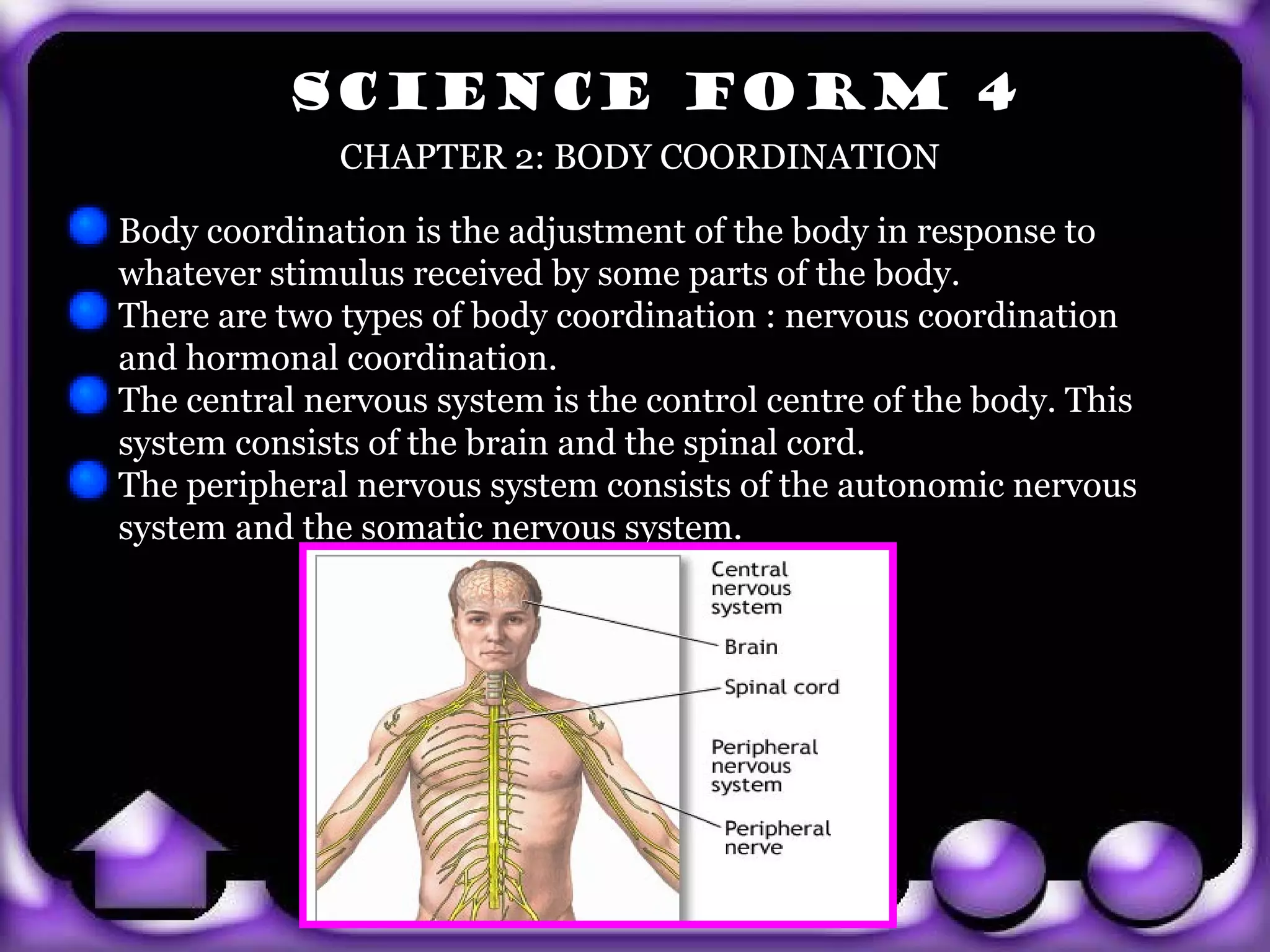
  The central nervous system is the control centre of the body. This
  system consists of the brain and the spinal cord.
  The peripheral nervous system consists of the autonomic nervous
  system and the somatic nervous system.


exit
SCIENCE FORM 4
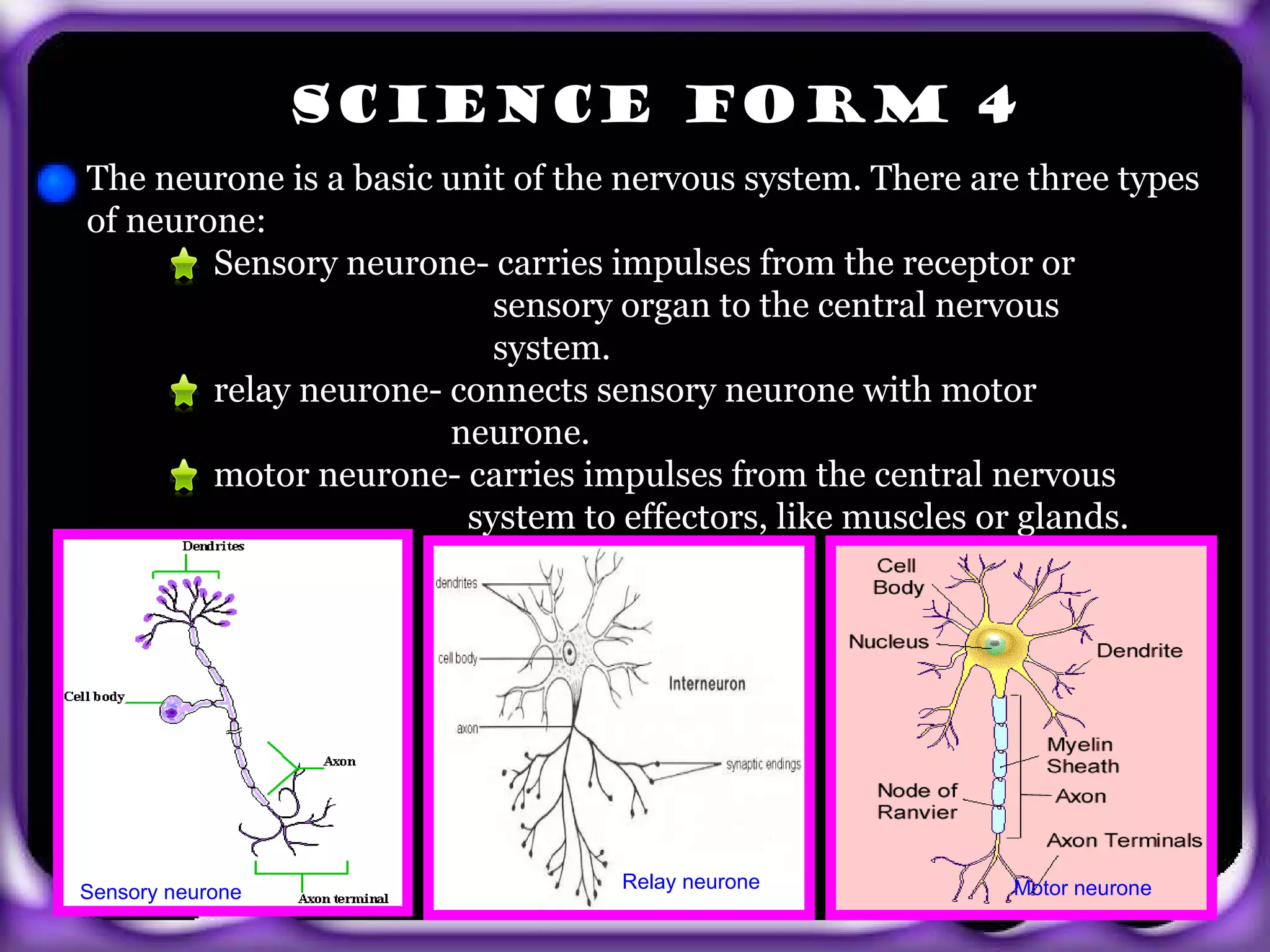
The neurone is a basic unit of the nervous system. There are three types
of neurone:
        Sensory neurone- carries impulses from the receptor or
                          sensory organ to the central nervous
                          system.
        relay neurone- connects sensory neurone with motor
                       neurone.
        motor neurone- carries impulses from the central nervous
                        system to effectors, like muscles or glands.


 exit


Sensory neurone                   Relay neurone            Motor neurone
SCIENCE FORM 4
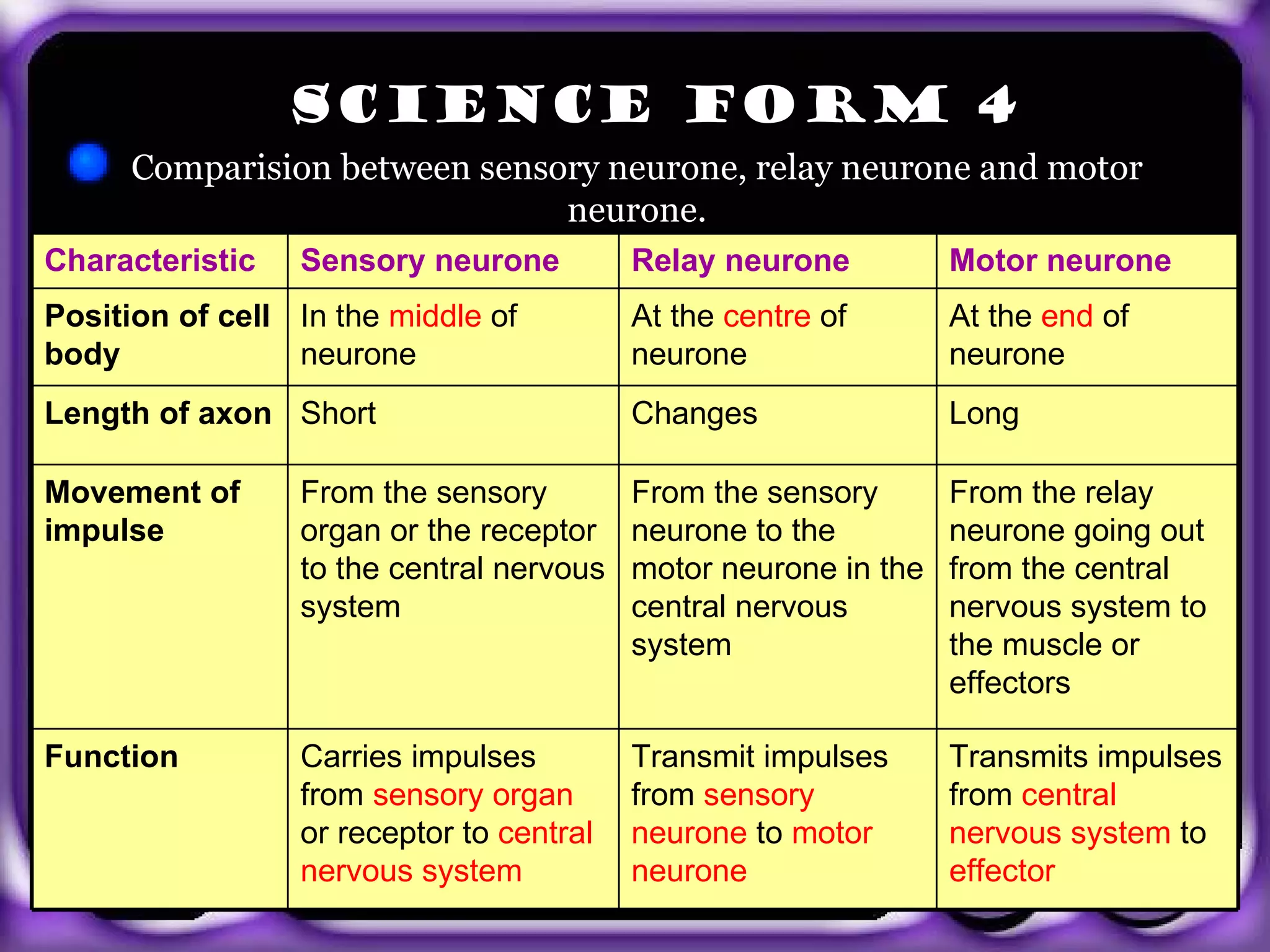
      Comparision between sensory neurone, relay neurone and motor
                               neurone.
Characteristic   Sensory neurone          Relay neurone          Motor neurone
Position of cell In the middle of         At the centre of       At the end of
body             neurone                  neurone                neurone
Length of axon Short                      Changes                Long

Movement of      From the sensory         From the sensory       From the relay
impulse          organ or the receptor    neurone to the         neurone going out
                 to the central nervous   motor neurone in the   from the central
                 system                   central nervous        nervous system to
                                          system                 the muscle or
                                                                 effectors
  exit
Function         Carries impulses         Transmit impulses      Transmits impulses
                 from sensory organ       from sensory           from central
                 or receptor to central   neurone to motor       nervous system to
                 nervous system           neurone                effector
SCIENCE FORM 4
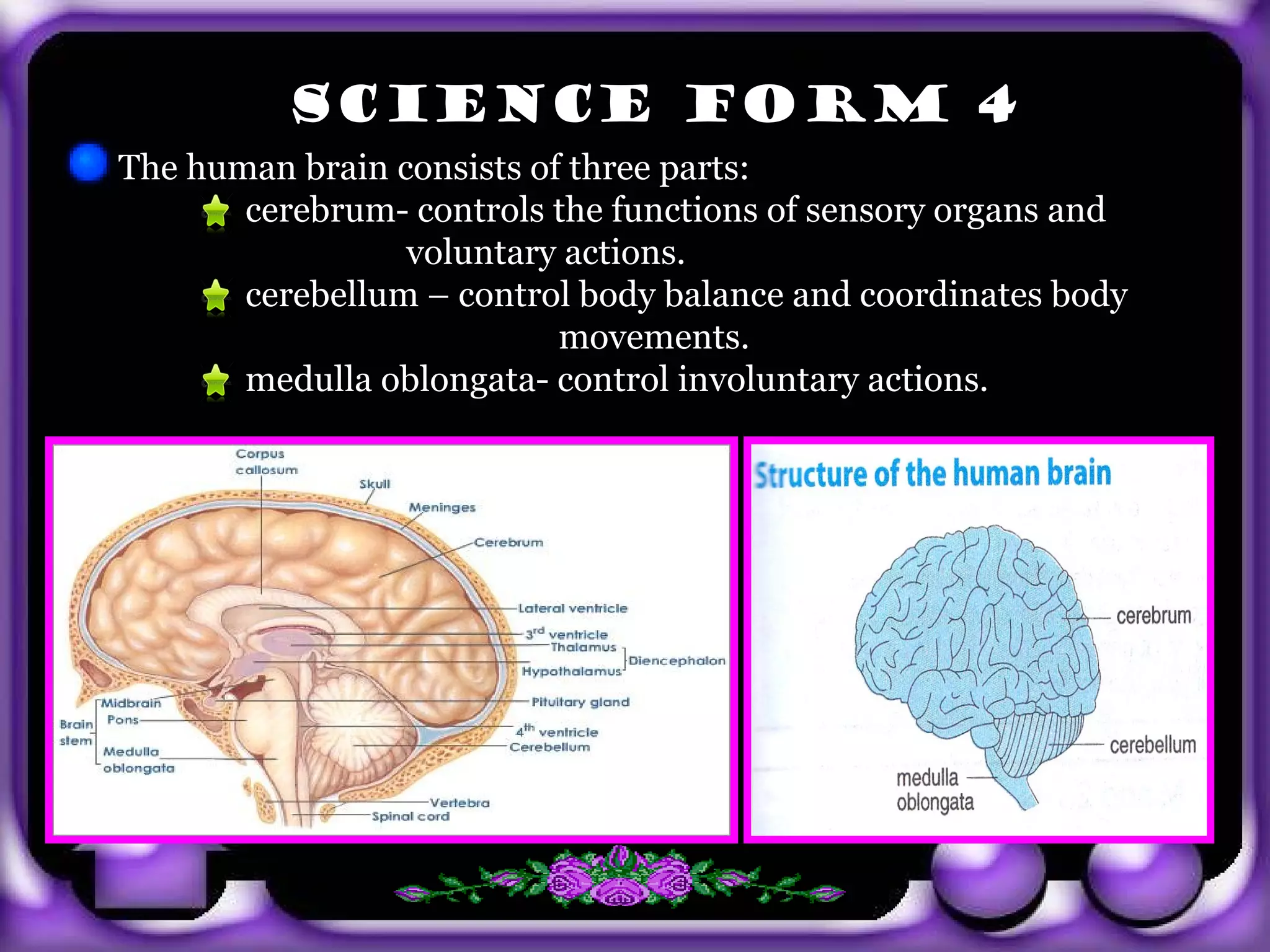
  The human brain consists of three parts:
         cerebrum- controls the functions of sensory organs and
                   voluntary actions.
         cerebellum – control body balance and coordinates body
                             movements.
         medulla oblongata- control involuntary actions.


exit
SCIENCE FORM 4
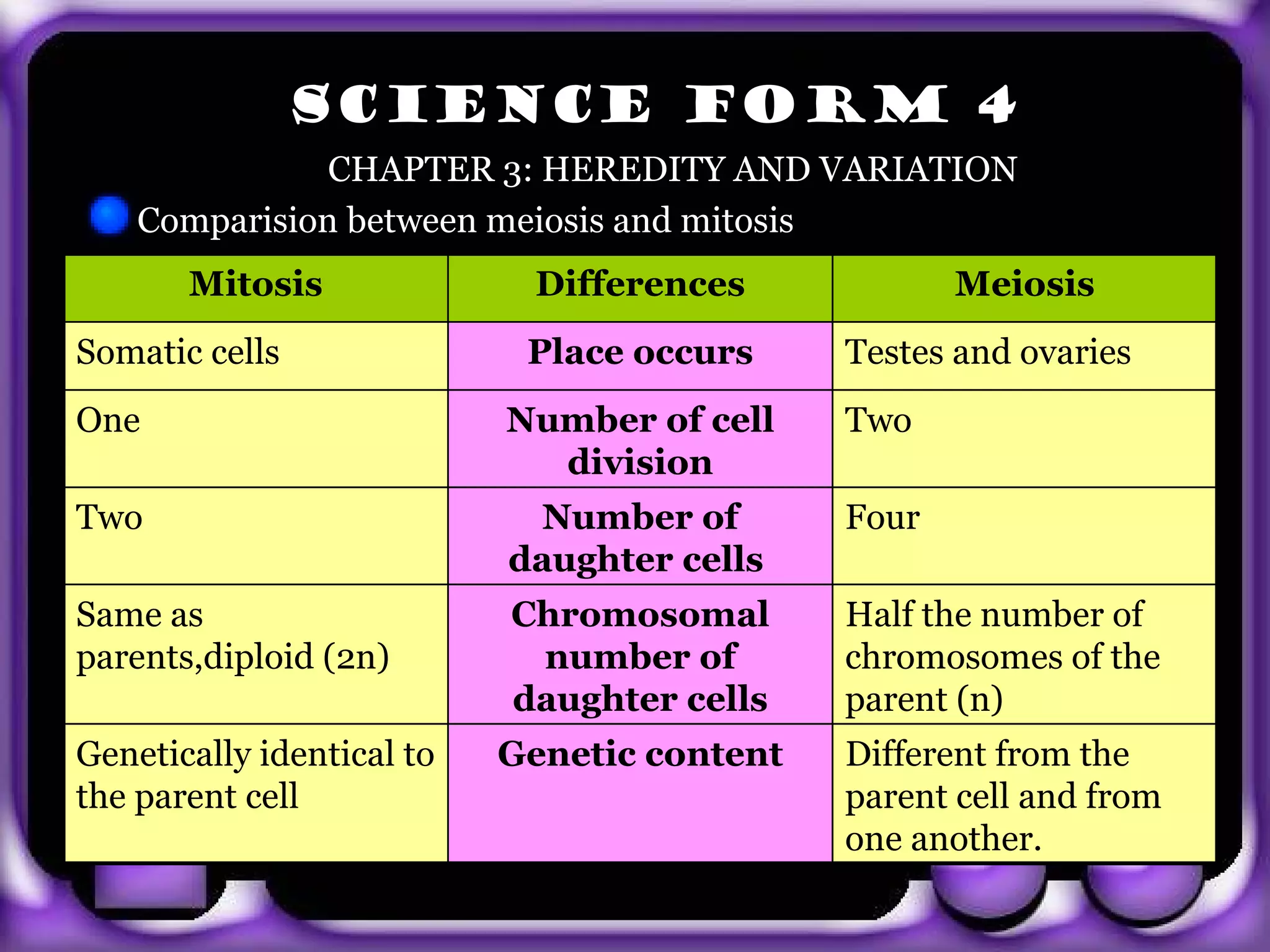
               CHAPTER 3: HEREDITY AND VARIATION
    Comparision between meiosis and mitosis
       Mitosis              Differences             Meiosis
Somatic cells               Place occurs     Testes and ovaries
One                        Number of cell    Two
                             division
Two                          Number of       Four
                           daughter cells
Same as                    Chromosomal       Half the number of
parents,diploid (2n)        number of        chromosomes of the
                           daughter cells    parent (n)
 exit
Genetically identical to   Genetic content   Different from the
the parent cell                              parent cell and from
                                             one another.
SCIENCE FORM 4
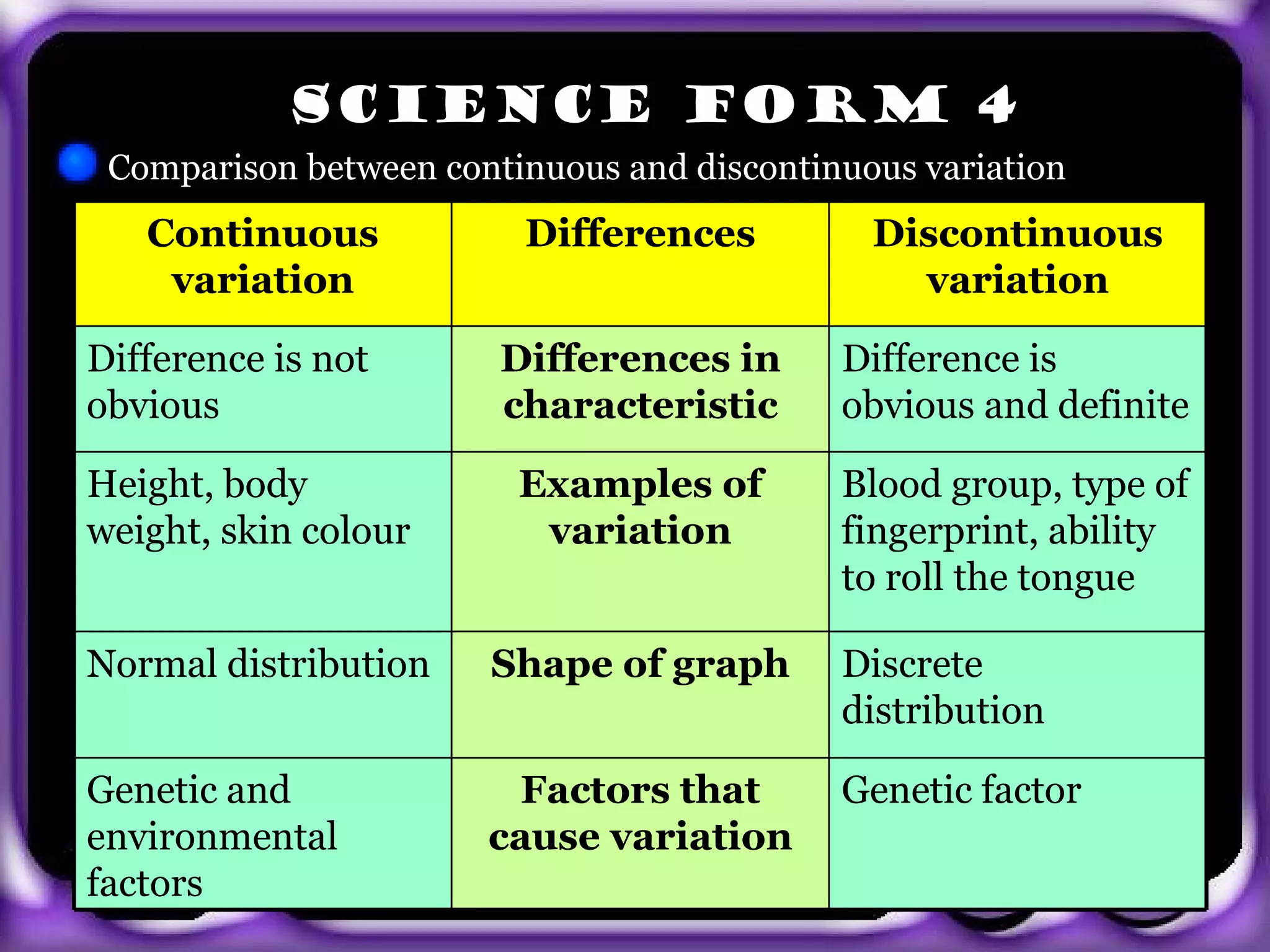
 Comparison between continuous and discontinuous variation
       Continuous        Differences          Discontinuous
        variation                               variation

Difference is not       Differences in      Difference is
obvious                 characteristic      obvious and definite

Height, body             Examples of        Blood group, type of
weight, skin colour       variation         fingerprint, ability
                                            to roll the tongue

Normal distribution    Shape of graph       Discrete
                                            distribution
exit
Genetic and              Factors that       Genetic factor
environmental          cause variation
factors
SCIENCE FORM 4
                         CHAPTER 4: MATTER
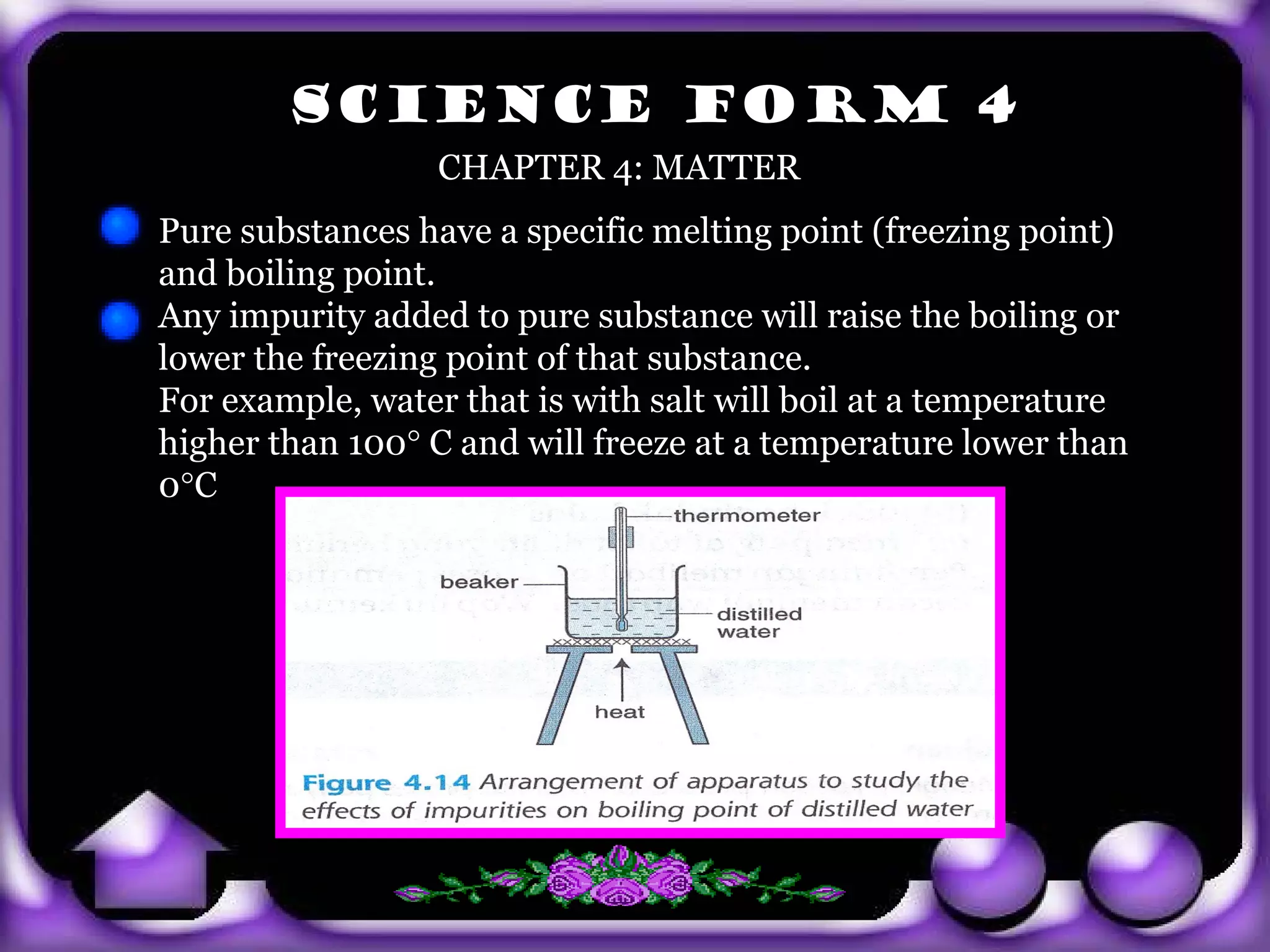
       Pure substances have a specific melting point (freezing point)
       and boiling point.
       Any impurity added to pure substance will raise the boiling or
       lower the freezing point of that substance.
       For example, water that is with salt will boil at a temperature
       higher than 100° C and will freeze at a temperature lower than
       0°C


exit
SCIENCE FORM 4
        CHAPTER 5: ENERGY AND CHEMICAL CHANGES

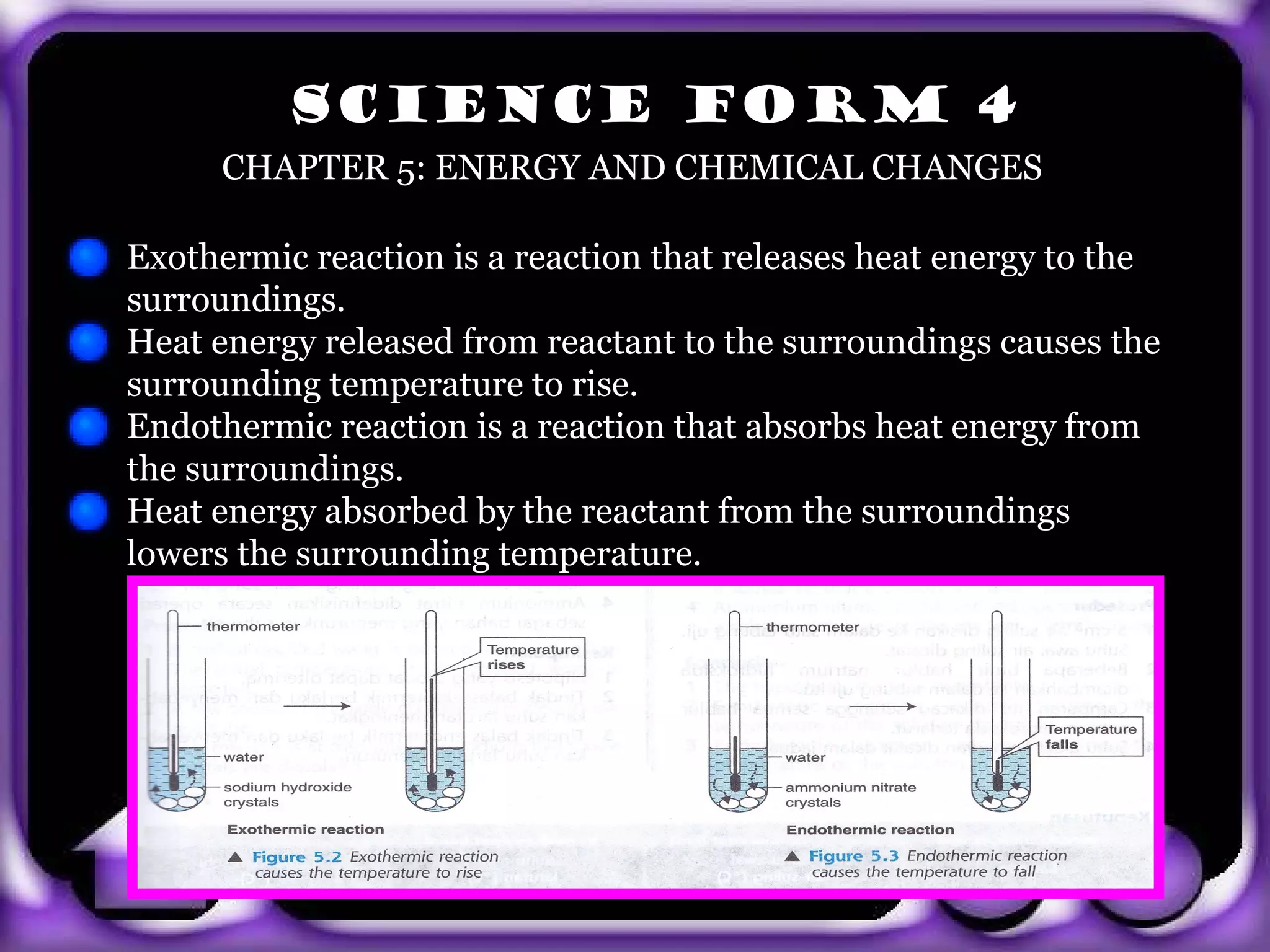
  Exothermic reaction is a reaction that releases heat energy to the
  surroundings.
  Heat energy released from reactant to the surroundings causes the
  surrounding temperature to rise.
  Endothermic reaction is a reaction that absorbs heat energy from
  the surroundings.
  Heat energy absorbed by the reactant from the surroundings
  lowers the surrounding temperature.


exit
SCIENCE FORM 4
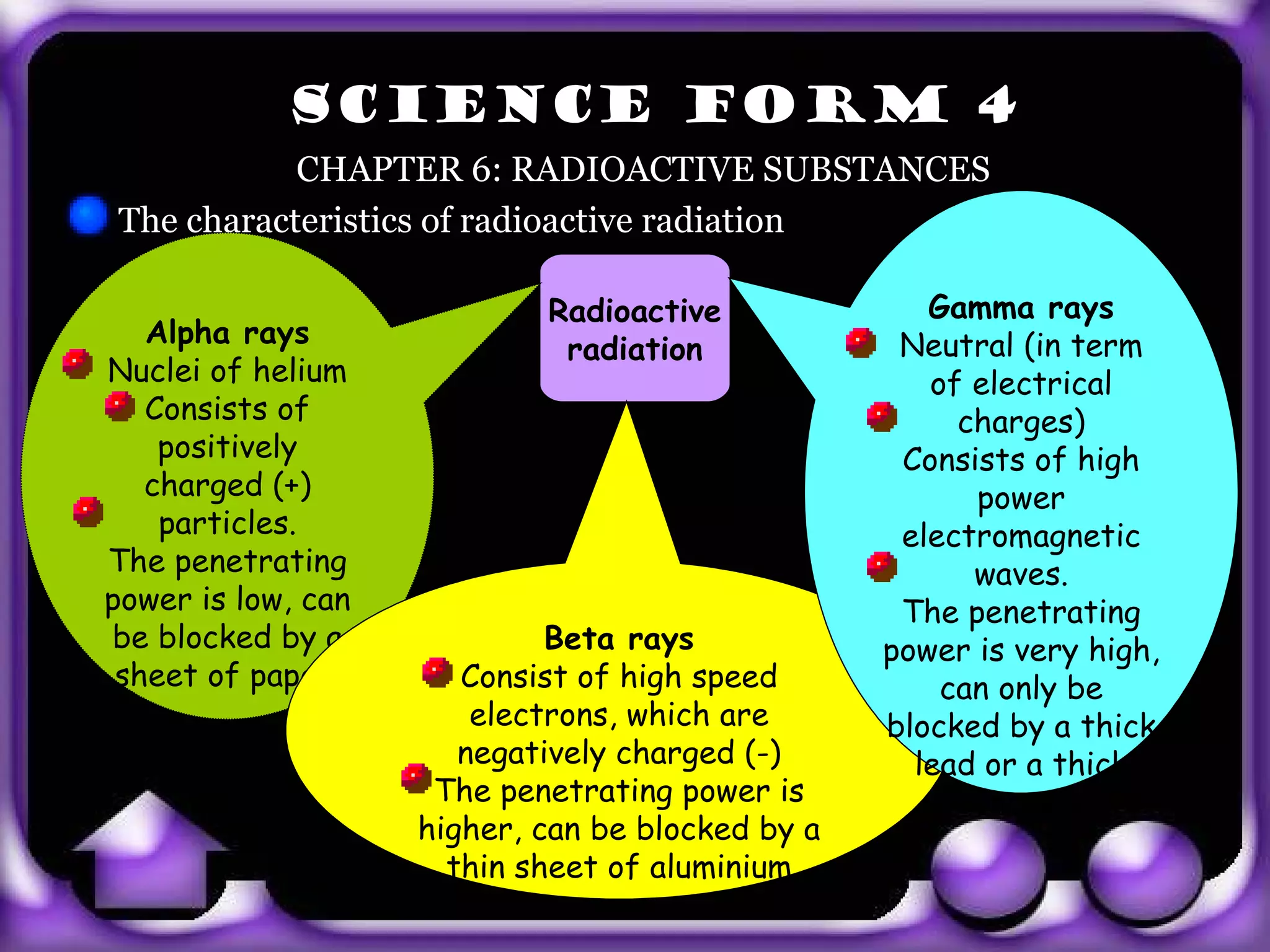
             CHAPTER 6: RADIOACTIVE SUBSTANCES
  The characteristics of radioactive radiation
                               The
                             Radioactive              Gamma rays
    Alpha rays                                      Neutral (in term
                              radiation
 Nuclei of helium                                     of electrical
    Consists of                                         charges)
     positively                                     Consists of high
    charged (+)                                          power
     particles.                                     electromagnetic
 The penetrating                                         waves.
 power is low, can                                  The penetrating
 be blocked by a              Beta rays            power is very high,
  sheet of paper.       Consist of high speed          can only be
                         electrons, which are      blocked by a thick
exit                    negatively charged (-)       lead or a thick
                      The penetrating power is          concrete
                     higher, can be blocked by a
                       thin sheet of aluminium
SCIENCE FORM 4
           CHAPTER 7: LIGHT,COLOUR AND SIGHT
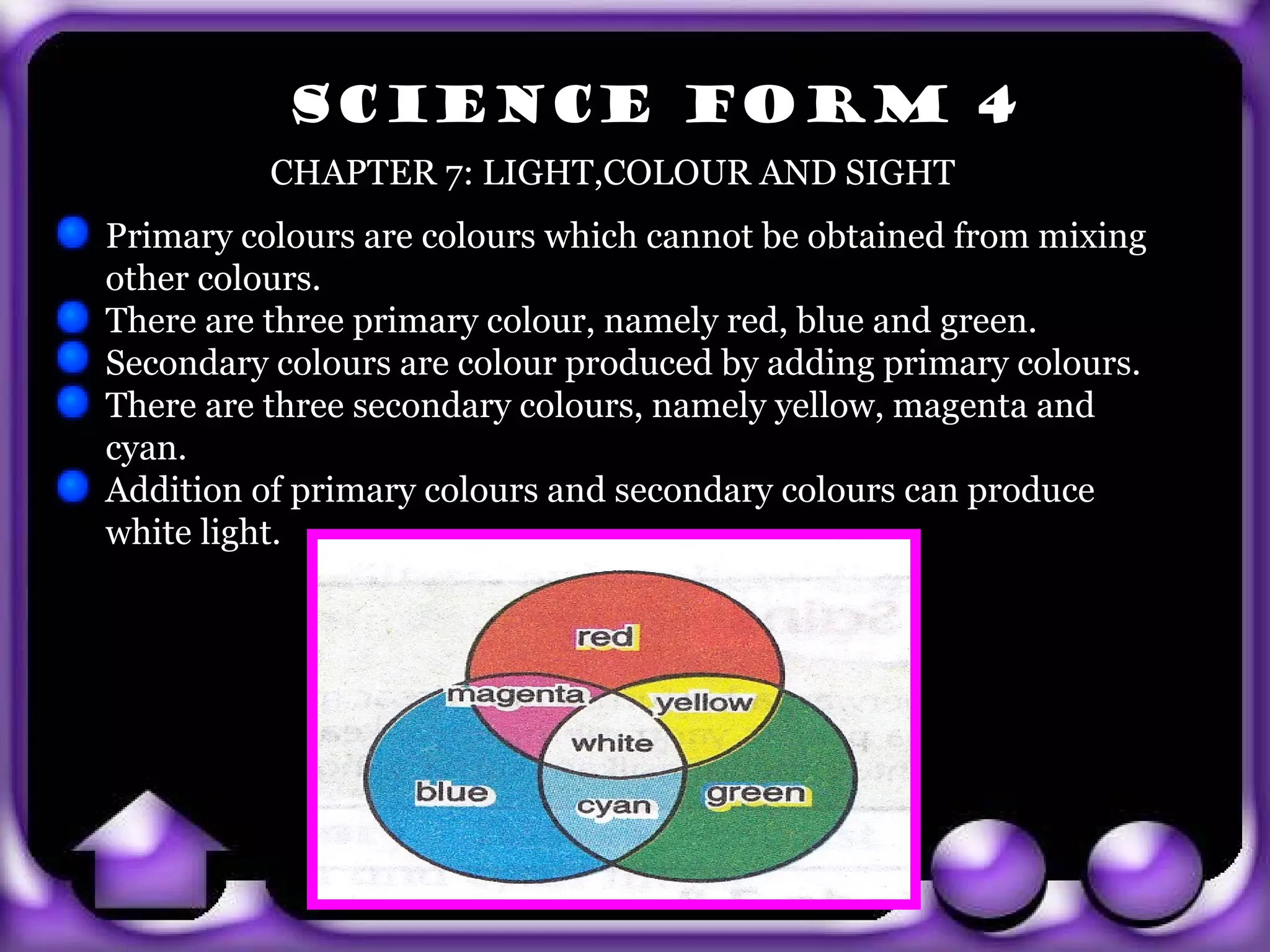
 Primary colours are colours which cannot be obtained from mixing
 other colours.
 There are three primary colour, namely red, blue and green.
 Secondary colours are colour produced by adding primary colours.
 There are three secondary colours, namely yellow, magenta and
 cyan.
 Addition of primary colours and secondary colours can produce
 white light.


exit
SCIENCE FORM 4
                CHAPTER 8: CHEMICALS IN INDUSTRY

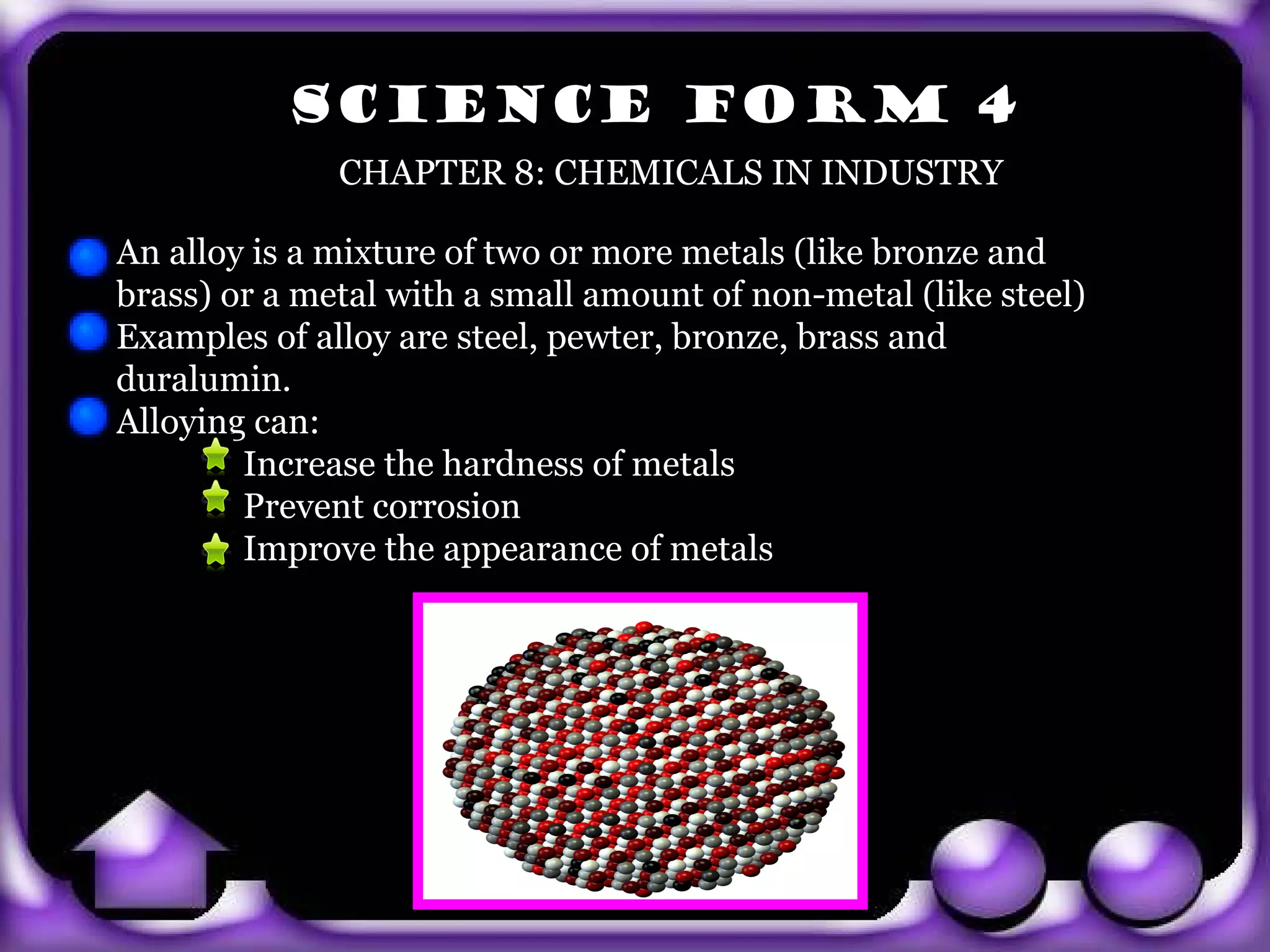
  An alloy is a mixture of two or more metals (like bronze and
  brass) or a metal with a small amount of non-metal (like steel)
  Examples of alloy are steel, pewter, bronze, brass and
  duralumin.
  Alloying can:
          Increase the hardness of metals
          Prevent corrosion
          Improve the appearance of metals


exit
SCIENCE FORM 5
                 CHAPTER 1: MICROORGANISMS
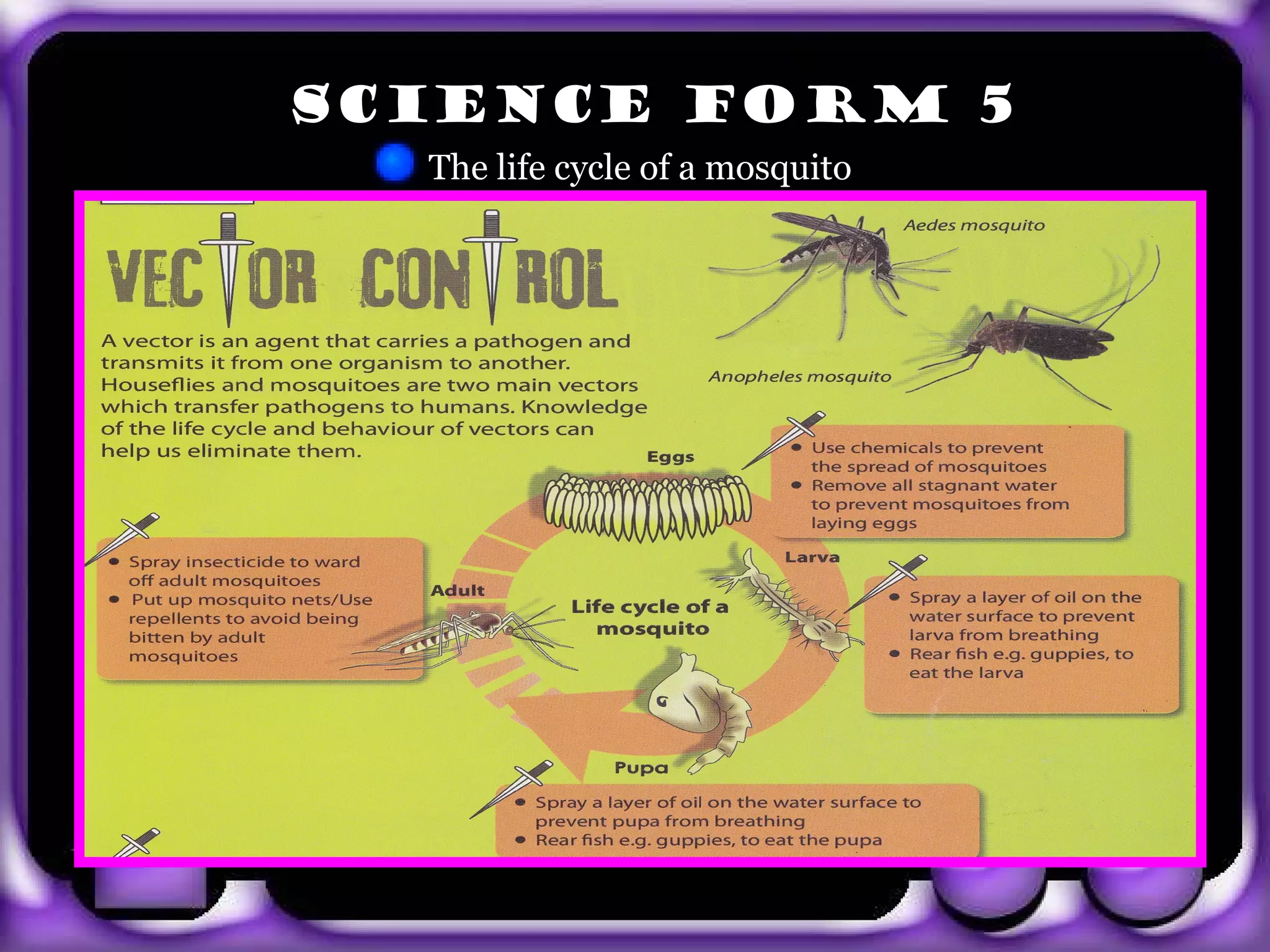
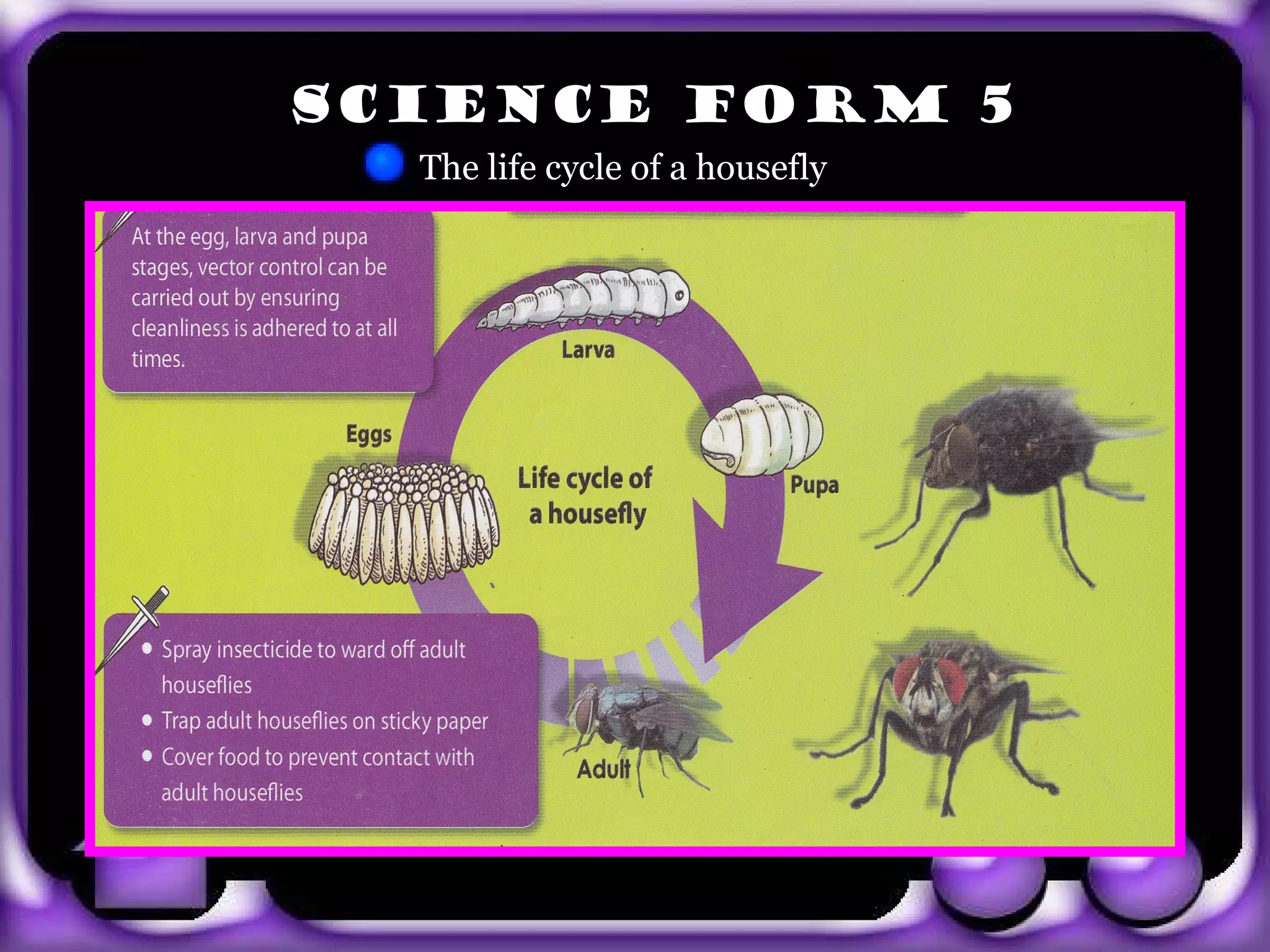
  Vector is an agent that carries diseases.
  Houseflies and mosquitoes are two main vectors that transfer
  pathogen to humans.
  Diseases like cholera and hepatitis A can be prevented if the
  population of houseflies is controlled.
  Dengue fever and malaria can be prevented is mosquito
  reproduction is prevented.
  Knowledge on the life cycle and behaviour of vectors can help us
  to eliminate them.


exit
SCIENCE FORM 5
         The lifeThe life a mosquito
                 cycle of


exit
SCIENCE FORM 5
         The life cycle of a housefly


exit
SCIENCE FORM 5
           CHAPTER 2: NUTRITION AND FOOD PRODUCTION

       The quantity of energy needed by an individual depends on the
       factors:
                Gender
                Age
                Body size
                Weather
                Physical activity
                Health condition


exit
SCIENCE FORM 5
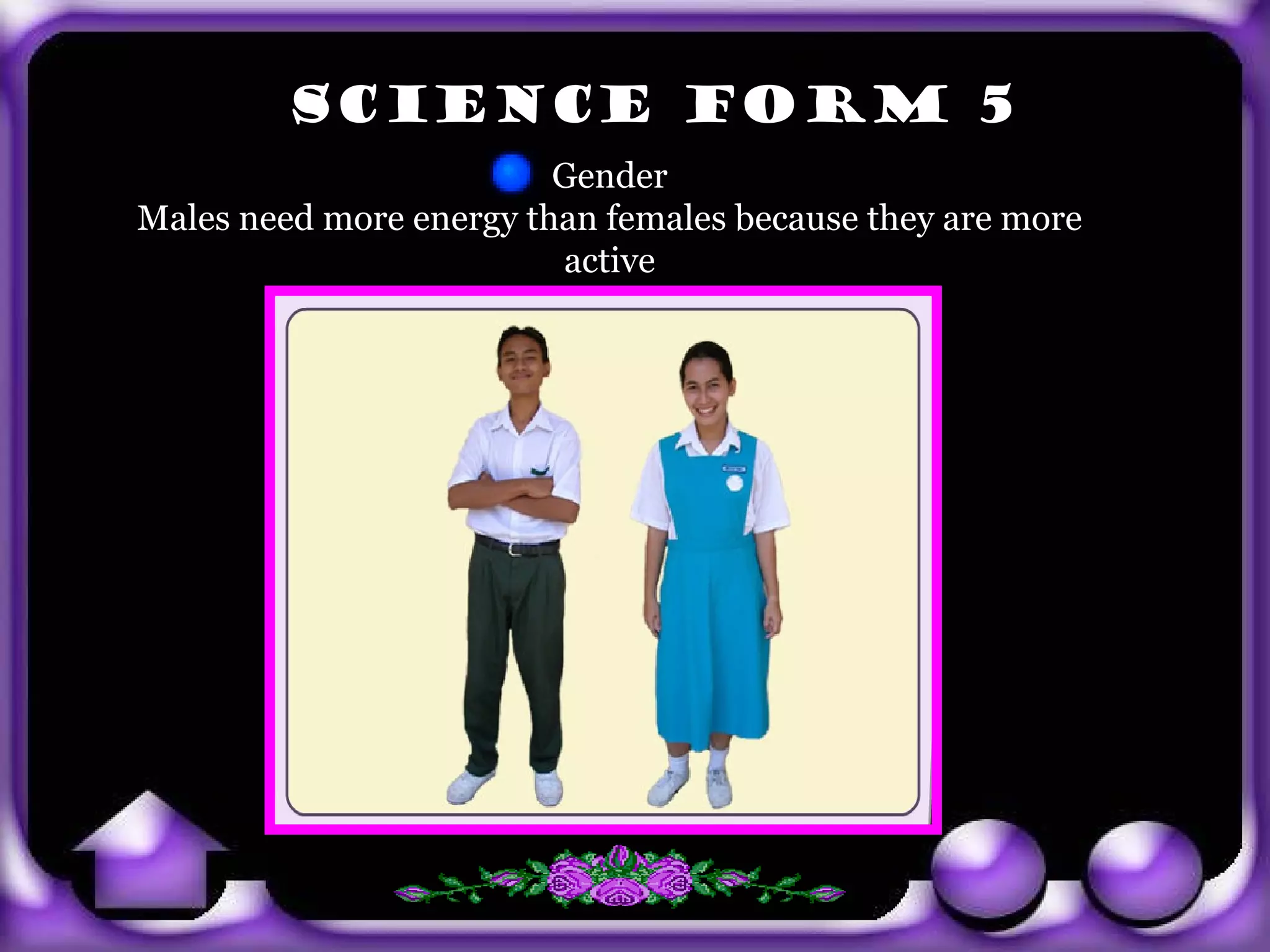
                            Gender
   Males need more energy than females because they are more
                            active


exit
SCIENCE FORM 5
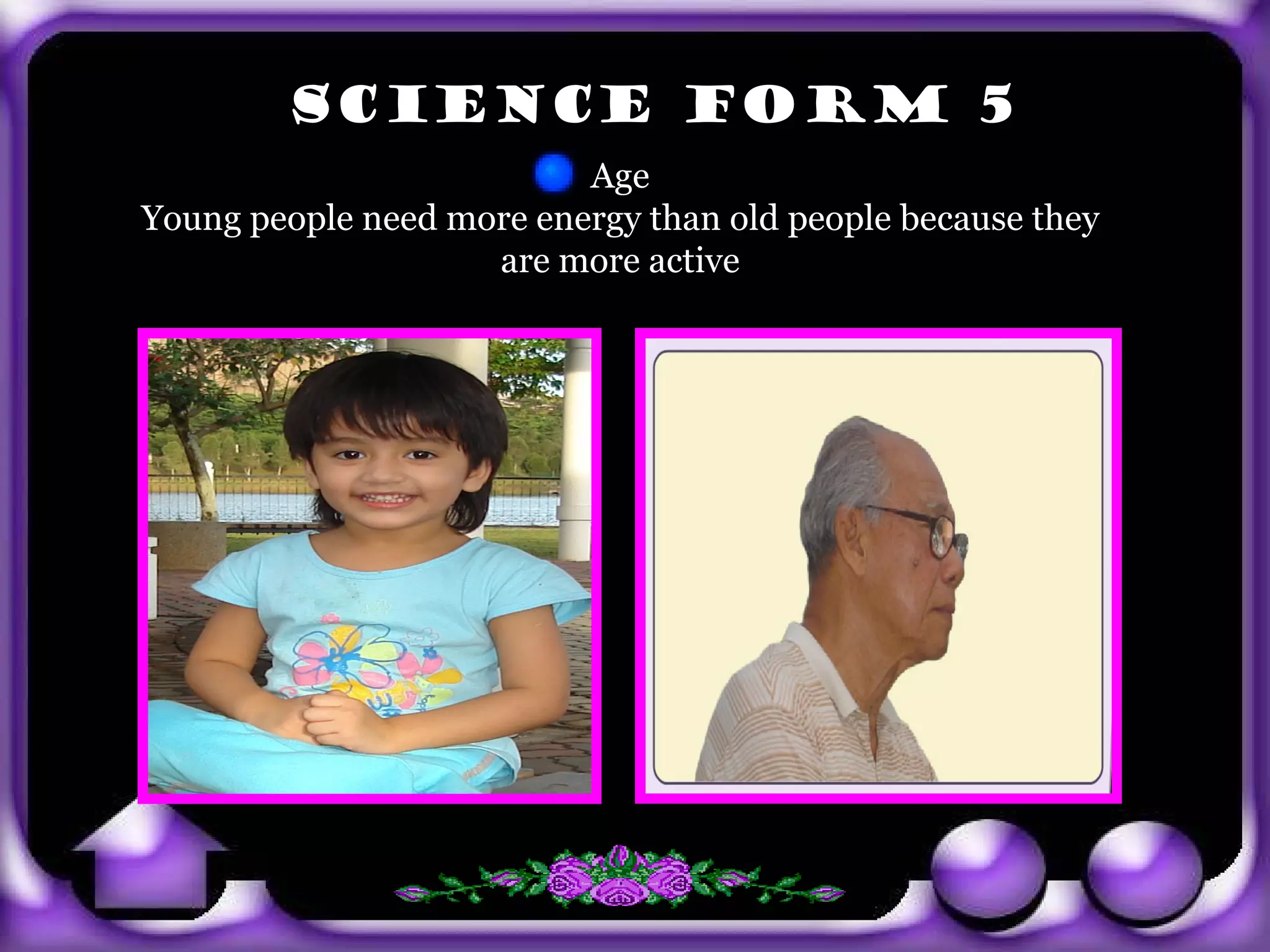
                                 Age
       Young people need more energy than old people because they
                           are more active


exit
SCIENCE FORM 5
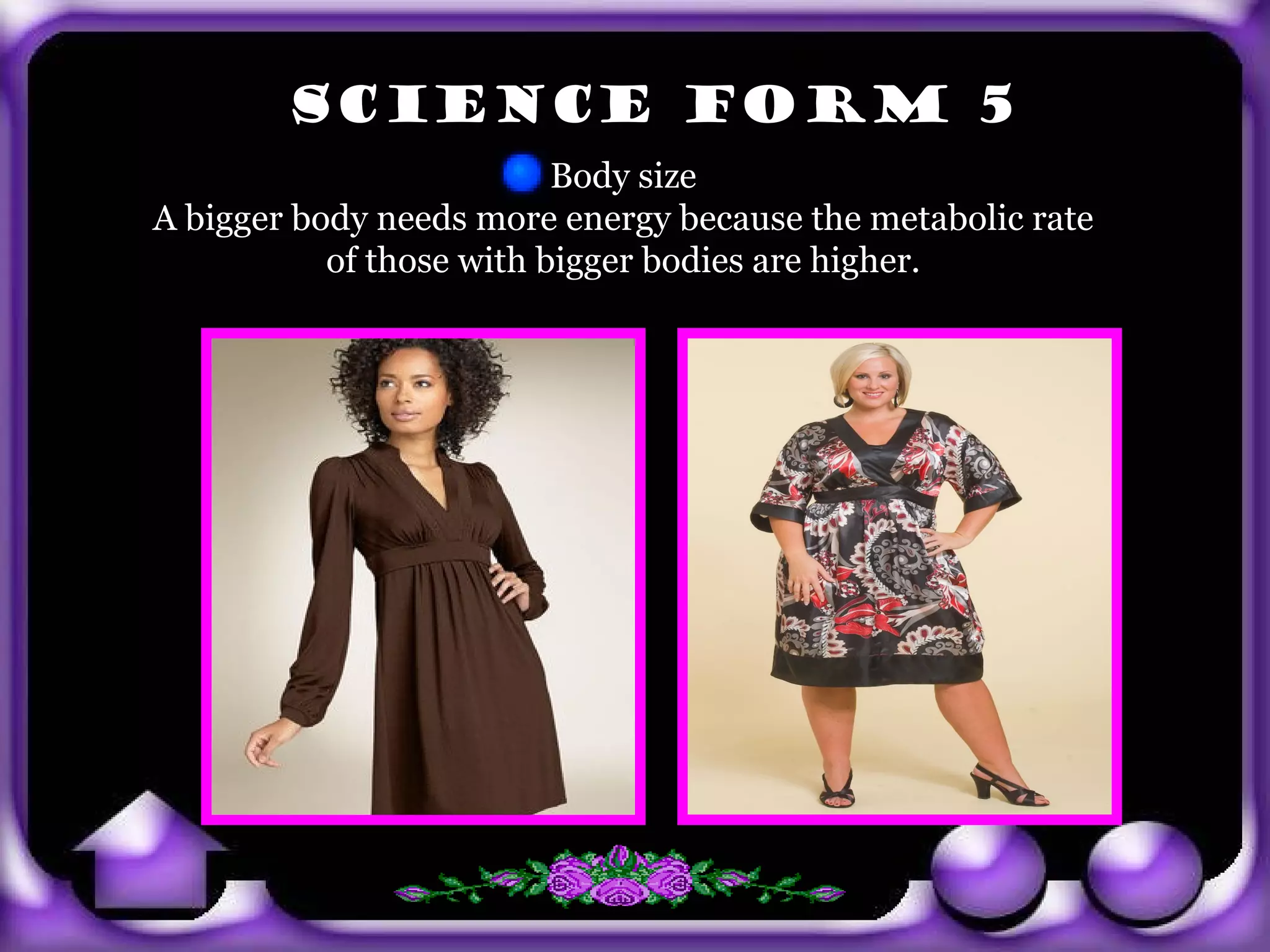
                                 Body size
       A bigger body needs more energy because the metabolic rate
                  of those with bigger bodies are higher.


exit
SCIENCE FORM 5
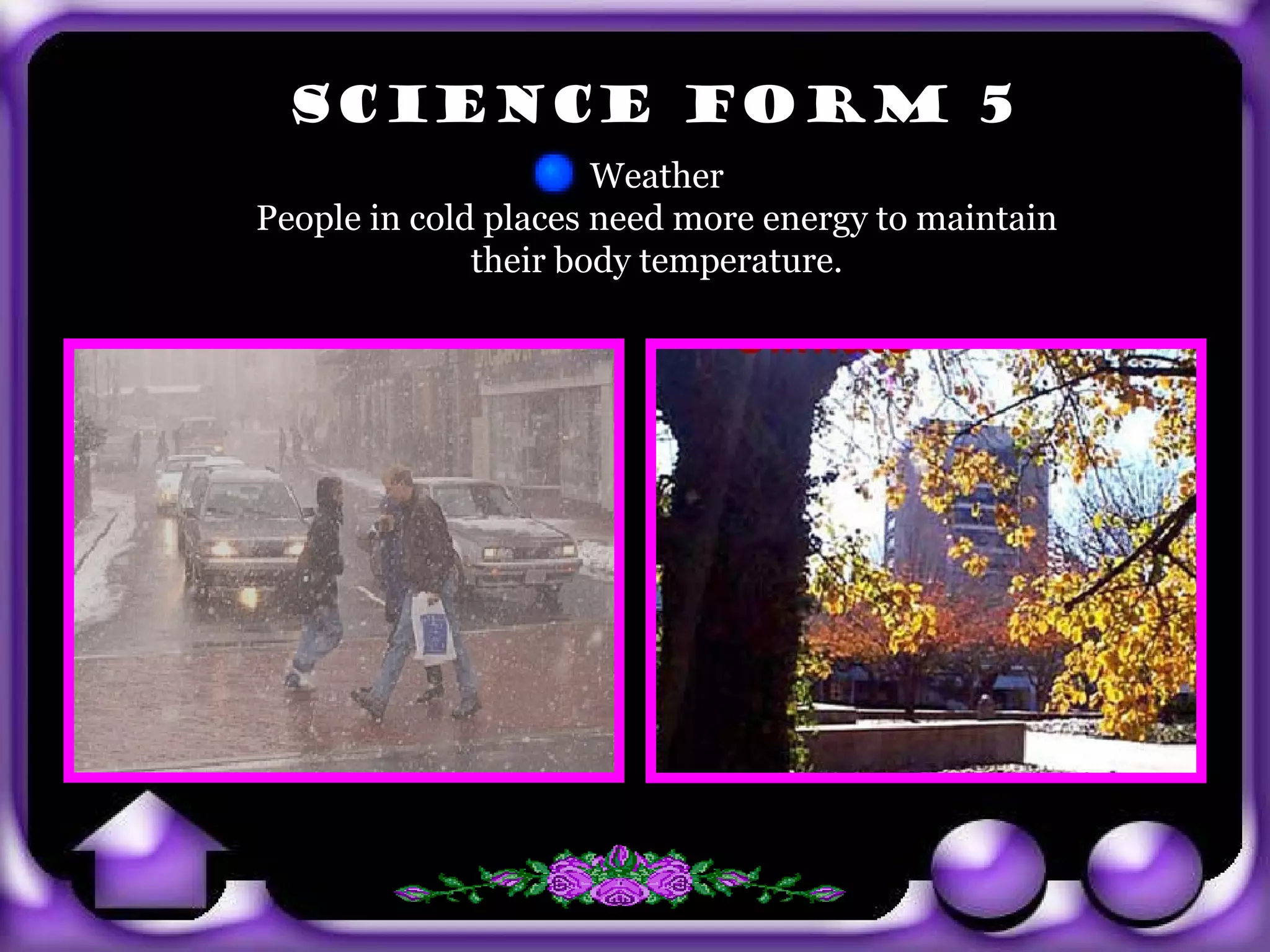
                             Weather
       People in cold places need more energy to maintain
                     their body temperature.


exit
SCIENCE FORM 5
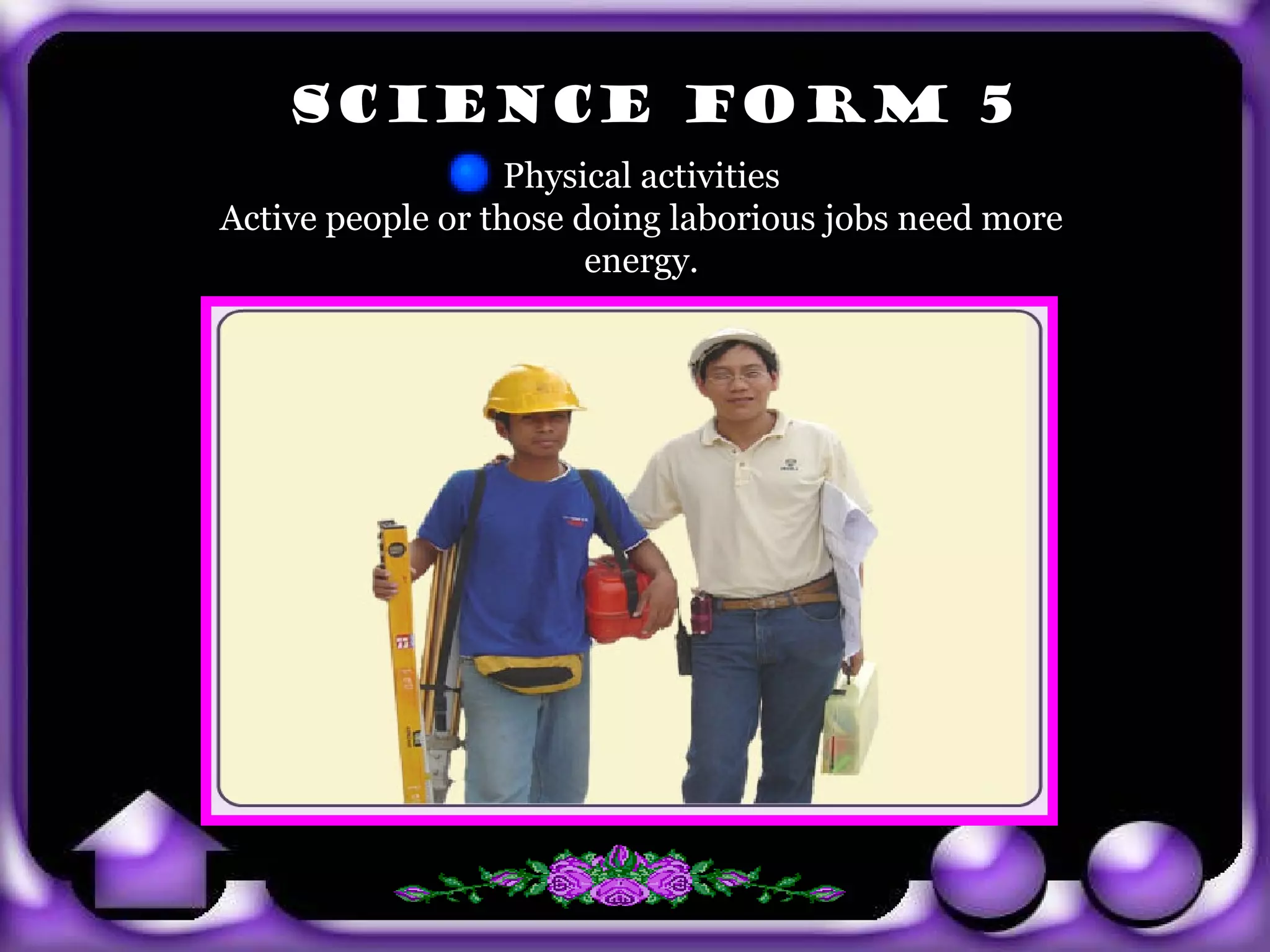
                          Physical activities
       Active people or those doing laborious jobs need more
                               energy.


exit
SCIENCE FORM 5
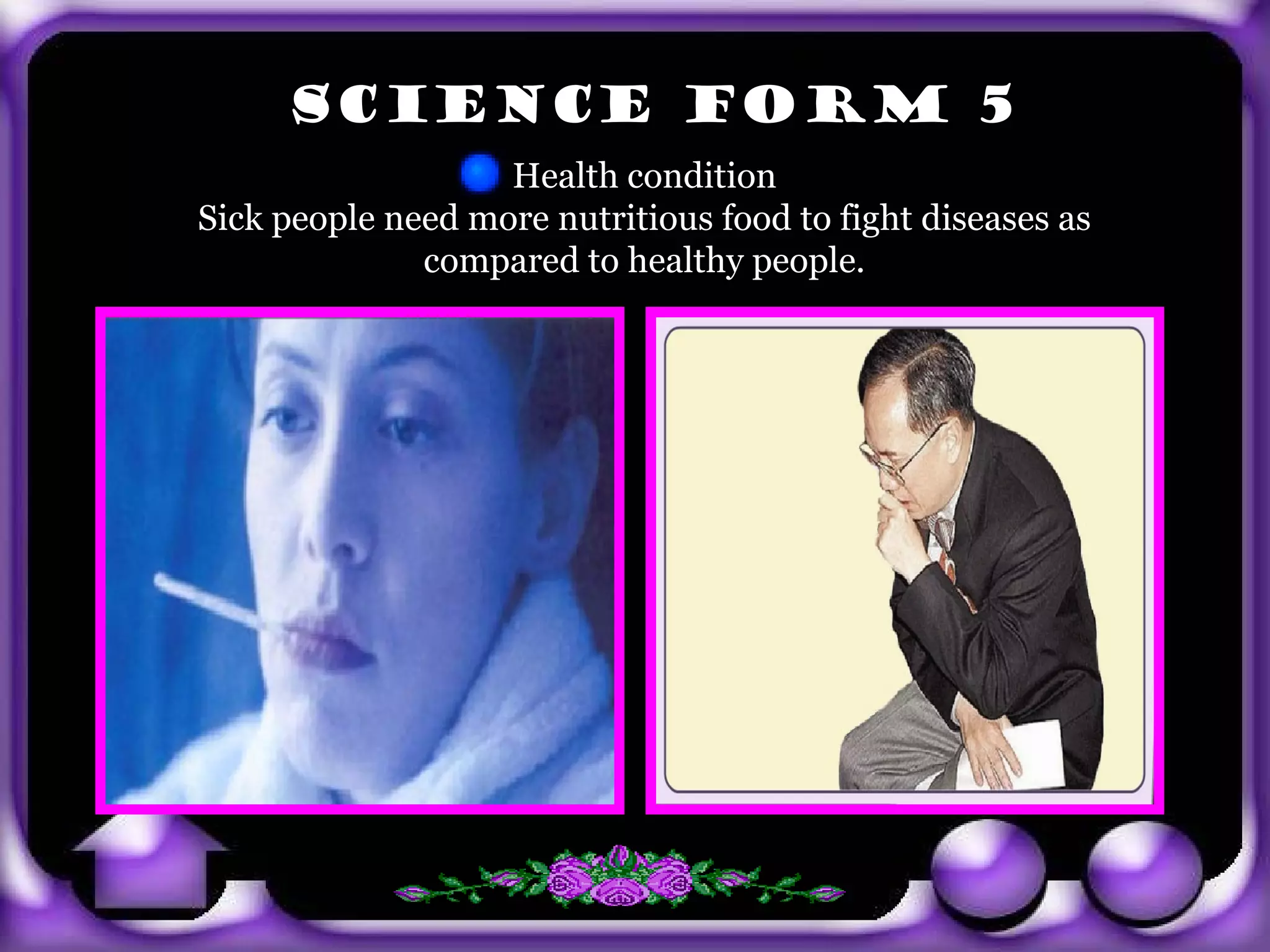
                          Health condition
       Sick people need more nutritious food to fight diseases as
                     compared to healthy people.


exit
SCIENCE FORM 5
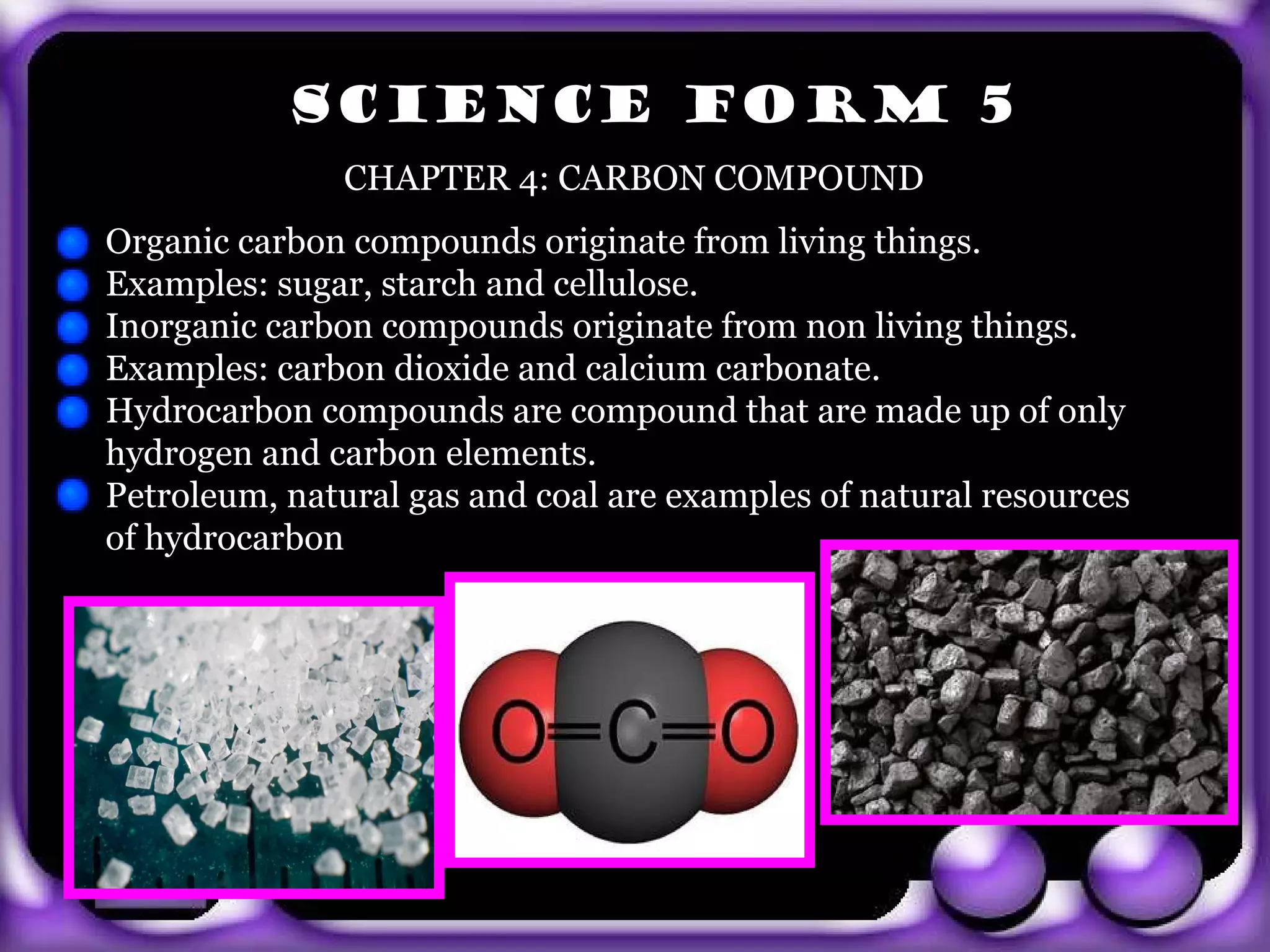
                CHAPTER 4: CARBON COMPOUND
 Organic carbon compounds originate from living things.
 Examples: sugar, starch and cellulose.
 Inorganic carbon compounds originate from non living things.
 Examples: carbon dioxide and calcium carbonate.
 Hydrocarbon compounds are compound that are made up of only
 hydrogen and carbon elements.
 Petroleum, natural gas and coal are examples of natural resources
 of hydrocarbon


exit
SCIENCE FORM 5
                        CHAPTER 5: MOTION
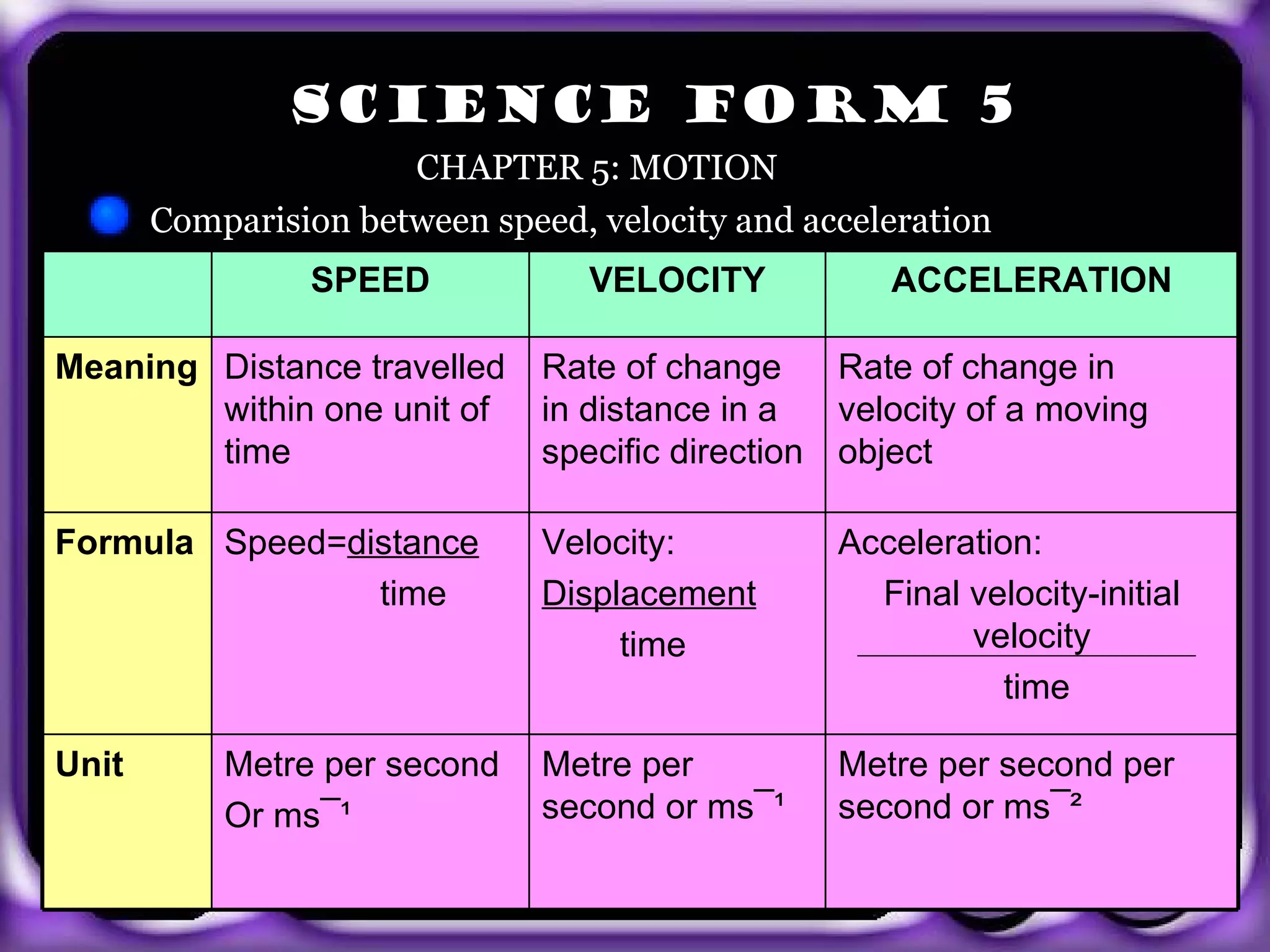
         Comparision between speed, velocity and acceleration
                  SPEED             VELOCITY           ACCELERATION

Meaning Distance travelled       Rate of change     Rate of change in
        within one unit of       in distance in a   velocity of a moving
        time                     specific direction object

Formula Speed=distance           Velocity:          Acceleration:
                time             Displacement         Final velocity-initial
                                      time                  velocity
                                                               time
  exit
Unit         Metre per second    Metre per          Metre per second per
             Or ms¯¹             second or ms¯¹     second or ms¯²
SCIENCE FORM 5
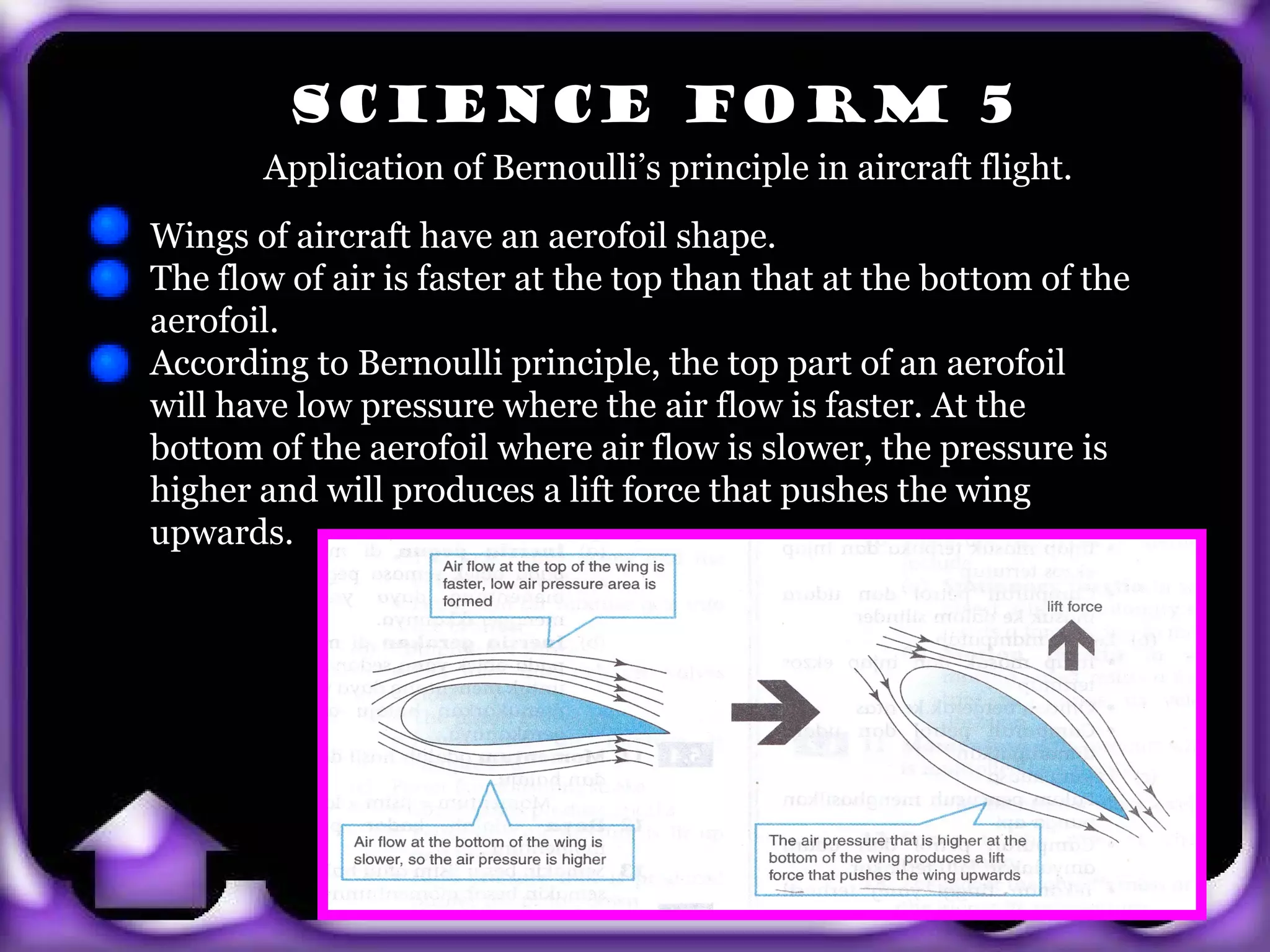
              Application of Bernoulli’s principle in aircraft flight.
       Wings of aircraft have an aerofoil shape.
       The flow of air is faster at the top than that at the bottom of the
       aerofoil.
       According to Bernoulli principle, the top part of an aerofoil
       will have low pressure where the air flow is faster. At the
       bottom of the aerofoil where air flow is slower, the pressure is
       higher and will produces a lift force that pushes the wing
       upwards.


exit
SCIENCE FORM 5
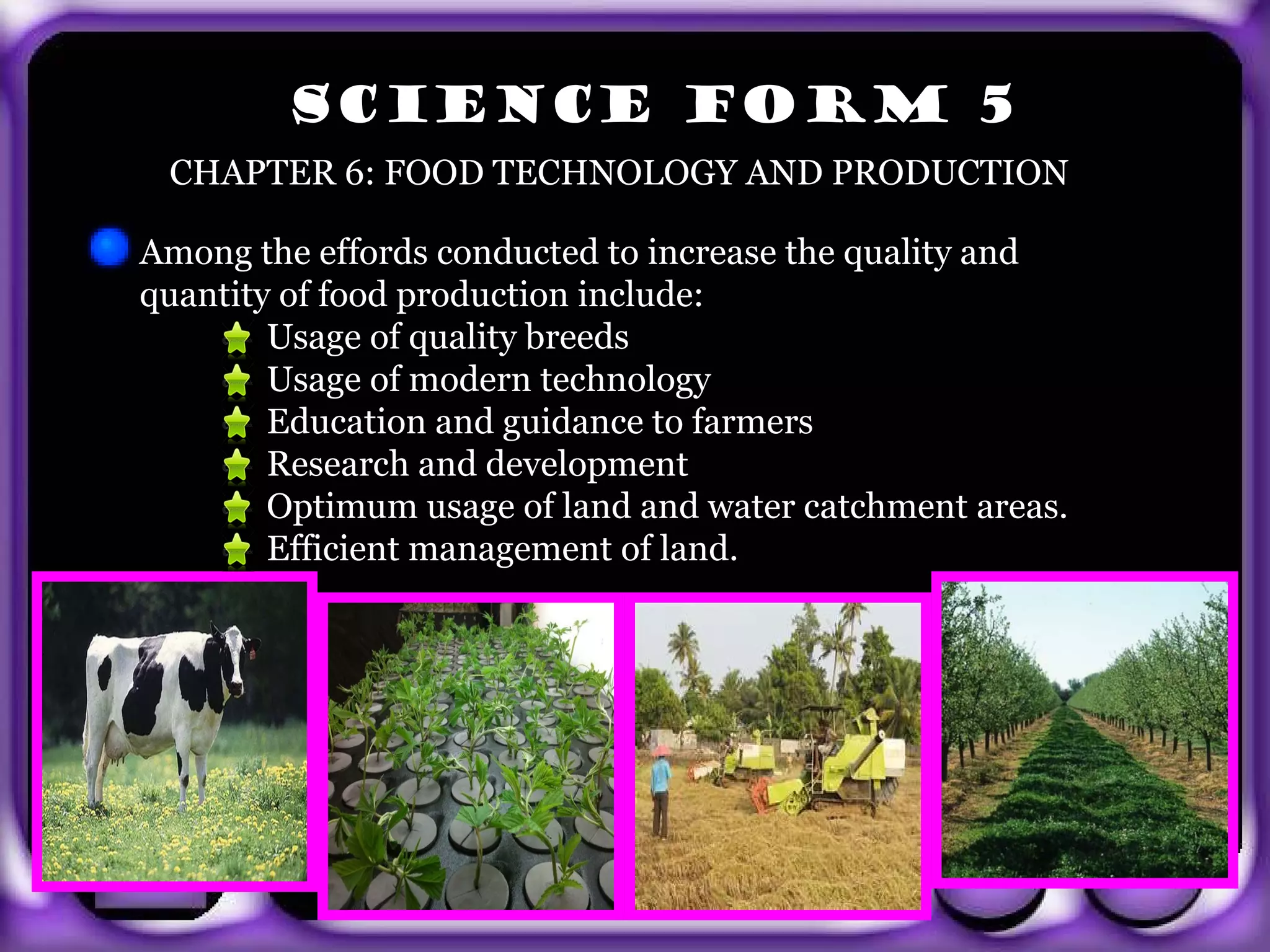
        CHAPTER 6: FOOD TECHNOLOGY AND PRODUCTION

       Among the effords conducted to increase the quality and
       quantity of food production include:
               Usage of quality breeds
               Usage of modern technology
               Education and guidance to farmers
               Research and development
               Optimum usage of land and water catchment areas.
               Efficient management of land.


exit
SCIENCE FORM 5
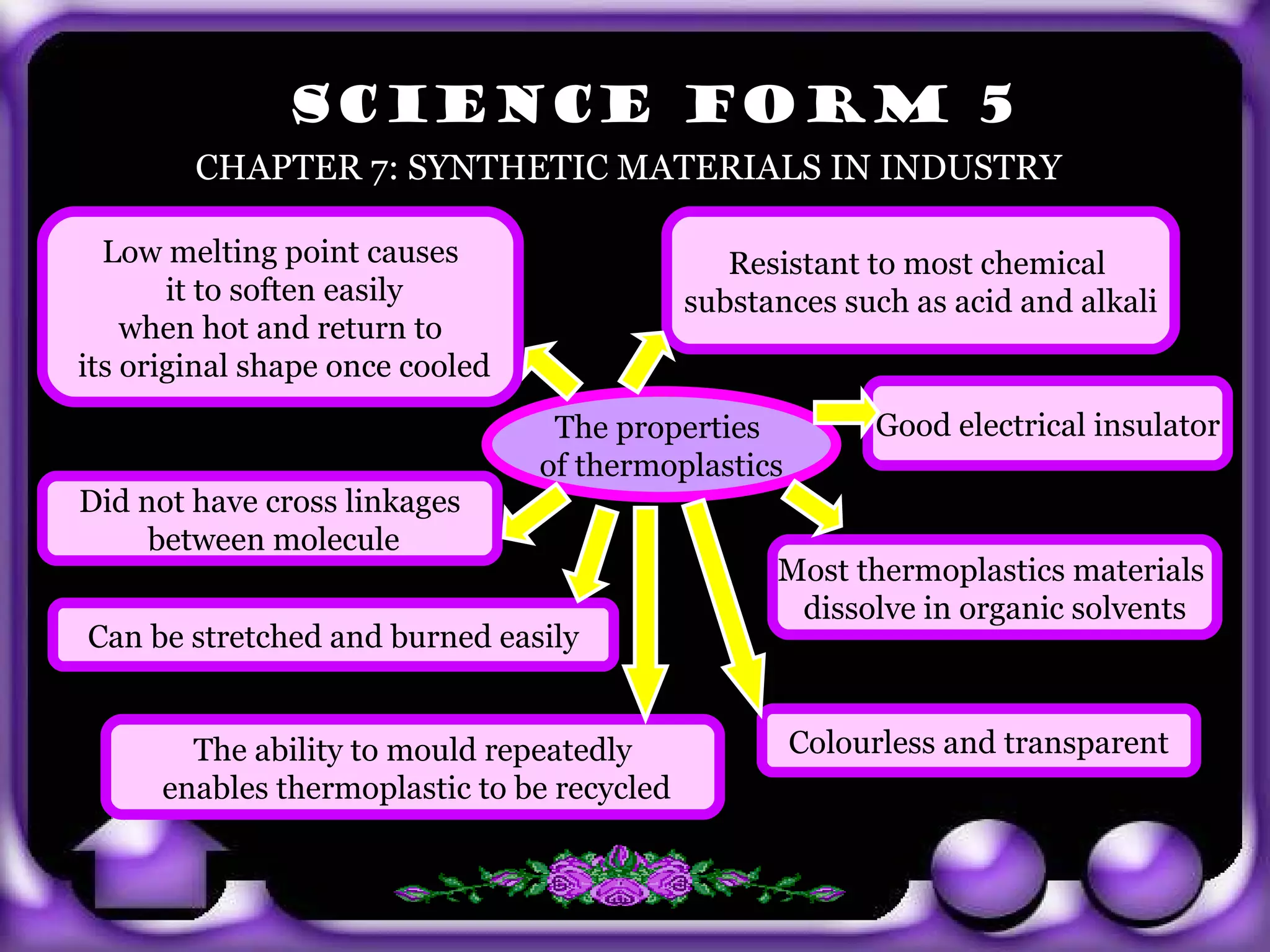
          CHAPTER 7: SYNTHETIC MATERIALS IN INDUSTRY

  Low melting point causes                        Resistant to most chemical
       it to soften easily                     substances such as acid and alkali
    when hot and return to
its original shape once cooled
                                   The properties           Good electrical insulator
                                  of thermoplastics
Did not have cross linkages
     between molecule
                                                     Most thermoplastics materials
                                                      dissolve in organic solvents
Can be stretched and burned easily


 exit     The ability to mould repeatedly             Colourless and transparent
        enables thermoplastic to be recycled
SCIENCE FORM 5
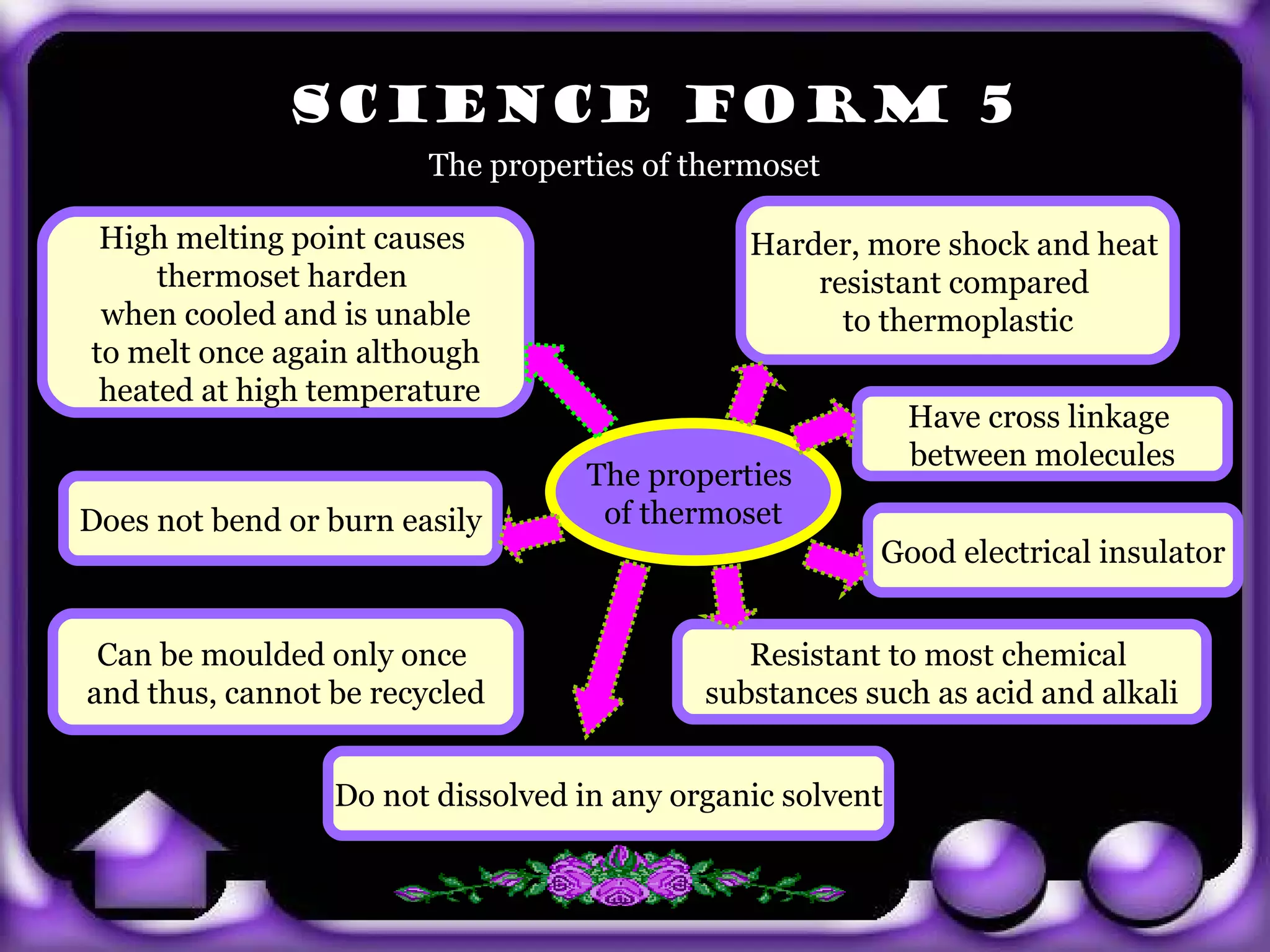
                        The properties of thermoset

 High melting point causes                    Harder, more shock and heat
     thermoset harden                             resistant compared
 when cooled and is unable                          to thermoplastic
to melt once again although
 heated at high temperature
                                                           Have cross linkage
                                                           between molecules
                                  The properties
Does not bend or burn easily       of thermoset
                                                       Good electrical insulator


 Can be moulded only once                     Resistant to most chemical
and thus, cannot be recycled               substances such as acid and alkali
exit
                 Do not dissolved in any organic solvent
SCIENCE FORM 5
        CHAPTER 8: ELECTRONICS AND COMMUNICATIONS
                       TECHNOLOGY (ICT)
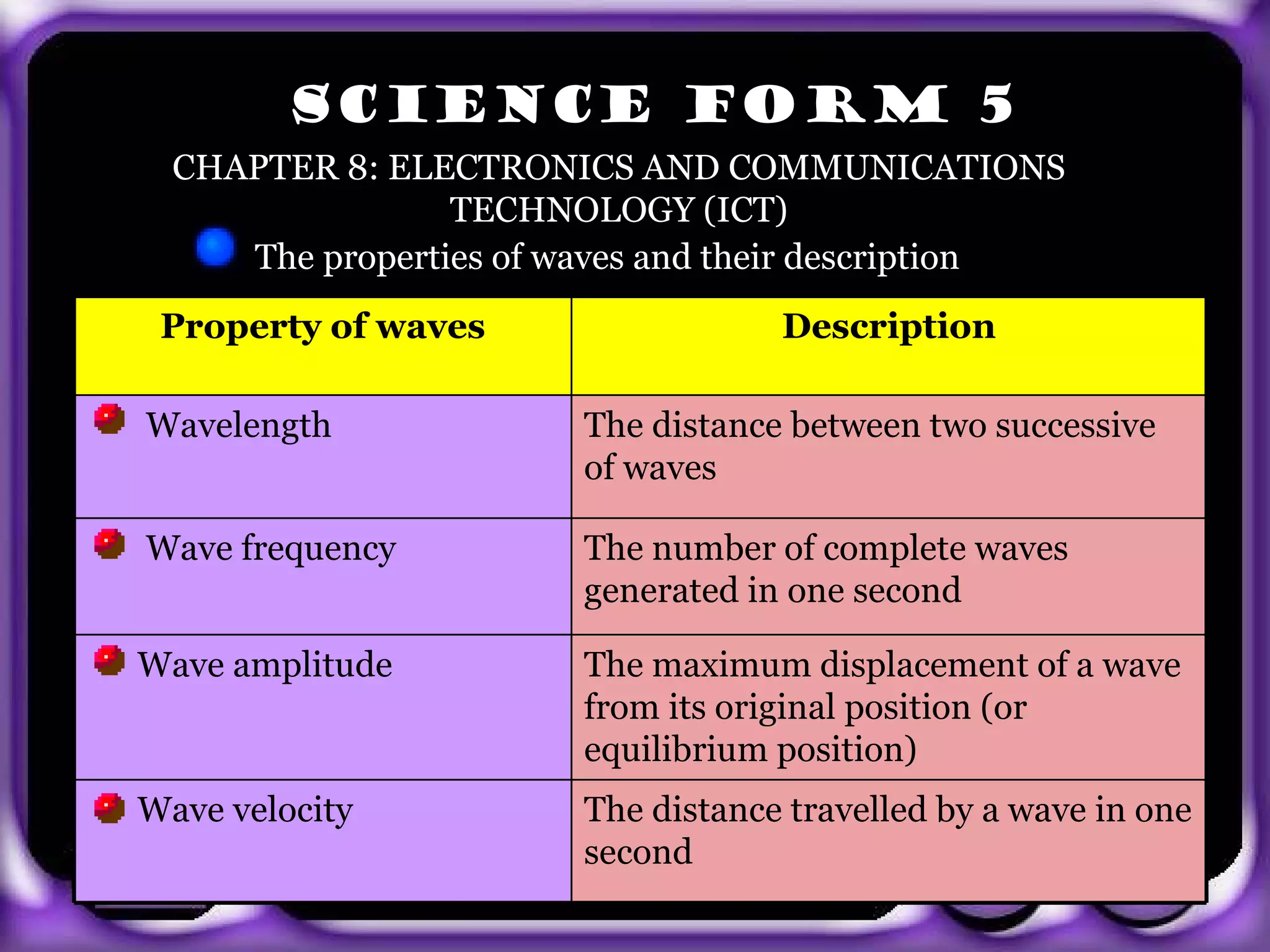
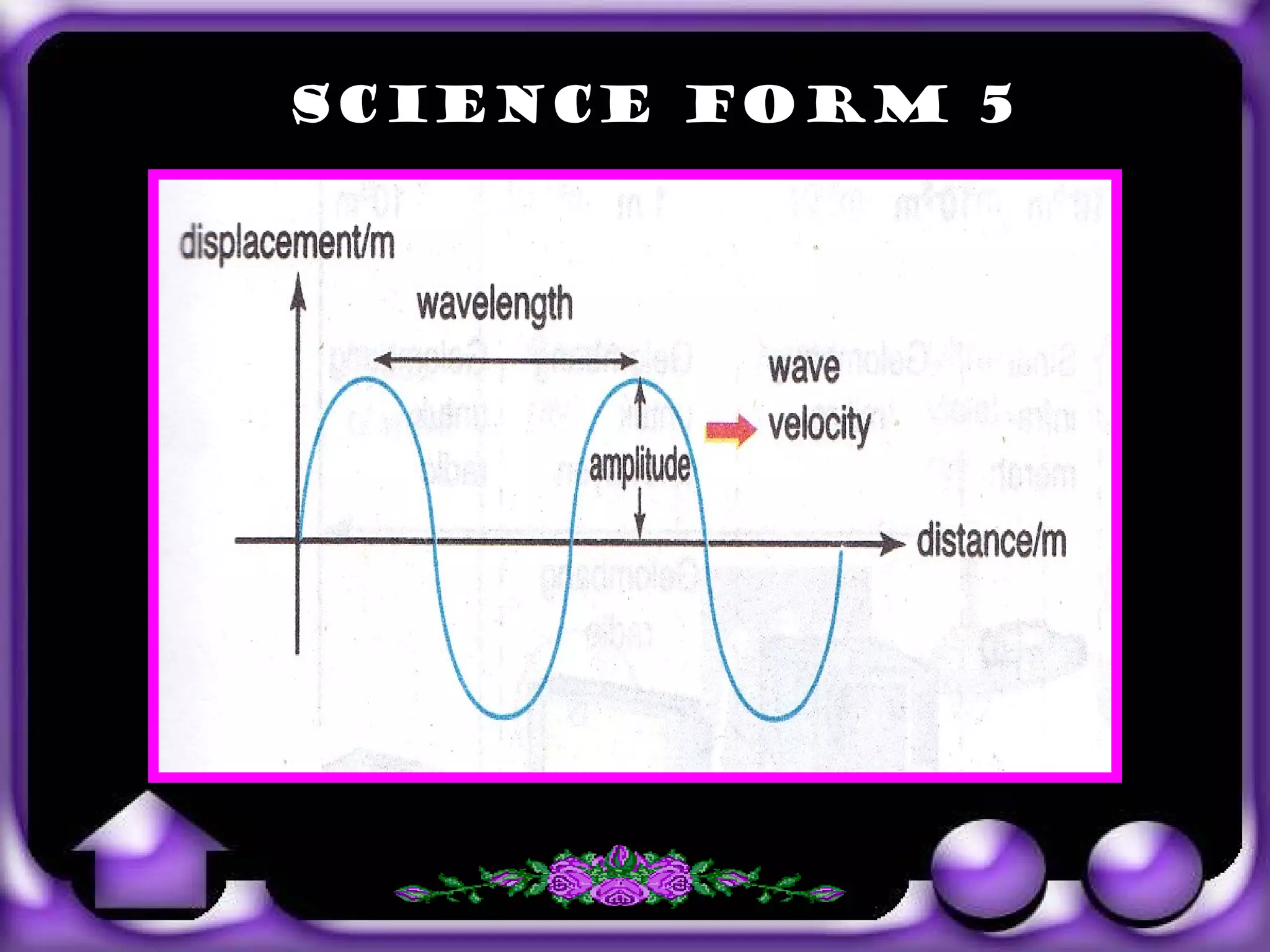
           The properties of waves and their description
       Property of waves                  Description

       Wavelength             The distance between two successive
                              of waves

       Wave frequency         The number of complete waves
                              generated in one second

   Wave amplitude             The maximum displacement of a wave
                              from its original position (or
exit                          equilibrium position)
   Wave velocity              The distance travelled by a wave in one
                              second
SCIENCE FORM 5


exit
SCIENCE FORM 5
        THE END….
       GOOD LUCK !!!!


exit

Note sains ultimate flash spm 2011

  • 1.
    SCIENCE FORM 4 CHAPTER 2: BODY COORDINATION Body coordination is the adjustment of the body in response to whatever stimulus received by some parts of the body. There are two types of body coordination : nervous coordination and hormonal coordination. The central nervous system is the control centre of the body. This system consists of the brain and the spinal cord. The peripheral nervous system consists of the autonomic nervous system and the somatic nervous system. exit
  • 2.
    SCIENCE FORM 4 Theneurone is a basic unit of the nervous system. There are three types of neurone: Sensory neurone- carries impulses from the receptor or sensory organ to the central nervous system. relay neurone- connects sensory neurone with motor neurone. motor neurone- carries impulses from the central nervous system to effectors, like muscles or glands. exit Sensory neurone Relay neurone Motor neurone
  • 3.
    SCIENCE FORM 4 Comparision between sensory neurone, relay neurone and motor neurone. Characteristic Sensory neurone Relay neurone Motor neurone Position of cell In the middle of At the centre of At the end of body neurone neurone neurone Length of axon Short Changes Long Movement of From the sensory From the sensory From the relay impulse organ or the receptor neurone to the neurone going out to the central nervous motor neurone in the from the central system central nervous nervous system to system the muscle or effectors exit Function Carries impulses Transmit impulses Transmits impulses from sensory organ from sensory from central or receptor to central neurone to motor nervous system to nervous system neurone effector
  • 4.
    SCIENCE FORM 4 The human brain consists of three parts: cerebrum- controls the functions of sensory organs and voluntary actions. cerebellum – control body balance and coordinates body movements. medulla oblongata- control involuntary actions. exit
  • 5.
    SCIENCE FORM 4 CHAPTER 3: HEREDITY AND VARIATION Comparision between meiosis and mitosis Mitosis Differences Meiosis Somatic cells Place occurs Testes and ovaries One Number of cell Two division Two Number of Four daughter cells Same as Chromosomal Half the number of parents,diploid (2n) number of chromosomes of the daughter cells parent (n) exit Genetically identical to Genetic content Different from the the parent cell parent cell and from one another.
  • 6.
    SCIENCE FORM 4 Comparison between continuous and discontinuous variation Continuous Differences Discontinuous variation variation Difference is not Differences in Difference is obvious characteristic obvious and definite Height, body Examples of Blood group, type of weight, skin colour variation fingerprint, ability to roll the tongue Normal distribution Shape of graph Discrete distribution exit Genetic and Factors that Genetic factor environmental cause variation factors
  • 7.
    SCIENCE FORM 4 CHAPTER 4: MATTER Pure substances have a specific melting point (freezing point) and boiling point. Any impurity added to pure substance will raise the boiling or lower the freezing point of that substance. For example, water that is with salt will boil at a temperature higher than 100° C and will freeze at a temperature lower than 0°C exit
  • 8.
    SCIENCE FORM 4 CHAPTER 5: ENERGY AND CHEMICAL CHANGES Exothermic reaction is a reaction that releases heat energy to the surroundings. Heat energy released from reactant to the surroundings causes the surrounding temperature to rise. Endothermic reaction is a reaction that absorbs heat energy from the surroundings. Heat energy absorbed by the reactant from the surroundings lowers the surrounding temperature. exit
  • 9.
    SCIENCE FORM 4 CHAPTER 6: RADIOACTIVE SUBSTANCES The characteristics of radioactive radiation The Radioactive Gamma rays Alpha rays Neutral (in term radiation Nuclei of helium of electrical Consists of charges) positively Consists of high charged (+) power particles. electromagnetic The penetrating waves. power is low, can The penetrating be blocked by a Beta rays power is very high, sheet of paper. Consist of high speed can only be electrons, which are blocked by a thick exit negatively charged (-) lead or a thick The penetrating power is concrete higher, can be blocked by a thin sheet of aluminium
  • 10.
    SCIENCE FORM 4 CHAPTER 7: LIGHT,COLOUR AND SIGHT Primary colours are colours which cannot be obtained from mixing other colours. There are three primary colour, namely red, blue and green. Secondary colours are colour produced by adding primary colours. There are three secondary colours, namely yellow, magenta and cyan. Addition of primary colours and secondary colours can produce white light. exit
  • 11.
    SCIENCE FORM 4 CHAPTER 8: CHEMICALS IN INDUSTRY An alloy is a mixture of two or more metals (like bronze and brass) or a metal with a small amount of non-metal (like steel) Examples of alloy are steel, pewter, bronze, brass and duralumin. Alloying can: Increase the hardness of metals Prevent corrosion Improve the appearance of metals exit
  • 12.
    SCIENCE FORM 5 CHAPTER 1: MICROORGANISMS Vector is an agent that carries diseases. Houseflies and mosquitoes are two main vectors that transfer pathogen to humans. Diseases like cholera and hepatitis A can be prevented if the population of houseflies is controlled. Dengue fever and malaria can be prevented is mosquito reproduction is prevented. Knowledge on the life cycle and behaviour of vectors can help us to eliminate them. exit
  • 13.
    SCIENCE FORM 5 The lifeThe life a mosquito cycle of exit
  • 14.
    SCIENCE FORM 5 The life cycle of a housefly exit
  • 15.
    SCIENCE FORM 5 CHAPTER 2: NUTRITION AND FOOD PRODUCTION The quantity of energy needed by an individual depends on the factors: Gender Age Body size Weather Physical activity Health condition exit
  • 16.
    SCIENCE FORM 5 Gender Males need more energy than females because they are more active exit
  • 17.
    SCIENCE FORM 5 Age Young people need more energy than old people because they are more active exit
  • 18.
    SCIENCE FORM 5 Body size A bigger body needs more energy because the metabolic rate of those with bigger bodies are higher. exit
  • 19.
    SCIENCE FORM 5 Weather People in cold places need more energy to maintain their body temperature. exit
  • 20.
    SCIENCE FORM 5 Physical activities Active people or those doing laborious jobs need more energy. exit
  • 21.
    SCIENCE FORM 5 Health condition Sick people need more nutritious food to fight diseases as compared to healthy people. exit
  • 22.
    SCIENCE FORM 5 CHAPTER 4: CARBON COMPOUND Organic carbon compounds originate from living things. Examples: sugar, starch and cellulose. Inorganic carbon compounds originate from non living things. Examples: carbon dioxide and calcium carbonate. Hydrocarbon compounds are compound that are made up of only hydrogen and carbon elements. Petroleum, natural gas and coal are examples of natural resources of hydrocarbon exit
  • 23.
    SCIENCE FORM 5 CHAPTER 5: MOTION Comparision between speed, velocity and acceleration SPEED VELOCITY ACCELERATION Meaning Distance travelled Rate of change Rate of change in within one unit of in distance in a velocity of a moving time specific direction object Formula Speed=distance Velocity: Acceleration: time Displacement Final velocity-initial time velocity time exit Unit Metre per second Metre per Metre per second per Or ms¯¹ second or ms¯¹ second or ms¯²
  • 24.
    SCIENCE FORM 5 Application of Bernoulli’s principle in aircraft flight. Wings of aircraft have an aerofoil shape. The flow of air is faster at the top than that at the bottom of the aerofoil. According to Bernoulli principle, the top part of an aerofoil will have low pressure where the air flow is faster. At the bottom of the aerofoil where air flow is slower, the pressure is higher and will produces a lift force that pushes the wing upwards. exit
  • 25.
    SCIENCE FORM 5 CHAPTER 6: FOOD TECHNOLOGY AND PRODUCTION Among the effords conducted to increase the quality and quantity of food production include: Usage of quality breeds Usage of modern technology Education and guidance to farmers Research and development Optimum usage of land and water catchment areas. Efficient management of land. exit
  • 26.
    SCIENCE FORM 5 CHAPTER 7: SYNTHETIC MATERIALS IN INDUSTRY Low melting point causes Resistant to most chemical it to soften easily substances such as acid and alkali when hot and return to its original shape once cooled The properties Good electrical insulator of thermoplastics Did not have cross linkages between molecule Most thermoplastics materials dissolve in organic solvents Can be stretched and burned easily exit The ability to mould repeatedly Colourless and transparent enables thermoplastic to be recycled
  • 27.
    SCIENCE FORM 5 The properties of thermoset High melting point causes Harder, more shock and heat thermoset harden resistant compared when cooled and is unable to thermoplastic to melt once again although heated at high temperature Have cross linkage between molecules The properties Does not bend or burn easily of thermoset Good electrical insulator Can be moulded only once Resistant to most chemical and thus, cannot be recycled substances such as acid and alkali exit Do not dissolved in any organic solvent
  • 28.
    SCIENCE FORM 5 CHAPTER 8: ELECTRONICS AND COMMUNICATIONS TECHNOLOGY (ICT) The properties of waves and their description Property of waves Description Wavelength The distance between two successive of waves Wave frequency The number of complete waves generated in one second Wave amplitude The maximum displacement of a wave from its original position (or exit equilibrium position) Wave velocity The distance travelled by a wave in one second
  • 29.
  • 30.
    SCIENCE FORM 5 THE END…. GOOD LUCK !!!! exit