RSS and sensor fusion algorithms
for indoor location systems on
smartphones
RSS and sensor fusion algorithms for indoor location systems on smartphones
Laia Descamps-Vila, A. Perez-Navarro and Jordi Conesa (and Andrés Gómez)
1
1. Context
2. Indoor positioning
3. Wifi Fingerprinting
Index
RSS and sensor fusion algorithms for indoor location systems on smartphones
3. Wifi Fingerprinting
4. Sensor Fusion
5. Test
6. Conclusions and Future Work
2
RSS and sensor fusion algorithms for indoor location systems on smartphones
3
1. Context
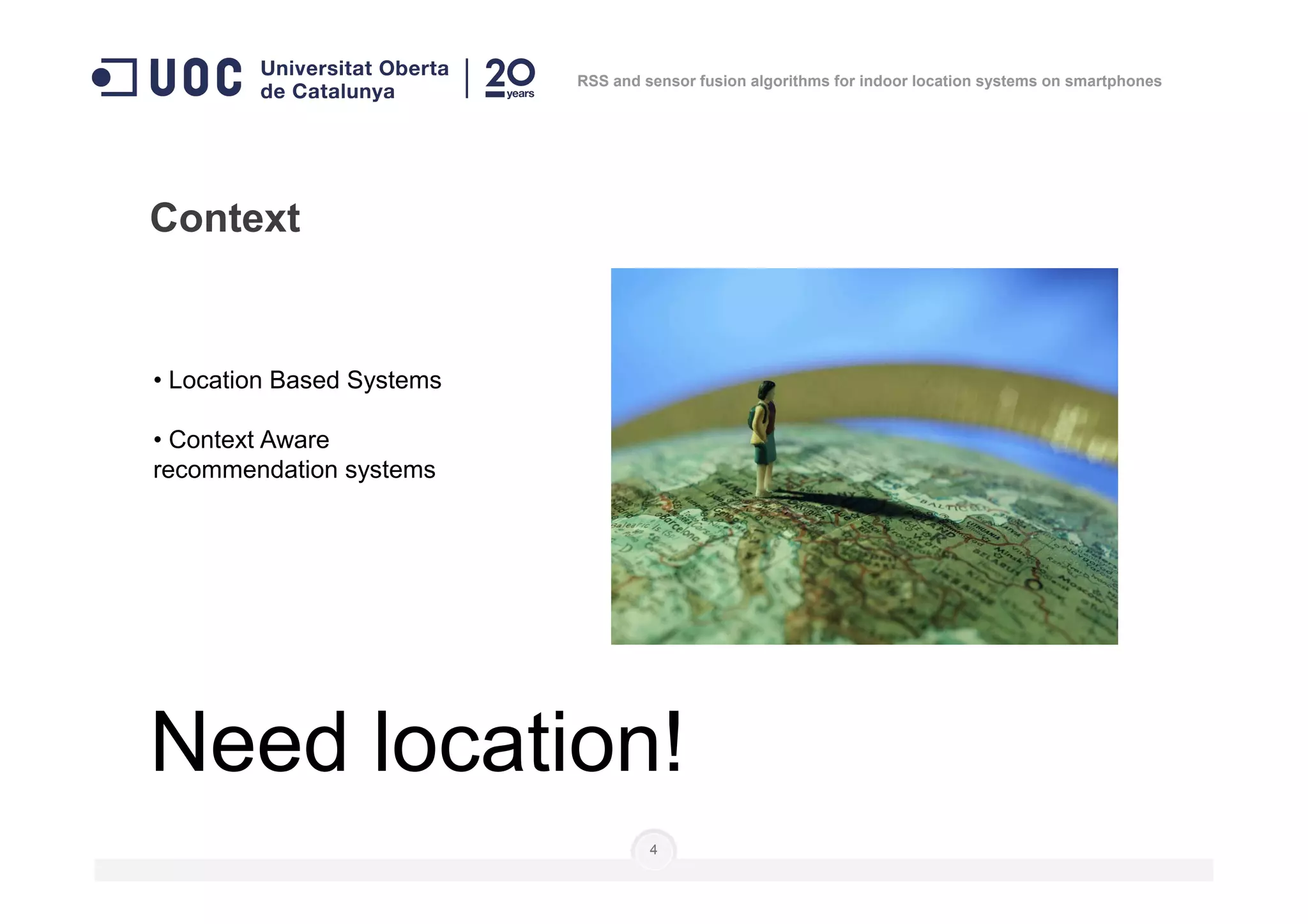
• Location Based Systems
• Context Aware
recommendation systems
Context
RSS and sensor fusion algorithms for indoor location systems on smartphones
recommendation systems
4
Need location!
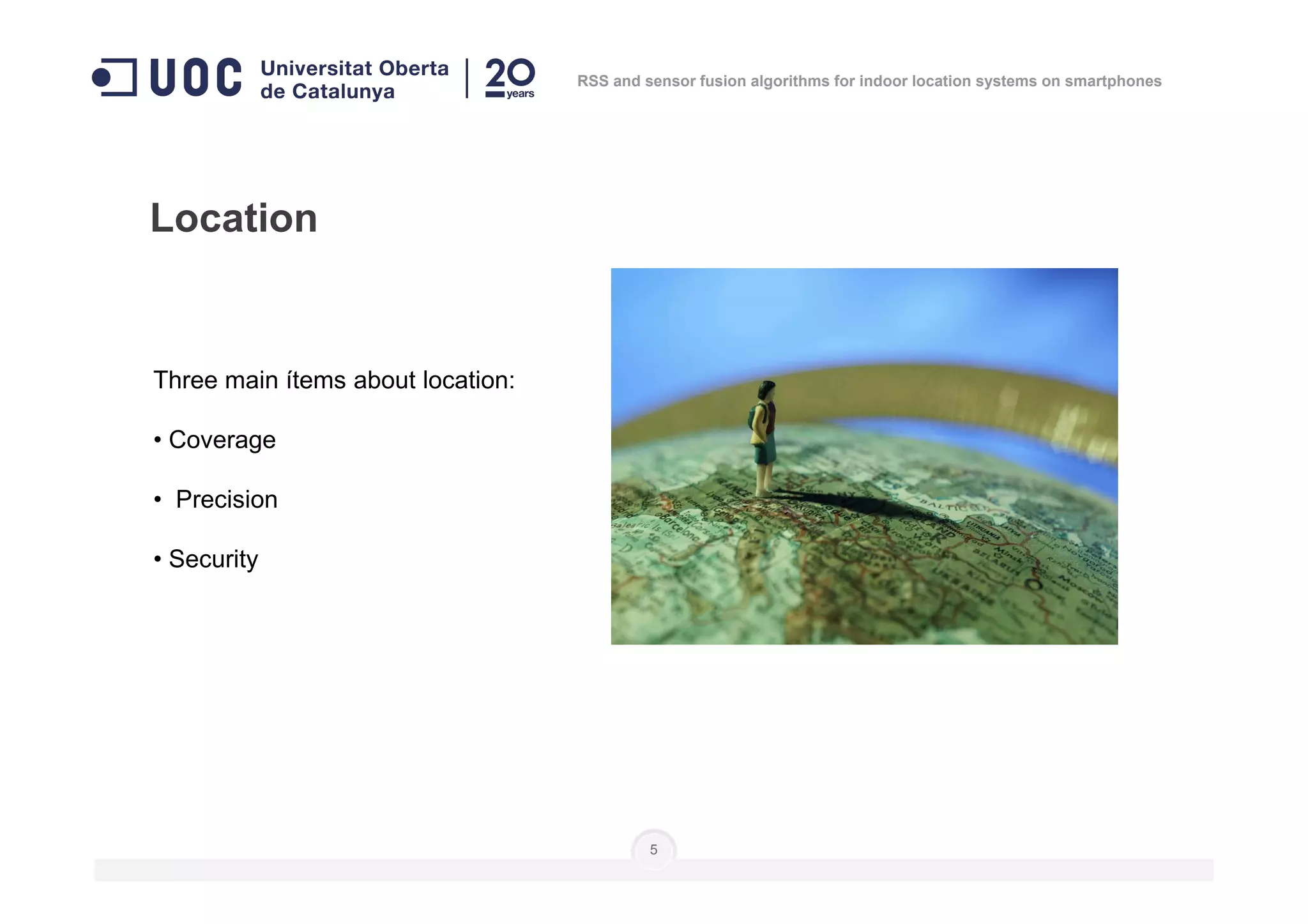
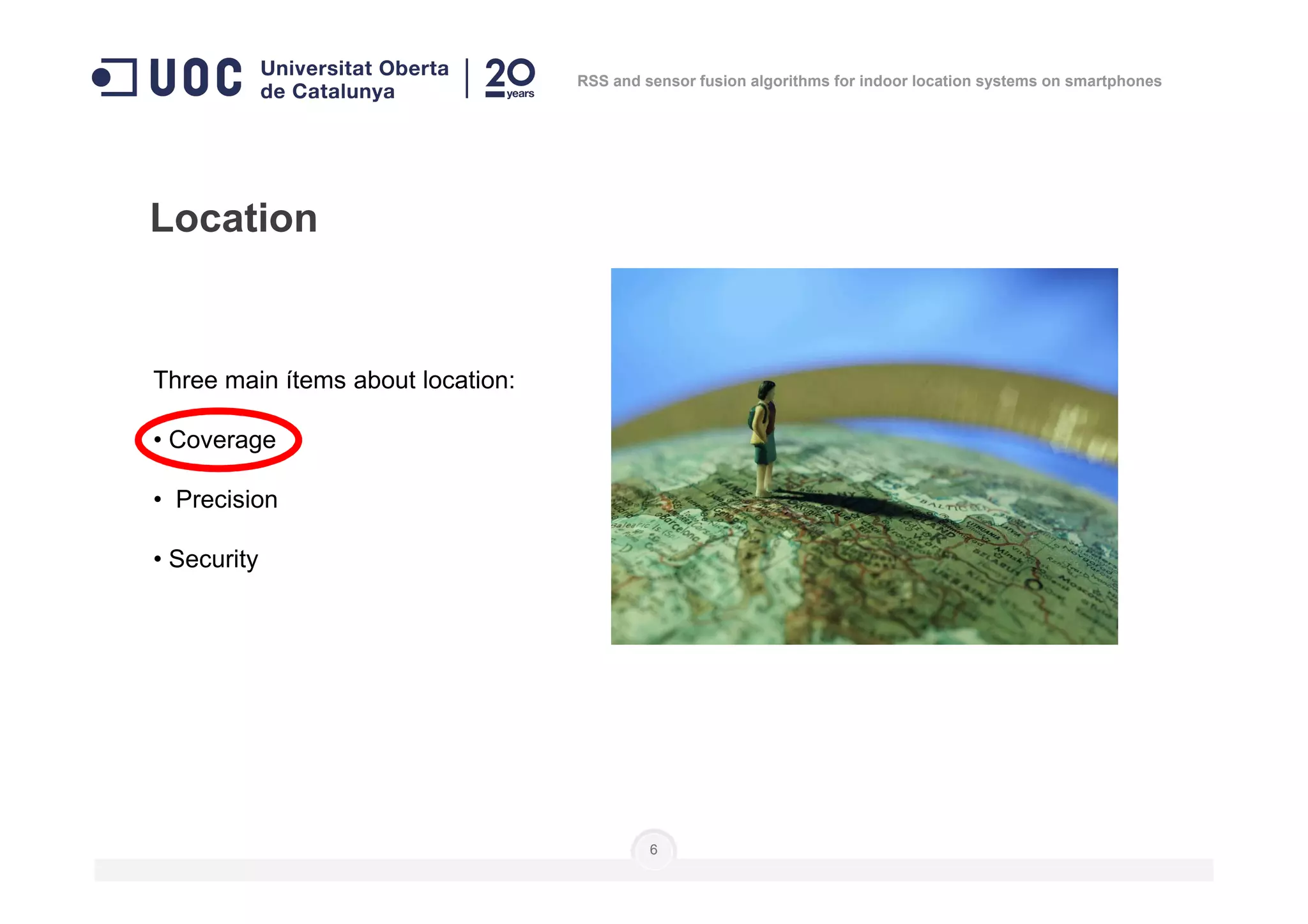
Three main ítems about location:
• Coverage
Location
RSS and sensor fusion algorithms for indoor location systems on smartphones
• Precision
• Security
5
Three main ítems about location:
• Coverage
Location
RSS and sensor fusion algorithms for indoor location systems on smartphones
• Precision
• Security
6
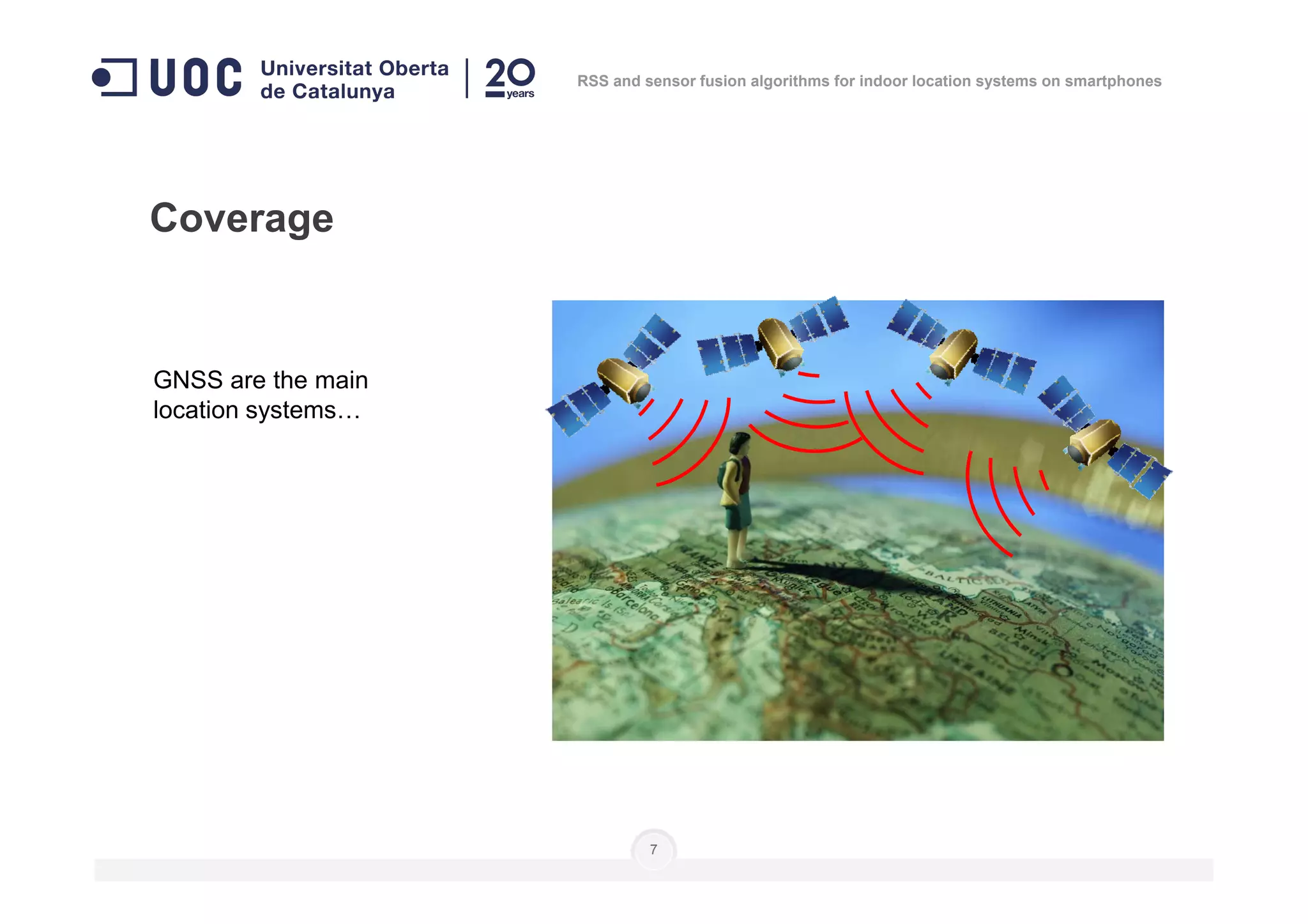
GNSS are the main
location systems…
Coverage
RSS and sensor fusion algorithms for indoor location systems on smartphones
7
GNSS are the main
location systems…
Coverage
RSS and sensor fusion algorithms for indoor location systems on smartphones
8
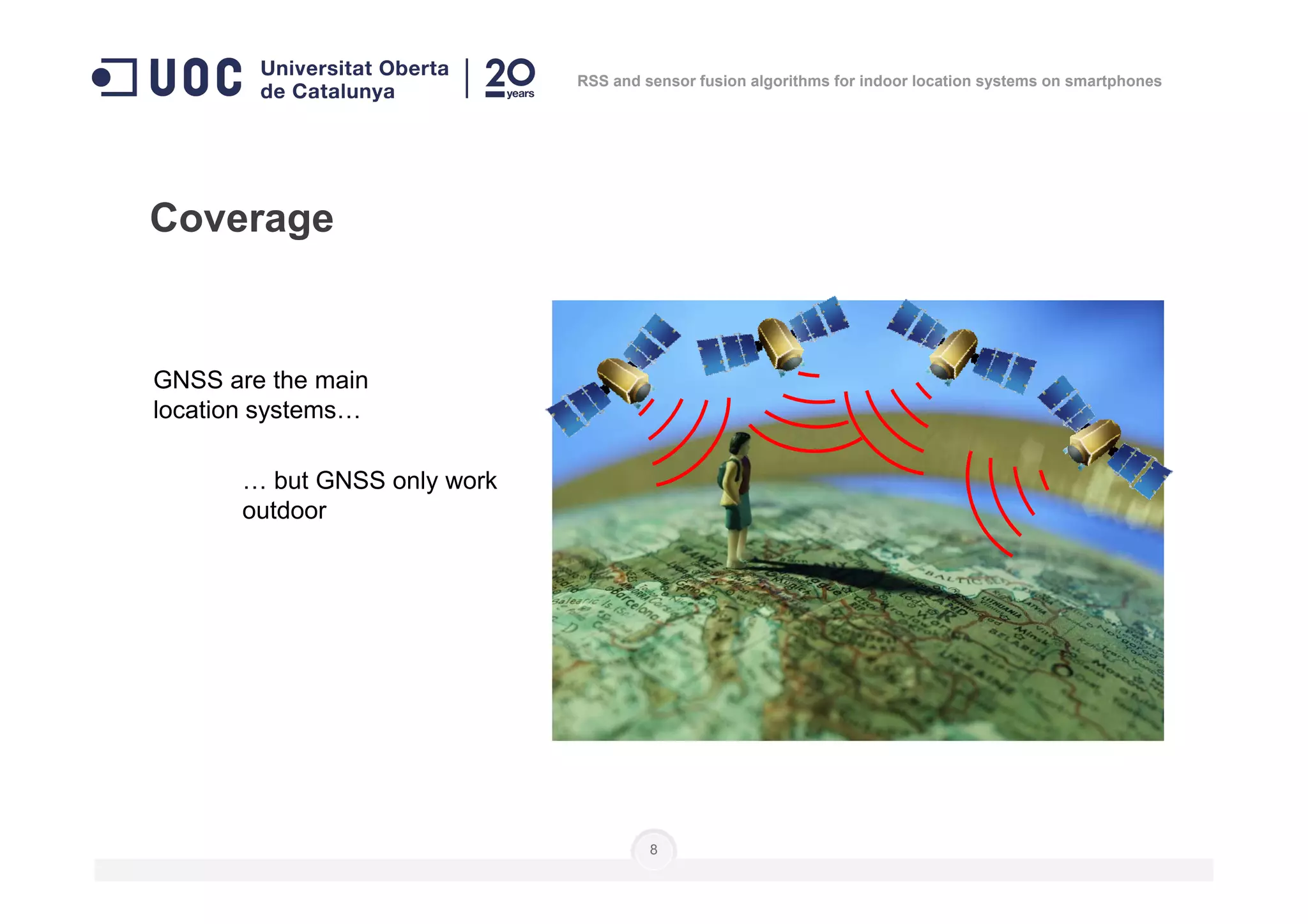
… but GNSS only work
outdoor
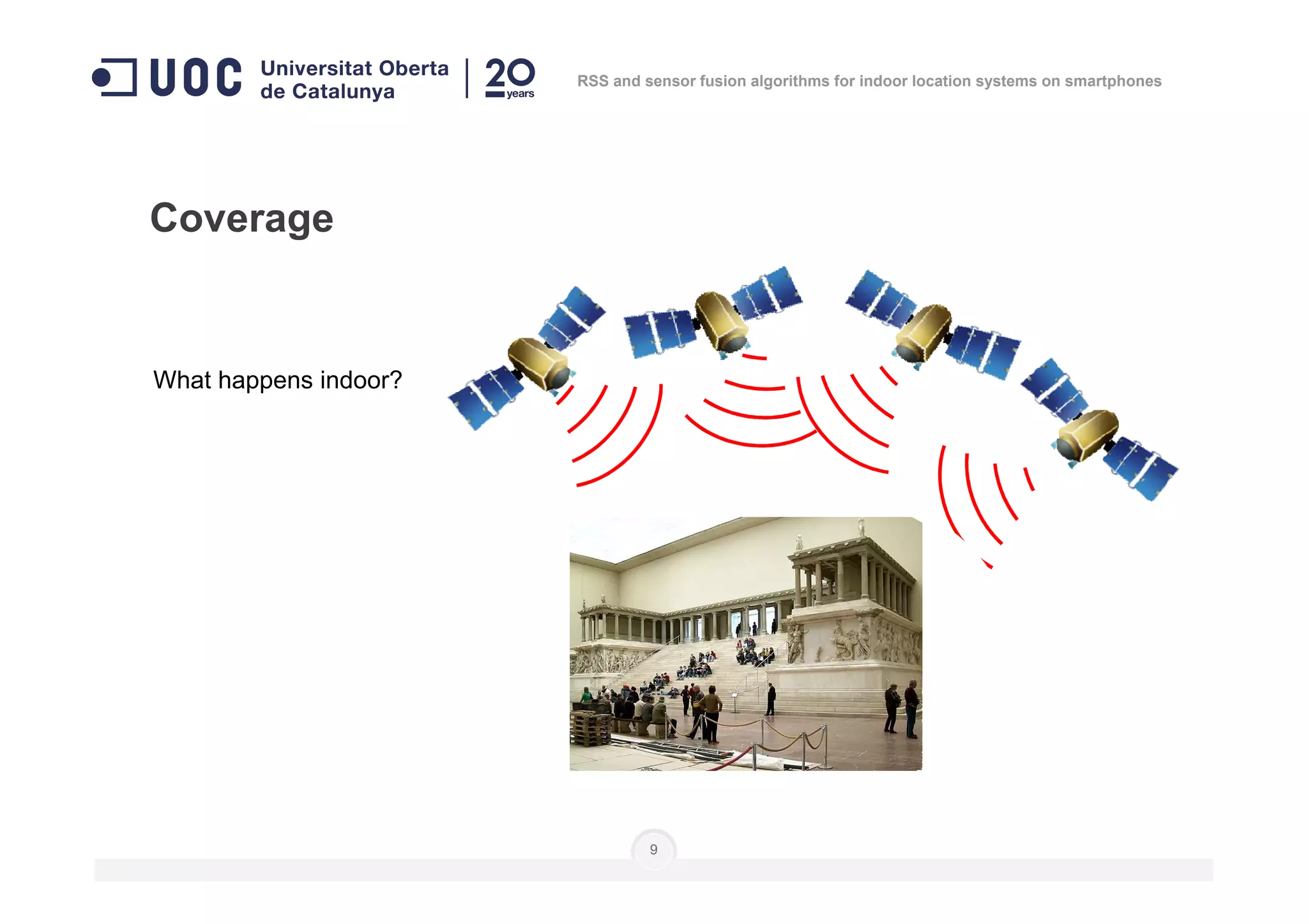
What happens indoor?
Coverage
RSS and sensor fusion algorithms for indoor location systems on smartphones
9
How can we get the position indoor?
Question
RSS and sensor fusion algorithms for indoor location systems on smartphones
10
•We only want to use infraestructures
already installed
• The pass from outdoor to indoor
Our restrictions
RSS and sensor fusion algorithms for indoor location systems on smartphones
• The pass from outdoor to indoor
environment should have to be
transparent to the user
• The positioning should have to be
performed with the smartphone
11
•We only want to use infraestructures already installed
• The pass from outdoor to indoor environment should have to be
transparent to the user
Our restrictions
RSS and sensor fusion algorithms for indoor location systems on smartphones
• The positioning should have to be
performed with the smartphone
• Without internet connection
• End user application
12
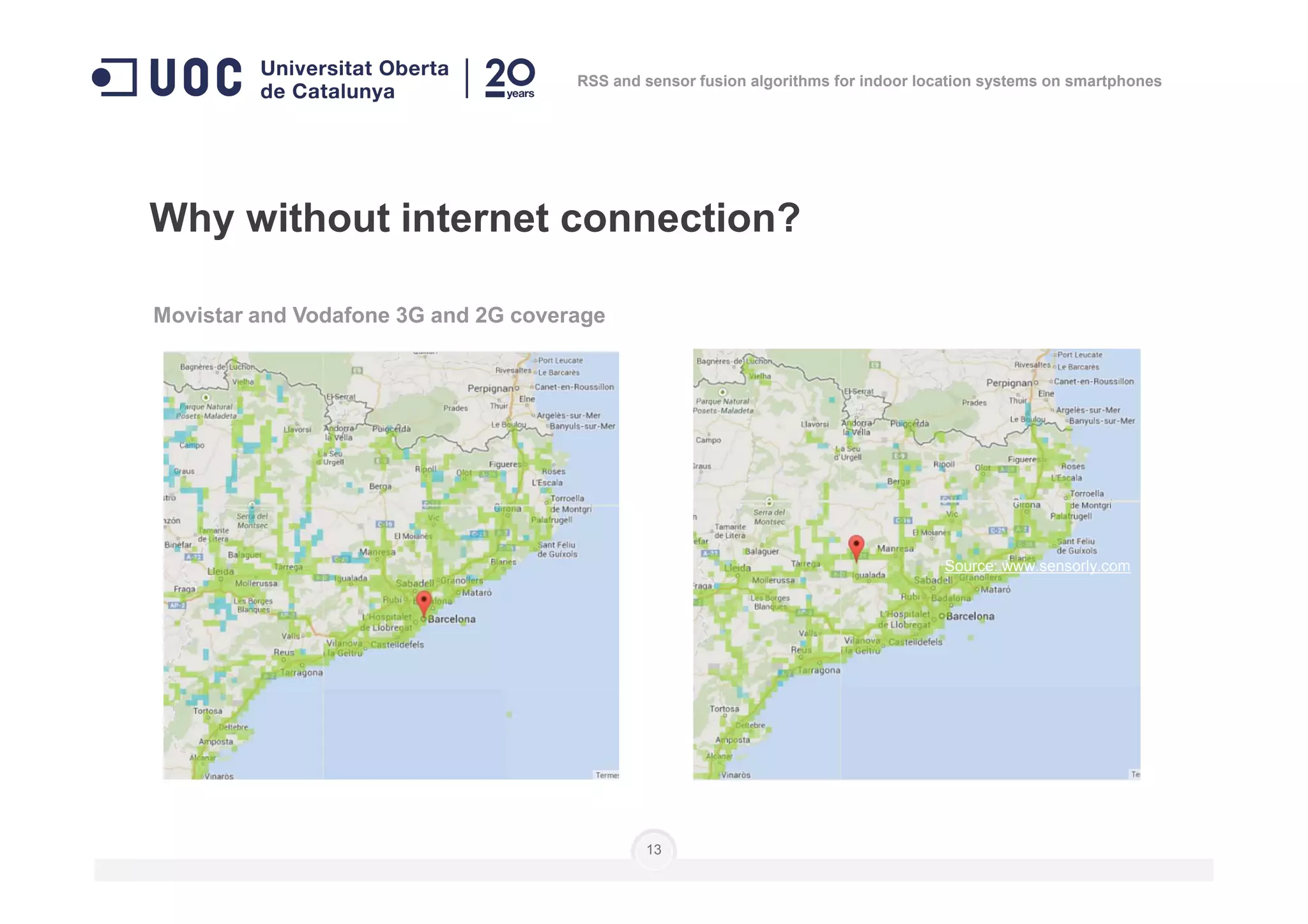
Movistar and Vodafone 3G and 2G coverage
Why without internet connection?
RSS and sensor fusion algorithms for indoor location systems on smartphones
13
Source: www.sensorly.com
•Fast enough to favor a satisfactory
user’s experience
• High precision
Why does “end user application means”?
RSS and sensor fusion algorithms for indoor location systems on smartphones
• High precision
• Robust
• Easy to use
14
1. Context
2. Indoor positioning
3. Wifi Fingerprinting
Index
RSS and sensor fusion algorithms for indoor location systems on smartphones
3. Wifi Fingerprinting
4. Sensor Fusion
5. Test
6. Conclusions and Future Work
15
RSS and sensor fusion algorithms for indoor location systems on smartphones
16
2. Indoor Positioning
• Markers
• Wireless systems
How to get indoor positioning?
RSS and sensor fusion algorithms for indoor location systems on smartphones
• Wireless systems
• Inertial systems
17
• Markers distributed within the
building (like QR codes).
• Easy and cheap to install
Markers
RSS and sensor fusion algorithms for indoor location systems on smartphones
• User and environment dependent
• Is not a true positioning system
18
• There are “beacons” distributed within
the building (WIFI, bluetooth, RFID)
• The position is calculated by triangulation
or any other positioning method
Wireless
RSS and sensor fusion algorithms for indoor location systems on smartphones
or any other positioning method
• Previous infraestructure should have to
be installed
• Users need a device with a sensor for
that kind of wave
19
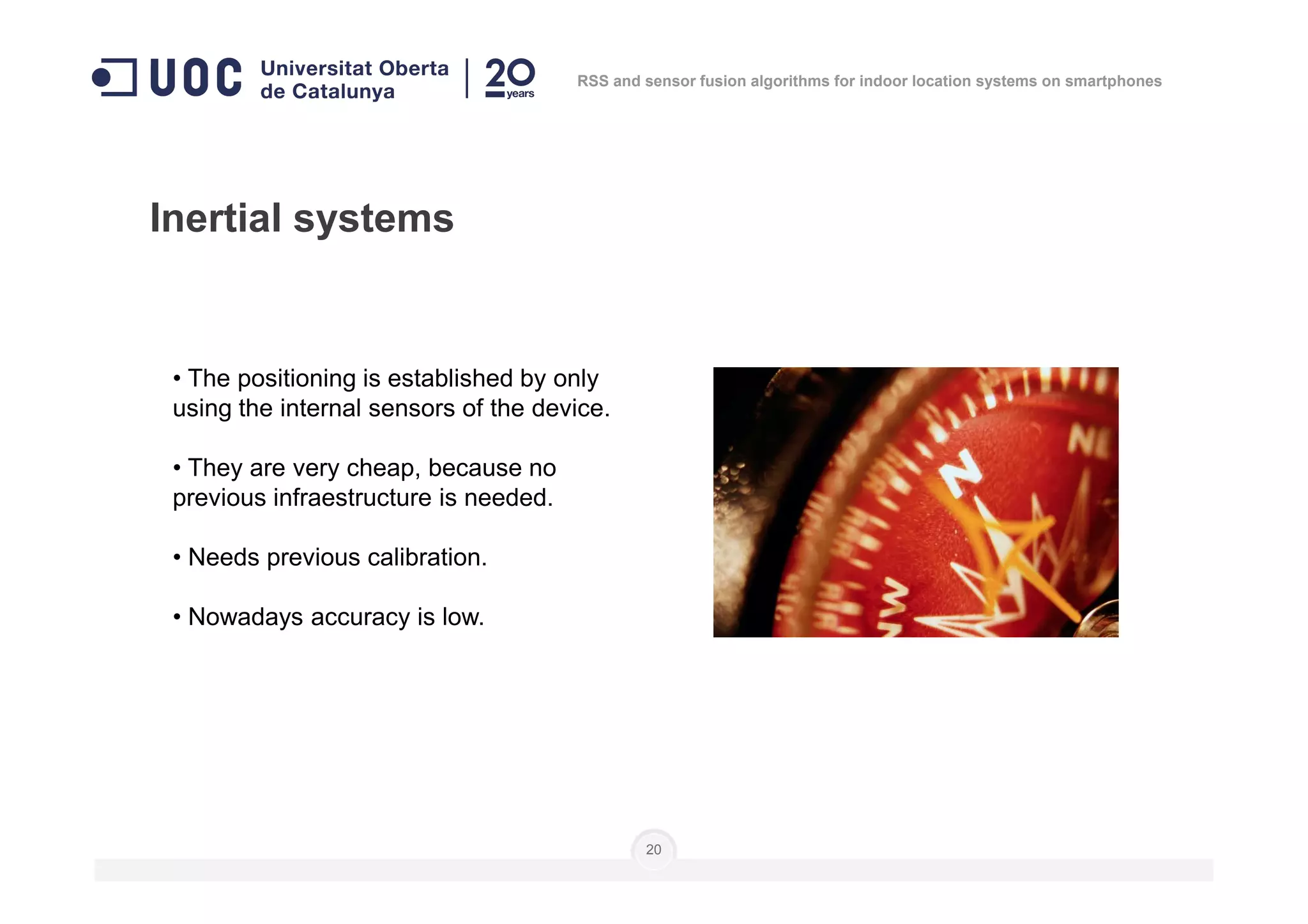
• The positioning is established by only
using the internal sensors of the device.
• They are very cheap, because no
Inertial systems
RSS and sensor fusion algorithms for indoor location systems on smartphones
• They are very cheap, because no
previous infraestructure is needed.
• Needs previous calibration.
• Nowadays accuracy is low.
20
• Markers
• Wireless systems
Our approach
RSS and sensor fusion algorithms for indoor location systems on smartphones
• Wireless systems
• Inertial systems
21
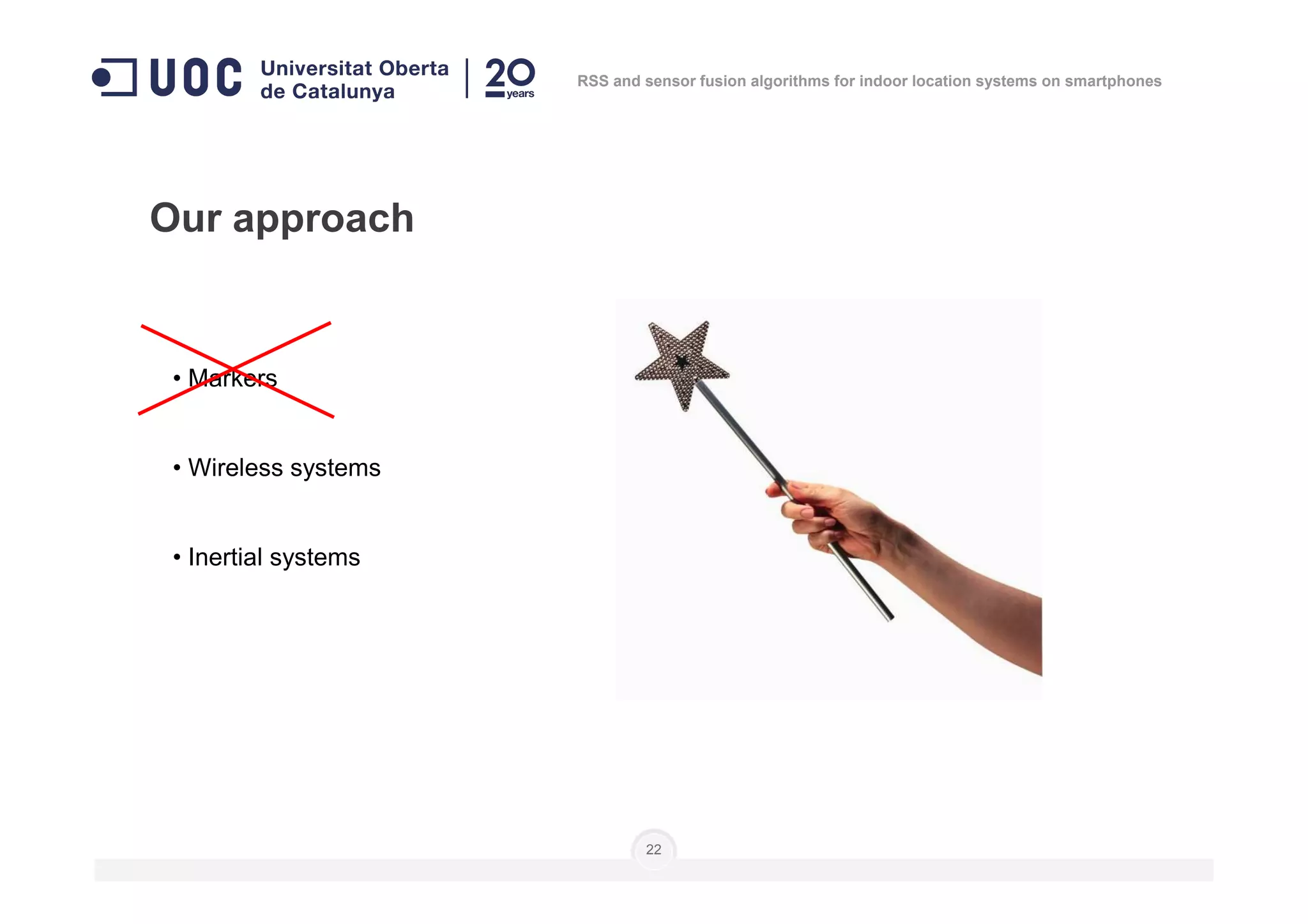
• Markers
• Wireless systems
Our approach
RSS and sensor fusion algorithms for indoor location systems on smartphones
• Wireless systems
• Inertial systems
22
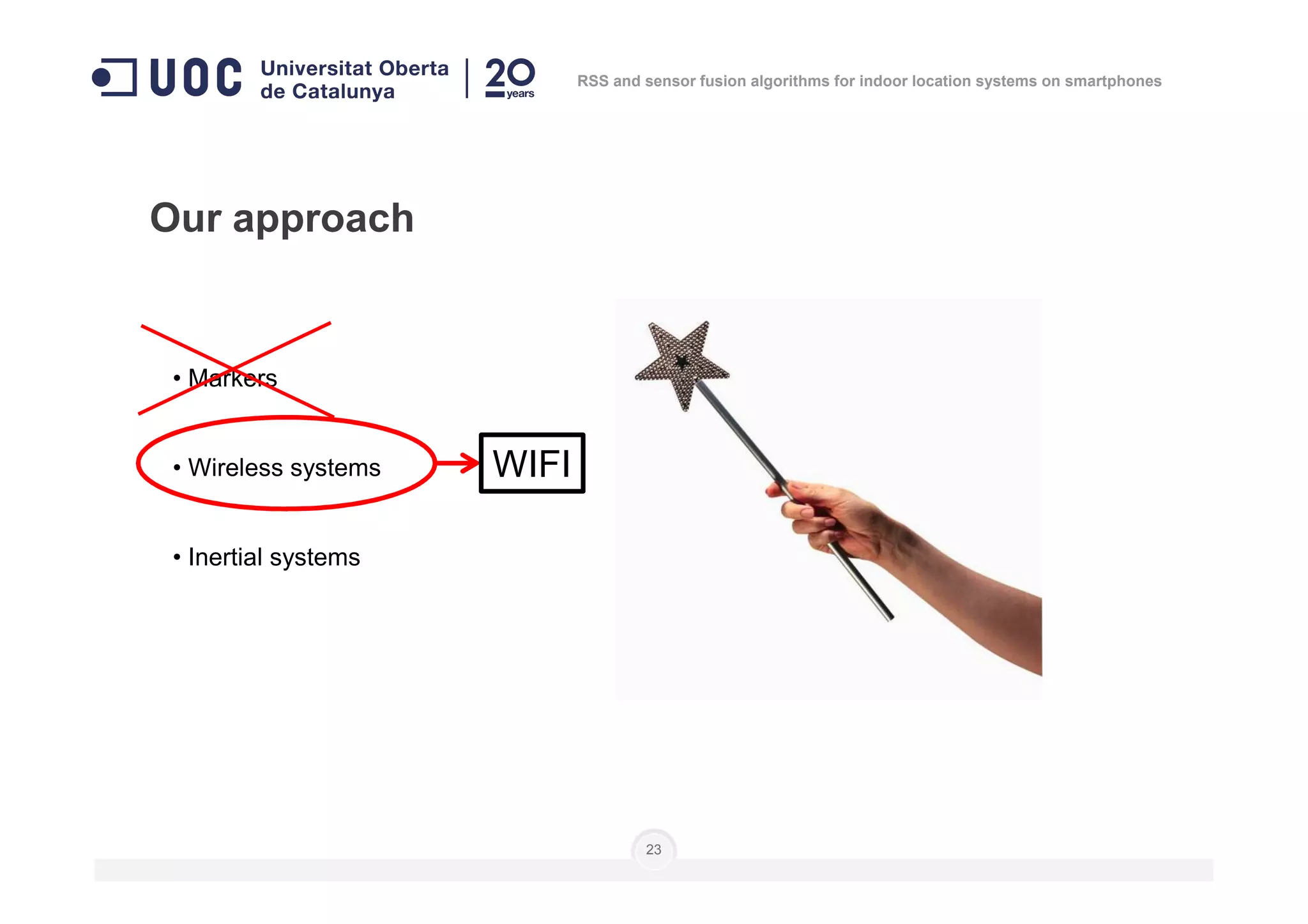
• Markers
• Wireless systems
Our approach
WIFI
RSS and sensor fusion algorithms for indoor location systems on smartphones
• Wireless systems
• Inertial systems
23
WIFI
• Markers
• Wireless systems
Our approach
WIFI
RSS and sensor fusion algorithms for indoor location systems on smartphones
• Wireless systems
• Inertial systems
24
WIFI
1. Context
2. Indoor positioning
3. Wifi Fingerprinting
Index
RSS and sensor fusion algorithms for indoor location systems on smartphones
3. Wifi Fingerprinting
4. Sensor Fusion
5. Test
6. Conclusions and Future Work
25
RSS and sensor fusion algorithms for indoor location systems on smartphones
26
3. Wifi Fingerprinting
• Calibration
RSS Fingerprinting
RSS and sensor fusion algorithms for indoor location systems on smartphones
• Positioning
27
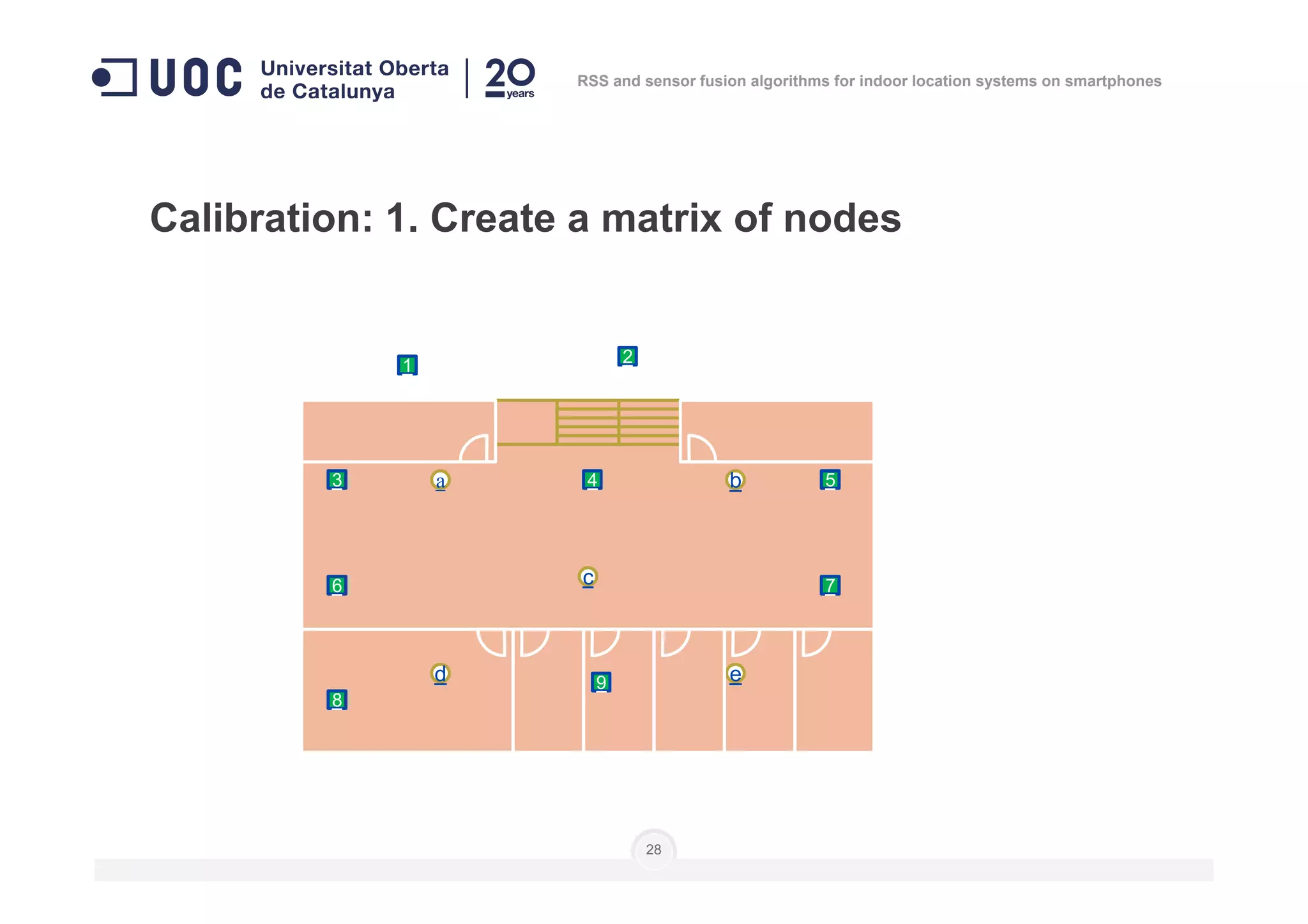
Calibration: 1. Create a matrix of nodes
1 2
RSS and sensor fusion algorithms for indoor location systems on smartphones
28
c
a
d
b
e
5
7
43
6
9
8
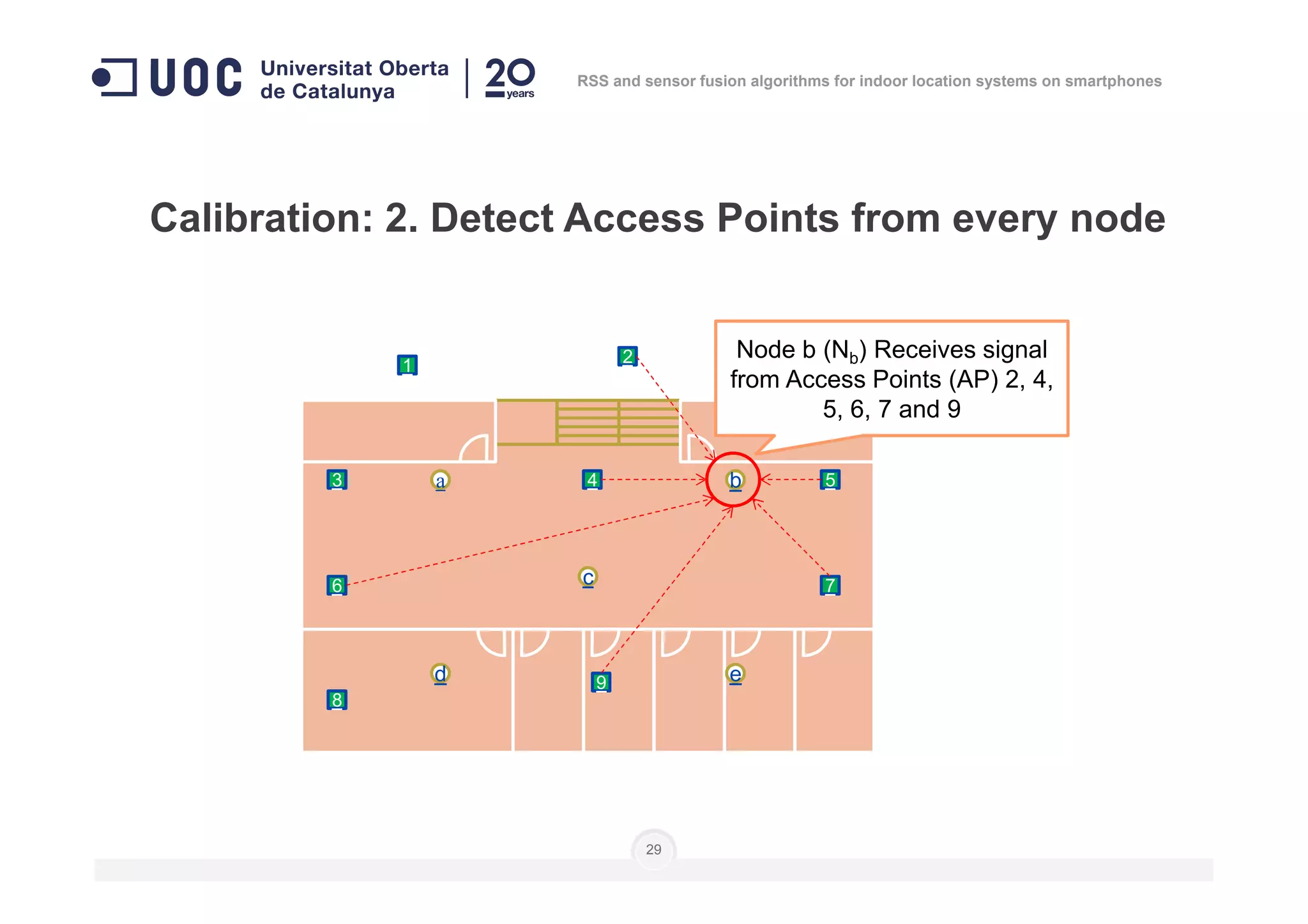
Calibration: 2. Detect Access Points from every node
1 2 Node b (Nb) Receives signal
from Access Points (AP) 2, 4,
5, 6, 7 and 9
RSS and sensor fusion algorithms for indoor location systems on smartphones
29
5
7
43
6
9
8
c
a
d
b
e
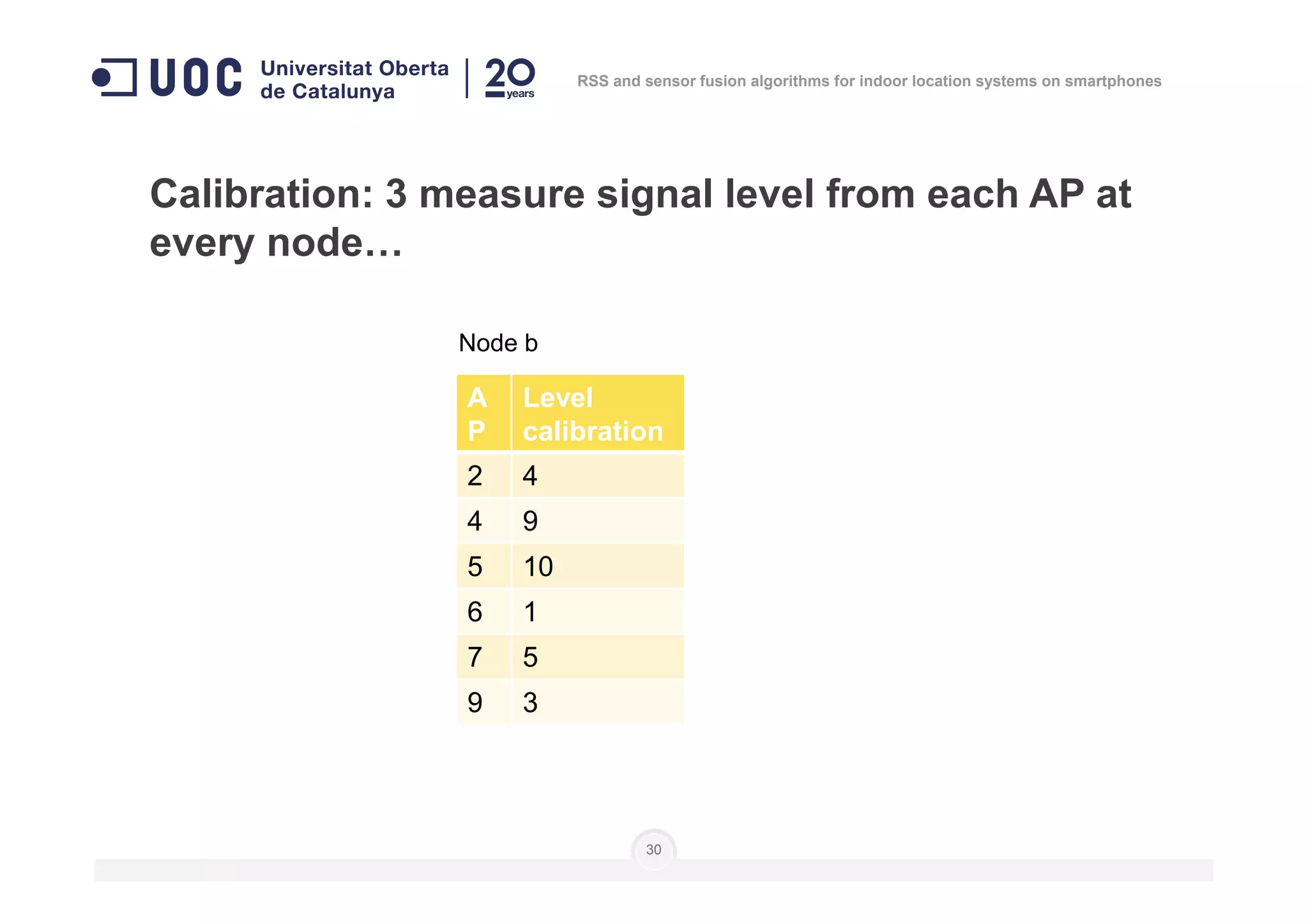
Calibration: 3 measure signal level from each AP at
every node…
Node b
A
P
Level
calibration
2 4
RSS and sensor fusion algorithms for indoor location systems on smartphones
30
2 4
4 9
5 10
6 1
7 5
9 3
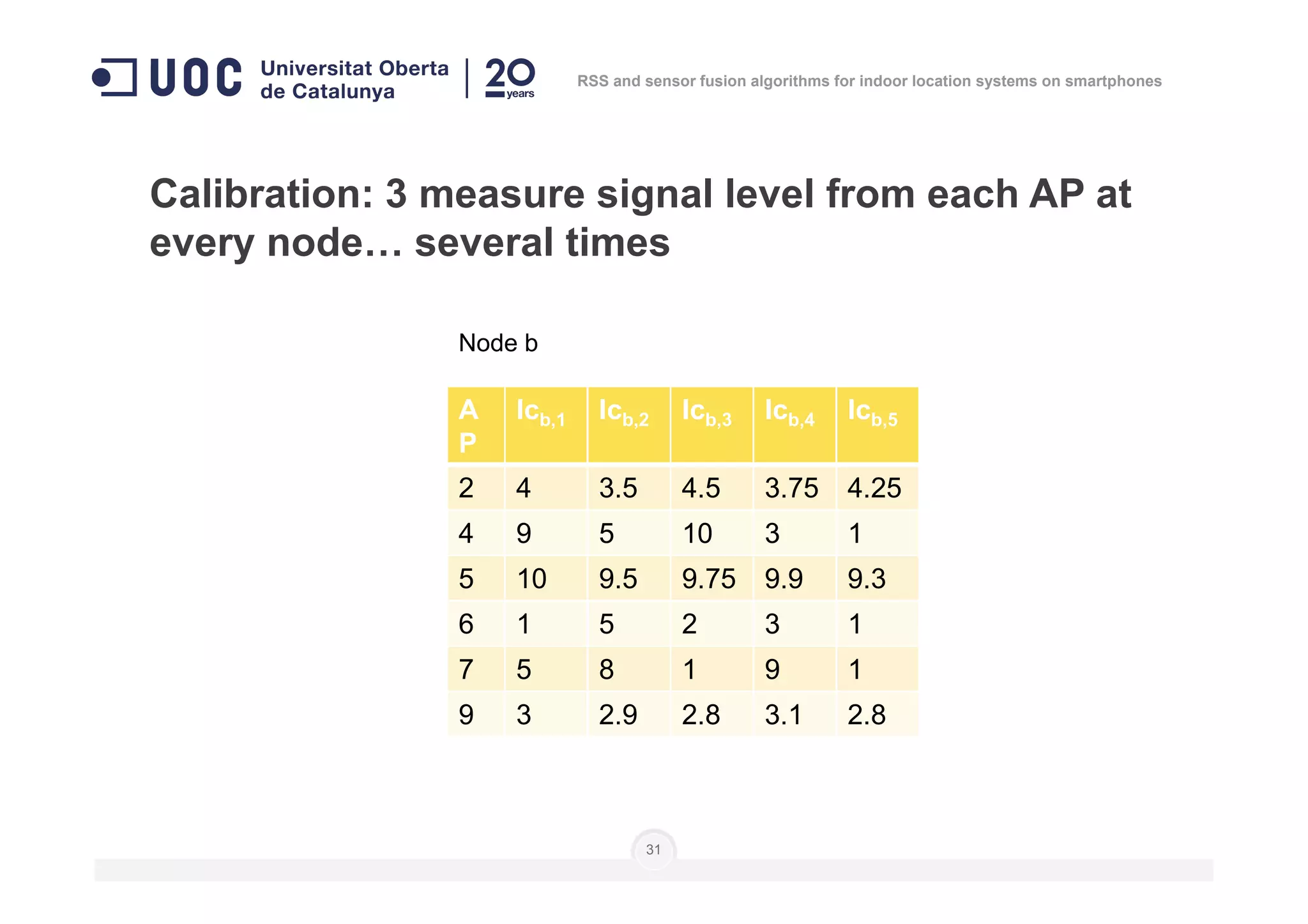
Calibration: 3 measure signal level from each AP at
every node… several times
Node b
A
P
lcb,1 lcb,2 lcb,3 lcb,4 lcb,5
RSS and sensor fusion algorithms for indoor location systems on smartphones
31
2 4 3.5 4.5 3.75 4.25
4 9 5 10 3 1
5 10 9.5 9.75 9.9 9.3
6 1 5 2 3 1
7 5 8 1 9 1
9 3 2.9 2.8 3.1 2.8
Calibration: 3 measure signal level from each AP at
every node… several times
]],...,[],...,,...,[],...,,...,[[)( 111 nnn
i lclclclclclcnN =
Number of
measures
Level of
calibration
RSS and sensor fusion algorithms for indoor location systems on smartphones
32
]],...,[],...,,...,[],...,,...,[[)( ,,,,1,1,i kikijijiii
lclclclclclcnN =
Node
identifier
AP
identifier
AP
measured
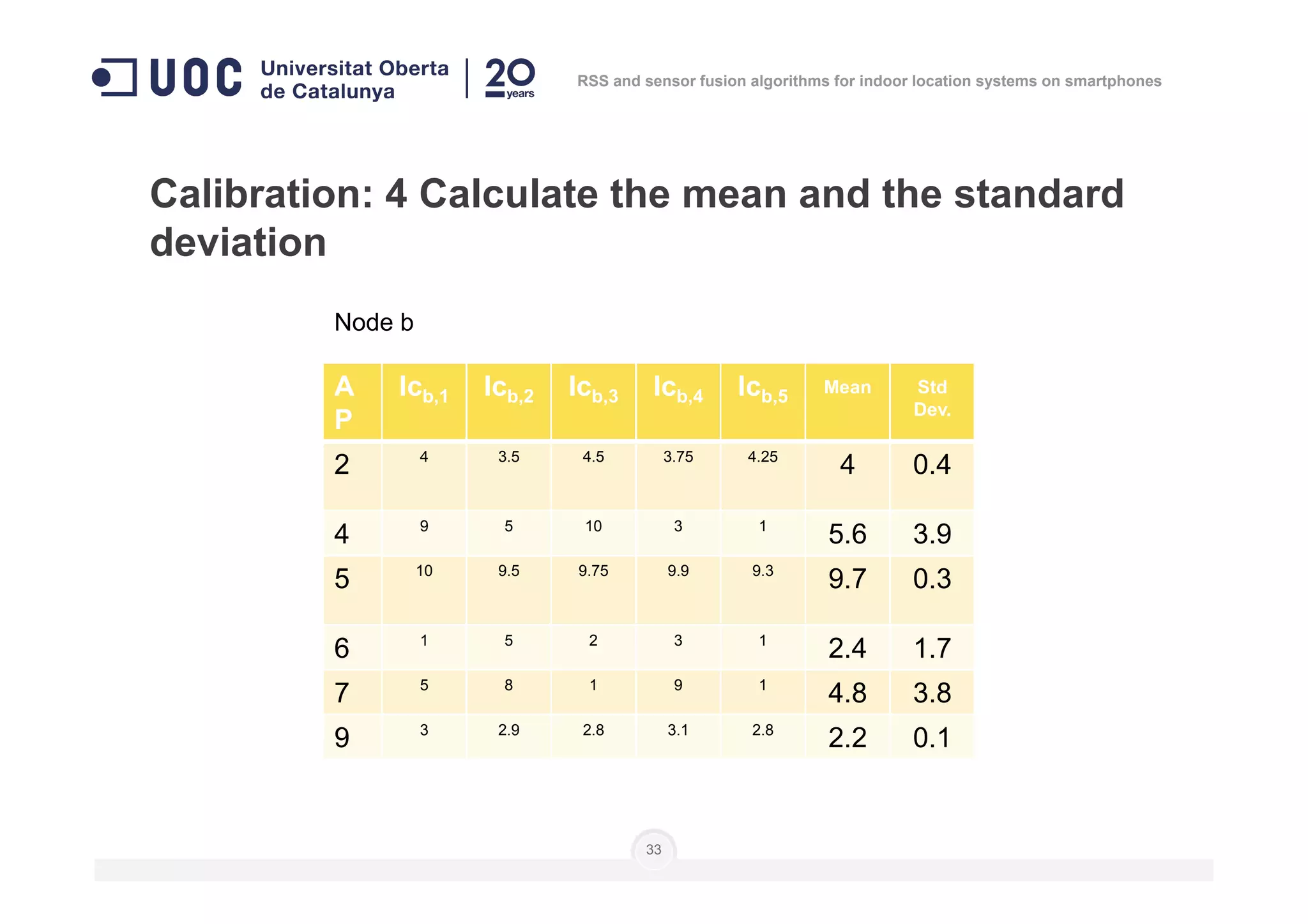
Calibration: 4 Calculate the mean and the standard
deviation
Node b
A
P
lcb,1 lcb,2 lcb,3 lcb,4 lcb,5 Mean Std
Dev.
2 4 3.5 4.5 3.75 4.25
4 0.4
RSS and sensor fusion algorithms for indoor location systems on smartphones
33
2 4 3.5 4.5 3.75 4.25
4 0.4
4 9 5 10 3 1
5.6 3.9
5 10 9.5 9.75 9.9 9.3
9.7 0.3
6 1 5 2 3 1
2.4 1.7
7 5 8 1 9 1
4.8 3.8
9 3 2.9 2.8 3.1 2.8
2.2 0.1
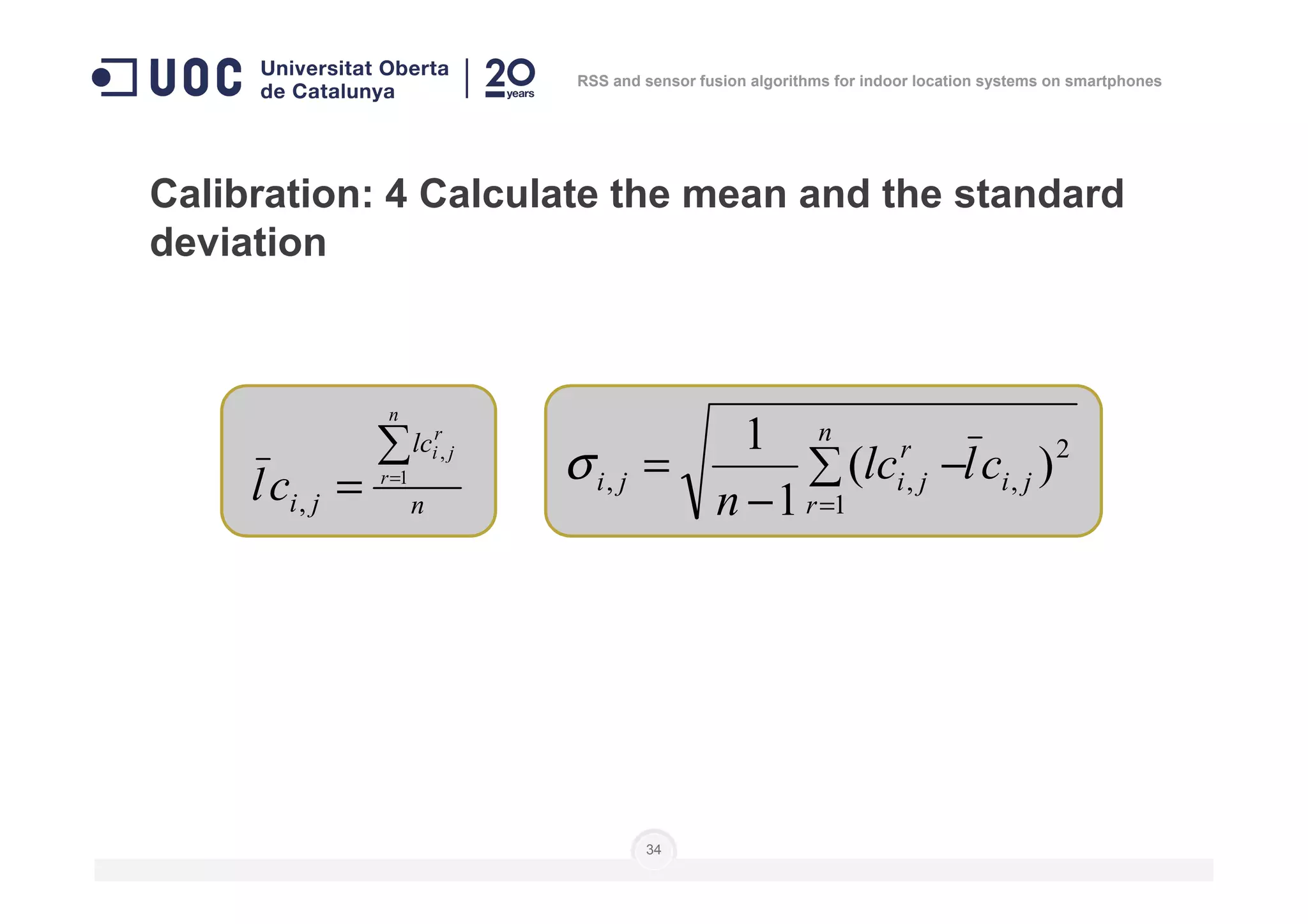
Calibration: 4 Calculate the mean and the standard
deviation
lc
n
r
ji
cl
∑
=
, 2
)(
1 n
r
cllc∑ −=σ
RSS and sensor fusion algorithms for indoor location systems on smartphones
34
nji
r
ji
cl
∑
= =1
,
,
2
,
1
,, )(
1
ji
r
r
jiji cllc
n
∑ −
−
=
=
σ
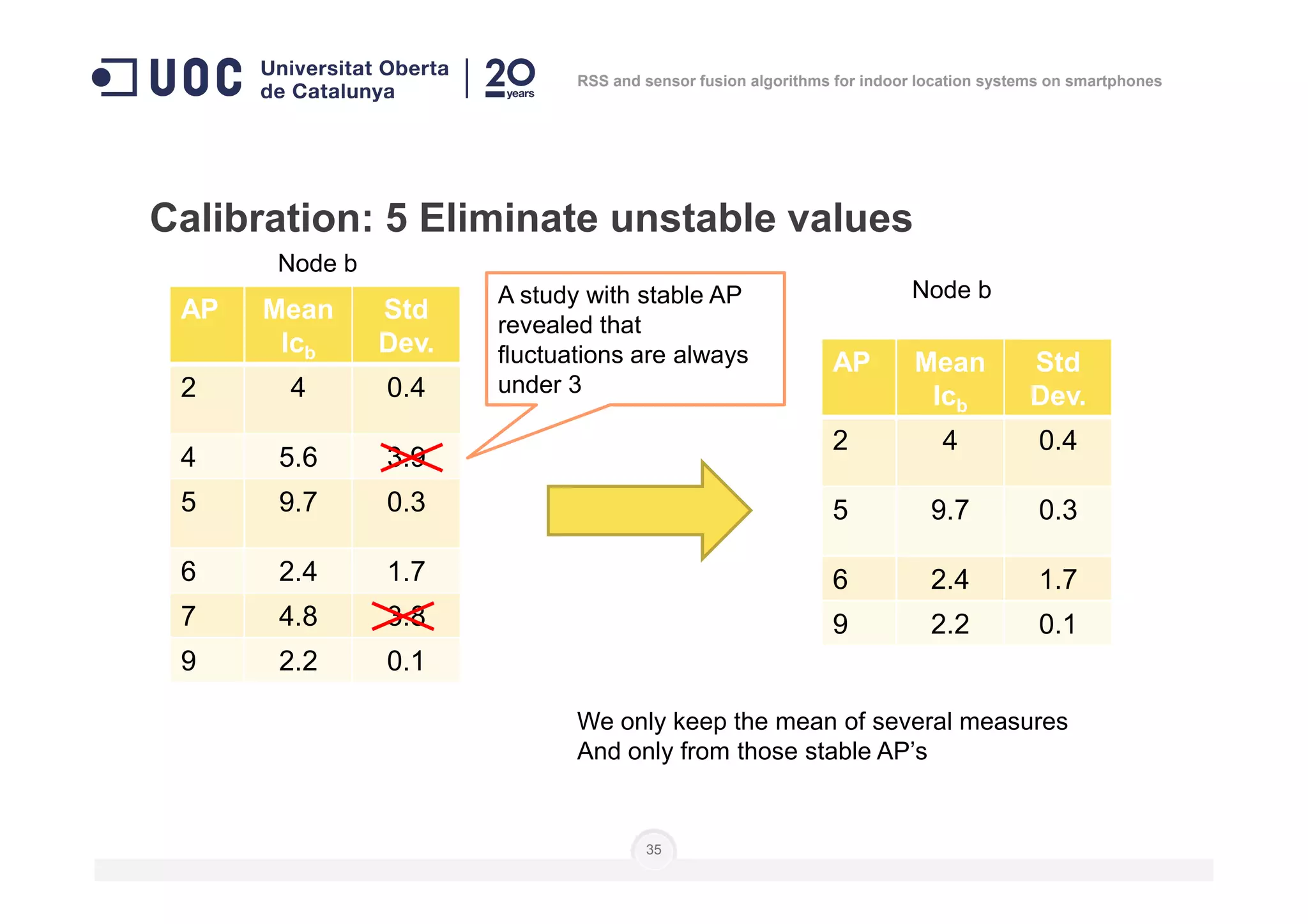
Calibration: 5 Eliminate unstable values
Node b
AP Mean
lcb
Std
Dev.
2 4 0.4
4 5.6 3.9
A study with stable AP
revealed that
fluctuations are always
under 3
AP Mean
lcb
Std
Dev.
2 4 0.4
Node b
RSS and sensor fusion algorithms for indoor location systems on smartphones
35
4 5.6 3.9
5 9.7 0.3
6 2.4 1.7
7 4.8 3.8
9 2.2 0.1
We only keep the mean of several measures
And only from those stable AP’s
5 9.7 0.3
6 2.4 1.7
9 2.2 0.1
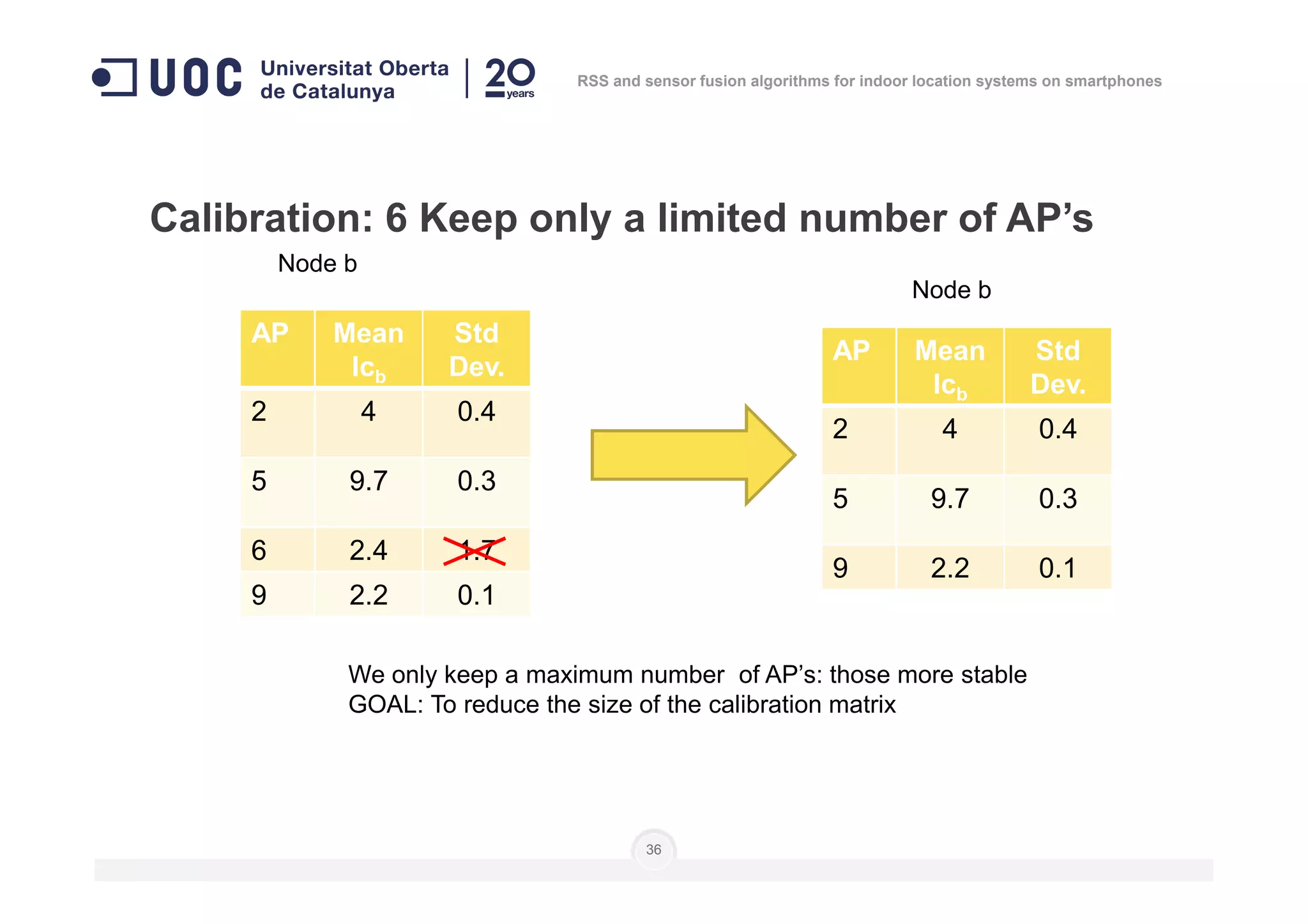
Calibration: 6 Keep only a limited number of AP’s
Node b
Node b
AP Mean
lcb
Std
Dev.
2 4 0.4
AP Mean
lcb
Std
Dev.
2 4 0.4
RSS and sensor fusion algorithms for indoor location systems on smartphones
36
We only keep a maximum number of AP’s: those more stable
GOAL: To reduce the size of the calibration matrix
5 9.7 0.3
6 2.4 1.7
9 2.2 0.1
5 9.7 0.3
9 2.2 0.1
Calibration Matrix
],0(;],0(_ kjsiclmatrixCal ∈∈=
RSS and sensor fusion algorithms for indoor location systems on smartphones
37
],0(;],0(_ , kjsiclmatrixCal ji ∈∈=
Calibration 7 Build the calibration matrix
Repeating the process calibration 1-6 for every node of the
calibration map, the calibration matrix is build
• Each node i has a maximum of k nodes associated.
RSS and sensor fusion algorithms for indoor location systems on smartphones
38
• Each node i has a maximum of kmax nodes associated.
• Every single node can detect different AP, so kmax is not the matrix
dimension
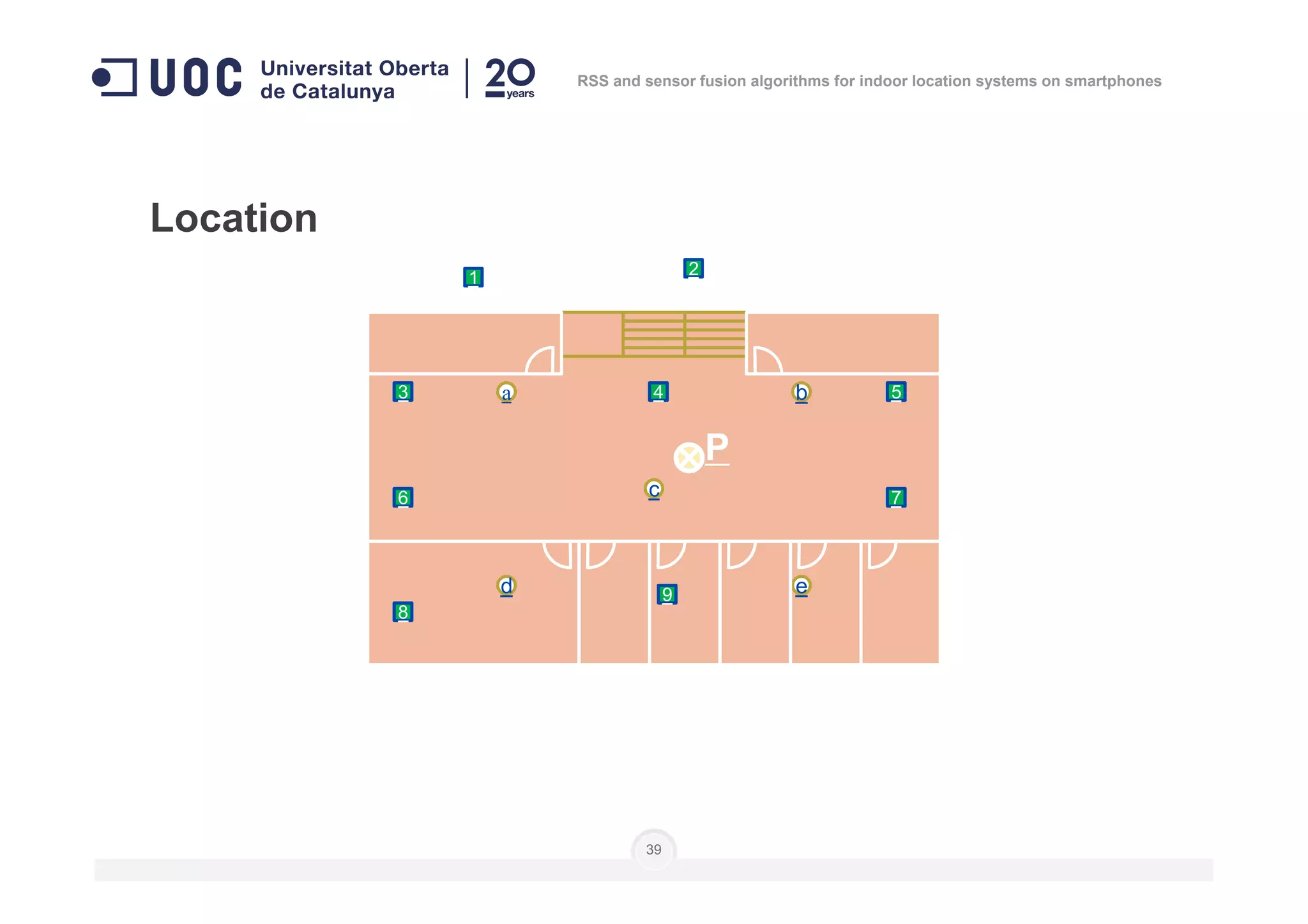
Location
a b 543
1 2
P
RSS and sensor fusion algorithms for indoor location systems on smartphones
39
c
d e
76
9
8
P
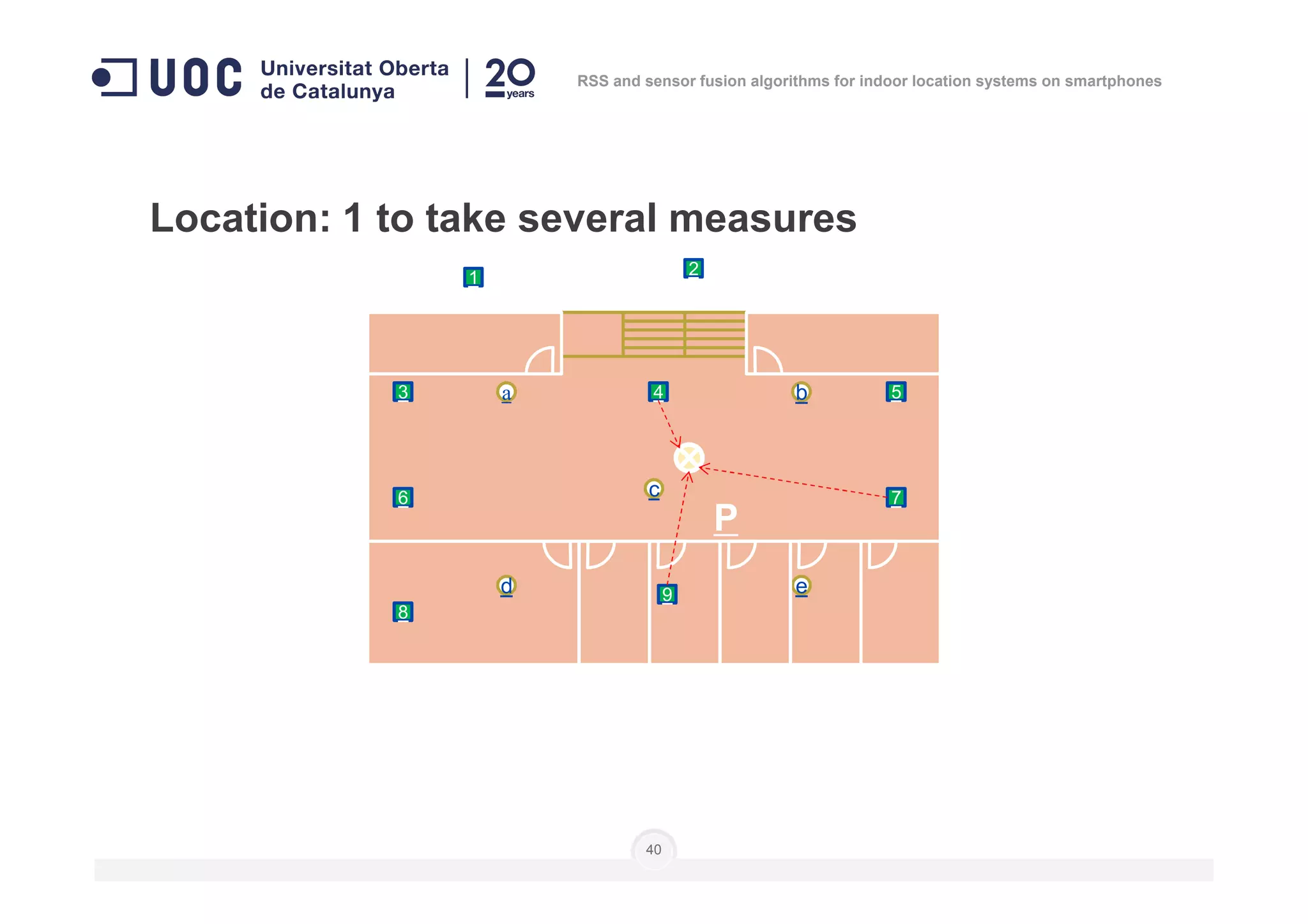
Location: 1 to take several measures
a b 543
1 2
RSS and sensor fusion algorithms for indoor location systems on smartphones
40
c
d e
76
9
8
P
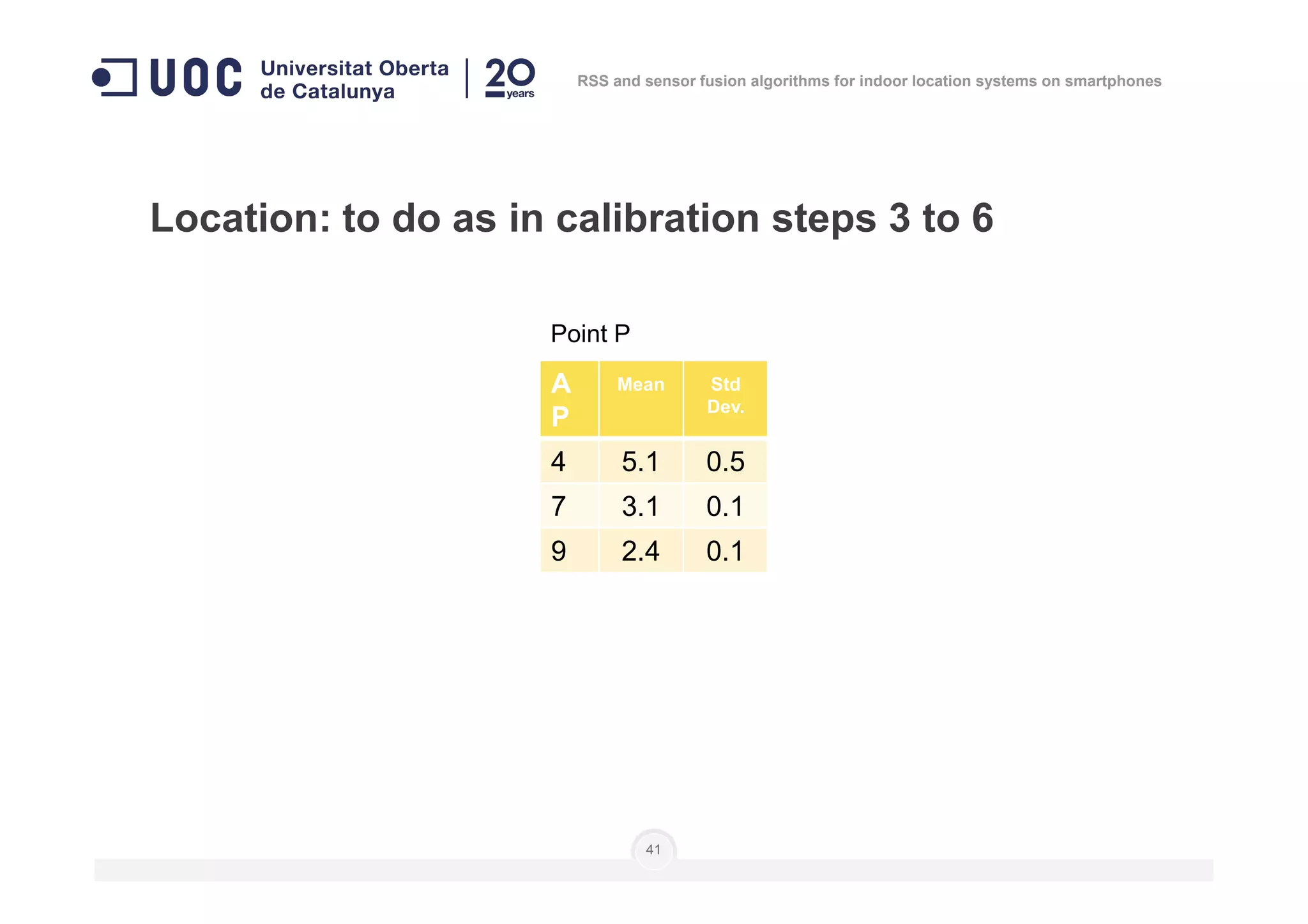
Location: to do as in calibration steps 3 to 6
Point P
A
P
Mean Std
Dev.
4 5.1 0.5
RSS and sensor fusion algorithms for indoor location systems on smartphones
41
4 5.1 0.5
7 3.1 0.1
9 2.4 0.1
Location: to do as in calibration steps 3 to 6
]],...,[],...,,...,[],...,,...,[[)( 111 nnn
lplplplplplpnP =
Number of
measures
Level of
position
RSS and sensor fusion algorithms for indoor location systems on smartphones
42
]],...,[],...,,...,[],...,,...,[[)( ,,,,1,1, mimijijiii
lplplplplplpnP =
Node
identifier
AP
identifier
AP
measured
(≠ k)
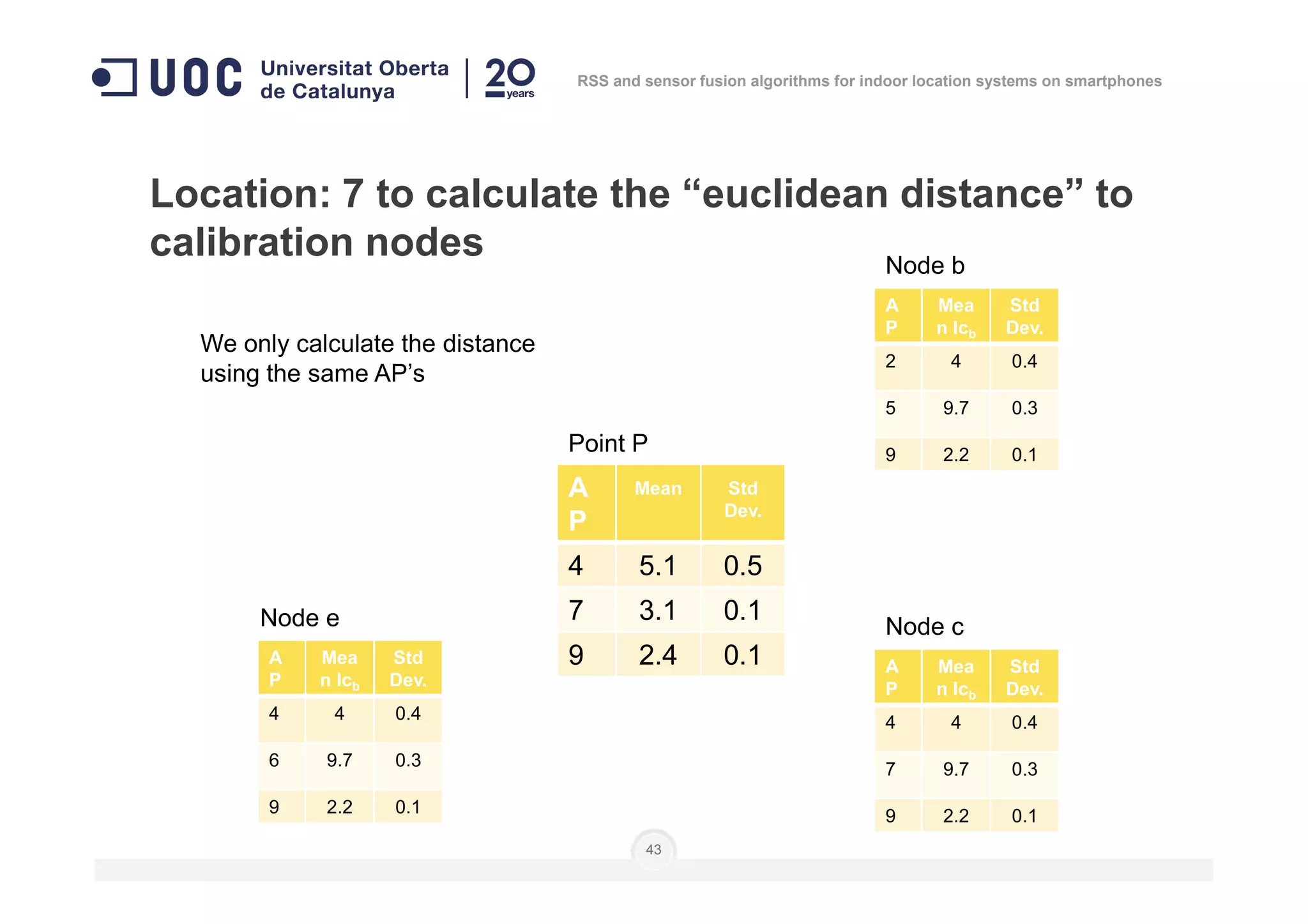
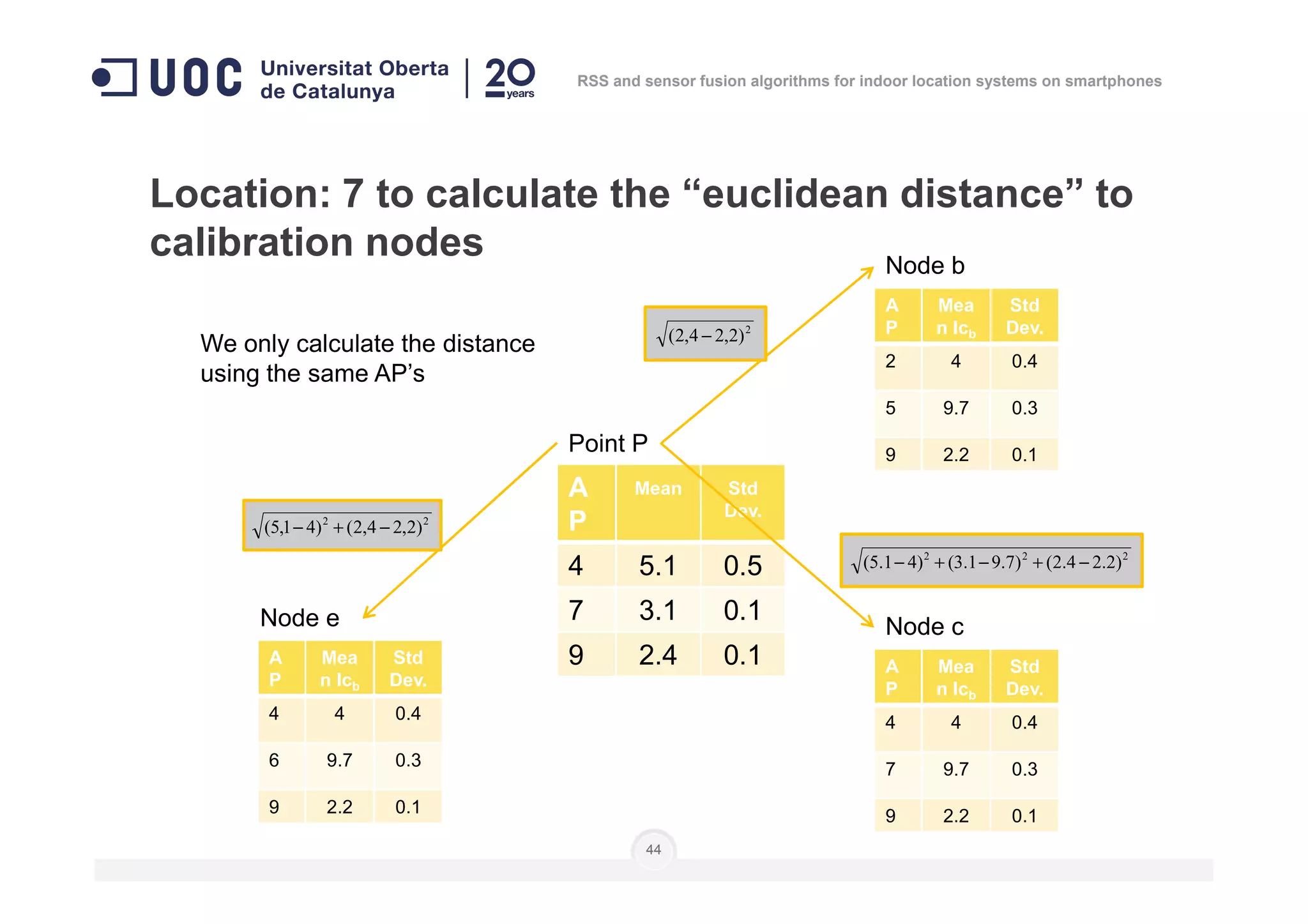
Location: 7 to calculate the “euclidean distance” to
calibration nodes
We only calculate the distance
using the same AP’s
A
P
Mea
n lcb
Std
Dev.
2 4 0.4
5 9.7 0.3
9 2.2 0.1
Node b
Point P
RSS and sensor fusion algorithms for indoor location systems on smartphones
43
A
P
Mean Std
Dev.
4 5.1 0.5
7 3.1 0.1
9 2.4 0.1
9 2.2 0.1
A
P
Mea
n lcb
Std
Dev.
4 4 0.4
7 9.7 0.3
9 2.2 0.1
Node c
A
P
Mea
n lcb
Std
Dev.
4 4 0.4
6 9.7 0.3
9 2.2 0.1
Node e
Location: 7 to calculate the “euclidean distance” to
calibration nodes
Point P
A
P
Mea
n lcb
Std
Dev.
2 4 0.4
5 9.7 0.3
9 2.2 0.1
Node b
2
)2,24,2( −
We only calculate the distance
using the same AP’s
RSS and sensor fusion algorithms for indoor location systems on smartphones
44
A
P
Mean Std
Dev.
4 5.1 0.5
7 3.1 0.1
9 2.4 0.1
9 2.2 0.1
A
P
Mea
n lcb
Std
Dev.
4 4 0.4
7 9.7 0.3
9 2.2 0.1
Node c
A
P
Mea
n lcb
Std
Dev.
4 4 0.4
6 9.7 0.3
9 2.2 0.1
Node e
22
)2,24,2()41,5( −+−
222
)2.24.2()7.91.3()41.5( −+−+−
Location: 7 to calculate the “euclidean distance” to
calibration nodes
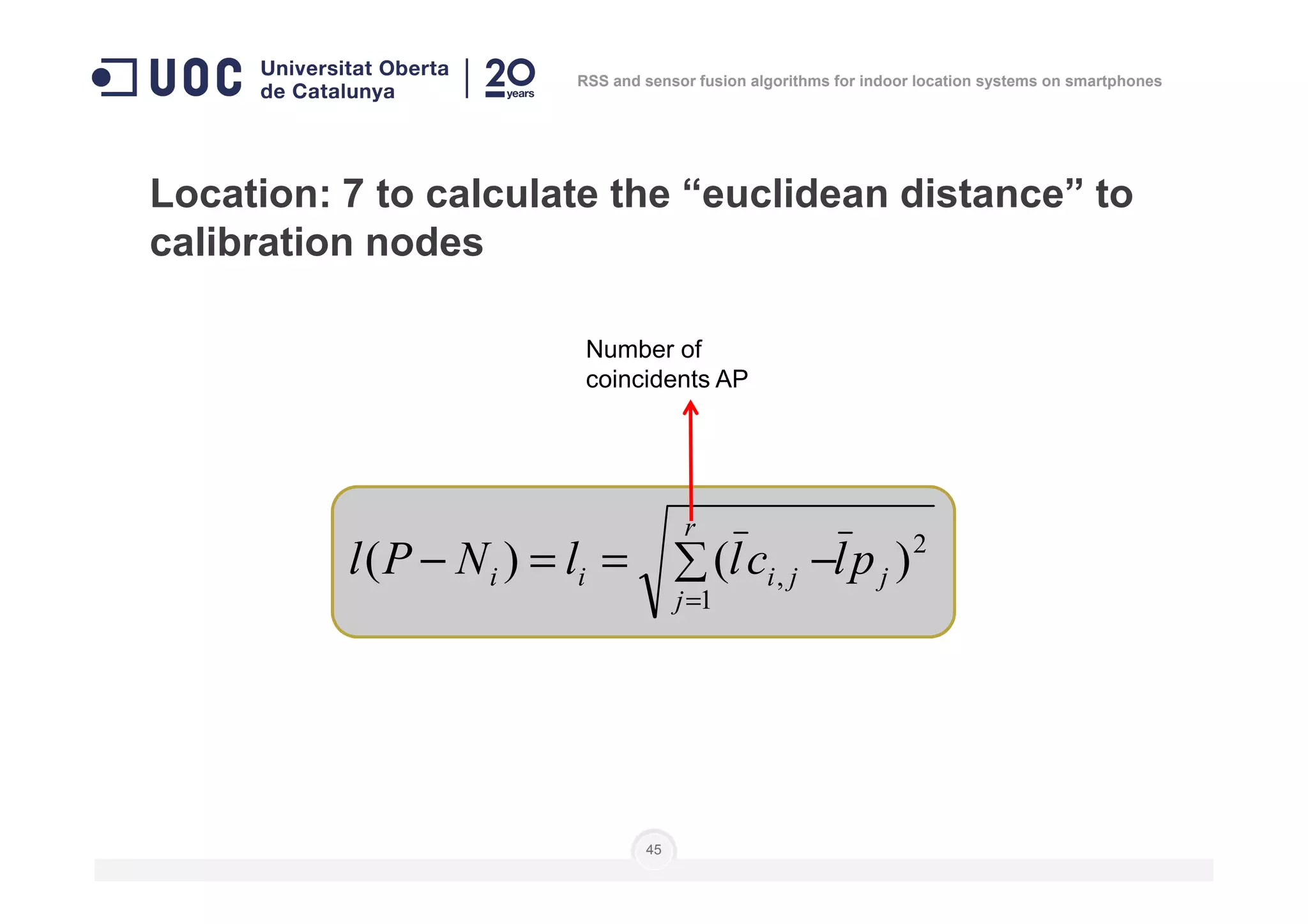
Number of
coincidents AP
RSS and sensor fusion algorithms for indoor location systems on smartphones
45
2
1
, )()( j
r
j
jiii plcllNPl ∑ −==−
=
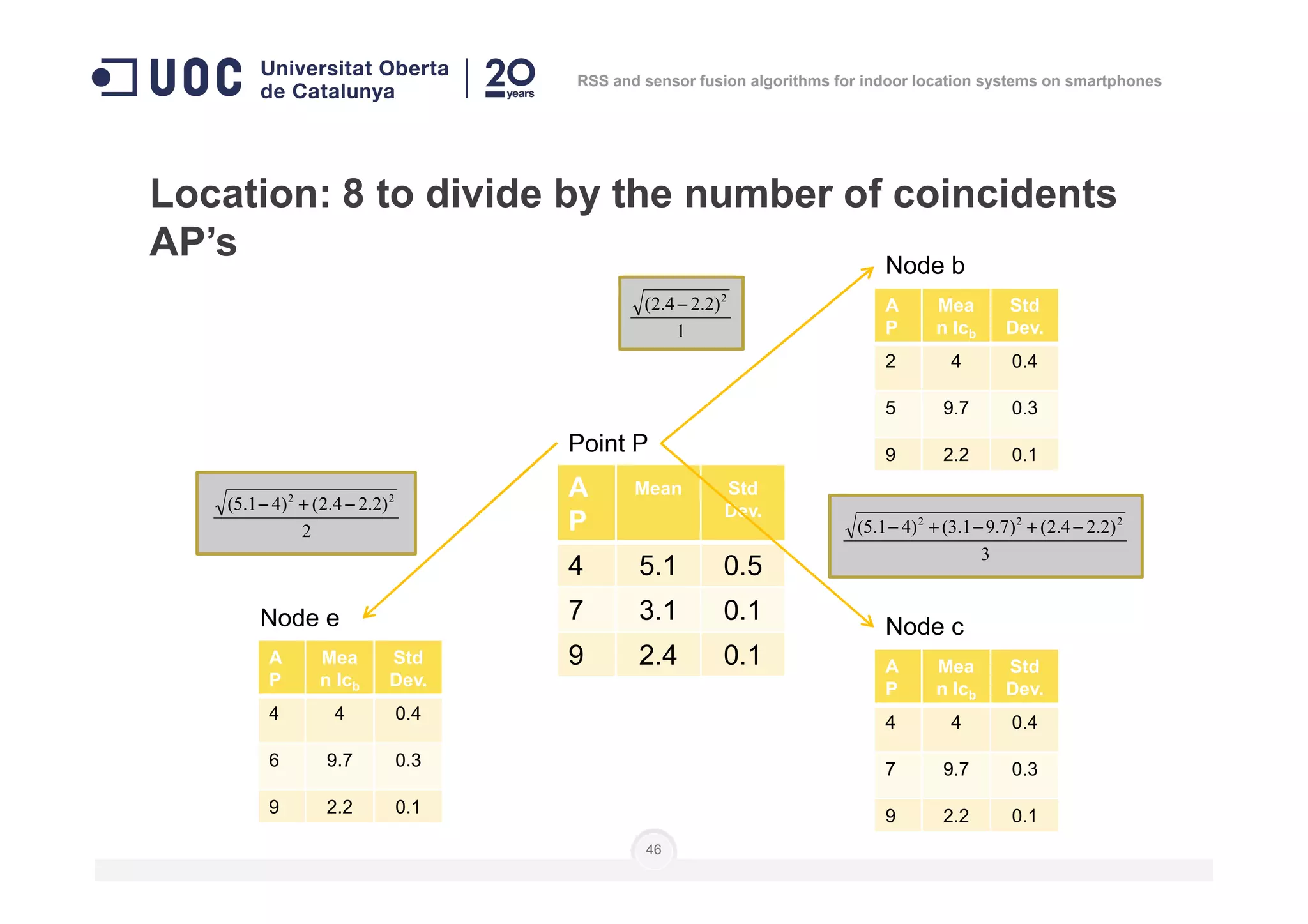
Location: 8 to divide by the number of coincidents
AP’s
Point P
A
P
Mea
n lcb
Std
Dev.
2 4 0.4
5 9.7 0.3
9 2.2 0.1
Node b
1
)2.24.2( 2
−
RSS and sensor fusion algorithms for indoor location systems on smartphones
46
A
P
Mean Std
Dev.
4 5.1 0.5
7 3.1 0.1
9 2.4 0.1
9 2.2 0.1
A
P
Mea
n lcb
Std
Dev.
4 4 0.4
7 9.7 0.3
9 2.2 0.1
Node c
A
P
Mea
n lcb
Std
Dev.
4 4 0.4
6 9.7 0.3
9 2.2 0.1
Node e
2
)2.24.2()41.5( 22
−+−
3
)2.24.2()7.91.3()41.5( 222
−+−+−
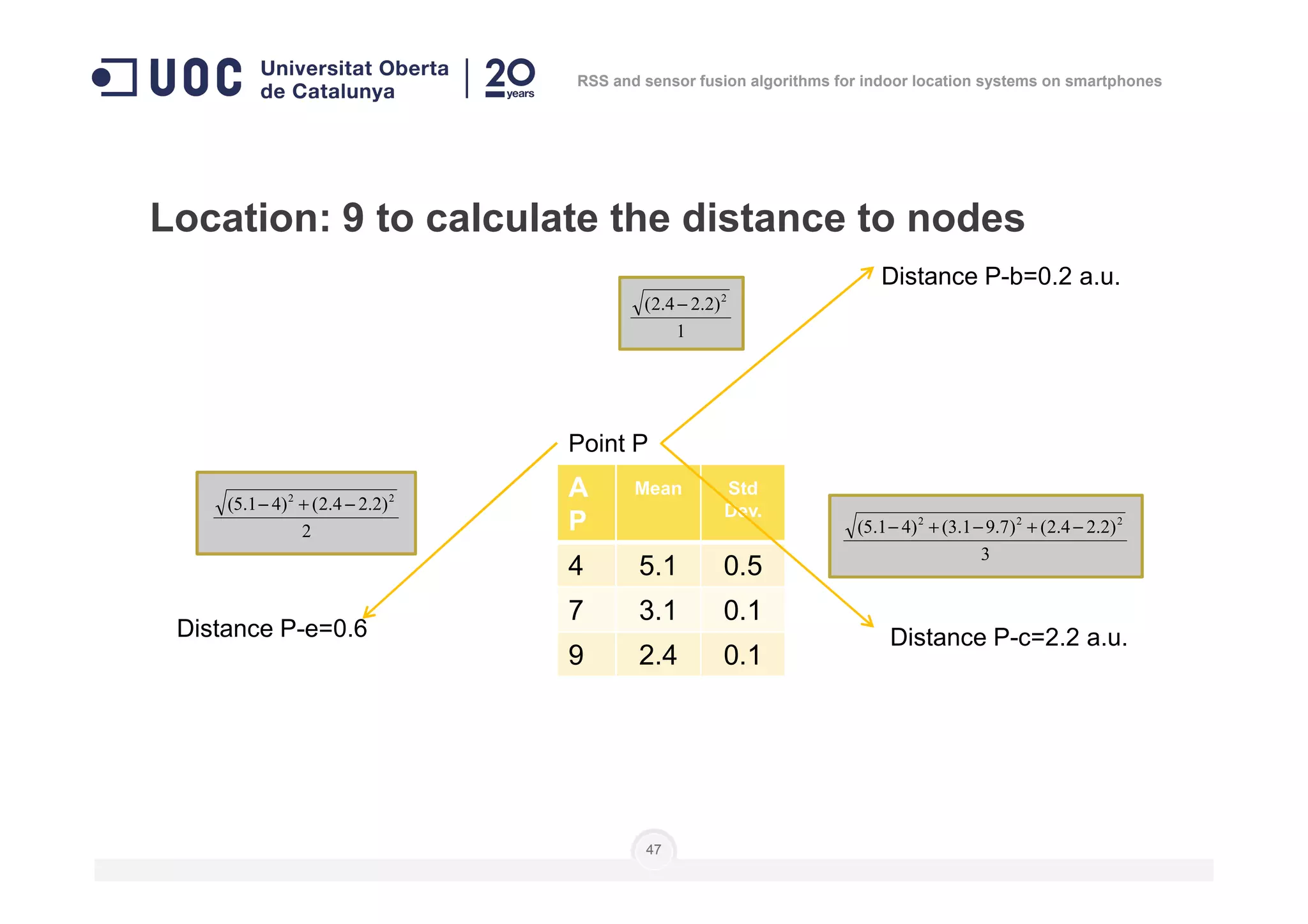
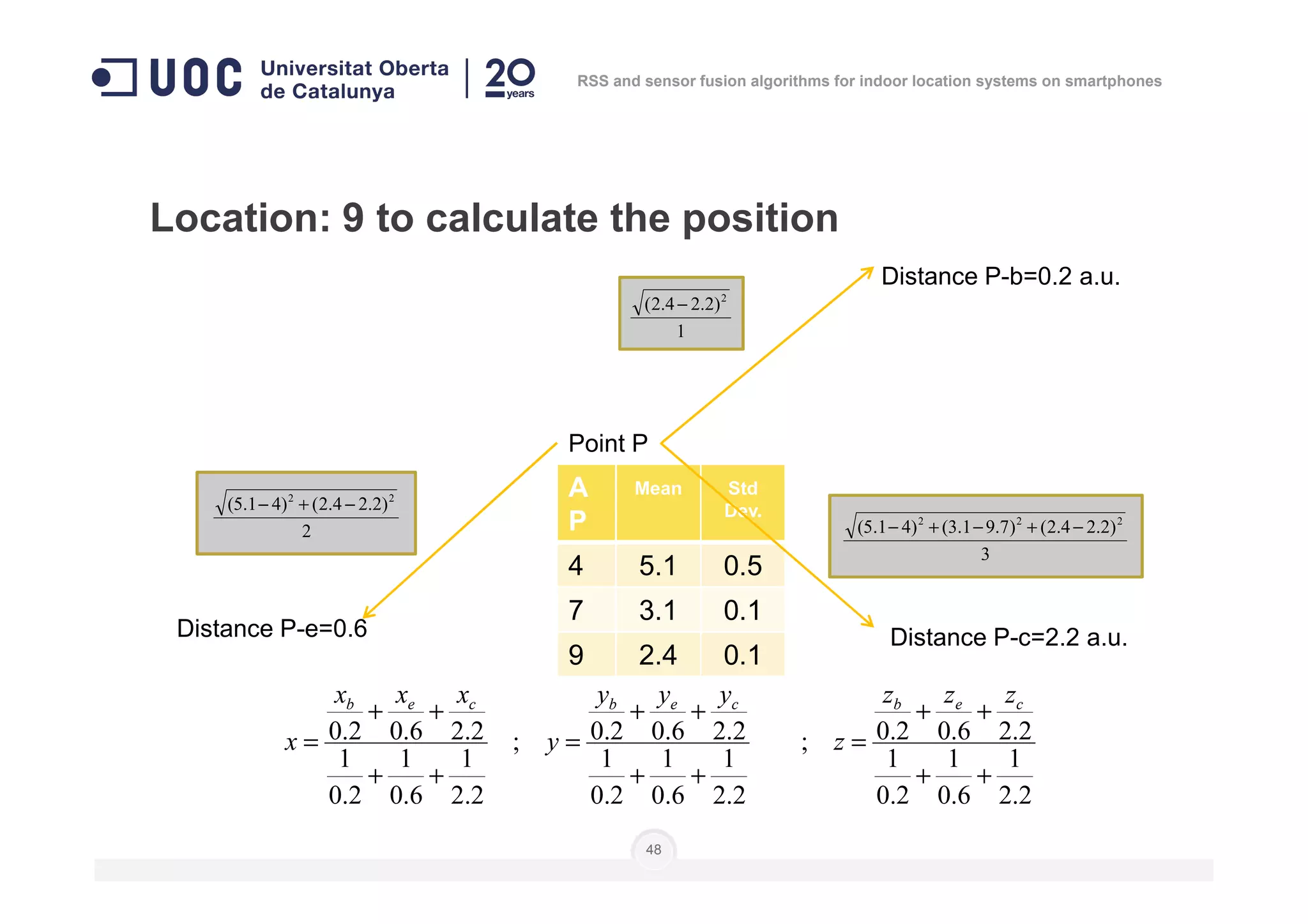
Location: 9 to calculate the distance to nodes
Point P
1
)2.24.2( 2
−
Distance P-b=0.2 a.u.
RSS and sensor fusion algorithms for indoor location systems on smartphones
47
A
P
Mean Std
Dev.
4 5.1 0.5
7 3.1 0.1
9 2.4 0.1
2
)2.24.2()41.5( 22
−+−
3
)2.24.2()7.91.3()41.5( 222
−+−+−
Distance P-e=0.6 Distance P-c=2.2 a.u.
Location: 9 to calculate the position
Point P
1
)2.24.2( 2
−
Distance P-b=0.2 a.u.
RSS and sensor fusion algorithms for indoor location systems on smartphones
48
A
P
Mean Std
Dev.
4 5.1 0.5
7 3.1 0.1
9 2.4 0.1
2
)2.24.2()41.5( 22
−+−
3
)2.24.2()7.91.3()41.5( 222
−+−+−
Distance P-e=0.6 Distance P-c=2.2 a.u.
2.2
1
6.0
1
2.0
1
2.26.02.0;
2.2
1
6.0
1
2.0
1
2.26.02.0;
2.2
1
6.0
1
2.0
1
2.26.02.0
++
++
=
++
++
=
++
++
=
cebcebceb zzz
z
yyy
y
xxx
x
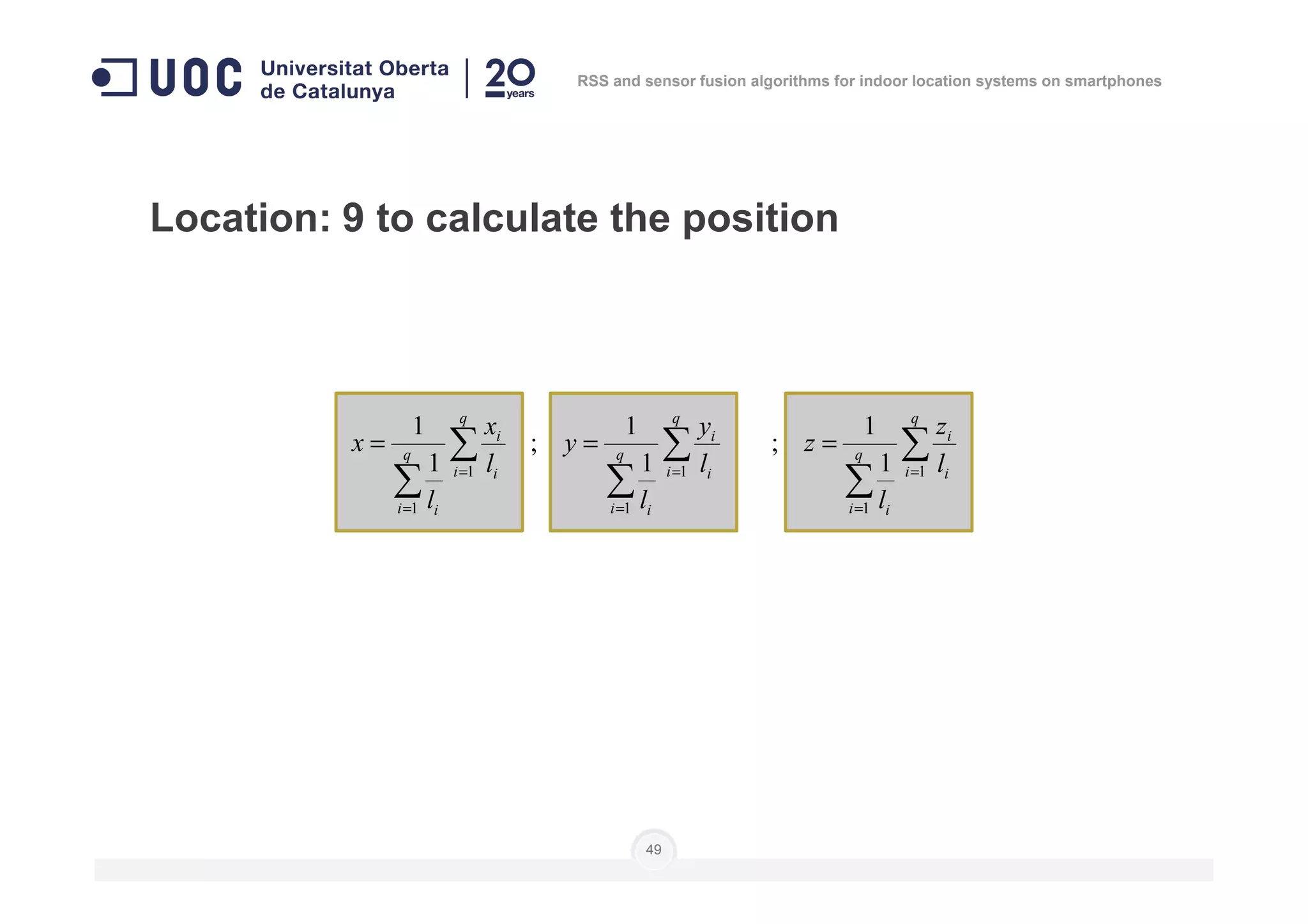
Location: 9 to calculate the position
∑
∑
∑
∑
∑
∑ ===
===
q
i
q
q
i
q
q
i
q
l
z
z
l
y
y
l
x
x
1
1
;
1
1
;
1
1
RSS and sensor fusion algorithms for indoor location systems on smartphones
49
∑
∑
∑
∑
∑
∑ =
=
=
=
=
=
i i
q
i i
i i
q
i i
i i
q
i i
l
l
l
l
l
l
1
1
1
1
1
1
111
1. Context
2. Indoor positioning
3. Wifi Fingerprinting
Index
RSS and sensor fusion algorithms for indoor location systems on smartphones
3. Wifi Fingerprinting
4. Sensor Fusion
5. Test
6. Conclusions and Future Work
50
RSS and sensor fusion algorithms for indoor location systems on smartphones
51
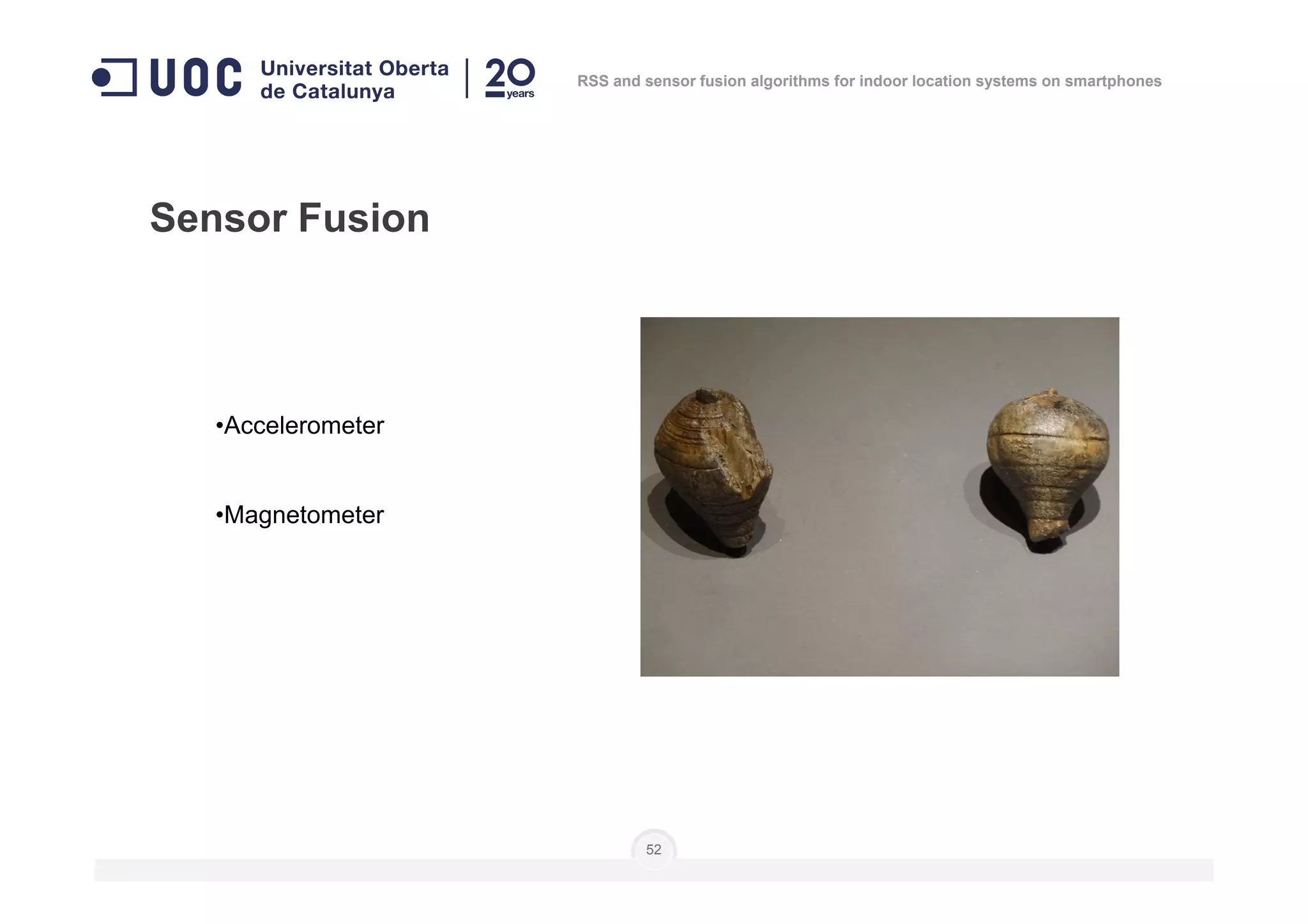
4. Sensor Fusion
•Accelerometer
Sensor Fusion
RSS and sensor fusion algorithms for indoor location systems on smartphones
•Magnetometer
52
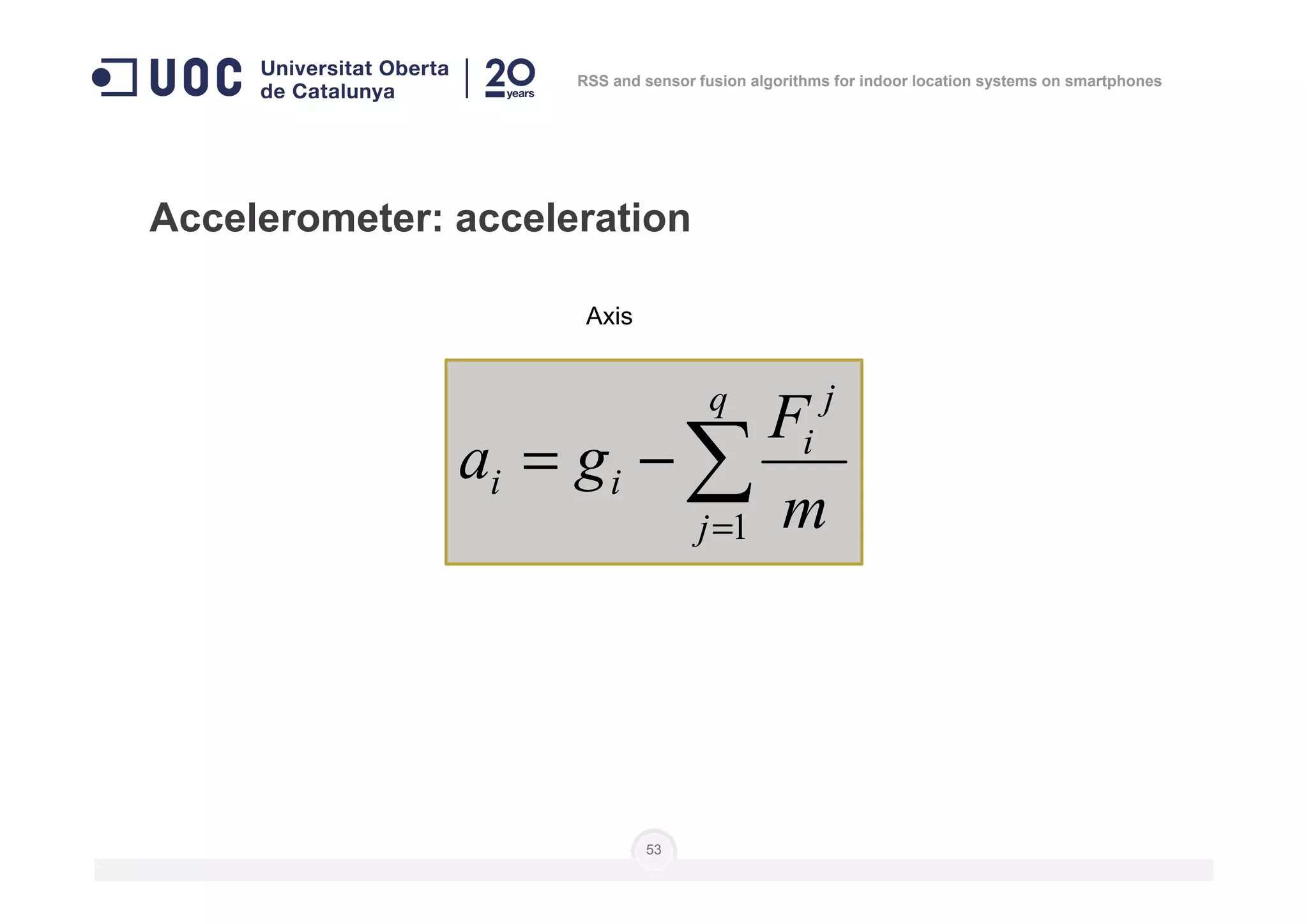
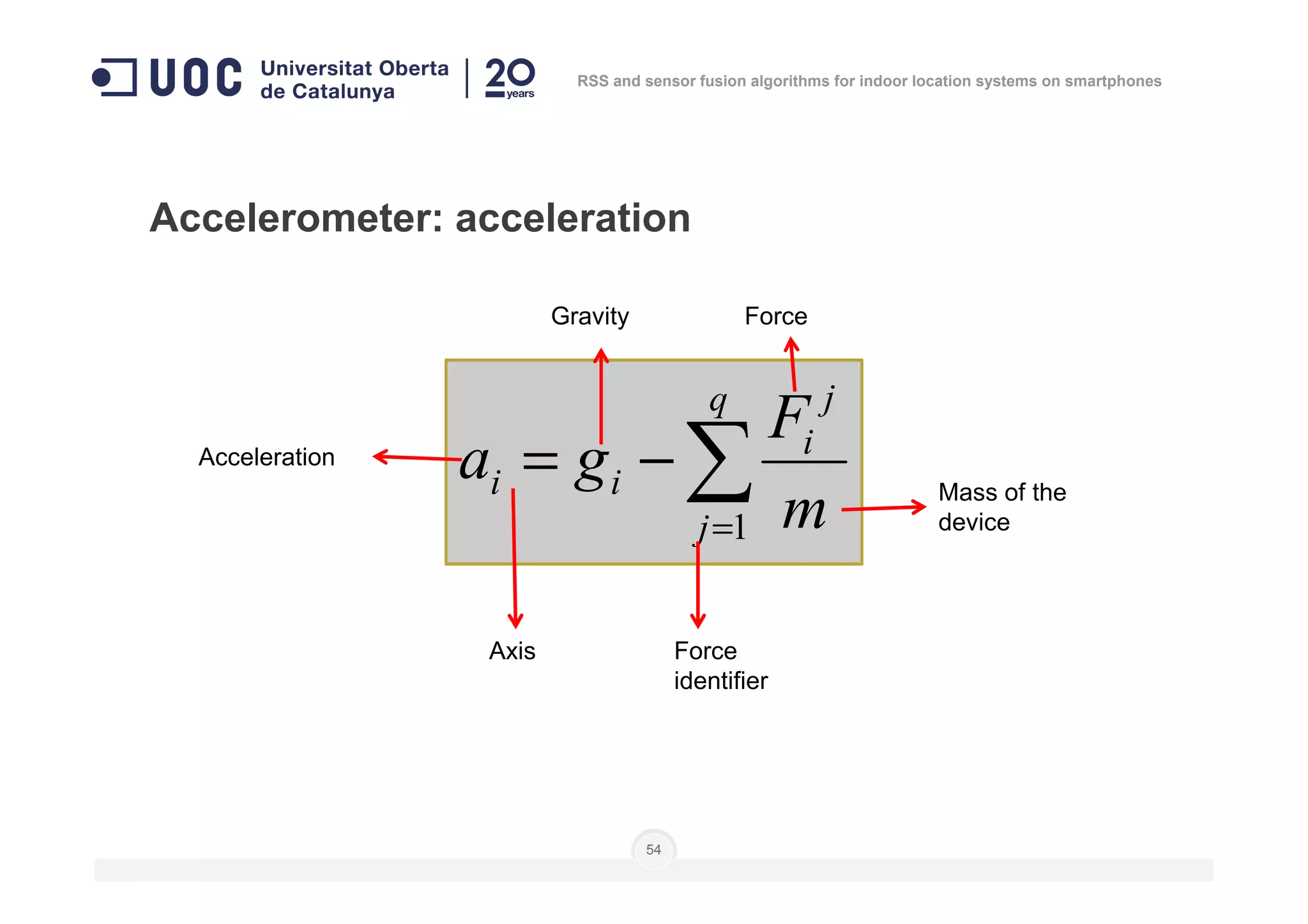
Accelerometer: acceleration
Axis
∑−=
q j
i
ii
F
ga
RSS and sensor fusion algorithms for indoor location systems on smartphones
53
∑=
−=
j
ii
m
ga
1
Accelerometer: acceleration
∑−=
q j
i
ii
F
ga
Gravity Force
Acceleration
RSS and sensor fusion algorithms for indoor location systems on smartphones
54
∑=
−=
j
ii
m
ga
1
Axis Force
identifier
Mass of the
device
Acceleration
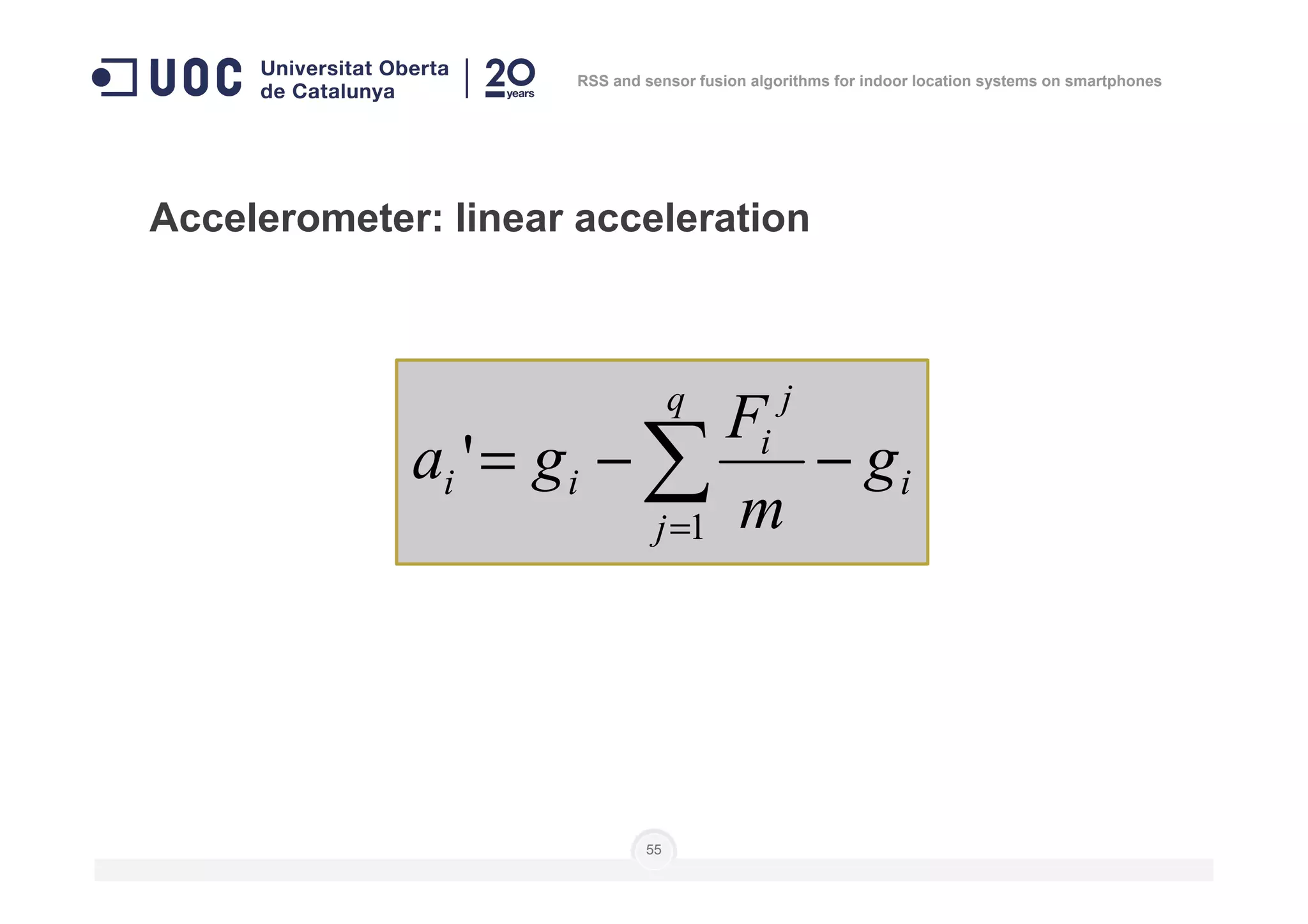
Accelerometer: linear acceleration
i
q j
i
ii g
F
ga −−= ∑'
RSS and sensor fusion algorithms for indoor location systems on smartphones
55
i
j
ii g
m
ga −−= ∑=1
'
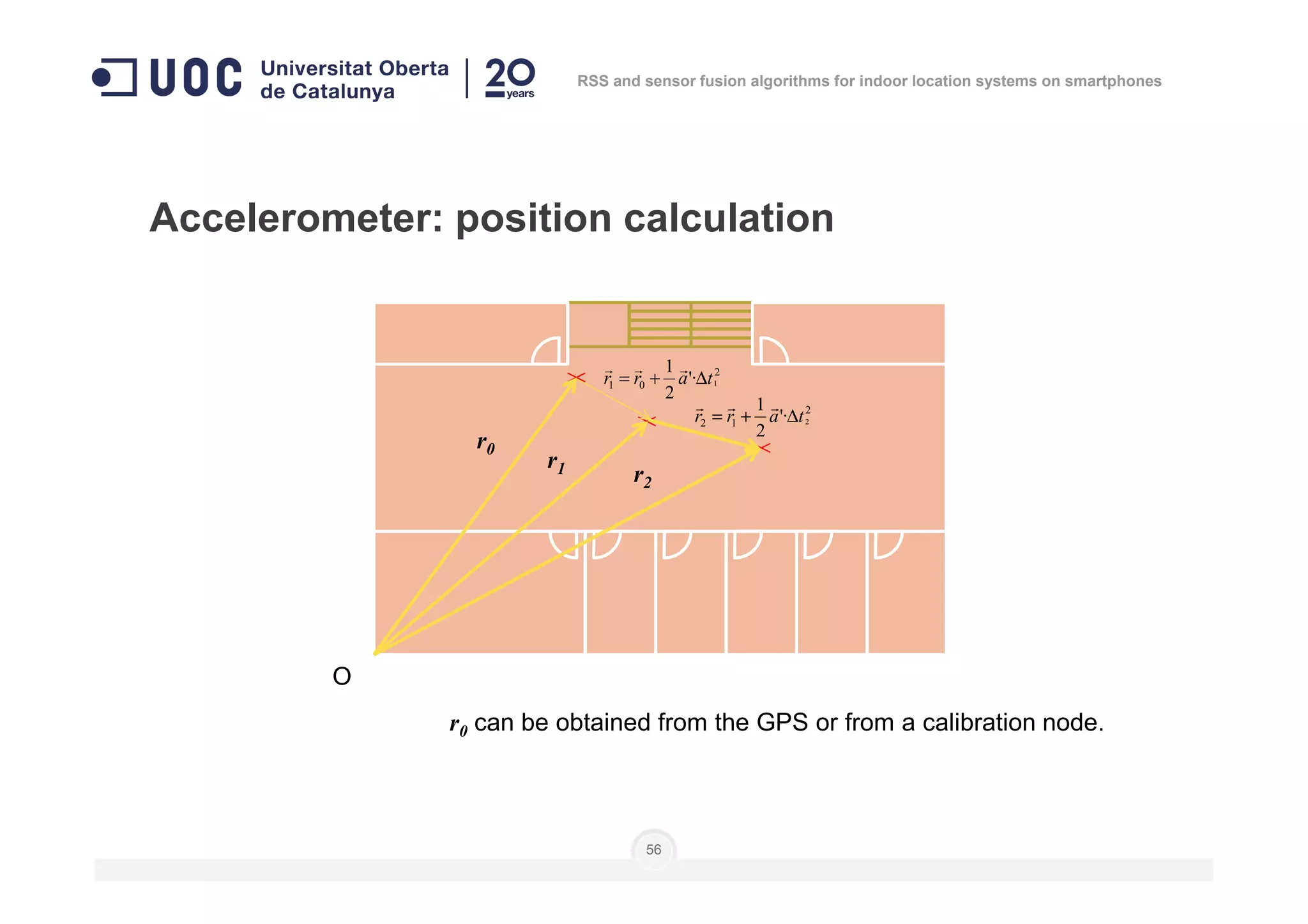
Accelerometer: position calculation
r0
r1 r
2
01 1'·
2
1
tarr ∆+=
rrr
2
12 2'·
2
1
tarr ∆+=
rrr
RSS and sensor fusion algorithms for indoor location systems on smartphones
56
O
r1 r2
r0 can be obtained from the GPS or from a calibration node.
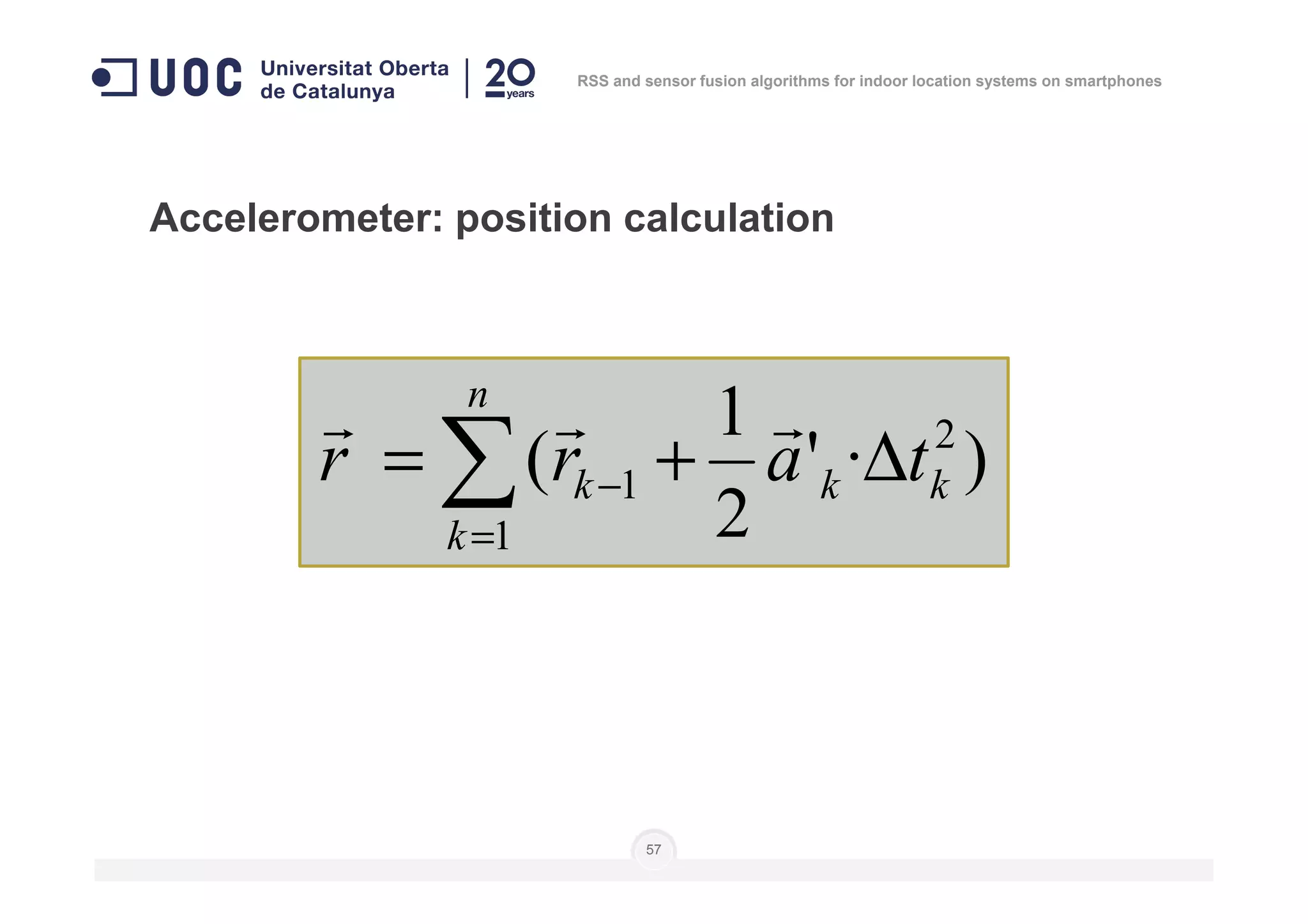
Accelerometer: position calculation
)·'
1
( 2
1 kk
n
k tarr ∆+= ∑ −
rrr
RSS and sensor fusion algorithms for indoor location systems on smartphones
57
)·'
2
(
1
1 kk
k
k tarr ∆+= ∑=
−
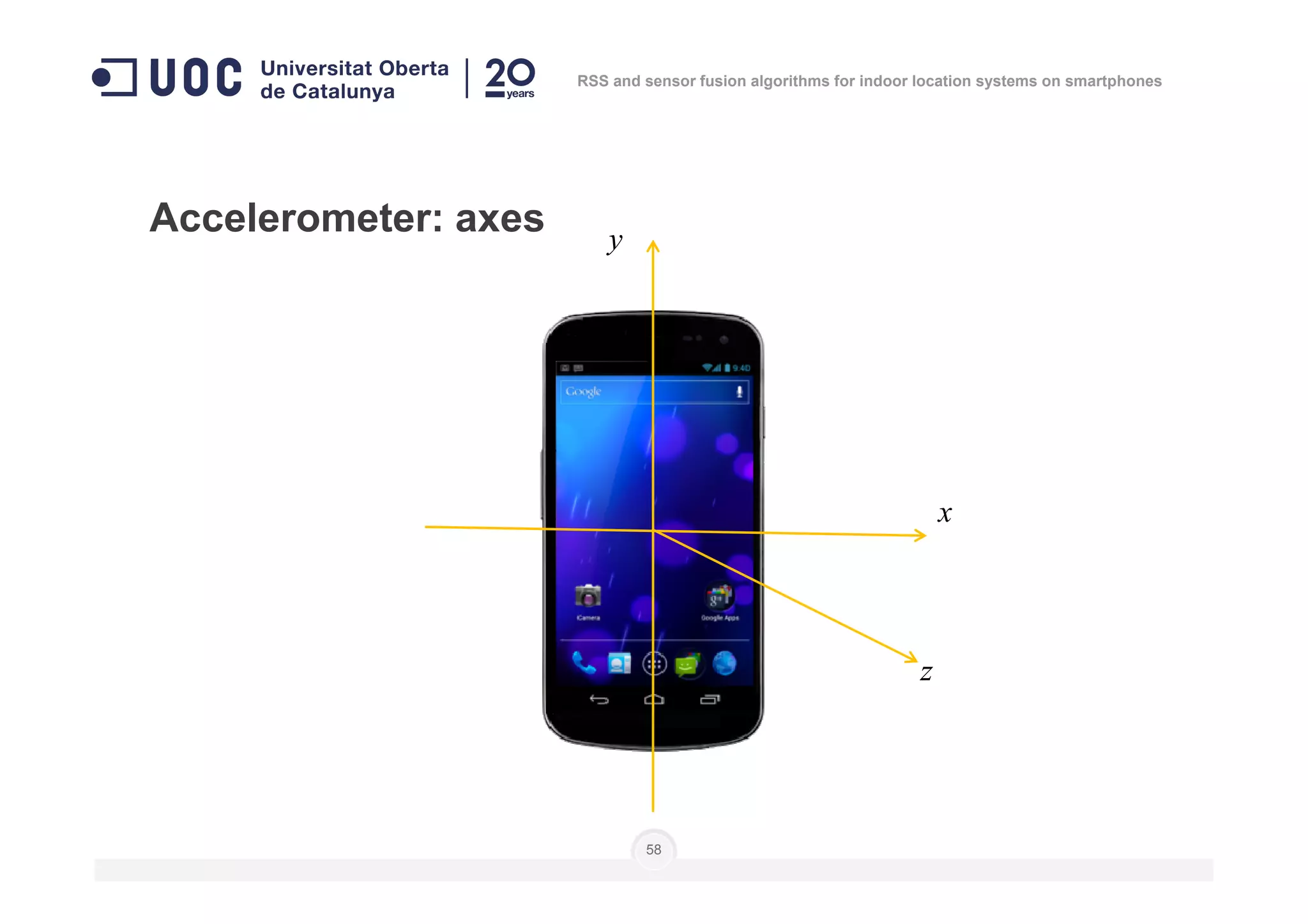
Accelerometer: axes y
RSS and sensor fusion algorithms for indoor location systems on smartphones
58
x
z
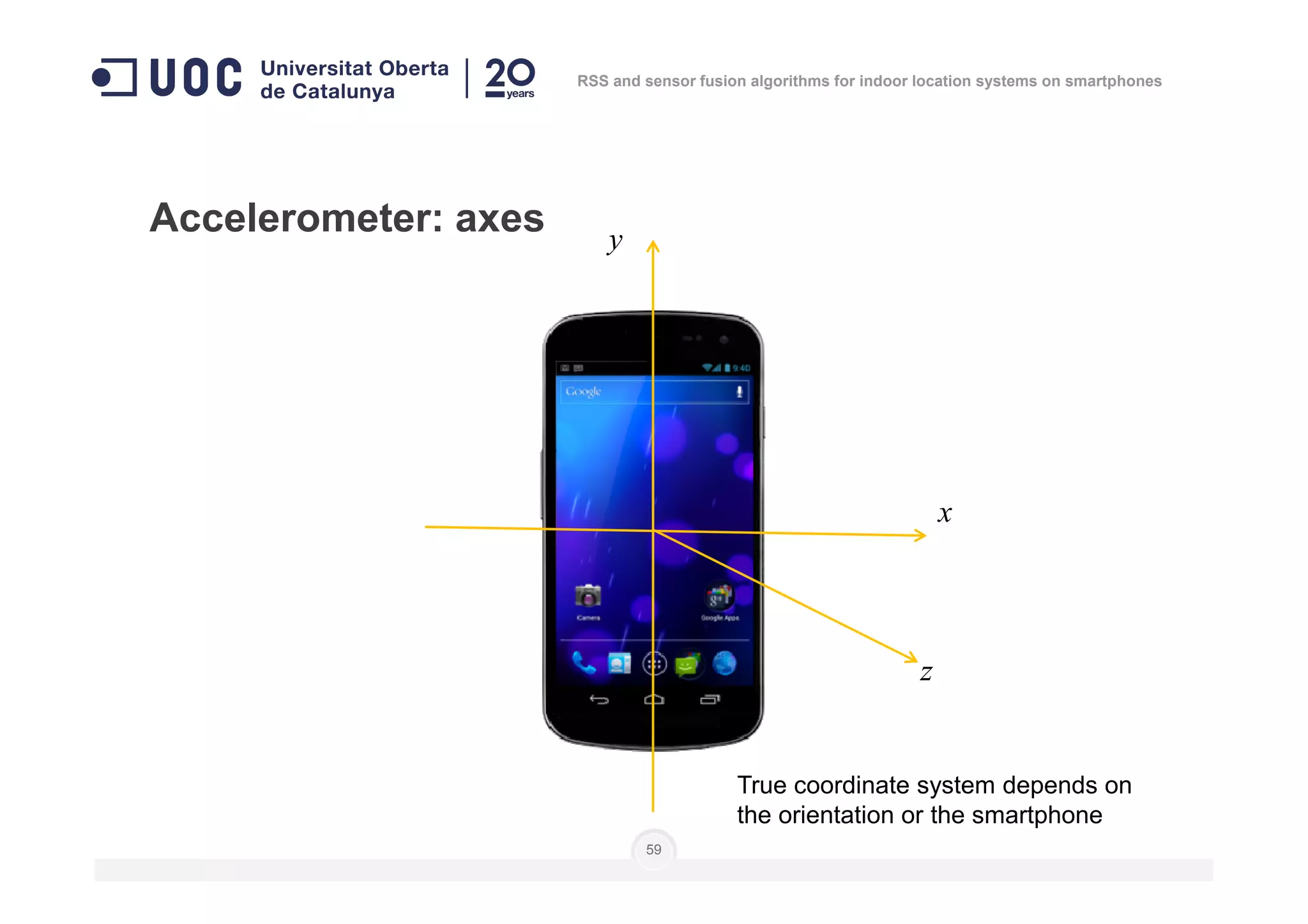
Accelerometer: axes y
RSS and sensor fusion algorithms for indoor location systems on smartphones
59
x
z
True coordinate system depends on
the orientation or the smartphone
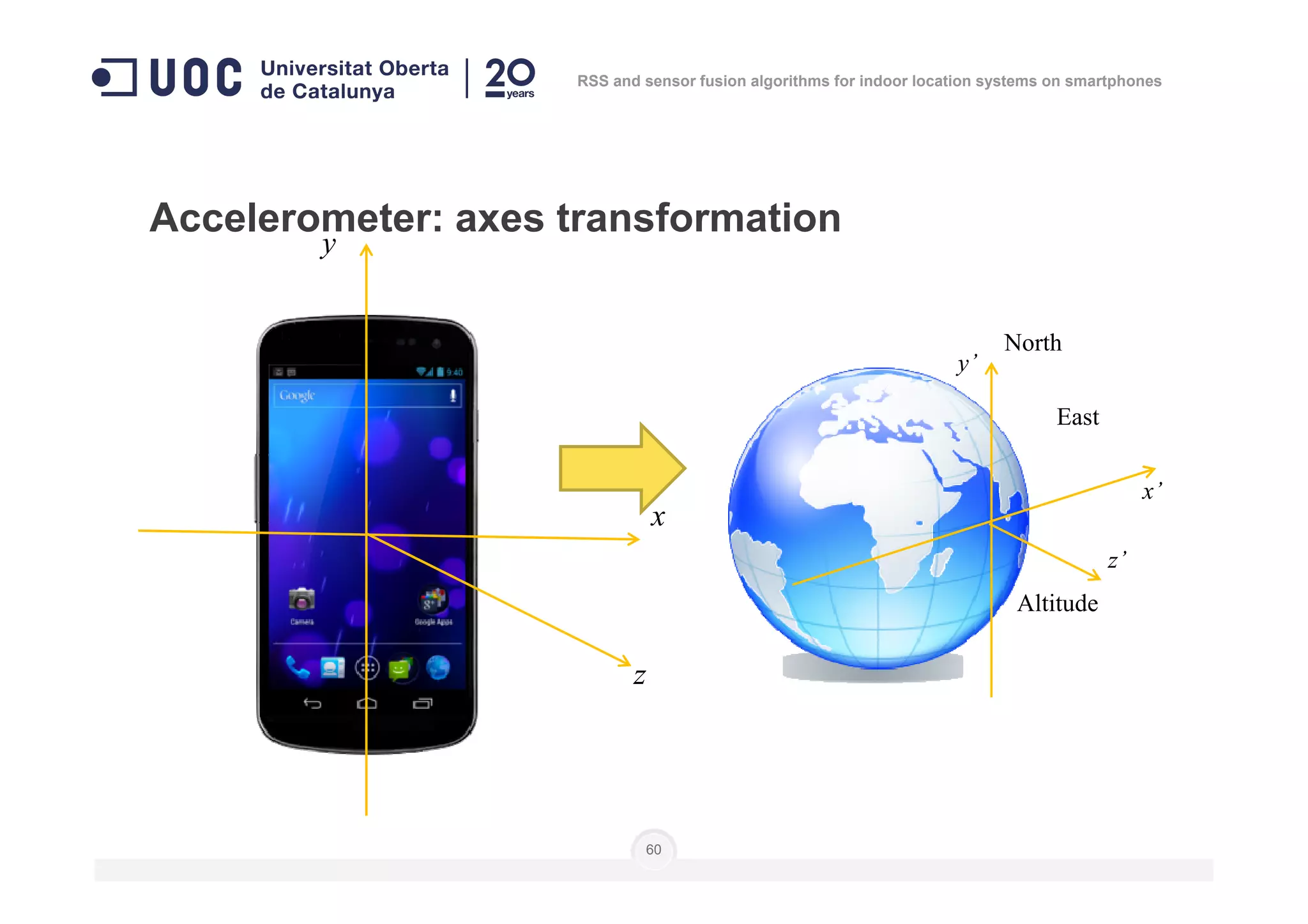
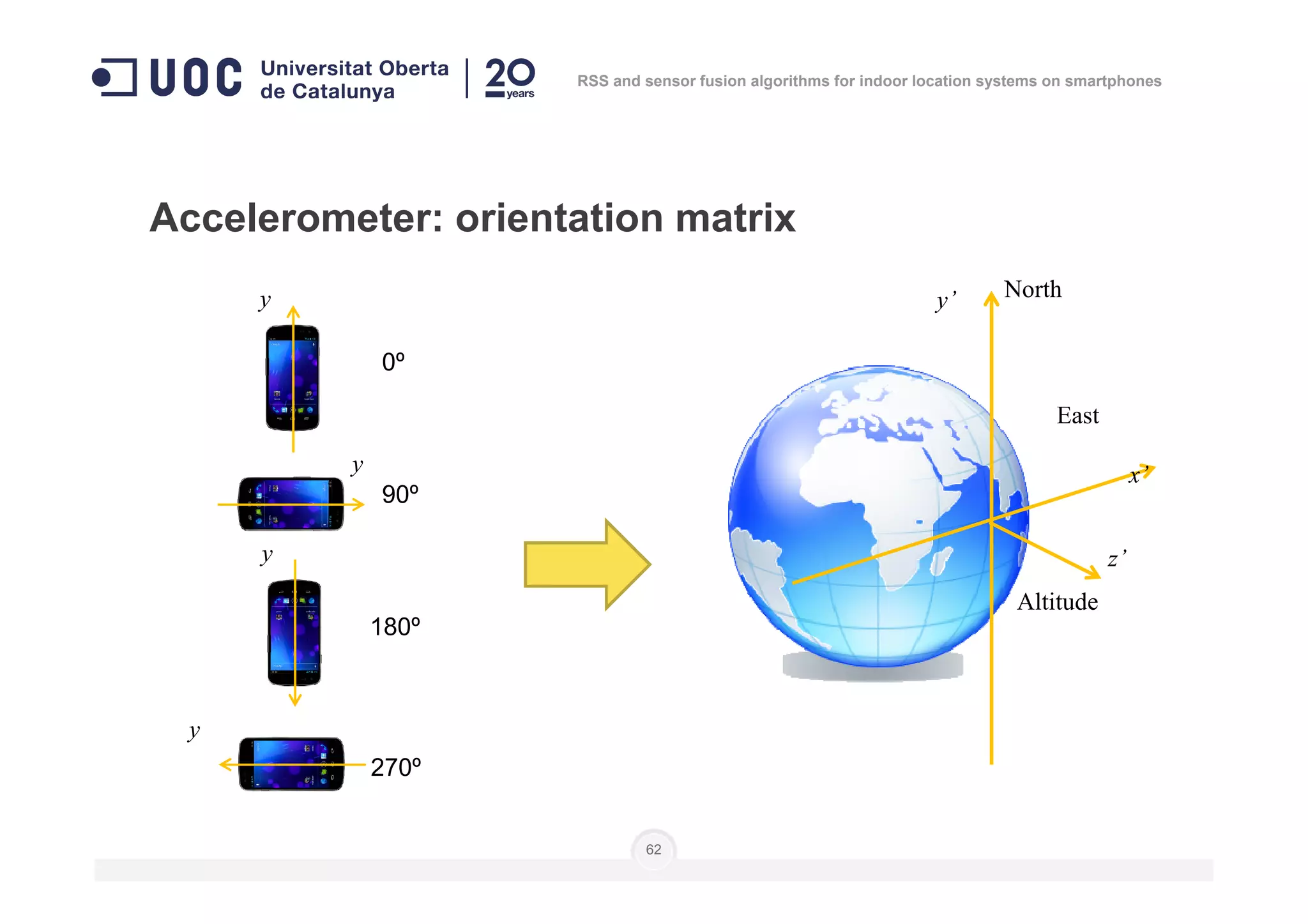
Accelerometer: axes transformation
y
North
East
y’
RSS and sensor fusion algorithms for indoor location systems on smartphones
60
x
z
Altitude
z’
x’
Accelerometer + Magnetometer
Combination of both sensors allows to know
orientation of the smartphone
RSS and sensor fusion algorithms for indoor location systems on smartphones
61
Accelerometer: orientation matrix
y North
East
x’
y’
0º
y
RSS and sensor fusion algorithms for indoor location systems on smartphones
62
Altitude
z’
x’y
90º
y
180º
y
270º
1. Context
2. Indoor positioning
3. Wifi Fingerprinting
Index
RSS and sensor fusion algorithms for indoor location systems on smartphones
3. Wifi Fingerprinting
4. Sensor Fusion
5. Test
6. Conclusions and Future Work
63
RSS and sensor fusion algorithms for indoor location systems on smartphones
64
5. Test
• RSS
Test
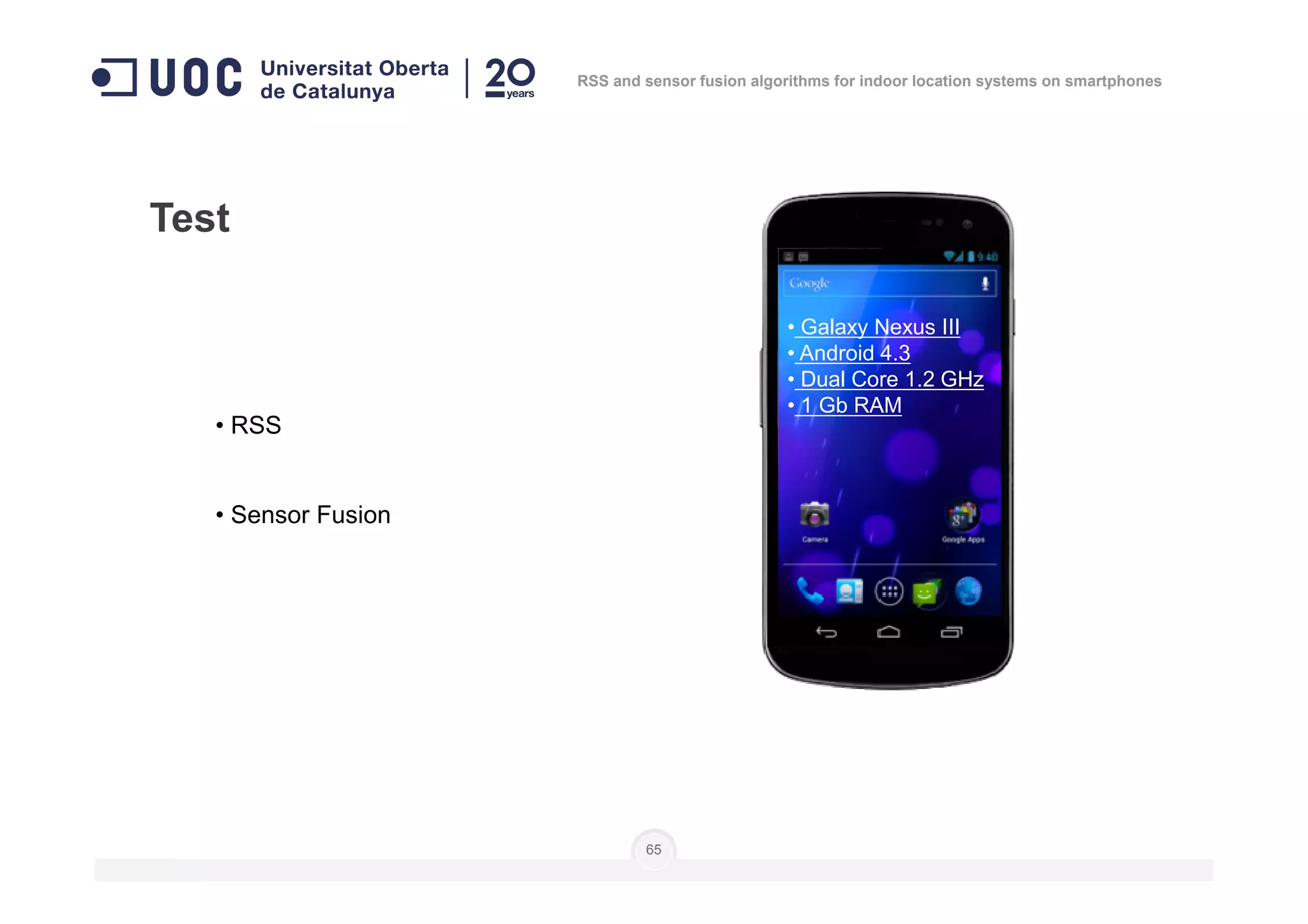
• Galaxy Nexus III
• Android 4.3
• Dual Core 1.2 GHz
• 1 Gb RAM
RSS and sensor fusion algorithms for indoor location systems on smartphones
• Sensor Fusion
65
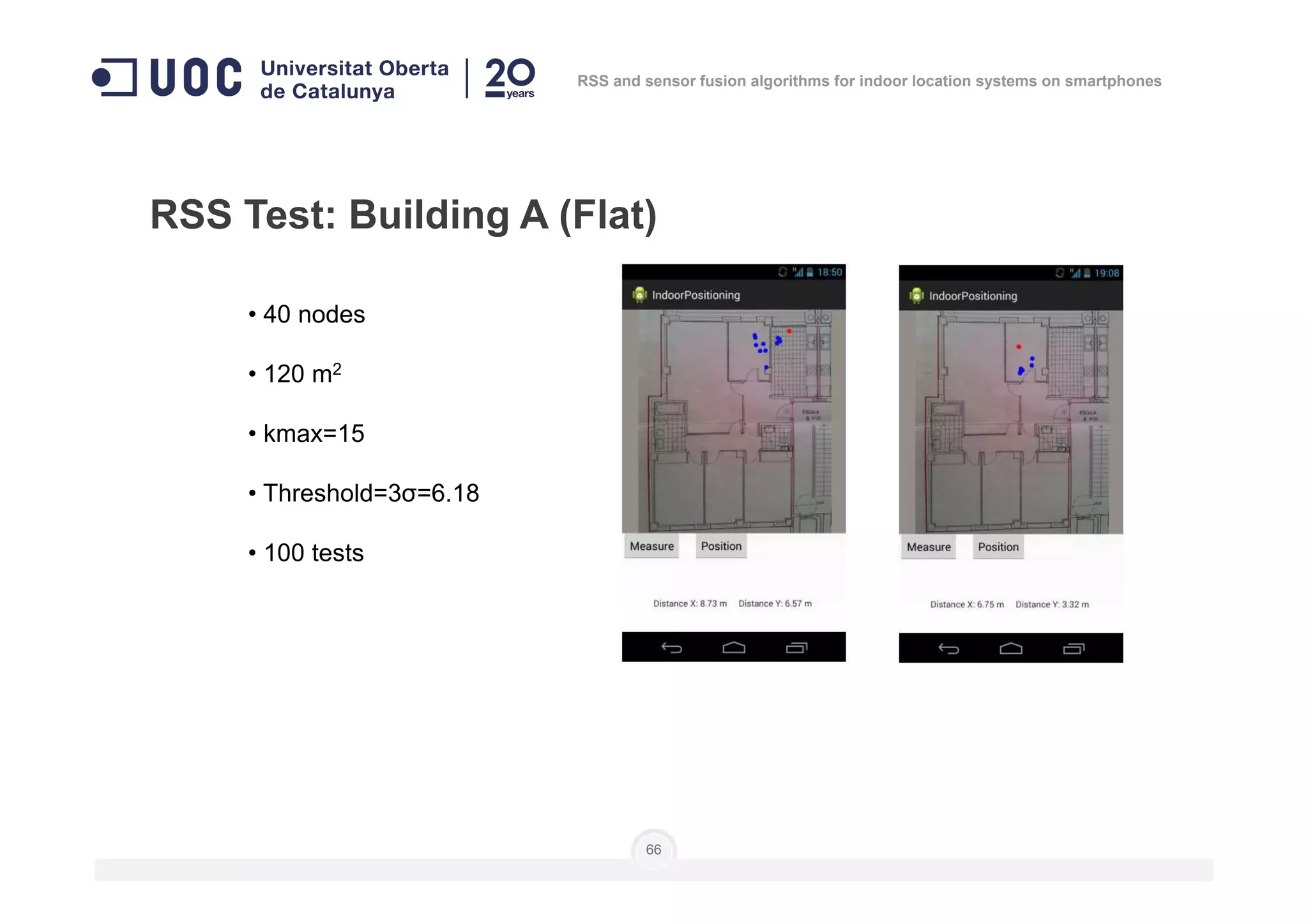
• 40 nodes
• 120 m2
• kmax=15
RSS Test: Building A (Flat)
RSS and sensor fusion algorithms for indoor location systems on smartphones
• Threshold=3σ=6.18
• 100 tests
66
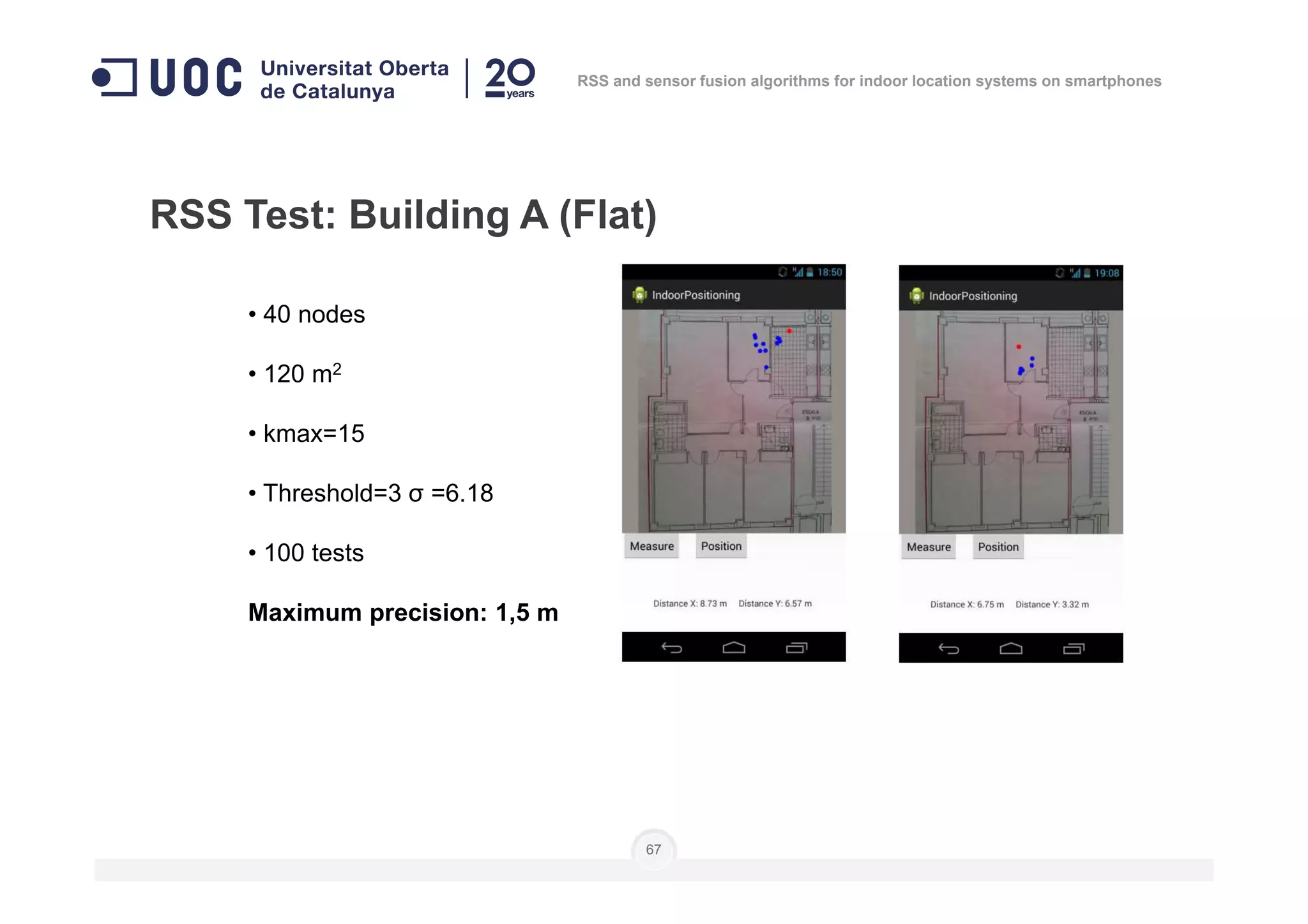
• 40 nodes
• 120 m2
• kmax=15
RSS Test: Building A (Flat)
RSS and sensor fusion algorithms for indoor location systems on smartphones
• Threshold=3 σ =6.18
• 100 tests
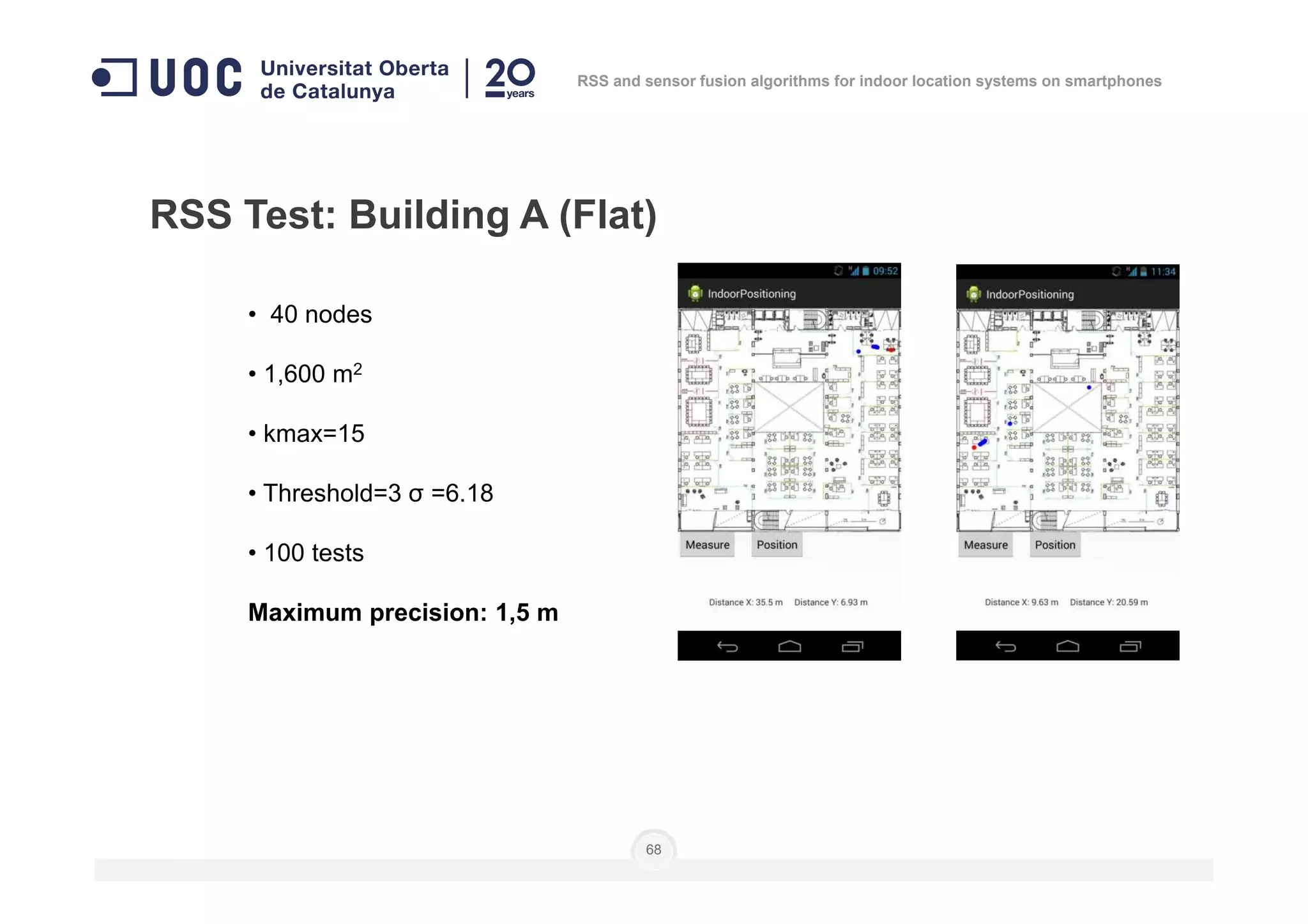
Maximum precision: 1,5 m
67
• 40 nodes
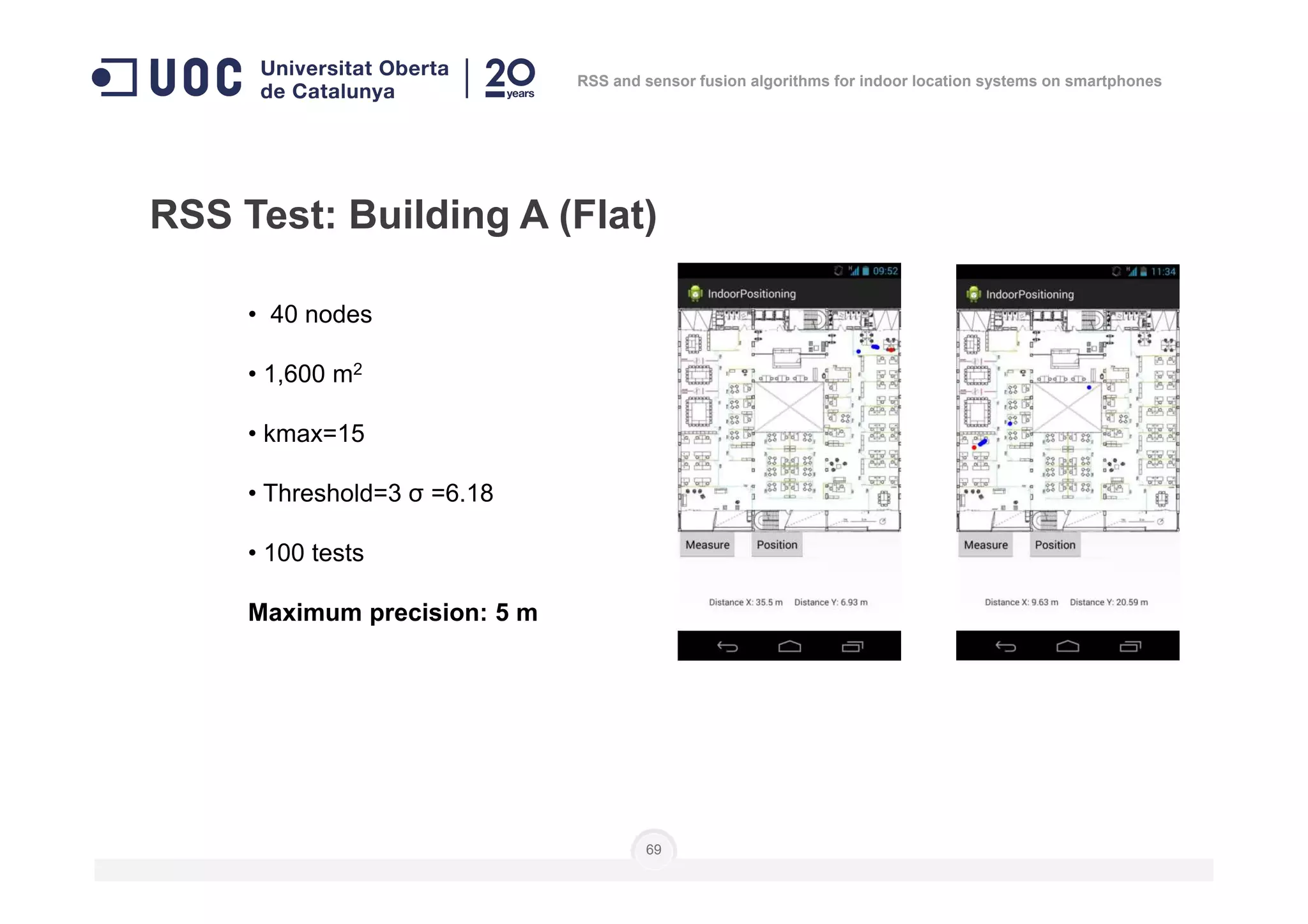
• 1,600 m2
• kmax=15
RSS Test: Building A (Flat)
RSS and sensor fusion algorithms for indoor location systems on smartphones
• Threshold=3 σ =6.18
• 100 tests
Maximum precision: 1,5 m
68
• 40 nodes
• 1,600 m2
• kmax=15
RSS Test: Building A (Flat)
RSS and sensor fusion algorithms for indoor location systems on smartphones
• Threshold=3 σ =6.18
• 100 tests
Maximum precision: 5 m
69
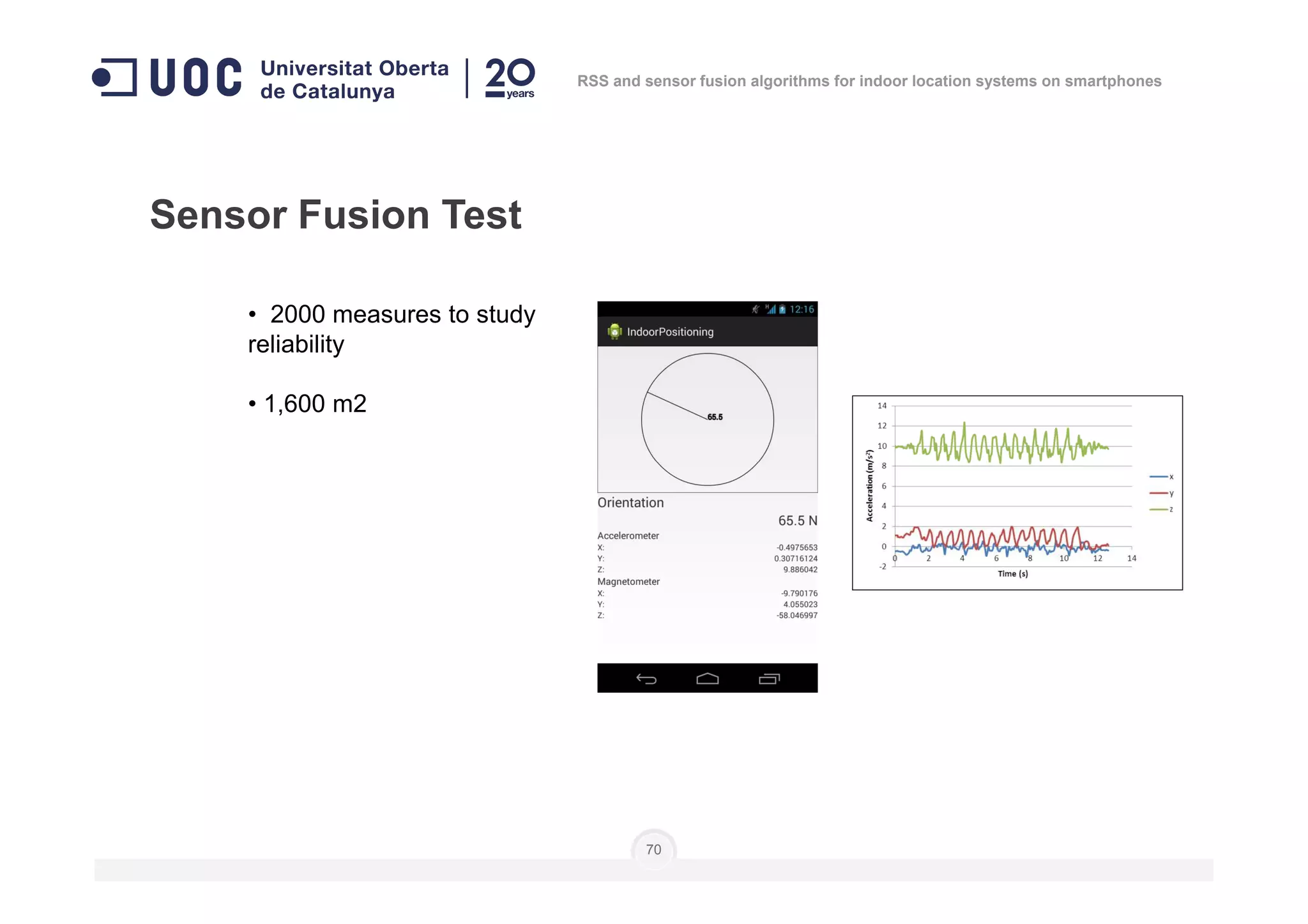
• 2000 measures to study
reliability
• 1,600 m2
Sensor Fusion Test
RSS and sensor fusion algorithms for indoor location systems on smartphones
70
• 2000 measures to study
reliability
• 1,600 m2
Sensor Fusion Test
RSS and sensor fusion algorithms for indoor location systems on smartphones
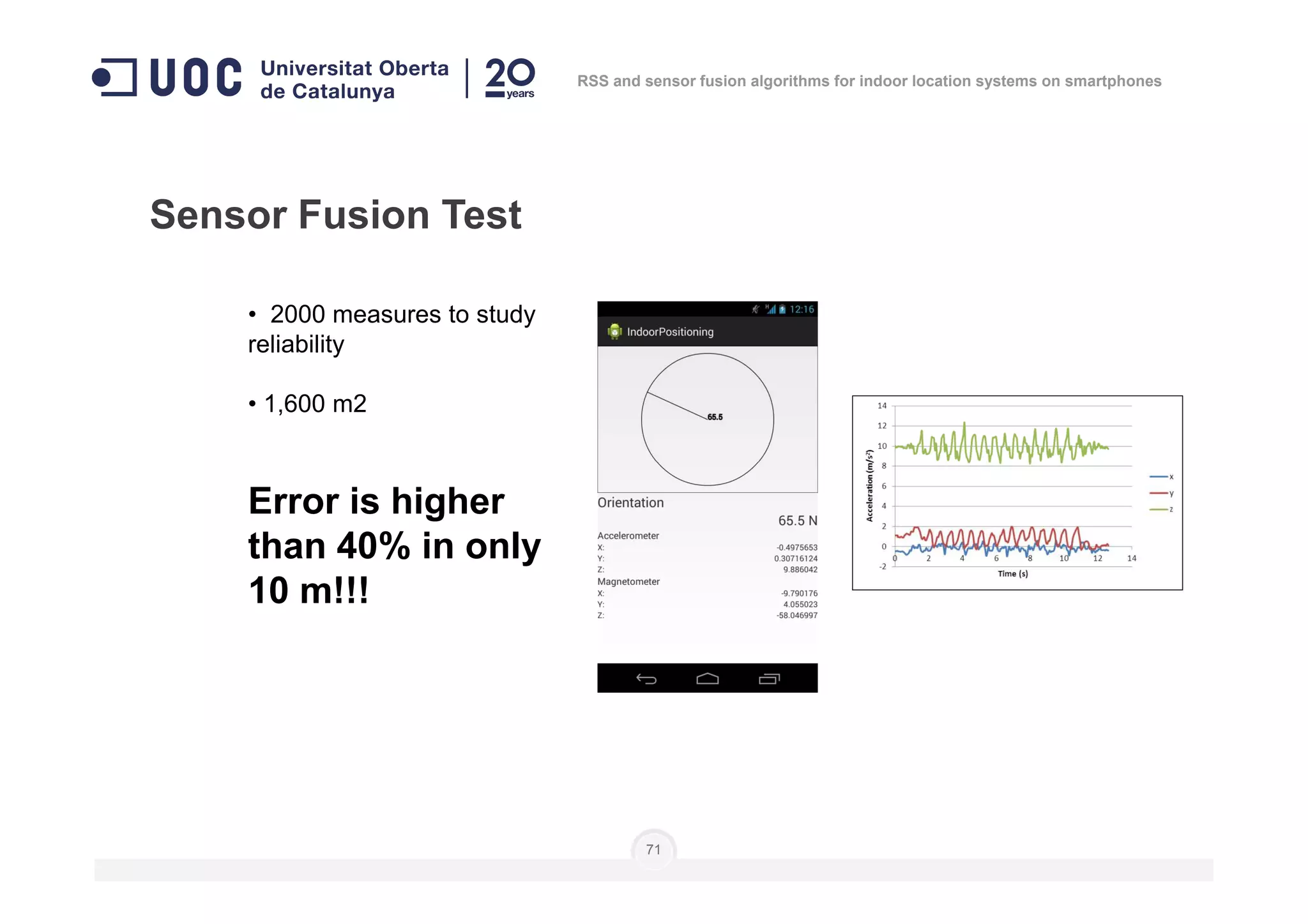
Error is higher
than 40% in only
10 m!!!
71
•High dependence on
frequency of sample
• Constant bias error of the
accelerometer: it increases
Sensor Fusion Test: Problems
RSS and sensor fusion algorithms for indoor location systems on smartphones
accelerometer: it increases
even in static position
72
1. Context
2. Indoor positioning
3. Wifi Fingerprinting
Index
RSS and sensor fusion algorithms for indoor location systems on smartphones
3. Wifi Fingerprinting
4. Sensor Fusion
5. Test
6. Conclusions and Future Work
73
RSS and sensor fusion algorithms for indoor location systems on smartphones
74
5. Conclusions and Future Work
Conclusions
•An RSS and a sensor fusion technique have been implemented in a
prototype
• RSS is able to give between 1.5 and 5 meters of accuracy, but is
highly dependant on the environment
RSS and sensor fusion algorithms for indoor location systems on smartphones
75
highly dependant on the environment
• Sensor fusion has low accuracy and depends on environment and has
a bias error.
• All the techniques proposed work entirely within the smartphone.
• All the techniques proposed have a response time less than 5
seconds.
Future Work
• To improve reliability of AP’s.
• To study how volume of people affects precision
• To improve z axis accuracy.
RSS and sensor fusion algorithms for indoor location systems on smartphones
76
• To improve z axis accuracy.
• To study where is the origin of the error.
• To study how to avoid the building dependence on the error.
RSS and Sensor Fusion Algorithms for Indoor Location Systems on Smartphones

RSS and Sensor Fusion Algorithms for Indoor Location Systems on Smartphones

  • 1.
    RSS and sensorfusion algorithms for indoor location systems on smartphones RSS and sensor fusion algorithms for indoor location systems on smartphones Laia Descamps-Vila, A. Perez-Navarro and Jordi Conesa (and Andrés Gómez) 1
  • 2.
    1. Context 2. Indoorpositioning 3. Wifi Fingerprinting Index RSS and sensor fusion algorithms for indoor location systems on smartphones 3. Wifi Fingerprinting 4. Sensor Fusion 5. Test 6. Conclusions and Future Work 2
  • 3.
    RSS and sensorfusion algorithms for indoor location systems on smartphones 3 1. Context
  • 4.
    • Location BasedSystems • Context Aware recommendation systems Context RSS and sensor fusion algorithms for indoor location systems on smartphones recommendation systems 4 Need location!
  • 5.
    Three main ítemsabout location: • Coverage Location RSS and sensor fusion algorithms for indoor location systems on smartphones • Precision • Security 5
  • 6.
    Three main ítemsabout location: • Coverage Location RSS and sensor fusion algorithms for indoor location systems on smartphones • Precision • Security 6
  • 7.
    GNSS are themain location systems… Coverage RSS and sensor fusion algorithms for indoor location systems on smartphones 7
  • 8.
    GNSS are themain location systems… Coverage RSS and sensor fusion algorithms for indoor location systems on smartphones 8 … but GNSS only work outdoor
  • 9.
    What happens indoor? Coverage RSSand sensor fusion algorithms for indoor location systems on smartphones 9
  • 10.
    How can weget the position indoor? Question RSS and sensor fusion algorithms for indoor location systems on smartphones 10
  • 11.
    •We only wantto use infraestructures already installed • The pass from outdoor to indoor Our restrictions RSS and sensor fusion algorithms for indoor location systems on smartphones • The pass from outdoor to indoor environment should have to be transparent to the user • The positioning should have to be performed with the smartphone 11
  • 12.
    •We only wantto use infraestructures already installed • The pass from outdoor to indoor environment should have to be transparent to the user Our restrictions RSS and sensor fusion algorithms for indoor location systems on smartphones • The positioning should have to be performed with the smartphone • Without internet connection • End user application 12
  • 13.
    Movistar and Vodafone3G and 2G coverage Why without internet connection? RSS and sensor fusion algorithms for indoor location systems on smartphones 13 Source: www.sensorly.com
  • 14.
    •Fast enough tofavor a satisfactory user’s experience • High precision Why does “end user application means”? RSS and sensor fusion algorithms for indoor location systems on smartphones • High precision • Robust • Easy to use 14
  • 15.
    1. Context 2. Indoorpositioning 3. Wifi Fingerprinting Index RSS and sensor fusion algorithms for indoor location systems on smartphones 3. Wifi Fingerprinting 4. Sensor Fusion 5. Test 6. Conclusions and Future Work 15
  • 16.
    RSS and sensorfusion algorithms for indoor location systems on smartphones 16 2. Indoor Positioning
  • 17.
    • Markers • Wirelesssystems How to get indoor positioning? RSS and sensor fusion algorithms for indoor location systems on smartphones • Wireless systems • Inertial systems 17
  • 18.
    • Markers distributedwithin the building (like QR codes). • Easy and cheap to install Markers RSS and sensor fusion algorithms for indoor location systems on smartphones • User and environment dependent • Is not a true positioning system 18
  • 19.
    • There are“beacons” distributed within the building (WIFI, bluetooth, RFID) • The position is calculated by triangulation or any other positioning method Wireless RSS and sensor fusion algorithms for indoor location systems on smartphones or any other positioning method • Previous infraestructure should have to be installed • Users need a device with a sensor for that kind of wave 19
  • 20.
    • The positioningis established by only using the internal sensors of the device. • They are very cheap, because no Inertial systems RSS and sensor fusion algorithms for indoor location systems on smartphones • They are very cheap, because no previous infraestructure is needed. • Needs previous calibration. • Nowadays accuracy is low. 20
  • 21.
    • Markers • Wirelesssystems Our approach RSS and sensor fusion algorithms for indoor location systems on smartphones • Wireless systems • Inertial systems 21
  • 22.
    • Markers • Wirelesssystems Our approach RSS and sensor fusion algorithms for indoor location systems on smartphones • Wireless systems • Inertial systems 22
  • 23.
    • Markers • Wirelesssystems Our approach WIFI RSS and sensor fusion algorithms for indoor location systems on smartphones • Wireless systems • Inertial systems 23 WIFI
  • 24.
    • Markers • Wirelesssystems Our approach WIFI RSS and sensor fusion algorithms for indoor location systems on smartphones • Wireless systems • Inertial systems 24 WIFI
  • 25.
    1. Context 2. Indoorpositioning 3. Wifi Fingerprinting Index RSS and sensor fusion algorithms for indoor location systems on smartphones 3. Wifi Fingerprinting 4. Sensor Fusion 5. Test 6. Conclusions and Future Work 25
  • 26.
    RSS and sensorfusion algorithms for indoor location systems on smartphones 26 3. Wifi Fingerprinting
  • 27.
    • Calibration RSS Fingerprinting RSSand sensor fusion algorithms for indoor location systems on smartphones • Positioning 27
  • 28.
    Calibration: 1. Createa matrix of nodes 1 2 RSS and sensor fusion algorithms for indoor location systems on smartphones 28 c a d b e 5 7 43 6 9 8
  • 29.
    Calibration: 2. DetectAccess Points from every node 1 2 Node b (Nb) Receives signal from Access Points (AP) 2, 4, 5, 6, 7 and 9 RSS and sensor fusion algorithms for indoor location systems on smartphones 29 5 7 43 6 9 8 c a d b e
  • 30.
    Calibration: 3 measuresignal level from each AP at every node… Node b A P Level calibration 2 4 RSS and sensor fusion algorithms for indoor location systems on smartphones 30 2 4 4 9 5 10 6 1 7 5 9 3
  • 31.
    Calibration: 3 measuresignal level from each AP at every node… several times Node b A P lcb,1 lcb,2 lcb,3 lcb,4 lcb,5 RSS and sensor fusion algorithms for indoor location systems on smartphones 31 2 4 3.5 4.5 3.75 4.25 4 9 5 10 3 1 5 10 9.5 9.75 9.9 9.3 6 1 5 2 3 1 7 5 8 1 9 1 9 3 2.9 2.8 3.1 2.8
  • 32.
    Calibration: 3 measuresignal level from each AP at every node… several times ]],...,[],...,,...,[],...,,...,[[)( 111 nnn i lclclclclclcnN = Number of measures Level of calibration RSS and sensor fusion algorithms for indoor location systems on smartphones 32 ]],...,[],...,,...,[],...,,...,[[)( ,,,,1,1,i kikijijiii lclclclclclcnN = Node identifier AP identifier AP measured
  • 33.
    Calibration: 4 Calculatethe mean and the standard deviation Node b A P lcb,1 lcb,2 lcb,3 lcb,4 lcb,5 Mean Std Dev. 2 4 3.5 4.5 3.75 4.25 4 0.4 RSS and sensor fusion algorithms for indoor location systems on smartphones 33 2 4 3.5 4.5 3.75 4.25 4 0.4 4 9 5 10 3 1 5.6 3.9 5 10 9.5 9.75 9.9 9.3 9.7 0.3 6 1 5 2 3 1 2.4 1.7 7 5 8 1 9 1 4.8 3.8 9 3 2.9 2.8 3.1 2.8 2.2 0.1
  • 34.
    Calibration: 4 Calculatethe mean and the standard deviation lc n r ji cl ∑ = , 2 )( 1 n r cllc∑ −=σ RSS and sensor fusion algorithms for indoor location systems on smartphones 34 nji r ji cl ∑ = =1 , , 2 , 1 ,, )( 1 ji r r jiji cllc n ∑ − − = = σ
  • 35.
    Calibration: 5 Eliminateunstable values Node b AP Mean lcb Std Dev. 2 4 0.4 4 5.6 3.9 A study with stable AP revealed that fluctuations are always under 3 AP Mean lcb Std Dev. 2 4 0.4 Node b RSS and sensor fusion algorithms for indoor location systems on smartphones 35 4 5.6 3.9 5 9.7 0.3 6 2.4 1.7 7 4.8 3.8 9 2.2 0.1 We only keep the mean of several measures And only from those stable AP’s 5 9.7 0.3 6 2.4 1.7 9 2.2 0.1
  • 36.
    Calibration: 6 Keeponly a limited number of AP’s Node b Node b AP Mean lcb Std Dev. 2 4 0.4 AP Mean lcb Std Dev. 2 4 0.4 RSS and sensor fusion algorithms for indoor location systems on smartphones 36 We only keep a maximum number of AP’s: those more stable GOAL: To reduce the size of the calibration matrix 5 9.7 0.3 6 2.4 1.7 9 2.2 0.1 5 9.7 0.3 9 2.2 0.1
  • 37.
    Calibration Matrix ],0(;],0(_ kjsiclmatrixCal∈∈= RSS and sensor fusion algorithms for indoor location systems on smartphones 37 ],0(;],0(_ , kjsiclmatrixCal ji ∈∈=
  • 38.
    Calibration 7 Buildthe calibration matrix Repeating the process calibration 1-6 for every node of the calibration map, the calibration matrix is build • Each node i has a maximum of k nodes associated. RSS and sensor fusion algorithms for indoor location systems on smartphones 38 • Each node i has a maximum of kmax nodes associated. • Every single node can detect different AP, so kmax is not the matrix dimension
  • 39.
    Location a b 543 12 P RSS and sensor fusion algorithms for indoor location systems on smartphones 39 c d e 76 9 8 P
  • 40.
    Location: 1 totake several measures a b 543 1 2 RSS and sensor fusion algorithms for indoor location systems on smartphones 40 c d e 76 9 8 P
  • 41.
    Location: to doas in calibration steps 3 to 6 Point P A P Mean Std Dev. 4 5.1 0.5 RSS and sensor fusion algorithms for indoor location systems on smartphones 41 4 5.1 0.5 7 3.1 0.1 9 2.4 0.1
  • 42.
    Location: to doas in calibration steps 3 to 6 ]],...,[],...,,...,[],...,,...,[[)( 111 nnn lplplplplplpnP = Number of measures Level of position RSS and sensor fusion algorithms for indoor location systems on smartphones 42 ]],...,[],...,,...,[],...,,...,[[)( ,,,,1,1, mimijijiii lplplplplplpnP = Node identifier AP identifier AP measured (≠ k)
  • 43.
    Location: 7 tocalculate the “euclidean distance” to calibration nodes We only calculate the distance using the same AP’s A P Mea n lcb Std Dev. 2 4 0.4 5 9.7 0.3 9 2.2 0.1 Node b Point P RSS and sensor fusion algorithms for indoor location systems on smartphones 43 A P Mean Std Dev. 4 5.1 0.5 7 3.1 0.1 9 2.4 0.1 9 2.2 0.1 A P Mea n lcb Std Dev. 4 4 0.4 7 9.7 0.3 9 2.2 0.1 Node c A P Mea n lcb Std Dev. 4 4 0.4 6 9.7 0.3 9 2.2 0.1 Node e
  • 44.
    Location: 7 tocalculate the “euclidean distance” to calibration nodes Point P A P Mea n lcb Std Dev. 2 4 0.4 5 9.7 0.3 9 2.2 0.1 Node b 2 )2,24,2( − We only calculate the distance using the same AP’s RSS and sensor fusion algorithms for indoor location systems on smartphones 44 A P Mean Std Dev. 4 5.1 0.5 7 3.1 0.1 9 2.4 0.1 9 2.2 0.1 A P Mea n lcb Std Dev. 4 4 0.4 7 9.7 0.3 9 2.2 0.1 Node c A P Mea n lcb Std Dev. 4 4 0.4 6 9.7 0.3 9 2.2 0.1 Node e 22 )2,24,2()41,5( −+− 222 )2.24.2()7.91.3()41.5( −+−+−
  • 45.
    Location: 7 tocalculate the “euclidean distance” to calibration nodes Number of coincidents AP RSS and sensor fusion algorithms for indoor location systems on smartphones 45 2 1 , )()( j r j jiii plcllNPl ∑ −==− =
  • 46.
    Location: 8 todivide by the number of coincidents AP’s Point P A P Mea n lcb Std Dev. 2 4 0.4 5 9.7 0.3 9 2.2 0.1 Node b 1 )2.24.2( 2 − RSS and sensor fusion algorithms for indoor location systems on smartphones 46 A P Mean Std Dev. 4 5.1 0.5 7 3.1 0.1 9 2.4 0.1 9 2.2 0.1 A P Mea n lcb Std Dev. 4 4 0.4 7 9.7 0.3 9 2.2 0.1 Node c A P Mea n lcb Std Dev. 4 4 0.4 6 9.7 0.3 9 2.2 0.1 Node e 2 )2.24.2()41.5( 22 −+− 3 )2.24.2()7.91.3()41.5( 222 −+−+−
  • 47.
    Location: 9 tocalculate the distance to nodes Point P 1 )2.24.2( 2 − Distance P-b=0.2 a.u. RSS and sensor fusion algorithms for indoor location systems on smartphones 47 A P Mean Std Dev. 4 5.1 0.5 7 3.1 0.1 9 2.4 0.1 2 )2.24.2()41.5( 22 −+− 3 )2.24.2()7.91.3()41.5( 222 −+−+− Distance P-e=0.6 Distance P-c=2.2 a.u.
  • 48.
    Location: 9 tocalculate the position Point P 1 )2.24.2( 2 − Distance P-b=0.2 a.u. RSS and sensor fusion algorithms for indoor location systems on smartphones 48 A P Mean Std Dev. 4 5.1 0.5 7 3.1 0.1 9 2.4 0.1 2 )2.24.2()41.5( 22 −+− 3 )2.24.2()7.91.3()41.5( 222 −+−+− Distance P-e=0.6 Distance P-c=2.2 a.u. 2.2 1 6.0 1 2.0 1 2.26.02.0; 2.2 1 6.0 1 2.0 1 2.26.02.0; 2.2 1 6.0 1 2.0 1 2.26.02.0 ++ ++ = ++ ++ = ++ ++ = cebcebceb zzz z yyy y xxx x
  • 49.
    Location: 9 tocalculate the position ∑ ∑ ∑ ∑ ∑ ∑ === === q i q q i q q i q l z z l y y l x x 1 1 ; 1 1 ; 1 1 RSS and sensor fusion algorithms for indoor location systems on smartphones 49 ∑ ∑ ∑ ∑ ∑ ∑ = = = = = = i i q i i i i q i i i i q i i l l l l l l 1 1 1 1 1 1 111
  • 50.
    1. Context 2. Indoorpositioning 3. Wifi Fingerprinting Index RSS and sensor fusion algorithms for indoor location systems on smartphones 3. Wifi Fingerprinting 4. Sensor Fusion 5. Test 6. Conclusions and Future Work 50
  • 51.
    RSS and sensorfusion algorithms for indoor location systems on smartphones 51 4. Sensor Fusion
  • 52.
    •Accelerometer Sensor Fusion RSS andsensor fusion algorithms for indoor location systems on smartphones •Magnetometer 52
  • 53.
    Accelerometer: acceleration Axis ∑−= q j i ii F ga RSSand sensor fusion algorithms for indoor location systems on smartphones 53 ∑= −= j ii m ga 1
  • 54.
    Accelerometer: acceleration ∑−= q j i ii F ga GravityForce Acceleration RSS and sensor fusion algorithms for indoor location systems on smartphones 54 ∑= −= j ii m ga 1 Axis Force identifier Mass of the device Acceleration
  • 55.
    Accelerometer: linear acceleration i qj i ii g F ga −−= ∑' RSS and sensor fusion algorithms for indoor location systems on smartphones 55 i j ii g m ga −−= ∑=1 '
  • 56.
    Accelerometer: position calculation r0 r1r 2 01 1'· 2 1 tarr ∆+= rrr 2 12 2'· 2 1 tarr ∆+= rrr RSS and sensor fusion algorithms for indoor location systems on smartphones 56 O r1 r2 r0 can be obtained from the GPS or from a calibration node.
  • 57.
    Accelerometer: position calculation )·' 1 (2 1 kk n k tarr ∆+= ∑ − rrr RSS and sensor fusion algorithms for indoor location systems on smartphones 57 )·' 2 ( 1 1 kk k k tarr ∆+= ∑= −
  • 58.
    Accelerometer: axes y RSSand sensor fusion algorithms for indoor location systems on smartphones 58 x z
  • 59.
    Accelerometer: axes y RSSand sensor fusion algorithms for indoor location systems on smartphones 59 x z True coordinate system depends on the orientation or the smartphone
  • 60.
    Accelerometer: axes transformation y North East y’ RSSand sensor fusion algorithms for indoor location systems on smartphones 60 x z Altitude z’ x’
  • 61.
    Accelerometer + Magnetometer Combinationof both sensors allows to know orientation of the smartphone RSS and sensor fusion algorithms for indoor location systems on smartphones 61
  • 62.
    Accelerometer: orientation matrix yNorth East x’ y’ 0º y RSS and sensor fusion algorithms for indoor location systems on smartphones 62 Altitude z’ x’y 90º y 180º y 270º
  • 63.
    1. Context 2. Indoorpositioning 3. Wifi Fingerprinting Index RSS and sensor fusion algorithms for indoor location systems on smartphones 3. Wifi Fingerprinting 4. Sensor Fusion 5. Test 6. Conclusions and Future Work 63
  • 64.
    RSS and sensorfusion algorithms for indoor location systems on smartphones 64 5. Test
  • 65.
    • RSS Test • GalaxyNexus III • Android 4.3 • Dual Core 1.2 GHz • 1 Gb RAM RSS and sensor fusion algorithms for indoor location systems on smartphones • Sensor Fusion 65
  • 66.
    • 40 nodes •120 m2 • kmax=15 RSS Test: Building A (Flat) RSS and sensor fusion algorithms for indoor location systems on smartphones • Threshold=3σ=6.18 • 100 tests 66
  • 67.
    • 40 nodes •120 m2 • kmax=15 RSS Test: Building A (Flat) RSS and sensor fusion algorithms for indoor location systems on smartphones • Threshold=3 σ =6.18 • 100 tests Maximum precision: 1,5 m 67
  • 68.
    • 40 nodes •1,600 m2 • kmax=15 RSS Test: Building A (Flat) RSS and sensor fusion algorithms for indoor location systems on smartphones • Threshold=3 σ =6.18 • 100 tests Maximum precision: 1,5 m 68
  • 69.
    • 40 nodes •1,600 m2 • kmax=15 RSS Test: Building A (Flat) RSS and sensor fusion algorithms for indoor location systems on smartphones • Threshold=3 σ =6.18 • 100 tests Maximum precision: 5 m 69
  • 70.
    • 2000 measuresto study reliability • 1,600 m2 Sensor Fusion Test RSS and sensor fusion algorithms for indoor location systems on smartphones 70
  • 71.
    • 2000 measuresto study reliability • 1,600 m2 Sensor Fusion Test RSS and sensor fusion algorithms for indoor location systems on smartphones Error is higher than 40% in only 10 m!!! 71
  • 72.
    •High dependence on frequencyof sample • Constant bias error of the accelerometer: it increases Sensor Fusion Test: Problems RSS and sensor fusion algorithms for indoor location systems on smartphones accelerometer: it increases even in static position 72
  • 73.
    1. Context 2. Indoorpositioning 3. Wifi Fingerprinting Index RSS and sensor fusion algorithms for indoor location systems on smartphones 3. Wifi Fingerprinting 4. Sensor Fusion 5. Test 6. Conclusions and Future Work 73
  • 74.
    RSS and sensorfusion algorithms for indoor location systems on smartphones 74 5. Conclusions and Future Work
  • 75.
    Conclusions •An RSS anda sensor fusion technique have been implemented in a prototype • RSS is able to give between 1.5 and 5 meters of accuracy, but is highly dependant on the environment RSS and sensor fusion algorithms for indoor location systems on smartphones 75 highly dependant on the environment • Sensor fusion has low accuracy and depends on environment and has a bias error. • All the techniques proposed work entirely within the smartphone. • All the techniques proposed have a response time less than 5 seconds.
  • 76.
    Future Work • Toimprove reliability of AP’s. • To study how volume of people affects precision • To improve z axis accuracy. RSS and sensor fusion algorithms for indoor location systems on smartphones 76 • To improve z axis accuracy. • To study where is the origin of the error. • To study how to avoid the building dependence on the error.