Motivation
Information loss measures
Experimental framework
Correlating GIL and SIL measures
Conclusions
Anonymizing graphs: measuring quality for
clustering
Jordi Casas-Roma 1
Jordi Herrera-Joancomart´ı 2
Vicen¸c Torra 3
1
Universitat Oberta de Catalunya (UOC)
jcasasr@uoc.edu
2
Universitat Aut`onoma de Barcelona (UAB)
jherrera@deic.uab.cat
3
Artificial Intelligence Research Institute (IIIA)
Spanish National Research Council (CSIC)
vtorra@iiia.csic.es
UOC Research Showcase 2015. February 11, 2015
1 / 17
Motivation
Information loss measures
Experimental framework
Correlating GIL and SIL measures
Conclusions
Overview
1 Motivation
2 Information loss measures
3 Experimental framework
4 Correlating GIL and SIL measures
5 Conclusions
2 / 17
Motivation
Information loss measures
Experimental framework
Correlating GIL and SIL measures
Conclusions
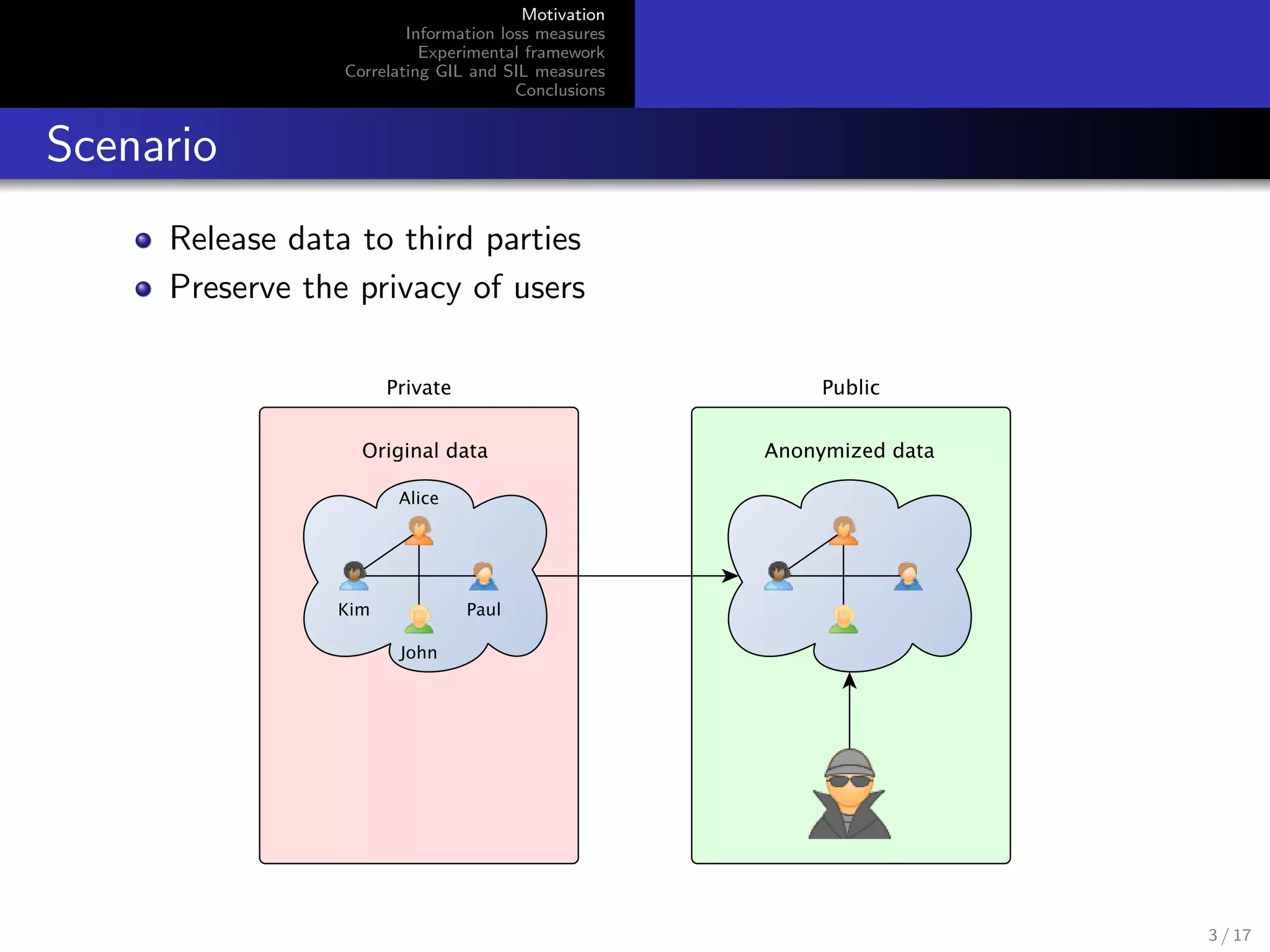
Scenario
Release data to third parties
Preserve the privacy of users
3 / 17
Motivation
Information loss measures
Experimental framework
Correlating GIL and SIL measures
Conclusions
Motivation
We observe...
There are several graph-mining tasks and several methods to
compute each task.
How can we evaluate the real data utility?
Question
Can we use some generic graph metrics to predict real graph-mining
tasks?
4 / 17
Motivation
Information loss measures
Experimental framework
Correlating GIL and SIL measures
Conclusions
Generic information loss (GIL)
Specific information loss (SIL)
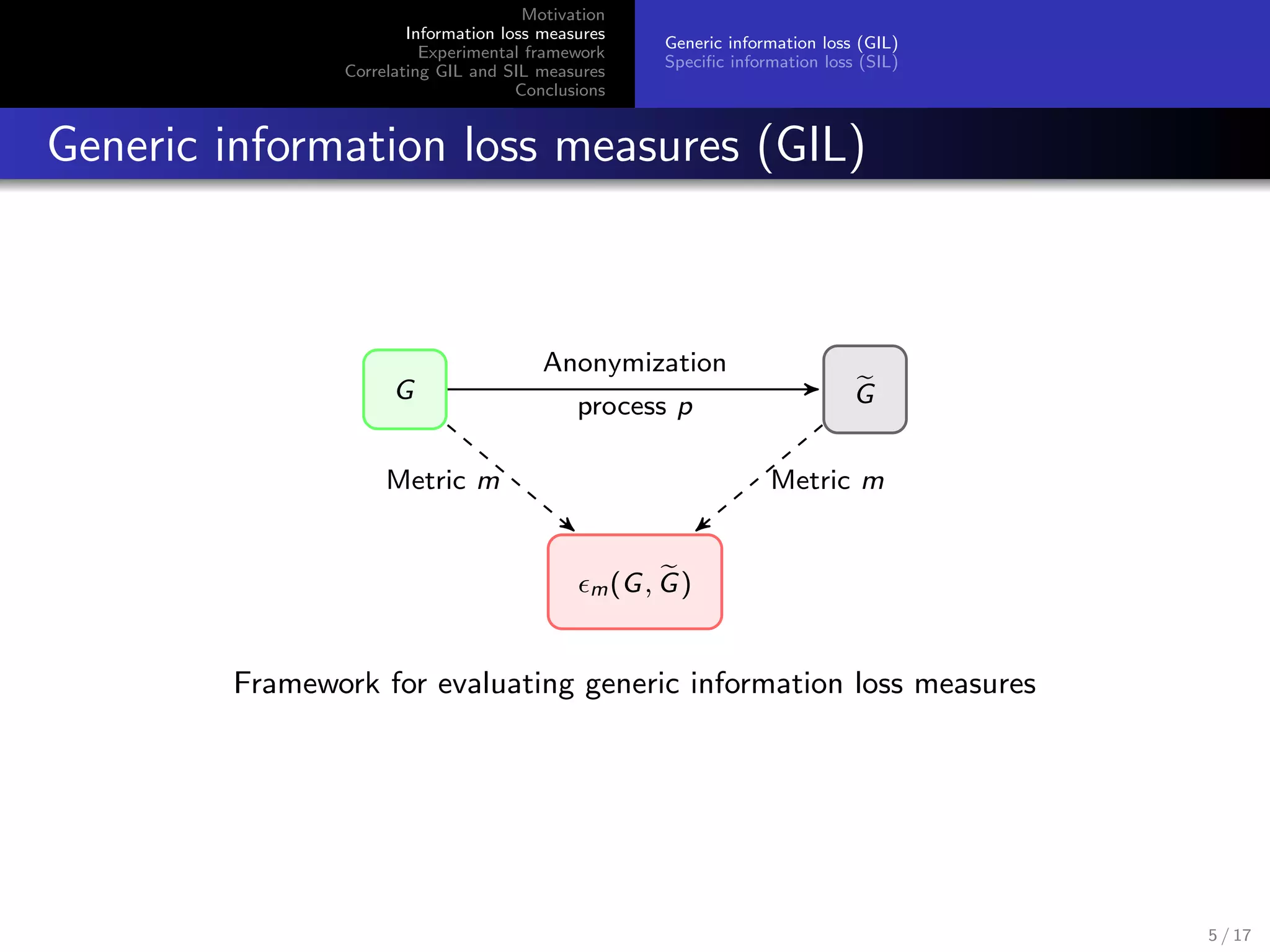
Generic information loss measures (GIL)
G G
m(G, G)
Anonymization
process p
Metric m Metric m
Framework for evaluating generic information loss measures
5 / 17
Motivation
Information loss measures
Experimental framework
Correlating GIL and SIL measures
Conclusions
Generic information loss (GIL)
Specific information loss (SIL)
Generic information loss measures (GIL)
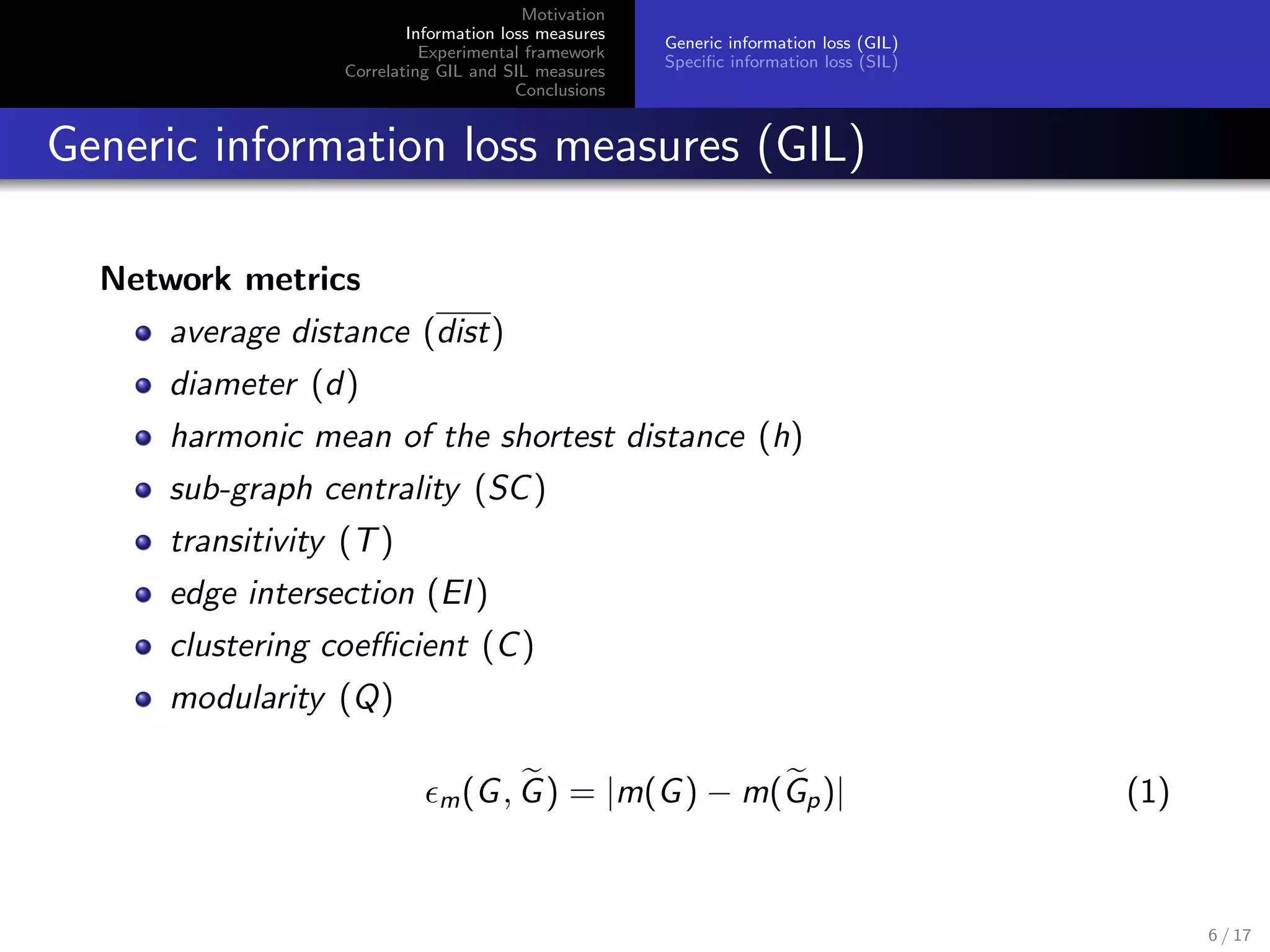
Network metrics
average distance (dist)
diameter (d)
harmonic mean of the shortest distance (h)
sub-graph centrality (SC)
transitivity (T)
edge intersection (EI)
clustering coefficient (C)
modularity (Q)
m(G, G) = |m(G) − m(Gp)| (1)
6 / 17
Motivation
Information loss measures
Experimental framework
Correlating GIL and SIL measures
Conclusions
Generic information loss (GIL)
Specific information loss (SIL)
Generic information loss measures (GIL)
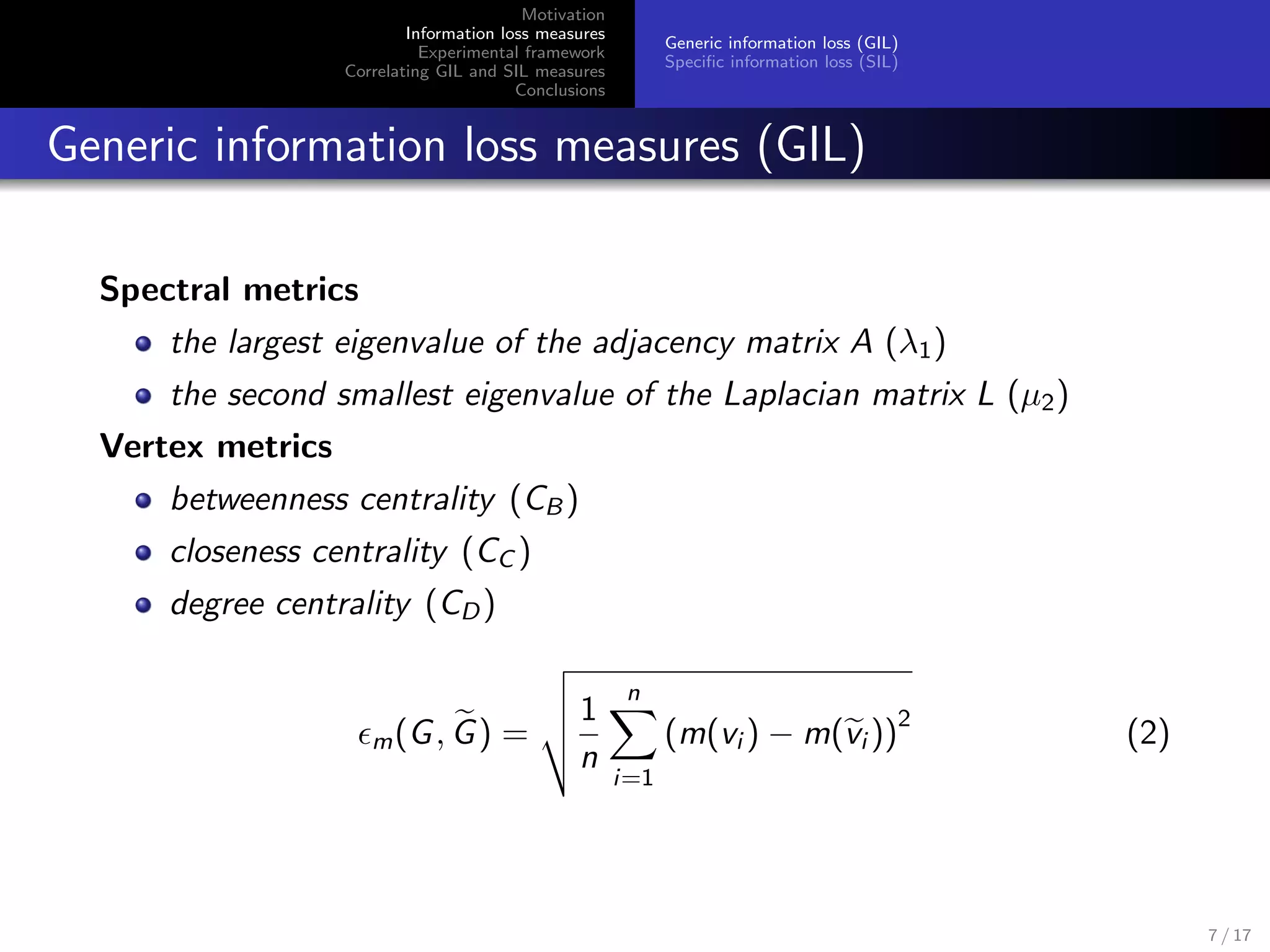
Spectral metrics
the largest eigenvalue of the adjacency matrix A (λ1)
the second smallest eigenvalue of the Laplacian matrix L (µ2)
Vertex metrics
betweenness centrality (CB )
closeness centrality (CC )
degree centrality (CD)
m(G, G) =
1
n
n
i=1
(m(vi ) − m(vi ))
2
(2)
7 / 17
Motivation
Information loss measures
Experimental framework
Correlating GIL and SIL measures
Conclusions
Generic information loss (GIL)
Specific information loss (SIL)
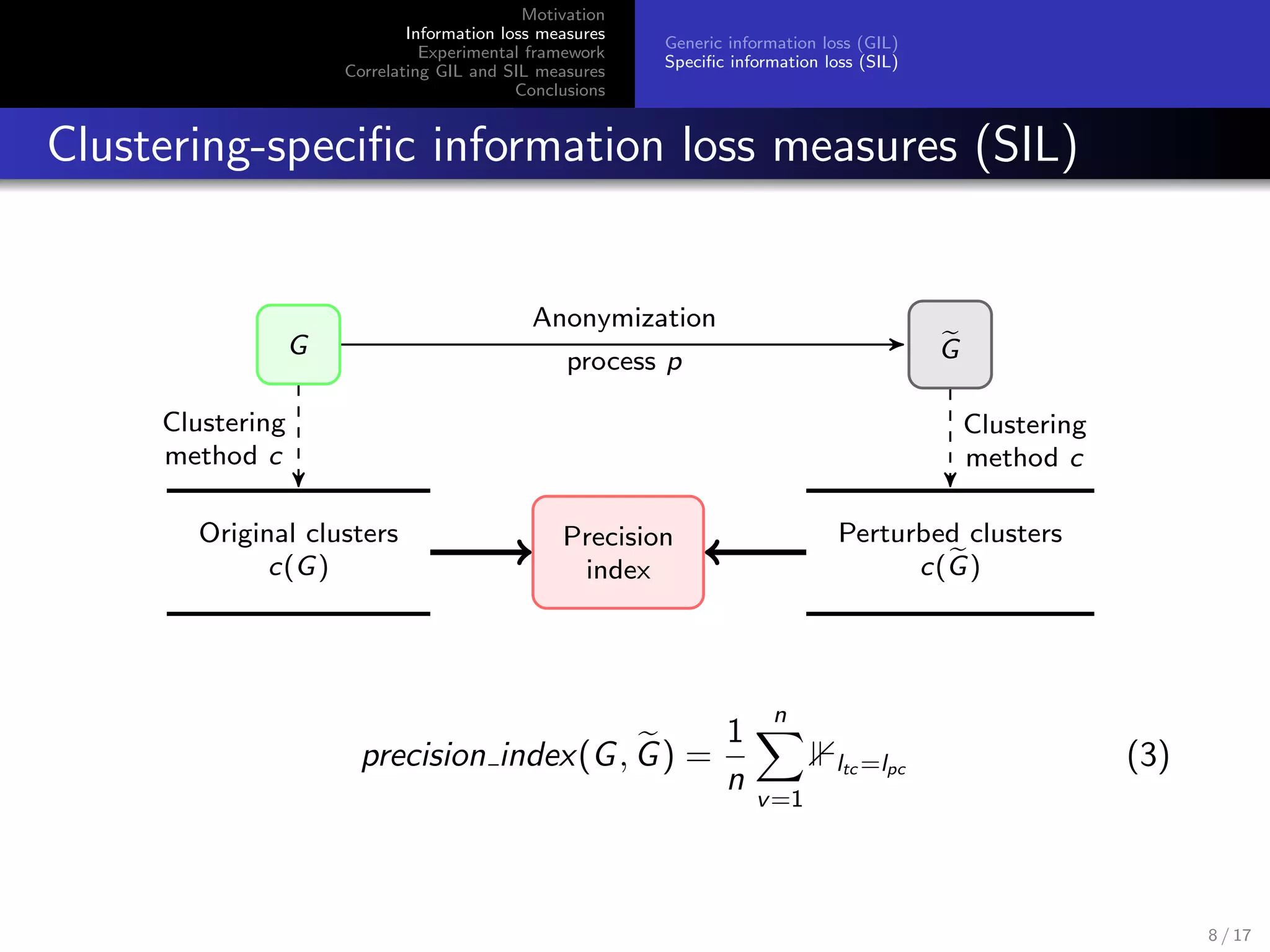
Clustering-specific information loss measures (SIL)
G G
Original clusters
c(G)
Precision
index
Perturbed clusters
c(G)
Anonymization
process p
Clustering
method c
Clustering
method c
precision index(G, G) =
1
n
n
v=1
ltc =lpc (3)
8 / 17
Motivation
Information loss measures
Experimental framework
Correlating GIL and SIL measures
Conclusions
Generic information loss (GIL)
Specific information loss (SIL)
Clustering-specific information loss measures (SIL)
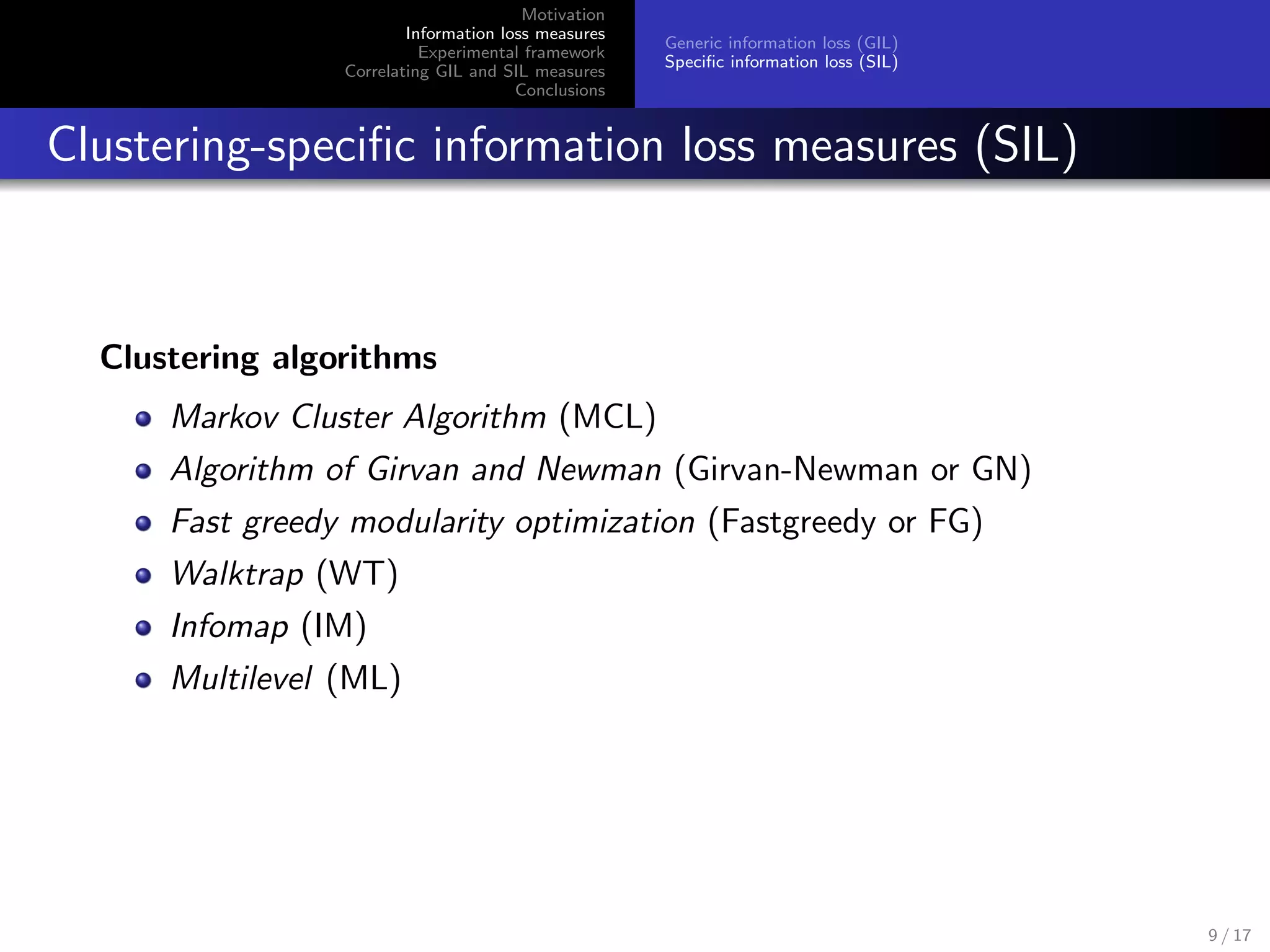
Clustering algorithms
Markov Cluster Algorithm (MCL)
Algorithm of Girvan and Newman (Girvan-Newman or GN)
Fast greedy modularity optimization (Fastgreedy or FG)
Walktrap (WT)
Infomap (IM)
Multilevel (ML)
9 / 17
Motivation
Information loss measures
Experimental framework
Correlating GIL and SIL measures
Conclusions
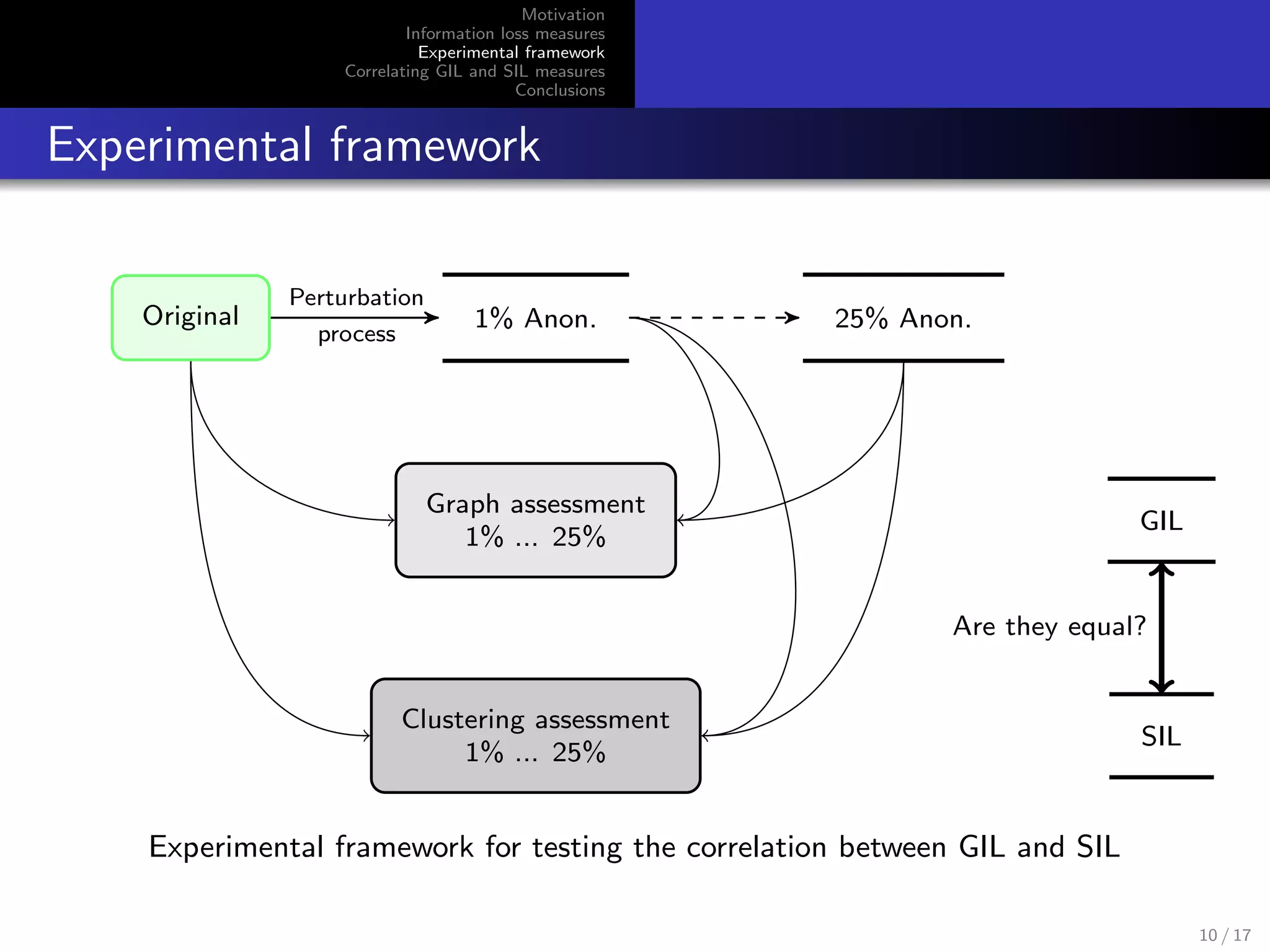
Experimental framework
Original 1% Anon. 25% Anon.
Graph assessment
1% ... 25%
GIL
Clustering assessment
1% ... 25%
SIL
Perturbation
process
Are they equal?
Experimental framework for testing the correlation between GIL and SIL
10 / 17
Motivation
Information loss measures
Experimental framework
Correlating GIL and SIL measures
Conclusions
GIL Self-correlation
SIL Self-correlation
GIL vs. SIL
Comparing datasets
GIL Self-correlation
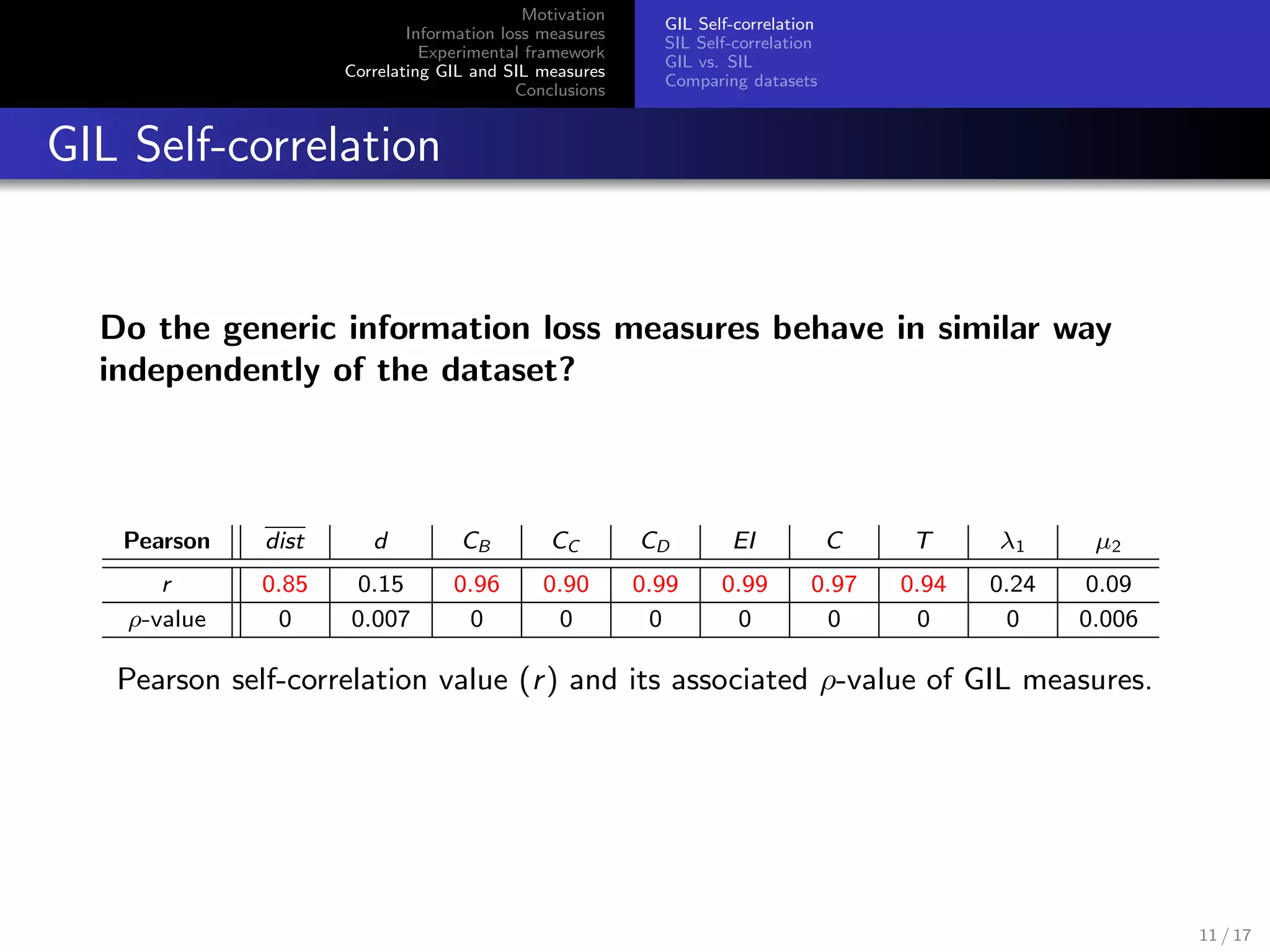
Do the generic information loss measures behave in similar way
independently of the dataset?
Pearson dist d CB CC CD EI C T λ1 µ2
r 0.85 0.15 0.96 0.90 0.99 0.99 0.97 0.94 0.24 0.09
ρ-value 0 0.007 0 0 0 0 0 0 0 0.006
Pearson self-correlation value (r) and its associated ρ-value of GIL measures.
11 / 17
Motivation
Information loss measures
Experimental framework
Correlating GIL and SIL measures
Conclusions
GIL Self-correlation
SIL Self-correlation
GIL vs. SIL
Comparing datasets
SIL self-correlation
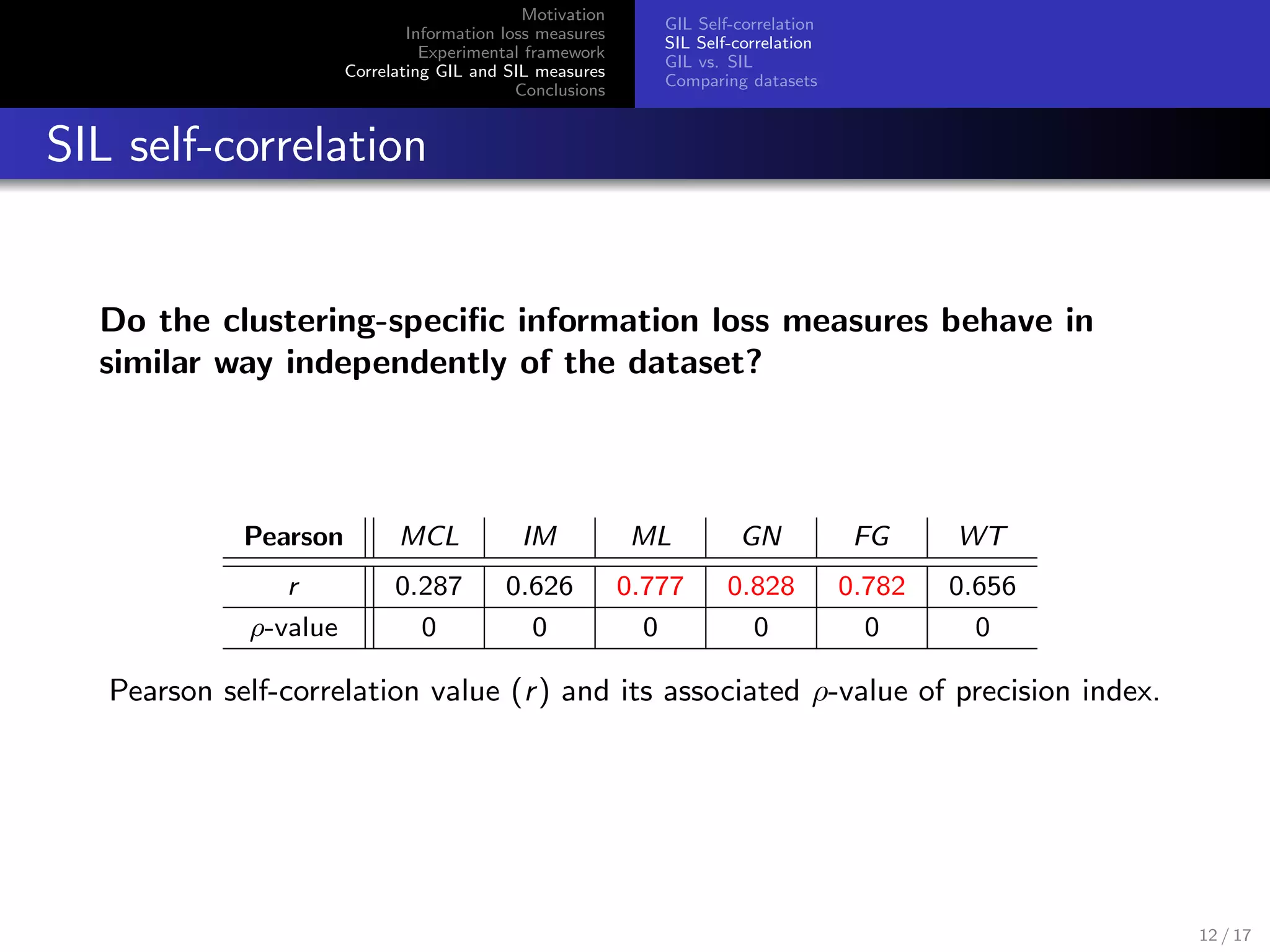
Do the clustering-specific information loss measures behave in
similar way independently of the dataset?
Pearson MCL IM ML GN FG WT
r 0.287 0.626 0.777 0.828 0.782 0.656
ρ-value 0 0 0 0 0 0
Pearson self-correlation value (r) and its associated ρ-value of precision index.
12 / 17
Motivation
Information loss measures
Experimental framework
Correlating GIL and SIL measures
Conclusions
GIL Self-correlation
SIL Self-correlation
GIL vs. SIL
Comparing datasets
GIL vs. SIL
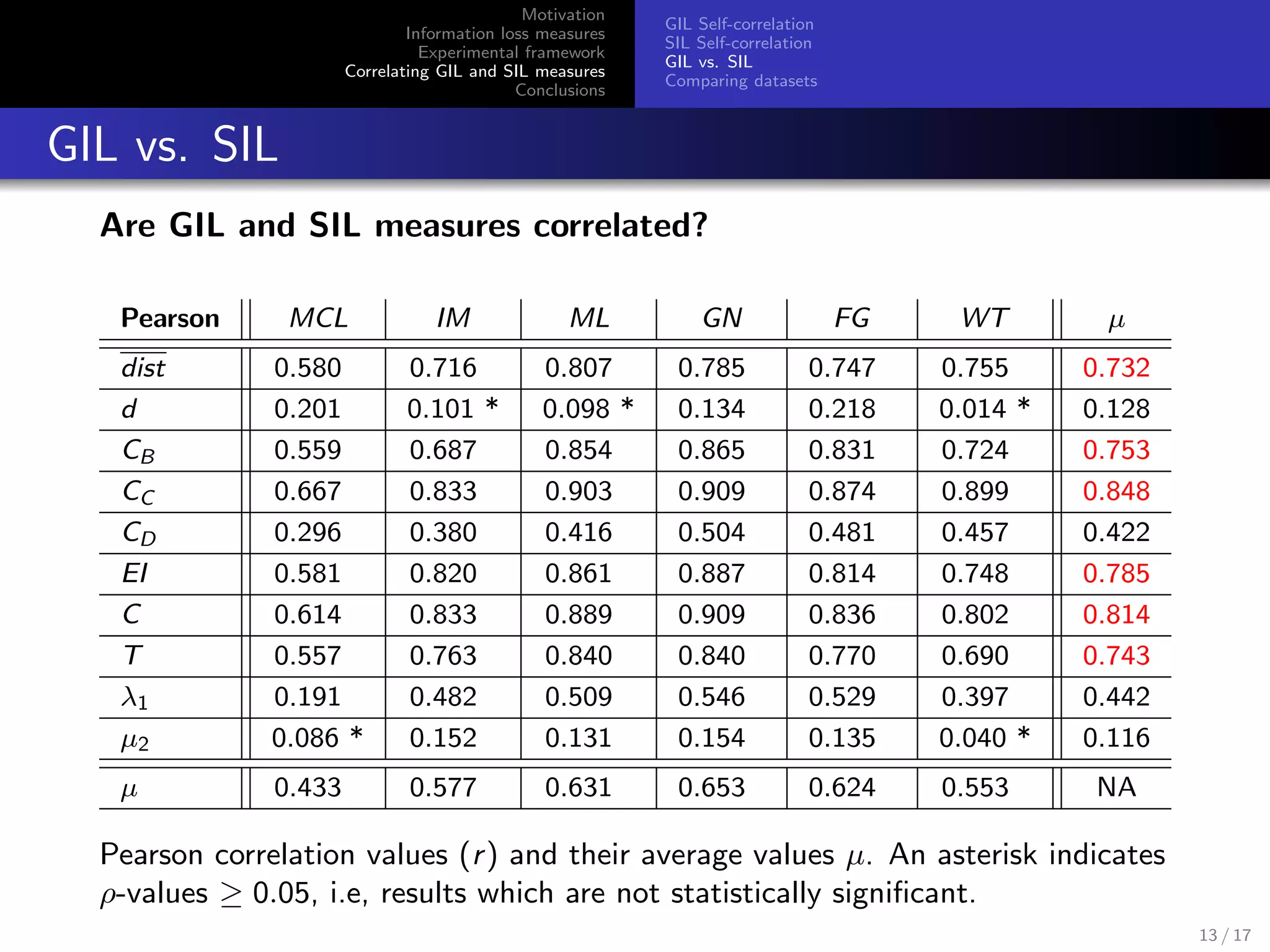
Are GIL and SIL measures correlated?
Pearson MCL IM ML GN FG WT µ
dist 0.580 0.716 0.807 0.785 0.747 0.755 0.732
d 0.201 0.101 * 0.098 * 0.134 0.218 0.014 * 0.128
CB 0.559 0.687 0.854 0.865 0.831 0.724 0.753
CC 0.667 0.833 0.903 0.909 0.874 0.899 0.848
CD 0.296 0.380 0.416 0.504 0.481 0.457 0.422
EI 0.581 0.820 0.861 0.887 0.814 0.748 0.785
C 0.614 0.833 0.889 0.909 0.836 0.802 0.814
T 0.557 0.763 0.840 0.840 0.770 0.690 0.743
λ1 0.191 0.482 0.509 0.546 0.529 0.397 0.442
µ2 0.086 * 0.152 0.131 0.154 0.135 0.040 * 0.116
µ 0.433 0.577 0.631 0.653 0.624 0.553 NA
Pearson correlation values (r) and their average values µ. An asterisk indicates
ρ-values ≥ 0.05, i.e, results which are not statistically significant.
13 / 17
Motivation
Information loss measures
Experimental framework
Correlating GIL and SIL measures
Conclusions
GIL Self-correlation
SIL Self-correlation
GIL vs. SIL
Comparing datasets
Aggregated GIL vs. SIL
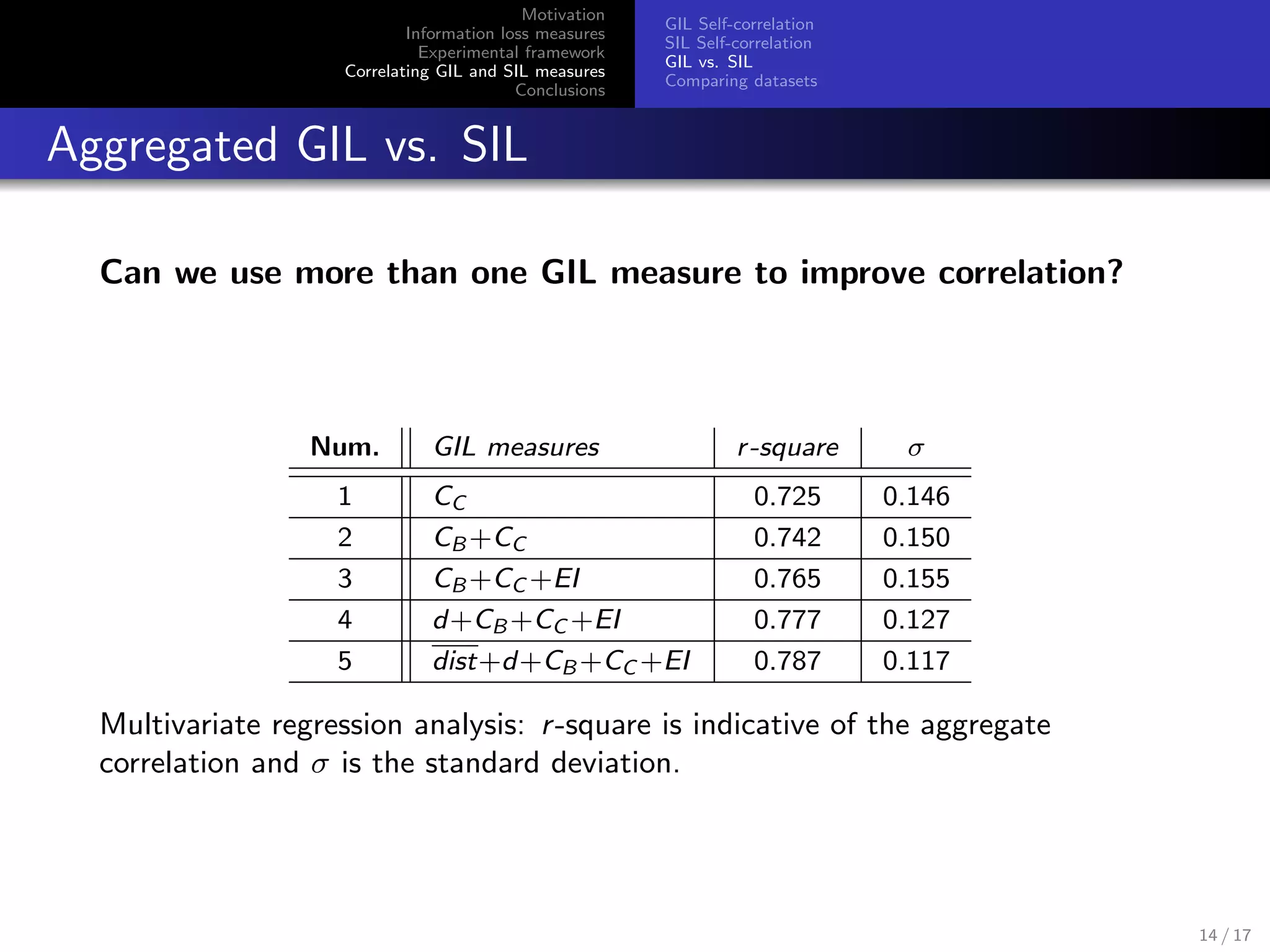
Can we use more than one GIL measure to improve correlation?
Num. GIL measures r-square σ
1 CC 0.725 0.146
2 CB +CC 0.742 0.150
3 CB +CC +EI 0.765 0.155
4 d+CB +CC +EI 0.777 0.127
5 dist+d+CB +CC +EI 0.787 0.117
Multivariate regression analysis: r-square is indicative of the aggregate
correlation and σ is the standard deviation.
14 / 17
Motivation
Information loss measures
Experimental framework
Correlating GIL and SIL measures
Conclusions
GIL Self-correlation
SIL Self-correlation
GIL vs. SIL
Comparing datasets
GIL vs. SIL
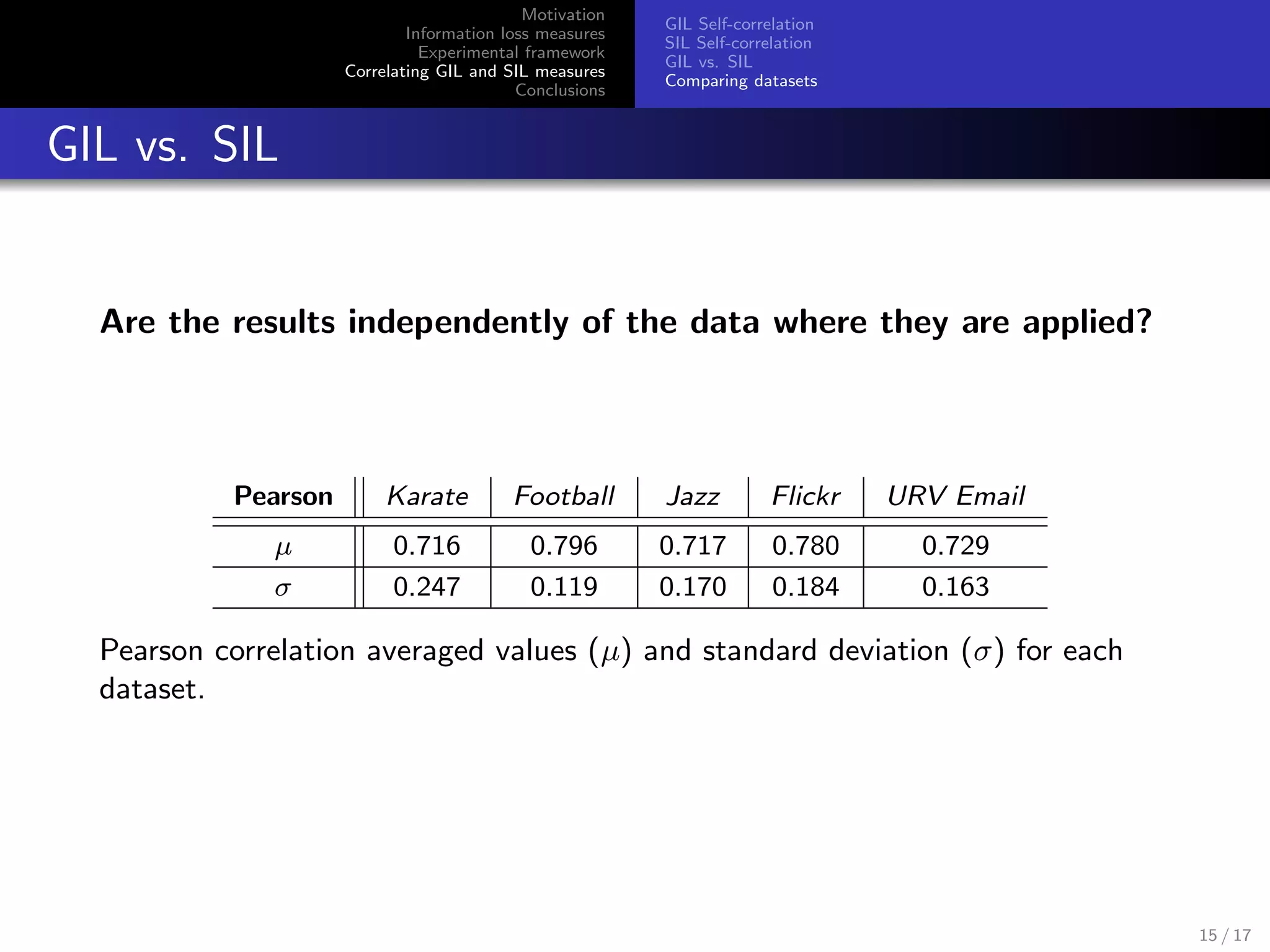
Are the results independently of the data where they are applied?
Pearson Karate Football Jazz Flickr URV Email
µ 0.716 0.796 0.717 0.780 0.729
σ 0.247 0.119 0.170 0.184 0.163
Pearson correlation averaged values (µ) and standard deviation (σ) for each
dataset.
15 / 17
Motivation
Information loss measures
Experimental framework
Correlating GIL and SIL measures
Conclusions
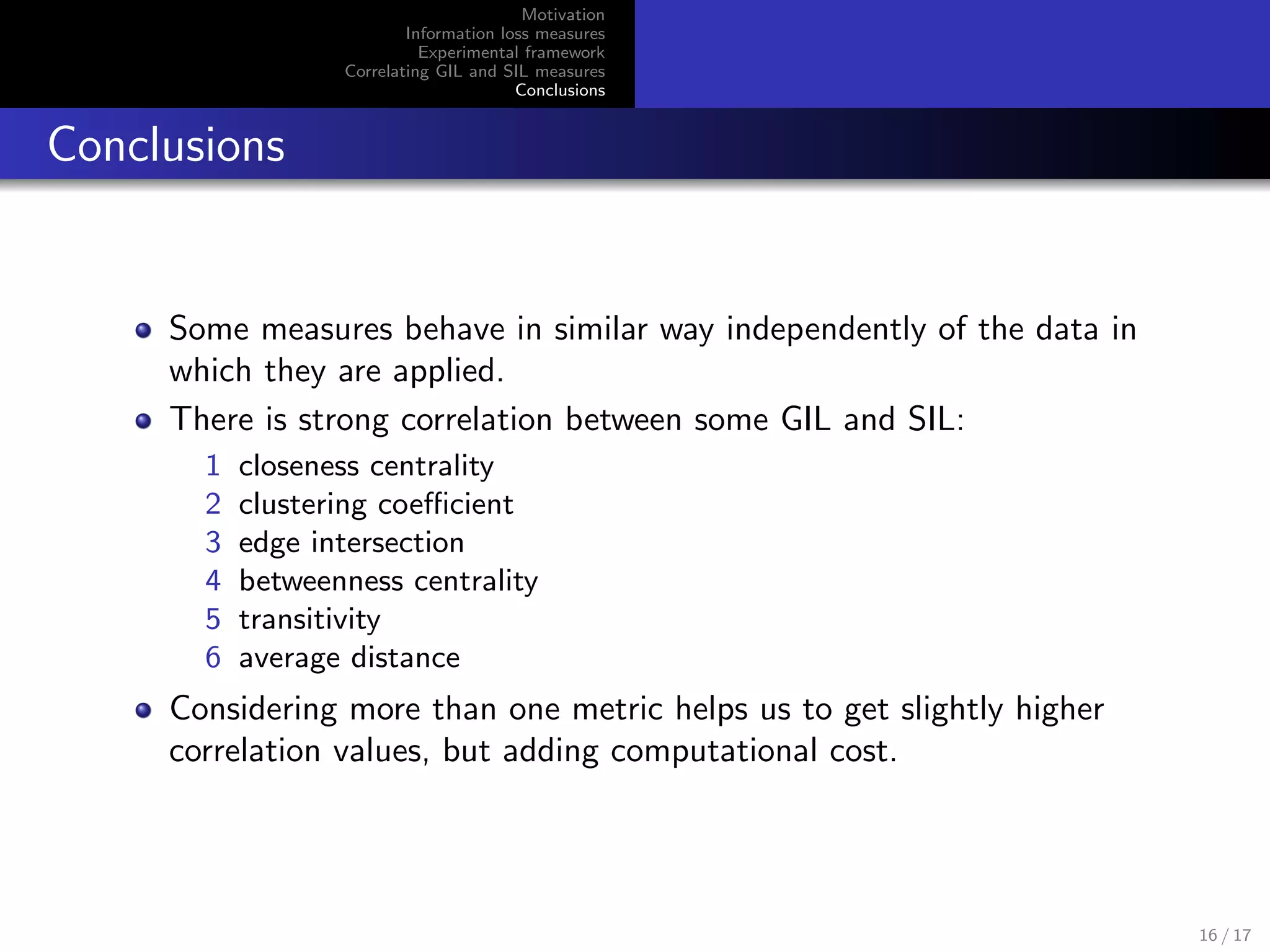
Conclusions
Some measures behave in similar way independently of the data in
which they are applied.
There is strong correlation between some GIL and SIL:
1 closeness centrality
2 clustering coefficient
3 edge intersection
4 betweenness centrality
5 transitivity
6 average distance
Considering more than one metric helps us to get slightly higher
correlation values, but adding computational cost.
16 / 17
Motivation
Information loss measures
Experimental framework
Correlating GIL and SIL measures
Conclusions
The End
Thanks for your attention
Jordi Casas-Roma UOC jcasasr@uoc.edu
Jordi Herrera-Joancomart´ı UAB jherrera@deic.uab.cat
Vicen¸c Torra IIIA-CSIC vtorra@iiia.csic.es
17 / 17

Anonymizing Graphs: Measuring Quality for Clustering

  • 1.
    Motivation Information loss measures Experimentalframework Correlating GIL and SIL measures Conclusions Anonymizing graphs: measuring quality for clustering Jordi Casas-Roma 1 Jordi Herrera-Joancomart´ı 2 Vicen¸c Torra 3 1 Universitat Oberta de Catalunya (UOC) jcasasr@uoc.edu 2 Universitat Aut`onoma de Barcelona (UAB) jherrera@deic.uab.cat 3 Artificial Intelligence Research Institute (IIIA) Spanish National Research Council (CSIC) vtorra@iiia.csic.es UOC Research Showcase 2015. February 11, 2015 1 / 17
  • 2.
    Motivation Information loss measures Experimentalframework Correlating GIL and SIL measures Conclusions Overview 1 Motivation 2 Information loss measures 3 Experimental framework 4 Correlating GIL and SIL measures 5 Conclusions 2 / 17
  • 3.
    Motivation Information loss measures Experimentalframework Correlating GIL and SIL measures Conclusions Scenario Release data to third parties Preserve the privacy of users 3 / 17
  • 4.
    Motivation Information loss measures Experimentalframework Correlating GIL and SIL measures Conclusions Motivation We observe... There are several graph-mining tasks and several methods to compute each task. How can we evaluate the real data utility? Question Can we use some generic graph metrics to predict real graph-mining tasks? 4 / 17
  • 5.
    Motivation Information loss measures Experimentalframework Correlating GIL and SIL measures Conclusions Generic information loss (GIL) Specific information loss (SIL) Generic information loss measures (GIL) G G m(G, G) Anonymization process p Metric m Metric m Framework for evaluating generic information loss measures 5 / 17
  • 6.
    Motivation Information loss measures Experimentalframework Correlating GIL and SIL measures Conclusions Generic information loss (GIL) Specific information loss (SIL) Generic information loss measures (GIL) Network metrics average distance (dist) diameter (d) harmonic mean of the shortest distance (h) sub-graph centrality (SC) transitivity (T) edge intersection (EI) clustering coefficient (C) modularity (Q) m(G, G) = |m(G) − m(Gp)| (1) 6 / 17
  • 7.
    Motivation Information loss measures Experimentalframework Correlating GIL and SIL measures Conclusions Generic information loss (GIL) Specific information loss (SIL) Generic information loss measures (GIL) Spectral metrics the largest eigenvalue of the adjacency matrix A (λ1) the second smallest eigenvalue of the Laplacian matrix L (µ2) Vertex metrics betweenness centrality (CB ) closeness centrality (CC ) degree centrality (CD) m(G, G) = 1 n n i=1 (m(vi ) − m(vi )) 2 (2) 7 / 17
  • 8.
    Motivation Information loss measures Experimentalframework Correlating GIL and SIL measures Conclusions Generic information loss (GIL) Specific information loss (SIL) Clustering-specific information loss measures (SIL) G G Original clusters c(G) Precision index Perturbed clusters c(G) Anonymization process p Clustering method c Clustering method c precision index(G, G) = 1 n n v=1 ltc =lpc (3) 8 / 17
  • 9.
    Motivation Information loss measures Experimentalframework Correlating GIL and SIL measures Conclusions Generic information loss (GIL) Specific information loss (SIL) Clustering-specific information loss measures (SIL) Clustering algorithms Markov Cluster Algorithm (MCL) Algorithm of Girvan and Newman (Girvan-Newman or GN) Fast greedy modularity optimization (Fastgreedy or FG) Walktrap (WT) Infomap (IM) Multilevel (ML) 9 / 17
  • 10.
    Motivation Information loss measures Experimentalframework Correlating GIL and SIL measures Conclusions Experimental framework Original 1% Anon. 25% Anon. Graph assessment 1% ... 25% GIL Clustering assessment 1% ... 25% SIL Perturbation process Are they equal? Experimental framework for testing the correlation between GIL and SIL 10 / 17
  • 11.
    Motivation Information loss measures Experimentalframework Correlating GIL and SIL measures Conclusions GIL Self-correlation SIL Self-correlation GIL vs. SIL Comparing datasets GIL Self-correlation Do the generic information loss measures behave in similar way independently of the dataset? Pearson dist d CB CC CD EI C T λ1 µ2 r 0.85 0.15 0.96 0.90 0.99 0.99 0.97 0.94 0.24 0.09 ρ-value 0 0.007 0 0 0 0 0 0 0 0.006 Pearson self-correlation value (r) and its associated ρ-value of GIL measures. 11 / 17
  • 12.
    Motivation Information loss measures Experimentalframework Correlating GIL and SIL measures Conclusions GIL Self-correlation SIL Self-correlation GIL vs. SIL Comparing datasets SIL self-correlation Do the clustering-specific information loss measures behave in similar way independently of the dataset? Pearson MCL IM ML GN FG WT r 0.287 0.626 0.777 0.828 0.782 0.656 ρ-value 0 0 0 0 0 0 Pearson self-correlation value (r) and its associated ρ-value of precision index. 12 / 17
  • 13.
    Motivation Information loss measures Experimentalframework Correlating GIL and SIL measures Conclusions GIL Self-correlation SIL Self-correlation GIL vs. SIL Comparing datasets GIL vs. SIL Are GIL and SIL measures correlated? Pearson MCL IM ML GN FG WT µ dist 0.580 0.716 0.807 0.785 0.747 0.755 0.732 d 0.201 0.101 * 0.098 * 0.134 0.218 0.014 * 0.128 CB 0.559 0.687 0.854 0.865 0.831 0.724 0.753 CC 0.667 0.833 0.903 0.909 0.874 0.899 0.848 CD 0.296 0.380 0.416 0.504 0.481 0.457 0.422 EI 0.581 0.820 0.861 0.887 0.814 0.748 0.785 C 0.614 0.833 0.889 0.909 0.836 0.802 0.814 T 0.557 0.763 0.840 0.840 0.770 0.690 0.743 λ1 0.191 0.482 0.509 0.546 0.529 0.397 0.442 µ2 0.086 * 0.152 0.131 0.154 0.135 0.040 * 0.116 µ 0.433 0.577 0.631 0.653 0.624 0.553 NA Pearson correlation values (r) and their average values µ. An asterisk indicates ρ-values ≥ 0.05, i.e, results which are not statistically significant. 13 / 17
  • 14.
    Motivation Information loss measures Experimentalframework Correlating GIL and SIL measures Conclusions GIL Self-correlation SIL Self-correlation GIL vs. SIL Comparing datasets Aggregated GIL vs. SIL Can we use more than one GIL measure to improve correlation? Num. GIL measures r-square σ 1 CC 0.725 0.146 2 CB +CC 0.742 0.150 3 CB +CC +EI 0.765 0.155 4 d+CB +CC +EI 0.777 0.127 5 dist+d+CB +CC +EI 0.787 0.117 Multivariate regression analysis: r-square is indicative of the aggregate correlation and σ is the standard deviation. 14 / 17
  • 15.
    Motivation Information loss measures Experimentalframework Correlating GIL and SIL measures Conclusions GIL Self-correlation SIL Self-correlation GIL vs. SIL Comparing datasets GIL vs. SIL Are the results independently of the data where they are applied? Pearson Karate Football Jazz Flickr URV Email µ 0.716 0.796 0.717 0.780 0.729 σ 0.247 0.119 0.170 0.184 0.163 Pearson correlation averaged values (µ) and standard deviation (σ) for each dataset. 15 / 17
  • 16.
    Motivation Information loss measures Experimentalframework Correlating GIL and SIL measures Conclusions Conclusions Some measures behave in similar way independently of the data in which they are applied. There is strong correlation between some GIL and SIL: 1 closeness centrality 2 clustering coefficient 3 edge intersection 4 betweenness centrality 5 transitivity 6 average distance Considering more than one metric helps us to get slightly higher correlation values, but adding computational cost. 16 / 17
  • 17.
    Motivation Information loss measures Experimentalframework Correlating GIL and SIL measures Conclusions The End Thanks for your attention Jordi Casas-Roma UOC jcasasr@uoc.edu Jordi Herrera-Joancomart´ı UAB jherrera@deic.uab.cat Vicen¸c Torra IIIA-CSIC vtorra@iiia.csic.es 17 / 17