
Open Knowledge Management   The wiki way   Frieda Brioschi Wikimedia Italia ECKM 2009 Vicenza, 4 Sep 2009
Background
basis of how various groups and organizations operate.  it is typified by communal management, and open access to the information or material resources needed for projects.  decisions being made by some form of consensus decision-making or voting.  Openness http://en.wikipedia.org/wiki/Openness
website using wiki software, allowing the easy creation and editing of any number of interlinked Web pages within the browser.  Wikis are often used to create collaborative websites, to power community websites, for personal note taking, in corporate intranets, and in knowledge management systems.  Wiki http://en.wikipedia.org/wiki/Wiki
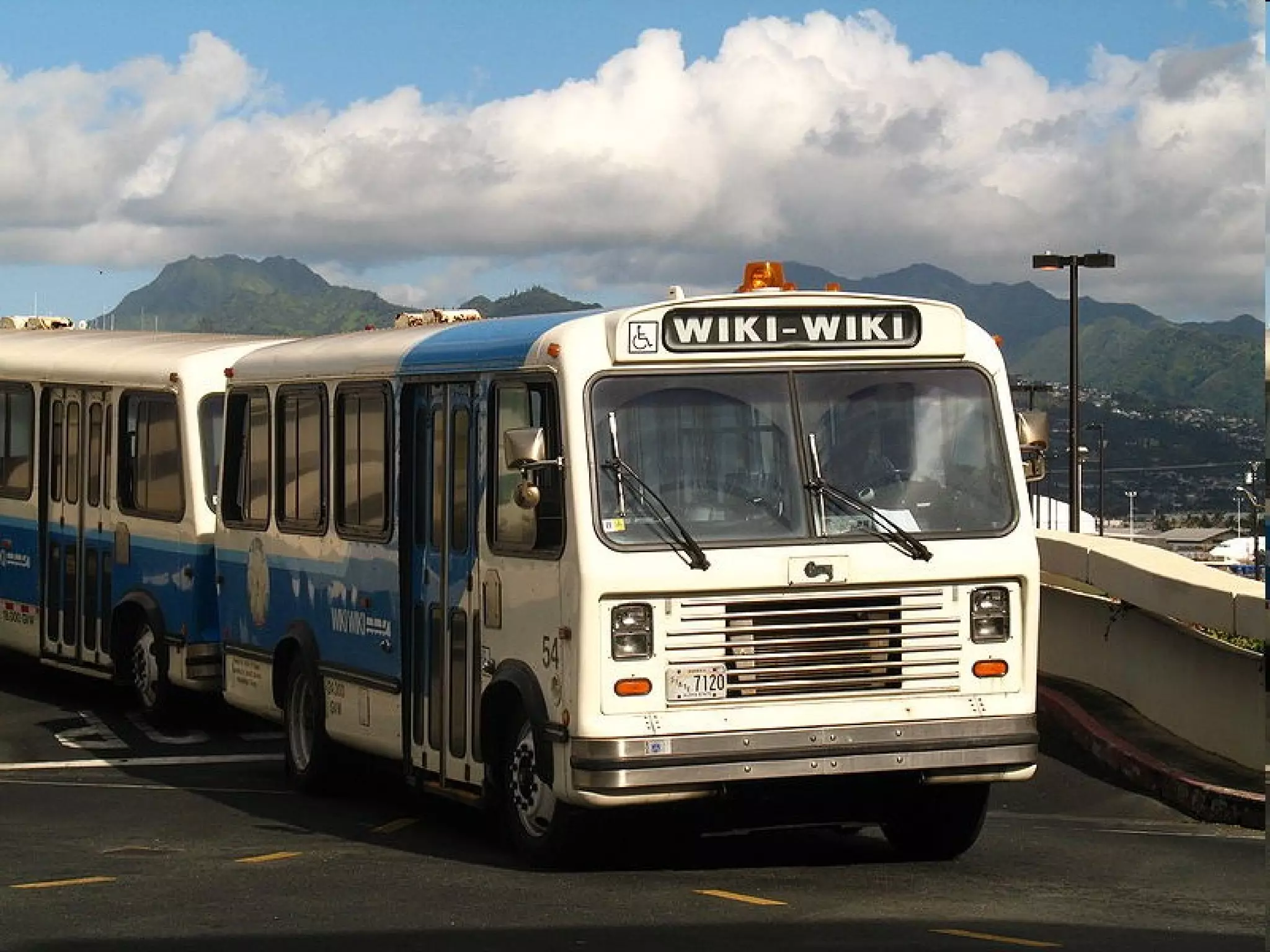
Ward Cunningham, the developer of the first wiki software (in 1995) , WikiWikiWeb, originally described it as " the simplest online database that could possibly work.  " "Wiki" is a Hawaiian word for "fast".  Wiki http://en.wikipedia.org/wiki/Wiki
http://commons.wikimedia.org/wiki/File:HNL_Wiki_Wiki_Bus.jpg
several  online  collaborative  wiki  projects  Wikimedia Universe
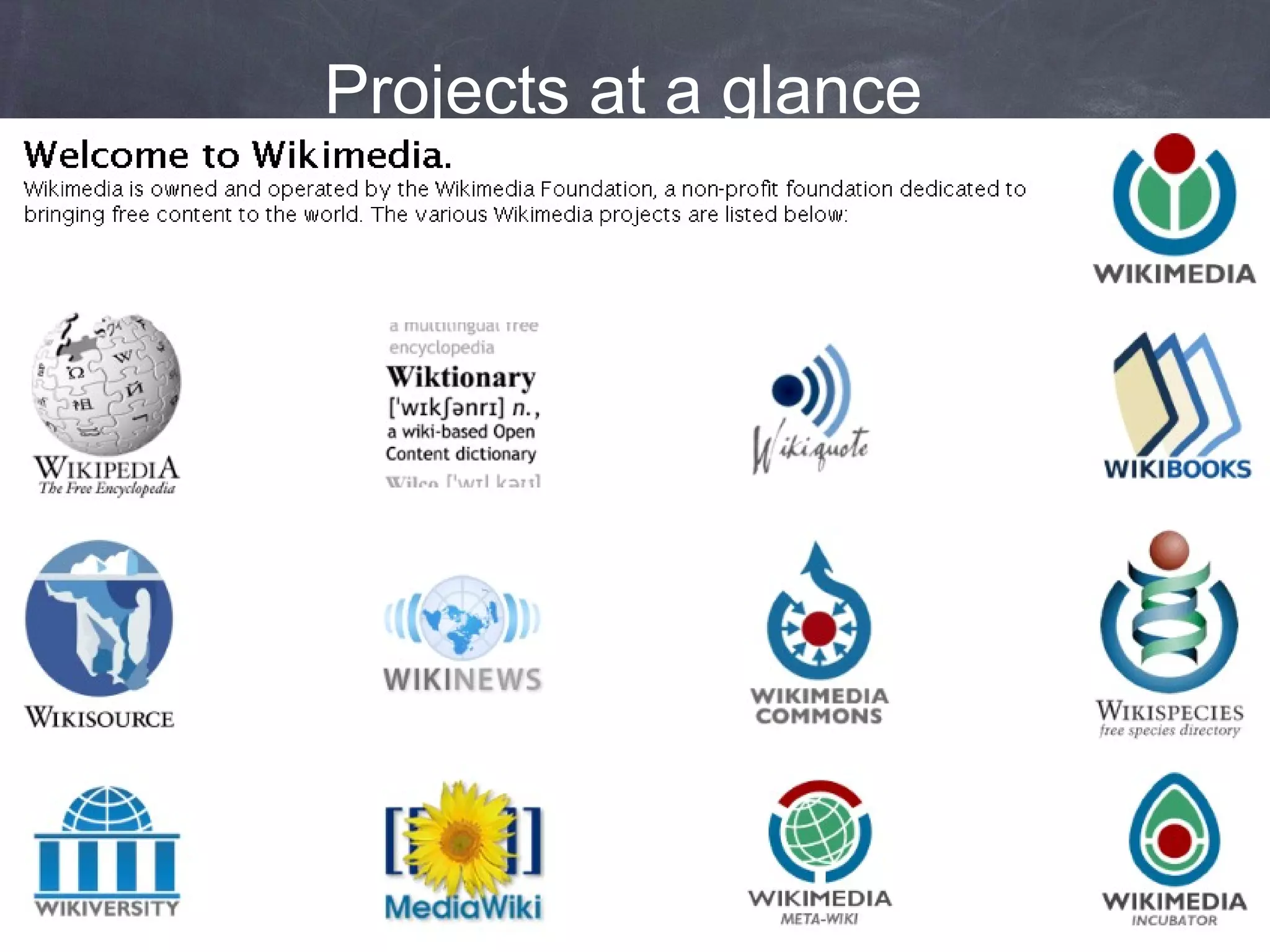
Projects at a glance
History
online encyclopedia  can be edited by anyone  aims to provide free encyclopedic information  launched on 15 January 2001 by Jimmy Wales and Larry Sanger  The concept of a free online encyclopedia originally came from Richard Stallman.  Wikipedia http://en.wikipedia.org/wiki/Wikipedia
Wikipedia http://commons.wikimedia.org/wiki/File:Old_Wikipedia.png
first domain created for a non-English Wikipedia was  deutsche.wikipedia.com   In January 2002, 90% of all Wikipedia articles were in English.  By January 2004, less than 50% were English. As of 2007, around 75% of all Wikipedia articles are contained within non-English Wikipedia versions.  Internationalization http://en.wikipedia.org/wiki/History_of_Wikipedia
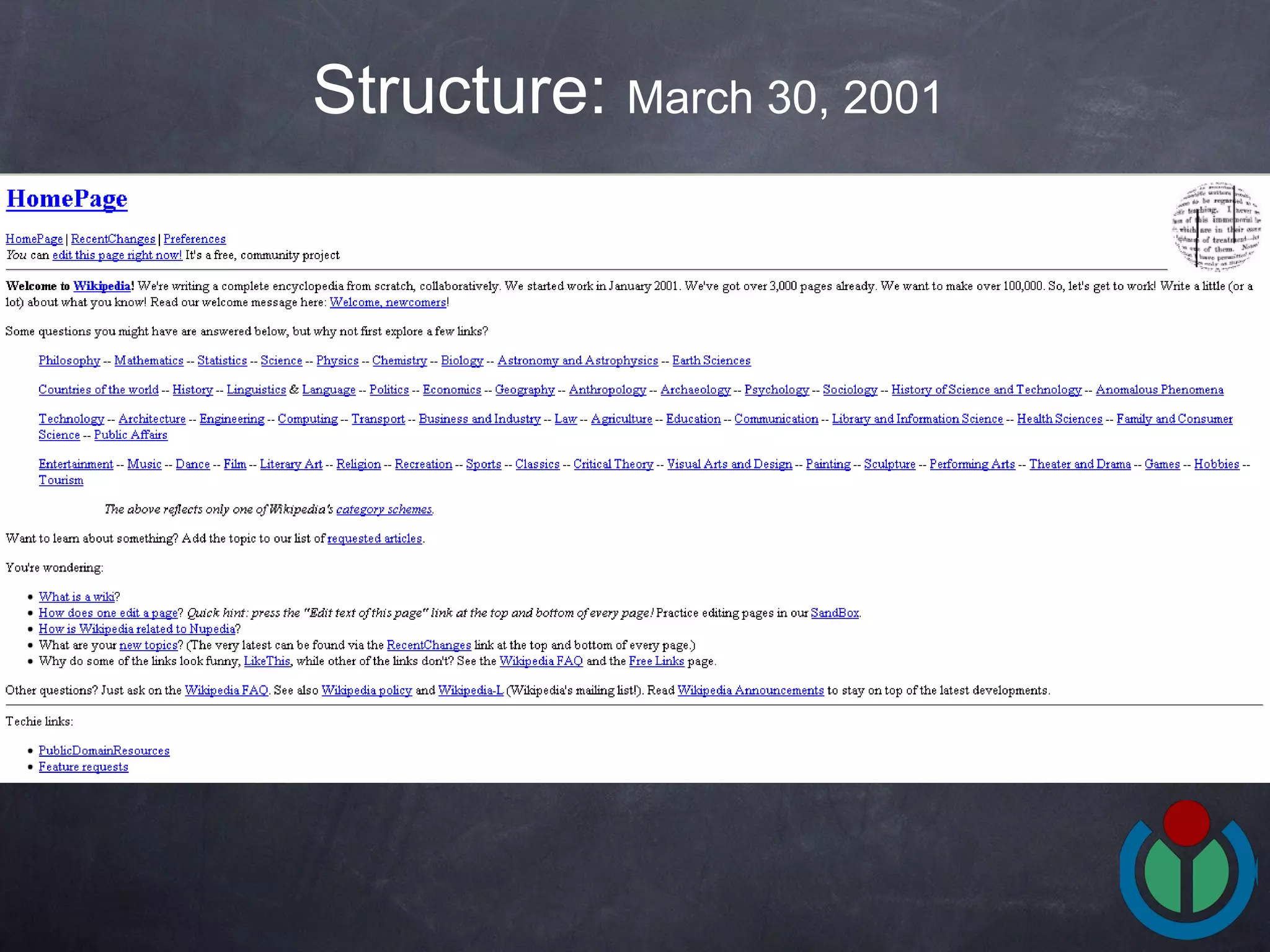
few info about the project no project name in the title of the page generic logo Structure:  March 30, 2001
few info about the project no project name untitled logo Structure:  March 30, 2001
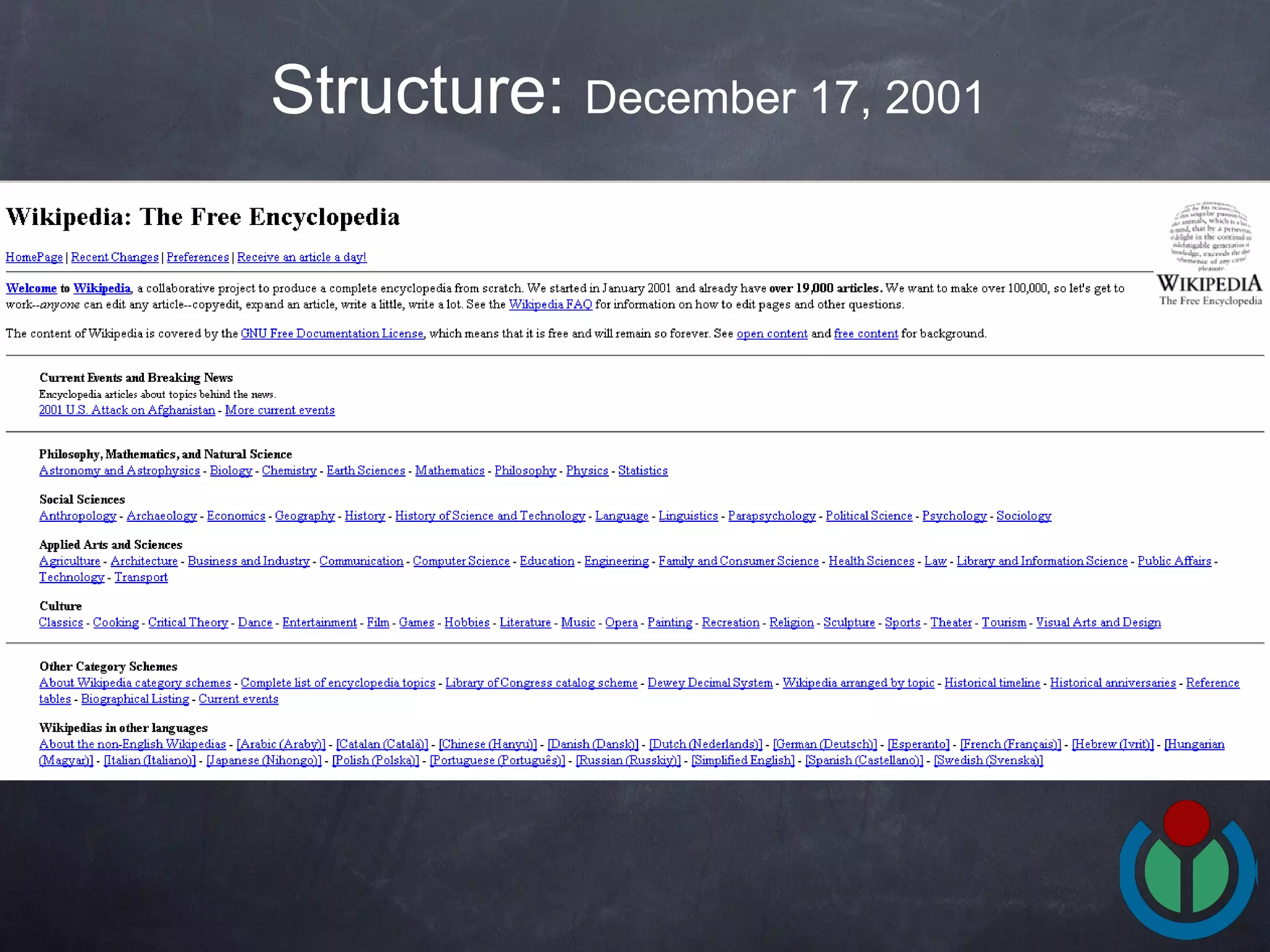
more info about the project (description & goals) project name full logo small menu “ Note: Unless you have the administrator password, you cannot currently edit this page. While this is unfortunate, it has turned out to be necessary to prevent vandalism of this page, which has occurred on several occasions.  “ Structure:  December 17, 2001
Structure:  December 17, 2001
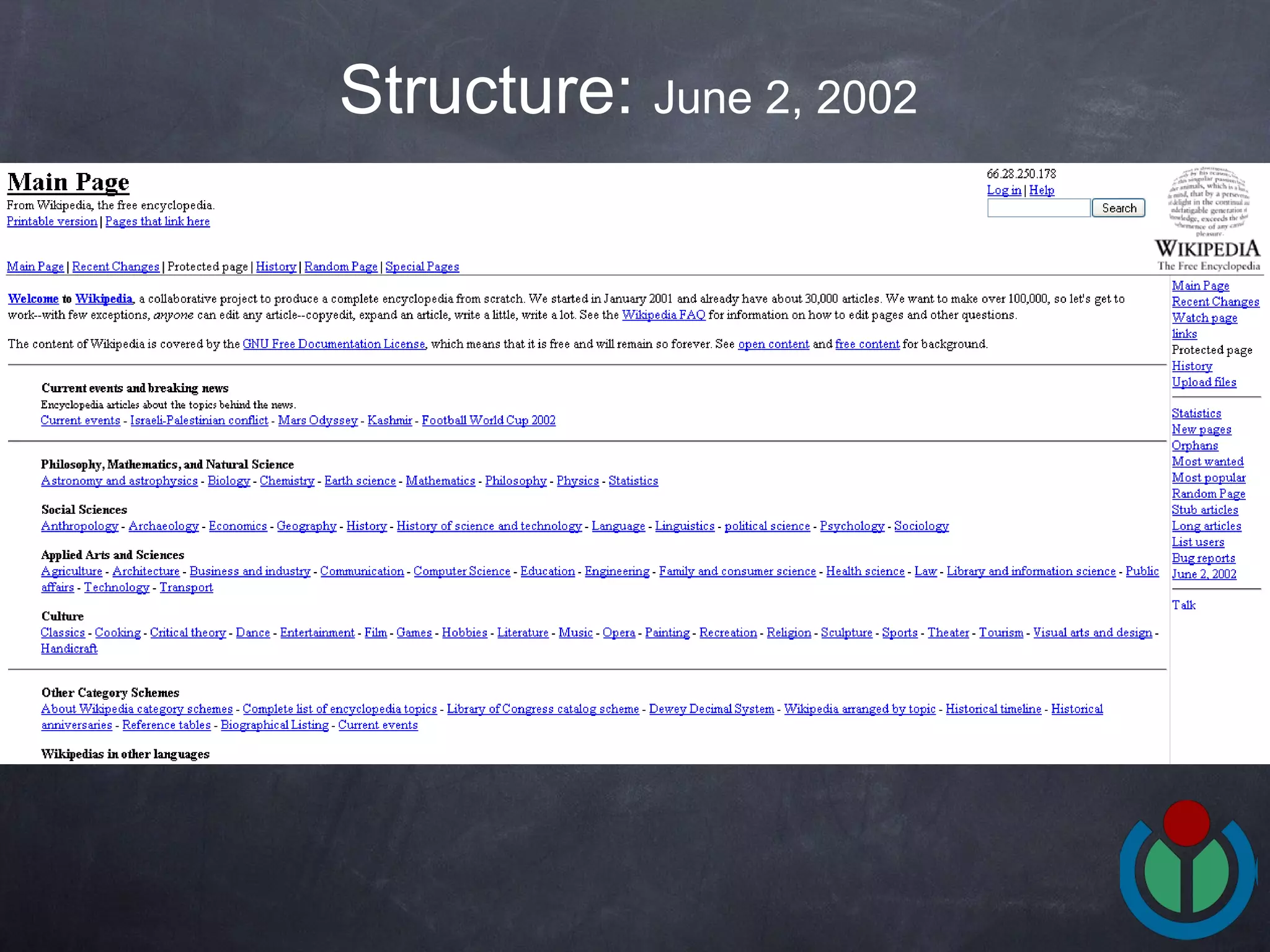
"Phase II" of the wiki software powering Wikipedia was introduced, replacing the older UseModWiki. Written specifically for the project by Magnus Manske, it included a PHP wiki engine  tech tools ( Statistics, New pages, Orphans, Most wanted, Most popular, Random Page, Stub articles, Long articles, List users, Bug reports)  Namespaces (special, talk) two menus (top & right) Structure:  June 2, 2002
Structure:  June 2, 2002
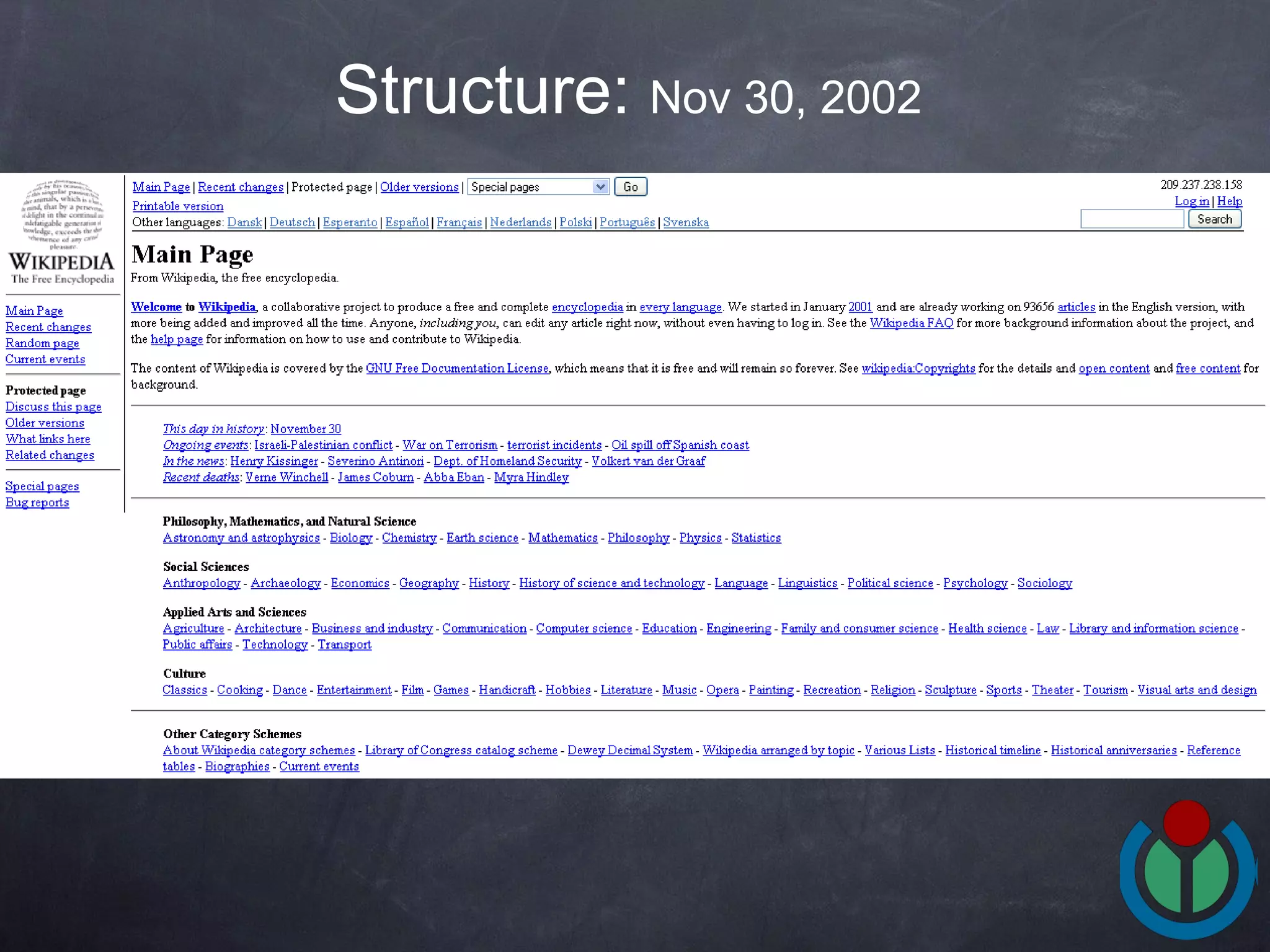
dubbed "Phase III", it replaced the older "Phase II" version, and became MediaWiki. It was written by Lee Daniel Crocker in response to the increasing demands of the growing project  interlanguage links   more namespaces (Wikipedia) two menus (top & right) Structure:  Nov 30, 2002
Structure:  Nov 30, 2002
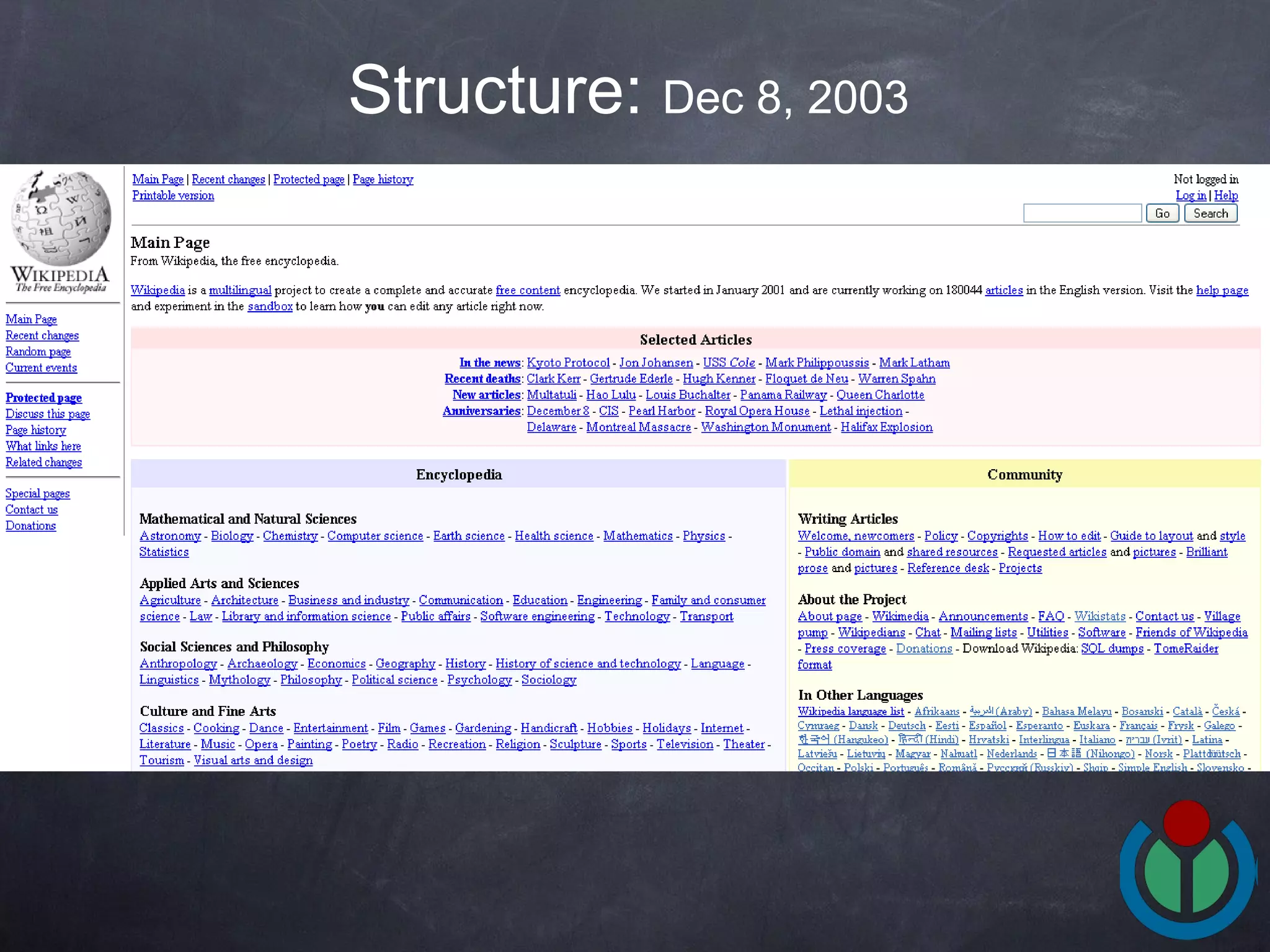
definitive logo  colours   Sister Projects (Meta, Wiktionary, Wikibooks, Wikiquote, Wikisource) Structure:  Dec 8, 2003
Structure:  Dec 8, 2003
How does it work?
“ So in the beginning, anybody could edit Wikipedia.  And then anybody could edit Wikipedia.  And as of tomorrow, anybody can edit Wikipedia.”   Jimmy Wales Open editing model   http://www.npr.org/templates/story/story.php?storyId=112257149
Except for a few pages every article may be edited anonymously or with a user account while only registered users may create a new article  (only in English edition) .  No article is owned by its creator or any other editor Open editing model   http://en.wikipedia.org/wiki/Wikipedia
the articles are collectively owned by a community of editors.  Changes to an article are available immediately  There’s no review before publishing Open editing model   http://en.wikipedia.org/wiki/Wikipedia
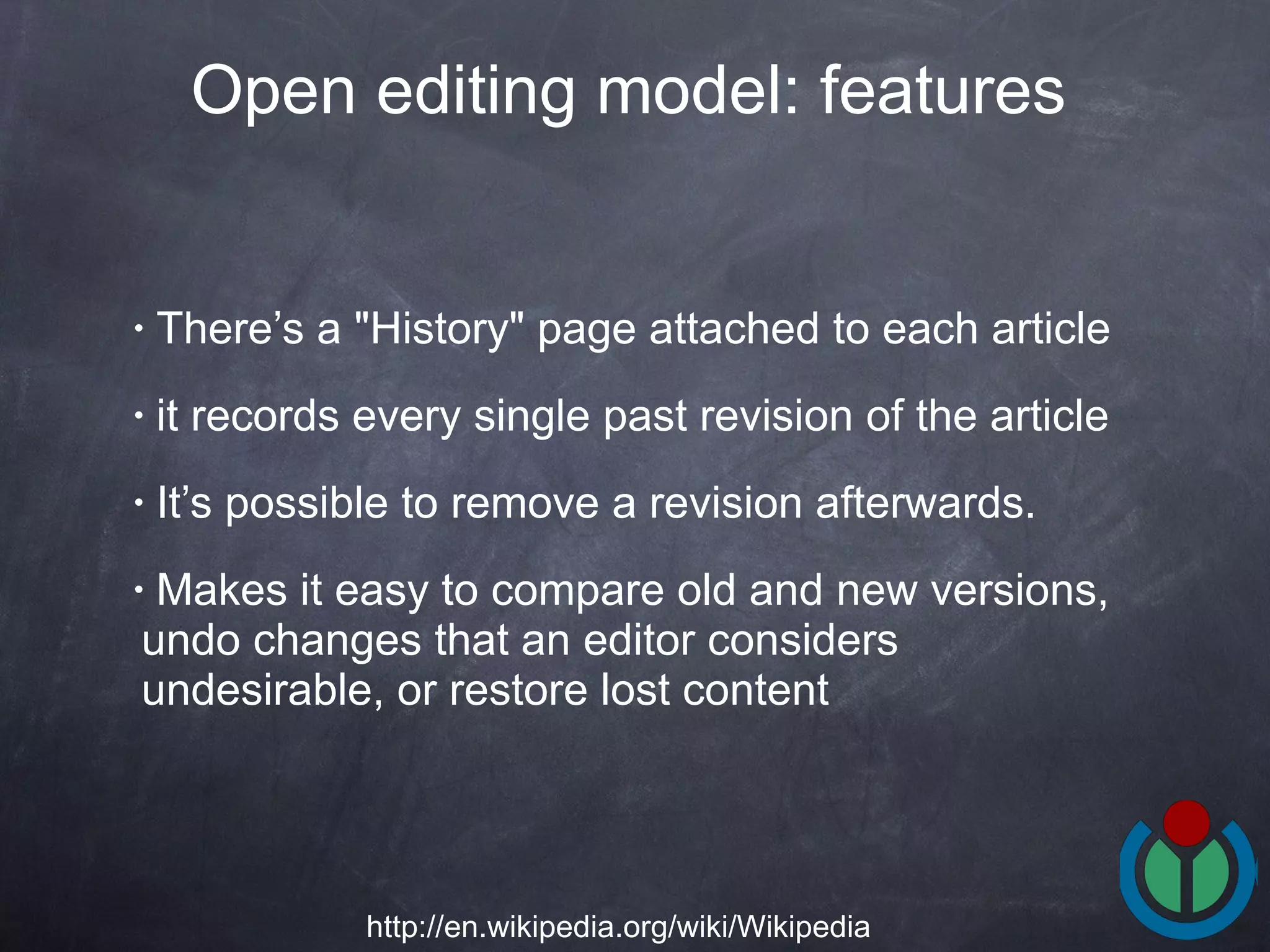
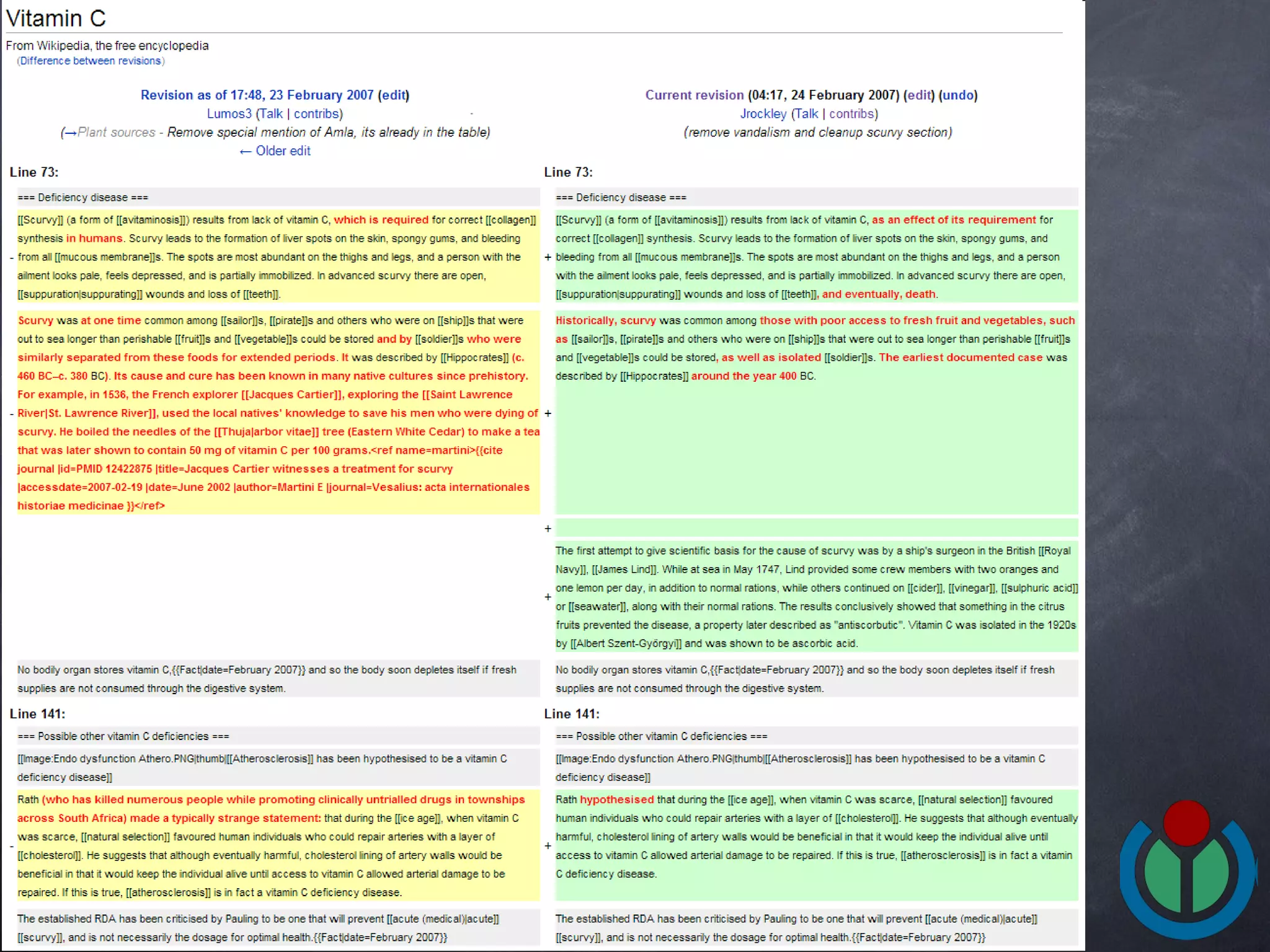
There’s a "History" page attached to each article it records every single past revision of the article It’s possible to remove a revision afterwards.  Makes it easy to compare old and new versions, undo changes that an editor considers undesirable, or restore lost content  Open editing model: features   http://en.wikipedia.org/wiki/Wikipedia
http://en.wikipedia.org/wiki/Openness
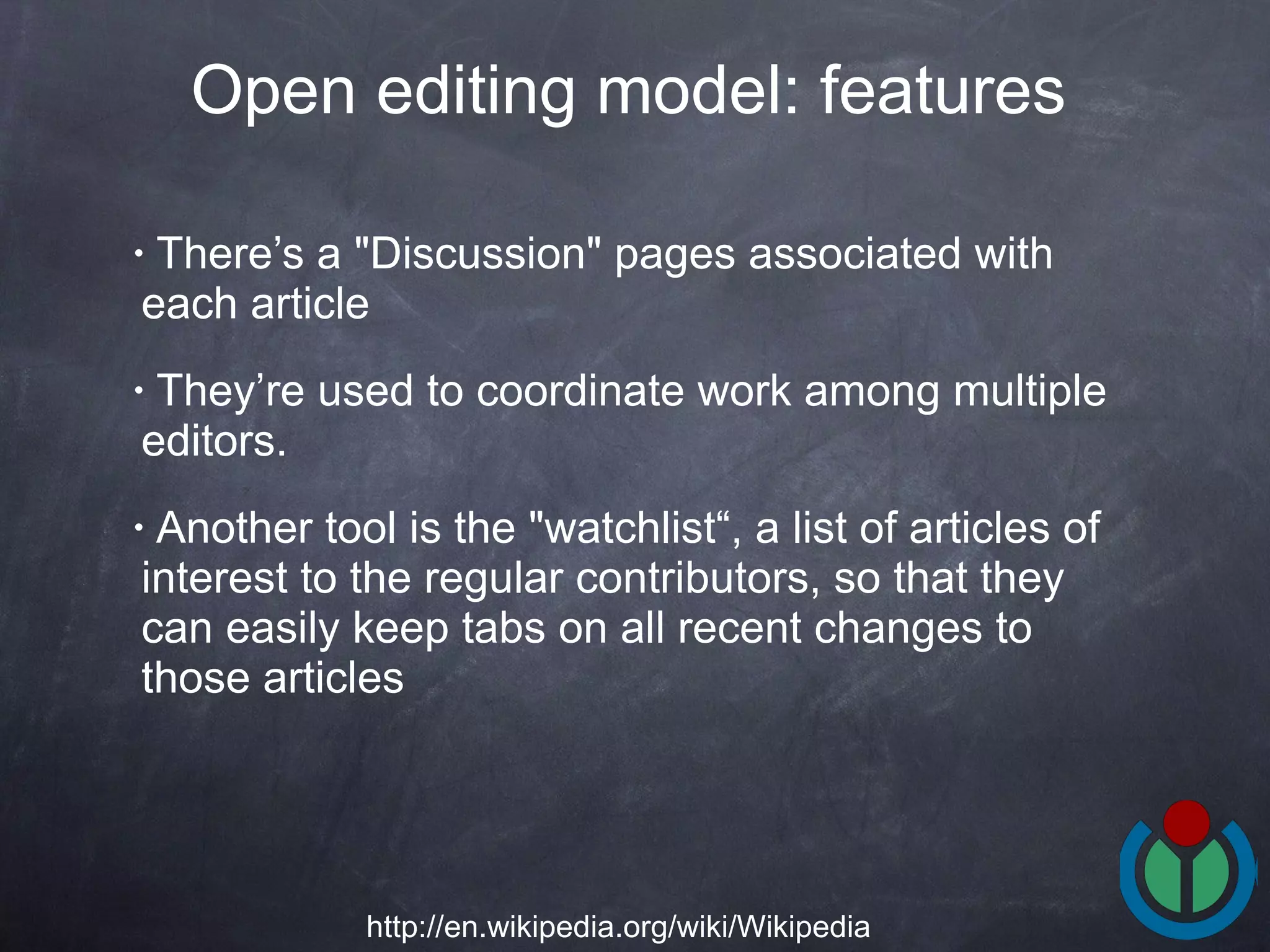
There’s a "Discussion" pages associated with each article  They’re used to coordinate work among multiple editors.  Another tool is the "watchlist“, a list of articles of interest to the regular contributors, so that they can easily keep tabs on all recent changes to those articles  Open editing model: features   http://en.wikipedia.org/wiki/Wikipedia
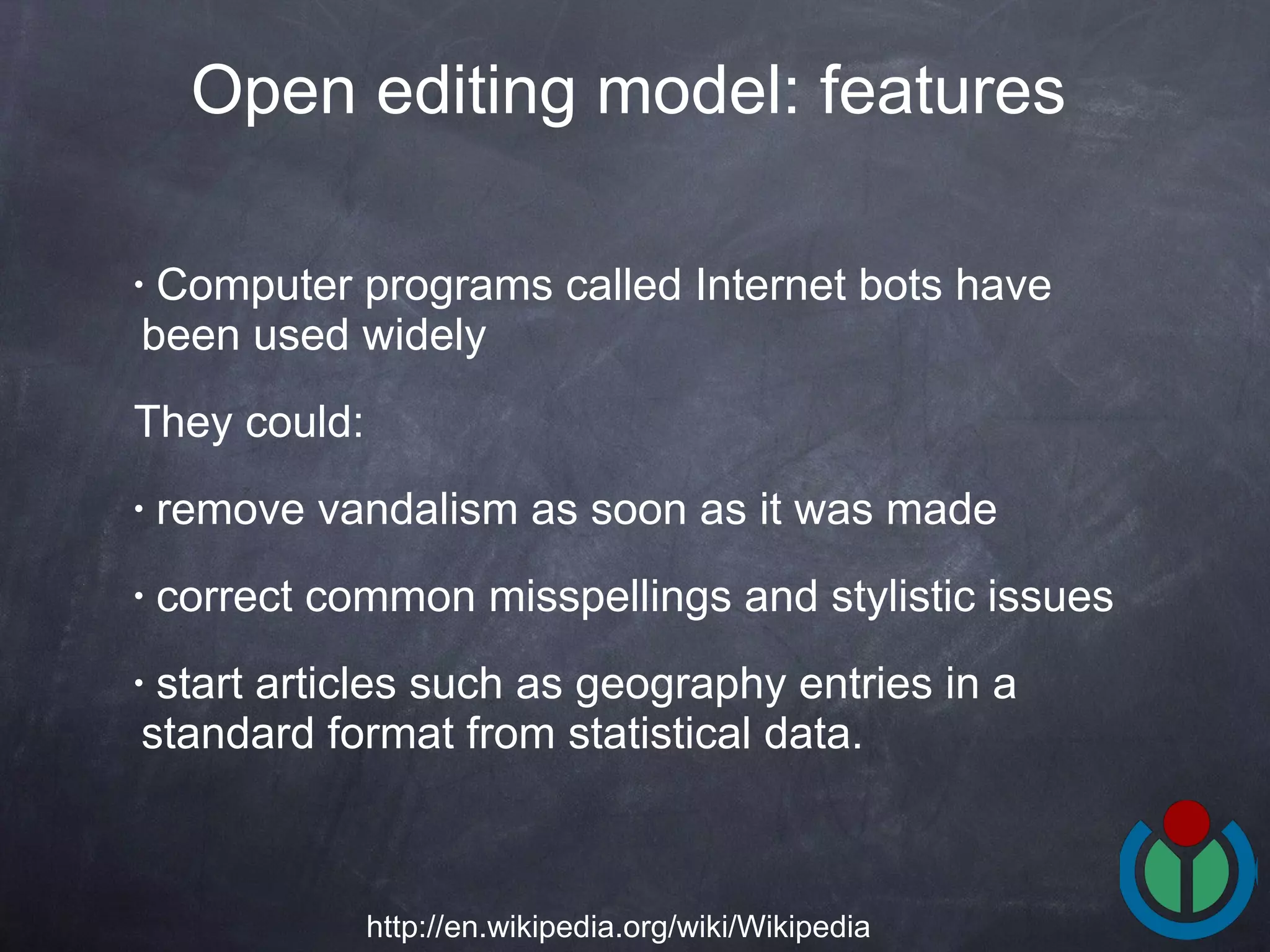
Computer programs called Internet bots have been used widely  They could: remove vandalism as soon as it was made correct common misspellings and stylistic issues start articles such as geography entries in a standard format from statistical data.  Open editing model: features   http://en.wikipedia.org/wiki/Wikipedia
Wikipedia is an encyclopedia   5 pillars of Wikipedia: 1 http://en.wikipedia.org/wiki/Wikipedia:Five_pillars
Wikipedia has a neutral point of view   5 pillars of Wikipedia: 2 http://en.wikipedia.org/wiki/Wikipedia:Five_pillars
Wikipedia is free content   5 pillars of Wikipedia: 3 http://en.wikipedia.org/wiki/Wikipedia:Five_pillars
Wikipedia has a code of conduct   5 pillars of Wikipedia: 4 http://en.wikipedia.org/wiki/Wikipedia:Five_pillars
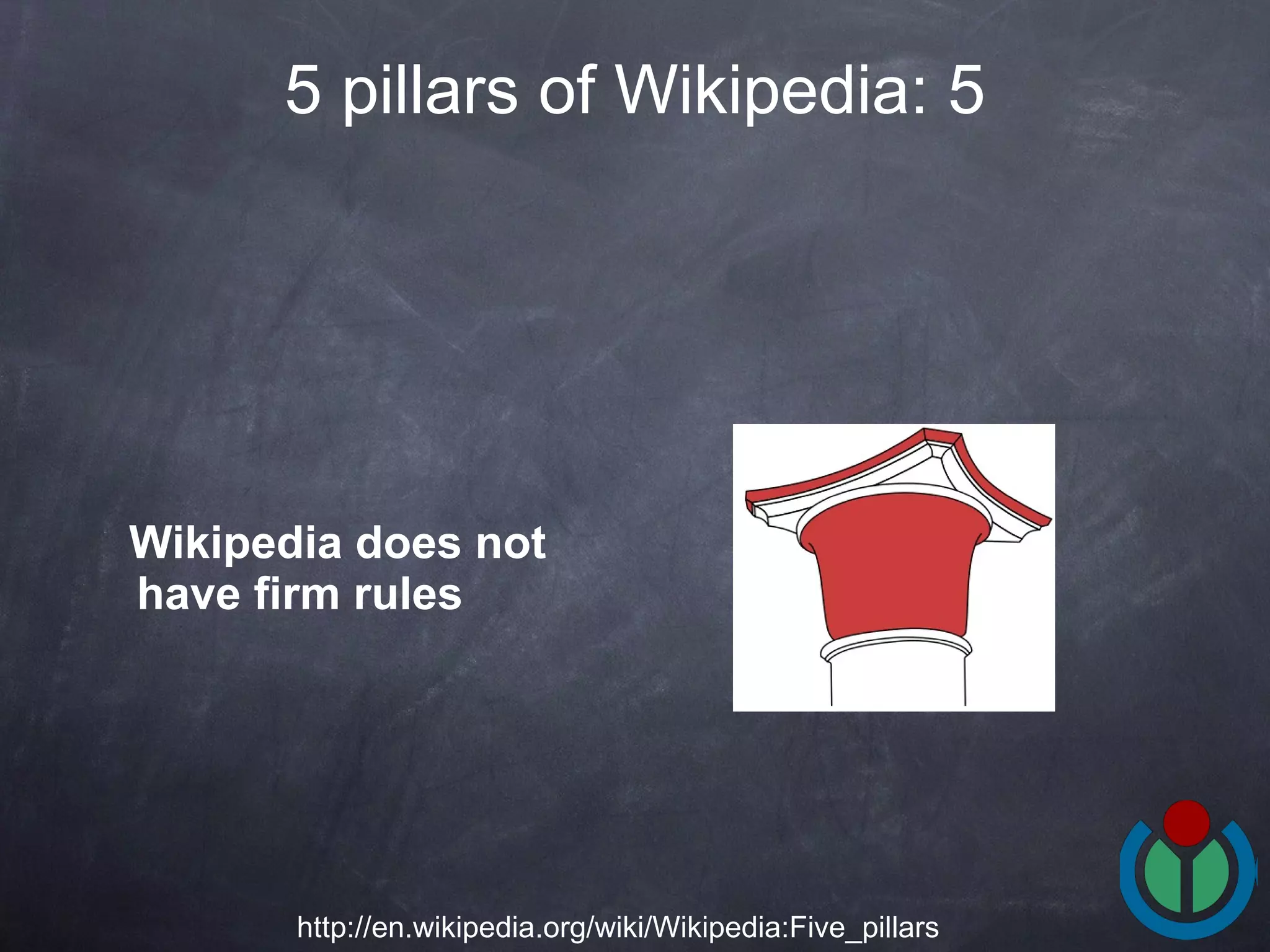
Wikipedia does not have firm rules   5 pillars of Wikipedia: 5 http://en.wikipedia.org/wiki/Wikipedia:Five_pillars
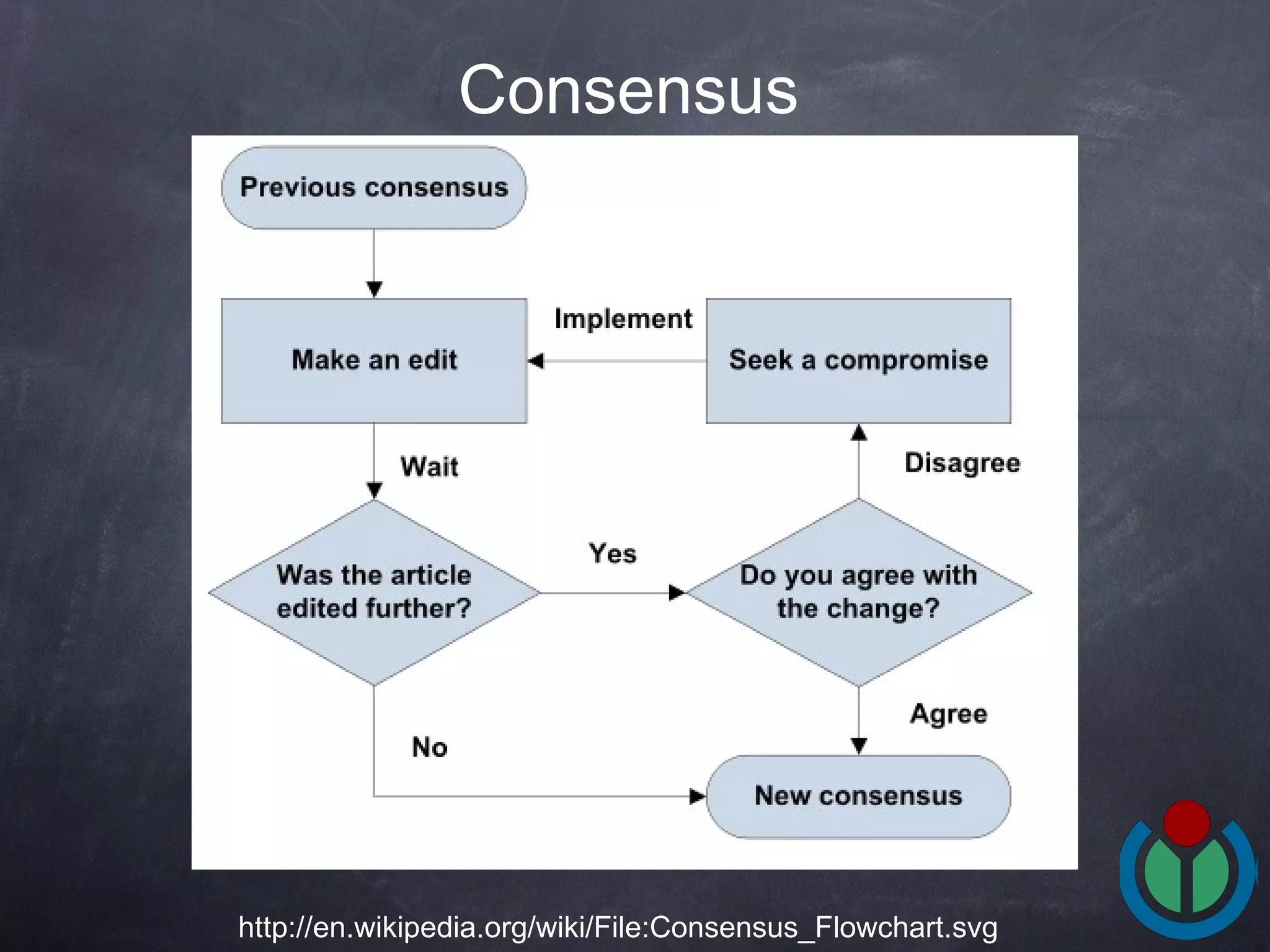
Consensus is about how editors work with others  It is Wikipedia's fundamental model for editorial decision-making  Policies and guidelines document communal consensus rather than creating it. Wikipedia decisions are made through discussions by reasonable people. Polling is a tool meant to facilitate discussion, and should be used with care.  Consensus   http://en.wikipedia.org/wiki/Wikipedia:Consensus
Consensus   http://en.wikipedia.org/wiki/File:Consensus_Flowchart.svg
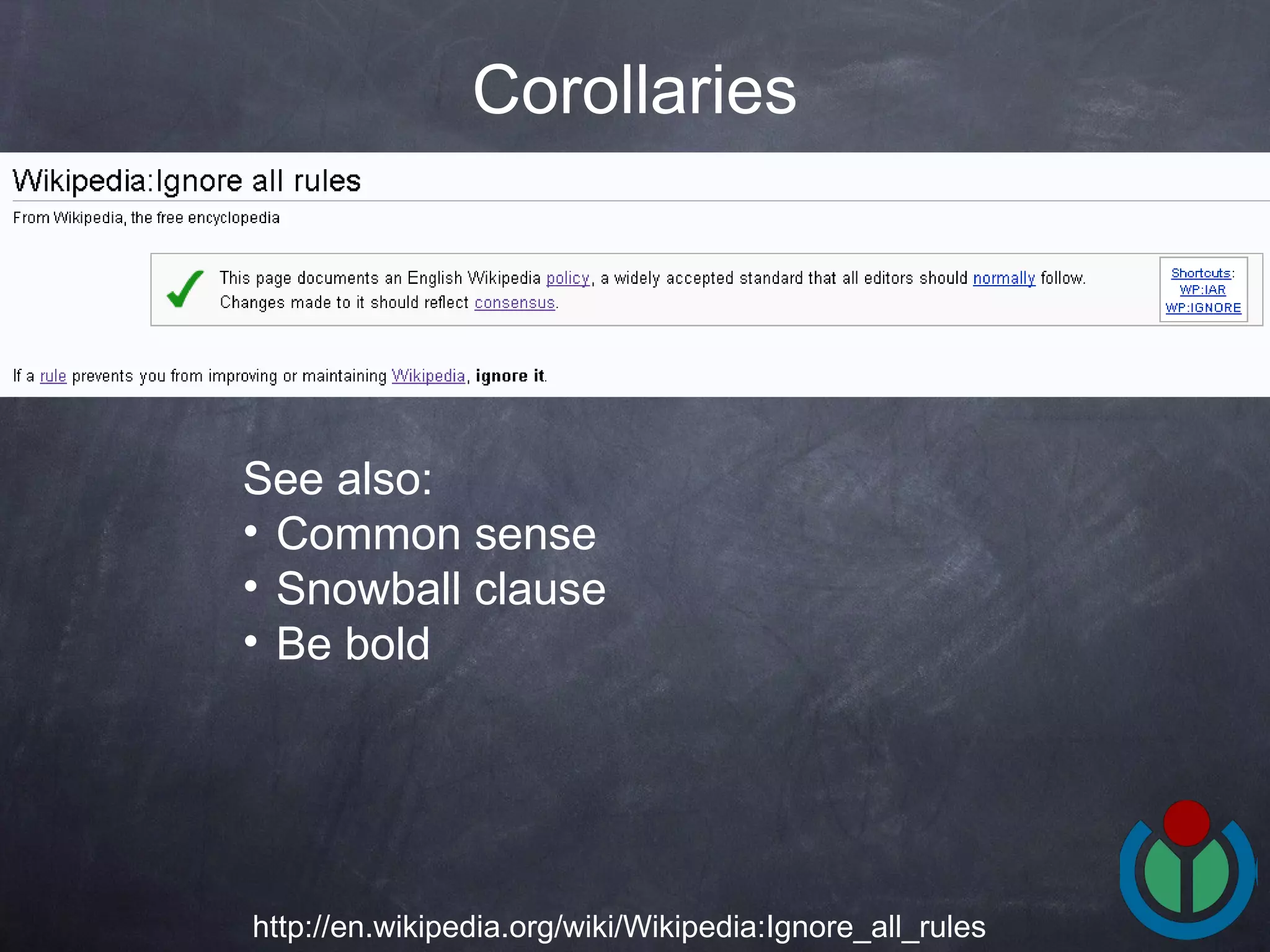
Corollaries http://en.wikipedia.org/wiki/Wikipedia:Ignore_all_rules See also: Common sense Snowball clause  Be bold
Wikipedia is a community  The community is dependent on the encyclopedia  The encyclopedia is dependent on the community  Therefore, community and encyclopedia are inexorably intertwined on Wikipedia  Community   http://en.wikipedia.org/wiki/Wikipedia_is_a_community
User groups (the order refers to technical access in the MediaWiki software): founder / steward / checkuser / oversight / bureaucrat / administrator/sysop / Abuse filter manager / rollbacker  (some wikis)  / patroller  (some wikis)  / account creator  (currently English Wikipedia only)  /ipblock exempt  (some wikis)  / bot / editor  (some wikis)  / registered user / newly registered user / anonymous user / blocked user  Power structure   http://meta.wikimedia.org/wiki/User_groups
Classification
Except in "article namespace",  subpages  are pages separated with a "/" from their 'parent' page. A subpage is considered "subordinate" to its host page, and is titled and linked as  [[Parentpage/Subpage]] .  It is possible to create a sub-subpage.  backlink to the higher levels of the page. Subpages   http://en.wikipedia.org/wiki/Wikipedia:Subpage
Common uses:  WikiProject subpages Portal subpages Dividing up Wikipedia process pages which would otherwise get too big to be easily used.  Documentation subpages for templates.  Subpages   http://en.wikipedia.org/wiki/Wikipedia:Subpage
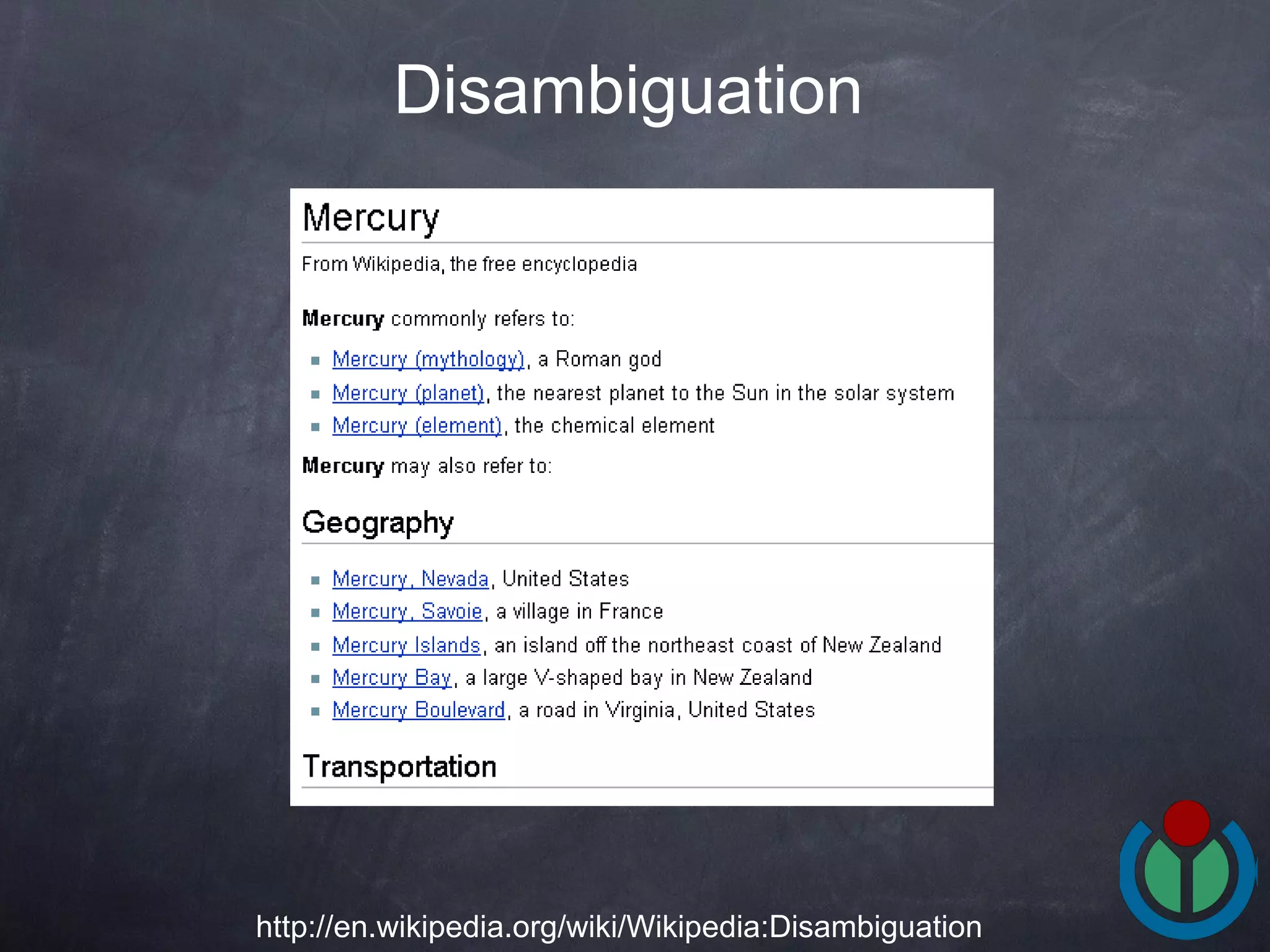
Resolves conflicts in Wikipedia article titles that occur when a single term can be associated with more than one topic Are paths leading to different articles which could, in principle, have the same title.  Disambiguation   http://en.wikipedia.org/wiki/Wikipedia:Disambiguation
Disambiguation   http://en.wikipedia.org/wiki/Wikipedia:Disambiguation
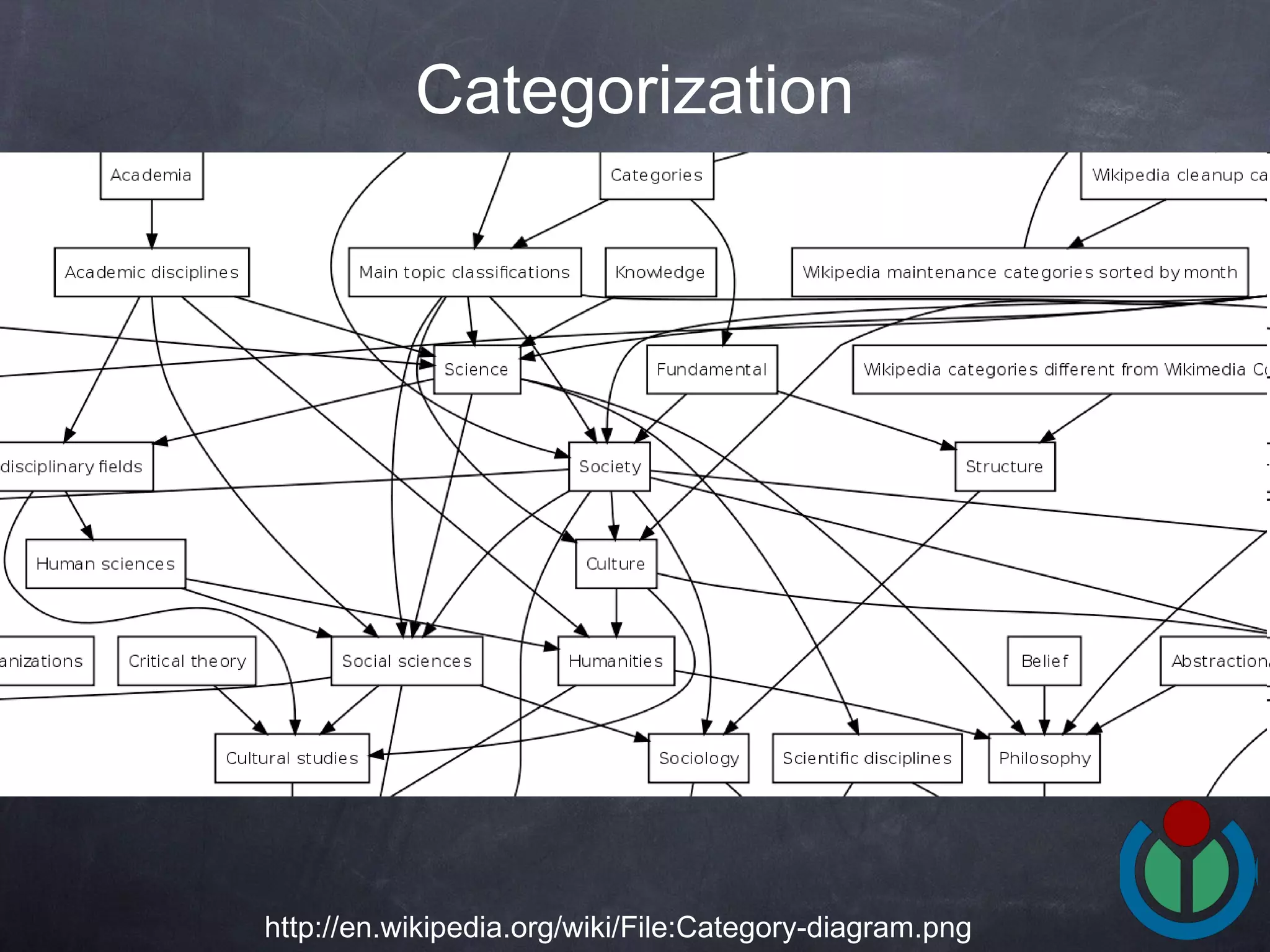
Help users navigation via multiple taxonomies.  Should be specific, neutral, inclusive and follow certain conventions.  Categories can be defined as subcategories of other categories, allowing easy navigation between connected subject areas via a tree-like structure.  This helps readers find articles on particular topics even if they don't know which articles exist or what they are called.  Categorization http://en.wikipedia.org/wiki/Wikipedia:Category
Categorization http://en.wikipedia.org/wiki/File:Category-diagram.png
Commonly used to organize information  May be embedded in articles or may be stand alone articles  have three main purposes:  information,  navigation,  development Lists http://en.wikipedia.org/wiki/Wikipedia:List
It’s a grouping of links used in multiple related articles to facilitate navigation between those articles.  Editing of a navigation template is done in a central place, the template page.  Navigation templates provide: Navigation Navigation between existing articles Navigation between related articles  Navigation templates http://en.wikipedia.org/wiki/Wikipedia:Navigation_templates
Search
"search" box at the left side of every Wikipedia window  accessible by using the "Search" special page  Search in Wikipedia http://en.wikipedia.org/wiki/Wikipedia:Search
Searching for external links: Linksearch is a tool for searching for links from Wikipedia articles to sites outside Wikipedia. List of all pages: Allpages - Alphabetic index for the main namespace  Many external tools Unconventional search http://en.wikipedia.org/wiki/Wikipedia:Search
Numbers
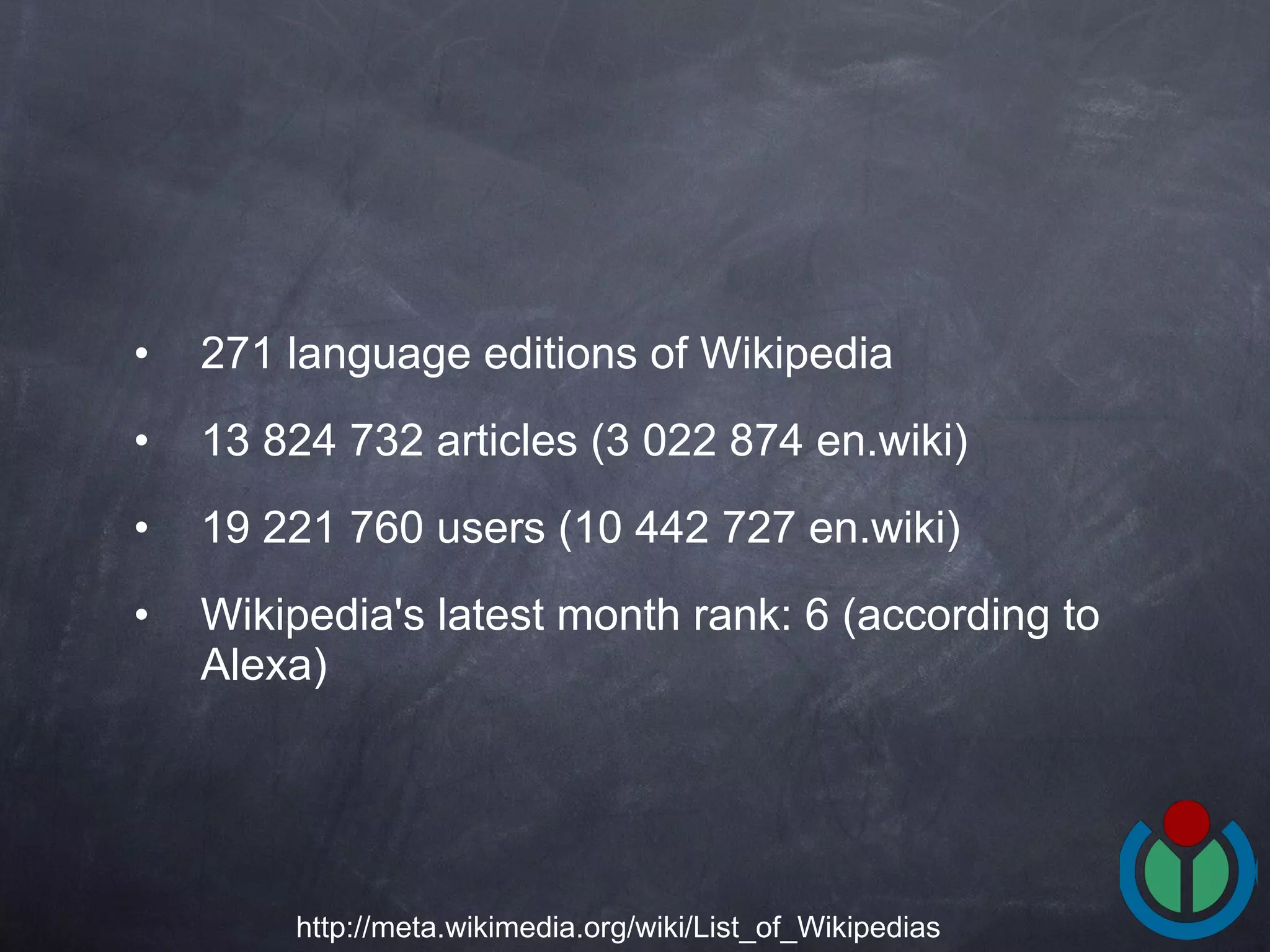
271 language editions of Wikipedia  13 824 732 articles (3 022 874 en.wiki) 19 221 760 users (10 442 727 en.wiki) Wikipedia's latest month rank: 6 (according to Alexa)  http://meta.wikimedia.org/wiki/List_of_Wikipedias
Conclusion
Every project is developed using a wiki engine, a software that allows anyone to easily add and edit content and is especially suited for collaborative writing This real-time collaborative model allows rapid updating of existing topics and introduction of new topics Projects are built on the expectation that collaboration among users will improve the quality of articles over time, in much the same way that open-source software develops Key features
The participation of contributors without specific expertise or formal qualifications enriches the projects Decision-making on the content and editorial policies is done by consensus and occasionally by vote Wikipedia follows two key rules: NPOV (Neutral Point Of View) and free licensed content Key features
Pros : Very fast growth: Wikipedia was born in 2001 and now it contains more than 13 million articles (Encyclopædia Britannica  was first published in 1768 and has  120,000 articles) The number of contributors can be potentially infinite It’s free of charge Anyone can fix errors or update an article very quickly Pros & Cons
Cons: Absence of a top-down planning and systematic review process The quality of articles varies widely and over time Modifications go directly online: vandalism and inaccurate content can stay online for a while before it gets detected Coverage of topics and level of detail is not always proportionate to their importance Pros & Cons
[email_address] http://www.wikimedia.it All texts from Wikipedia are cc-by-sa, logos are trademark of Wikimedia Foundation Inc.

Open Knowledge Management

  • 1.
    Open Knowledge Management The wiki way Frieda Brioschi Wikimedia Italia ECKM 2009 Vicenza, 4 Sep 2009
  • 2.
  • 3.
    basis of howvarious groups and organizations operate. it is typified by communal management, and open access to the information or material resources needed for projects. decisions being made by some form of consensus decision-making or voting. Openness http://en.wikipedia.org/wiki/Openness
  • 4.
    website using wikisoftware, allowing the easy creation and editing of any number of interlinked Web pages within the browser. Wikis are often used to create collaborative websites, to power community websites, for personal note taking, in corporate intranets, and in knowledge management systems. Wiki http://en.wikipedia.org/wiki/Wiki
  • 5.
    Ward Cunningham, thedeveloper of the first wiki software (in 1995) , WikiWikiWeb, originally described it as " the simplest online database that could possibly work. " "Wiki" is a Hawaiian word for "fast". Wiki http://en.wikipedia.org/wiki/Wiki
  • 6.
  • 7.
    several online collaborative wiki projects Wikimedia Universe
  • 8.
  • 9.
  • 10.
    online encyclopedia can be edited by anyone aims to provide free encyclopedic information launched on 15 January 2001 by Jimmy Wales and Larry Sanger The concept of a free online encyclopedia originally came from Richard Stallman. Wikipedia http://en.wikipedia.org/wiki/Wikipedia
  • 11.
  • 12.
    first domain createdfor a non-English Wikipedia was deutsche.wikipedia.com In January 2002, 90% of all Wikipedia articles were in English. By January 2004, less than 50% were English. As of 2007, around 75% of all Wikipedia articles are contained within non-English Wikipedia versions. Internationalization http://en.wikipedia.org/wiki/History_of_Wikipedia
  • 13.
    few info aboutthe project no project name in the title of the page generic logo Structure: March 30, 2001
  • 14.
    few info aboutthe project no project name untitled logo Structure: March 30, 2001
  • 15.
    more info aboutthe project (description & goals) project name full logo small menu “ Note: Unless you have the administrator password, you cannot currently edit this page. While this is unfortunate, it has turned out to be necessary to prevent vandalism of this page, which has occurred on several occasions. “ Structure: December 17, 2001
  • 16.
  • 17.
    "Phase II" ofthe wiki software powering Wikipedia was introduced, replacing the older UseModWiki. Written specifically for the project by Magnus Manske, it included a PHP wiki engine tech tools ( Statistics, New pages, Orphans, Most wanted, Most popular, Random Page, Stub articles, Long articles, List users, Bug reports) Namespaces (special, talk) two menus (top & right) Structure: June 2, 2002
  • 18.
  • 19.
    dubbed "Phase III",it replaced the older "Phase II" version, and became MediaWiki. It was written by Lee Daniel Crocker in response to the increasing demands of the growing project interlanguage links more namespaces (Wikipedia) two menus (top & right) Structure: Nov 30, 2002
  • 20.
  • 21.
    definitive logo colours Sister Projects (Meta, Wiktionary, Wikibooks, Wikiquote, Wikisource) Structure: Dec 8, 2003
  • 22.
  • 23.
  • 24.
    “ So inthe beginning, anybody could edit Wikipedia. And then anybody could edit Wikipedia. And as of tomorrow, anybody can edit Wikipedia.” Jimmy Wales Open editing model http://www.npr.org/templates/story/story.php?storyId=112257149
  • 25.
    Except for afew pages every article may be edited anonymously or with a user account while only registered users may create a new article (only in English edition) . No article is owned by its creator or any other editor Open editing model http://en.wikipedia.org/wiki/Wikipedia
  • 26.
    the articles arecollectively owned by a community of editors. Changes to an article are available immediately There’s no review before publishing Open editing model http://en.wikipedia.org/wiki/Wikipedia
  • 27.
    There’s a "History"page attached to each article it records every single past revision of the article It’s possible to remove a revision afterwards. Makes it easy to compare old and new versions, undo changes that an editor considers undesirable, or restore lost content Open editing model: features http://en.wikipedia.org/wiki/Wikipedia
  • 28.
  • 29.
    There’s a "Discussion"pages associated with each article They’re used to coordinate work among multiple editors. Another tool is the "watchlist“, a list of articles of interest to the regular contributors, so that they can easily keep tabs on all recent changes to those articles Open editing model: features http://en.wikipedia.org/wiki/Wikipedia
  • 30.
    Computer programs calledInternet bots have been used widely They could: remove vandalism as soon as it was made correct common misspellings and stylistic issues start articles such as geography entries in a standard format from statistical data. Open editing model: features http://en.wikipedia.org/wiki/Wikipedia
  • 31.
    Wikipedia is anencyclopedia 5 pillars of Wikipedia: 1 http://en.wikipedia.org/wiki/Wikipedia:Five_pillars
  • 32.
    Wikipedia has aneutral point of view 5 pillars of Wikipedia: 2 http://en.wikipedia.org/wiki/Wikipedia:Five_pillars
  • 33.
    Wikipedia is freecontent 5 pillars of Wikipedia: 3 http://en.wikipedia.org/wiki/Wikipedia:Five_pillars
  • 34.
    Wikipedia has acode of conduct 5 pillars of Wikipedia: 4 http://en.wikipedia.org/wiki/Wikipedia:Five_pillars
  • 35.
    Wikipedia does nothave firm rules 5 pillars of Wikipedia: 5 http://en.wikipedia.org/wiki/Wikipedia:Five_pillars
  • 36.
    Consensus is abouthow editors work with others It is Wikipedia's fundamental model for editorial decision-making Policies and guidelines document communal consensus rather than creating it. Wikipedia decisions are made through discussions by reasonable people. Polling is a tool meant to facilitate discussion, and should be used with care. Consensus http://en.wikipedia.org/wiki/Wikipedia:Consensus
  • 37.
    Consensus http://en.wikipedia.org/wiki/File:Consensus_Flowchart.svg
  • 38.
  • 39.
    Wikipedia is acommunity The community is dependent on the encyclopedia The encyclopedia is dependent on the community Therefore, community and encyclopedia are inexorably intertwined on Wikipedia Community http://en.wikipedia.org/wiki/Wikipedia_is_a_community
  • 40.
    User groups (theorder refers to technical access in the MediaWiki software): founder / steward / checkuser / oversight / bureaucrat / administrator/sysop / Abuse filter manager / rollbacker (some wikis) / patroller (some wikis) / account creator (currently English Wikipedia only) /ipblock exempt (some wikis) / bot / editor (some wikis) / registered user / newly registered user / anonymous user / blocked user Power structure http://meta.wikimedia.org/wiki/User_groups
  • 41.
  • 42.
    Except in "articlenamespace", subpages are pages separated with a "/" from their 'parent' page. A subpage is considered "subordinate" to its host page, and is titled and linked as [[Parentpage/Subpage]] . It is possible to create a sub-subpage. backlink to the higher levels of the page. Subpages http://en.wikipedia.org/wiki/Wikipedia:Subpage
  • 43.
    Common uses: WikiProject subpages Portal subpages Dividing up Wikipedia process pages which would otherwise get too big to be easily used. Documentation subpages for templates. Subpages http://en.wikipedia.org/wiki/Wikipedia:Subpage
  • 44.
    Resolves conflicts inWikipedia article titles that occur when a single term can be associated with more than one topic Are paths leading to different articles which could, in principle, have the same title. Disambiguation http://en.wikipedia.org/wiki/Wikipedia:Disambiguation
  • 45.
    Disambiguation http://en.wikipedia.org/wiki/Wikipedia:Disambiguation
  • 46.
    Help users navigationvia multiple taxonomies. Should be specific, neutral, inclusive and follow certain conventions. Categories can be defined as subcategories of other categories, allowing easy navigation between connected subject areas via a tree-like structure. This helps readers find articles on particular topics even if they don't know which articles exist or what they are called. Categorization http://en.wikipedia.org/wiki/Wikipedia:Category
  • 47.
  • 48.
    Commonly used toorganize information May be embedded in articles or may be stand alone articles have three main purposes: information, navigation, development Lists http://en.wikipedia.org/wiki/Wikipedia:List
  • 49.
    It’s a groupingof links used in multiple related articles to facilitate navigation between those articles. Editing of a navigation template is done in a central place, the template page. Navigation templates provide: Navigation Navigation between existing articles Navigation between related articles Navigation templates http://en.wikipedia.org/wiki/Wikipedia:Navigation_templates
  • 50.
  • 51.
    "search" box atthe left side of every Wikipedia window accessible by using the "Search" special page Search in Wikipedia http://en.wikipedia.org/wiki/Wikipedia:Search
  • 52.
    Searching for externallinks: Linksearch is a tool for searching for links from Wikipedia articles to sites outside Wikipedia. List of all pages: Allpages - Alphabetic index for the main namespace Many external tools Unconventional search http://en.wikipedia.org/wiki/Wikipedia:Search
  • 53.
  • 54.
    271 language editionsof Wikipedia 13 824 732 articles (3 022 874 en.wiki) 19 221 760 users (10 442 727 en.wiki) Wikipedia's latest month rank: 6 (according to Alexa) http://meta.wikimedia.org/wiki/List_of_Wikipedias
  • 55.
  • 56.
    Every project isdeveloped using a wiki engine, a software that allows anyone to easily add and edit content and is especially suited for collaborative writing This real-time collaborative model allows rapid updating of existing topics and introduction of new topics Projects are built on the expectation that collaboration among users will improve the quality of articles over time, in much the same way that open-source software develops Key features
  • 57.
    The participation ofcontributors without specific expertise or formal qualifications enriches the projects Decision-making on the content and editorial policies is done by consensus and occasionally by vote Wikipedia follows two key rules: NPOV (Neutral Point Of View) and free licensed content Key features
  • 58.
    Pros : Veryfast growth: Wikipedia was born in 2001 and now it contains more than 13 million articles (Encyclopædia Britannica was first published in 1768 and has 120,000 articles) The number of contributors can be potentially infinite It’s free of charge Anyone can fix errors or update an article very quickly Pros & Cons
  • 59.
    Cons: Absence ofa top-down planning and systematic review process The quality of articles varies widely and over time Modifications go directly online: vandalism and inaccurate content can stay online for a while before it gets detected Coverage of topics and level of detail is not always proportionate to their importance Pros & Cons
  • 60.
    [email_address] http://www.wikimedia.it Alltexts from Wikipedia are cc-by-sa, logos are trademark of Wikimedia Foundation Inc.