Wikipedia: the inside story 
Andrea Rankin, June 2007
What is a Wiki? 
The simplest online database that could possibly work 
(‘wiki wiki’ means ‘rapidly’ in the Hawaiian language). 
Wiki is a piece of server software that allows users to 
freely create and edit web page content using any web 
browser. 
Open editing encourages democratic use of the Web 
and promotes content composition by non technical 
users.
What is Wikipedia? 
 A free content, multilingual encyclopedia 
written collaboratively by contributors around 
the world 
 The site is a Wiki - anybody can edit and add 
to an article. Offers quick understanding on 
controversial issues. Strong in current affairs. 
(Google search: define: Wikipedia)
What isn’t Wikipedia? 
 It is not an archive (it was decided that 
poems and other literary works were not 
suited to Wikipedia)
Wikipedia’s dream 
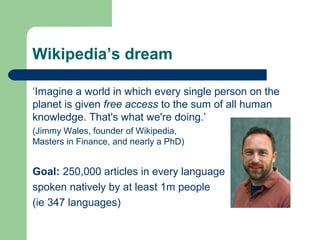
‘Imagine a world in which every single person on the 
planet is given free access to the sum of all human 
knowledge. That's what we're doing.’ 
(Jimmy Wales, founder of Wikipedia, 
Masters in Finance, and nearly a PhD) 
Goal: 250,000 articles in every language 
spoken natively by at least 1m people 
(ie 347 languages)
How and why it works 
Operates on an open society basis, where 
people trust each other! 
 Written by 1000s of volunteers in all languages 
 Run by a non profit organisation – Wikipedia Foundation 
 Wikipedia will spend $2-3m in 2007 – all donations (mostly from 
the USA) 
 Cost to run Wikipedia - $25-30,000 per month in bandwidth 
 See Margaret Fulton’s entry 
http://en.wikipedia.org/wiki/Margaret_Fulton
Free? 
 Free access (if you have the internet) 
 Free speech (although it is vigilantly 
checked) 
 Freedom to: 
– copy 
– modify 
– redistribute commercially or non commercially
Popularity 
 9th most popular site on the internet; 6th in 
Germany; 12th in India, Japan and Iran 
 2.23% use cnn.com every day, 6.19% use 
Wikipedia every day 
 2005-6 there was a big jump in popularity
How good is Wikipedia? 
 A study compared Wikipedia with 
Encyclopedia Britannica 
– Wikipedia had an average of 4 errors per article 
and Britannica 3 
– Wikipedia followed up on errors after the study, 
whereas Britannica just got defensive (according 
to Jimmy Wales)
How should it be used by students? 
 RESA Online discusses this 
www.unisanet.unisa.edu.au/learn/resaonline/ 
? 
PATH=/Resources/LitReview/Methodology+i 
n+the+social+sciences+and+humanities/&de 
fault=Research+methodology+issues/Wikipe 
dia+as+a+research+tool.htm 
 Main point – articles are not refereed, so 
Wikipedia should be a starting point only
Offshoots 
Citizendium http://en.citizendium.org/wiki/Main_Page 
Aims to improve on the Wikipedia model by adding ‘gentle expert 
oversight’ and requiring contributors to use their real names – 
founded by an ex founder of Wikipedia, who was losing sleep at 
night! 
Uncyclopedia http://uncyclopedia.org/wiki/Main_Page 
Anonymous http://uncyclopedia.org/wiki/Anonymous 
Kangaroo http://uncyclopedia.org/wiki/Kangaroo
How can you create a wiki? 
Use some free software and web space 
eg Wikispaces www.wikispaces.com/ 
‘Create simple web pages that groups, friends, and 
families can edit together’ 
 Pick a username 
 Set your password 
 Enter your email address
Wikis in universities 
1. Education 
2. Communication 
 UniSA courses – for student assessment and 
resources eg Information Architecture and Design 
 Boston College student wikia (Wikia offers free 
MediaWiki hosting for your community to build a 
free content wiki-based website) 
 CaseWiki – an encyclopedic reference about Case 
Western Reserve University and its surroundings 
 More examples: School and university projects 
(Wikipedia)

Wikipedia

  • 1.
    Wikipedia: the insidestory Andrea Rankin, June 2007
  • 2.
    What is aWiki? The simplest online database that could possibly work (‘wiki wiki’ means ‘rapidly’ in the Hawaiian language). Wiki is a piece of server software that allows users to freely create and edit web page content using any web browser. Open editing encourages democratic use of the Web and promotes content composition by non technical users.
  • 3.
    What is Wikipedia?  A free content, multilingual encyclopedia written collaboratively by contributors around the world  The site is a Wiki - anybody can edit and add to an article. Offers quick understanding on controversial issues. Strong in current affairs. (Google search: define: Wikipedia)
  • 4.
    What isn’t Wikipedia?  It is not an archive (it was decided that poems and other literary works were not suited to Wikipedia)
  • 5.
    Wikipedia’s dream ‘Imaginea world in which every single person on the planet is given free access to the sum of all human knowledge. That's what we're doing.’ (Jimmy Wales, founder of Wikipedia, Masters in Finance, and nearly a PhD) Goal: 250,000 articles in every language spoken natively by at least 1m people (ie 347 languages)
  • 6.
    How and whyit works Operates on an open society basis, where people trust each other!  Written by 1000s of volunteers in all languages  Run by a non profit organisation – Wikipedia Foundation  Wikipedia will spend $2-3m in 2007 – all donations (mostly from the USA)  Cost to run Wikipedia - $25-30,000 per month in bandwidth  See Margaret Fulton’s entry http://en.wikipedia.org/wiki/Margaret_Fulton
  • 7.
    Free?  Freeaccess (if you have the internet)  Free speech (although it is vigilantly checked)  Freedom to: – copy – modify – redistribute commercially or non commercially
  • 8.
    Popularity  9thmost popular site on the internet; 6th in Germany; 12th in India, Japan and Iran  2.23% use cnn.com every day, 6.19% use Wikipedia every day  2005-6 there was a big jump in popularity
  • 9.
    How good isWikipedia?  A study compared Wikipedia with Encyclopedia Britannica – Wikipedia had an average of 4 errors per article and Britannica 3 – Wikipedia followed up on errors after the study, whereas Britannica just got defensive (according to Jimmy Wales)
  • 10.
    How should itbe used by students?  RESA Online discusses this www.unisanet.unisa.edu.au/learn/resaonline/ ? PATH=/Resources/LitReview/Methodology+i n+the+social+sciences+and+humanities/&de fault=Research+methodology+issues/Wikipe dia+as+a+research+tool.htm  Main point – articles are not refereed, so Wikipedia should be a starting point only
  • 11.
    Offshoots Citizendium http://en.citizendium.org/wiki/Main_Page Aims to improve on the Wikipedia model by adding ‘gentle expert oversight’ and requiring contributors to use their real names – founded by an ex founder of Wikipedia, who was losing sleep at night! Uncyclopedia http://uncyclopedia.org/wiki/Main_Page Anonymous http://uncyclopedia.org/wiki/Anonymous Kangaroo http://uncyclopedia.org/wiki/Kangaroo
  • 12.
    How can youcreate a wiki? Use some free software and web space eg Wikispaces www.wikispaces.com/ ‘Create simple web pages that groups, friends, and families can edit together’  Pick a username  Set your password  Enter your email address
  • 13.
    Wikis in universities 1. Education 2. Communication  UniSA courses – for student assessment and resources eg Information Architecture and Design  Boston College student wikia (Wikia offers free MediaWiki hosting for your community to build a free content wiki-based website)  CaseWiki – an encyclopedic reference about Case Western Reserve University and its surroundings  More examples: School and university projects (Wikipedia)