By: Alex Weinrich
Menu
   Overview of Wikipedia
   History and Creator
   Purpose of Wikipedia
   Content of Wikipedia and where is comes
    from.
   Uses for Wikipedia
   Wikipedia: A web 2.0 tool
   Similar Sites to Wikipedia
   What Does Research Say
   Positives and Negatives
Overview
 Wikipedia is a research tool that is free to
  anybody with access to the internet.
 Wikipedia’s has a vast amount of articles, so
  you always find what you need. It has about
  3,154,396 content pages.
 Wikipedia is the largest encyclopedia in the
  world. It allows the user to make changes in
  the article. This could be good or bad. Each
  article averages about 18 revisions.
History and Creators
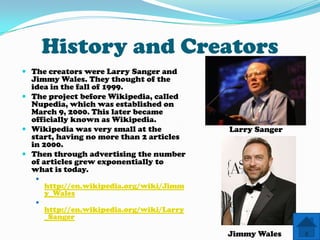
 The creators were Larry Sanger and
  Jimmy Wales. They thought of the
  idea in the fall of 1999.
 The project before Wikipedia, called
  Nupedia, which was established on
  March 9, 2000. This later became
  officially known as Wikipedia.
 Wikipedia was very small at the           Larry Sanger
  start, having no more than 2 articles
  in 2000.
 Then through advertising the number
  of articles grew exponentially to
  what is today.
   
       http://en.wikipedia.org/wiki/Jimm
       y_Wales
   
       http://en.wikipedia.org/wiki/Larry
       _Sanger

                                            Jimmy Wales
Purpose
   This tool is extremely useful
    when there is research to be
    done. Being the largest
    encyclopedia, you can search
    anything and have an in
    depth answer for free.
   The articles have been
    revised by professionals and
    experts.
   http://en.wikipedia.org/wi
    ki/Wikipedia
Content and Where It Comes From
 The users submit their
  information to
  Wikipedia. Their
  information has to be
  backed up by sources
  and Wikipedia checks it
  before it is published.   On the other hand, there is a lot
 This is why there is so   of controversy to this process.
                            Many users say that the
  many articles, people     information is not credible
  from all over the world   because anybody on the internet
  came together to          can click “edit this page” and
  suggest their ideas and   change the content.
  information.
Uses for Wikipedia
 The are many different uses for Wikipedia but it
  is mostly used in school or the office.
 At school, students always have research projects
  to do and can go to Wikipedia for basically
  anything. However, many schools do not allow the
  use of Wikipedia as a source because of the fact
  that anybody can edit the information.
 In the office, anybody that needs more in depth
  information on a subject. It is likely that when
  you search something, Wikipedia will be on the
  first page of results.
Wikipedia: A web 2.0 tool
 This is a web 2.0 tool because it can be
  accessed by anybody on the web, just as
  YouTube and Facebook can be. Wikipedia has
  a immense amount of people involved and
  communicates information to them for free.
 It is a collaboration of everyone working
  collectively to build a colossal, free
  encyclopedia, and it keeps building today.
Similar Sites
 Some similar sites to
 Wikipedia are:
   Encyclopedia.com
   Britannica.com
   MSN Encarta
   WorldBook.com
What Does Research Say?
 The New York Times says that
    Wikipedia is “a place for
    amateurs.”
   “It represents the rise of the
    amateur at the expense of the
    professional.”
   The New York Times questions
    the credibility of the information
    when everyone is able to edit it.
   Wikipedia has prevented
    unknown users from making and
    editing new articles.
   http://www.nytimes.com/info/wi
    kipedia/?inline=nyt-org
Positives and Negatives
 Positives
    There is such a wide range of articles in
     which you can search for a certain thing
     or subject.
    Wikipedia is very easy to use. Most of the
     time, you can Google the search content
     and Wikipedia will be one of the first to
     come up.
    Experts and professionals revise the
     articles before they are published.
 Negatives
    Anyone can edit any page on Wikipedia.
    Wikipedia relies solely on donations and
     volunteers.
    The users need to come up with the
     content.

Wikipedia

  • 1.
  • 2.
    Menu  Overview of Wikipedia  History and Creator  Purpose of Wikipedia  Content of Wikipedia and where is comes from.  Uses for Wikipedia  Wikipedia: A web 2.0 tool  Similar Sites to Wikipedia  What Does Research Say  Positives and Negatives
  • 3.
    Overview  Wikipedia isa research tool that is free to anybody with access to the internet.  Wikipedia’s has a vast amount of articles, so you always find what you need. It has about 3,154,396 content pages.  Wikipedia is the largest encyclopedia in the world. It allows the user to make changes in the article. This could be good or bad. Each article averages about 18 revisions.
  • 4.
    History and Creators The creators were Larry Sanger and Jimmy Wales. They thought of the idea in the fall of 1999.  The project before Wikipedia, called Nupedia, which was established on March 9, 2000. This later became officially known as Wikipedia.  Wikipedia was very small at the Larry Sanger start, having no more than 2 articles in 2000.  Then through advertising the number of articles grew exponentially to what is today.  http://en.wikipedia.org/wiki/Jimm y_Wales  http://en.wikipedia.org/wiki/Larry _Sanger Jimmy Wales
  • 5.
    Purpose This tool is extremely useful when there is research to be done. Being the largest encyclopedia, you can search anything and have an in depth answer for free.  The articles have been revised by professionals and experts.  http://en.wikipedia.org/wi ki/Wikipedia
  • 6.
    Content and WhereIt Comes From  The users submit their information to Wikipedia. Their information has to be backed up by sources and Wikipedia checks it before it is published. On the other hand, there is a lot  This is why there is so of controversy to this process. Many users say that the many articles, people information is not credible from all over the world because anybody on the internet came together to can click “edit this page” and suggest their ideas and change the content. information.
  • 7.
    Uses for Wikipedia The are many different uses for Wikipedia but it is mostly used in school or the office.  At school, students always have research projects to do and can go to Wikipedia for basically anything. However, many schools do not allow the use of Wikipedia as a source because of the fact that anybody can edit the information.  In the office, anybody that needs more in depth information on a subject. It is likely that when you search something, Wikipedia will be on the first page of results.
  • 8.
    Wikipedia: A web2.0 tool  This is a web 2.0 tool because it can be accessed by anybody on the web, just as YouTube and Facebook can be. Wikipedia has a immense amount of people involved and communicates information to them for free.  It is a collaboration of everyone working collectively to build a colossal, free encyclopedia, and it keeps building today.
  • 9.
    Similar Sites  Somesimilar sites to Wikipedia are:  Encyclopedia.com  Britannica.com  MSN Encarta  WorldBook.com
  • 10.
    What Does ResearchSay?  The New York Times says that Wikipedia is “a place for amateurs.”  “It represents the rise of the amateur at the expense of the professional.”  The New York Times questions the credibility of the information when everyone is able to edit it.  Wikipedia has prevented unknown users from making and editing new articles.  http://www.nytimes.com/info/wi kipedia/?inline=nyt-org
  • 11.
    Positives and Negatives Positives  There is such a wide range of articles in which you can search for a certain thing or subject.  Wikipedia is very easy to use. Most of the time, you can Google the search content and Wikipedia will be one of the first to come up.  Experts and professionals revise the articles before they are published.  Negatives  Anyone can edit any page on Wikipedia.  Wikipedia relies solely on donations and volunteers.  The users need to come up with the content.