Spatially enabled open source BI
    (GeoBI) with GeoKettle,
 GeoMondrian & SOLAPLayers

                  Dr. Thierry Badard, CTO
                          Spatialytics Solutions Inc.
                                   Quebec, Canada
                          tbadard@spatialytics.com
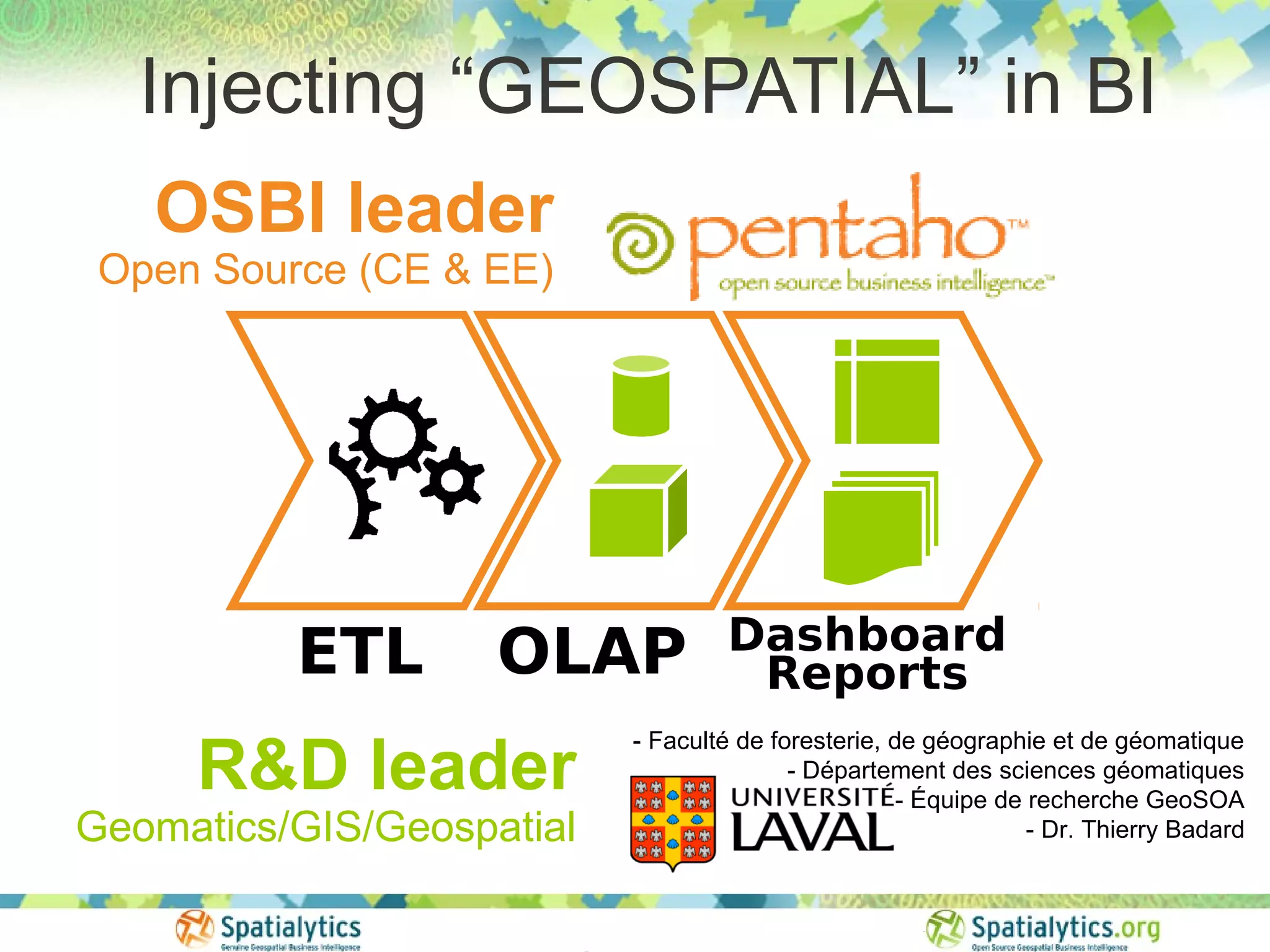
Injecting “GEOSPATIAL” in BI
   OSBI leader
 Open Source (CE & EE)


                                   Dashboard
          ETL       OLAP            Reports

     R&D leader
                           - Faculté de foresterie, de géographie et de géomatique
                                          - Département des sciences géomatiques
                                                     - Équipe de recherche GeoSOA
Geomatics/GIS/Geospatial                                         - Dr. Thierry Badard
Why merge BI and geospatial software?
●
    Because “About 80% of all data stored in corporate databases has a
    spatial component” [Franklin 1992]
●   Enable the exploration of spatial relations between data
    −   To definitely take into account all aspects (spatial, temporal, desc.) of data
    −   And then take more informed decisions
●
    Some phenomena can only be effectively observed and interpreted
    by representing them on a map!
    −   Spatial distribution,
    −   Spatiotemporal evolution,
    −   etc.
●
    But we need to go beyond simple push-pins on a Google Maps!
    –   Need for complex spatial analysis and transformations
    –   Advanced and cool thematic map representations
    –   Extend the query language with geospatial capabilities
    –   Easy navigation via drill-down and roll-up operators applied to maps
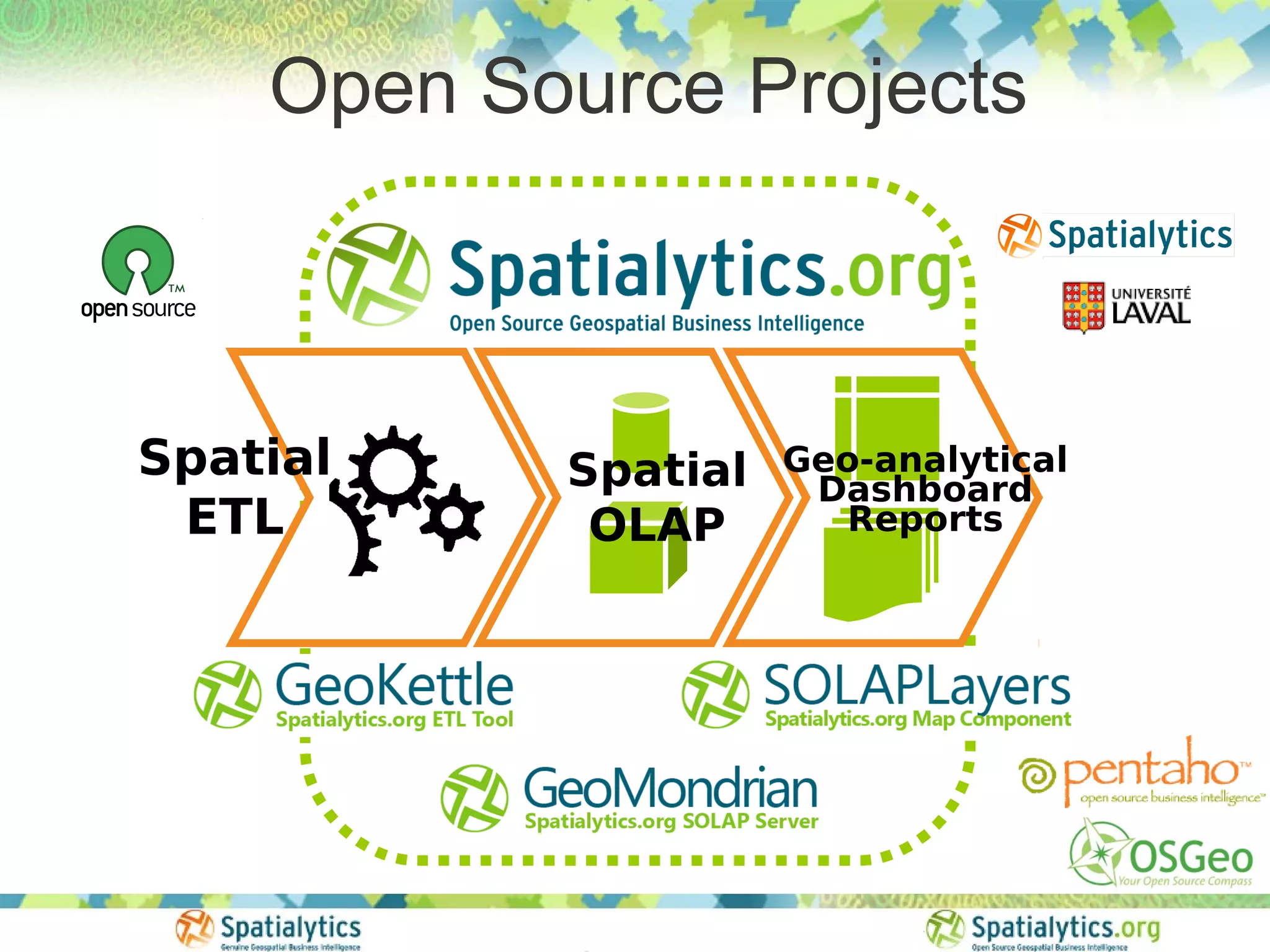
Open Source Projects


Spatial    Spatial   Geo-analytical
                      Dashboard
 ETL        OLAP       Reports
GeoKettle
●
    GeoKettle is a "spatially-enabled" version of Pentaho Data
    Integration (Kettle)
●
    GeoKettle provides a true and consistent integration of the
    spatial component
    −   All steps provided by Kettle are able to deal with geospatial data types
    −   Some geospatial dedicated steps have been added
●
    First release in May 2008: 2.5.2-20080531
●
    Current stable version: 3.2.0-r188-20090706
●
    To be released very shortly: GeoKettle 2.0 with many new
    features!
●
    Released under LGPL at http://www.geokettle.org
●
    Used in different organizations and countries
●
    A growing community of users and developers
GeoKettle
●
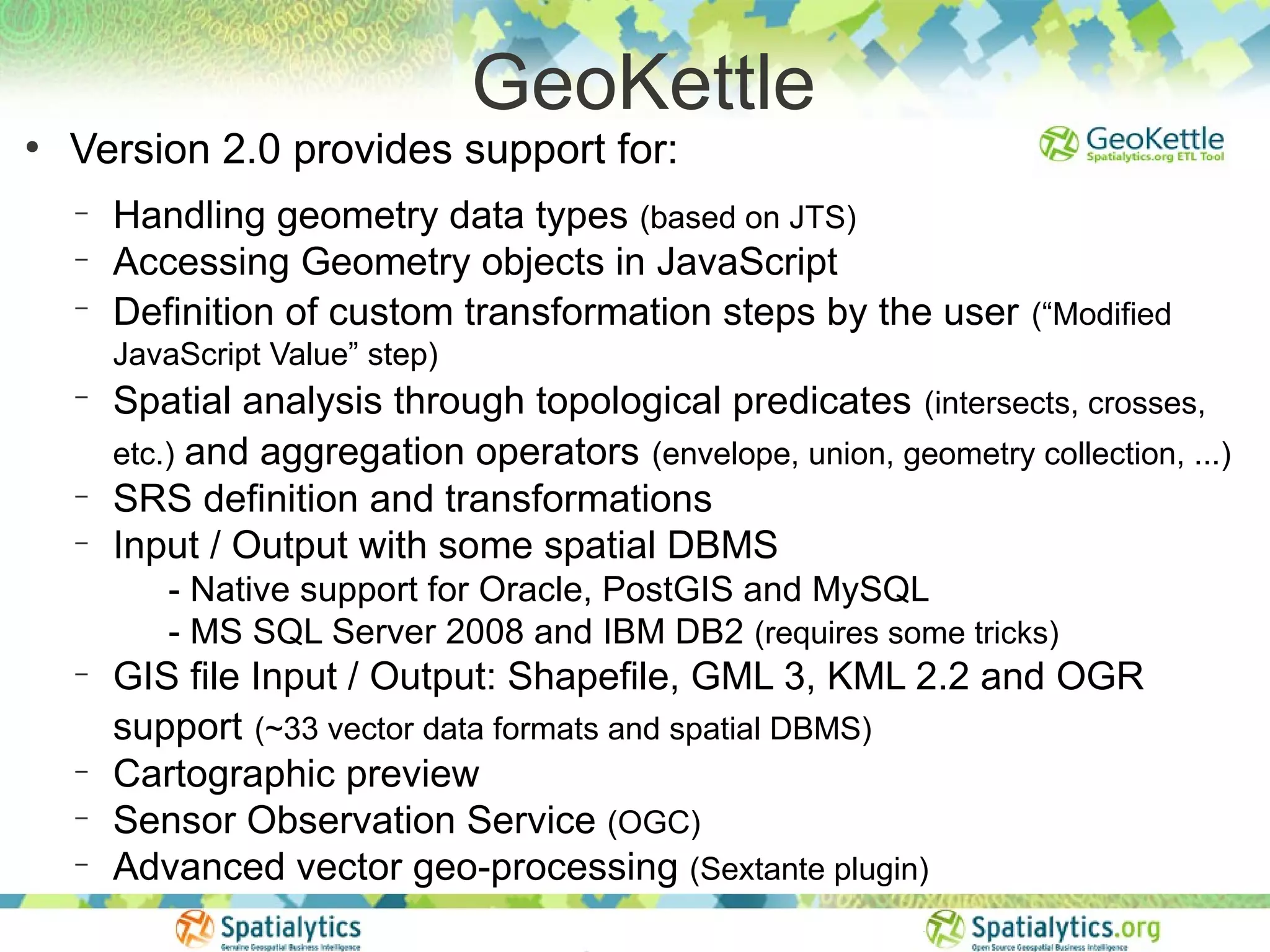
    Version 2.0 provides support for:
    −   Handling geometry data types (based on JTS)
    −   Accessing Geometry objects in JavaScript
    −
        Definition of custom transformation steps by the user (“Modified
        JavaScript Value” step)
    −
        Spatial analysis through topological predicates (intersects, crosses,
        etc.) and aggregation operators (envelope, union, geometry collection, ...)
    −   SRS definition and transformations
    −   Input / Output with some spatial DBMS
           - Native support for Oracle, PostGIS and MySQL
           - MS SQL Server 2008 and IBM DB2 (requires some tricks)
    −   GIS file Input / Output: Shapefile, GML 3, KML 2.2 and OGR
        support (~33 vector data formats and spatial DBMS)
    −   Cartographic preview
    −   Sensor Observation Service (OGC)
    −   Advanced vector geo-processing (Sextante plugin)
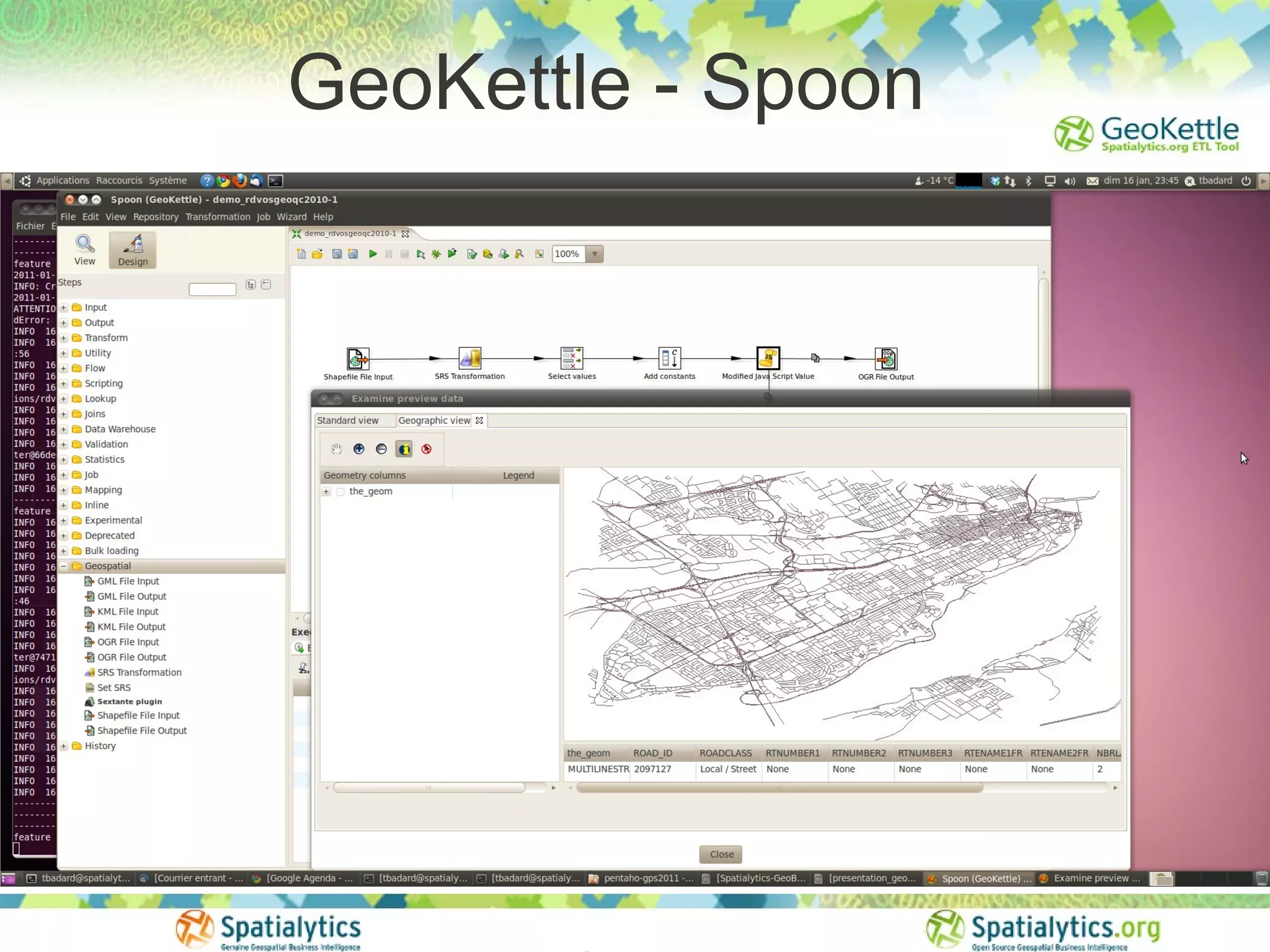
GeoKettle - Spoon
GeoMondrian
●
    GeoMondrian is a "spatially-enabled" version of
    Pentaho Analysis Services (Mondrian)
●
    GeoMondrian brings to the Mondrian OLAP
    server what PostGIS brings to the PostgreSQL
    DBMS
    –   i.e. a consistent and powerful support for geospatial
        data.

●
    Licensed under the EPL
●
    http://www.geo-mondrian.org
GeoMondrian
●
    As far as we know, it is the first implementation of a true
    Spatial OLAP (SOLAP) Server
    −   And it is an open source project! ;-)
●
    Provides a consistent integration of spatial objects into the
    OLAP data cube structure
    −   Instead of fetching them from an external spatial DBMS, web
        service or a GIS file
●
    Implements a native Geometry data type
●
    Provides first spatial extensions to the MDX language
    −   Add spatial analysis capabilities to the analytical queries
●
    At present, it only supports PostGIS datawarehouses
    −   But other DBMS will be supported in the next version!
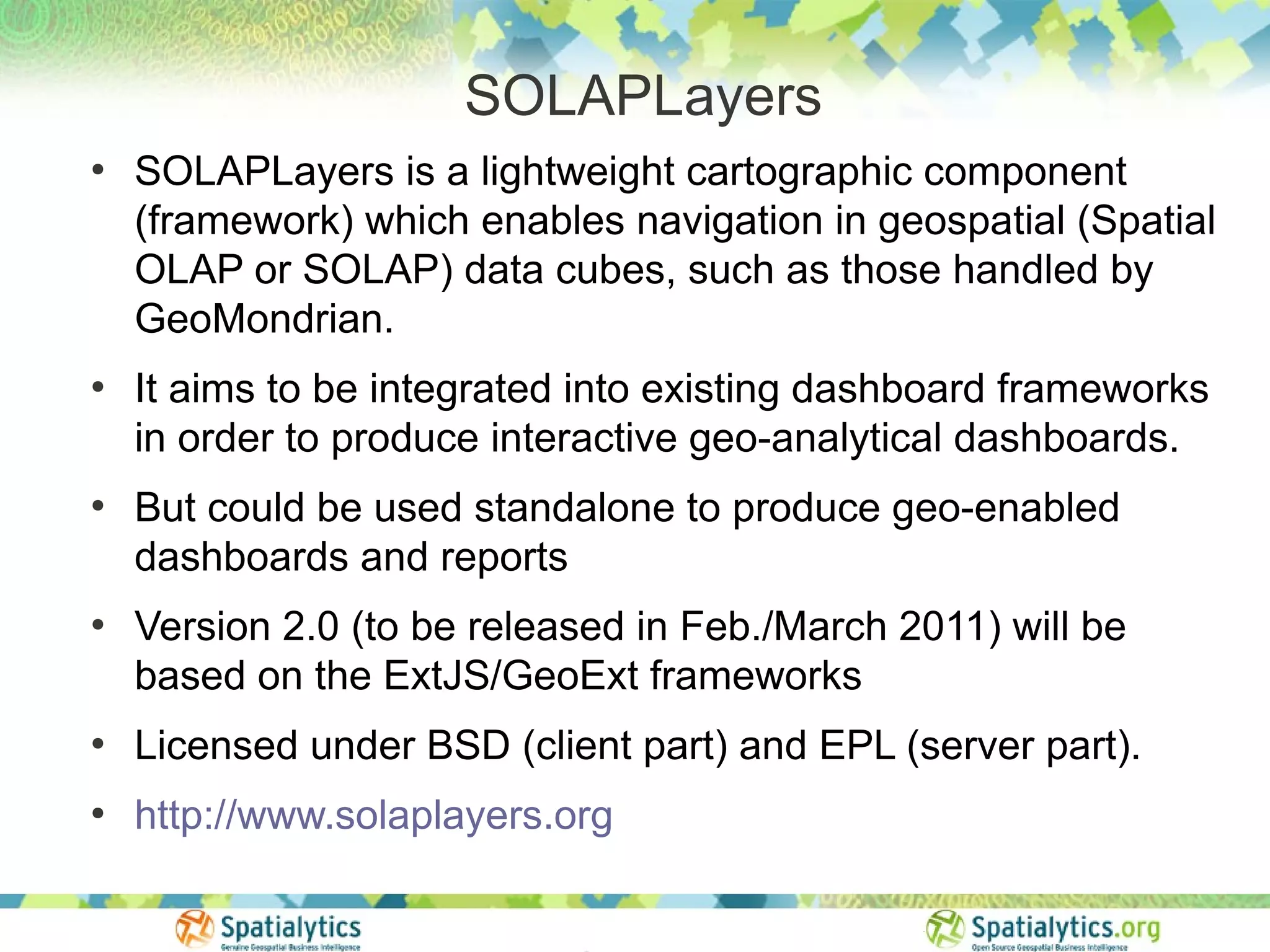
SOLAPLayers
●
    SOLAPLayers is a lightweight cartographic component
    (framework) which enables navigation in geospatial (Spatial
    OLAP or SOLAP) data cubes, such as those handled by
    GeoMondrian.
●
    It aims to be integrated into existing dashboard frameworks
    in order to produce interactive geo-analytical dashboards.
●
    But could be used standalone to produce geo-enabled
    dashboards and reports
●
    Version 2.0 (to be released in Feb./March 2011) will be
    based on the ExtJS/GeoExt frameworks
●
    Licensed under BSD (client part) and EPL (server part).
●
    http://www.solaplayers.org
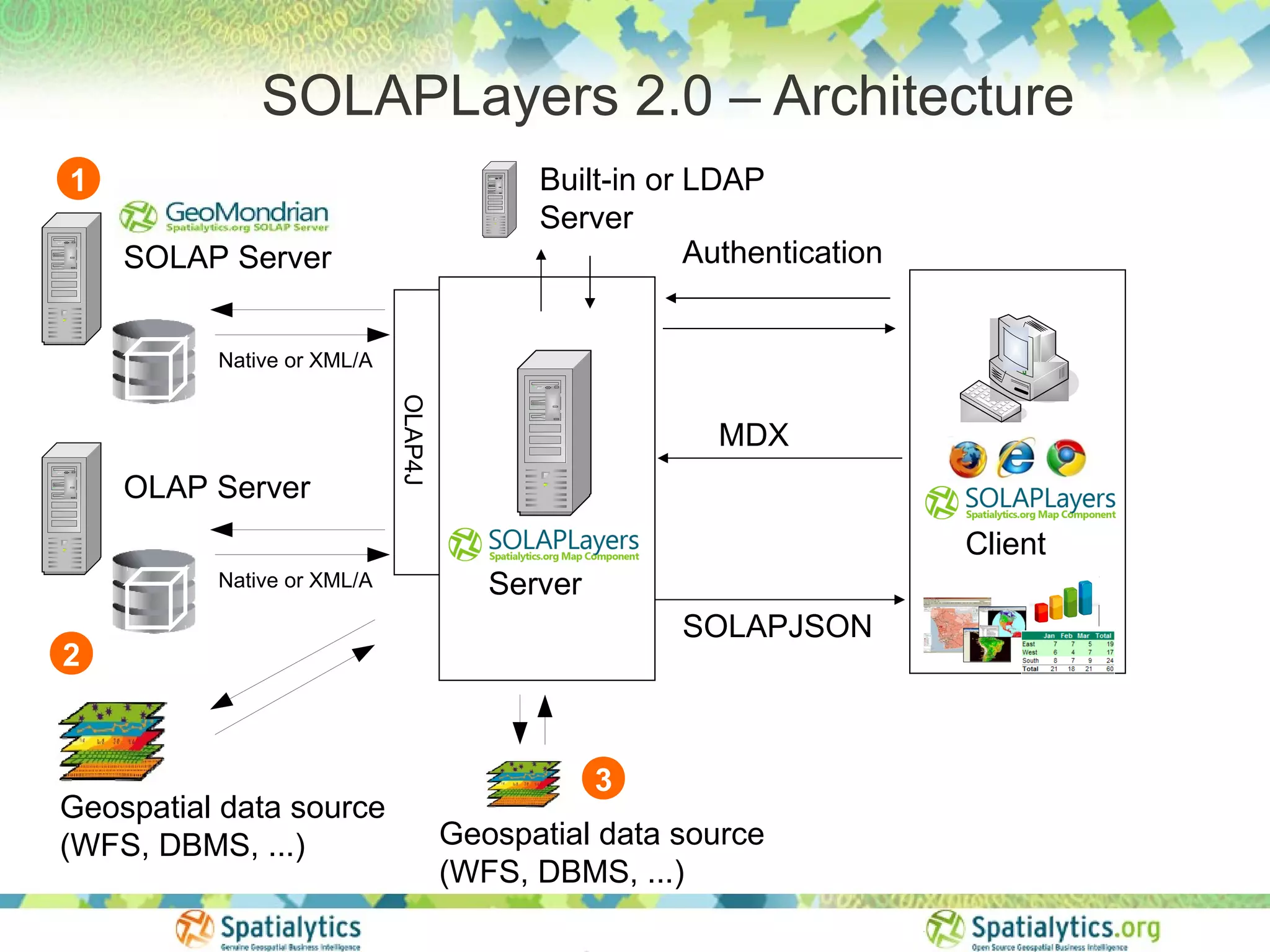
SOLAPLayers 2.0 – Architecture
1                                          Built-in or LDAP
                                           Server
    SOLAP Server                                       Authentication


          Native or XML/A
                            OLAP4J
                                                        MDX
    OLAP Server
                                                                        Client
          Native or XML/A               Server
                                                     SOLAPJSON
2


                                                 3
Geospatial data source
(WFS, DBMS, ...)                     Geospatial data source
                                     (WFS, DBMS, ...)
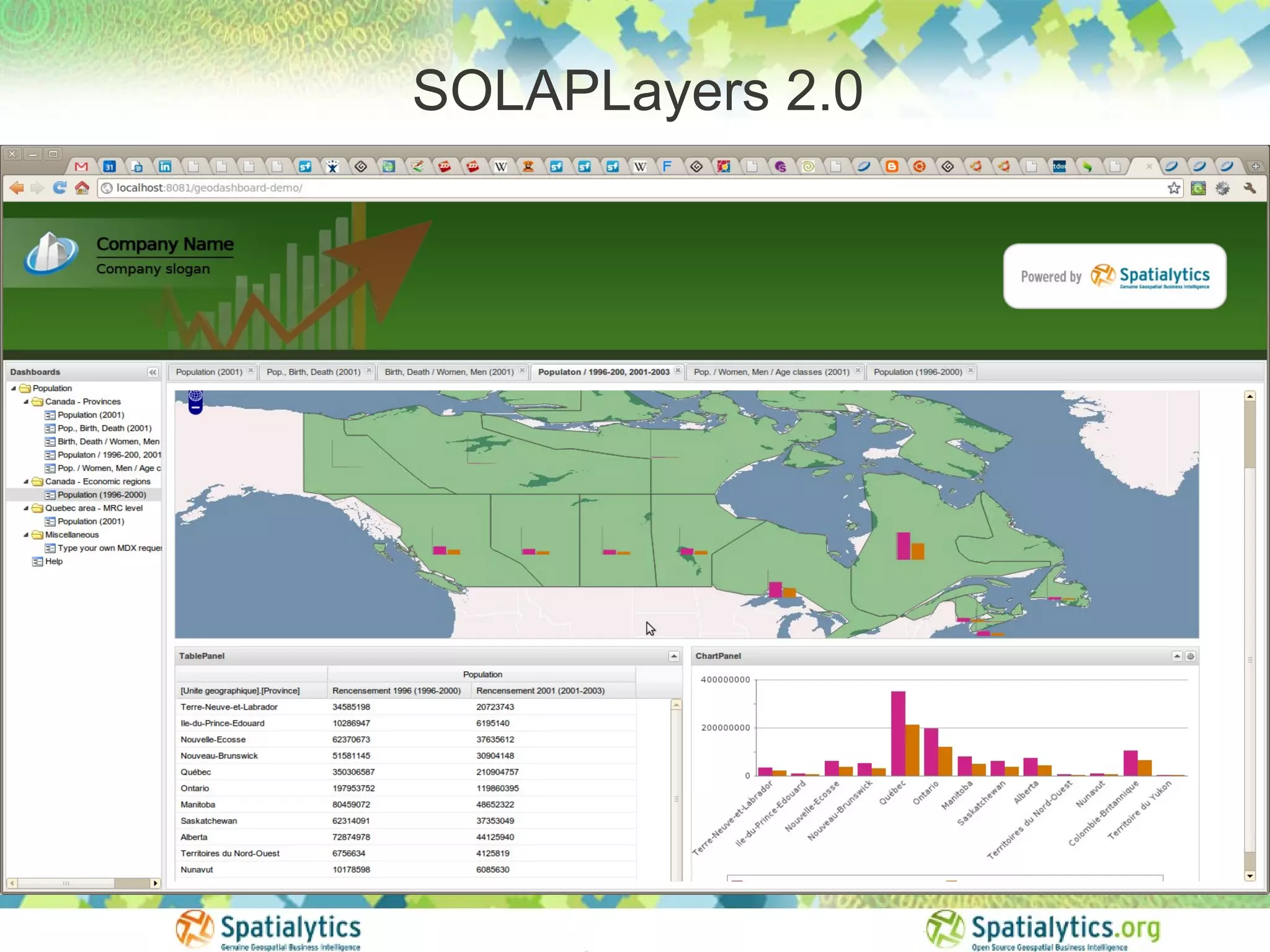
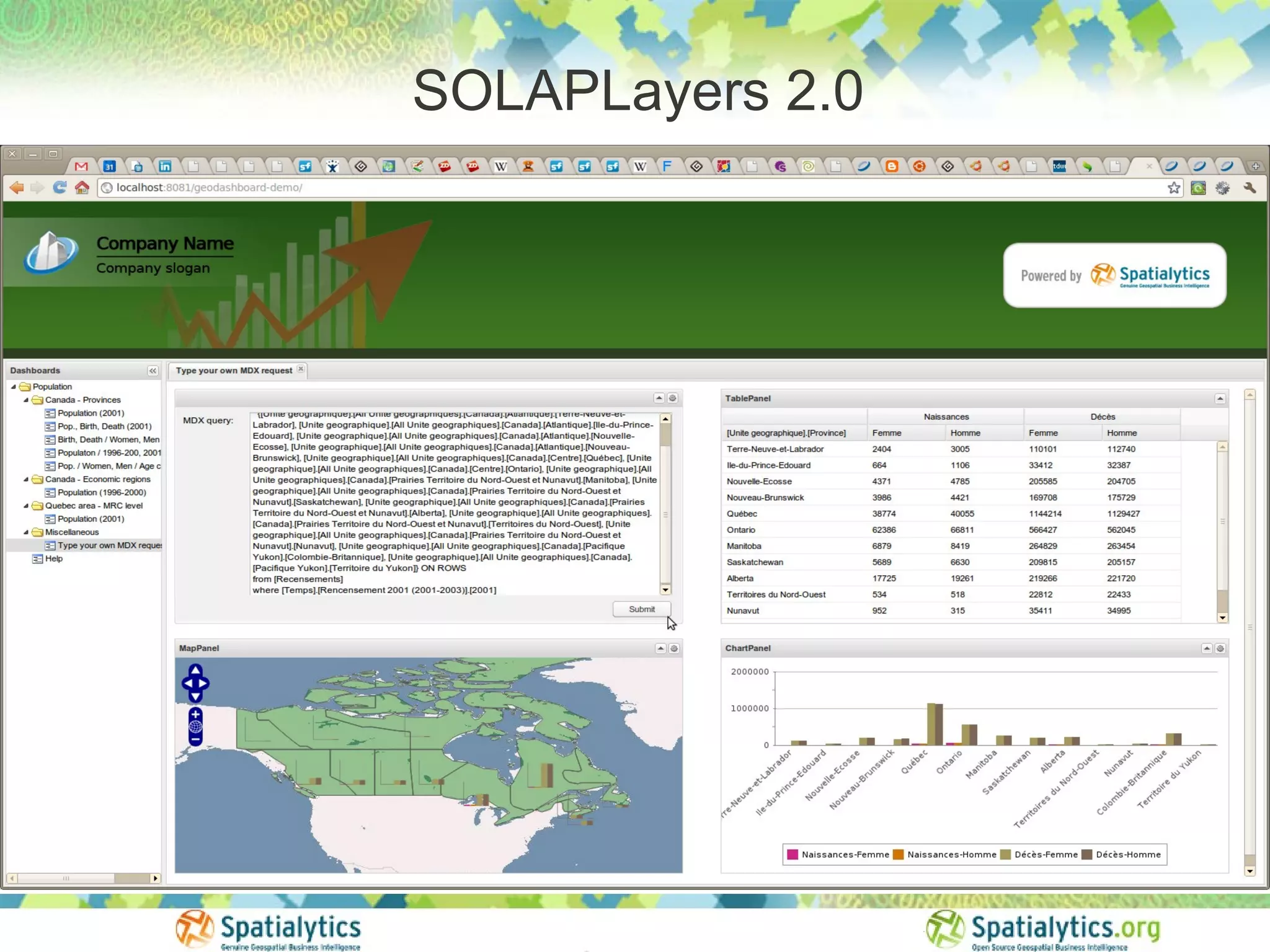
SOLAPLayers 2.0
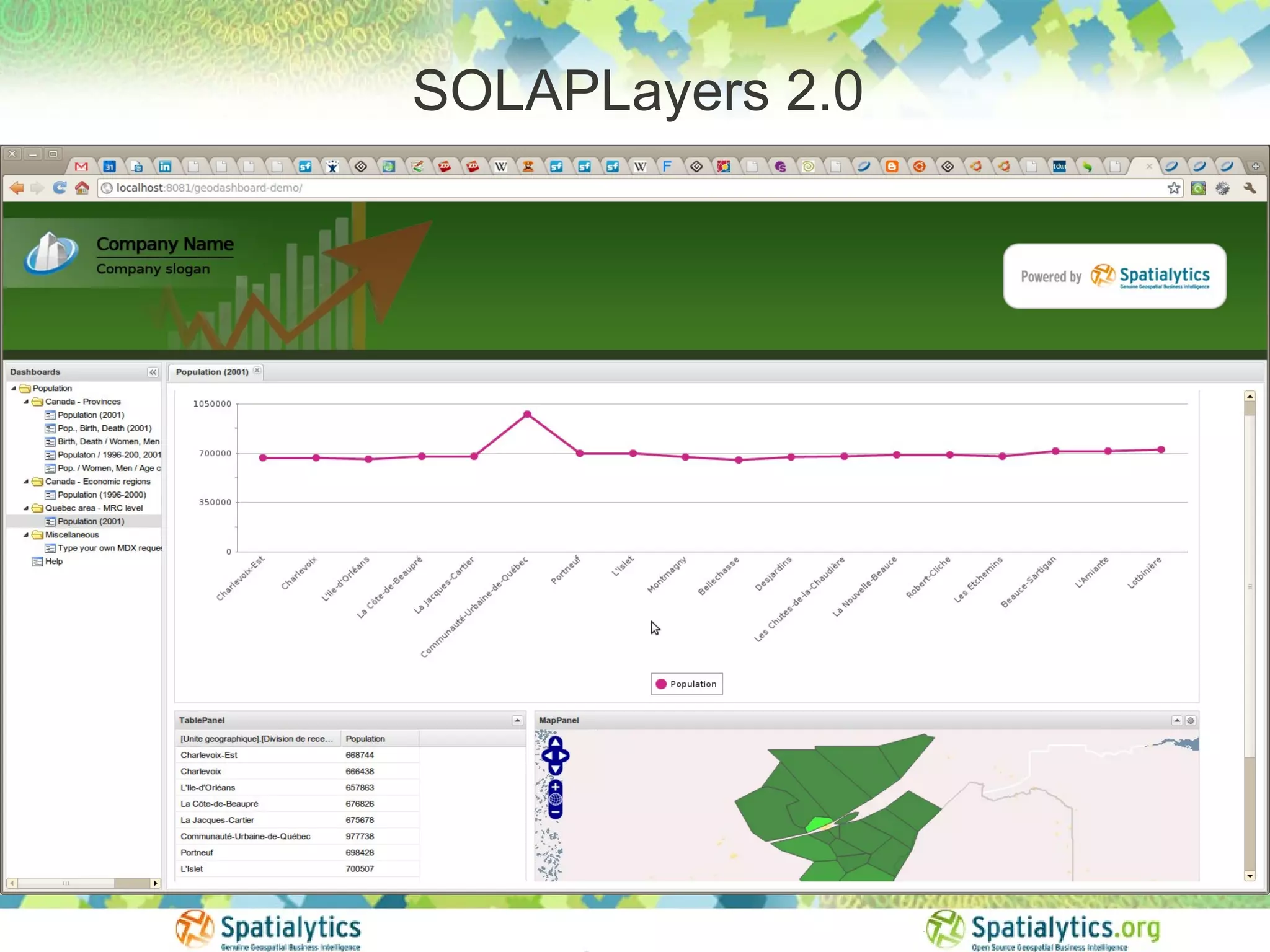
SOLAPLayers 2.0
SOLAPLayers 2.0
Questions?
●   Thanks for your attention and do not hesitate to ask for demos
    and to contact us for possible collaborations!
●   Contact:
    Dr. Thierry Badard, CTO
    Spatialytics inc.
    Quebec, Canada
    Email: tbadard@spatialytics.com
    Web: http://www.spatialytics.org
          http://www.spatialytics.com
    Twitter: tbadard & spatialytics


                      http://www.geokettle.org      Twitter : geokettle

                      http://www.geo-mondrian.org   Twitter : geomondrian

                      http://www.solaplayers.org    Twitter : solaplayers
Spatially enabled MDX
●
    Goal: bring to Mondrian and MDX what SQL spatial
    extensions do for relational DBMS (i.e. Simple Features for
    SQL and implementations such as PostGIS).
●
    Example query: filter spatial dimension members based on
    distance from a feature
    −   SELECT
         {[Measures].[Population]} on columns,
         Filter(
           {[Unite geographique].[Region economique].members},
             ST_Distance([Unitegeographique].CurrentMember.Properties("geom"),
             [Unite geographique].[Province].[Ontario].Properties("geom")) < 2.0
         ) on rows
        FROM [Recensements]
        WHERE [Temps].[Rencensement 2001 (2001-2003)].[2001]
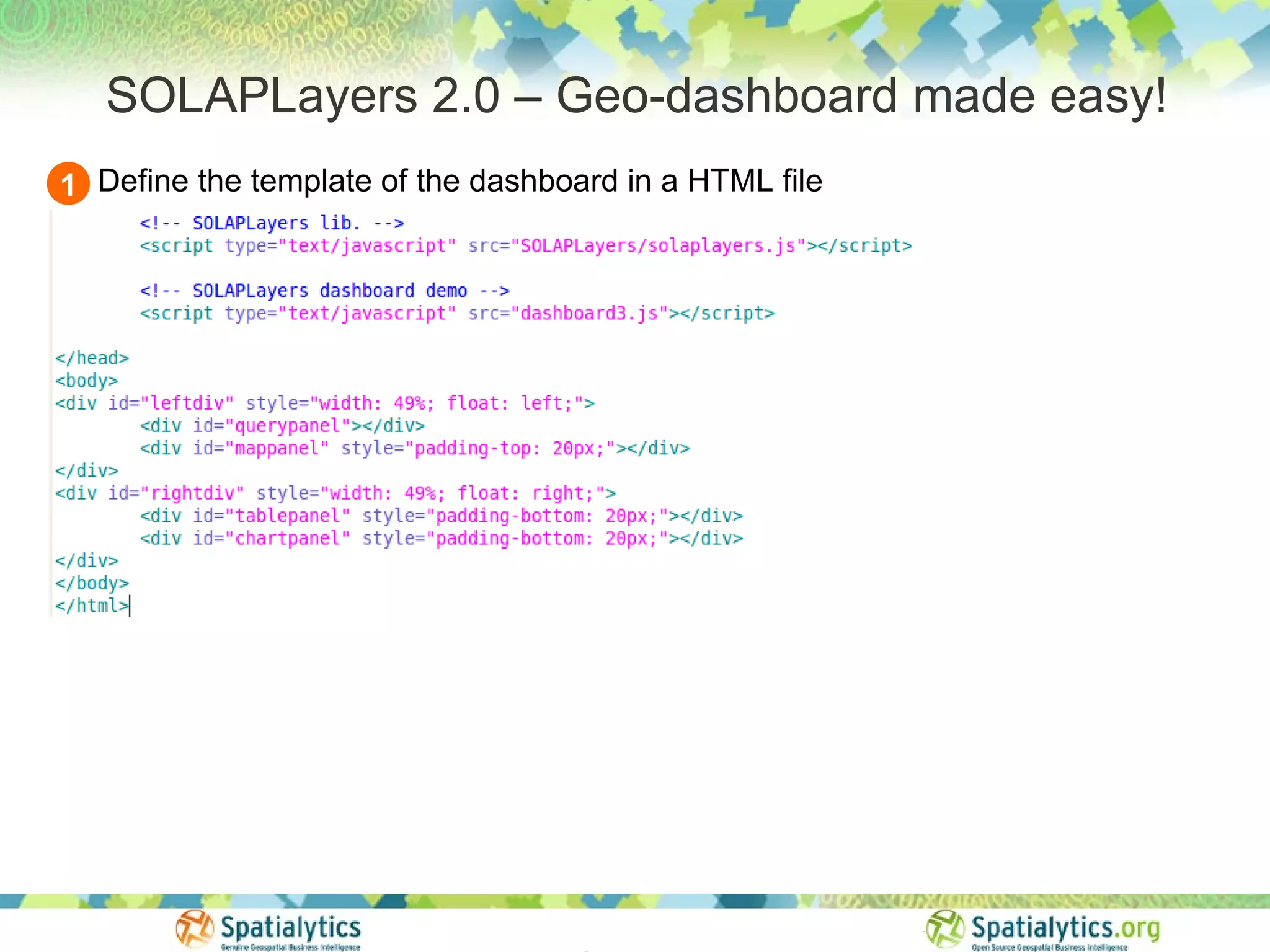
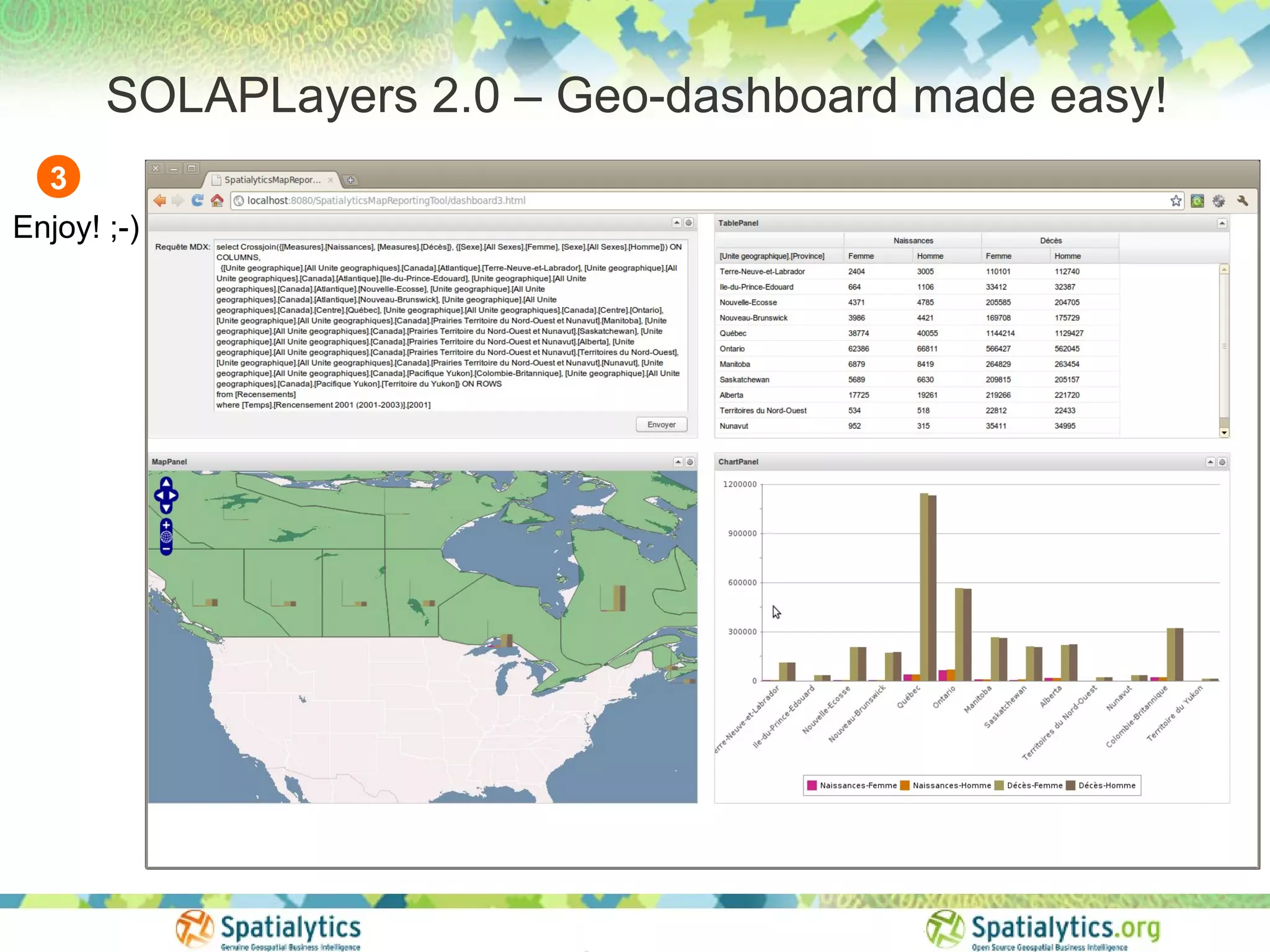
SOLAPLayers 2.0 – Geo-dashboard made easy!
1 Define the template of the dashboard in a HTML file
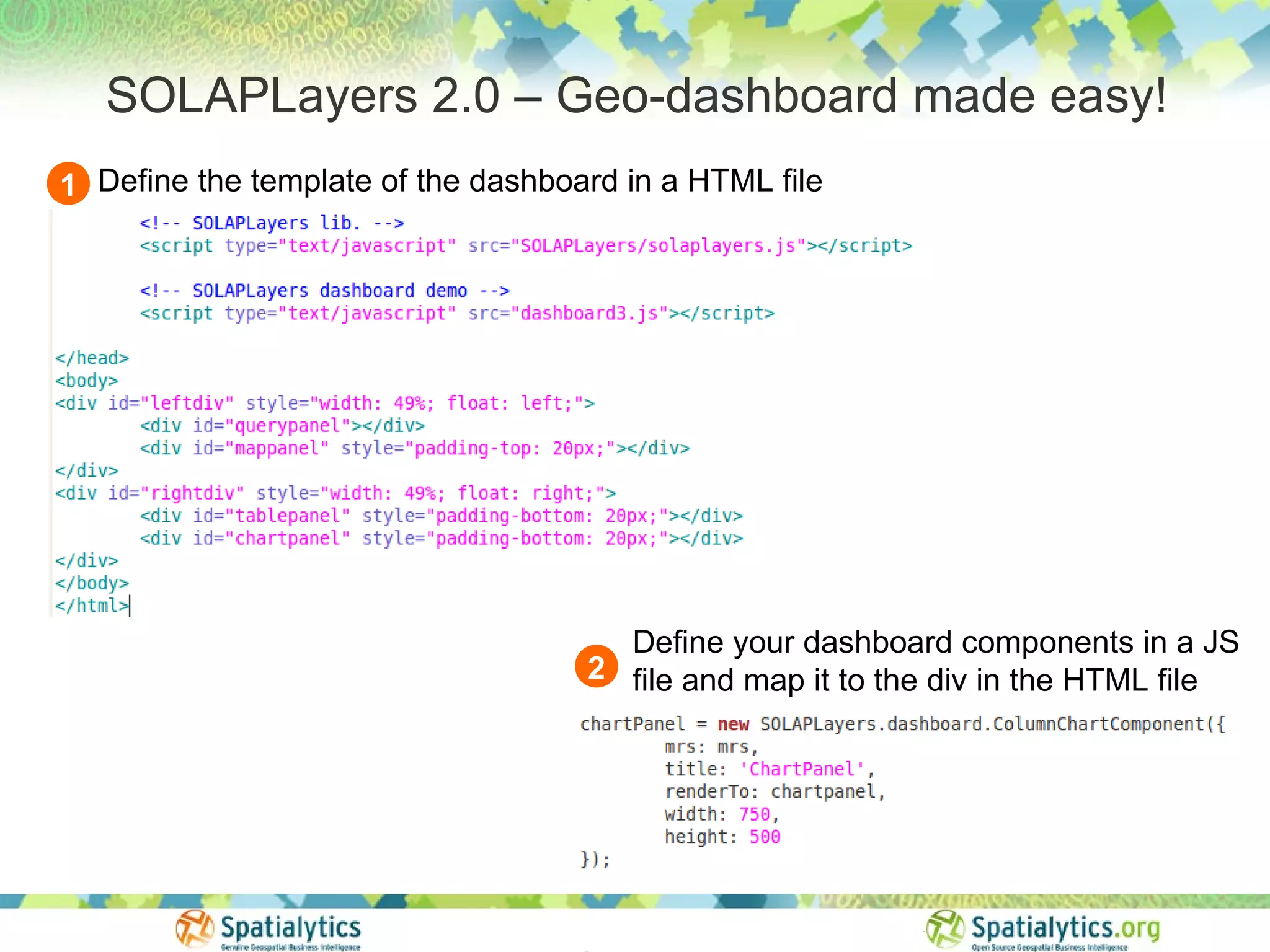
SOLAPLayers 2.0 – Geo-dashboard made easy!
1 Define the template of the dashboard in a HTML file


                                      Define your dashboard components in a JS
                                    2 file and map it to the div in the HTML file
SOLAPLayers 2.0 – Geo-dashboard made easy!
  3
Enjoy! ;-)
SOLAPLayers
●   As GeoExt which provides Geospatial extensions to ExtJS,
    SOLAPLayers provides GeoBI extensions to ExtJS
●   So, to make it simple: SOLAPLayers = GeoBIExt!
●   At present, it provides the main components for creating
    geo-analytical dashboards
    –   Map, crosstab, column chart, line chart, ...
    –   But, many more to come and to develop!
        ●   Cube explorer, query builder, time slider/navigator, gauges, score cards, social graphs, ...

    –   Advanced interaction capabilities and settings will be added to each components!
    –   Additional thematic mapping capabilities are also required: multi-maps, ...

●   We anticipate to have a first stable of version 2.0 in
    February/March 2011

Spatially enabled open source BI (GeoBI) with GeoKettle, GeoMondrian & SOLAPLayers

  • 1.
    Spatially enabled opensource BI (GeoBI) with GeoKettle, GeoMondrian & SOLAPLayers Dr. Thierry Badard, CTO Spatialytics Solutions Inc. Quebec, Canada tbadard@spatialytics.com
  • 2.
    Injecting “GEOSPATIAL” inBI OSBI leader Open Source (CE & EE) Dashboard ETL OLAP Reports R&D leader - Faculté de foresterie, de géographie et de géomatique - Département des sciences géomatiques - Équipe de recherche GeoSOA Geomatics/GIS/Geospatial - Dr. Thierry Badard
  • 3.
    Why merge BIand geospatial software? ● Because “About 80% of all data stored in corporate databases has a spatial component” [Franklin 1992] ● Enable the exploration of spatial relations between data − To definitely take into account all aspects (spatial, temporal, desc.) of data − And then take more informed decisions ● Some phenomena can only be effectively observed and interpreted by representing them on a map! − Spatial distribution, − Spatiotemporal evolution, − etc. ● But we need to go beyond simple push-pins on a Google Maps! – Need for complex spatial analysis and transformations – Advanced and cool thematic map representations – Extend the query language with geospatial capabilities – Easy navigation via drill-down and roll-up operators applied to maps
  • 4.
    Open Source Projects Spatial Spatial Geo-analytical Dashboard ETL OLAP Reports
  • 5.
    GeoKettle ● GeoKettle is a "spatially-enabled" version of Pentaho Data Integration (Kettle) ● GeoKettle provides a true and consistent integration of the spatial component − All steps provided by Kettle are able to deal with geospatial data types − Some geospatial dedicated steps have been added ● First release in May 2008: 2.5.2-20080531 ● Current stable version: 3.2.0-r188-20090706 ● To be released very shortly: GeoKettle 2.0 with many new features! ● Released under LGPL at http://www.geokettle.org ● Used in different organizations and countries ● A growing community of users and developers
  • 6.
    GeoKettle ● Version 2.0 provides support for: − Handling geometry data types (based on JTS) − Accessing Geometry objects in JavaScript − Definition of custom transformation steps by the user (“Modified JavaScript Value” step) − Spatial analysis through topological predicates (intersects, crosses, etc.) and aggregation operators (envelope, union, geometry collection, ...) − SRS definition and transformations − Input / Output with some spatial DBMS - Native support for Oracle, PostGIS and MySQL - MS SQL Server 2008 and IBM DB2 (requires some tricks) − GIS file Input / Output: Shapefile, GML 3, KML 2.2 and OGR support (~33 vector data formats and spatial DBMS) − Cartographic preview − Sensor Observation Service (OGC) − Advanced vector geo-processing (Sextante plugin)
  • 7.
  • 8.
    GeoMondrian ● GeoMondrian is a "spatially-enabled" version of Pentaho Analysis Services (Mondrian) ● GeoMondrian brings to the Mondrian OLAP server what PostGIS brings to the PostgreSQL DBMS – i.e. a consistent and powerful support for geospatial data. ● Licensed under the EPL ● http://www.geo-mondrian.org
  • 9.
    GeoMondrian ● As far as we know, it is the first implementation of a true Spatial OLAP (SOLAP) Server − And it is an open source project! ;-) ● Provides a consistent integration of spatial objects into the OLAP data cube structure − Instead of fetching them from an external spatial DBMS, web service or a GIS file ● Implements a native Geometry data type ● Provides first spatial extensions to the MDX language − Add spatial analysis capabilities to the analytical queries ● At present, it only supports PostGIS datawarehouses − But other DBMS will be supported in the next version!
  • 10.
    SOLAPLayers ● SOLAPLayers is a lightweight cartographic component (framework) which enables navigation in geospatial (Spatial OLAP or SOLAP) data cubes, such as those handled by GeoMondrian. ● It aims to be integrated into existing dashboard frameworks in order to produce interactive geo-analytical dashboards. ● But could be used standalone to produce geo-enabled dashboards and reports ● Version 2.0 (to be released in Feb./March 2011) will be based on the ExtJS/GeoExt frameworks ● Licensed under BSD (client part) and EPL (server part). ● http://www.solaplayers.org
  • 11.
    SOLAPLayers 2.0 –Architecture 1 Built-in or LDAP Server SOLAP Server Authentication Native or XML/A OLAP4J MDX OLAP Server Client Native or XML/A Server SOLAPJSON 2 3 Geospatial data source (WFS, DBMS, ...) Geospatial data source (WFS, DBMS, ...)
  • 12.
  • 13.
  • 14.
  • 15.
    Questions? ● Thanks for your attention and do not hesitate to ask for demos and to contact us for possible collaborations! ● Contact: Dr. Thierry Badard, CTO Spatialytics inc. Quebec, Canada Email: tbadard@spatialytics.com Web: http://www.spatialytics.org http://www.spatialytics.com Twitter: tbadard & spatialytics http://www.geokettle.org Twitter : geokettle http://www.geo-mondrian.org Twitter : geomondrian http://www.solaplayers.org Twitter : solaplayers
  • 16.
    Spatially enabled MDX ● Goal: bring to Mondrian and MDX what SQL spatial extensions do for relational DBMS (i.e. Simple Features for SQL and implementations such as PostGIS). ● Example query: filter spatial dimension members based on distance from a feature − SELECT {[Measures].[Population]} on columns, Filter( {[Unite geographique].[Region economique].members}, ST_Distance([Unitegeographique].CurrentMember.Properties("geom"), [Unite geographique].[Province].[Ontario].Properties("geom")) < 2.0 ) on rows FROM [Recensements] WHERE [Temps].[Rencensement 2001 (2001-2003)].[2001]
  • 17.
    SOLAPLayers 2.0 –Geo-dashboard made easy! 1 Define the template of the dashboard in a HTML file
  • 18.
    SOLAPLayers 2.0 –Geo-dashboard made easy! 1 Define the template of the dashboard in a HTML file Define your dashboard components in a JS 2 file and map it to the div in the HTML file
  • 19.
    SOLAPLayers 2.0 –Geo-dashboard made easy! 3 Enjoy! ;-)
  • 20.
    SOLAPLayers ● As GeoExt which provides Geospatial extensions to ExtJS, SOLAPLayers provides GeoBI extensions to ExtJS ● So, to make it simple: SOLAPLayers = GeoBIExt! ● At present, it provides the main components for creating geo-analytical dashboards – Map, crosstab, column chart, line chart, ... – But, many more to come and to develop! ● Cube explorer, query builder, time slider/navigator, gauges, score cards, social graphs, ... – Advanced interaction capabilities and settings will be added to each components! – Additional thematic mapping capabilities are also required: multi-maps, ... ● We anticipate to have a first stable of version 2.0 in February/March 2011