Page1 © Hortonworks Inc. 2011 – 2016. All Rights Reserved
Hive: Data Organization for Performance
Gopal Vijayaraghavan
Page2 © Hortonworks Inc. 2011 – 2016. All Rights Reserved
In this episode
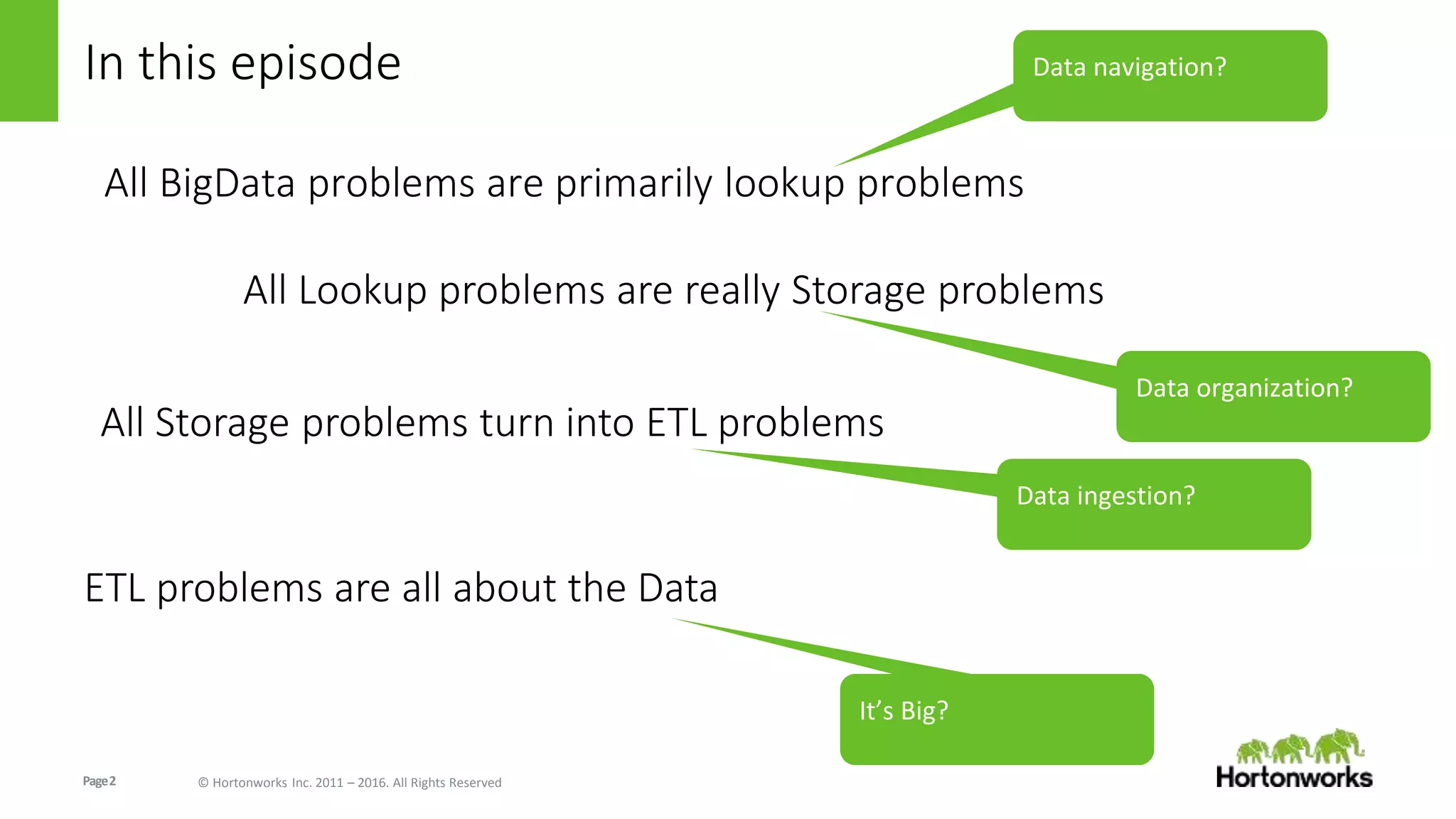
All BigData problems are primarily lookup problems
All Lookup problems are really Storage problems
All Storage problems turn into ETL problems
ETL problems are all about the Data
Data navigation?
Data organization?
Data ingestion?
It’s Big?
Page3 © Hortonworks Inc. 2011 – 2016. All Rights Reserved
Good idea: Do things that scale!
There are many problems like this, but this one is mine
Page4 © Hortonworks Inc. 2011 – 2016. All Rights Reserved
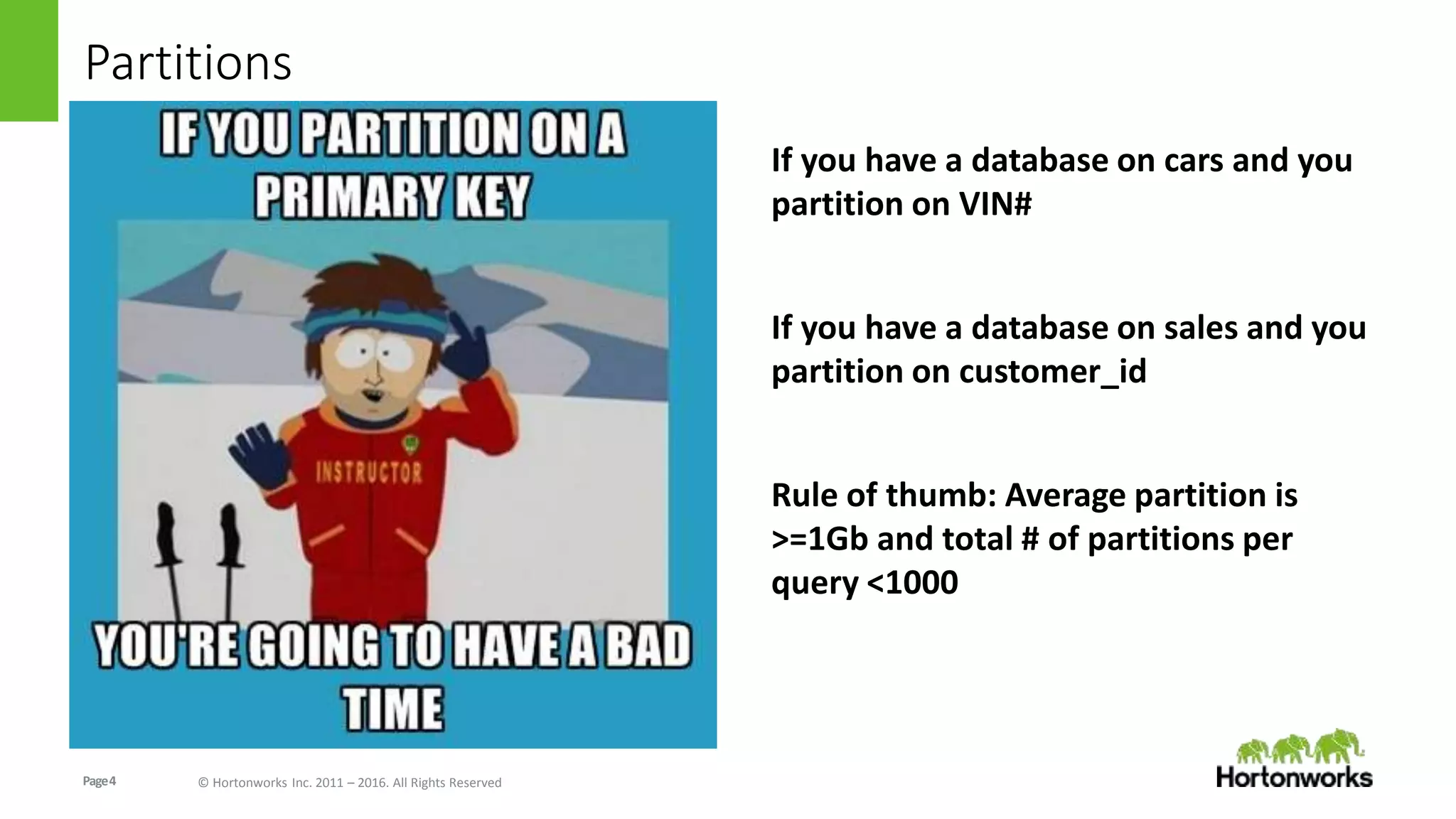
Partitions
If you have a database on cars and you
partition on VIN#
If you have a database on sales and you
partition on customer_id
Rule of thumb: Average partition is
>=1Gb and total # of partitions per
query <1000
Page5 © Hortonworks Inc. 2011 – 2016. All Rights Reserved
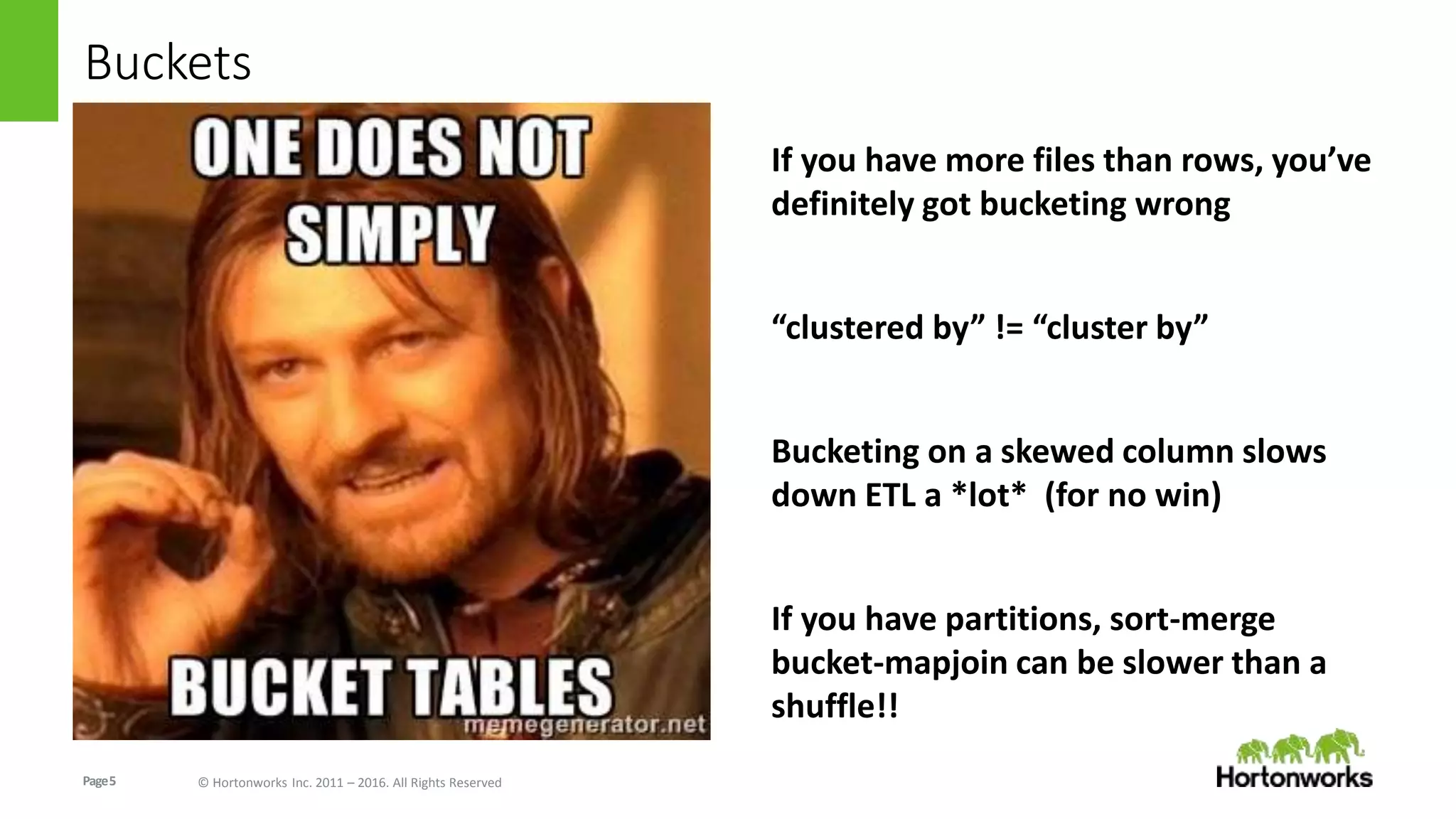
Buckets
If you have more files than rows, you’ve
definitely got bucketing wrong
“clustered by” != “cluster by”
Bucketing on a skewed column slows
down ETL a *lot* (for no win)
If you have partitions, sort-merge
bucket-mapjoin can be slower than a
shuffle!!
Page6 © Hortonworks Inc. 2011 – 2016. All Rights Reserved
Buckets - II
Histograms!
select explode(histogram_numeric(
hash(<col>)% <n-bucket>, <n-bucket>
)) as h from table;
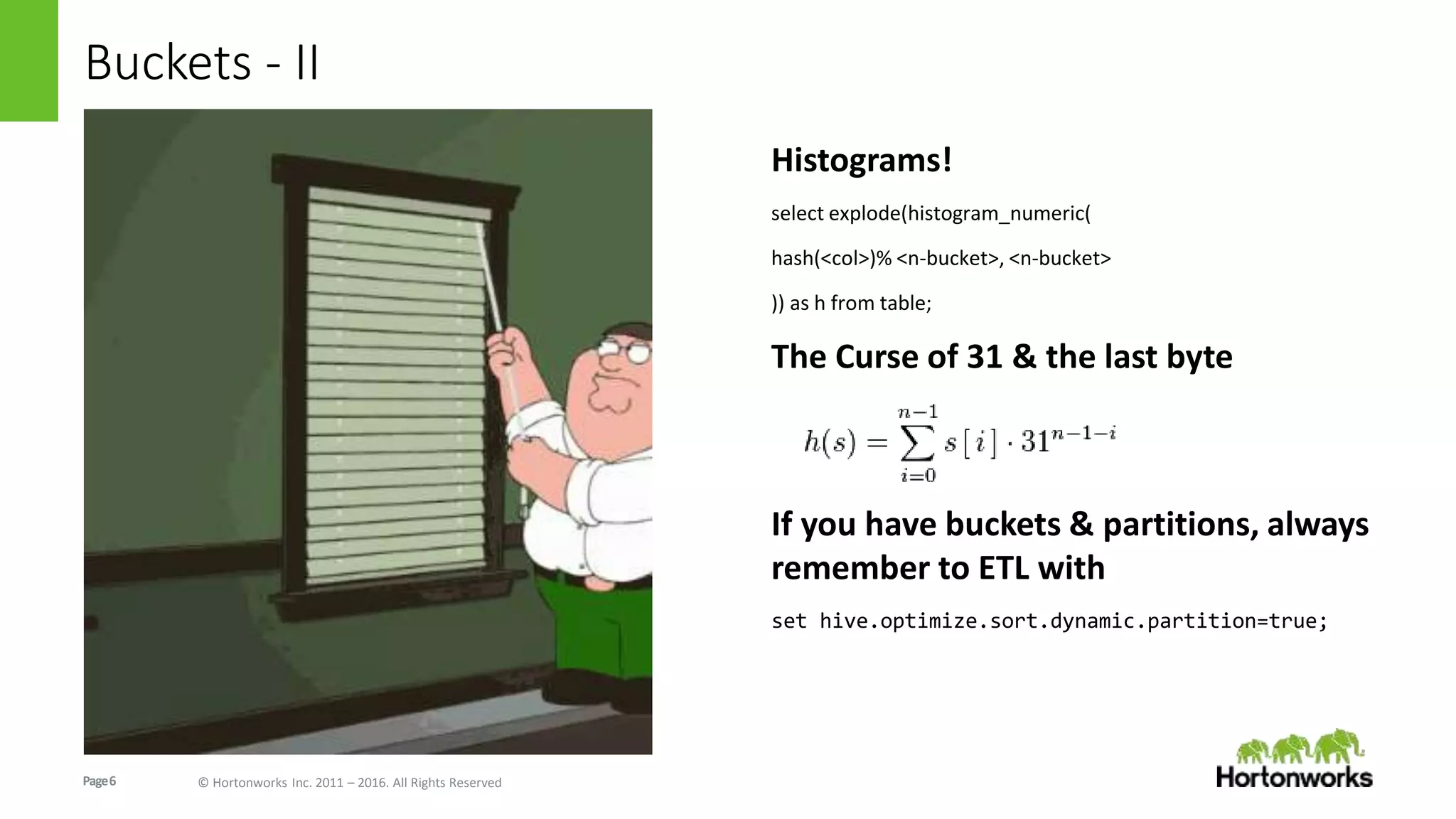
The Curse of 31 & the last byte
If you have buckets & partitions, always
remember to ETL with
set hive.optimize.sort.dynamic.partition=true;
Page7 © Hortonworks Inc. 2011 – 2016. All Rights Reserved
Denormalization
Denormalization can turn a compute
problem into an IO/lookup problem.
But if you then optimize that with
compression, you get a compute
problem again.
If you think JOINs are bad, you
probably haven’t moved out of
MapReduce.
Broadcast joins are good & dynamically
partitioned broadcast joins can scale
that ~1000x
Page8 © Hortonworks Inc. 2011 – 2016. All Rights Reserved
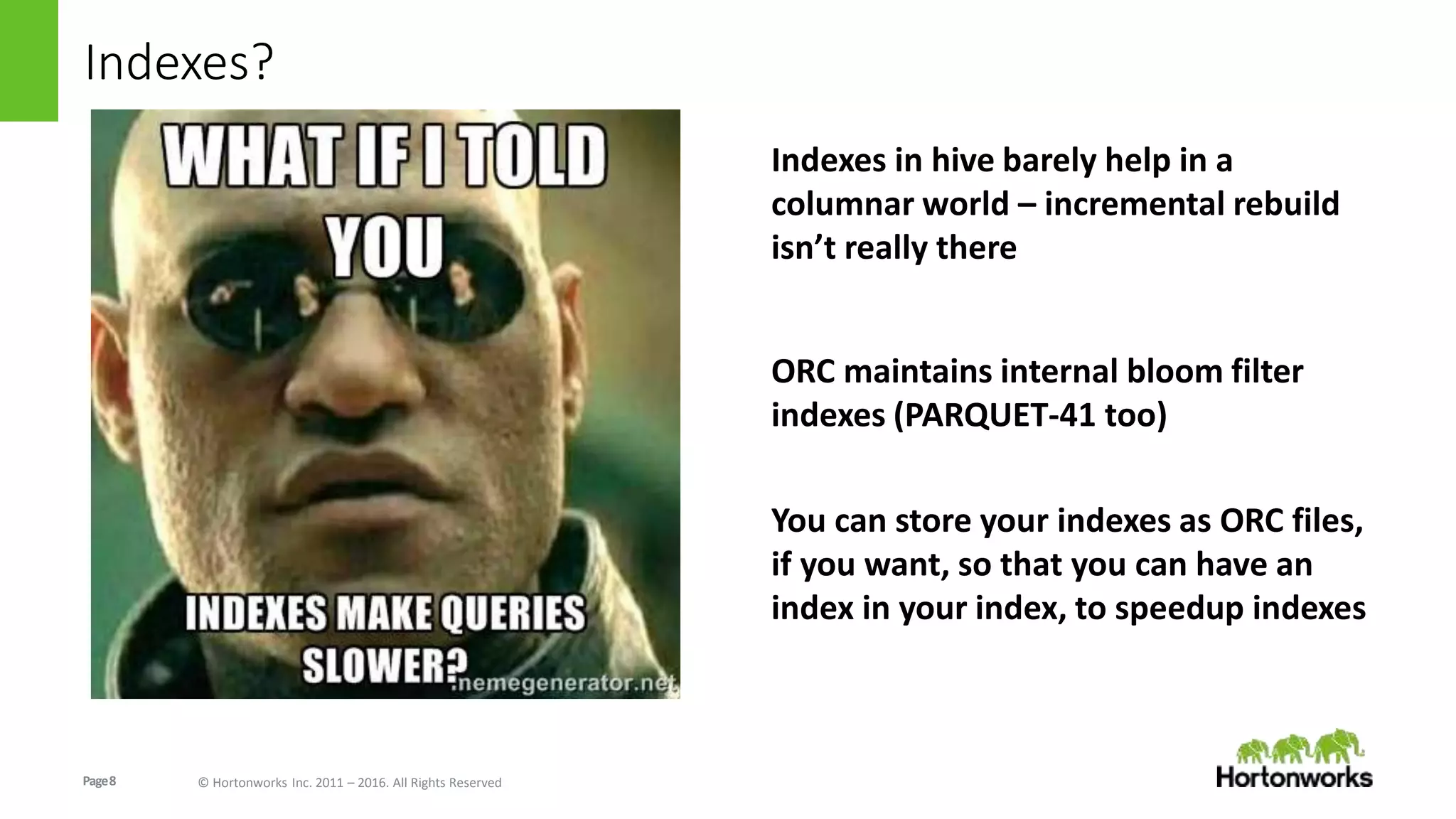
Indexes?
Indexes in hive barely help in a
columnar world – incremental rebuild
isn’t really there
ORC maintains internal bloom filter
indexes (PARQUET-41 too)
You can store your indexes as ORC files,
if you want, so that you can have an
index in your index, to speedup indexes
Page9 © Hortonworks Inc. 2011 – 2016. All Rights Reserved
Schema & Predicate Push Down
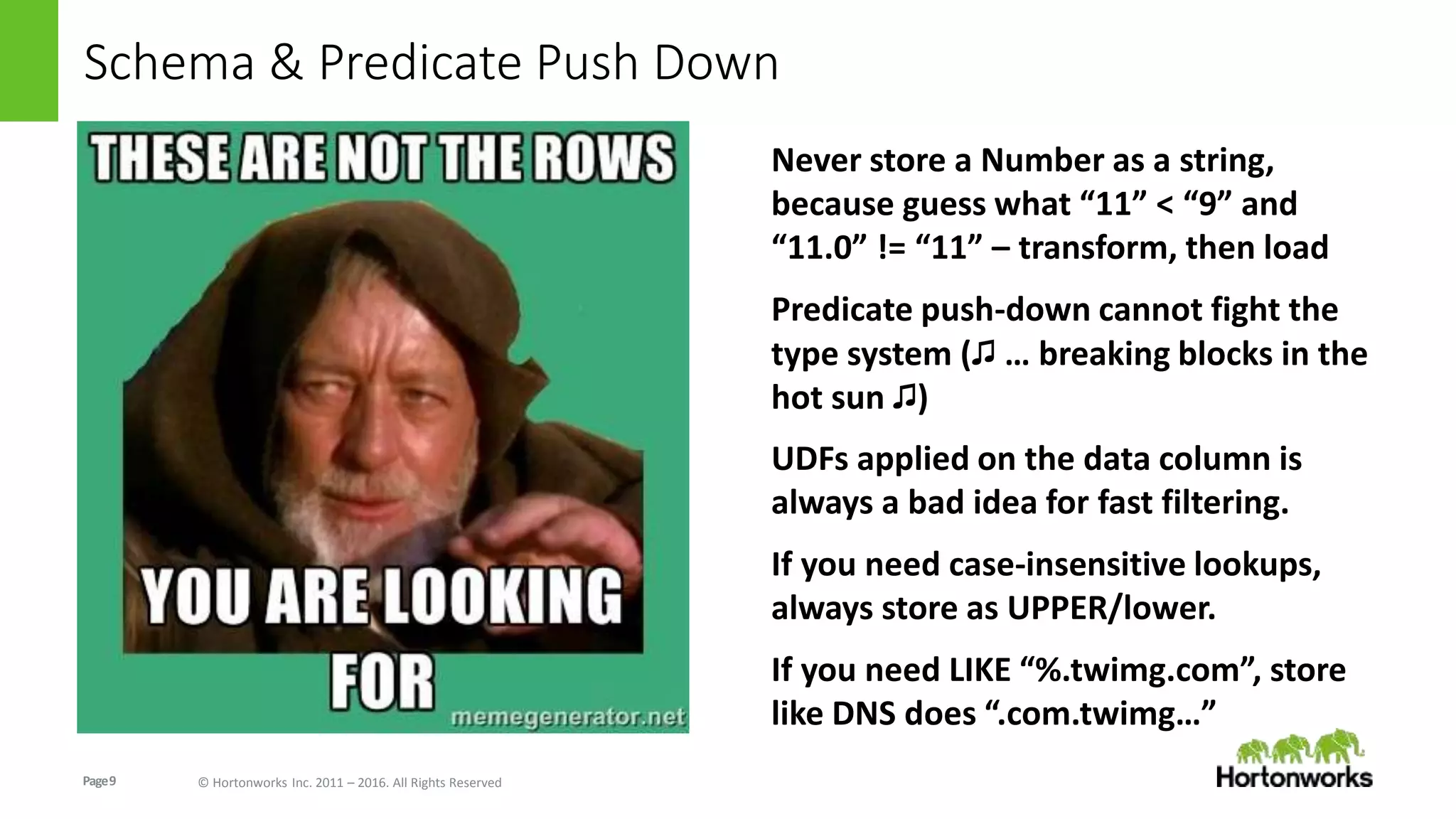
Never store a Number as a string,
because guess what “11” < “9” and
“11.0” != “11” – transform, then load
Predicate push-down cannot fight the
type system (♫ … breaking blocks in the
hot sun ♫)
UDFs applied on the data column is
always a bad idea for fast filtering.
If you need case-insensitive lookups,
always store as UPPER/lower.
If you need LIKE “%.twimg.com”, store
like DNS does “.com.twimg…”
Page10 © Hortonworks Inc. 2011 – 2016. All Rights Reserved
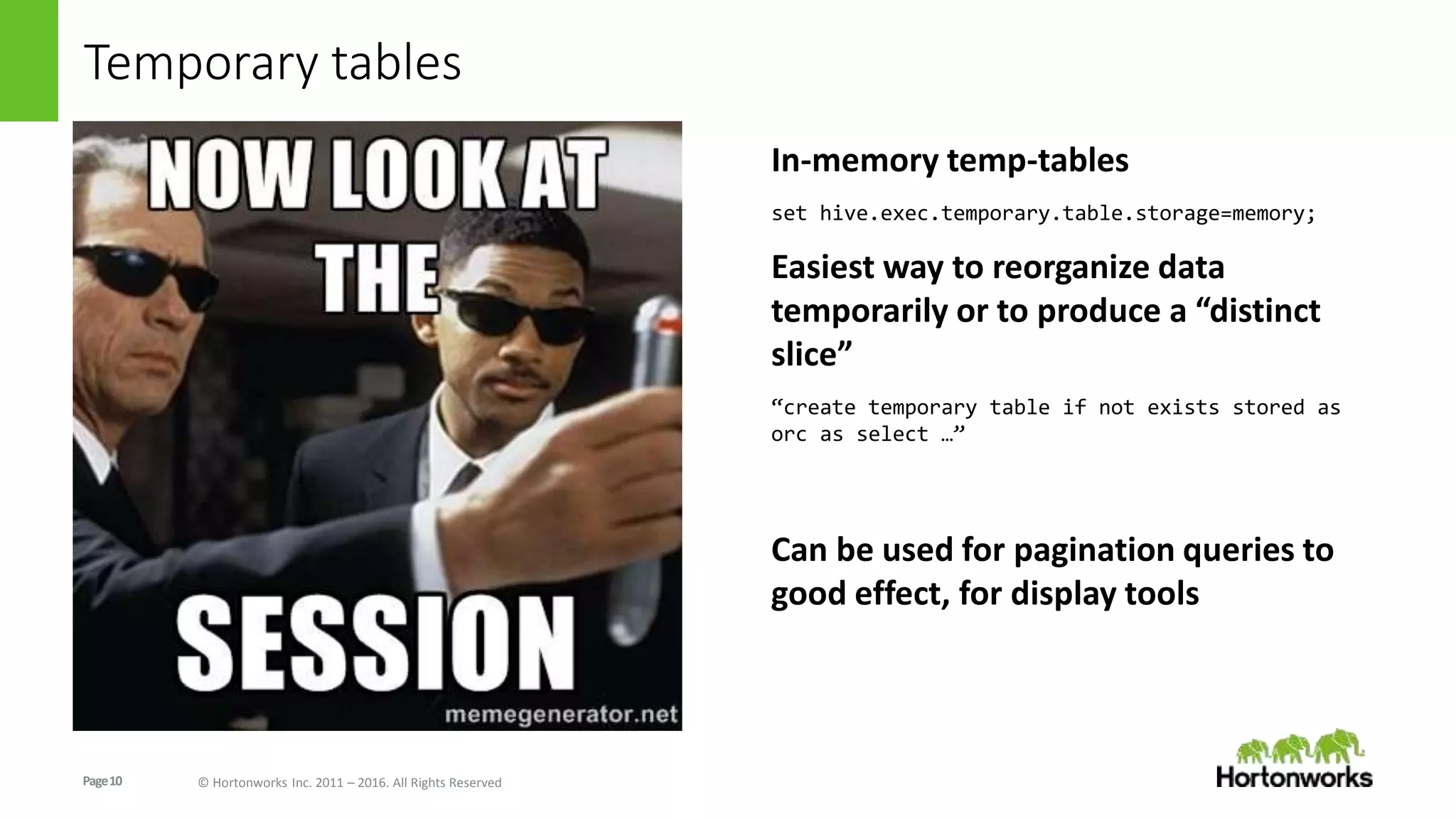
Temporary tables
In-memory temp-tables
set hive.exec.temporary.table.storage=memory;
Easiest way to reorganize data
temporarily or to produce a “distinct
slice”
“create temporary table if not exists stored as
orc as select …”
Can be used for pagination queries to
good effect, for display tools
Page11 © Hortonworks Inc. 2011 – 2016. All Rights Reserved
Complex types & Nesting
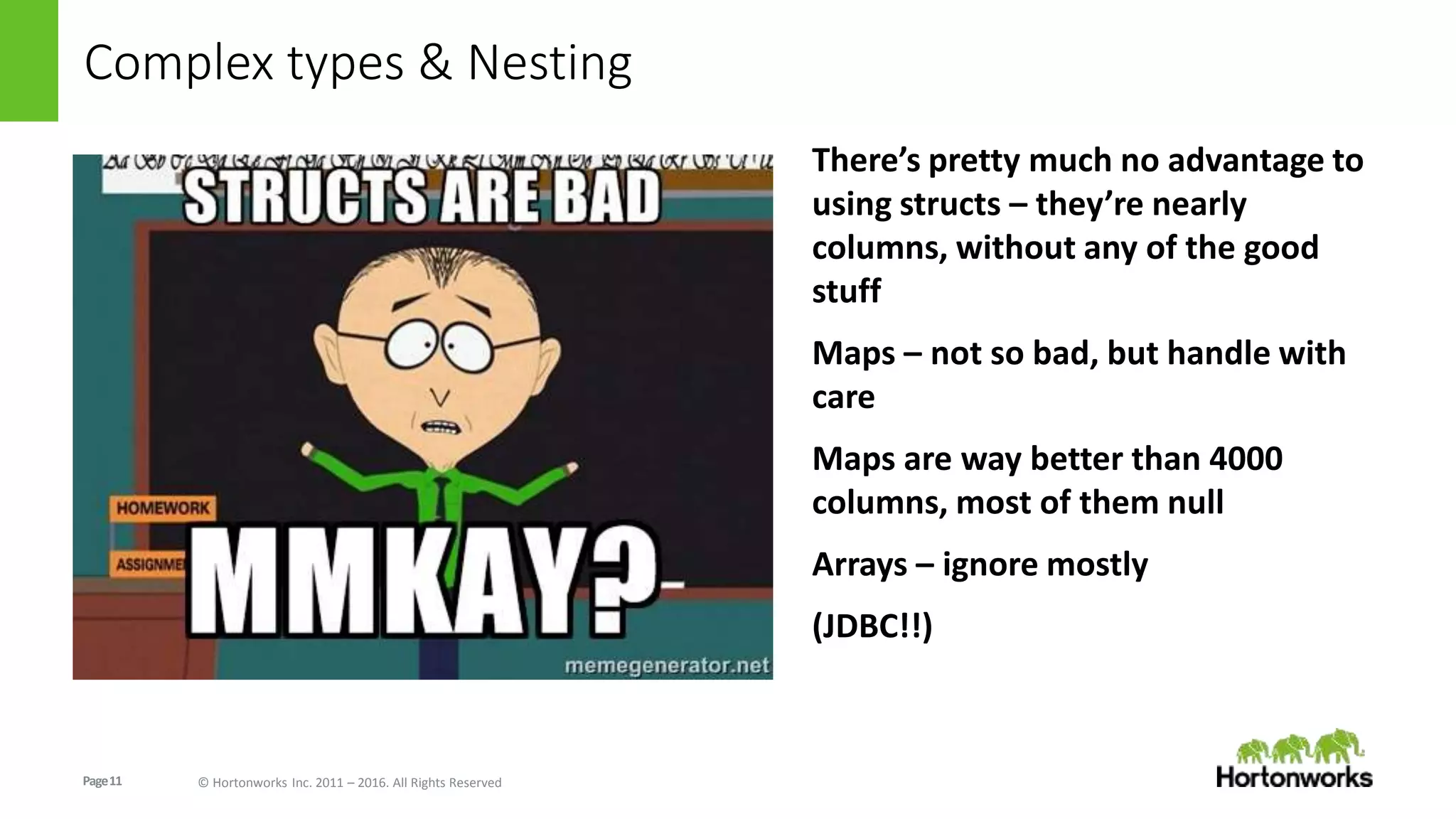
There’s pretty much no advantage to
using structs – they’re nearly
columns, without any of the good
stuff
Maps – not so bad, but handle with
care
Maps are way better than 4000
columns, most of them null
Arrays – ignore mostly
(JDBC!!)
Page12 © Hortonworks Inc. 2011 – 2016. All Rights Reserved
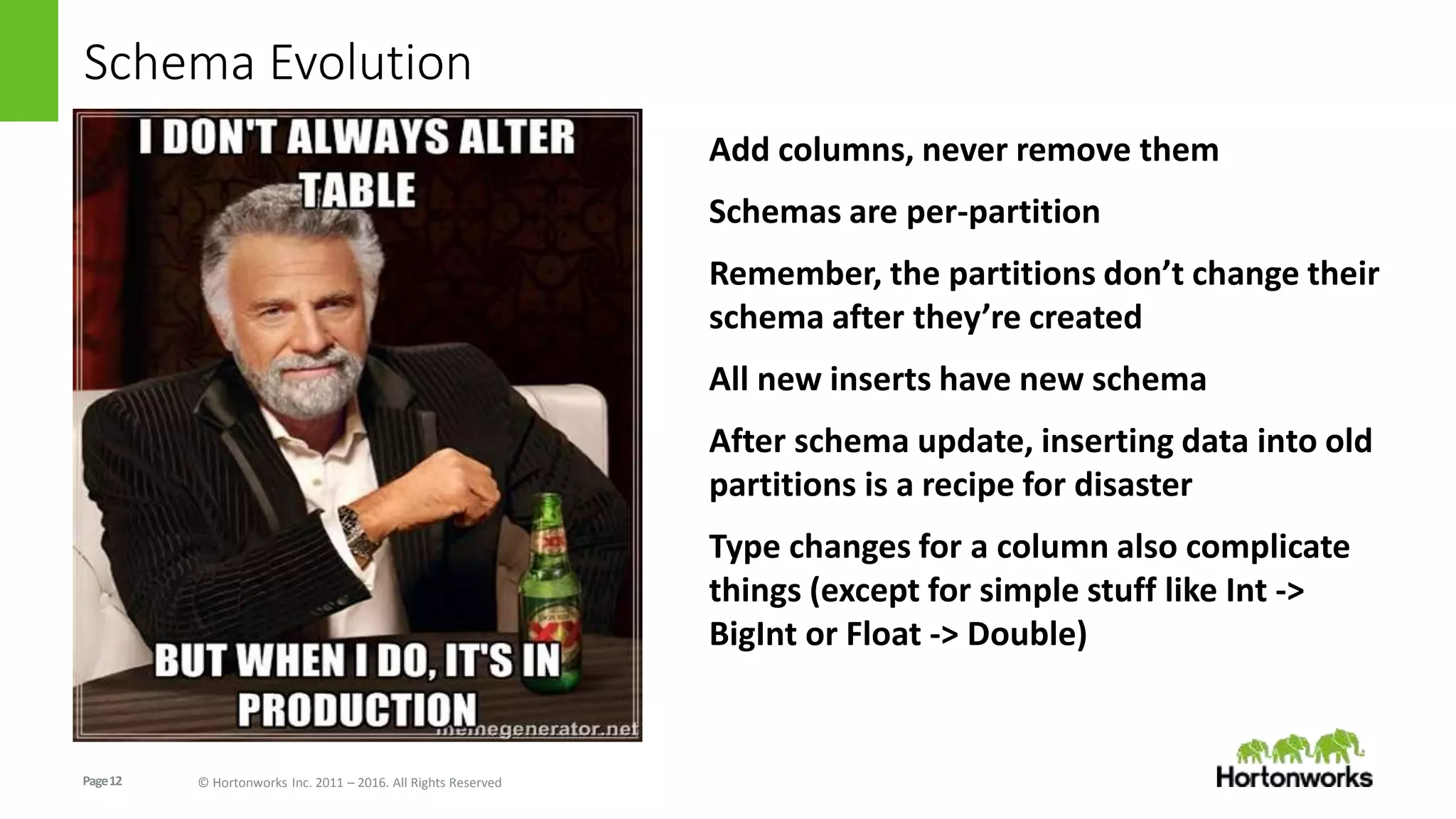
Schema Evolution
Add columns, never remove them
Schemas are per-partition
Remember, the partitions don’t change their
schema after they’re created
All new inserts have new schema
After schema update, inserting data into old
partitions is a recipe for disaster
Type changes for a column also complicate
things (except for simple stuff like Int ->
BigInt or Float -> Double)
Page13 © Hortonworks Inc. 2011 – 2016. All Rights Reserved
Questions?
?

Data organization: hive meetup

  • 1.
    Page1 © HortonworksInc. 2011 – 2016. All Rights Reserved Hive: Data Organization for Performance Gopal Vijayaraghavan
  • 2.
    Page2 © HortonworksInc. 2011 – 2016. All Rights Reserved In this episode All BigData problems are primarily lookup problems All Lookup problems are really Storage problems All Storage problems turn into ETL problems ETL problems are all about the Data Data navigation? Data organization? Data ingestion? It’s Big?
  • 3.
    Page3 © HortonworksInc. 2011 – 2016. All Rights Reserved Good idea: Do things that scale! There are many problems like this, but this one is mine
  • 4.
    Page4 © HortonworksInc. 2011 – 2016. All Rights Reserved Partitions If you have a database on cars and you partition on VIN# If you have a database on sales and you partition on customer_id Rule of thumb: Average partition is >=1Gb and total # of partitions per query <1000
  • 5.
    Page5 © HortonworksInc. 2011 – 2016. All Rights Reserved Buckets If you have more files than rows, you’ve definitely got bucketing wrong “clustered by” != “cluster by” Bucketing on a skewed column slows down ETL a *lot* (for no win) If you have partitions, sort-merge bucket-mapjoin can be slower than a shuffle!!
  • 6.
    Page6 © HortonworksInc. 2011 – 2016. All Rights Reserved Buckets - II Histograms! select explode(histogram_numeric( hash(<col>)% <n-bucket>, <n-bucket> )) as h from table; The Curse of 31 & the last byte If you have buckets & partitions, always remember to ETL with set hive.optimize.sort.dynamic.partition=true;
  • 7.
    Page7 © HortonworksInc. 2011 – 2016. All Rights Reserved Denormalization Denormalization can turn a compute problem into an IO/lookup problem. But if you then optimize that with compression, you get a compute problem again. If you think JOINs are bad, you probably haven’t moved out of MapReduce. Broadcast joins are good & dynamically partitioned broadcast joins can scale that ~1000x
  • 8.
    Page8 © HortonworksInc. 2011 – 2016. All Rights Reserved Indexes? Indexes in hive barely help in a columnar world – incremental rebuild isn’t really there ORC maintains internal bloom filter indexes (PARQUET-41 too) You can store your indexes as ORC files, if you want, so that you can have an index in your index, to speedup indexes
  • 9.
    Page9 © HortonworksInc. 2011 – 2016. All Rights Reserved Schema & Predicate Push Down Never store a Number as a string, because guess what “11” < “9” and “11.0” != “11” – transform, then load Predicate push-down cannot fight the type system (♫ … breaking blocks in the hot sun ♫) UDFs applied on the data column is always a bad idea for fast filtering. If you need case-insensitive lookups, always store as UPPER/lower. If you need LIKE “%.twimg.com”, store like DNS does “.com.twimg…”
  • 10.
    Page10 © HortonworksInc. 2011 – 2016. All Rights Reserved Temporary tables In-memory temp-tables set hive.exec.temporary.table.storage=memory; Easiest way to reorganize data temporarily or to produce a “distinct slice” “create temporary table if not exists stored as orc as select …” Can be used for pagination queries to good effect, for display tools
  • 11.
    Page11 © HortonworksInc. 2011 – 2016. All Rights Reserved Complex types & Nesting There’s pretty much no advantage to using structs – they’re nearly columns, without any of the good stuff Maps – not so bad, but handle with care Maps are way better than 4000 columns, most of them null Arrays – ignore mostly (JDBC!!)
  • 12.
    Page12 © HortonworksInc. 2011 – 2016. All Rights Reserved Schema Evolution Add columns, never remove them Schemas are per-partition Remember, the partitions don’t change their schema after they’re created All new inserts have new schema After schema update, inserting data into old partitions is a recipe for disaster Type changes for a column also complicate things (except for simple stuff like Int -> BigInt or Float -> Double)
  • 13.
    Page13 © HortonworksInc. 2011 – 2016. All Rights Reserved Questions? ?