Outline Chapter 5 Electricity
and Magnetism
5-1. Positive and Negative
Charge
5-2. What is Charge?
5-3. Coulomb’s Law
5-4. Force on an Uncharged
Object
5-5. Matter in Bulk
5-6. Conductors and Insulators
5-7. Superconductivity
5-8. The Ampere
5-9. Potential Difference

5-10. Ohm's Law
5-11. Electric Power
5-12. Magnets
5-13. Magnetic Field
5-14. Oersted's Experiment
5-15. Electromagnets
5-16. Magnetic Force on a
Current
5-17. Electric Motors
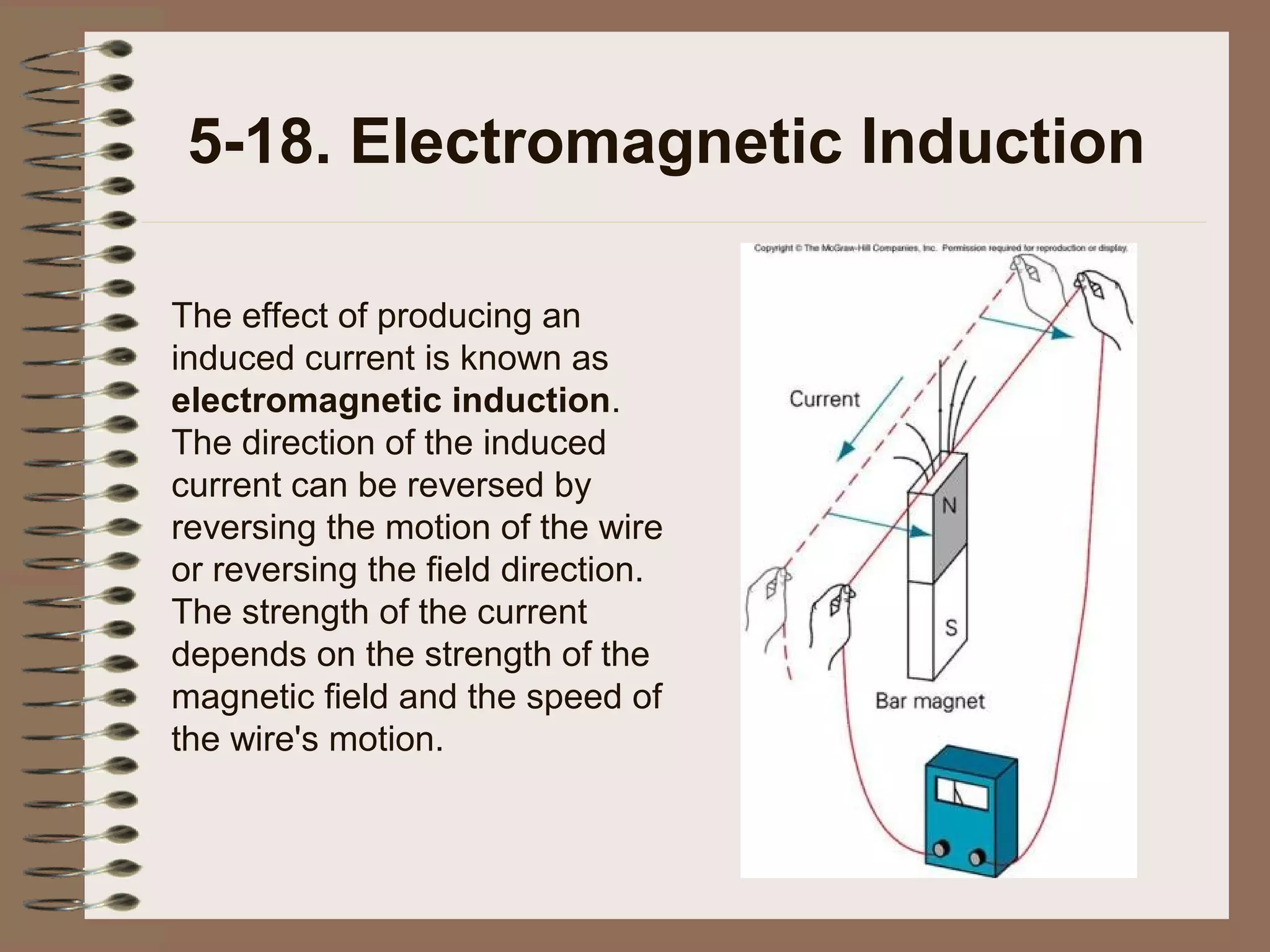
5-18. Electromagnetic Induction
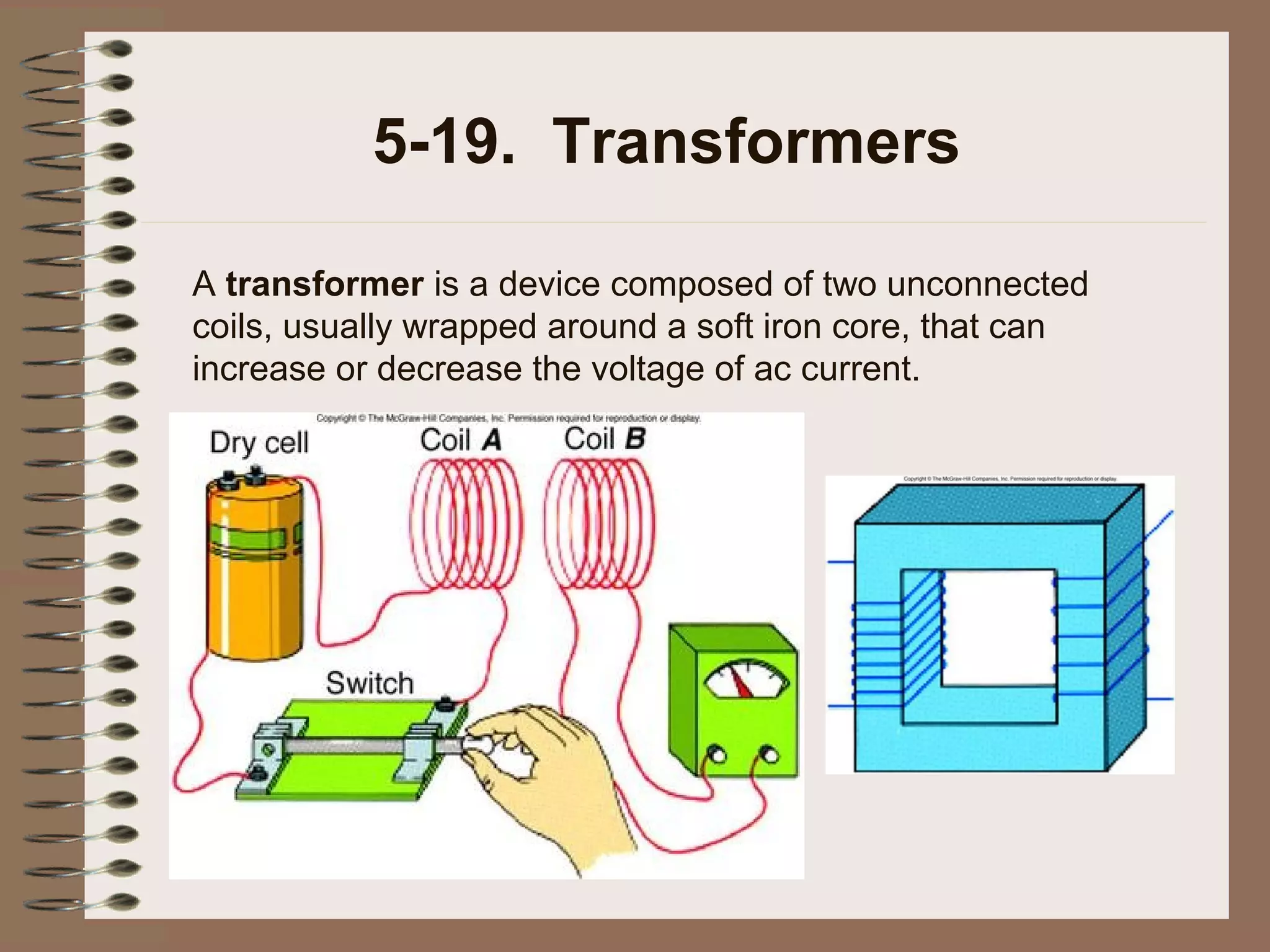
5-19. Transformers
5-1. Positive and
Negative Charge
Opposites attract-Same charges
repel
Let’s try it!
5-1. Positive and Negative
Charge
Electrons are stripped
from one component
and transferred to the
other to cause both to
be oppositely charged.
Fig. 5.2

Ben Franklin discovered
electric charge.
5-2. What is Charge?
Atoms are composed of protons (+), electrons (-)
and neutrons. The nucleus contains the protons
and neutrons and the electrons surround the
nucleus.
5-2. What is Charge?
Protons are much larger than electrons but have
an equal and opposite charge.
The coulomb (C) is the unit of electric charge.
The basic quantity of electric charge (e) is 1.6 x 10⁻¹⁹ C.
5-3. Coulomb’s Law
Q1 Q2
F = K ------R2

Charles Coulomb
(1736-1806)
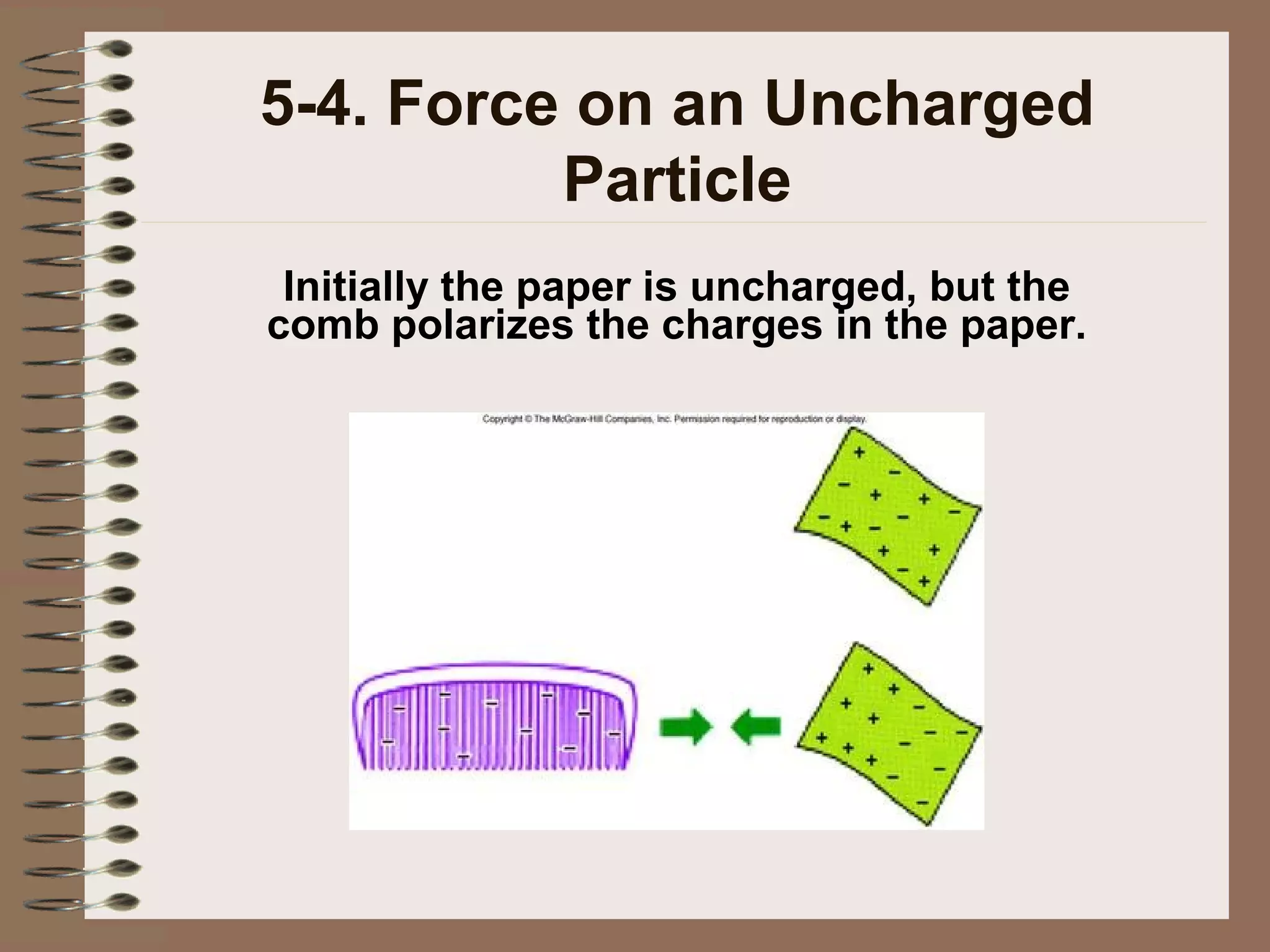
5-4. Force on an Uncharged
Particle
Initially the paper is uncharged, but the
comb polarizes the charges in the paper.
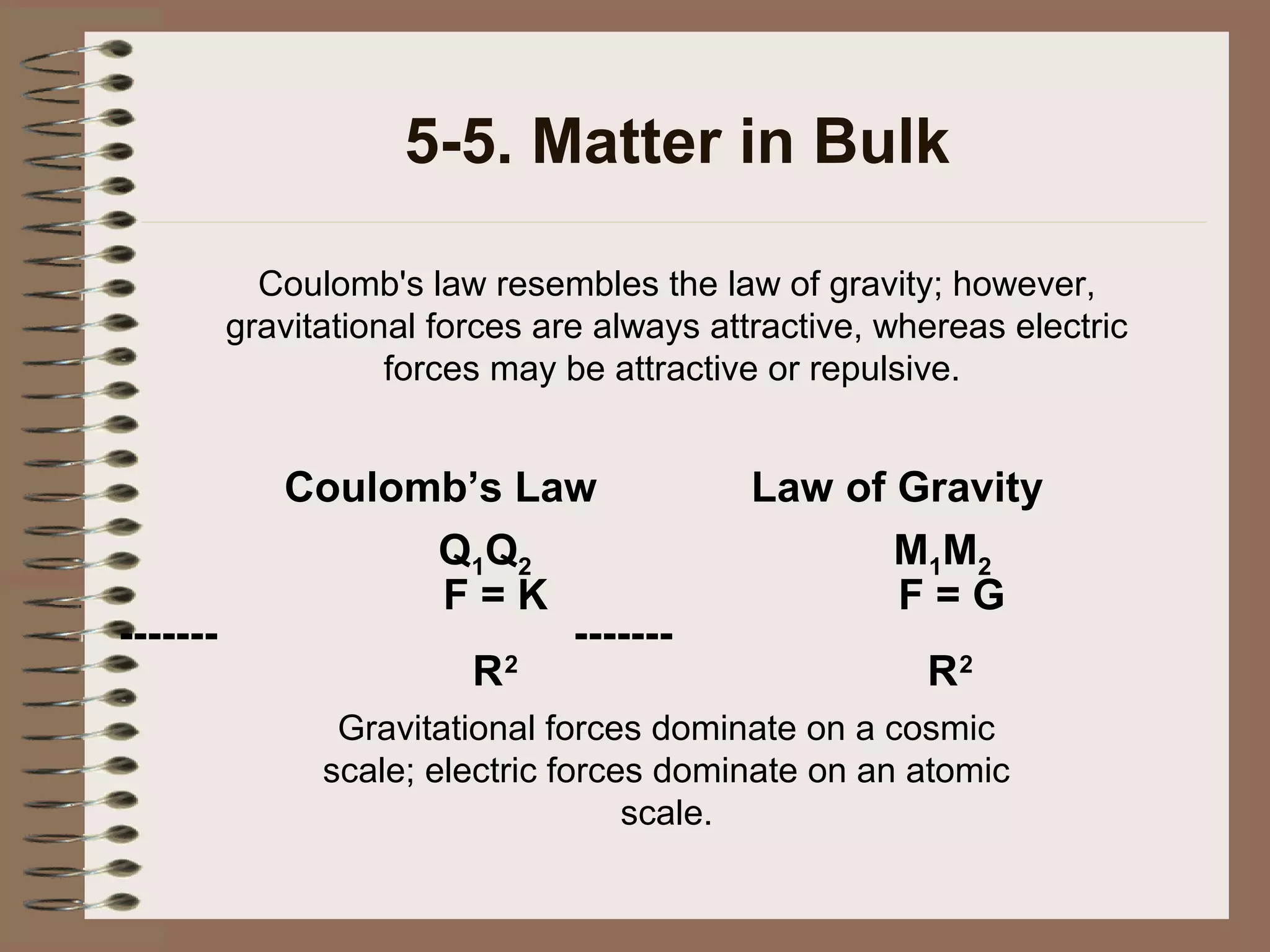
5-5. Matter in Bulk
Coulomb's law resembles the law of gravity; however,
gravitational forces are always attractive, whereas electric
forces may be attractive or repulsive.

-------

Coulomb’s Law
Q1 Q2
F=K
------R2

Law of Gravity
M1 M 2
F=G
R2

Gravitational forces dominate on a cosmic
scale; electric forces dominate on an atomic
scale.
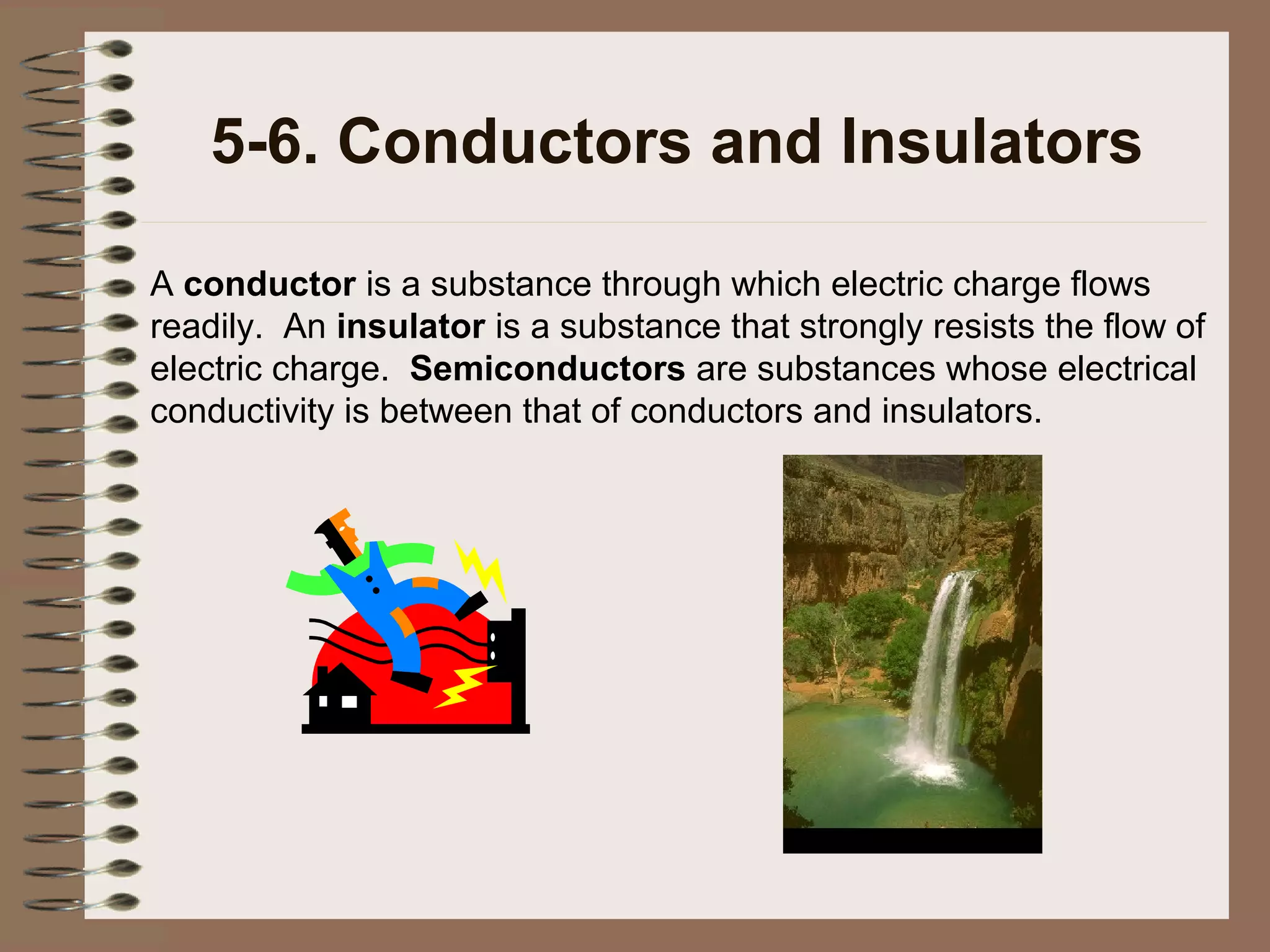
5-6. Conductors and Insulators
A conductor is a substance through which electric charge flows
readily. An insulator is a substance that strongly resists the flow of
electric charge. Semiconductors are substances whose electrical
conductivity is between that of conductors and insulators.
Semiconductors
Transistors are switches that conduct
electricity only when a second source of
electricity is energized.

A

B

John Bardeen
Nobel Prizes in 1956
and 1972 for
developing the
transistor and
superconductivity.

What a
Transistor
looks like.

C
A current will not flow from A to B unless C is energized.
Fig. 5.11

Enlargement
of 5 mm
square
computer
chip.
5-7. Superconductivity
Superconductivity
refers to the loss of all
electrical resistance by
certain materials at very
low temperatures.
Substances that are
superconducting at
150K are now known
which is warmer than
liquid nitrogen (77K).

Maglev Train in Japan
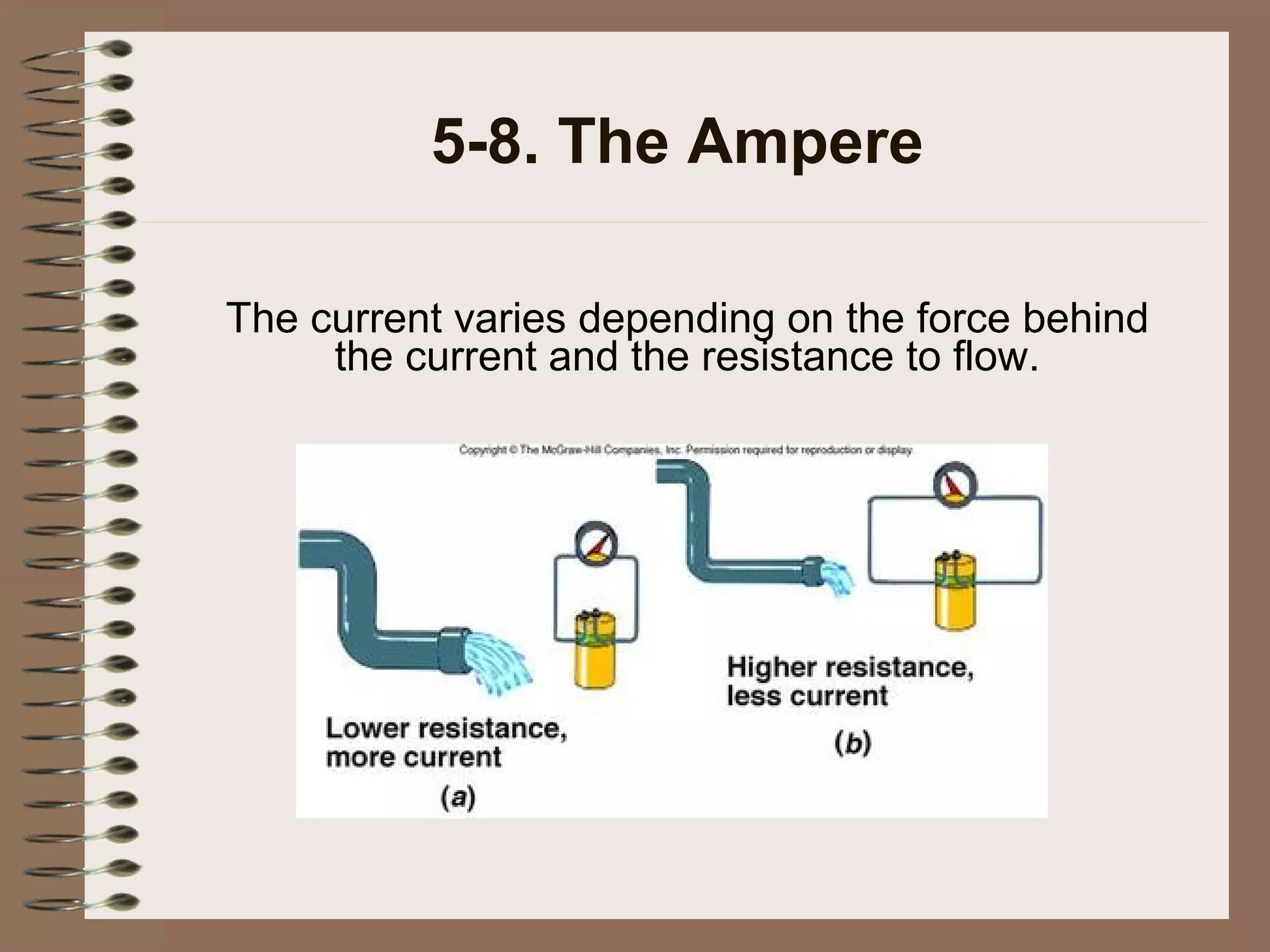
5-8. The Ampere
The Ampere is a measure of how
much electrical current is flowing
and is measured in units of amps.

Q
I = ---t
5-8. The Ampere
The current varies depending on the force behind
the current and the resistance to flow.
5-9. Potential Difference
Potential difference, or voltage, is
the electrical potential energy per
coulomb of charge.

Alessandro Volta
(1745-1827)

J
V = ---C
Fig. 5.16-17
5-10. Ohm’s Law
André Marie Ampére
(1775-1836)

V
I = ---R
Resistance is a
measure of
opposition to the
flow of charge
and is measured
in ohms (Ω)

Georg Ohm (1787-1854)
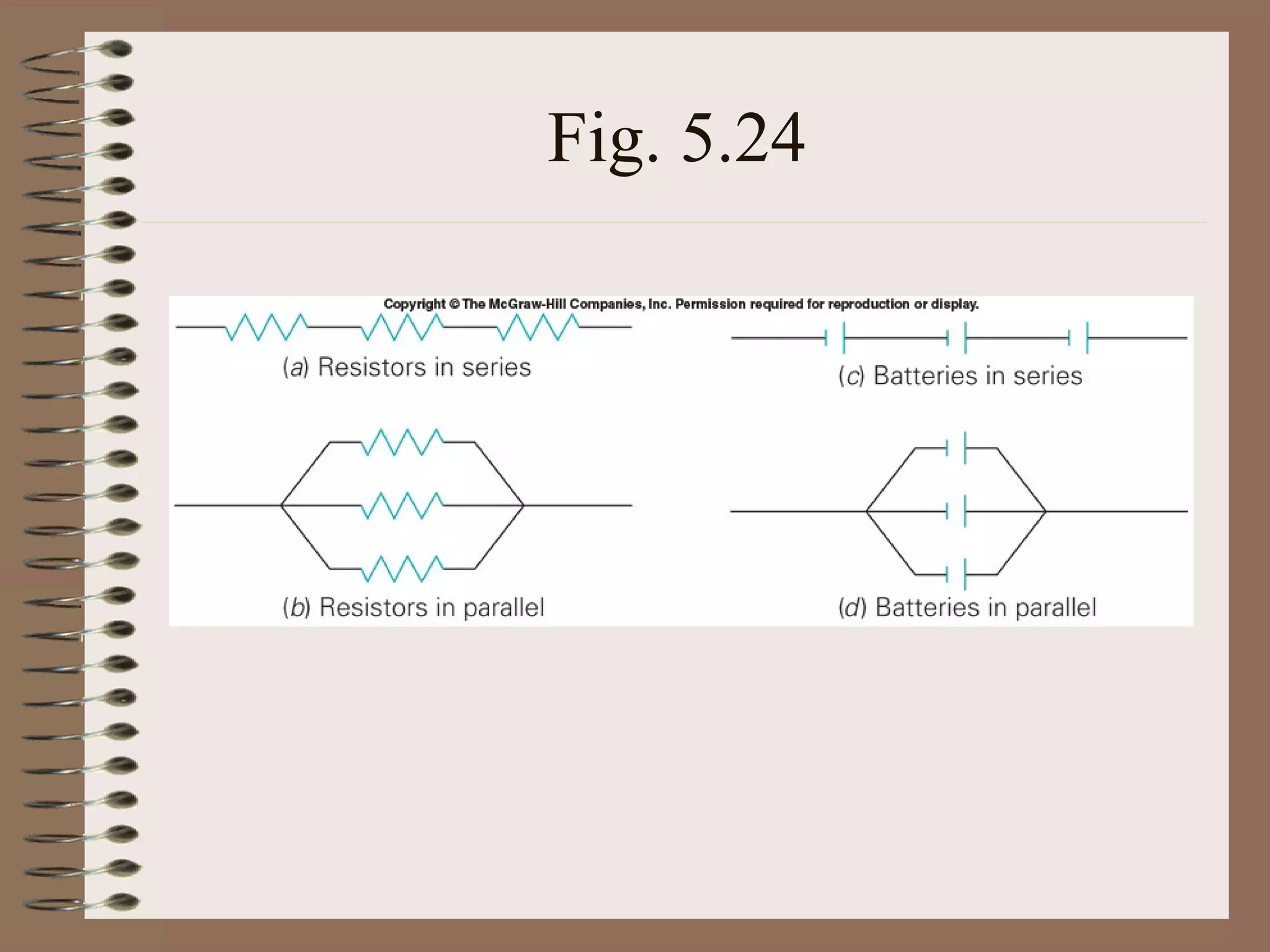
Fig. 5.24
Fig. 5.22
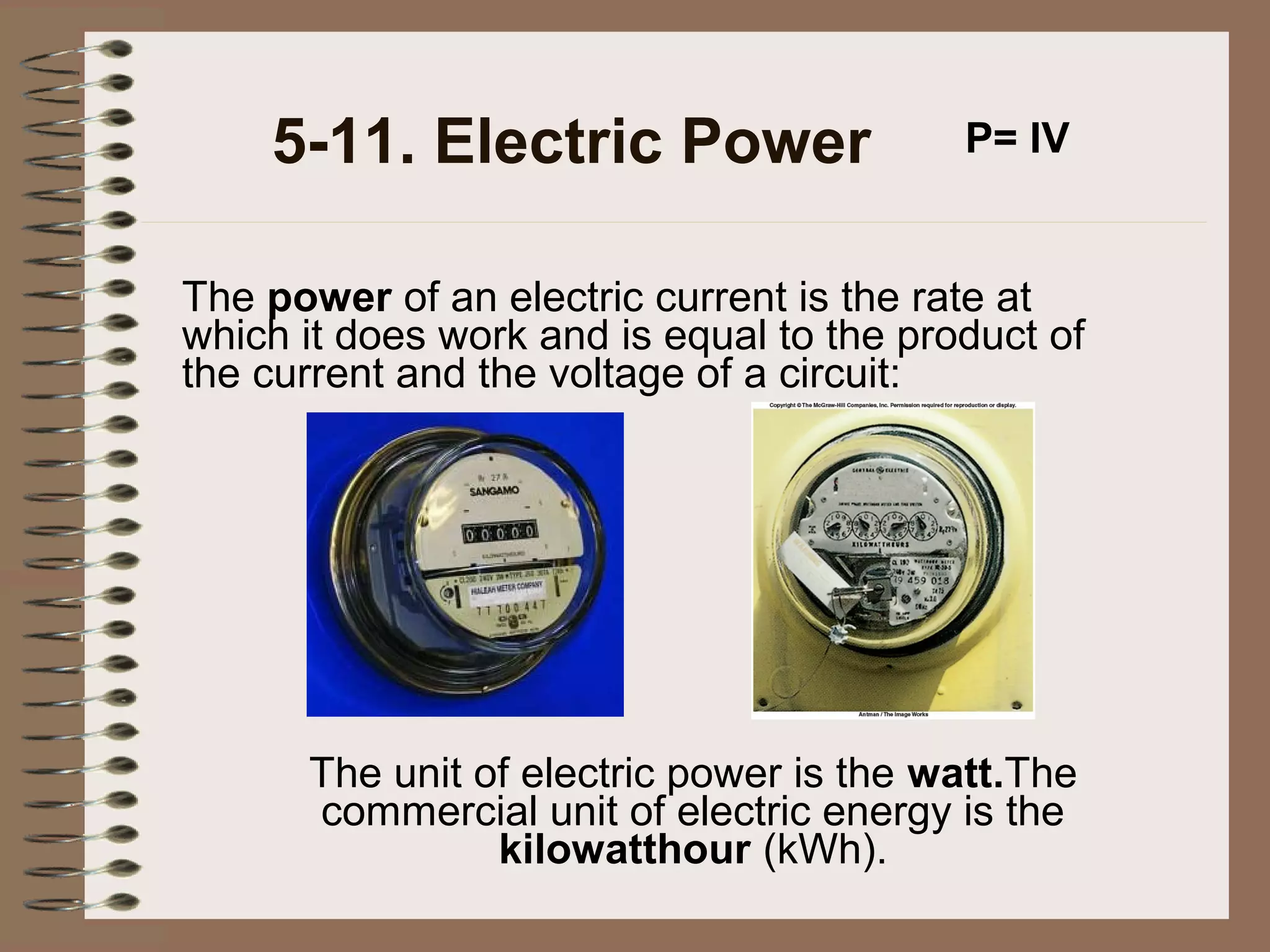
5-11. Electric Power

P= IV

The power of an electric current is the rate at
which it does work and is equal to the product of
the current and the voltage of a circuit:

The unit of electric power is the watt.The
commercial unit of electric energy is the
kilowatthour (kWh).
5-11. Electric Power
Typical Power Ratings
Appliance
Stove
Clothes Dryer
Heater
Dishwasher
Photocopier
Iron
Vacuum Cleaner
Coffee Maker
Refrigerator
Portable Sander
Fan
Personal Computer
TV Receiver
Fax Transmitter/Receiver
Charger for Electric Toothbrush

Power (W)
12,000
5,000
2,000
1,600
1,400
1,000
750
700
400
200
150
150
120
65
1
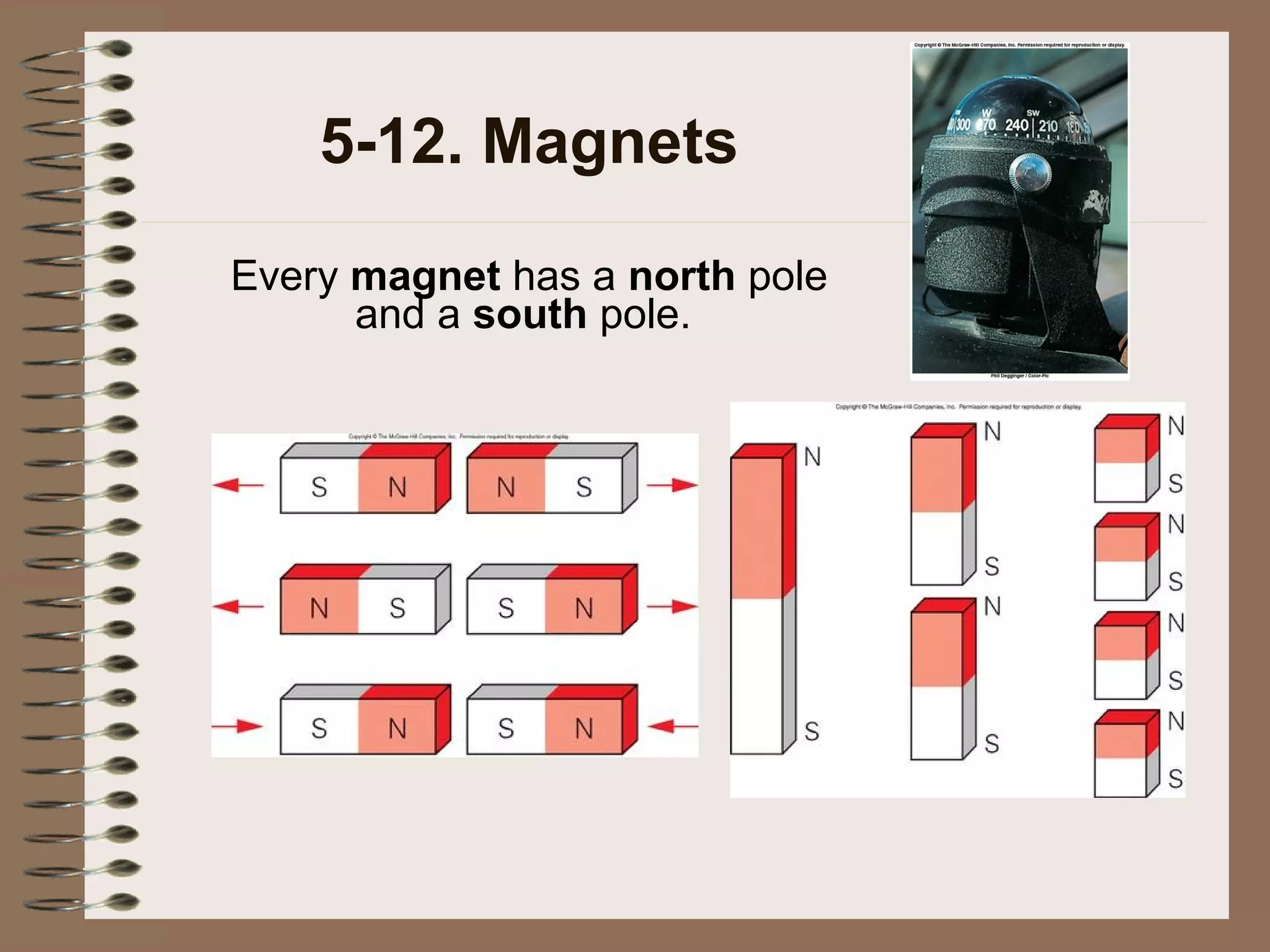
5-12. Magnets
Every magnet has a north pole
and a south pole.
5-13. Magnet Field
How to make a magnet:
Heat in magnetic field.

Magnetic force lines.
5-14. Oersted’s
Experiment

Hans
Christian
Oersted
(1777-1851)

Hans Christian Oersted discovered in 1820 that an
electric current near a compass causes the compass
needle to be deflected. Oersted's experiment showed
that every electric current has a magnetic field
surrounding it.
5-14. Oersted’s Experiment
According to the right-hand rule, the electron current
in a wire and the magnetic field it generates are
perpendicular to each other.
5-14. Oersted’s Experiment
All magnetic fields originate from moving electric
charges. A magnetic field appears only when relative
motion is present between an electric charge and an
observer. Electric and magnetic fields are different
aspects of a single electromagnetic field.
5-15. Electromagnets
An electromagnet consists of an iron core placed
inside a wire coil. The magnetic field strength of a
wire coil carrying an electric current increases in
direct proportion to the number of turns of the coil.
5-15. Electromagnets
An electromagnet can
be used to move large
quantities of metal.
When the current is on
the magnet will pick up
the metal. When you
want to drop it you turn
off the power and the
electromagnet is
disabled and the metal
drops.
5-16. Magnetic Force on a
Current
A magnetic field exerts a
sideways push on an
electric current with the
maximum push occurring
when the current is
perpendicular to the
magnetic field. Currents
exert magnetic forces on
each other. The forces are
attractive when parallel
currents are in the same
direction and are repulsive
when the parallel currents
are in opposite directions.
Fig. 5.39

The experimental
Japanese Maglev train
uses magnetic forces
for both support and
propulsion.
How a TV works.
5-17. Electric Motors
An electric motor uses
the sideways push of
a magnetic field to
turn a current-carrying
wire loop. Electric
motors use a
commutator to
change the direction
of the current in the
loop. Alternating
current electric motors
do not use
commutators.
5-18. Electromagnetic Induction
The effect of producing an
induced current is known as
electromagnetic induction.
The direction of the induced
current can be reversed by
reversing the motion of the wire
or reversing the field direction.
The strength of the current
depends on the strength of the
magnetic field and the speed of
the wire's motion.
Fig. 5.41

Michael Faraday (17911867) built the first electric
motor and discovered
magnetic induction.

The stationary
windings of a
large electric
motor. magnetic
forces underlie
the operation of
such motors.
Fig. 5.44
Sharks navigate
with the help of
the earth’s
magnetic field.
They detect the
field using
electromagnetic
induction.
Alternating and Direct Current
Alternating current (ac) is current that flows in a back-andforth manner; household current changes direction 120 times
each second (60 Hz). Direct current (dc) flows in one
direction.

The ac generator (or alternator) produces an ac current and can be
modified to produce dc current by
1. Use of a commutator.
2. Use of a rectifier which permits current to pass through it in only
one direction.
5-19. Transformers
A transformer is a device composed of two unconnected
coils, usually wrapped around a soft iron core, that can
increase or decrease the voltage of ac current.
5-19. Transformers
A transformer is used to step the voltage
down and the current up (P=IV) so that
we can use it. Low power is desired for
the transport of electricity long distances
to avoid loss of energy to heat loss.
A moving coil
activated by voice
vibrations is used
as a microphone.
The coil induces a
current in the
magnet that can be
amplified or
recorded.
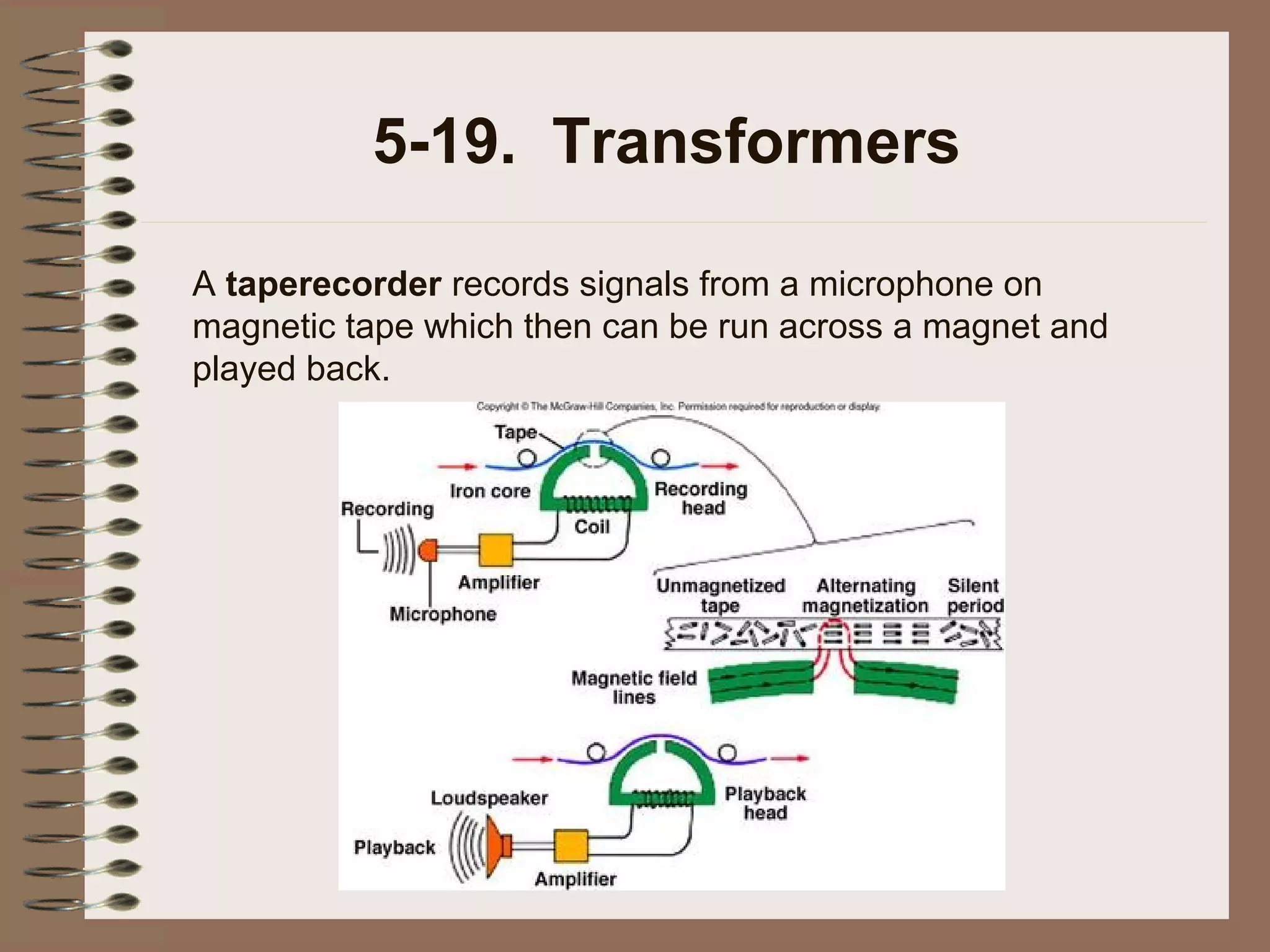
5-19. Transformers
A taperecorder records signals from a microphone on
magnetic tape which then can be run across a magnet and
played back.

C5 electricity magnetism

  • 1.
    Outline Chapter 5Electricity and Magnetism 5-1. Positive and Negative Charge 5-2. What is Charge? 5-3. Coulomb’s Law 5-4. Force on an Uncharged Object 5-5. Matter in Bulk 5-6. Conductors and Insulators 5-7. Superconductivity 5-8. The Ampere 5-9. Potential Difference 5-10. Ohm's Law 5-11. Electric Power 5-12. Magnets 5-13. Magnetic Field 5-14. Oersted's Experiment 5-15. Electromagnets 5-16. Magnetic Force on a Current 5-17. Electric Motors 5-18. Electromagnetic Induction 5-19. Transformers
  • 2.
    5-1. Positive and NegativeCharge Opposites attract-Same charges repel Let’s try it!
  • 3.
    5-1. Positive andNegative Charge Electrons are stripped from one component and transferred to the other to cause both to be oppositely charged.
  • 4.
    Fig. 5.2 Ben Franklindiscovered electric charge.
  • 5.
    5-2. What isCharge? Atoms are composed of protons (+), electrons (-) and neutrons. The nucleus contains the protons and neutrons and the electrons surround the nucleus.
  • 6.
    5-2. What isCharge? Protons are much larger than electrons but have an equal and opposite charge. The coulomb (C) is the unit of electric charge. The basic quantity of electric charge (e) is 1.6 x 10⁻¹⁹ C.
  • 7.
    5-3. Coulomb’s Law Q1Q2 F = K ------R2 Charles Coulomb (1736-1806)
  • 8.
    5-4. Force onan Uncharged Particle Initially the paper is uncharged, but the comb polarizes the charges in the paper.
  • 9.
    5-5. Matter inBulk Coulomb's law resembles the law of gravity; however, gravitational forces are always attractive, whereas electric forces may be attractive or repulsive. ------- Coulomb’s Law Q1 Q2 F=K ------R2 Law of Gravity M1 M 2 F=G R2 Gravitational forces dominate on a cosmic scale; electric forces dominate on an atomic scale.
  • 10.
    5-6. Conductors andInsulators A conductor is a substance through which electric charge flows readily. An insulator is a substance that strongly resists the flow of electric charge. Semiconductors are substances whose electrical conductivity is between that of conductors and insulators.
  • 11.
    Semiconductors Transistors are switchesthat conduct electricity only when a second source of electricity is energized. A B John Bardeen Nobel Prizes in 1956 and 1972 for developing the transistor and superconductivity. What a Transistor looks like. C A current will not flow from A to B unless C is energized.
  • 12.
    Fig. 5.11 Enlargement of 5mm square computer chip.
  • 13.
    5-7. Superconductivity Superconductivity refers tothe loss of all electrical resistance by certain materials at very low temperatures. Substances that are superconducting at 150K are now known which is warmer than liquid nitrogen (77K). Maglev Train in Japan
  • 14.
    5-8. The Ampere TheAmpere is a measure of how much electrical current is flowing and is measured in units of amps. Q I = ---t
  • 15.
    5-8. The Ampere Thecurrent varies depending on the force behind the current and the resistance to flow.
  • 16.
    5-9. Potential Difference Potentialdifference, or voltage, is the electrical potential energy per coulomb of charge. Alessandro Volta (1745-1827) J V = ---C
  • 17.
  • 18.
    5-10. Ohm’s Law AndréMarie Ampére (1775-1836) V I = ---R Resistance is a measure of opposition to the flow of charge and is measured in ohms (Ω) Georg Ohm (1787-1854)
  • 19.
  • 20.
  • 21.
    5-11. Electric Power P=IV The power of an electric current is the rate at which it does work and is equal to the product of the current and the voltage of a circuit: The unit of electric power is the watt.The commercial unit of electric energy is the kilowatthour (kWh).
  • 22.
    5-11. Electric Power TypicalPower Ratings Appliance Stove Clothes Dryer Heater Dishwasher Photocopier Iron Vacuum Cleaner Coffee Maker Refrigerator Portable Sander Fan Personal Computer TV Receiver Fax Transmitter/Receiver Charger for Electric Toothbrush Power (W) 12,000 5,000 2,000 1,600 1,400 1,000 750 700 400 200 150 150 120 65 1
  • 23.
    5-12. Magnets Every magnethas a north pole and a south pole.
  • 24.
    5-13. Magnet Field Howto make a magnet: Heat in magnetic field. Magnetic force lines.
  • 25.
    5-14. Oersted’s Experiment Hans Christian Oersted (1777-1851) Hans ChristianOersted discovered in 1820 that an electric current near a compass causes the compass needle to be deflected. Oersted's experiment showed that every electric current has a magnetic field surrounding it.
  • 26.
    5-14. Oersted’s Experiment Accordingto the right-hand rule, the electron current in a wire and the magnetic field it generates are perpendicular to each other.
  • 27.
    5-14. Oersted’s Experiment Allmagnetic fields originate from moving electric charges. A magnetic field appears only when relative motion is present between an electric charge and an observer. Electric and magnetic fields are different aspects of a single electromagnetic field.
  • 28.
    5-15. Electromagnets An electromagnetconsists of an iron core placed inside a wire coil. The magnetic field strength of a wire coil carrying an electric current increases in direct proportion to the number of turns of the coil.
  • 29.
    5-15. Electromagnets An electromagnetcan be used to move large quantities of metal. When the current is on the magnet will pick up the metal. When you want to drop it you turn off the power and the electromagnet is disabled and the metal drops.
  • 30.
    5-16. Magnetic Forceon a Current A magnetic field exerts a sideways push on an electric current with the maximum push occurring when the current is perpendicular to the magnetic field. Currents exert magnetic forces on each other. The forces are attractive when parallel currents are in the same direction and are repulsive when the parallel currents are in opposite directions.
  • 31.
    Fig. 5.39 The experimental JapaneseMaglev train uses magnetic forces for both support and propulsion.
  • 32.
    How a TVworks.
  • 33.
    5-17. Electric Motors Anelectric motor uses the sideways push of a magnetic field to turn a current-carrying wire loop. Electric motors use a commutator to change the direction of the current in the loop. Alternating current electric motors do not use commutators.
  • 34.
    5-18. Electromagnetic Induction Theeffect of producing an induced current is known as electromagnetic induction. The direction of the induced current can be reversed by reversing the motion of the wire or reversing the field direction. The strength of the current depends on the strength of the magnetic field and the speed of the wire's motion.
  • 35.
    Fig. 5.41 Michael Faraday(17911867) built the first electric motor and discovered magnetic induction. The stationary windings of a large electric motor. magnetic forces underlie the operation of such motors.
  • 36.
    Fig. 5.44 Sharks navigate withthe help of the earth’s magnetic field. They detect the field using electromagnetic induction.
  • 37.
    Alternating and DirectCurrent Alternating current (ac) is current that flows in a back-andforth manner; household current changes direction 120 times each second (60 Hz). Direct current (dc) flows in one direction. The ac generator (or alternator) produces an ac current and can be modified to produce dc current by 1. Use of a commutator. 2. Use of a rectifier which permits current to pass through it in only one direction.
  • 38.
    5-19. Transformers A transformeris a device composed of two unconnected coils, usually wrapped around a soft iron core, that can increase or decrease the voltage of ac current.
  • 39.
    5-19. Transformers A transformeris used to step the voltage down and the current up (P=IV) so that we can use it. Low power is desired for the transport of electricity long distances to avoid loss of energy to heat loss. A moving coil activated by voice vibrations is used as a microphone. The coil induces a current in the magnet that can be amplified or recorded.
  • 40.
    5-19. Transformers A taperecorderrecords signals from a microphone on magnetic tape which then can be run across a magnet and played back.