Said Salim Palayi
Assistant Executive Engineer
Electrical Division, Manjeri
K.S.E.B Limited
salimpalayi@yahoo.com
Basics of Over Current Protection
01/09/20151
Over current and its causes
In an electric power system, over current or
excess current is a situation where a larger than
intended electric current exists through a
conductor, leading to excessive generation of
heat, and the risk of fire or damage to equipment.
Possible causes for over current include short
circuits, excessive load, incorrect design, or a
ground fault.
01/09/20152
Working Principle of Over Current Relay
In an over current relay, there would be
essentially a current coil. When normal current
flows through this coil, the magnetic effect
generated by the coil is not sufficient to move
the moving element of the relay, as in this
condition the restraining force is greater than
deflecting force. But when the current through
the coil increased, the magnetic effect
increases, and after certain level of current, the
deflecting force generated by the magnetic
effect of the coil, crosses the restraining force,
as a result, the moving element starts moving to
change the contact position in the relay. 01/09/20153
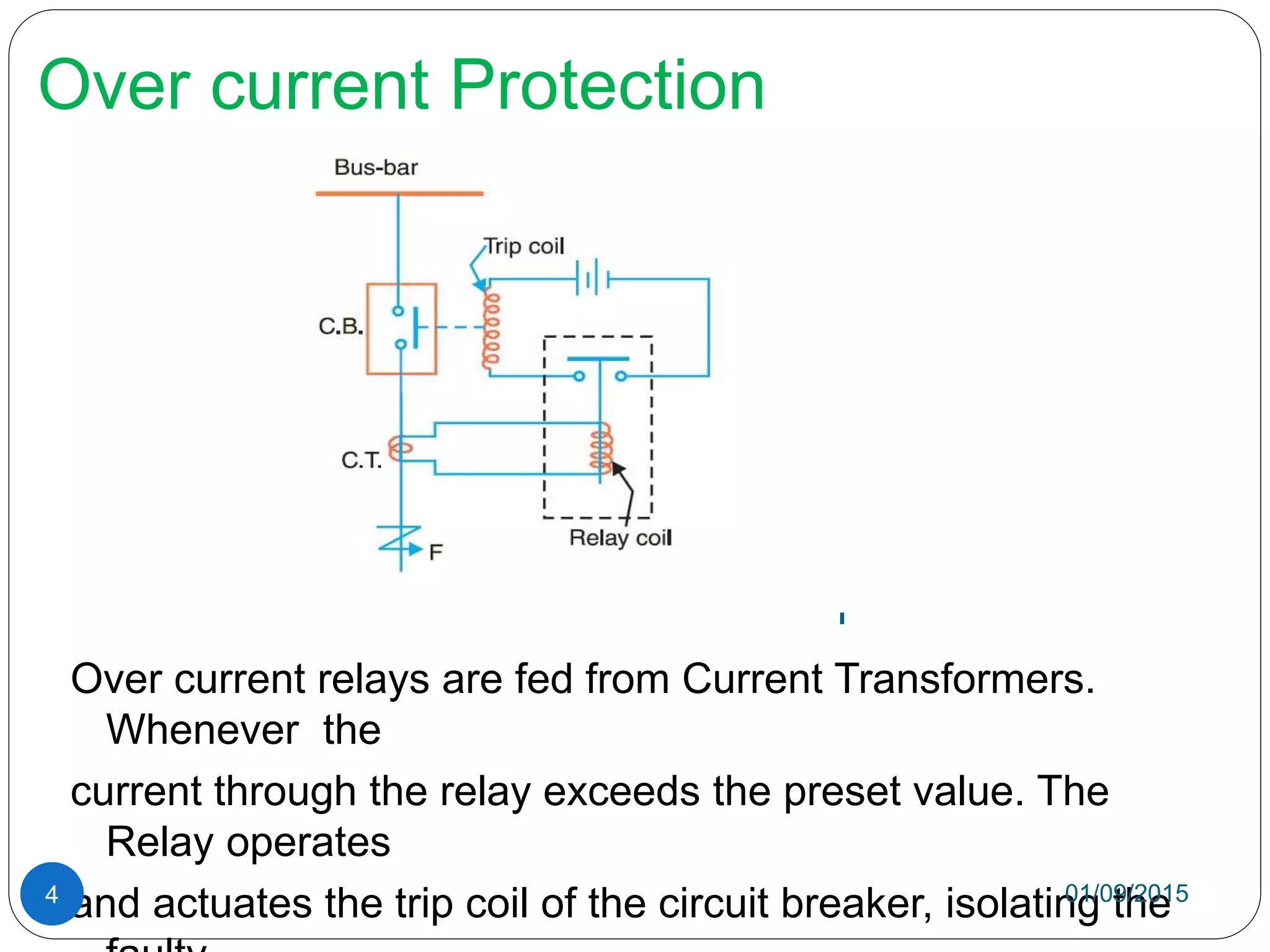
Over current Protection
Over current relays are fed from Current Transformers.
Whenever the
current through the relay exceeds the preset value. The
Relay operates
and actuates the trip coil of the circuit breaker, isolating the01/09/20154
Types of over current relays
Depending upon time of operation, Over current
relays are classified into 3 groups.
 Instantaneous over current relay.
 Definite time over current relay.
 Inverse time over current relay.
01/09/20155
Instantaneous over current
relay
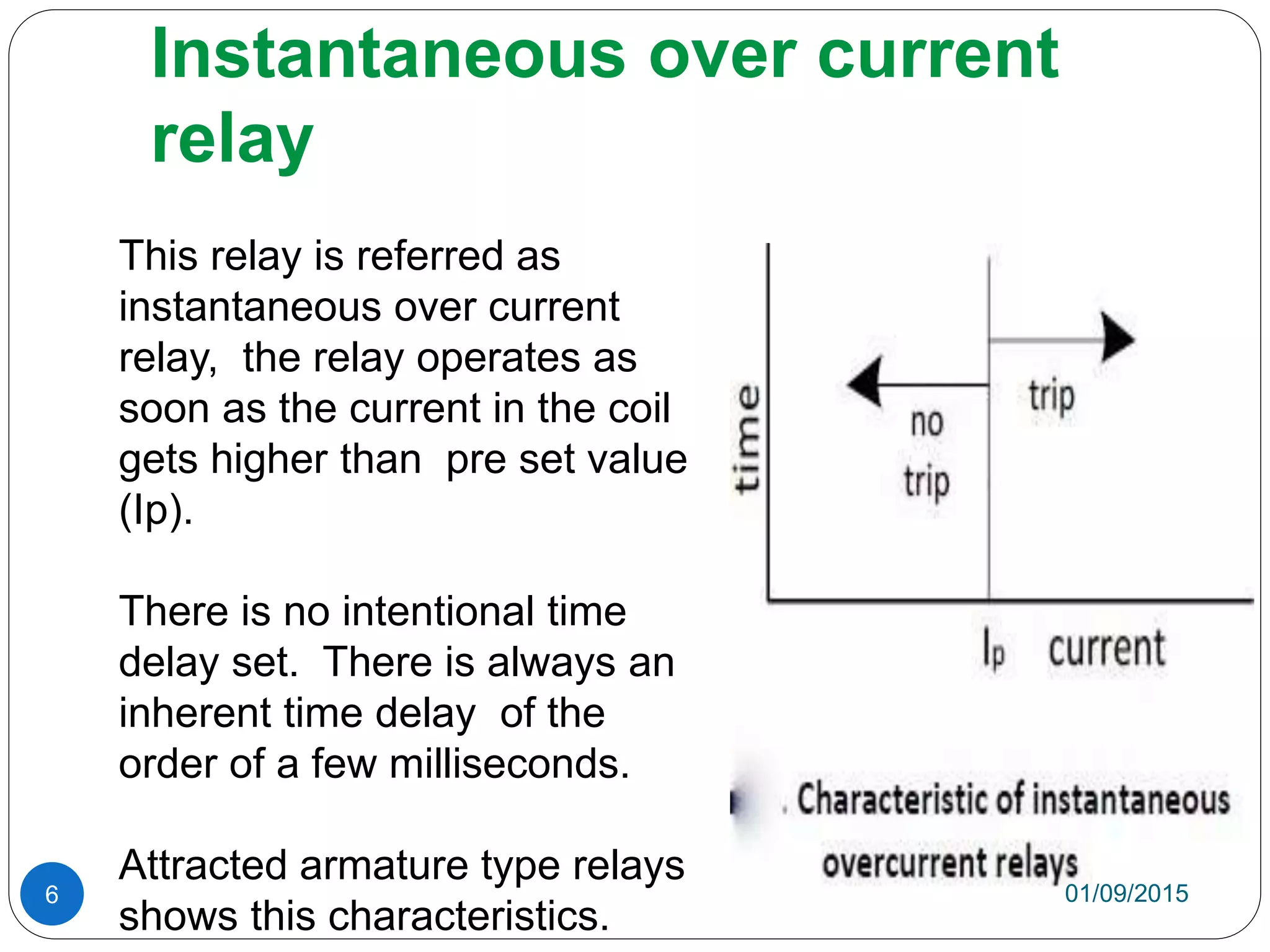
This relay is referred as
instantaneous over current
relay, the relay operates as
soon as the current in the coil
gets higher than pre set value
(Ip).
There is no intentional time
delay set. There is always an
inherent time delay of the
order of a few milliseconds.
Attracted armature type relays
shows this characteristics.
01/09/20156
Definite time over current relay
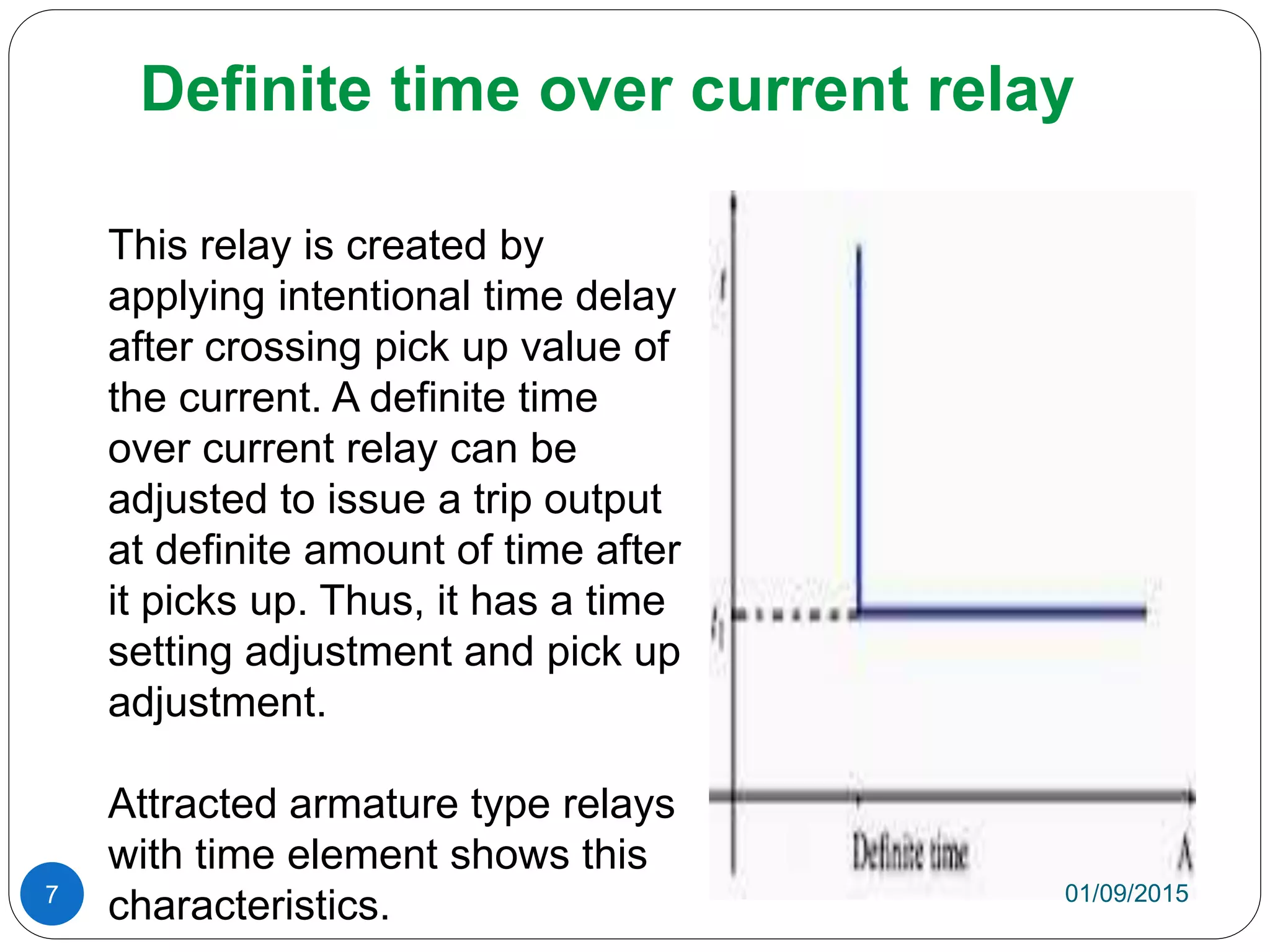
This relay is created by
applying intentional time delay
after crossing pick up value of
the current. A definite time
over current relay can be
adjusted to issue a trip output
at definite amount of time after
it picks up. Thus, it has a time
setting adjustment and pick up
adjustment.
Attracted armature type relays
with time element shows this
characteristics. 01/09/20157
Inverse time over current relay
Inverse time is a natural
character of any induction type
rotating device. This means
that, the time of operation
inversely varies with input
current.
This characteristic of
electromechanical induction
disc relay in very suitable for
over current protection.
In this relay, if fault is more
severe, it would be cleared
more faster.
01/09/20158
Classification of Inverse time
relays
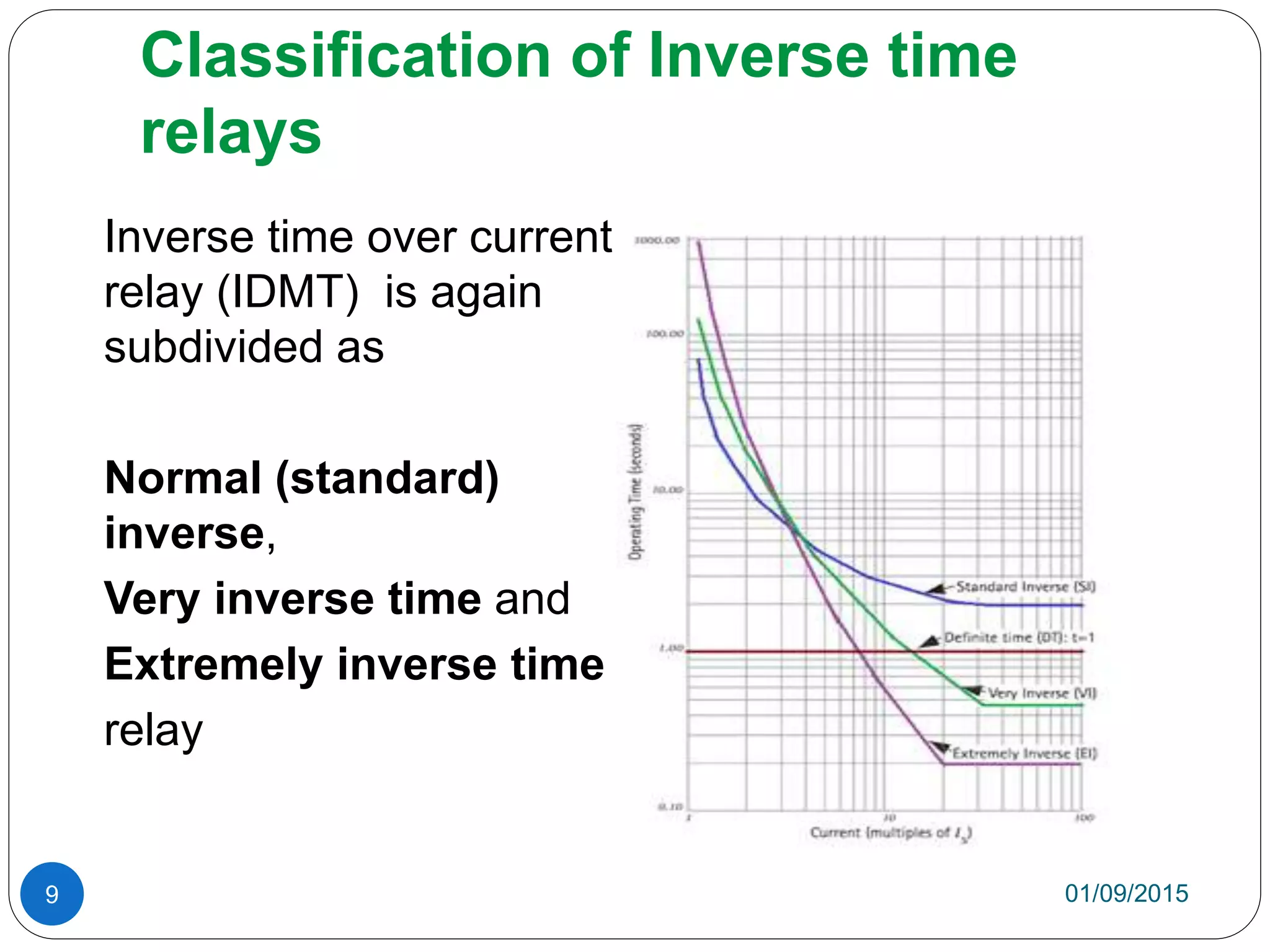
Inverse time over current
relay (IDMT) is again
subdivided as
Normal (standard)
inverse,
Very inverse time and
Extremely inverse time
relay
01/09/20159
Over current Protection Schemes
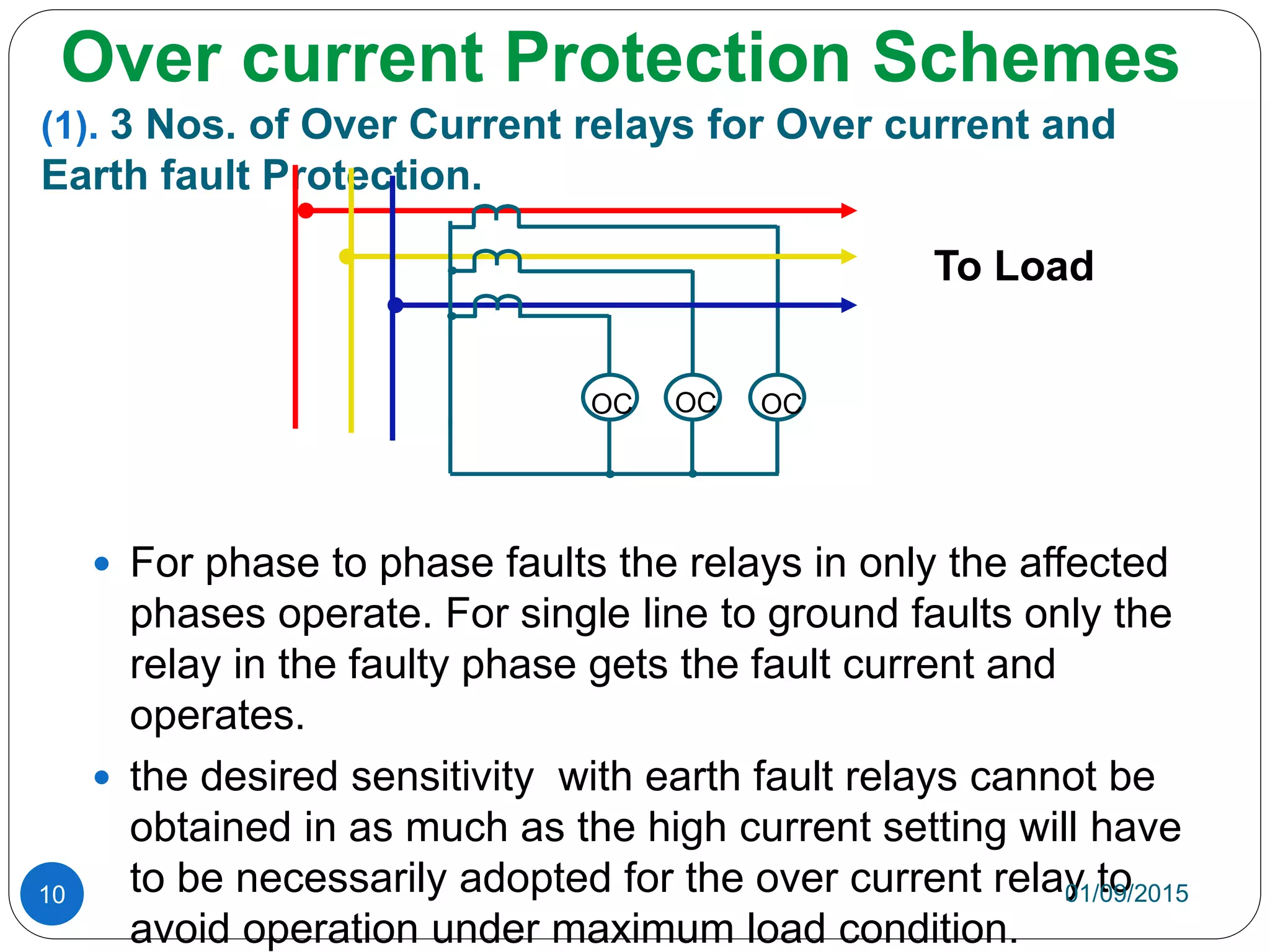
(1). 3 Nos. of Over Current relays for Over current and
Earth fault Protection.
 For phase to phase faults the relays in only the affected
phases operate. For single line to ground faults only the
relay in the faulty phase gets the fault current and
operates.
 the desired sensitivity with earth fault relays cannot be
obtained in as much as the high current setting will have
to be necessarily adopted for the over current relay to
avoid operation under maximum load condition.
01/09/201510
OC OC OC
To Load
Over current Protection Schemes
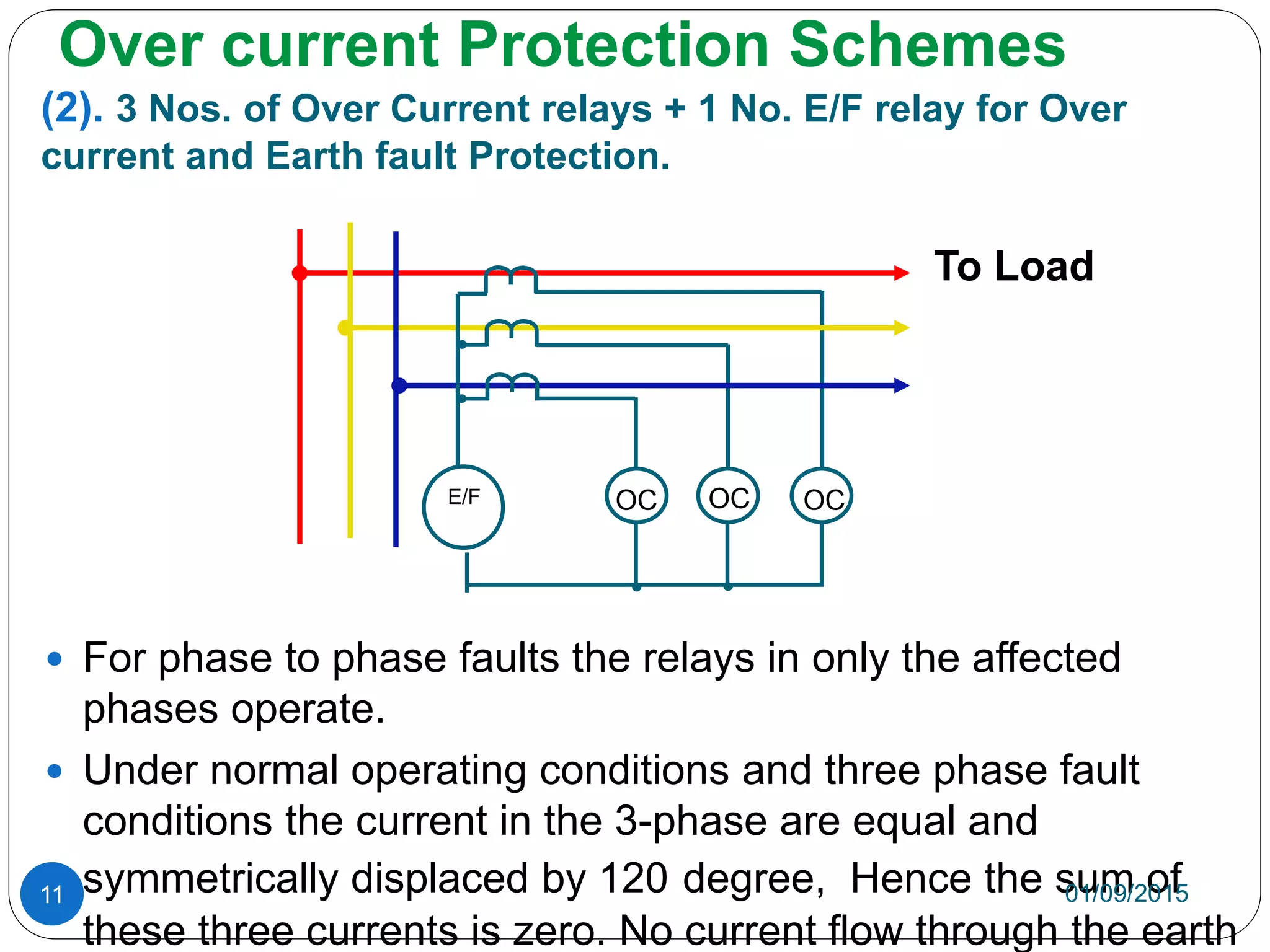
(2). 3 Nos. of Over Current relays + 1 No. E/F relay for Over
current and Earth fault Protection.
 For phase to phase faults the relays in only the affected
phases operate.
 Under normal operating conditions and three phase fault
conditions the current in the 3-phase are equal and
symmetrically displaced by 120 degree, Hence the sum of
these three currents is zero. No current flow through the earth
01/09/201511
To Load
OC OC OCE/F
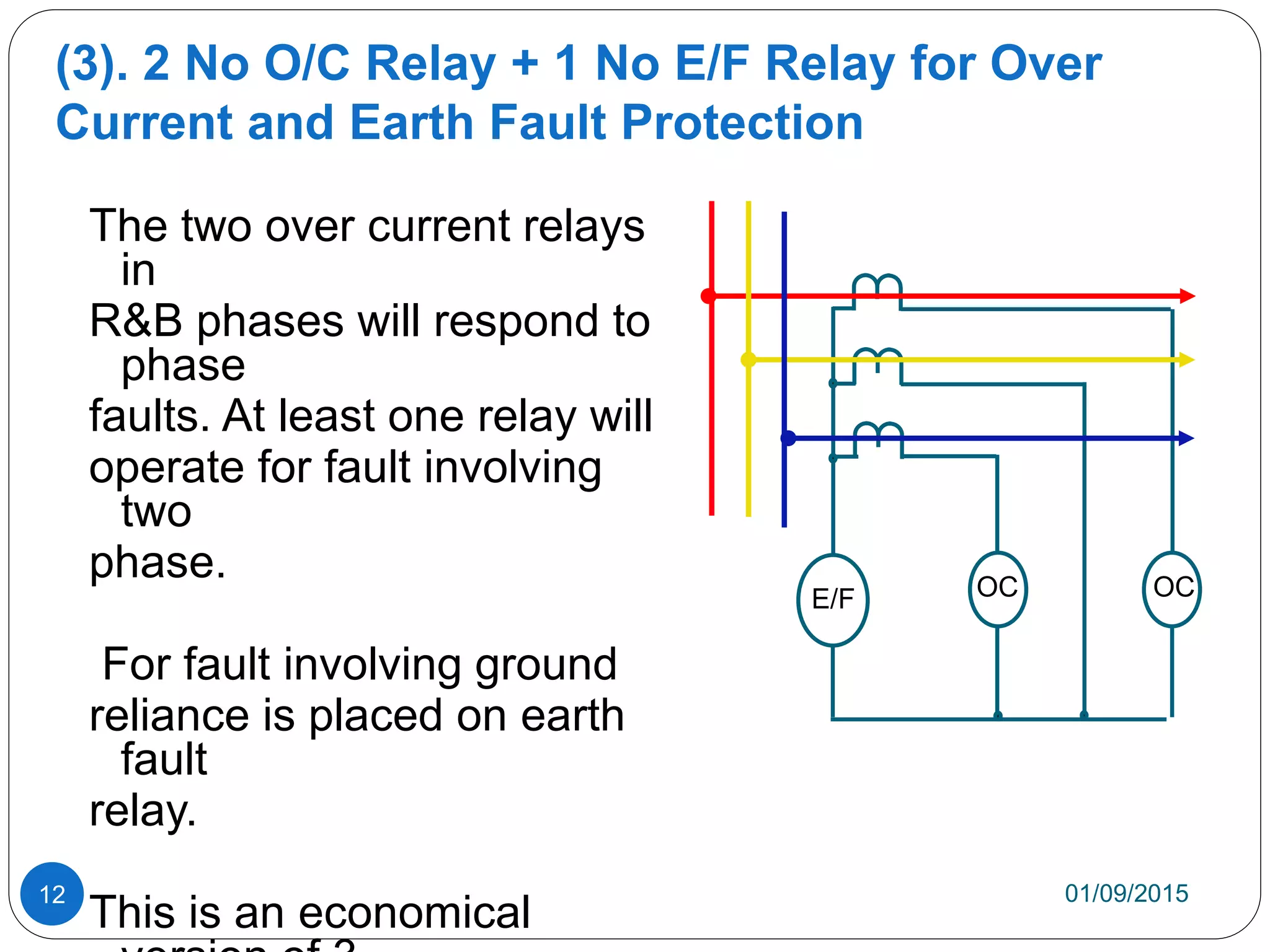
(3). 2 No O/C Relay + 1 No E/F Relay for Over
Current and Earth Fault Protection
01/09/201512
The two over current relays
in
R&B phases will respond to
phase
faults. At least one relay will
operate for fault involving
two
phase.
For fault involving ground
reliance is placed on earth
fault
relay.
This is an economical
E/F OC OC
Directional Over current and E/F
Relays
01/09/201513
 When fault currents can flow in more than one
direction it is desirable to determine which
direction the fault current is flowing and trip the
appropriate devices accordingly to contain a
given fault.
 Directional Relay has a characteristics that it
responds to over current condition in the forward
direction only. Relay will not respond to reverse
faults
 Compares the current in the line versus a known
reference (that will always be the same). This
reference voltage or current is known as
polarizing voltage or polarizing current.
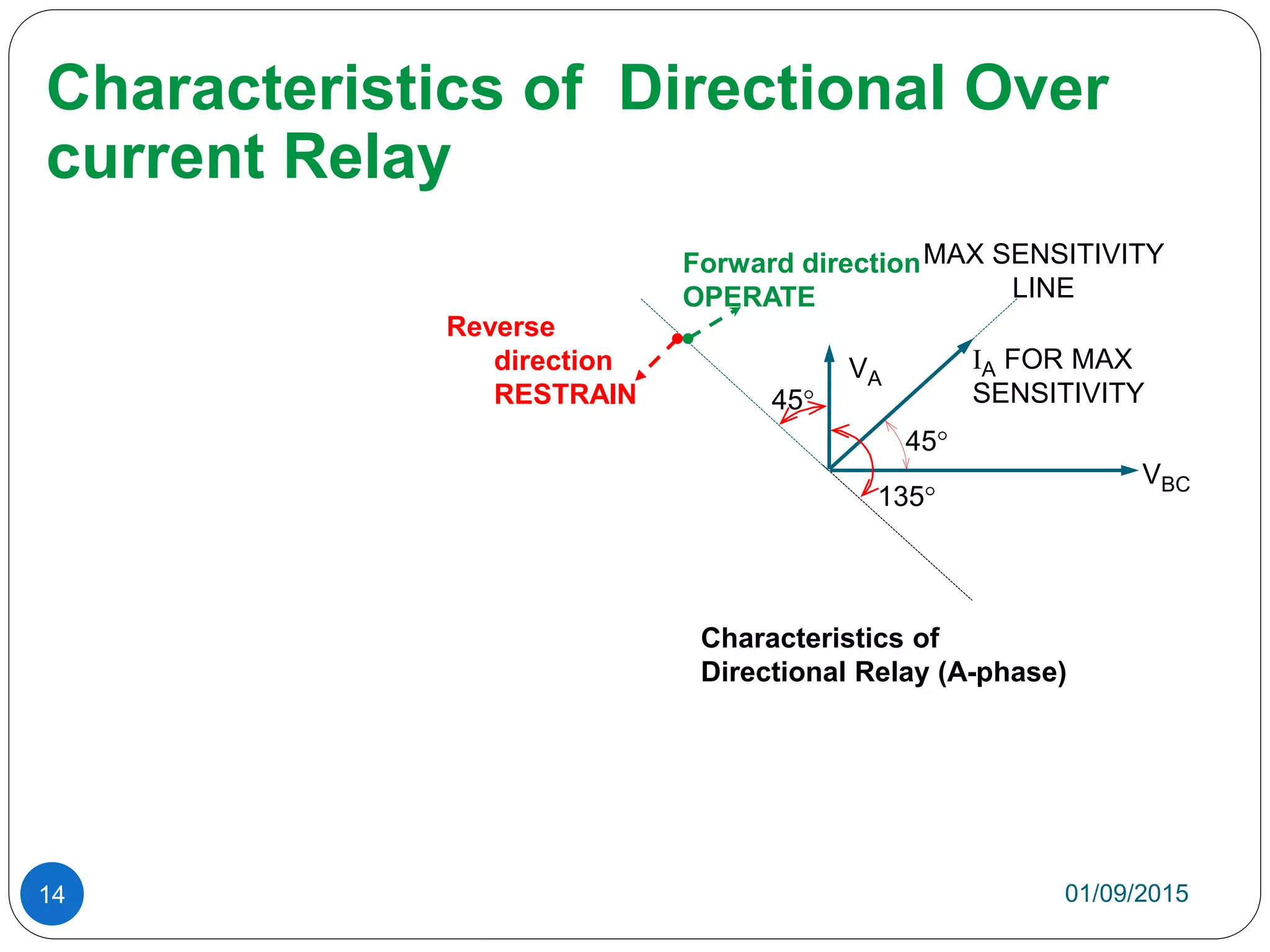
Characteristics of Directional Over
current Relay
MAX SENSITIVITY
LINE
Forward direction
OPERATE
IA FOR MAX
SENSITIVITY
Reverse
direction
RESTRAIN 45
45
135
VA
VBC
01/09/201514
Characteristics of
Directional Relay (A-phase)
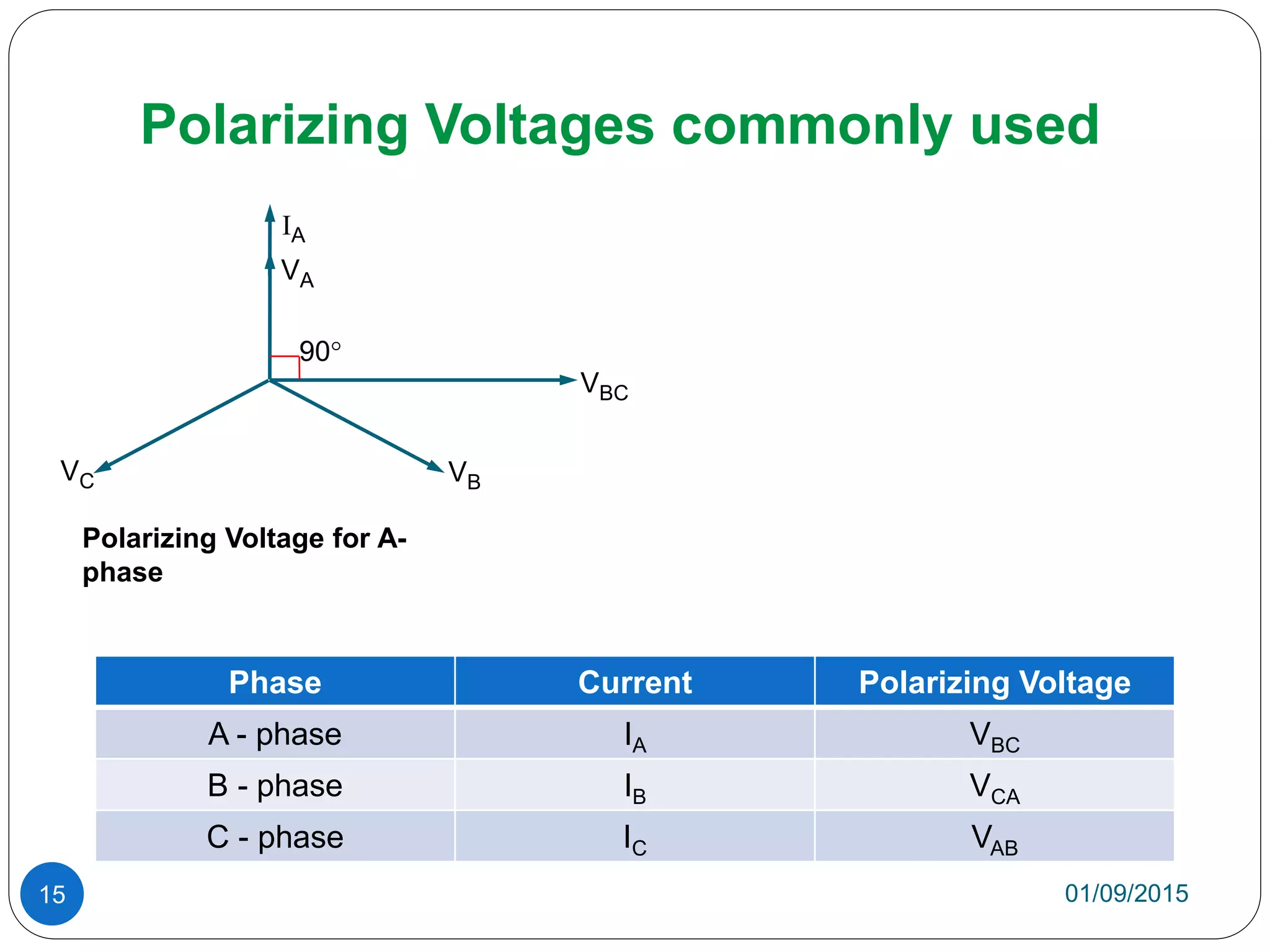
Polarizing Voltages commonly used
01/09/201515
Phase Current Polarizing Voltage
A - phase IA VBC
B - phase IB VCA
C - phase IC VAB
IA
VA
90
VBVC
VBC
Polarizing Voltage for A-
phase
Directional E/F Protection Scheme
01/09/201516
 The directional earth-fault relay has two coils.
One to the coils is connected in residual current
circuits (like ordinary earth fault relay). This coil
gets current during earth-faults only. The other
coil gets residual voltage VRES from broken delta
connection. ( figure is shown in next page)
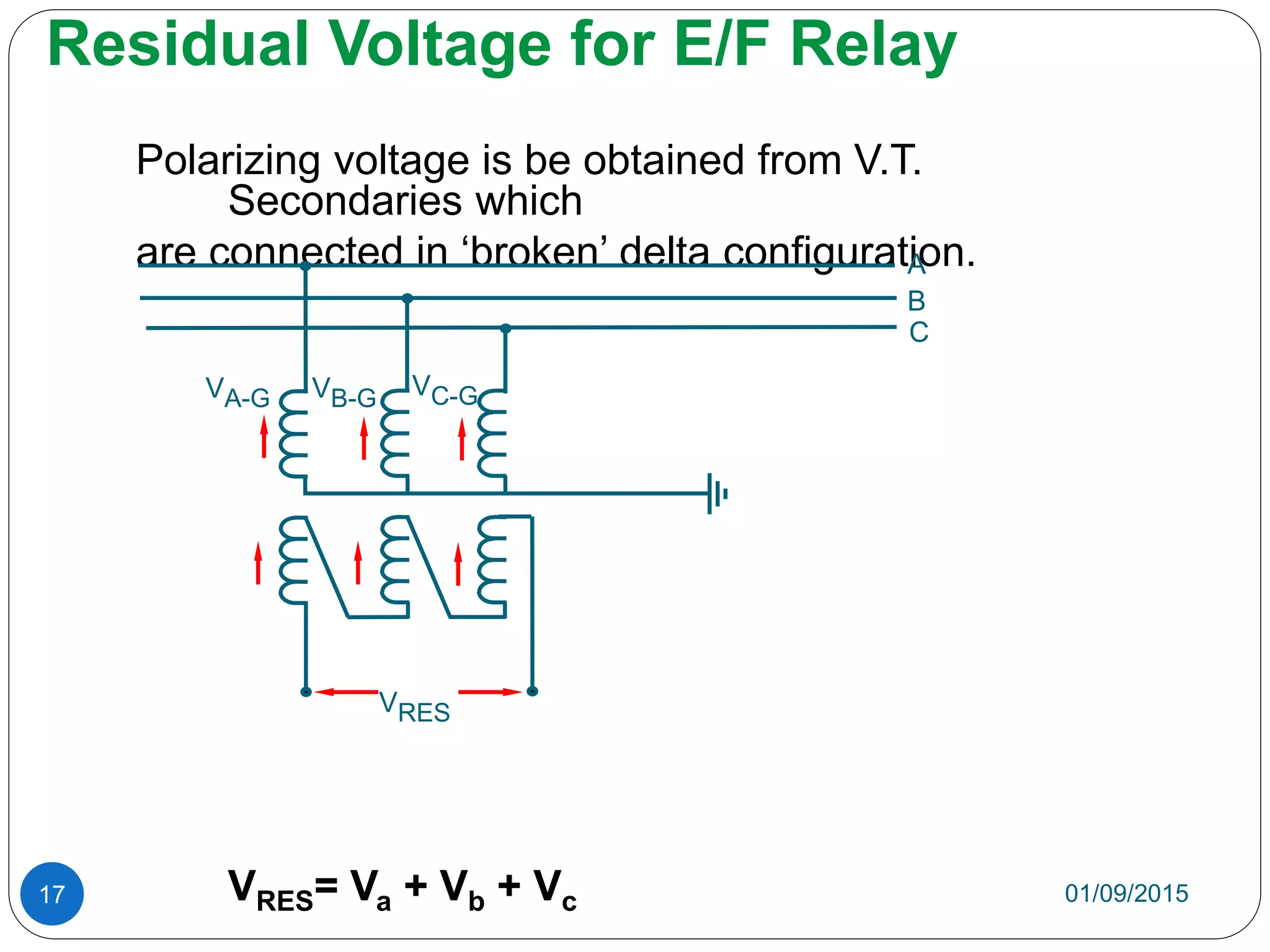
Residual Voltage for E/F Relay
Polarizing voltage is be obtained from V.T.
Secondaries which
are connected in ‘broken’ delta configuration.
VRES= Va + Vb + Vc
A
B
C
VRES
VC-GVB-GVA-G
01/09/201517
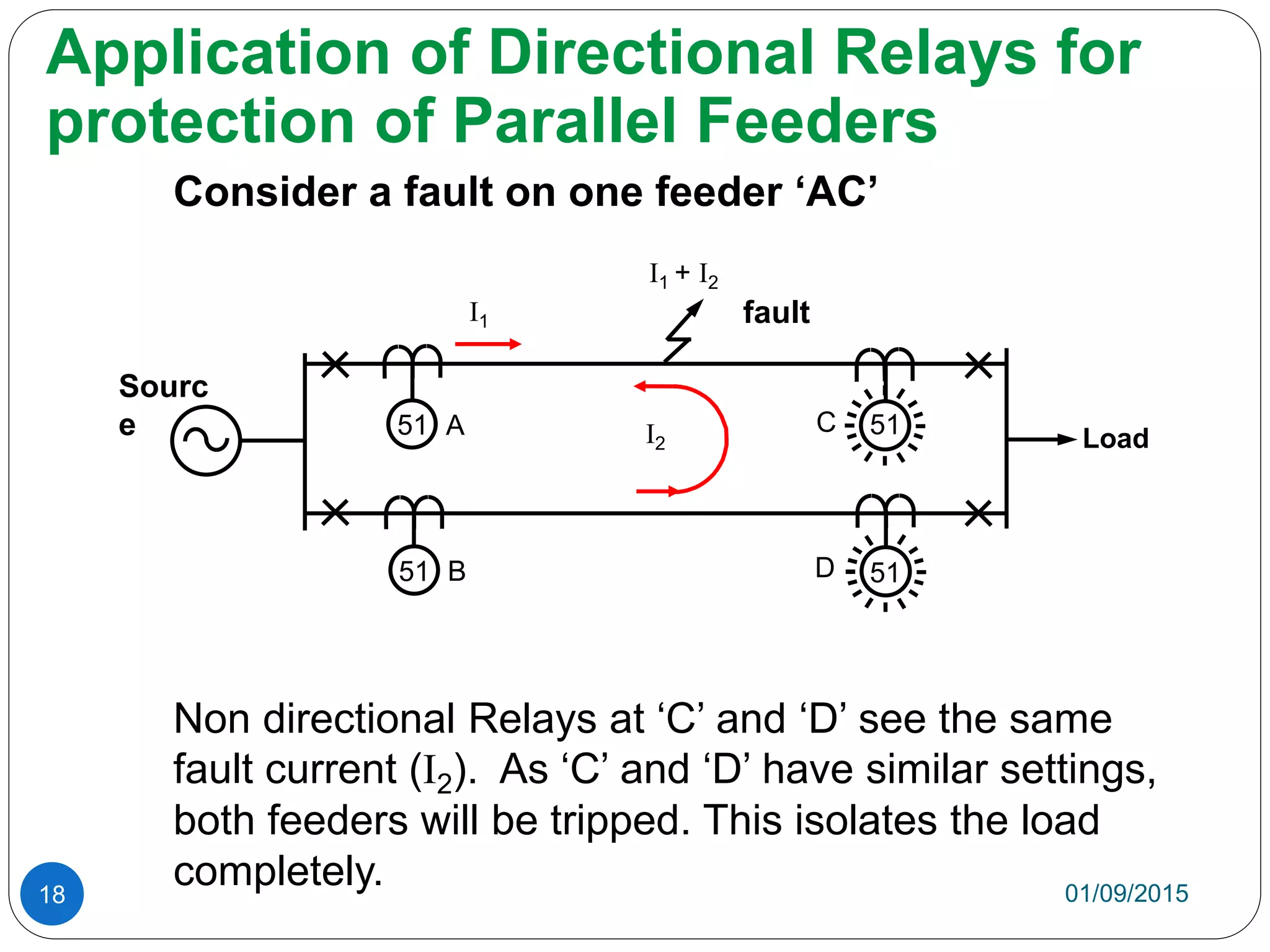
Application of Directional Relays for
protection of Parallel Feeders
Consider a fault on one feeder ‘AC’
Non directional Relays at ‘C’ and ‘D’ see the same
fault current (I2). As ‘C’ and ‘D’ have similar settings,
both feeders will be tripped. This isolates the load
completely.
51 A 51C
51 B 51D
Load
I1 + I2
I1
I2
01/09/201518
fault
Sourc
e
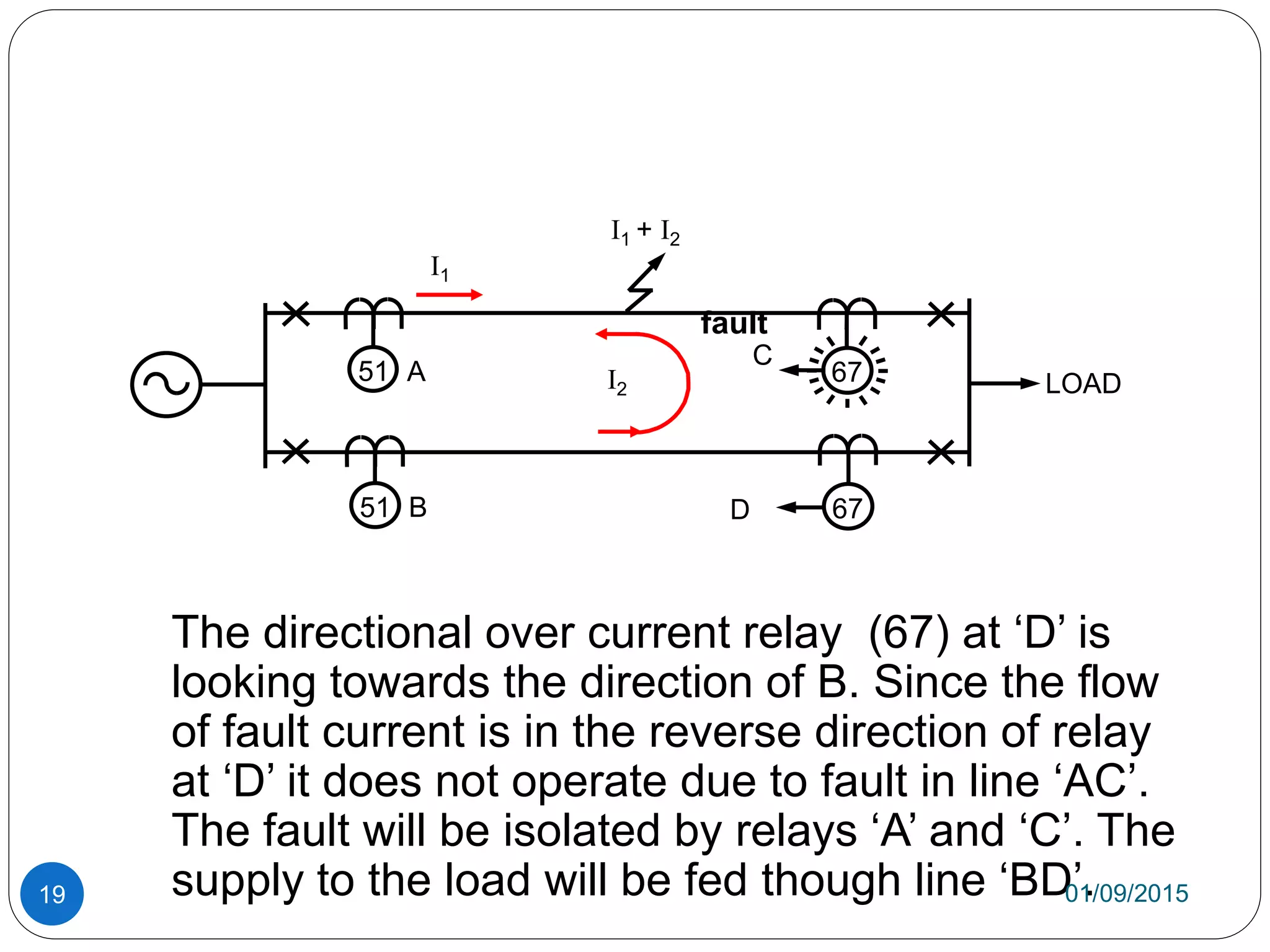
The directional over current relay (67) at ‘D’ is
looking towards the direction of B. Since the flow
of fault current is in the reverse direction of relay
at ‘D’ it does not operate due to fault in line ‘AC’.
The fault will be isolated by relays ‘A’ and ‘C’. The
supply to the load will be fed though line ‘BD’.
51 A 67
C
51 B 67D
LOAD
I1 + I2
I1
I2
01/09/201519
fault
Directional relay for ring main
protection
01/09/201520
0.
1
0.
5
0.
9
1.
3
0.
1
0.
5
0.
9
1.
3
4
2
3
1 1’
2’
3’
4’
Sourc
e
01/09/201521
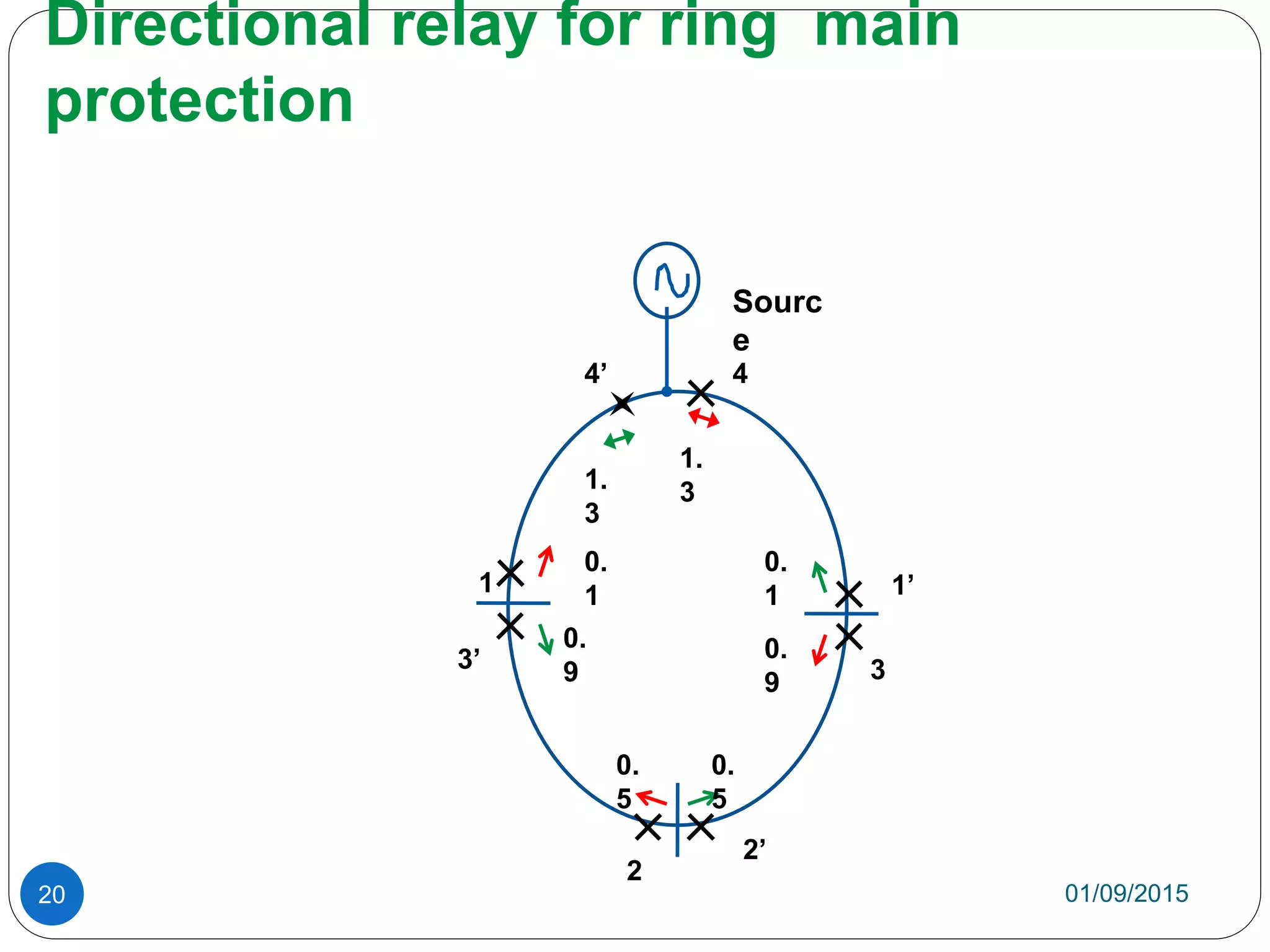
 The arrows associated with relays indicate the
direction of flow that will cause the relay to
operate. Non directional relays are provided at
supply point (where power can flow only in one
direction) and directional relays are provided at
intermediate substations around the ring where
power flow can be in either direction. One set of
relays will be operative according to the direction
of fault current.
 The ring is graded first in a clock wise direction
and then in anti-clock wise direction. The relays
looking in clock wise direction are arranged to
operate in 1-2-3-4 sequence and relays looking in
the anti-clockwise are arranged to operate in
sequence 1’-2’-3’-4’.
Application of Over current
Protection
Overcurrent & Earth fault Protection is used in almost all
electrical equipments such as.
 HT lines
 Transformers
 Generators
 Reactors
 Capacitor Banks
 Motors
 Neutral displacement relays in capacitor banks
 EHT lines (Directional overcurrent &E/F)
 Breaker failure Protection
01/09/201522
Bibliography
 http://www.electrical4u.com/
 http://electrical-engineering-portal.com/
 https://electricalnotes.wordpress.com/
 Network Protection And Automation Guide,
Alstom.
01/09/201523

Basics of overcurrent protection

  • 1.
    Said Salim Palayi AssistantExecutive Engineer Electrical Division, Manjeri K.S.E.B Limited salimpalayi@yahoo.com Basics of Over Current Protection 01/09/20151
  • 2.
    Over current andits causes In an electric power system, over current or excess current is a situation where a larger than intended electric current exists through a conductor, leading to excessive generation of heat, and the risk of fire or damage to equipment. Possible causes for over current include short circuits, excessive load, incorrect design, or a ground fault. 01/09/20152
  • 3.
    Working Principle ofOver Current Relay In an over current relay, there would be essentially a current coil. When normal current flows through this coil, the magnetic effect generated by the coil is not sufficient to move the moving element of the relay, as in this condition the restraining force is greater than deflecting force. But when the current through the coil increased, the magnetic effect increases, and after certain level of current, the deflecting force generated by the magnetic effect of the coil, crosses the restraining force, as a result, the moving element starts moving to change the contact position in the relay. 01/09/20153
  • 4.
    Over current Protection Overcurrent relays are fed from Current Transformers. Whenever the current through the relay exceeds the preset value. The Relay operates and actuates the trip coil of the circuit breaker, isolating the01/09/20154
  • 5.
    Types of overcurrent relays Depending upon time of operation, Over current relays are classified into 3 groups.  Instantaneous over current relay.  Definite time over current relay.  Inverse time over current relay. 01/09/20155
  • 6.
    Instantaneous over current relay Thisrelay is referred as instantaneous over current relay, the relay operates as soon as the current in the coil gets higher than pre set value (Ip). There is no intentional time delay set. There is always an inherent time delay of the order of a few milliseconds. Attracted armature type relays shows this characteristics. 01/09/20156
  • 7.
    Definite time overcurrent relay This relay is created by applying intentional time delay after crossing pick up value of the current. A definite time over current relay can be adjusted to issue a trip output at definite amount of time after it picks up. Thus, it has a time setting adjustment and pick up adjustment. Attracted armature type relays with time element shows this characteristics. 01/09/20157
  • 8.
    Inverse time overcurrent relay Inverse time is a natural character of any induction type rotating device. This means that, the time of operation inversely varies with input current. This characteristic of electromechanical induction disc relay in very suitable for over current protection. In this relay, if fault is more severe, it would be cleared more faster. 01/09/20158
  • 9.
    Classification of Inversetime relays Inverse time over current relay (IDMT) is again subdivided as Normal (standard) inverse, Very inverse time and Extremely inverse time relay 01/09/20159
  • 10.
    Over current ProtectionSchemes (1). 3 Nos. of Over Current relays for Over current and Earth fault Protection.  For phase to phase faults the relays in only the affected phases operate. For single line to ground faults only the relay in the faulty phase gets the fault current and operates.  the desired sensitivity with earth fault relays cannot be obtained in as much as the high current setting will have to be necessarily adopted for the over current relay to avoid operation under maximum load condition. 01/09/201510 OC OC OC To Load
  • 11.
    Over current ProtectionSchemes (2). 3 Nos. of Over Current relays + 1 No. E/F relay for Over current and Earth fault Protection.  For phase to phase faults the relays in only the affected phases operate.  Under normal operating conditions and three phase fault conditions the current in the 3-phase are equal and symmetrically displaced by 120 degree, Hence the sum of these three currents is zero. No current flow through the earth 01/09/201511 To Load OC OC OCE/F
  • 12.
    (3). 2 NoO/C Relay + 1 No E/F Relay for Over Current and Earth Fault Protection 01/09/201512 The two over current relays in R&B phases will respond to phase faults. At least one relay will operate for fault involving two phase. For fault involving ground reliance is placed on earth fault relay. This is an economical E/F OC OC
  • 13.
    Directional Over currentand E/F Relays 01/09/201513  When fault currents can flow in more than one direction it is desirable to determine which direction the fault current is flowing and trip the appropriate devices accordingly to contain a given fault.  Directional Relay has a characteristics that it responds to over current condition in the forward direction only. Relay will not respond to reverse faults  Compares the current in the line versus a known reference (that will always be the same). This reference voltage or current is known as polarizing voltage or polarizing current.
  • 14.
    Characteristics of DirectionalOver current Relay MAX SENSITIVITY LINE Forward direction OPERATE IA FOR MAX SENSITIVITY Reverse direction RESTRAIN 45 45 135 VA VBC 01/09/201514 Characteristics of Directional Relay (A-phase)
  • 15.
    Polarizing Voltages commonlyused 01/09/201515 Phase Current Polarizing Voltage A - phase IA VBC B - phase IB VCA C - phase IC VAB IA VA 90 VBVC VBC Polarizing Voltage for A- phase
  • 16.
    Directional E/F ProtectionScheme 01/09/201516  The directional earth-fault relay has two coils. One to the coils is connected in residual current circuits (like ordinary earth fault relay). This coil gets current during earth-faults only. The other coil gets residual voltage VRES from broken delta connection. ( figure is shown in next page)
  • 17.
    Residual Voltage forE/F Relay Polarizing voltage is be obtained from V.T. Secondaries which are connected in ‘broken’ delta configuration. VRES= Va + Vb + Vc A B C VRES VC-GVB-GVA-G 01/09/201517
  • 18.
    Application of DirectionalRelays for protection of Parallel Feeders Consider a fault on one feeder ‘AC’ Non directional Relays at ‘C’ and ‘D’ see the same fault current (I2). As ‘C’ and ‘D’ have similar settings, both feeders will be tripped. This isolates the load completely. 51 A 51C 51 B 51D Load I1 + I2 I1 I2 01/09/201518 fault Sourc e
  • 19.
    The directional overcurrent relay (67) at ‘D’ is looking towards the direction of B. Since the flow of fault current is in the reverse direction of relay at ‘D’ it does not operate due to fault in line ‘AC’. The fault will be isolated by relays ‘A’ and ‘C’. The supply to the load will be fed though line ‘BD’. 51 A 67 C 51 B 67D LOAD I1 + I2 I1 I2 01/09/201519 fault
  • 20.
    Directional relay forring main protection 01/09/201520 0. 1 0. 5 0. 9 1. 3 0. 1 0. 5 0. 9 1. 3 4 2 3 1 1’ 2’ 3’ 4’ Sourc e
  • 21.
    01/09/201521  The arrowsassociated with relays indicate the direction of flow that will cause the relay to operate. Non directional relays are provided at supply point (where power can flow only in one direction) and directional relays are provided at intermediate substations around the ring where power flow can be in either direction. One set of relays will be operative according to the direction of fault current.  The ring is graded first in a clock wise direction and then in anti-clock wise direction. The relays looking in clock wise direction are arranged to operate in 1-2-3-4 sequence and relays looking in the anti-clockwise are arranged to operate in sequence 1’-2’-3’-4’.
  • 22.
    Application of Overcurrent Protection Overcurrent & Earth fault Protection is used in almost all electrical equipments such as.  HT lines  Transformers  Generators  Reactors  Capacitor Banks  Motors  Neutral displacement relays in capacitor banks  EHT lines (Directional overcurrent &E/F)  Breaker failure Protection 01/09/201522
  • 23.
    Bibliography  http://www.electrical4u.com/  http://electrical-engineering-portal.com/ https://electricalnotes.wordpress.com/  Network Protection And Automation Guide, Alstom. 01/09/201523